Archive
Ephemeris: 09/12/2023 – Two small but distinctive constellations by the Summer Triangle
this is Ephemeris for Tuesday, September 12th. Today the Sun will be up for 12 hours and 41 minutes, setting at 7:59, and it will rise tomorrow at 7:19. The Moon, 2 days before new, will rise at 5:37 tomorrow morning.
There are two small constellations in and near the Summer Triangle of bright stars. Both are near Altair the bottom star of the triangle in the southeast. The first is Delphinus the dolphin to the left of Altair. Delphinus is made-up of a small squished box of stars with another star below. It does look a dolphin leaping out of the water. The legendary Greek poet Arion, according to myth, was rescued by a dolphin. Also the little squished box is an asterism called Job’s Coffin, though no one knows the origin of that name. The second constellation is above Altair, and within the Summer Triangle. It is called Sagitta the arrow. The stars do line up to look like a short arrow. It’s supposed to represent Cupid’s dart.
The astronomical event times given are for the Traverse City/Interlochen area of Michigan (EDT, UT –4 hours). They may be different for your location.
Addendum


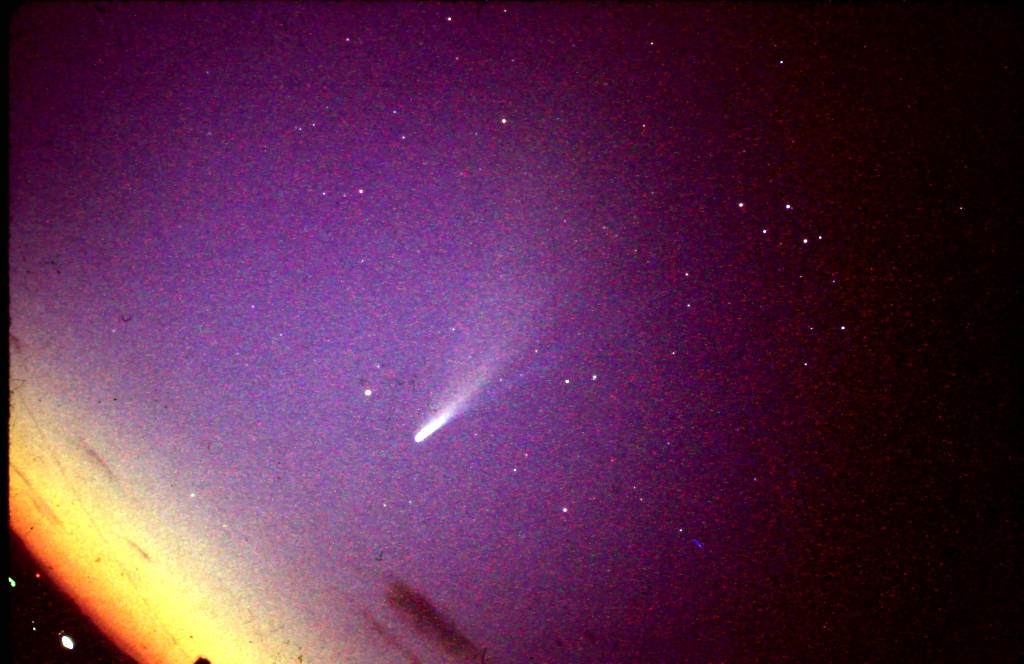
Painting circa 1938.
Ephemeris: 08/14/2023 – August is the month to explore the Milky Way
This is Ephemeris for Monday, August 14th. Today the Sun will be up for 14 hours and 6 minutes, setting at 8:50, and it will rise tomorrow at 6:44. The Moon, 2 days before new, will rise at 5:35 tomorrow morning.
Now is the time the summer Milky Way is displayed to its fullest to the southern horizon. We have a week and a half before the Moon begins to encroach on our dark skies after 10 pm. City folk come to our area and are sometimes fooled by the brightness and expanse of the Milky Way and think it’s a cloud. Yes, those are clouds indeed, but they are clouds of stars. Binoculars will begin to show them to be millions of stars, each too faint to be seen individually to the eye, but whose combined glow give the impression of a luminous cloud. Binoculars are the ideal tool to explore the Milky Way. Objects still too fuzzy can be checked out with a telescope to reveal their true nature. The dark nights of August and September are my favorites.
The astronomical event times given are for the Traverse City/Interlochen area of Michigan (EDT, UT –4 hours). They may be different for your location.
Addendum
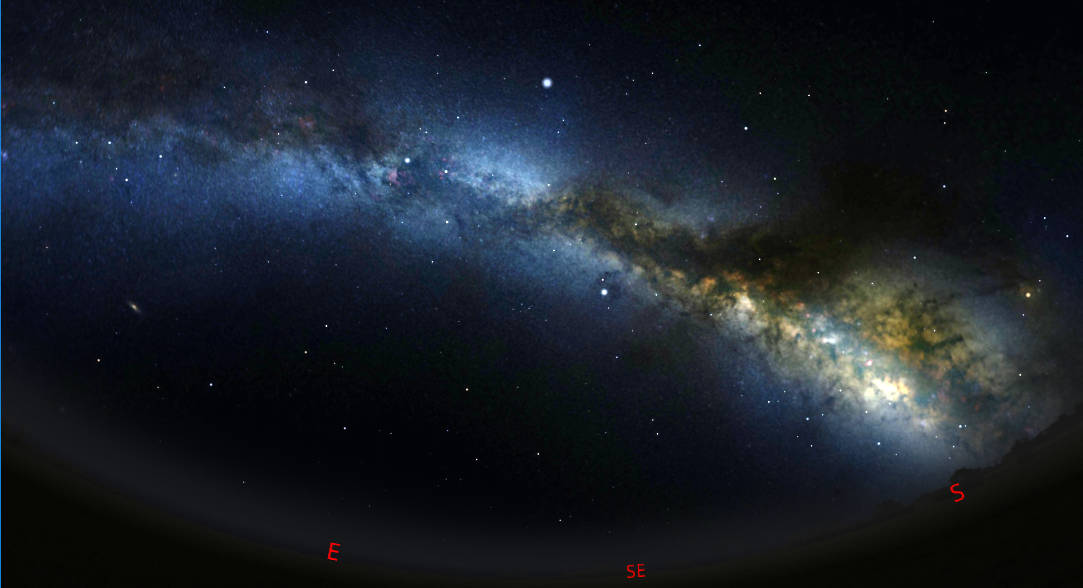
The span of the Milky Way across the summer sky as seen in the free Stellarium app. Specifically August 15th at 10 pm from Northern Michigan. The Milky Way has been set to its maximum brightness to show as much detail as possible. It really isn’t that bright. The horizon is only delineated by the compass points. The dark clouds of the Great Rift are also visible. The Milky Way, in Stellarium, is photo-realistic. The triangle of three bright stars above center is the Summer Triangle, Specifically, clockwise from the top star: Vega, Altair and Deneb. Large images can be truncated on the right. Click or tap on the image to enlarge and display the complete image.
Ephemeris: 07/18/2023 – Vega, the brightest star of the Summer Triangle
This is Ephemeris for Tuesday, July 18th. Today the Sun will be up for 15 hours and 9 minutes, setting at 9:23, and it will rise tomorrow at 6:15. The Moon, 1 day past new, will set at 10:30 this evening.
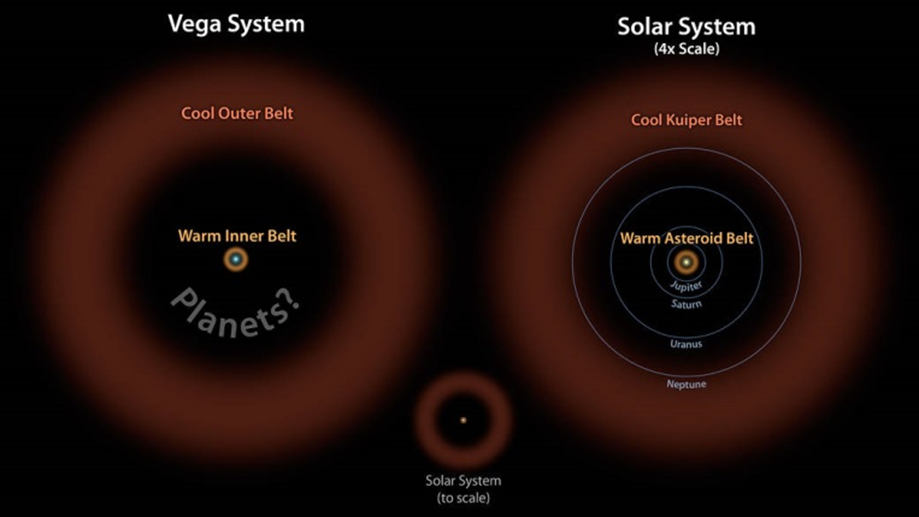
Vega, in the constellation Lyra the harp, is the highest bright star In the east and brightest star of the Summer Triangle also rising in that direction. It is an important and much studied star, first as a standard for brightness for the magnitude scale at almost exactly zero. In 1983 the Infrared Astronomy Satellite, IRAS, discovered an excess of infrared radiation coming from the star. It seems now that there are two orbiting rings around the star, an inner warm ring and an outer cold ring. This is somewhat like the two disks of material the Sun has: The asteroid belt between Mars and Jupiter and the Kuiper belt, beyond Neptune. No planets have yet been discovered around Vega, but I wouldn’t bet against it.
The astronomical event times given are for the Traverse City/Interlochen area of Michigan (EDT, UT –4 hours). They may be different for your location.
Addendum
07/07/223 – Ephemeris – GTAS meeting and presentation: Observing the summer skies with the naked-eye
This is Ephemeris for Friday, July 7th. Today the Sun will be up for 15 hours and 25 minutes, setting at 9:30, and it will rise tomorrow at 6:05. The Moon, 2 days before last quarter, will rise at 12:38 tomorrow morning.
Viewing Summer skies with just your Eyes will be the presentation by Robert Carroll at tonight’s meeting of the Grand Traverse Astronomical Society at Northwestern Michigan College’s Rogers Observatory at 9 pm. Bob is one of the charter members of the society. He will show artist’s interpretation of the heavens. Then, focusing on Hercules, the Summer Triangle, and the Milky Way. Hopefully, he “will inspire young parents, and their children, to go OUTSIDE, leave the screens and tablets behind, and LOOK UP to see the night sky.” There are two ways to attend: In person at the observatory, south of Traverse City on Birmley Road, or via Zoom with a link provided by the society’s website gtastro.org just prior to the meeting.
The astronomical event times given are for the Traverse City/Interlochen area of Michigan (EDT, UT –4 hours). They may be different for your location.
Addendum
01/09/2023 – Ephemeris – The Summer Triangle is still with us in the early evening
This is Ephemeris for Monday, January 9th. Today the Sun will be up for 9 hours and 1 minute, setting at 5:21, and it will rise tomorrow at 8:18. The Moon, 3 days past full, will rise at 7:56 this evening.
The bright Moon is now slowly leaving the evening sky tonight, giving us nearly an hour of dark skies after 7 pm. At 7pm, Orion is holding forth in the east-southeast. At that time, also, the Summer Triangle is still in the sky, west and northwest. The Northern Cross, which is also the constellation of Cygnus the swan, is standing upright in the west northwestern sky. Its top star Deneb, dimmest of the three Summer Triangle stars, will not set for observers north of Traverse City, though it will take a flat northern horizon and exceptionally clear skies to spot it at its lowest in the north. Altair, the southernmost of the triangle stars will set first in the west at 7:57 pm, Vega, the brightest will set in the northwest at 9:41 pm.
The astronomical event times given are for the Traverse City/Interlochen area of Michigan (EST, UT –5 hours). They may be different for your location.
Addendum
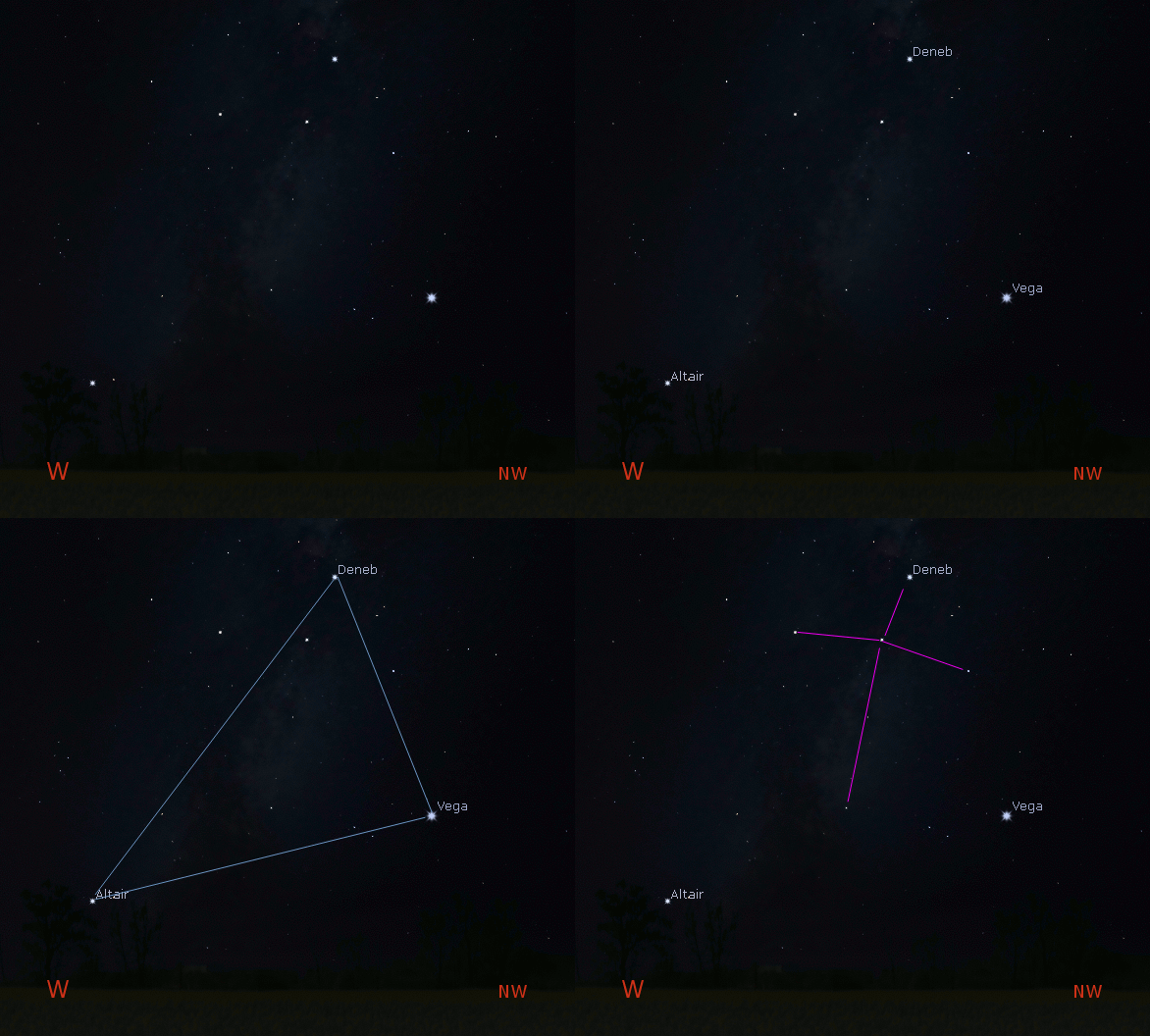
The setting Summer Triangle and Northern Cross in the west and northwestern sky at 7 pm tonight, January 9th.
08/19/2022 – Ephemeris – Finding the small constellations near the Summer Triangle
This is Ephemeris for Friday, August 19th. Today the Sun will be up for 13 hours and 52 minutes, setting at 8:41, and it will rise tomorrow at 6:51. The Moon, at last quarter today, will rise at 12:32 tomorrow morning.
I’ve already talked about the three constellations whose bright stars mark the Summer Triangle: Vega in Lyra the harp, Deneb in Cygnus the swan, and Altair in Aquila the eagle. There are two small constellations near the south end of the triangle near Altair. These are Delphinus the dolphin and Sagitta the arrow. Delphinus is easily spotted, as it’s five or six stars appear as a tiny dolphin leaping out of the water. Sagitta appears as a very short arrow. An interesting sight can be spotted in binoculars near the tail end of Sagitta. It’s 7 stars in a nearly straight line, with a hook of four stars below the center of the line. It’s called The Coathanger. It’s even better if seen in a finder telescope, which inverts the image.
The astronomical event times given are for the Traverse City/Interlochen area of Michigan (EDT, UT – 4 hours). They may be different for your location.
Addendum
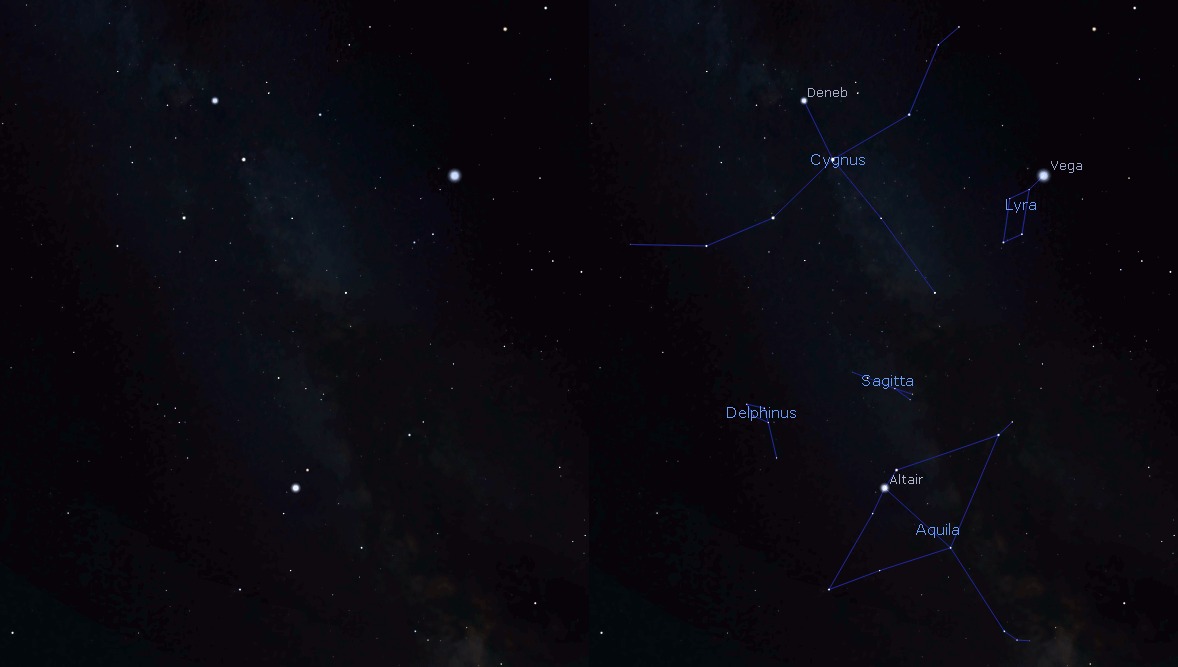
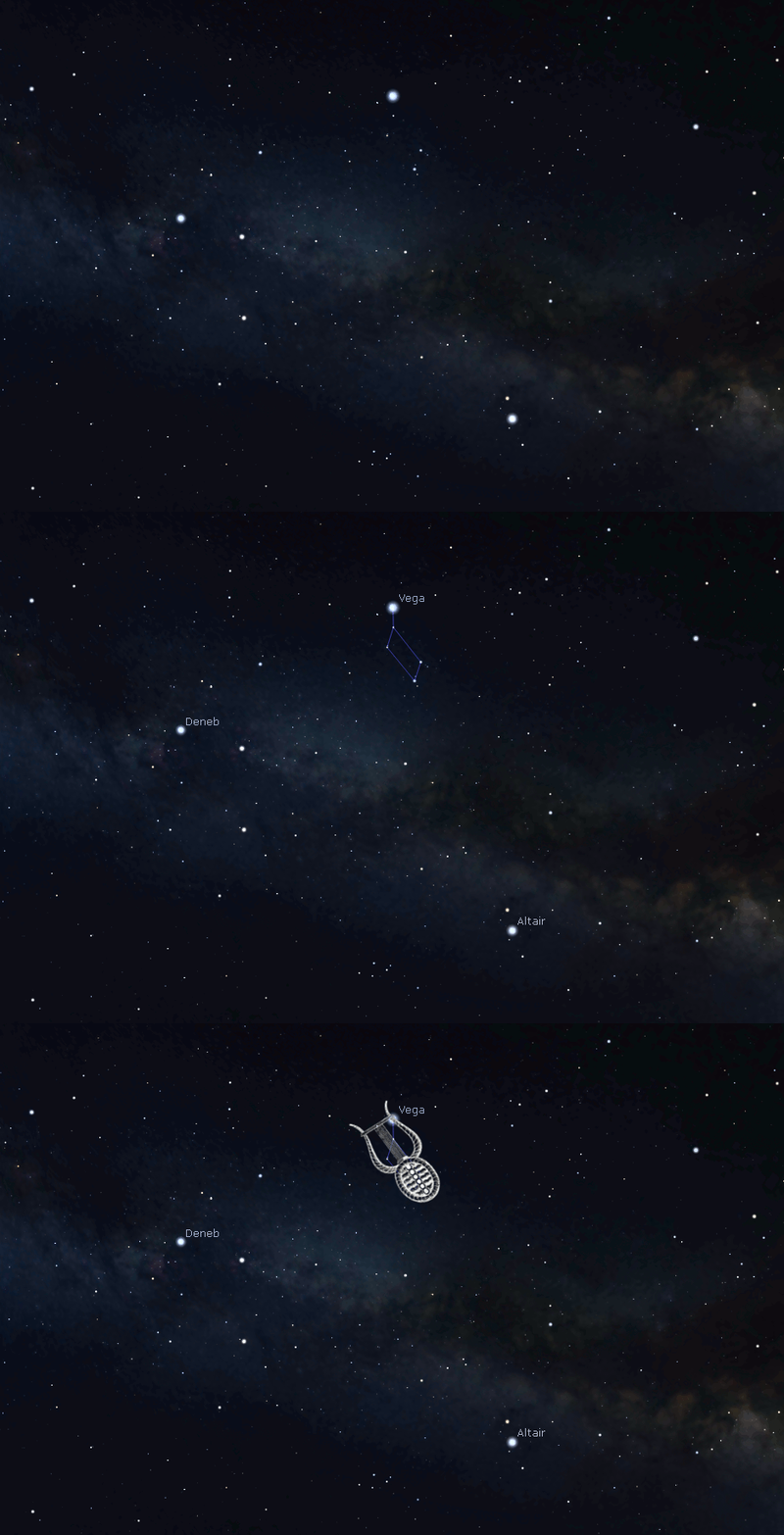
Finding the small constellations of Delphinus the dolphin and Sagitta the arrow among the stars and constellations of the Summer Triangle. Created using Stellarium and GIMP.
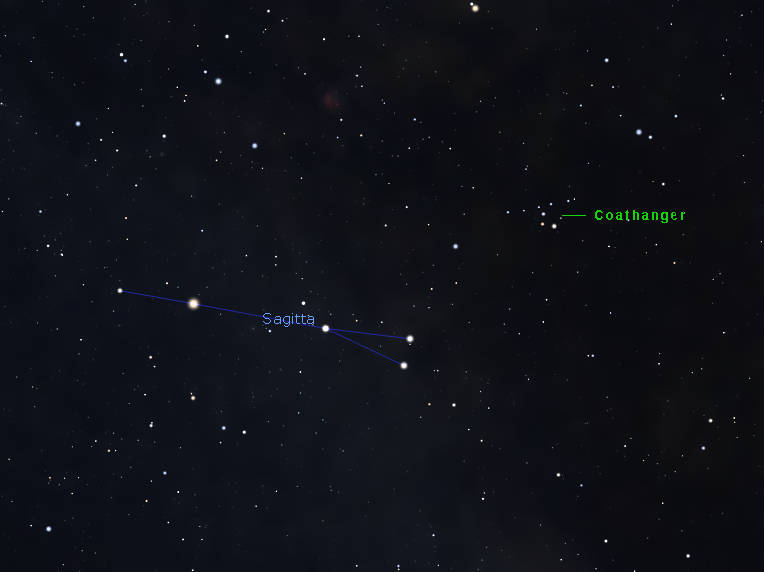
How to locate the binocular asterism of the Coathanger. It is also known as Collinder 399, Brocchi’s Cluster and Al Sufi’s Cluster. It’s not a real star cluster, but a random arrangement of stars at various distances, that from the solar system make a distinctive pattern.
08/18/2022 – Ephemeris – The Great Rift
This is Ephemeris for Thursday, August 18th. Today the Sun will be up for 13 hours and 54 minutes, setting at 8:43, and it will rise tomorrow at 6:49. The Moon, 1 day before last quarter, will rise at 12:02 tomorrow morning.
High overhead, the Milky Way is seen passing through the Summer Triangle of three bright stars. Here we find the Milky Way splits into two sections. The split starts in the constellation of Cygnus the Swan or Northern Cross very high in the east. The western part of the Milky Way ends southwest of Aquila the eagle. This dark dividing feature is called the Great Rift. Despite the lack of stars seen there, it doesn’t mean that there are fewer stars there than in the brighter patches of the Milky Way. The rift is a great dark cloud that obscures the light of the stars behind it. Sometimes binoculars can be used to find the edges of the clouds of the rift, as star numbers drop off suddenly. This is especially easily seen in Aquila.
The astronomical event times given are for the Traverse City/Interlochen area of Michigan (EDT, UT – 4 hours). They may be different for your location.
Addendum
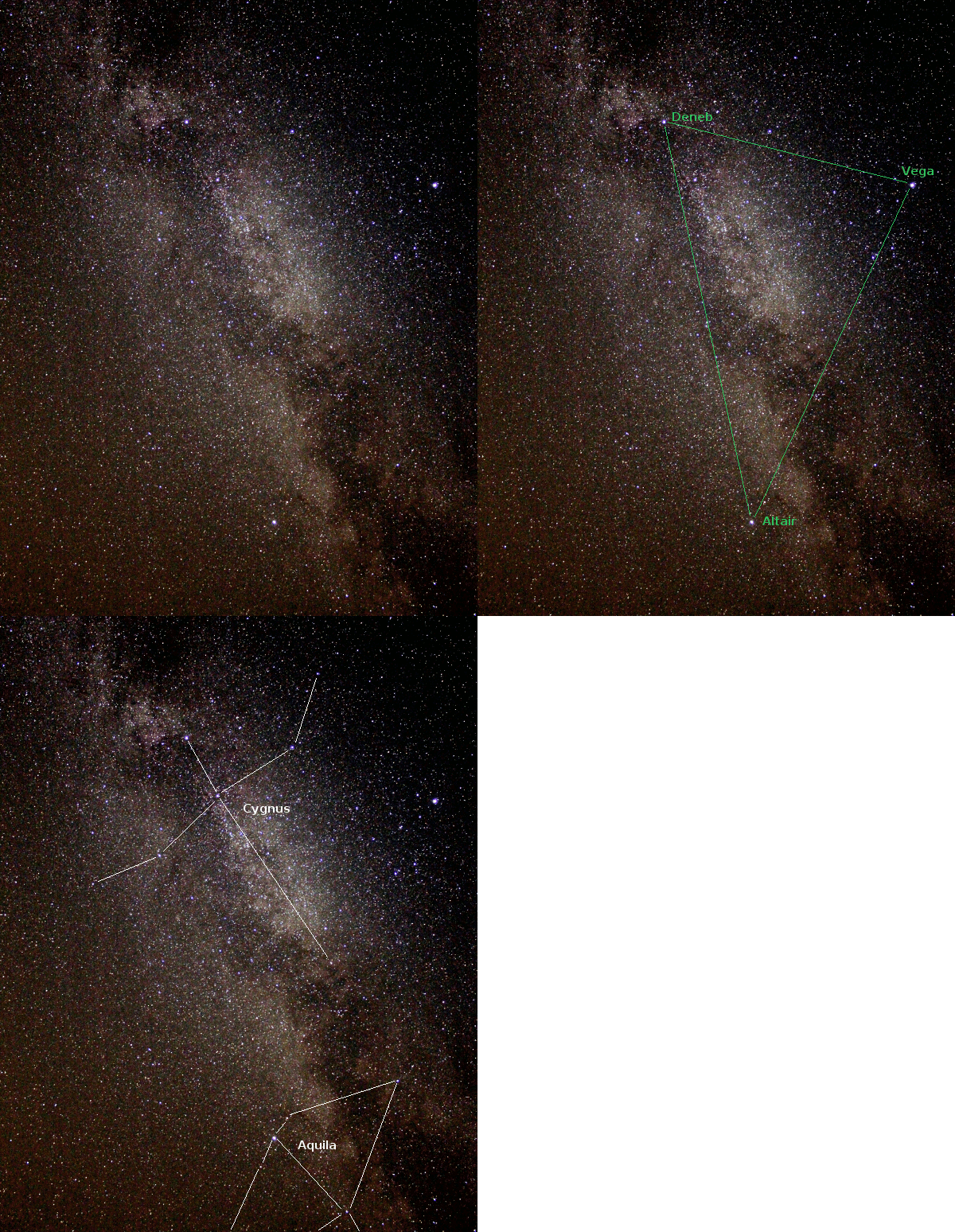
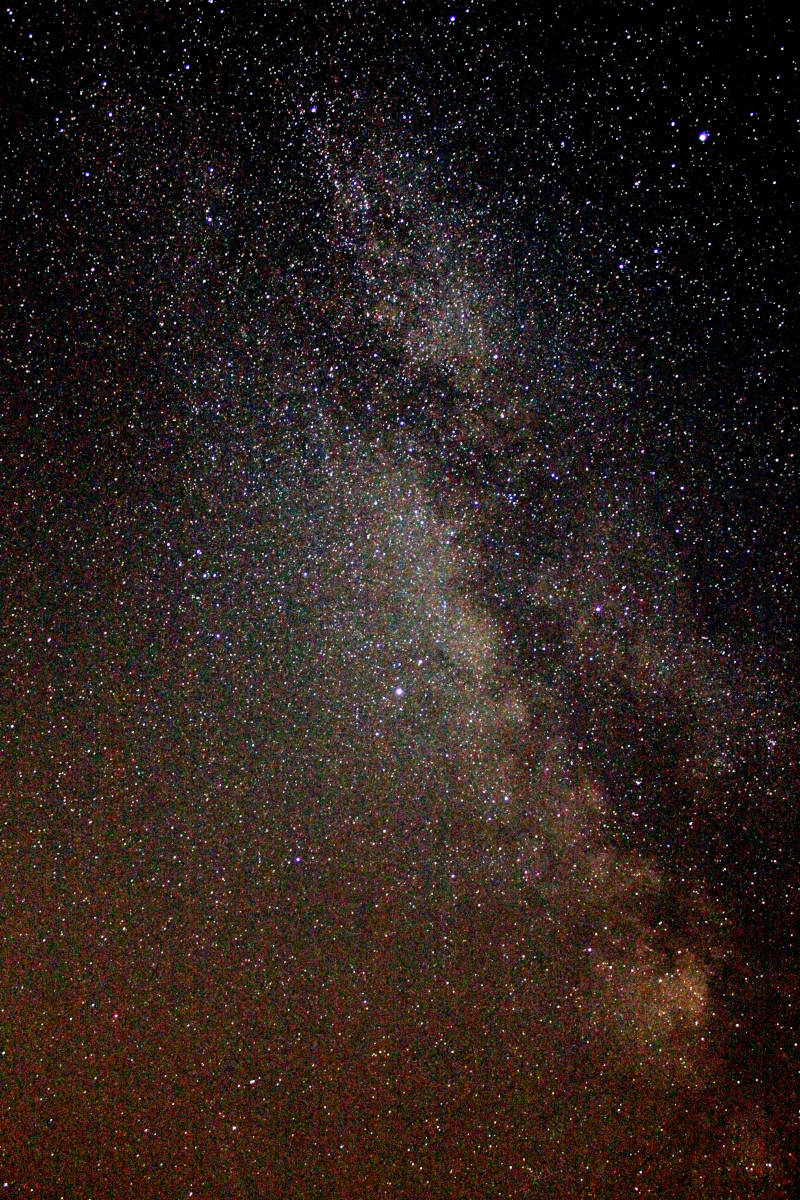
The Great Rift finder animation as seen in the Summer Triangle, also showing the constellations of Cygnus the swan and the northern part of Aquila the Eagle. This image a stack of 5 30 second exposures taken the morning of the Perseid meteor shower the is year in a vain attempt to capture some meteors.
07/18/2022 – Ephemeris – How to find the celestial eagle
This is Bob Moler with Ephemeris for Monday, July 18th. Today the Sun will be up for 15 hours and 8 minutes, setting at 9:23, and it will rise tomorrow at 6:15. The Moon, 2 days before last quarter, will rise at 12:33 tomorrow morning.
Aquila the eagle is a constellation that lies in the Milky Way. It’s in the southeastern sky as it gets dark. Its brightest star, Altair, is one of the stars of the Summer Triangle, a group of three bright stars that dominate the eastern sky in the evening now. Altair, in the head of the eagle, is flanked by two slightly dimmer stars, the shoulders of the eagle. The eagle is flying northeastward through the Milky Way. Its wings are seen in the wing tip stars. A curved group of stars to the lower right of Altair is its tail. Within Aquila, the Milky Way shows many dark clouds as part of the Great Rift that splits it here. The other summer bird is Cygnus the swan above and left of Aquila, flying toward the eagle.
The astronomical event times given are for the Traverse City/Interlochen area of Michigan (EDT, UT – 4 hours). They may be different for your location.
Addendum
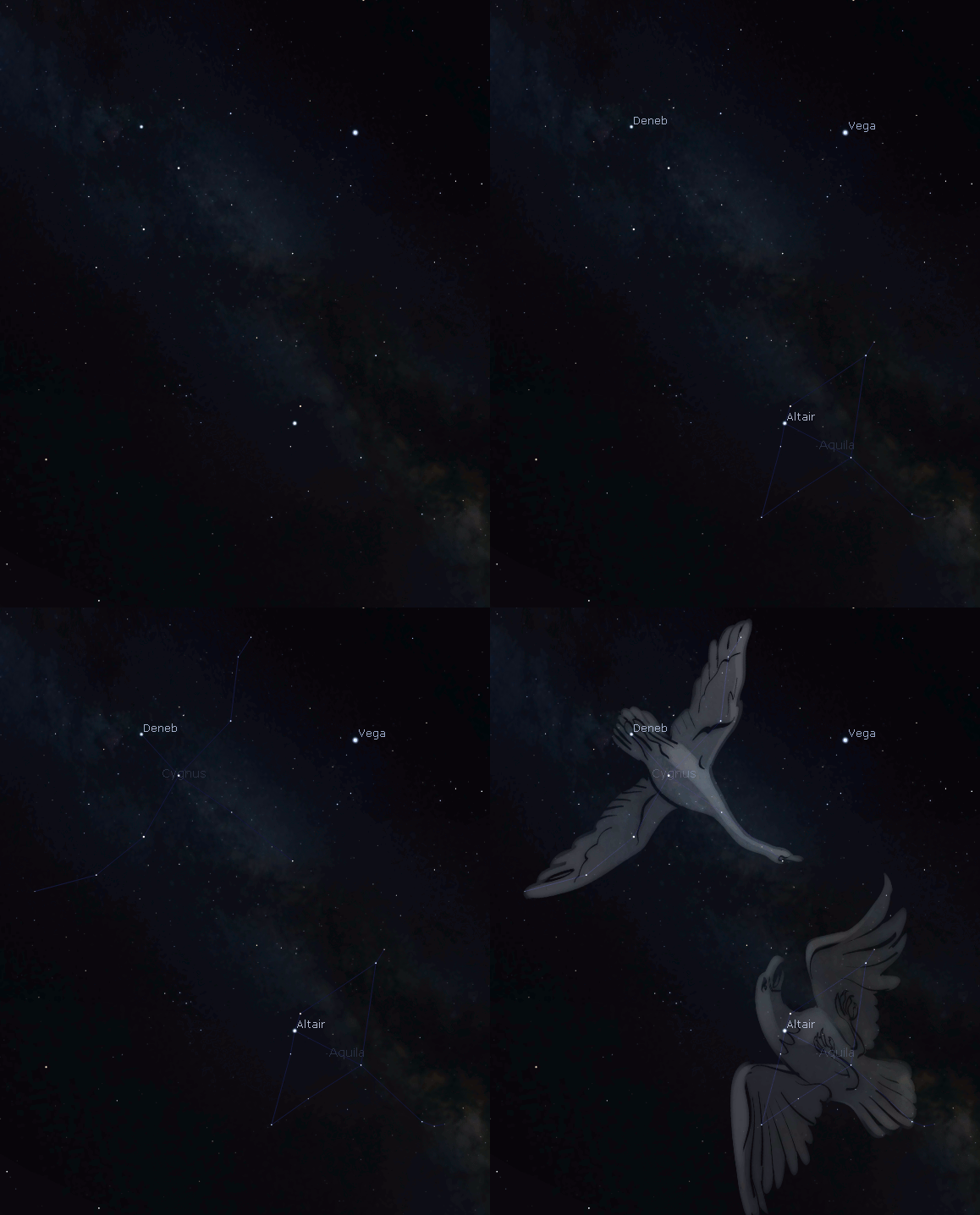
Animated Aquila finder chart, also showing Cygnus the swan. The named stars are the stars of the Summer Triangle. Created using Stellarium.
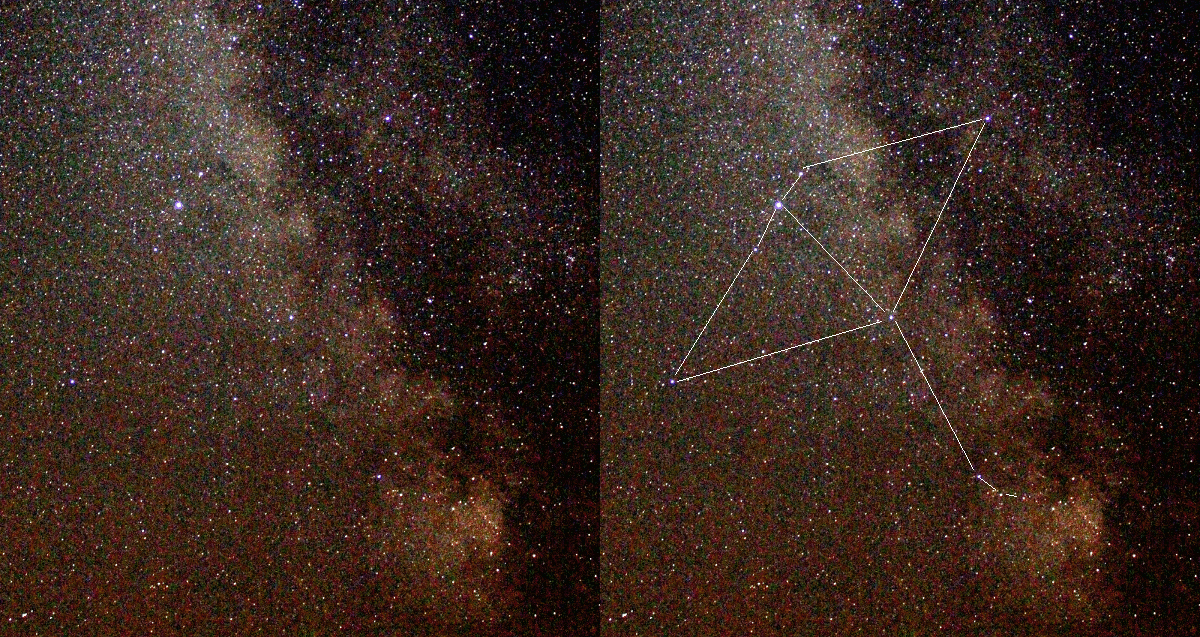
Annotated and animated photograph taken of Aquila August 13, 2018 during the Perseid meteor shower. Alas, no Perseids in this photograph. The clouds of the Great Rift are easily visible. The red tinge of the image was due to the smoke haze from the wildfires in the western states. Taken by me and processed using Registax and GIMP.
07/15/2022 – Ephemeris – How to find the constellation of Cygnus the swan
This is Ephemeris for Friday, July 15th. Today the Sun will be up for 15 hours and 14 minutes, setting at 9:25, and it will rise tomorrow at 6:12. The Moon, 2 days past full, will rise at 11:23 this evening.
Located fairly high in the east at 11 p.m. is the constellation of Cygnus the swan, flying south through the Milky Way. It is also called the Northern Cross. At the left, the tail of the swan or the head of the cross is the bright star Deneb, one of the stars of the Summer Triangle. The next star right is Sadr the intersection of the body and the wings of the swan seen in flight, or the intersection of the two pieces of the cross. There are two or three stars farther to the right that delineate the swan’s long neck or upright of the cross, that ends with the star Alberio in the beak of the swan or foot of the cross. The crosspiece of the cross extends to the stars on either side of the intersection star Sadr, while the swan’s wings extend to a couple more stars each.
The astronomical event times given are for the Traverse City/Interlochen area of Michigan (EDT, UT – 4 hours). They may be different for your location.
Addendum
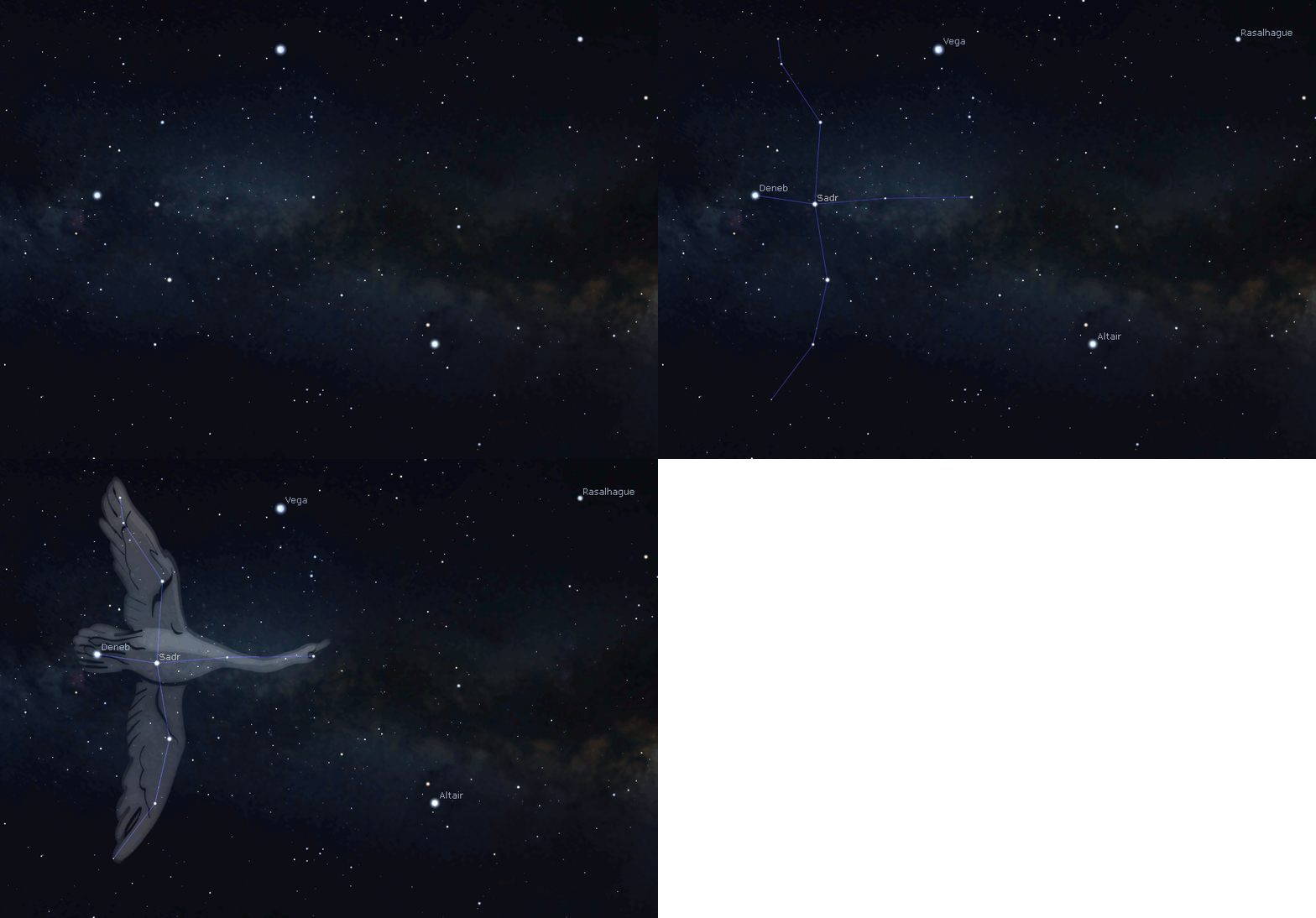
Animated Cygnus finder chart. Included also are, beside Deneb, the other stars of the Summer Triangle: Vega and Altair and their constellations Lyra the harp and Aquila. See if you can find them. Created using Stellarium.
07/14/2022 – Ephemeris – The dimmest Summer Triangle star is actually the brightest
This is Ephemeris for Thursday, July 14th. Today the Sun will be up for 15 hours and 15 minutes, setting at 9:26, and it will rise tomorrow at 6:11. The Moon, 1 day past full, will rise at 10:49 this evening.
This evening, when it gets dark enough, the bright star Deneb in Cygnus the swan will be high in the east-northeast. I’ll cover Cygnus tomorrow when the sky is darker. Deneb is the dimmest star of the summer triangle. Of the other stars of the triangle, Vega is higher in the east, while Altair is lower in the southeast. Deneb’s apparent magnitude, or brightness as seen from Earth, makes it the dimmest of the three bright stars. That’s because of its vast distance of maybe 1,550 light years, 57 times the distance of Vega. If brought as close as Vega, Deneb would be as bright, at least, as the first quarter moon. It is possibly as bright as 196 thousand Suns; and it’s a huge star, possibly as large in diameter as the orbit of the Earth. For all this, it is only 23 or so times the mass of the Sun.
The astronomical event times given are for the Traverse City/Interlochen area of Michigan (EDT, UT – 4 hours). They may be different for your location.
Addendum
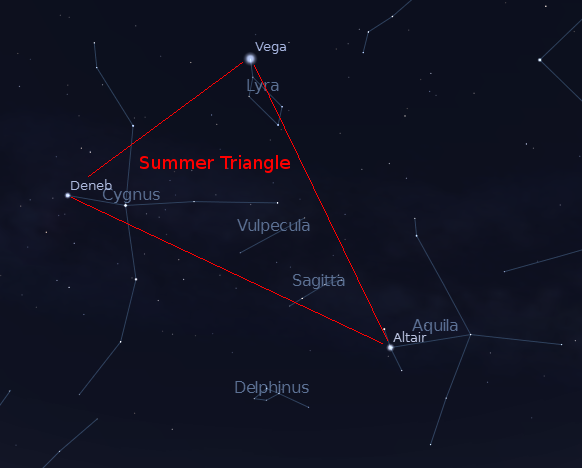
The Summer Triangle. Created using Stellarium and The Gimp.
If you put Deneb in the search box, you will find that the content of the posts, over the years, about the star are nearly identical. However, the distance estimates vary widely. It is too far away for trigonometric parallax measurements by earth based telescopes. Though in the range of ESA’s Hipparcos and Gaia satellites, it is too bright. So other less accurate measurements are used. I don’t think it involves coin flipping. The assumed distance also affects estimates of luminosity, and mass.

