Archive
06/15/2012 – Ephemeris – The constellation of Libra the scales or balance
Ephemeris for Friday, June 15th. Today the sun will be up for 15 hours and 32 minutes, setting at 9:29. The moon, half way from last quarter to new, will rise at 3:49 tomorrow morning. Tomorrow the sun will rise at 5:56.
One of the constellations of the Zodiac or circle of animals isn’t either animal or human. It is Libra the Scales or balance. It lies low in the southern sky at 11 p.m., just to the right of the rising Scorpius the scorpion. Libra, it seems, is an afterthought, a simple diamond shape of four stars.. Its two brightest stars Zubeneschamali and Zubenelgenubi translate to the north and south claw respectively, of Scorpius to the left of it. The Arabs, at least, seemed to view this as part of Scorpius. The balance was perhaps to signify the equality of day and night, at the time the sun was in this part of the sky at the start of autumn, over 2000 years ago. Nowadays the sun is one constellation west, in Virgo at the start of autumn.
Times are for the Traverse City/Interlochen area of Michigan. They may be different for your location.
Addendum
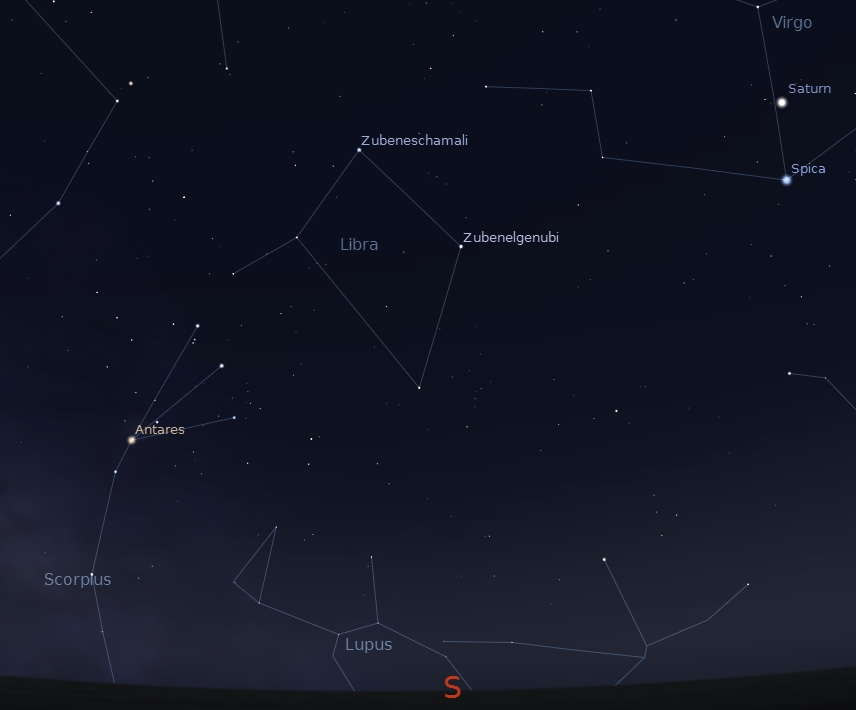
The constellation Libra on June 15, 2012 at 11 p.m. Created using Stellarium.
Click on image to enlarge.
06/14/2012 – Ephemeris – Flag Day: Red, White and Blue Stars
Ephemeris for Flag Day, Thursday, June 14th. Today the sun will be up for 15 hours and 32 minutes, setting at 9:29. The moon, 3 days past last quarter, will rise at 3:16 tomorrow morning. Tomorrow the sun will rise at 5:56.
Since it’s Flag Day, lets look for some red white and blue stars. Red is easy, I talked about it Tuesday, It is Antares now low in the southeast in the evening in the heart of the constellation of Scorpius the scorpion. For the white star there is no purer white star than Vega, spectral type A0 (A zero), the astronomers definition of white. It is located midway up the sky in the east. It is the 5th brightest night time star, and is seen off a small parallelogram of stars that make up the body of Lyra the harp. For the blue star, the best is Spica, below Saturn this year and in the south in the evening. It is the bluest of the 21 brightest first magnitude stars. Color in stars is often subtle, so try to see these colors.
Times are for the Traverse City/Interlochen area of Michigan. They may be different for your location.
Addendum
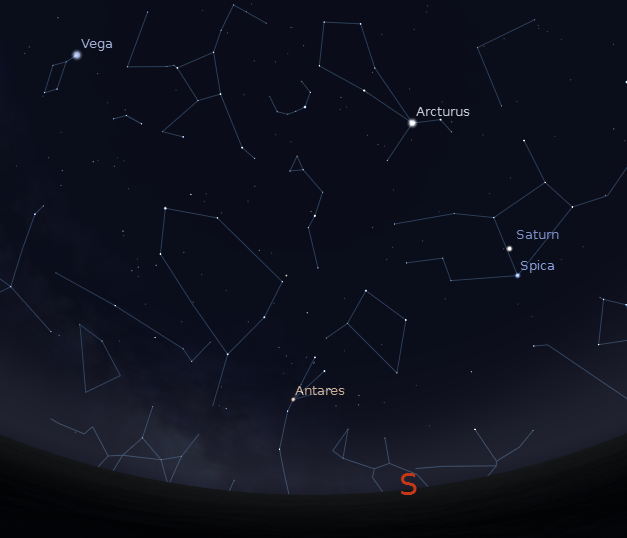
Red (Antares), White (Vega) and Blue (Spica) stars of spring. Created using Stellarium.
06/13/2012 – Ephemeris – Where are the bright planets this week?
Ephemeris for Wednesday, June 13th. Today the sun will be up for 15 hours and 32 minutes, setting at 9:28. The moon, 2 days past last quarter, will rise at 2:47 tomorrow morning. Tomorrow the sun will rise at 5:56.
Let’s see what’s happening with the bright planets for this week. Mars is in the southwest in the evening between the constellations Leo the lion and Virgo with its unmistakable bright reddish color, though its fading as it retreats from us. Mars will be setting in the west at 1:58 a.m. Saturn will be in the south above the bright star Spica now. It’s due south at 9:41 p.m. and will set at 3:17 a.m. Jupiter, now a morning planet will rise at 4:39 a.m. in the east northeast. Venus, now in the morning sky is very close to the rising sun, will itself rise at 5:18 a.m. I’m not sure it’s all that visible yet. Mercury is in the evening sky but too close to the sun to be seen, we should be able to spot it the last week of this month.
Times are for the Traverse City/Interlochen area of Michigan. They may be different for your location.
Addendum
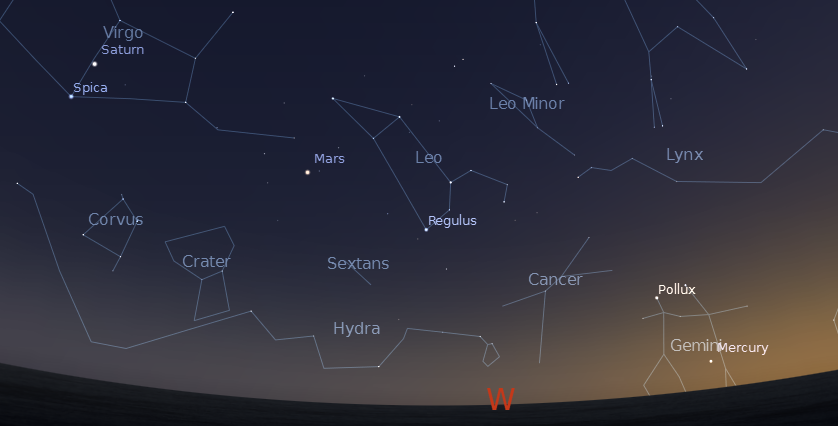
Centered on the southwestern sky at 10:30 p.m. on June 13, 2012. Created using Stellarium.
The planets Saturn, Mars and Mercury. Click to enlarge.
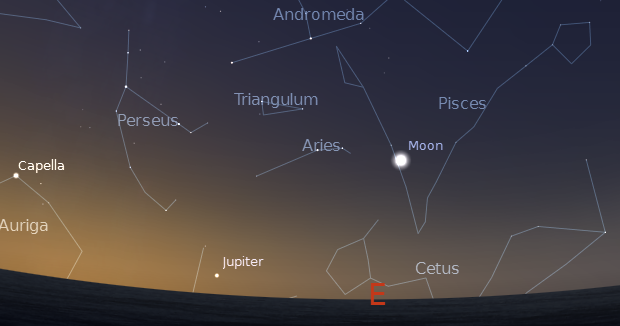
The morning sky in the east at 5 a.m. on June 14, 2012. Created using Stellarium.
Jupiter rising a bit right of East at 5 a.m. Venus will rise at 5:18 on the 14th. We should see them both next week. Click to enlarge.
06/12/2012 – Ephemeris – The bright star Antares
Ephemeris for Tuesday, June 12th. Today the sun will be up for 15 hours and 31 minutes, setting at 9:28. The moon, 1 day past last quarter, will rise at 2:20 tomorrow morning. Tomorrow the sun will rise at 5:56.
A rival to Mars is now low in southeast at 10:30. It is the red star Antares, whose names literally means “Rival of Mars”. This is from the Greek who’s god of war was Ares. Mars is in the southwest now and a bit brighter than Antares. When Mars catches up with Antares around October 20th this year, they will be nearly the same brightness, and one would be hard put to tell them apart. Antares is in the heart of Scorpius the scorpion which lies close to our southern horizon later in the evening, and is best seen next month at an earlier time. Antares is also a star that appears strange as its twinkling is very pronounced being always close to the horizon for us sputtering all the colors of the rainbow.
Times are for the Traverse City/Interlochen area of Michigan. They may be different for your location.
Addendum
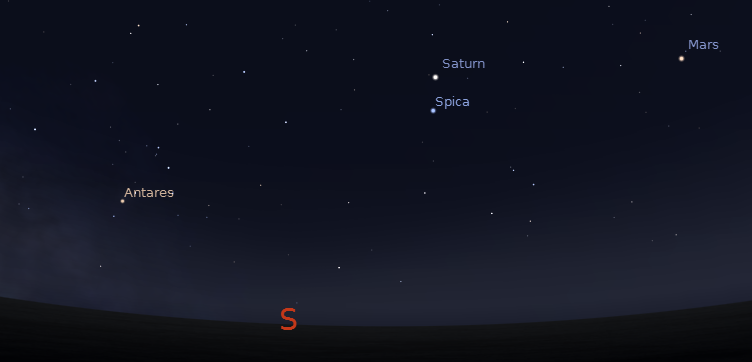
Antares and Mars at 11 p.m. on June 12, 2012. Created using Stellarium.
06/11/2012 – Ephemeris – The bright star Arcturus
Ephemeris for Monday, June 11th. Today the sun will be up for 15 hours and 30 minutes, setting at 9:27. The moon, at last quarter today, will rise at 1:55 tomorrow morning. Tomorrow the sun will rise at 5:56.
The bright star Arcturus appears high in the south at 10:30 in the evening. It’s at the base of a kite shaped constellation of Boötes the herdsman or bear chaser. Arcturus is remarkable for several reasons. It is only 10 percent more massive than the sun but is 110 times brighter and is orange in color. That’s because Arcturus has entered its red giant stage of life after depleting hydrogen in its core as its fuel source. Arcturus is much older than the sun to have evolved so far, being only a little more massive than the sun. Also Arcturus may be new to our galaxy, Its rapid motion of 76 miles per second with respect to the sun, along with 51 other stars known may have come from a small galaxy that collided with the Milky Way.
Times are for the Traverse City/Interlochen area of Michigan. They may be different for your location.
Addendum
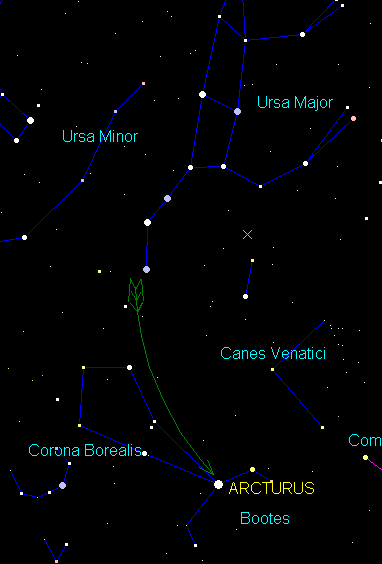
Arcturus, Boötes and the Big Dipper
06/08/2012 – Ephemeris – The constellation of Hercules
Ephemeris for Friday, June 8th. Today the sun will be up for 15 hours and 28 minutes, setting at 9:26. The moon, 3 days before last quarter, will rise at 12:38 tomorrow morning. Tomorrow the sun will rise at 5:57.
High in the east is the dim and reasonably large constellation of Hercules. Here is the greatest of the Greek heroes, dim and upside down even, while the comparative nobody Orion gets a great constellation to his name in the winter. Anyway, Hercules can be spotted by the distinctive keystone shape of stars that mark the old boy’s kilt. Stars connected to the four corners show his body and limbs. Check a constellation book for where all the stars lead to. On the west side of the keystone can be spotted with binoculars a fuzzy star. Investigations with larger and larger telescopes will reveal a huge assembly of stars called a globular star cluster. There’s perhaps a million stars there. The finest in the northern heavens.
Times are for the Traverse City/Interlochen area of Michigan. They may be different for your location.
Addendum
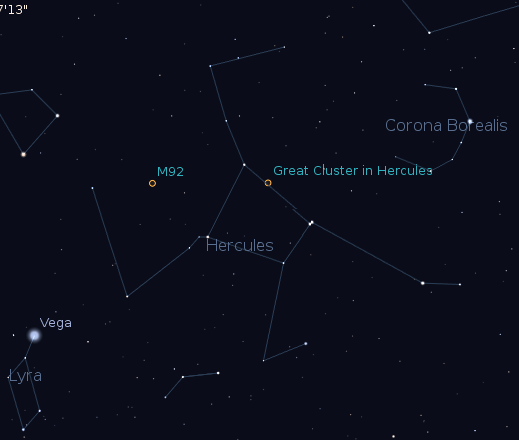
The constellation Hercules and his neighbors. Created with Stellarium.
M92 is also a globular star cluster but more distant. The Great Globular Cluster in Hercules is also designated M13.
06/07/2012 – Ephemeris – The constellation of Corona Borealis
Ephemeris for Thursday, June 7th. Today the sun will be up for 15 hours and 27 minutes, setting at 9:25. The moon, 3 days past full, will rise at 12:07 tomorrow morning. Tomorrow the sun will rise at 5:57.
High in the southeast at 10:30 p.m. can be found a rather small arc of stars just east of the kite shaped constellation of Boötes with the bright star Arcturus at the bottom. It’s called Corona Borealis, the Northern Crown. There is a Southern Crown, Corona Australis, just below the Teapot of Sagittarius, a late summer constellation, which barely rises above the horizon here. This semi-circle of stars was to the Greeks the crown bestowed to Princess Ariadne daughter of King Minos of Crete after she had helped the Greek Theseus escape from the Labyrinth of the Minotaur. To the Native Americans around here it was the sweat lodge, and to the Australian Aborigines it was the boomerang whenever it rose over their northern horizon.
Times are for the Traverse City/Interlochen area of Michigan. They may be different for your location.
Addendum

Corona Borealis with Boötes at 10:30 p.m. Created with Stellarium.
06/06/2012 – Ephemeris – Where are the bright planets this week?
Ephemeris for Wednesday, June 6th. Today the sun will be up for 15 hours and 26 minutes, setting at 9:24. The moon, 2 days past full, will rise at 11:31 this evening. Tomorrow the sun will rise at 5:57.
Let’s see what’s happening with the bright planets for this week. Venus is now in the morning sky and very close to the sun, will be seen again in a few weeks. Mars is in the southwest in the evening in the constellation of Leo the lion with its unmistakable bright reddish color, though its fading as it retreats from us. It’s heading eastward toward Virgo. Mars will be setting in the west at 2:20 a.m. Saturn will be in the south above the bright star Spica now. It’s due south at 10:09 p.m. and will set at 3:45 a.m. Jupiter, now a morning planet will rise at 5:01 a.m. in the east northeast. Mercury is in the evening sky but too close to the sun to be seen, we should be able to spot it the last week of this month.
Times are for the Traverse City/Interlochen area of Michigan. They may be different for your location.
Addendum
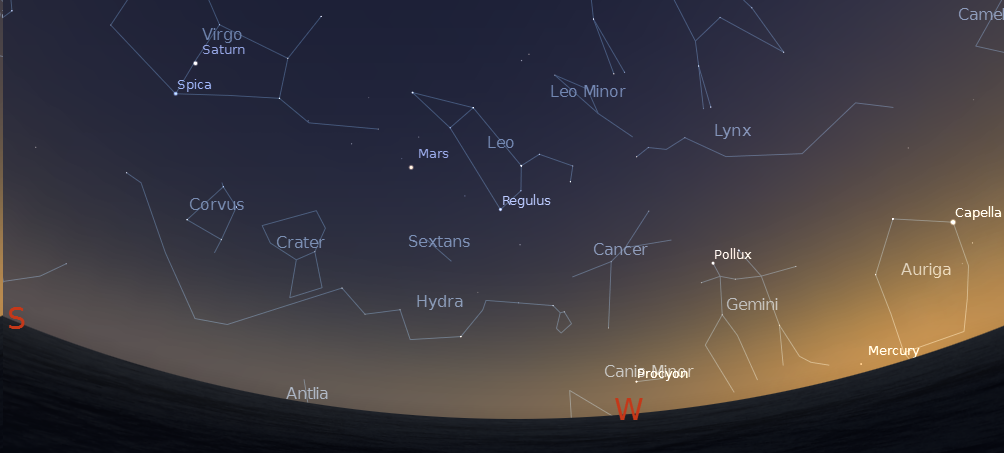
The planets at 10:15 in the evening. Check out Mercury near the horizon. Created using Stellarium.
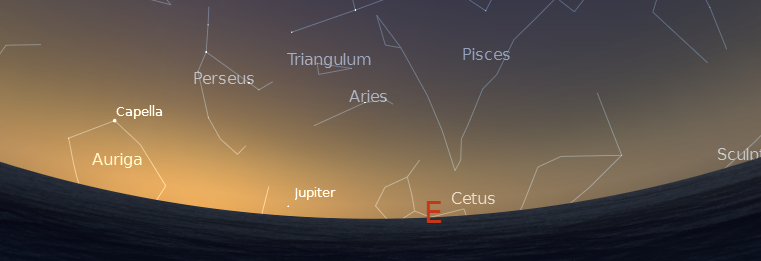
5:15 a.m. at 6/7/2012. Morning sky and Jupiter. Created using Stellarium.
Grand Traverse Astronomical Society’s Transit of Venus Watch – What a Time!
This was a fantastic event at Traverse City’s Open Space on the bay front. The clouds that threatened all day parted and dissolved to reveal a perfect sky. Hundreds of people turned out. Here are some crowd shots I made with my Android phone, plus one of the transit.

Most of a huge line to see the transit with the GTAS’ 25″ Dobsonian telescope.

Transit Crowds near the telescopes.

More of the Transit Crowd an Bill Renis manning our Lunt Hydrogen Alpha Solar Telescope.

A look at the crowd and our GTAS Banner.
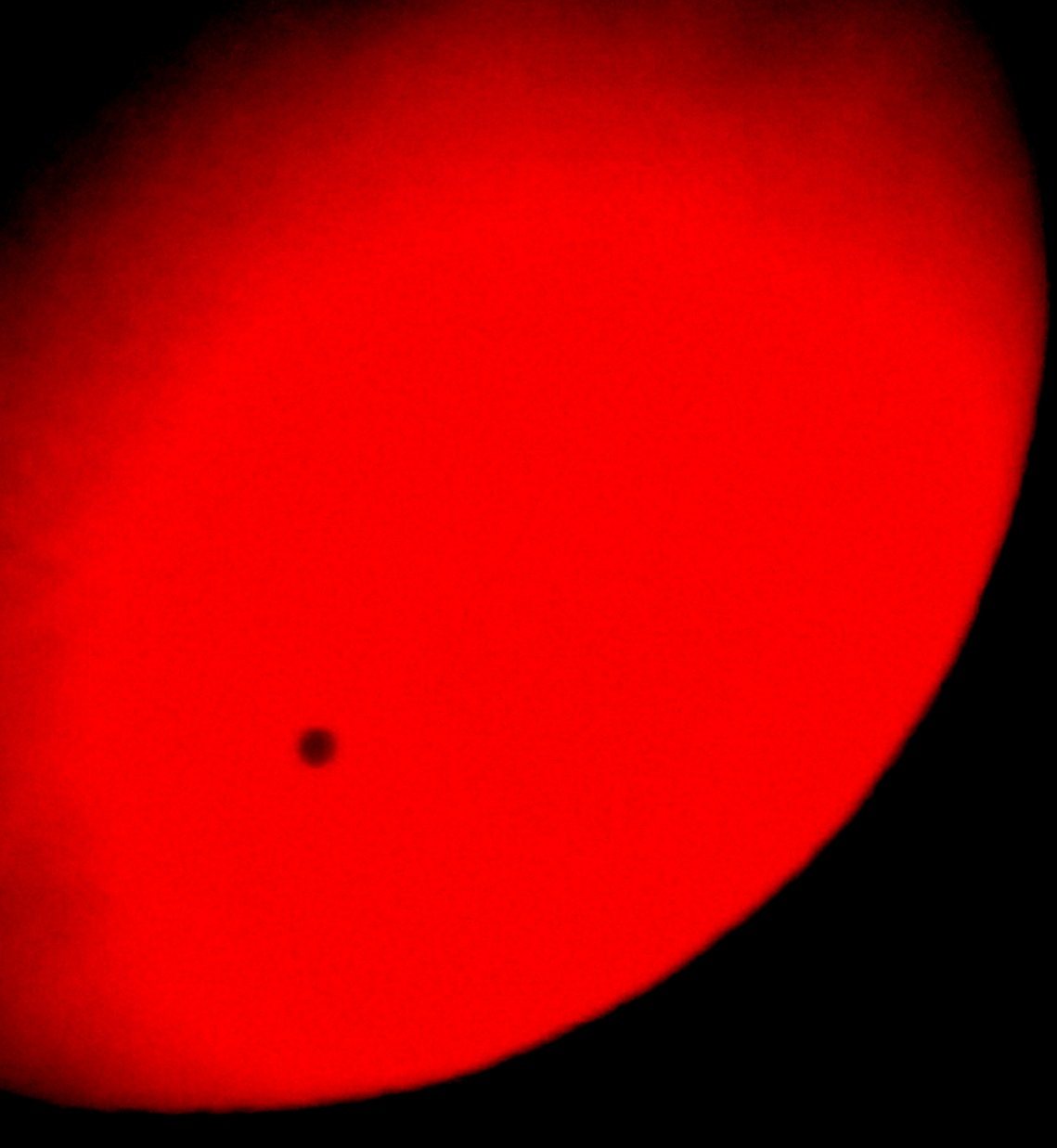
Venus against the sun taken at 8:49 p.m. through the Lunt solar telescope and a Droid Bionic phone.
Update (06/22/2012)
I received photographs from Gary and Eileen Carlisle and put them on the gtastro.org website. Here are theirs below. Eileen took the crowd shots, while Gary took the transit shot just before sunset as the crowds thinned. Gary’s crowd estimate was 500 folks.
More information: The transit started at 6:04 p.m. EDT. I spotted first contact through the Lunt. It took another minute or so to spot it in the white light telescopes. The Lunt showed the sun’s chromosphere that extends some 6,000 miles above the sun’s photosphere. The transit ended fro us as the sun set into the hills of Leelanau County across the west arm of Grand Traverse Bay.
The location we viewed from was the Open Space Park on the bay front in Traverse City, Michigan US. It is also used as the main venue of the National Cherry festival in early July and free outdoors screenings of movies at the Traverse City Film Festival in late July or early August.
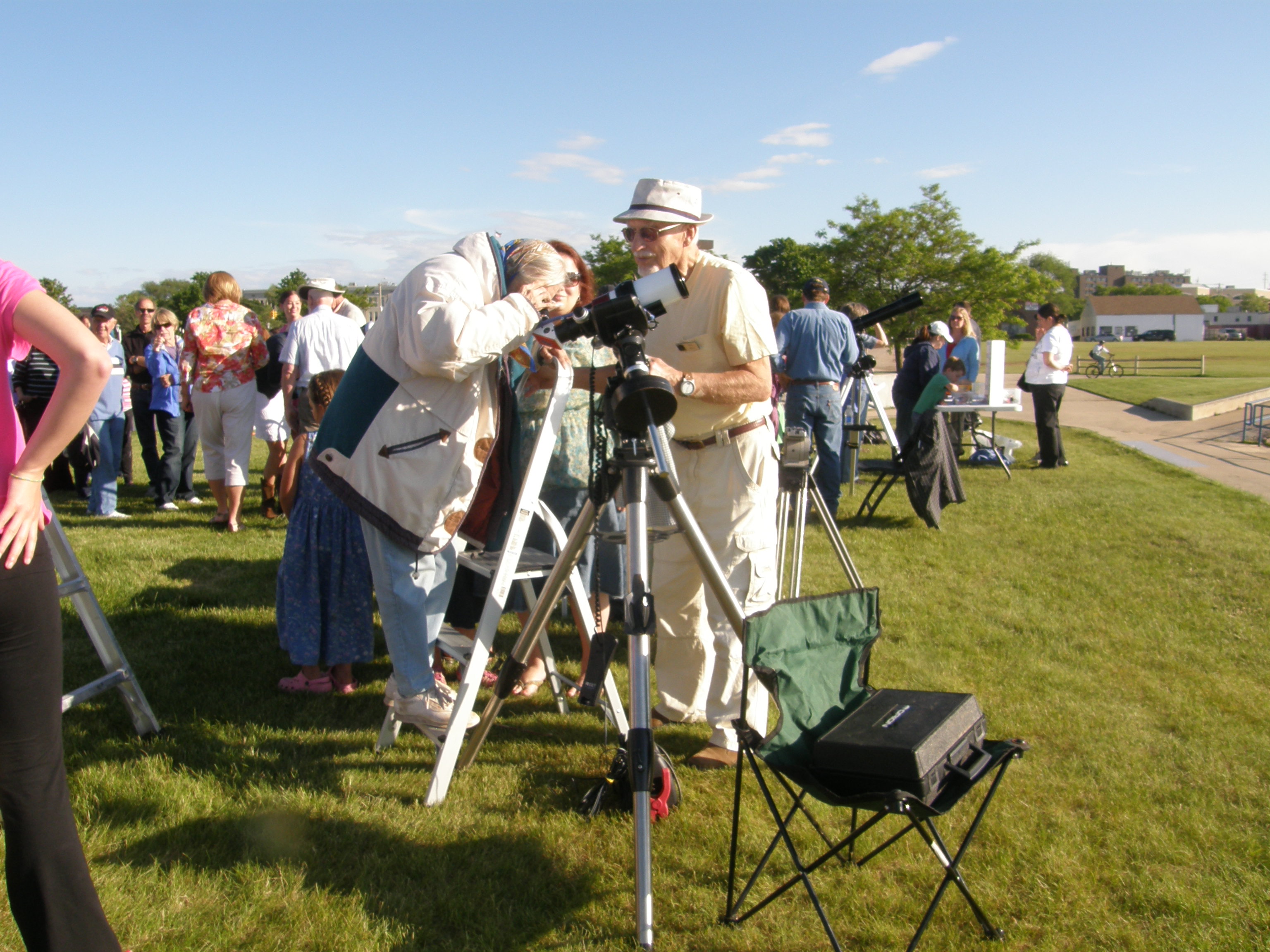
Bill Renis (yellow shirt, white hat and sunglasses) helping a person view the transit using the Lunt Solar Telescope. This was also the society’s 30th anniversary. Bill and I were the only two charter members attending.
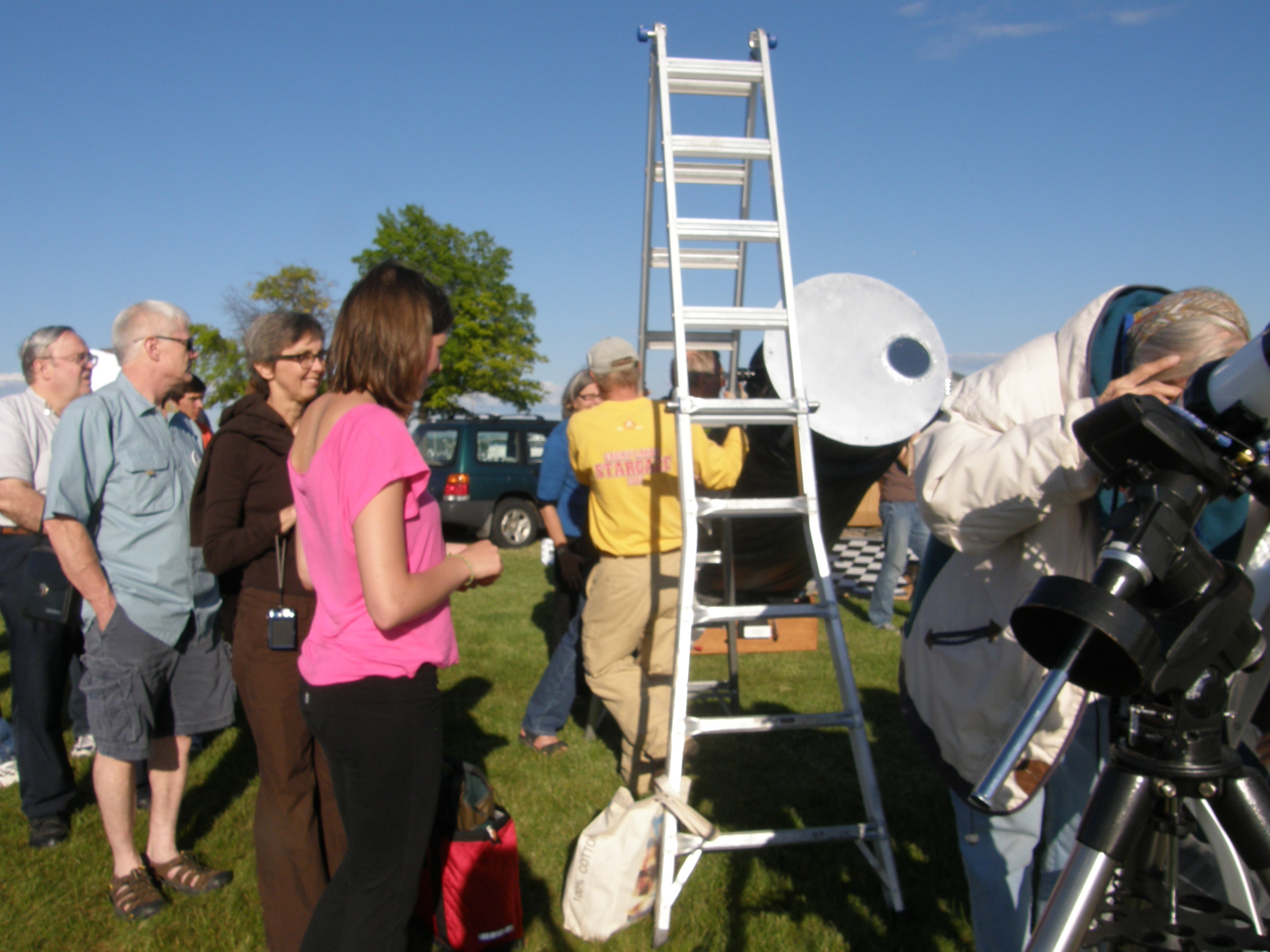
We brought out our Obsession 25″ telescope, stopped down to 8 inches with a solar filter. It gave excellent images. I saw second contact without the annoying teardrop effect.

Our “Meteorite Man” Joe Brooks brings out his meteorite collection for our events.
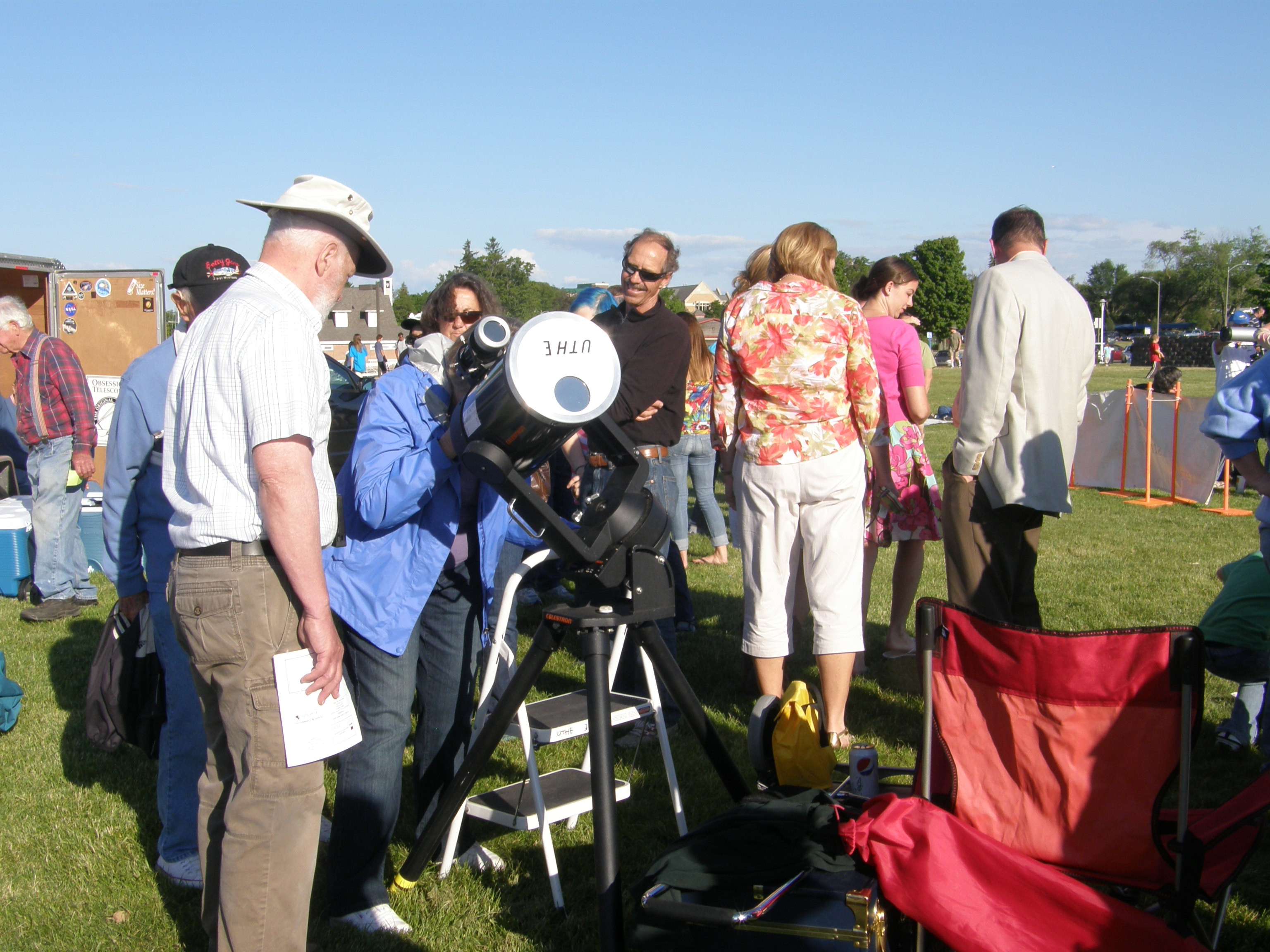
Member Ron Uthe brought his 8″ telescope to the event.
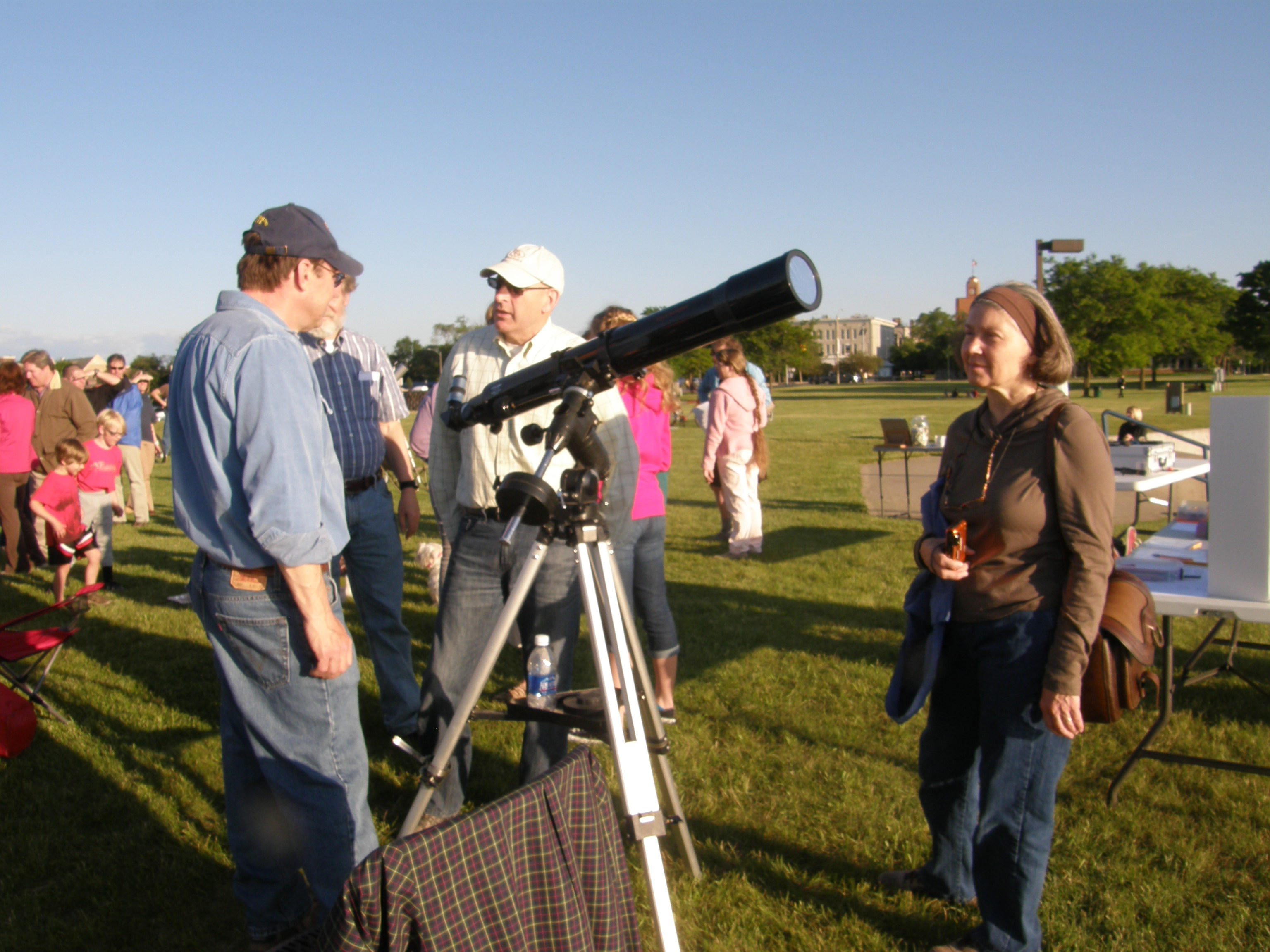
This is GTAS president Rich Kuschell’s 4″ refractor.

A little impromptu musical accompaniment.
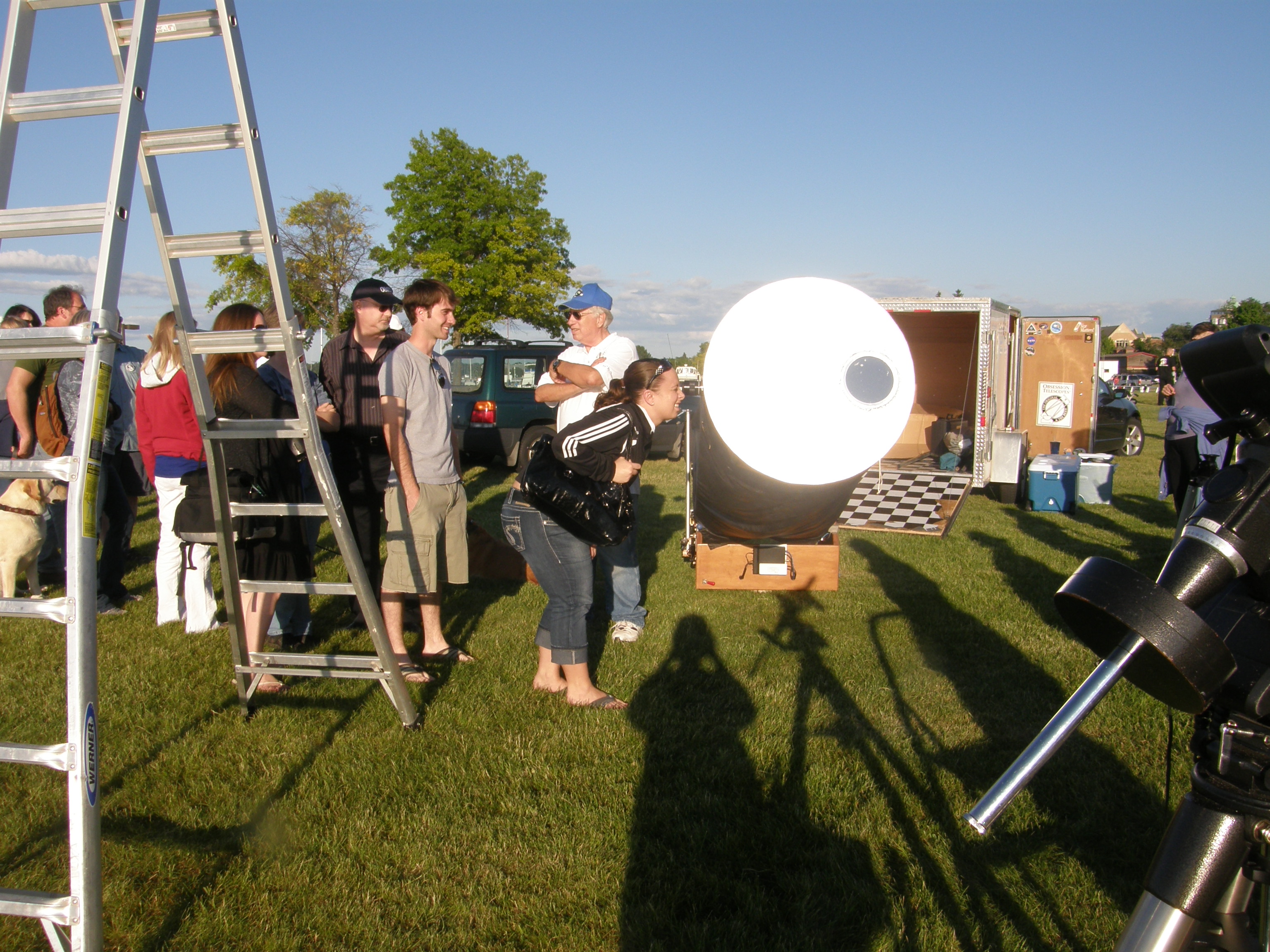
The sun’s getting low now. That’s me in the blue cap.

The small kids got a chance to create moon craters in pans of flour covered by chocolate drink powder.
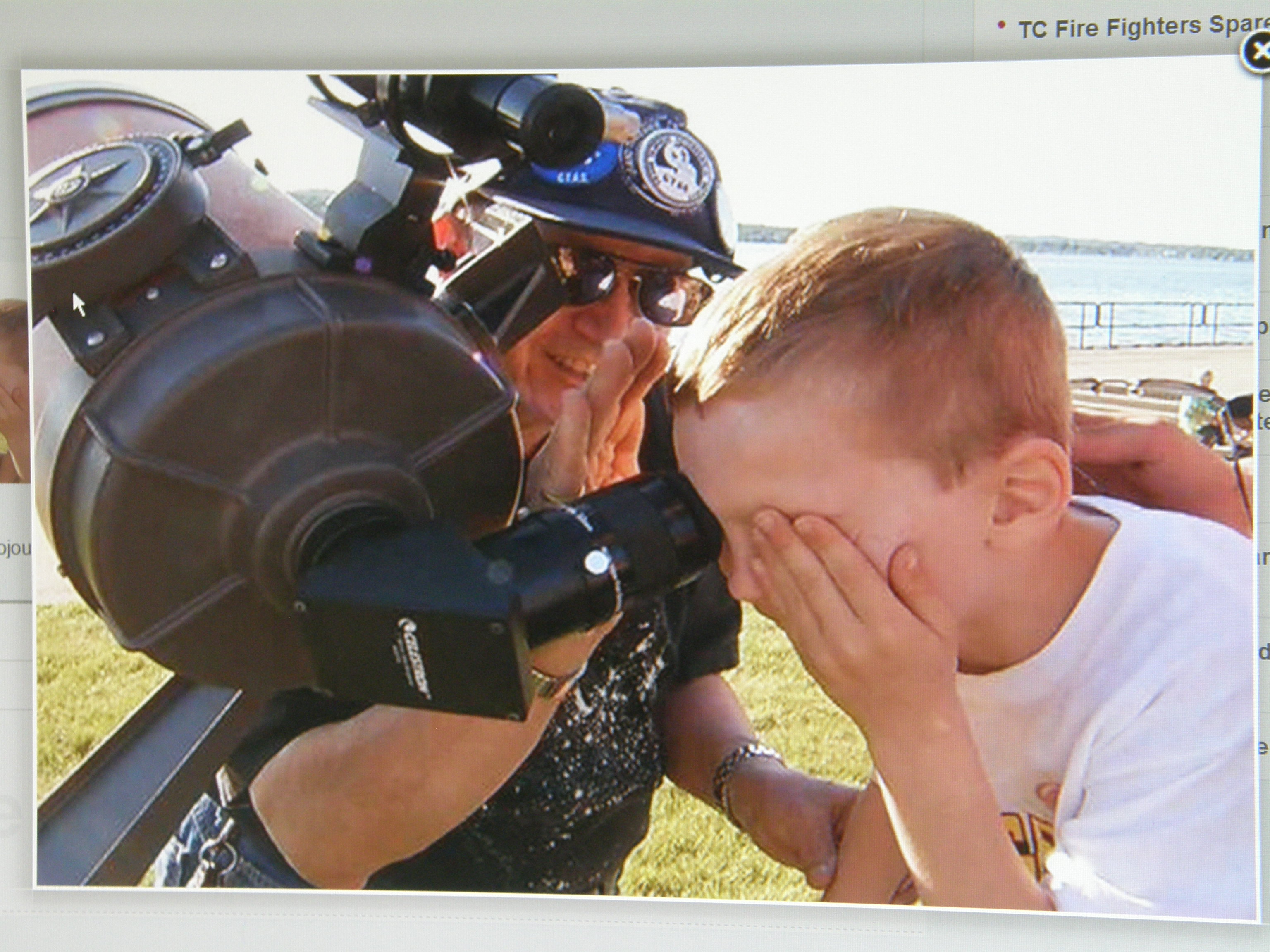
Gary Carlisle shielding the sun for a young man viewing through his 8″ telescope.
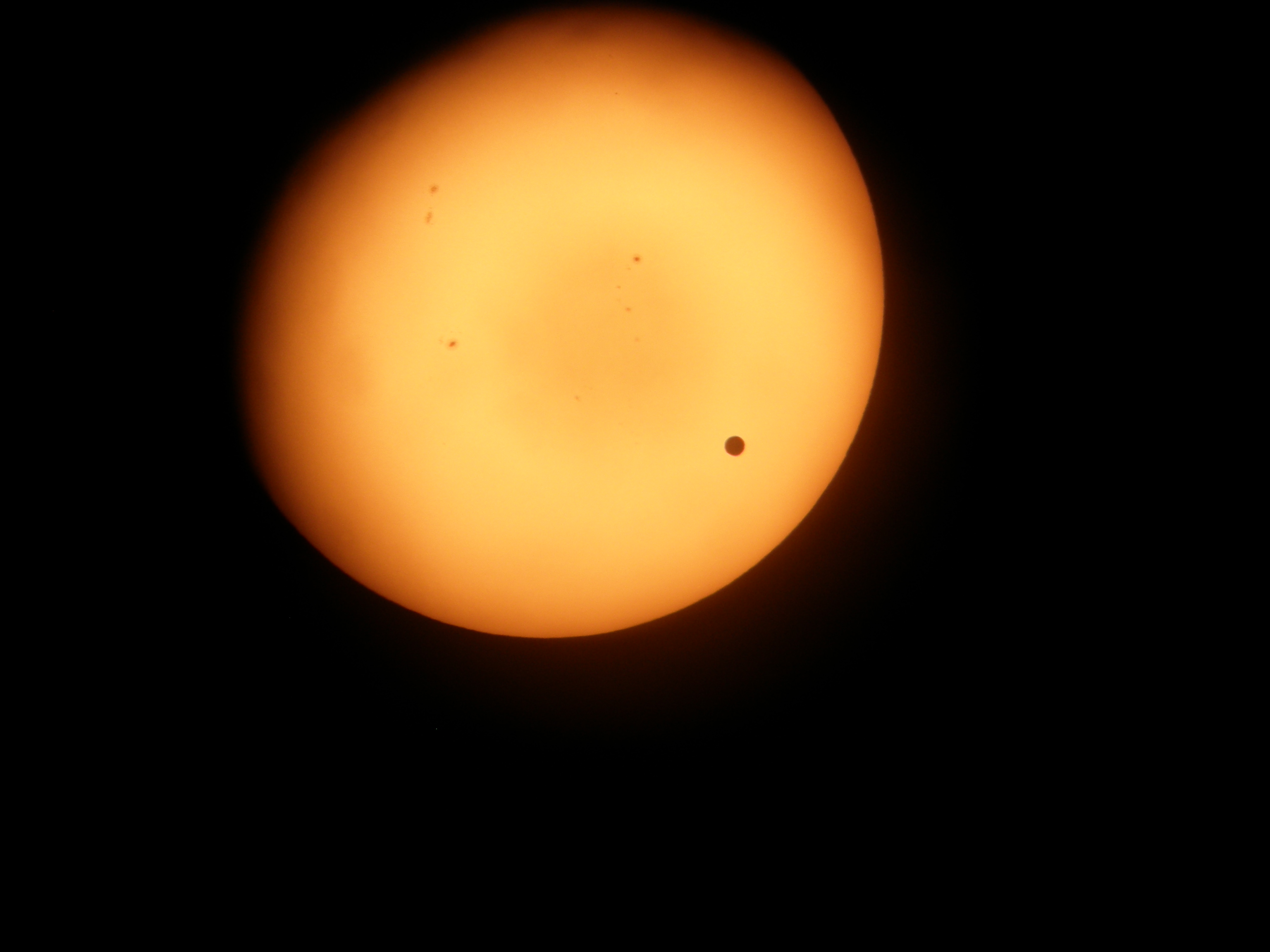
Gary’s photo of the transit.
06/05/2012 – Ephemeris – Transit of Venus is today!
Ephemeris for Tuesday, June 5th. Today the sun will be up for 15 hours and 25 minutes, setting at 9:24. The moon, 1 day past full, will rise at 10:46 this evening. Tomorrow the sun will rise at 5:58.
Early this evening we will see a rare event, the transit of the planet Venus across the sun. This will start at a few minutes after 6 p.m. When Venus will start crossing the sun from near the top. While the transit will last nearly 7 hours, we’ll see about 3 hours of it, clouds willing before the sun sets. The safety precautions are the same as viewing a solar eclipse, that is Do Not Look Directly At The Sun. Safe approved solar filters that fit in front of a telescope, projection of the sun’s image with a telescope or binoculars are the ways to view this event. The Grand Traverse Astronomical Society will be at the Open Space in Traverse City at 6 p.m. tonight for safe views of the event. The next transit of Venus will be in 2117.
Times are for the Traverse City/Interlochen area of Michigan. They may be different for your location.
Addendum
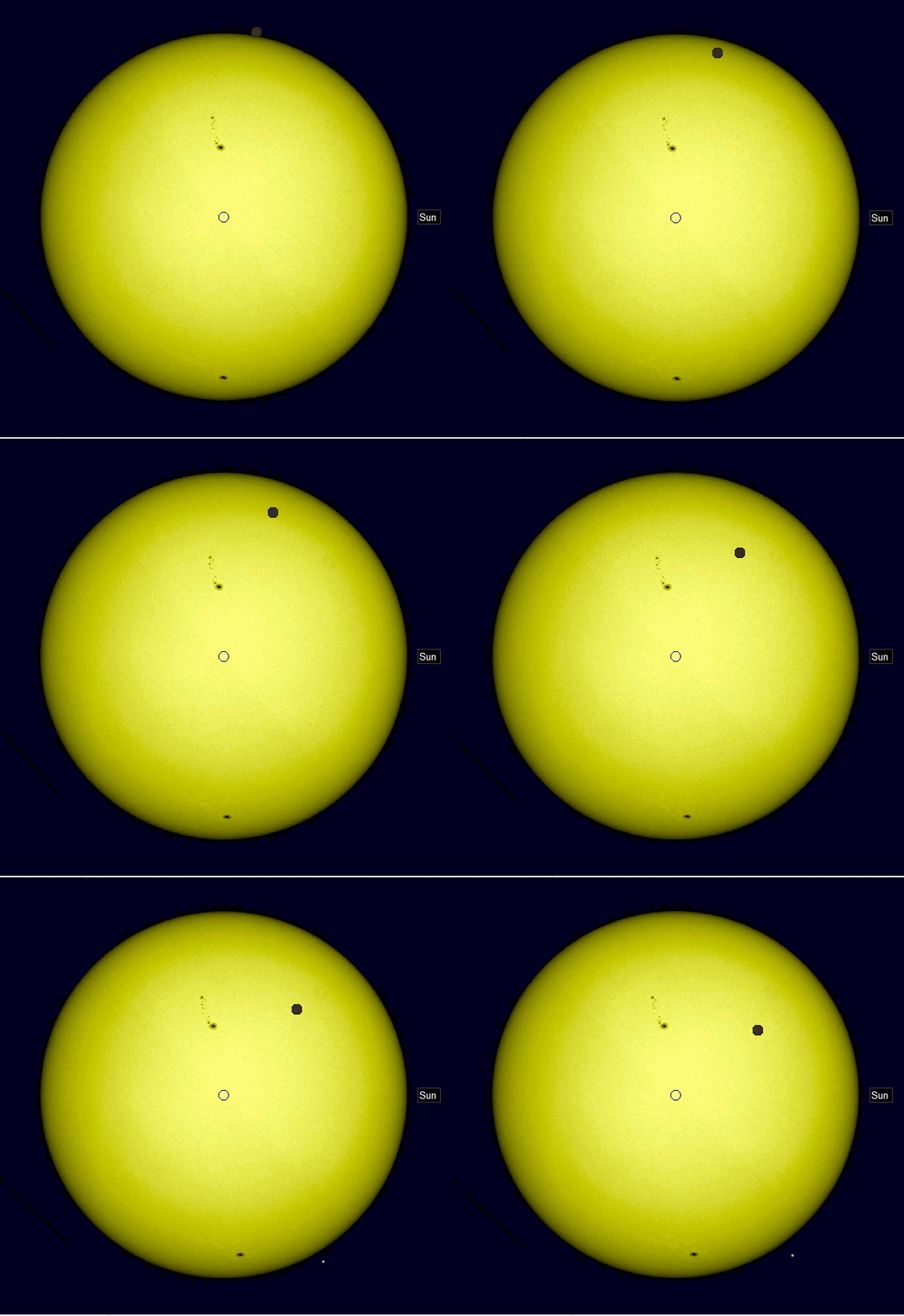
Animation of the Transit of Venus from Northern Michigan. Created using cartes du Ciel.
The Animation starts with Venus at contact 1, and every half hour until sunset. That’s why the transit ends abruptly.
For more information check out this NASA page.
How to observe the sun? The same techniques that are use to view a solar eclipse.
 Bob Moler's Ephemeris Blog