Archive
10/01/2013 – Ephemeris – Let’s Preview October Skies
Ephemeris for Tuesday, October 1st. The sun will rise at 7:40. It’ll be up for 11 hours and 41 minutes, setting at 7:22. The moon, 3 days before new, will rise at 5:10 tomorrow morning.
Let’s look at the skies for the month of October. The sun will still be moving south rapidly. Daylight hours in the Interlochen/Traverse City area will drop from 11 hours and 41 minutes today to 10 hours 13 minutes on the 31st. The altitude of the sun above the southern horizon at local noon will be 42 degrees today, and will descend to 31 degrees on Halloween, also in the Interlochen/Traverse City area. The Straits area will have the sun a degree lower. Local noon, when the sun is due south will be about 1:30 p.m. in Interlochen/Traverse City. Comet ISON is currently about a sixth as bright as original estimates would predict. However comets can unpredictable in their brightness. So we will know for sure in two months.
Times are for the Traverse City/Interlochen area of Michigan. They may be different for your location.
Addendum
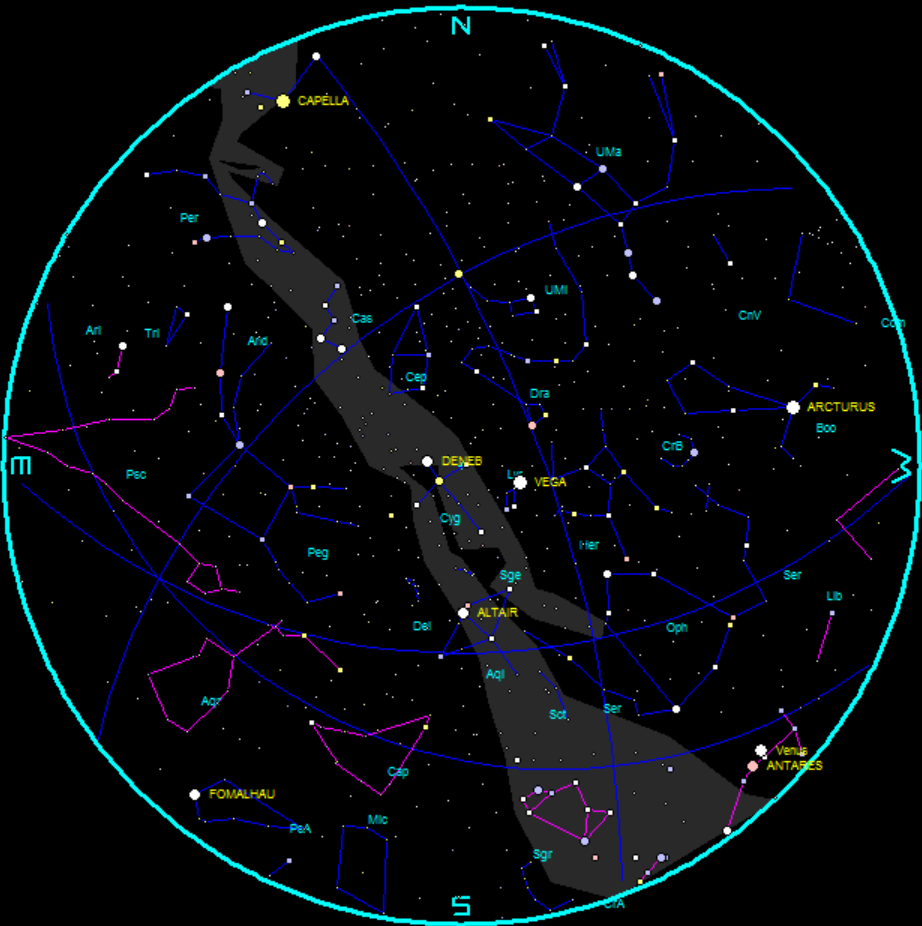
Star Chart for October 15th, 2013 at 9 p.m. Created by my LookingUp program.
09/30/2013 – Ephemeris – The constellation of Cassiopeia the queen
Ephemeris for Monday, September 30th. The sun will rise at 7:39. It’ll be up for 11 hours and 44 minutes, setting at 7:24. The moon, half way from last quarter to new, will rise at 4:07 tomorrow morning.
The stars of the autumn skies slowly are replacing the summer stars from the east. Look in the northeastern sky by 9 p.m. and you can find the W shaped constellation of Cassiopeia the queen. Cassiopeia is so far north that it never sets for us in Michigan. It is opposite the pole star Polaris from the Big Dipper. There’s a dim star that appears above the middle star of the W which turns the W into a very crooked backed chair. Cassiopeia, in Greek mythology, represents a queen of ancient Ethiopia, the W represents the profile of her throne. She enters in to the great autumn story whose other characters are also seen in the stars as the constellations Andromeda, Pegasus, Perseus, Cetus and her husband Cepheus.
Times are for the Traverse City/Interlochen area of Michigan. They may be different for your location.
Addendum
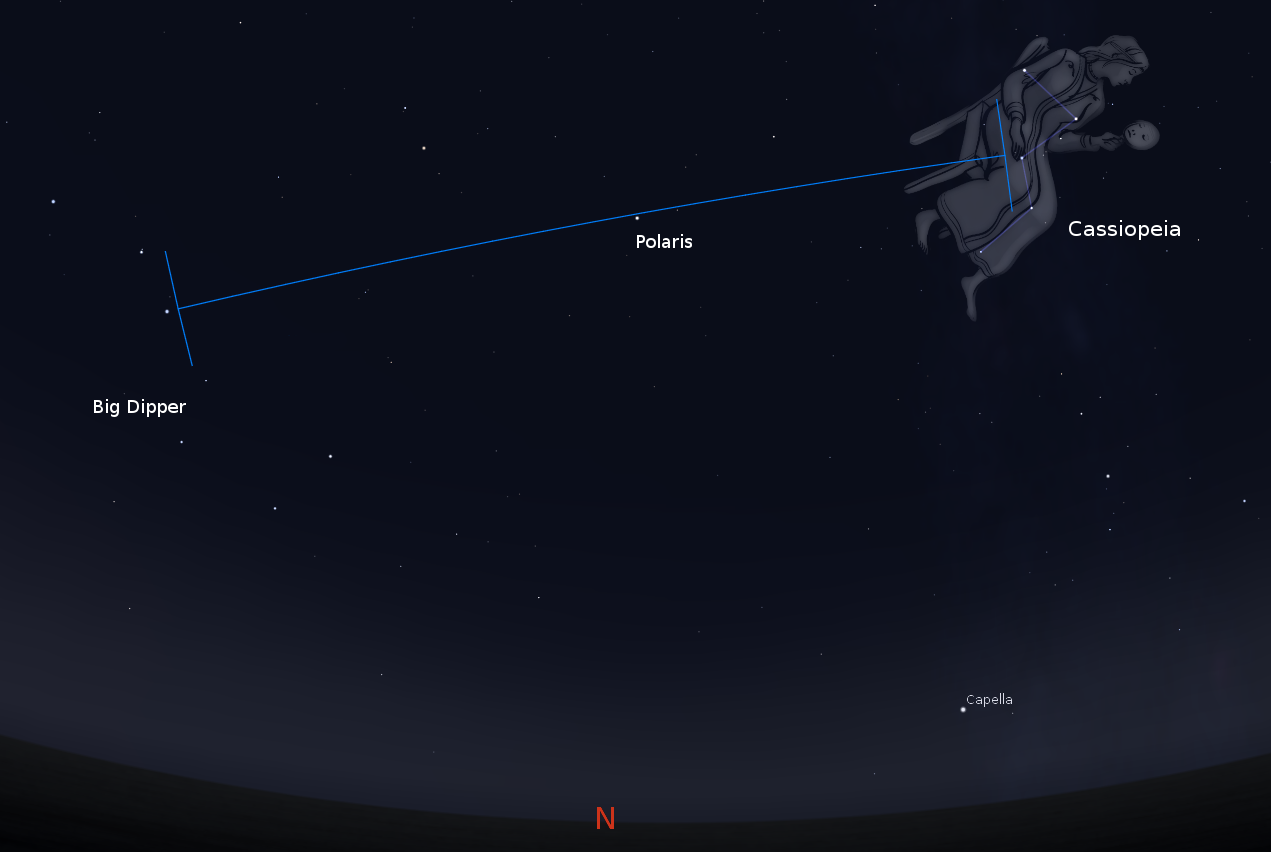
Cassiopeis, in the northeast is opposite Polaris from the Big Dipper. For 9 p.m. on September 30th. Created using Stellarium. Artistic credit: Johan Meuris. Click to enlarge.
Links to other sites for Comet ISON information as it approaches perihelion
C/2012 S1 (ISON) is the official designation for Comet ISON, which will pass close to Mars on its inbound leg of its orbit of the sun.
Universe Today has two links on what to expect as Comet ISON nears the sun.
The Comet ISON, a Viewing Guide From Now to Perihelion: http://www.universetoday.com/104818/comet-ison-a-viewing-guide-from-now-to-perihelion/
The comet’s coma (head) is turning green as it approaches. That’s a good thing: http://www.universetoday.com/105087/comet-ison-goes-green/
Here’s another site: The NASA Comet ISON Observing Campaign: http://www.isoncampaign.org/ which answers some of your questions and details some of the world-wide and solar system wide attempts to observe Comet ISON as it makes its mad dash to and from the sun.
As Comet ISON approaches the Sun it is doing so close to the ecliptic plane (plane of the earth’s orbit). Situated in the morning sky, it will follow fairly close to the ecliptic, passing Mars and Saturn on the way in from our point of view. It will physically pass close to Mars this week. Expect photos of the comet from Mars by the end of the week. What Martians are taking the photos? Why we are. NASA and the Europeans have assets on and around Mars who will, in their robotic way photograph and possibly analyze the comet as it passes by. The apparent passage by Saturn is apparent from our point of view from the earth. It is far in the background. Comet Encke, the shortest of the periodic comets with a 3.3 year orbit will be in some of the photographs from earth.
Around the end of October Comet ISON will cross the earth’s orbit heading to perihelion on November 28th. Comet will stay a morning comet after leaving the sun heading northward from the earth’s point of view. We expect the comet be at its brightest, but rapidly fade in December. But who knows. I will be reporting what I know and see about the time the comet becomes visible in binoculars or a small telescope. Stay tuned.
09/27/2013 – Ephemeris – The GTAS will be at the Acme Fall Festival tomorrow
Ephemeris for Friday, September 27th. The sun will rise at 7:35. It’ll be up for 11 hours and 54 minutes, setting at 7:30. The moon, 1 day past last quarter, will rise at 1:11 tomorrow morning. | The Grand Traverse Astronomical Society will be at the Acme Fall Festival tomorrow, that’s Saturday September 28th from 10 to 5 p.m. It will be held at Flintfields on Bates Road, north of M72. The society members will bring their telescopes which will be used to view the sun if it’s clear. There will also be exhibits of astronomical photos from NASA, professional and our own amateur astronomers. As the festival year winds down and the school year begins members of the society can bring astronomy and space to the classroom. Plus the society is beginning to plan for next year. Contact the Grand Traverse Astronomical Society via email at info@gtastro.org for information or to set up a date and topic.
Times are for the Traverse City/Interlochen area of Michigan. They may be different for your location.
09/26/2013 – Ephemeris – The Milky Way is crossing overhead
Ephemeris for Thursday, September 26th. The sun will rise at 7:34. It’ll be up for 11 hours and 57 minutes, setting at 7:31. The moon, at last quarter today, will rise at 12:17 tomorrow morning. | At 10 this evening the Milky Way will pass directly overhead. The bright star Deneb of the Summer Triangle and at the head of the Northern Cross is directly overhead at that time. Deneb is incidentally the tail of Cygnus the swan. The Milky Way stretches from the northeast to the southwest where the Teapot of Sagittarius is tipping, pouring out its tea on the horizon. The Milky Way can be enjoyed with the naked eye, binoculars or telescope. With the naked eye, we see it as the pre-scientific cultures did. The Milky way was a pathway of milk, the path that the American Indian warriors journeyed to the hereafter, the stars their camp fires shining in the night. In reality it is what we can see of our galaxy.
Times are for the Traverse City/Interlochen area of Michigan. They may be different for your location.
Addendum
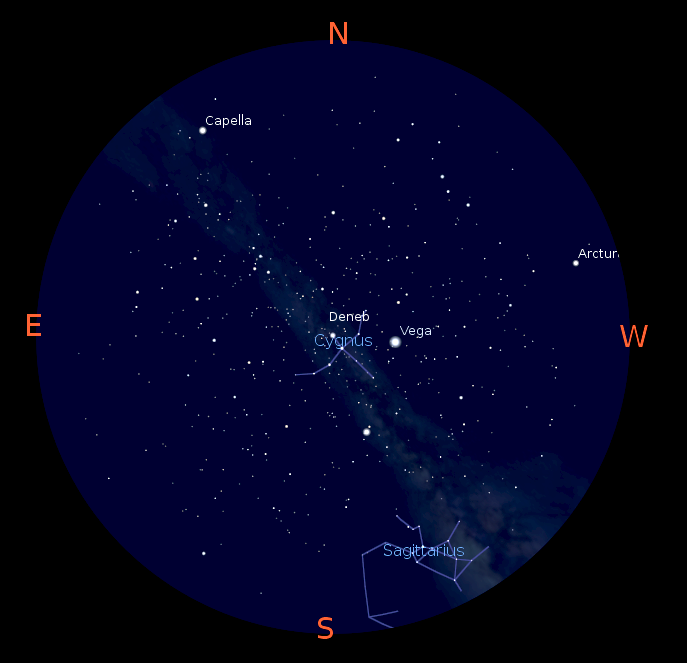
The Milky Way crosses the sky overhead at 10 p.m., September 26, 2013. Horizon to horizon view. Created using Stellarium.
09/25/2013 – Ephemeris – Where are the bright planets this week?
Ephemeris for Wednesday, September 25th. The sun will rise at 7:33. It’ll be up for 12 hours, setting at 7:33. The moon, 1 day before last quarter, will rise at 11:26 this evening.
Time again to check out the bright planets. Saturn and Venus will be at the same height above the west southwestern horizon. Dimmer Saturn will be to the right of Venus by nearly the width of a fist held at arm’s length. Binoculars may be needed to spot it. Venus will set at 9:04 p.m., while Saturn will set at 9:06. We will soon lose Saturn in the sun’s glare for a few months. The rest of the planetary action will be in the morning sky. The giant planet Jupiter will rise at 12:59 a.m. in the east northeast. It’s cruising against the stars of Gemini this viewing season. By 6 a.m it will be high in the east southeast, the brightest object in that direction. Mars will rise at 3:34 a.m. also in the east northeast. It’s in the east at 6 a.m.
Times are for the Traverse City/Interlochen area of Michigan. They may be different for your location.
Addendum
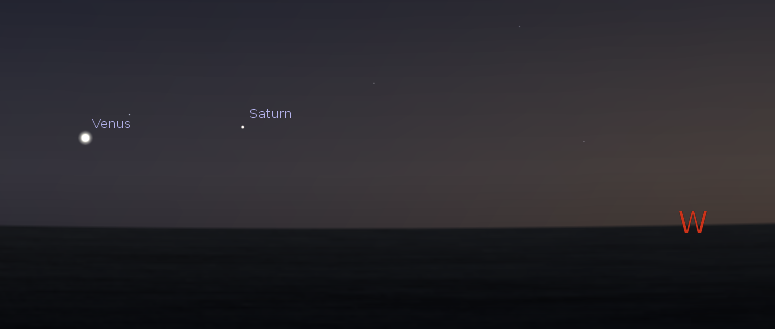
Venus and Saturn at 8:30 p.m. on September 25, 2013. Created using Stellarium.
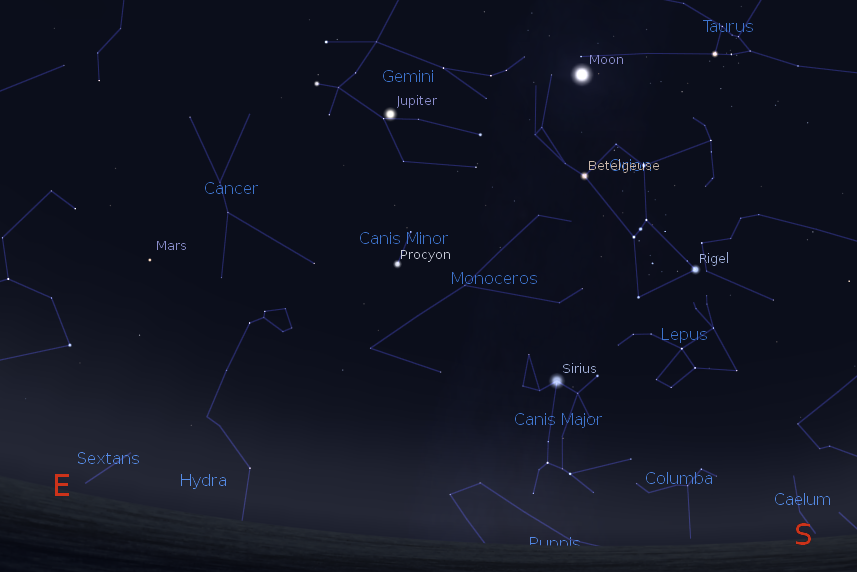
Jupiter and Mars against the winter constellations at 6 a.m., September 26, 2013. Created using Stellarium.
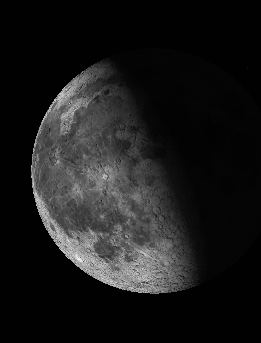
Detail of the Moon at 6 a,m. on September 26, 2013. Created using Stellarium.
09-24-2013 – Ephemeris – The dragon in the sky
Ephemeris for Tuesday, September 24th. The sun will rise at 7:32. It’ll be up for 12 hours and 3 minutes, setting at 7:35. The moon, 2 days before last quarter, will rise at 10:40 this evening.
High in the northern sky at 9 p.m. lies a twisted constellation, that of Draco the dragon. This dragon is more like the snakelike Chinese dragon than the dinosaur like dragon of European legend. At least that’s how I see it. I find it better to start at the tail of Draco, to trace him out in the stars. Draco’s tail starts between the bowl of the Big Dipper and the Little Dipper. The Dragon is seen in a line of stars that extends parallel to the handle of the Big Dipper before curving around the bowl of the Little Dipper to the east then bends back toward the west. The head of Draco is an odd box of stars near the bright star Vega, nearly overhead. Though not made up of very bright stars, Draco has an easy shape to trace.
Times are for the Traverse City/Interlochen area of Michigan. They may be different for your location.
Addendum
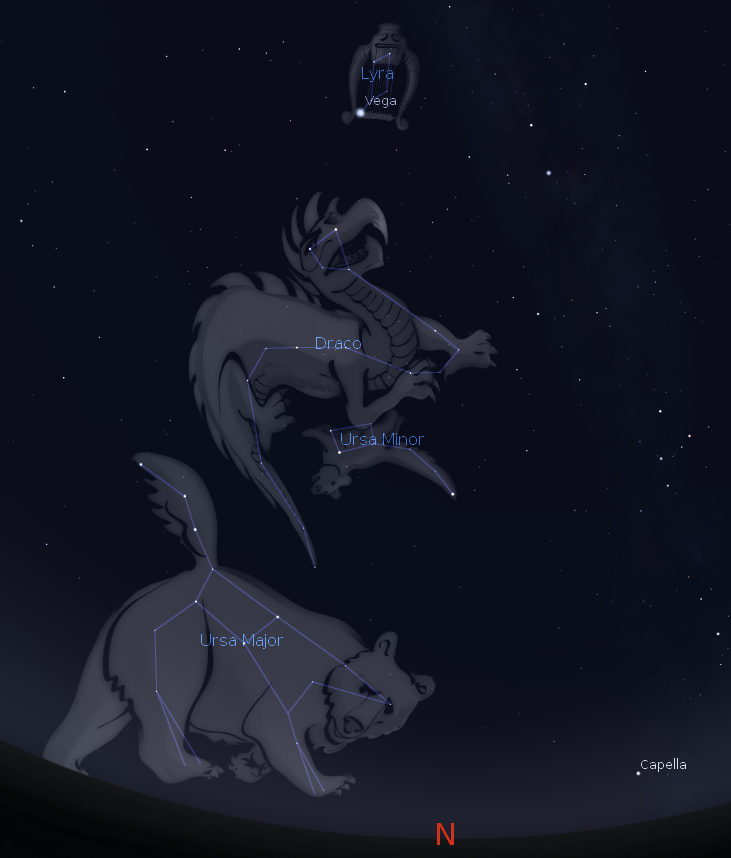
Draco and neighboring constellations at 9 .m. September 24, 2013. Created using Stellarium. Constellation art by Johan Meuris.
09/23/2013 – Ephemeris – Motions of the Moon
Ephemeris for Monday, September 23rd. The sun will rise at 7:31. It’ll be up for 12 hours and 6 minutes, setting at 7:37. The moon, 3 days before last quarter, will rise at 9:57 this evening.
The moon has two motions, as I see it in the sky. As the earth rotates, it appears to carry the moon and all the other celestial objects westward each day and night. It so happens that the earth rotates one degree in 4 minutes. The moon and sun happen to be about a half degree in size, so the will appear to move their diameters in 2 minutes. Since around here they rise and set at a 45 degree angle, more or less, the rising and setting of the moon and sun take about 3 minutes. The moon also orbits the earth. It’s orbital velocity is about 2,000 miles an hour. And since the moon is 2,160 miles in diameter, its orbital velocity moves it about its diameter in an hour against the stars. That’s why central solar eclipses last about 2 hours, One hour in and one hour out.
Times are for the Traverse City/Interlochen area of Michigan. They may be different for your location.
Addendum
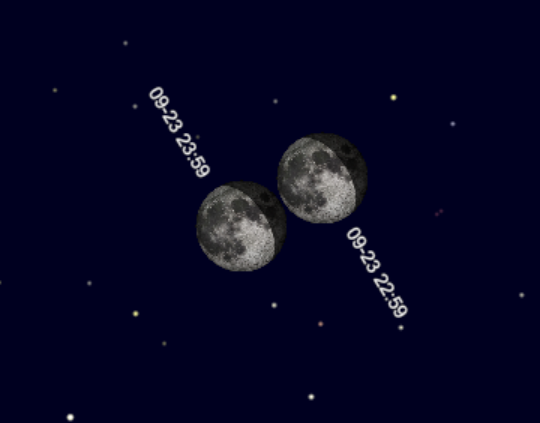
The 1 hour motion of the moon as it orbits the earth. This is for September 23, 2013. Created using Cartes duCiel (Sky Charts).
09/20/2013 – Ephemeris – The September equinox and astronomy at Fishtown
Ephemeris for Friday, September 20th. The sun will rise at 7:27. It’ll be up for 12 hours and 15 minutes, setting at 7:43. The moon, 1 day past full, will rise at 8:11 this evening.
At 4:44 in the afternoon Sunday autumn will begin. More important and sad for me is that summer will also end. Since March 20th the sun has been north of the celestial equator, shining directly over some part of the northern hemisphere tropics, but Sunday it moves south of the equator, causing sunset at the north pole and sunrise at the south pole. That point in time is called the autumnal or September equinox. In a few days daylight hours here will drop below 12 hours and keep on dropping until we near Christmas. On a brighter note: During the day Saturday, that’s tomorrow, the Grand Traverse Astronomical Society will have their telescopes down at Fishtown for the Leland Heritage Celebration, that’s 10 am to 5 p.m. in Leland Michigan.
Times are for the Traverse City/Interlochen area of Michigan. They may be different for your location.
Addendum

The Earth looking from the direction of the sun at the moment of the Autumnal Equinox, 4:44 p.m.EDT September 22, 2013. Created using Celestia.

GTAS at Fishtown in 2011.
09/19/2013 – Ephemeris – Talk like a Pirate Day and the Harvest Moon
Aye mateys this is Cap’n. Bob with Ephemeris for Talk like a Pirate Day Thursday, September 19th. Arrr. That’s the extent of it for me. The sun will rise at 7:26. It’ll be up for 12 hours and 18 minutes, setting at 7:45. The moon, at full today, will rise at 7:39 this evening.
This is the Harvest Moon, the closest full moon to the autumnal equinox, which is four days away. It is the most famous and useful of the full moons of the year. In the days before electric lights, the bright moon, rising before and just after sunset extended twilight and allowed farmers extra light to gather in the crops. It is this part of the moon’s cycle that it rises much less than the average 50 minutes later each night. It will rise only 26 minutes later tomorrow night. The moon is in a part of its orbit in which it is most rapidly moving northward and is also staying out longer each night. We will be seeing the bright moon in the early evening for the next few days.
Times are for the Traverse City/Interlochen area of Michigan. They may be different for your location.
Addendum
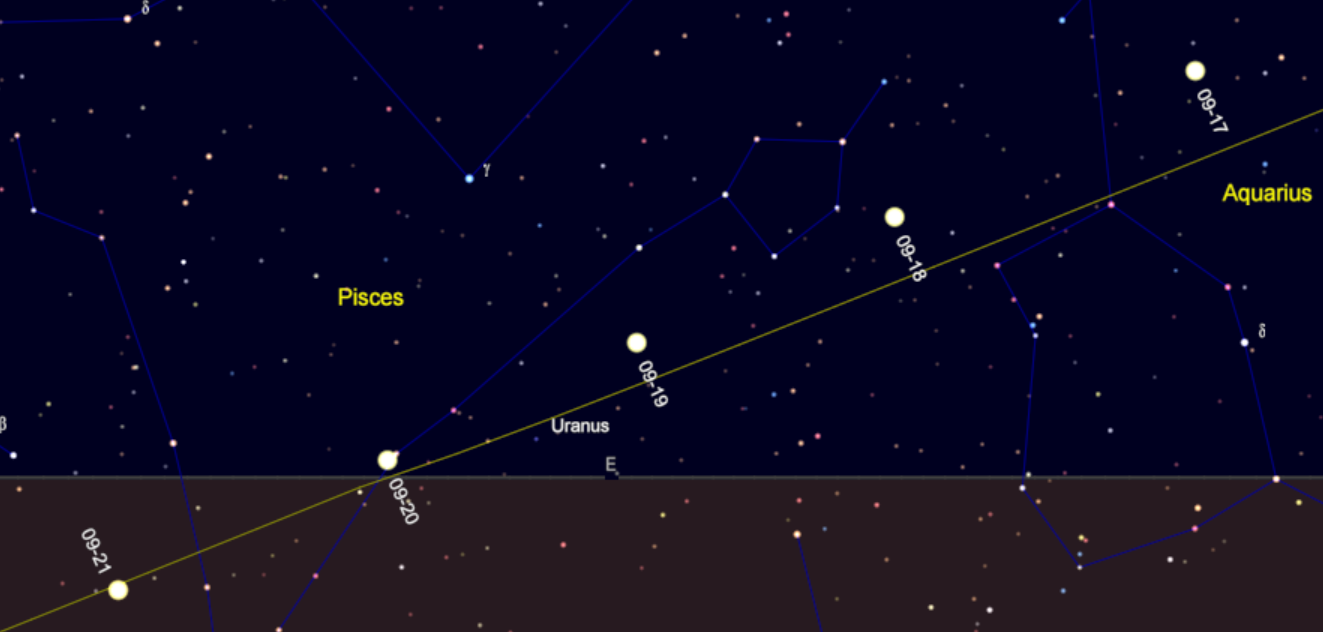
The moon on 5 nights at 8:30 p.m. for September 17 to the 21st, 2013 showing the Moon’s northerly motion. Created using Cartes duCiel.
 Bob Moler's Ephemeris Blog