Archive
07/29/2016 – Ephemeris – Aquila the Eagle, third constellation of the Summer Triangle
Ephemeris for Friday, July 29th. The Sun rises at 6:26. It’ll be up for 14 hours and 45 minutes, setting at 9:11. The Moon, 3 days past last quarter, will rise at 3:20 tomorrow morning.
Aquila the eagle is a constellation that lies in the Milky Way. It’s in the southeastern sky as it gets dark. Its brightest star, Altair is one of the stars of the Summer Triangle, a group of three bright stars seen now in the eastern sky in the evening. Altair, in the head of the eagle, is flanked by two slightly dimmer stars, the shoulders of the eagle. The eagle is flying northeastward through the Milky Way. Its wings are seen in the wing tip stars. A curved group of stars to the lower right of Altair is its tail. Within Aquila the Milky Way shows many dark clouds as part of the Great Rift that splits it here. The other summer bird is Cygnus the swan, which I talked about Tuesday, above and left of Aquila, flying in the opposite direction.
Times are for the Traverse City/Interlochen area of Michigan. They may be different for your location.
Addendum
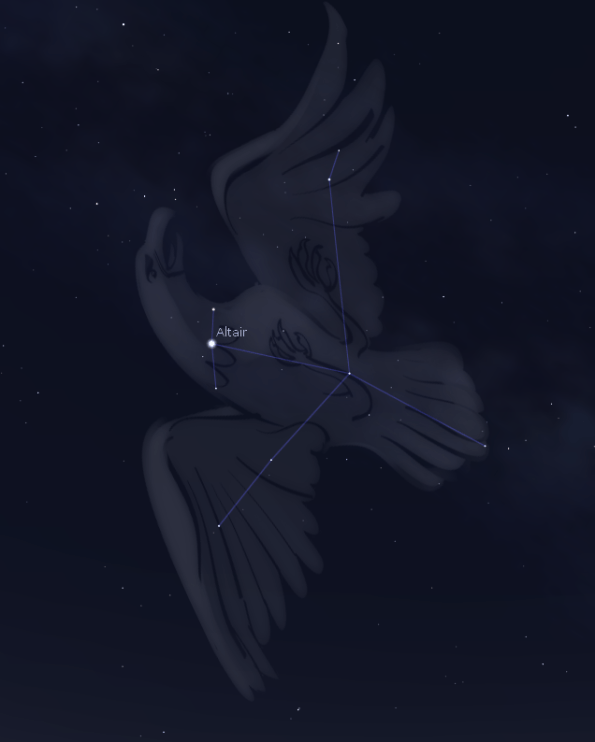
Aquila the Eagle in the southeastern sky. Created using Stellarium.
07/28/2016 – Ephemeris – Two upcoming meteor showers plus an occultation tomorrow morning
Ephemeris for Thursday, July 28th. The Sun rises at 6:25. It’ll be up for 14 hours and 47 minutes, setting at 9:12. The Moon, 2 days past last quarter, will rise at 2:31 tomorrow morning.
We have a couple of meteor showers of note coming up. The first is the Southern Delta Aquariids which will peak on the 30th. The radiant point for these meteors will rise around midnight in the southeast. Their numbers and their brightness are not very great. The Perseid meteor shower peak will have interference from the waxing gibbous moon drowning out all but the brightest meteors on the evening of August 11 and morning of he 12th. However the Perseids have a long run up to their peak, so their numbers will grow after the moon sets. The Perseid radiant is circumpolar for Northern Michigan, meaning it never sets, so some Perseid meteors can always be seen at night. Their radiant will be low in the northeastern sky in the evening and much higher in the northeast just before dawn.
Times are for the Traverse City/Interlochen area of Michigan. They may be different for your location.
Addenda
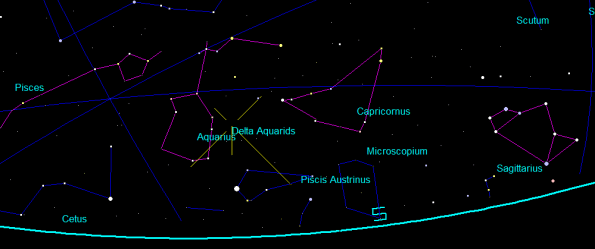
Approximate Radiant of the South Delta Aquariid meteor shower. The radiant does move over the several weeks of the shower to the east. Created using my LookingUp program.
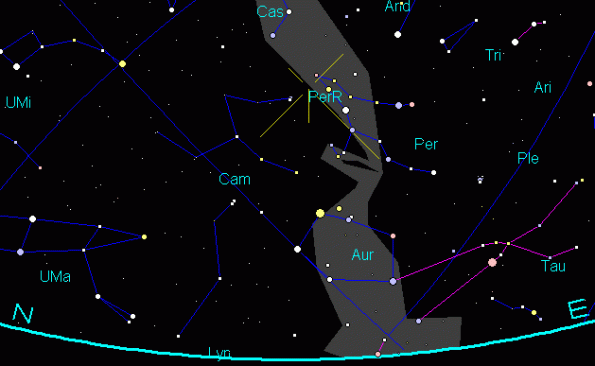
Perseid Meteor Shower radiant after midnight. Created using my LookingUp program.
Update: Occultation of Aldebaran tomorrow morning
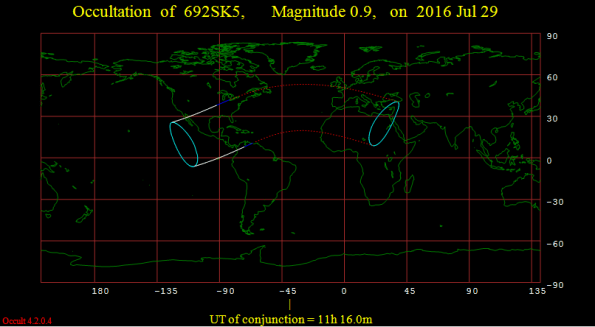
The area where the occultation of Aldebaran will be visible. The area bordered by the white lines is where the occultation will occur with the Sun below the horizon. Credit IOTA’s Occult 4 program.
There will be an occultation of Aldebaran by the Moon centered on 11:16 UT (7:16 a.m. EDT) July 29, 2016. Our area (Michigan) cannot see the event, being too far north. It will be visible south of a line containing the state of Maine down through Texas. Universe Today has information on grazing occultation possibilities: http://www.universetoday.com/129841/spectacular-aldebaran-graze-july-29/
07/27/2016 – Ephemeris – All the bright planets are now in the evening sky
Note: Mercury and Venus are in the evening sky but too low to be easily spotted, even with a Lake Michigan horizon, so I did not cover them in the program below but see the addendum.
Ephemeris for Wednesday, July 27th. The Sun rises at 6:24. It’ll be up for 14 hours and 49 minutes, setting at 9:13. The Moon, 1 day past last quarter, will rise at 1:48 tomorrow morning.
Our evening planets are moving with the stars to the west, and setting almost a half hour earlier each week. Jupiter is in the west in the evening. It will set at 11:08 p.m. Binoculars can make out some of Jupiter’s moons, but a telescope is required to see all four bright moons and Jupiter’s cloud features. Mars starts the evening in the southern sky, moving to the southwest. It’s above and right of its dimmer look-a-like star Antares, whose name means Rival of Mars. The planet will set at 1:24 a.m. The Earth is pulling ahead of Mars so it’s now 65 million miles away and tiny in telescopes. The ringed planet Saturn is low in the south. It’s to the left of Mars. Saturn will pass due south at 9:53 p.m. and will set at 2:30 a.m.
Times are for the Traverse City/Interlochen area of Michigan. They may be different for your location.
Addendum
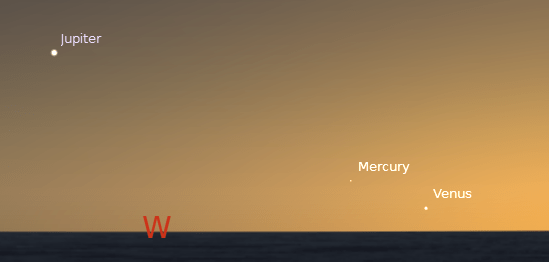
Venus, Mercury and Jupiter at 9:45 p.m. a half hour after sunset. Venus is 2 degrees above the horizon, and Mercury is 4 degrees. Created using Stellarium.
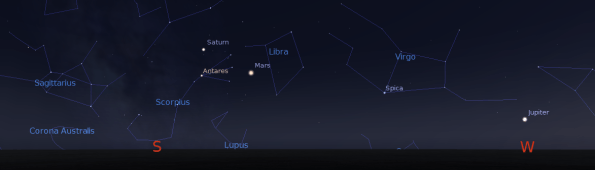
Jupiter, Mars and Saturn with the southern summer constellations at 10:30 p.m., July 27, 2016. Created using Stellarium.
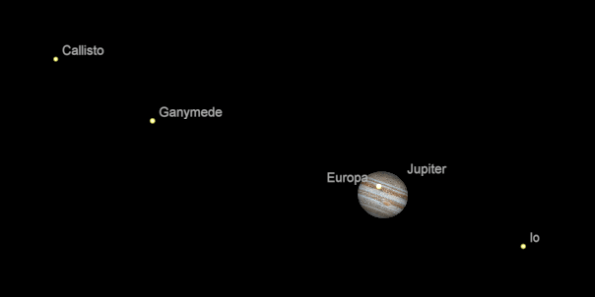
Jupiter and its Galilean moons at 10:30 p.m. July 27, 2016. Jupiter’s apparent diameter will be 32.3″. Europa will be transiting the planet, and will probably not visible. Created using Cartes du Ciel (Sky Charts).
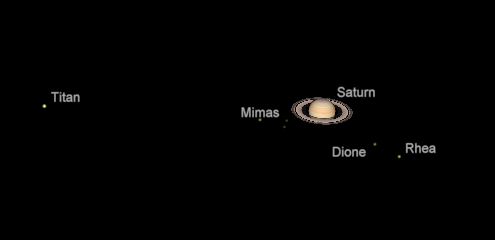
Saturn and its moons at 10:30 p.m. July 27, 2016. The apparent diameter of the planet will be 17.6″, larger than Mars’ disk. The rings span 41.1″, larger than the apparent diameter of Jupiter. Created using Cartes du Ciel (Sky Charts).
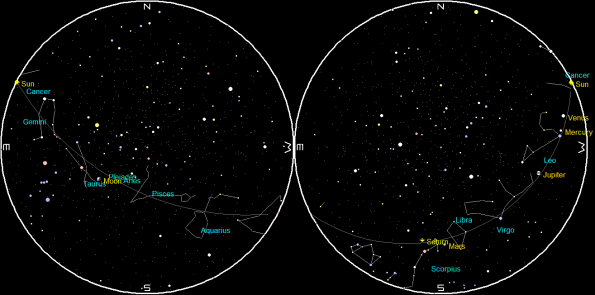
Planets at sunset and sunrise of a single night starting with sunset on the right on July 27, 2016. The night ends on the left with sunrise on July 28. If you are using Firefox right-click on the image and select View Image to enlarge the image. That goes for all the large images.
074/26/2016 – Ephemeris – The flying swan and Northern Cross
Ephemeris for Tuesday, July 26th. The Sun rises at 6:22. It’ll be up for 14 hours and 52 minutes, setting at 9:15. The Moon, at last quarter today, will rise at 1:09 tomorrow morning.
Fairly high in the east at 11 p.m. Is the constellation of Cygnus the swan, flying south through the Milky Way. It is also called the Northern Cross. At the left, the tail of the swan or the head of the cross is the bright star Deneb, one of the stars of the Summer Triangle. The next star right is Sadr the intersection of the body and the wings of the swan seen in flight, or the intersection of the two pieces of the cross. There are two or three stars farther to the right that delineate the swan’s long neck or upright of the cross, that ends with the star Alberio in the beak of the swan or foot of the cross. It takes a telescope, but Alberio splits into a beautiful blue and gold binary star.
Times are for the Traverse City/Interlochen area of Michigan. They may be different for your location.
Addendum
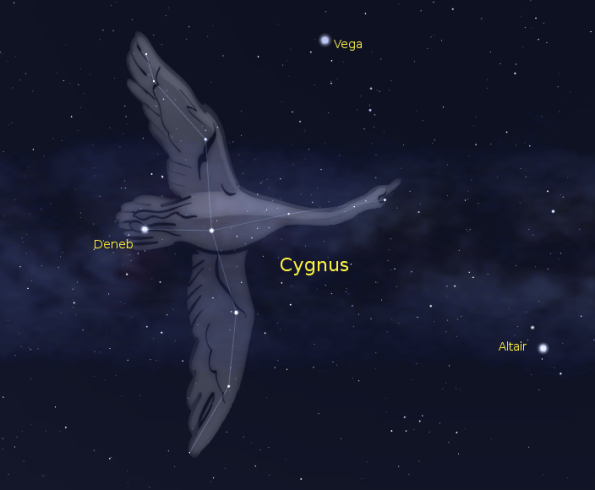
Cygnus the Swan Created using Stellarium.
07/25/2016 – Ephemeris – Hermes’ Harp
Ephemeris for Monday, July 25th. The Sun rises at 6:21. It’ll be up for 14 hours and 54 minutes, setting at 9:16. The Moon, 1 day before last quarter, will rise at 12:34 tomorrow morning.
High up in the eastern sky at 11 p.m. can be found a bright star just north of a small, narrow, but very distinctive parallelogram of stars. They are the stars of the constellation Lyra the harp. The bright star is Vega, one of the twenty-one brightest stars, first magnitude stars. Vega is actually the 5th brightest night-time star. The harp, according to Greek mythology, was invented by the Greek god Hermes. The form of the harp in the sky, is as he had invented it: by stretching strings across a tortoise shell. Hermes gave it to his half-brother Apollo, who in turn gave it to the great musician Orpheus. In binoculars, near Vega, two stars appear together. They barely appear to the unaided eye as one star, called Epsilon Lyrae.
Times are for the Traverse City/Interlochen area of Michigan. They may be different for your location.
Addendum
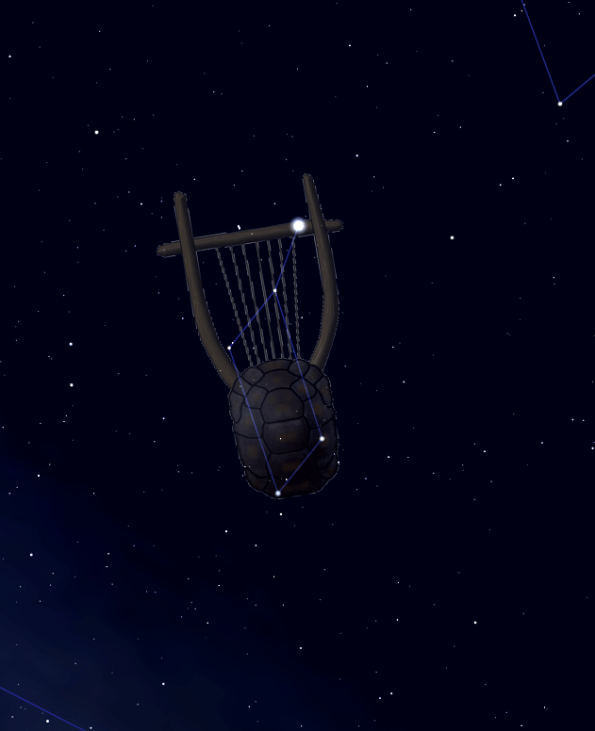
Lyra as a tortoise shell harp. Created using Stellarium and free clip art.
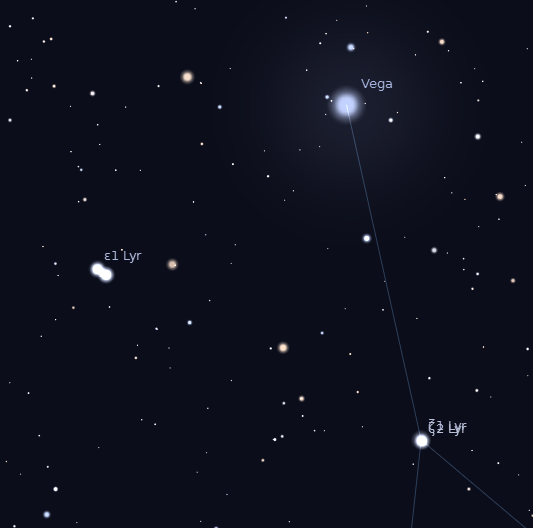
Closeup on Vega and Epsilon Lyrae. Created using Stellarium.
07/22/2016 – Ephemeris – Tomorrow is Astronomy Fest at the Sleeping Bear Dunes National Lakeshore
Ephemeris for Friday, July 22nd. Today the Sun will be up for 15 hours even, setting at 9:19, and it will rise tomorrow at 6:19. The Moon, 3 days past full, will rise at 10:55 this evening.
Tomorrow the Sleeping Bear Dunes National Lakeshore will hold its first, possibly annual, Astronomy Fest. There will be events all afternoon and evening at several locations in the park. From one to three p.m. at the Platte River Campground Amphitheater, there will be talks by Dr. Jerry Dobek, director of the Northwestern College’s Rogers Observatory and NPS Science Intern Caprice Phillips concerning dark skies and how you can help. Park Ranger Marie Scott will give her Starry night program. And yours truly will give a talk about the astronomical discoveries of the last 100 years. From 4 to 6 p.m. telescopes will be set up at the Dune Climb to view the Sun, and from 9 to 11 p.m. Telescopes will be set up at Platte River Point. to view the planets and wonders of the summer skies.
Times are for the Traverse City/Interlochen area of Michigan. They may be different for your location.
07/21/2016 – Ephemeris – This sunspot cycle is past peak
Ephemeris for Thursday, July 21st. Today the Sun will be up for 15 hours and 2 minutes, setting at 9:20, and it will rise tomorrow at 6:18. The Moon, 2 days past full, will rise at 10:20 this evening.
The Sun is on the down side in this sunspot cycle. Sunspots increase and decrease on the Sun in a roughly 11 year cycle. This sunspot cycle wasn’t a very high peak in numbers of sunspots. The peak of sunspot numbers occurred in both 2012 and 2014, an odd double peak. The peak in activity for this cycle is among the lowest since systematic observations have been recorded over the last 200 or so years. This year so far has seen 16 Sun spotless days according to SpaceWeather.com. There was none last year and only one in 2014. Coming up to this sunspot peak saw an extended period of years with mostly spotless days. The Sun is actually brighter when it has lots sunspots, than when it is not. Odd but true. In not so distant past sunspots have been missing for years.
Times are for the Traverse City/Interlochen area of Michigan. They may be different for your location.
Addendum
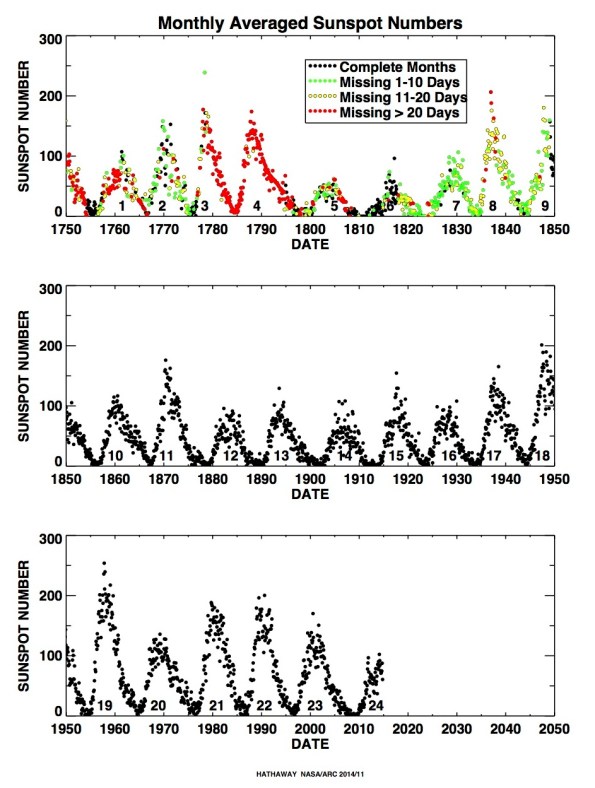
All the recorded sunspot cycles back to the 18th century. Credit: Dr. David Hathaway, NASA /ARC.
07/20/2016 – Ephemeris – The evening planets are moving with the stars to the west
Ephemeris for Wednesday, July 20th. Today the Sun will be up for 15 hours and 4 minutes, setting at 9:21, and it will rise tomorrow at 6:17. The Moon, 1 day past full, will rise at 9:42 this evening.
Our evening planets are moving with the stars to the west, and setting almost a half hour earlier each week. Jupiter is in the west in the evening. It will set at 11:33 p.m. Binoculars can make out some of Jupiter’s moons, but a telescope is required to see all four bright moons and Jupiter’s cloud features. Mars starts the evening in the southern sky, moving to the southwest. It’s above and right of its dimmer look-a-like star Antares, whose name means Rival of Mars. The planet will set at 1:46 a.m. The Earth is pulling ahead of Mars so it’s now 61 million miles away and tiny in telescopes. The ringed planet Saturn is low in the south. It’s to the left of Mars. Saturn will pass due south at 10:21 p.m. and will set at 2:58 a.m.
Times are for the Traverse City/Interlochen area of Michigan. They may be different for your location.
Addendum
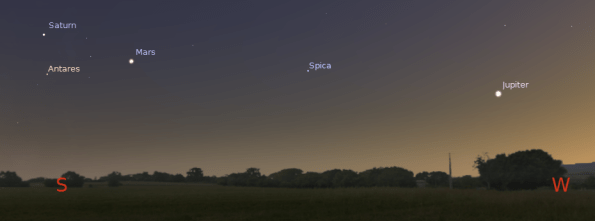
The evening planets at 10 p.m., July 20, 2016. Created using Stellarium.
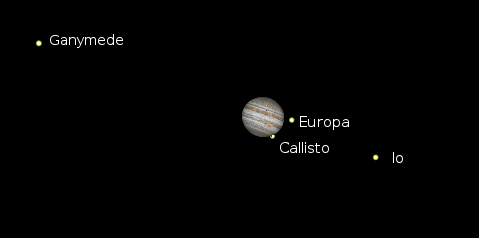
Jupiter and its Galilean moons at 10 p.m. July 20, 2016. Jupiter’s apparent diameter will be 32.7″. Callisto is about to be occulted by Jupiter at 10:08 p.m. (2:08 UT, July 21st). Created using Cartes du Ciel (Sky Charts).
Mars as it might be seen in a large telescope with high power at 10 p.m. July 20, 2016. Mars’ apparent diameter is 14.1″. The central meridian will be 25.04 degrees. Created using Cartes du Ciel (Sky Charts).
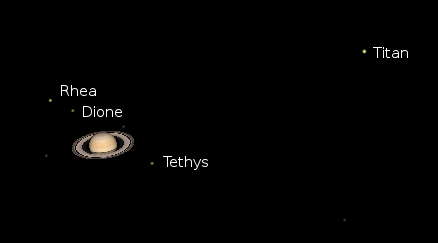
Saturn and its moons at 10 p.m. July 20, 2016. The apparent diameter of the planet will be 17.8″, larger than Mars’ disk. The rings span 41.5″, larger than the apparent diameter of Jupiter. Created using Cartes du Ciel (Sky Charts).
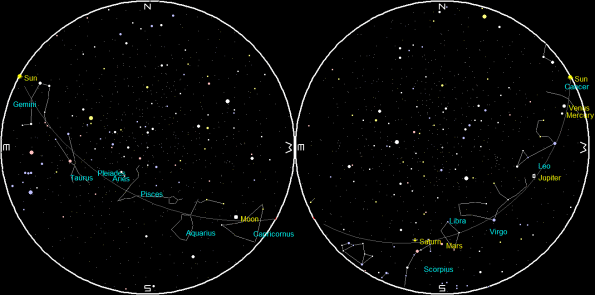
Planets at sunset and sunrise of a single night starting with sunset on the right on July 20, 2016. The night ends on the left with sunrise on July 21. If you are using Firefox right-click on the image and select View Image to enlarge the image. That goes for all the large images.
07/19/2016 – Ephemeris – The bright Moon is seen low in the summer
Ephemeris for Tuesday, July 19th. Today the Sun will be up for 15 hours and 6 minutes, setting at 9:22, and it will rise tomorrow at 6:16. The Moon, at full today, will rise at 9:00 this evening.
In the summer time the moon appears to be seen low in the south. If you can remember back six month to winter and where the bright moon was then. It was very high in the sky then. The reason for the difference in altitude of the bright moon is that the Moon follows closely the Sun’s yearly track against the stars. That track is the ecliptic, along which the constellations of the Zodiac lie. The Moon’s own orbit of the Earth departs from that by five degrees. Tonight the Moon will be about 3 degrees, or 6 Moon diameters above of north of that line. The full Moon happens to be in the same place, plus or minus up to five degrees north or south of where the Sun was 6 months ago or will be 6 months hence.
Times are for the Traverse City/Interlochen area of Michigan. They may be different for your location.
Addendum
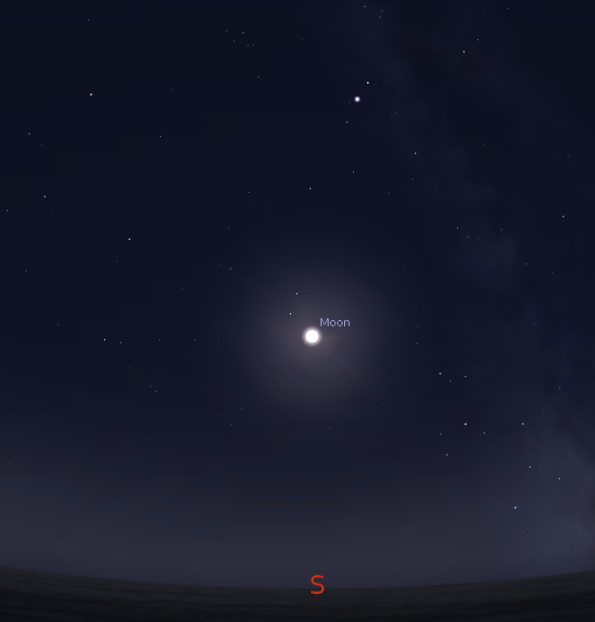
The Moon is low in the south on July 20, 2016. Created using Stellarium.
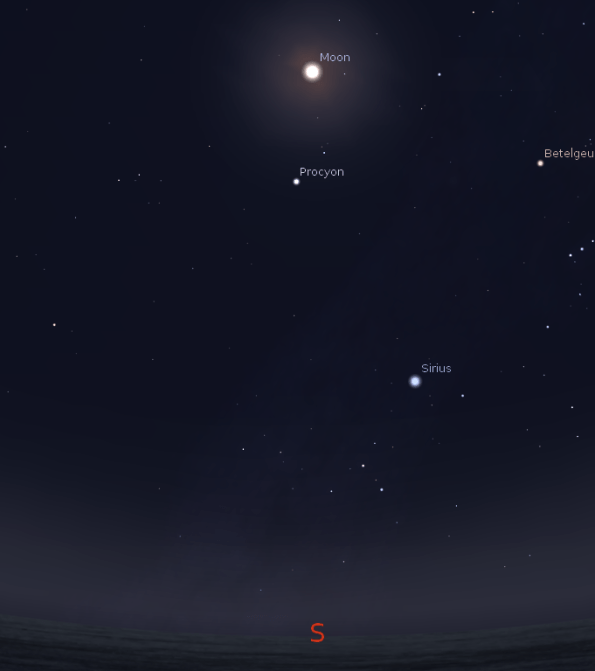
The Moon is high in the south on January 23, 2016. Created using Stellarium.
These images are the same scale.
07/18/2016 – Ephemeris – A second gravitational wave detection and new thoughts about dark matter
Ephemeris for Monday, July 18th. Today the Sun will be up for 15 hours and 8 minutes, setting at 9:22, and it will rise tomorrow at 6:15. The Moon, 1 day before full, will set at 6:04 tomorrow morning.
A couple of weeks ago a second gravitational wave event was reported. This one was detected on December 26th last year. Scientists determined that it came from the collision of a 14 and a 8 solar mass black holes resulting in a 21 solar mass black hole with one solar mass loss as gravitational wave energy. The event happened 1.5 billion light years away. Some scientists at NASA are speculating that, since no particles with the exotic properties of dark matter have been discovered that this matter might be primordial black holes, created at the time of the Big Bang itself. These primordial black holes can also help solve some other problems of the evolving early universe.
Times are for the Traverse City/Interlochen area of Michigan. They may be different for your location.
Addendum
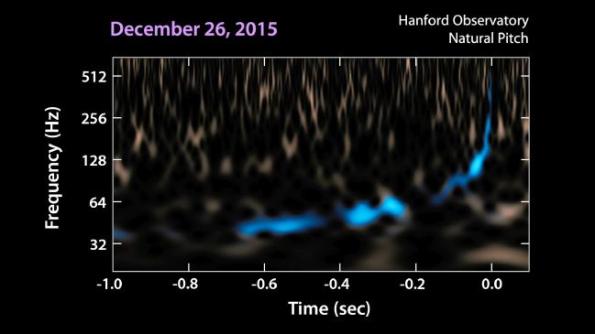
Gravitational wave signal in blue of the December 26, 2015 detection of the second gravitational wave event.
 Bob Moler's Ephemeris Blog