Archive
03/15/2019 – Ephemeris – The era of US crewed space launches begins
Ephemeris for Ides of March, Friday, March 15th. Today the Sun will be up for 11 hours and 53 minutes, setting at 7:48, and it will rise tomorrow at 7:53. The Moon, 1 day past first quarter, will set at 5:07 tomorrow morning.
Two weeks ago, the United States began to get back in the human space launch business with the launch of a test Crew Dragon space capsule on a Falcon 9 rocket, all made by SpaceX. The 6 day mission to dock with the International Space Station and then return to the Earth was an apparent success as everything appeared to go smoothly. After a successful in-flight abort test with the same capsule in a few months, another test with a crew will be flown. Boeing’s Starliner capsule is not far behind with a possible uncrewed launch in April. Both companies have abort tests to get behind them before crews can be launched. SpaceX is expected to launch a crew as early as June.
The times given are for the Traverse City/Interlochen area of Michigan. They may be different for your location.
Addendum
NASA
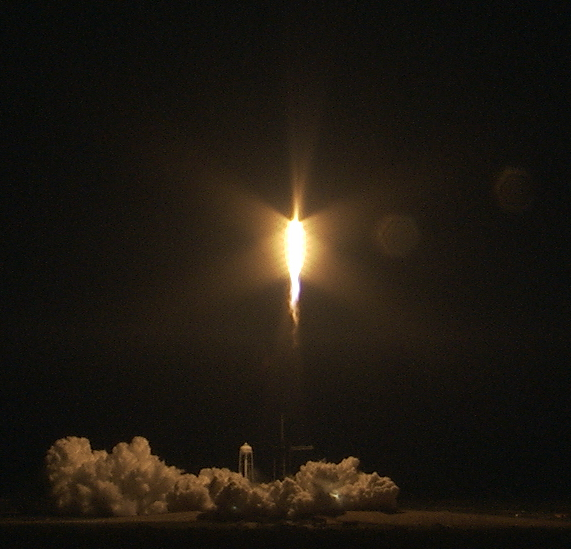
SpaceX Falcon 9 Crew Dragon Demo-1 liftoff. Credit NASA.
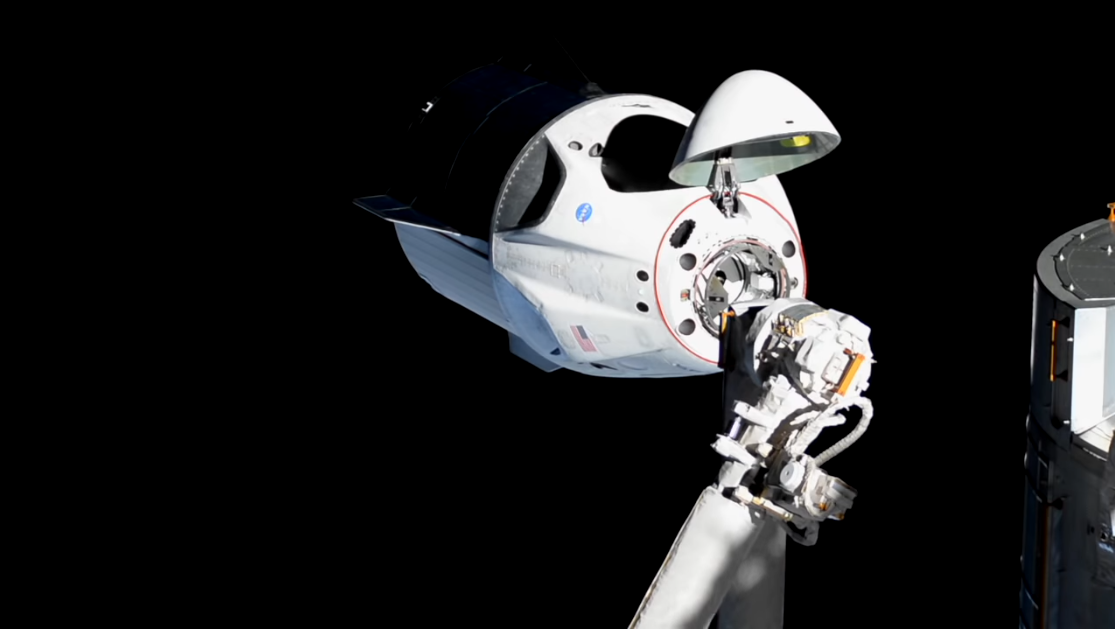
NASA-SpaceX Demo-1 Screen Cap of docking at the ISS. Credit NASA.
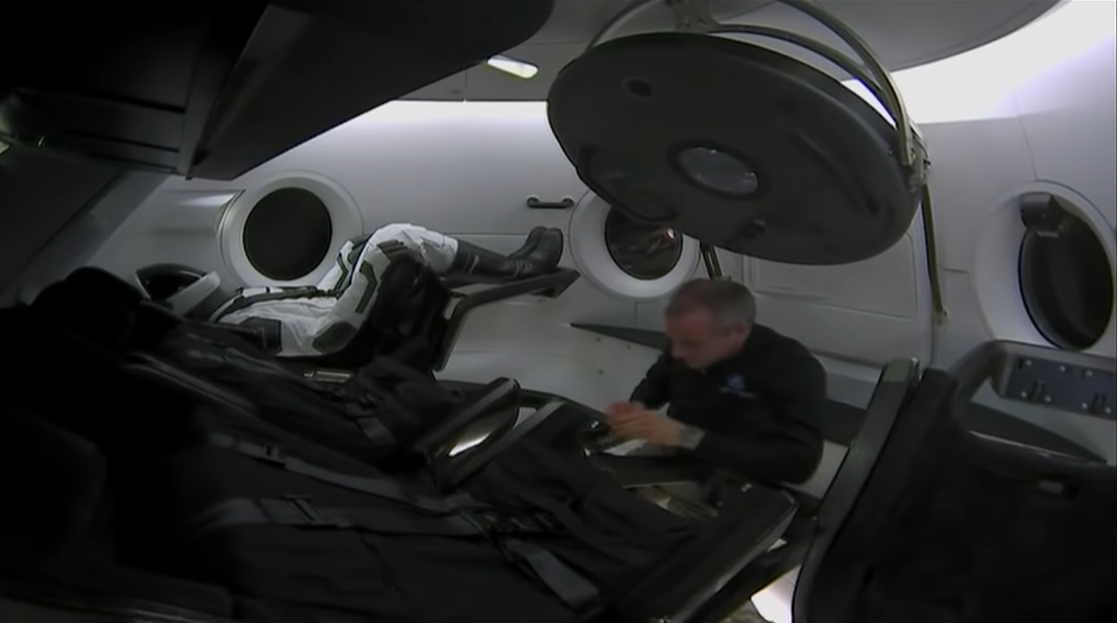
Inside the SpaceX Crew Dragon with Canadian astronaut David Saint-Jacques. Credit NASA/SpaceX.

NASA-SpaceX Demo-1 Crew Dragon Capsule splashdown in the Atlantic. Credit NASA/SpaceX.
03/14/2019 – Ephemeris – Happy Pi Day
Ephemeris for Pi Day, Thursday, March 14th. Today the Sun will be up for 11 hours and 49 minutes, setting at 7:47, and it will rise tomorrow at 7:55. The Moon, at first quarter today, will set at 4:09 tomorrow morning.
Pi day: the first three digits of the mathematical constant π is 3.14 the ratio of a circle’s circumference to its diameter, so March 14th is Pi day. Why do we use the Greek letter pi? Pi is the first letter of the Greek word perimetros which means circumference. The first Pi Day was celebrated in 1988, organized by Larry Shaw at San Francisco’s Exploratorium. There are other lass known pi related days on the calendar. The fraction used in pi approximations is 22/7ths. So July 22nd is Pi Approximation Day. In many formulae π is multiplied by two, or 2π. 2π to two decimal places is 6.28, so it’s Two Pi Day or Tau (τ) Day, June 28th. So whether you like apple, cherry, or pumpkin, have a happy Pi day. https://www.piday.org/pi-facts/
The times given are for the Traverse City/Interlochen area of Michigan. They may be different for your location.
Addendum

Credit http://www.piday.org.
Check out https://www.piday.org/pi-facts/ for more information on pi.
03/13/2019 – Ephemeris – Let’s find the bright planets for this week
Ephemeris for Wednesday, March 13th. Today the Sun will be up for 11 hours and 46 minutes, setting at 7:46, and it will rise tomorrow at 7:57. The Moon, 1 day before first quarter, will set at 3:06 tomorrow morning.
Let’s look at the planets for this week. We are back to one evening planet visible now. Mars will be in the west-southwestern sky this evening and will set at 12:39 a.m. Mars is fading as the Earth, in its inner and faster orbit is leaving Mars behind at 175 million miles (282 million km) away. In the morning sky we have Jupiter which will rise tomorrow at 3:20 a.m. in the east-southeast It is second to Venus in brightness. Saturn will be next to rise at 5:06 a.m., also in the east-southeast It will be to the upper right of Venus which will rise at 6:30 a.m. By 7 in the morning they will be strung out from the southeast to the south. They will be a beautiful sight as morning twilight advances.
The times given are for the Traverse City/Interlochen area of Michigan. They may be different for your location.
Addendum
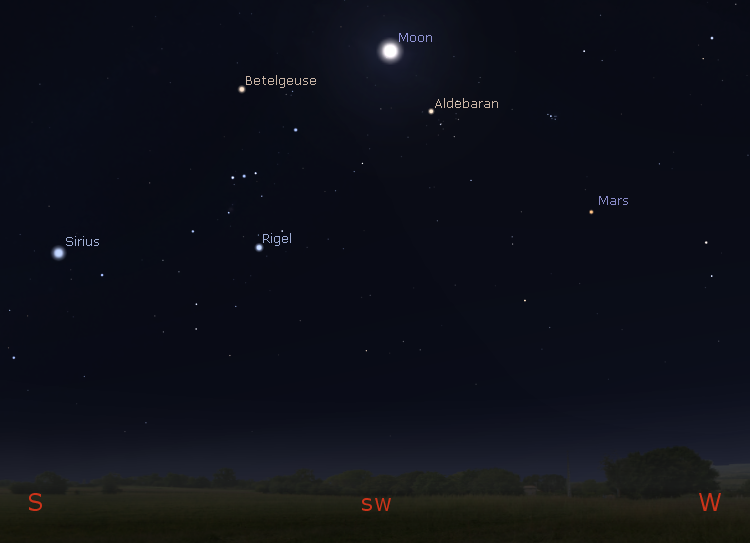
Mars and the Moon with the brighter stars at 9 p.m. March 13, 2019. Created using Stellarium.
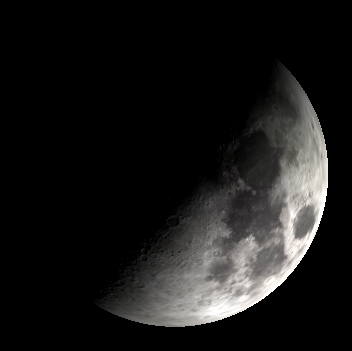
The Moon as it might appear in binoculars or a small telescope tonight at 9 p.m. March 13, 2019. Created using Stellarium.
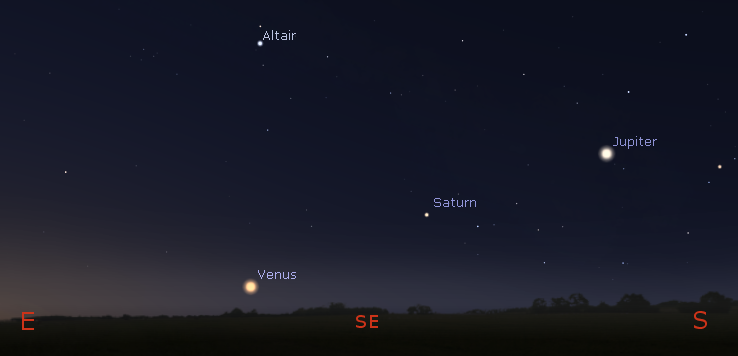
Morning planets and the constellations at 7 a.m. Tomorrow March 14, 2019. Click on the image to enlarge. Created using Stellarium.
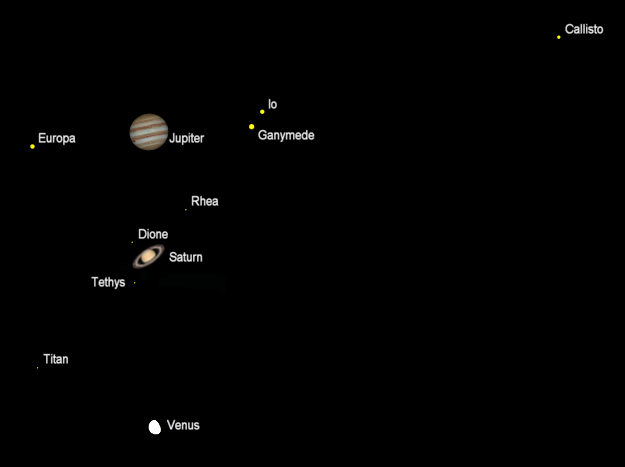
Jupiter, Saturn and Venus with the same magnification at 7 a.m. tomorrow morning March 14, 2019. Created using Cartes du Ciel (Sky Charts).
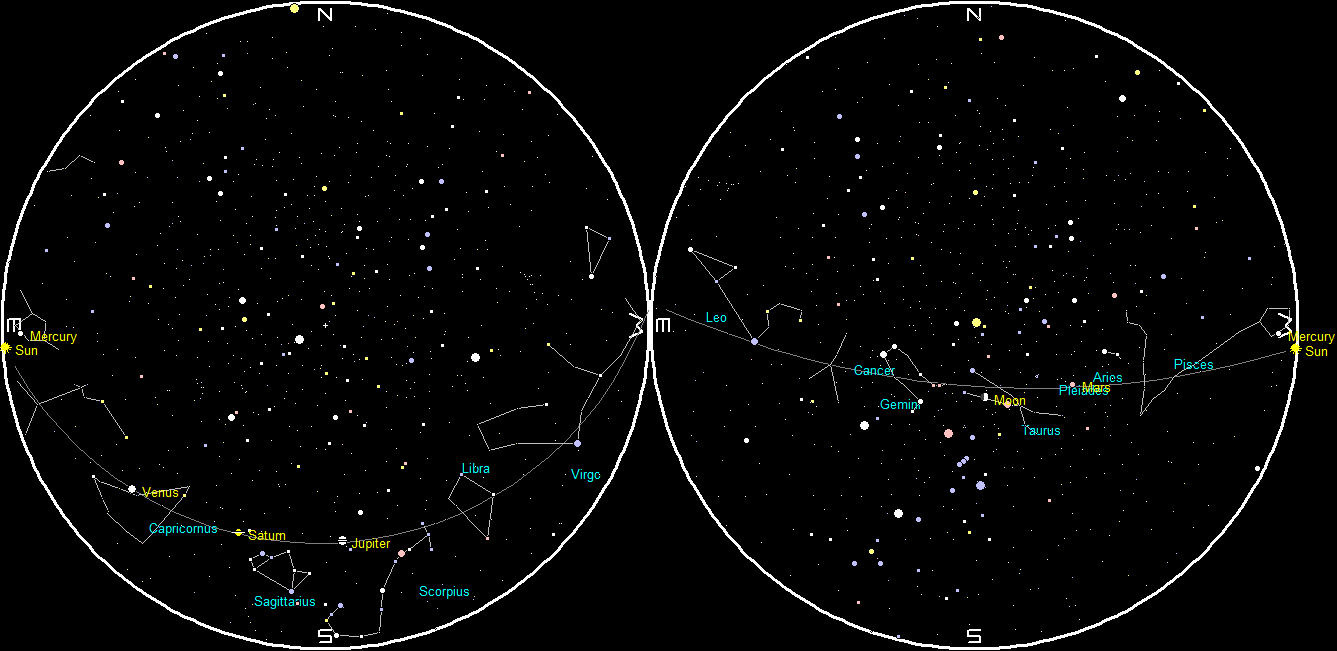
Planets and the Moon at sunset and sunrise of a single night starting with sunset on the right on March 13, 2019. The night ends on the left with sunrise on the 14th. Click on the image to enlarge. Created using my LookingUp program.
03/12/2019 – Ephemeris – Does the Moon rotate?
Ephemeris for Tuesday, March 12th. Today the Sun will be up for 11 hours and 43 minutes, setting at 7:44, and it will rise tomorrow at 7:59. The Moon, 2 days before first quarter, will set at 2:00 tomorrow morning.
Since we see only one face of the Moon throughout the month does that mean that the Moon doesn’t rotate? It doesn’t appear to rotate with respect to the Earth, but the Moon rotates through all the stars and constellations of the zodiac in a 27.32 days. That’s called a sidereal month. The lunar month we’re more familiar with is the synodic month, or lunation, that lasts 29.53 days which is the interval between new moons. It is the basis of the Jewish and Islamic calendars. The reason for the locking of the Moon’s rotation and revolution of the Earth, also called synchronous rotation, is the tidal pull of each on the other. The Earth has managed to slow the Moon’s rotation to match its revolution. The Moon is trying to do the same to the Earth with much less success, though every year or two a second is added to the time stream, UTC1 or Greenwich Mean Time, due to the slowing of the Earth’s rotation.
The times given are for the Traverse City/Interlochen area of Michigan. They may be different for your location.
Addendum
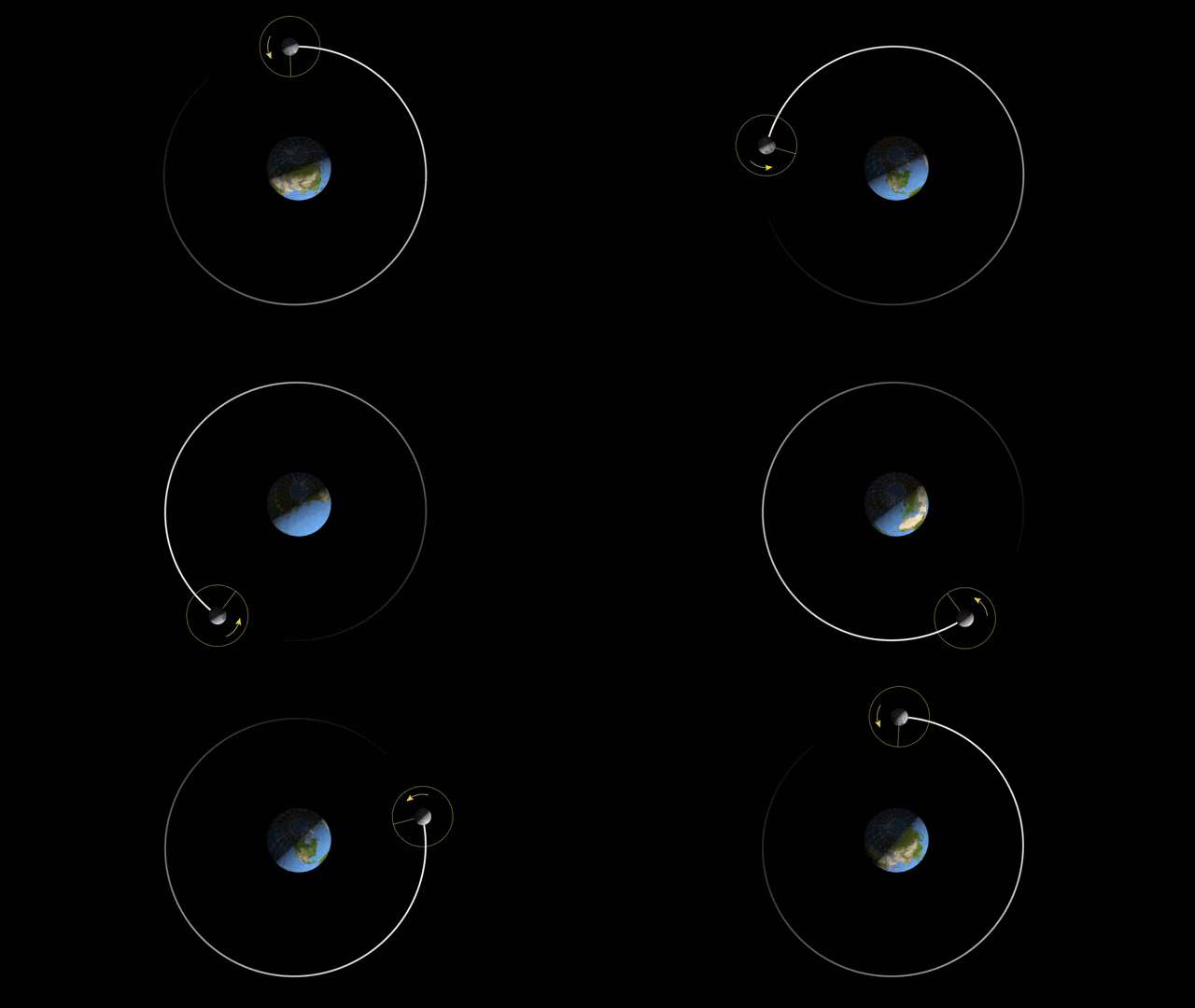
Animation of the Moon orbiting the Earth showing the Moon’s rotation. Credit: NASA’s Scientific Visualization Studio/Ernie Wright, modified and converted to GIF by Bob Moler.
NASA’s Scientific Visualization Studio web page where I got the original for the above video.
03/11/2019 – Ephemeris – The Moon: Dark side, far side, which is it?
Ephemeris for Monday, March 11th. Today the Sun will be up for 11 hours and 40 minutes, setting at 7:43, and it will rise tomorrow at 8:01. The Moon, 3 days before first quarter, will set at 12:54 tomorrow morning.
Tonight the Moon is at its crescent phase, meaning it is slightly closer to the Sun than the Earth is. Most of the Moon we see is in night. Some earth shine may be seen on its night side due to the big nearly full Earth shining on it. I get ticked sometimes when someone who knows better, especially in the media, mentions the dark side of the Moon when they should use the term far side, the part of the Moon that permanently faces away from the Earth. When the Chinese Chang’e 4 spacecraft landed on the far side of the Moon recently many headlines proclaimed that it landed on the dark side of the Moon. The Moon has a night side, as does the Earth, but that changes as the Moon rotates in the sunlight. And the Moon does rotate. It happens to be in sync with its revolution about the Earth.
The times given are for the Traverse City/Interlochen area of Michigan. They may be different for your location.
Addendum
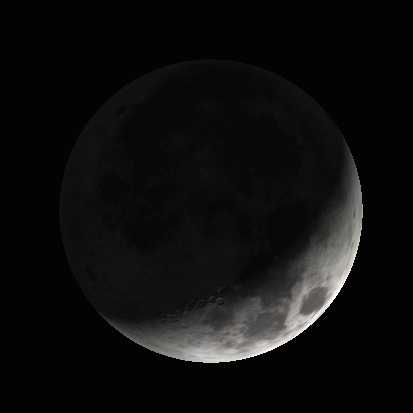
The crescent Moon tonight at 9 p.m. EDT, March 11, 2019. Created using Stellarium.
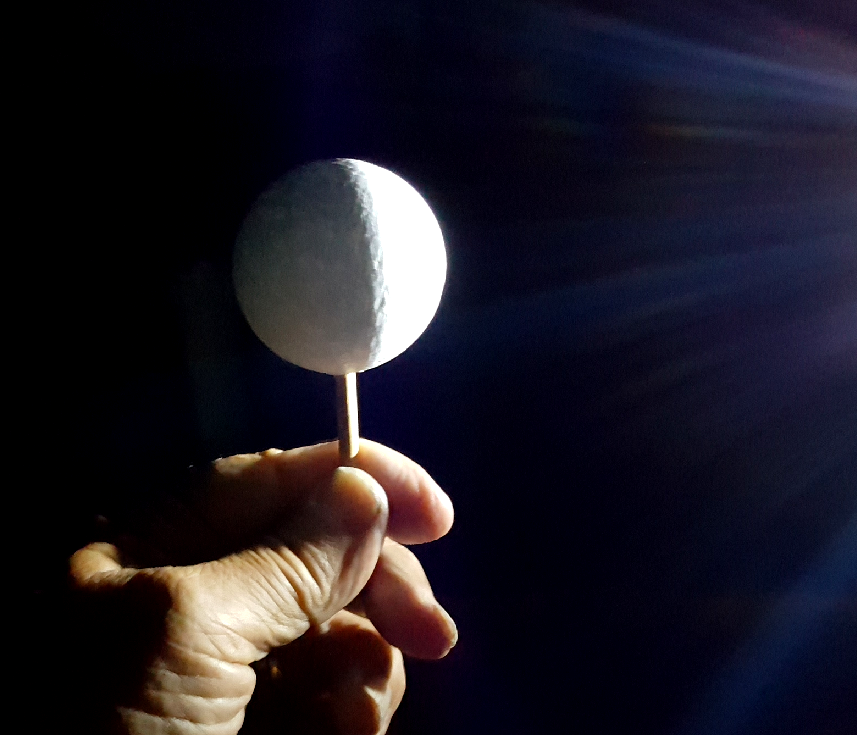
Demonstration of the Moon’s crescent phase with the Styrofoam moon ball we use for Project Astro held up to a light off frame to the right. The night side of the ball is illuminated a bit by the translucency of the ball, and the reflection off my hand. Note the roughness of the ball is visible only at the terminator.
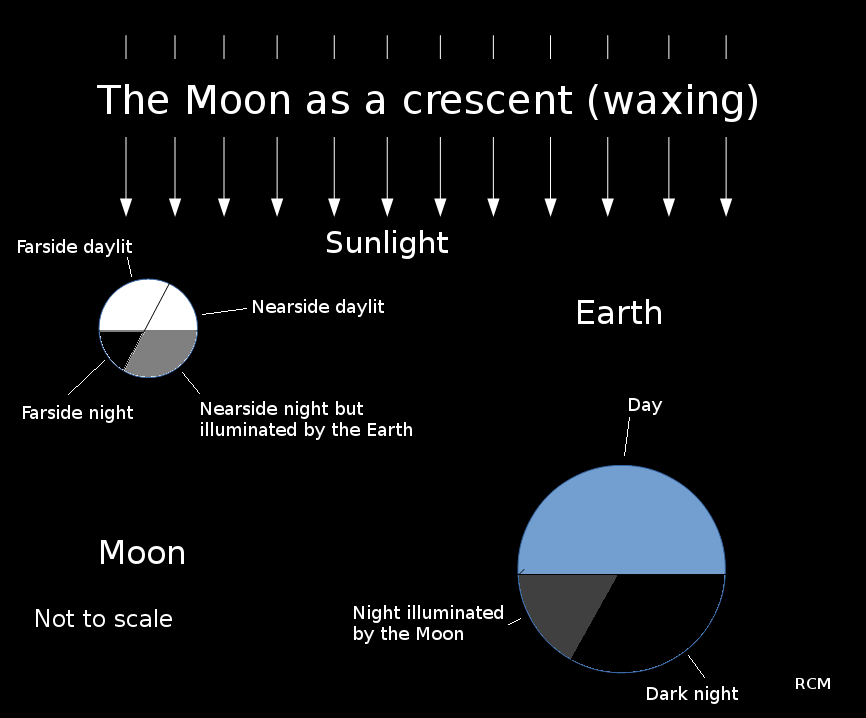
The Earth and Moon if seen as a crescent, near side, far side, sunlit side and earth shine. Credit: me.
03/08/2019 – Ephemeris – International Women’s Day
Ephemeris for International Women’s Day, Friday, March 8th. Today the Sun will be up for 11 hours and 31 minutes, setting at 6:39, and it will rise tomorrow at 7:06. The Moon, 2 days past new, will set at 8:43 this evening.
On this International Women’s Day let’s take a look in my favorite fields of astronomy and space. There’s Hypatia of Alexandria who was murdered by an ignorant mob in 415 AD, Caroline Herschel sister to William Herschel and among other things discovered 8 comets, Maria Mitchell, whose comet discovery rocketed her to fame in the United States in the 1800s, Annie Jump Cannon, who classified stars, Henrietta Leavitt who found how to find distances to far away galaxies, and Vera Rubin who helped discover dark matter. In space there’s Sally Ride, Mae Jamison, and Peggy Whitson, who holds the American space flight time, and EVA time records regardless of gender. And that’s just scratching the surface.
The times given are for the Traverse City/Interlochen area of Michigan. They may be different for your location.
Addendum
Ten female astronomers everyone should know: https://www.mnn.com/leaderboard/stories/10-female-astronomers-everyone-should-know.
My favorite astronomer on Twitter is astrophysicist Dr. Katherine J Mack @AstroKatie.
03/07/2019 – Ephemeris – Leo the lion rising
Ephemeris for Thursday, March 7th. Today the Sun will be up for 11 hours and 28 minutes, setting at 6:38, and it will rise tomorrow at 7:08. The Moon, 1 day past new, will set at 7:42 this evening.
Tonight as twilight fades around 8 p.m. the constellation of Leo the lion can be seen rising in the east. The head and mane of a male lion is seen as a backward question mark. This pattern of stars is also called the sickle. The bright star that is the dot at the bottom is Regulus, the “Little King Star”. To the lower left is a triangle of stars that is the lion’s hind end with the star Denebola at the far end. It is said that the reason the figure of a lion came to be seen in the stars here is because lions came from the desert, driven by the heat, to drink from the river Nile the time of the year that the sun was in this part of the sky. Leo can also be found by first locating the Big Dipper high in the northeast, a hole in its bowl drips on Leo.
The times given are for the Traverse City/Interlochen area of Michigan. They may be different for your location.
Addendum
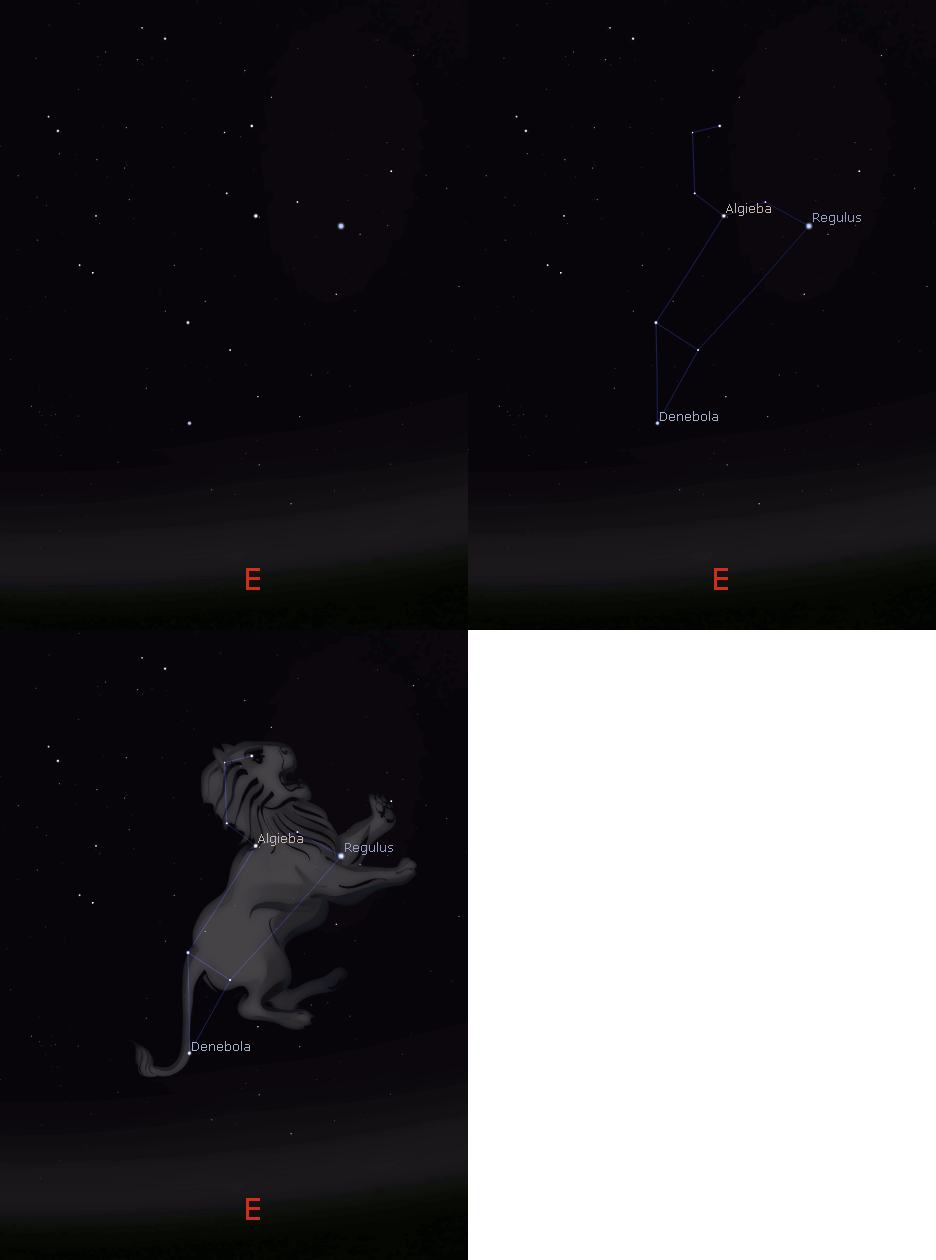
The constellation Leo rising animation. Created using Stellarium and GIMP.
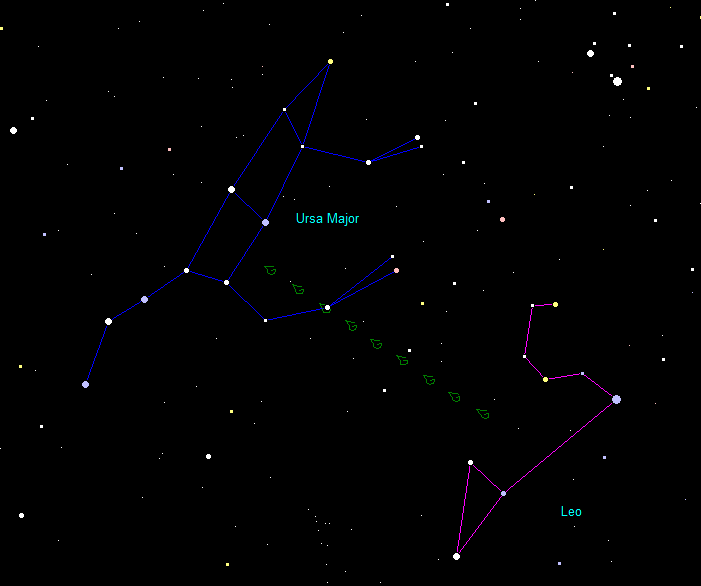
Finding Leo from the Big Dipper: Leaky Big Dipper drips on Leo. Created using my LookingUp program.
03/06/2019 – Ephemeris – Looking at the bright naked eye planets for this week
Ephemeris for Ash Wednesday, March 6th. Today the Sun will be up for 11 hours and 25 minutes, setting at 6:36, and it will rise tomorrow at 7:10. The Moon is new today, and won’t be visible.
Let’s look at the planets for this week. We have two evening planets visible now. Tiny and elusive Mercury is really hard to spot low in the west from about 7 p.m. until it sets at 7:52 p.m. It is fading fast. Binoculars are the only way to spot it now. Mars will be in the west-southwestern sky this evening and will set at 11:42 p.m. Mars too is fading. In the morning sky we have Jupiter which will rise tomorrow at 2:45 a.m. It is second to Venus in brightness. Saturn will be next to rise at 4:32 a.m. It will be to the upper right of Venus which will rise at 5:32 a.m. tomorrow. By 6 in the morning they will be string out from the southeast to the south. They will be a beautiful sight as morning twilight advances.
The times given are for the Traverse City/Interlochen area of Michigan. They may be different for your location.
Addendum
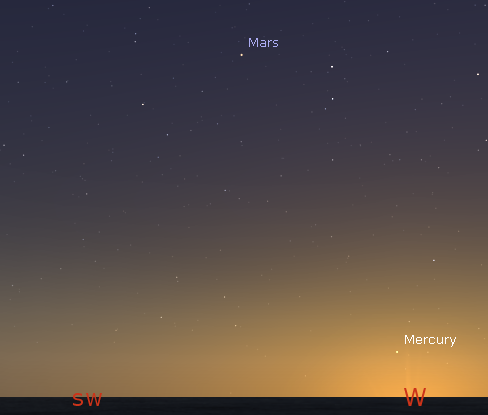
Mars and Mercury at 7:15 p.m. tonight March 6, 2019. I had to increase the star and planet brightness to make Mercury appear in the bright twilight because it has dropped to second magnitude. Created using Stellarium.
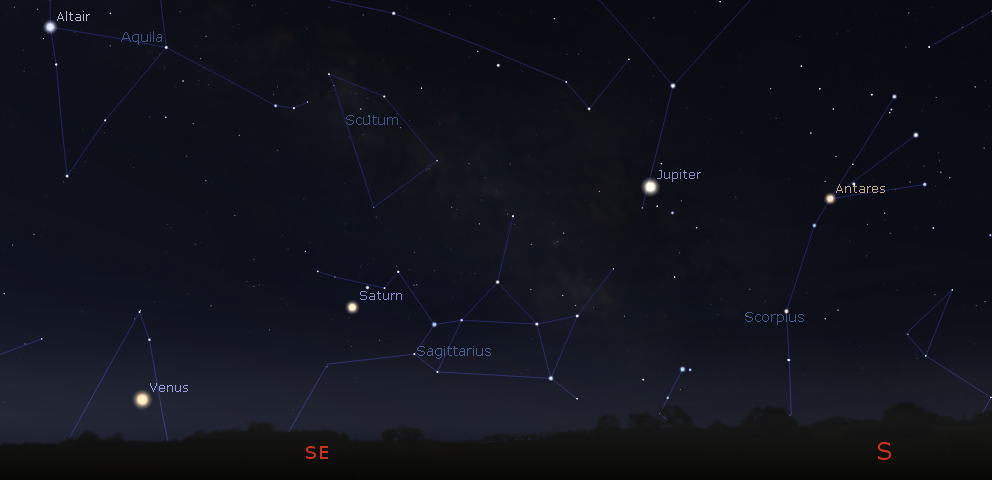
Morning planets and the constellations at 6 a.m. Tomorrow March 7, 2019. Click on image to enlarge. Created using Stellarium.
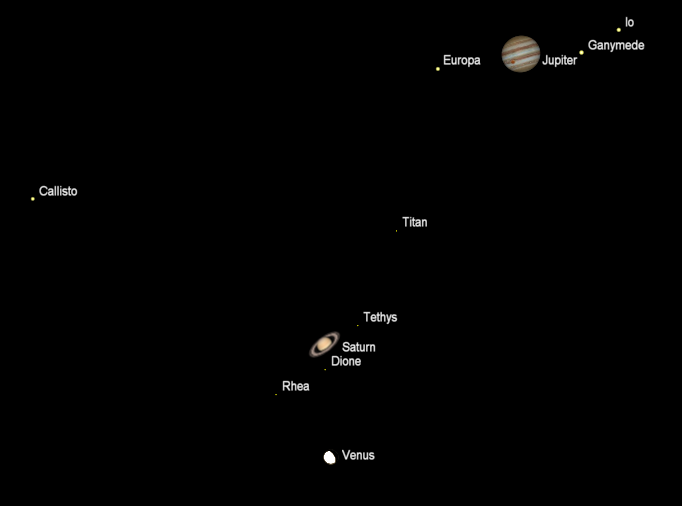
Jupiter, Saturn and Venus with the same magnification at 6 a.m. tomorrow morning March 7, 2019. Created using Cartes du Ciel (Sky Charts).
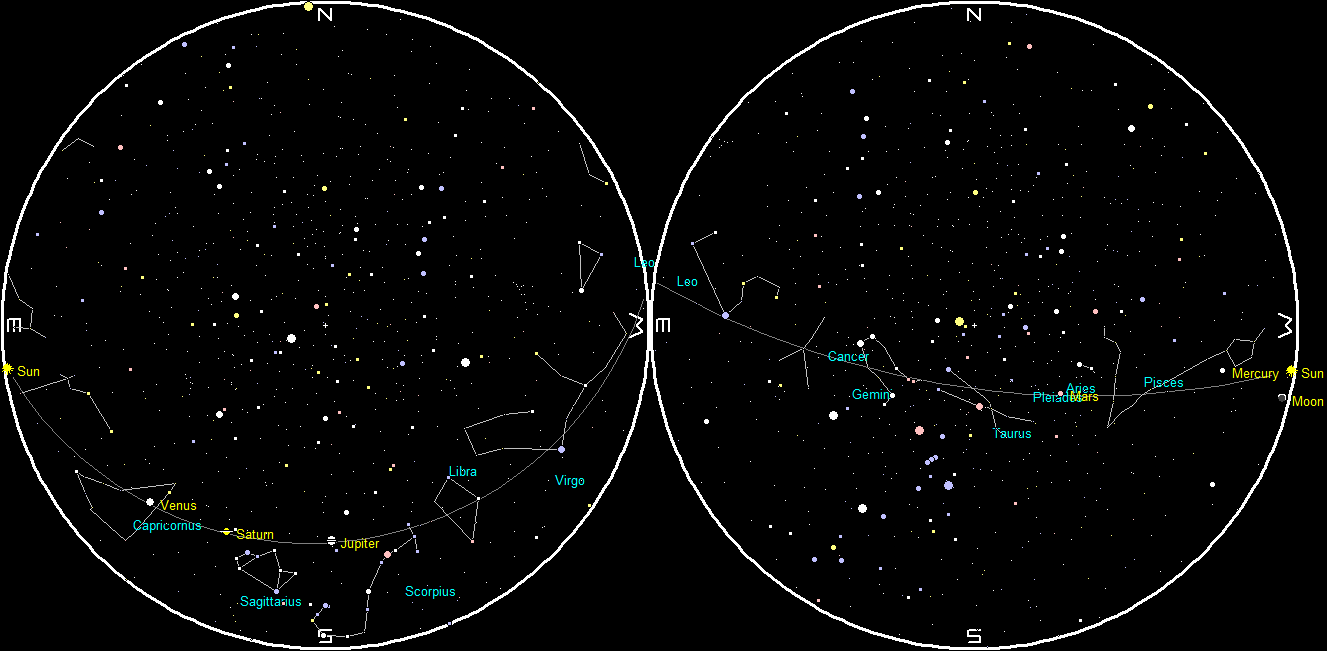
Planets and the Moon at sunset and sunrise of a single night starting with sunset on the right on March 6, 2019. The night ends on the left with sunrise on the 7th. Click on the image to enlarge. Created using my LookingUp program.
03/05/2019 – Ephemeris – The Big Dipper rising in the east
Ephemeris for Fat Tuesday, March 5th. Today the Sun will be up for 11 hours and 21 minutes, setting at 6:35, and it will rise tomorrow at 7:11. The Moon, 1 day before new, will rise at 7:33 tomorrow morning.
While Orion and the stars of winter are still holding forth in the south the Big Dipper is sneaking up in the northeast. Indeed at 8 p.m. the front stars of the dipper’s bowl are half way up the sky, at the same altitude of Polaris the North Star. To the Anishinaabe native peoples of this region the Big Dipper wasn’t part of a bear, it was the hind end of the Fisher, Ojiig in their language. The Fisher, a magical animal of their legends, a weasel-like animal brought warm seasons to the Earth, and serves as a weather indicator. As he climbs the sky in the east he is signaling spring and the maple sugaring season. The Big Dipper is also a pointer to some of the important stars and constellations of spring.
The times given are for the Traverse City/Interlochen area of Michigan. They may be different for your location.
Addendum
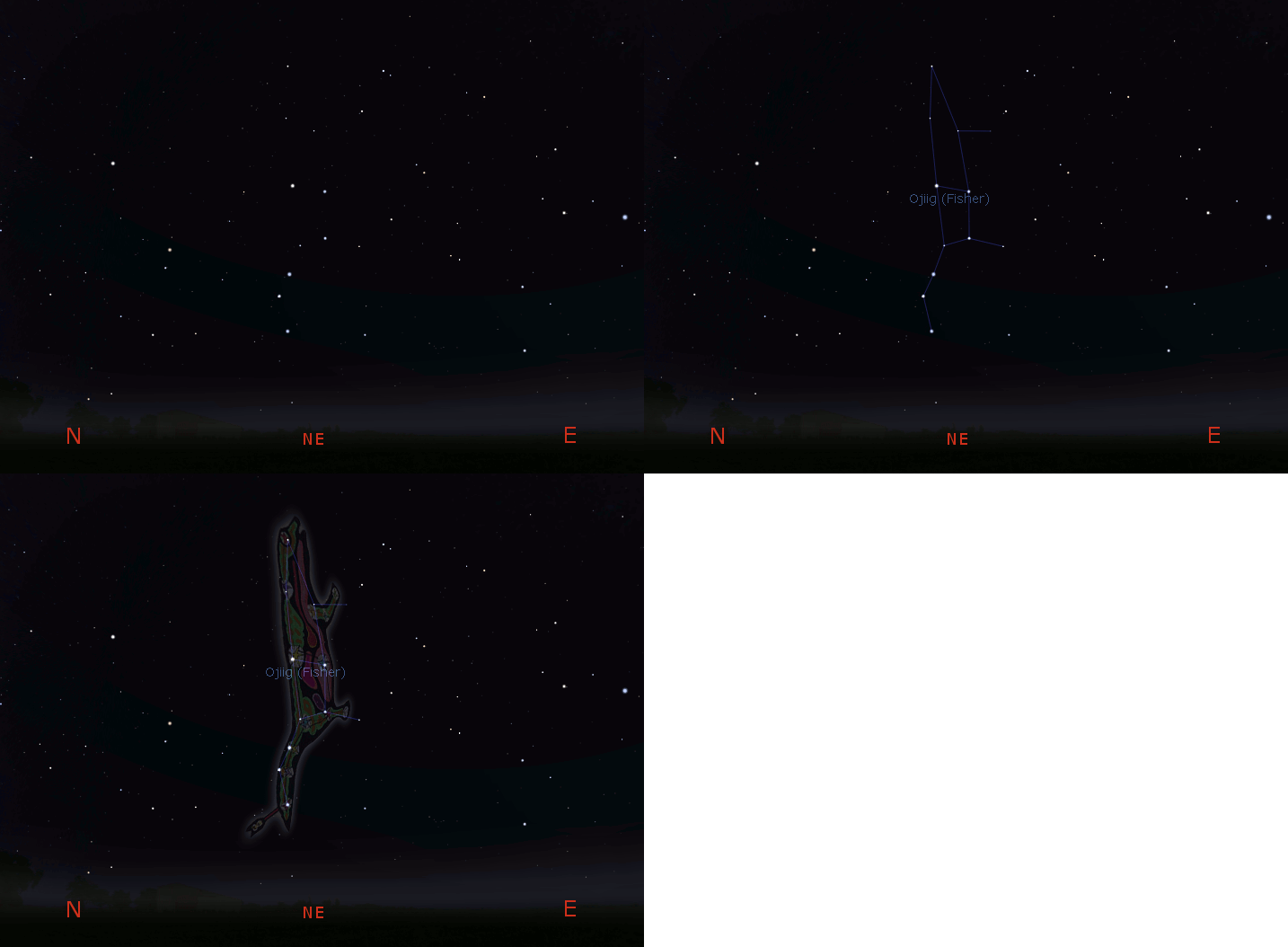
The Big Dipper, as Ojiig the Fisher of the Anishinaabe people rising higher in the northeast at 8 p.m. March 5, 2019. Created using Stellarium.
The Anishinaabe constellation drawing of the Fisher is from Ojibwe Sky Star Map Constellation Guide by Annette S. Lee, William Wilson, Jeffrey Tibbets and Carl Gawboy available locally and online. They are part of the latest editions of Stellarium, a free planetarium program. Links to it are on the right. Other information and links are available within the Sky Lore tab.
My story of the Fisher is here: https://bobmoler.wordpress.com/2012/10/11/the-story-of-the-fisher-star/
03/04/2019 – Ephemeris – Zodiacal light is especially visible this time of year
Ephemeris for Monday, March 4th. Today the Sun will be up for 11 hours and 18 minutes, setting at 6:34, and it will rise tomorrow at 7:13. The Moon, 2 days before new, will rise at 7:07 tomorrow morning.
Zodiacal light is a faint but towering glow that can be seen after the end of astronomical twilight on moonless nights. It is seen in the west in the evening in late winter and early spring and in the east in the morning in late summer and early autumn. The axis of the glow is the ecliptic, the apparent annual path of the Sun in the sky, along which lie the constellations of the zodiac. Right now the end of twilight is about 8 p.m. and advancing at a rate of a minute or two each night. The cause of zodiacal light is dust, micron sized dust from comets and asteroids. Most of these lie in the plane of the solar system, centered on the ecliptic and the constellations of the zodiac and increases in brightness and width toward the Sun.
The times given are for the Traverse City/Interlochen area of Michigan. They may be different for your location.
Addendum
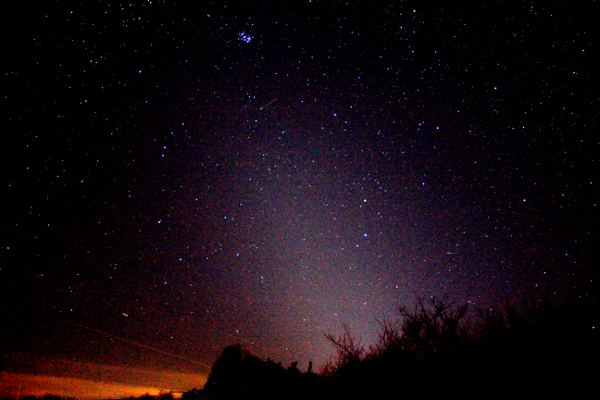
Much enhanced Zodiacal Light from the my back yard at 9:31 p.m. March 16, 2018, 5 minutes after the official end of astronomical twilight. Canon EOS Rebel T5 18mm f.l., f/3.5, 6 sec. ISO 12,800 . The clouds on the left appear to be illuminated by the lights of the towns of Beulah and Frankfort 20+ miles away.
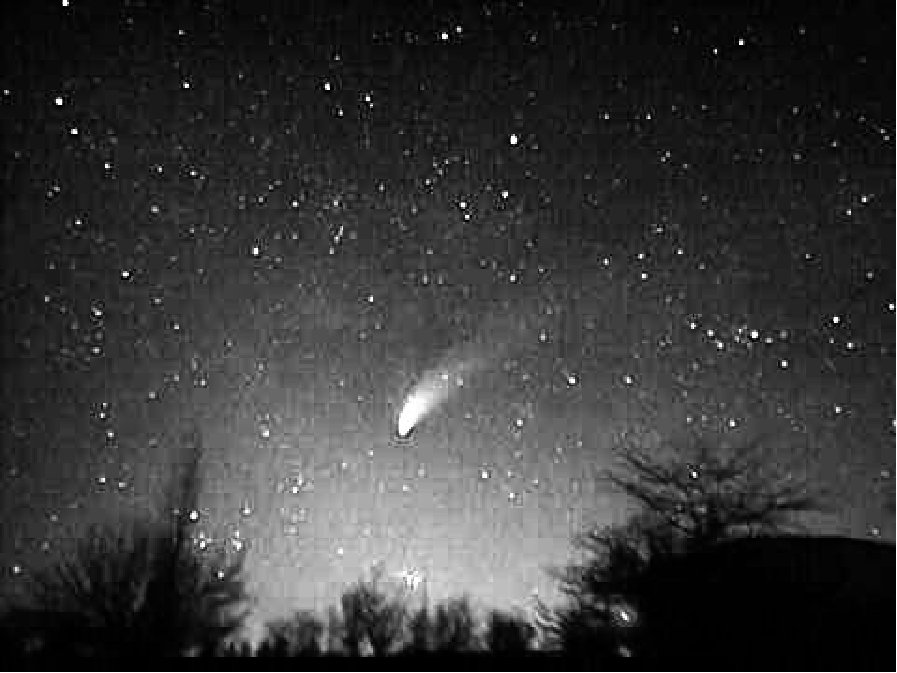
This is my previous best photo of zodiacal light. Zodiacal Light and Comet Hale-Bopp April 1997. Enhanced contrast.
The latest versions of Stellarium also show zodiacal light, but to see it the atmosphere needs to be turned off. That’s keyboard shortcut A.
 Bob Moler's Ephemeris Blog