Archive
06/28/2019 – Ephemeris – Arcturus, just passing thru!
Ephemeris for Friday, June 28th. Today the Sun will be up for 15 hours and 33 minutes, setting at 9:32, and it will rise tomorrow at 5:59. The Moon, 3 days past last quarter, will rise at 3:42 tomorrow morning.
Arcturus is an orange-colored giant star, 37 light years away. We see it high in the south-southwest and pointed to by following the arc of the handle of the Big Dipper. Arcturus is a rapidly moving star. It’s velocity is about 76 miles per second (122 km/s). It’s almost at its nearest to the Sun now. In the next 1,500 years it will move about one degree, twice the width of the Moon toward Spica. Arcturus may have been part of a dwarf galaxy being assimilated by the Milky Way which may account to its rapid motion. Arcturus is thought to be close to 8% more massive than the Sun and about 6 to 8 ½ billion years old. It has entered its red giant stage after running out of hydrogen in its core. It may be a glimpse of what the Sun will look like in 5 billion years.
The times given are for the Traverse City/Interlochen area of Michigan. They may be different for your location.
Addendum
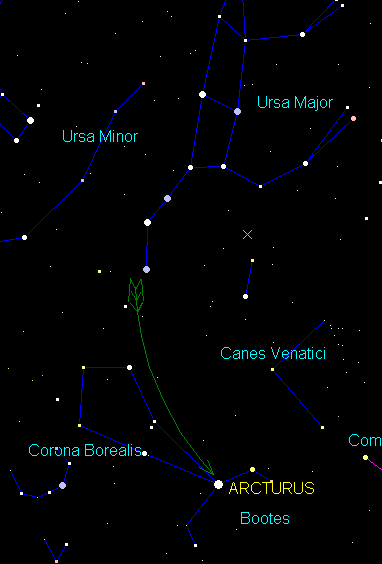
Bootes and the Big Dipper, a finder chart for Arcturus.
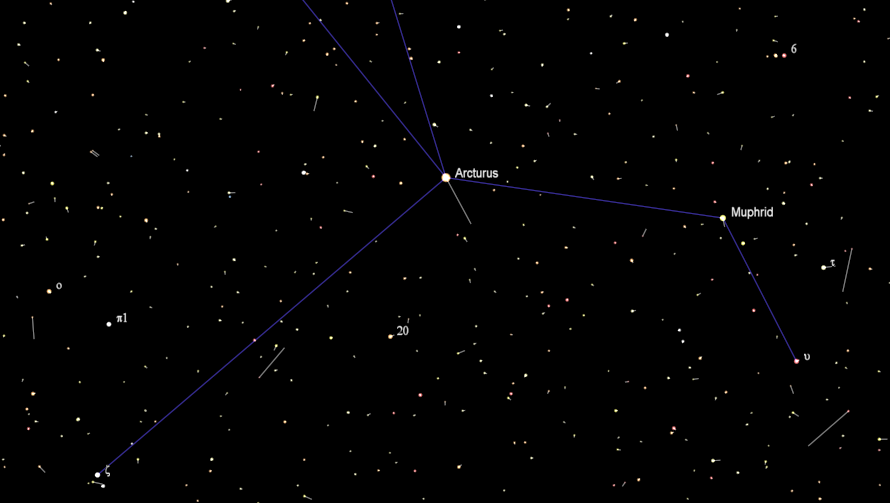
Closeup of the region around Arcturus. The short line toward 5 o’clock is the distance Arcturus will travel in the next 1,500 years. Note there are other stars, which are nearby like Arcturus, with comparable proper motions. Click on the image to enlarge. Created using Cartes du Ciel (Sky Charts).
06/27/2019 – Ephemeris – The constellation of Lyra the lyre or harp
Ephemeris for Thursday, June 27th. Today the Sun will be up for 15 hours and 33 minutes, setting at 9:32, and it will rise tomorrow at 5:59. The Moon, 2 days past last quarter, will rise at 3:13 tomorrow morning.
High up in the eastern sky at 11 p.m. can be found a bright star just north of a small, narrow, but very distinctive parallelogram of stars. They are the stars of the constellation Lyra the harp. The bright star is Vega, one of the twenty one brightest first magnitude stars. Vega is actually the 4th brightest night-time star. The harp, according to Greek mythology, was invented by the Greek god Hermes. The form of the harp in the sky, is as he had invented it: by stretching strings across a tortoise shell. Hermes gave it to his half-brother Apollo, who in turn gave it to the great musician Orpheus. The Sun has a motion with respect to most stars around it. Its direction is towards the vicinity of Lyra.
The times given are for the Traverse City/Interlochen area of Michigan. They may be different for your location.
Addendum
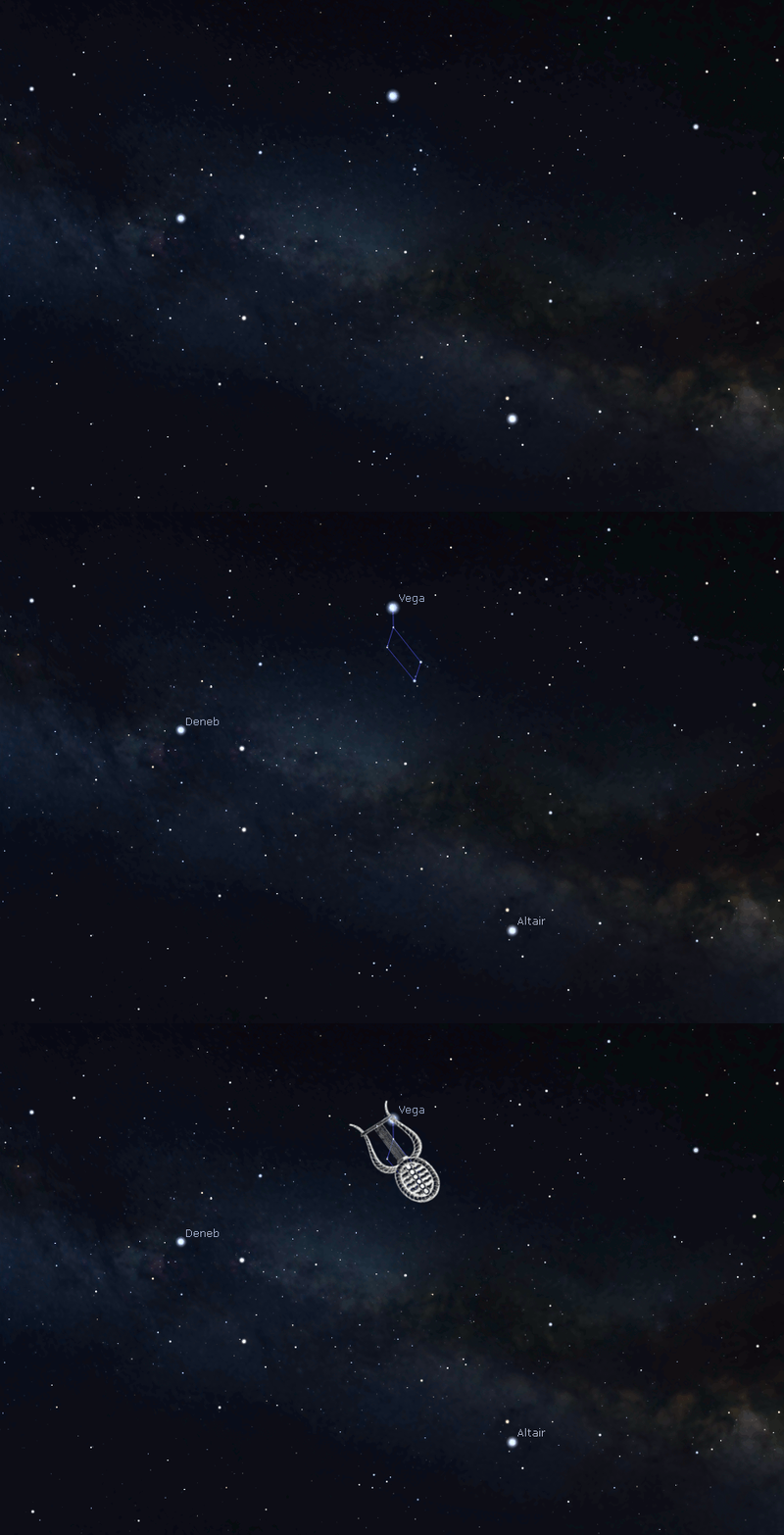
Animated Lyra finder chart. The lyre image not supplied by Stellarium but is from The World’s Earliest Music by Hermann Smith, Figure 60, A Project Gutenberg eBook, and captioned “The Chelys or Greek Tortoiseshell Lyre”. Click on the image to enlarge. Created using Stellarium.
06/26/2019 – Ephemeris – Checking out the locations of the bright planets for this week
Ephemeris for Wednesday, June 26th. Today the Sun will be up for 15 hours and 33 minutes, setting at 9:32, latest sunset of the year, and it will rise tomorrow at 5:59. The Moon, 1 day past last quarter, will rise at 2:47 tomorrow morning.
Let’s look at the planets for this week. Mars and Mercury will be low in the west-northwestern sky to the left of the star Pollux. Mercury is somewhat brighter than Pollux tonight with dimmer Mars to the right of Mercury. Mercury is separating from Mars rapidly, It’s not named for the messenger of the gods for nothing. Mercury will set at 11 p.m., three minutes after Mars. Jupiter will start the evening low in the southeast. It’s far brighter than any star and will be visible just about all night, setting at 4:55 a.m. It’s in Ophiuchus the serpent bearer now, just above Scorpius the scorpion. In the morning sky we have Saturn which will rise at 10:11 p.m., in the east-southeast. It’s in Sagittarius the archer. Venus is too close to the Sun to be seen.
The times given are for the Traverse City/Interlochen area of Michigan. They may be different for your location.
Addendum
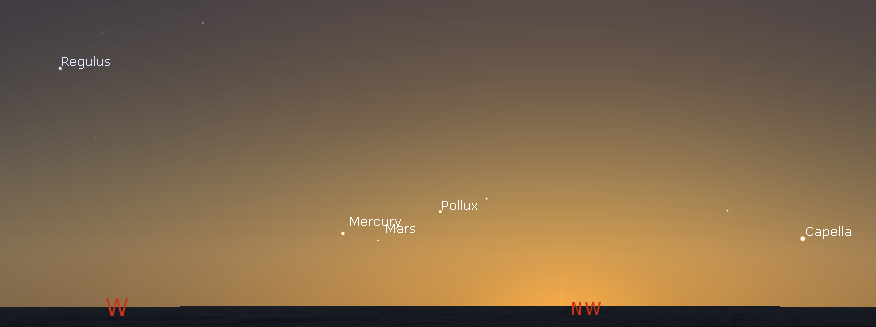
Mercury and Mars with the brighter stars at 10:15 p.m., June 26, 2019. Click on the image to enlarge. Created using Stellarium.
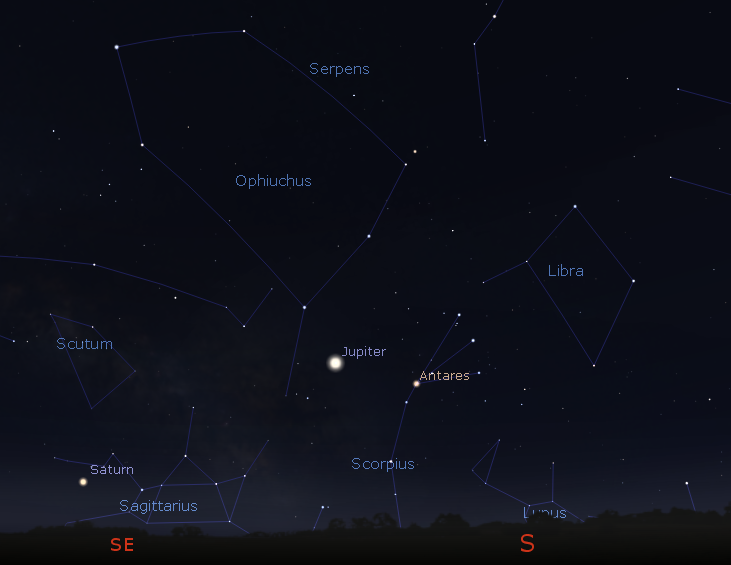
Jupiter and Saturn at 11 p.m. June 26, 2019. Click on the image to enlarge. Created using Stellarium.
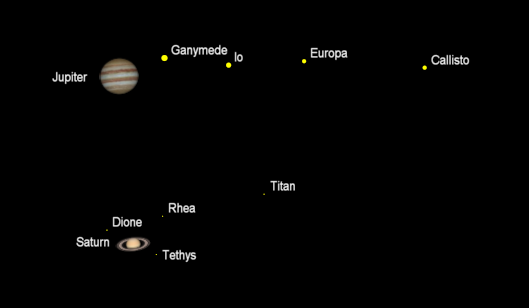
Jupiter and Saturn with the same magnification at 11:30 p.m., June 26, 2019. Created using Cartes du Ciel (Sky Charts).
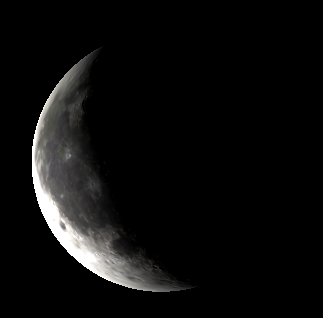
The waning crescent Moon at 4:30 a.m. June 27, 2019. Created using Stellarium.
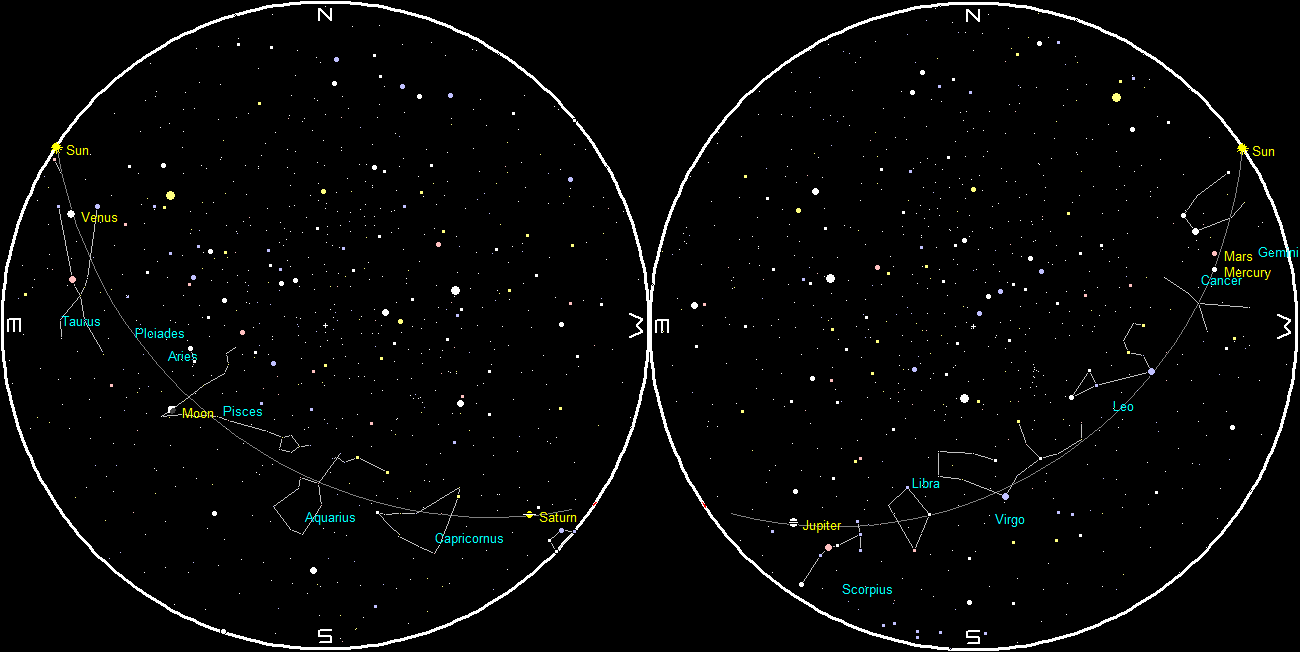
Planets and the Moon at sunset and sunrise of a single night starting with sunset on the right on June 26, 2019. The night ends on the left with sunrise on the 27th. Click on the image to enlarge. Created using my LookingUp program.
06/25/2019 – Ephemeris – Weird clouds of the twilight zone
Ephemeris for Tuesday, June 25th. Today the Sun will be up for 15 hours and 34 minutes, setting at 9:32, and it will rise tomorrow at 5:58. The Moon, at last quarter today, will rise at 2:23 tomorrow morning.
This time of year one can see, on rare occasions, some ghostly clouds called noctilucent clouds. Noctilucent means night shining. These are silvery clouds that can be seen near the end of twilight. We’re a bit south of the prime latitudes to see them from 50 to 70 degrees both north and south of the equator. I’ve seen them a few times. They move rather rapidly, even though they’re at an altitude of around 50 miles. The clouds appear to be made of ice crystals that possibly form around meteoric dust. Their appearance cannot be predicted, but show up near the end of twilight and they are white, and are not the usual reddish clouds of twilight. These clouds mostly appear in July and August. But I’ve seen many recent reports of them from Europe.
The times given are for the Traverse City/Interlochen area of Michigan. They may be different for your location.
Addendum
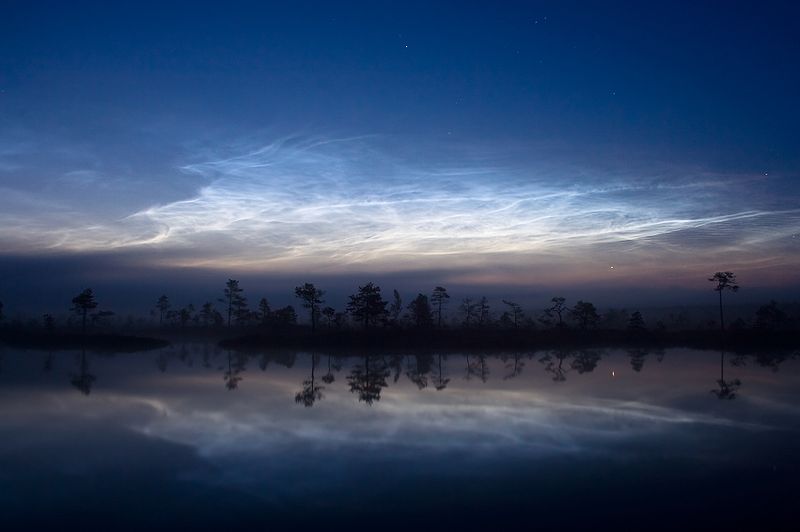
Noctilucent clouds, Kuresoo bog, Soomaa National Park, Estonia. July 26, 2009 by Martin Koitmäe. From Wikimedia Commons.
Spaceweather.com is a great place to learn more and hosts a gallery of recent noctilucent cloud photos.
06/24/2019 – Ephemeris – Ophiuchus the serpent bearer
Ephemeris for Monday, June 24th. Today the Sun will be up for 15 hours and 34 minutes, setting at 9:32, and it will rise tomorrow at 5:58. The Moon, 1 day before last quarter, will rise at 2 tomorrow morning.
The planet Jupiter shines brightly in the south-southeast at 11 p.m. In the area of sky above it lies a large constellation of faint stars called Ophiuchus, the serpent bearer. Ophiuchus represents the legendary physician Aesculapius. The constellation shape is like a large bell, which reminds me of the head, shoulders and arms of a fellow that’s holding the snake like a weight lifter struggling to pull up a heavy barbell. Serpens, the constellation of the serpent is in the sky in two sections. The front end lies to the right as Serpens Caput, and wends its way up towards Corona Borealis, the Northern Crown. Serpens Cauda, the tail rises to the left of Ophiuchus. It’s a rewarding sight, and not that hard to spot.
The times given are for the Traverse City/Interlochen area of Michigan. They may be different for your location.
Addendum
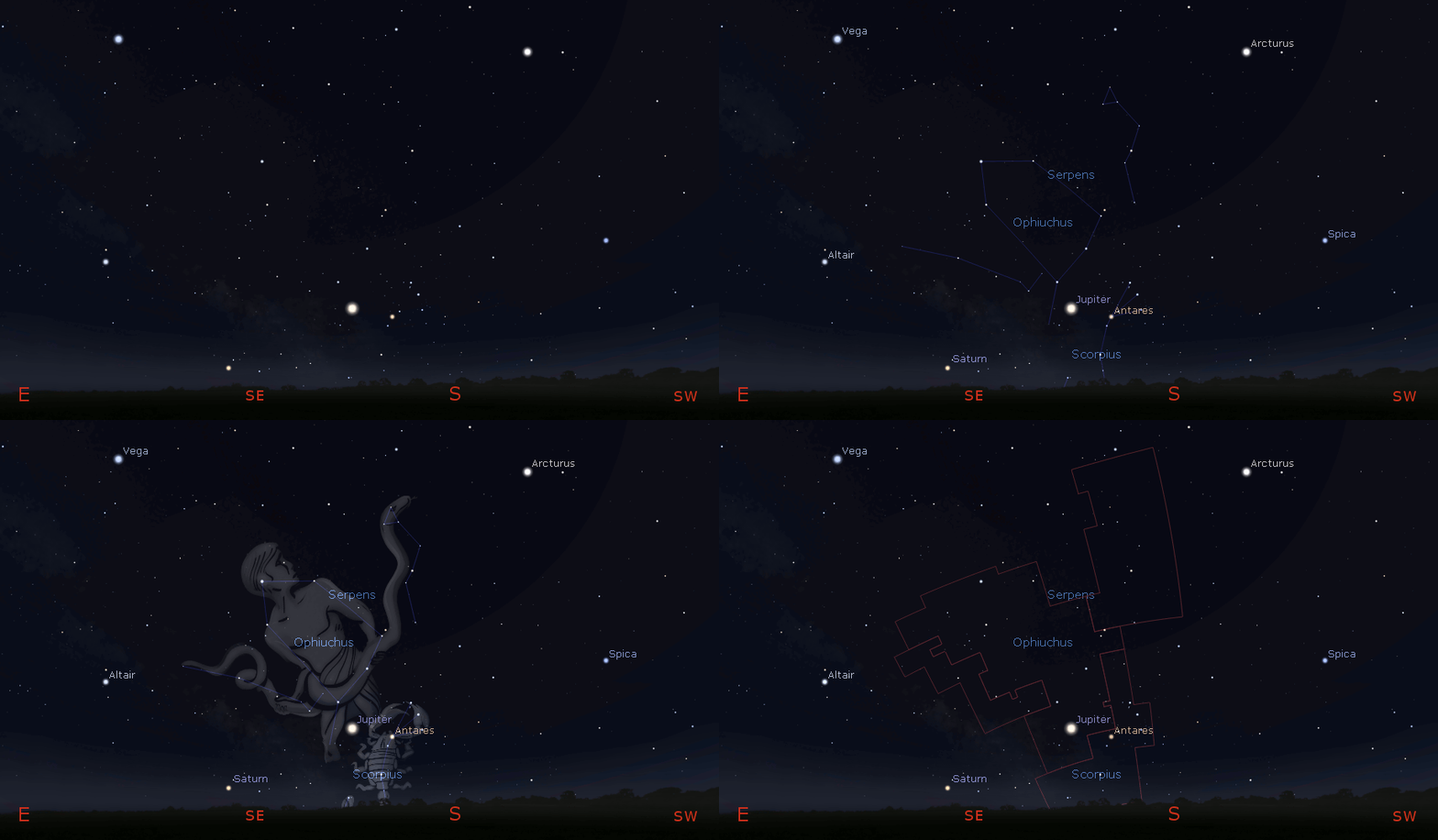
Ophiuchus finder animation for 11 p.m. June 24, 2019. Also showing the constellation boundaries. Click on the image to enlarge. Created using Stellarium and GIMP.
06/21/2019 – Ephemeris – Summer starts today!
Ephemeris for Friday, June 21st. Today the Sun will be up for 15 hours and 34 minutes, setting at 9:32, and it will rise tomorrow at 5:57. The Moon, half way from full to last quarter, will rise at 12:44 tomorrow morning.
At 11:54 (15:54 UT) this morning the Sun will reach its greatest angle north of the celestial equator or 23 ½ degrees. The date and the point in the sky where the Sun is at that instant is called the summer solstice, or summer Sun standstill. It means the point at which the Sun seems poised farthest north before heading southward. This would be most noticeable if you were monitoring the height of the Sun at noon or the Sun’s rising or setting point day by day as the ancients did. Besides being the day with the longest sunlight we, in the northern hemisphere, are also receiving more intense heat from the sun than any other day of the year. Still hotter weather is in store as the northern hemisphere continues to warm up.
The times given are for the Traverse City/Interlochen area of Michigan. They may be different for your location.
Addendum
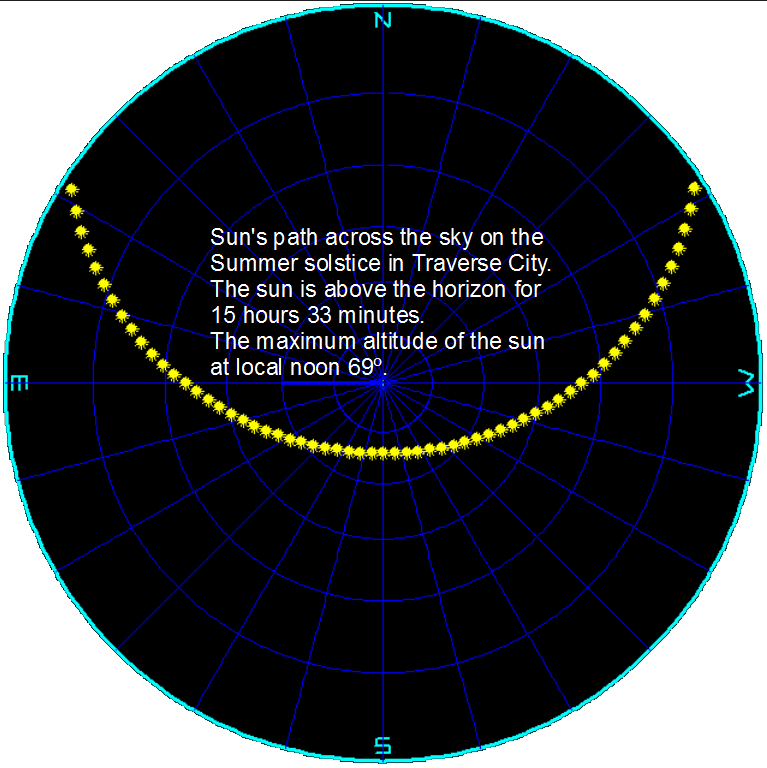
The Sun’s apparent path in the sky for the summer solstice. The cyan circle is the horizon and the Sun is plotted every 15 minutes throughout the day. Created using my LookingUp program. This is a slide from his school program on the cause of the seasons.
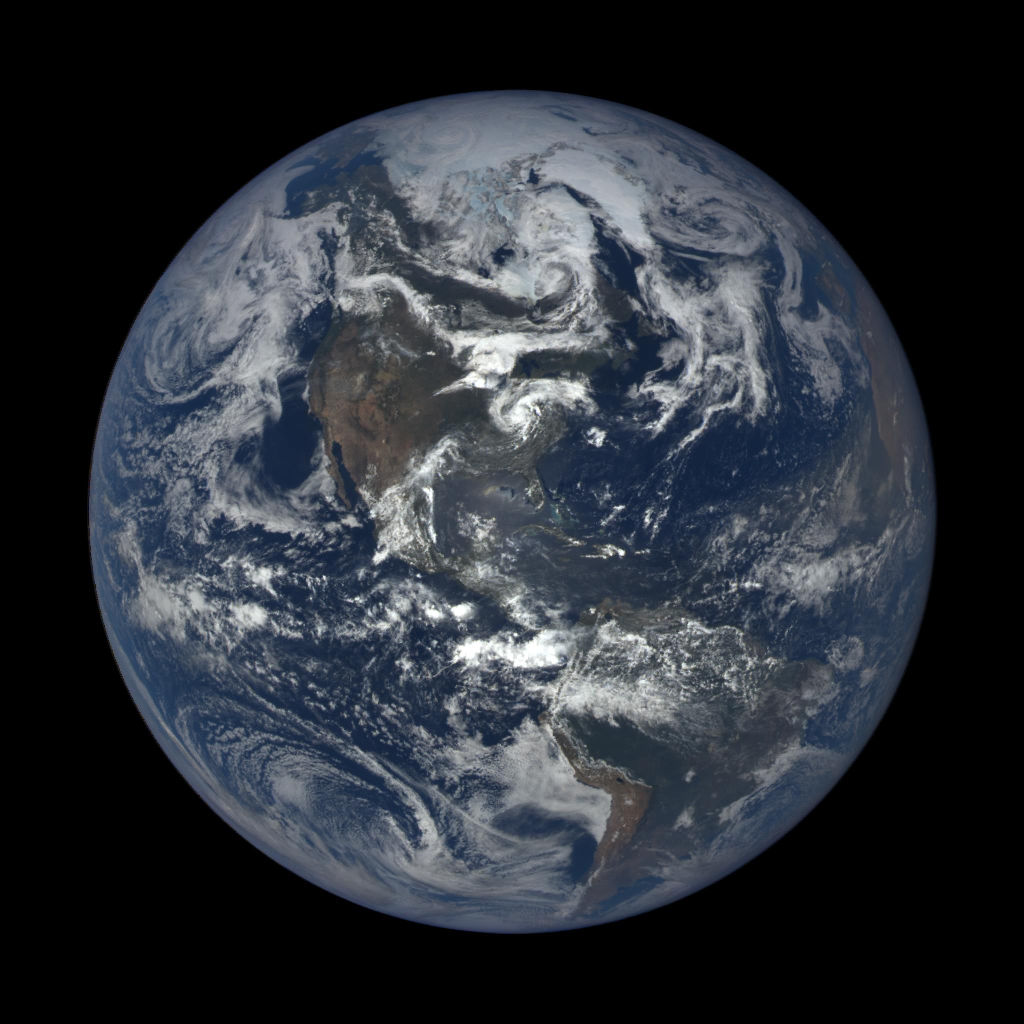
Earth from the DSCOVR satellite at the June solstice 2015. Of course we’re under a cloud. Credit NOAA
06/20/2019 – Ephemeris – Hercules wuz robbed!
Ephemeris for Thursday, June 20th. Today the Sun will be up for 15 hours and 34 minutes, setting at 9:31, and it will rise tomorrow at 5:57. The Moon, 3 days past full, will rise at 12:12 tomorrow morning.
Orion, the hard luck mythological Greek hunter gets a splashy constellation in the winter sky, but the greatest hero of all, Hercules, gets a dim group of stars on the border between the spring and summer stars. At 11 p.m. Hercules is high in the southeast. It is located above and right of the bright star, Vega in the east. Hercules’ central feature is a keystone shaped box of stars, called the Keystone, which represents the old boy’s shorts. From each top corner extend lines of stars that are his legs, from the bottom stars, the rest of his torso and arms extend. So in one final indignity he’s upside down in our sky. Some see him crouched down, club upraised holding the Hydra about to throttle it. For those with a telescope it contains the beautiful globular star cluster M13.
The times given are for the Traverse City/Interlochen area of Michigan. They may be different for your location.
Addendum
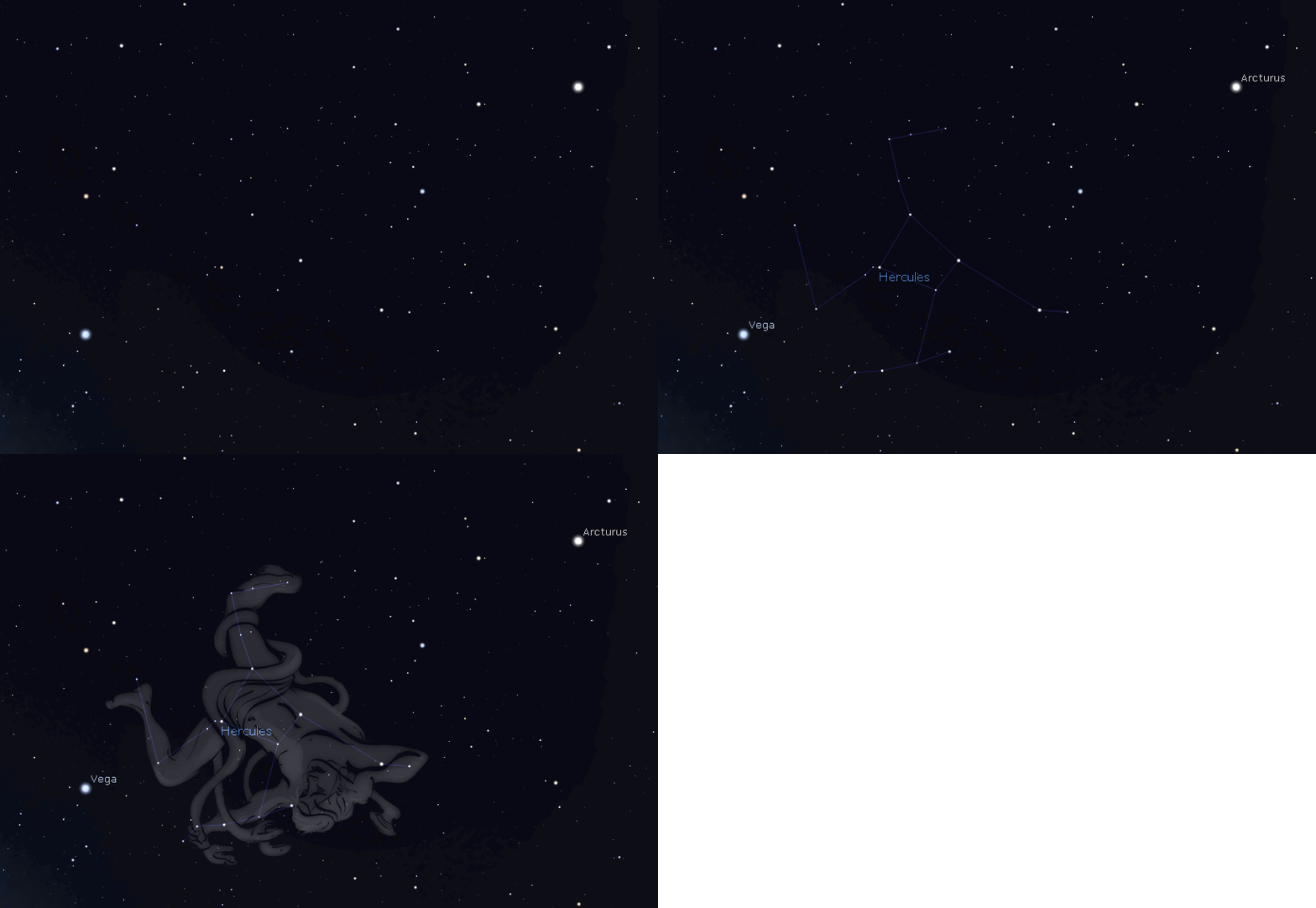
Hercules animation showing neighboring stars at 11 p.m. for mid June, Click on image to enlarge. Created using Stellarium and GIMP.
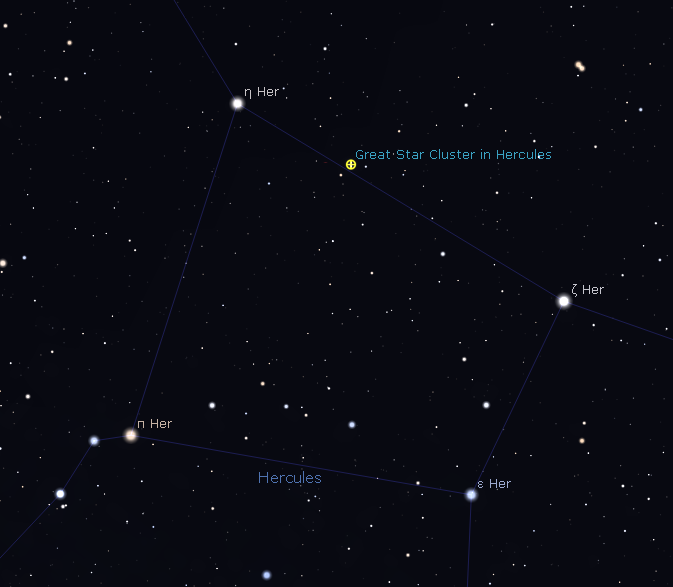
Stars and M13 (Great Star Cluster in Hercules) visible in binoculars in the Keystone of Hercules. Click in the image to enlarge. Created using Stellarium.
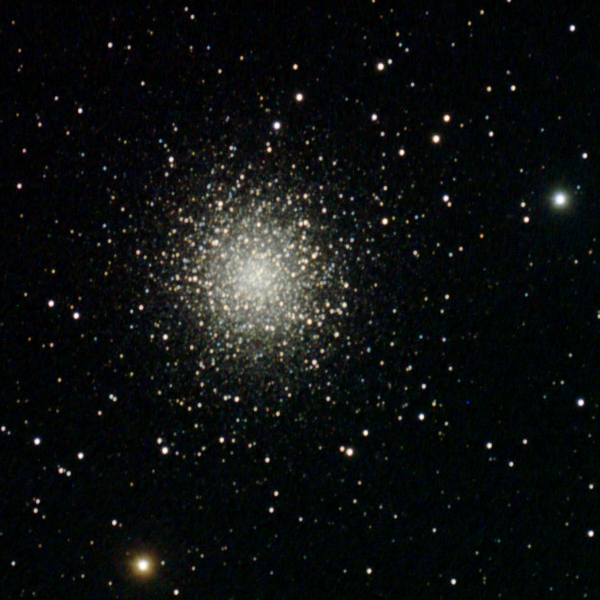
M13, the Great Globular Star Cluster in Hercules. It takes a telescope with an aperture (diameter) of 6 inches (150 mm) to begin the resolve the stars in it. Credit: Scott Anttila
06/19/2019 – Ephemeris – Checking out the bright planets for tonight
Ephemeris for Wednesday, June 19th. Today the Sun will be up for 15 hours and 34 minutes, setting at 9:31, and it will rise tomorrow at 5:56. The Moon, 2 days past full, will rise at 11:34 this evening.
Let’s look at the planets for this week. Mars and Mercury will be low in the west-northwestern sky below and left of the star Pollux. Mercury is somewhat brighter than Pollux tonight with dimmer Mars a bit right of and below Mercury. Mercury is separating from Mars rapidly, It not named for the messenger of the gods for nothing. Mercury will set at 11:13 p.m., three minutes after Mars. Jupiter will start the evening low in the southeast. It far brighter than any star and will be visible all night, setting at 5:30 a.m. It’s in Ophiuchus the serpent bearer now, just above Scorpius the scorpion. In the morning sky we have Saturn which will rise at 10:41 p.m., in the east-southeast. It’s in Sagittarius the archer. Venus is too close to the Sun to be seen.
The times given are for the Traverse City/Interlochen area of Michigan. They may be different for your location.
Addendum
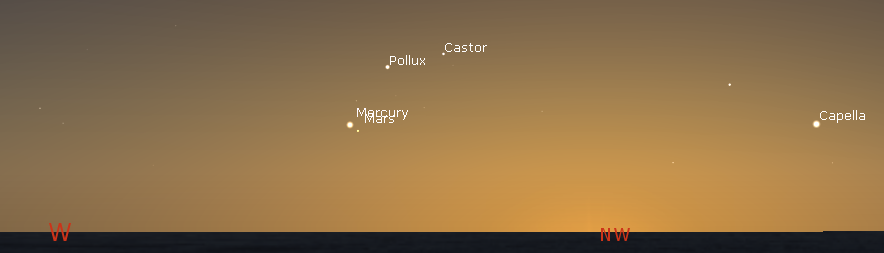
Mercury and Mars with the brighter stars at 10:15 p.m., June 19, 2019. Click on the image to enlarge. Created using Stellarium.
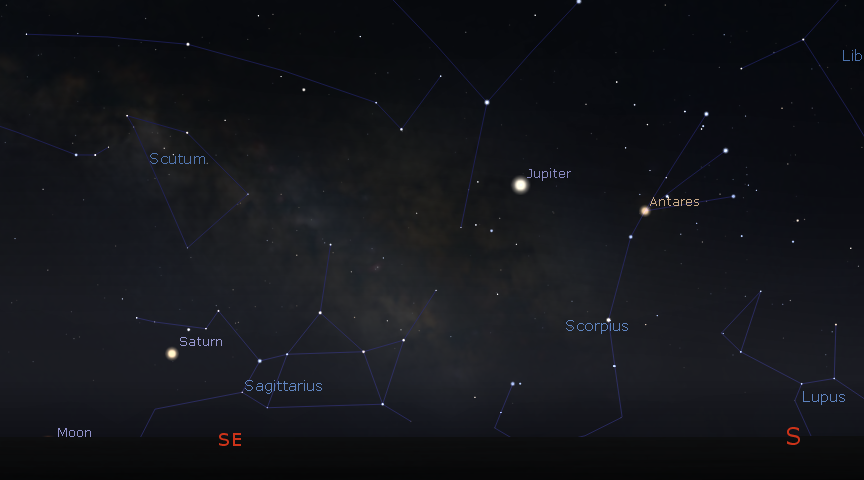
Jupiter and Saturn before moonrise at 11:30 p.m. June 19, 2019. Click on the image to enlarge. Created using Stellarium.
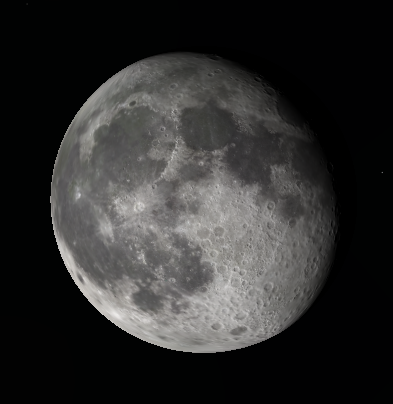
The waning gibbous Moon at midnight as it might be seen in binoculars or a small telescope.. Created using Stellarium.
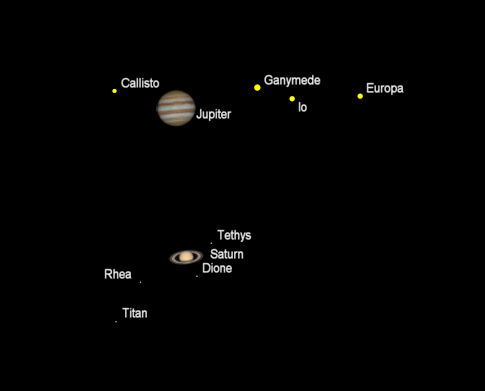
Jupiter and Saturn with the same magnification at 11:30 p.m., June 19, 2019. Created using Cartes du Ciel (Sky Charts).
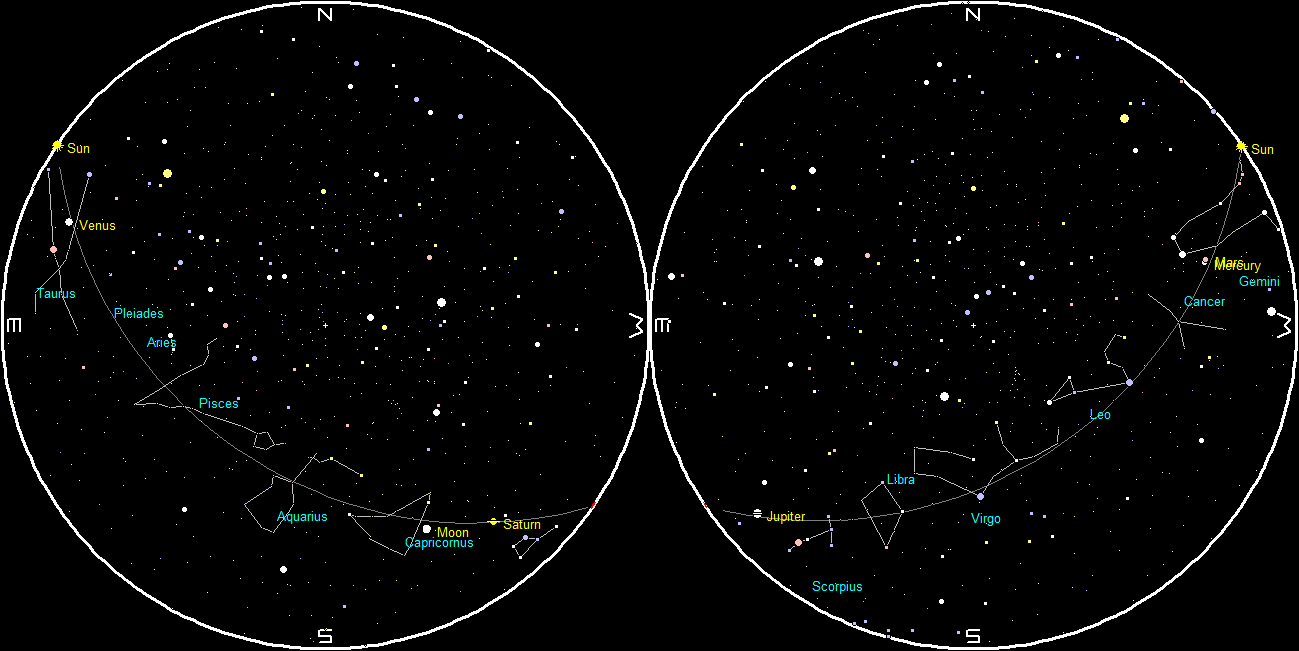
Planets and the Moon at sunset and sunrise of a single night starting with sunset on the right on June 19, 2019. The night ends on the left with sunrise on the 20th. Click on the image to enlarge. Created using my LookingUp program.
06-18-2019 – Ephemeris – Mercury and Mars will be seen together tonight
Ephemeris for Tuesday, June 18th. Today the Sun will be up for 15 hours and 34 minutes, setting at 9:31, and it will rise tomorrow at 5:56. The Moon, 1 day past full, will rise at 10:49 this evening.
This evening the Planets Mercury and Mars will appear less than a moon-width apart in the evening twilight. Mercury, the brighter of the two, by a factor of 4 times, will be visible first, at about 10:15 p.m. very low in the west-northwest. Mars will be immediately below it by less than the width of the Moon. At that time they will be a bit less than the width of your fist held at arm’s length above the horizon. Binoculars are the best way to spot them. Mercury will continue to move eastward in the sky away from Mars. Until after it reaches its greatest separation from the Sun on the 23rd. It will then head back and pass at a much greater distance below Mars on July 5th. This is the best chance to spot Mercury in the evening sky this year.
The times given are for the Traverse City/Interlochen area of Michigan. They may be different for your location.
Addendum
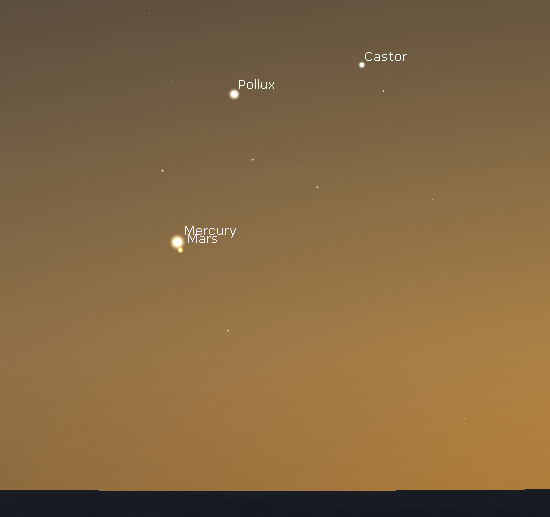
Mercury and Mars this evening at 10:30 p.m., June 18, 2019. Created using Stellarium.
06/17/2019 – Ephemeris – President Kennedy wanted to get us to the Moon… But how?
Ephemeris for Monday, June 17th. Today the Sun will be up for 15 hours and 34 minutes, setting at 9:30, and it will rise tomorrow at 5:56. The Moon, at full today, will rise at 9:56 this evening.
President Kennedy’s Challenge to land “a man on the Moon and returning him safely to the Earth” came only 20 days after Alan Shepard’s sub-orbital flight and 45 days after Yuri Gagarin’s orbital flight. To the NASA designers the question was how! Three scenarios were studied. The Moon direct approach where the spacecraft would be sent intact to the Moon and back which would take a really gigantic rocket. The Earth rendezvous where the spacecraft would be assembled in Earth orbit and then sent to the Moon. And the lunar orbit rendezvous where only part of the craft would be sent down to the lunar surface, while the main craft stayed in orbit of the Moon. After a lot of study the third option was accepted. It was up to project Gemini to develop the skills necessary to rendezvous and dock two spacecraft in orbit.
The times given are for the Traverse City/Interlochen area of Michigan. They may be different for your location.
Addendum
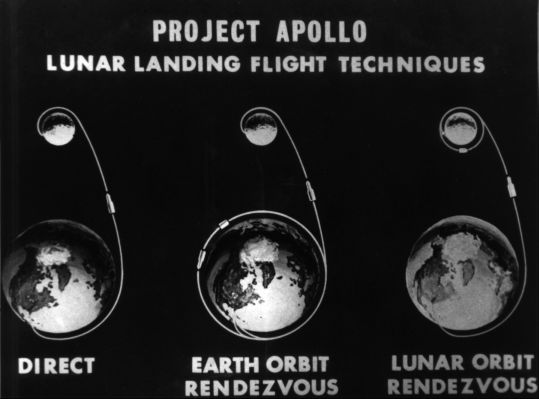
Three flight techniques to land on the Moon. John Houbolt, who came up with the Lunar Orbit Rendezvous went through a lot of grief before his method was accepted in 1962. Credit: NASA.
 Bob Moler's Ephemeris Blog