Archive
06/30/2022 – Ephemeris – Previewing the skies of July
This is Bob Moler with Ephemeris for International Asteroid Day, Thursday, June 30th. On this day in 1908, 114 years ago, a small asteroid exploded over the Tunguska region of Siberia. Today the Sun will be up for 15 hours and 31 minutes, setting at 9:32, and it will rise tomorrow at 6:01. The Moon, 2 days past new, will set at 11:11 this evening.
Let’s preview July’s skies. The Sun, having reached its northern solstice, is beginning to slide southward again, at first imperceptibly, then with greater speed. The daylight hours will decrease from 15 hours and 30 minutes tomorrow to 14 hours 41 minutes at month’s end. The daylight hours will be slightly shorter south of Interlochen, and slightly longer to the north. The altitude of the Sun at local noon, when the Sun is due south, will decrease from 68 degrees today to 63 degrees at month’s end. The Sun will be a degree lower in the Straits area. Despite the warmth, the Earth will reach its greatest distance from the Sun this Sunday the 3rd.
The astronomical event times given are for the Traverse City/Interlochen area of Michigan (EDT, UT – 4 hours). They may be different for your location.
Addendum
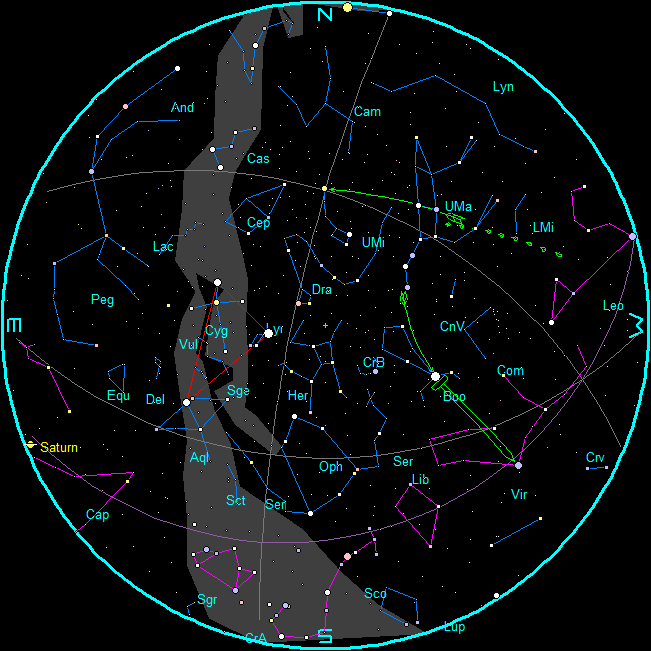
Star Chart for July 2022 (11 p.m. EDT, July 15, 2022). Created using my LookingUp program. Click on image to enlarge.
The planets and stars are plotted for the 15th at 11 p.m. EDT in the evening and 4:30 a.m. for the morning chart. These are the chart times. Note that Traverse City is located approximately 45 minutes behind our time meridian, West 75° longitude. (An hour 45 minutes behind our daylight saving time meridian during EDT). To duplicate the star positions on a planisphere you may have to set it to 1 hour 45 minutes earlier than the current time.
Note the chart times are for the 15th. For each week before the 15th, add ½ hour (28 minutes if you’re picky). For each week after the 15th, subtract ½ hour. The planet positions are updated each Wednesday on this blog. For planet positions on dates other than the 15th.
July Morning Star Chart
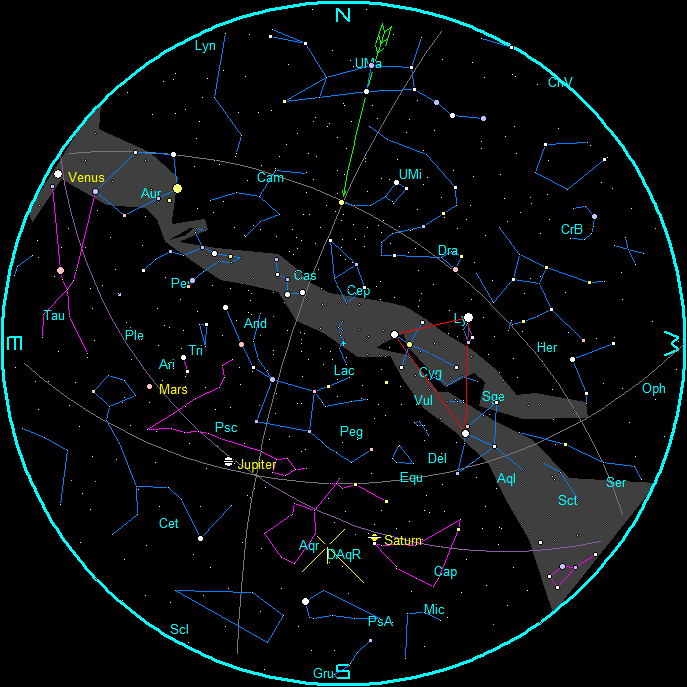
Star Chart for July mornings, 2022 (4:30 a.m. EDT July 15, 2022). Created using my LookingUp program. Click on image to enlarge.
For a list of constellation names to go with the abbreviations, click here.
- Pointer stars at the front of the bowl of the Big Dipper point to Polaris, the North Star.
- Leaky dipper drips on Leo.
- Follow the arc of the handle of the Big Dipper to the star Arcturus, and
- Extend like a spike to Spica.
- The Summer Triangle is in red.
- DAqR is the radiant of the South Delta Aquariid meteor shower (Peaks on the 27th)
Twilight Limits, Nautical and Astronomical
| EDT | |||||||
| Morning | Twilight | Evening | Twilight | Dark | Night | Moon | |
| Date | Astro. | Nautical | Nautical | Astro. | Start | End | Illum. |
| 2022-07-01 | 3h39m | 4h41m | 23h00m | 0h03m | 0h03m | 3h39m | 0.09 |
| 2022-07-02 | 3h40m | 4h42m | 23h00m | 0h02m | 0h02m | 3h40m | 0.15 |
| 2022-07-03 | 3h41m | 4h43m | 22h59m | 0h01m | 0h11m | 3h41m | 0.22 |
| 2022-07-04 | 3h42m | 4h44m | 22h59m | 0h00m | 0h33m | 3h42m | 0.31 |
| 2022-07-05 | 3h43m | 4h45m | 22h58m | 23h59m | 0h54m | 3h43m | 0.41 |
| 2022-07-06 | 3h45m | 4h45m | 22h57m | 23h58m | 1h13m | 3h45m | 0.51 |
| 2022-07-07 | 3h46m | 4h46m | 22h57m | 23h57m | 1h32m | 3h46m | 0.62 |
| 2022-07-08 | 3h47m | 4h47m | 22h56m | 23h56m | 1h53m | 3h47m | 0.72 |
| 2022-07-09 | 3h49m | 4h48m | 22h55m | 23h55m | 2h18m | 3h49m | 0.82 |
| 2022-07-10 | 3h50m | 4h50m | 22h55m | 23h54m | 2h48m | 3h50m | 0.9 |
| 2022-07-11 | 3h52m | 4h51m | 22h54m | 23h52m | 3h27m | 3h52m | 0.96 |
| 2022-07-12 | 3h54m | 4h52m | 22h53m | 23h51m | – | – | 1 |
| 2022-07-13 | 3h55m | 4h53m | 22h52m | 23h50m | – | – | 1 |
| 2022-07-14 | 3h57m | 4h54m | 22h51m | 23h48m | – | – | 0.97 |
| 2022-07-15 | 3h59m | 4h55m | 22h50m | 23h47m | – | – | 0.91 |
| 2022-07-16 | 4h01m | 4h57m | 22h49m | 23h45m | 23h45m | 23h50m | 0.84 |
| 2022-07-17 | 4h02m | 4h58m | 22h48m | 23h43m | 23h43m | – | 0.74 |
| 2022-07-18 | 4h04m | 4h59m | 22h47m | 23h42m | 23h42m | 0h13m | 0.64 |
| 2022-07-19 | 4h06m | 5h01m | 22h45m | 23h40m | 23h40m | 0h33m | 0.54 |
| 2022-07-20 | 4h08m | 5h02m | 22h44m | 23h38m | 23h38m | 0h53m | 0.44 |
| 2022-07-21 | 4h10m | 5h03m | 22h43m | 23h36m | 23h36m | 1h13m | 0.34 |
| 2022-07-22 | 4h12m | 5h05m | 22h42m | 23h35m | 23h35m | 1h36m | 0.25 |
| 2022-07-23 | 4h13m | 5h06m | 22h40m | 23h33m | 23h33m | 2h02m | 0.18 |
| 2022-07-24 | 4h15m | 5h07m | 22h39m | 23h31m | 23h31m | 2h33m | 0.11 |
| 2022-07-25 | 4h17m | 5h09m | 22h38m | 23h29m | 23h29m | 3h11m | 0.06 |
| 2022-07-26 | 4h19m | 5h10m | 22h36m | 23h27m | 23h27m | 3h58m | 0.02 |
| 2022-07-27 | 4h21m | 5h12m | 22h35m | 23h25m | 23h25m | 4h21m | 0 |
| 2022-07-28 | 4h23m | 5h13m | 22h33m | 23h23m | 23h23m | 4h23m | 0 |
| 2022-07-29 | 4h25m | 5h15m | 22h32m | 23h21m | 23h21m | 4h25m | 0.02 |
| 2022-07-30 | 4h27m | 5h16m | 22h30m | 23h19m | 23h19m | 4h27m | 0.06 |
| 2022-07-31 | 4h29m | 5h18m | 22h28m | 23h17m | 23h17m | 4h29m | 0.11 |
Twilight calendar was generated using Cartes du Ciel (Sky Charts).
See my blog post: Twilight Zone for the definitions of the different periods of twilight here: https://bobmoler.wordpress.com/2018/09/27/.
NASA Calendar of Planetary Events
Jul  1  Fr            Venus: 29.6° W
     1  Fr   9:21 am  Moon-Beehive: 3.9° S
     3  Su  10:59 pm  Earth at Aphelion: 1.0167 AU
     6  We  10:14 pm  First Quarter
     9  Sa   1:28 pm  Moon Descending Node
    10  Su   7:50 pm  Moon-Antares: 3° S
    12	Tu  10:30 am  NASA will release 1st full color images from the
                      Webb Space Telescope
    12  Tu   5:16 pm  Moon South Dec.: 26.9° S
    13  We   5:08 am  Moon Perigee: 357,300 km
    13  We   2:37 pm  Full Buck Moon
    15  Fr   4:16 pm  Moon-Saturn: 4° N
    16  Sa   3:30 pm  Mercury Superior Conj.
    18  Mo   8:55 pm  Moon-Jupiter: 2.3° N
    20  We  10:18 am  Last Quarter
    21  Th  12:46 pm  Moon-Mars: 1.1° S
    22  Fr   5:21 am  Moon Ascending Node
    22  Fr  11:29 pm  Moon-Pleiades: 3.7° N
    26  Tu   5:19 am  Moon North Dec.: 26.9° N
    26  Tu   6:22 am  Moon Apogee: 406,300 km
    26  Tu  10:12 am  Moon-Venus: 4.6° S
    28  Th   5:26 am  Delta Aquariid Shower: ZHR = 20
    28  Th   1:55 pm  New Moon
Aug  1  Mo            Venus: 21.7° W
All event times are given for UTC-4 hr: Eastern Daylight Saving Time.
Sky Events Calendar by Fred Espenak and Sumit Dutta (NASA’s GSFC),
http://eclipse.gsfc.nasa.gov/SKYCAL/SKYCAL.html.
If you go to the above site you can print out a list like the above for the entire year or calendar pages for your time zone.
Sun and Moon Rising and Setting Events
LU                  Ephemeris of Sky Events for Interlochen/TC
July, 2022    Local time zone: EDT
+-----------------------------------------------------------------------+
| DATE |  SUN     SUN  DAYLIGHT|   TWILIGHT*    |MOON  RISE OR    ILLUM |
|      |  RISE    SET    HOURS |  END    START  |PHASE SET** TIME FRACTN|
+=======================================================================+
|Fri  1| 06:01a  09:32p  15:30 | 10:57p  04:35a |      Set  11:44p    8%|
|Sat  2| 06:01a  09:31p  15:30 | 10:56p  04:36a |      Set  12:10a   13%|
+------+-----------------------+----------------+-----------------------+
|Sun  3| 06:02a  09:31p  15:29 | 10:56p  04:37a |      Set  12:33a   21%|
|Mon  4| 06:02a  09:31p  15:28 | 10:56p  04:38a |      Set  12:53a   29%|
|Tue  5| 06:03a  09:30p  15:27 | 10:55p  04:38a |      Set  01:12a   39%|
|Wed  6| 06:04a  09:30p  15:26 | 10:54p  04:39a |F Qtr Set  01:32a   49%|
|Thu  7| 06:04a  09:30p  15:25 | 10:54p  04:40a |      Set  01:53a   60%|
|Fri  8| 06:05a  09:29p  15:24 | 10:53p  04:41a |      Set  02:17a   70%|
|Sat  9| 06:06a  09:29p  15:22 | 10:52p  04:42a |      Set  02:47a   80%|
+------+-----------------------+----------------+-----------------------+
|Sun 10| 06:07a  09:28p  15:21 | 10:51p  04:43a |      Set  03:27a   89%|
|Mon 11| 06:08a  09:28p  15:20 | 10:51p  04:44a |      Set  04:19a   95%|
|Tue 12| 06:08a  09:27p  15:18 | 10:50p  04:46a |      Set  05:26a   99%|
|Wed 13| 06:09a  09:26p  15:17 | 10:49p  04:47a |Full  Rise 10:05p  100%|
|Thu 14| 06:10a  09:26p  15:15 | 10:48p  04:48a |      Rise 10:49p   98%|
|Fri 15| 06:11a  09:25p  15:14 | 10:47p  04:49a |      Rise 11:23p   92%|
|Sat 16| 06:12a  09:24p  15:12 | 10:46p  04:50a |      Rise 11:50p   85%|
+------+-----------------------+----------------+-----------------------+
|Sun 17| 06:13a  09:24p  15:10 | 10:44p  04:52a |      Rise 12:12a   76%|
|Mon 18| 06:14a  09:23p  15:08 | 10:43p  04:53a |      Rise 12:33a   66%|
|Tue 19| 06:15a  09:22p  15:07 | 10:42p  04:54a |      Rise 12:52a   56%|
|Wed 20| 06:16a  09:21p  15:05 | 10:41p  04:56a |L Qtr Rise 01:13a   46%|
|Thu 21| 06:17a  09:20p  15:03 | 10:40p  04:57a |      Rise 01:35a   36%|
|Fri 22| 06:18a  09:19p  15:01 | 10:38p  04:58a |      Rise 02:01a   27%|
|Sat 23| 06:19a  09:18p  14:59 | 10:37p  05:00a |      Rise 02:32a   19%|
+------+-----------------------+----------------+-----------------------+
|Sun 24| 06:20a  09:17p  14:57 | 10:35p  05:01a |      Rise 03:11a   12%|
|Mon 25| 06:21a  09:16p  14:55 | 10:34p  05:03a |      Rise 03:57a    7%|
|Tue 26| 06:22a  09:15p  14:53 | 10:33p  05:04a |      Rise 04:51a    3%|
|Wed 27| 06:23a  09:14p  14:50 | 10:31p  05:05a |      Rise 05:52a    1%|
|Thu 28| 06:24a  09:13p  14:48 | 10:30p  05:07a |New   Set  09:46p    0%|
|Fri 29| 06:25a  09:12p  14:46 | 10:28p  05:08a |      Set  10:14p    2%|
|Sat 30| 06:26a  09:10p  14:44 | 10:27p  05:10a |      Set  10:38p    5%|
+------+-----------------------+----------------+-----------------------+
|Sun 31| 06:27a  09:09p  14:41 | 10:25p  05:11a |      Set  10:59p   10%|
+-----------------------------------------------------------------------+
* Nautical Twilight
** Moonrise or moonset, whichever occurs between sunrise and sunset
Created using my LookingUp for DOS output as text.
06/29/2022 Ephemeris – Let’s search for the naked-eye planets for this week
This is Ephemeris for Wednesday, June 29th. Today the Sun will be up for 15 hours and 32 minutes, setting at 9:32, and it will rise tomorrow at 6:00. The Moon, 1 day past new, will set at 10:32 this evening.
Let’s search for the naked-eye planets for this week. All the naked-eye planets are in the morning sky, although Mercury is too close to the Sun to be seen. At 5 am tomorrow the planets will be spread out from Mercury invisible on the horizon, brilliant Venus low in the east-northeast to Saturn higher in the south. To the right and above of Venus, in the east-southeast, will be the Mars. Jupiter is in the southeast. Mars is dimmer than Jupiter, but is slowly getting brighter as the Earth is slowly advancing on it. Saturn ends the line of planets in the south. By tomorrow night, Saturn will rise a minute before midnight. It won’t be an official evening planet until it rises before sunset. That won’t happen until mid-August.
The astronomical event times given are for the Traverse City/Interlochen area of Michigan (EDT, UT – 4 hours). They may be different for your location.
Addendum
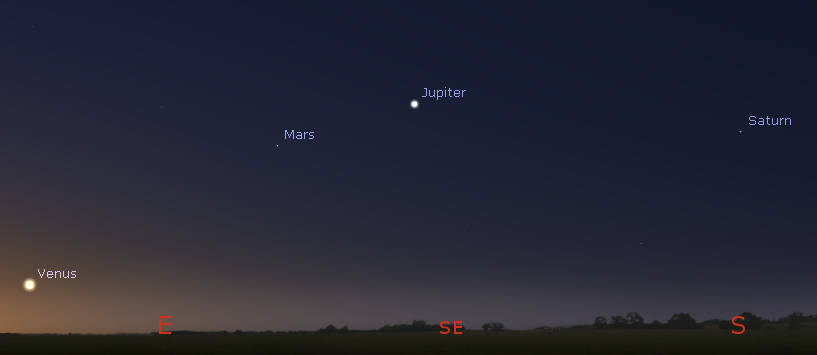
The morning planets at 5 am tomorrow morning, June 30, 2022. The planets actually appear in a straight line in the sky, being placed along the ecliptic, or path of the Sun in the sky. The ecliptic is a great circle on the celestial sphere. Click on the image to enlarge it. The span of the planets from Venus to Saturn is 114 degrees. Click on the image to enlarge it. Created using Stellarium.
The image above was plotted using the Miller cylindrical projection. While the azimuths are correct, the other plots are not. The planets actually appear to be in a straight line in the sky. I’ve finagled a stereographic projection to show that fact, as seen below.
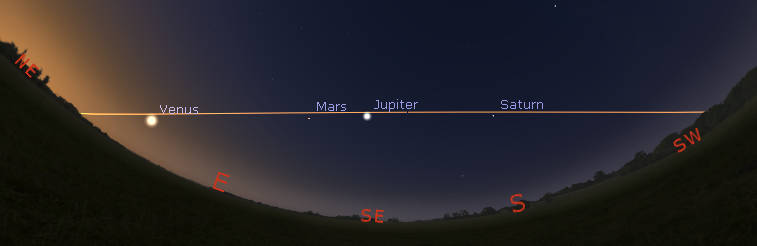
Distortions of rendering a spherical sky on a flat plane. The morning planets as seen in a stereographic view where great circles, like the ecliptic and horizon, are either circles or straight lines. In this image, the ecliptic, orange line, runs through the center of the plot, so it appears straight. In the real sky, both the planets and the horizon appear to be in straight lines. This assumes that your horizon is flat. Created using Stellarium.
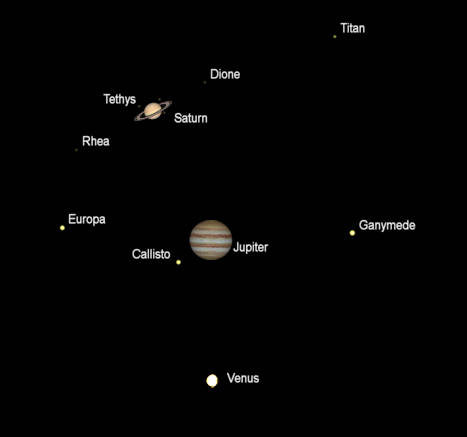
Views of Saturn, Jupiter, and Venus (north up) as they would be seen in a small telescope, with the same magnification, tomorrow morning at 5:00 am, June 30, 2022. I do not show planets less than 10 seconds of arc in diameter. Apparent diameters: Saturn 18.16″, its rings 42.31″; Jupiter 40.75″. Mars is not shown, its apparent diameter is 7.20″ and is 85.7% illuminated; Venus 11.91″, 85.8% illuminated. Jupiter’s moon Io will be behind the planet at that time. The ” symbol means seconds of arc (1/3600th of a degree.) Created using Cartes du Ciel (Sky Charts).
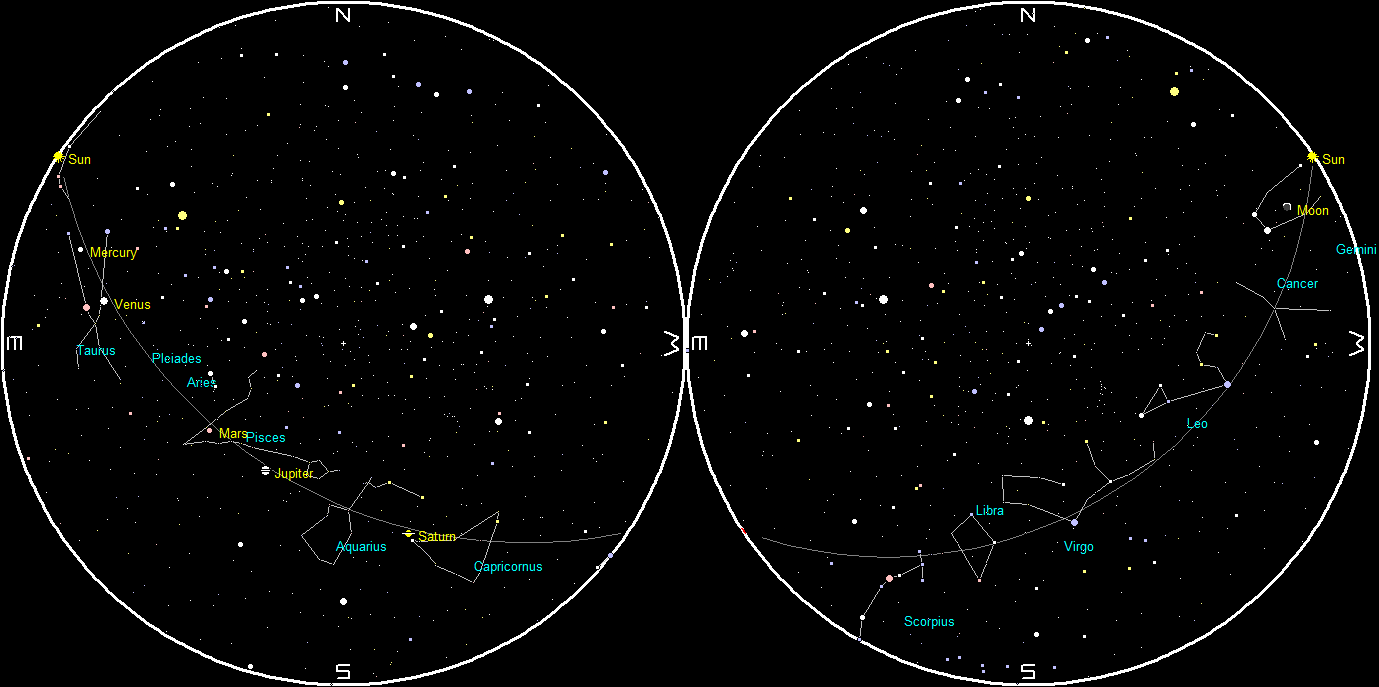
The naked-eye planets and the Moon at sunset and sunrise on a single night, starting with sunset on the right on June 29, 2022. The night ends on the left with sunrise on the 30th. Notice that all the naked-eye planets are in the morning sky now. Click on the image to enlarge it. Created using my LookingUp program.
06/28/2022 – Ephemeris – Finding the celestial harp
This is Ephemeris for Tuesday, June 28th. Today the Sun will be up for 15 hours and 32 minutes, setting at 9:32, and it will rise tomorrow at 6:00. The Moon is new today, and won’t be visible.
High in the east at 11 p.m. can be found a bright star just above a small, narrow, but very distinctive parallelogram of stars. They are the stars of the constellation Lyra the harp. The bright star is Vega, the 4th or 5th brightest nighttime star*, and currently the topmost star of the Summer Triangle. To the Romans, the star Vega represented a falling eagle or vulture. Apparently they never made the distinction between the two species. It is a pure white star and serves as a calibration star for color and brightness. In the evening, it is the top-most star of the Summer Triangle. The harp, according to Greek mythology, was invented by the god Hermes. The form of the harp, in the sky, is as he had invented it: by stretching strings across a tortoise shell. Hermes gave it to his half-brother Apollo, who in turn gave it to the legendary musician Orpheus.
The astronomical event times given are for the Traverse City/Interlochen area of Michigan (EDT, UT – 4 hours). They may be different for your location.
*Vega’s rival for the fourth spot on the brightness list is Arcturus to it’s west. Wikipedia’s source says that Arcturus is slightly brighter. Stellarium’s source says Vega is brighter. The difference is a few hundredths of a magnitude. However, they are of different colors. Vega is pure white, while Arcturus is yellow-orange because it has a cooler surface temperature than Vega. Check them out for yourself.
Addendum
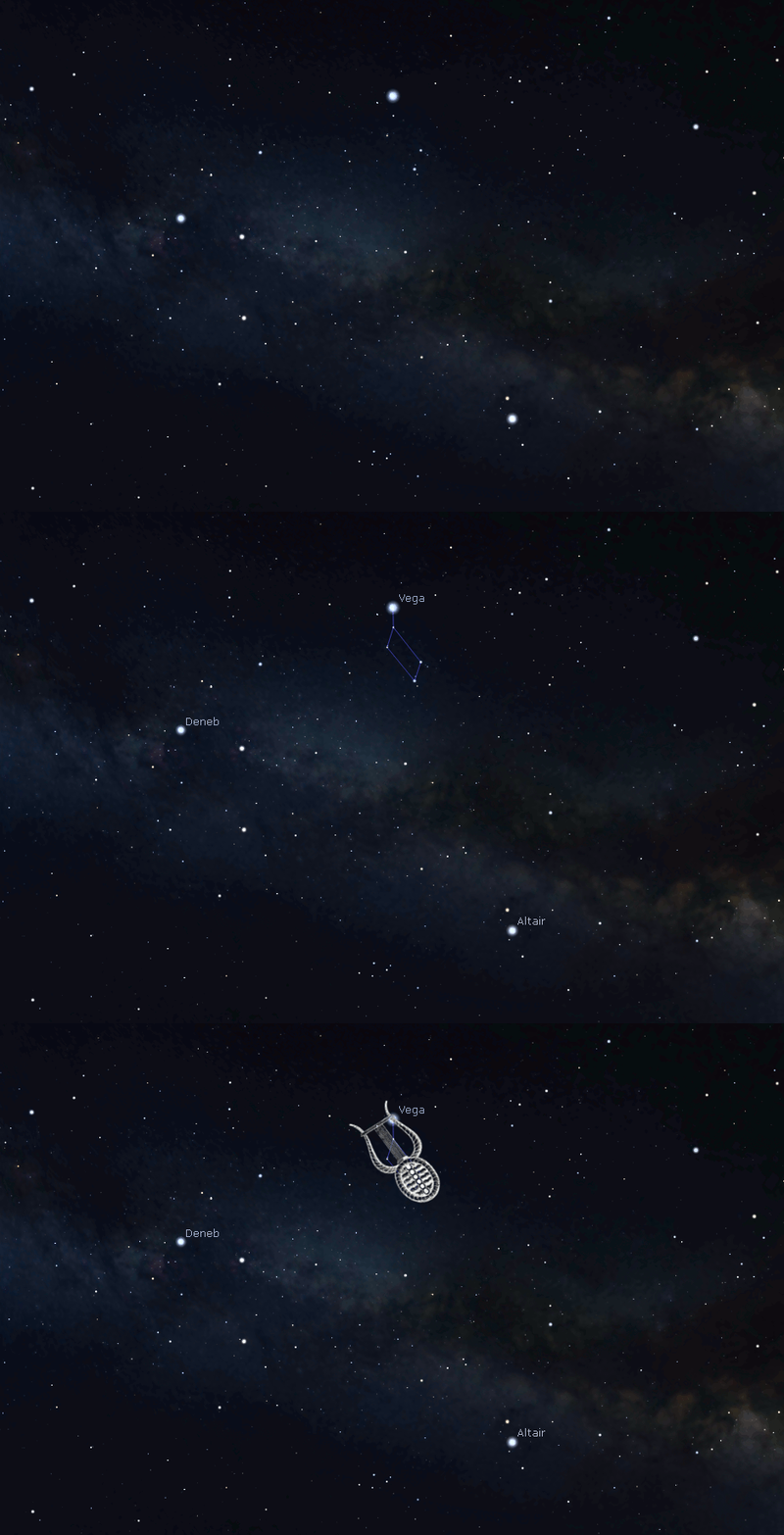
Animated Lyra finder chart. The lyre image not supplied by Stellarium but is from The World’s Earliest Music by Hermann Smith, Figure 60, A Project Gutenberg E-Book, and captioned “The Chelys or Greek Tortoiseshell Lyre”. The three names stars are the stars of the Summer Triangle in the eastern sky these evenings of late June. Created using Stellarium.
06/27/2022 – Ephemeris – Finding the Summer Triangle
This is Ephemeris for Monday, June 27th. Today the Sun will be up for 15 hours and 33 minutes, setting at 9:32, and it will rise tomorrow at 5:59. The Moon, 1 day before new, will rise at 5:13 tomorrow morning.
We’re nearly a week into summer, and the asterism or informal constellation called the Summer Triangle can be seen rising in the east as it gets dark. Highest of the three bright stars is Vega in the constellation Lyra the harp, whose body is seen in a narrow parallelogram nearby. The second star of the triangle is Deneb, in Cygnus the swan, lower and left of Vega, It appears dimmer than Vega because it is by far the most distant of the three. The third star of the Summer Triangle is seen farther below and a right of Vega. It is Altair in Aquila the eagle, and the closest. Altair is 16.5 light years away, Vega is 27 light years, while Deneb may be a whopping 2,600 light years away. One light year is 6 trillion miles (9 trillion kilometers).
The astronomical event times given are for the Traverse City/Interlochen area of Michigan (EDT, UT – 4 hours). They may be different for your location.
Addendum
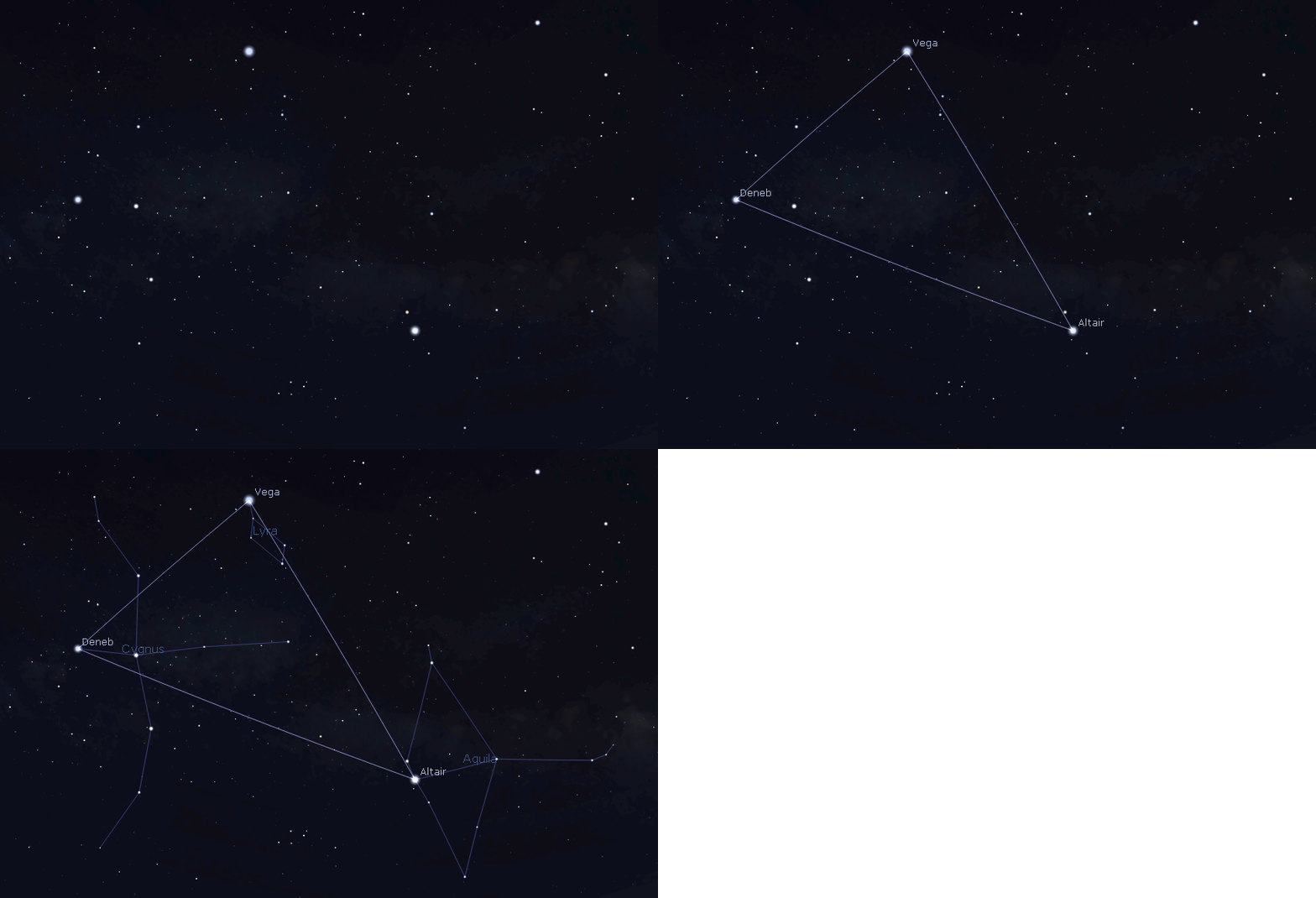
The Summer Triangle finder animation showing first the unlabeled sky, Then the Summer Triangle with the stars labeled, then the constellations of those stars. Created using Stellarium and GIMP.
06/24/2022 – Ephemeris – Finding the greatest celestial hero: Hercules
This is Ephemeris for Friday, June 24th. Today the Sun will be up for 15 hours and 34 minutes, setting at 9:32, and it will rise tomorrow at 5:58. The Moon, halfway from last quarter to new, will rise at 3:31 tomorrow morning.
Orion, the hard luck mythical Greek hunter, gets a splashy constellation in the winter sky, but the greatest hero of all, Hercules, gets a dim group of stars on the border between the spring and summer stars. At 11 p.m. Hercules is high in the southeast. It is located right of the bright star Vega, in the east. Hercules’ central feature is a keystone shaped box of stars, called, of course, the Keystone of Hercules tilted to the left, which represents the old boy’s shorts. From the top and left corner stars extend lines of stars that are his legs, from the bottom and right stars, the rest of his torso and arms extend. So in one final indignity, he’s upside down in our sky. For those with a telescope, Hercules contains the beautiful globular star cluster Messier 13.
The astronomical event times given are for the Traverse City/Interlochen area of Michigan (EDT, UT – 4 hours). They may be different for your location.
Addendum
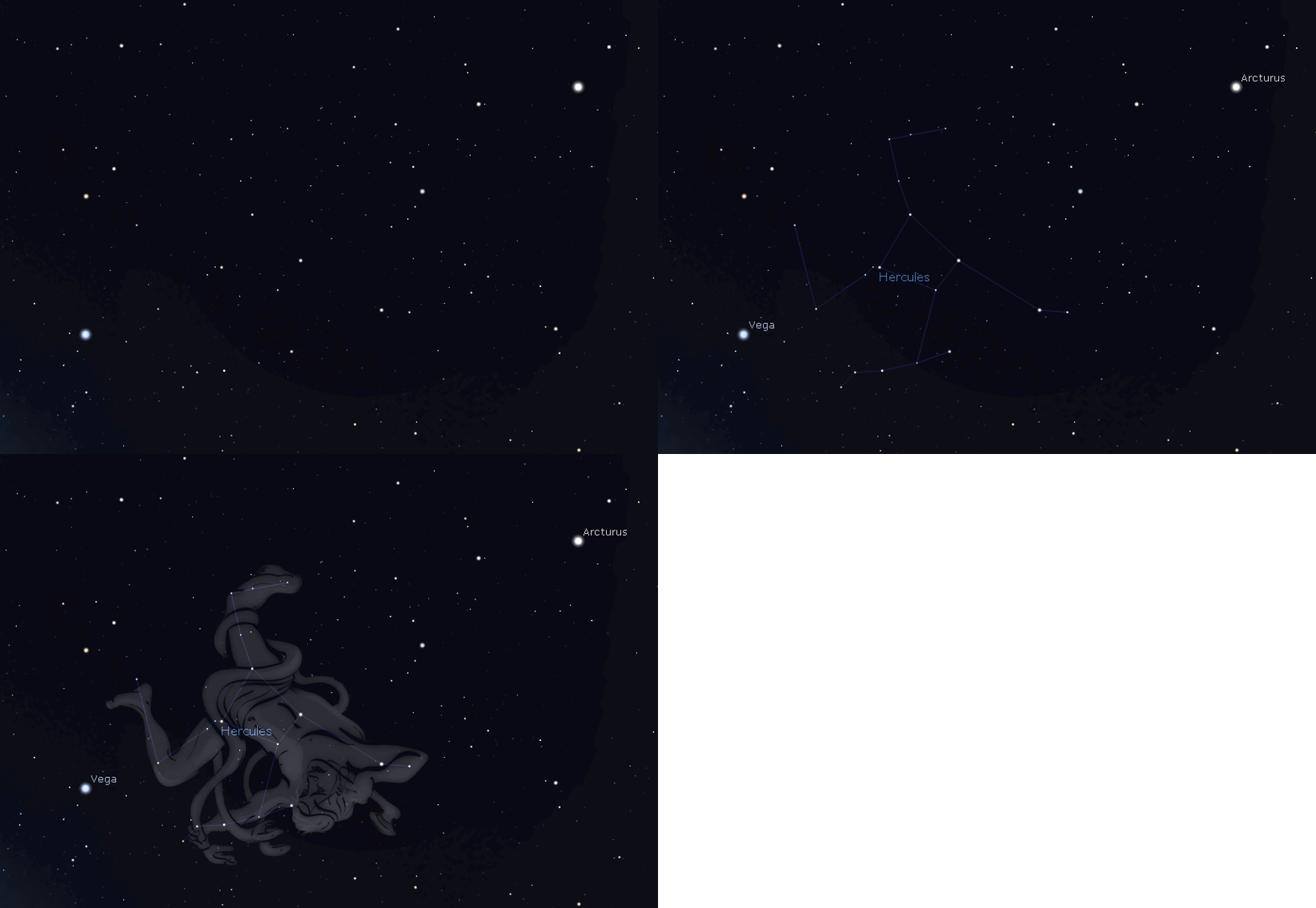
Hercules animation showing neighboring stars at 11 p.m. for mid-June. Click on image to enlarge. Created using Stellarium.
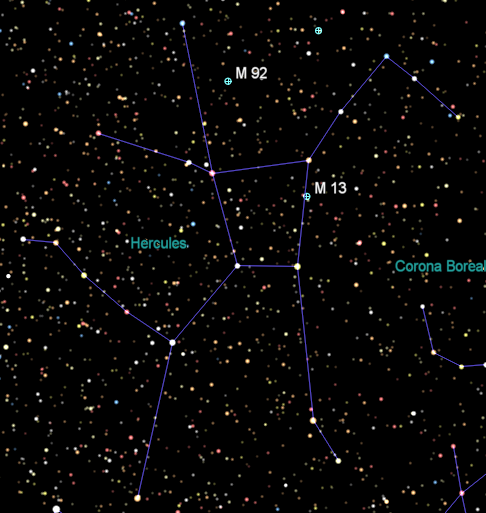
Hercules with all the stars visible in binoculars and its two globular star clusters: M13 and M92. M13 is almost bright enough to be spotted with the naked eye. It is easily visible in binoculars as a tiny fuzzy spot. It takes a telescope with an aperture of 6 – 8″ or 150 – 200 mm to begin to see some individual stars. M92 is dimmer and harder to resolve. Created using Cartes du Ciel (Sky Charts).
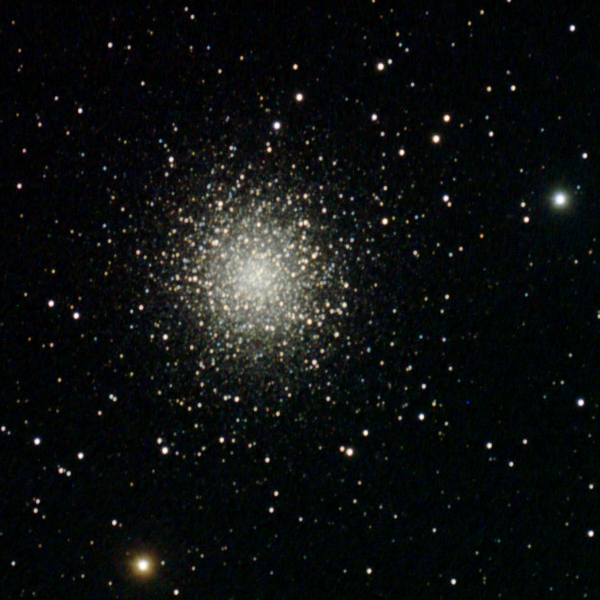
M 13, the Great Globular Star Cluster in Hercules. Credit: Scott Anttila.
06/23/2022 – Ephemeris – Corona Borealis, the Northern Crown
This is Ephemeris for Thursday, June 23rd. Today the Sun will be up for 15 hours and 34 minutes, setting at 9:32, and it will rise tomorrow at 5:58. The Moon, 3 days past last quarter, will rise at 3:08 tomorrow morning.
High in the south at 11 this evening can be seen a small nearly circular constellation of Corona Borealis, the Northern Crown. It is just left of Boötes, the kite shaped constellation off the handle of the Big Dipper. According to Greek myth, the crown was given by the gods to the princess Ariadne, daughter of King Minos of Crete. The crown is more like a tiara with the bright star Alphecca at the front. To the Anishinaabe people, who are native to our region, it is the Sweat Lodge. Part of what we call Hercules next to it is the Exhausted Bather, who is lying on the ground after the ceremony. The seven stones that are heated for the Sweat Lodge ceremony are the Pleiades, now close to Venus in the morning twilight.
The astronomical event times given are for the Traverse City/Interlochen area of Michigan (EDT, UT – 4 hours). They may be different for your location.
Addendum
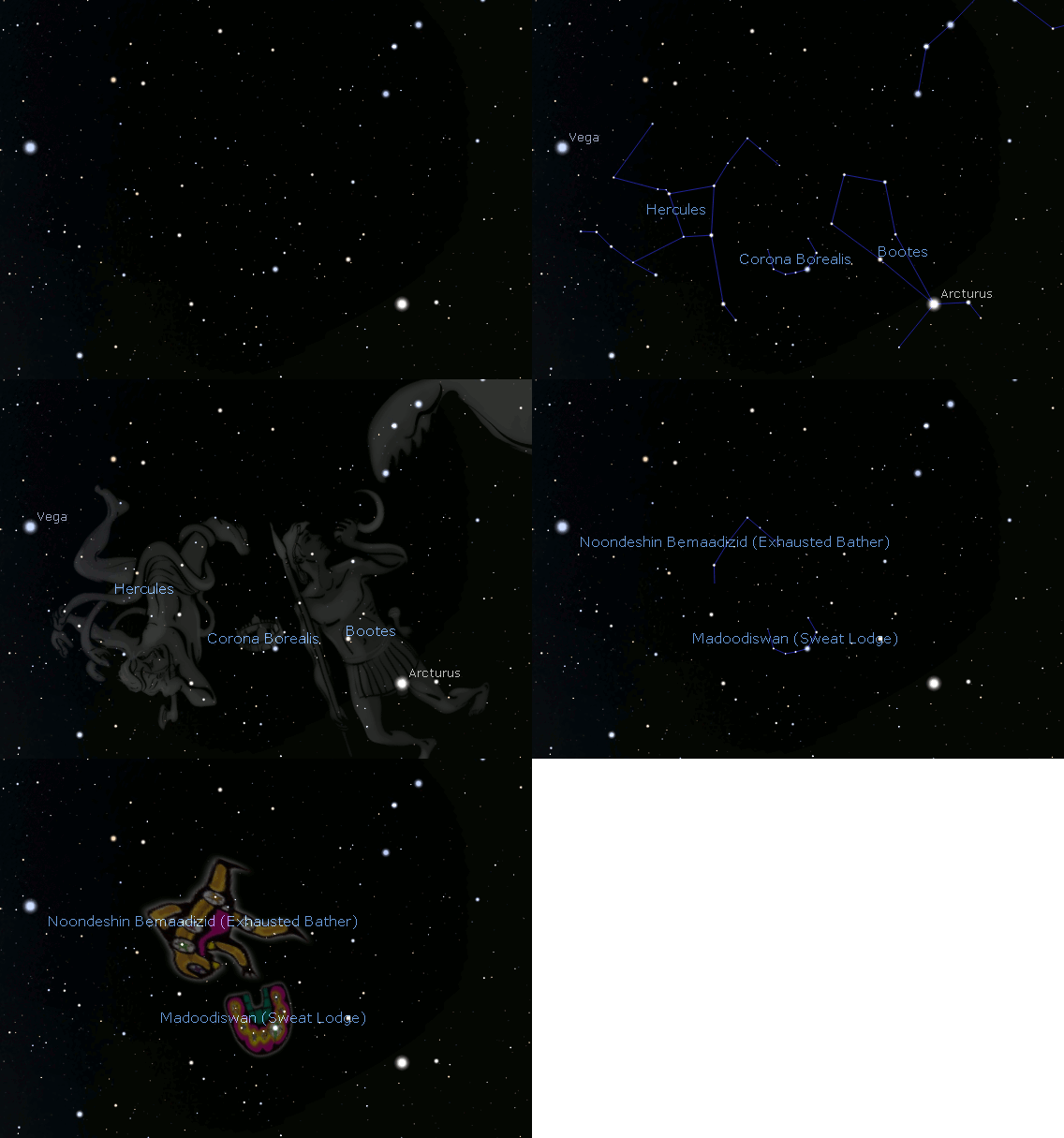
Corona Borealis and Sweat Lodge finder animation. Looking high in the south at 11 pm, June 23rd. The tail of Ursa Major or the handle of the Big Dipper is in the upper right. Created using Stellarium and GIMP. Both star lore images are embedded in Stellarium. The Anishinaabe images are embedded in Stellarium and is from Ojibwe Giizhig Anung Masinaaigan – Ojibiwe Sky Star Map created by A. Lee, W. Wilson, and C. Gawboy.
06/22/2022 – Ephemeris – Let’s search for the naked-eye planets for this week
This is Ephemeris for Wednesday, June 22nd. Today the Sun will be up for 15 hours and 34 minutes, setting at 9:32, and it will rise tomorrow at 5:57. The Moon, 2 days past last quarter, will rise at 2:48 tomorrow morning.
Let’s search for the naked-eye planets for this week. All the naked-eye planets are in the morning sky, although Mercury may be too close to the Sun to be seen. It might just be visible low in the east-northeast after 5. That’s at least for those as far north as we are. At 5 am tomorrow the planets will be spread out from Mercury, actually invisible, near the horizon, brilliant Venus low in the east-northeast to Saturn higher in the south. To the right of Venus, tomorrow morning, stretching from east to southeast, will be the Moon, Mars and Jupiter. Mars is quite a bit dimmer than Jupiter. All will be in line sloping to the upper right with Saturn all by its lonesome in the south. The naked-eye planets are arranged in the morning sky, in the same order as their distances from the Sun.
The astronomical event times given are for the Traverse City/Interlochen area of Michigan (EDT, UT – 4 hours). They may be different for your location.
Addendum
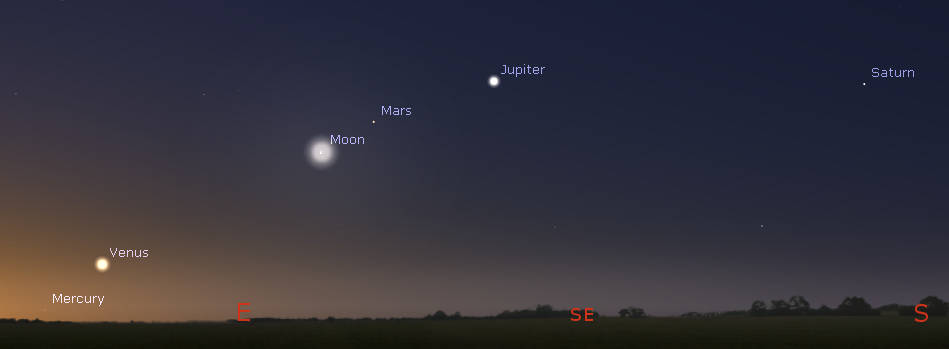
The morning planets and the waning crescent Moon at 5 am tomorrow morning, June 23, 2022. Click on the image to enlarge it. The span of the planets from Venus to Saturn is 95 degrees. Click on the image to enlarge it. Created using Stellarium.
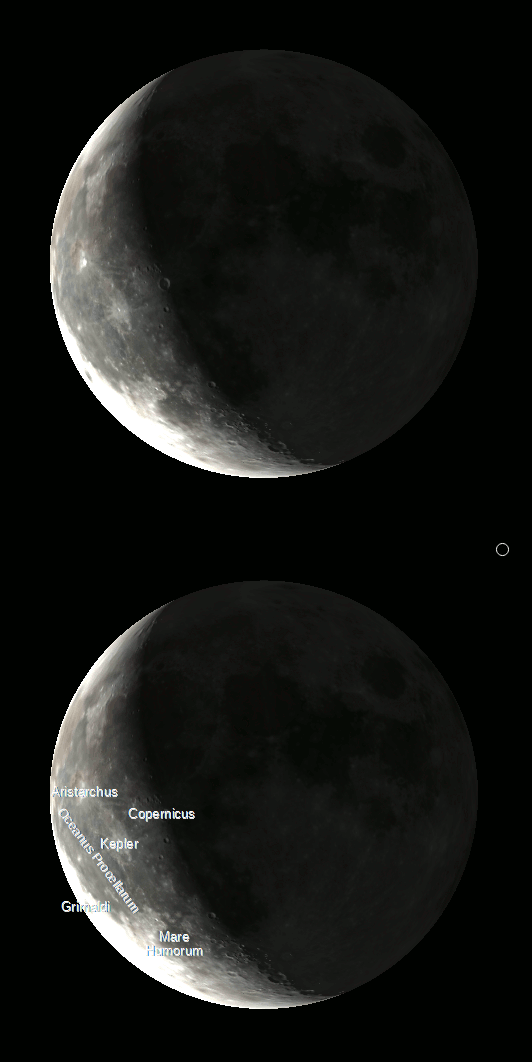
Waning crescent Moon closeup, annotated, as seen in binoculars or a small telescope. Created using Stellarium, Libreoffice and GIMP.
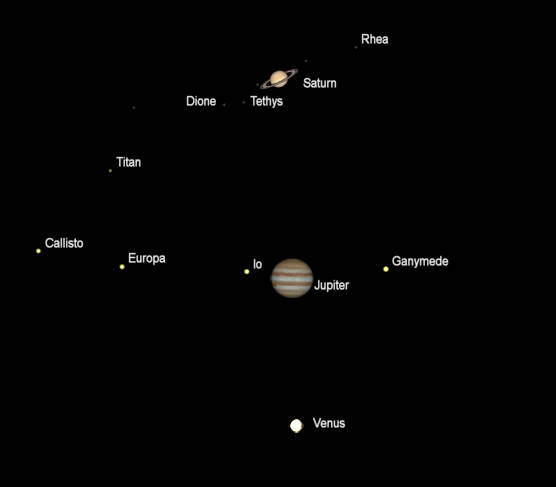
Views of Saturn, Jupiter, and Venus (north up) as they would be seen in a small telescope, with the same magnification, tomorrow morning at 5:00 am, June 23, 2022. I do not show planets less than 10 seconds of arc in diameter. Apparent diameters: Saturn 17.99″, its rings 41.90″; Jupiter 39.86″. Mars is not shown, its apparent diameter is 7.00″ and is 86.1% illuminated; Venus 12.27″, 84.1% illuminated. The ” symbol means seconds of arc (1/3600th of a degree). Created using Cartes du Ciel (Sky Charts).
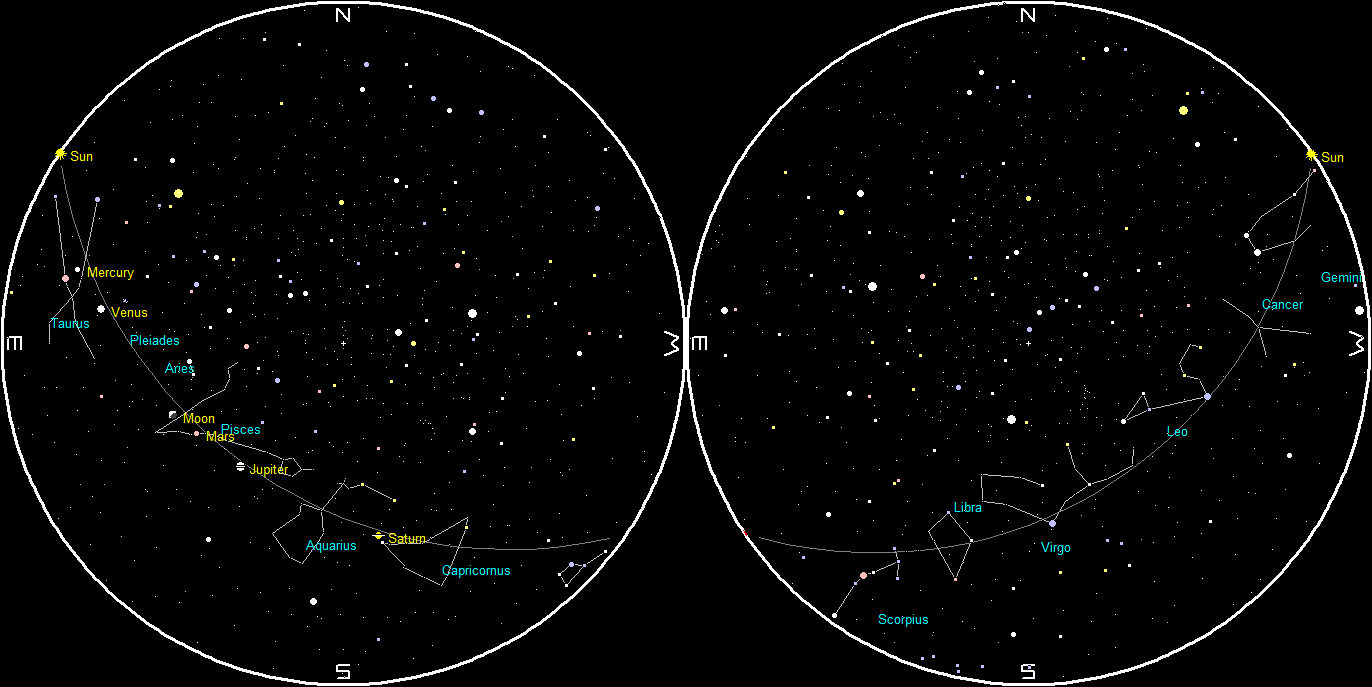
The naked-eye planets and the Moon at sunset and sunrise on a single night, starting with sunset on the right on June 22, 2022. The night ends on the left with sunrise on the 23rd. Notice that all the naked-eye planets are in the morning sky now. Click on the image to enlarge it. Created using my LookingUp program.
06/21/2022 – Ephemeris – Summer arrives today!
This is Ephemeris for Tuesday, June 21st. Today the Sun will be up for 15 hours and 34 minutes, setting at 9:32, and it will rise tomorrow at 5:57. The Moon, 1 day past last quarter, will rise at 2:28 tomorrow morning.
Summer arrived at 5:14 this morning (9:14 UT). In all the excitement, I forgot to mention that the waning Moon is passing the long line of planets in the morning. Tomorrow morning, it will be nearing Mars. Today, the Sun will be out a bit over 15 ½ hours for us in the Interlochen/Traverse City area. Also, the Sun will reach up to nearly 67 degrees altitude above the southern horizon at local noon, that’s 1:44 pm. We are now climbing down from those extreme values, at first slowly, but with increasing rapidity as summer goes on. However, the Northern Hemisphere is continuing to warm up. Our warmest average temperatures tend to be near the end of July. What’s really neat is, that the Earth is farther from the Sun than it was six months ago as winter started.
The astronomical event times given are for the Traverse City/Interlochen area of Michigan (EDT, UT – 4 hours). They may be different for your location.
Addendum
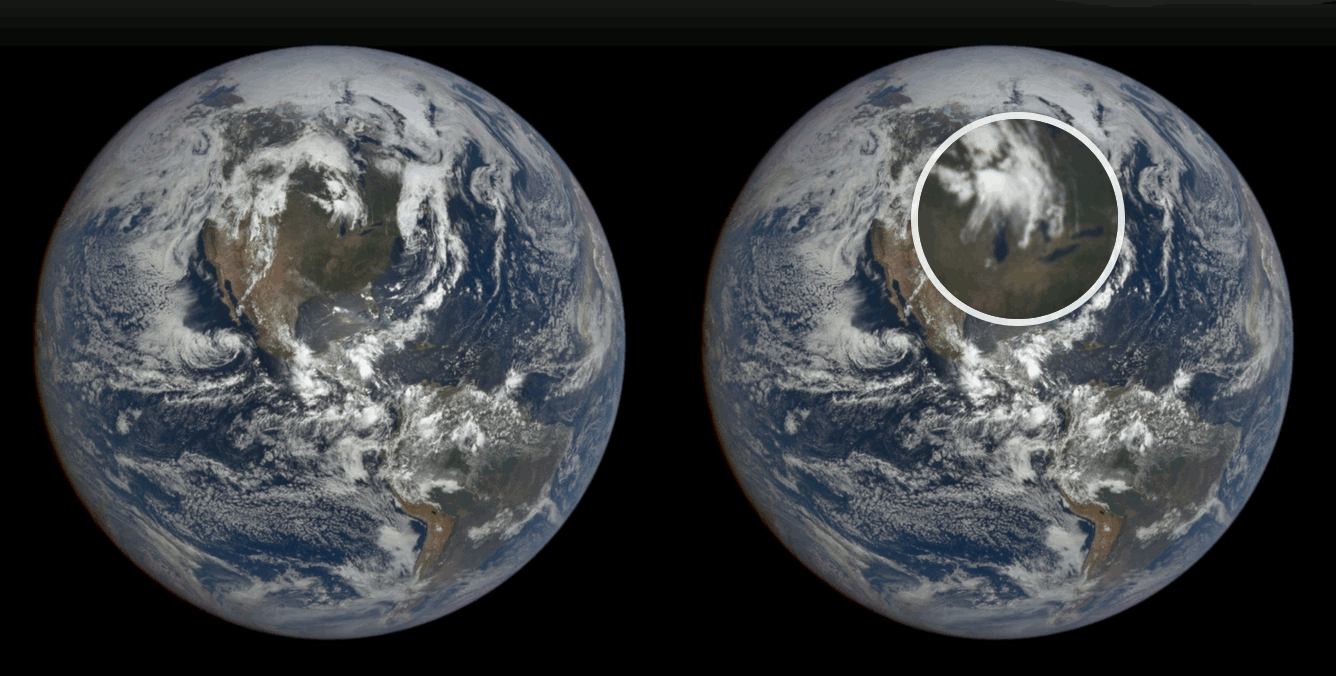
DSCOVR image of Earth near summer solstice with magnified Michigan animation. Most of Michigan’n mitt is obscured in the north where I’m located, plus the Upper Peninsula. Image taken 1:26 pm EDT, June 19, 2022. Credit NASA/NOAA DSCOVR satellite in halo orbit of Sun-Earth L1 Lagrange Point.
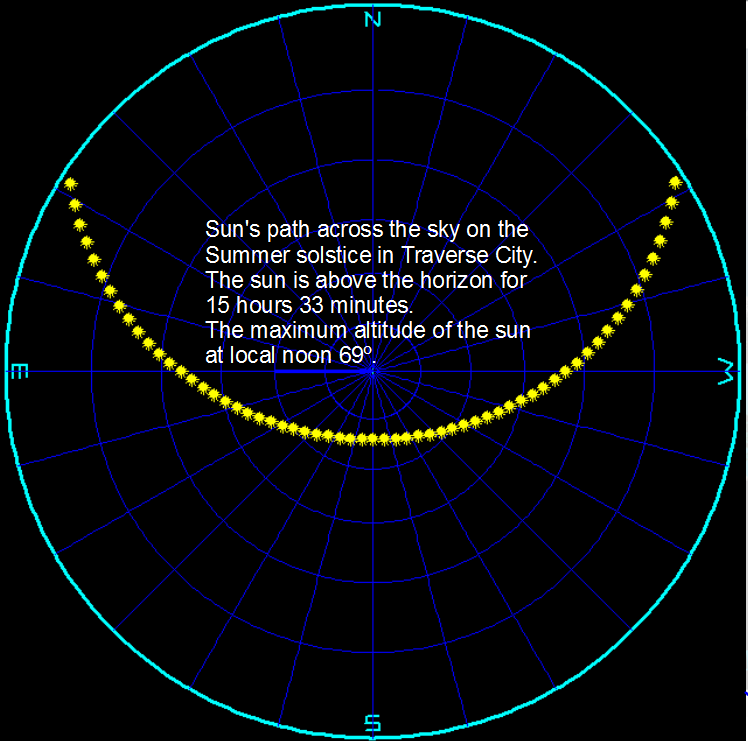
The sun’s daily path through the sky from horizon to horizon on the first day of summer, the summer solstice. Credit My LookingUp program.
06/20/2022 – Ephemeris – Here we are at the last full day of spring
This is Ephemeris for Juneteenth, Observed, Monday, June 20th. Today the Sun will be up for 15 hours and 34 minutes, setting at 9:31, and it will rise tomorrow at 5:57. The Moon, at last quarter today, will rise at 2:09 tomorrow morning.
Here we are at the last full day of spring. Summer will begin at 5:14 EDT, or 9:14 UT tomorrow morning, when the Sun reaches its highest point on the celestial sphere, and directly over the northern latitude line called the Tropic of Cancer. At that time, folks at or north of the Arctic Circle at about 66 ½ degrees north latitude won’t see the Sun set. As it is, Interlochen is only about 4 degrees latitude south of the land of the all night twilight. It’s neat, around here in the western part of the Lower Michigan, to go out around midnight and see a bit of the last twilight glow near the north. Remember that around here, local or astronomical midnight occurs around 1:45 am. Ah politicians, aren’t they wonderful. And they’ve just made Daylight Saving Time permanent.
The astronomical event times given are for the Traverse City/Interlochen area of Michigan (EDT, UT – 4 hours). They may be different for your location.
Addendum
The event at 5:14 am EDT or 9:14 UT is called the summer solstice, or in deference to our Southern Hemisphere neighbors, the June solstice, because for them winter is starting. Solstice means “Sun stands still”. It doesn’t, of course. The sun is always moving eastward against the stars. However, if one checks the altitude of the Sun in the south at local noon each day, the Sun would move higher each day since the winter solstice until around June 21st, and go no further. It would slowly begin a retreat, day by day. That pause at the highest point is the solstice.
06/17/2022 – Ephemeris – What’s that weird twinkly star low in the south?
This is Ephemeris for Friday, June 17th. Today the Sun will be up for 15 hours and 34 minutes, setting at 9:30, and it will rise tomorrow at 5:56. The Moon, halfway from full to last quarter, will rise at 12:55 tomorrow morning.
At this time of year, there is a star that appears low in the south-southeast that appears red and twinkles mightily. The twinkling caused by the Earth’s atmosphere is enhanced when viewing it in binoculars. In a telescope, it appears as a virtual sparkler. It’s been called in to authorities as a UFO, unidentified flying object, or as the Defense Department now calls them UAPs, or unidentified aerial phenomena. Anyway, this light is identified. It is the red giant star Antares, in the heart of Scorpius the scorpion, one of the constellations of the zodiac. Antares other claim to fame is embodied in its name. Decoded, Antares means Rival of Mars due to its color and the fact that Mars passes by every couple of years. Ant means anti, and Ares is the Greek god of war that the Romans appropriated as Mars.
The astronomical event times given are for the Traverse City/Interlochen area of Michigan (EDT, UT – 4 hours). They may be different for your location.
Addendum
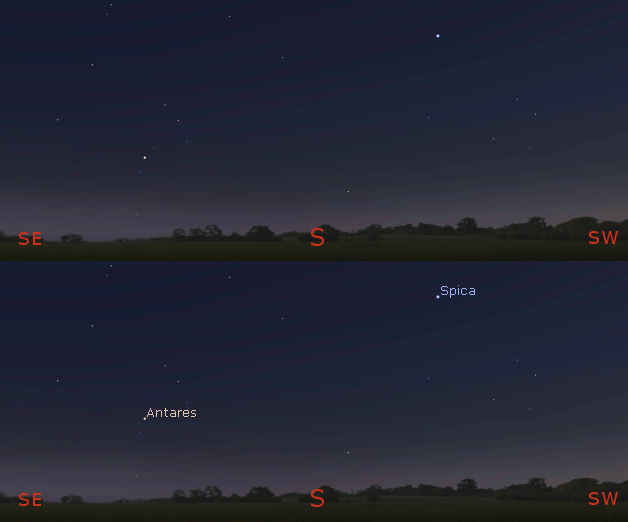
Antares low in the south-southeast at 10:30 pm, June 17, 2022, without Mars for competition. At this time, Antares is only 13 degrees above the horizon. Click on the image to enlarge it. Created Using Stellarium and GIMP.
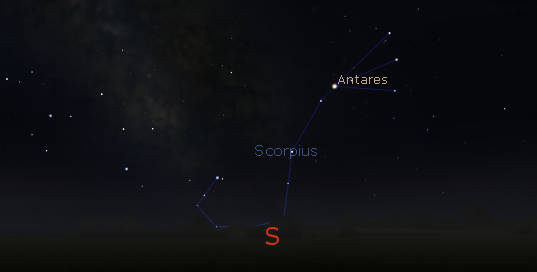
Scorpius at its highest as seen from the Grand Traverse area. Antares at this time is not quite 19 degrees altitude. This is 1 am, June 18th. Perceptive viewers of this image may spot a teapot in the stars to the left of Scorpius. That’s what we modern folk see in the stars of Sagittarius the archer. Created using Stellarium.
 Bob Moler's Ephemeris Blog