Archive
03/10/2022 – Ephemeris – Viewing the Moon at first quarter tonight
This is Ephemeris for Thursday, March 10th. Today the Sun will be up for 11 hours and 38 minutes, setting at 6:42, and it will rise tomorrow at 7:02. The Moon, at first quarter today, will set at 3:26 tomorrow morning.
By the time we spot the moon this evening, it will be over half a day from being exactly first quarter phase. Looking at the brighter part of the Moon in binoculars, which is at the bottom or south end. We are looking at the lunar highlands of mostly very old craters that extend back to the formation of the Moon, nearly 4.5 billion years ago, that weren’t obliterated by the asteroid strikes that created the darker maria or lunar seas half a billion years later. In small telescopes there is a vertical line of three large craters whose names, from largest to smallest and top down, are Ptolemaeus, Alphonsus, and Arzachel. Alphonsus is a curious crater. In 1958 a Soviet astronomer recorded a possible volcanic eruption or outgassing from the crater floor.
The astronomical event times given are for the Traverse City/Interlochen area of Michigan (EST, UT – 5 hours). They may be different for your location.
Addendum
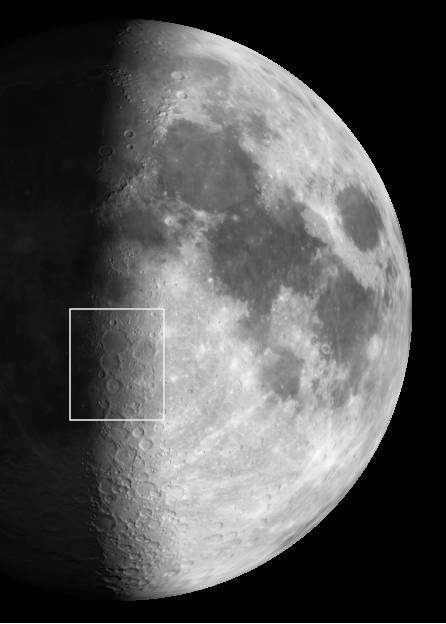
Lunar craters Ptolemaeus, Alphonsus and Arzachel outlined on the Moon’s disk, at first quarter, at 8 pm, March 10, 2022. Created using Virtual Moon Atlas.
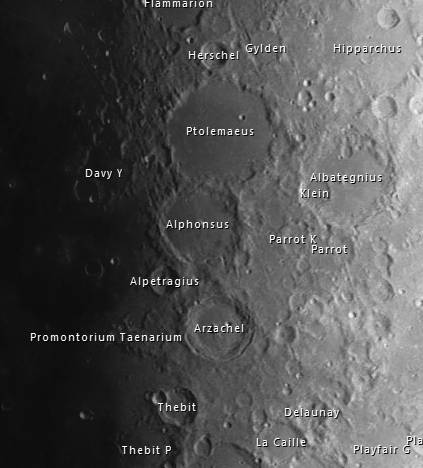
Closeup of lunar craters Ptolemaeus, Alphonsus and Arzachel, with other nearby craters, outlined above. Created using Virtual Moon Atlas.
03/09/2022 – Ephemeris – Let’s search for the naked-eye planets for this week
This is Ephemeris for Wednesday, March 9th. Today the Sun will be up for 11 hours and 35 minutes, setting at 6:41, and it will rise tomorrow at 7:04. The Moon, 1 day before first quarter, will set at 2:28 tomorrow morning.
Let’s search for the naked-eye planets for this week. There are no bright planets in the evening sky. Jupiter, the last to leave, will stay too close to the direction of the Sun to be visible in the morning sky for at least a month. So that’s where the action shifts. Jupiter joins Mercury, Saturn, Venus and Mars. Late winter and early spring mornings aren’t the best for spotting planets close to the Sun, since they tend to lie low in the southeastern sky. Saturn and Mercury are also too close to the direction of the Sun to be spotted now. Venus will rise at 4:55 tomorrow morning and Mars will rise at 5:16. By 6:15, they will be low in the southeast, with much dimmer Mars at the 5 o’clock position below Venus.
The astronomical event times given are for the Traverse City/Interlochen area of Michigan (EST, UT – 5 hours). They may be different for your location.
Addendum
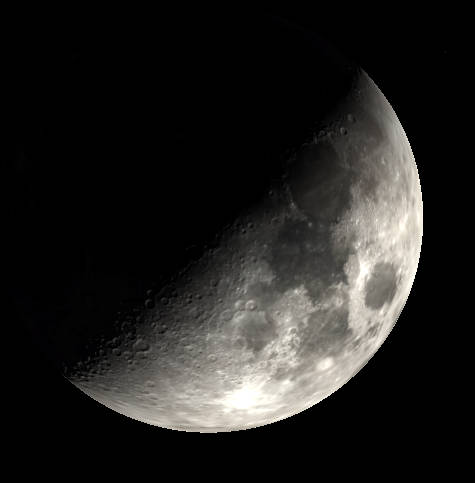
The waxing crescent Moon at 8 pm or an hour or so after sunset tonight, March 9, 2022. It is shown as it might be seen in binoculars or a small telescope. Created using Stellarium.
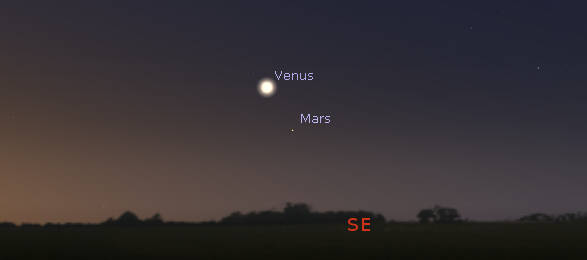
Morning planets Venus and Mars at 6:15 am, or about 45 minutes before sunrise tomorrow, March 10, 2022. Created using Stellarium.
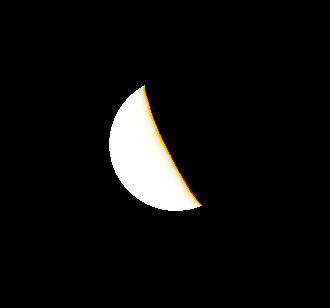
Venus through a telescope as it would appear before sunrise tomorrow morning, March 10, 2022. It’s shown larger than usual, since it’s the only planet that looks like anything in a small telescope now. Its apparent diameter is 27.78″, and it is 44.0% illuminated by the Sun. Mars has an apparent diameter of 4.83″, and is slightly gibbous at 93.3% illuminated. (” means seconds of arc. 1″ is 1/3600th of a degree). Created using Stellarium, which is also the source for the apparent diameters and the illuminated fraction of Venus and Mars.
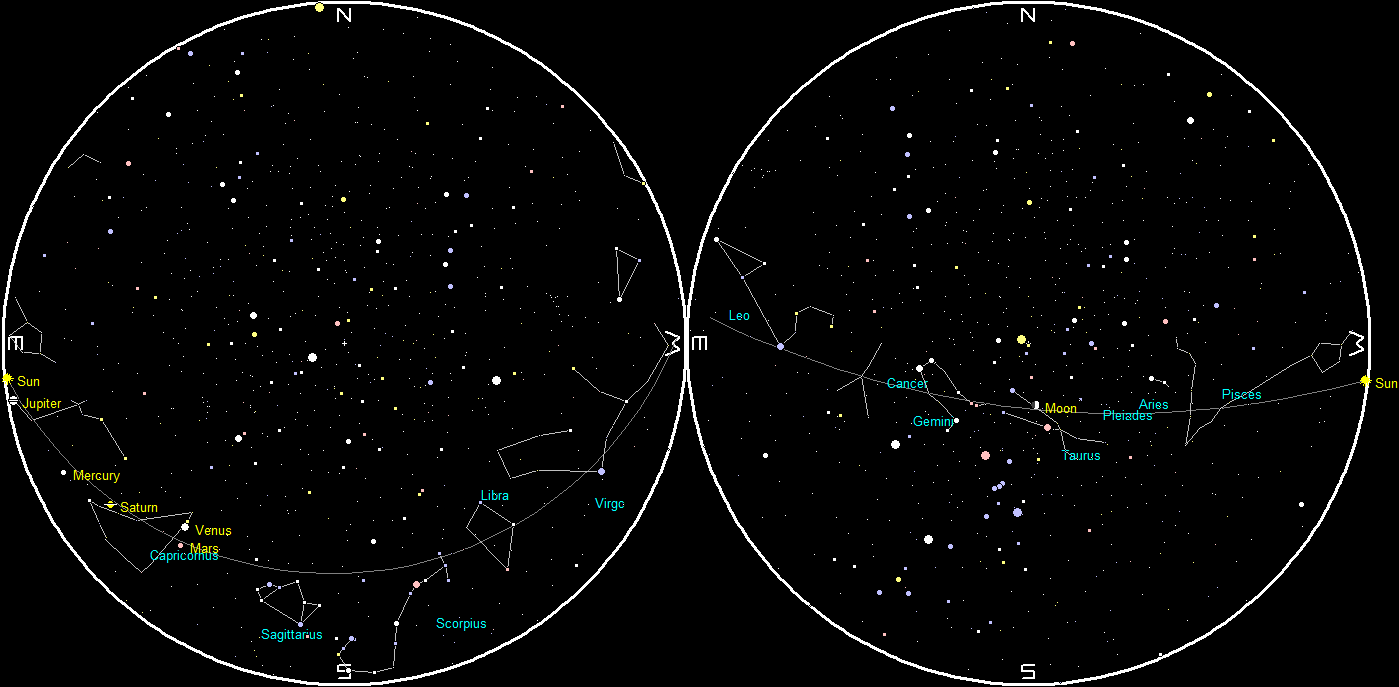
The naked-eye planets and the Moon at sunset and sunrise on a single night, starting with sunset on the right on March 9, 2022. The night ends on the left with sunrise on the 10th. Notice that all the naked-eye planets are in the morning sky now. Click on the image to enlarge it. Created using my LookingUp program.
03/08/2022 – Ephemeris – International Women’s Day
This is Ephemeris for International Women’s Day, Tuesday, March 8th. Today the Sun will be up for 11 hours and 32 minutes, setting at 6:39, and it will rise tomorrow at 7:06. The Moon, 2 days before first quarter, will set at 1:25 tomorrow morning.
The planet Venus is the only major planet named after a goddess. Satellites of the planets are named after both male and female deities. When asteroids were discovered between Mars and Jupiter they began to receive female deity names, however errant asteroids that that came close to the Earth’s orbit received male names. Venus, named after the Roman goddess of love, by convention, has female names for its land forms. But before that convention was adopted the first bright radar feature found on Venus, in 1967, was Maxwell Montes, named after James Clerk Maxwell whose work in the 19th century predicted radio waves. It is by reflected radio waves (radar) by which that feature had been found using the Arecibo radio telescope.
The astronomical event times given are for the Traverse City/Interlochen area of Michigan (EST, UT – 5 hours). They may be different for your location.
Addendum
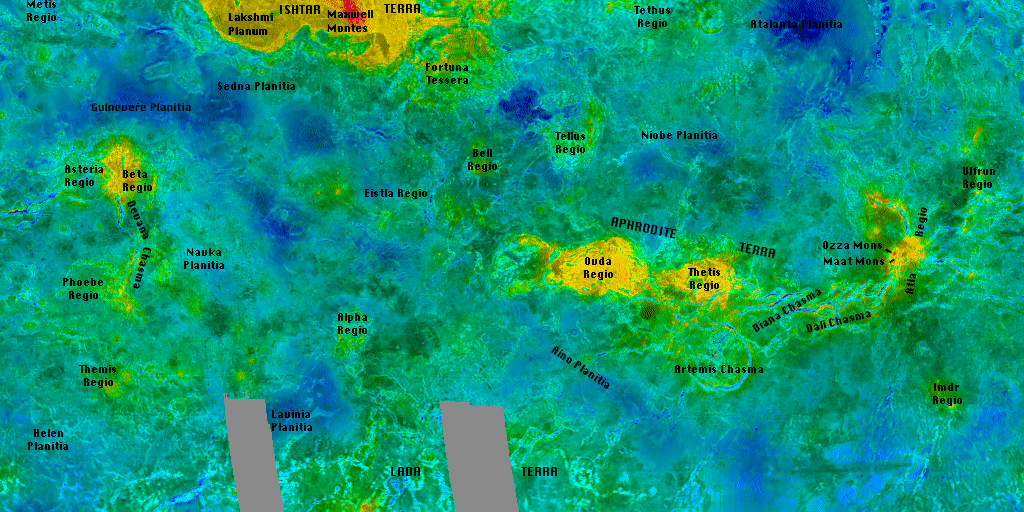
Radar map of Venus produced by the radar altimeter of the Pioneer Venus Orbiter, 1978-1992. Note Maxwell Montes at the top, part of Ishtar Terra, a continent-like land mass. Another large land mass is Aphrodite Terra in the center right. Click on the image to enlarge it. Credit: NASA.
03/07/2022 – Ephemeris – The Fisher announces the beginning of the Maple sugaring season
This is Ephemeris for Monday, March 7th. Today the Sun will be up for 11 hours and 28 minutes, setting at 6:38, and it will rise tomorrow at 7:07. The Moon, 3 days before first quarter, will set at 12:19 tomorrow morning.
March is a month of transitions. The stars of the winter skies, that is Orion and his merry band of bright stars, move to the west as those of spring rise in the east. The Big Dipper is ascending in the northeastern sky, after lying low in the north during the long dark evenings in the heart of winter. The dipper is the hind end of the Great Bear, officially Ursa Major. The Anishinaabe peoples of the Great Lakes region saw the Big Dipper as the hind end and tail of a magical creature called Fisher, or in their language Ojiig, who brought summer to the Earth. Its position in the sky around the pole announces the seasons. The Fisher’s ascension high into the northeastern sky signals this month’s maple sugaring season.
The astronomical event times given are for the Traverse City/Interlochen area of Michigan (EST, UT – 5 hours). They may be different for your location.
Addendum
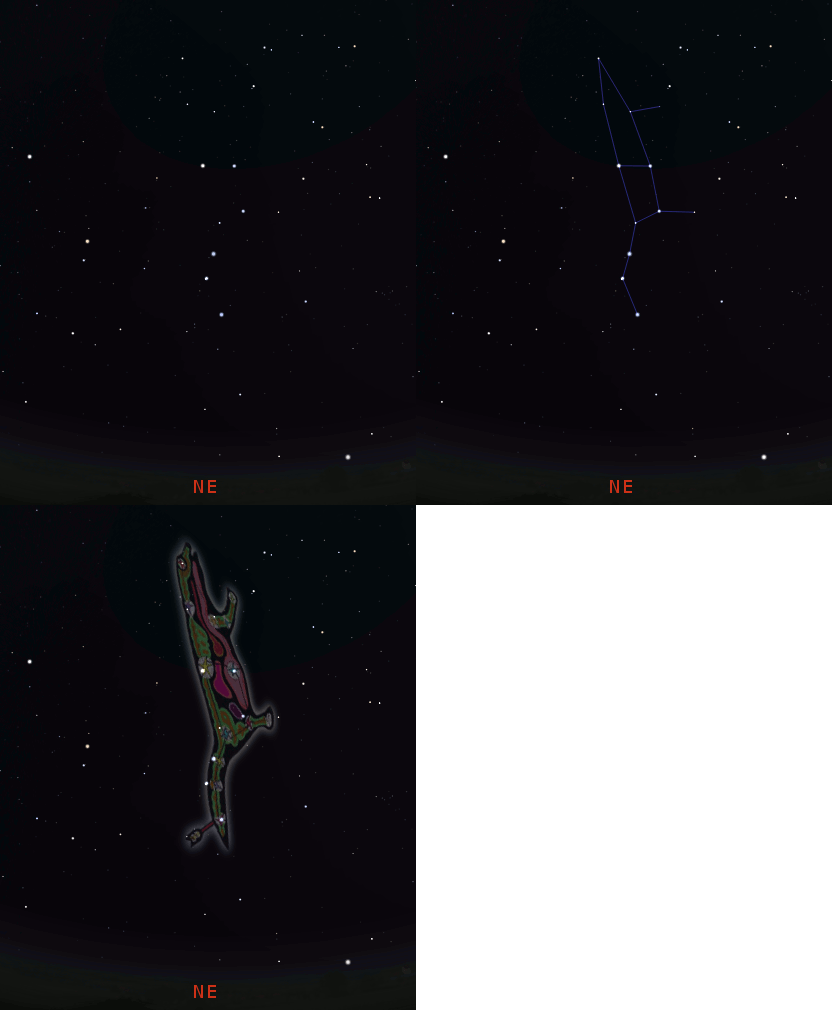
The Fisher announcing maple sugaring season – animation. Star positions for about 2 hours after sunset, near 45 degrees north latitude, for a week into March. Created using Stellarium and GIMP.
For the story of how the Fisher brought summer to the earth, and why he’s got an arrow sticking into his tail, click here.
03/04/2022 – Ephemeris – Tonight, an illustrated Zoom talk: “Light Pollution: Cause and Effect”
This is Ephemeris for Friday, March 4th. Today the Sun will be up for 11 hours and 19 minutes, setting at 6:34, and it will rise tomorrow at 7:13. The Moon, 2 days past new, will set at 8:56 this evening.
The Grand Traverse Astronomical Society (GTAS) will hold a virtual meeting and program at 8 pm tonight via Zoom. For the program, Dr. Jerry Dobek, astronomy professor at Northwestern Michigan College, will present an illustrated talk – Light Pollution: Cause and Effect. The focus of the talk will be on the general causes and effects of light pollution, as well as examples of proper lighting. Dr. Dobek has helped write lighting ordinances for governments here and around the nation. A virtual star party will start around 9 pm, also hosted by Dr. Dobek, but only if it’s clear in Traverse City. It will feature the wonders of the winter and early spring sky. Instructions to join the meeting and a link can be found on the society’s website, gtastro.org. All are welcome.
The astronomical event times given are for the Traverse City/Interlochen area of Michigan (EST, UT – 5 hours). They may be different for your location.
Addendum
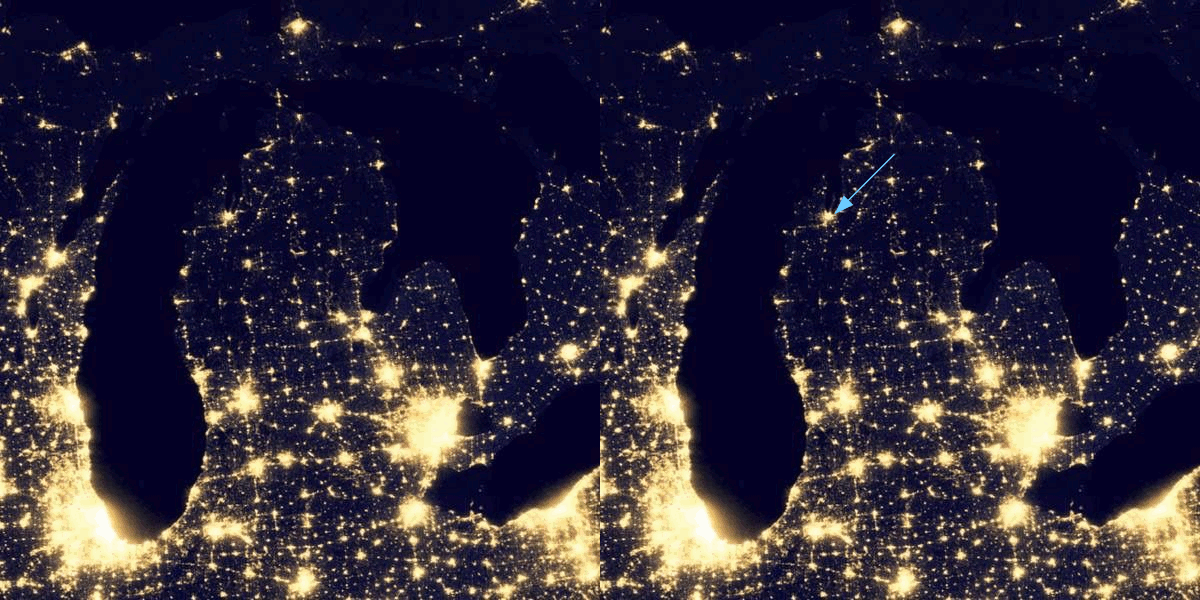
Michigan lights at night from space, with pointer to Traverse City. Image credit: NASA, animation created using LibreOffice and GIMP.
If COVID-19 stays tamped down this spring and summer, the GTAS will be working with the rangers of the Sleeping Bear Dunes National Lakeshore to schedule monthly sun and star parties. The areas of the park we observe from are generally northwest (above, left in the image above) of Traverse City, near the shore of Lake Michigan.
03/03/2022 – Ephemeris – Finding Cancer the crab
This is Ephemeris for Thursday, March 3rd. Today the Sun will be up for 11 hours and 16 minutes, setting at 6:33, and it will rise tomorrow at 7:15. The Moon, 1 day past new, will set at 7:46 this evening.
The constellation of Cancer the crab is made of dim stars, which are generally connected, in constellation charts, with lines that make either the letter K or an upside down Y, which lie directly between the star pair Castor and Pollux in Gemini and Regulus in Leo. In the center of the constellation is, what to the naked-eye is a fuzzy spot called Praesepe, or the manger. The two nearby stars, one to the northeast, and one to the southeast are Asellus Borealis, and Asellus Australis, the northern and southern donkey colts feeding out of the manger. Viewing that fuzzy spot with a pair of binoculars will reveal that it’s not fuzzy at all. It resolves into a cluster of stars, which astronomers, over the years, have called the Beehive cluster. Back in the first and second century CE, the Sun entered Cancer to begin the season of summer. It’s now just a transitional constellation between the winter and spring evening skies.
The astronomical event times given are for the Traverse City/Interlochen area of Michigan (EST, UT – 5 hours). They may be different for your location.
Addendum
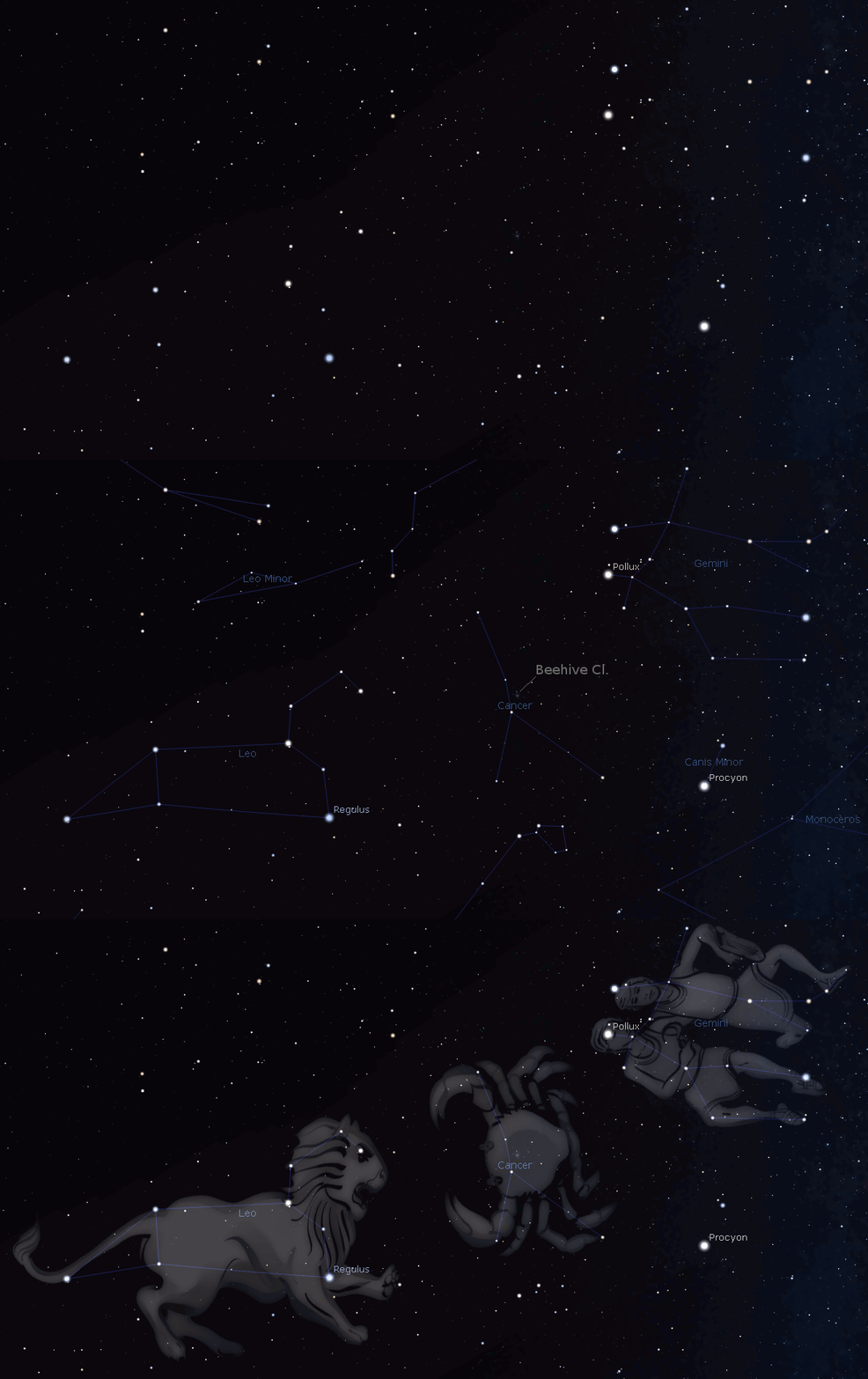
Cancer, the crab finder chart. Note the beehive cluster, also known to amateur astronomers as M44, along with other catalog names. Prior to the invention of the telescope this cluster was known as Praesepe which means “Manger”. Click on the image to enlarge it. Created using Stellarium and GIMP.
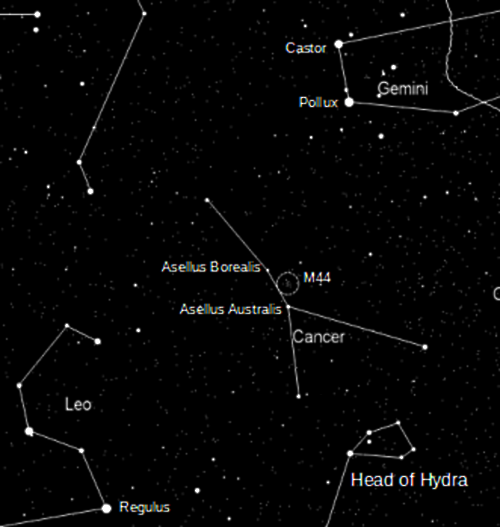
A closer look at Cancer, noting the donkey stars Asellus Borealis and Australis feeding at the manger, Praesepe or M44, aka: the Beehive Cluster. Created using Cartes du Ciel (Sky Charts) and LibreOffice for captions. Adapted from a chart I created for the March 2022 issue of the GTAS newsletter, the Stellar Sentinel.
03/02/2023 – Ephemeris – Let’s search for the naked-eye planets for this week
This is Ephemeris for Ash Wednesday, March 2nd. Today the Sun will be up for 11 hours and 13 minutes, setting at 6:31, and it will rise tomorrow at 7:16. The Moon is new today, and won’t be visible.
Let’s search for the naked-eye planets for this week. The last evening planet, Jupiter, will pass behind the Sun this Saturday and enter the morning sky. So the action shifts to the morning sky, where Saturn, Mercury, Venus and Mars reside. Saturn and Mercury are too close to the direction of the Sun to be spotted now. Mercury is heading back toward the Sun. Saturn should be able to be spotted in morning twilight in a few weeks as it joins Venus, our brilliant morning star, and Mars in the southeast about half an hour to 45 minutes before sunrise. Tomorrow morning Mars will be below, and right of bright Venus, which will rise at 5 am, with Mars following at 5:26.
The astronomical event times given are for the Traverse City/Interlochen area of Michigan (EST, UT – 5 hours). They may be different for your location.
Addendum
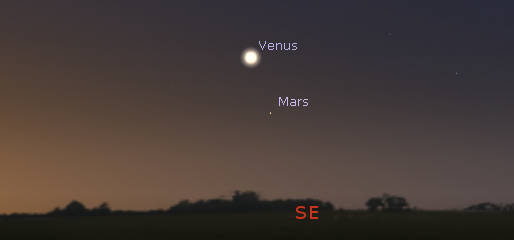
Venus and Mars in the morning as they might appear at 6:30 am, about 45 minutes before sunrise, Thursday, March 3, 2022. Created using Stellarium.
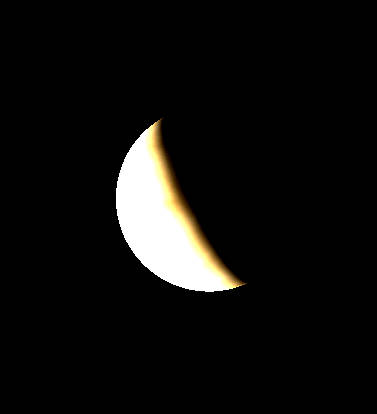
Venus through a telescope as it would appear before sunrise tomorrow morning, March 3, 2022. It’s shown larger than usual, since it’s the only planet that looks like anything in a small telescope now. Its apparent diameter is 30.49″, and it is 39.7% illuminated by the Sun. Mars has an apparent diameter of 4.73″.
(” means seconds of arc. 1″ is 1/3600th of a degree). Created using Stellarium, which is also the source for the apparent diameters and the illuminated fraction of Venus.
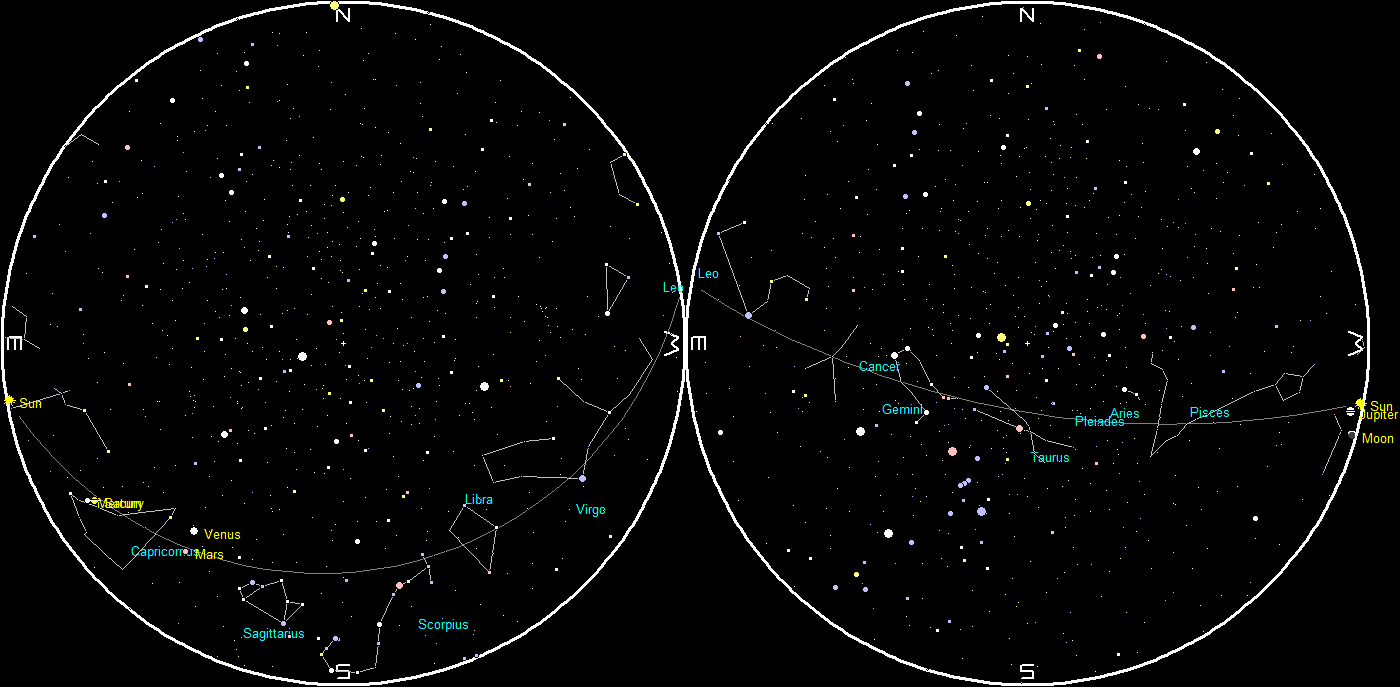
The naked-eye planets and the Moon at sunset and sunrise on a single night, starting with sunset on the right on March 2, 2022. The night ends on the left with sunrise on the 3rd. There’s a label pile up in the sunrise panel where the Labels for Saturn and Mercury overlay each other. Click on the image to enlarge it. Created using my LookingUp program.
03/01/2022 – Ephemeris – Previewing March skies
This is Ephemeris for Fat Tuesday, March 1st. Today the Sun will be up for 11 hours and 10 minutes, setting at 6:30, and it will rise tomorrow at 7:18. The Moon, 1 day before new, will rise at 7:44 tomorrow morning.
Let’s look at the skies for the month of March. The Sun will cross the celestial equator in March as the promising season of spring will begin. Daylight hours in the Interlochen/Traverse City area and will increase from 11 hours and 10 minutes today to 12 hours 43 minutes on the 31st. The altitude, or angle, of the Sun above the southern horizon at local noon will be just under 38 degrees today and will ascend to nearly 50 degrees on the 31st. The altitude of the Sun in the Straits area will be a degree lower. Local apparent noon this month, when the Sun passes due south, will be about 12:51 p.m. and an hour later when Daylight Saving Time starts on the 13th. Spring will begin on the 20th at 11:33 am.
Addendum
March Evening Star Chart
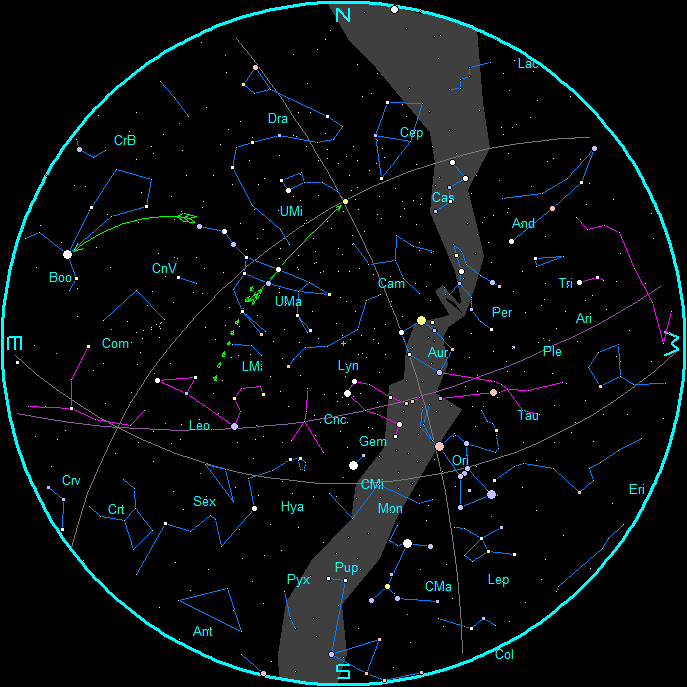
Star Chart for March 2022 (10 pm EDT, March 15, 2022). Click on the image to enlarge it. Created using my LookingUp program.
The planets and stars are plotted for the 15th at 10 p.m. EDT in the evening and 6 a.m. for the morning chart. These are the chart times. Note that Traverse City is located approximately 45 minutes behind our time meridian. (An hour and 45 minutes behind our Daylight Saving Time meridian during EDT). To duplicate the star positions on a planisphere (rotating star finder) you may have to set it to 45 minutes or 1 hour 45 minutes earlier than your current time.
Note the chart times of 10 p.m. and 6 a.m. are for the 15th. For each week before the 15th, add ½ hour (28 minutes if you’re picky). For each week after the 15th, subtract ½ hour. For planet positions on dates other than the 15th, check the Wednesday planet posts on this blog.
March Morning Star Chart
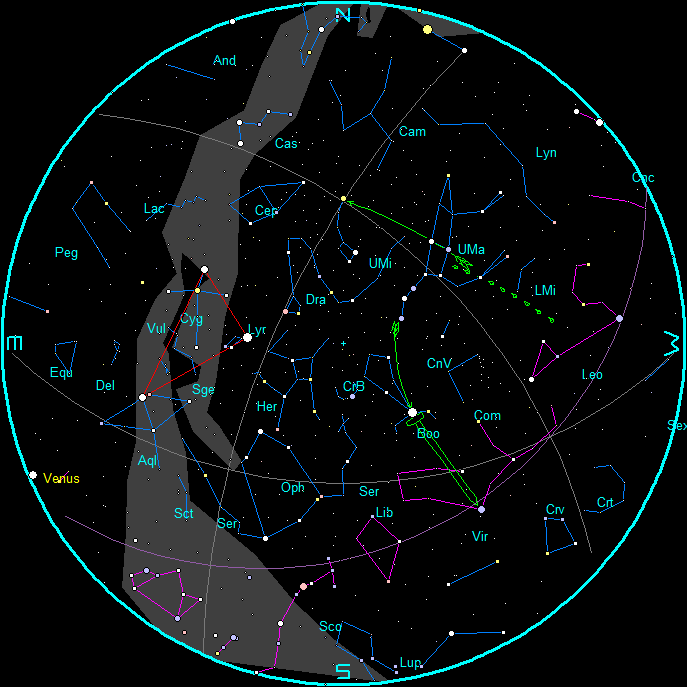
Star Chart for March mornings, 2022 (6 a.m. EDT March 15, 2022). Click on image to enlarge. Created using my LookingUp program.
Only Venus of all the morning planets has yet to rise at chart time on the 15th.
For a list of constellation names to go with the abbreviations click here.
- Pointer stars at the front of the bowl of the Big Dipper point to Polaris the North Star.
- The leaky bowl of the Big Dipper drips on Leo.
- Follow the arc of the handle of the Big Dipper to the star Arcturus, and
- Extend it as a spike to Spica.
- The Summer Triangle appears in red.
Twilight Limits, Nautical and Astronomical
| EST/EDT | |||||||
| Morning | Twilight | Evening | Twilight | Dark | Night | Moon | |
| Date | Astro. | Nautical | Nautical | Astro. | Start | End | Illum. |
| 2022-03-01 | 5h44m | 6h18m | 19h32m | 20h06m | 20h06m | 5h44m | 0 |
| 2022-03-02 | 5h42m | 6h16m | 19h33m | 20h07m | 20h07m | 5h42m | 0 |
| 2022-03-03 | 5h40m | 6h14m | 19h35m | 20h09m | 20h09m | 5h40m | 0.03 |
| 2022-03-04 | 5h39m | 6h13m | 19h36m | 20h10m | 20h57m | 5h39m | 0.07 |
| 2022-03-05 | 5h37m | 6h11m | 19h37m | 20h11m | 22h06m | 5h37m | 0.13 |
| 2022-03-06 | 5h35m | 6h09m | 19h39m | 20h13m | 23h13m | 5h35m | 0.21 |
| 2022-03-07 | 5h33m | 6h07m | 19h40m | 20h14m | – | 5h33m | 0.29 |
| 2022-03-08 | 5h31m | 6h05m | 19h41m | 20h15m | 0h20m | 5h31m | 0.38 |
| 2022-03-09 | 5h30m | 6h04m | 19h43m | 20h17m | 1h25m | 5h30m | 0.48 |
| 2022-03-10 | 5h28m | 6h02m | 19h44m | 20h18m | 2h28m | 5h28m | 0.57 |
| 2022-03-11 | 5h26m | 6h00m | 19h45m | 20h19m | 3h26m | 5h26m | 0.66 |
| 2022-03-12 | 5h24m | 5h58m | 19h46m | 20h21m | 4h18m | 5h24m | 0.75 |
| 2022-03-13 | 6h22m | 6h56m | 20h48m | 21h22m | 6h03m | 6h22m | 0.83 |
| 2022-03-14 | 6h20m | 6h54m | 20h49m | 21h24m | – | – | 0.9 |
| 2022-03-15 | 6h18m | 6h53m | 20h50m | 21h25m | – | – | 0.95 |
| 2022-03-16 | 6h16m | 6h51m | 20h52m | 21h26m | – | – | 0.99 |
| 2022-03-17 | 6h14m | 6h49m | 20h53m | 21h28m | – | – | 1 |
| 2022-03-18 | 6h12m | 6h47m | 20h54m | 21h29m | – | – | 0.99 |
| 2022-03-19 | 6h10m | 6h45m | 20h56m | 21h31m | 21h31m | 21h42m | 0.96 |
| 2022-03-20 | 6h12m | 6h47m | 21h01m | 21h36m | 21h36m | 22h58m | 0.9 |
| 2022-03-21 | 6h10m | 6h45m | 21h02m | 21h37m | 21h37m | – | 0.82 |
| 2022-03-22 | 6h08m | 6h43m | 21h04m | 21h39m | 21h39m | 0h15m | 0.73 |
| 2022-03-23 | 6h06m | 6h41m | 21h05m | 21h40m | 21h40m | 1h34m | 0.62 |
| 2022-03-24 | 6h04m | 6h39m | 21h06m | 21h42m | 21h42m | 2h50m | 0.5 |
| 2022-03-25 | 6h02m | 6h37m | 21h08m | 21h43m | 21h43m | 3h59m | 0.39 |
| 2022-03-26 | 6h00m | 6h35m | 21h09m | 21h45m | 21h45m | 4h57m | 0.28 |
| 2022-03-27 | 5h58m | 6h33m | 21h10m | 21h46m | 21h46m | 5h43m | 0.19 |
| 2022-03-28 | 5h55m | 6h31m | 21h12m | 21h48m | 21h48m | 5h55m | 0.11 |
| 2022-03-29 | 5h53m | 6h29m | 21h13m | 21h49m | 21h49m | 5h53m | 0.05 |
| 2022-03-30 | 5h51m | 6h27m | 21h15m | 21h51m | 21h51m | 5h51m | 0.01 |
| 2022-03-31 | 5h49m | 6h25m | 21h16m | 21h52m | 21h52m | 5h49m | 0 |
Twilight calendar was generated using Cartes du Ciel (Sky Charts).
See my blog post: Twilight Zone for the definitions of the different periods of twilight here: https://bobmoler.wordpress.com/2019/09/27/
NASA Calendar of Planetary Events
     Date    Time     Event
Mar  1  Tu            Venus: 45° W
     2  We  10:48 am  Mercury-Saturn: 0.7° N
     2  We  12:35 pm  New Moon
     5  Sa   7:51 am  Jupiter Solar Conjunction
     8  Tu   3:22 am  Moon Ascending Node
    10  Th   5:45 am  First Quarter
    10  Th   6:05 pm  Moon Apogee: 404,300 km
    11  Fr   7:14 pm  Moon Northernmost Declination: 26.7° N
    13  Su   1:58 am  Moon-Pollux: 2.6° N
    13  Su   6:08 am  Neptune Solar Conjunction
    14  Mo   3:55 am  Moon-Beehive: 3.7° S
    15  Tu  11:12 pm  Venus-Mars: 3.9° N
    18  Fr   3:17 am  Full Worm Moon
    20  Su   5:59 am  Venus Elongation: 46.6° West
    20  Su  11:33 am  Vernal Equinox
    22  Tu   4:12 am  Moon Descending Node
    23  We   7:28 pm  Moon Perigee: 369,800 km
    25  Fr   1:37 am  Last Quarter
    25  Fr   7:58 am  Moon Southernmost Declination: 26.8° S
    27  Su  10:54 pm  Moon-Mars: 4.2° N
    28  Mo   5:50 am  Moon-Venus: 6.9° N
    28  Mo   7:43 am  Moon-Saturn: 4.5° N
    28  Mo   8:53 pm  Venus-Saturn: 2.1° N
Apr  1  Fr            Venus: 46.1° W
All event times are given for UTC-5:00: Eastern Standard Time before the 14th or UTC-4:00 Daylight Saving Time thereafter.
Sky Events Calendar by Fred Espenak and Sumit Dutta (NASA’s GSFC),
http://eclipse.gsfc.nasa.gov/SKYCAL/SKYCAL.html
If you go to the above site you can print out a list like the above for the entire year or calendar pages for your time zone.
Note that the site is now kept up for archival purposes. Fred Espenak retired from NASA several years ago and has his own site, AstroPixels, which contain the same information: http://astropixels.com/almanac/almanac.html.
Sun and Moon Rising and Setting Events
LU             Ephemeris of Sky Events for Interlochen/TC
March, 2022    Local time zone: EST
+-----------------------------------------------------------------------+
| DATE |  SUN     SUN  DAYLIGHT|   TWILIGHT*    |MOON  RISE OR    ILLUM |
|      |  RISE    SET    HOURS |  END    START  |PHASE SET** TIME FRACTN|
+=======================================================================+
|Tue  1| 07:20a  06:30p  11:10 | 07:33p  06:17a |      Rise 07:44a    1%|
|Wed  2| 07:18a  06:31p  11:13 | 07:35p  06:15a |New   Set  06:32p    0%|
|Thu  3| 07:16a  06:33p  11:16 | 07:36p  06:13a |      Set  07:46p    2%|
|Fri  4| 07:15a  06:34p  11:19 | 07:37p  06:12a |      Set  08:56p    6%|
|Sat  5| 07:13a  06:35p  11:22 | 07:39p  06:10a |      Set  10:05p   12%|
+------+-----------------------+----------------+-----------------------+
|Sun  6| 07:11a  06:37p  11:25 | 07:40p  06:08a |      Set  11:13p   19%|
|Mon  7| 07:09a  06:38p  11:28 | 07:41p  06:06a |      Set  12:19a   27%|
|Tue  8| 07:07a  06:39p  11:32 | 07:42p  06:04a |      Set  01:25a   36%|
|Wed  9| 07:06a  06:41p  11:35 | 07:44p  06:03a |      Set  02:28a   46%|
|Thu 10| 07:04a  06:42p  11:38 | 07:45p  06:01a |F Qtr Set  03:26a   55%|
|Fri 11| 07:02a  06:43p  11:41 | 07:46p  05:59a |      Set  04:18a   64%|
|Sat 12| 07:00a  06:45p  11:44 | 07:48p  05:57a |      Set  05:02a   73%|
+------+-----------------------+----------------+-----------------------+
| EDT  |      Time Change      |                |                       |
|Sun 13| 07:58a  07:46p  11:47 | 08:49p  06:55a |      Set  06:39a   81%|
|Mon 14| 07:56a  07:47p  11:50 | 08:50p  06:53a |      Set  07:10a   88%|
|Tue 15| 07:55a  07:49p  11:53 | 08:52p  06:52a |      Set  07:36a   94%|
|Wed 16| 07:53a  07:50p  11:57 | 08:53p  06:50a |      Set  07:59a   98%|
|Thu 17| 07:51a  07:51p  12:00 | 08:54p  06:48a |      Set  08:20a  100%|
|Fri 18| 07:49a  07:52p  12:03 | 08:56p  06:46a |Full  Rise 08:28p   99%|
|Sat 19| 07:47a  07:54p  12:06 | 08:57p  06:44a |      Rise 09:42p   96%|
+------+-----------------------+----------------+-----------------------+
|Sun 20| 07:45a  07:55p  12:09 | 08:58p  06:42a |      Rise 10:57p   91%|
|Mon 21| 07:43a  07:56p  12:12 | 09:00p  06:40a |      Rise 12:15a   84%|
|Tue 22| 07:42a  07:57p  12:15 | 09:01p  06:38a |      Rise 01:34a   75%|
|Wed 23| 07:40a  07:59p  12:18 | 09:02p  06:36a |      Rise 02:50a   64%|
|Thu 24| 07:38a  08:00p  12:22 | 09:04p  06:34a |      Rise 03:59a   53%|
|Fri 25| 07:36a  08:01p  12:25 | 09:05p  06:32a |L Qtr Rise 04:56a   41%|
|Sat 26| 07:34a  08:02p  12:28 | 09:06p  06:30a |      Rise 05:42a   30%|
+------+-----------------------+----------------+-----------------------+
|Sun 27| 07:32a  08:04p  12:31 | 09:08p  06:28a |      Rise 06:18a   21%|
|Mon 28| 07:30a  08:05p  12:34 | 09:09p  06:26a |      Rise 06:47a   12%|
|Tue 29| 07:29a  08:06p  12:37 | 09:11p  06:24a |      Rise 07:10a    6%|
|Wed 30| 07:27a  08:07p  12:40 | 09:12p  06:22a |      Rise 07:31a    2%|
|Thu 31| 07:25a  08:09p  12:43 | 09:13p  06:20a |      Rise 07:51a    0%|
+-----------------------------------------------------------------------+
* Nautical Twilight
** Moonrise or moonset, whichever occurs between sunrise and sunset
Created using my LookingUp for DOS output as text.
02/28/2022 – Ephemeris – Ancient Egypt’s most important star
This is Ephemeris for Monday, February 28th. Today the Sun will be up for 11 hours and 7 minutes, setting at 6:29, and it will rise tomorrow at 7:20. The Moon, 2 days before new, will rise at 7:17 tomorrow morning.
The Ancient Egyptian agricultural year began with the flooding of the Nile, which was announced by the heliacal rising of the brightest nighttime star, Sirius. A heliacal rising is the first appearance of a star in the morning twilight after disappearing in evening twilight some months before. The Greeks called the star Sothis, while the ancient Egyptians called the star Sopdet. The heliacal rising would occur on July 20th had our calendar been in use back then. The relationship between the summer solstice and the heliacal rising of Sothis, 29 days later, stayed the same for nearly three millennia, from at least 2900 BCE to 12 CE, despite precession* of the Earth’s axis moving the Sun from the middle of the constellation Leo at the summer solstice to the western edge of Cancer one and a half constellations west. Sopdet was personified by a goddess, who was the consort to Sah, who is what they called Orion.
———-
The astronomical event times given are for the Traverse City/Interlochen area of Michigan (EST, UT – 5 hours). They may be different for your location.
* Precession of the equinoxes. The slow, 26,000 year wobble of the Earth’s axis which causes the Earth, most of the time, to not have a pole star. We’re lucky to live at a time to have a bright star within a degree of the north celestial pole. That star is, of course, Polaris. Precession also changes the point in the sky, along the ecliptic and zodiac, where the Sun appears on the first day of spring, or any season. These points move westward along the ecliptic (the plane of the earth’s orbit of the Sun) one degree every 72 years.
Addendum
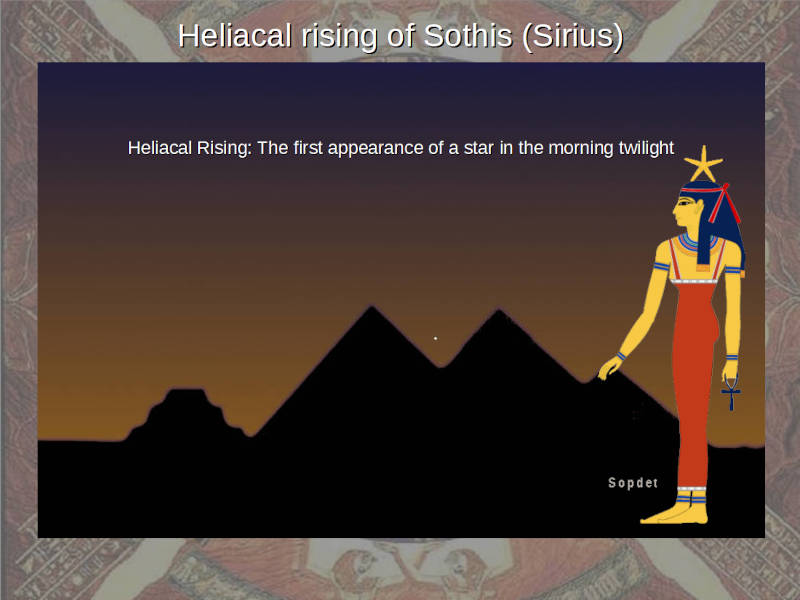
The Egyptian used the heliacal rising of Sirius as a signal that the flooding of the Nile was imminent, starting their agricultural year. The Greeks called the star Sothis, while the Egyptians themselves called it Sopdet, a goddess, and consort of the god Sah, our Orion.
Part of my presentation, December 2021 of Ancient Astronomy of the Egyptians and Babylonians.
02/25/2022 – Ephemeris – The star that’s called the Pup
This is Ephemeris for Friday, February 25th. Today the Sun will be up for 10 hours and 58 minutes, setting at 6:25, and it will rise tomorrow at 7:25. The Moon, 2 days past last quarter, will rise at 5:04 tomorrow morning.
Sirius is the brightest nighttime star and is located in the south at 9 p.m. below and a bit left of Orion the Hunter. We’ve visited Sirius last Friday. But there is another star in the Sirius system that is practically invisible due to Sirius’ dazzling glare. Its name is Sirius B, nicknamed the Pup, alluding to Sirius’ Dog Star title as the heart of Canis Major, Orion’s larger hunting dog. The tiny star was suspected as far back as 1834 due to Sirius’ wavy path in the sky against the more distant stars. Sirius and the Pup have 50-year orbits of each other. The Pup was first seen by famed 19th century telescope maker Alvan Clark in 1862 while testing a new telescope. The Pup was the first of a new class of stars to be discovered, white dwarfs. The Pup, with the mass of the Sun, is packed into the volume of the Earth.
The astronomical event times given are for the Traverse City/Interlochen area of Michigan (EST, UT – 5 hours). They may be different for your location.
Addendum
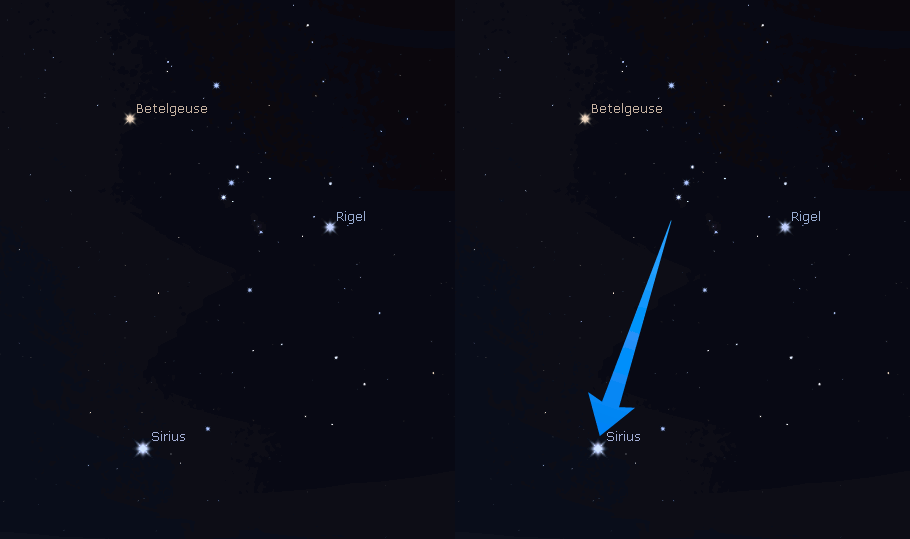
A Sirius finder animation for late January/early February at around 8 pm. Even in bright moonlight, the seven bright stars of Orion can be seen. The three stars of Orion’s belt make a great pointer to Sirius. Created using Stellarium, GIMP and Libreoffice (for the arrow).
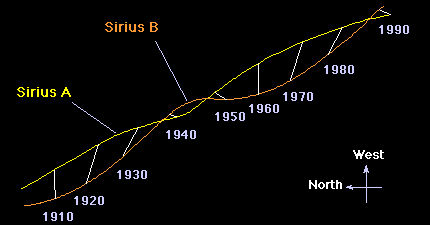
Sirius A & B’s path in the sky, showing the wobble that betrayed the Pup’s presence. Credit Mike Guidry, University of Tennessee.
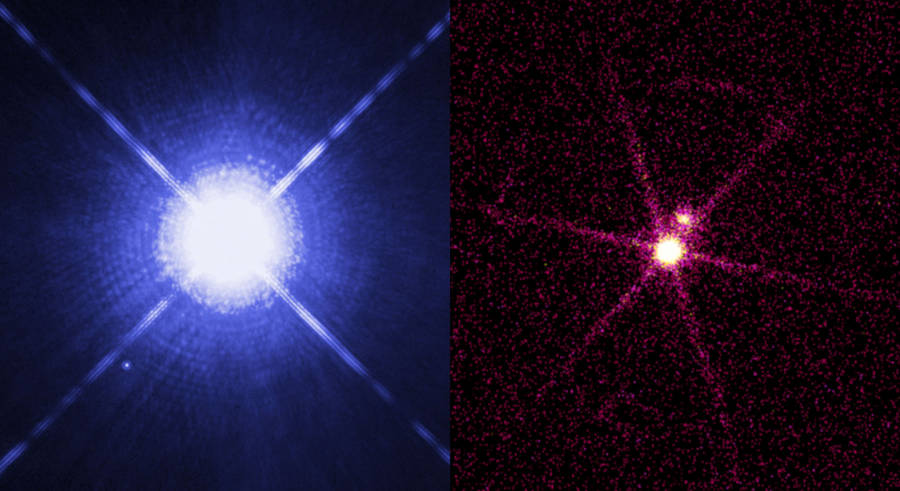
Sirius A and B imaged by two different space telescopes, revealing dramatically different views! Hubble’s image (left) shows Sirius A shining brightly in visible light, with diminutive Sirius B a tiny dot. However, in Chandra’s image (right) tiny Sirius B is dramatically brighter in X-rays! The “Universe in a Different Light” activity highlights more surprising views of some familiar objects: http://bit.ly/different-light-nsn NASA, ESA, H. Bond (STScI), and M. Barstow (University of Leicester) (left); NASA/SAO/CXC (right)

