Archive
02/24/2022 – Ephemeris – The celestial unicorn
This is Ephemeris for Thursday, February 24th. Today the Sun will be up for 10 hours and 55 minutes, setting at 6:23, and it will rise tomorrow at 7:27. The Moon, 1 day past last quarter, will rise at 3:57 tomorrow morning.
Among all the constellations in the sky of animals real and mythical, there is also a unicorn. It’s called Monoceros, and inhabits the south-southeastern sky at 8 p.m. mostly bounded by Orion on the right, Canis Major, the great dog below and Canis Minor, the little dog to the left and above. Unfortunately for observers without a telescope, Monoceros, is devoid of any but the faintest stars. Maybe that’s why no one sees unicorns anymore. It has many faint stars because the Milky Way runs through it. To the telescopic observer and astrophotographer it is a feast of faint nebulae or clouds of gas and dust, the birthplace of stars, including the red rose of the Rosette Nebula* (NGC 2237), and Hagrid’s Dragon Cluster (NGC 2301), which sounds suspiciously like it was recently, and unofficially, named. Monoceros also contains a beautiful telescopic triple star system, Beta (β) Monocerotis.
The astronomical event times given are for the Traverse City/Interlochen area of Michigan (EST, UT – 5 hours). They may be different for your location.
* The Rosette nebula surrounds the star cluster NGC 2244. This sparse star cluster is visible visually in telescopes. I’ve never been able to spot the nebula in a telescope, but it shows up, faintly, in my wide angle photographs of the area.
Addendum
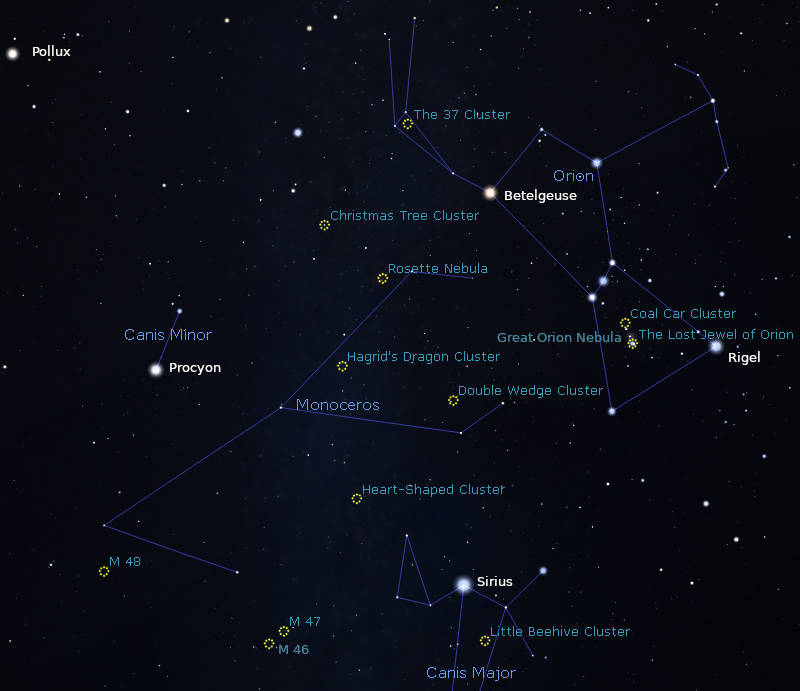
Deep Sky Objects in and around Monoceros. Deep Sky Objects are telescopic objects that lie beyond the solar system. Click on the image to enlarge. Created using Stellarium.
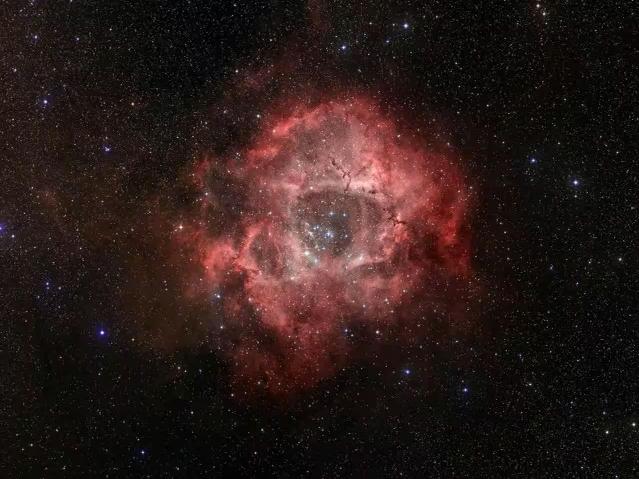
Rosette Nebula in the infrared from the Spitzer Space Telescope. Credit: NASA/JPL/Caltech
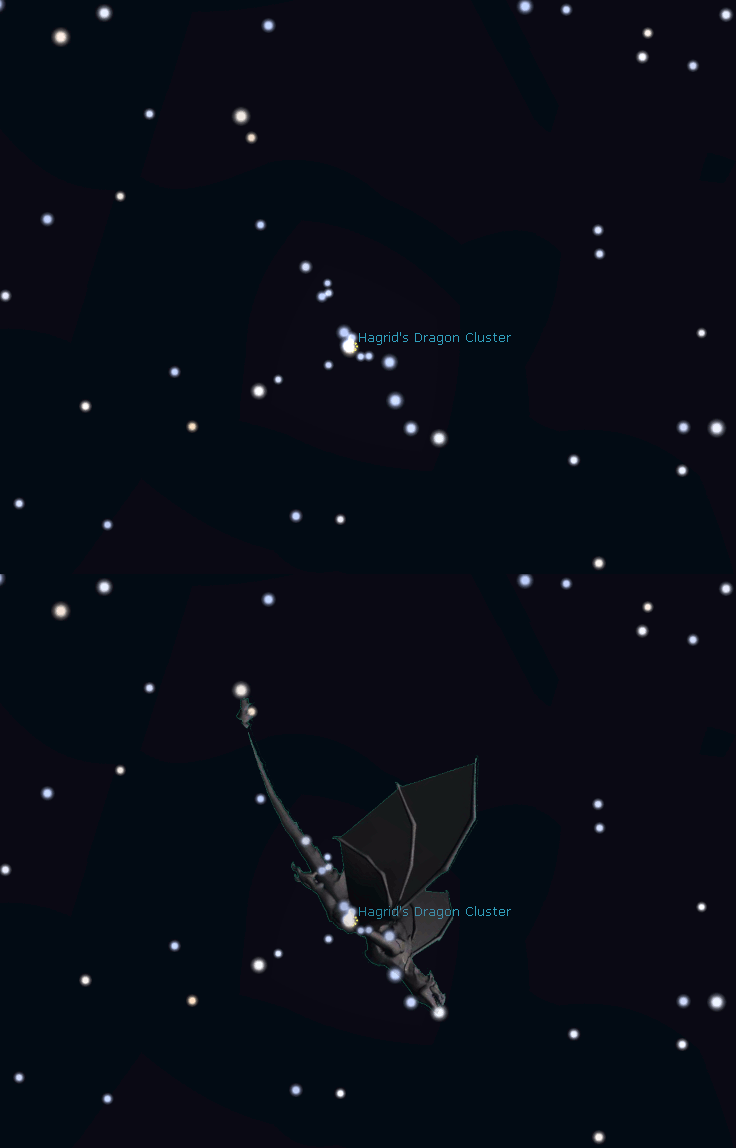
The brighter stars of NGC 2301 (Hagrid’s Dragon Cluster, AKA Great Bird Cluster and Copeland’s Golden Worm). It’s also in two other catalogs: Cr 119 and Mel 54. Created using Stellarium and GIMP. The dragon image is from “Dragon Flying Cycle” on YouTube by Simon Hussey.
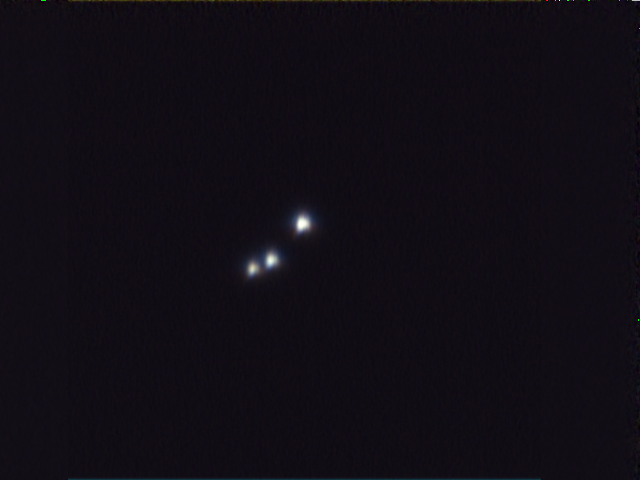
Telescopic Beta Monocerotis. William Hershel, discoverer of Uranus, said that it was “One of the most beautiful sights in the heavens.” Credit: F. Ringwald, Fresno State.
02/23/2022 – Ephemeris – Let’s search for the naked-eye planets for this week
This is Ephemeris for Wednesday, February 23rd. Today the Sun will be up for 10 hours and 52 minutes, setting at 6:22, and it will rise tomorrow at 7:28. The Moon, at last quarter today, will rise at 2:43 tomorrow morning.
Let’s search for the naked-eye planets for this week. The last evening planet, Jupiter, is too close to the setting Sun to be spotted now after sunset. The action now shifts to the morning sky, where Venus and Mars reside. Saturn entered the morning sky sixteen days ago, and it will be about another month or so before it’s far enough from the direction of the Sun to be spotted. Venus, our brilliant morning star, Mars and maybe even Mercury can be spotted low in the southeast by 6:45 am, about half an hour before sunrise. Mars will be below, and right of Venus, while Mercury will be near the horizon left of Venus. Mercury is brighter than Mars, but lower in the more intense twilight. Venus will rise at 5:06, with Mars following at 5:38, and Mercury rising last at 6:32.
The astronomical event times given are for the Traverse City/Interlochen area of Michigan (EST, UT – 5 hours). They may be different for your location.
Addendum
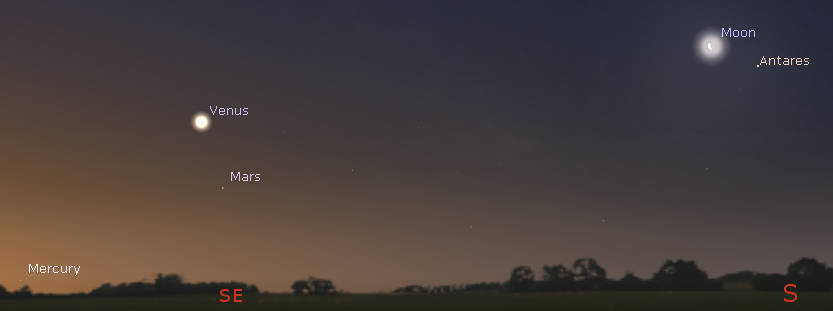
Morning planets and the waning crescent Moon at 6:45 am, or about 40 minutes before sunrise tomorrow morning, February 24, 2022. Mercury may not actually be visible. Click on the image to enlarge it. Created using Stellarium.
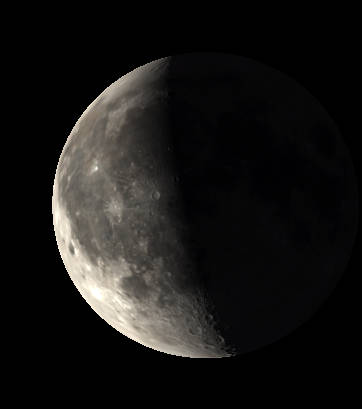
Waning Crescent Moon as it might be shown in binoculars or small telescope tomorrow morning, February 24, 2022. Created using Stellarium.
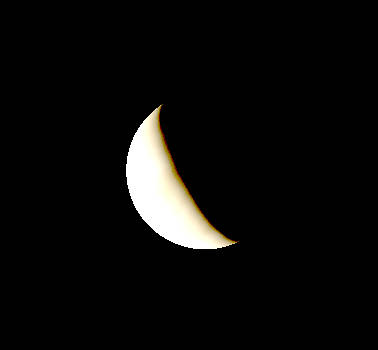
Venus through a telescope as it would appear before sunrise tomorrow morning, February 24, 2022. It’s shown larger than usual, since it’s the only planet that looks like anything in a small telescope now. Its apparent diameter is 33.72″, and it is 34.9% illuminated by the Sun.
(” means seconds of arc. 1″ is 1/3600th of a degree) Mars has an apparent diameter of 4.63″, while Mercury has one of 6.18″. Created using Stellarium, which is also the source for the apparent diameters and the illuminated fraction of Venus.
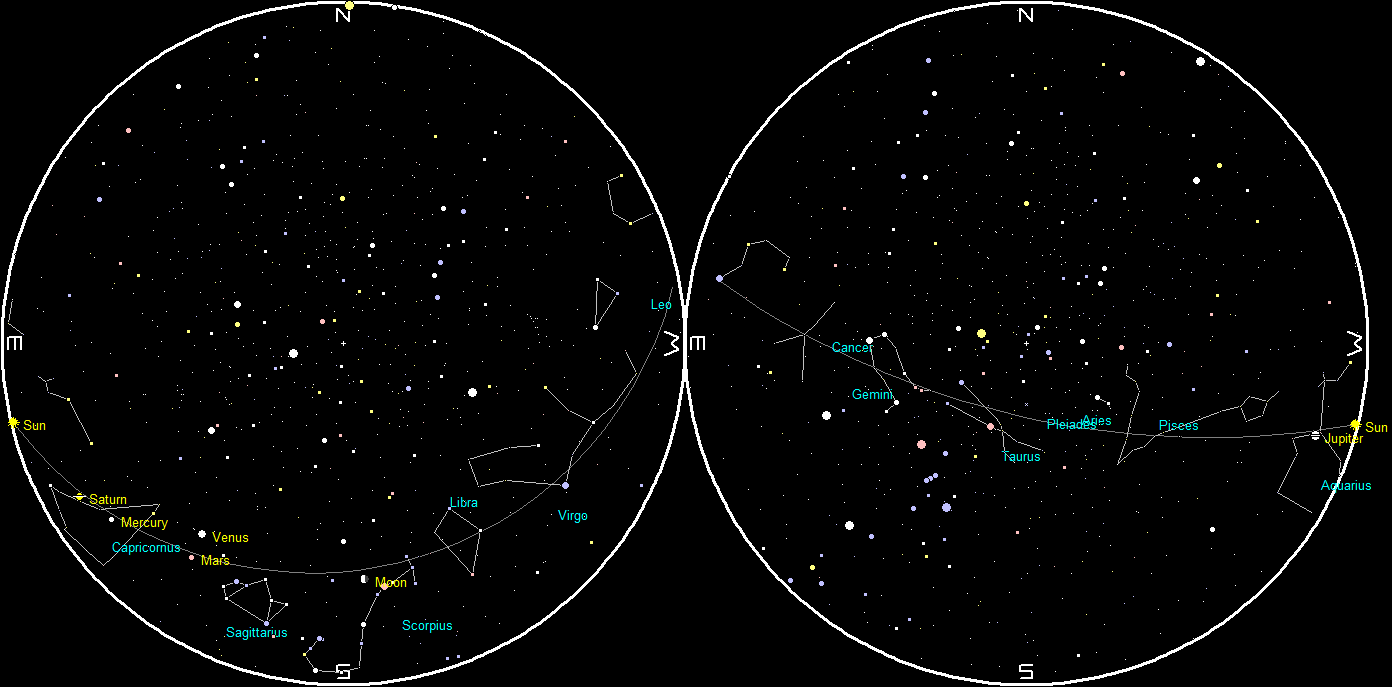
The naked-eye planets and the Moon at sunset and sunrise on a single night, starting with sunset on the right on February 23, 2022. The night ends on the left with sunrise on the 24th. Click on the image to enlarge it. Created using my LookingUp program.
02/22/2022 – Ephemeris – The Winter Triangle
This is Ephemeris for Tuesday, February 22nd. Today the Sun will be up for 10 hours and 49 minutes, setting at 6:21, and it will rise tomorrow at 7:30. The Moon, 1 day before last quarter, will rise at 1:26 tomorrow morning.
I’ve talked about the Winter Circle of bright stars already this winter, but some other astronomers talk about the Winter Triangle. The stars involved are Betelgeuse in the hunter Orion, Sirius in Canis Major, Orion’s large hunting dog, and Procyon in Canis Minor, his other small hunting dog. These three stars enclose a rather blank piece of sky with the faint Milky Way running through it and the almost invisible constellation of Monoceros the unicorn. The Summer Triangle has three bright stars with no other close competition. The Winter Triangle has four other bright stars near it. Any three of these would make a nice triangle. One of these constellations, Canis Minor, is tiny with Procyon and one other star. It makes me think of a dachshund, or maybe, if I’m hungry, a hot dog.
The astronomical event times given are for the Traverse City/Interlochen area of Michigan (EST, UT -5 hours). They may be different for your location.
Addendum
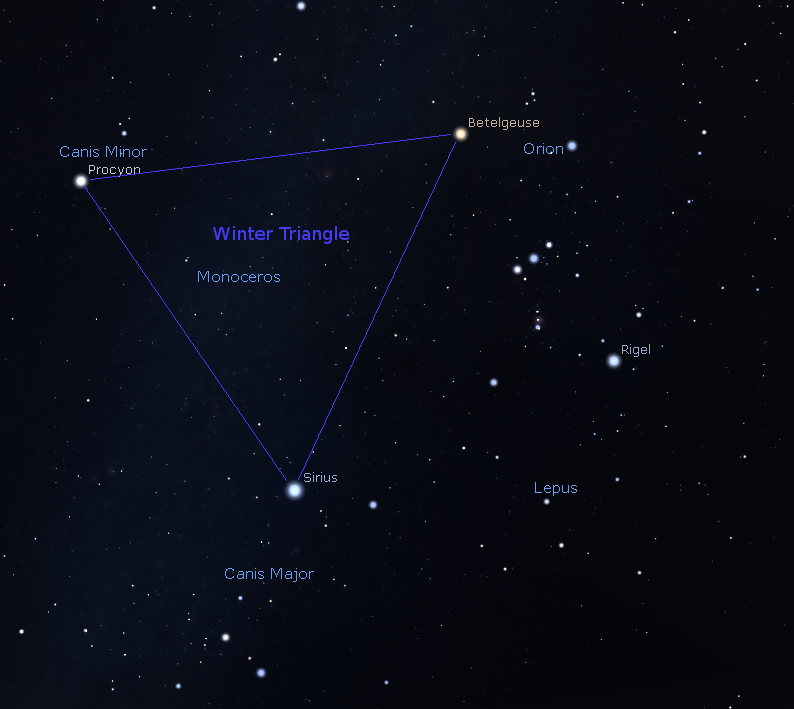
The Winter Triangle. It encloses a pretty blank space where Monoceros the unicorn lies. Created using Stellarium with my annotations for the Winter Triangle.
02/21/2022 – Ephemeris – The time President Abraham Lincoln visited the US Naval Observatory
This is Ephemeris for President’s Day, Monday, February 21st. Today the Sun will be up for 10 hours and 46 minutes, setting at 6:19, and it will rise tomorrow at 7:32. The Moon, 2 days before last quarter, will rise at 12:09 tomorrow morning.
In August 1863, during the height of the Civil War, President Abraham Lincoln and his secretary John Hay rode out to the Naval Observatory, where it was back then in Foggy Bottom. The astronomer there, Asaph Hall, showed them the Moon and the star Arcturus through the observatory’s telescope. A couple of nights later Lincoln came out alone to ask the astronomer some questions about what he saw, in including why the Moon was upside down in the observatory telescope while the telescope he used gave a right side up image.* Fourteen years later, Asaph Hall, still at the Naval Observatory, discovered the two satellites of Mars through the observatory’s then larger telescope.
The astronomical event times given are for the Traverse City/Interlochen area of Michigan (EST, UT – 5 hours). They may be different for your location.
Addendum
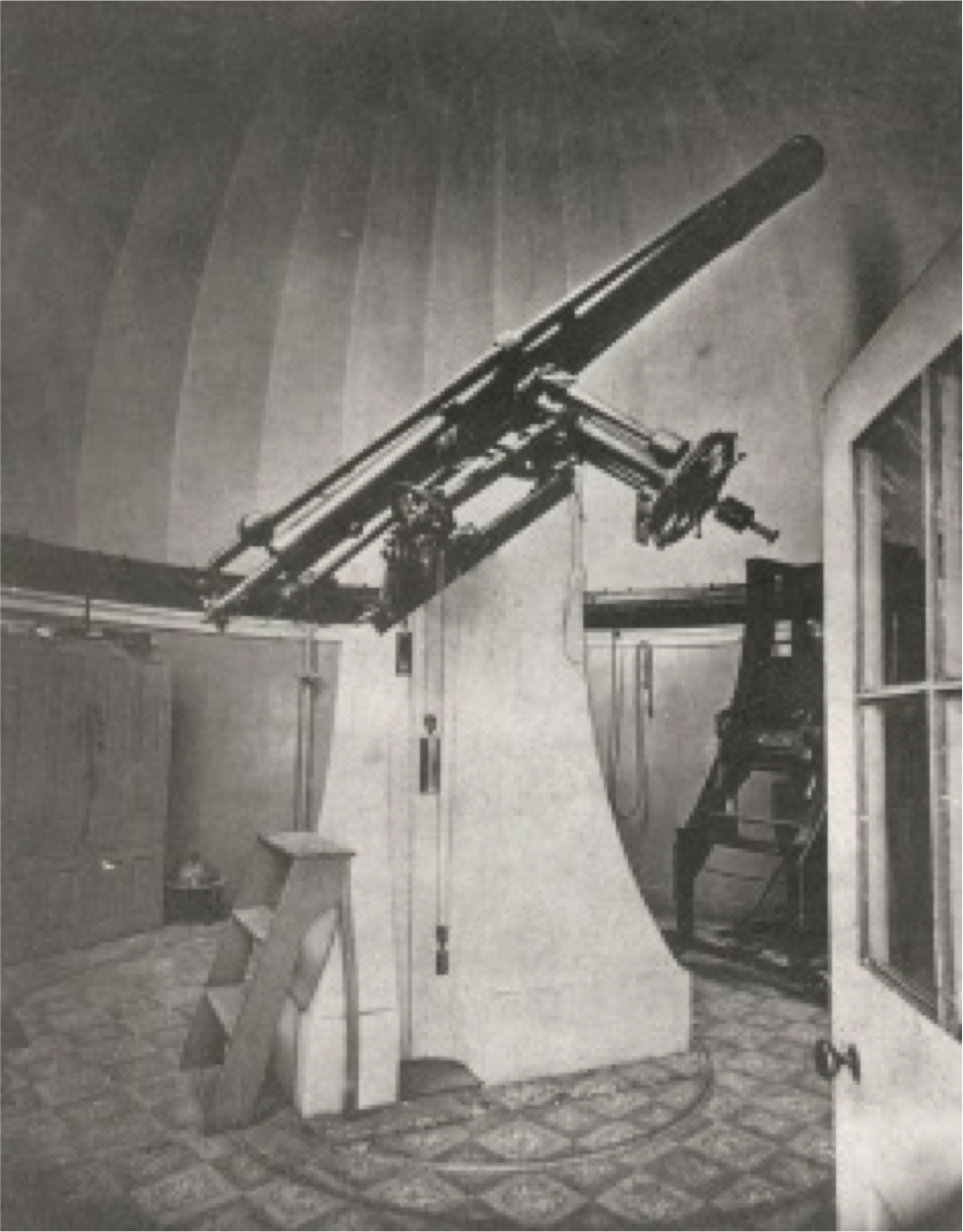
The 9.6 inch telescope through which Lincoln viewed the Moon and Arcturus on the night of August 22, 1863. From the Astronomy.com website.

The old Naval Observatory. From the Astronomy.com website.
* Most telescopes naturally create an upside down image. The spyglass type telescope President Lincoln was probably familiar with was a Galilean telescope that didn’t form an image within it. Telescopes like binoculars use prisms to erect the image. Astronomers don’t care if the image is upside down. Whatever is used to turn the image right side up reduces the amount of light that makes it through the telescope. For astronomers, the name of the game is to capture more light and increase the ability to see fine detail, which are both functions of the primary’s diameter. That’s why modern telescopes are measured by the diameter of their primary mirrors or lenses.
02/18/2022 – Ephemeris – Sirius, the brightest nighttime star
This is Ephemeris for Friday, February 18th. Today the Sun will be up for 10 hours and 37 minutes, setting at 6:15, and it will rise tomorrow at 7:36. The Moon, 2 days past full, will rise at 8:32 this evening.
In the evening, the great constellation of Orion the hunter can be seen in the south. Its large rectangle of bright stars is easily visible, even with a full moon. The three stars in a straight line, his belt, tilt downward to the left to a very bright star merrily twinkling lower in the sky. This star is called Sirius, also known as the Dog Star because it’s in the heart of Orion’s larger hunting dog, Canis Major. It is an arc light white star as seen in binoculars or telescope. It is the brightest star in the night sky, and a neighboring star, just twice the distance of the closest star to the Sun at 8.6 light years. It’s name, Sirius, has nothing to do with a dog, but is from the Greek meaning scorching for its brightness or sparkling, due to its intense twinkling.
The astronomical event times given are for the Traverse City/Interlochen area of Michigan (EST, UT – 5 hours). They may be different for your location.
Addendum
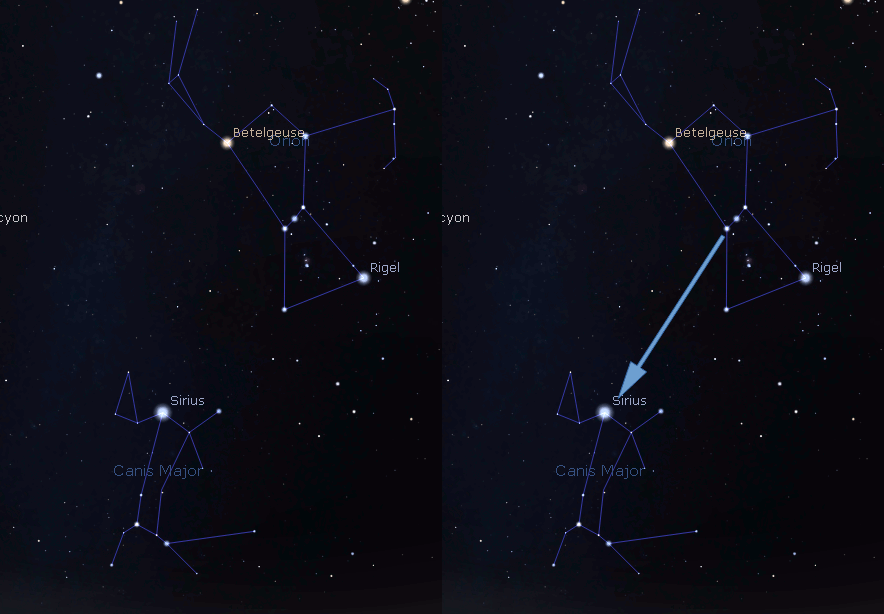
In the southern sky, Orion’s belt points to Sirius. Created using Stellarium, Libreoffice and GIMP.
02/17/2022 – Ephemeris – Mission to a metallic asteroid
This is Ephemeris for Thursday, February 17th. Today the Sun will be up for 10 hours and 34 minutes, setting at 6:14, and it will rise tomorrow at 7:38. The Moon, 1 day past full, will rise at 7:21 this evening.
In August this year, one of the three scheduled Falcon-Heavy rocket launches this year will send the Psyche spacecraft on a four-year journey to its namesake asteroid, 16 Psyche. It is an unusual asteroid, thought to be 30 to 60 percent iron-nickel in composition. The spacecraft will swing by Mars for a gravitational boost. After the chemical powered boost into solar orbit, the spacecraft will open its huge solar panels in the shape of two crosses to feed its power hungry electric thrusters to complete the journey and to orbit 16 Psyche. The thrusters are Hall Effect thrusters, the first used in space, that use magnetic fields instead of electric fields to eject xenon gas ions to provide thrust. It is expected to arrive at 16 Psyche in 2026.
The astronomical event times given are for the Traverse City/Interlochen area of Michigan (EST, UT – 5 hours). They may be different for your location.
Addendum
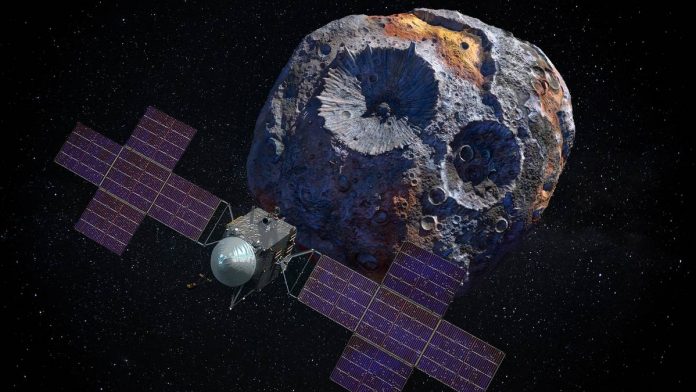
Artist’s visualization of the spacecraft Psyche orbiting asteroid 16 Psyche. This imagining seems to assume the asteroid is nearly 100% metallic. Credit: NASA.
02/16/2022 – Ephemeris – Let’s search for the naked-eye planets for this week
This is Bob Moler with Ephemeris for Wednesday, February 16th. Today the Sun will be up for 10 hours and 31 minutes, setting at 6:12, and it will rise tomorrow at 7:39. The Moon, at full today, will rise at 6:11 this evening.
Let’s search for the naked-eye planets for this week. There is just one planet left in the evening sky now, and it’s going to leave us soon. Jupiter will be barely visible very low in the west-southwest around 6:45 pm, or a half hour after sunset. It will set at 7:16 pm. Saturn has entered the morning sky, where we’ve lost it for a month or so. Speaking of the morning sky, Venus, our brilliant morning star, Mars and maybe even Mercury can be spotted low in the southeast by 6:55 am, about 45 minutes before sunrise. Mars will be below, and right of Venus, while Mercury will be near the horizon left of Venus. Mercury is brighter than Mars, but lower in more intense twilight. Venus will rise at 5:12, with Mars following at 5:45, and Mercury rising last at 6:30.
The astronomical event times given are for the Traverse City/Interlochen area of Michigan (EST, UT – 5 hours). They may be different for your location.
Addendum

Jupiter, tonight, is barely visible in the west-southwest at 6:45 pm, about 34 minutes after sunset, February 16, 2022. Created using Stellarium.
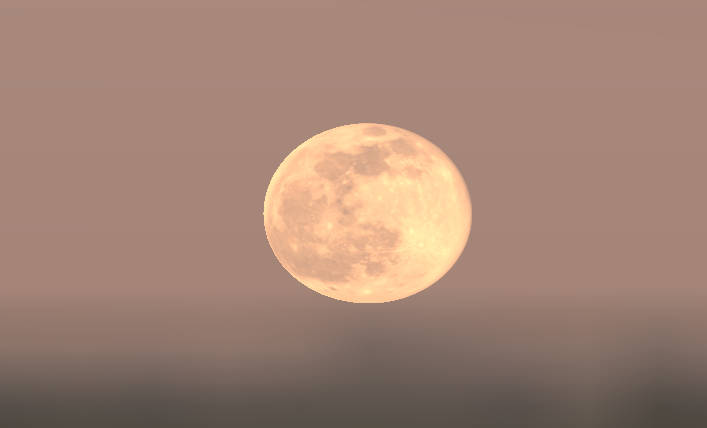
The full Moon as it might appear as it rises tonight, as viewed in binoculars. Notice the squashed appearance of the Moon, which is due to the fact that atmospheric refraction is affecting the bottom part of the Moon more than the top. Created using Stellarium.
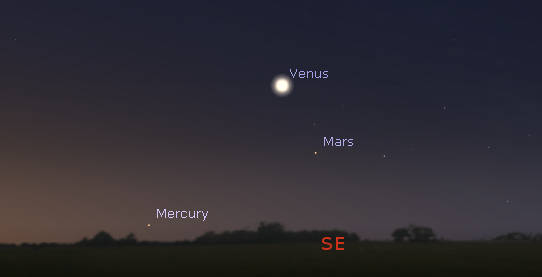
Venus, Mars and Mercury, visible at 6:45 am, or about 55 minutes before sunrise, tomorrow February 17, 2022. Mercury is at its greatest elongation or separation from the Sun. Created using Stellarium.
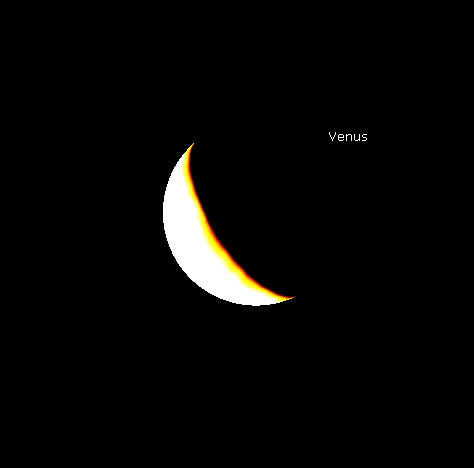
Only one planet is worth attention through a telescope. That one is Venus as a bright crescent. Venus is magnified much more than I normally do, so the caption will fit under it. Created using Stellarium.
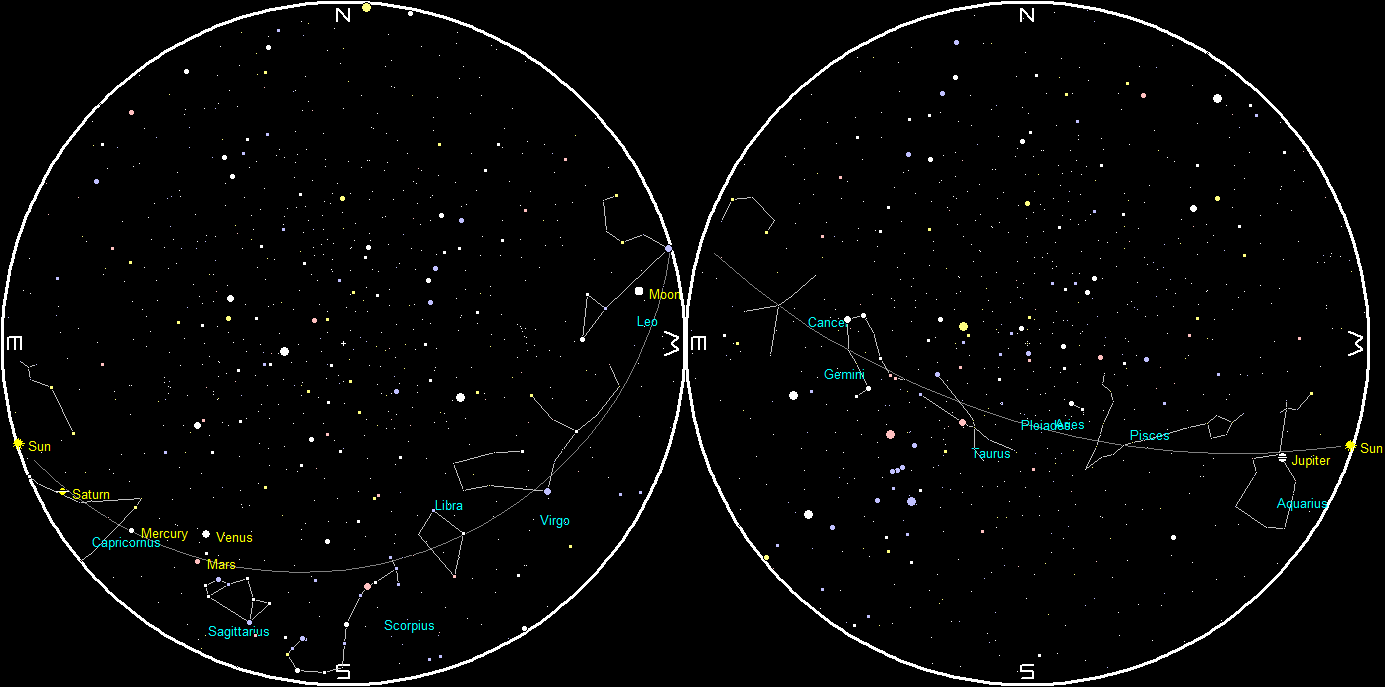
The naked-eye planets and the Moon at sunset and sunrise on a single night, starting with sunset on the right on February 16, 2022. The night ends on the left with sunrise on the 17th. Click on the image to enlarge it. Created using my LookingUp program.
02/15/2022 – Ephemeris – The Moon’s splashiest crater
This is Ephemeris for Tuesday, February 15th. Today the Sun will be up for 10 hours and 28 minutes, setting at 6:11, and it will rise tomorrow at 7:41. The Moon, 1 day before full, will set at 8:09 tomorrow morning.
The Moon at 8 pm tonight will be only 16 hours before being full. As down as I am about full moons due to the fact that they light up the sky and flood out the dimmer objects, I once in a while stop and view it. Being less than a day from full, we see it tonight from very nearly the direction of the Sun, so there will be few shadows to be had. The crater Tycho is near the bottom or south end of the moon and has long rays of tiny ejecta craters. The full moon is the best time to see these rays, which are easily visible in binoculars, through which Tycho itself looks like a bright dot. In telescopes, Tycho looks like a small, bright crater with a dark ring around it. The full moon is super bright. It’s daytime over there.
The astronomical event times given are for the Traverse City/Interlochen area of Michigan (EST, UT – 5 hours). They may be different for your location.
Addendum
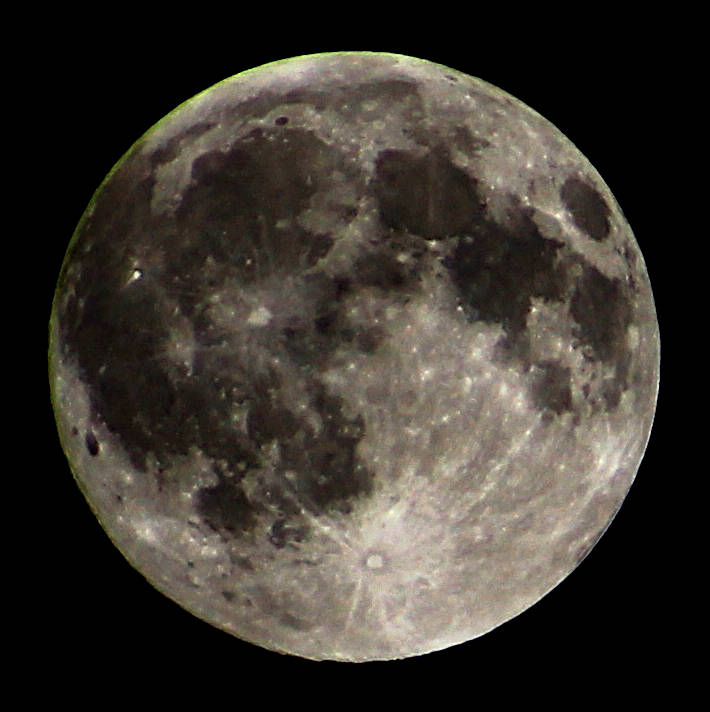
An image I took of the full moon in August 2016 and processed for maximum contrast to show the crater Tycho with its dark ring, near the bottom (south) of the Moon and its rays that stretch for hundreds of miles across the face of the Moon. The image is fairly low resolution, taken with a 300 mm telephoto lens. Click on the image to enlarge it a bit.
02/14/2022 – Ephemeris – A celestial Valentine’s Day encounter
This is Bob Moler with Ephemeris for St Valentine’s Day, Monday, February 14th. Today the Sun will be up for 10 hours and 25 minutes, setting at 6:10, and it will rise tomorrow at 7:43. The Moon, 2 days before full, will set at 7:40 tomorrow morning.
Twenty-two years ago to the day, the NEAR-Shoemaker* spacecraft entered into orbit of the near Earth asteroid 433 Eros. It wasn’t originally planned to enter orbit of the asteroid named after the Greek god of love on Valentine’s Day, 2000. It arose after an aborted course correction a year earlier. After solving the problem, a new course was plotted and NEAR-Shoemaker was gently inserted into orbit of this 21 mile long asteroid shaped like a bent bread stick with a bite taken out of the center of it. The spacecraft spent almost a year orbiting Eros at various altitudes. The spacecraft ended its mission gently crashing into the middle of the asteroid, where it stayed alive for two weeks before succumbing to the cold.
The astronomical event times given are for the Traverse City/Interlochen area of Michigan (EST, UT – 5 hours). They may be different for your location.
*The name Shoemaker was added to the NEAR spacecraft name after it was launched. NEAR stands for Near Earth Asteroid Rendezvous. It was named for Eugene Shoemaker, a geologist who proved that the Barringer Crater in Arizona was an impact crater rather than a volcanic crater, thus proving, before the Apollo 11 landing on the Moon, that the Moon’s craters were mostly impact craters produced by small asteroids like Eros. Shoemaker and his wife Carolyn, the astronomer in the family, along with David Levy discovered the Comet Shoemaker-Levy 9. The comet had broken into more than 22 pieces and crashed into Jupiter over a week in July 1994, making blemishes in the Jovian clouds that lasted many months.
Addendum
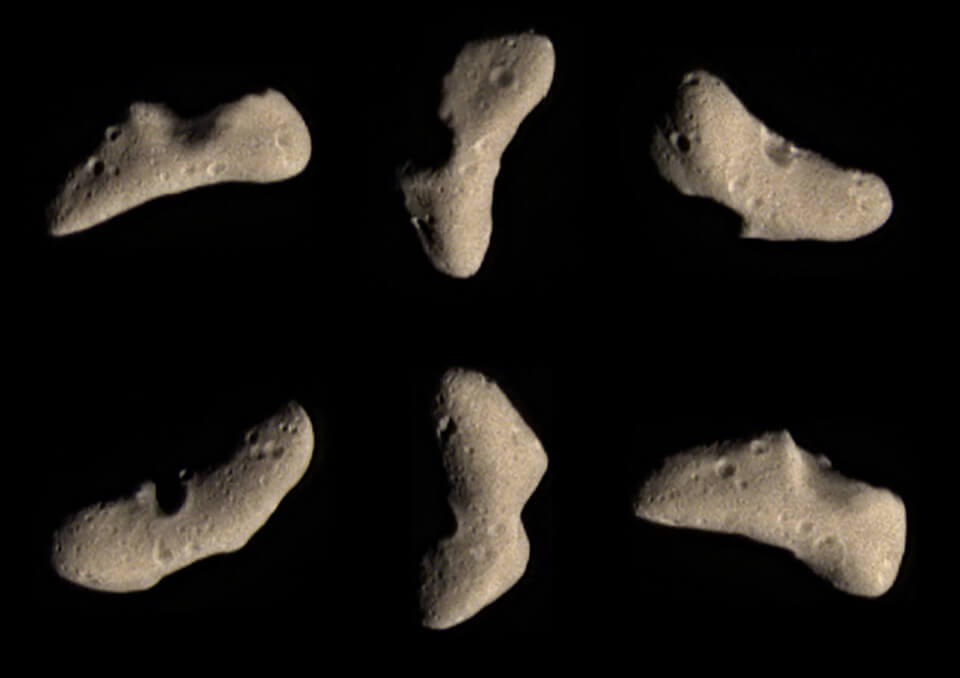
“These color images of Eros were taken by the NEAR probe on February 12, 2000, at a distance of 1,800 kilometers, during the final approach imaging sequence before insertion into orbit. The images show the approximate color of Eros as it would be seen with the naked eye.” Click on the image to enlarge it. Credit
NASA/JPL/JHUAPL. Caption from: https://eros2019.imcce.fr/eros.html via Google Translate.
By the way, the Roman equivalent to Eros was the god Cupid, whose love dart is the constellation Sagitta, which resides within the Summer Triangle of bright stars, to be seen in the evening sky four months from now.
I’ll end with a Valentine heart. The red color is real, it’s due to hydrogen.
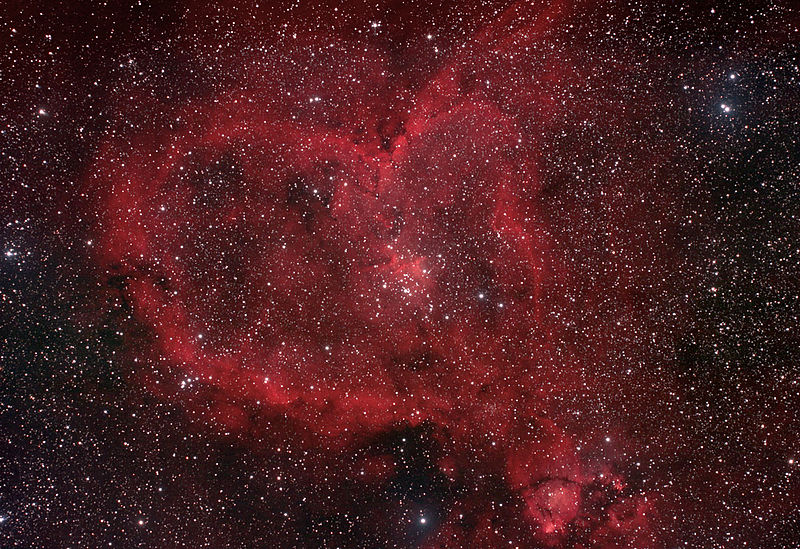
IC 1805 (Heart Nebula) Credit: s58y [CC BY 2.0 (https://creativecommons.org/licenses/by/2.0)%5D, via Wikimedia Commons.
02/11/2022 – Ephemeris – The Sun Rises on the Moon’s Bay of Rainbows
This is Ephemeris for Friday, February 11th. Today the Sun will be up for 10 hours and 16 minutes, setting at 6:05, and it will rise tomorrow at 7:47. The Moon, 3 days past first quarter, will set at 5:34 tomorrow morning.
On the moon tonight, the gibbous phase and the terminator on the left side of the moon is revealing a large semicircular mountain range called the Jura Mountains that encloses a flat lava plain that looks like a bay in the margin of the Sea of Showers or Mare Imbrium. It is easily visible in binoculars this evening, when the sunrise line is crossing the bay. The Jura Mountains will appear as a hook out of the upper left edge of the moon. That’s about the coolest sight that’s visible on the moon that can be seen with binoculars. It’s especially striking if seen in a small telescope.
Also, related to the Moon: The Artemis-1 uncrewed mission to orbit the Moon has been pushed off at least one month or more, to this April or even May.
Addendum
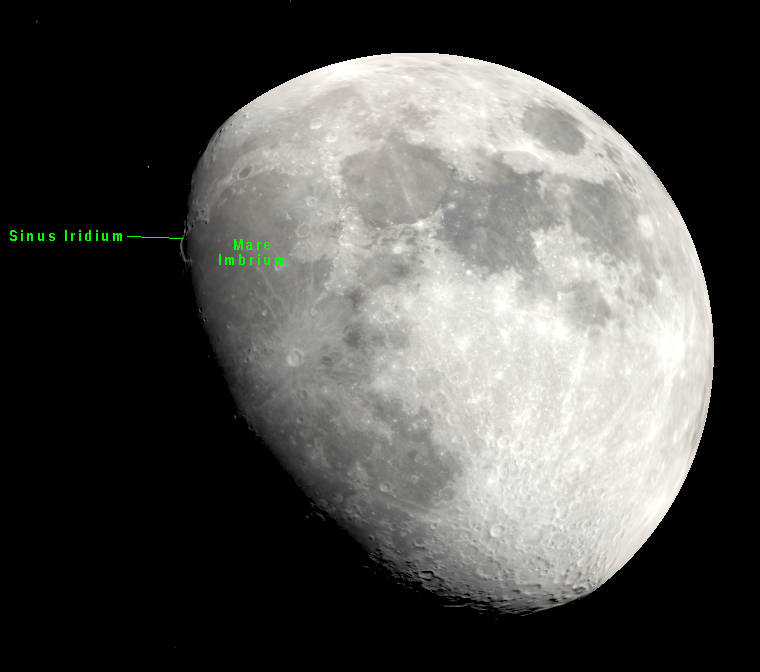
Sunrise at Sinus Iridium, full Moon disc with annotations. Click on the image to enlarge it. Moon image created using Stellarium.
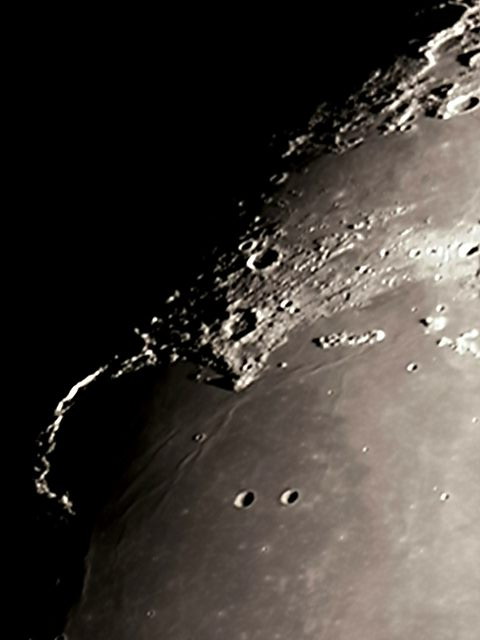
Sinus Iridium at sunrise. Photo by “Seb2003” on http://forums.futura-sciences.com/materiel-astronomique-photos-damateurs/5809-images-de-lune.html.

