Archive
02/10/2022 – Ephemeris – The waxing gibbous Moon is revealing more seas and craters
This is Ephemeris for Thursday, February 10th. Today the Sun will be up for 10 hours and 14 minutes, setting at 6:04, and it will rise tomorrow at 7:48. The Moon, 2 days past first quarter, will set at 4:38 tomorrow morning.
The Moon tonight is a waxing gibbous phase. More gray lunar seas are appearing near the terminator, the sunrise line. From north to south these seas, most only partially in sunlight, are: At the far north, the Cold Sea, Sea of Showers, The sea where the famous crater Copernicus is, the Sea of Islands. The southernmost sea at the terminator is the Sea of Clouds. Some large and prominent craters can be seen with binoculars or a small telescope can be seen in the south, the striking and relatively fresh Tycho, with its Moon girdling ejecta rays, though the rays are best seen at full moon. And the huge crater Clavius, with an arc of 5 smaller craters, one on its wall and the others on its floor, in ever diminishing sizes.
The astronomical event times given are for the Traverse City/Interlochen area of Michigan (EST, UT – 5 hours). They may be different for your location.
Addendum
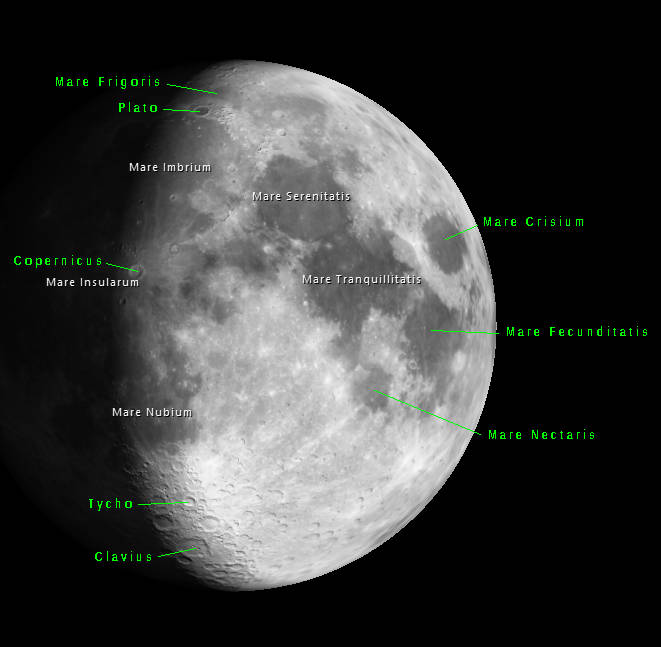
2 days past first quarter Moon as it would be seen in a small telescope or even binoculars, annotated. For this evening, February 10, 2022. Click on the image to enlarge it. Created using Virtual Moon Atlas. Annotations in white are from the app, mine are in green. Translations of the sea names are below.
Translations
Mare Crisium – Sea of Crises
Mare Fecunditatis – Sea of Fertility
Mare Frigoris – Sea of Cold
Mare Imbrium – Sea of Showers
Mare Insularum – Sea of Islands
Mare Nectaris – Sea of Nectar
Mare Nubium – Sea of Clouds
Mare Serenitatis – Sea of Serenity
Mare Tranquilitatis – Sea of Tranquility
A closer look
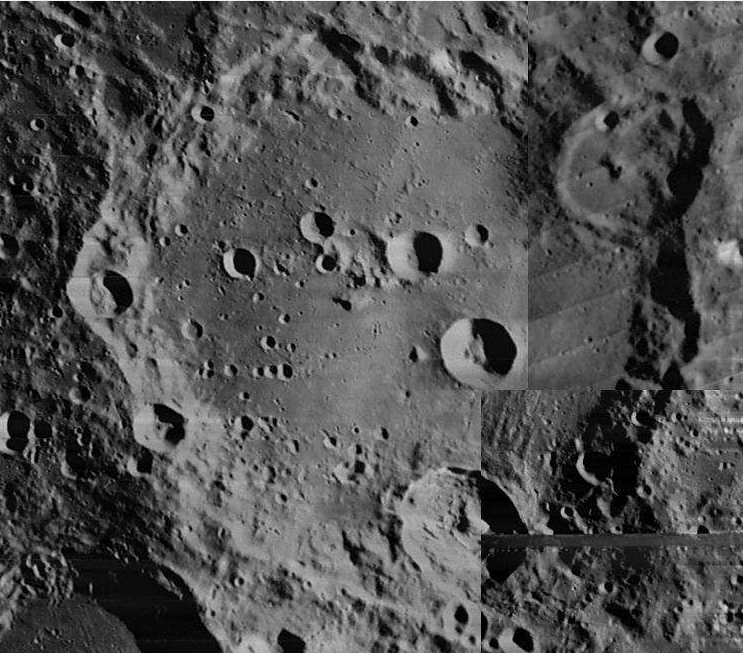
A montage of Clavius as photographed by one of the Lunar Orbiter spacecraft in the 1960s From Digital Lunar Orbital Photographic Atlas. Credit Jeff Gillis, Lunar and Planetary Institute.
02/09/2022 – Ephemeris – Let’s search for the naked-eye planets for this week
This is Ephemeris for Wednesday, February 9th. Today the Sun will be up for 10 hours and 11 minutes, setting at 6:02, and it will rise tomorrow at 7:50. The Moon, 1 day past first quarter, will set at 3:37 tomorrow morning.
Let’s search for the naked-eye planets for this week. There is just one planet left in the evening sky now, and it’s going to leave us soon. Jupiter will be visible in the west-southwest around 6:30 pm. It will set at 7:35 pm. Saturn is too close to the Sun to be seen, It crossed behind the Sun last Friday, and has entered the morning sky, where we will lose it for a month or so. Speaking of the morning sky, Venus, our brilliant morning star, Mars and maybe even Mercury can be spotted low in the southeast by 7 o’clock. Mars will be below, right of Venus, while Mercury will be near the horizon left of Venus. Mercury is brighter than Mars, but lower in more intense twilight. Venus will rise at 5:23, with Mars following at 5:53, and Mercury rising last at 6:32.
The astronomical event times given are for the Traverse City/Interlochen area of Michigan (EST, UT – 5 hours). They may be different for your location.
Addendum
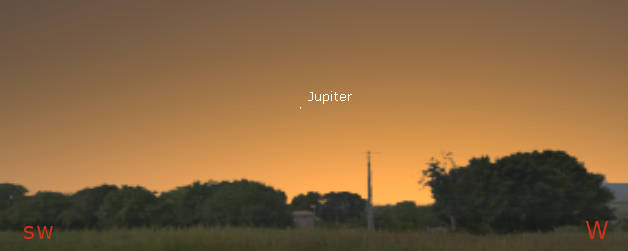
Jupiter in evening twilight tonight at 6:30 pm or about a half hour after sunset, February 9, 2022. Created using Stellarium.
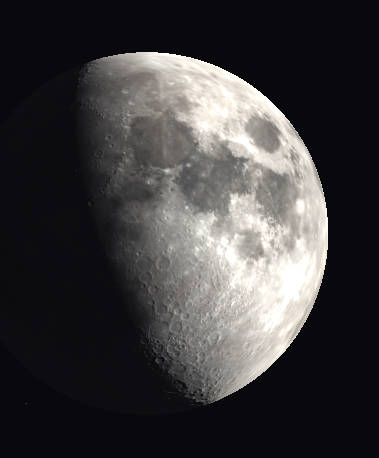
The waxing gibbous Moon as it might appear tonight in binoculars or small telescope. Created using Stellarium.
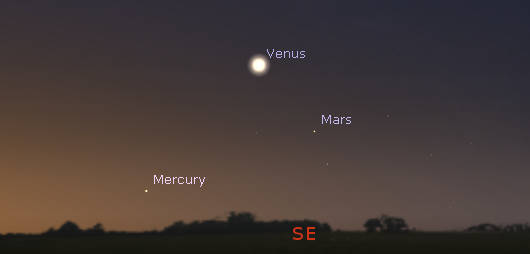
Venus, Mars, and Mercury at 7 am, or about 50 minutes before sunrise in the morning twilight. Created using Stellarium.
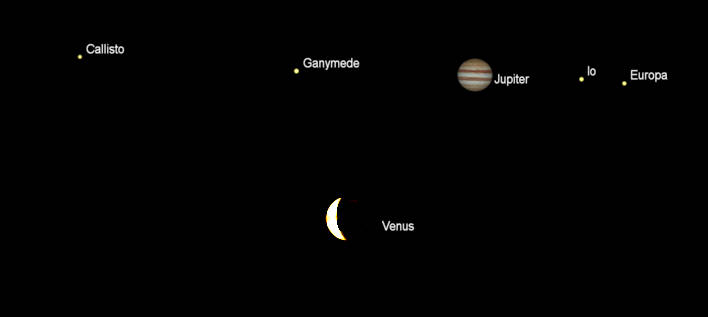
Telescopic views of the Jupiter and its moons; and Venus (north up) as they would be seen in a small telescope, with the same magnification, overnight, February 9/10, 2022. As far as Jupiter is concerned, I’m not sure its moons will be visible in the twilight or close to the horizon. I do not show planets less than 10 seconds of arc in diameter. Apparent diameters: Jupiter, 33.34″ at 6:45 pm. Mars is not shown, its apparent diameter is 4.44″. Venus has an apparent diameter of 42.07″ and is 23.8% illuminated at 7 am. Mercury, is also not shown, it has an apparent diameter of 7.73″ and it’s 47.3% illuminated. The ” symbol means seconds of arc (1/3600th of a degree.) Created using Cartes du Ciel (Sky Charts).
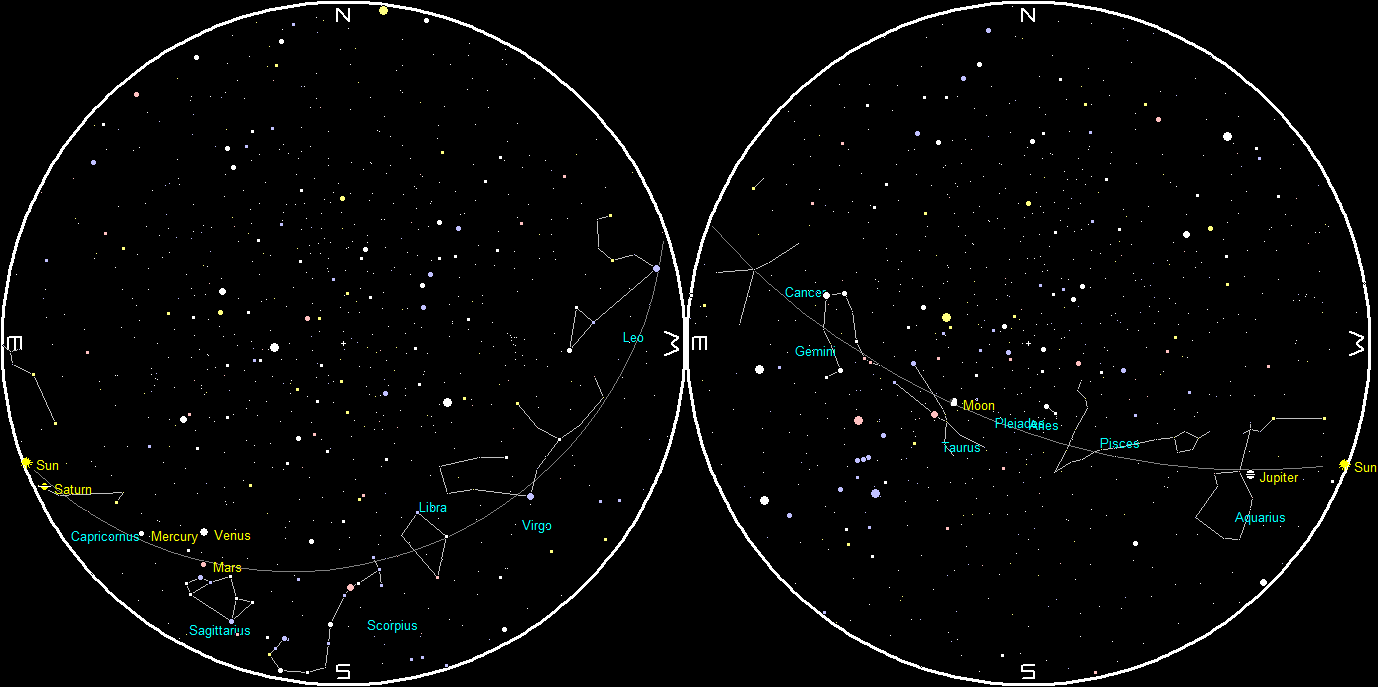
The naked-eye planets and the Moon at sunset and sunrise on a single night, starting with sunset on the right on February 9, 2022. The night ends on the left with sunrise on the 10th. Click on the image to enlarge it. Created using my LookingUp program.
02/08/2022 – Ephemeris – The first quarter Moon tonight
This is Ephemeris for Tuesday, February 8th. Today the Sun will be up for 10 hours and 8 minutes, setting at 6:01, and it will rise tomorrow at 7:51. The Moon, at first quarter today, will set at 2:34 tomorrow morning.
The Moon tonight, will be about 12 hours past being exactly first quarter, so it will be showing to be just a bit gibbous, that is a bit more than 50% illuminated by the Sun from our vantage point. In binoculars, the gray lunar seas, which are actually frozen lava filled plains, dominate the upper right quarter of the Moon. At the bottom, or south end of the Moon are the lighter more cratered region of the Moon called the Lunar Highlands. It is near the terminator, the line between day and night on the Moon, where shadows are longest, where craters can be seen by the shadows of the rims. Farther away from the terminator, the Sun is higher in the Moon’s sky, so the shadows get shorter or disappear all together.
The astronomical event times given are for the Traverse City/Interlochen area of Michigan (EST, UT – 5 hours). They may be different for your location.
Addendum
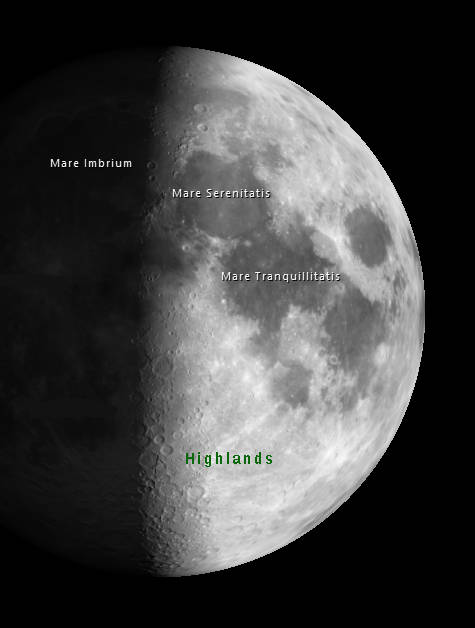
The is what the Moon might look like tonight, hours after first quarter. Just a bit of Mare Imbrium (Sea of Showers) is visible. Mare Serenitatis is the Sea of Serenity, Mare Tranquilitatis is the Sea of Tranquility. The green annotation is mine. BTW, Mare is pronounced Mar-e. It’s Latin, meaning sea. Created using Virtual Moon Atlas, a free app that can be downloaded from a link on the right, or listed under Free Astronomical Software.
02/07/2022 – Ephemeris – The Moon tonight
This is Ephemeris for Monday, February 7th. Today the Sun will be up for 10 hours and 5 minutes, setting at 6:00, and it will rise tomorrow at 7:53. The Moon, 1 day before first quarter, will set at 1:29 tomorrow morning.
Tonight, let’s take a look at the nearly first quarter Moon. The small, nearly circular gray spot is the sea of Crises. A diagonal chain of larger seas run from the terminator, the sunrise line, to below the Sea of Crises. They are, from the terminator, the seas of Serenity, Tranquility and Fertility. NASA is hoping to launch its uncrewed mission to the Moon, Artemis-1, next month with a large block of launch dates. The launch window begins on March 12th and ends on the 27th, with two blackout dates. Two lengths of missions are possible, a long 38 to 42 day mission is possible in the first part of the launch window, and a shorter 26 to 28 day mission is possible in the latter part of the window.
The astronomical event times given are for the Traverse City/Interlochen area of Michigan (EST, UT – 5 hours). They may be different for your location.
Addendum
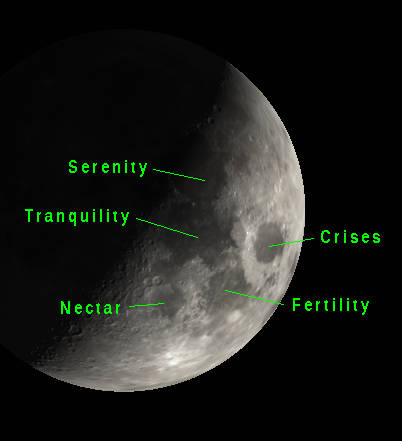
The Moon as it might appear tonight in binoculars or a small telescope at 7 pm tonight, February 7, 2022. I labeled the lunar seas with their English names, translated from the Latin. Also labeled is the Sea of Nectar, which wasn’t mentioned in the program. Moon image created using Stellarium.
02/02/2022 – Ephemeris – Let’s search for the naked-eye planets for this week
This is Bob Moler with Ephemeris for Ground Hog Day, Wednesday, February 2nd. Today the Sun will be up for 9 hours and 52 minutes, setting at 5:52, and it will rise tomorrow at 7:59. The Moon, 1 day past new, will set at 7:42 this evening.
Let’s search for the naked-eye planets for this week. There is just one planet left in the evening sky now. Jupiter will be visible in the west-southwest by 6:30 pm. The thin crescent Moon will appear below and left of it tonight. It’s kind of hard to tell which will be brighter. Jupiter will set at 7:54 pm. Saturn is too close to the Sun to be seen, and will cross behind the Sun on Friday, and will then enter the morning sky, where we will lose it for a month or so. Speaking of the morning sky, Venus, our brilliant morning star, will be in the southeast by 7 o’clock with the much dimmer Mars to the right and below it. Venus will rise at 5:40, with Mars following at 5:59. Antares is Mars’ rival in color and brightness, the red giant star Antares will be in the south-southeast at 7. Mars is speeding away from it.
The astronomical event times given are for the Traverse City/Interlochen area of Michigan (EST, UT – 5 hours). They may be different for your location.
Addendum
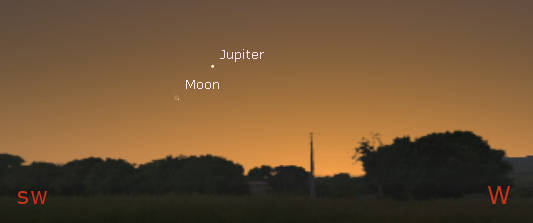
Jupiter and the Moon in twilight at 6:30 pm tonight, February 2, 2022. Created using Stellarium.
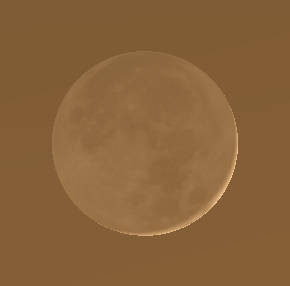
This is what tonight’s one-day old Moon might look like in a pair of binoculars at 6:30 pm, February 2, 2022. The image shows earth shine, the reflected light of a nearly full Earth on The Moon’s night side. Created using Stellarium.
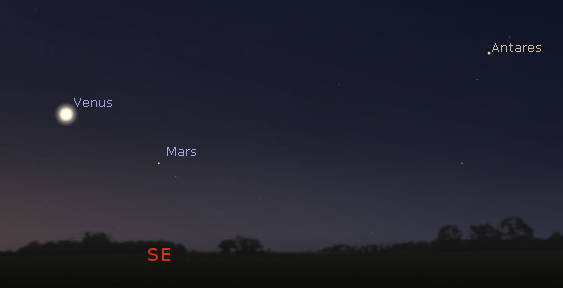
Venus and Mars in the morning at 7:00 tomorrow morning, February 2, 2022. Created using Stellarium.
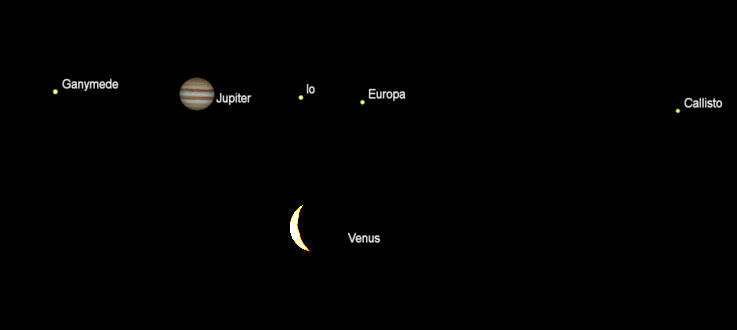
Telescopic views of the bright planets and their brighter moons (north up) as they would be seen in a small telescope, with the same magnification, overnight, February 2/3, 2022. I do not show planets less than 10 seconds of arc in diameter. Apparent diameters: Jupiter, 33.56″ at 7 pm. Mars is not shown, its apparent diameter is 4.35″. Venus has an apparent diameter of 47.25″ and is 17.5% illuminated at 7 am. The ” symbol means seconds of arc (1/3600th of a degree.) Created using Cartes du Ciel (Sky Charts).
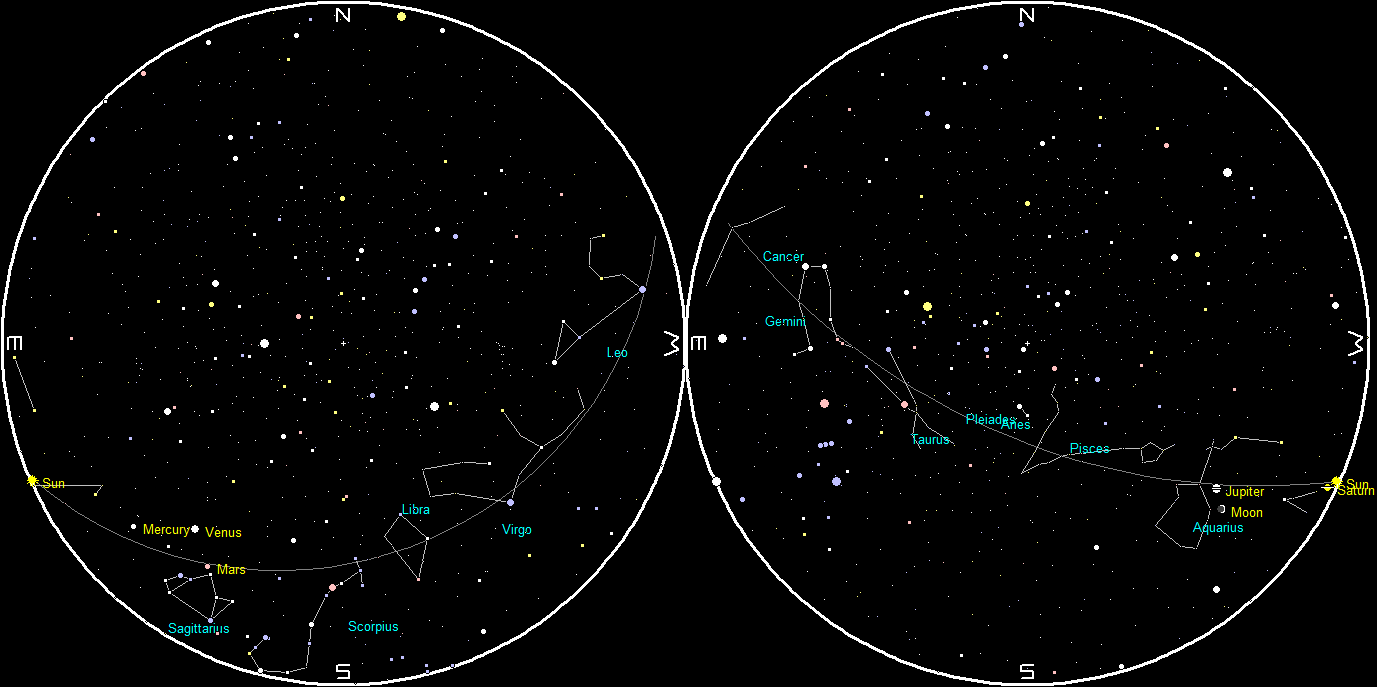
The naked-eye planets and the Moon at sunset and sunrise on a single night, starting with sunset on the right on February 2, 2022. The night ends on the left with sunrise on the 3rd. Click on the image to enlarge it. Created using my LookingUp program.
02/01/2022 – Ephemeris – Let’s look ahead at our short month of February
This is Bob Moler with Ephemeris for Tuesday, February 1st. Today the Sun will be up for 9 hours and 49 minutes, setting at 5:51, and it will rise tomorrow at 8:00. The Moon is new today, and won’t be visible.
Let’s look ahead at our short month of February. We’re in the depths of winter, but the Sun is continuing its return to northern climes. This is reflected in the increase in daylight hours, from 9 hours 49 minutes today to 11 hours 7 minutes on the 28th. These times are for the Interlochen/Traverse City area. The duration of daylight is slightly shorter in the northern part of our listening area and slightly longer to the south. As the month goes on, the weather should generally warm and clear up. We will be slowly losing Jupiter from the evening sky this month. Venus is moving away from the Sun and will pass Mars in the morning sky on the 12th. Neither Mercury nor Saturn will be visible this month because they will be lost in the Sun’s glare.
The astronomical event times given are for the Traverse City/Interlochen area of Michigan (EST, UT – 5 hours). They may be different for your location.
Addendum
February Evening Star Chart
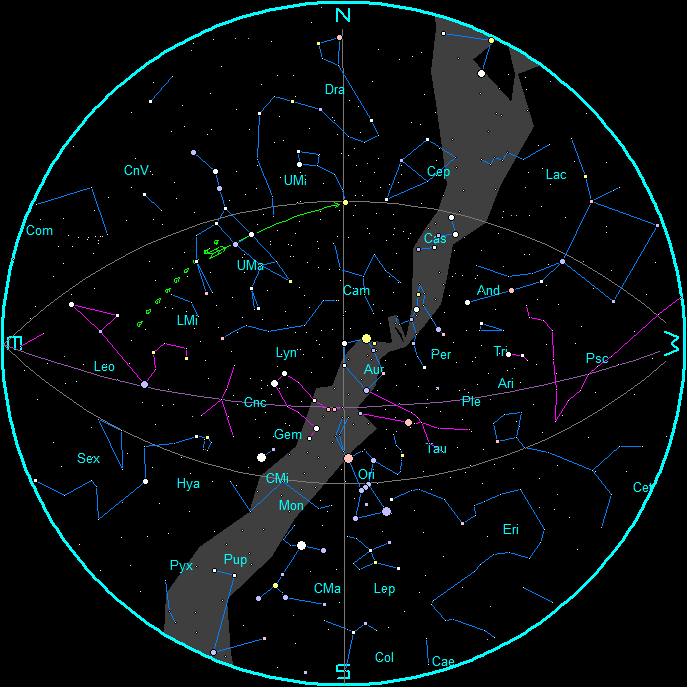
Star Chart for February 2022, (9 p.m. EST February 15, 2022). Created using my LookingUp program. Click on image to enlarge.
The planets and stars are plotted for the 15th at 9 p.m. EST in the evening and 6 a.m. for the morning chart. These are the chart times. Note that Traverse City is located approximately 45 minutes behind our time meridian. (An hour 45 minutes behind our daylight saving time meridian during EDT). To duplicate the star positions on a planisphere (rotating star finder) you may have to set it to 1 hour 45 minutes earlier than the current time.
Note the chart times of 9 p.m. and 6 a.m. are for the 15th. For each week before the 15th, add ½ hour (28 minutes if you’re picky). For each week after the 15th, subtract ½ hour. The planet positions are updated each Wednesday on this blog. For planet positions on dates other than the 15th, check the Wednesday planet posts on this blog.
February Morning Star Chart
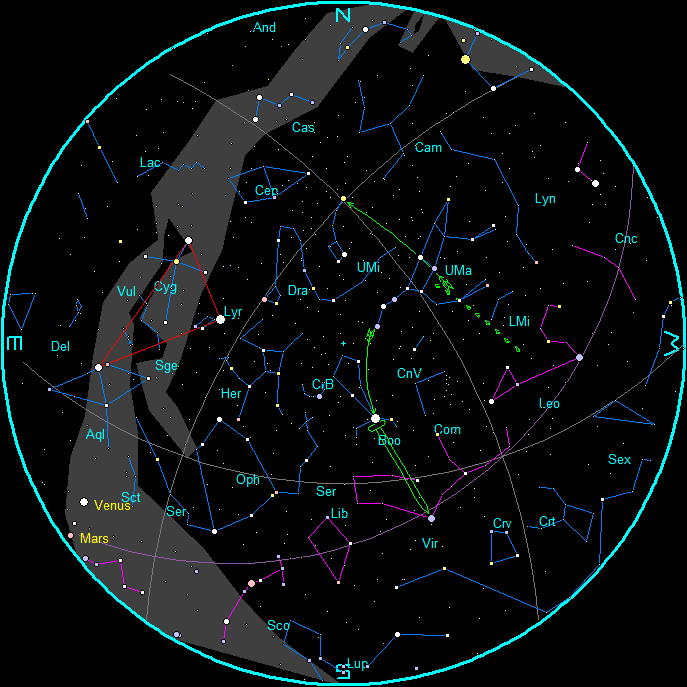
Star Chart for February mornings, 2022 (6 a.m. EST February 15, 2022). Created using my LookingUp program. Click on image to enlarge.
For a list of constellation names to go with the abbreviations, click here.
- Pointer stars at the front of the bowl of the Big Dipper point to Polaris, the North Star.
- Follow the arc of the handle of the Big Dipper to the star Arcturus, and
- Extend like a spike to Spica,
- The Summer Triangle is in red.
Twilight Limits, Nautical and Astronomical
| EST | |||||||
| Morning | Twilight | Evening | Twilight | Dark | Night | Moon | |
| Date | Astro. | Nautical | Nautical | Astro. | Start | End | Illum. |
| 2022-02-01 | 6h22m | 6h56m | 18h56m | 19h30m | 19h30m | 6h22m | 0.01 |
| 2022-02-02 | 6h21m | 6h55m | 18h57m | 19h31m | 19h43m | 6h21m | 0.05 |
| 2022-02-03 | 6h20m | 6h54m | 18h59m | 19h33m | 20h57m | 6h20m | 0.11 |
| 2022-02-04 | 6h19m | 6h53m | 19h00m | 19h34m | 22h08m | 6h19m | 0.19 |
| 2022-02-05 | 6h18m | 6h52m | 19h01m | 19h35m | 23h17m | 6h18m | 0.28 |
| 2022-02-06 | 6h17m | 6h51m | 19h02m | 19h36m | – | 6h17m | 0.37 |
| 2022-02-07 | 6h16m | 6h50m | 19h04m | 19h38m | 0h23m | 6h16m | 0.47 |
| 2022-02-08 | 6h15m | 6h49m | 19h05m | 19h39m | 1h29m | 6h15m | 0.56 |
| 2022-02-09 | 6h13m | 6h47m | 19h06m | 19h40m | 2h34m | 6h13m | 0.65 |
| 2022-02-10 | 6h12m | 6h46m | 19h08m | 19h41m | 3h38m | 6h12m | 0.74 |
| 2022-02-11 | 6h11m | 6h45m | 19h09m | 19h43m | 4h39m | 6h11m | 0.82 |
| 2022-02-12 | 6h10m | 6h43m | 19h10m | 19h44m | 5h35m | 6h10m | 0.89 |
| 2022-02-13 | 6h08m | 6h42m | 19h11m | 19h45m | – | – | 0.94 |
| 2022-02-14 | 6h07m | 6h41m | 19h13m | 19h47m | – | – | 0.98 |
| 2022-02-15 | 6h06m | 6h39m | 19h14m | 19h48m | – | – | 1 |
| 2022-02-16 | 6h04m | 6h38m | 19h15m | 19h49m | – | – | 1 |
| 2022-02-17 | 6h03m | 6h37m | 19h17m | 19h50m | – | – | 0.98 |
| 2022-02-18 | 6h01m | 6h35m | 19h18m | 19h52m | 19h52m | 20h32m | 0.93 |
| 2022-02-19 | 6h00m | 6h34m | 19h19m | 19h53m | 19h53m | 21h43m | 0.87 |
| 2022-02-20 | 5h58m | 6h32m | 19h20m | 19h54m | 19h54m | 22h55m | 0.79 |
| 2022-02-21 | 5h57m | 6h31m | 19h22m | 19h55m | 19h55m | – | 0.69 |
| 2022-02-22 | 5h55m | 6h29m | 19h23m | 19h57m | 19h57m | 0h10m | 0.58 |
| 2022-02-23 | 5h54m | 6h28m | 19h24m | 19h58m | 19h58m | 1h26m | 0.47 |
| 2022-02-24 | 5h52m | 6h26m | 19h26m | 19h59m | 19h59m | 2h43m | 0.36 |
| 2022-02-25 | 5h51m | 6h24m | 19h27m | 20h01m | 20h01m | 3h58m | 0.25 |
| 2022-02-26 | 5h49m | 6h23m | 19h28m | 20h02m | 20h02m | 5h04m | 0.16 |
| 2022-02-27 | 5h47m | 6h21m | 19h30m | 20h03m | 20h03m | 5h47m | 0.08 |
| 2022-02-28 | 5h46m | 6h19m | 19h31m | 20h05m | 20h05m | 5h46m | 0.03 |
Twilight calendar was generated using Cartes du Ciel (Sky Charts).
See my blog post: Twilight Zone for the definitions of the different periods of twilight here: https://bobmoler.wordpress.com/2019/09/27/
NASA Calendar of Planetary Events
Date         Time     Event
Feb  1  Tu            Venus: 32° W
     1  Tu  12:46 am  New Moon
     2  We   4:08 pm  Moon-Jupiter: 4.4° N
     4  Fr   1:34 pm  Saturn Solar Conjunction
     8  Tu   8:50 am  First Quarter
     9  We   1:12 am  Moon Ascending Node
    10  Th   9:39 pm  Moon Apogee: 404,900 km
    12  Sa  11:45 am  Moon North Dec.: 26.4° N
    12  Sa   8:00 pm  Venus-Mars: 6.6° N
    13  Su   5:52 pm  Moon-Pollux: 2.8° N
    13  Su            Venus greatest brilliancy
    14  Mo   6:42 pm  Moon-Beehive: 3.5° S
    16  We  11:57 am  Full Snow Moon
    16  We   3:59 pm  Mercury Elongation: 26.3° West
    23  We   1:54 am  Moon Descending Node
    23  We   5:32 pm  Last Quarter
    26  Sa   1:37 am  Moon South Dec.: 26.6° S
    26  Sa   5:18 pm  Moon Perigee: 367,800 km
    27  Su   4:00 am  Moon-Mars: 3.5° N
    28  Mo   3:07 pm  Moon-Mercury: 3.8° N
    28  Mo   6:47 pm  Moon-Saturn: 4.3° N
Mar  1  Tu            Venus: 45° W
All event times are given for UTC-5:00: Eastern Standard or Daylight Time
Sky Events Calendar by Fred Espenak and Sumit Dutta (NASA’s GSFC),
http://eclipse.gsfc.nasa.gov/SKYCAL/SKYCAL.html
If you go to the above site you can print out a list like the above for the entire year or calendar pages for your time zone.
Sun and Moon Rising and Setting Events
LU           Ephemeris of Sky Events for Interlochen/TC
February, 2022    Local time zone: EST
+-----------------------------------------------------------------------+
| DATE |  SUN     SUN  DAYLIGHT|   TWILIGHT*    |MOON  RISE OR    ILLUM |
|      |  RISE    SET    HOURS |  END    START  |PHASE SET** TIME FRACTN|
+=======================================================================+
|Tue  1| 08:01a  05:51p  09:49 | 06:57p  06:55a |New   Set  06:23p    1%|
|Wed  2| 08:00a  05:52p  09:52 | 06:58p  06:54a |      Set  07:42p    4%|
|Thu  3| 07:59a  05:54p  09:54 | 07:00p  06:53a |      Set  08:57p   10%|
|Fri  4| 07:58a  05:55p  09:57 | 07:01p  06:52a |      Set  10:08p   17%|
|Sat  5| 07:56a  05:57p  10:00 | 07:02p  06:51a |      Set  11:16p   26%|
+------+-----------------------+----------------+-----------------------+
|Sun  6| 07:55a  05:58p  10:03 | 07:04p  06:50a |      Set  12:23a   35%|
|Mon  7| 07:54a  06:00p  10:05 | 07:05p  06:49a |      Set  01:29a   44%|
|Tue  8| 07:53a  06:01p  10:08 | 07:06p  06:48a |F Qtr Set  02:34a   54%|
|Wed  9| 07:51a  06:02p  10:11 | 07:07p  06:46a |      Set  03:37a   63%|
|Thu 10| 07:50a  06:04p  10:14 | 07:09p  06:45a |      Set  04:38a   72%|
|Fri 11| 07:48a  06:05p  10:16 | 07:10p  06:44a |      Set  05:34a   80%|
|Sat 12| 07:47a  06:07p  10:19 | 07:11p  06:42a |      Set  06:24a   87%|
+------+-----------------------+----------------+-----------------------+
|Sun 13| 07:46a  06:08p  10:22 | 07:13p  06:41a |      Set  07:05a   93%|
|Mon 14| 07:44a  06:10p  10:25 | 07:14p  06:40a |      Set  07:40a   97%|
|Tue 15| 07:43a  06:11p  10:28 | 07:15p  06:38a |      Set  08:09a   99%|
|Wed 16| 07:41a  06:12p  10:31 | 07:16p  06:37a |Full  Rise 06:11p  100%|
|Thu 17| 07:39a  06:14p  10:34 | 07:18p  06:36a |      Rise 07:21p   98%|
|Fri 18| 07:38a  06:15p  10:37 | 07:19p  06:34a |      Rise 08:32p   94%|
|Sat 19| 07:36a  06:17p  10:40 | 07:20p  06:33a |      Rise 09:42p   88%|
+------+-----------------------+----------------+-----------------------+
|Sun 20| 07:35a  06:18p  10:43 | 07:22p  06:31a |      Rise 10:55p   81%|
|Mon 21| 07:33a  06:19p  10:46 | 07:23p  06:30a |      Rise 12:09a   71%|
|Tue 22| 07:32a  06:21p  10:49 | 07:24p  06:28a |      Rise 01:26a   61%|
|Wed 23| 07:30a  06:22p  10:52 | 07:26p  06:26a |L Qtr Rise 02:43a   49%|
|Thu 24| 07:28a  06:23p  10:55 | 07:27p  06:25a |      Rise 03:57a   38%|
|Fri 25| 07:27a  06:25p  10:58 | 07:28p  06:23a |      Rise 05:04a   27%|
|Sat 26| 07:25a  06:26p  11:01 | 07:29p  06:22a |      Rise 05:59a   18%|
+------+-----------------------+----------------+-----------------------+
|Sun 27| 07:23a  06:27p  11:04 | 07:31p  06:20a |      Rise 06:43a   10%|
|Mon 28| 07:21a  06:29p  11:07 | 07:32p  06:18a |      Rise 07:17a    4%|
+-----------------------------------------------------------------------+
* Nautical Twilight
** Moonrise or moonset, whichever occurs between sunrise and sunset
Created using my LookingUp for DOS output as HTML.
01/31/2022 – Ephemeris – The winter circle of bright stars
This is Ephemeris for Monday, January 31st. Today the Sun will be up for 9 hours and 47 minutes, setting at 5:50, and it will rise tomorrow at 8:01. The Moon, 1 day before new, will rise at 8:48 tomorrow morning.
The winter skies are blessed with more first magnitude stars than any other season. Six of these stars lie in a large circle centered on the seventh, It’s called the Winter Circle. This circle is up in the evening. Starting high overhead is yellow Capella in Auriga the charioteer. Moving down clockwise is orange Aldebaran in the face of Taurus the Bull. Then down to Orion’s knee, we find blue-white Rigel. Down and left is the brightest star of all the brilliant white Sirius the Dog Star in Canis Major, lowest of these stars in the south-southeast. Moving up and left is white Procyon in Canis Minor, Above Procyon is Pollux in Gemini, the twins. All these are not quite centered on Betelgeuse, the bright red star in Orion’s shoulder.
The astronomical event times given are for the Traverse City/Interlochen area of Michigan (EST, UT – 5 hours). They may be different for your location.
Addendum
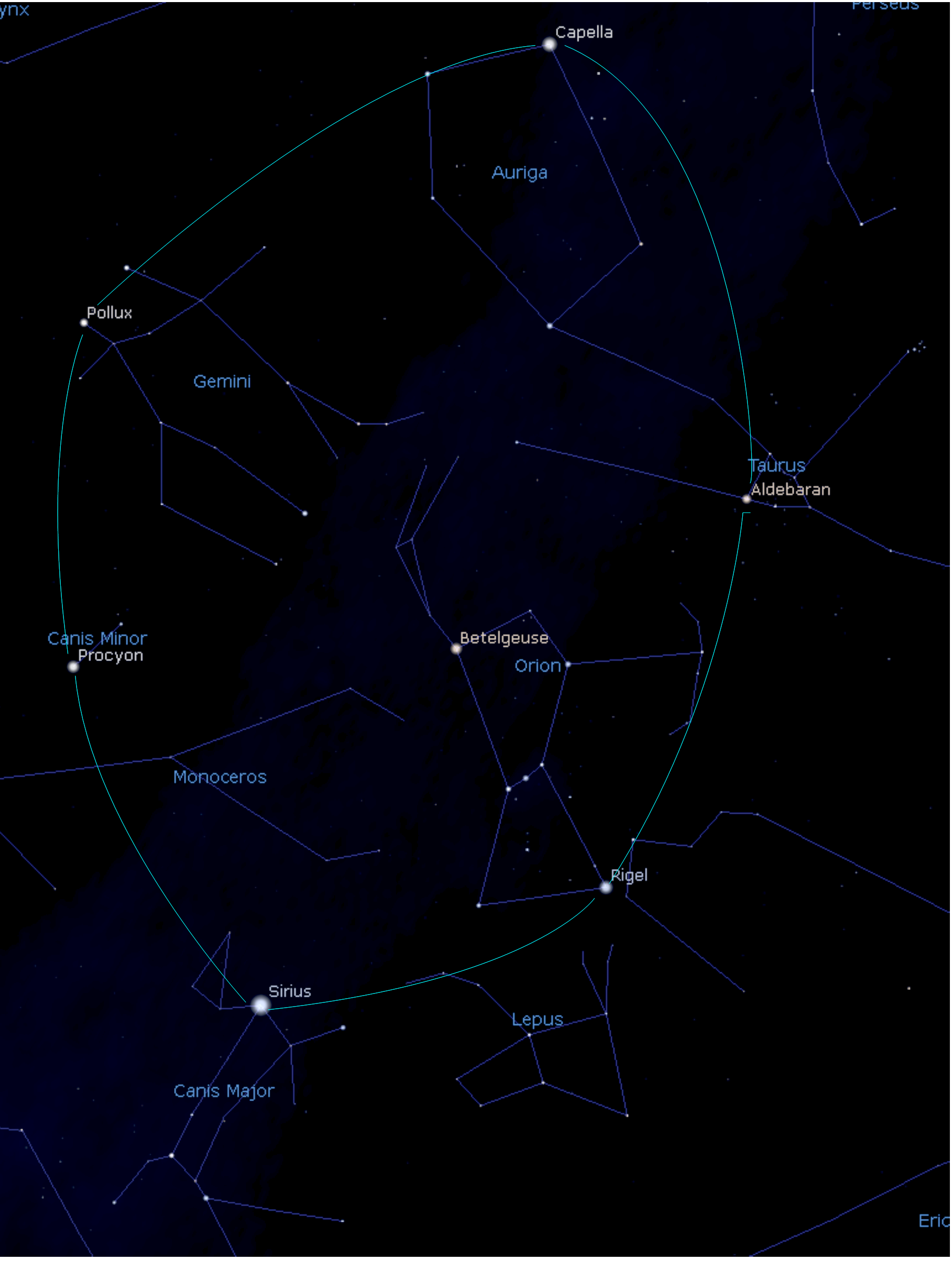
The bright stars of winter arrayed in a not so accurate circle. Some call it the Winter Hexagon. These stars are what make the winter sky so brilliant on the rare clear night in winter. Created using Stellarium.
01/28/2022 – Ephemeris – Auriga the charioteer without a chariot
This is Ephemeris for Friday, January 28th. Today the Sun will be up for 9 hours and 39 minutes, setting at 5:45, and it will rise tomorrow at 8:05. The Moon, 3 days past last quarter, will rise at 6:10 tomorrow morning.
The constellation Auriga the charioteer is nearly overhead at 9 p.m. It is a pentagon of stars, with the brilliant star Capella at one of its upper corners. Capella represents a she-goat he’s carrying. A narrow triangle of stars nearby Capella represents her three kids. The chariot, or by some a wagon is not seen in the stars and is supposed to be pulled by four horses, abreast. Or four oxen, or two oxen, a horse, and a zebra. None of these are depicted in the stars. The only constellation art I’ve seen is a man holding a large goat and three baby goats. There’s no chariot, no wagon and definitely no horses, oxen or zebras. What I see is a distinctive pentagon of stars, with one, Capella, brighter than the rest, and a nearby small triangle of stars.
The astronomical event times given are for the Traverse City/Interlochen area of Michigan (EST, UT – 5 hours). They may be different for your location.
Addendum
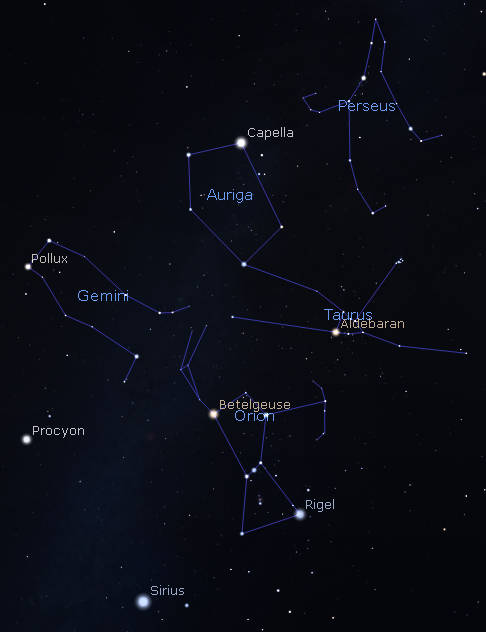
Auriga and surrounding constellations at 9 pm in late January. Created using Stellarium.
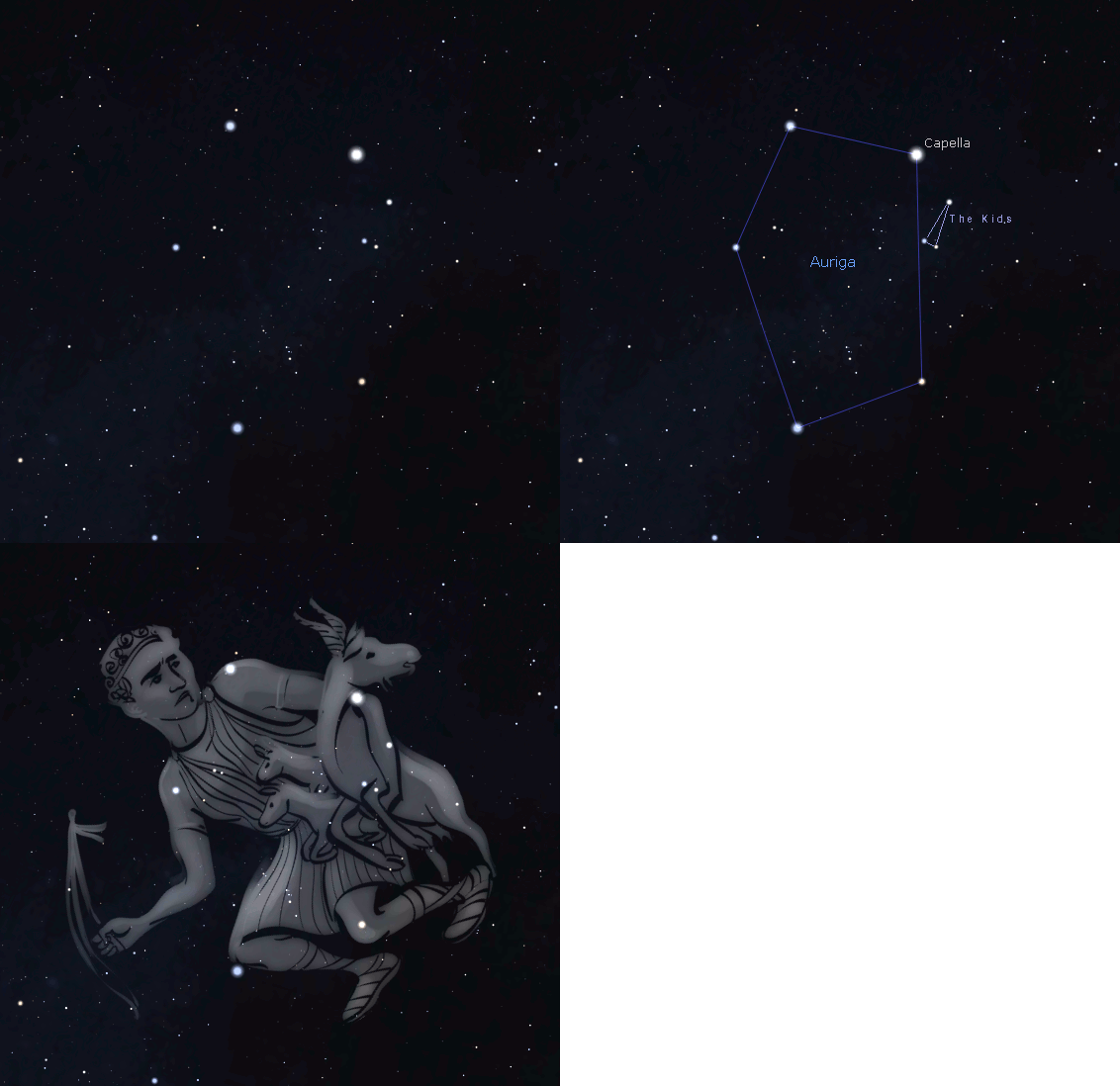
Auriga star field, constellation lines and art. Auriga seems to be missing a kid, he’s supposed to have three, I think. Created using Stellarium and GIMP.
I checked other constellation art, and it appears that there are only two kids. I may have been wrong all these years. Yet the asterism of The Kids has three stars.
01/27/2022 – Ephemeris – Looking at the constellation of Gemini the twins
This is Ephemeris for Thursday, January 27th. Today the Sun will be up for 9 hours and 37 minutes, setting at 5:44, and it will rise tomorrow at 8:06. The Moon, 2 days past last quarter, will rise at 4:56 tomorrow morning.
Another famous winter constellation is Gemini. The constellation of Gemini the Twins is visible high in the southeast, above and left of Orion the hunter, at 9 p.m. The namesake stars of the two lads, are the two bright stars at the left end of Gemini, and are high and nearly in the east. Castor is on top, while Pollux is below. From them come two lines of stars that outline the two, extending horizontally toward Orion. In Greek mythology the lads were half brothers, Castor was fathered by a mere mortal, while Pollux was fathered by Zeus, but were born together as twins. When Castor was killed during the quest for the Golden Fleece, Pollux pleaded with Zeus to let him die also, so Zeus placed them together in the sky.
The astronomical event times given are for the Traverse City/Interlochen area of Michigan (EST, UT – 5 hours). They may be different for your location.
Addendum
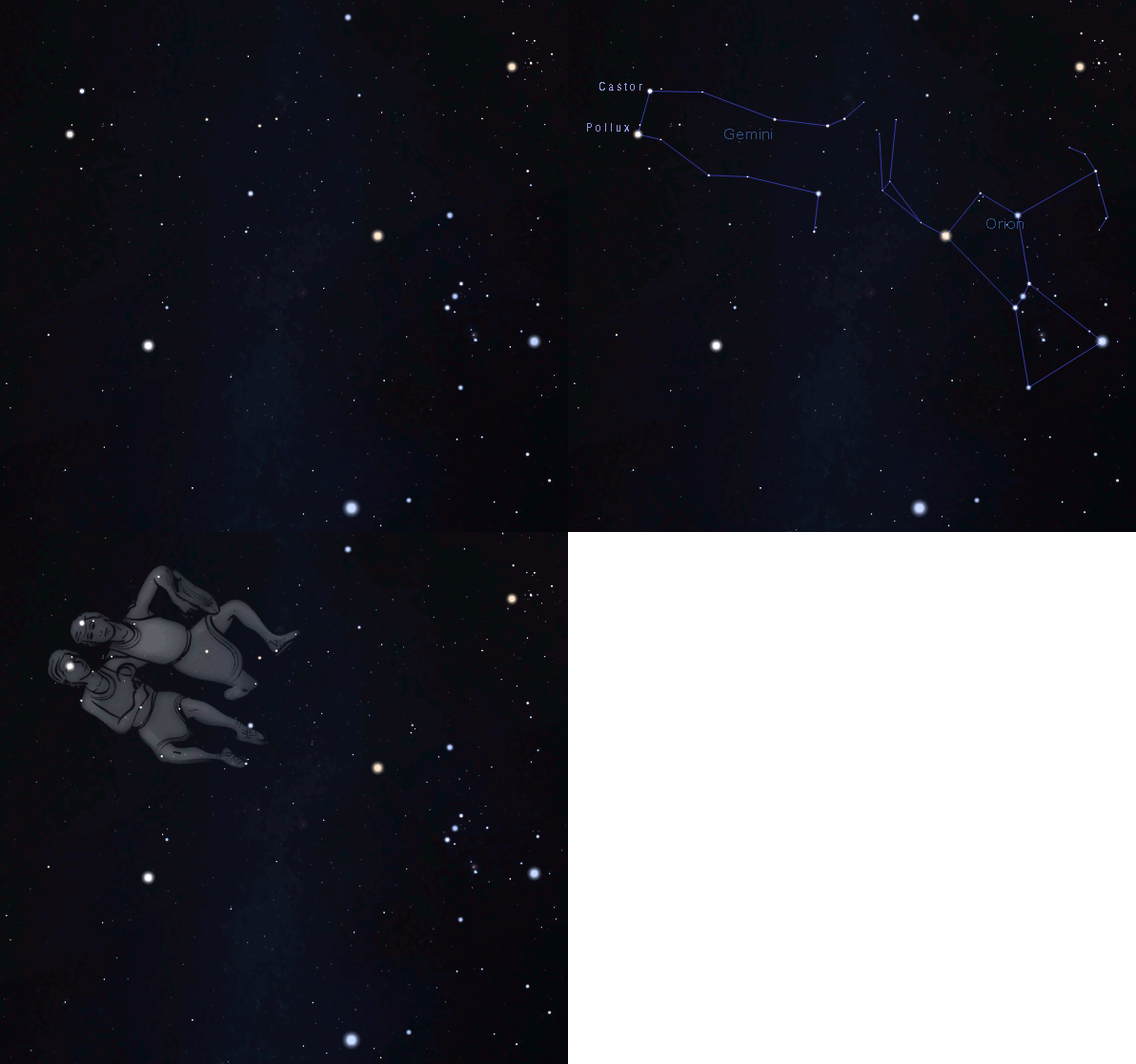
Gemini finder animation for 9 pm January 27th, showing just stars, constellation lines and star names, and figures of the lads. Click on the image to enlarge it. Created using Stellarium and GIMP.
01/26/2022 – Ephemeris – Evening planets? Then there was one.
This is Bob Moler with Ephemeris for Wednesday, January 26th. Today the Sun will be up for 9 hours and 35 minutes, setting at 5:43, and it will rise tomorrow at 8:07. The Moon, 1 day past last quarter, will rise at 3:37 tomorrow morning.
Let’s search for the naked-eye planets for this week. There is just one planet left in the evening sky now. Jupiter will be visible in the southwest by 6:15 pm. Jupiter will set at 8:12 pm. Saturn is too close to the Sun to be seen, and will cross behind the Sun in 9 days to enter the morning sky. In the morning sky, Venus, our brilliant morning star, and the much dimmer Mars will rise about the same time about 6:05 am. Both will appear low in the southeastern twilight by 7 am. Mars will be to the right of Venus by 11 and a half degrees, about the width of a fist held at arm’s length. Mars’ rival in color and brightness, the red giant star Antares, is to its right and a bit higher, and nearer the waning crescent Moon.
The astronomical event times given are for the Traverse City/Interlochen area of Michigan (EST, UT – 5 hours). They may be different for your location.
Addendum
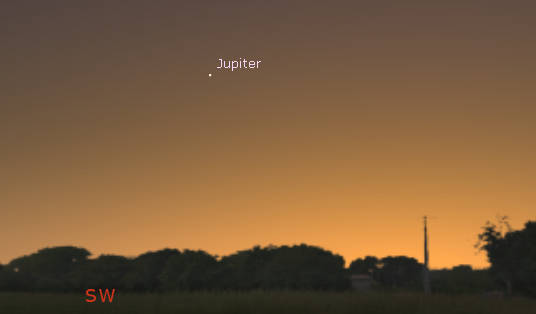
Jupiter in evening twilight tonight, January 26, 2022. Created using Stellarium.
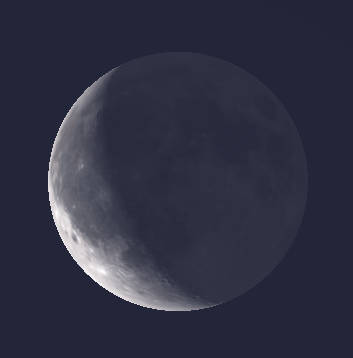
Waning crescent Moon as it might be seen at 7:15 am tomorrow morning, January 27, 2022. Created using Stellarium.
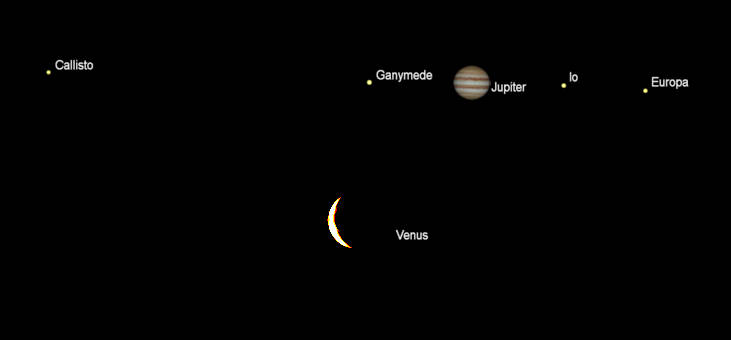
Telescopic views of the bright planets and their brighter moons (north up) as they would be seen in a small telescope, with the same magnification, overnight, January 26/27, 2022. I do not show planets less than 10 seconds of arc in diameter. Apparent diameters: Jupiter, 33.85″. Mars is not shown, its apparent diameter is 4.27″. Venus has an apparent diameter of 52.85″ and is 11.0% illuminated. The ” symbol means seconds of arc (1/3600th of a degree.) Created using Cartes du Ciel (Sky Charts).
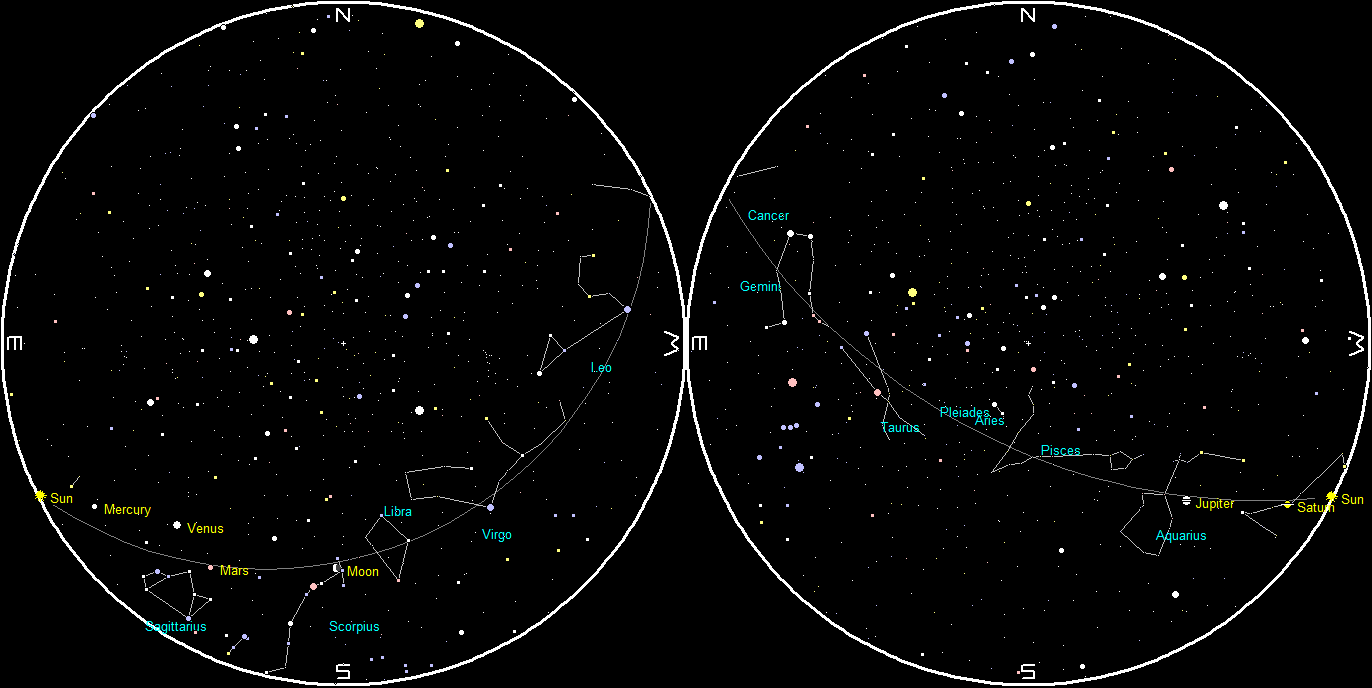
The naked-eye planets and the Moon at sunset and sunrise on a single night, starting with sunset on the right on January 26, 2022. The night ends on the left with sunrise on the 27th. Click on the image to enlarge it. Created using my LookingUp program.

