Archive
03/07/2019 – Ephemeris – Leo the lion rising
Ephemeris for Thursday, March 7th. Today the Sun will be up for 11 hours and 28 minutes, setting at 6:38, and it will rise tomorrow at 7:08. The Moon, 1 day past new, will set at 7:42 this evening.
Tonight as twilight fades around 8 p.m. the constellation of Leo the lion can be seen rising in the east. The head and mane of a male lion is seen as a backward question mark. This pattern of stars is also called the sickle. The bright star that is the dot at the bottom is Regulus, the “Little King Star”. To the lower left is a triangle of stars that is the lion’s hind end with the star Denebola at the far end. It is said that the reason the figure of a lion came to be seen in the stars here is because lions came from the desert, driven by the heat, to drink from the river Nile the time of the year that the sun was in this part of the sky. Leo can also be found by first locating the Big Dipper high in the northeast, a hole in its bowl drips on Leo.
The times given are for the Traverse City/Interlochen area of Michigan. They may be different for your location.
Addendum
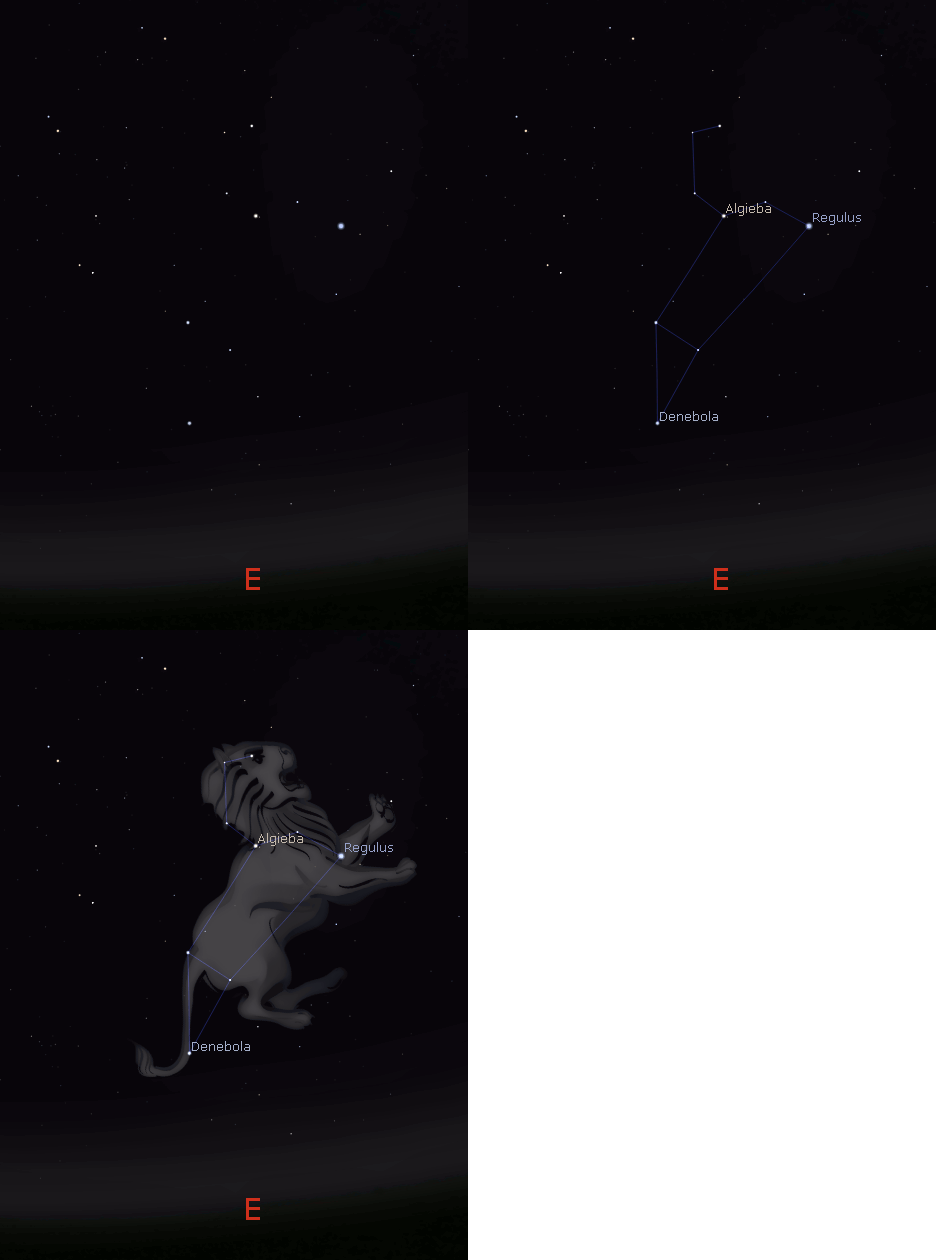
The constellation Leo rising animation. Created using Stellarium and GIMP.
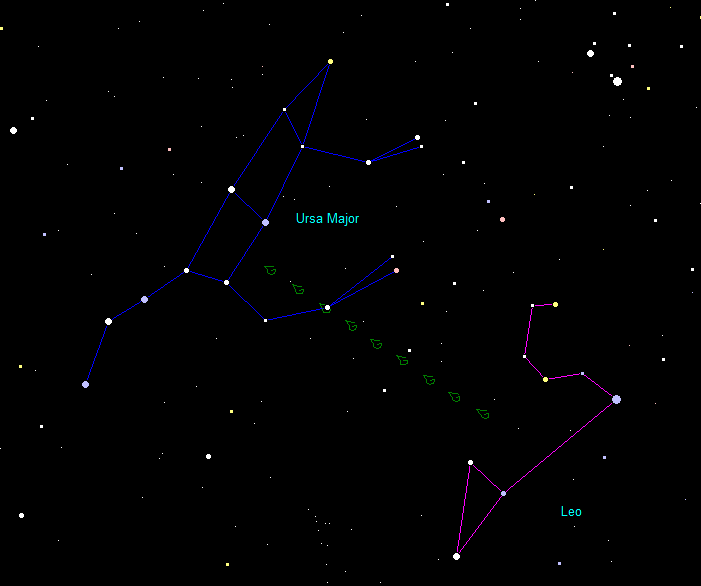
Finding Leo from the Big Dipper: Leaky Big Dipper drips on Leo. Created using my LookingUp program.
03/06/2019 – Ephemeris – Looking at the bright naked eye planets for this week
Ephemeris for Ash Wednesday, March 6th. Today the Sun will be up for 11 hours and 25 minutes, setting at 6:36, and it will rise tomorrow at 7:10. The Moon is new today, and won’t be visible.
Let’s look at the planets for this week. We have two evening planets visible now. Tiny and elusive Mercury is really hard to spot low in the west from about 7 p.m. until it sets at 7:52 p.m. It is fading fast. Binoculars are the only way to spot it now. Mars will be in the west-southwestern sky this evening and will set at 11:42 p.m. Mars too is fading. In the morning sky we have Jupiter which will rise tomorrow at 2:45 a.m. It is second to Venus in brightness. Saturn will be next to rise at 4:32 a.m. It will be to the upper right of Venus which will rise at 5:32 a.m. tomorrow. By 6 in the morning they will be string out from the southeast to the south. They will be a beautiful sight as morning twilight advances.
The times given are for the Traverse City/Interlochen area of Michigan. They may be different for your location.
Addendum
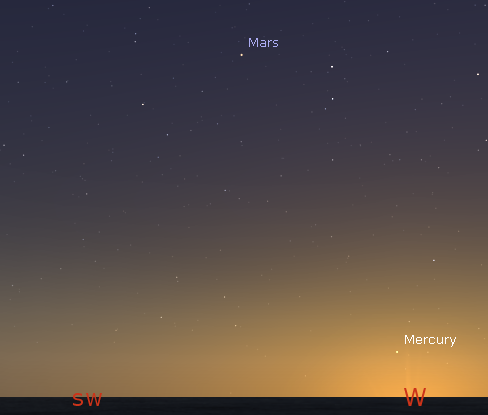
Mars and Mercury at 7:15 p.m. tonight March 6, 2019. I had to increase the star and planet brightness to make Mercury appear in the bright twilight because it has dropped to second magnitude. Created using Stellarium.
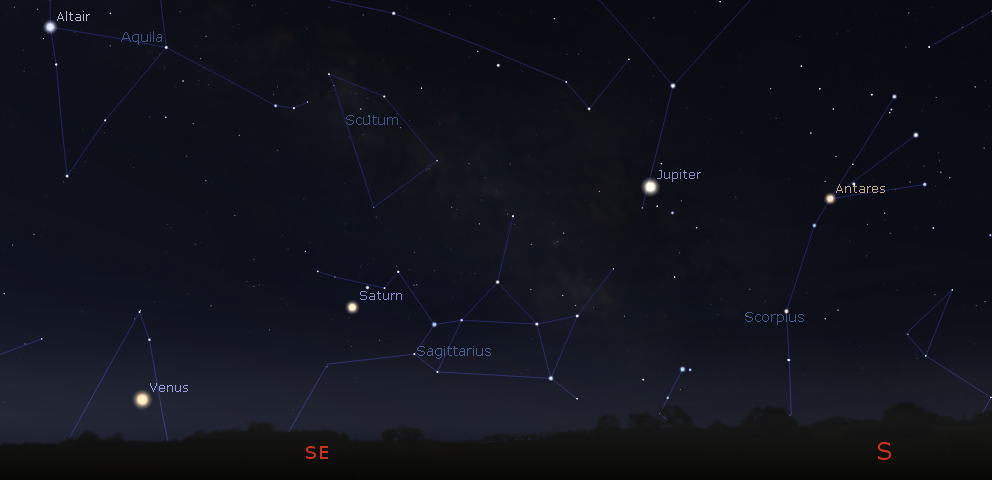
Morning planets and the constellations at 6 a.m. Tomorrow March 7, 2019. Click on image to enlarge. Created using Stellarium.
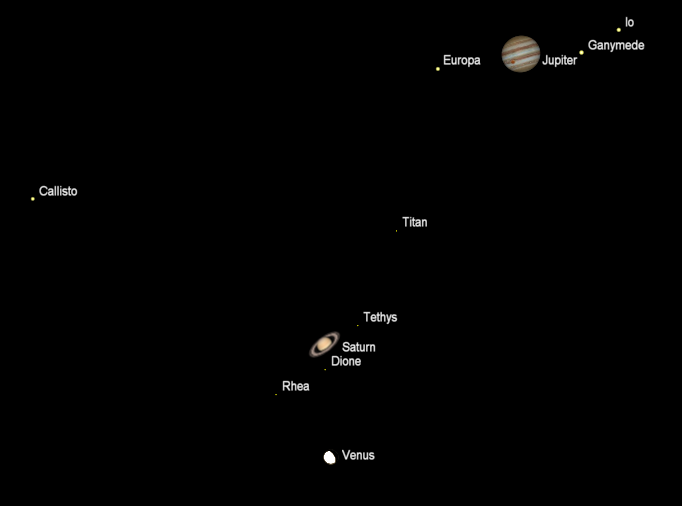
Jupiter, Saturn and Venus with the same magnification at 6 a.m. tomorrow morning March 7, 2019. Created using Cartes du Ciel (Sky Charts).
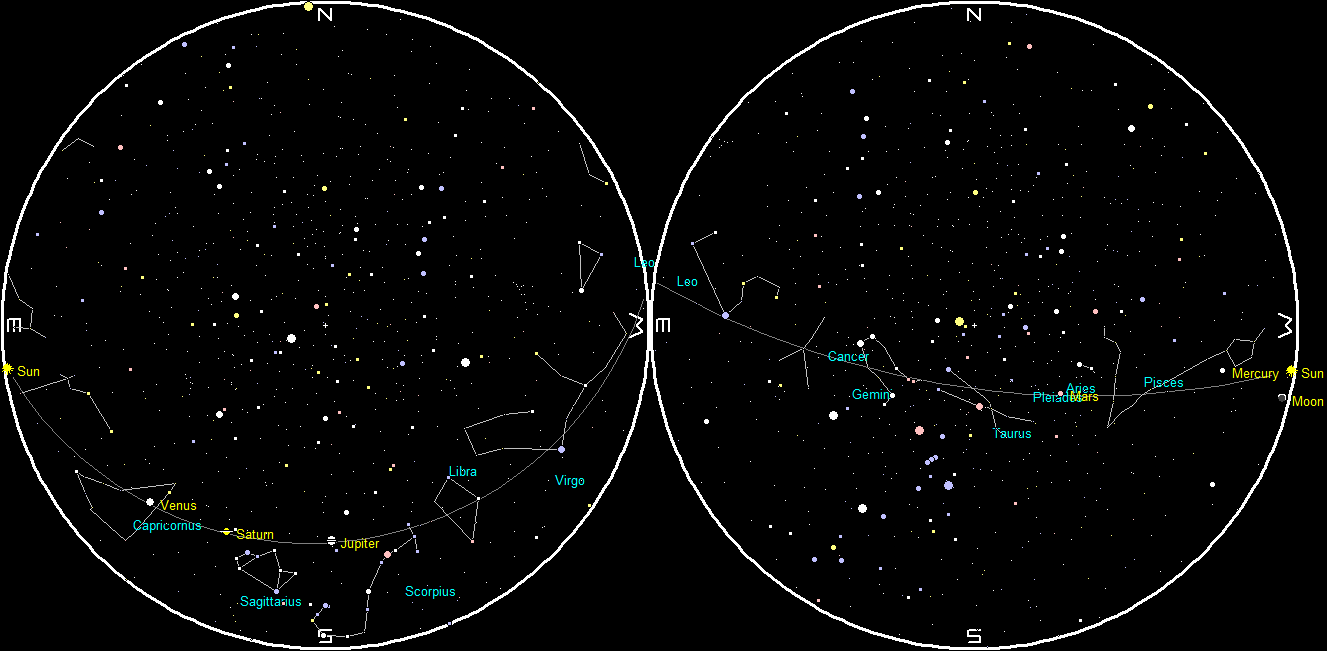
Planets and the Moon at sunset and sunrise of a single night starting with sunset on the right on March 6, 2019. The night ends on the left with sunrise on the 7th. Click on the image to enlarge. Created using my LookingUp program.
03/05/2019 – Ephemeris – The Big Dipper rising in the east
Ephemeris for Fat Tuesday, March 5th. Today the Sun will be up for 11 hours and 21 minutes, setting at 6:35, and it will rise tomorrow at 7:11. The Moon, 1 day before new, will rise at 7:33 tomorrow morning.
While Orion and the stars of winter are still holding forth in the south the Big Dipper is sneaking up in the northeast. Indeed at 8 p.m. the front stars of the dipper’s bowl are half way up the sky, at the same altitude of Polaris the North Star. To the Anishinaabe native peoples of this region the Big Dipper wasn’t part of a bear, it was the hind end of the Fisher, Ojiig in their language. The Fisher, a magical animal of their legends, a weasel-like animal brought warm seasons to the Earth, and serves as a weather indicator. As he climbs the sky in the east he is signaling spring and the maple sugaring season. The Big Dipper is also a pointer to some of the important stars and constellations of spring.
The times given are for the Traverse City/Interlochen area of Michigan. They may be different for your location.
Addendum
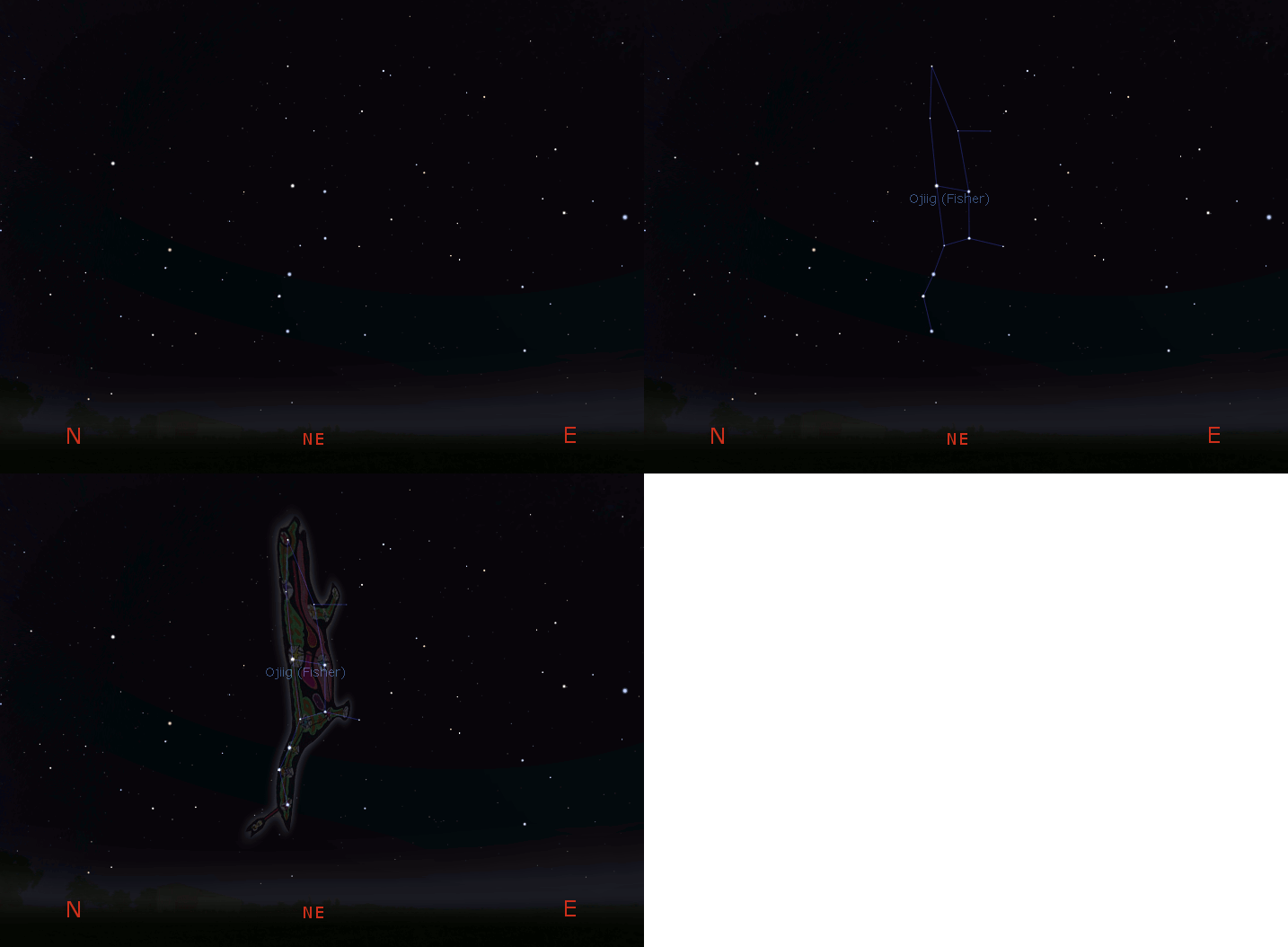
The Big Dipper, as Ojiig the Fisher of the Anishinaabe people rising higher in the northeast at 8 p.m. March 5, 2019. Created using Stellarium.
The Anishinaabe constellation drawing of the Fisher is from Ojibwe Sky Star Map Constellation Guide by Annette S. Lee, William Wilson, Jeffrey Tibbets and Carl Gawboy available locally and online. They are part of the latest editions of Stellarium, a free planetarium program. Links to it are on the right. Other information and links are available within the Sky Lore tab.
My story of the Fisher is here: https://bobmoler.wordpress.com/2012/10/11/the-story-of-the-fisher-star/
03/04/2019 – Ephemeris – Zodiacal light is especially visible this time of year
Ephemeris for Monday, March 4th. Today the Sun will be up for 11 hours and 18 minutes, setting at 6:34, and it will rise tomorrow at 7:13. The Moon, 2 days before new, will rise at 7:07 tomorrow morning.
Zodiacal light is a faint but towering glow that can be seen after the end of astronomical twilight on moonless nights. It is seen in the west in the evening in late winter and early spring and in the east in the morning in late summer and early autumn. The axis of the glow is the ecliptic, the apparent annual path of the Sun in the sky, along which lie the constellations of the zodiac. Right now the end of twilight is about 8 p.m. and advancing at a rate of a minute or two each night. The cause of zodiacal light is dust, micron sized dust from comets and asteroids. Most of these lie in the plane of the solar system, centered on the ecliptic and the constellations of the zodiac and increases in brightness and width toward the Sun.
The times given are for the Traverse City/Interlochen area of Michigan. They may be different for your location.
Addendum
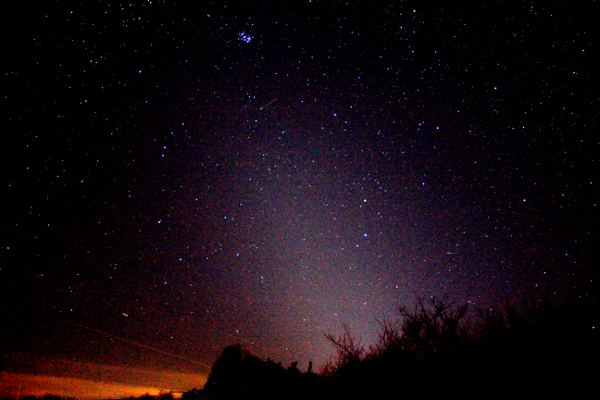
Much enhanced Zodiacal Light from the my back yard at 9:31 p.m. March 16, 2018, 5 minutes after the official end of astronomical twilight. Canon EOS Rebel T5 18mm f.l., f/3.5, 6 sec. ISO 12,800 . The clouds on the left appear to be illuminated by the lights of the towns of Beulah and Frankfort 20+ miles away.
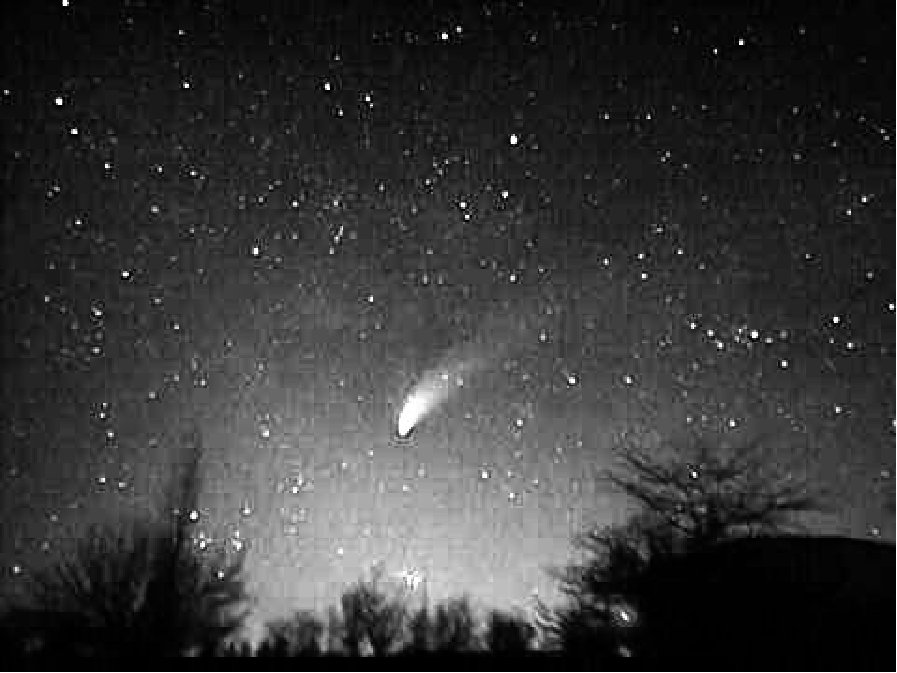
This is my previous best photo of zodiacal light. Zodiacal Light and Comet Hale-Bopp April 1997. Enhanced contrast.
The latest versions of Stellarium also show zodiacal light, but to see it the atmosphere needs to be turned off. That’s keyboard shortcut A.
03/01/2019 – Ephemeris – GTAS topic tonight: Spring sky wonders
Ephemeris for Friday, March 1st. Today the Sun will be up for 11 hours and 9 minutes, setting at 6:30, and it will rise tomorrow at 7:18. The Moon, 3 days past last quarter, will rise at 5:23 tomorrow morning.
I will be previewing the skies of Spring this evening at this evening’s meeting of the Grand Traverse Astronomical Society (GTAS) at 8 p.m. at Northwestern Michigan College’s Rogers Observatory. The spring stars seem to get away from us with the rapid advance of sunset and the big bump of daylight saving time on the tenth. After the meeting there will be a star party starting at 9 p.m. On tap if its clear will be Orion and its great nebula, a star nursery only 1400 light years away. It will be a wonderful sight with its clouds and wisps of gas and dust illuminated by a clutch of hot baby stars. The Observatory is located south of Traverse City on Birmley Road off either Garfield or Keystone roads.
The times given are for the Traverse City/Interlochen area of Michigan. They may be different for your location.
Addendum
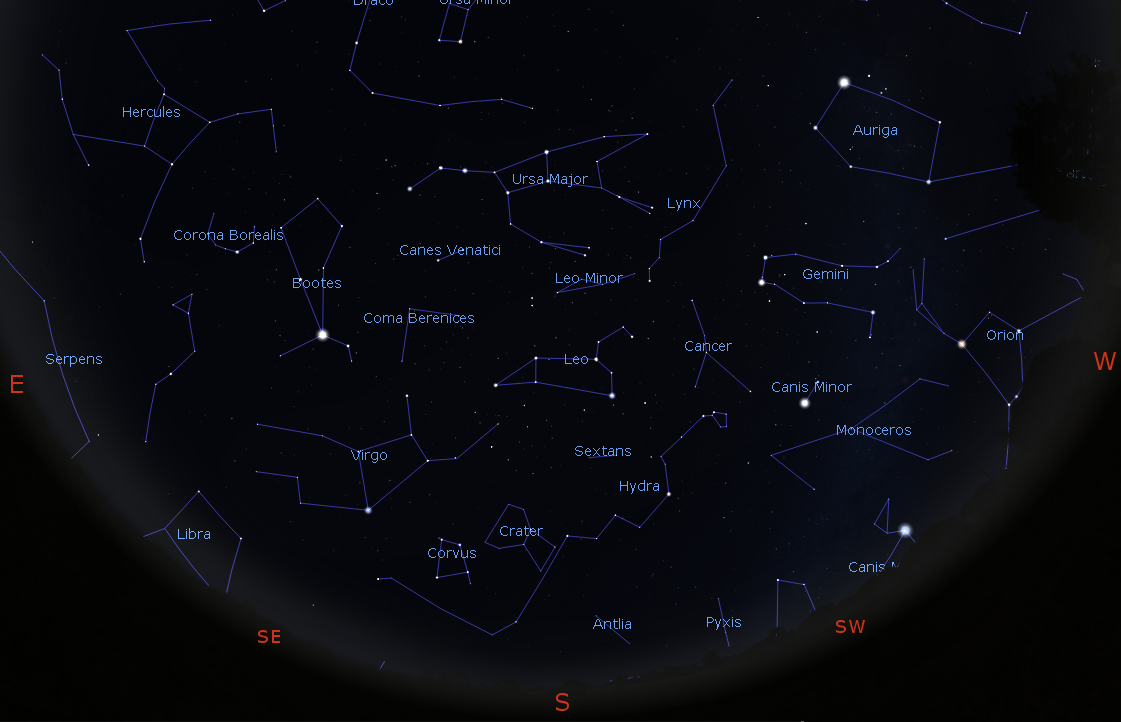
The constellations of spring with some constellations of winter leaving to the west and those of summer entering from the east. Click on the image to enlarge. Created using Stellarium.
02/28/2019 – Ephemeris – Looking ahead at March skies
Ephemeris for Thursday, February 28th. Today the Sun will be up for 11 hours and 6 minutes, setting at 6:28, and it will rise tomorrow at 7:20. The Moon, 2 days past last quarter, will rise at 4:38 tomorrow morning.
Let’s look at the skies of March, which will start tomorrow. During March the increase in daylight hours are at its greatest, with spring 3 weeks away. Daylight hours will increase from 11 hours and 9 minutes tomorrow to 12 hours and 42 minutes on the 31st. Along with that, the altitude of the Sun at noon will increase from 38 degrees tomorrow to 49 ½ degrees at month’s end. Local noon, by the way for Interlochen and Traverse City, is about 12:50 p.m, which is mainly due to the fact that our standard time meridian happens to run through Philadelphia. That’s before daylight time starts in eleven days. Winter ends and spring will begin at 5:58 p.m. on the 20th.
The times given are for the Traverse City/Interlochen area of Michigan. They may be different for your location.
Addenda
March Evening Star Chart
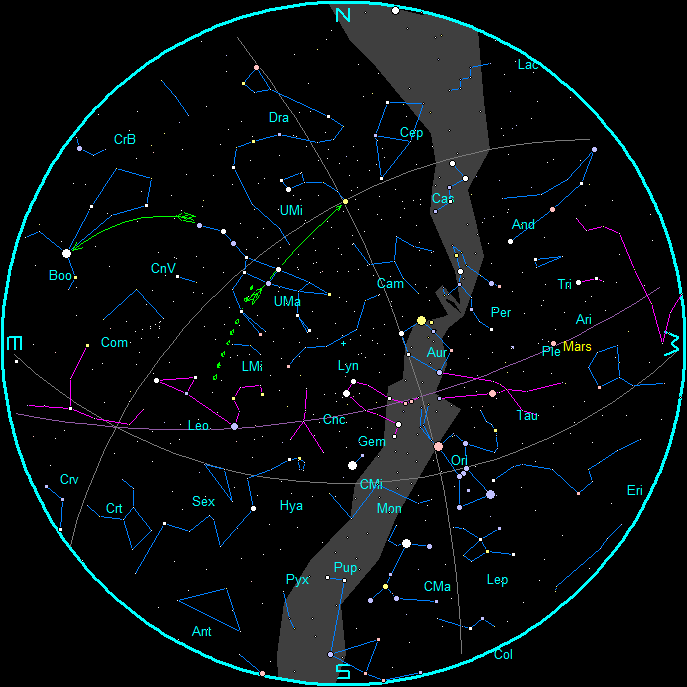
Star Chart for March 2019 (10 p.m. EDT March 15, 2019). Created using my LookingUp program. Click on image to enlarge.
The planets and stars are plotted for the 15th at 10 p.m. EST in the evening and 6 a.m. for the morning chart. These are the chart times. Note that Traverse City is located approximately 45 minutes behind our time meridian, West 75° longitude. (An hour 45 minutes behind our daylight saving time meridian during EDT). To duplicate the star positions on a planisphere you may have to set it to 1 hour 45 minutes earlier than the current time.
Note the chart times of 10 p.m. and 6 a.m. are for the 15th. For each week before the 15th add ½ hour (28 minutes if you’re picky). For each week after the 15th subtract ½ hour. The planet positions are updated each Wednesday on this blog. For planet positions on dates other than the 15th, check the Wednesday planet posts on this blog.
March Morning Star Chart
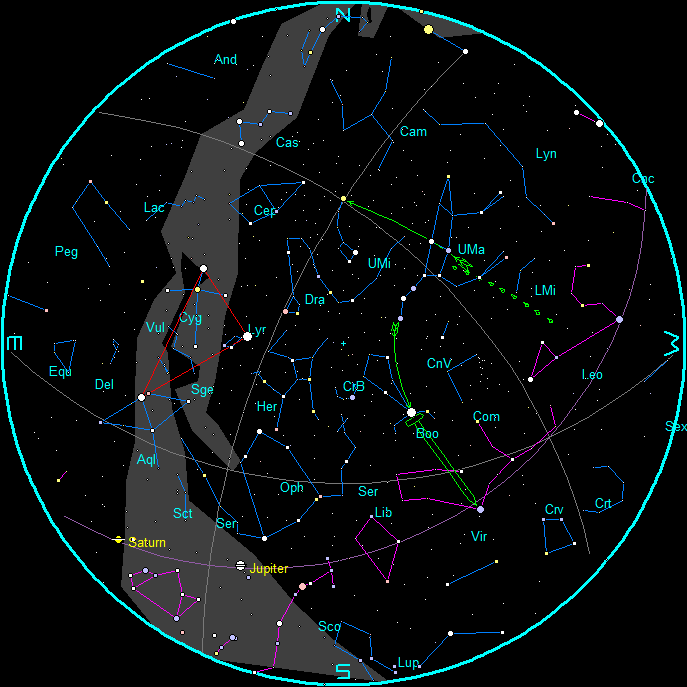
Star Chart for March mornings 2019 (6 a.m. EST March 15, 2019). Created using my LookingUp program. Click on image to enlarge.
For a list of constellation names to go with the abbreviations click here.
- Pointer stars at the front of the bowl of the Big Dipper point to Polaris the North Star.
- Follow the arc of the handle of the Big Dipper to the star Arcturus, and
- Extend like a spike to Spica,
- The Summer Triangle is in red.
Twilight Limits, Nautical and Astronomical
| EST/EDT | |||||||
| Morning twilight | Evening twilight | Dark night | Moon | ||||
| Date | Astro. | Nautical | Nautical | Astro. | Start | End | Illum. |
| 2018-03-01 | 5h44m | 6h17m | 19h32m | 20h06m | – | – | 0.99 |
| 2018-03-02 | 5h42m | 6h16m | 19h33m | 20h07m | – | – | 1.00 |
| 2018-03-03 | 5h40m | 6h14m | 19h34m | 20h08m | 20h08m | 20h40m | 0.98 |
| 2018-03-04 | 5h38m | 6h12m | 19h36m | 20h10m | 20h10m | 21h48m | 0.93 |
| 2018-03-05 | 5h37m | 6h11m | 19h37m | 20h11m | 20h11m | 22h54m | 0.87 |
| 2018-03-06 | 5h35m | 6h09m | 19h38m | 20h12m | 20h12m | 23h57m | 0.79 |
| 2018-03-07 | 5h33m | 6h07m | 19h40m | 20h14m | 20h14m | – | 0.70 |
| 2018-03-08 | 5h31m | 6h05m | 19h41m | 20h15m | 20h15m | 0h58m | 0.60 |
| 2018-03-09 | 5h29m | 6h03m | 19h42m | 20h16m | 20h16m | 1h56m | 0.50 |
| 2018-03-10 | 5h27m | 6h02m | 19h44m | 20h18m | 20h18m | 2h50m | 0.40 |
| 2018-03-11 | 6h26m | 7h00m | 20h45m | 21h19m | 21h19m | 4h40m | 0.31 |
| 2018-03-12 | 6h24m | 6h58m | 20h46m | 21h20m | 21h20m | 5h25m | 0.22 |
| 2018-03-13 | 6h22m | 6h56m | 20h47m | 21h22m | 21h22m | 6h06m | 0.15 |
| 2018-03-14 | 6h20m | 6h54m | 20h49m | 21h23m | 21h23m | 6h20m | 0.08 |
| 2018-03-15 | 6h18m | 6h52m | 20h50m | 21h25m | 21h25m | 6h18m | 0.04 |
| 2018-03-16 | 6h16m | 6h50m | 20h51m | 21h26m | 21h26m | 6h16m | 0.01 |
| 2018-03-17 | 6h14m | 6h49m | 20h53m | 21h27m | 21h27m | 6h14m | 0.00 |
| 2018-03-18 | 6h12m | 6h47m | 20h54m | 21h29m | 21h29m | 6h12m | 0.02 |
| 2018-03-19 | 6h10m | 6h45m | 20h55m | 21h30m | 22h21m | 6h10m | 0.06 |
| 2018-03-20 | 6h12m | 6h47m | 21h01m | 21h36m | 23h30m | 6h12m | 0.12 |
| 2018-03-21 | 6h10m | 6h45m | 21h02m | 21h37m | – | 6h10m | 0.21 |
| 2018-03-22 | 6h08m | 6h43m | 21h03m | 21h39m | 0h39m | 6h08m | 0.31 |
| 2018-03-23 | 6h06m | 6h41m | 21h05m | 21h40m | 1h48m | 6h06m | 0.42 |
| 2018-03-24 | 6h03m | 6h39m | 21h06m | 21h42m | 2h54m | 6h03m | 0.54 |
| 2018-03-25 | 6h01m | 6h37m | 21h07m | 21h43m | 3h54m | 6h01m | 0.66 |
| 2018-03-26 | 5h59m | 6h35m | 21h09m | 21h45m | 4h48m | 5h59m | 0.77 |
| 2018-03-27 | 5h57m | 6h33m | 21h10m | 21h46m | 5h34m | 5h57m | 0.86 |
| 2018-03-28 | 5h55m | 6h31m | 21h12m | 21h48m | – | – | 0.93 |
| 2018-03-29 | 5h53m | 6h29m | 21h13m | 21h49m | – | – | 0.93 |
| 2018-03-30 | 5h51m | 6h27m | 21h14m | 21h51m | – | – | 0.98 |
| 2018-03-31 | 5h49m | 6h25m | 21h16m | 21h52m | – | – | 1.00 |
Twilight calendar was generated using Cartes du Ciel (Sky Charts).
See my blog post: Twilight Zone for the definitions of the different periods of twilight here: https://bobmoler.wordpress.com/2019/09/27/.
NASA Calendar of Planetary Events
| Date | Local Time | Event | ||
| Mar | 1 | Fr | 01:23 AM | Moon South Dec.: 21.6° S |
| 1 | Fr | Venus: 40.8° W | ||
| 1 | Fr | 01:40 PM | Moon-Saturn: 0.3° S | |
| 2 | Sa | 06:03 AM | Moon Descending Node | |
| 2 | Sa | 04:28 PM | Moon-Venus: 1.3° N | |
| 4 | Mo | 06:25 AM | Moon Apogee: 406400 km | |
| 6 | We | 11:04 AM | New Moon | |
| 6 | We | 07:48 PM | Neptune Conjunction | |
| 13 | We | 06:13 AM | Moon-Aldebaran: 2° S | |
| 14 | Th | 06:27 AM | First Quarter | |
| 14 | Th | 09:43 PM | Mercury Inferior Conj. | |
| 15 | Fr | 01:59 PM | Moon North Dec.: 21.8° N | |
| 16 | Sa | 12:22 PM | Moon Ascending Node | |
| 17 | Su | 09:01 AM | Moon-Beehive: 0.5° N | |
| 18 | Mo | 07:59 PM | Moon-Regulus: 2.5° S | |
| 19 | Tu | 03:47 PM | Moon Perigee: 359400 km | |
| 20 | We | 05:58 PM | Vernal Equinox | |
| 20 | We | 09:43 PM | Full Moon | |
| 26 | Tu | 10:28 PM | Moon-Jupiter: 2° S | |
| 28 | Th | 12:10 AM | Last Quarter | |
| 28 | Th | 09:02 AM | Moon South Dec.: 21.9° S | |
| 29 | Fr | 01:11 AM | Moon-Saturn: 0.1° N | |
| 29 | Fr | 09:08 AM | Moon Descending Node | |
| 30 | Sa | 11:08 PM | Mars-Pleiades: 3.2° S | |
| 31 | Su | 08:14 PM | Moon Apogee: 405600 km | |
| Apr | 1 | Mo | Venus: 34.6° W | |
All event times are given for UTC-5 hr: Eastern Standard or UTC-4 hr: Daylight Saving Time starting March 10th.
Sky Events Calendar by Fred Espenak and Sumit Dutta (NASA’s GSFC),
http://eclipse.gsfc.nasa.gov/SKYCAL/SKYCAL.html.
If you go to the above site you can print out a list like the above for the entire year or calendar pages for your time zone.
Sun and Moon Rising and Setting Events
| Ephemeris of Sky Events for NMC Observatory | ||||||||||
| March, 2019 – Local time zone: EST | ||||||||||
| Sun | Twilight* | Moon | Illum | |||||||
| Date | Rise | Set | Hours | End | Start | Phase | R/S** | Time | Fractn | |
| Fri | 1 | 07:20a | 06:30a | 11:09 | 07:33p | 06:17a | Rise | 05:22a | 18 | |
| Sat | 2 | 07:18a | 06:31p | 11:12 | 07:34p | 06:15a | Rise | 06:02a | 12 | |
| Sun | 3 | 07:16a | 06:32p | 11:15 | 07:35p | 06:13a | Rise | 06:36a | 6 | |
| Mon | 4 | 07:15a | 06:34p | 11:18 | 07:36p | 06:12a | Rise | 07:06a | 3 | |
| Tue | 5 | 07:13a | 06:35p | 11:22 | 07:38p | 06:10a | Rise | 07:33a | 0 | |
| Wed | 6 | 07:11a | 06:36p | 11:25 | 07:39p | 06:08a | New | Set | 06:41p | 0 |
| Thu | 7 | 07:09a | 06:37p | 11:28 | 07:40p | 06:06a | Set | 07:41p | 2 | |
| Fri | 8 | 07:07a | 06:39p | 11:31 | 07:42p | 06:05a | Set | 08:43p | 5 | |
| Sat | 9 | 07:06a | 06:40p | 11:34 | 07:43p | 06:03a | Set | 09:45p | 10 | |
| *** Start EDT *** | ||||||||||
| Sun | 10 | 08:04a | 07:41p | 11:37 | 08:44p | 07:01a | Set | 11:49p | 17 | |
| Mon | 11 | 08:02a | 07:43p | 11:40 | 08:46p | 06:59a | Set | 12:54a | 25 | |
| Tue | 12 | 08:00a | 07:44p | 11:43 | 08:47p | 06:57a | Set | 02:00a | 35 | |
| Wed | 13 | 07:58a | 07:45p | 11:46 | 08:48p | 06:56a | Set | 03:05a | 45 | |
| Thu | 14 | 07:57a | 07:47p | 11:49 | 08:50p | 06:54a | F Qtr | Set | 04:08a | 56 |
| Fri | 15 | 07:55a | 07:48p | 11:53 | 08:51p | 06:52a | Set | 05:06a | 67 | |
| Sat | 16 | 07:53a | 07:49p | 11:56 | 08:52p | 06:50a | Set | 05:58a | 77 | |
| Sun | 17 | 07:51a | 07:50p | 11:59 | 08:53p | 06:48a | Set | 06:42a | 87 | |
| Mon | 18 | 07:49a | 07:52p | 12:02 | 08:55p | 06:46a | Set | 07:21a | 94 | |
| Tue | 19 | 07:47a | 07:53p | 12:05 | 08:56p | 06:44a | Set | 07:54a | 98 | |
| Wed | 20 | 07:46a | 07:54p | 12:08 | 08:57p | 06:42a | Full | Rise | 07:35p | 100 |
| Thu | 21 | 07:44a | 07:55p | 12:11 | 08:59p | 06:40a | Rise | 08:52p | 99 | |
| Fri | 22 | 07:42a | 07:57p | 12:14 | 09:00p | 06:39a | Rise | 10:07p | 95 | |
| Sat | 23 | 07:40a | 07:58p | 12:18 | 09:02p | 06:37a | Rise | 11:20p | 88 | |
| Sun | 24 | 07:38a | 07:59p | 12:21 | 09:03p | 06:35a | Rise | 12:30a | 80 | |
| Mon | 25 | 07:36a | 08:00p | 12:24 | 09:04p | 06:33a | Rise | 01:36a | 71 | |
| Tue | 26 | 07:34a | 08:02p | 12:27 | 09:06p | 06:31a | Rise | 02:37a | 62 | |
| Wed | 27 | 07:33a | 08:03p | 12:30 | 09:07p | 06:29a | Rise | 03:32a | 52 | |
| Thu | 28 | 07:31a | 08:04p | 12:33 | 09:08p | 06:27a | L Qtr | Rise | 04:20a | 42 |
| Fri | 29 | 07:29a | 08:05p | 12:36 | 09:10p | 06:25a | Rise | 05:02a | 33 | |
| Sat | 30 | 07:27a | 08:07p | 12:39 | 09:11p | 06:23a | Rise | 05:38a | 24 | |
| Sun | 31 | 07:25a | 08:08p | 12:42 | 09:12p | 06:21a | Rise | 06:09a | 17 | |
* Nautical Twilight
** Moonrise or moonset, whichever occurs between sunset and sunrise
Created using my LookingUp for DOS output as CSV.
02/27/2019 – Ephemeris – All the classical planets from antiquity are now visible
Ephemeris for Wednesday, February 27th. Today the Sun will be up for 11 hours and 3 minutes, setting at 6:27, and it will rise tomorrow at 7:22. The Moon, 1 day past last quarter, will rise at 3:46 tomorrow morning.
Let’s look at the planets for this week. We have two evening planets visible now. Tiny and elusive Mercury should be visible low in the west from about 7 p.m. to about 7:45 p.m. It should be visible for the next few days. Binoculars are a big help in spotting it. Mars will be in the west-southwestern sky this evening and will set at 11:44 p.m. In the morning sky we have Jupiter which will rise tomorrow at 3:05 a.m. It is second to Venus in brightness. Saturn will be next to rise at 4:57 a.m. It will be to the upper right of Venus which will rise at 5:31 a.m. tomorrow. In small telescopes Saturn will show its rings and Venus will show a small slightly gibbous moon shape which will shrink and grow more full over the next months
The times given are for the Traverse City/Interlochen area of Michigan. They may be different for your location.
Addendum
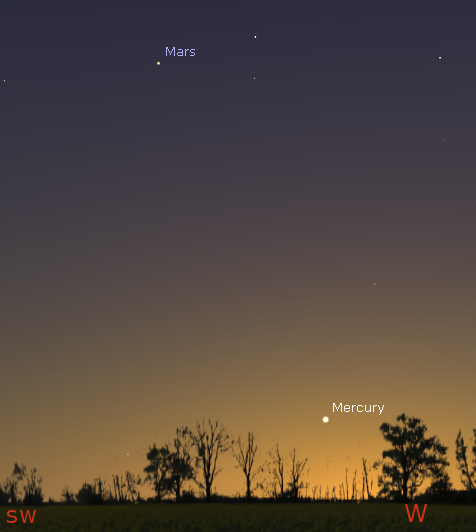
Mars and Mercury at 7 p.m. tonight February 17, 2019. Created using Stellarium.
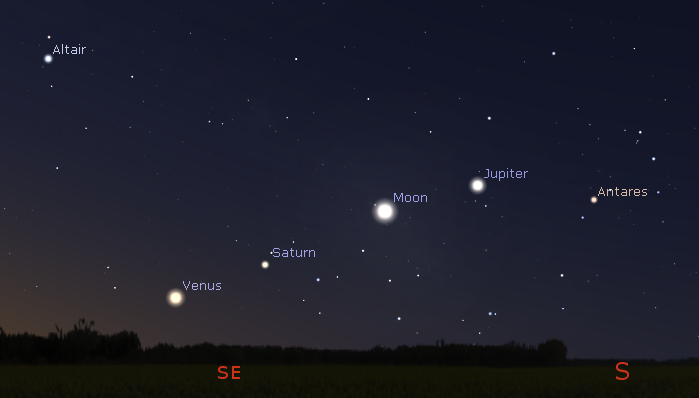
Morning planets and the Moon at 6:30 a.m. Tomorrow February 28, 2019. The actual Moon image is below. Created using Stellarium.
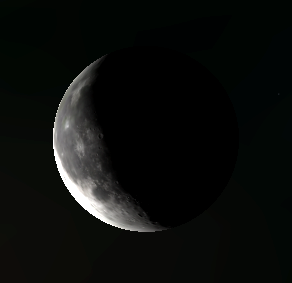
The moon as it might appear in binoculars tomorrow morning, February 28, 2019. Created using Stellarium.
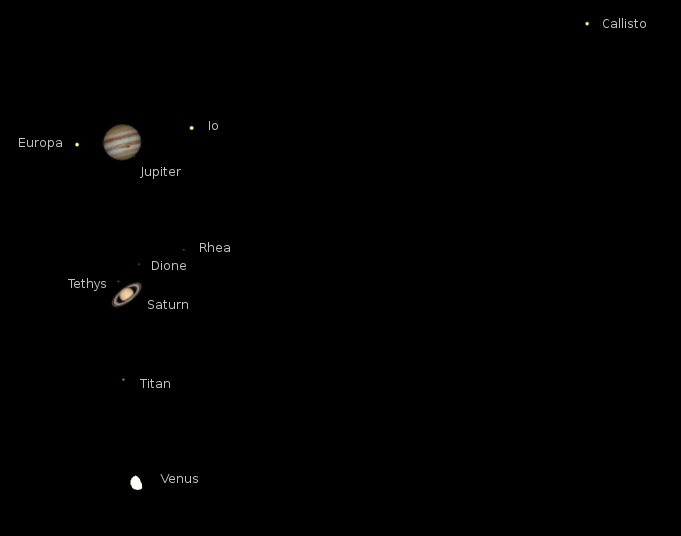
Jupiter, Saturn and Venus with the same magnification at 6:30 a.m. tomorrow morning February 28, 2019. Ganymede is behind Jupiter at that hour. See the table of Jupiter moon events tomorrow morning. Created using Cartes du Ciel (Sky Charts).
| Satellite | Event | Date | UT | EST |
| Ganymede | Eclipse start | 28 Feb 2019 | 06:16 | — |
| Ganymede | Eclipse end | 28 Feb 2019 | 08:21 | 3:21 a.m. |
| Europa | Shadow start | 28 Feb 2019 | 11:09 | 6:09 a.m. |
| Ganymede | Occultation start | 28 Feb 2019 | 11:13 | 6:13 a.m. |
| Ganymede | Occultation end | 28 Feb 2019 | 13:23 | — |
| Europa | Shadow end | 28 Feb 2019 | 13:31 | — |
| Europa | Transit start | 28 Feb 2019 | 13:34 | — |
| Io | Eclipse start | 28 Feb 2019 | 13:42 | — |
| Europa | Transit end | 28 Feb 2019 | 15:58 | — |
| Io | Occultation end | 28 Feb 2019 | 17:06 | — |
Jupiter satellites will have a busy morning. Events with EST times are visible from Northern Michigan. Events with UT only times are visible in other longitudes in the western hemisphere.
Times are provided by the Project Pluto: https://www.projectpluto.com/jevent.htm.
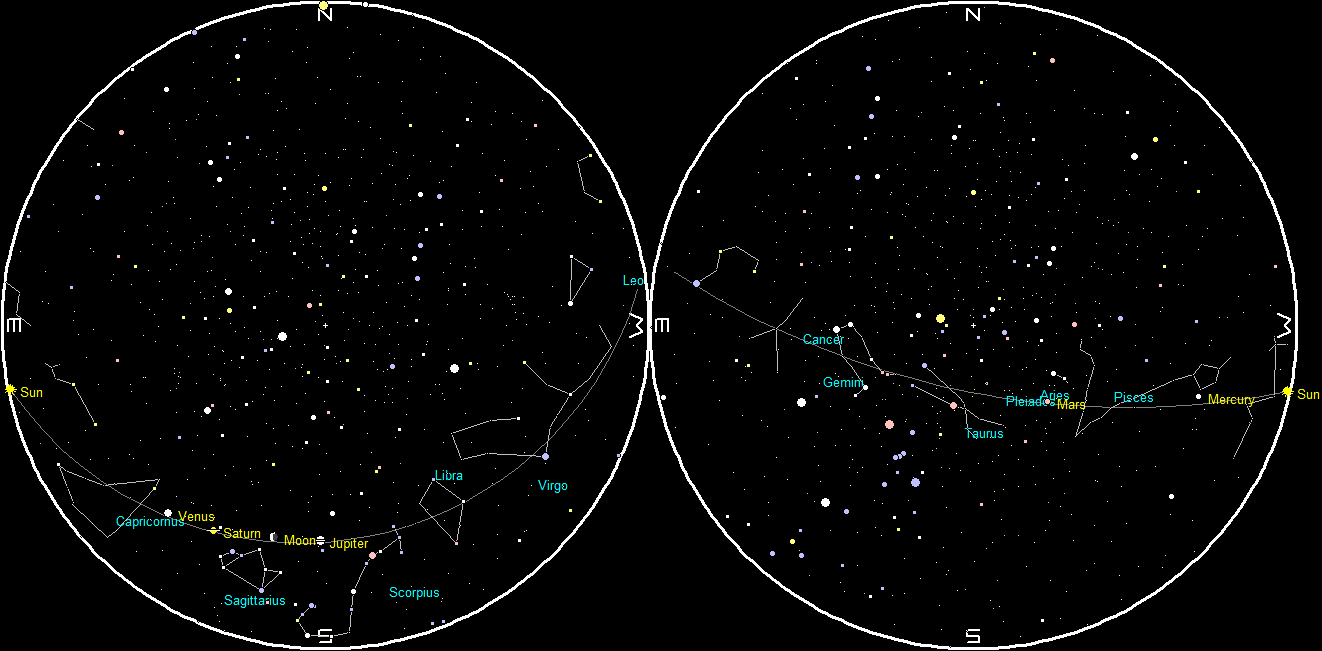
Planets and the Moon at sunset and sunrise of a single night starting with sunset on the right on February 27, 2019. The night ends on the left with sunrise on the 28th. Click on the image to enlarge. Created using my LookingUp program.
02/26/2019 – Ephemeris – Mercury at greatest eastern elongation from the Sun tonight
Ephemeris for Tuesday, February 26th. Today the Sun will be up for 11 hours even, setting at 6:26, and it will rise tomorrow at 7:24. The Moon, at last quarter today, will rise at 2:49 tomorrow morning.
This evening the planet Mercury is at its greatest distance from the Sun to the east by an angle of 18 degrees. It’s called greatest eastern elongation from the Sun. Mercury has a very elliptical orbit of the Sun, and right now it’s near its closest to the Sun called perihelion, of 28.6 million miles (46.1 million km). In late winter and spring the ecliptic, the path in the sky that the planets appear near, meets the horizon at a steep angle near sunset, which allows us to see planets near and east of the Sun more easily. The same is true for the planets west of the Sun in the morning in the fall. Southern hemisphere observers see Mercury best when its is at aphelion, farthest from the Sun, 66 percent farther away.
The times given are for the Traverse City/Interlochen area of Michigan. They may be different for your location.
Addendum
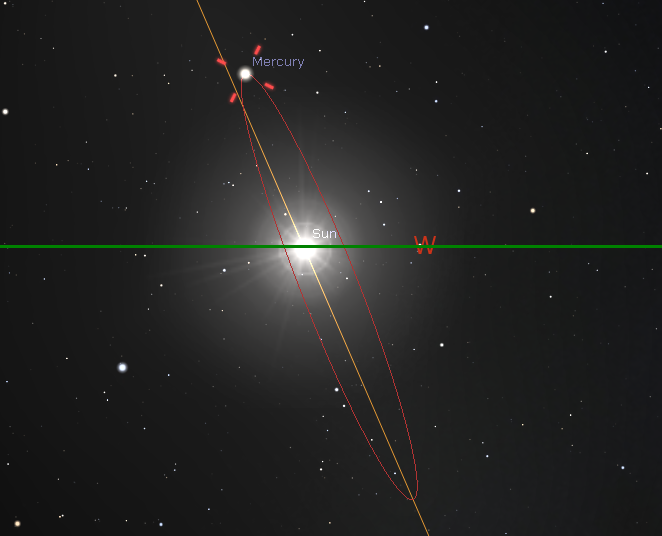
Looking at Mercury at greatest eastern elongation tonight February 26, 2019 from Northern Michigan displaying its orbit with a transparent horizon at sunset. Notice how lopsided the orbit appears, extending farther below the horizon (green line) than above. The yellow line is the ecliptic. Created using Stellarium and GIMP.
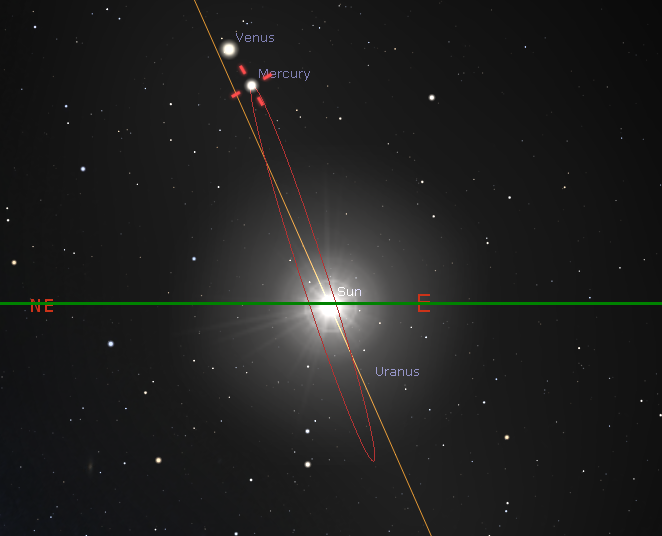
The next greatest elongation of Mercury is the western elongation on April 11, 2019. Here we are looking at it from the southern hemisphere, where it’s autumn displaying its orbit with a transparent horizon at sunrise. Notice how lopsided the orbit appears, extending farther above the horizon (green line) than below. The yellow line is the ecliptic. Created using Stellarium and GIMP.
Note the same is true for both northern and southern hemispheres:
Late winter and spring – planets near and east of the Sun are seen more easily after sunset.
Late summer and autumn – planets near and west of the Sun are seen more easily before sunrise.
02/25/2019 – Ephemeris – Cancer the crab
Ephemeris for Monday, February 25th. Today the Sun will be up for 10 hours and 57 minutes, setting at 6:24, and it will rise tomorrow at 7:25. The Moon, 1 day before last quarter, will rise at 1:46 tomorrow morning.
Between the stars Castor and Pollux in Gemini high in the southeast and the star Regulus in Leo the Lion in the east-southeast lies the dimmest constellation of the zodiac, Cancer the crab. To me its 5 brightest stars make an upside down Y. There’s the stars in the center of the constellation Asellus Borealis and Asellus Australis, the north and south donkeys. There’s a fuzzy spot between and just west of them called Praesepe, the manger. In binoculars it resolves into a cluster of stars called the Beehive cluster. We amateur astronomers also know it as M44, the 44th object on comet hunter Charles Messier’s list of objects that might be mistaken for comets.
The times given are for the Traverse City/Interlochen area of Michigan. They may be different for your location.
Addendum
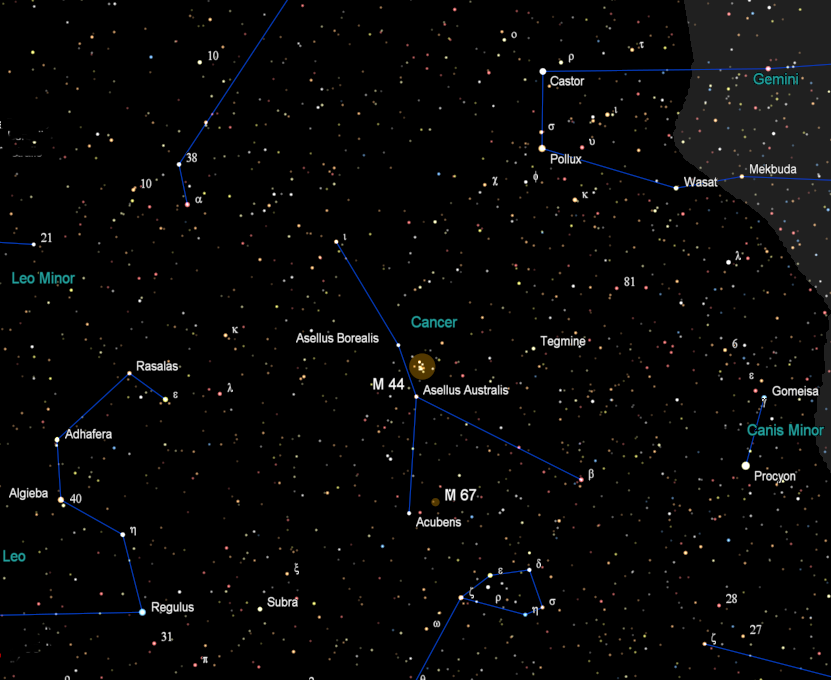
The constellation Cancer finder chart. Click on image to enlarge. Created using Cartes du Ciel (Sky Charts).
02/22/2019 – Ephemeris – Orion is a hard luck hero
Ephemeris for Friday, February 22nd. Today the Sun will be up for 10 hours and 48 minutes, setting at 6:20, and it will rise tomorrow at 7:30. The Moon, 3 days past full, will rise at 10:19 this evening.
We come back to the central constellation of the winter sky Orion the hunter, holding out in the south-southwest at 9 p.m. with his three stars of his belt in a straight line, with his shoulder stars above and knees below. In one Greek story he was killed by the sting of a scorpion so the gods made sure the rising of the constellation Scorpius would chase him out of the sky to the west. To the Greeks he was a hapless hero. Orion is mentioned in the Bible in the book of Job. The name for Orion in Hebrew is Kesil, meaning “Fool”. To the native peoples around the Great Lakes, the stars here are those of the Winter Maker, who stretches his arms from Aldebaran in Taurus to Procyon in Canis Minor. When he rides high the evening sky it is indeed winter.
The times given are for the Traverse City/Interlochen area of Michigan. They may be different for your location.
Addendum
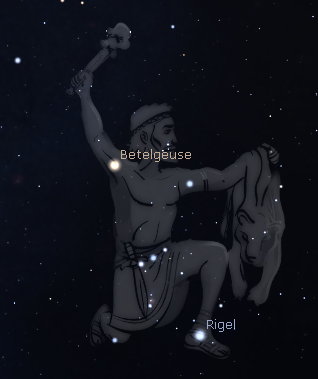
Orion as he is seen tonight at 9 p.m. February 22, 2019. Created using Stellarium.
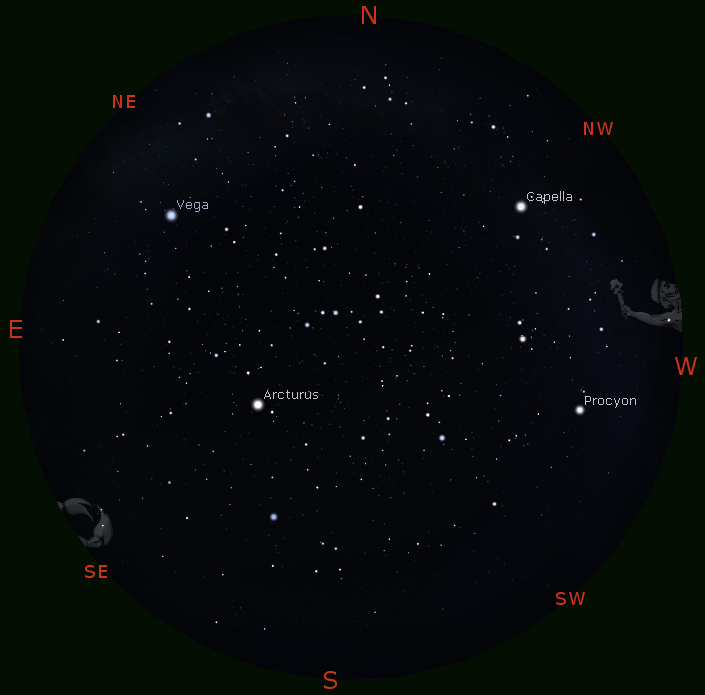
Scorpius, rising in the southeast, chases Orion, setting in the west, from the skies. February 23, at 2:44 a.m. any year.

