Archive
08/21/2014 – Ephemeris – What do a dolphin, an arrow and a coffin have in common?
Ephemeris for Thursday, August 21st. The sun rises at 6:52. It’ll be up for 13 hours and 46 minutes, setting at 8:38. The moon, half way from last quarter to new, will rise at 4:12 tomorrow morning.
Located below the eastern edge of the Summer Triangle of three of the brightest stars in the sky, which is high in the southeast in the sky at 10 p.m., is the tiny constellation of Delphinus the dolphin. Delphinus’ 6 stars in a small parallelogram with a tail, really does look like a dolphin leaping out of the water. The parallelogram itself has the name Job’s Coffin. The origin of this asterism or informal constellation is unknown. Of the dolphin itself: the ancient Greeks appreciated this aquatic mammal as we do, and told stories of dolphins rescuing shipwrecked sailors. There’s another tiny and slender constellation to the right of Delphinus called Sagitta the arrow, which is said to represent Cupid’s dart.
Times are for the Traverse City/Interlochen area of Michigan. They may be different for your location.
Addendum
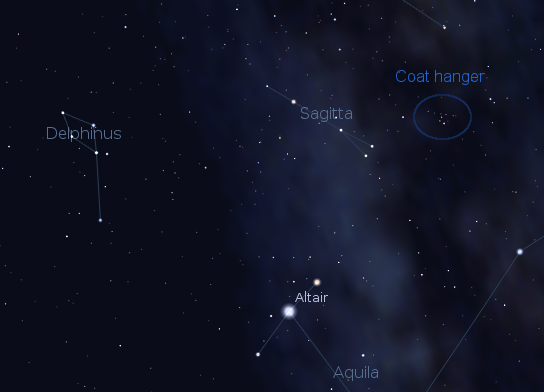
Delphinus, Sagitta and the Coat hanger. Diagram created using Stellarium.
The Coat hanger is strictly a binocular asterism. However it was discovered by the great Arabian astronomer Al Sufi inn the 10th century, and is currently designated Collinder 399. It is actually a random pattern of unrelated stars.
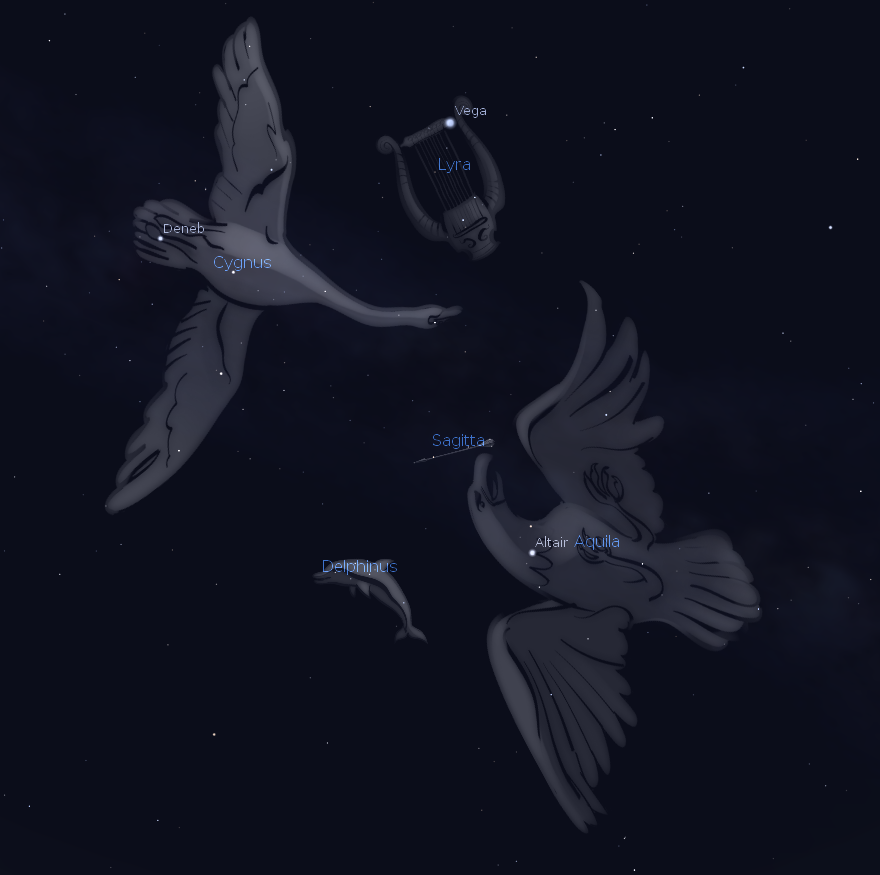
Delphinus and Sagitta images along with the stars and constellations of the Summer Triangle. Created using Stellarium.
08/20/2014 – Ephemeris – Where are the bright planets for this week?
Ephemeris for Wednesday, August 20th. The sun rises at 6:50. It’ll be up for 13 hours and 48 minutes, setting at 8:39. The moon, 3 days past last quarter, will rise at 3:17 tomorrow morning.
Wednesday is bright planet day on Ephemeris. Reddish Mars is on the western edge of Libra the scales, skirting below Saturn in the southwest as darkness falls. It will set at 11:23 p.m. Saturn will be in the southwest, above and left of Mars as darkness falls. It will set at 11:50 p.m. Saturn’s is still great viewing with small or large telescopes to see those fabulous rings and its large moon Titan. Mars will pass Saturn traveling eastward next Wednesday. Brilliant Jupiter will rise in the east-northeast at 5:03 a.m. in morning twilight, followed by the brighter Venus, which will rise 17 minutes later. Jupiter is increasing its distance from the sun, while Venus is retreating toward the Sun from our point of view
Times are for the Traverse City/Interlochen area of Michigan. They may be different for your location.
Addendum
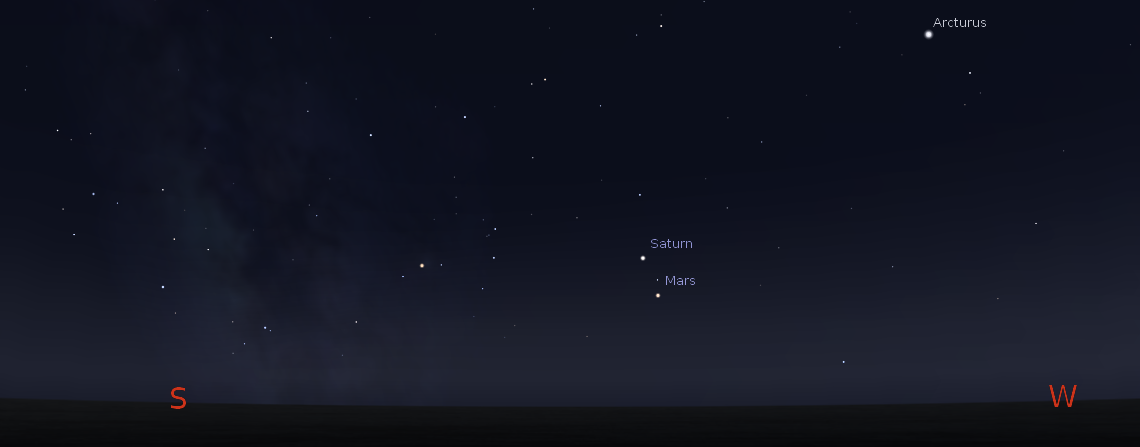
Mars and Saturn with the stars of the zodiac from Virgo to Sagittarius at 10 p.m. August 20, 2014. Created with Stellarium.
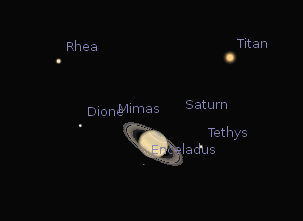
Saturn and moons through a telescope on August 20, 2014. Created using Stellarium.
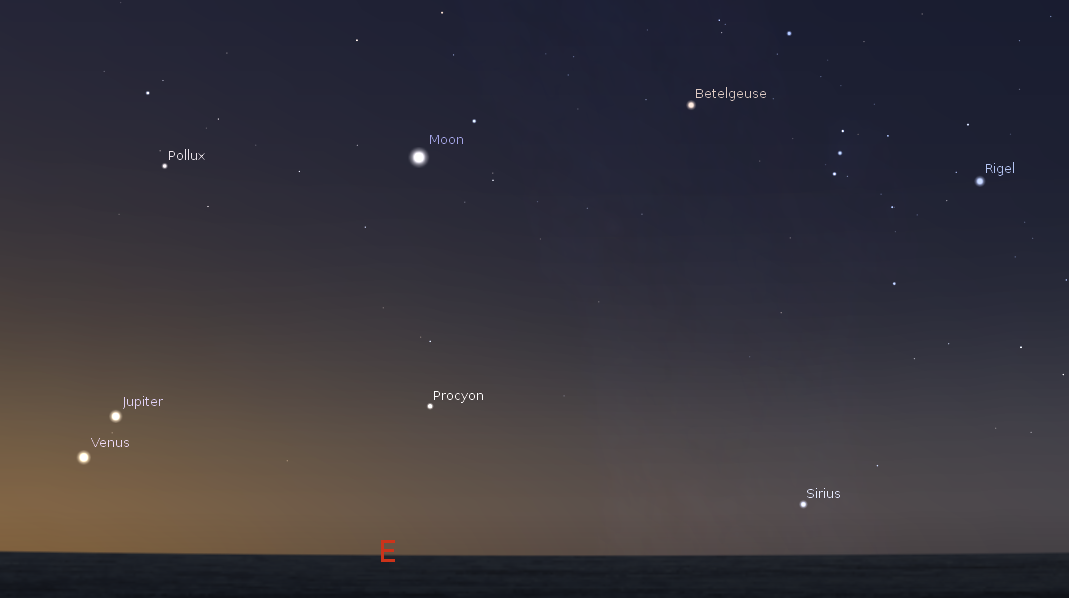
Jupiter, Venus and the Moon and winter stars at 6 a.m. August 21, 2014. Created using Stellarium.
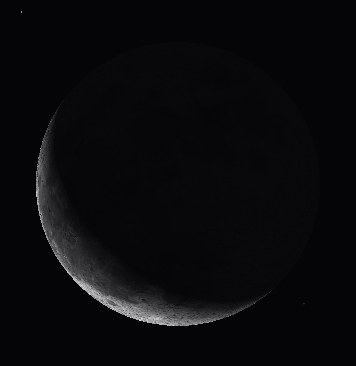
The crescent Moon as seen in binoculars at 6 a.m., August 21, 2014. Created using Stellarium.
08/19/2014 -Ephemeris – Scutum’s place in history
Ephemeris for Tuesday, August 19th. The sun rises at 6:49. It’ll be up for 13 hours and 51 minutes, setting at 8:41. The moon, 2 days past last quarter, will rise at 2:26 tomorrow morning.
Yesterday we took a look at the wonders in the constellation of Scutum the shield above the Teapot of Sagittarius and below Aquila the eagle. Scutum is the shield of John Sobieski the Polish king who stopped the advance of the Turks at Kalenberg in 1683. The Polish half of me is very proud. Scutum is one of two official constellations which are related to a real person. The other one is Coma Berenices, a hank of the Egyptian queen Berenice’s hair. However the stars here are so dim and embedded in the glow of the Milky Way as to be nearly impossible to discern. Scutum lies in one of the richest portions of the Milky Way, wonderful to scan with binoculars and telescopes for star clusters and nebulae or clouds of dust and gas.
Times are for the Traverse City/Interlochen area of Michigan. They may be different for your location.
Addendum
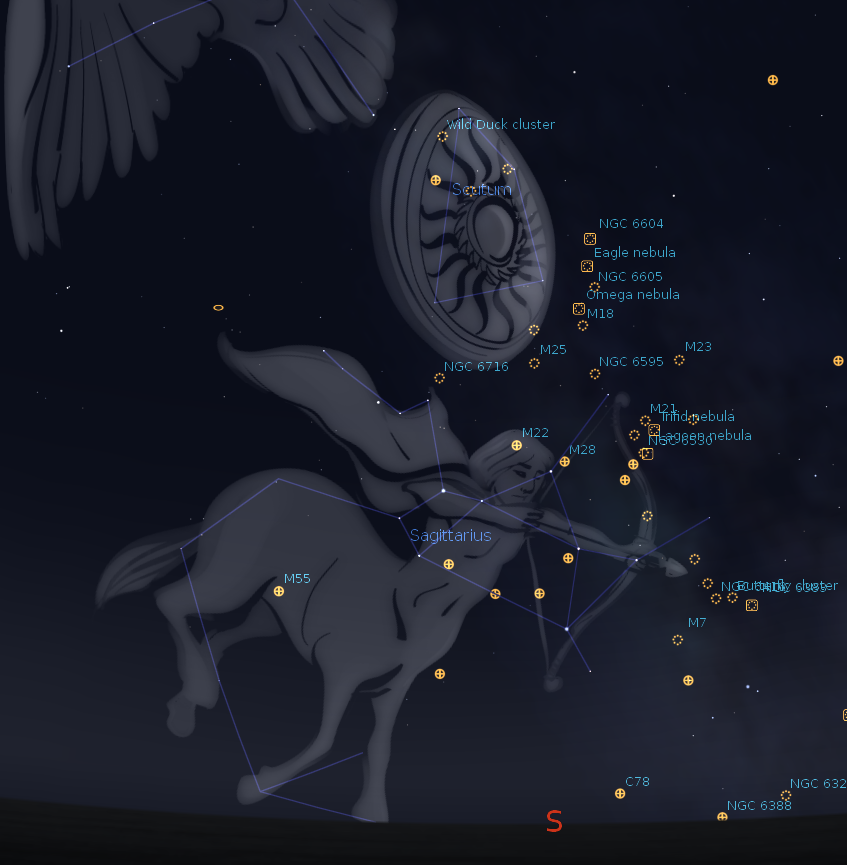
Binocular and telescope deep sky objects in Scutum and Sagittarius. Created using Stellarium.
08/18/2014 – Ephemeris – Scanning the Milky Way in Scutum
Ephemeris for Monday, August 18th. The sun rises at 6:48. It’ll be up for 13 hours and 54 minutes, setting at 8:43. The moon, 1 day past last quarter, will rise at 1:37 tomorrow morning.
The teapot pattern of stars that is the constellation of Sagittarius lies at the southern end of the Milky Way this evening. It appears that the Milky Way is steam rising from the spout. The area above Sagittarius in the brightest part of the Milky Way is the dim constellation of Scutum the shield. Don’t bother looking for the stars that make up the constellation; what’s important is the star clouds of the Milky Way. Scan this area with binoculars or small telescope for star clusters and nebulae or clouds of gas. In binoculars both clusters and nebulae will appear fuzzy, but a small telescope will tell most of them apart. Even if you’ve never been able to find anything in your telescope, use your lowest power and scan.
Times are for the Traverse City/Interlochen area of Michigan. They may be different for your location.
Addendum
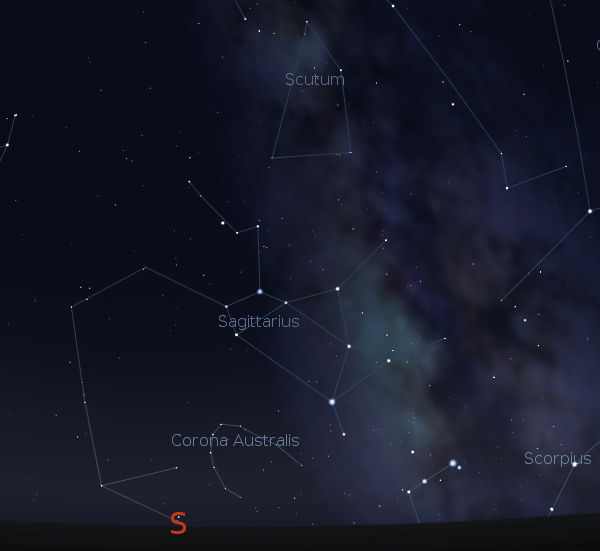
The constellations Sagittarius and Scutum. Created using Stellarium.
08/15/2014 – Ephemeris – Jupiter and Venus will appear to cross paths Monday morning
Ephemeris for Friday, August 15th. The sun rises at 6:45. It’ll be up for 14 hours and 2 minutes, setting at 8:47. The moon, 2 days before last quarter, will rise at 11:33 this evening.
Over this weekend the planets Venus and Jupiter will be seen to approach each other. In reality Jupiter is five times the Earth’s distance behind the sun, while Venus is about 70 percent of Earth’s distance behind the sun. Most of the motion against what stars can be seen after 5:30 a.m. will be Venus, being dragged by the sun plus its own orbital motion toward the east. Jupiter is moving eastward too, but is taking its sweet time of 12 years to orbit the sun. The planets will cross, or be in conjunction at about midnight Monday morning, before they rise. By the time they will rise around 5:12 a.m. the two planets will be half the width of the Moon apart, slightly farther apart than they were at midnight.
Times are for the Traverse City/Interlochen area of Michigan. They may be different for your location.
Addendum
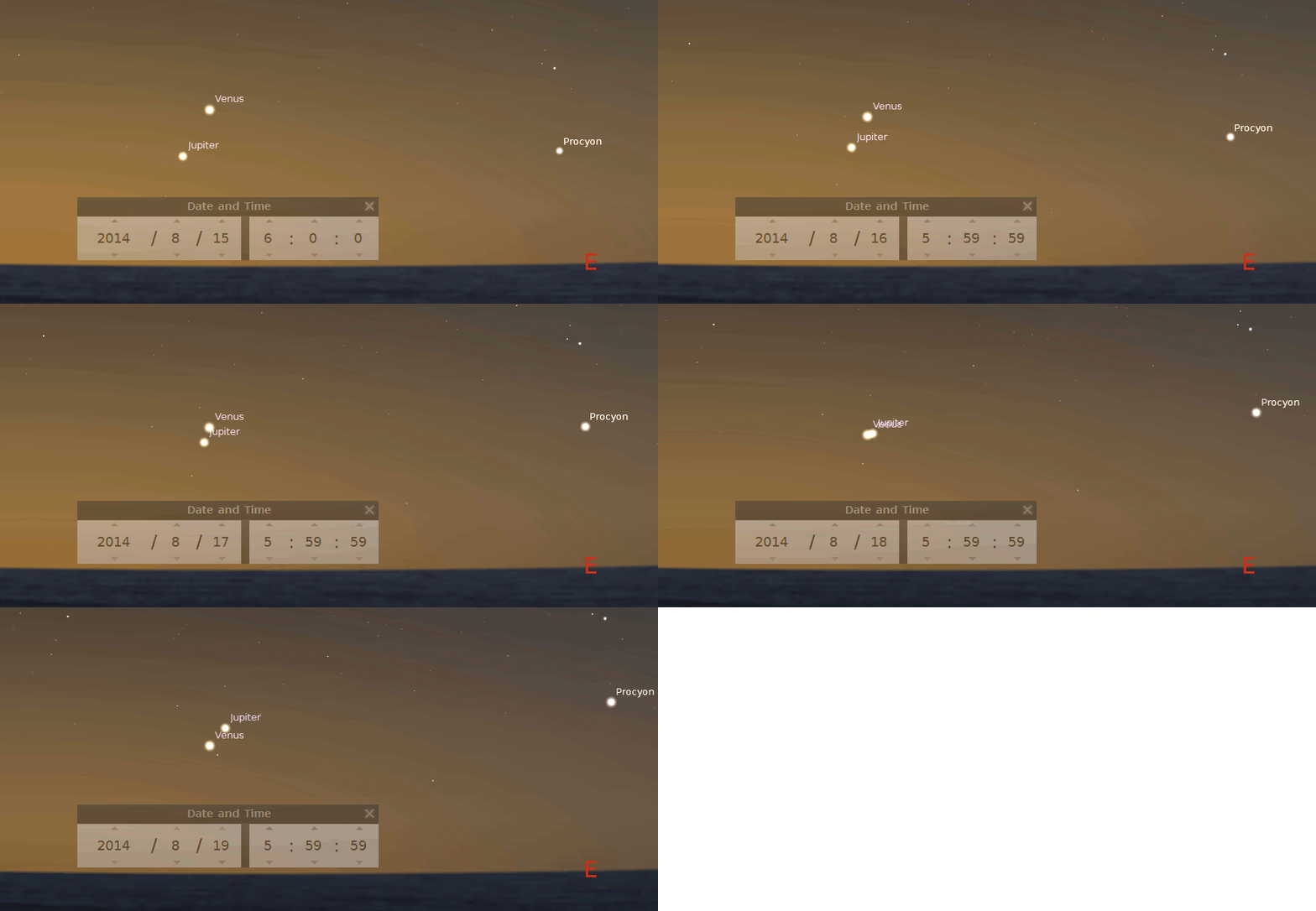
Watch Jupiter and Venus approach each other and separate. From August 15 to August 18, 2018. Created using Stellarium and GIMP.
08/14/2014 – Ephemeris – The Milky Way now spans the sky in the evening
Ephemeris for Thursday, August 14th. The sun rises at 6:43. It’ll be up for 14 hours and 5 minutes, setting at 8:49. The moon, 3 days before last quarter, will rise at 10:58 this evening.
We’ll get a bit of darkness tonight, but it will be the start of about two weeks of the best sky viewing of the year. Now is the time the summer Milky Way is displayed to its fullest to the southern horizon. City folk come to our area and are sometimes fooled by the brightness and expanse of the Milky Way and think it’s clouding up. Yes those are clouds indeed, but they are star clouds. Binoculars will begin to show them to be millions of stars, each too faint to be seen by themselves to the unaided eye, but whose combined glow give the impression of a luminous cloud. Binoculars are the ideal tool to begin to explore the Milky Way. Objects still too fuzzy can be checked out with a telescope to reveal their true nature.
Times are for the Traverse City/Interlochen area of Michigan. They may be different for your location.
Addendum
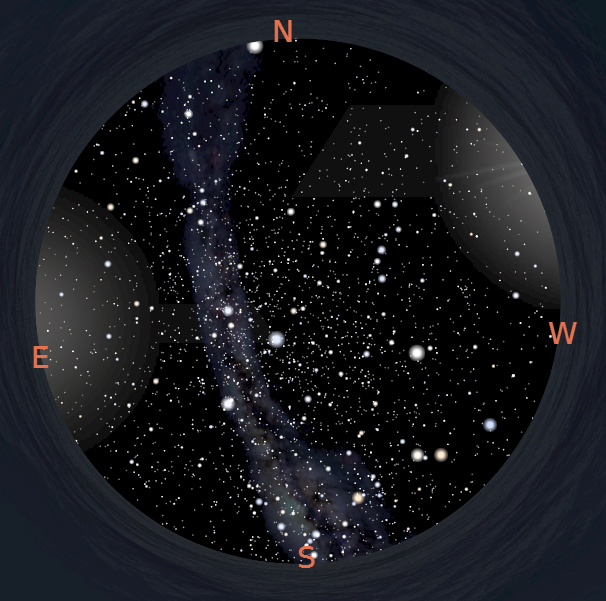
The Milky Way at 10 p.m. on August 14, 2014. Residual glow in the west is from the Sun, to the east is for the Soon to rise Moon. There is also an odd artifact connected to the solar glow. Created using Stellarium.
08/13/2014 – Ephemeris – This week’s parade of the bright planets
Ephemeris for Wednesday, August 13th. The sun rises at 6:42. It’ll be up for 14 hours and 8 minutes, setting at 8:51. The moon, 3 days past full, will rise at 10:24 this evening.
Wednesday is bright planet day on Ephemeris. Reddish Mars is between the constellations of Virgo and Libra, approaching Saturn in the southwest as darkness falls. It will set at 11:40 p.m. Saturn will be in the southwest, above and left of Mars as darkness falls, in the Libra the scales. It will set at 12:16 a.m. Saturn’s is still great viewing with small or large telescopes to see those fabulous rings and its large moon Titan. Mars will pass Saturn traveling eastward later this month on the 27th. Brilliant Venus will rise in the east-northeast at 5:03 a.m. in morning twilight. Below left of Venus, we welcome back Jupiter which will rise at 5:23 tomorrow morning. Jupiter and Venus will appear to cross paths on the 18th.
Times are for the Traverse City/Interlochen area of Michigan. They may be different for your location.
Addendum
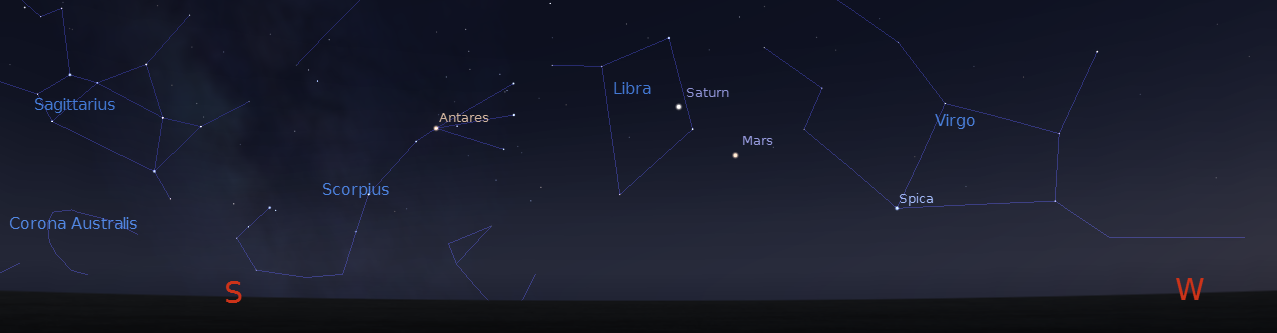
Mars and Saturn with the zodiacal constellations Virgo, Libra, Scorpius and Sagittarius at 10 p.m. August 13, 2014. Created using Stellarium.
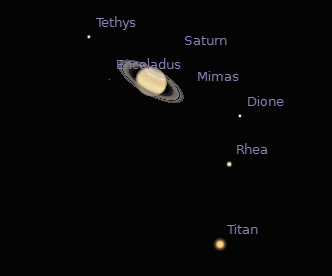
Saturn and its moons. Small telescopes will reveal only Saturn and Titan. Created using Stellarium.
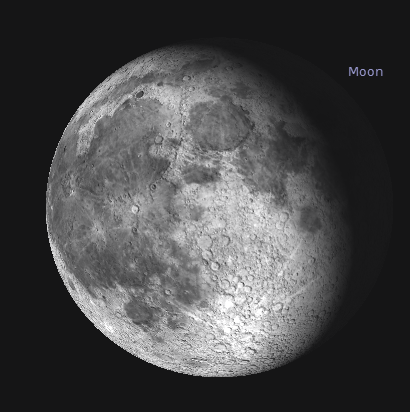
The Moon low in the east at 11 p.m. Created using Stellarium.
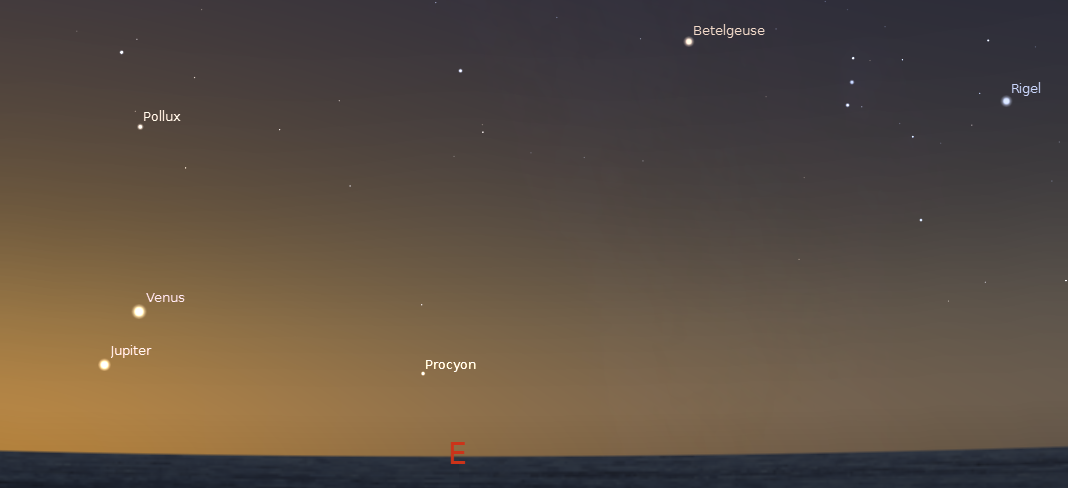
Venus and Jupiter at 6 a.m. in the bright morning twilight with the rising stars of winter. Created using Stellarium.
08/12/2014 – Ephemeris – Comet Swift-Tuttle progenitor of the Perseid meteors
Ephemeris for Tuesday, August 12th. The sun rises at 6:41. It’ll be up for 14 hours and 11 minutes, setting at 8:52. The moon, 2 days past full, will rise at 9:50 this evening.
The Perseid meteor shower will reach its peak later this evening. The moon will still interfere with all but the brightest meteors. The meteors are caused by bits of sand grain to pea sized rubble given off by Comet Swift-Tuttle on past runs through the inner solar system. As comets go Comet Swift-Tuttle is large, with a nucleus of some 16 miles (26 km) in diameter. Comet Halley’s nucleus is half that and Churyumov–Gerasimenko’s nucleus that ESA’s Rosetta spacecraft is now orbiting is half Halley’s. Despite the wear and tear that a comet’s nucleus must endure when coming close to the Sun, the distribution of debris to give us a pretty even annual meteor shower means the comet has been near its present orbit for a very long time.
Times are for the Traverse City/Interlochen area of Michigan. They may be different for your location.
Addendum
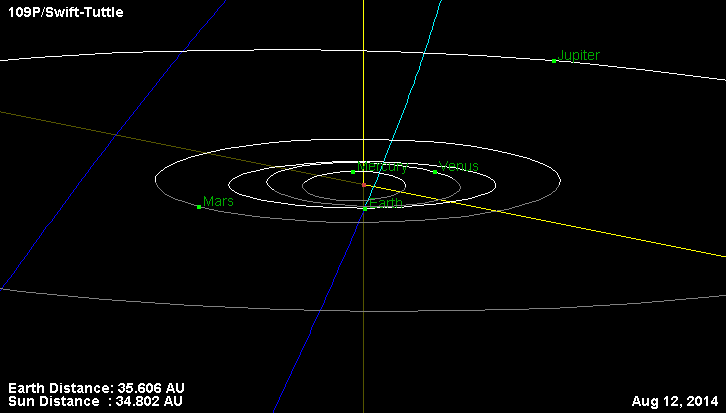
Orbit of Comet 109P/Swift-Tuttle. Blue line is the comet’s orbit, coming from above. Credit NASA / JPL / Applet by Osamu Ajiki (AstroArts), and further modified by Ron Baalke (JPL)
Link to the animation from which the above image was taken and other information on Comet Swift-Tuttle go to http://ssd.jpl.nasa.gov/sbdb.cgi?sstr=109P;cad=1
08/11/2014 – Ephemeris – The Moon’s terminator is now the sunset line
Ephemeris for Monday, August 11th. The sun rises at 6:40. It’ll be up for 14 hours and 13 minutes, setting at 8:54. The moon, 1 day past full, will rise at 9:15 this evening.
After the full moon the shadow action moves from the eastern or left edge of the moon to the western or right edge of the moon, or if the moon’s low in the east, to the upper right edge. For the first two weeks of the lunar cycle, from new to full we were watching the sunrise terminator slowly sweep across the face of moon. Now, after full the sunrise terminator is sweeping across the Moon’s far side, and the sunset terminator is beginning to sweep across the near side, our side of the Moon. Tonight the terminator is approaching the small Sea of Crises on the upper right of the Moon. By tomorrow night the terminator will be half way across that sea. By Wednesday it will be lights out for the Sea of Crises for two weeks.
Times are for the Traverse City/Interlochen area of Michigan. They may be different for your location.
Addendum
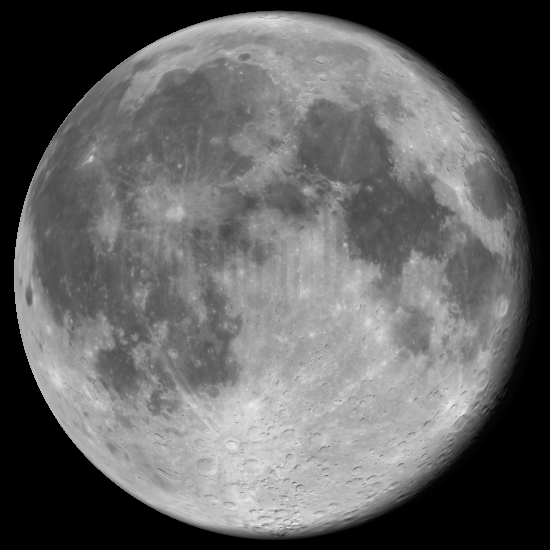
The moon at 10 p.m. tonight, August 11, 2014. Created using Virtual Moon Atlas.
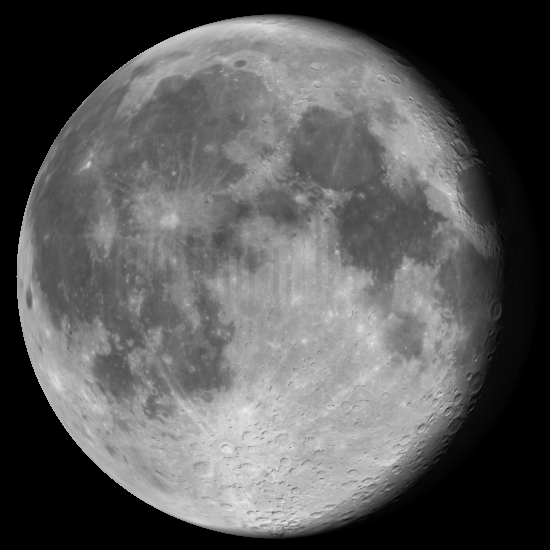
The moon at 10 p.m. tomorrow night, August 12, 2014. Created using Virtual Moon Atlas.
Supermoon, Smoopermoon
Pardon me if I don’t get excited by the fact that we are going to have a “supermoon” August 10th. On the night of the full moon it will be at perigee, its closest point to the Earth in its orbit. The distance according to our Celestial Calendar page is 356,897 kilometers. That’s 221,766 miles. At apogee this month, on the 24th, the moon will be 406,523 kilometers, or 252,602 miles away. That’s somewhat larger than 11 percent difference in distance, due to the Moon’s elliptical orbit. The name for the smallest moon is micromoon. Either is an exaggeration of terms.
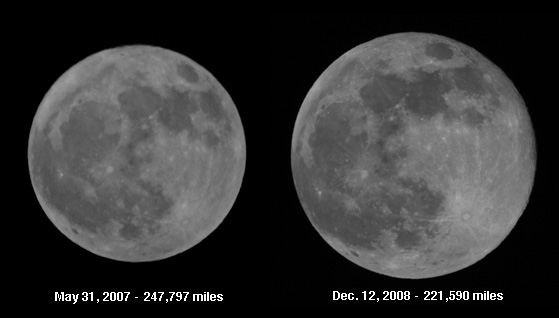
A supoermoon compared to a micromoon. Credit: Michael Myers.
I don’t remember the supermoon term growing up. Wikipedia says it was coined by astrologer Richard Knolle in 1979 according to his web post from 2011. Oooo, an astrologer.
There’s a profession astronomers can respect. </snark>*
Being a relatively old guy, 1979 was well past my formative years as an amateur astronomer and even four years after I started producing my Ephemeris programs for Interlochen Public Radio. Yet I only remember supermoon being a big deal or any deal at all for the last few years.
The actual size of the supermoon aside, folks mistake the normal optical illusion of an enlarged moon rising as the supermoon. The moon always looks larger when it’s near the horizon than when it’s high in the sky. The same thing happens to the sun, it looks larger rising and setting, the when higher in the sky. Caution: Use a solar filter to observe the sun. In photographs the Moon is the same size whether on the horizon or high in the sky. Actually the horizon moon will appear slightly smaller on the horizon. One, it will be squished vertically by the action of the refraction of the earth’s atmosphere. Two, it is nearly 4,000 miles farther away at the horizon than at he zenith, where we’re the radius of the Earth closer to the Moon.
I challenge anyone to be able to actually detect, by looking at the moon in the sky, whether they are looking at a supermoon or not. There’s nothing of comparable size out there. The same thing will happen when one thinks the full moon is so white. OK, there’s some gray too. However the Moon’s total albedo of reflectance is 0.136 or 13.6%. Some say 0.07 or 7%, comparable to a charcoal briquette. If one could get Saturn’s moon Enceladus, with nearly a 100% albedo, next to the Moon without it turning into a comet by sublimating away, the dinginess of our Moon would be immediately obvious.

