Archive
08/08/2014 – Ephemeris – Supermoon plus astronomical fun in the Grand Traverse Area
Ephemeris for Friday, August 8th. The sun rises at 6:36. It’ll be up for 14 hours and 21 minutes, setting at 8:58. The moon, 2 days before full, will set at 5:17 tomorrow morning.
In two days the Moon will reach perigee within a few hours of being a full moon. This has become known as a supermoon. Perigee is the point where an Earth orbiting object is closest to the Earth. The farthest point is called apogee. The coincidence of full moon and perigee was coined as the supermoon by astrologer Richard Knolle in 1979, but apparently didn’t catch on until he wrote a popular article in 2011. No wonder I hadn’t heard of it, this program had been on for 4 years before the term was even coined. The problem with appreciating the supermoon is the lack of a reference of nearly the same size. The moon always looks large when it’s near the horizon. It’s a well-known optical illusion, It’ll fool us every time.
Times are for the Traverse City/Interlochen area of Michigan. They may be different for your location.
Addendum
Saturday evening the 9th the Grand Traverse Astronomical Society (GTAS) will host a Sun and Star Party at Thoreson Farm at the Sleeping Bear Dunes National Lakeshore. It’s the concluding event at the Port Oneida Fair. Solar viewing will be from 4 to 6 p.m., and the evening event will run from 9 to 11 p.m. with the main attraction will be the nearly full Moon, the planet Saturn and colorful binary stars and bright star clusters. Thoreson Farm is located on South Thoreson Road. South Thoreson Road runs into M22, about a mile west of Port Oneida Road.
Sunday evening the 10th the GTAS will attend the Meteors and S’mores event at the Leelanau State Park at the tip of the Leelanau Peninsula. The event will run from 8:30 p.m. to 11:45 p.m. The Perseid meteor shower will reach peak a couple of days later, but there will still bright Perseids visible to the vigilant.
I’ll have more to say about the supermoon tomorrow in a non-Ephemeris post.
08/07/2014 – Ephemeris – Two large craters of the lunar highlands visible tonight
Ephemeris for Thursday, August 7th. The sun rises at 6:35. It’ll be up for 14 hours and 24 minutes, setting at 8:59. The moon, 3 days before full, will set at 4:07 tomorrow morning.
The gibbous Moon is getting brighter as it becomes more sunlit from the Earth’s prospective. The disk of the Moon will be 89 percent illuminated by the sun tonight. The bright crater Aristarchus, which I’ve talked about before, on the upper left of the moon is now in sunlight. On the lower left there are two interesting craters for the small telescope. Split in half by the sunrise line terminator is the large crater Schickard 137 miles (227 km) in diameter. Craters near the limb of the Moon are foreshortened by the fact that the Moon’s nearly spherical so they there appear elongated. One, more elongated than most, is nearby Schiller which is actually 108 by 43 miles (179 by 69 km), which may be two overlapping craters or a really low angle asteroid impact.
Times are for the Traverse City/Interlochen area of Michigan. They may be different for your location.
Addendum
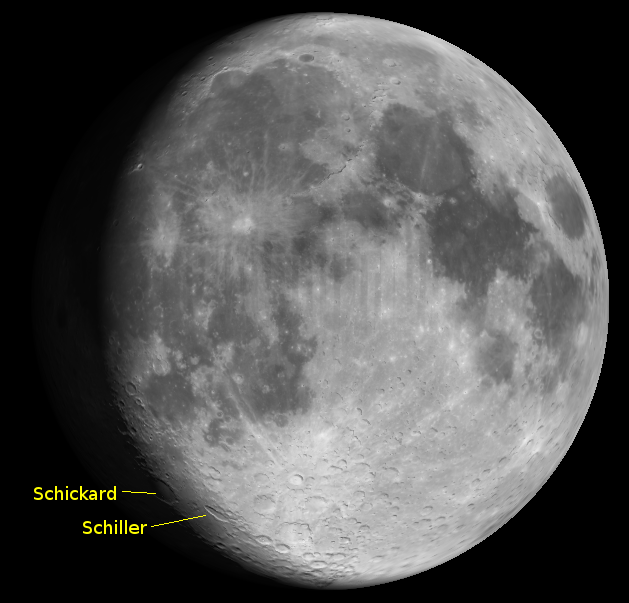
The lunar craters Schickard and Schiller on the lunar terminator at 10 p..m., August 7, 2014. Created using Virtual Moon Atlas.
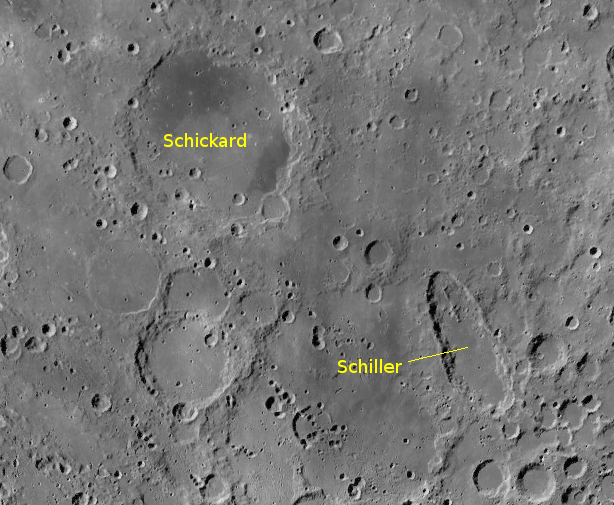
The craters Schickard and Schiller from the Lunar Reconnaissance Orbiter. Credit NASA from Virtual Moon Atlas.
08/06/2014 – Ephemeris – Wednesday is bright planet day on Ephemeris
Ephemeris for Wednesday, August 6th. The sun rises at 6:34. It’ll be up for 14 hours and 26 minutes, setting at 9:01. The moon, 3 days past first quarter, will set at 3:03 tomorrow morning. | Wednesday is bright planet day on Ephemeris. Reddish Mars is in Virgo in the southwest as darkness falls. It’s 113 million miles (183 million km) away now, over twice as far as it was last April, and will set at 11:58 p.m. Saturn will be low in the south-southwest as darkness falls, in the faint constellation of Libra the scales. It will set at 12:43 a.m. Saturn’s great viewing with small or large telescopes to see those fabulous rings and its large moon Titan. Somewhat larger telescopes can spot some smaller moons closer in. Brilliant Venus will rise in the east northeast at 4:47 a.m. in morning twilight. Dark skies for the Perseid meteor shower will run from 3:03 a.m. to 4:34 a.m. Bright meteors will be visible all night.
Times are for the Traverse City/Interlochen area of Michigan. They may be different for your location.
Addendum
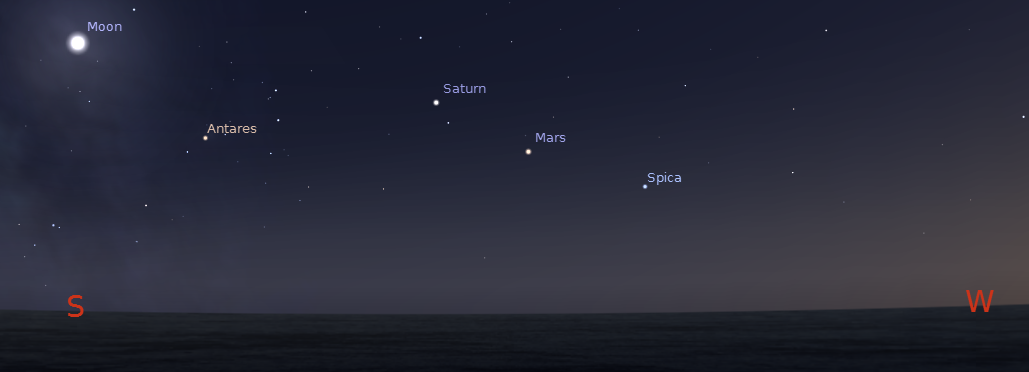
The planets Mars and Saturn with the bright stars and the Moon at 10 p.m., August 6, 2014. Created using Stellarium.
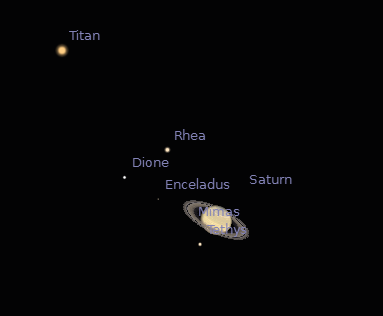
Saturn and its satellites through a telescope as seen on the evening of August 6, 2014. Created using Stellarium.
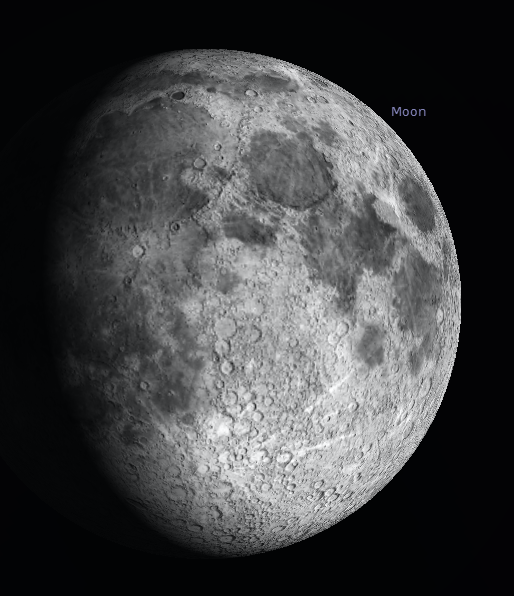
The Moon as it would be seen in binoculars at 10 p.m. , August 7, 2014. Created using Stellarium.
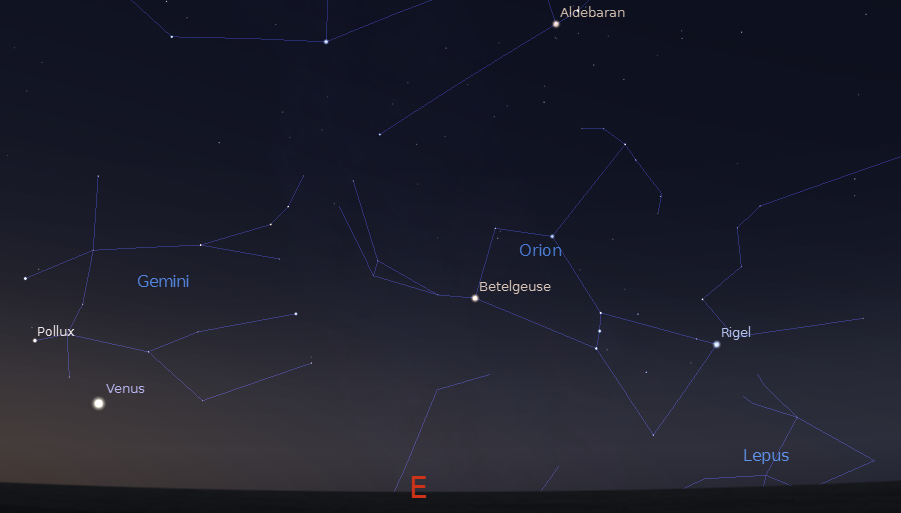
Venus and the constellations of winter rising in morning twilight at 5:30 a.m., August 7, 2014.
08/05/2014 – Ephemeris – The gibbous Moon and the Perseid meteors
Ephemeris for Tuesday, August 5th. The sun rises at 6:33. It’ll be up for 14 hours and 29 minutes, setting at 9:02. The moon, 2 days past first quarter, will set at 2:07 tomorrow morning.
As the moon moves around the Earth, its illuminated fraction gets greater since it’s now moving around to be opposite the sun in the sky which it will reach in 5 days, the full moon. Tonight the face of the moon we see is 71 percent illuminated by the sun. Anytime the moon is between 50 and 100 percent illuminated by the Sun we call a gibbous moon. The word gibbous means hump-backed, and lets face it, the Moon looks cooler when it’s a crescent. If you’re interested in the growing Perseid meteor shower and want to see it in dark skies, the hours of darkness will be restricted tonight to between moon set at 2:07 a.m. and the beginning of astronomical twilight at 4:32 a.m., though you can push it to 5 a.m. before the twilight becomes objectionable.
Times are for the Traverse City/Interlochen area of Michigan. They may be different for your location.
Addendum
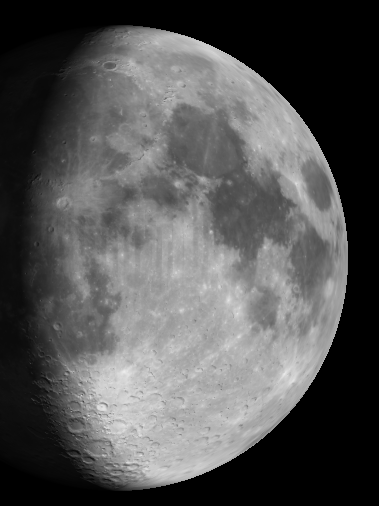
The gibbous Moon tonight (August 5, 2014). Created using Virtual Moon Atlas.
08/04/2014 – Ephemeris – The Moon’s remarkable crater Clavius
Ephemeris for Monday, August 4th. The sun rises at 6:32. It’ll be up for 14 hours and 31 minutes, setting at 9:03. The moon, 1 day past first quarter, will set at 1:20 tomorrow morning.
Let’s take a look at the Moon tonight. The south end of the moon is bright part, the lunar highlands, the oldest terrain on the Moon. A huge crater is visible that just came into sunlight. It is the crater Clavius. It’s visible in binoculars, but it is best seen in a telescope with enough magnification so the moon more than fills the field of view. Clavius has four small craters on its floor in a slight arc, in descending order of size. Clavius itself is 136 miles (225 km) in diameter. It has a flat floor, but it’s large enough to be convex following the curvature of the Moon, a fact that can be seen when Clavius is close to the terminator as it will be tonight. It is another one of my favorite lunar features.
Times are for the Traverse City/Interlochen area of Michigan. They may be different for your location.
Addendum
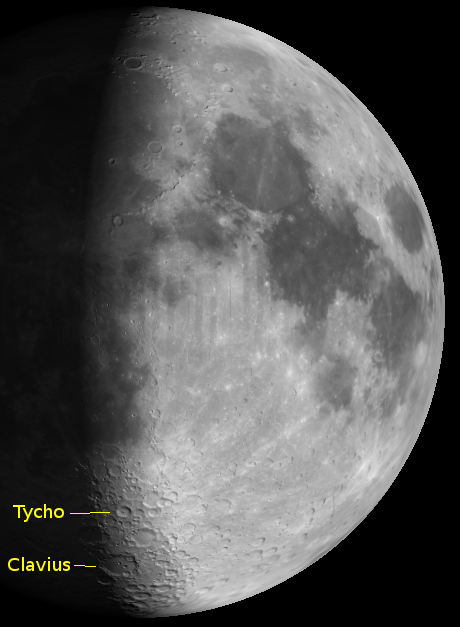
The Moon highlighting the craters Clavius and Tycho for 10 p.m. August 4, 2014. Created using Virtual Moon Atlas.
A note: For science fiction fans in the book and movie 2001 a Space Odyssey by Arthur C. Clarke the U.S. Moon Base was located in the crater Clavius, and the lunar monolith, designated TMA-1 (Tycho Magnetic Anomaly 1) in surveys, was located in the nearby crater Tycho.
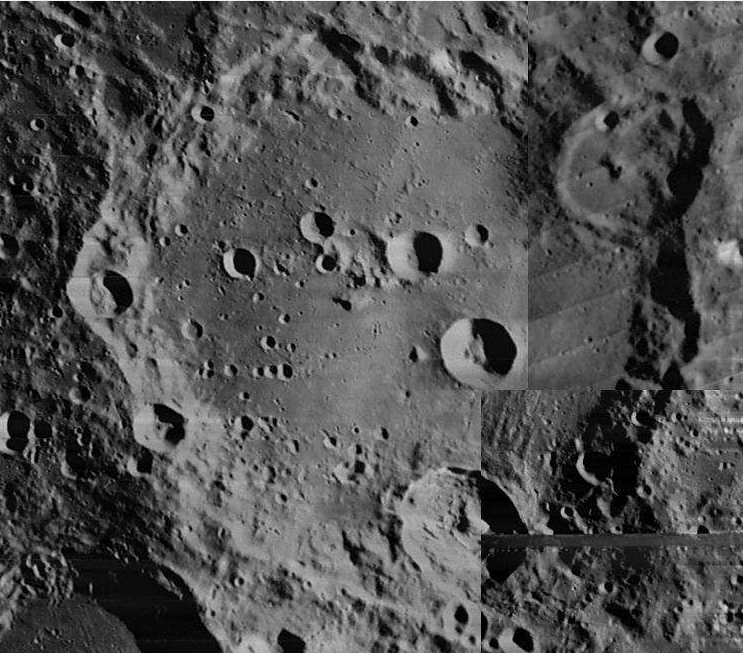
Clavius as photographed by one of the Lunar Orbiter spacecraft in the 1960s. From Digital Lunar Orbital Photographic Atlas. Credit Jeff Gillis, Lunar and Planetary Institute.
08/01/2014 – Ephemeris – There’s a star party tonight
Ephemeris for Friday, August 1st. The sun rises at 6:28. It’ll be up for 14 hours and 38 minutes, setting at 9:07. The moon, 2 days before first quarter, will set at 11:35 this evening.
Tonight the Grand Traverse Astronomical Society will host a star party at Northwestern Michigan College’s Rogers Observatory from 9 to 11 p.m. If it’s clear the planets Mars and Saturn and the Moon will be the featured attractions. Saturn’s rings are always a fabulous sight. Try to see the circular gap in the rings called Cassini division. Cassini is also the namesake of the spacecraft that has spent 10 years orbiting the planet. The moon Titan can also be easily seen. It’s a world larger than Mercury, has an atmosphere denser than the Earth’s and has lakes of liquid methane and ethane at its poles. Our Moon is two-thirds the diameter of Titan, and essentially airless, which allows us to see its features easily.
Times are for the Traverse City/Interlochen area of Michigan. They may be different for your location.
07/31/2014 – Ephemeris – Previewing August skies
Ephemeris for Thursday, July 31st. The sun rises at 6:27. It’ll be up for 14 hours and 41 minutes, setting at 9:09. The moon, 3 days before first quarter, will set at 11:07 this evening.
Let’s look ahead at the month of August in the skies. Daylight hours will decrease from 14 hours and 38 minutes tomorrow to 13 hours 16 minutes on the 31st. The altitude of the sun at local noon, that is degrees of angle above the horizon will decrease from 63 degrees tomorrow to just over 53 degrees on the 31st. Straits area listeners can subtract one more degree from those angles. Local noon, when the sun is due south, is about 1:43 p.m. The Perseid meteor shower will reach its peak on the morning of the 13th. All but the brightest meteors will be lost in the bright moonlight. Until then look for the meteors after the moon sets. That radiant point, where the meteors will seem to come from, will be in the northeastern sky.
Times are for the Traverse City/Interlochen area of Michigan. They may be different for your location.
Addendum
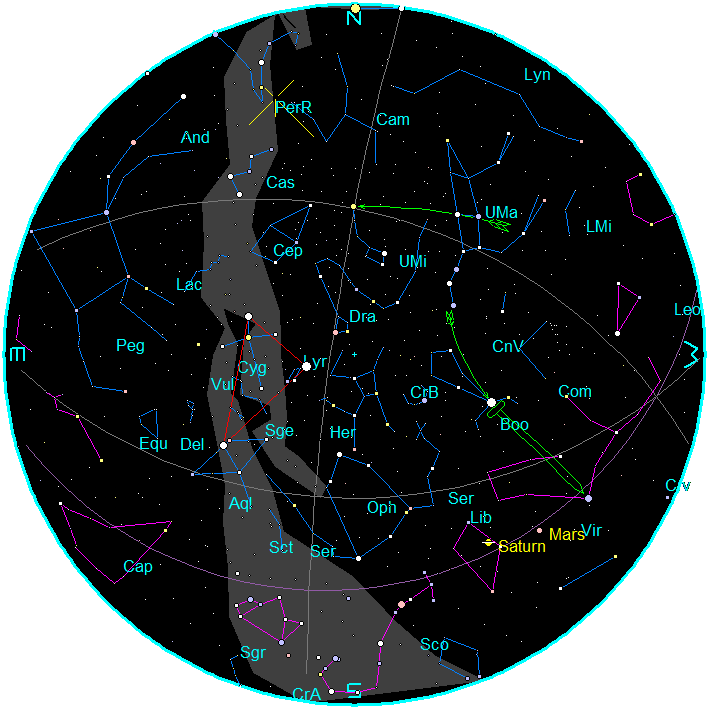
August star chart for 10 p.m. on August 15, 2014. Created by my LookingUp program.
The Moon is not plotted. The planets are plotted for the 15th. Mars will move eastward through the month and will approach Saturn.
Astronomical twilight ends at 11:11 p.m. on August 1st, decreasing to 10:05 on the 31st.
Add a half hour to every week before the 15th and subtract and hour for every week after the 15th.
For a list of constellation names to go with the abbreviations click here.
Also shown is the Summer Triangle in red. Clockwise from the top star is Deneb in Cygnus, Vega in Lyra and Altair in Aquila.
The yellow radiant marked PerR is the radiant for the Perseid meteor shower.
The green pointers from the Big Dipper are:
- Pointer stars at the front of the bowl of the Big Dipper point to Polaris the North Star.
- The arc of the dipper’s handle points to Arcturus.
- The straighten the ark to a spike to point to Spica.
07/30/2014 – Ephemeris – Wednesday is classic planet day on Ephemeris
Ephemeris for Wednesday, July 30th. The sun rises at 6:26. It’ll be up for 14 hours and 43 minutes, setting at 9:10. The moon, half way from new to first quarter, will set at 10:40 this evening.
It’s Wednesday and once again time to look at the bright planets for this week. Reddish Mars is in Virgo in the southwest as darkness falls. It’s 109 million miles (176 million km) away now, over twice as far as it was last April, and will set at 12:17 a.m. Saturn will be low in the south-southwest as darkness falls, in the faint constellation of Libra the scales. It will set at 1:11 a.m. Saturn’s in perfect position for viewing with a small or large telescopes to see those fabulous rings and its large moon Titan. Somewhat larger telescopes can spot some smaller moons closer in. Brilliant Venus will rise in the east northeast
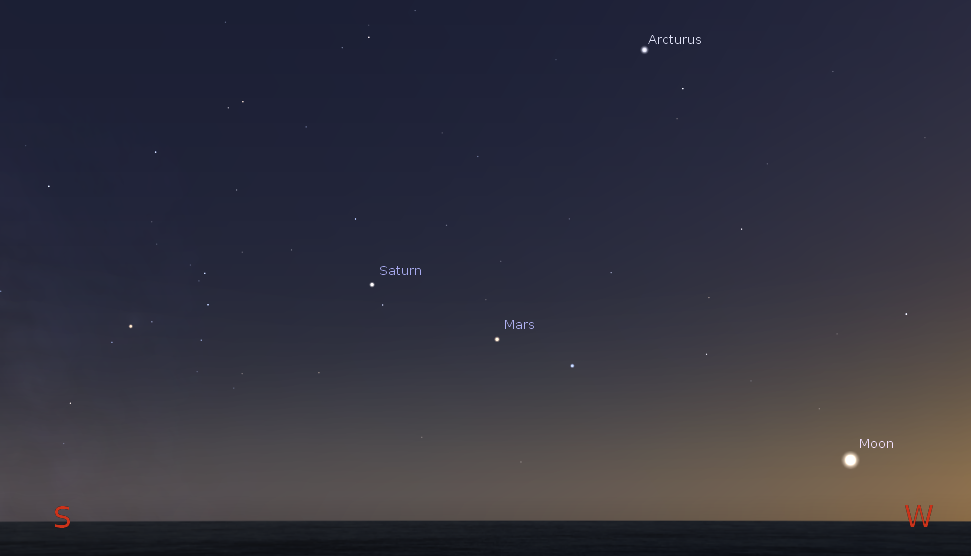
The Moon, Mars and Saturn at 10 p.m. on July 30, 2014. The bright star right of Mars is Spica, and the bright star left of Saturn is Antares. Created using Stellarium.
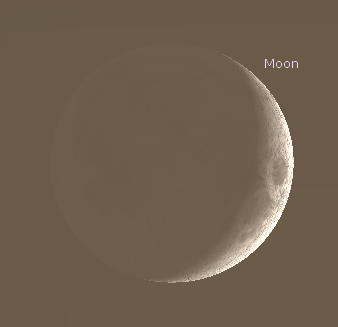
The Moon as seen in binoculars at 10 p.m. on July 30, 2014. Created using Stellarium.
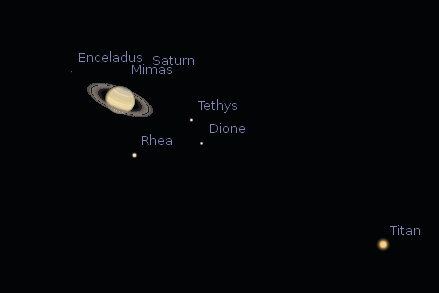
Saturn and its moons on the evening of July 30, 2014. Created using Stellarium.
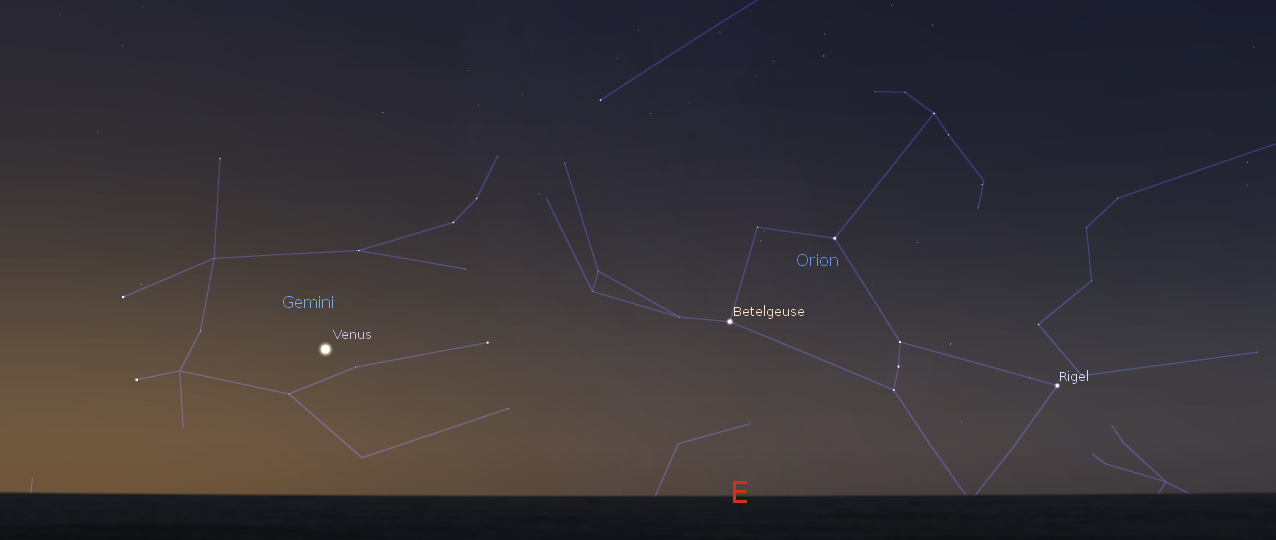
Venus and the winter constellations rising at 5:30 a.m. on July 31, 2014. Created using Stellarium.
at 4:33 a.m. in morning twilight. Mercury will rise at 5:36 and be nearly impossible to spot below Venus.
Times are for the Traverse City/Interlochen area of Michigan. They may be different for your location.
Addendum
07/29/2014 – Ephemeris – The celestial Teapot
Ephemeris for Tuesday, July 29th. The sun rises at 6:25. It’ll be up for 14 hours and 45 minutes, setting at 9:11. The moon, 3 days past new, will set at 10:14 this evening.
The Milky Way runs from north to south through the heavens at 11 p.m. You’ll notice that the Milky Way is brighter and broader just above the horizon in the south. In that glow in the south is a star pattern that looks like a stout little teapot, with a bright stream of the Milky Way rising from the spout, which faces the west. This pattern of stars is the major part of the constellation called Sagittarius. According to Greek mythology Sagittarius is a centaur with a bow and arrow poised to shoot Scorpius the scorpion to the right. This centaur is called Chiron, the most learned of the breed, centaurs usually being a rowdy bunch. The center of the pin wheel of our Milky Way galaxy lies hidden beyond the stars and clouds above the spout of the teapot.
Times are for the Traverse City/Interlochen area of Michigan. They may be different for your location.
Addendum
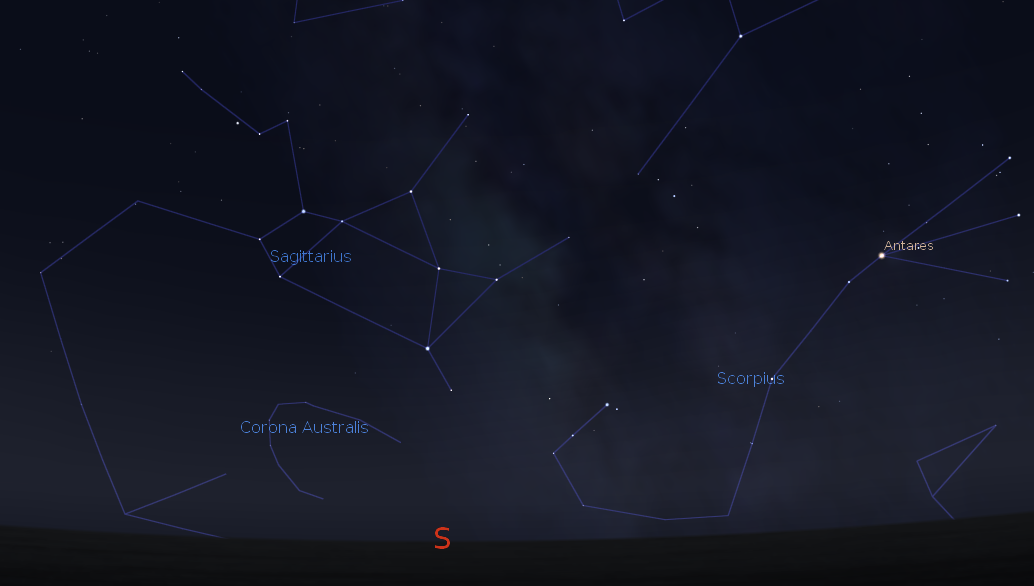
Sagittarius and Scorpius. Created using Stellarium.
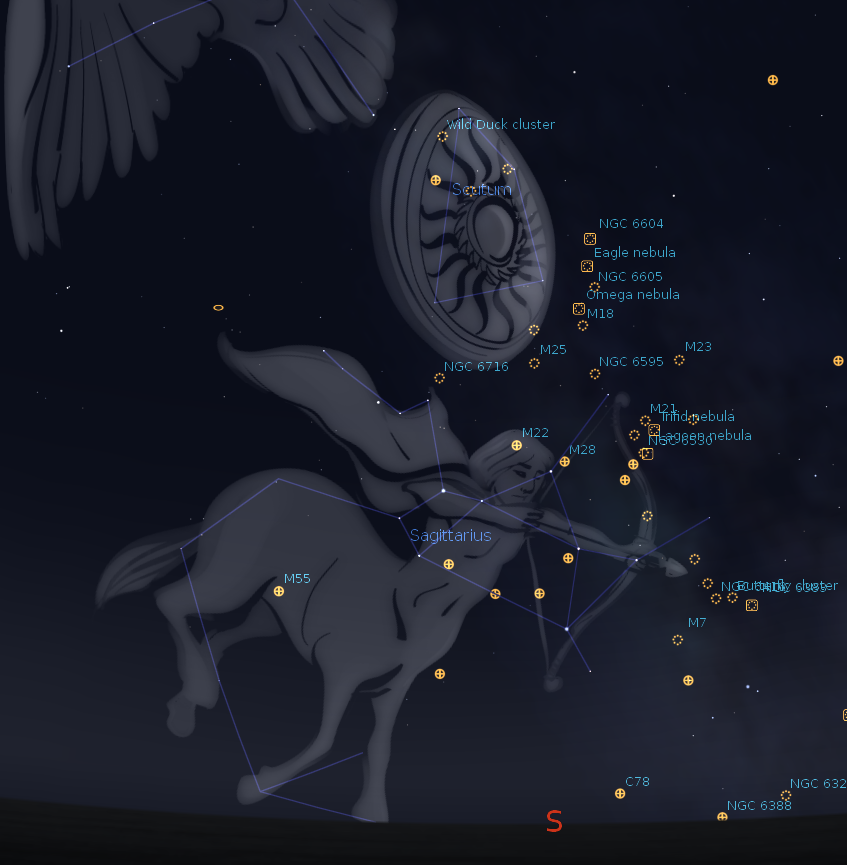
Binocular and telescope deep sky objects in Scutum and Sagittarius. Created using Stellarium.
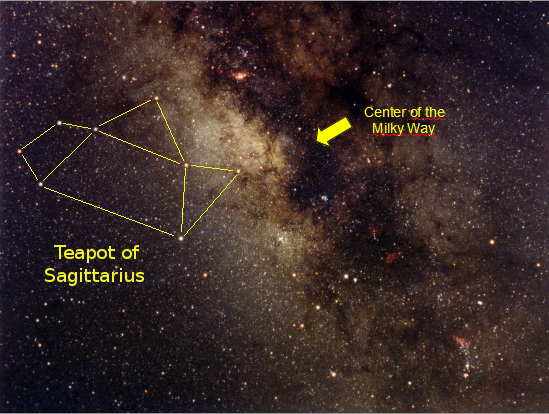
Location of the center of the Milky Way and the Teapot of Sagittarius.
07/28/2014 – Ephemeris – One meteor shower is at peak and another is ramping up.
Ephemeris for Monday, July 28th. The sun rises at 6:24. It’ll be up for 14 hours and 48 minutes, setting at 9:12. The moon, 2 days past new, will set at 9:46 this evening.
We have a couple of meteor showers of note coming up. The first is the Southern Delta Aquarids which will peak on the 30th. The radiant point for these meteors will rise around midnight in the southeast. Their numbers and their brightness are not very great. The Perseid meteor shower will have the misfortune to coincide with the full moon on August 12th and 13th, drowning out all but the brightest meteors. However the Perseids have a long run up to their peak, so their numbers will grow after the moon sets until the moon sets in morning twilight. The Perseid radiant is circumpolar for Northern Michigan, meaning it never sets, so some Perseid meteors can always be seen at night. Their radiant will be in the northeastern sky in the evening.
Times are for the Traverse City/Interlochen area of Michigan. They may be different for your location.
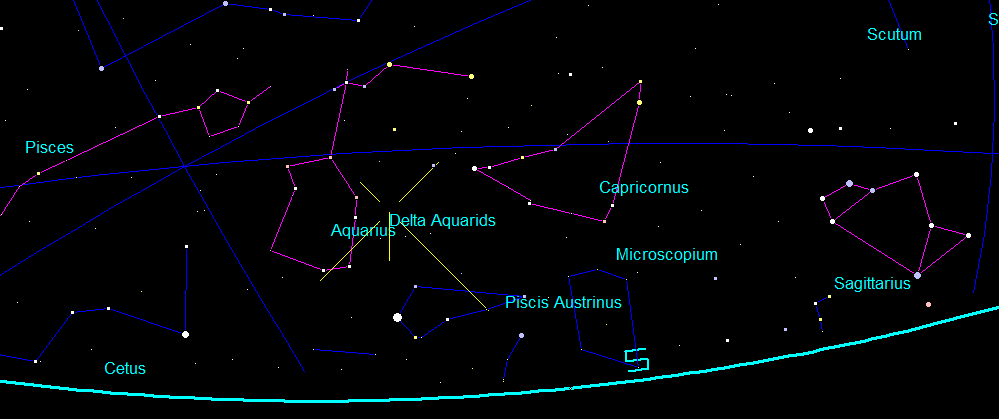
Approximate Radiant of the South Delta Aquarid meteor shower. The radiant does move over the several weeks of the shower to the east. Created using my LookinUp program.
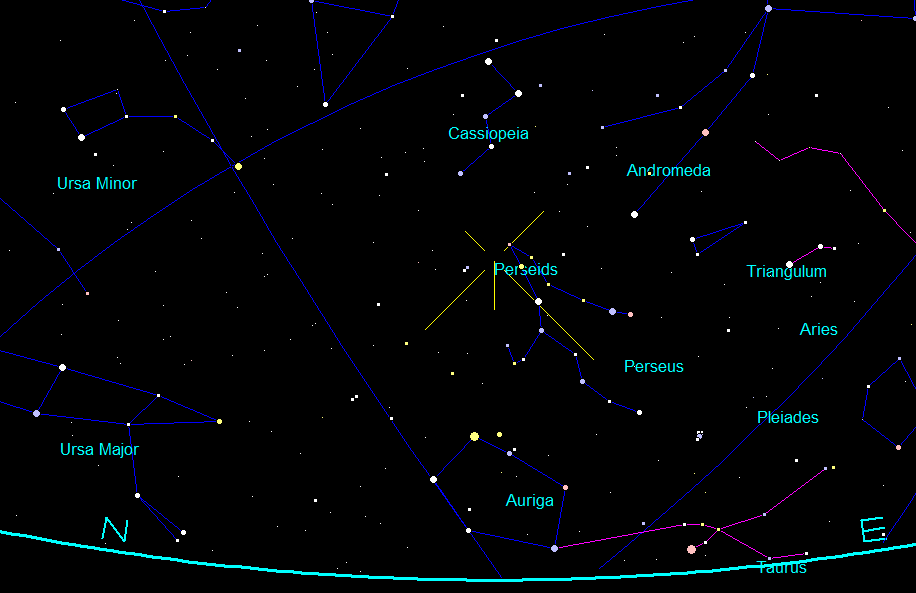
The Perseid meteor shower radiant a about 2 a,m, during the period of the shower. Created using my LookingUp program.

