Archive
07/25/2014 – Ephemeris – Tomorrow’s viewing event at Sleeping Bear Dunes National Lakeshore
Ephemeris for Friday, July 25th. The sun rises at 6:21. It’ll be up for 14 hours and 54 minutes, setting at 9:15. The moon, 1 day before new, will rise at 6:17 tomorrow morning.
Tomorrow the Grand Traverse Astronomical Society will be at the Sleeping Bear Dunes National Lakeshore for observations of the Sun, planets and the rest of the heavens. Sleeping Bear The venue on Saturday will be on Pierce Stocking Scenic Drive at the Dunes Overlook, Stop #3 clouds permitting. Hazy or partly cloudy skies are acceptable. There will be observation of the Sun from 4 to 6 p.m. and viewing of the night sky from 9 to 11 p.m. For the solar part of the afternoon the park rangers have neat models of the sun and its prominences. The planets visible will be Mars and Saturn, and by 10:30 the constellations will be visible to view the wonders they contain and the ancient stories they represent.
Times are for the Traverse City/Interlochen area of Michigan. They may be different for your location.
Addendum

Looking through the 25 inch Dobsonian telescope at Stop #3. This was in October, so it maybe warmer in July. Credit: Eileen Carlisle.

One of the other telescopes at the Stop #3 event in October a few years ago. Credit: Eileen Carlisle.
07/24/2014 – Ephemeris – A look at Altair the third star of the Summer Triangle
Ephemeris for Thursday, July 24th. The sun rises at 6:20. It’ll be up for 14 hours and 56 minutes, setting at 9:17. The moon, 2 days before new, will rise at 5:21 tomorrow morning.
The Summer Triangle Is high in the east to southeast sky in the evening. The southernmost star of the Summer Triangle is Altair, in the southeast. Altair is the closest of the three stars at a distance of 16.7 light years away. One light year is nearly 6 trillion miles, that’s 6 followed by 12 zeros. Altair is nearly 11 times the brightness of the sun. If seen at Altair’s distance, the sun would only be as bright as one of the two stars that flank it in our sky. What is rather different about Altair is its rapid rotation. While it’s almost twice the sun’s diameter, it rotates once in only 9 hours, and would show a decidedly squashed appearance if seen close up. Our sun’s a slow poke, taking nearly a month to rotate just once.
Times are for the Traverse City/Interlochen area of Michigan. They may be different for your location.
Addendum
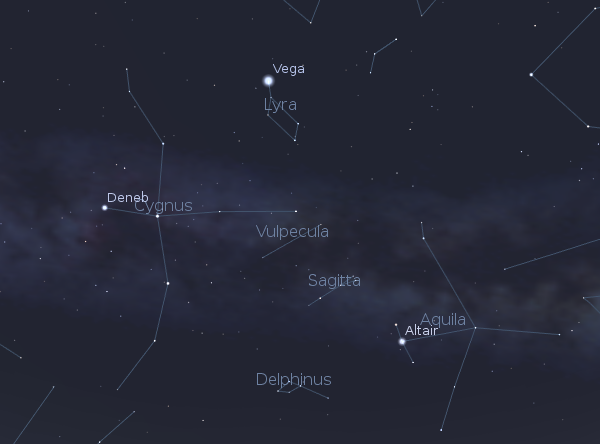
Deneb with the other stars and constellations in the Summer Triangle. Created using Stellarium.
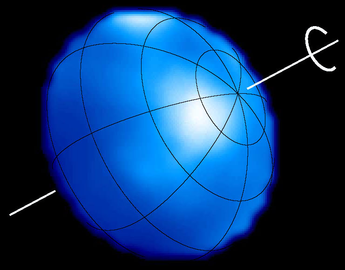
False-color image of the rapidly rotating star Altair, made with the MIRC imager on the CHARA array on Mt. Wilson. Credit: Ming Zhao, University of Michigan
07/23/2014 – Ephemeris – It’s Wednesday. Do you know where the bright planets are?
Ephemeris for Wednesday, July 23rd. The sun rises at 6:19. It’ll be up for 14 hours and 58 minutes, setting at 9:18. The moon, 3 days before new, will rise at 4:28 tomorrow morning.
It’s Wednesday and once again time to locate the bright planets for this week. Reddish Mars is in Virgo in the southwest as darkness falls. It’s 105 million miles (169 million km) away now, nearly 3 times farther away than it was last April, and will set at 12:39 a.m. Saturn will be low in the south-southwest as darkness falls, in the faint constellation of Libra the scales. It will set at 1:38 a.m. Saturn’s in perfect position for viewing with a small or large telescopes to see those fabulous rings and its large moon Titan. Somewhat larger telescopes can spot some smaller moons closer in. Brilliant Venus will rise in the east at 4:22 a.m. in morning twilight. Mercury will rise at 4:46 and be barely visible below Venus. The crescent moon will be right of Venus tomorrow morning.
Times are for the Traverse City/Interlochen area of Michigan. They may be different for your location.
Addendum
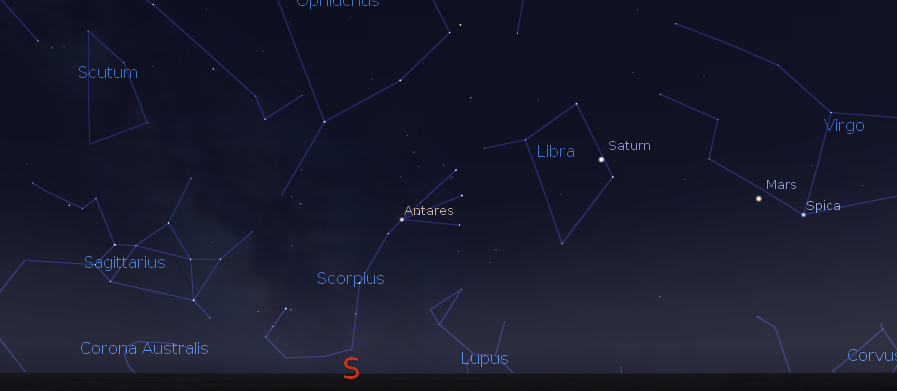
The evening planets Mars and Saturn with the zodiacal constellations at 10:30 p.m. on July 23, 2014. Created using Stellarium.
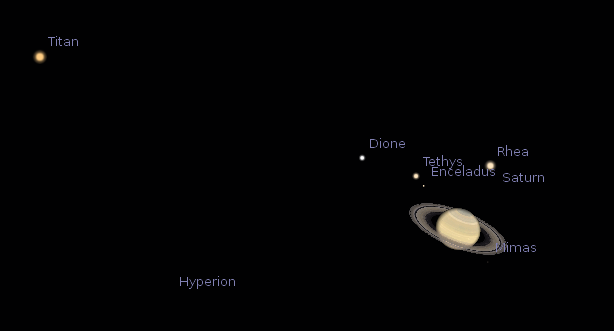
Saturn through a telescope. In small telescopes of the moons only Titan will be visible. July 23, 2014. Created using Stellarium.
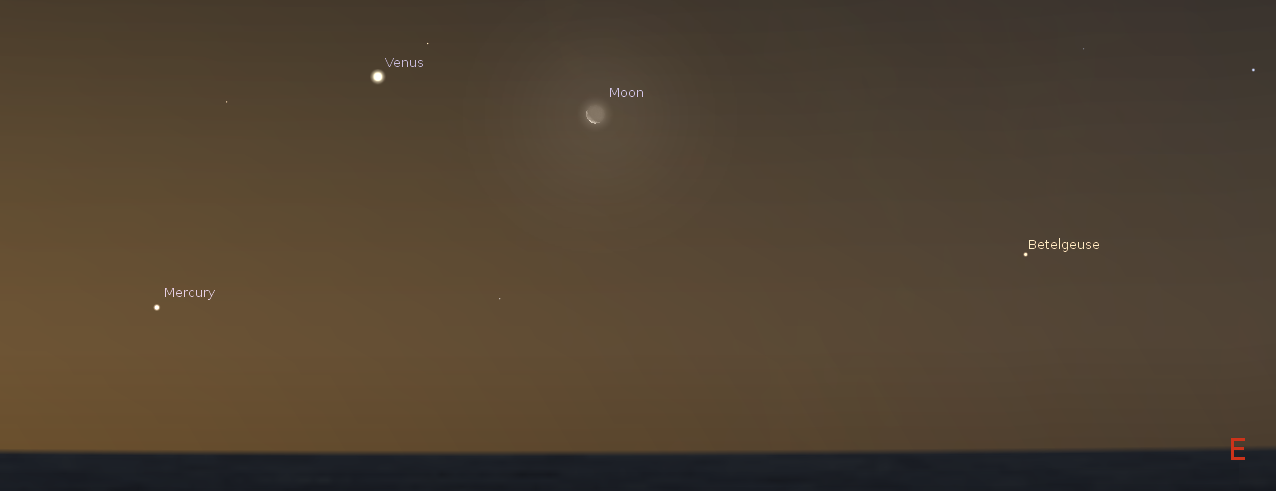
Venus, Mercury, and the crescent Moon at 5:30 a.m. on July 24, 2014. Created using Stellarium.
07/22/2014 – Ephemeris – Rosetta spies a cosmic rubber ducky
Ephemeris for Tuesday, July 22nd. Today the sun will be up for 15 hours even, setting at 9:18. The moon, half way from last quarter to new, will rise at 3:38 tomorrow morning. Tomorrow the sun will rise at 6:19.
The European Space Agency (ESA) Rosetta spacecraft is closing in on Comet 67P/Churyumov-Gerasimenko, also known as Comet Cherry-Gerry, or Comet C-G. After photos of the comet’s nucleus were published last week it has acquired a new nickname: Rubber Ducky. The nucleus may be a contact binary with two comet nuclei that stuck together after a slow speed collision. Further study may reveal the nature of the two pieces. Rosetta has more than a year to study the comet. It has a lander craft called Philae that can land on one of the pieces of the nucleus. No one expected the possibility of two possibly dissimilar comet nuclei to study. Rosetta will enter orbit of the comet August 6th.
Times are for the Traverse City/Interlochen area of Michigan. They may be different for your location.
Addendum
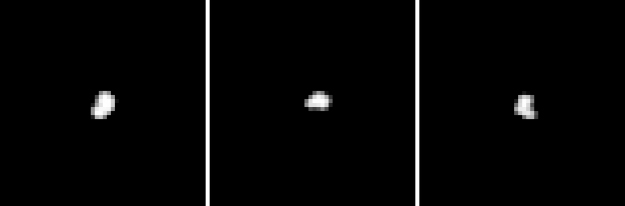
A hint of strangeness appears on July 4, 2014. What’s that lump on the side in that third image? Credits: ESA/Rosetta/MPS for OSIRIS Team MPS/UPD/LAM/IAA/SSO/INTA/UPM/DASP/IDA
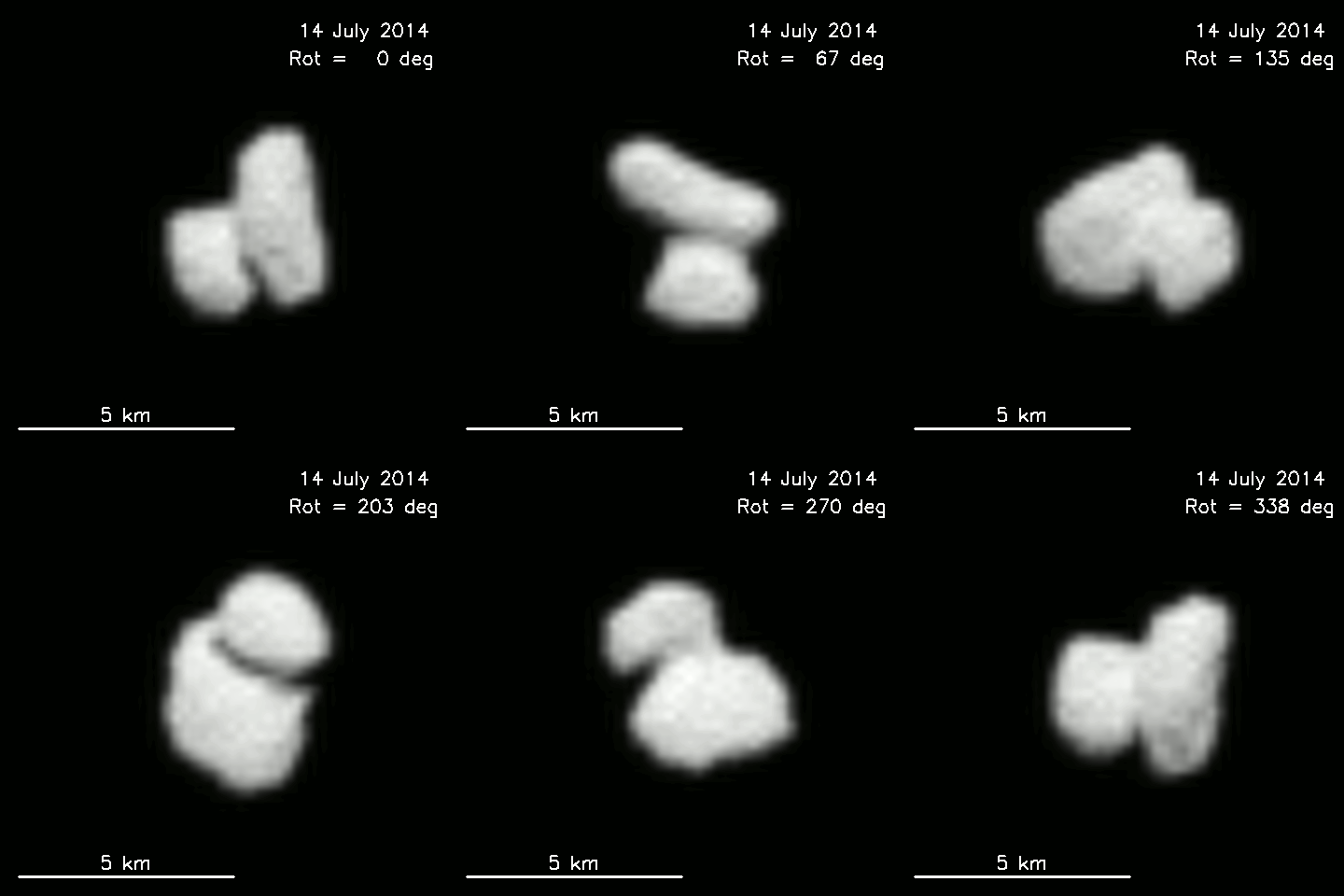
An animation of Comet C-G rotation on July 14, 2014. The 30 pixel wide image has been smoothed. The actual rotation rate is 1 rotation every 12.4 hours. Credits: ESA/Rosetta/MPS for OSIRIS Team MPS/UPD/LAM/IAA/SSO/INTA/UPM/DASP/IDA
For more information go to http://sci.esa.int/rosetta/, or search: esa rosetta.
The post that explains this image more fully is here.
ESA has a policy of weekly releases, so expect a new one this Wednesday, Thursday or Friday.
07/21/2014 – Ephemeris – The celestial eagle: Aquila
Ephemeris for Monday, July 21st. Today the sun will be up for 15 hours and 2 minutes, setting at 9:19. The moon, 3 days past last quarter, will rise at 2:52 tomorrow morning. Tomorrow the sun will rise at 6:18.
Aquila the eagle is a constellation that lies in the Milky Way. It’s in the southeastern sky as it gets dark. Its brightest star, Altair is one of the stars of the Summer Triangle, a group of three bright stars dominating the eastern sky in the evening now. Altair, in the head of the eagle, is flanked by two slightly dimmer stars, the shoulders of the eagle. The eagle is flying northeastward through the Milky Way. Its wings are seen in the wing tip stars. A curved group of stars to the lower right of Altair is its tail. Within Aquila the Milky Way shows many dark clouds as part of the Great Rift that splits it here. The other summer bird is Cygnus the swan above and left of Aquila, flying in the opposite direction.
Times are for the Traverse City/Interlochen area of Michigan. They may be different for your location.
Addendum
Deneb with the other stars and constellations in the Summer Triangle. Created using Stellarium.
07/18/2014 – Ephemeris – Deneb is the brightest star of the Summer Triangle… Really
Ephemeris for Friday, July 18th. Today the sun will be up for 15 hours and 8 minutes, setting at 9:22. The moon, at last quarter today, will rise at 12:58 tomorrow morning. Tomorrow the sun will rise at 6:15.
At 11 this evening the bright star Deneb in Cygnus the swan will be moderately high in the east northeast. Deneb is the dimmest star of the summer triangle. Of the other stars of the triangle, Vega is nearly overhead, and Altair to the southeast. While Deneb’s apparent magnitude, or brightness as seen from Earth, makes it the dimmest of the three bright stars, Deneb has a vast distance of possibly 1,550 light years. If brought as close as Vega, Deneb would be several times brighter than Venus. For all this it is only 13-20 times the mass of the sun. It will have an extremely short life and will explode, go supernova, in perhaps a few million years. Closer to home, check out the Sun at Kingsley Heritage Days This Saturday and Sunday.
Times are for the Traverse City/Interlochen area of Michigan. They may be different for your location.
Addendum
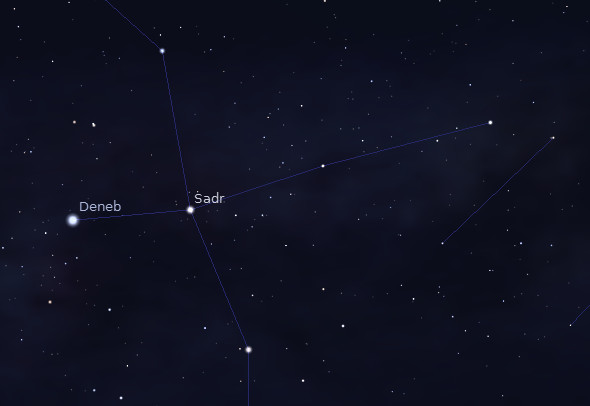
Deneb and the Northern Cross section of Cygnus the swan. Created using Stellarium.
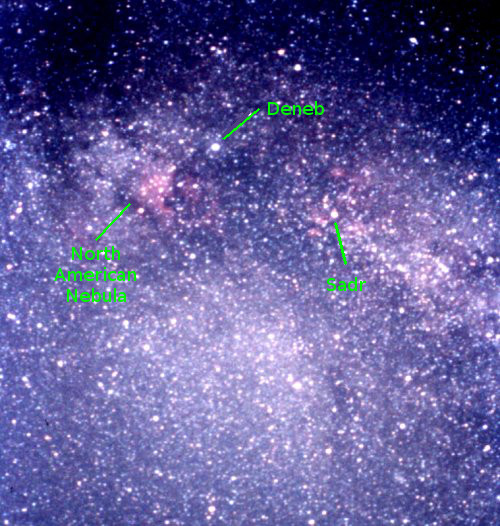
One of my old photographs of Deneb and the North American Nebula digitized from a slide.
The North American Nebula, visible as a faint smudge in binoculars or the naked eye may be ionized and illuminated by Deneb. It’s distance appears to be comparable to that of Deneb.
You may note that previous postings about Deneb over the years have given different distances of Deneb. That just denotes how difficult it is to pin down its distance.
07/17/2014 – Ephemeris – The constellation Cygnus the swan
Ephemeris for Thursday, July 17th. Today the sun will be up for 15 hours and 10 minutes, setting at 9:23. The moon, 1 day before last quarter, will rise at 12:25 tomorrow morning. Tomorrow the sun will rise at 6:14. | Fairly high in the east at 11 p.m. Is the constellation of Cygnus the swan, flying south through the Milky Way. It is also called the Northern Cross. At the left, the tail of the swan or the head of the cross is the bright star Deneb, one of the stars of the Summer Triangle. The next star right is Sadr the intersection of the body and the wings of the swan seen in flight, or the intersection of the two pieces of the cross. There are two or three stars farther to the right that delineate the swan’s long neck or upright of the cross, that ends with the star Alberio in the beak of the swan or foot of the cross. The crosspiece of the cross extends to the stars on either side of the intersection star Sadr, while the swan’s wings extend to a couple more stars each.
Times are for the Traverse City/Interlochen area of Michigan. They may be different for your location.
Addendum
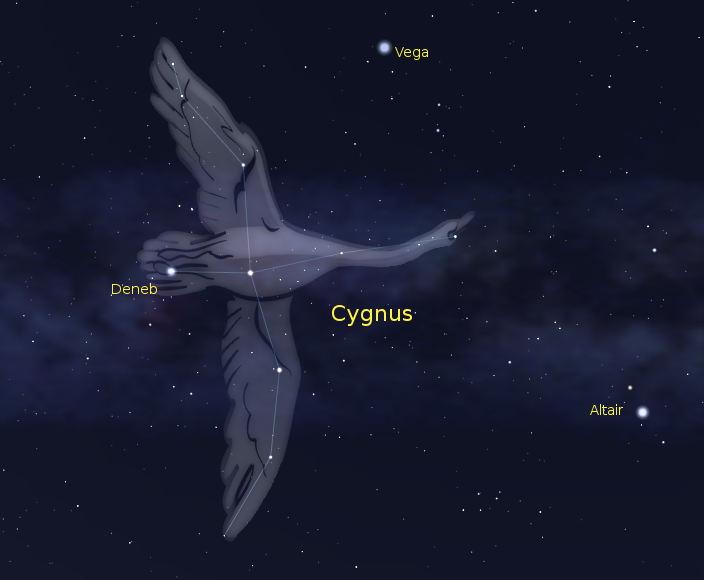
CygnusTheSwan Created using Stellarium.
07/16/2014 – Ephemeris – A late post for the planet day
Ephemeris for Wednesday, July 16th. Today the sun will be up for 15 hours and 11 minutes, setting at 9:24. The moon, 2 days before last quarter, will rise at 11:52 this evening. Tomorrow the sun will rise at 6:13.
It’s Wednesday and once again time to locate the bright planets for this week. Reddish Mars is in Virgo in the southwest as darkness falls. It’s 101 million miles (163 million km) away now, nearly 2 and a half times farther away than last April, and will set at 12:56 a.m. Saturn will be low in the south-southwest as darkness falls, in the faint constellation of Libra the scales. It will set at 2:06 a.m. Saturn’s in perfect position for viewing with a small or large telescopes to see those fabulous rings and its large moon Titan. Somewhat larger telescopes can spot some smaller moons closer in. Brilliant Venus will rise in the east at 4:14 a.m. in morning twilight. Mercury will rise at 4:46 and be barely visible below Venus.
Times are for the Traverse City/Interlochen area of Michigan. They may be different for your location.
Addendum
I’m late on this one, so the planet positions below are for Thursday evening and Friday Morning.
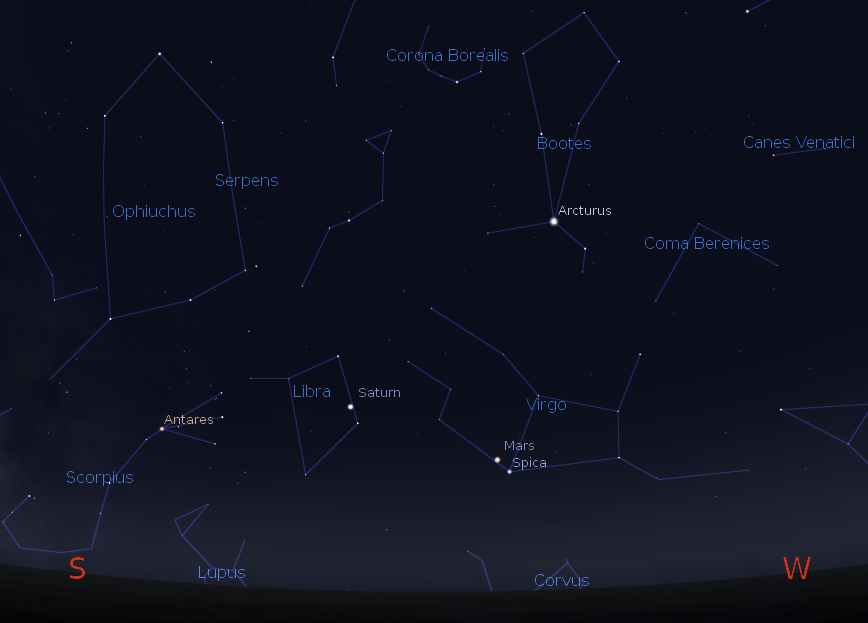
Mars and Saturn with the evening stars and constellations at 11 p.m. Thursday July 17, 2014. Created using Stellarium.
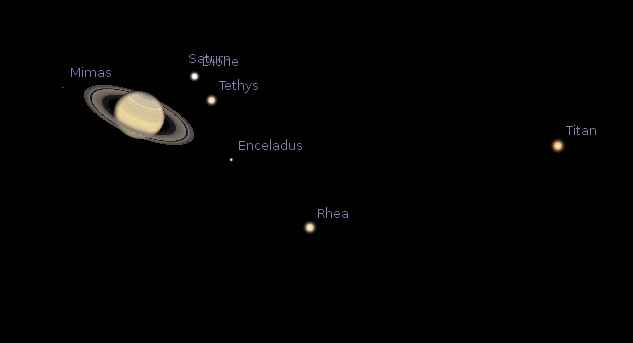
Saturn through a telescope. In small telescopes of the moons only Titan will be visible. July 17, 2014. Created using Stellarium.
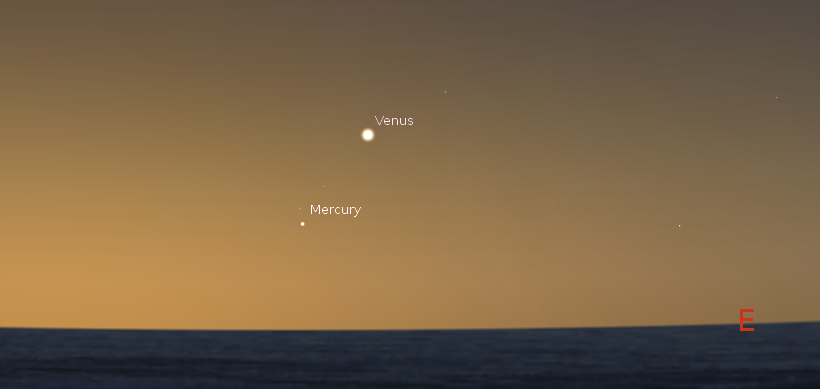
Venus and Mercury at 5:30 a.m. July 18, 2014. Created using Stellarium.
07/15/2014 – Ephemeris – The constellation of Lyra the harp
Ephemeris for Tuesday, July 15th. Today the sun will be up for 15 hours and 13 minutes, setting at 9:24. The moon, half way from full to last quarter, will rise at 11:19 this evening. Tomorrow the sun will rise at 6:12.
Very high up in the eastern sky at 11 p.m. can be found a bright star just north of a small, narrow, but very distinctive parallelogram of stars. They are the stars of the constellation Lyra the harp. The bright star is Vega, one of the twenty one brightest first magnitude stars. Vega is actually the 5th brightest night-time star. The harp, according to Greek mythology, was invented by the Greek god Hermes. The form of the harp in the sky, is as he had invented it: by stretching strings across a tortoise shell. Hermes gave it to his half-brother Apollo, who in turn gave it to the great musician Orpheus. The sun has a motion with respect to most stars around it. Its direction is towards the vicinity of Lyra.
Times are for the Traverse City/Interlochen area of Michigan. They may be different for your location.
Addendum
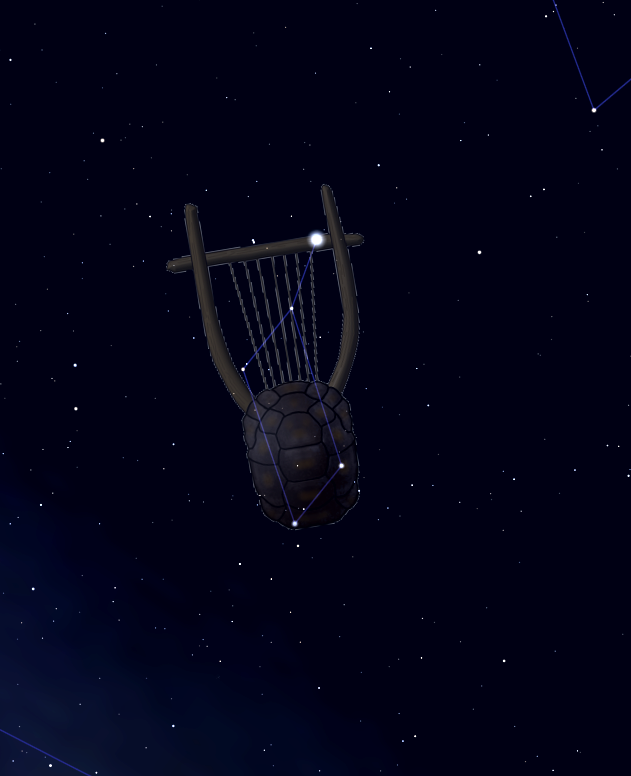
Lyra as a tortoise shell harp. Created using Stellarium and free clip art.
07/14/2014 – Ephemeris – New Horizons to Pluto: 1 year and counting!
Ephemeris for Monday, July 14th. Today the sun will be up for 15 hours and 14 minutes, setting at 9:25. The moon, 2 days past full, will rise at 10:45 this evening. Tomorrow the sun will rise at 6:11.
Exactly one year from today the New Horizons spacecraft will fly by the dwarf planet Pluto. It will be taking photographs of Pluto and its moons, sniffing out Pluto and its large moon Charon. During most of the close flyby the spacecraft will be too busy to talk to Earth. When past Pluto the spacecraft will be able over the next few months to down-link to us all its information. At that great distance it must send data back to us with a transmission speed will make the old 300 baud modems of three decades ago seem fast. Recently the Hubble Space Telescope has been pressed into service to spot new targets beyond Pluto for New Horizons. It quickly found two, and is looking for more.
Times are for the Traverse City/Interlochen area of Michigan. They may be different for your location.
Addendum
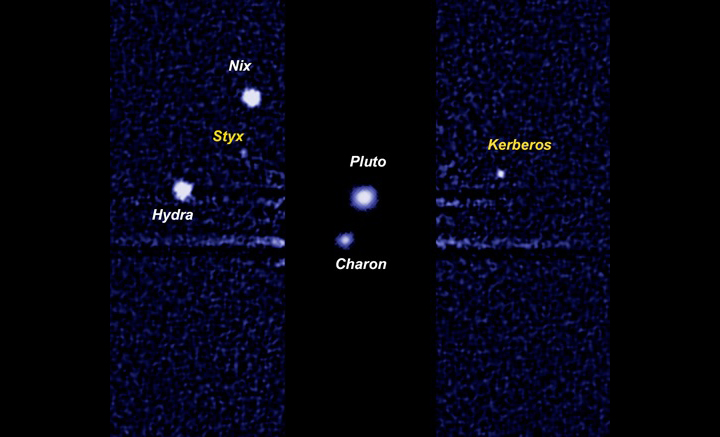
Pluto and its moons as photographed by the Hubble Space Telescope. Pluto and Charon were filtered to reduce their brightness to bring out the other dim moons. Credit: NASA/Hubble.
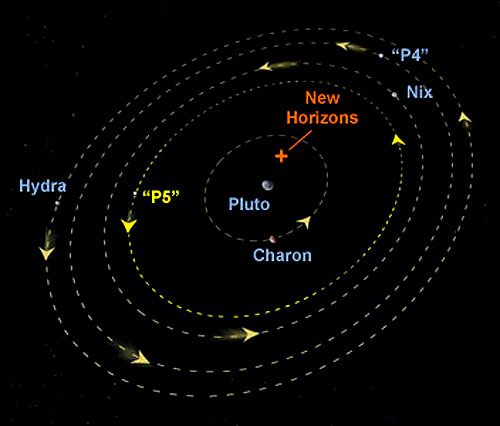
New Horizon’s aim point in relation to the moons. This was created before P4 and P5 received names. P4 became Styx, and P5 became Kerberos. Credit: NASA/GSFC.
When more and more moons were discovered around Pluto serious consideration was given to steer clear of the moon orbits. It is quite possible that there is much debris orbiting Pluto where all these satellites are. They all orbit Pluto in the same plane, along with Charon, above Pluto’s equator. It is thought that any material streaming toward Pluto would be intercepted by Charon, so the space between Charon and Pluto might be clear of debris, so New Horizons can punch through in safety. New Horizons is going like a bat out of heck and has no brakes. New Horizon’s velocity with respect to Pluto at closest approach will be 49,600 kilometers per hour or 30,800 mph according to the New Horizons article on Wikipedia (no citation given). The path of the spacecraft can be altered is a moon or other hazard is detected.
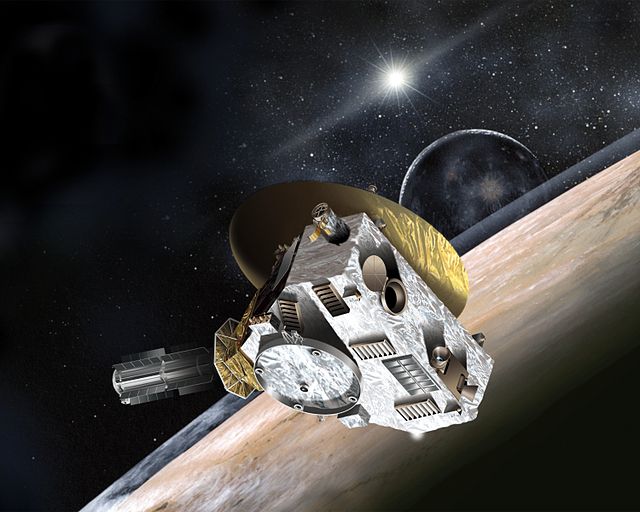
Artist conception of the New Horizons spacecraft at Pluto. Credit: NASA/Johns Hopkins University Applied Physics Laboratory/Southwest Research Institute.
New Horizon’s web page: http://pluto.jhuapl.edu/

