Archive
07/11/2014 – Ephemeris – Spot Mercury tomorrow and Learn about two comets tonight
Ephemeris for Friday, July 11th. Today the sun will be up for 15 hours and 19 minutes, setting at 9:27. The moon, 1 day before full, will set at 6:31 tomorrow morning. Tomorrow the sun will rise at 6:08.
Really diehard Mercury watchers just may catch a glimpse of this very elusive planet tomorrow morning after it rises at 4:47 a.m. It’s below and left of Venus at that time. But before then the Grand Traverse Astronomical Society will hold its monthly meeting tonight at Northwestern Michigan College’s Observatory on Birmley Road. Yours truly will be giving the talk starting at 8 p.m. about the two comets that will be in the news starting next month. The first will be orbited by the European Rosetta spacecraft which will send down a lander starting next month. The second will be a close approach of a comet to Mars, near enough to possibly menace our satellites orbiting Mars in October. There will be viewing afterwords.
Times are for the Traverse City/Interlochen area of Michigan. They may be different for your location.
More information on the talk is here.
Addendum
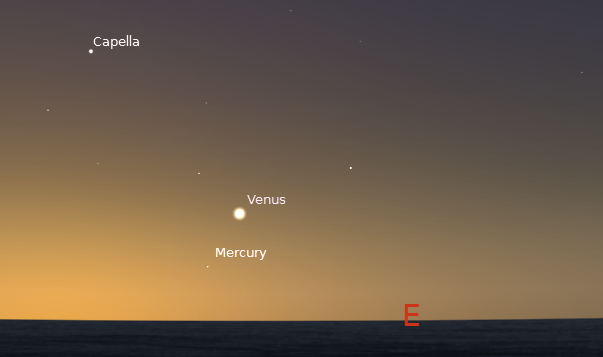
Mercury and Venus rising in twilight at 5:30 a.m. July 12, 2014. Created using Stellarium.

Title Slide for Tail of Two Comets
07/10/2014 – Ephemeris – Why is the bright Moon so low in summer and so high in winter?
Ephemeris for Thursday, July 10th. Today the sun will be up for 15 hours and 20 minutes, setting at 9:28. The moon, 2 days before full, will set at 5:22 tomorrow morning. Tomorrow the sun will rise at 6:08.
If you watch the moon for the next few nights, you won’t have to strain your neck because the moon at its highest will be less than 30 degrees above the southern horizon for us in northern Michigan. That’s because the moon closely follows the path of the sun in the sky, called the ecliptic, with a deviation of only 5 degrees maximum. Tonight it’s a couple of degrees north of the ecliptic. Tonight it’s located about where the sun was back last November or will be next November. In winter you’d swear that the full moon at its greatest height was practically overhead. It’s another effect of the Earth’s axial tilt of 23 ½ degrees. Our moon is odd in it doesn’t orbit the Earth’s equator like most large moons do for their planets.
Times are for the Traverse City/Interlochen area of Michigan. They may be different for your location.
Addendum
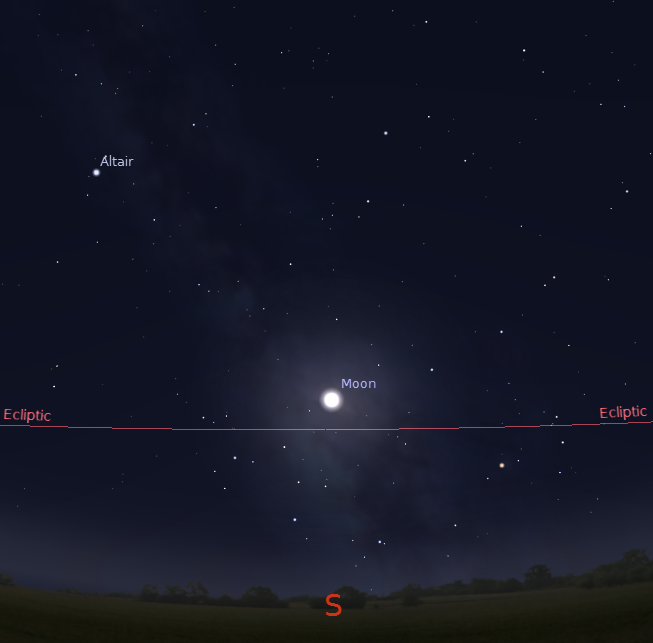
The full Moon on July, 12, 2014. Created using Stellarium.
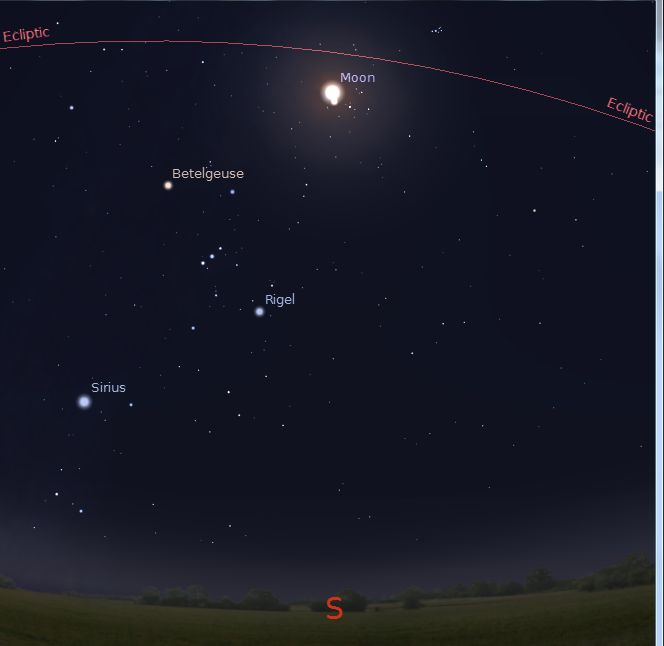
The full Moon on December 6, 2014. Created using Stellarium.
07/09/2014 – Ephemeris – Where are the bright planets this week?
Ephemeris for Wednesday, July 9th. Today the sun will be up for 15 hours and 22 minutes, setting at 9:28. The Moon, 3 days before full, will set at 4:20 tomorrow morning. Tomorrow the sun will rise at 6:07.
It’s Wednesday and once again time to locate the bright planets for this week. Jupiter sets less than a half hour after the sun, so it’s gone for us until September mornings. Reddish Mars is in Virgo in the southwest as darkness falls. It’s 97 million miles (156 million km) away now, nearly 2 and a half times farther away than last April, and will set at 1:17 a.m. Saturn will be low in the south-southwest as darkness falls, in the faint constellation of Libra the scales. It will set at 2:34 a.m. Saturn’s in perfect position for viewing with a small or large telescope to see those fabulous rings and its large moon Titan. Somewhat larger telescopes can spot some smaller moons closer in. Brilliant Venus will rise in the east at 4:09 a.m. in morning twilight.
Times are for the Traverse City/Interlochen area of Michigan. They may be different for your location.
Addendum
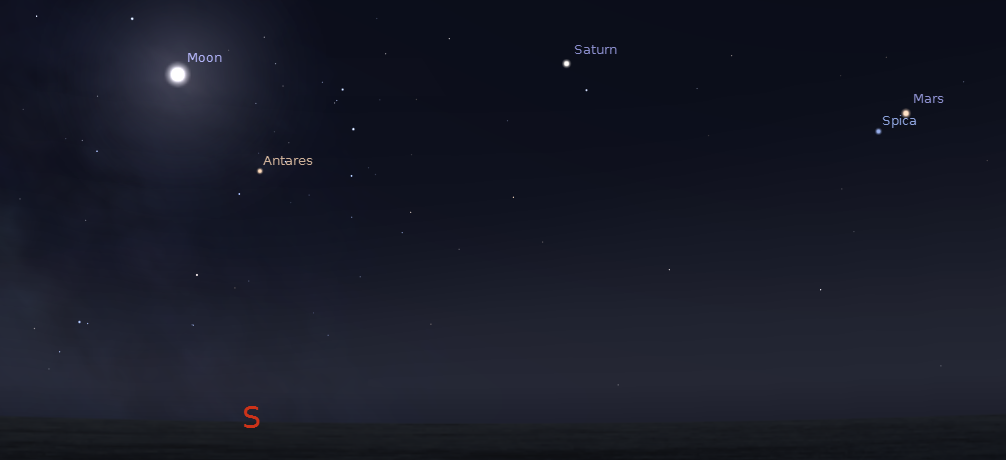
Mars, Saturn and the Moon will appear along with the brighter stars of summer at 11 p.m. on July 9, 2014. Created using Stellarium.
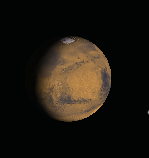
Mars as seen through a large telescope. It appears really tiny in any other telescope. Time: 11 p.m. on July 9, 2014. Created using Stellarium.
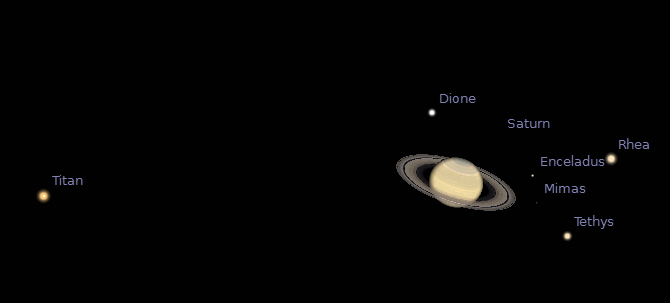
Saturn and some of its moons. Smaller telescopes will see only Titan, but see how many moon you can see. July 9, 11 p.m. Created using Stellarium.
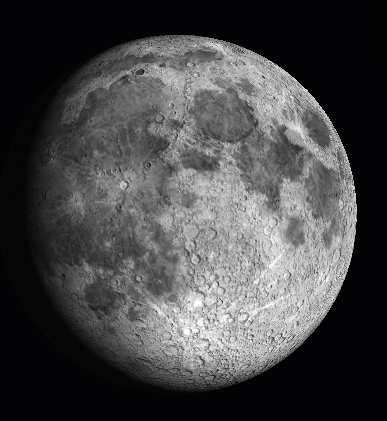
A binocular view of the gibbous Moon on July 9, 2014 at 11 p.m. Created using Stellarium.
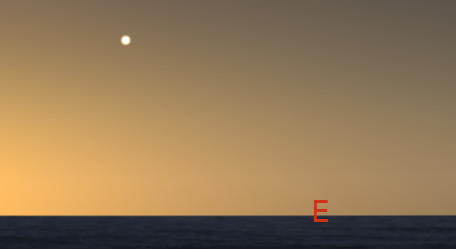
Venus low in the east at 5:45 a.m. July 11, 2014; roughly a half hour before sunrise. Created using Stellarium.
Venus low in the east at 5:45 a.m. July 11, 2014; roughly a half hour before sunrise. Created using Stellarium.

Bright gibbous disk of Venus as seen through a telescope on July 10, 2014. Created using Stellarium.
07/08/2014 – Ephemeris – Why are the near side and the far side of the moon so different?
Ephemeris for Tuesday, July 8th. Today the sun will be up for 15 hours and 23 minutes, setting at 9:29. The moon, 3 days past first quarter, will set at 3:27 tomorrow morning. Tomorrow the sun will rise at 6:06.
We’re all familiar with the gray blotches on the moon called seas that make up the face of the Man in the Moon. The other side, the far side, misnamed the dark side, has only one small sea. Astronomers have wondered why. Seems that it’s a product of the Moon’s birth and the late heavy bombardment that came later. In a new hypothesis, a Mars sized proto-planet hit the proto-Earth with a glancing blow peeling off material that fell into a disk that coalesced into the Moon, a lot closer to the earth than it is today, and the far side contained thicker light crustal material than the near side. When the giant planets began their migration much asteroidal material struck the moon. Near side impacts penetrated into the Moons magma, while the far side impacts did not.
Times are for the Traverse City/Interlochen area of Michigan. They may be different for your location.
Addendum
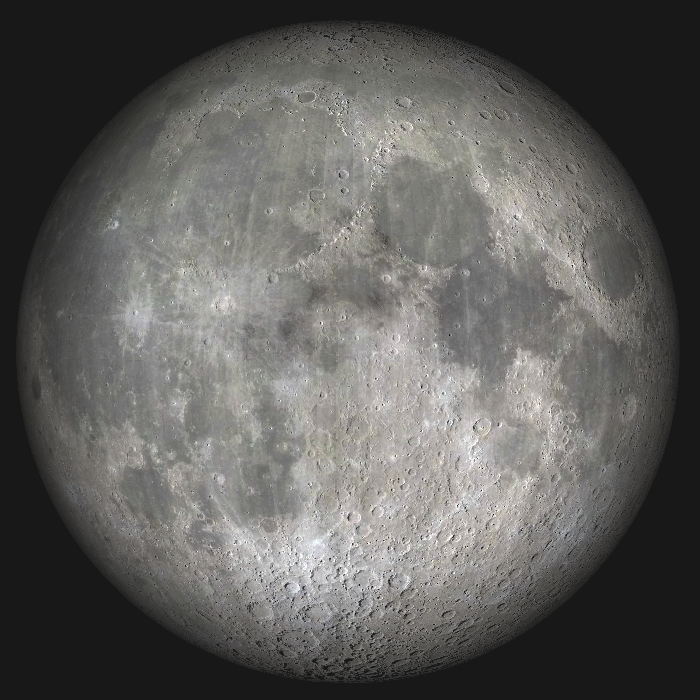
The Moon’s near side. Created using Virtual Moon Atlas.
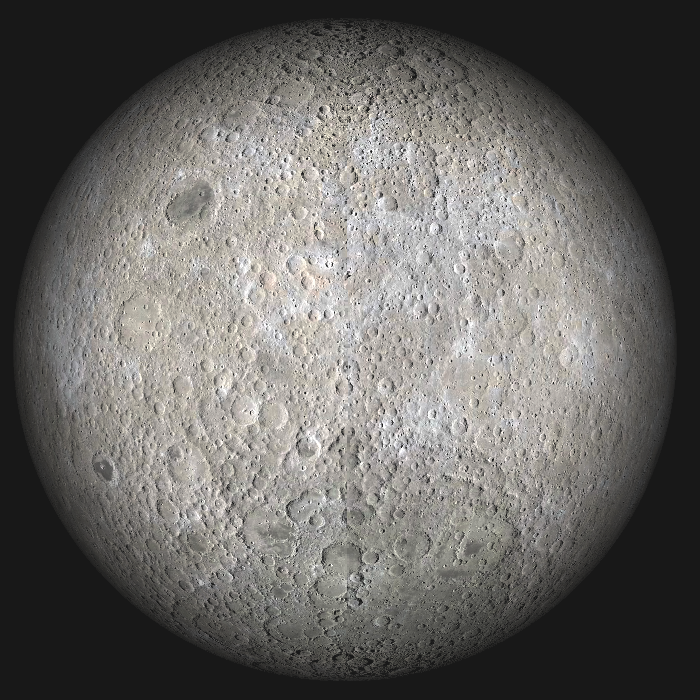
The Moon’s far side. Created using Virtual Moon Atlas.
07/07/2014 – Ephemeris – The Moon will appear near Saturn tonight
Ephemeris for Monday, July 7th. Today the sun will be up for 15 hours and 24 minutes, setting at 9:29. The Moon, 2 days past first quarter, will set at 2:43 tomorrow morning. Tomorrow the sun will rise at 6:05.
Tonight the planet Saturn will be seen above the bright gibbous Moon. At 11 p.m. Saturn will be only 3 moon widths above the moon and may be hard to spot in the Moon’s glare, so that binoculars may be needed to find it. Other than that the moon makes a nice pointer to the ringed planet. The rings of Saturn become apparent in telescopes of at least 20 power. At first the planet looks elliptical, then the planet can be seen to separate from the rings. The Moon itself is a fine but bright object for the telescope. Look near the terminator or sunrise line to see the long lunar shadows delineate the Moon’s crater detail, especially the grand Crater Copernicus near the center of the Moon.
Times are for the Traverse City/Interlochen area of Michigan. They may be different for your location.
Addendum
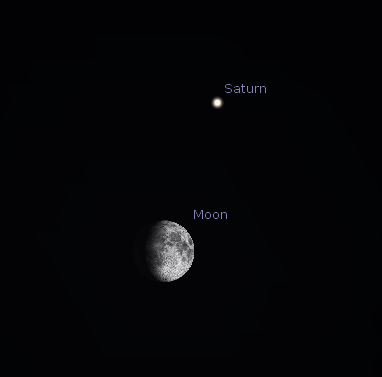
Saturn and the Moon as they would appear at 11 p.m. on July 7, 2014. Created using Stellarium.
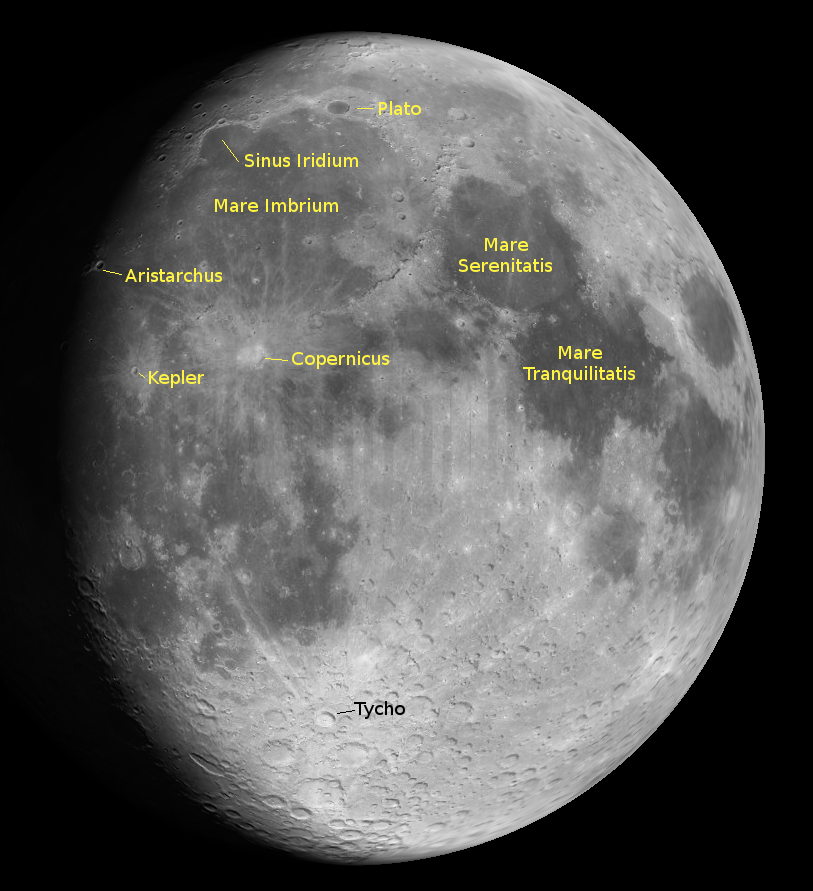
Oops, here’s the Moon for tomorrow night July 8th, 2014. The difference from tonight is the Aristarchus will not be visible, and Sinus Iridium will look cooler. Created using Virtual Moon Atlas. It’s 2 a.m. and I’m too tired to fix it.
07/04/2014 – Ephemeris – Find patriotic red, white and blue stars
Ephemeris for Independence Day, Friday, July 4th. Today the sun will be up for 15 hours and 27 minutes, setting at 9:30. The moon, 1 day before first quarter, will set at 1:03 tomorrow morning. Tomorrow the sun will rise at 6:03.
On this patriotic day let’s look for some red, white, and blue stars. Red is easy, the red star Antares is seen in the south at 11 p.m. Mars, the red planet, in the southwest, can be added even though it’s not technically a star. White is easy too, the official white calibration star Vega high in the east at 11 p.m. The blue star is really blue-white. The brightest of these out at 11 p.m. is Spica, low in the southwest. The color is best seen in binoculars. Star colors are quite subtle, and are an indicator of the temperature of their outer gaseous layers. The temperature of a stars outer layers, in order of their increasing temperatures, red, white and blue, is not related to the temperature in their cores. Of these three the coolest on the outside, Antares is really the hottest inside, using helium as fuel.
Times are for the Traverse City/Interlochen area of Michigan. They may be different for your location.
Addendum
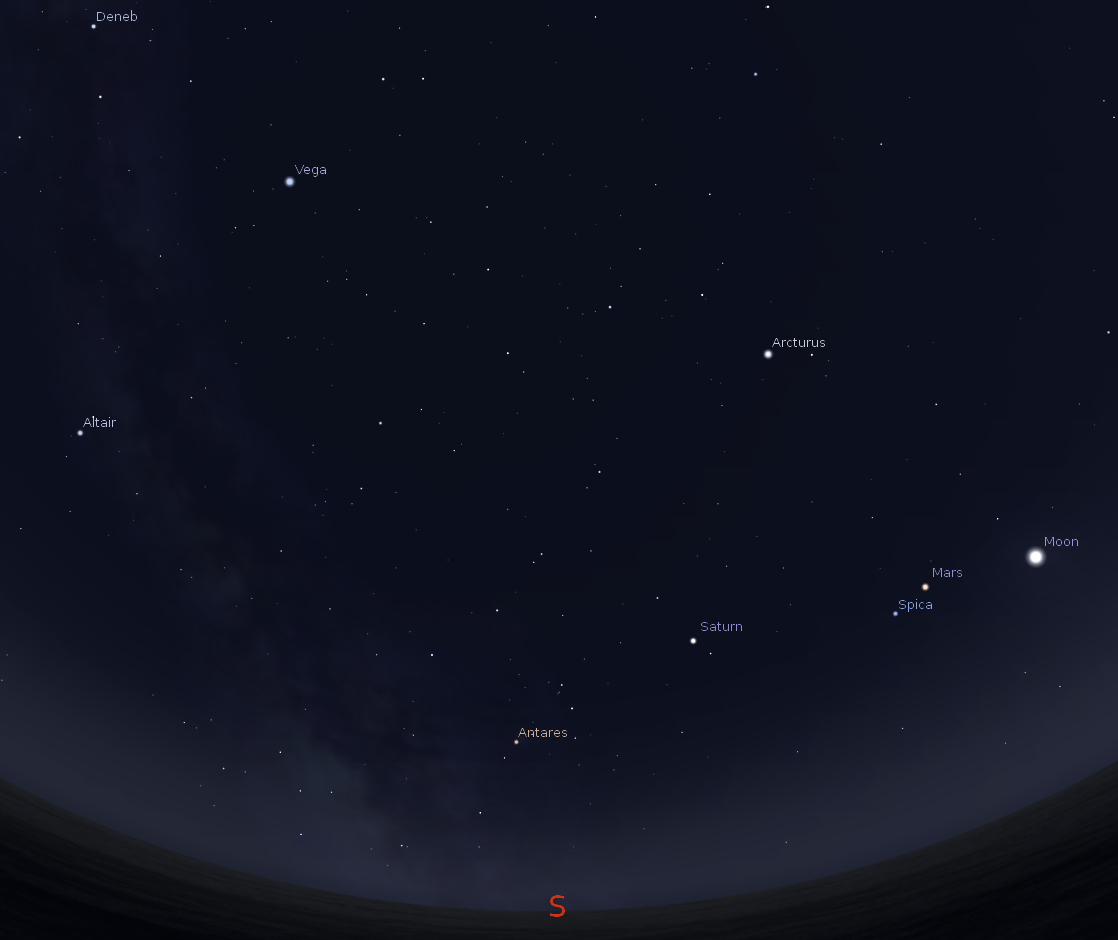
Red white and blue stars for Independence Day at 11 p.m. on July 4, 2014. Created using Stellarium.
07/03/2014 – Ephemeris – Today the Earth is its farthest from the Sun for this year
Thursday, July 3rd. Today the sun will be up for 15 hours and 28 minutes, setting at 9:30. The moon, 2 days before first quarter, will set at 12:35 tomorrow morning. Tomorrow the sun will rise at 6:02.
Later today the Earth will pass a point in its orbit called aphelion. This is the point where the Earth is its farthest from the Sun. Astronomers measure it in terms of the astronomical units AU), the mean distance between the Earth and the Sun. In astronomical units the Earth will be 1.01668 AU from the Sun at 6:59 p.m. (22:59 UT). Converted to miles it is 94.51 million miles (152.1 million km). The 1.7 percent farther distance from the Sun doesn’t really show up as making a difference in temperature. It is swamped by the greater effect of the Earth’s axial tilt currently giving us our summer season. The one thing about aphelion in summer gives us is a longer summer, than winter. The Earth travels slightly slower when farther from the Sun than when closer to it, so summer is the longest season at 94 days.
Times are for the Traverse City/Interlochen area of Michigan. They may be different for your location.
Addendum
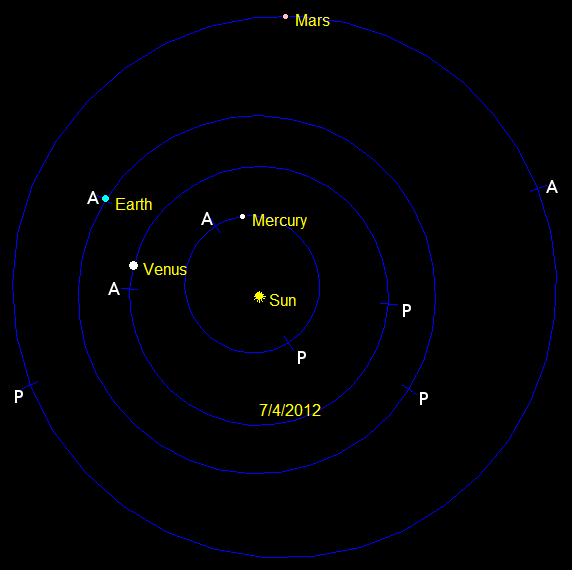
The orbits of the inner planets. (P)erihelion – (A)phelion
Note that the chart is from 2012. The date of aphelion and perihelion varies by a day or two each year. Mars and Mercury have the most eccentric orbits.
07/02/2014 – Ephemeris – Bright planets to start off the 3rd quarter of 2014
Ephemeris for Wednesday, July 2nd. Today the sun will be up for 15 hours and 29 minutes, setting at 9:31. The moon, 3 days before first quarter, will set at 12:09 tomorrow morning. Tomorrow the sun will rise at 6:02.
It’s Wednesday and once again time to locate the bright planets for this week. Jupiter sets less than an hour after the sun, for most folks finding it in twilight will be futile. It will next be seen on September mornings. Reddish Mars is in Virgo in the southwest as darkness falls. It’s 93 million miles (150 million km) away now, and will set at 1:39 a.m. Saturn will be low in the south as darkness falls. It’s in the faint constellation of Libra the scales this year. It will pass due south at 10 p.m. It will set at 3:02 a.m. Saturn’s in perfect position for viewing with a small or large telescope to see those fabulous rings and its large moon Titan. Brilliant Venus will rise in the east at 4:07 a.m. in morning twilight.
Times are for the Traverse City/Interlochen area of Michigan. They may be different for your location.
Addendum
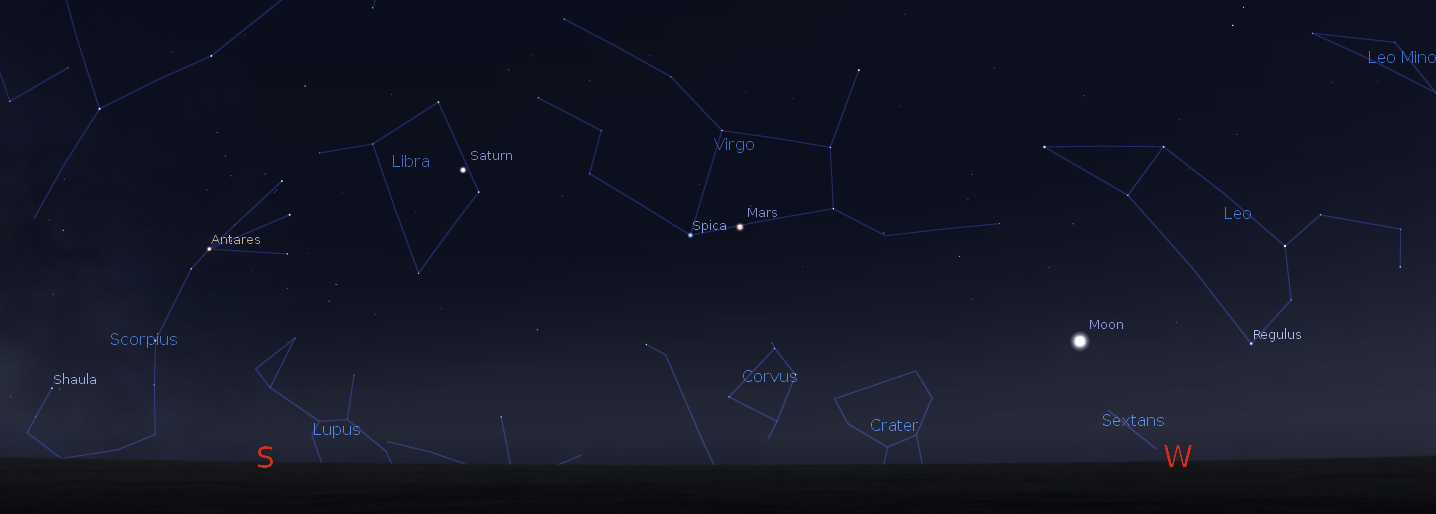
Saturn, Mars and the moon at 11 p.m. on July 2, 2014. Created using Stellarium.
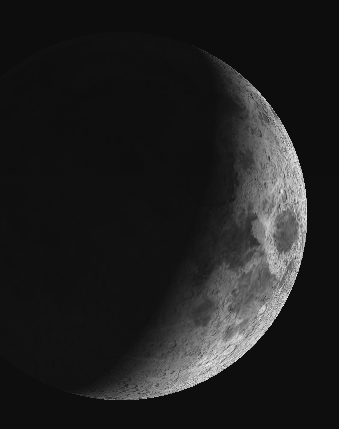
Binocular view of the Moon at 11 p.m., July 2, 2014. Created using Stellarium.
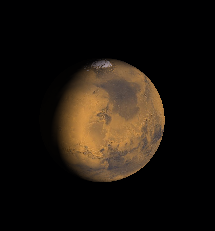
Telescopic view of Mars at high power at 11 p.m., July 2, 2014. Created using Stellarium.
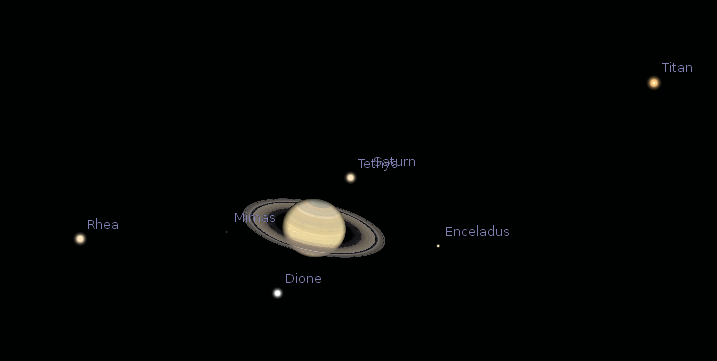
Telescopic view of Saturn and some of its moons on July 2, 2014. Created using Stellarium.
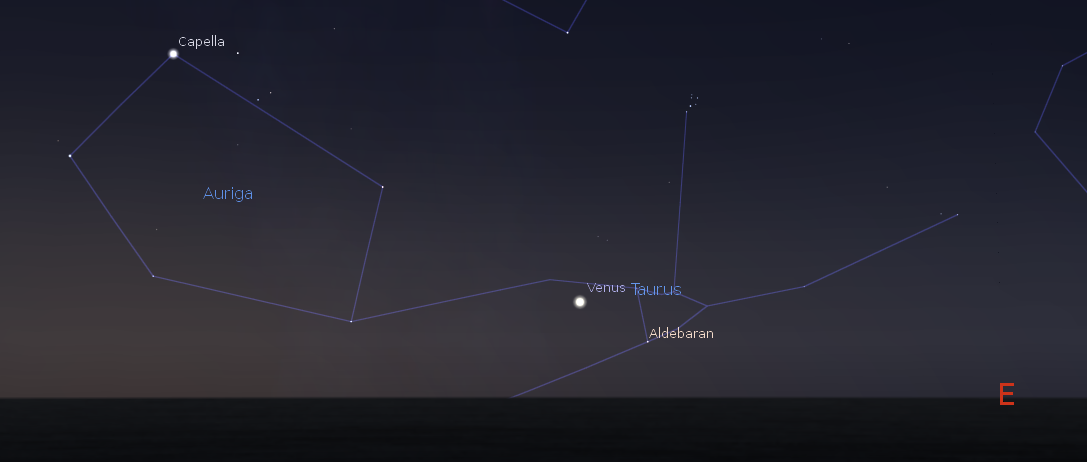
Venus and the morning stars at 4:45 a.m., July 3, 2014. Created using Stellarium.
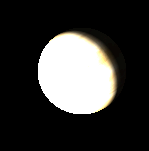
Telescopic view of Venus on July 3, 2014. Created using Stellarium.
07/01/2014 – Ephemeris – July 2014 Preview
Ephemeris for Tuesday, July 1st. Today the Sun will be up for 15 hours and 30 minutes, setting at 9:31. The Moon, half way from new to first quarter, will set at 11:42 this evening. Tomorrow the sun will rise at 6:01.
Lets preview July’s skies. The sun, having reached its northern solstice, is beginning to slide southward again, at first imperceptibly, then with greater speed. The daylight hours will decrease from 15 hours and 30 minutes today to 14 hours 41 minutes at month’s end. The daylight hours will be slightly shorter south of Interlochen, and slightly longer to the north. The altitude of the sun at local noon, when the sun is due south will decrease from 68 degrees today to 63 degrees at month’s end. The sun will be a degree lower in the Straits area. Despite the warmth, the earth will reach its greatest distance from the sun on Thursday the 3rd. The planets visible this month in the evening are Mars and Saturn.
Times are for the Traverse City/Interlochen area of Michigan. They may be different for your location.
Addendum
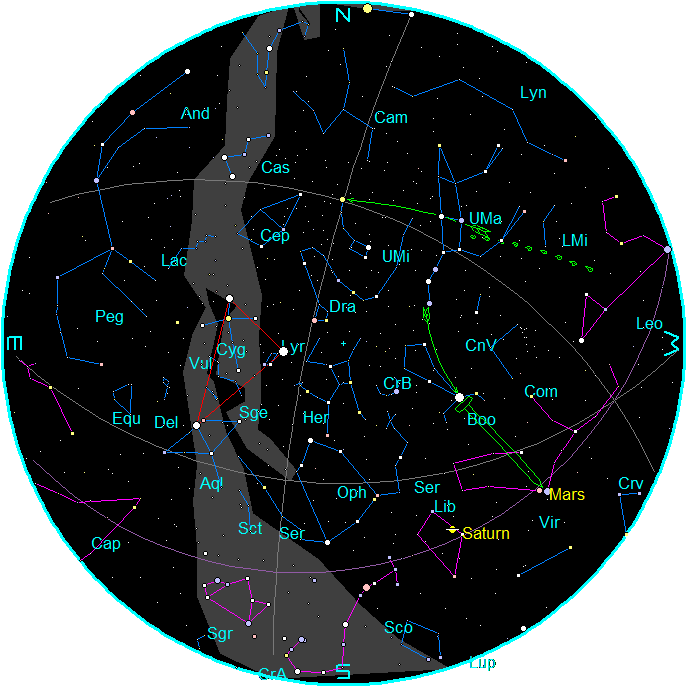
July star chart for 11 p.m. on July 15, 2014. Created by my LookingUp program.
Astronomical twilight ends at 11:58 p.m. on July 1st, decreasing to 11:13 on the 31st.
Add a half hour to every week before the 15th and subtract and hour for every week after the 15th.
For a list of constellation names to go with the abbreviations click here.
Also shown is the Summer Triangle in red. Clockwise from the top star is Deneb in Cygnus, Vega in Lyra and Altair in Aquila.
The green pointers from the Big Dipper are:
- Pointer stars at the front of the bowl of the Big Dipper point to Polaris the North Star.
- The leaky bowl drips on the back of Leo the lion.
- The arc of the dipper’s handle points to Arcturus.
- The straighten the ark to a spike to point to Spica.
06/30/2014 – Ephemeris – The celestial snake handler
Ephemeris for Monday, June 30th. Today the sun will be up for 15 hours and 30 minutes, setting at 9:31. The moon, 3 days past new, will set at 11:14 this evening. Tomorrow the sun will rise at 6:01. | The red star Antares shines in the south at 11 p.m. In the constellation of Scorpius. In the area of sky above and a little to the left lies a large constellation of faint stars called Ophiuchus, the serpent bearer. The constellation shape is like a large bell, which reminds me of the head, shoulders and arms of a fellow that’s holding the snake-like a weight lifter pulling up a heavy bar bell. The serpent he’s holding is Serpens, the only two-part constellation in the heavens. The head rises to Ophiuchus’ right and the tail extends up to the left. In legend Ophiuchus was a great physician, educated by the god Apollo, and the centaur Chiron, also found in the stars as Sagittarius, now rising below and left of him.
Times are for the Traverse City/Interlochen area of Michigan. They may be different for your location.
Addendum
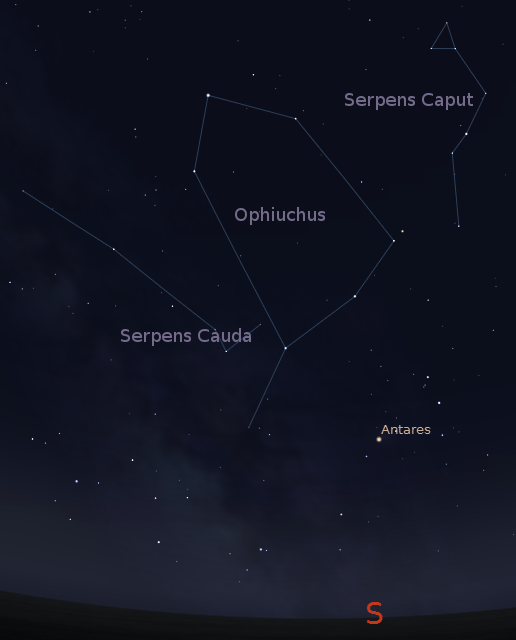
Ophiuchus and Serpens at 11 p.m.. Created using Stellarium.

