Archive
07/22/2022 – Ephemeris – Saturday, weather permitting, there will be a star party at Sleeping Bear Dunes
This is Ephemeris for Pi Day number 2, Friday, July 22nd. Today the Sun will be up for 15 hours and 1 minute, setting at 9:19, and it will rise tomorrow at 6:19. The Moon, 2 days past last quarter, will rise at 2:01 tomorrow morning.
What’s Pi Day number 2? In the European way to write the date: 22 July or 22/7, the improper fraction that approximates pi, the ratio of the circumference of a circle to its diameter.
On to astronomical matters: Tomorrow night July 23rd there will be, weather permitting, a star party at Sleeping Bear Dunes National Lakeshore, this will take place at the Dune Climb. The star party is made possible by the rangers of the park and the Grand Traverse Astronomical Society. The society’s and member’s telescopes will take over the parking lot closest to the Dunes The event starts at 9 p.m., while it’s still light out and the location can be found. The park rangers will leave at 11, while the society members will stay longer.
The astronomical event times given are for the Traverse City/Interlochen area of Michigan (EDT, UT – 4 hours). They may be different for your location.
Addendum
Excerpt from the Sleeping Bear Dunes National Lakeshore calendar posting for August 23:
“These events will be cancelled if the sky is not visible due to weather conditions. The decision to cancel is usually made either three hours in advance or by 4:30 p.m. the day prior to the event. Please call park rangers at 231-326-4700, ext. 5005, for a voicemail message with the decision. For the early morning and late evening astronomy events, bring a flashlight for the walk to and from the event. Park rangers and GTAS staff will wear red glow bracelets at the events. For more information about the Grand Traverse Astronomical Society, go to http://www.gtastro.org/. “
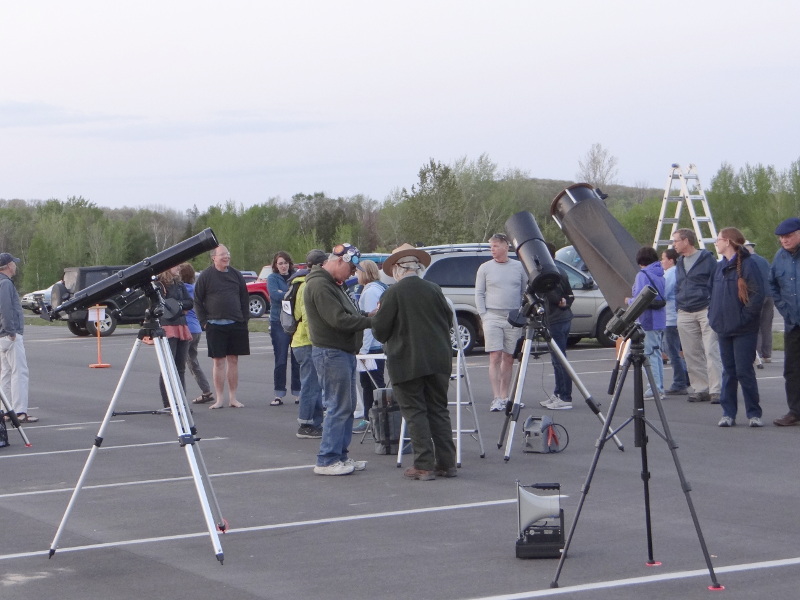
Preparing to start a star party at the Dune Climb in a year before COVID. A few of the telescopes are visible, including the GTAS 25 inch “Emmettron” telescope at the far right. Credit: Eileen Carlisle.
Celestial events that night at the Dune Climb:
9:17 pm – Sunset (Sun will set behind the dune by around 8 pm)
9:57 pm – ISS* pass: highest 24° altitude in the north, moving from WNW to ENE.
10:00 pm – Brighter stars are visible. Telescopes can start to show the brighter binary stars.
10:20 pm – Saturn rises in the east-southeast. The sharpness of its image will improve as it rises higher in the sky.
10:33 pm – Nautical twilight ends. The brighter deep sky objects (DSOs**) become visible in telescopes. The Milky Way begins to show.
11:31 pm – ISS pass: highest 43° north-northeast, moving from NW to ENE
11:33 pm – Astronomical twilight ends. The sky is now completely dark.
* ISS – International Space Station. Start to look for it 2-3 minutes before this time. It will be at its brightest at its highest altitude.
** Deep Sky Objects – Telescopic objects beyond the solar system. They include star clusters, nebulae, and galaxies. Though that night, the only galaxy visible will be the Milky Way.
Click here for the definitions of the types of twilight.
07/21/2022 – Ephemeris – Observing the heavens from the shore of Sleeping Bear Bay
This is Ephemeris for Thursday, July 21st. Today the Sun will be up for 15 hours and 3 minutes, setting at 9:20, and it will rise tomorrow at 6:18. The Moon, 1 day past last quarter, will rise at 1:35 tomorrow morning.
There’s an observatory on the shores of Sleeping Bear Bay near Glen Arbor that is open to the public twice a week on clear nights. It’s the Leelanau School’s Lanphier Observatory, which is open Wednesday and Thursday evenings weather permitting from 10 p.m. to midnight through August 25th. The Leelanau School is located at 1 Old Homestead Road, off M22, just north of Glen Arbor. The Observatory is behind the Student Center and across the Crystal River. It’s a bit of a hike. It will help to take a flashlight for heading back in the dark. The observatory dome contains a 14-inch telescope on a computerized mount, and smaller telescopes may be available on the observatory deck. The observatory is run by Norm Wheeler, retired instructor of the school. Get there early to enjoy the sunset on Lake Michigan.
The astronomical event times given are for the Traverse City/Interlochen area of Michigan (EDT, UT – 4 hours). They may be different for your location.
Addendum
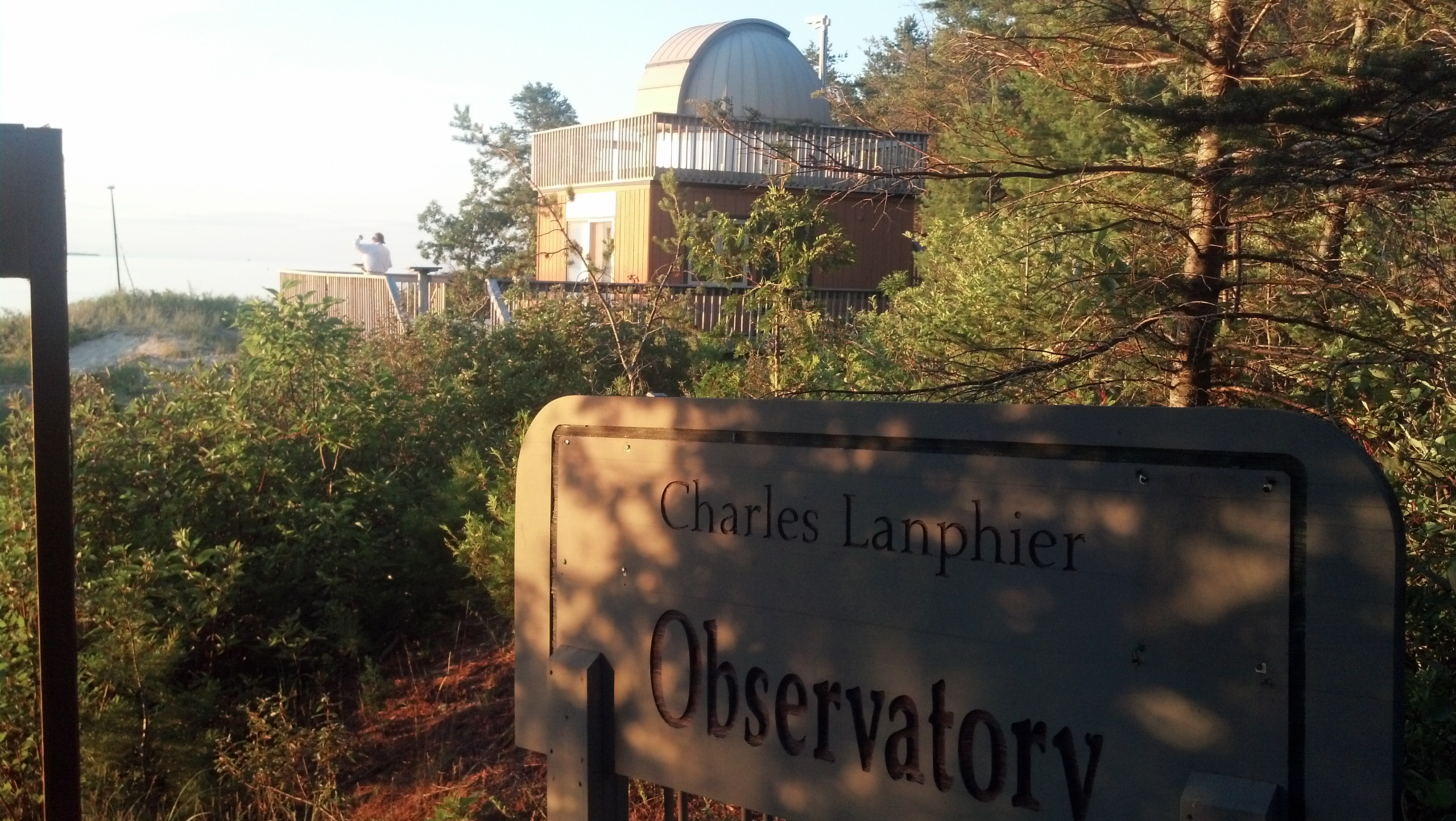
Lanphier Observatory from the trail leading up to it. It’s just off the beach. Beside observing from the main telescope in the dome, there is observation of the constellations and Milky Way from the deck. Credit: Bob Moler.
07/20/2022 – Ephemeris – Let’s search for the naked-eye planets for this week
This is Ephemeris for Wednesday, July 20th. Today the Sun will be up for 15 hours and 5 minutes, setting at 9:21, and it will rise tomorrow at 6:17. The Moon, at last quarter today, will rise at 1:13 tomorrow morning.
Let’s search for the naked-eye planets for this week. All but one of the naked-eye planets are in the morning sky, That one is Mercury, too close to the Sun to be seen in the evening. At 5:15 am tomorrow, the planets will be spread out from brilliant Venus low in the east-northeast to Saturn higher in the south-southwest. Mars will be a lot higher than Venus in the east-southeast. The waning crescent Moon will be just right of Mars. Jupiter is farther to the right in the southeast. Mars is dimmer than Jupiter, but is slowly getting brighter as the Earth creeps up on it. Saturn ends the line of planets lower than Jupiter in the south-southwest. Tonight, Saturn will rise about 10:30 pm, though it won’t be an official evening planet until it rises before sunset, which won’t happen until mid-August.
The astronomical event times given are for the Traverse City/Interlochen area of Michigan (EDT, UT – 4 hours). They may be different for your location.
Addendum
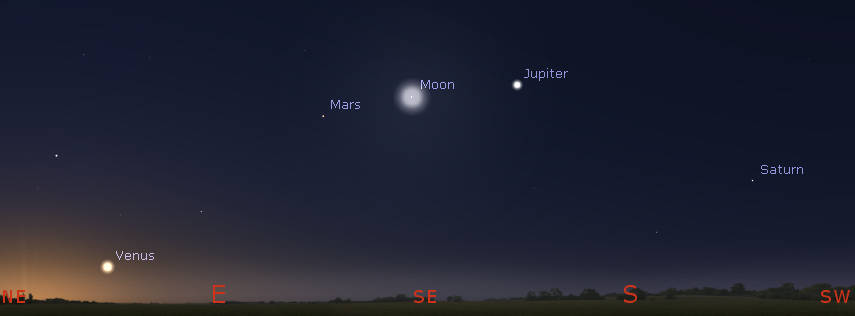
The morning planets and the Moon at 5:15 am tomorrow morning, July 21, 2022. The planets and Moon actually appear in a straight line in the sky, being placed along the ecliptic, or path of the Sun in the sky. The ecliptic is a great circle on the celestial sphere. Click on the image to enlarge it. The span of the planets from Venus to Saturn is 129 degrees. Click on the image to enlarge it. Created using Stellarium.
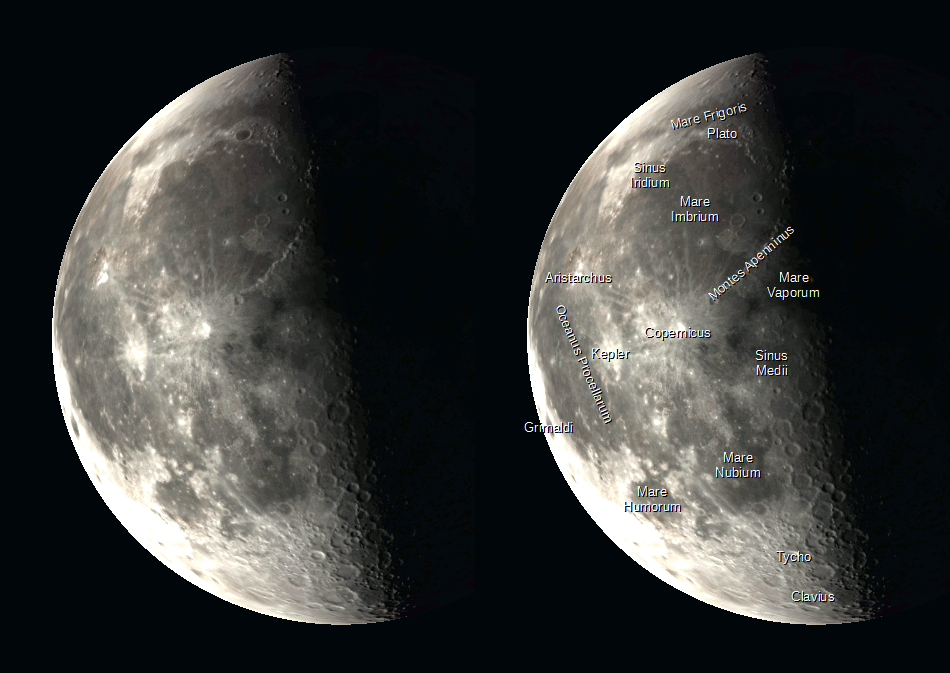
Animated last quarter Moon at 5:15 tomorrow morning, July 21, 2022, with labels. Created using Stellarium and LibreOffice.
Translations
Mare Frigoris – Sea of Cold
Mare Humorum – Sea of Moisture
Mare Imbrium – Sea of Showers
Mare Nubium – Sea of Clouds
Mare Serenitatis – Sea of Serenity
Mare Vaporum – Sea of Vapors
Montes Apenninus – Apennine Mountains
Oceanus Procellarum – Ocean of Storms
Sinus Iridium – Bay of Rainbows
Sinus Medii – Central Bay
Note that Mare is pronounced Mar-é
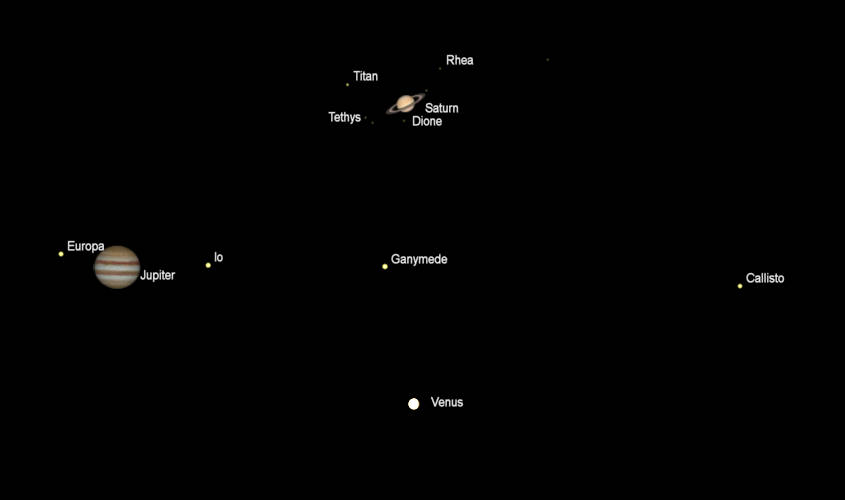
Views of Saturn, Jupiter, and Venus (north up) as they would be seen in a small telescope, with the same magnification, tomorrow morning at 5:15 am, July 21, 2022. I do not show planets less than 10 seconds of arc in diameter. Apparent diameters: Saturn 18.56″, its rings 43.24″; Jupiter 43.47″. Mars is not shown, its apparent diameter is 7.84″; Venus 11.10″. The ” symbol means seconds of arc (1/3600th of a degree.) Click on the image to enlarge it. Created using Cartes du Ciel (Sky Charts).
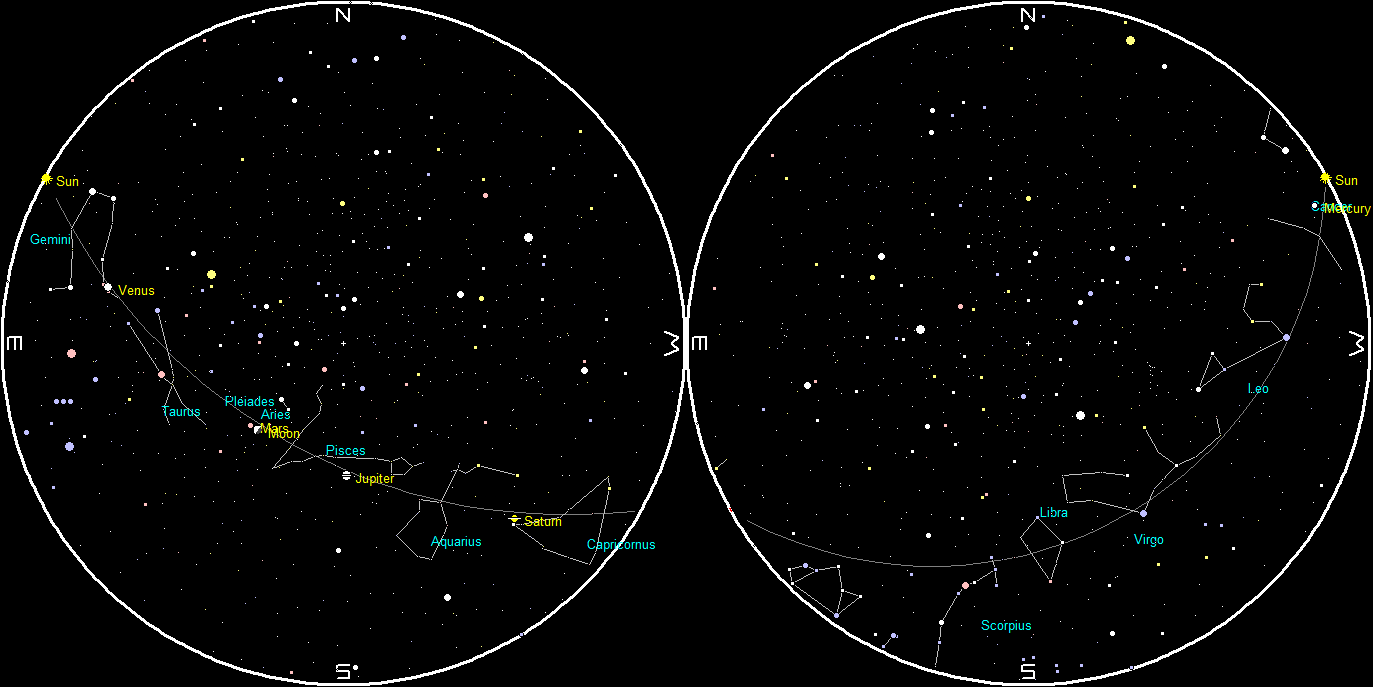
The naked-eye planets and the Moon at sunset and sunrise on a single night, starting with sunset on the right on July 21, 2022. The night ends on the left with sunrise on the 21st. Notice that all the naked-eye planets except Mercury are in the morning sky now. Click on the image to enlarge it. Created using my LookingUp program.
07/19/2022 – Ephemeris – How to find the constellations of the man with the snake
This is Ephemeris for Tuesday, July 19th. Today the Sun will be up for 15 hours and 7 minutes, setting at 9:22, and it will rise tomorrow at 6:16. The Moon, 1 day before last quarter, will rise at 12:52 tomorrow morning.
The red star Antares shines in the south at 11 pm, in the constellation of Scorpius. In the area of sky above lies a large constellation of faint stars called Ophiuchus, the serpent bearer. The constellation shape is like a large tilted bell, which reminds me of the head, shoulders and arms of a fellow that’s holding the snake, like a weight lifter pulling up a heavy barbell. The serpent he’s holding is Serpens, the only two-part constellation in the heavens. The head rises to Ophiuchus’ right, and the tail extends up to the left. In Greek legend Ophiuchus represents a great physician, educated by the god Apollo, and the centaur Chiron, who is also found in the stars as Sagittarius, now rising in the south-southeast below and left of him.
The astronomical event times given are for the Traverse City/Interlochen area of Michigan (EDT, UT – 4 hours). They may be different for your location.
Addendum
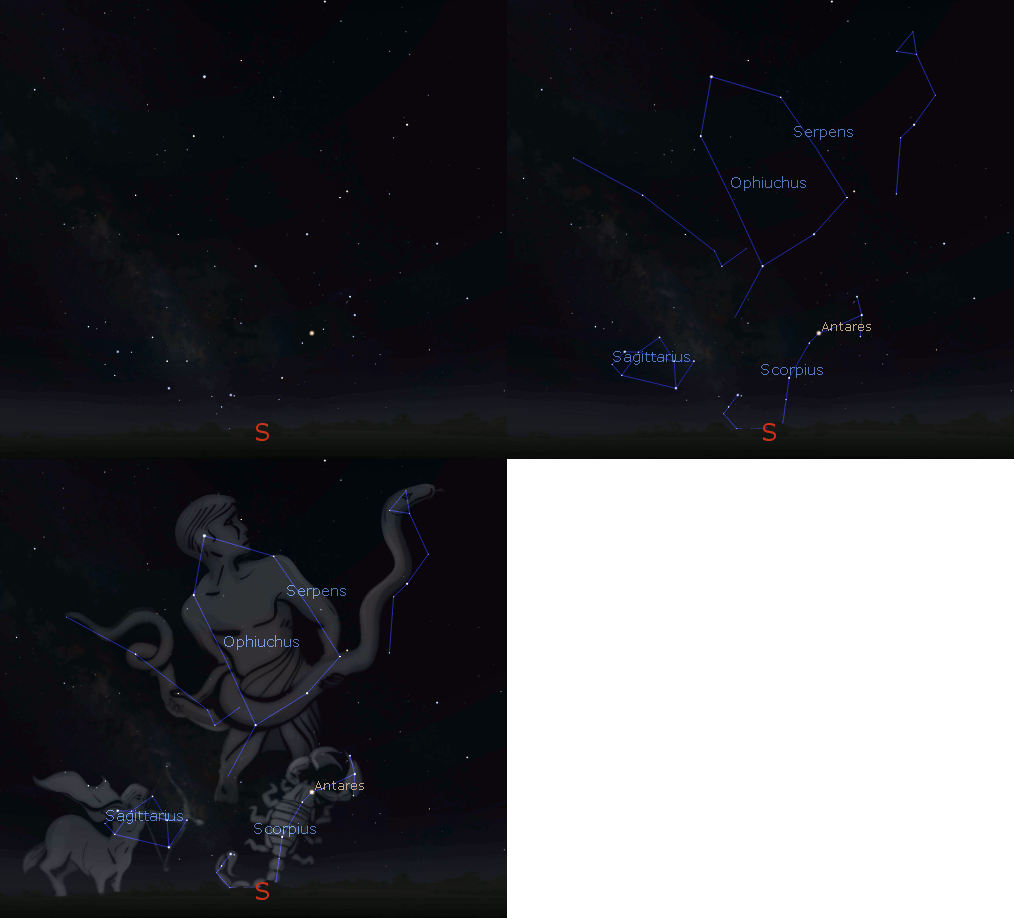
Ophiuchus finder animation for mid-July at 11 pm. Created using Stellarium and GIMP.
07/18/2022 – Ephemeris – How to find the celestial eagle
This is Bob Moler with Ephemeris for Monday, July 18th. Today the Sun will be up for 15 hours and 8 minutes, setting at 9:23, and it will rise tomorrow at 6:15. The Moon, 2 days before last quarter, will rise at 12:33 tomorrow morning.
Aquila the eagle is a constellation that lies in the Milky Way. It’s in the southeastern sky as it gets dark. Its brightest star, Altair, is one of the stars of the Summer Triangle, a group of three bright stars that dominate the eastern sky in the evening now. Altair, in the head of the eagle, is flanked by two slightly dimmer stars, the shoulders of the eagle. The eagle is flying northeastward through the Milky Way. Its wings are seen in the wing tip stars. A curved group of stars to the lower right of Altair is its tail. Within Aquila, the Milky Way shows many dark clouds as part of the Great Rift that splits it here. The other summer bird is Cygnus the swan above and left of Aquila, flying toward the eagle.
The astronomical event times given are for the Traverse City/Interlochen area of Michigan (EDT, UT – 4 hours). They may be different for your location.
Addendum
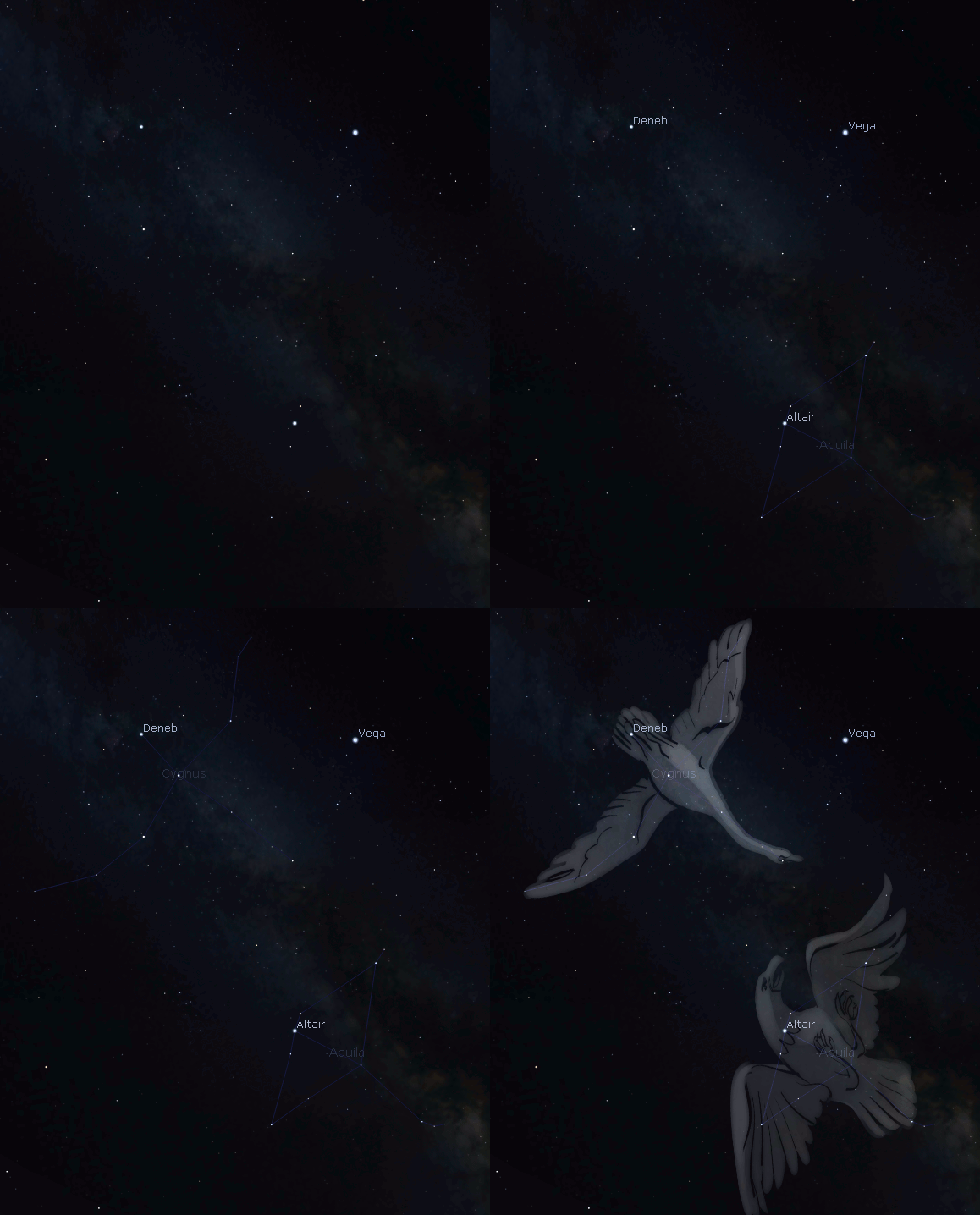
Animated Aquila finder chart, also showing Cygnus the swan. The named stars are the stars of the Summer Triangle. Created using Stellarium.
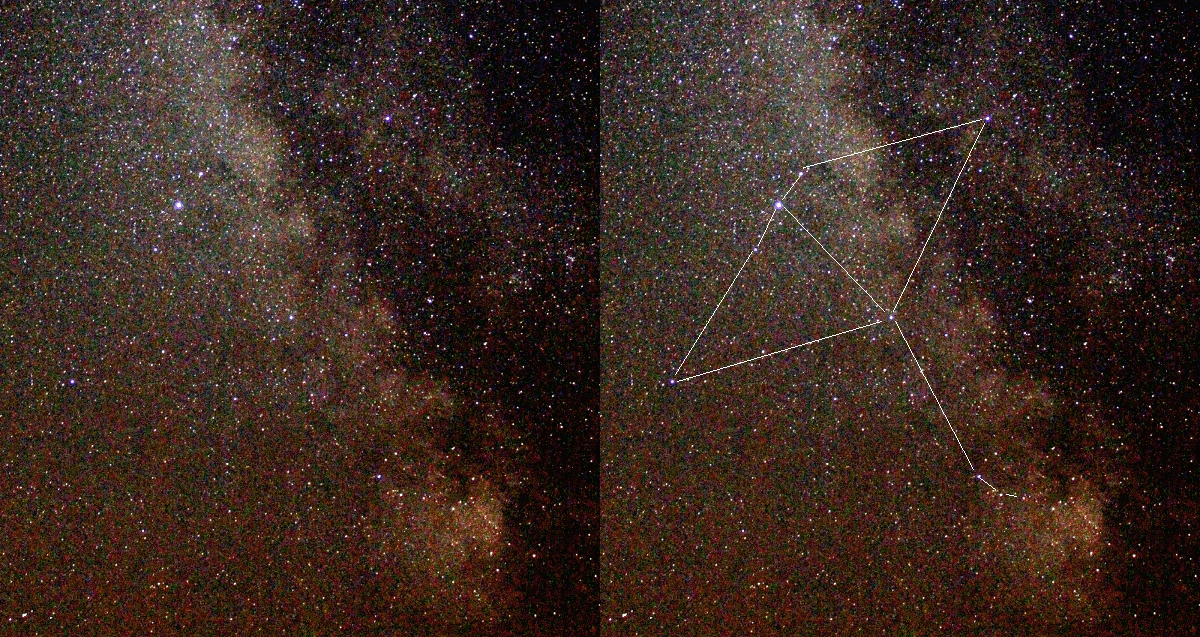
Annotated and animated photograph taken of Aquila August 13, 2018 during the Perseid meteor shower. Alas, no Perseids in this photograph. The clouds of the Great Rift are easily visible. The red tinge of the image was due to the smoke haze from the wildfires in the western states. Taken by me and processed using Registax and GIMP.
07/15/2022 – Ephemeris – How to find the constellation of Cygnus the swan
This is Ephemeris for Friday, July 15th. Today the Sun will be up for 15 hours and 14 minutes, setting at 9:25, and it will rise tomorrow at 6:12. The Moon, 2 days past full, will rise at 11:23 this evening.
Located fairly high in the east at 11 p.m. is the constellation of Cygnus the swan, flying south through the Milky Way. It is also called the Northern Cross. At the left, the tail of the swan or the head of the cross is the bright star Deneb, one of the stars of the Summer Triangle. The next star right is Sadr the intersection of the body and the wings of the swan seen in flight, or the intersection of the two pieces of the cross. There are two or three stars farther to the right that delineate the swan’s long neck or upright of the cross, that ends with the star Alberio in the beak of the swan or foot of the cross. The crosspiece of the cross extends to the stars on either side of the intersection star Sadr, while the swan’s wings extend to a couple more stars each.
The astronomical event times given are for the Traverse City/Interlochen area of Michigan (EDT, UT – 4 hours). They may be different for your location.
Addendum
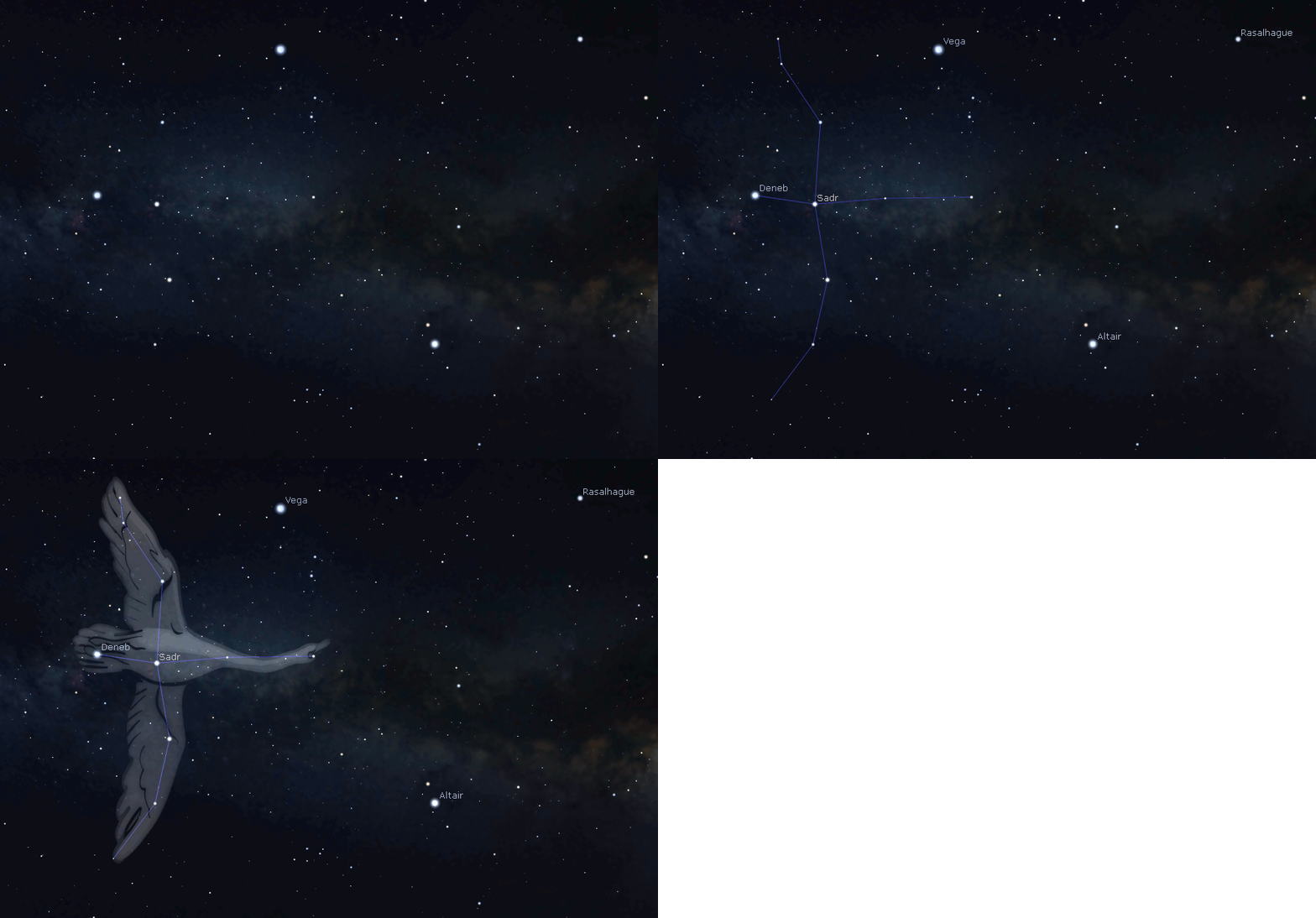
Animated Cygnus finder chart. Included also are, beside Deneb, the other stars of the Summer Triangle: Vega and Altair and their constellations Lyra the harp and Aquila. See if you can find them. Created using Stellarium.
07/14/2022 – Ephemeris – The dimmest Summer Triangle star is actually the brightest
This is Ephemeris for Thursday, July 14th. Today the Sun will be up for 15 hours and 15 minutes, setting at 9:26, and it will rise tomorrow at 6:11. The Moon, 1 day past full, will rise at 10:49 this evening.
This evening, when it gets dark enough, the bright star Deneb in Cygnus the swan will be high in the east-northeast. I’ll cover Cygnus tomorrow when the sky is darker. Deneb is the dimmest star of the summer triangle. Of the other stars of the triangle, Vega is higher in the east, while Altair is lower in the southeast. Deneb’s apparent magnitude, or brightness as seen from Earth, makes it the dimmest of the three bright stars. That’s because of its vast distance of maybe 1,550 light years, 57 times the distance of Vega. If brought as close as Vega, Deneb would be as bright, at least, as the first quarter moon. It is possibly as bright as 196 thousand Suns; and it’s a huge star, possibly as large in diameter as the orbit of the Earth. For all this, it is only 23 or so times the mass of the Sun.
The astronomical event times given are for the Traverse City/Interlochen area of Michigan (EDT, UT – 4 hours). They may be different for your location.
Addendum
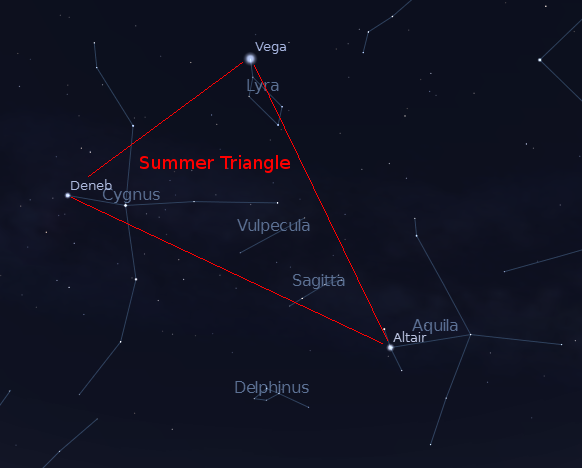
The Summer Triangle. Created using Stellarium and The Gimp.
If you put Deneb in the search box, you will find that the content of the posts, over the years, about the star are nearly identical. However, the distance estimates vary widely. It is too far away for trigonometric parallax measurements by earth based telescopes. Though in the range of ESA’s Hipparcos and Gaia satellites, it is too bright. So other less accurate measurements are used. I don’t think it involves coin flipping. The assumed distance also affects estimates of luminosity, and mass.
07/13/2022 – EPHEMERIS – Let’s search for the naked-eye planets for this week
This is Ephemeris for Wednesday, July 13th. Today the Sun will be up for 15 hours and 17 minutes, setting at 9:26, and it will rise tomorrow at 6:10. The Full Buck Moon, also a supermoon, will rise at 10:05 this evening.
Let’s search for the naked-eye planets for this week. All the naked-eye planets are in the morning sky, although Mercury is too close to the Sun to be seen. On the Saturday it will leave the morning sky crossing over to the evening sky. At 5 am tomorrow, the planets will be spread out from brilliant Venus low in the east-northeast to Saturn higher in the south-southwest. Mars will be a lot higher than Venus in the east-southeast. Jupiter is a bit higher in the southeast. Mars is dimmer than Jupiter, but is slowly getting brighter as the Earth creeps up on it. Saturn ends the line of planets in the south-southwest. Tonight, Saturn will rise about 11:03 pm, though it won’t be an official evening planet until it rises before sunset, which happens in mid-August.
The astronomical event times given are for the Traverse City/Interlochen area of Michigan (EDT, UT – 4 hours). They may be different for your location.
Addendum
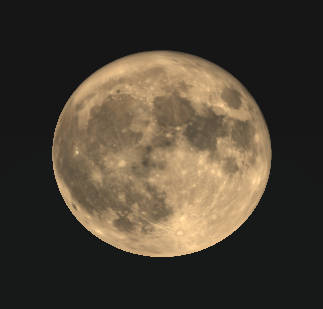
Tonight’s full supermoon shortly after it will rise at 10:30 pm July 13, 2022. Created using Stellarium.
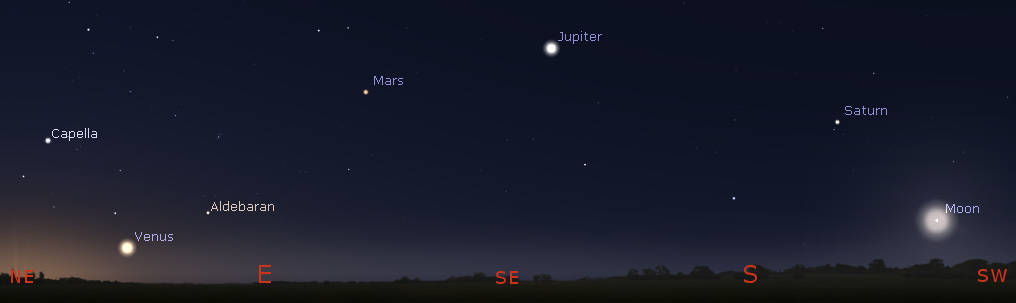
The morning planets and the Moon at 5 am tomorrow morning, July 14, 2022. The planets and Moon actually appear in a straight line in the sky, being placed along the ecliptic, or path of the Sun in the sky. The ecliptic is a great circle on the celestial sphere. Click on the image to enlarge it. The span of the planets from Venus to Saturn is 122 degrees. Two of winter’s first magnitude stars, Aldebaran and Capella, are now visible in morning twilight. Click on the image to enlarge it. Created using Stellarium.
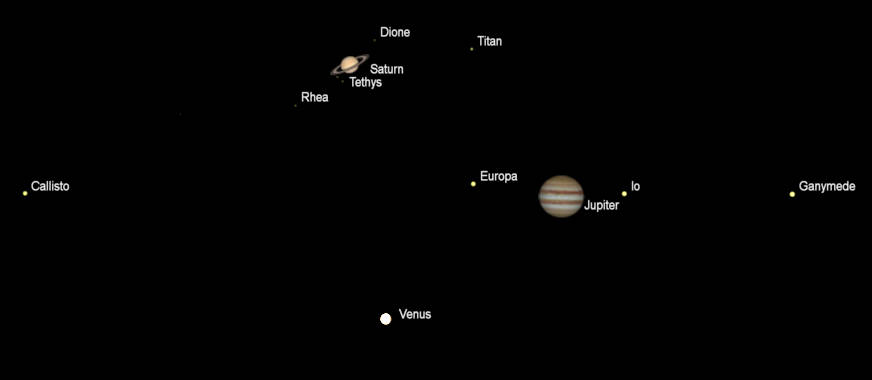
Views of Saturn, Jupiter, and Venus (north up) as they would be seen in a small telescope, with the same magnification, tomorrow morning at 5:00 am, July 14, 2022. I do not show planets less than 10 seconds of arc in diameter. Apparent diameters: Saturn 18.46″, its rings 43.01″; Jupiter 42.63″. Mars is not shown, its apparent diameter is 7.63″; Venus 11.31″. The ” symbol means seconds of arc (1/3600th of a degree.) Click on the image to enlarge it. Created using Cartes du Ciel (Sky Charts).
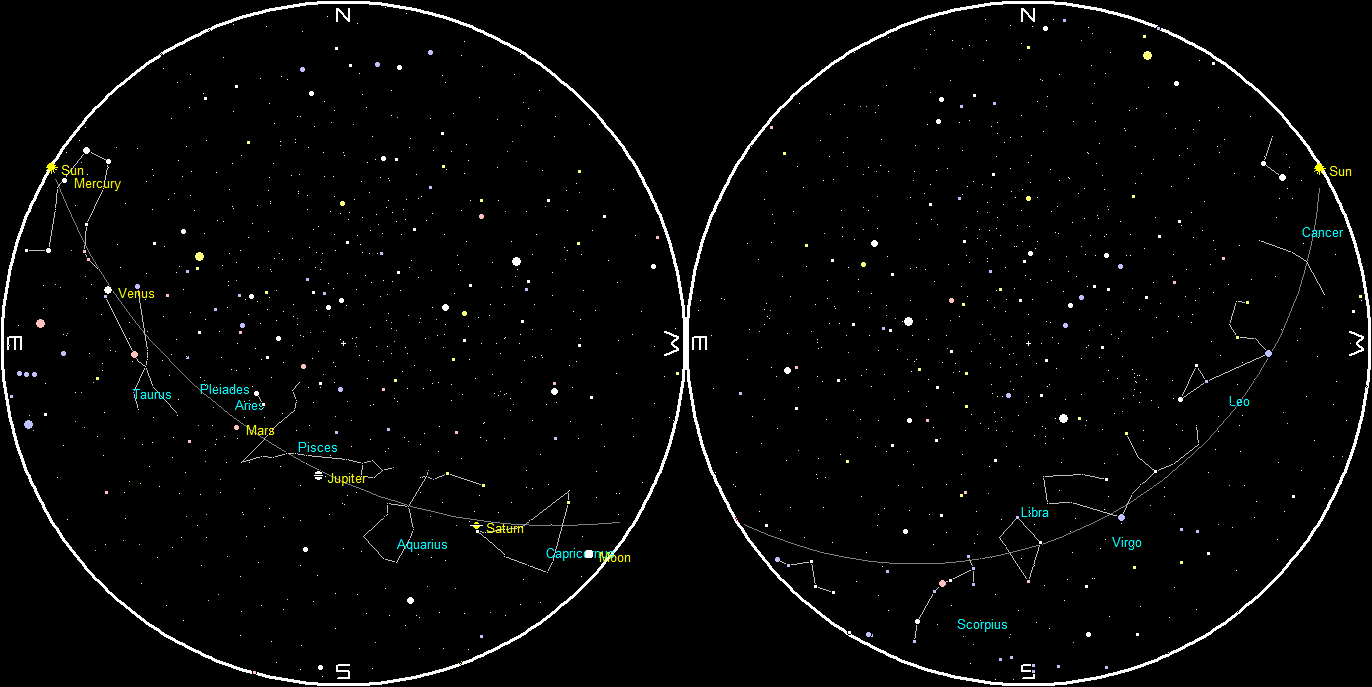
The naked-eye planets and the Moon at sunset and sunrise on a single night, starting with sunset on the right on July 13, 2022. The night ends on the left with sunrise on the 14th. Notice that all the naked-eye planets are in the morning sky now. Click on the image to enlarge it. Created using my LookingUp program.
07/12/2022 – Ephemeris – The rest of the first images and data from the James Webb Space Telescope to be released tomorrow
This is Bob Moler with Ephemeris for Tuesday, July 12th. Today the Sun will be up for 15 hours and 18 minutes, setting at 9:27, and it will rise tomorrow at 6:09. The Moon, 1 day before full, will set at 5:26 tomorrow morning.
Later today at 10:30 am, NASA and the Space Telescope Science Institute will present the first results from the James Webb Space Telescope. These will be, I believe, four multi-spectral images rendered in full color, and other data. The wavelength coverage of Webb in the infrared is greater than Hubble Space Telescope, which is mostly visible light, by several factors. The test images we’ve seen released so far are monochromatic and rendered in white, yellow, orange and red to depict a wide brightness range. There will be a Webb image release with explanations at the Milliken Auditorium of the Dennos Museum at 10:30, with doors opening at 10 am; and also at the Main Library in Traverse City. I’ll endeavor to be at the library.
The astronomical event times given are for the Traverse City/Interlochen area of Michigan (EDT, UT – 4 hours). They may be different for your location.
Addendum
Not known by me last Sunday night when I wrote and recorded today’s program was that President Biden was going to preview one of the images Monday evening. If I were the general public, I would have been underwhelmed. It wasn’t enlarged, or particularly colorful. Here it is below. Click on it for an even larger view:
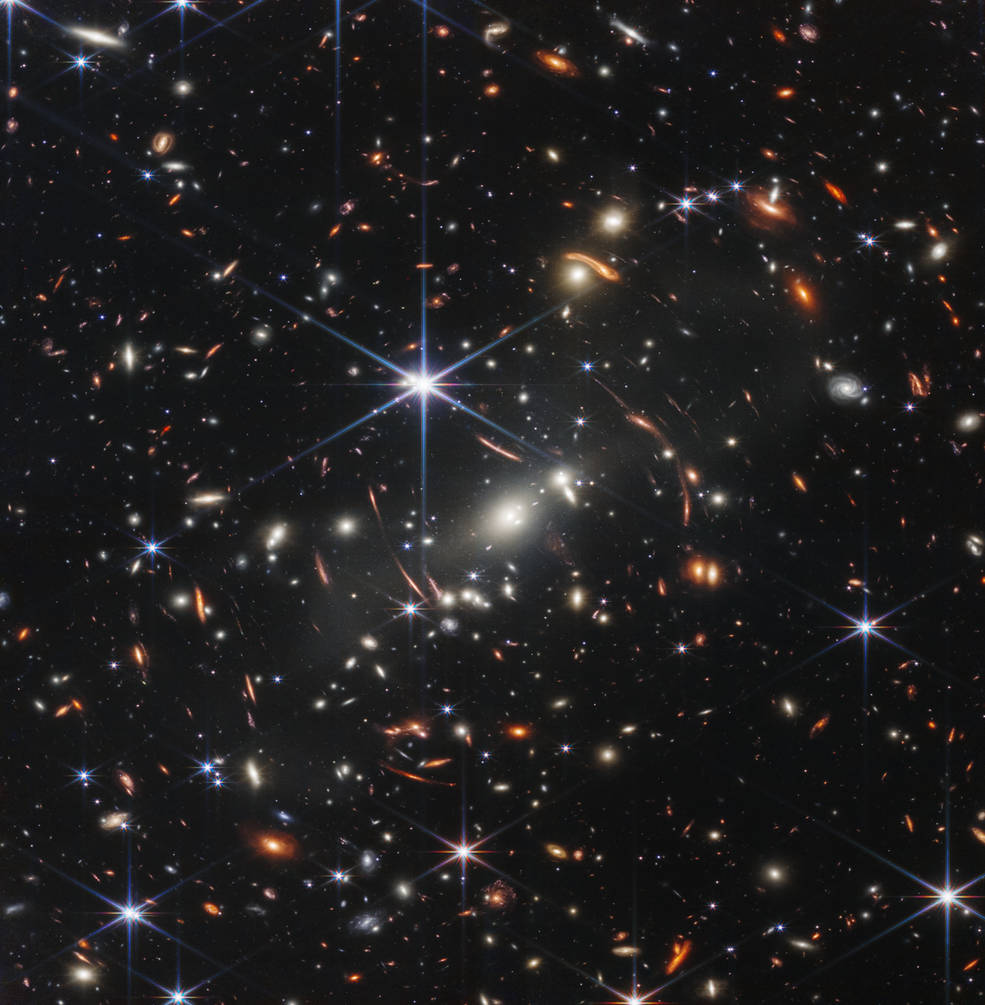
The teaser deep field image from President Biden’s July 11th presentation. Click on the image to fill your screen with it. Credit: NASA, ESA, CSA, JWST, STScI.
In the image above, anything with diffraction spikes is a star in our galaxy. Everything else is a galaxy, like the Milky Way, with billions of stars. This is a tiny piece of sky. As a rule of thumb, the redder the galaxy, the farther away it is. The light emitted by these galaxies are starlight in mostly visible wavelengths, but shifted to the infrared by their great speed of recession caused by the expansion of space between us and them. Also note that many of these galaxies are distorted into short arcs. They seem curved as if being part of a circle around the large, bright galaxy in the center. This is caused by the gravitational lensing caused by the mass of that galaxy, dark matter, and other galaxies in its cluster. This is an effect predicted by Einstein’s theory of General Relativity. I have a feeling that we are going to see a lot more gravitational lensing as the JWST probes into deeper and deeper fields.
One thing to remember about deep fields, is that because of the speed of light being finite, that the farther we look out, the farther back in time we see into an evolving universe. The farthest back we can see with electromagnetic radiation (that is gamma rays, x-rays, ultraviolet, visible, and infrared light, microwaves and radio waves) is the era of the cosmic microwave background, when the universe became transparent, about 380 thousand years after the Big Bang. After that came a period called the dark ages before galaxies formed and the first stars ignited, called the dark ages. At least that’s what I hear-tell. There are lots of questions, like the chicken and egg question: Which came first, supermassive black holes or galaxies?
We will find answers to some of our questions, I’m sure. Even more intriguing, we will be able to ask even more and deeper questions to probe the mystery and beauty of the universe.
07/11/2022 – Ephemeris – First color images from the James Webb Space Telescope will be released tomorrow
This is Ephemeris for Monday, July 11th. Today the Sun will be up for 15 hours and 20 minutes, setting at 9:28, and it will rise tomorrow at 6:08. The Moon, 2 days before full, will set at 4:19 tomorrow morning.
Tomorrow at 10:30 am, NASA and the Space Telescope Science Institute will present the first results from the James Webb Space Telescope. These will be, I believe, four multi-spectral images rendered in full color, and other data. The spectral range of Webb in the infrared is greater than Hubble Space Telescope by several factors. Hubble operates mostly in visible light and plus a bit in the ultraviolet and the near infrared. The current alignment images released are monochromatic and rendered in orange for aesthetic reasons, and to hint that these are from the long wavelength part of the spectrum. I expect the new images to look as great or better than anything the Hubble has produced. There will be a Webb image release and celebration at the Milliken Auditorium of the Dennos Museum at 10:30, with doors opening at 10 am; and also at the Main Library in Traverse City.
The astronomical event times given are for the Traverse City/Interlochen area of Michigan (EDT, UT – 4 hours). They may be different for your location.
Addendum
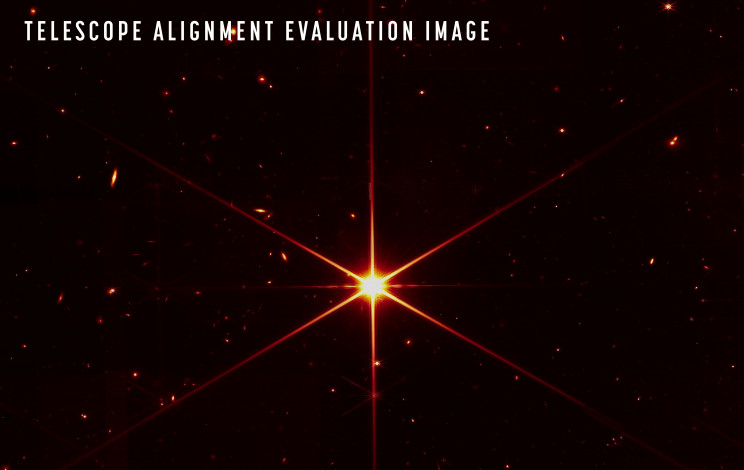
The alignment image of the James Webb Space Telescope after the 18 primary mirror segments have been aligned to act as a single mirror. Beside the alignment star showing its overexposed diffraction spikes, many faint galaxies can be seen. The alignment star, near the Big Dipper, is almost too faint to be seen in binoculars. Credit: NASA, Space Telescope Science Institute (STScI).
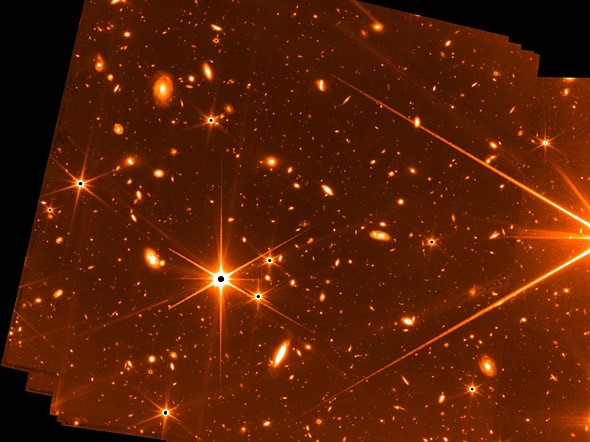
Webb Fine Guidance Sensor (FGC) test image guiding on a star for 72 exposures totaling 32 hours over 8 days. The color key to brightness is white, yellow, orange, red for bright to dim. The black cores to the stars, and at least one galaxy is due to saturating the pixels due to brightness, and are not black holes. Credits: Canadian Space Agency, NASA, FGS team. The Fine Guidance Sensor is a contribution to the James Webb Space Telescope by the Canadian Space Agency.
 Bob Moler's Ephemeris Blog