Archive

Archive for the ‘Observing’ Category

Ephemeris: 08/29/2025 – Late August crescent Moon stays low in the western sky

August 29, 2025 Comments off

This is Ephemeris for Friday, August 29th. Today the Sun will be up for 13 hours and 22 minutes, setting at 8:24, and it will rise tomorrow at 7:03. The Moon, 2 days before first quarter, will set at 10:48 this evening.

There’s an interesting feature that I’ve noticed about the Moon this time of year. When there’s a waxing crescent Moon in the evening, in late summer to early autumn, it’s seen pretty low in the southwestern sky after sunset. Tonight it’ll be two days before first quarter so it’ll be a fat crescent. However, when it’s seen after sunset, it will be very low in the southwestern sky. Contrast that for early risers, at this time of year the waning crescent Moon moves at a steep angle to the horizon, as do the planets now in the east. And of course the opposite is true for late winter and early spring moons. By the way, the Harvest Moon is in early October this year. The Harvest Moon is the nearest full moon to the autumnal equinox.

The astronomical event times given in this blog are for the Traverse City/Interlochen area of Michigan (Lat 44.7° N, Long 85.7° W; EDT, UT – 4 hours) unless stated otherwise. Times will be different for other locations.

Addendum
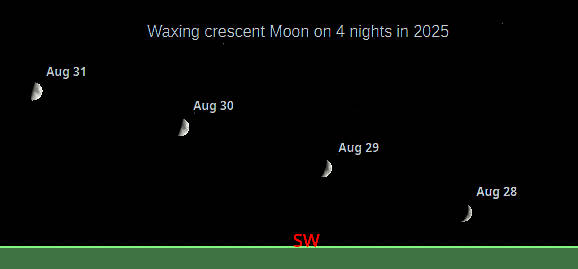
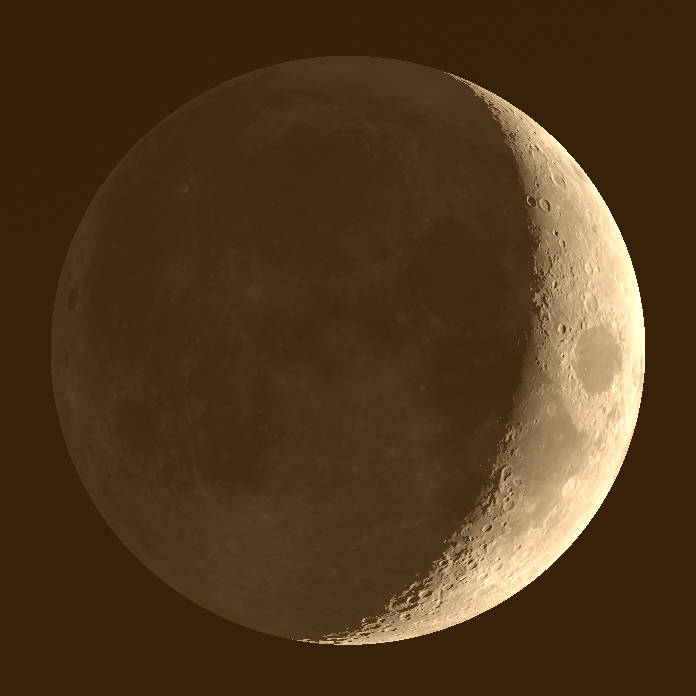
Daily position of the crescent Moon on four dates in late August, 2025. The Moon is shown 3 times normal size for clarity. Created using Stellarium, GIMP and LibreOffice Draw.
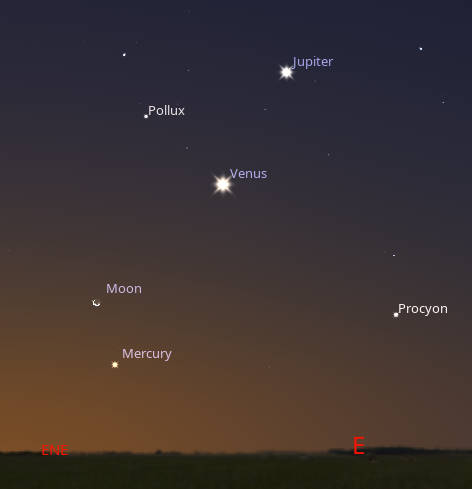
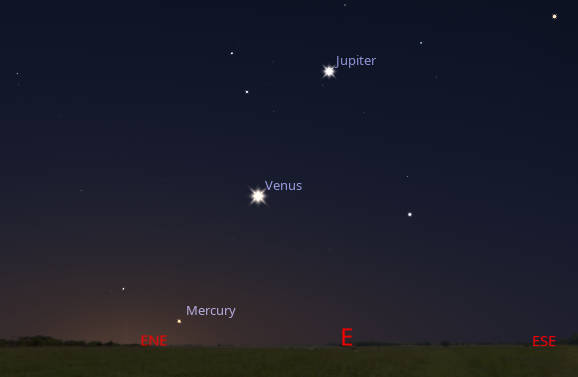
This is the planert and Moon line up from the morning of a couple of weeks ago. Note the steep line of the planets. The Planets motion closely follows the ecliptic (Sun’s path) as does the Moon.

Ephemeris: 08/27/2025 – Taking our weekly look at the whereabouts of the naked-eye planets

August 27, 2025 Comments off

This is Ephemeris for Wednesday, August 27th. Today the Sun will be up for 13 hours and 28 minutes, setting at 8:27, and it will rise tomorrow at 7:00. The Moon, halfway from new to first quarter, will set at 10:02 this evening.

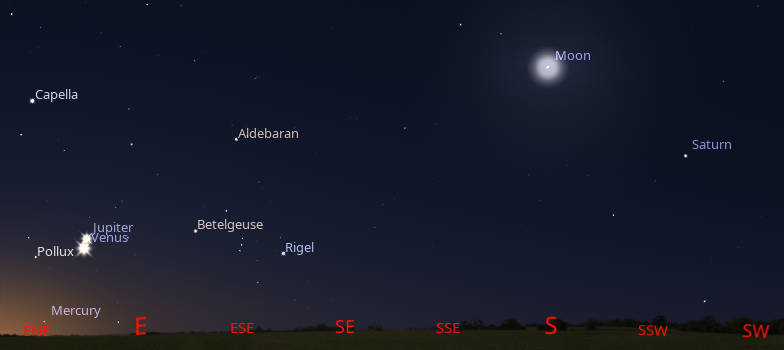
Let’s take our weekly look at the whereabouts of the naked-eye planets. The Red Planet Mars is too close to the direction of the Sun to spot. This is the curse of trying to view evening planets, which are near the direction of the Sun in late summer and early fall, for us at higher latitudes. Saturn now rises at 9:27 PM in the east. In a telescope Saturn sports a very thin ring, a bit more than 3° from being edge on. This angle will decrease to about a third of a degree by November 23rd before increasing. By 6 AM Saturn will be in the southwest. Jupiter will appear above the brighter Venus in the Eastern sky And among the brighter winter stars. Mercury will be in line with Venus and Jupiter very near the horizon.

The astronomical event times given in this blog are for the Traverse City/Interlochen area of Michigan (Lat 44.7° N, Long 85.7° W; EDT, UT – 4 hours) unless stated otherwise. Times will be different for other locations.

Addendum
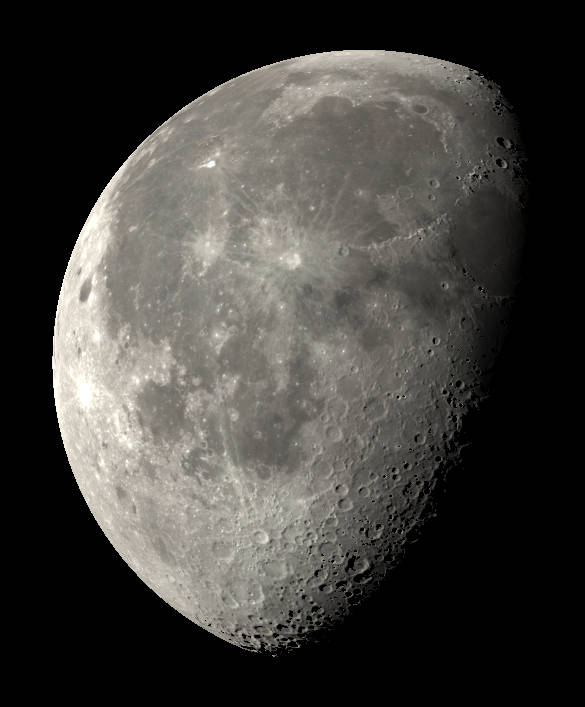
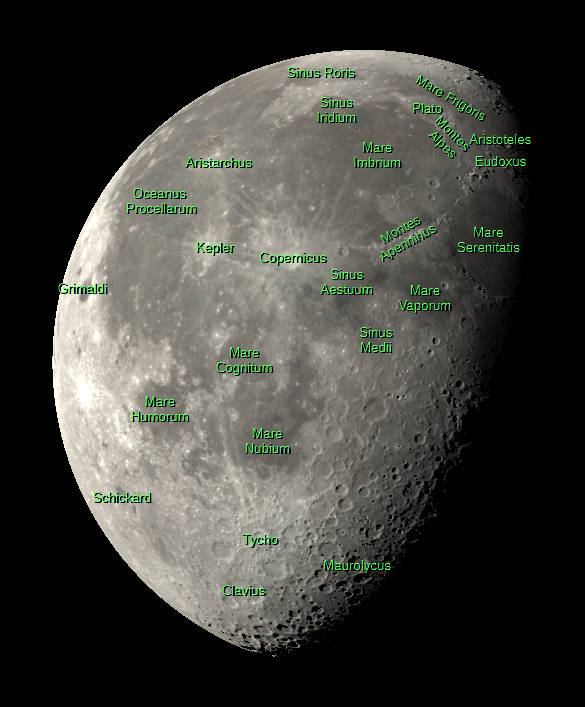
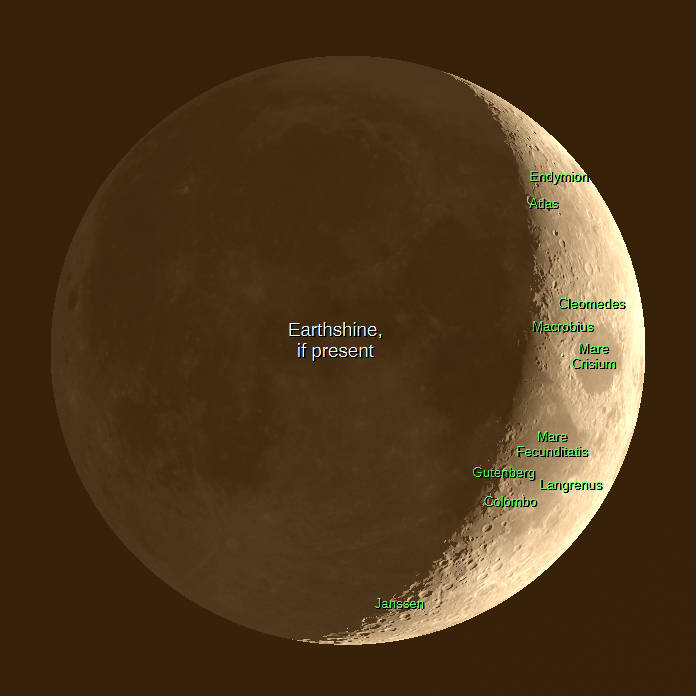
The Moon tomorrow morning, July 28, 2025. A view visible in small telescopes showing an image with and without selected features labeled. Created using Stellarium, LibreOffice Draw, and GIMP.
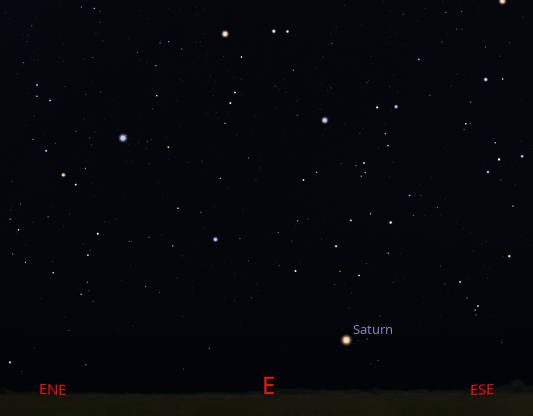
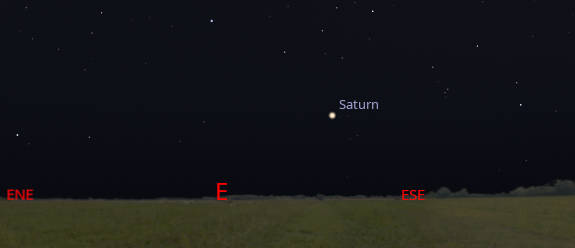
Saturn is seen low in the east at 10:30 PM tonight
Saturn is seen low in the east at 10:30 PM tonight, August 27, 2025. Created using Stellarium.
Three of the four morning planets are visible in the east at 6:00 AM tomorrow morning
Three of the four morning planets are visible in the east at 6:00 AM tomorrow morning, August 28, 2025. Saturn is off in the southwest. Mercury may not actually be visible. Created using Stellarium and GIMP.
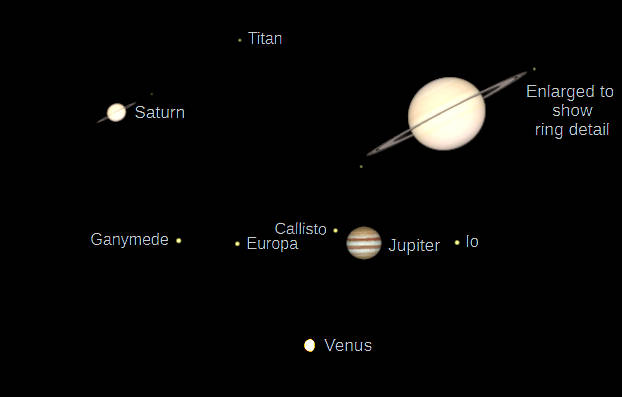
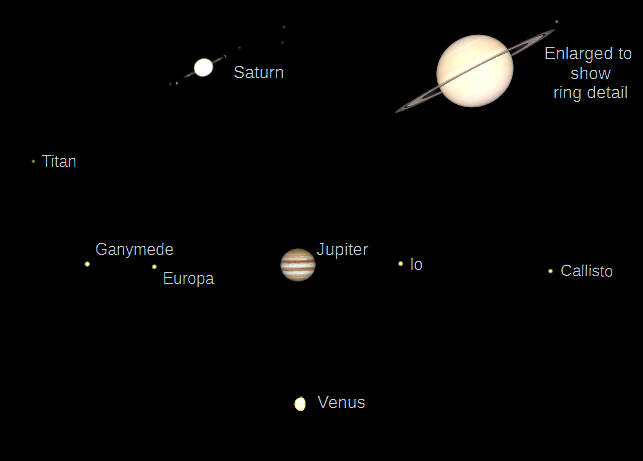
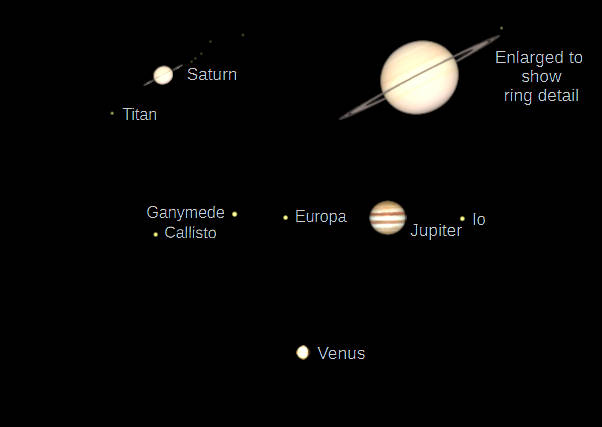
Telescopic Saturn, Jupiter and Venus (north up) as they would be seen in a small telescope with the same magnification
Telescopic Saturn, Jupiter and Venus (north up) as they would be seen in a small telescope with the same magnification. On the evening of the August 27th 2025, Saturn will be 19.5″ in diameter, but its rings, even being nearly edge on, should show up brighter than seen here, and extend to 44.8″. They are tilted 2.7° from being edge on. On the morning of the August 28st 2025, Jupiter will be 34.1″ in diameter. Venus’ apparent diameter will be 12.5″, and be 83.4% illuminated. Mercury, too small to be shown here, is 5.9″ in diameter, and 77.1% illuminated. The ” means seconds of arc, or 1/3600th of a degree. Created using Cartes du Ciel (Sky Charts), LibreOffice Draw and GIMP.
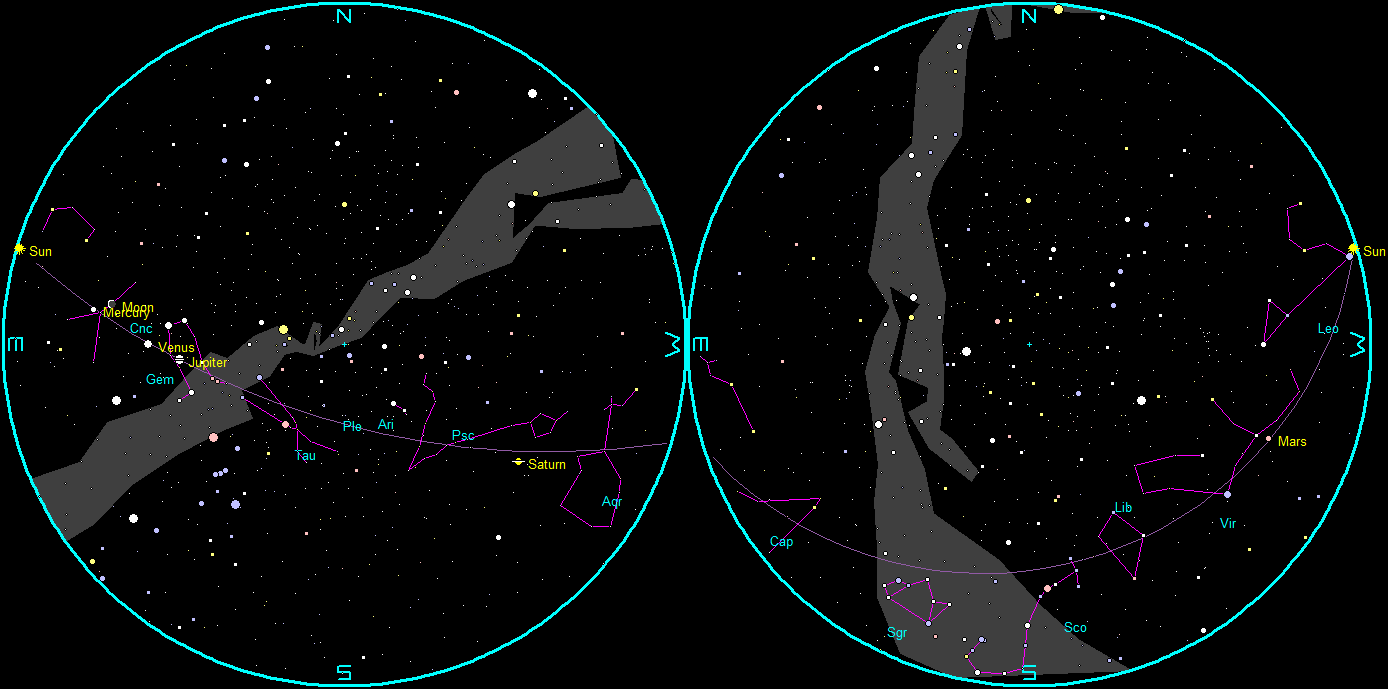
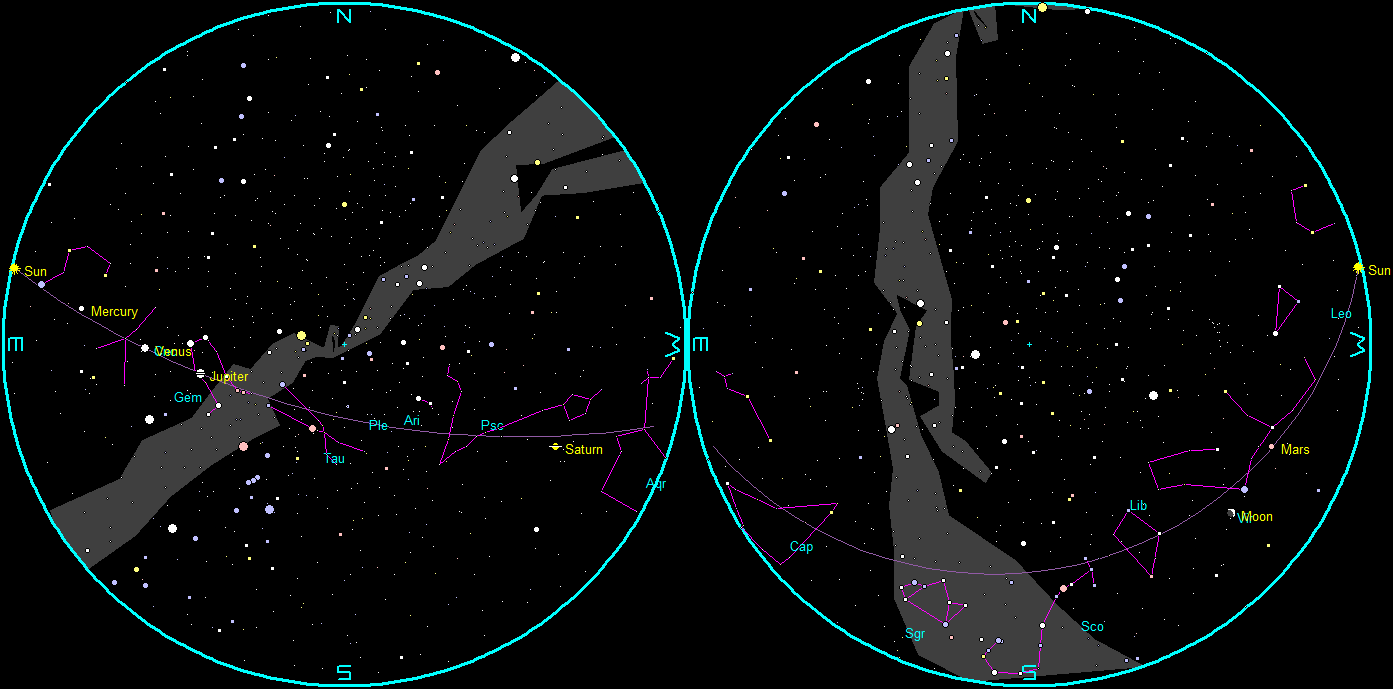
The naked-eye planets and the Moon at sunset and sunrise on a single night
The naked-eye planets and the Moon at sunset and sunrise on a single night, starting with sunset on the right on August 27, 2025. The night ends on the left with sunrise on the 28th. Click or tap on the image to enlarge it. Created using my LookingUp app and GIMP.
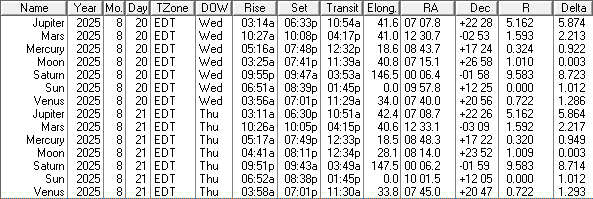
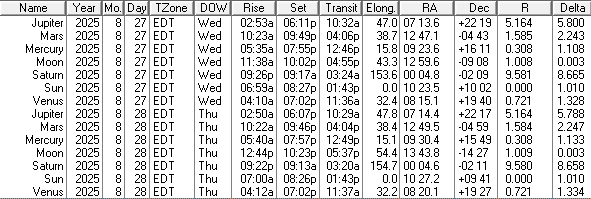
A low precision ephemeris of the Sun Moon and naked eye planet positions for today and tomorrow
This is a low precision ephemeris of the Sun Moon and naked eye planet positions for today and tomorrow, August 27th and 28th, 2025. Some of the columns are self-explanatory, others are not. The transit column is the time that the body crosses the meridian and is due south. Elong, for elongation, is the angle between the Sun and that body. RA is right ascension, which is the object’s east-west position on the celestial sphere in hours and minutes. Dec is declination which is the north-south position of the object on the celestial sphere in degrees and minutes. R is the distance of that object from the Sun in astronomical units. An astronomical unit is about 93 million miles or 150 million kilometers. And Delta is the distance of that object from the Earth, also in astronomical units. I omit the ‘m’ in am and pm for compactness. The data was generated using my LookingUp for DOS app and displayed as a table by my Ephemeris Helper app.

Ephemeris: 08/26/2025 – Update on our expected nova T Coronae Borealis

August 26, 2025 Comments off

This is Ephemeris for Tuesday, August 26th. Today the Sun will be up for 13 hours and 31 minutes, setting at 8:29, and it will rise tomorrow at 6:59. The Moon, 3 days past new, will set at 9:44 this evening.

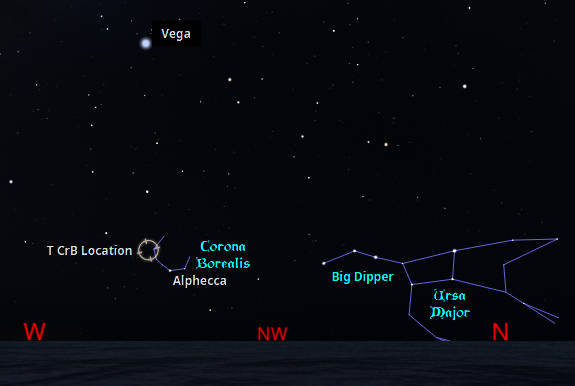
There is a star in the constellation of Corona Borealis, the Northern Crown, which astronomers are expecting to become a nova which means become rapidly very bright. The initial predictions favored last year, 2024, but it has yet to explode. The star’s designation is T Coronae Borealis, or T CrB for short. It’s a variable star designation. And an explosion occurs on one member of this binary star system about every 80 years. The last time was in 1946. Jean Schneider* of the Paris Observatory thinks they found a pattern within the 80-year time frame. The 227.6-day period of the white dwarf star orbiting its much larger primary. This seems to match the last three explosions. So the next likely date will be November 10th this year. We’ll see.

The astronomical event times given in this blog are for the Traverse City/Interlochen area of Michigan (Lat 44.7° N, Long 85.7° W; EDT, UT – 4 hours) unless stated otherwise. Times will be different for other locations.

* I found a link to this on the spaceweather.com website in a section called T CrB Nova Watch.

Addendum

If T CrB goes nova around November 10, 2025, this would be the location of the nova in the sky at 7 PM for the Grand Traverse area if Michigan.
If T CrB goes nova around November 10, 2025, this would be the location of the nova in the sky at 7 PM for the Grand Traverse area of Michigan. This is about an hour and 20 minutes after sunset for most northern mid-latitude locations. Created using Stellarium,, labeled in LibreOffice Draw and exported in GIMP.

Ephemeris: 08/25/2025 – Two fascinating constellations in and near the Summer Triangle

August 25, 2025 Comments off

This is Bob Moler with Ephemeris for Monday, August 25th. Today the Sun will be up for 13 hours and 33 minutes, setting at 8:31, and it will rise tomorrow at 6:58. The Moon, 2 days past new, will set at 9:27 this evening.

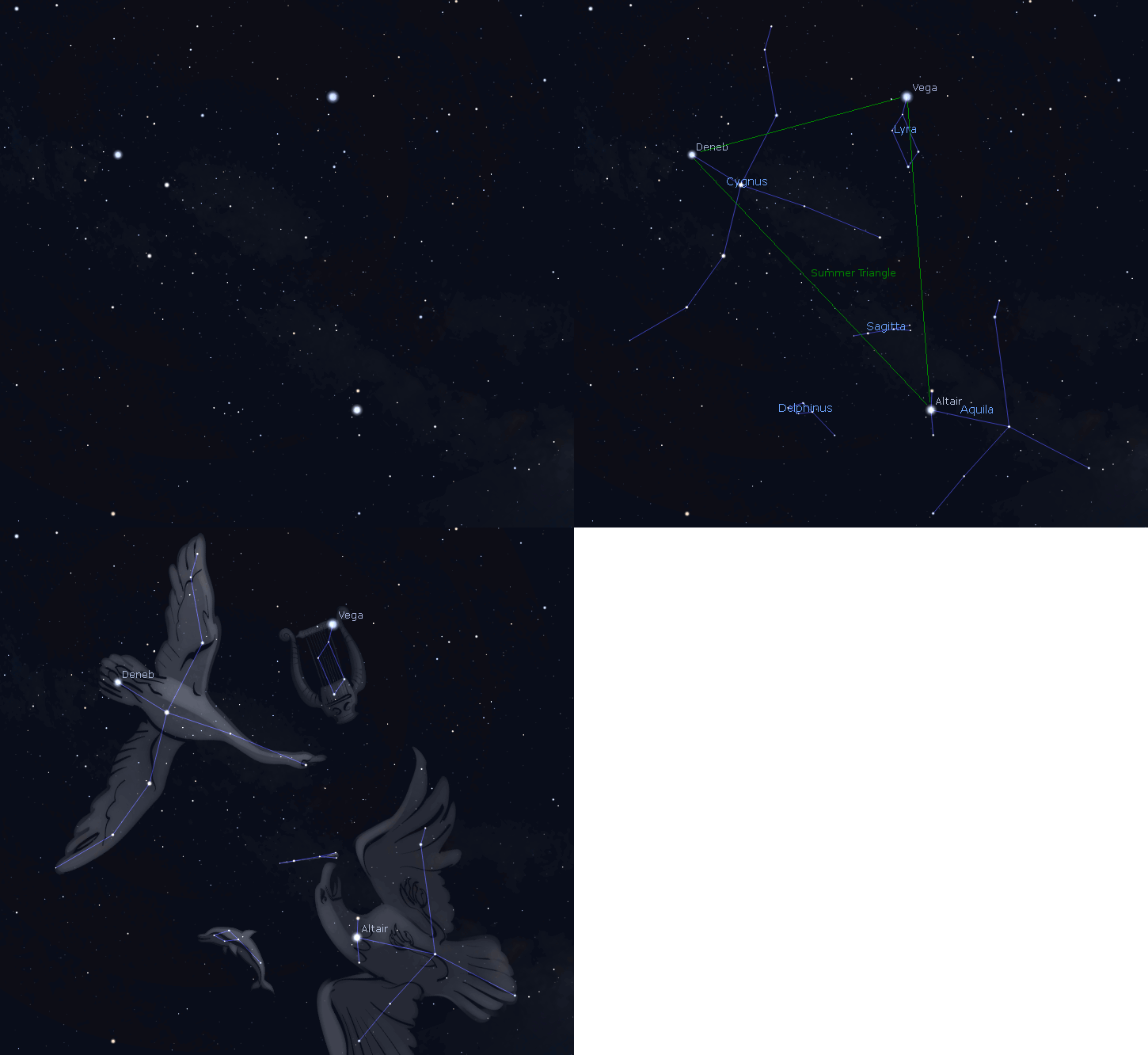
There are two small constellations in and near the Summer Triangle of bright stars. Both are near Altair the bottom star of the triangle in the southeast. The first is Delphinus the dolphin to the left of Altair. Delphinus is made-up of a small squished box of stars with another star below. It does look a dolphin leaping out of the water. The legendary Greek poet Arion, according to myth, was rescued by a dolphin. Also, the little squished box is an asterism called Job’s Coffin, though no one knows the origin of that name. The second constellation is above Altair, and within the Summer Triangle. It is called Sagitta the arrow. The stars do line up to look like a short arrow. It’s supposed to represent Cupid’s dart.

The astronomical event times given in this blog are for the Traverse City/Interlochen area of Michigan (Lat 44.7° N, Long 85.7° W; EDT, UT – 4 hours) unless stated otherwise. Times will be different for other locations.

Addendum
Delphinus and Sagitta finder animation
Delphinus and Sagitta finder animation. Created using Stellarium and GIMP.
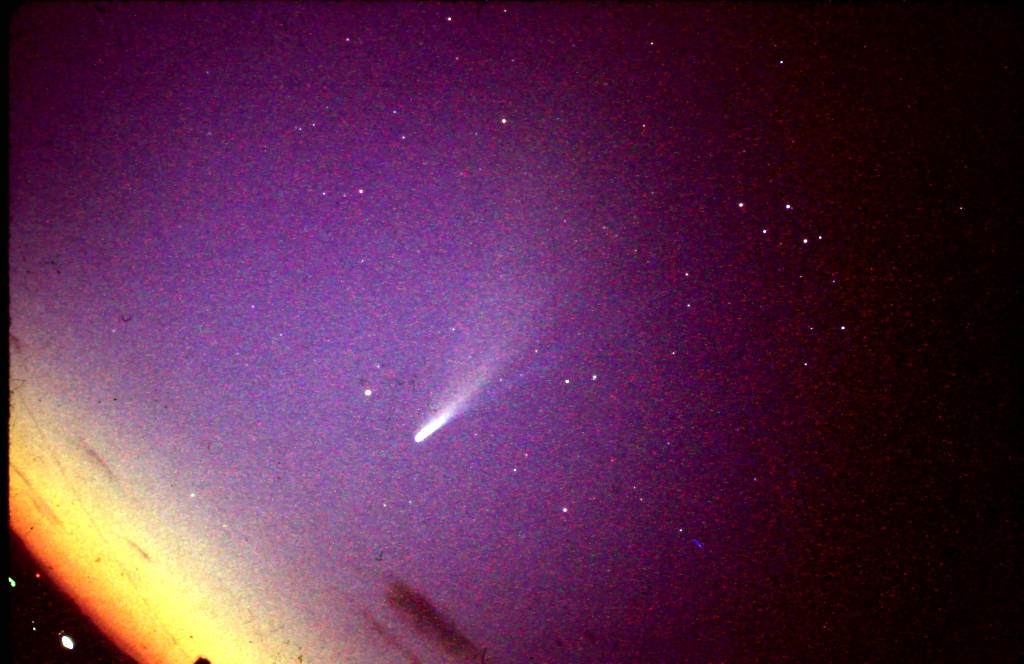
Comet West at 6 am, March 8, 1976
Comet West, C/1975 V1, as photographed by me at about 6 am, March 8, 1976. The wide, curved dust tail is most prominent with the narrow blue ion tail pointed more directly at the rising Sun. The small summer constellation of Delphinus the dolphin is to the upper right. The diamond shape of stars at the front of the dolphin’s body is an asterism called Job’s Coffin.

Ephemeris: 08/21/2025 – The Milky Way’s Great Rift

August 21, 2025 Comments off

This is Ephemeris for Thursday, August 21st. Today the Sun will be up for 13 hours and 45 minutes, setting at 8:38, and it will rise tomorrow at 6:53. The Moon, 2 days before new, will rise at 5:57 tomorrow morning.

Once one finds the Milky Way which is pretty hard to miss this month, it becomes obvious that the Milky Way is split lengthwise starting near Deneb, the northernmost star of the Summer Triangle, almost all the way to the Teapot of Sagittarius low in the south. That dark split is called the Great Rift. Galileo first discovered that the hazy clouds of the Milky Way were actually made of faint stars, so it was thought the dark areas were due to a lack of stars. The great 18th century astronomer William Herschel did star counts all over the sky with his telescope. A map his sister drew of the flattened shape of his universe shows the lack of distant stars in one direction. It’s not really fewer stars, but interstellar clouds of dust blocking the light of the stars behind them.

The astronomical event times given in this blog are for the Traverse City/Interlochen area of Michigan (Lat 44.7° N, Long 85.7° W; EDT, UT – 4 hours) unless stated otherwise. Times will be different for other locations.

Addendum
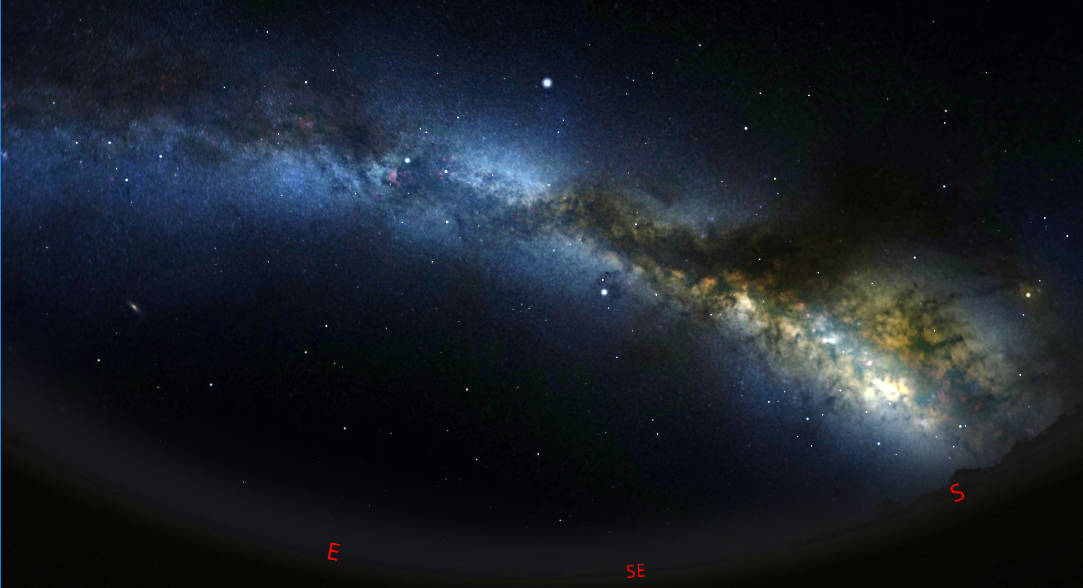
The span of the Milky Way across the summer sky as seen in the free Stellarium app. Specifically August 15th at 10 pm from Northern Michigan. The Milky Way has been set to its maximum brightness to show as much detail as possible. It really isn’t that bright. The horizon is only delineated by the compass points. The dark clouds of the Great Rift are also visible. The Milky Way, in Stellarium, is photo-realistic. The triangle of three bright stars above center is the Summer Triangle, Specifically, clockwise from the top star: Vega, Altair and Deneb. Large images can be truncated on the right. Click or tap on the image to enlarge and display the complete image.
The span of the Milky Way across the summer sky as seen in the free Stellarium app. The Milky Way has been set to its maximum brightness to show as much detail as possible. It really isn’t that bright. The horizon is only delineated by the compass points. The dark clouds of the Great Rift are also visible. The Milky Way, in Stellarium, is photo-realistic. The triangle of three bright stars above center is the Summer Triangle, Specifically, clockwise from the top star: Vega, Altair and Deneb. Large images can be truncated on the right. Click or tap on the image to enlarge and display the complete image.
Herschel's Universe
The shape of the universe (Milky Way) as measured by William Herschel by counting stars in the eyepiece fields of his telescope pointed in various directions. The large indent on the right is caused by the Great Rift, clouds of gas and dust the block the light of the stars behind it, not the lack of stars in that direction. The Great Rift is easily seen in the summer sky running through the Milky Way. Drawing by Caroline Herschel.

Ephemeris: 08/20/2025 – Taking our weekly look at the whereabouts of the naked-eye planets

August 20, 2025 Comments off

This is Ephemeris for Wednesday, August 20th. Today the Sun will be up for 13 hours and 48 minutes, setting at 8:39, and it will rise tomorrow at 6:52. The Moon, 3 days before new, will rise at 4:41 tomorrow morning.

Let’s take our weekly look at the whereabouts of the naked-eye planets. The Red Planet Mars is too close to the direction of the Sun to spot. This is the curse of trying to view evening planets, which are near the direction of the Sun in late summer and early fall, for us at higher latitudes. Saturn now rises at 9:55 PM in the east. In a telescope Saturn sports a very thin ring, a bit less than 3° from being edge on. By 6 AM Saturn will be in the southwest. Jupiter will appear above the brighter Venus in the Eastern sky And among the brighter winter stars. Venus is by far the brighter of the two planets. Mercury will be below the crescent Moon tomorrow morning.

The astronomical event times given in this blog are for the Traverse City/Interlochen area of Michigan (Lat 44.7° N, Long 85.7° W; EDT, UT – 4 hours) unless stated otherwise. Times will be different for other locations.

Addendum
Saturn is seen low in the east at 11 PM tonight
Saturn is seen low in the east at 11 PM tonight, August 20, 2025. It’s below the Great Square of Pegasus seen standing on one corner above and left of it. Created using Stellarium.
Three of the four morning planets are visible, along with the crescent Moon, in the east at 6:00 AM tomorrow morning, August 21, 2025.
Three of the four morning planets are visible, along with the crescent Moon, in the east at 6:00 AM tomorrow morning, August 21, 2025. Saturn is off in the southwest. Mercury will be visible for the next few days before it heads back toward the Sun. The Moon needed a bit of cosmetic surgery to have it show up better. Stellarium doesn’t handle real thin crescent moon images well at this small of a scale. Created using Stellarium and GIMP.
Telescopic Saturn, Jupiter and Venus (north up) as they would be seen in a small telescope with the same magnification.
Telescopic Saturn, Jupiter and Venus (north up) as they would be seen in a small telescope with the same magnification. On the morning of the August 21st 2025, Saturn will be 19.1″ in diameter, but its rings, even being nearly edge on, should show up brighter than seen here., and extend to 44.5″. They are tilted 2.9° from being edge on. Jupiter will be 33.6″ in diameter. Venus’ apparent diameter will be 12.9″, and be 81.4% illuminated. Mercury, too small to be shown here, is 7.0″ in diameter, and 49.9% illuminated. The ” means seconds of arc, or 1/3600th of a degree. Created using Cartes du Ciel (Sky Charts), LibreOffice Draw and GIMP.
The naked-eye planets and the Moon at sunset and sunrise on a single night, starting with sunset on the right on August 20, 2025. The night ends on the left with sunrise on the 21st.
The naked-eye planets and the Moon at sunset and sunrise on a single night, starting with sunset on the right on August 20, 2025. The night ends on the left with sunrise on the 21st. Click or tap on the image to enlarge it. Created using my LookingUp app and GIMP.
A low precision ephemeris of the Sun Moon and naked eye planet positions for today and tomorrow
This is a low precision ephemeris of the Sun Moon and naked eye planet positions for today and tomorrow, August 20th and 21st, 2025. Some of the columns are self-explanatory, others are not. The transit column is the time that the body crosses the meridian and is due south. Elong, for elongation, is the angle between the Sun and that body. RA is right ascension, which is the object’s east-west position on the celestial sphere in hours and minutes. Dec is declination which is the north-south position of the object on the celestial sphere in degrees and minutes. R is the distance of that object from the Sun in astronomical units. An astronomical unit is about 93 million miles or 150 million kilometers. And Delta is the distance of that object from the Earth, also in astronomical units. I omit the ‘m’ in am and pm for compactness. The data was generated using my LookingUp for DOS app and displayed as a table by my Ephemeris Helper app.

Ephemeris: 08/18/2025 – Wandering through Sagittarius with binoculars

August 18, 2025 Comments off

This is Ephemeris for Monday, August 18th. Today the Sun will be up for 13 hours and 54 minutes, setting at 8:43, and it will rise tomorrow at 6:50. The Moon, 2 days past last quarter, will rise at 2:12 tomorrow morning.

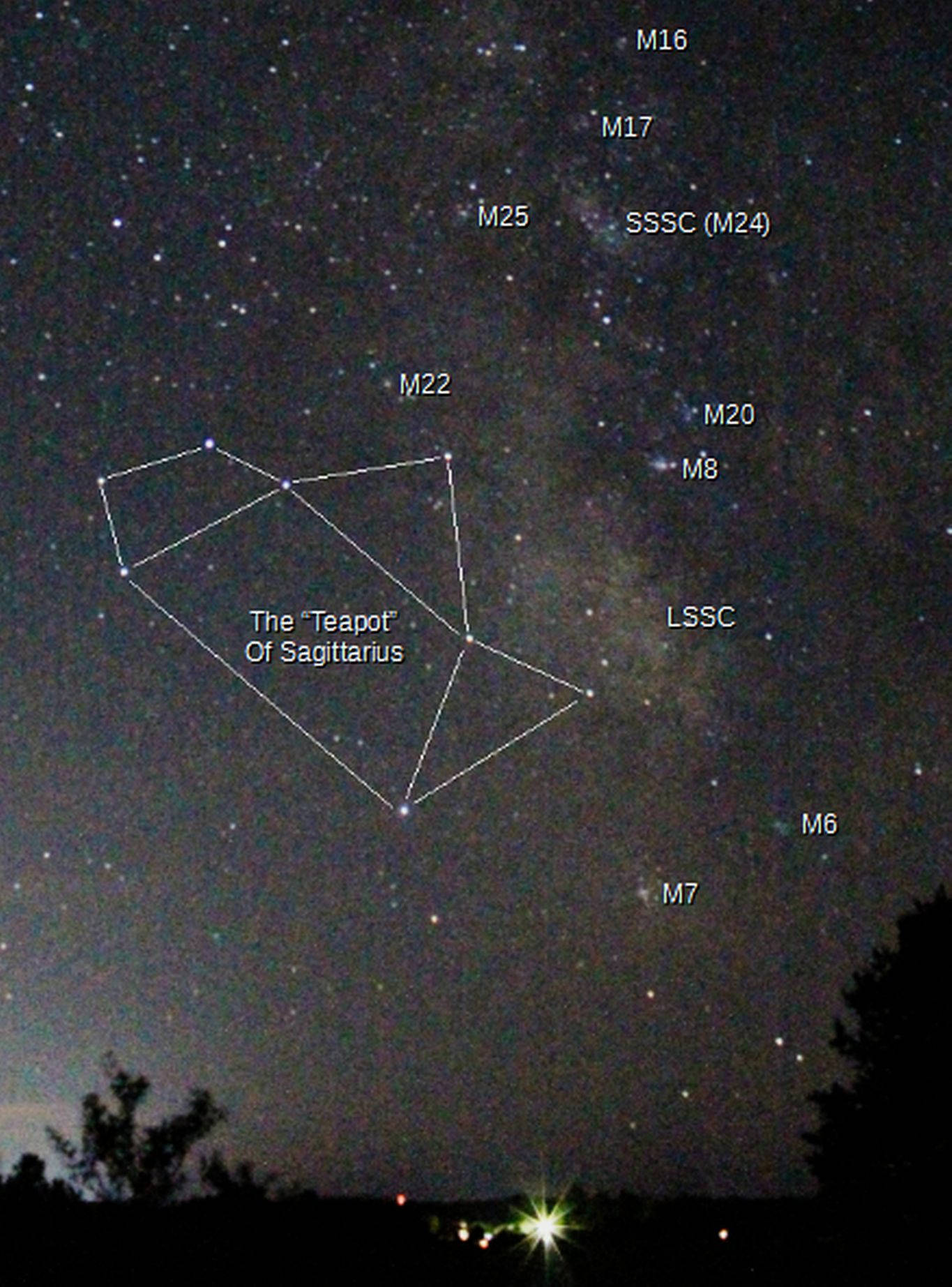
Let’s look around the Teapot shape of stars that is the constellation of Sagittarius. A pair of binoculars or a telescope with a very low magnifying power is all that’s needed. The purpose here is not so much to make things bigger, but make them brighter. Right off the tip of the teapot’s spout is a large and bright patch of light. This is the farthest we can see, in visible light that is, toward the center of our galaxy, part of the central bulge. Astronomer Walter Baade discovered that fact in the mid 1940s. The center of the galaxy is 4 moon-widths or 2 degrees to the right of it, but obscured by a cloud of interstellar dust. It is called the Large Sagittarius Star Cloud or Baade’s Window, peering out 25 thousand light years away.

The astronomical event times given in this blog are for the Traverse City/Interlochen area of Michigan (Lat 44.7° N, Long 85.7° W; EDT, UT – 4 hours) unless stated otherwise. Times will be different for other locations.

Addendum
Annotated Sagittarius photograph
Sagittarius in a short time exposure with added annotations. The “M” designations are objects in Charles Messier’s catalog created in the latter half of the 18th century. LSSC is the Large Sagittarius Star Cloud, SSSC is the Small Sagittarius Star Cloud. Credit Bob Moler.

Ephemeris: 08/15/2025 – The Milky Way on August evenings

August 15, 2025 Comments off

This is Ephemeris for Friday, August 15th. Today the Sun will be up for 14 hours and 2 minutes, setting at 8:48, and it will rise tomorrow at 6:46. The Moon, 1 day before last quarter, will rise at 11:41 this evening.

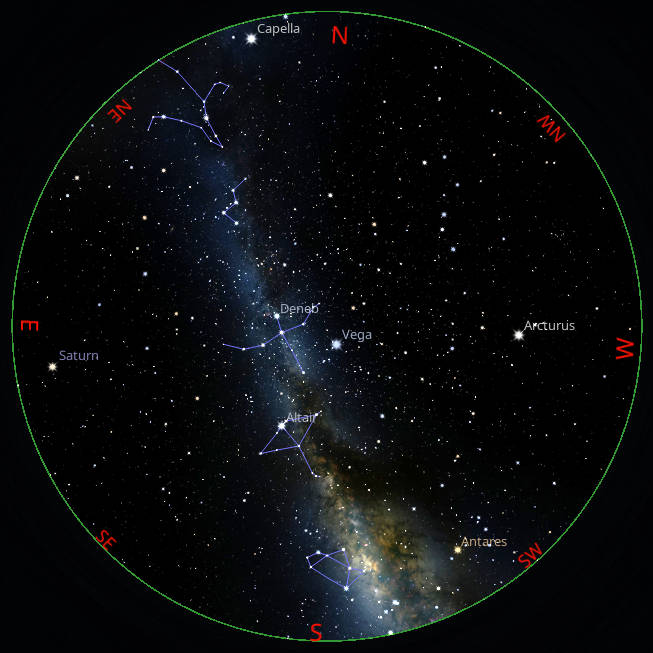
August is the best time to see the most southern part of the Milky Way. The constellation of Sagittarius the Archer or for us moderns a Teapot is due South at 10:30 this evening . The Milky Way runs up from the South moving high in the east and ends up in the northeast and the constellation of Cassiopeia the queen which looks like the letter W. We will have to wait several months or stay up for several hours tonight to see the Milky Way cross overhead, but by then the southern part of the Milky Way will have begun to set in the southwest. So this is the time to enjoy looking towards the center our Galaxy which is located right above the tip of the spout of Sagittarius, but behind a cloud of dust.

The astronomical event times given in this blog are for the Traverse City/Interlochen area of Michigan (Lat 44.7° N, Long 85.7° W; EDT, UT – 4 hours) unless stated otherwise. Times will be different for other locations.

Addendum
The Milky Way seen across the sky dome
The Milky Way seen across the sky dome at 11 PM, August 15, 2025. First magnitude stars are labeled, and the brighter constellations along the Milky Way are shown. From upper left the constellations shown are Perseus, Cassiopeia, Cygnus, Aquila and Sagittarius. Created using Stellarium.

Ephemeris: 08/14/2025 – Centaur or Teapot, you decide

August 14, 2025 Comments off

This is Bob Moler with Ephemeris for Thursday, August 14th. Today the Sun will be up for 14 hours and 5 minutes, setting at 8:49, and it will rise tomorrow at 6:45. The Moon, 2 days before last quarter, will rise at 11:11 this evening.

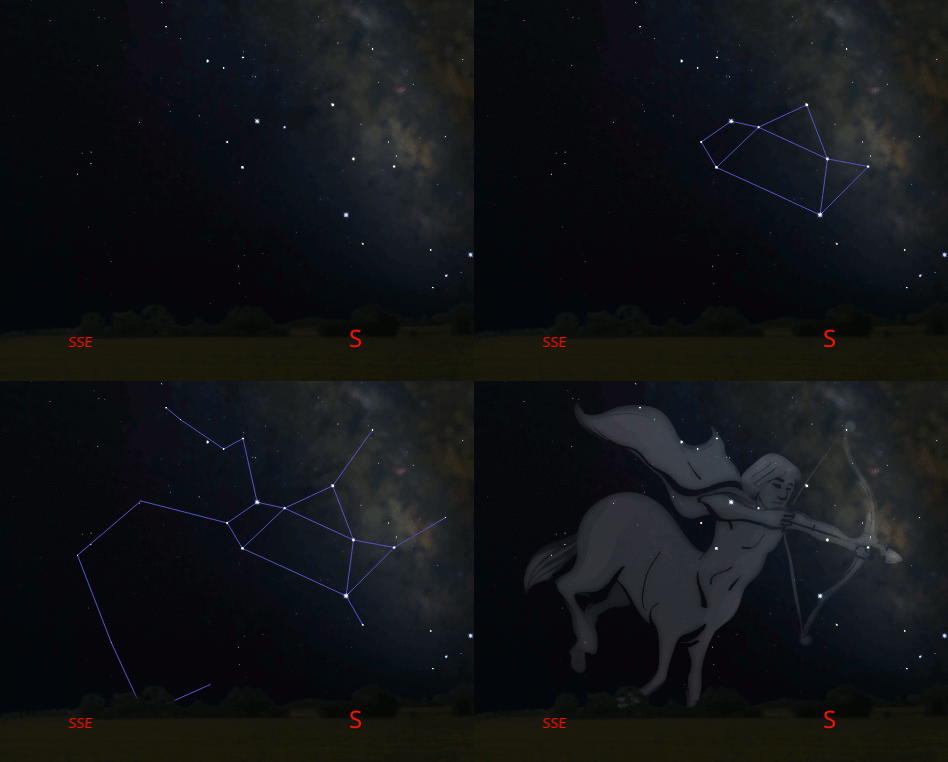
Low in the south at 10:30 PM shines the heart of summer Milky Way. The constellation that’s seen there is Sagittarius which is supposed to be a centaur with a bow and arrow. We modern folk haven’t seen a centaur outside a Harry Potter movie, so we see its stars looking like a teapot, a short and stout little teapot like in the children’s song. It is tipped to the West with the Milky Way like steam rising from its spout, which is about to pour its tea on the southwestern horizon later tonight. Sagittarius is just begging to be explored with binoculars or a very low power telescope to see its myriad of stars, star clusters and nebulae. As fabulous as all this appears, we cannot see into the heart of the Milky Way for all the clouds of dust in the way.

The astronomical event times given in this blog are for the Traverse City/Interlochen area of Michigan (Lat 44.7° N, Long 85.7° W; EDT, UT – 4 hours) unless stated otherwise. Times will be different for other locations.

Addendum
An animated constellation of Sagittarius and Teapot asterism finder.
An animated constellation of Sagittarius and Teapot asterism finder in 4 frames for about 10:30 PM, August 14th. First the stars as they would be seen in the sky. Second, lines showing the teapot asterism with the Milky Way seen as steam rising from the spout. Then the lines drawn of the constellation in a modern rendition. And finally, the art image showing the Centaur by Stellarium. Created using Stellarium and GIMP.

Ephemeris: 08/13/2025 – Taking our weekly look at the whereabouts of the naked-eye planets

August 13, 2025 Comments off

This is Bob Moler with Ephemeris for International Left-handers Day, Wednesday, August 13th. Today the Sun will be up for 14 hours and 7 minutes, setting at 8:51, and it will rise tomorrow at 6:44. The Moon, 3 days before last quarter, will rise at 10:47 this evening.

Let’s take our weekly look at the whereabouts of the naked-eye planets. The Red Planet Mars is getting so low in the western sky in evening twilight that I’ve given up on trying to spot it. This is the curse of trying to view evening planets, which are near the direction of the Sun in late summer and early fall, for us at higher latitudes. Mars won’t pass behind the Sun and enter the morning sky until January 9th. Saturn now rises at 10:23 PM in the east. In a telescope Saturn sports a very thin ring, less than 4° from being edge on. By 5:30 AM Saturn will be high in the south, when our winter pal Orion will be rising. Venus and Jupiter will appear very close. Venus is by far the brighter of the two.

The astronomical event times given in this blog are for the Traverse City/Interlochen area of Michigan (Lat 44.7° N, Long 85.7° W; EDT, UT – 4 hours) unless stated otherwise. Times will be different for other locations.

Addendum
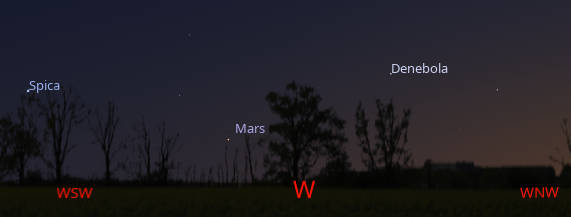
Mars and Spica this evening in the western sky an hour after sunset
Mars and Spica this evening in the western sky an hour after sunset here (9:51 PM), August 13, 2025. With the smoke from the Canadian wild files, I doubt any stars or planets could be seen near the horizon. Created using Stellarium.
Saturn, Jupiter and Venus with some bright winter stars at 5:45 AM tomorrow morning
Saturn, Jupiter and Venus with some bright winter stars at 5:45 AM tomorrow morning, August 14th, 2025, looking from east-northeast to southwest. Created using Stellarium.
The Moon tomorrow morning, August 14, 2025. A view visible in small telescopes showing an image with and without selected features labeled. Feature labels are centered. Created using Stellarium, LibreOffice Draw, and GIMP.
Telescopic Saturn, Jupiter and Venus as they would be seen in a small telescope with the same magnification
Telescopic Saturn, Jupiter and Venus (north up) as they would be seen in a small telescope with the same magnification. On the morning of the August 14th 2025, Saturn will be 19.0″ in diameter, but its rings, even being nearly edge on, should show up brighter than seen here., and extend to 44.2″. They are tilted 3.1° from being edge on. Jupiter will be 33.3″ in diameter. Venus’ apparent diameter will be 13.3″, and be 79.4% illuminated. The ” means seconds of arc, or 1/3600th of a degree. Created using Cartes du Ciel (Sky Charts), LibreOffice Draw and GIMP.
The naked-eye planets and the Moon at sunset and sunrise on a single night
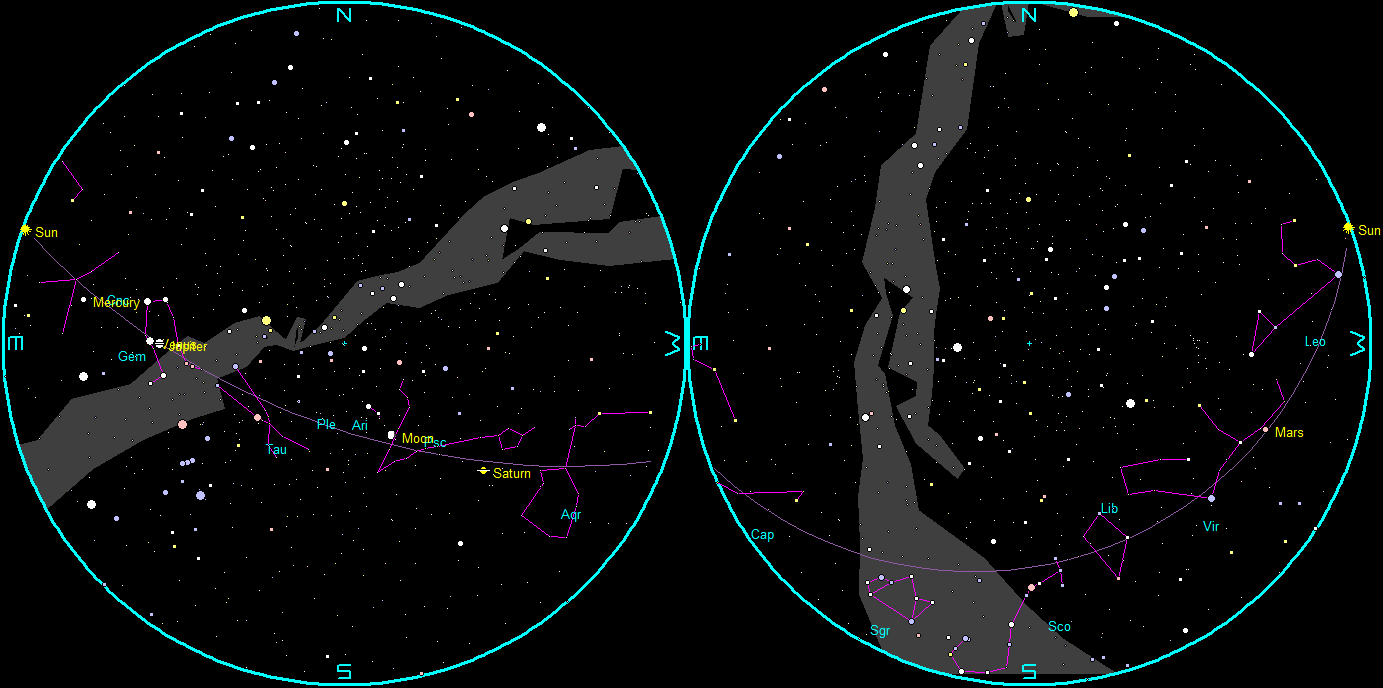
The naked-eye planets and the Moon at sunset and sunrise on a single night, starting with sunset on the right on August 13, 2025. The night ends on the left with sunrise on the 14th. Click or tap on the image to enlarge it. Created using my LookingUp app and GIMP.
A low precision ephemeris of the Sun Moon and naked eye planet positions for today and tomorrow
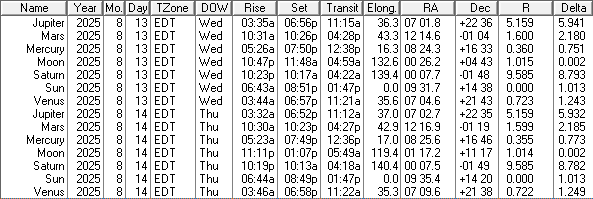
This is a low precision ephemeris of the Sun Moon and naked eye planet positions for today and tomorrow, August 13th and 14th, 2025. Some of the columns are self-explanatory, others are not. The transit column is the time that the body crosses the meridian and is due south. Elong, for elongation, is the angle between the Sun and that body. RA is right ascension, which is the object’s east-west position on the celestial sphere in hours and minutes. Dec is declination which is the north-south position of the object on the celestial sphere in degrees and minutes. R is the distance of that object from the Sun in astronomical units. An astronomical unit is about 93 million miles or 150 million kilometers. And Delta is the distance of that object from the Earth, also in astronomical units. I omit the ‘m’ in am and pm for compactness. The data was generated using my LookingUp for DOS app and displayed as a table by my Ephemeris Helper app.