Archive
09/22/11 – Ephemeris – The Constellations Delphinus and Sagitta
Thursday, September 22nd. The sun will rise at 7:29. It’ll be up for 12 hours and 11 minutes, setting at 7:40. The moon, 2 days past last quarter, will rise at 2:47 tomorrow morning.
Located below the eastern edge of the Summer Triangle of three of the brightest stars in the sky, which is overhead in our sky at 10 p.m., is the tiny constellation of Delphinus the dolphin. Delphinus’ 6 stars in a small parallelogram with a tail, really does look like a dolphin leaping out of the water. The parallelogram itself has the name Job’s Coffin. The origin of this asterism or informal constellation is unknown. Of the dolphin itself: the ancient Greeks appreciated this aquatic mammal as we do, and told stories of dolphins rescuing shipwrecked sailors. There’s another tiny constellation to the right of Delphinus, Sagitta the arrow a small thin group of 5 stars, which represents Cupid’s dart. Behind Sagitta binoculars will find a little star group called the Coat hanger.
* Times are for the Traverse City/Interlochen area of Michigan. They may be different for your location.
Addendum
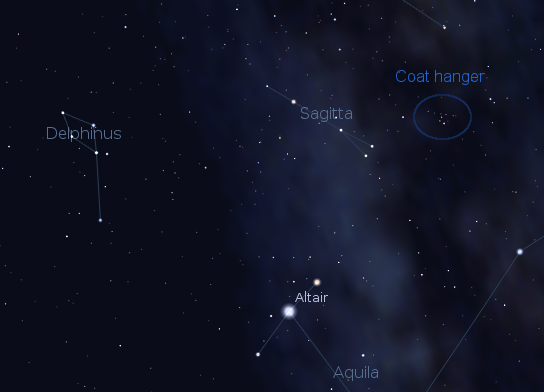
Delphinus, Sagitta and the Coat hanger. Diagram created using Stellarium.
09/21/11 – Ephemeris – The bright planets this week
Wednesday, September 21st. The sun will rise at 7:28. It’ll be up for 12 hours and 14 minutes, setting at 7:42. The moon, 1 day past last quarter, will rise at 1:37 tomorrow morning.
It’s Wednesday and time again to take a look at the whereabouts of the bright planets. The planet Venus is rather close to the sun in the evening setting 26 minutes after the sun and not really visible. The ringed planet Saturn also hidden in the bright twilight is setting 51 minutes after the sun. Jupiter is now the prominent planet of the evening sky after it rises at 9:13 p.m. in the east northeast and is seen against the stars of the constellation Aries now. In a telescope it will be accompanied by its 4 brightest moons, and as the planet rises higher Jupiter’s image becomes sharper, and its cloud bands will become visible. Mars will rise at 2:25 a.m also in the east northeast and is now between the constellations of Gemini and Cancer.
* Times are for the Traverse City/Interlochen area of Michigan. They may be different for your location.
09/20/11 – Ephemeris – The constellation Andromeda
Tuesday, September 20th. The sun will rise at 7:26. It’ll be up for 12 hours and 17 minutes, setting at 7:44. The moon, at last quarter today, will rise at 12:33 tomorrow morning.
In the east southeast at 9 this evening can be found a large square of stars, the Great Square of Pegasus the flying horse. The square is standing on one corner. What look like its hind legs stretching to the left from the left corner star is another constellation, Andromeda the chained maiden. She is seen in the sky as two diverging curved strings of stars that curve upward. She was rescued by the hero Perseus, a nearby constellation, riding his steed Pegasus. Andromeda’s claim to astronomical fame is the large galaxy seen with the unaided eye just above the upper line of stars. The Great Andromeda Galaxy is two and a half million light years away. To the unaided eye the galaxy appears a a small smudge of light. In binoculars the galaxy is a delicate spindle of light.
* Times are for the Traverse City/Interlochen area of Michigan. They may be different for your location.
Addendum
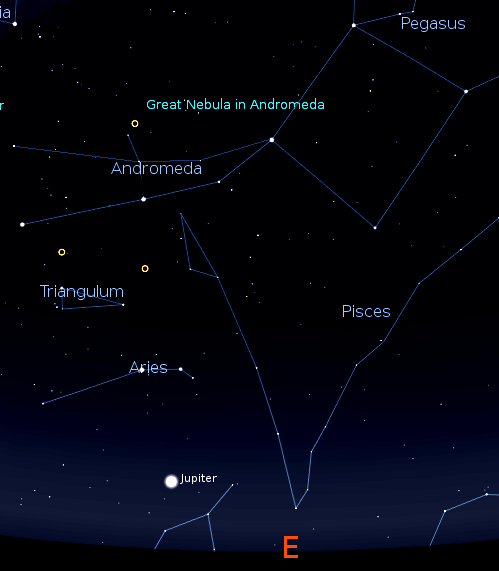
The Constellation Andromeda. Created using Stellarium.
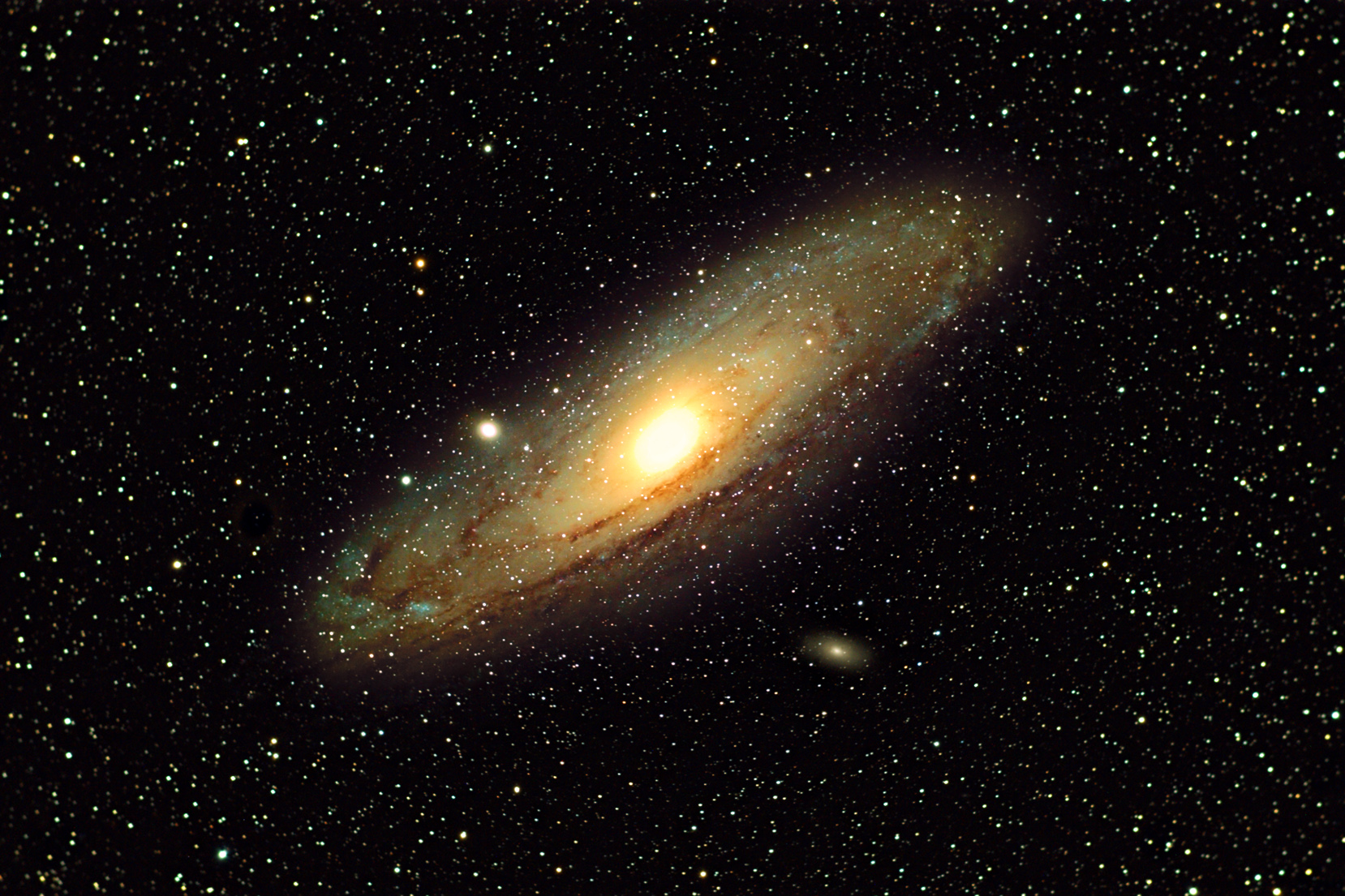
The Great Andromeda Galaxy (M31). Image taken by Scott Anttila.
Click on image for full size version.
Stellarium has it by its old name the Great Andromeda Nebula, before it was reclassified as an island universe (obsolete) or galaxy.
09/14/11 – Ephemeris – The bright planets visible this week
Wednesday, September 14th. The sun will rise at 7:19. It’ll be up for 12 hours and 35 minutes, setting at 7:55. The moon, 2 days past full, will rise at 8:29 this evening.
It’s Wednesday and time again to take a look at the whereabouts of the bright planets. The planet Venus is rather close to the sun in the evening setting 23 minutes after the sun and not really visible. The ringed planet Saturn is not really visible in the west in evening twilight. It will set 45 minutes after the sun. Jupiter is now the prominent planet of the evening sky after it rises at 9:41 p.m. in the east northeast and is seen against the stars of the constellation Aries now. It will be accompanied by its 4 brightest moons. Mars will rise at 2:31 a.m also in the east northeast and is now between the constellation Gemini and Cancer. Mercury is briefly visible now from about half an hour after its rising in the east at 6:17 until about 7 a.m.
* Times are for the Traverse City/Interlochen area of Michigan. They may be different for your location.
09/07/11 – Ephemeris – The bright planets visible this week
Wednesday, September 7th. The sun will rise at 7:11. It’ll be up for 12 hours and 56 minutes, setting at 8:08. The moon, 3 days past first quarter, will set at 3:23 tomorrow morning.
It’s Wednesday and time again to take a look at the whereabouts of the bright planets. The ringed planet Saturn will be barely visible in the west southwest in evening twilight. It’s near the bright star Spica to its left. Spica has a blue tinge, while Saturn is yellowish. It will set at 9:25 p.m. Because we are seeing Saturn in evening twilight now its image is being deteriorated by the earth’s atmosphere being low in the sky. Jupiter will rise at 10:10 p.m. in the east northeast and is seen against the stars of the constellation Aries now. Mars will rise at 2:36 a.m also in the east northeast and is now passing through the constellation Gemini the twins. Mercury is briefly visible now from about half an hour after its rising in the east at 5:43 until about 20 minutes before sunrise.
* Times are for the Traverse City/Interlochen area of Michigan. They may be different for your location.
09/05/11 – Ephemeris – Mercury is visible in the morning
Labor Day, Monday, September 5th. The sun will rise at 7:09. It’ll be up for 13 hours and 2 minutes, setting at 8:12. The moon, 1 day past first quarter, will set at 1:13 tomorrow morning.
The planet Mercury is now very low in the eastern sky before sunrise. This tiny planet was at its greatest apparent distance from the sun yesterday. Astronomers call it greatest elongation and its separation from the sun was an 18 degree angle. Mercury will be very close to the east northeast horizon in the 6:30 a.m. twilight. Once found, you can probably follow it for the next 20 minutes or so. Mercury will be visible for the next week of so. The cool thing is that it will become brighter. It’s illuminated by the sun, and as it moves away from us around the sun its phase or illuminated portion from our vantage point becomes larger. Currently Mercury is being studied up close by the MESSENGER spacecraft now orbiting it.
* Times are for the Traverse City/Interlochen area of Michigan. They may be different for your location.
Addendum
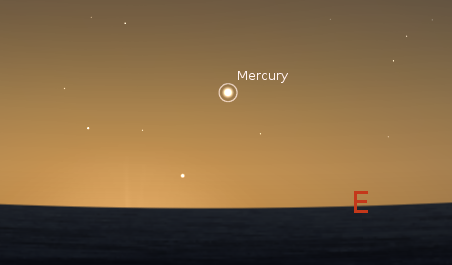
Mercury in the morning in early September 2011. Chrat created using Stellarium.
08/25/11 – Ephemeris – The Great Rift
Thursday, August 25th. The sun rises at 6:56. It’ll be up for 13 hours and 35 minutes, setting at 8:31. The moon, 3 days before new, will rise at 3:57 tomorrow morning.
High overhead the Milky Way is seen passing through the Summer Triangle of three bright stars. Here we find the Milky Way split into two sections. The split starts in the constellation of Cygnus the Swan or Northern Cross very high in the east. The western part of the Milky Way ends southwest of the Aquila the eagle. This dark dividing feature is called the Great Rift. Despite the lack of stars seen there, it doesn’t mean that there are fewer stars there than in the brighter patches of the Milky Way. The rift is a great dark cloud that obscures the light of the stars behind it. Sometimes binoculars can be used to find the edges of the clouds of the rift, as stars numbers drop off suddenly. This is especially easy in Aquila.
* Times are for the Traverse City/Interlochen area of Michigan. They may be different for your location.
Addendum
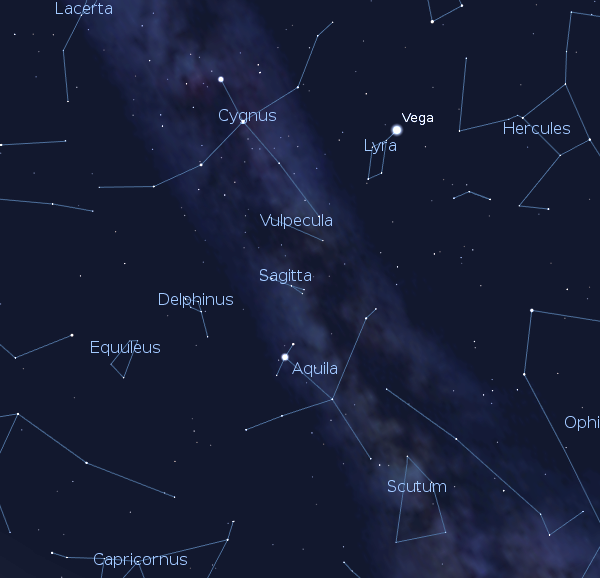
The Great Rift in the Milky Way. Created using Stellarium.
08/24/11 – Ephemeris – The bright planets visible this week
Wednesday, August 24th. The sun rises at 6:55. It’ll be up for 13 hours and 38 minutes, setting at 8:33. The moon, 3 days past last quarter, will rise at 2:47 tomorrow morning.
It’s Wednesday and time again to take a look at the whereabouts of the bright planets. The ringed planet Saturn will be visible in the west southwest in evening twilight. It’s near the bright star Spica to its left. Spica has a blue tinge, while Saturn is yellowish. It will set at 10:17 p.m. Saturn is a wonderful sight is a telescope with its rings. We are seeing Saturn in evening twilight now. Its image is being deteriorated by the earth’s atmosphere being low in the sky. Jupiter will rise at 11:04 p.m. in the east northeast and is seen against the stars of the constellation Aries now. Mars will rise at 2:48 a.m also in the east northeast and is now passing through the constellation Gemini the twins. Venus, now in the evening sky, is too close to the sun to be seen.
* Times are for the Traverse City/Interlochen area of Michigan. They may be different for your location.
08/23/11 – Ephemeris – The wonders found in the constellation Scutum
Tuesday, August 23rd. The sun rises at 6:54. It’ll be up for 13 hours and 41 minutes, setting at 8:35. The moon, 2 days past last quarter, will rise at 1:45 tomorrow morning.
The teapot pattern of stars that is the constellation of Sagittarius lies at the southern end of the Milky Way this evening. It appears that the Milky Way is steam rising from the spout. The area above Sagittarius in the brightest part of the Milky Way is the dim constellation of Scutum the shield. Don’t bother looking for the stars that make up the constellation; what’s important is the star clouds of the Milky Way. Scan this area with binoculars or small telescope for star clusters and nebulae or clouds of gas. In binoculars both clusters and nebulae will appear fuzzy, but a small telescope will tell most of them apart. Even if you’ve never been able to find anything in your telescope, put on the lowest power eyepiece you have and scan back and forth for these wonders.
* Times are for the Traverse City/Interlochen area of Michigan. They may be different for your location.
Addendum
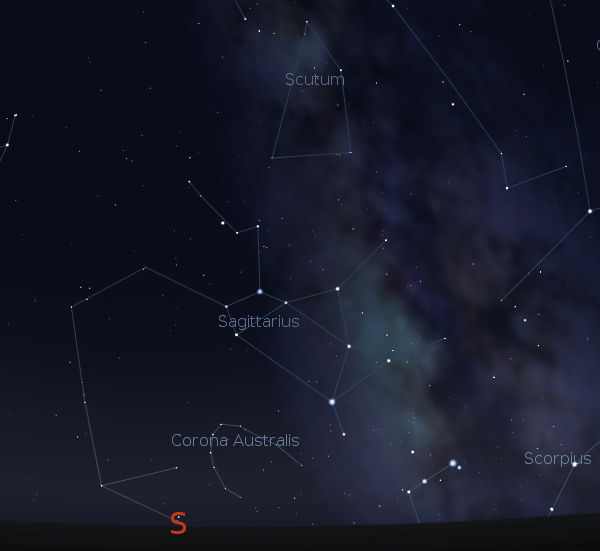
The constellations Sagittarius and Scutum. Created using Stellarium.
08/11/11 – Ephemeris – Prospects for this year’s Perseid Meteor Shower
Thursday, August 11th. The sun rises at 6:40. It’ll be up for 14 hours and 14 minutes, setting at 8:54. The moon, 2 days before full, will set at 5:31 tomorrow morning.
In the next two nights the Perseid meteor shower will be at a peak. The problem this year will be that the moon is full, or full enough that the skies will not be dark all night. Hope is not completely lost, because there will be a few really bright meteors, a few an hour, rather than the 50 or more an hour visible in dark skies. The paths of meteors appear longer in the evening where the radiant point of the meteors lies low in the north northeast, when the bits of rock skip through our atmosphere at a very low angle. These bits of rock were liberated by comet Swift Tuttle on a prior pass of the inner solar system. It orbits the sun in 130 years, and its path takes it very close to the orbit of the earth, so this time of year we pass through its debris.
* Times are for the Traverse City/Interlochen area of Michigan. They may be different for your location.
Addendum
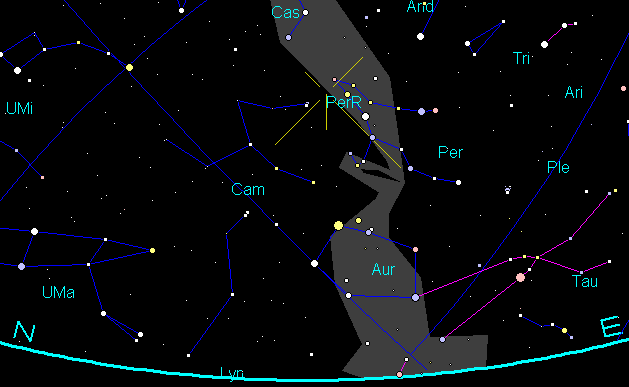
Perseid Meteor Shower radiant after midnight
The radiant is actually circumpolar for northern Michigan. At 10:30 p.m. it’s just east or the north compass point and very low on the horizon.

