Archive
08/04/11 – Ephemeris – The moon’s Sea of Tranquility
Thursday, August 4th. The sun rises at 6:32. It’ll be up for 14 hours and 32 minutes, setting at 9:04. The moon, 2 days before first quarter, will set at 11:18 this evening.
In binoculars the center of the of the moon and clipped by the terminator, the moon’s sunrise line is the landing area of the first humans on the moon The Sea of Tranquility. It is a circular basin 424 miles in diameter with a flat floor. It was formed in the first 600 million years of the moon’s existence after the worst of the cratering was over. The moon appears to have been formed by a glancing collision of a Mars sized body with the earth during the formation of the solar system. The debris circled the earth and condensed to form the moon. It is from studying the rocks brought back by the Apollo astronauts that this origin scenario was first put forth. The origin of a huge satellite for the earth had baffled astronomers before this discovery..
* Times are for the Traverse City/Interlochen area of Michigan. They may be different for your location.
Addendum
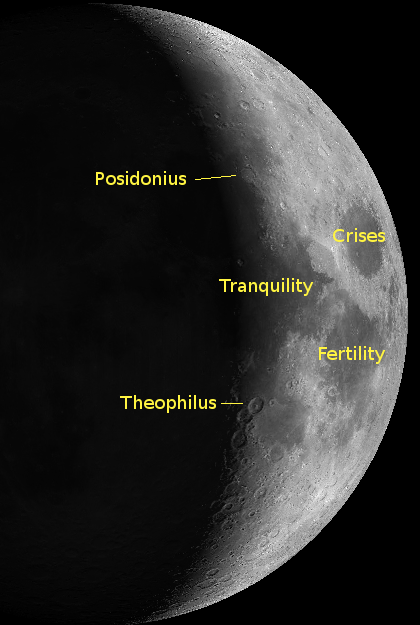
The Sea of Tranquility emerging into sunlight - Virtual Moon Atlas
08/01/11 – Ephemeris – Previewing August skies
Monday, August 1st. The sun rises at 6:28. It’ll be up for 14 hours and 39 minutes, setting at 9:08. The moon, 2 days past new, will set at 9:52 this evening.
Let’s look ahead at the month of August in the skies. Daylight hours will decrease from 14 hours and 39 minutes today to 13 hours 17 minutes on the 31st. The altitude of the sun at local noon, that is degrees of angle above the horizon will decrease from 63 degrees today to just over 53 degrees on the 31st. Straits area listeners can subtract one more degree from those angles. Local noon, when the sun is due south, is about 1:43 p.m. The Perseid meteor shower will reach its peak on the morning of the 12th, but will be mostly unseen due to the bright moon. However on the nights between now and then when the moon has set these meteors will still be plentiful. We saw two bright ones Saturday night at the Sleeping Bear Dunes viewing night.
* Times are for the Traverse City/Interlochen area of Michigan. They may be different for your location.
07/27/11 – Ephemeris – The bright planets this week
Wednesday, July 27th. The sun rises at 6:23. It’ll be up for 14 hours and 50 minutes, setting at 9:14. The moon, 3 days before new, will rise at 4:00 tomorrow morning.
It’s Wednesday and time again to take a look at the whereabouts of the bright planets. The ringed planet Saturn will be visible in the west southwest as it gets dark. It’s near the bright star Spica to its left. Spica has a blue tinge, while Saturn is yellowish. It will set at 11:58 p.m. Saturn is a wonderful sight is a telescope with its rings. We are now slowly seeing Saturn slip into evening twilight. We have a few more weeks of good viewing of Saturn before its image deteriorates by being too low in the sky. Jupiter will rise at 12:50 a.m. in the east northeast and is seen against the stars of the constellation Aries now. Mars will rise at 3:15 also in the east northeast and is located near the lower tip of the horn of Taurus the bull.
* Times are for the Traverse City/Interlochen area of Michigan. They may be different for your location.
Wednesday, July 27th. The sun rises at 6:23. It’ll be up for 14 hours and 50 minutes, setting at 9:14. The moon, 3 days before new, will rise at 4:00 tomorrow morning. | It’s Wednesday and time again to take a look at the whereabouts of the bright planets. The ringed planet Saturn will be visible in the west southwest as it gets dark. It’s near the bright star Spica to its left. Spica has a blue tinge, while Saturn is yellowish. It will set at 11:58 p.m. Saturn is a wonderful sight is a telescope with its rings. We are now slowly seeing Saturn slip into evening twilight. We have a few more weeks of good viewing of Saturn before its image deteriorates by being too low in the sky. Jupiter will rise at 12:50 a.m. in the east northeast and is seen against the stars of the constellation Aries now. Mars will rise at 3:15 also in the east northeast and is located near the lower tip of the horn of Taurus the bull.
* Times are for the Traverse City/Interlochen area of Michigan. They may be different for your location.
07/26/11 – Ephemeris – The Milky Way
Tuesday, July 26th. The sun rises at 6:22. It’ll be up for 14 hours and 53 minutes, setting at 9:15. The moon, 3 days past last quarter, will rise at 3:01 tomorrow morning.
The Milky Way, which is rising to pass overhead later in the evening is what we see of a huge structure of stars of which we are a part. We call it the Milky Way galaxy. It’s a spiral galaxy with a straight bar of stars through the center, a barred spiral galaxy about a hundred thousand light years across. It’s part of a small cluster of galaxies called the Local Group. Besides these three dozen galaxies, the Milky Way has small satellite galaxies orbiting it. The largest of these are the two Magellanic clouds seen from the southern hemisphere of earth. Even now a tiny galaxy is colliding with our galaxy. We can penetrate to the center of our own galaxy in infrared light, but not visible light from our location 26,000 light years away.
* Times are for the Traverse City/Interlochen area of Michigan. They may be different for your location.
Addendum

The Milky Way 360 degrees - Wikipedia
This is a mosaic of photographs showing the Milky Way as seen from the earth. The summer Milky Way we see is from just right of center to the left edge.
07/21/11 – Ephemeris – The constellation of Cygnus the swan
Thursday, July 21st. Today the sun will be up for 15 hours and 3 minutes, setting at 9:20. The moon, 2 days before last quarter, will rise at 11:56 this evening. Tomorrow the sun will rise at 6:17.
High in the east northeast as it gets dark flies the constellation of Cygnus the swan. This constellation is also known as the Northern Cross. The cross is seen lying on its side with the bright star Deneb at the head of the cross to the left. The rest of the cross is delineated in the stars to the right. As a swan, Deneb is the tail, the stars of the crosspiece of the cross are the leading edges of wings as Cygnus flies south through the Milky Way. There are faint stars that also define the tips and trailing edges of its wings. It is a very good portrayal of a flying swan, like the mute swans we see on the wing. In Cygnus we are looking in the direction that the sun and the earth are traveling as we orbit the center of the Milky Way.
* Times are for the Traverse City/Interlochen area of Michigan. They may be different for your location.
Addendum
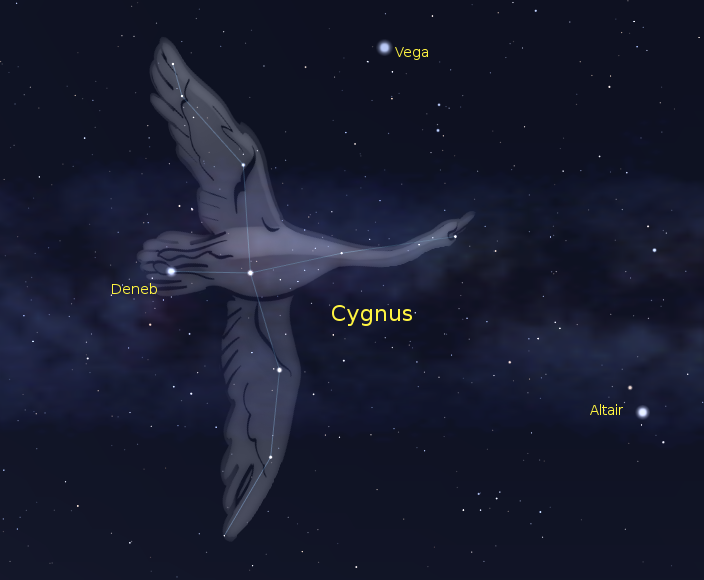
Cygnus The Swan Created using Stellarium.
Click to enlarge.
07/20/11 – Ephemeris – The bright planets visible this week
Wednesday, July 20th. Today the sun will be up for 15 hours and 5 minutes, setting at 9:21. The moon, 3 days before last quarter, will rise at 11:33 this evening. Tomorrow the sun will rise at 6:16.
It’s Wednesday and time again to take a look at the whereabouts of the bright planets. The ringed planet Saturn will be visible in the west southwest as it gets dark. It’s near the bright star Spica to its left. Spica has a blue tinge, while Saturn is yellowish. It will set at 12:29 a.m. Saturn is a wonderful sight is a telescope with its rings. We are now slowly seeing Saturn slip into evening twilight. We have about another month of good viewing of Saturn before its image deteriorates by being too low in the sky. Jupiter will rise at 1:15 a.m. in the east and is seen against the stars of Aries now. Mars will rise at 3:24 in the east northeast and is located against the horns of Taurus the bull.
* Times are for the Traverse City/Interlochen area of Michigan. They may be different for your location.
07/19/11 – Ephemeris – The brightest stars visible now in the evening
Tuesday, July 19th. Today the sun will be up for 15 hours and 6 minutes, setting at 9:21. The moon, half way from full to last quarter, will rise at 11:11 this evening. Tomorrow the sun will rise at 6:15.
Let’s check out all the bright stars in the evening sky, as it gets dark tonight. High in the west is the bright yellow-orange star Arcturus. In the northwest is the Big Dipper, whose curved handle points to Arcturus. Straightening that curve to a spike will point to Spica a blue-white star low in the southwest. The bright star to its right isn’t. It’s the planet Saturn. In the south is the red star Antares which usually twinkles merrily. High in the east is the bright white star Vega. To its lower right is Altair, and to its lower left the star Deneb. Vega, Altair and Deneb make the Summer Triangle, whose rising in the east signals the coming of summer. Always present for us in northern Michigan is Capella very low in the north.
* Times are for the Traverse City/Interlochen area of Michigan. They may be different for your location.
Addendum
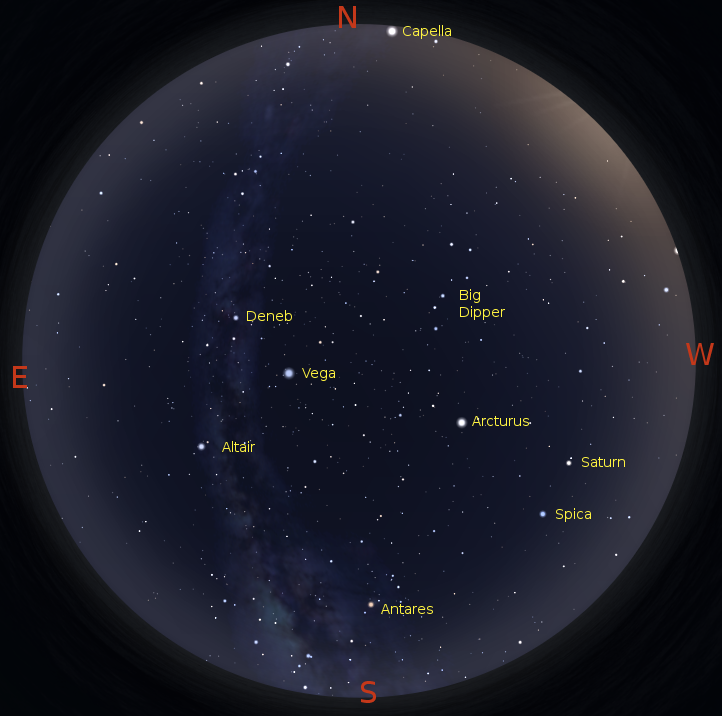
Bright Summer Stars. Created using Stellarium.
Click on the image to enlarge. This is a whole sky chart. The round edge is the horizon. BTW the star Capella, very low in the north, is a winter star, but it’s visible all year round for folks north of 44 degrees north latitude.
07/13/11 – Ephemeris – The bright planets visible this week
Wednesday, July 13th. Today the sun will be up for 15 hours and 16 minutes, setting at 9:26. The moon, 2 days before full, will set at 5:29 tomorrow morning. Tomorrow the sun will rise at 6:10.
It’s Wednesday and time again to take a look at the whereabouts of the bright planets. The ringed planet Saturn will be visible in the west southwest as it gets dark. It’s near the bright star Spica to its left. Spica has a blue tinge, while Saturn is yellowish. It will set at 12:55 a.m. Saturn is a wonderful sight is a telescope with its rings. The shadows of the rings on the planet and planet on the rings are now near their maximum extent. We are now slowly seeing Saturn slip into evening twilight. We have about another month of good viewing of Saturn before its image deteriorates by being too low in the sky. Jupiter will rise at 1:40 a.m. in the east. Mars will rise at 3:33 in the east northeast.
* Times are for the Traverse City/Interlochen area of Michigan. They may be different for your location.
06/29/11 – Ephemeris – The bright planets this week
Wednesday, June 29th. Today the sun will be up for 15 hours and 31 minutes, setting at 9:31. The moon, 2 days before new, will rise at 5:14 tomorrow morning. Tomorrow the sun will rise at 6:00.
It’s Wednesday and time again to take a look at the whereabouts of the bright planets. The ringed planet Saturn will be visible in the southwest as it gets dark. It’s near the bright star Spica to its left. Spica has a blue tinge, while Saturn is yellowish. It will set at 1:57 a.m. Saturn is a wonderful sight is a telescope with its rings. The shadows of the rings on the planet and planet on the rings are now near their maximum extent. Its bright moon Titan is also visible. Folks with good telescopes and good eyesight can also see up to four of Saturn’s fainter moons. Jupiter will rise at 2:30 a.m. in the east. Mars will rise at 3:54. Venus now rises too close to sunrise to be seen in the twilight as is Mercury.
* Times are for the Traverse City/Interlochen area of Michigan. They may be different for your location.
06/20/11 – Ephemeris – The constellation Libra the scales
Monday, June 20th. Today the sun will be up for 15 hours and 33 minutes, setting at 9:30. The moon, 3 days before last quarter, will rise at 12:24 tomorrow morning. Tomorrow the sun will rise at 5:57.
One of the constellations of the Zodiac or circle of animals isn’t either animal or human. It is Libra the Scales or balance. It lies low in the southern sky at 11 p.m., just to the right of the rising Scorpius the scorpion. Libra, it seems, is an afterthought, a simple diamond shape of four stars.. Its two brightest stars Zubeneschamali and Zubenelgenubi translate to the north and south claw respectively, of Scorpius to the left of it. The Arabs, at least, seemed to view this as part of Scorpius. The balance was perhaps to signify the equality of day and night, at the time the sun was in this part of the sky at the start of autumn, over 2000 years ago. Nowadays the sun is one constellation west, in Virgo at the start of autumn.
* Times are for the Traverse City/Interlochen area of Michigan. They may be different for your location.
Addendum
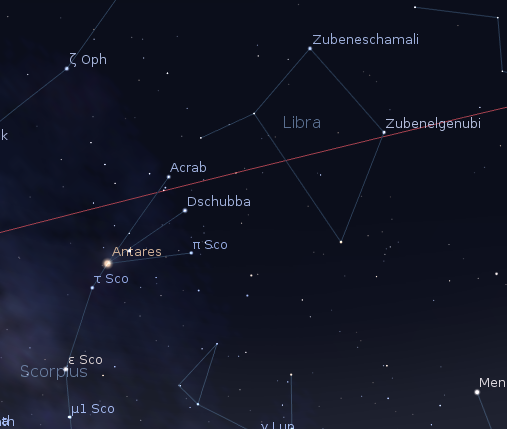
Libra the scales. Created using Stellarium

