Archive

Archive for the ‘Observing’ Category

Ephemeris: 07/29/2024 – Late July’s meteor shower

July 29, 2024 Comments off

This is Ephemeris for Monday, July 29th. Today the Sun will be up for 14 hours and 45 minutes, setting at 9:11, and it will rise tomorrow at 6:27. The Moon, 2 days past last quarter, will rise at 1:26 tomorrow morning.

There are more meteor showers that occur in the second-half of the year than there are in the first six months of the year. I don’t know why that is. The first of these major showers is the Southern Delta Aquariid meteor shower. There happens to be a few meteor showers at appear to emanate from the constellation of Aquarius so they named them after the closest star to the direction they appear to come from at their maximum. The star Delta in the southern part of Aquarius is associated with two meteor showers. This one appears to be coming from south of that star. And are only an eighth as active as the Perseids that we’re going to have next month partly because the radiant point doesn’t get very high in the sky.

The astronomical event times given are for the Traverse City/Interlochen area of Michigan (EDT, UT–4 hours). They may be different for your location.

Addendum

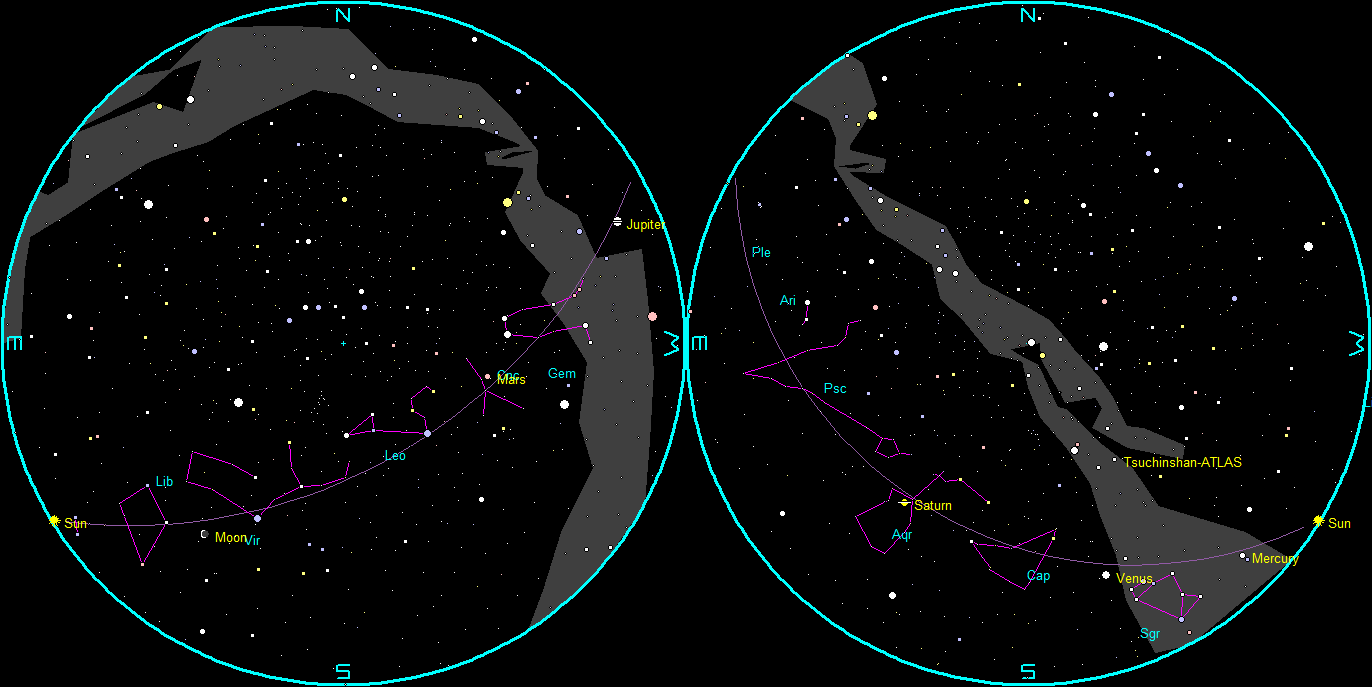
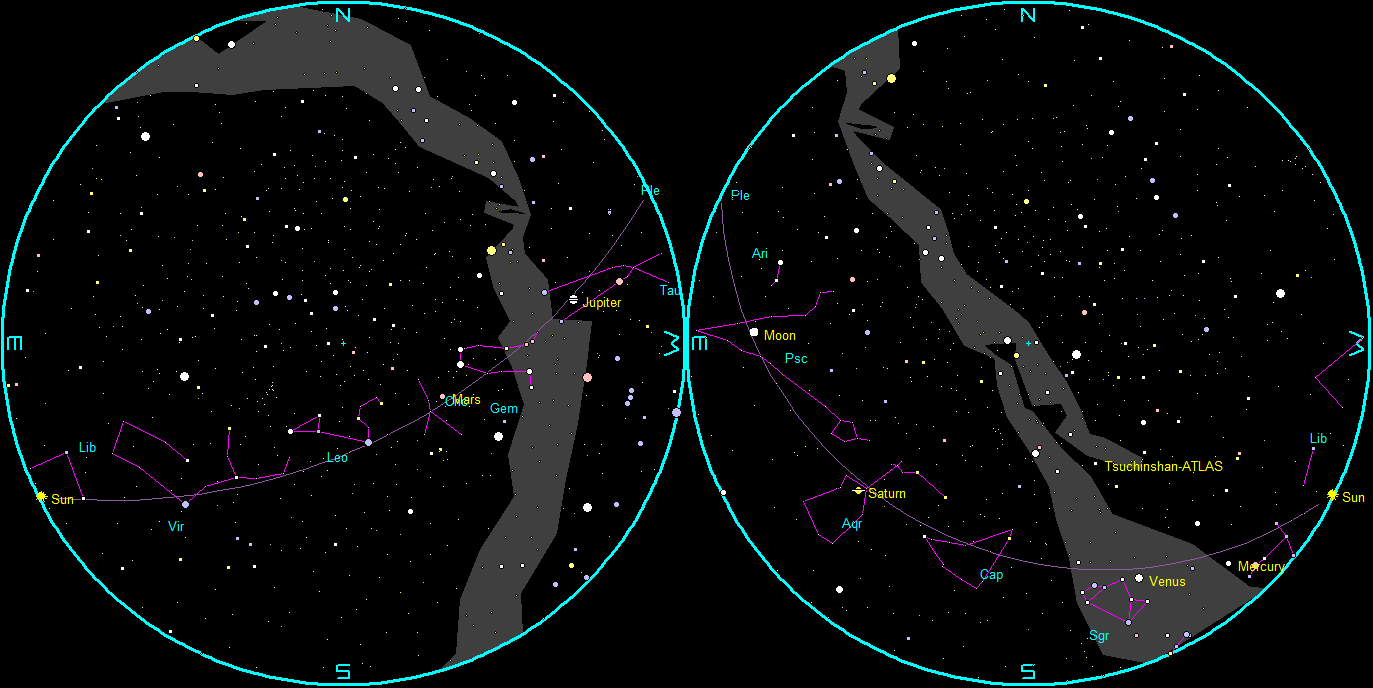
A look at the sky centered facing approximately southeast at 4 o'clock in the morning
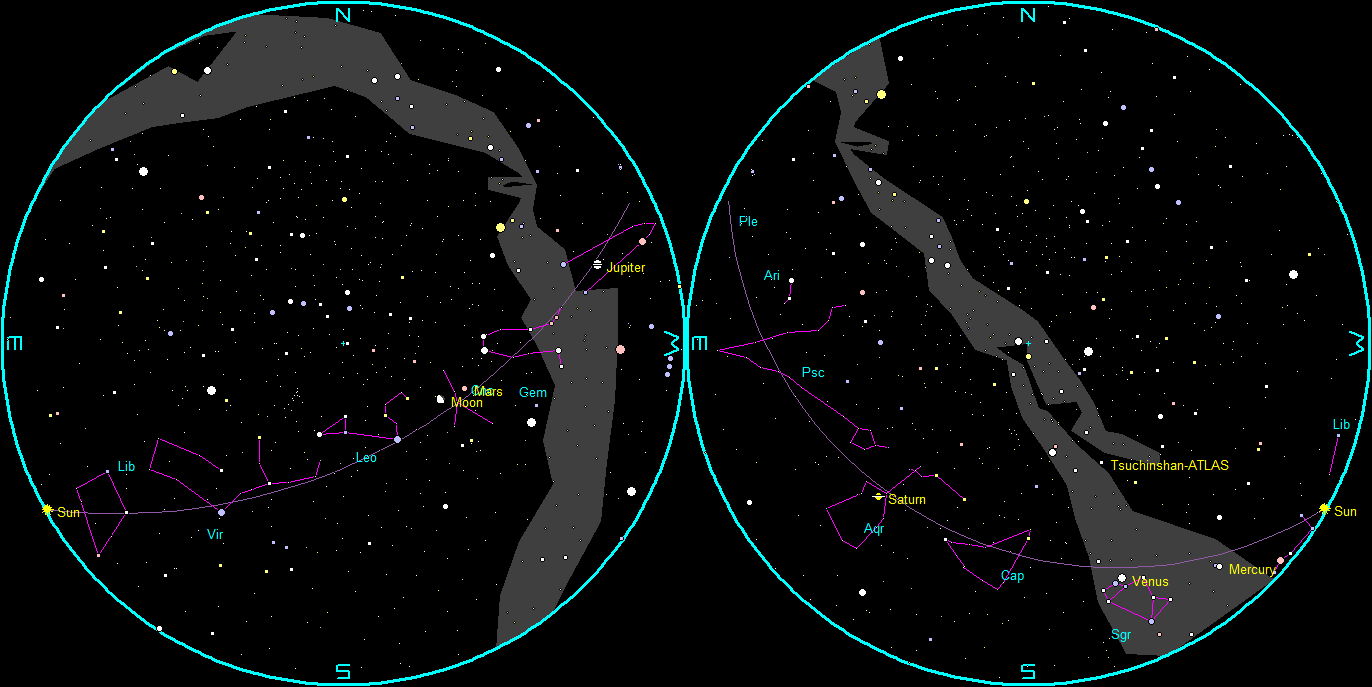
A look at the partial sky dome centered facing approximately southeast at 4 o’clock in the morning tomorrow, July 30th 2024. The waning crescent Moon will still be out along with the planets Jupiter, Mars and Saturn in the south. The fat crescent Moon will hamper the meteor shower a bit. Labeled are the active showers at that time. The showers labeled in yellow are at their peak, or very nearly at their peak. The other named showers are not at their peak, and may only provide a few meteors per hour. Only the Perseids and Southern Delta Aquariids are considered major showers. Actually the Southern Delta Aquariids will be at peak in the morning, providing about 18 meteors per hour on average at the 4 o’clock morning hour. Click or tap on the image to enlarge it. Created using Stellarium.

Ephemeris: 07/25/2024 – The Milky Way as it will appear tonight

July 25, 2024 Comments off

This is Ephemeris for Thursday, July 25th. Today the Sun will be up for 14 hours and 54 minutes, setting at 9:16, and it will rise tomorrow at 6:23. The Moon, 2 days before last quarter, will rise at 11:43 this evening.

With the Moon out of the sky until almost 11:30 PM we get our first look at the summer Milky Way in the evening. The Milky Way will stretch from the east-northeast, high in the east to the South. The asterism of the stout little Teapot in Sagittarius, low to the south, is near the bottom end of the Milky Way. The milky stream appears as steam coming out of the spout. With more stars there, one might be able to see the Centaur with a bow and arrow. The front part of the teapot is the bow. The bottom left, and the far right star are the back and the tip of the arrow which is pointing at the heart of Scorpius the scorpion in the south-southwest. We’ll be exploring the wonders of the summer Milky Way this month and next.

The astronomical event times given are for the Traverse City/Interlochen area of Michigan (EDT, UT–4 hours). They may be different for your location.

Addendum

 Dome of the sky from horizon to horizon at 11 PM tonight
The Dome of the sky from horizon to horizon at 11 PM tonight July 25th. The Milky Way streams from north northeast through high in the east through the three bright stars of the Summer Triangle and down to the southern horizon. The lines of the Teapot asterism of the constellation of Sagittarius and Scorpius are in the south. The Milky Way and the stars are shown somewhat brighter than they would appear in the sky. Click or tap on the image to enlarge it. Created using Stellarium.

Ephemeris: 07/24/2024 – Where are the naked-eye planets this week?

July 24, 2024 Comments off

This is Ephemeris for Wednesday, July 24th. Today the Sun will be up for 14 hours and 56 minutes, setting at 9:17, and it will rise tomorrow at 6:21. The Moon, halfway from full to last quarter, will rise at 11:23 this evening.

Let’s take our weekly look at the whereabouts of the naked-eye planets. Venus may still be too close to the direction of the Sun to be easily seen, it will set at 10:02 pm in the west-northwest. The best time to spot it will start about 9:40 pm or so. Mercury has been fading as its phase has become a crescent, as it’s heading back to the direction of the Sun. By 5:30 tomorrow morning, or about 50 minutes before sunrise, Saturn will be in the south below and right of the waning gibbous Moon, Mars and Jupiter will make a right triangle with the bright star Aldebaran in the east with Mars on top and Jupiter on the left. Saturn may look disappointing in telescopes this year since rings are nearly edge on and appear almost as a line through the planet. Saturn will rise at 11:14 pm, Mars will rise at 2:04 am, and finally Jupiter at 2:39 am.

The astronomical event times given are for the Traverse City/Interlochen area of Michigan (EDT, UT–4 hours). They may be different for your location.

Addendum

Venus and Mercury in evening twilight
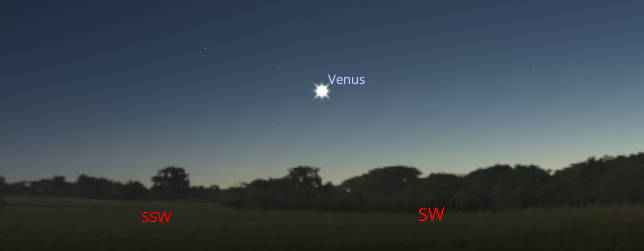
In this view from Stellarium looking toward the west-northwest at 9:45 PM or about 1/2 an hour after sunset, Venus appears about 2 1/2 degrees above the Lake Michigan horizon. Mercury doesn’t appear to be visible through the bright twilight even though Stellarium points it out with the with the tag. It might be spotted with binoculars.
Moon and Saturn
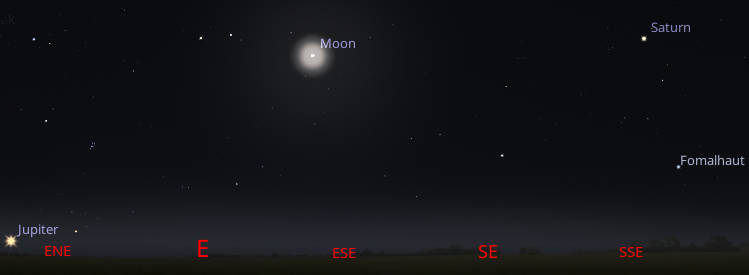
The waning gibbous Moon and Saturn rising at midnight tonight in the east . Created using Stellarium.
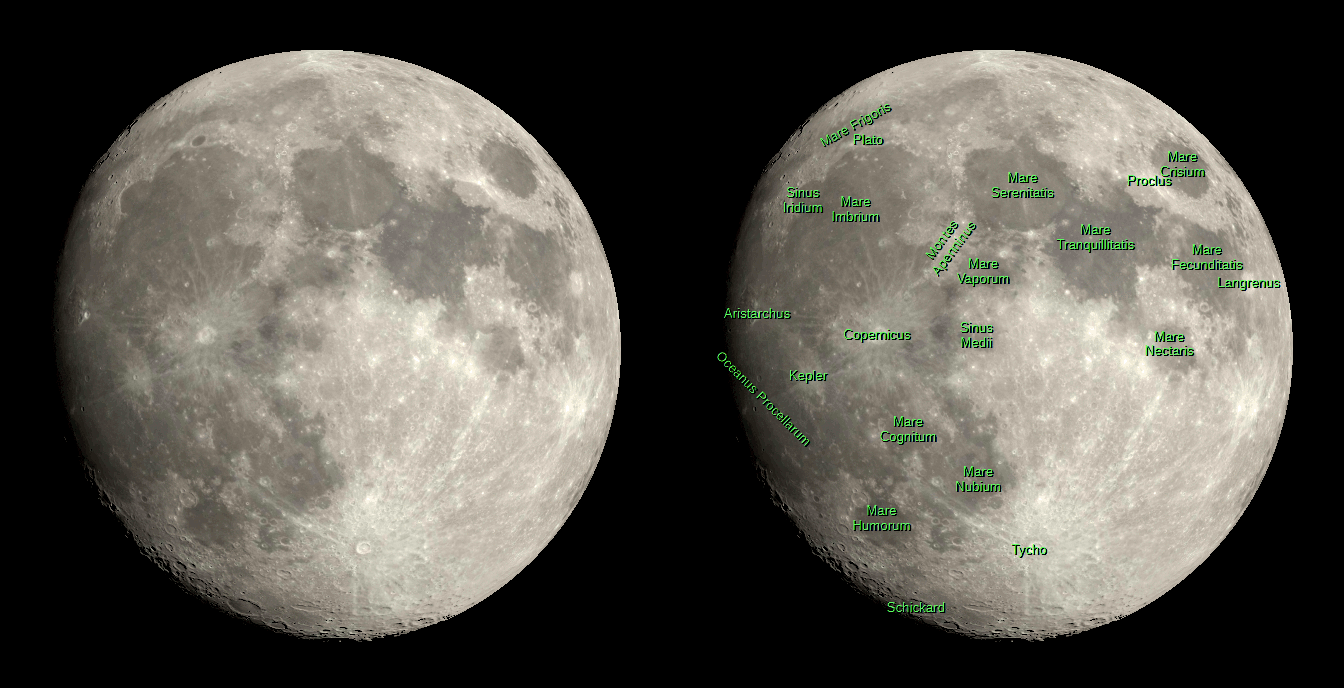
Annotated Moon
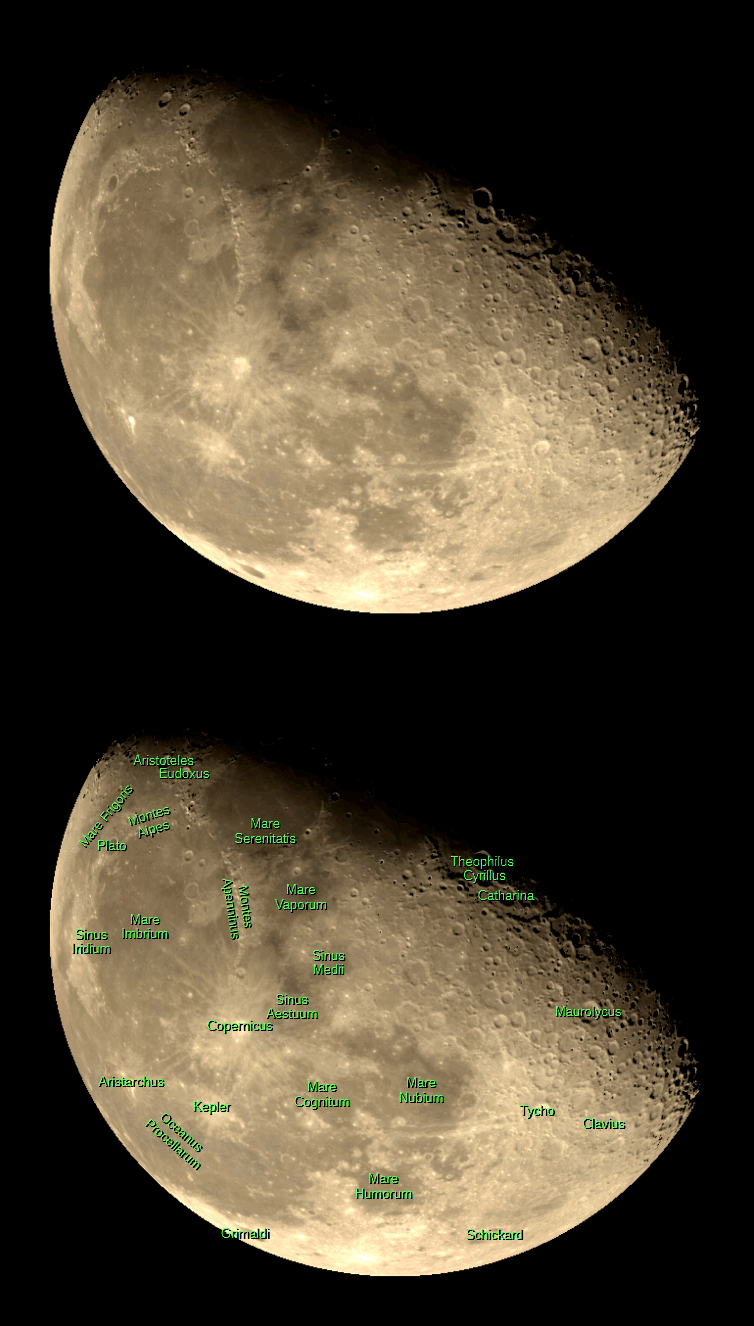
The Moon as it might appear in binoculars or a small telescope at 12 AM tomorrow morning, July 25th 2024. Selected features are labeled. Created using Stellarium, LibreOffice Draw, and GIMP.
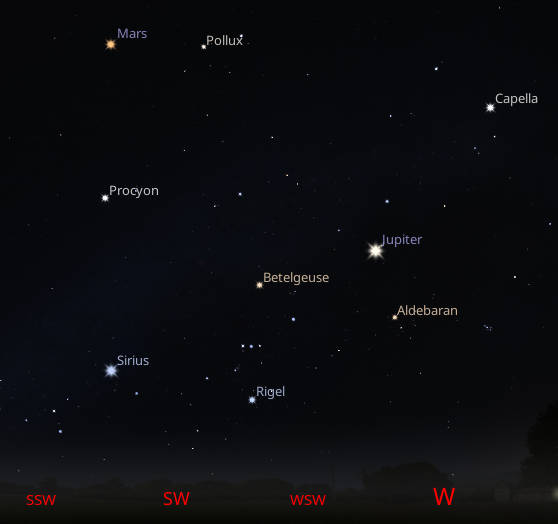
Morning planets and the moon
Saturn, the Moon, Mars and Jupiter as they might be seen low in the east and southern sky at 5:30 AM, or about 50 minutes before sunrise, tomorrow morning July 25, 2024. Saturn will rise at 11:13 PM, Mars at 2:04 AM, and Jupiter at 2:39 AM. Note the near right triangle of Mars, Jupiter and Aldebaran. Click or tap on the image to enlarge it. Created using Stellarium.
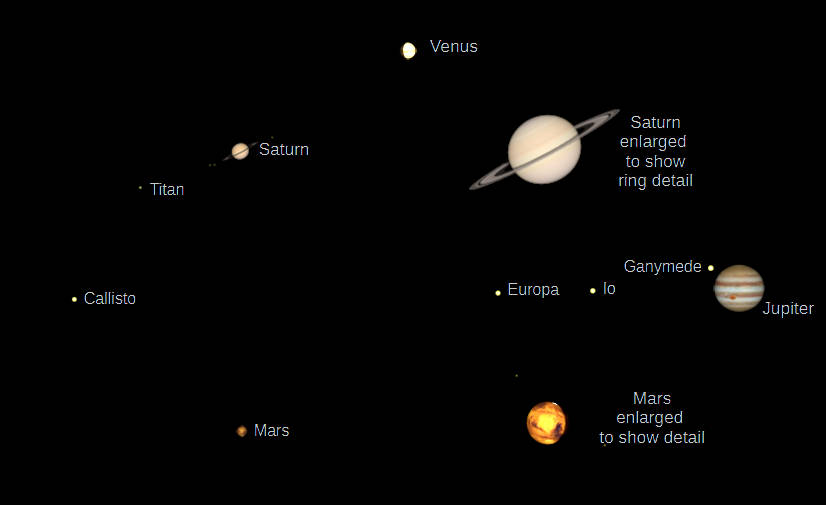
Telescopic planets
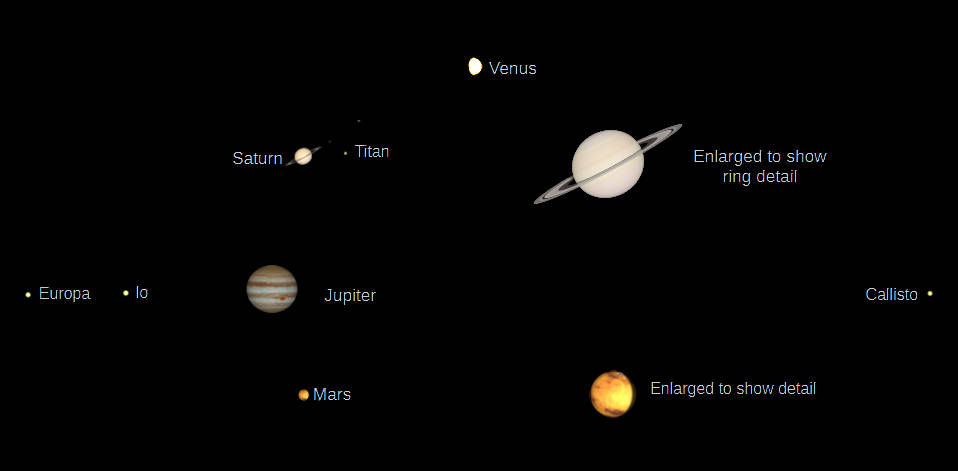
Telescopic Saturn and Jupiter (north up) as they would be seen in a small telescope at 5 AM July 25th 2024 with the same magnification. Apparent diameters: Saturn 18.6″, its rings 43.3″, 2 degrees from edge on; Mars, too small to be represented here, is 5.8″; Jupiter 35.0″. Note the ” means seconds of arc, or 1/3600th of a degree. Created using Cartes du Ciel (Sky Charts).
The naked-eye planets and the Moon at sunset and sunrise on a single night, starting with sunset on the right on July 24, 2023. The night ends on the left with sunrise on the 25th. Click or tap on the image to enlarge it. Created using my LookingUp app and GIMP.
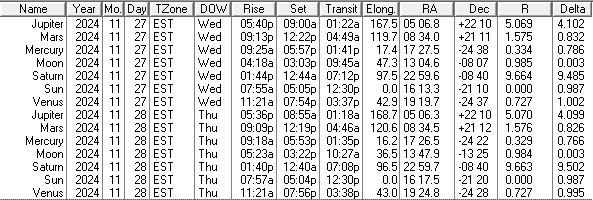
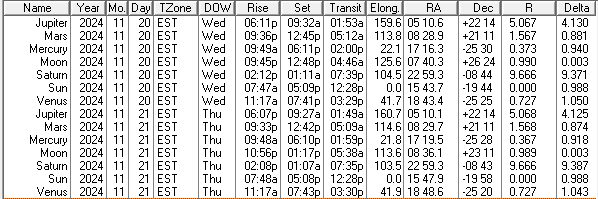
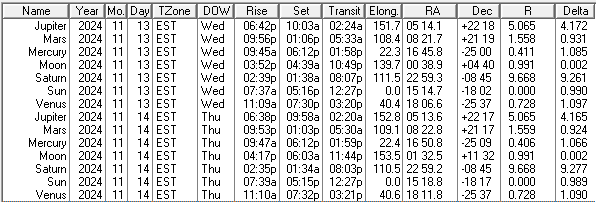
This is an ephemeris of the Sun Moon and naked eye planet positions for today and tomorrow, July 24th and 25th 2024. Some of the columns are self-explanatory, others not. The transit column is the time that the body crosses the meridian and is due south. Elong, for elongation, is the angle between the Sun and that body. RA is right ascension, which is the object’s east-west position on the celestial sphere. Dec is declination which is the north-south position of the object on the celestial sphere. R is the distance of that object from the Sun in astronomical units. An astronomical unit is about 93 million miles or 150 million kilometers. And Delta is the distance of that object from the Earth, also in astronomical units. I omit the ‘m’ in am and pm for compactness. The data was generated using my LookingUp for DOS app and displayed by my Ephemeris Helper app.

Ephemeris: 07/23/2024 – Albireo, a blue and gold double star

July 23, 2024 Comments off

This is Bob Moler with Ephemeris for Tuesday, July 23rd. Today the Sun will be up for 14 hours and 58 minutes, setting at 9:18, and it will rise tomorrow at 6:20. The Moon, 2 days past full, will rise at 11:01 this evening.

Alberio is the name given to the star that is in the head of the constellation of Cygnus the swan, which is in the east these evenings, flying south along the Milky Way. It is also at the foot of the asterism or informal constellation of the Northern Cross. To the naked eye and binoculars Albireo looks like a single star. However, even in small telescopes its true nature is revealed. It’s a double star whose individual star colors are strikingly different Its brightest star is yellow, and the dimmer star is blue. While star colors are subtle, these two, due to their apparent closeness, make an obvious color contrast. Unlike what your interior decorator says: In stars, blue is hot, yellow, orange and red are cool. The two stars are too far apart to be considered a binary star system that are gravitationally bound, but appear to move together in space. It is what is called an optical double, though they’re both around 430 light years away.

The astronomical event times given are for the Traverse City/Interlochen area of Michigan (EDT, UT–4 hours). They may be different for your location.

Addendum

Albireo finder animation
Animated Albireo finder chart. Albireo is located in the head of Cygnus the swan, or at the base of the Northern Cross. Tagged stars are, beside Albireo, the stars of the Summer Triangle: Deneb, Vega and Altair plus the star at the junction of the upright and crosspiece of the cross, Sadr. Created using Stellarium.
Albireo photographed in a telescope
Albireo, captured at high magnification by the staff of the Smithsonian Institution.

Ephemeris: 07/18/2024 The brightest spot on the Moon

July 18, 2024 Comments off

This is Ephemeris for Thursday, July 18th. Today the Sun will be up for 15 hours and 7 minutes, setting at 9:22, and it will rise tomorrow at 6:15. The Moon, 3 days before full, will set at 3:40 tomorrow morning.

The moon tonight is bright. The sunrise line or terminator on the moon is crossing the large gray plain called Oceanus Procellarum, the largest of the moon’s seas. These seas were figments of the first telescopic observer’s imagination. They are really huge impact basins into which interior lava flowed. On the left side of the Moon is a bright spot in the gray expanse of Oceanus Procellarum visible in binoculars. In a telescope it is a crater called Aristarchus. It is a fairly new crater in lunar terms, probably less than a billion years old. As a rule the brighter the crater the newer it is. Aristarchus is the brightest spot on the Moon. Over the years visual astronomers have seen hazes and bright spots from time to time in and near Aristarchus.

The astronomical event times given are for the Traverse City/Interlochen area of Michigan (EDT, UT–4 hours). They may be different for your location.

Addendum

The Moon as it might appear at 11 PM tonight
The Moon as it might appear at 11 PM tonight, July 18th 2024. Annotated are Oceanus Procellarum and the crater Aristarchus. Created using Stellarium, LibreOffice Draw, and GIMP.
Aristarchus close up
The crater Aristarchus in a telescope from Earth. To the left of Aristarchus is Vallis Schroteri or Schroter’s Valley ending with the crater Herodotus, which is nicknamed the Cobra Head. They are visible in small telescopes. Credit: Lunar and Planetary Institute.
Oblique view of the crater Aristarchus from a lunar orbiting satellite
Oblique view of the crater Aristarchus from a lunar orbiting satellite. Credit: NASA/GSFC/Arizona State University.

Ephemeris: 07/17/2024 – Where are the naked-eye planets this week?

July 17, 2024 Comments off

This is Ephemeris for Wednesday, July 17th. Today the Sun will be up for 15 hours and 9 minutes, setting at 9:23, and it will rise tomorrow at 6:14. The Moon, halfway from first quarter to full, will set at 2:49 tomorrow morning.

Let’s take our weekly look at the whereabouts of the naked-eye planets. Venus is still too close to the direction of the Sun to be easily seen, it will set at 10:04 pm in the west-northwest. It is below and right of Mercury. That elusive planet just might be seen very low in the west-northwest by 10 pm or so. By 5:30 tomorrow morning, or about 45 minutes before sunrise, Saturn will be in the south, Mars will be lower in the east, and Jupiter will below it in the east-northeast. Mars is closing in on Jupiter and will pass it on August 14th. Saturn may look disappointing in telescopes this year since the rings are nearly edge on and appear almost as a line through the planet. It will rise before midnight tonight, at 11:45 pm.

The astronomical event times given are for the Traverse City/Interlochen area of Michigan (EDT, UT–4 hours). They may be different for your location.

Addendum

Venus and Mercury as they might appear about 30 minutes after sunset
Venus and Mercury as they might appear about 9:53 PM or about 30 minutes after sunset over a Lake Michigan horizon. Spotting Venus may be impossible. Mercury might be glimpsed in binoculars even though this is not a favorable elongation. Evening appearances of Mercury in summer are difficult to observe. Created using Stellarium.
The bright star by the Moon tonight is Antares, the red giant star in the heart of Scorpius the scorpion.
The Moon as it might appear through a small telescope tonight
The Moon as it might appear through a small telescope tonight, July 17th 2024. Selected features are labeled. Created using stellarium, LibreOffice draw, and GIMP.
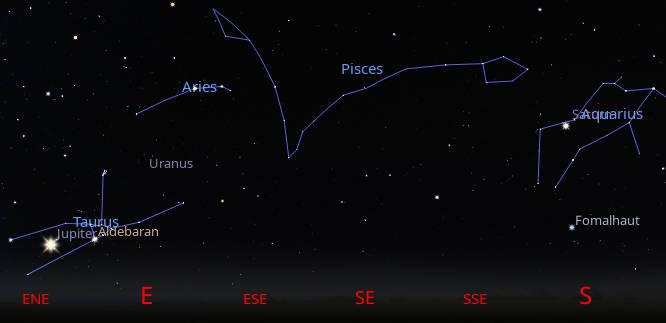
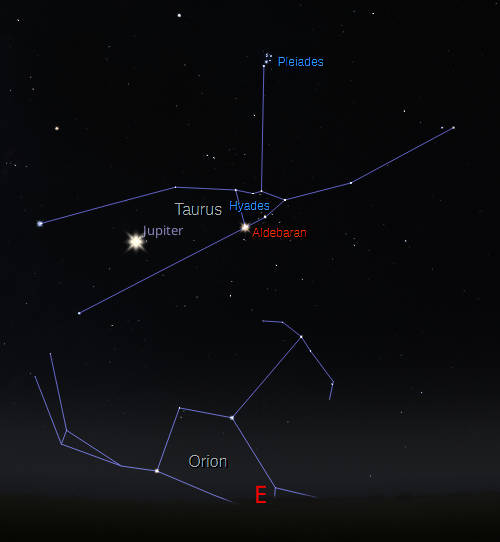
A panorama of the morning planets about 45 minutes before sunrise.
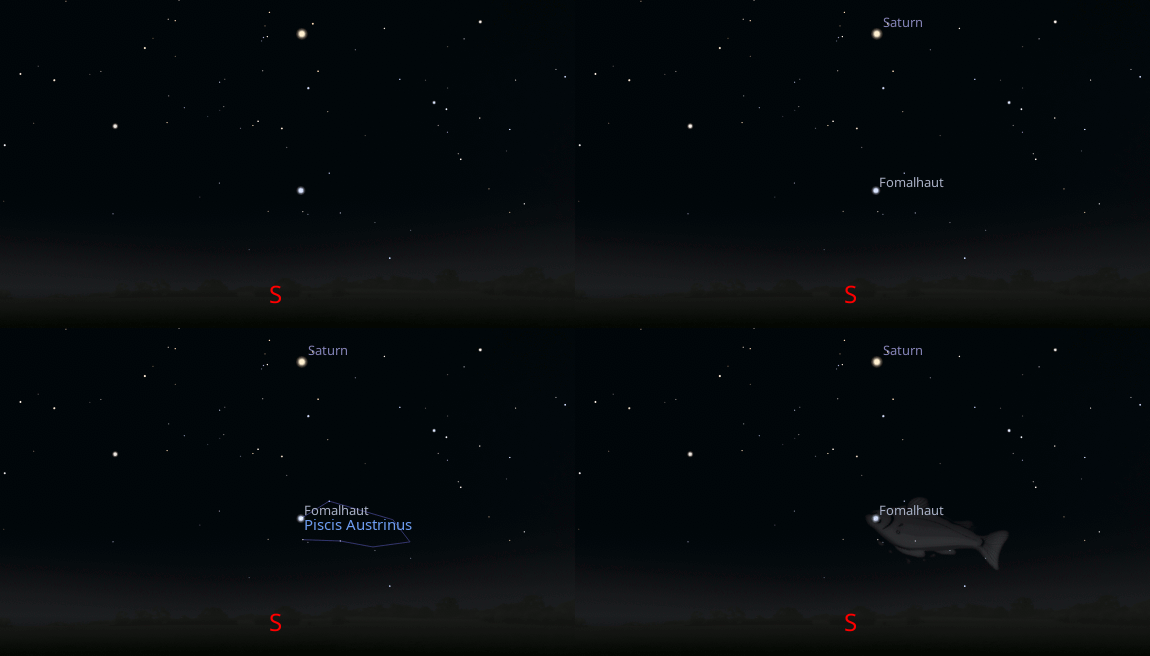
A panorama of the morning planets at 5:30 AM seen from the Grand Traverse Area or about 45 minutes before sunrise. Along with the planets the bright stars of autumn and winter are rising: Fomalhaut below Saturn and Aldebaran below and right of Jupiter Click or tap on the image to enlarge it. Created using Stellarium.
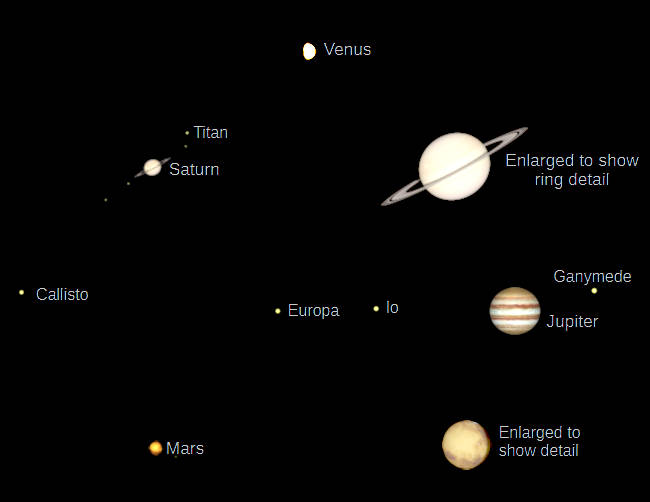
Telescopic Saturn and Jupiter
Telescopic Saturn and Jupiter (north up) as they would be seen in a small telescope at 5:30 AM July 18th 2024 with the same magnification. Apparent diameters: Saturn 18.4″, its rings 42.9″ tilted only 2 degrees from being edge on to us; Mars, too small to be represented here, is 5.6″; Jupiter 34.5″. Note the ” means seconds of arc, or 1/3600th of a degree. Click or tap on the image to enlarge it to show some of Saturn’s faint moons in line with the rings. Created using Cartes du Ciel (Sky Charts).
The naked-eye planets and the Moon at sunset and sunrise on a single night
The naked-eye planets and the Moon at sunset and sunrise on a single night, starting with sunset on the right on July 17, 2024. The night ends on the left with sunrise on the 18th. Click or tap on the image to enlarge it. Created using my LookingUp app and GIMP.
An ephemeris of the Sun Moon and naked eye planet positions for today and tomorrow
This is an ephemeris of the Sun Moon and naked eye planet positions for today and tomorrow, July 17th and 18th 2024. Some of the columns are self-explanatory, others not. The transit column is the time that the body crosses the meridian and is due south. Elong, for elongation, is the angle between the Sun and that body. RA is right ascension, which is the object’s east-west position on the celestial sphere. Dec is declination which is the north-south position of the object on the celestial sphere. The time of the positions is 8 pm EDT, (0 hr UT the next date). R is the distance of that object from the Sun in astronomical units. An astronomical unit is about 93 million miles or 150 million kilometers. And Delta is the distance of that object from the Earth, also in astronomical units. I omit the ‘m’ in am and pm for compactness. The data was generated using my LookingUp for DOS app and displayed by my Ephemeris Helper app.

Ephemeris: 07/10/2024 – Where are the naked-eye planets this week?

July 10, 2024 Comments off

This is Ephemeris for Wednesday, July 10th. Today the Sun will be up for 15 hours and 20 minutes, setting at 9:28, and it will rise tomorrow at 6:08. The Moon, 3 days before first quarter, will set at 12:10 tomorrow morning.

Let’s find out where the naked-eye planets have wandered off to this week. Venus is too close to the direction of the Sun to be easily seen, it will set at 10:07 pm in the west-northwest below and right of Mercury. That elusive planet just might be seen very low in the west-northwest by 10 pm or so. By 5:15 tomorrow morning, or about 50 minutes before sunrise, Saturn will be in the south, Mars will be lower in the east, and Jupiter will below it in the east-northeast. Mars is closing in on Jupiter and will pass it on August 14th. Saturn may look disappointing in telescopes this year since rings are nearly edge on and appear almost as a line through the planet. It will rise at 12:09 am, Mars at 2:34 am, and Jupiter at 3:28 am.

The astronomical event times given are for the Traverse City/Interlochen area of Michigan (EDT, UT–4 hours). They may be different for your location.

Addendum

This is an ephemeris of the Sun Moon and naked eye planet positions for today and tomorrow, July 3rd and 4th 2024. Some of the columns are self-explanatory, others not. The transit column is the time that the body crosses the meridian and is due south. Elong, for elongation, is the angle between the Sun and that body. RA is right ascension, which is the object’s east-west position on the celestial sphere. Dec is declination which is the north-south position of the object on the celestial sphere. The time of the positions is 8 pm EDT, (0 hr UT the next date). R is the distance of that object from the Sun in astronomical units. An astronomical unit is about 93 million miles or 150 million kilometers. And Delta is the distance of that object from the Earth, also in astronomical units. I omit the ‘m’ in am and pm for compactness. The data was generated using my LookingUp for DOS app and displayed by my Ephemeris Helper app.
Venus, Mercury and the Moon as it might appear about 10 PM or about 50 minutes after sunset over a Lake Michigan horizon. Spotting Venus may be impossible. Mercury might be glimpsed even though this is not a favorable elongation. Evening appearances of Mercury in summer are difficult to observe. The Moon is shown twice its normal size to show its phase. Created using Stellarium.
The Moon as it might appear through a small telescope tonight
The Moon as it might appear through a small telescope tonight, July 10th 2024. Selected features are labeled. Created using stellarium, LibreOffice draw, and GIMP.
A panorama of the morning planets at 5:15 AM
A panorama of the morning planets at 5:15 AM seen from the Grand Traverse Area or about 53 minutes before sunrise. Along with the planets the bright stars of autumn and winter are rising. Click or tap on the image to enlarge it. Created using Stellarium.
Telescopic Saturn and Jupiter
Telescopic Saturn and Jupiter (north up) as they would be seen in a small telescope at 5 AM July 11th 2024 with the same magnification. Apparent diameters: Saturn 18.2″, its rings 42.4″ tilted only 2 degrees from being edge on to us; Mars, too small to be represented here, is 5.5″; Jupiter 34.1″. Note the ” means seconds of arc, or 1/3600th of a degree. Click or tap on the image to enlarge it to show some of Saturn’s faint moons in line with the rings. Created using Cartes du Ciel (Sky Charts).
The naked-eye planets and the Moon at sunset and sunrise on a single night
The naked-eye planets and the Moon at sunset and sunrise on a single night, starting with sunset on the right on July 10, 2024. The night ends on the left with sunrise on the 11th. Click or tap on the image to enlarge it. Created using my LookingUp app and GIMP.
Ephemeris of the Sun Moon and naked eye planet positions for today and tomorrow
This is an ephemeris of the Sun Moon and naked eye planet positions for today and tomorrow, July 10th and 11th 2024. Some of the columns are self-explanatory, others not. The transit column is the time that the body crosses the meridian and is due south. Elong, for elongation, is the angle between the Sun and that body. RA is right ascension, which is the object’s east-west position on the celestial sphere. Dec is declination which is the north-south position of the object on the celestial sphere. The time of the positions is 8 pm EDT, (0 hr UT the next date). R is the distance of that object from the Sun in astronomical units. An astronomical unit is about 93 million miles or 150 million kilometers. And Delta is the distance of that object from the Earth, also in astronomical units. I omit the ‘m’ in am and pm for compactness. The data was generated using my LookingUp for DOS app and displayed by my Ephemeris Helper app.

Ephemeris: 07/08/2024 – The Summer Triangle dominates the eastern sky

July 8, 2024 Comments off

This is Ephemeris for Monday, July 8th. Today the Sun will be up for 15 hours and 23 minutes, setting at 9:29, and it will rise tomorrow at 6:06. The Moon, 3 days past new, will set at 11:34 this evening.

We’re two weeks into summer, and the asterism or informal constellation called the Summer Triangle can be seen in the eastern sky as it gets dark. The highest of the three bright stars is Vega in the constellation Lyra the harp, whose body is seen in a narrow parallelogram just below it. The second star of the triangle is Deneb, in Cygnus the swan, lower and left of Vega, It appears dimmer than Vega because it is by far the most distant of the three. The third star of the Summer Triangle is seen farther below and a right of Vega. It is Altair in Aquila the eagle, and the closest. Altair is 16.5 light years away, Vega is 27 light years, while Deneb may be a whopping 2,600 light years away. One light year by the way, is 6 trillion miles (9 trillion kilometers).

The astronomical event times given are for the Traverse City/Interlochen area of Michigan (EDT, UT–4 hours). They may be different for your location.

Addendum

Finder animation for the Summer Triangle
Finder animation for the Summer Triangle. Created using Stellarium and GIMP.
The Milky Way in the Summer Triangle
Something that we are going to be missing in the next couple of weeks with the Moon being out in the evening will be the Milky Way that runs through the Summer Triangle. This photograph by Daniel Dell’Olmo emphasizes the Milky Way that can be seen under moonless skies.

Ephemeris: 07/03/2024 – Where have the naked-eye planets wandered off to this week?

July 3, 2024 Comments off

This is Ephemeris for Wednesday, July 3rd. Today the Sun will be up for 15 hours and 28 minutes, setting at 9:31, and it will rise tomorrow at 6:03. The Moon, 2 days before new, will rise at 4:13 tomorrow morning.

Let’s find out where the naked-eye planets have wandered off to this week,. Venus is too close to the direction of the Sun to be seen. Mercury just might be seen very low in the west-northwest by 10 pm or so. Venus will appear in the evening sky next month. By 5:15 tomorrow morning, or about 45 minutes before sunrise, Saturn will be in the south-southeast and Mars will be lower in the east, and Jupiter will be low in the east-northeast. The skinny waning crescent Moon may be seen halfway between Jupiter and the northeastern horizon. Saturn will be a bit dimmer this year and next due to its rings being nearly edge on to us and not reflecting as much light. Saturn will rise at 12:40 am, Mars at 2:48 am, and Jupiter at 3:51 am.

The astronomical event times given are for the Traverse City/Interlochen area of Michigan (EDT, UT–4 hours). They may be different for your location.

Addendum

Mercury and Venus in the evening sky 1/2 an hour after sunset or 10 PM according to Stellarium . Spotting Mercury will be a real challenge and probably require binoculars. This is not a good elongation of Mercury for observers in the northern hemisphere so don’t worry if you can’t spot it. Venus, basically, is too close to the horizon to be spotted. Created using Stellarium.
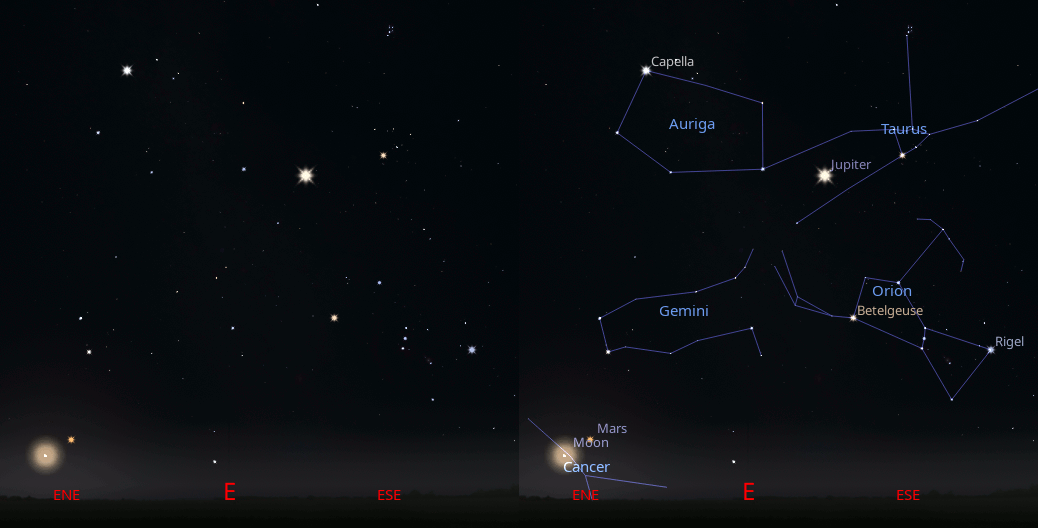
The morning planets and the Moon are spread out from the east-northeast to the south in the morning sky at 5:15 AM, or about 45 minutes before sunrise, July 4, 2024. Also visible is the bright star Capella. Created using Stellarium.
This is the Moon according to Stellarium a day before new as it might appear tomorrow morning, July 4th 2024. The night side of the Moon will appear to be illuminated by earthshine, the reflection of the Sun’s light from off the Earth in the Moon’s sky. Created using Stellarium.
Telescopic Saturn and Jupiter (north up) as they would be seen in a small telescope at 5 AM July 4th 2024 with the same magnification. Apparent diameters: Saturn 18.0″, its rings 41.9″; Mars, too small to be represented here, is 5.4″; Jupiter 33.7″. Note the ” means seconds of arc, or 1/3600th of a degree. Created using Cartes du Ciel (Sky Charts).
The naked-eye planets and the Moon at sunset and sunrise on a single night, starting with sunset on the right on July 3, 2024. The night ends on the left with sunrise on the 4th. Click or tap on the image to enlarge it. Created using my LookingUp app and GIMP.
This is an ephemeris of the Sun Moon and naked eye planet positions for today and tomorrow, July 3rd and 4th 2024. Some of the columns are self-explanatory, others not. The transit column is the time that the body crosses the meridian and is due south. Elong, for elongation, is the angle between the Sun and that body. RA is right ascension, which is the object’s east-west position on the celestial sphere. Dec is declination which is the north-south position of the object on the celestial sphere. The time of the positions is 8 pm EDT, (0 hr UT the next date). R is the distance of that object from the Sun in astronomical units. An astronomical unit is about 93 million miles or 150 million kilometers. And Delta is the distance of that object from the Earth, also in astronomical units. I omit the ‘m’ in am and pm for compactness. The data was generated using my LookingUp for DOS app and displayed by my Ephemeris Helper app.

Ephemeris: 7/02/2024 – Antares and the scorpion

July 2, 2024 Comments off

This is Bob Moler with Ephemeris for Tuesday, July 2nd. Today the Sun will be up for 15 hours and 29 minutes, setting at 9:31, and it will rise tomorrow at 6:02. The Moon, 3 days before new, will rise at 3:26 tomorrow morning.

The constellation of Scorpius the scorpion is low in the south at 11 PM these nights. It’s bright star Antares will pass due south at 11:30 this evening. Antares is an interesting star in that it is a red giant star, and its name Antares* means “Rival of Mars” alluding to the fact that it and Mars appears to be the same color. And about every two years Mars passes near Antares, so unless you know your stars and planets you could mistake them for each other. Antares lies at the heart of the scorpion. To its upper right is the front part of its body and claws, and the trail of stars running down the other way, nearly to the horizon, in the south and back up in the south-southeast to the two stars of its stinger make its characteristic tail.

The astronomical event times given are for the Traverse City/Interlochen area of Michigan (EDT, UT–4 hours). They may be different for your location.

*Breaking down Antares: Ant (Anti, against) – Ares (The Greek god of war the Romans called Mars).

Addendum

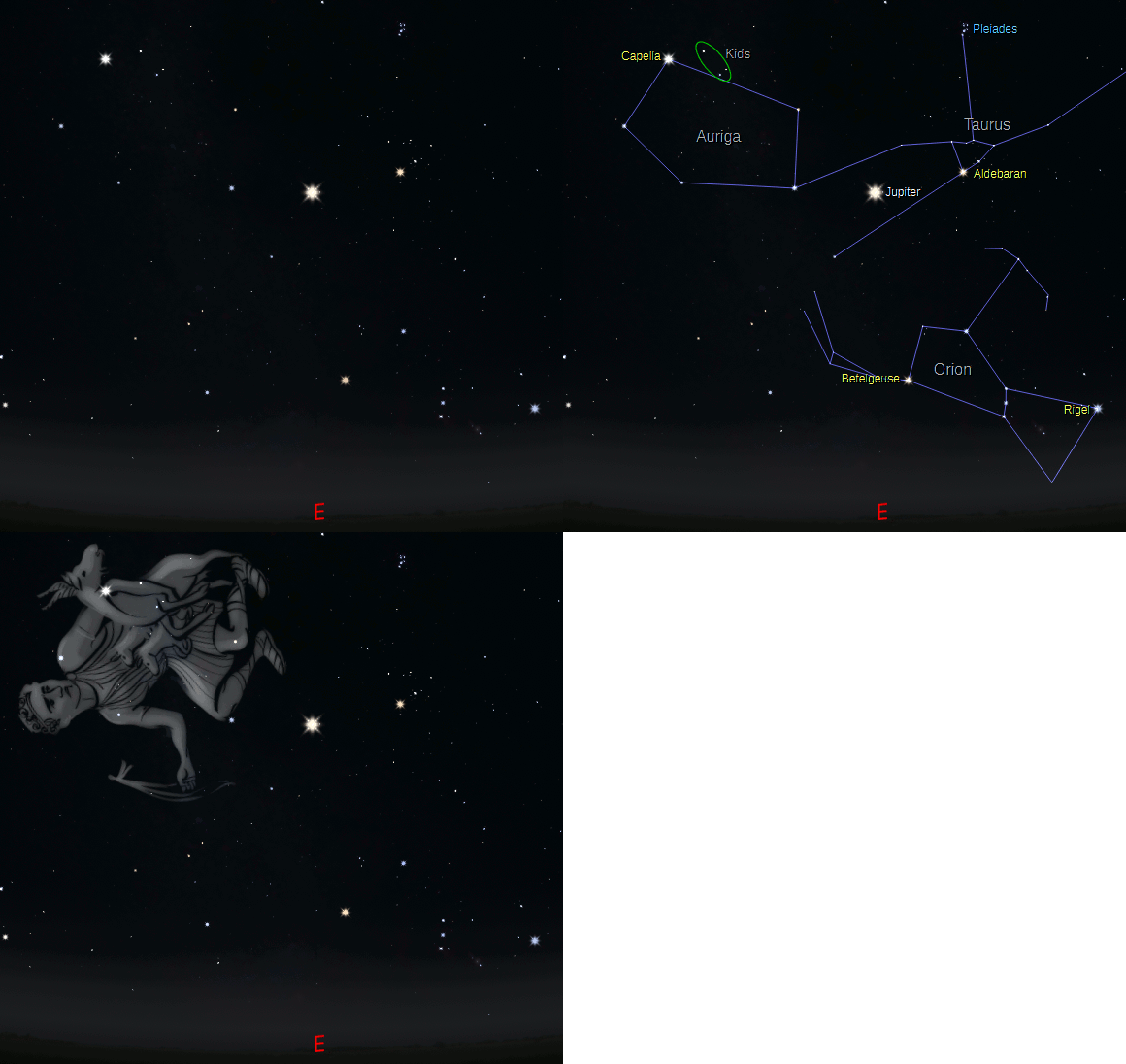
Scorpius Finder in four frames
Scorpius Finder in four frames. The 1st frame is the star field above the southern horizon as it might appear at 11 pm, July 2nd. The 2nd frame shows the constellation lines of Scorpius. I differ a bit from Stellarium in the lines above right of Antares. The 3rd frame is the constellation art that comes with Stellarium of Scorpius. The 4th frame is the star field again with the constellation lines, but seen without the horizon or atmospheric extinction getting in the way. The Arabs may have thought Scorpius was a larger constellation. There are two stars at the upper right corner of the frame that they saw belonged to Scorpius, which now belong to Libra. The upper one, nearest the top, is Zubeneschamali which means northern claw. The one below it and nearest the right edge of the image is Zubenelgenubi, the southern claw. These names predate Libra being its own constellation.

Note for trivia fans: Zubeneschamali is the longest star name at 14 letters.