Archive
Ephemeris: 08/13/2024 – Antares and the Moon
This is Ephemeris for Tuesday, August 13th. Today the Sun will be up for 14 hours and 7 minutes, setting at 8:50, and it will rise tomorrow at 6:44. The Moon, 1 day past first quarter, will set at 12:41 tomorrow morning.
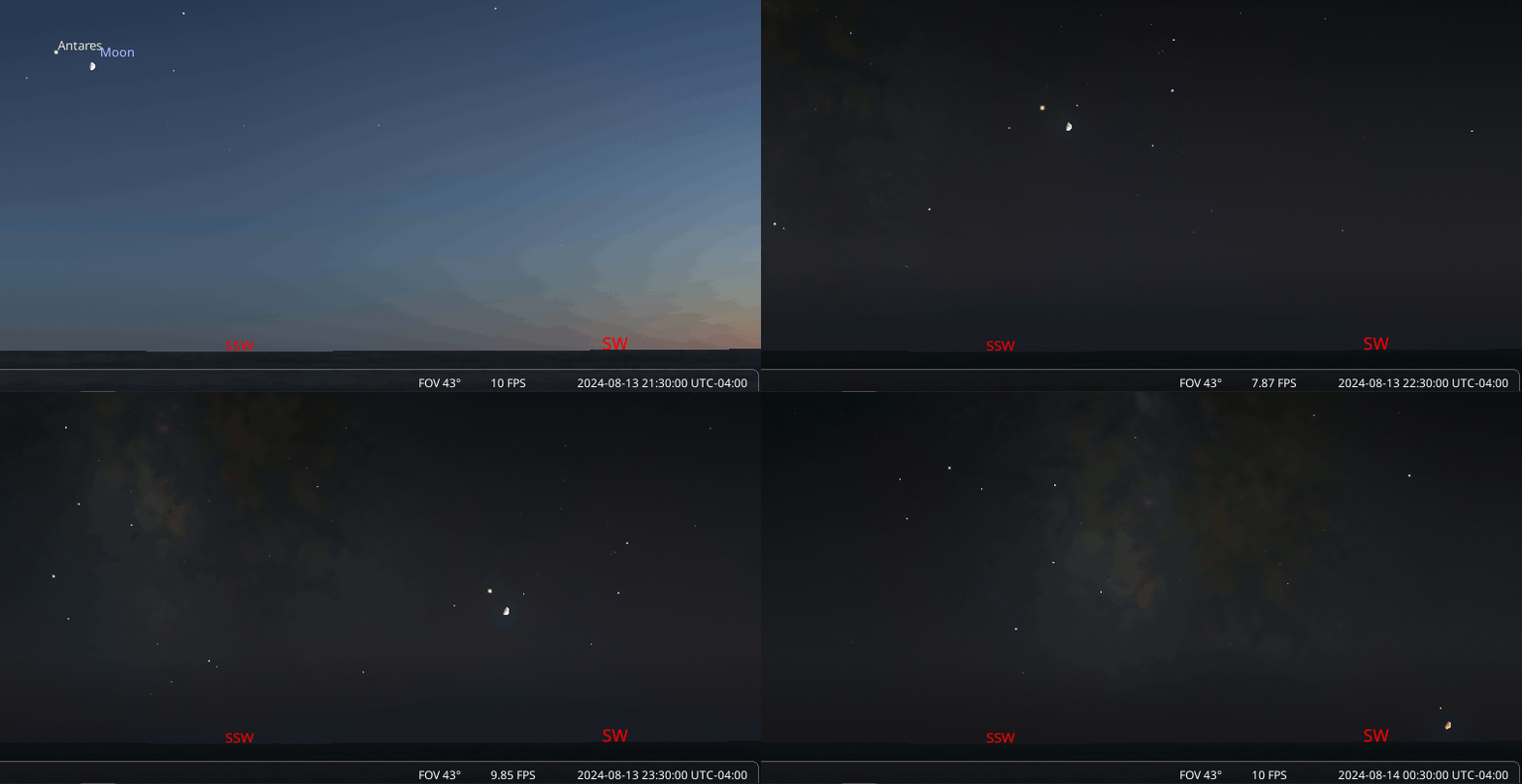
The Moon tonight will have a companion. Just to the left of it will be a star. That star may not look very bright because it is overpowered by moonlight, but it is one of the brightest stars of the sky. It is Antares in Scorpius the scorpion, a red giant star. Every month for the last several years and for the next several years the moon will pass in front of that star. Unfortunately due to the timing and to the path of the Moon it doesn’t happen for any particular spot on the Earth very often. Tonight, as the Moon sets it will be approaching Antares but will appear about to pass below it at the time it sets. We will not be able to see the Moon actually cover or occult Antares from Northern Michigan until May 2028, nearly four years from now.
The astronomical event times given are for the Traverse City/Interlochen area of Michigan (EDT, UT–4 hours). Times will be different for other locations.
Addendum
Ephemeris: 08/12/2024 – Expect a stellar explosion soon
This is Ephemeris for Monday, August 12th. Today the Sun will be up for 14 hours and 9 minutes, setting at 8:52, and it will rise tomorrow at 6:43. The Moon, at first quarter today, will set at 12:07 tomorrow morning.
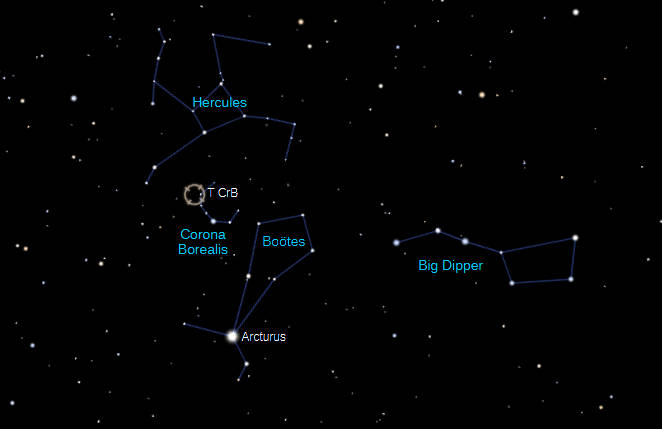
This is a reminder that we are expecting a once in a lifetime nova or exploding star in our skies fairly soon, maybe in a month or two. At least we’re hoping. Unlike many reoccurring events in astronomy this one cannot be predicted exactly since we’re not really sure what is happening. We have a general idea. The star is T Coronae Borealis which is in the Northern Crown constellation, which is a small semicircular stellar group near the star Arcturus which is a bright star found off the end of the handle of the Big Dipper. It is to the upper left of that star and the kite shaped constellation of Boötes of which Arcturus is at the base. The nova will appear as bright as Corona’s brightest star, but will fade in about 8 days below naked eye visibility. So it will be easy to miss.
The astronomical event times given are for the Traverse City/Interlochen area of Michigan (EDT, UT–4 hours). Times will be different for other locations.
Addendum
Ephemeris: 08/08/2024 – The source of the Perseid Meteor Shower
This is Ephemeris for Thursday, August 8th. Today the Sun will be up for 14 hours and 20 minutes, setting at 8:58, and it will rise tomorrow at 6:38. The Moon, halfway from new to first quarter, will set at 10:47 this evening.
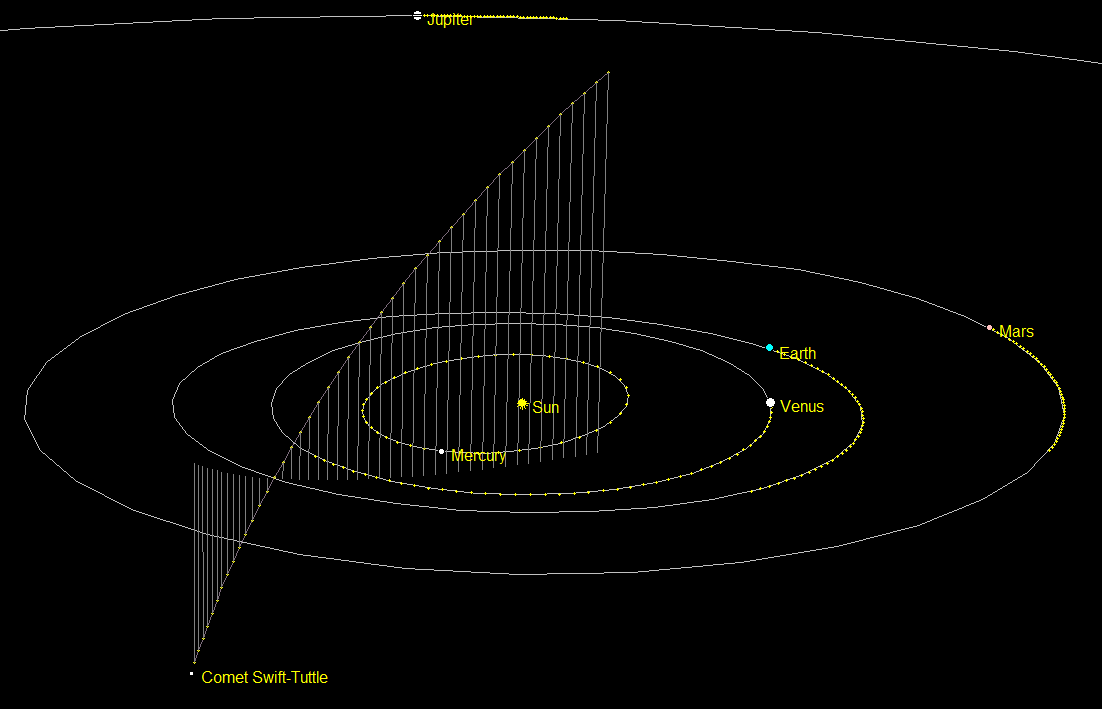
The source of the Perseid meteor shower is Comet Swift-Tuttle, first discovered in 1862 buy Lewis Swift and Horace Parnell Tuttle. The comet was expected back around 1982, but it didn’t show. Its orbit was recalculated and was expected around 1992, when it indeed showed up. The comet has a 130 or so year orbit of the Sun which does vary from appearance to appearance. The comet appears to be in resonance with Jupiter’s orbit of the Sun, going around once in the same time Jupiter goes around the Sun 11 times. Its next appearance in the inner solar system will be in the year 2126, when it is expected to be quite bright then, coming relatively close to the Earth.
The astronomical event times given are for the Traverse City/Interlochen area of Michigan (EDT, UT–4 hours). Times will be different for other locations.
Addendum
Ephemeris: 08/07/2024 – Where have the naked eye planets wandered off to?
This is Ephemeris for Wednesday, August 7th. Today the Sun will be up for 14 hours and 23 minutes, setting at 8:59, and it will rise tomorrow at 6:37. The Moon, 3 days past new, will set at 10:31 this evening.
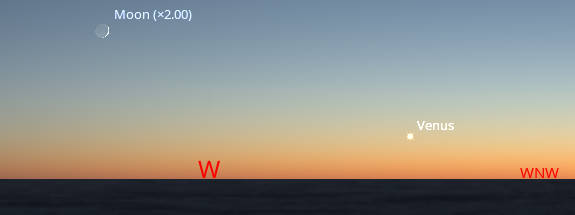
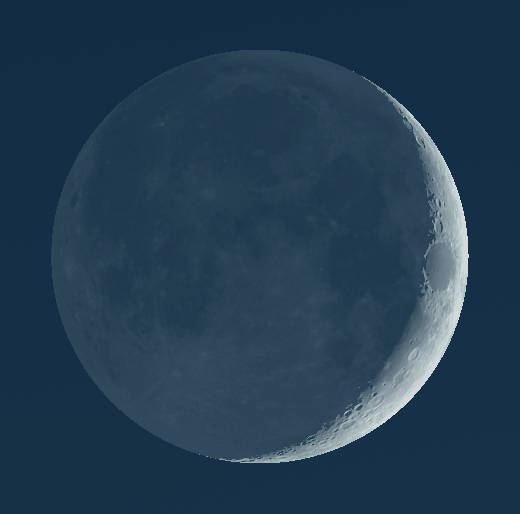
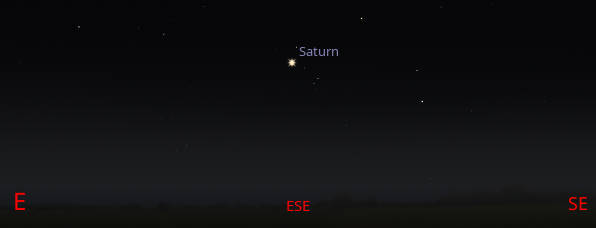
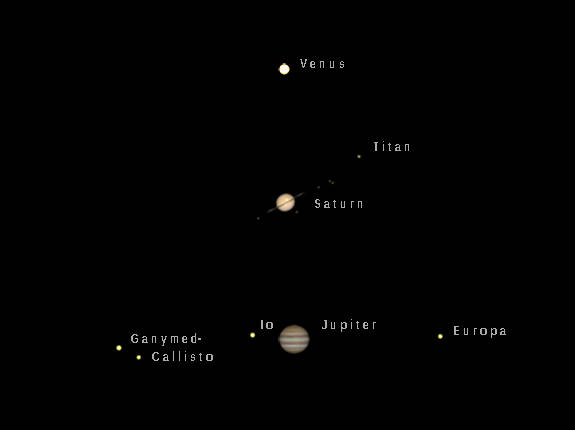
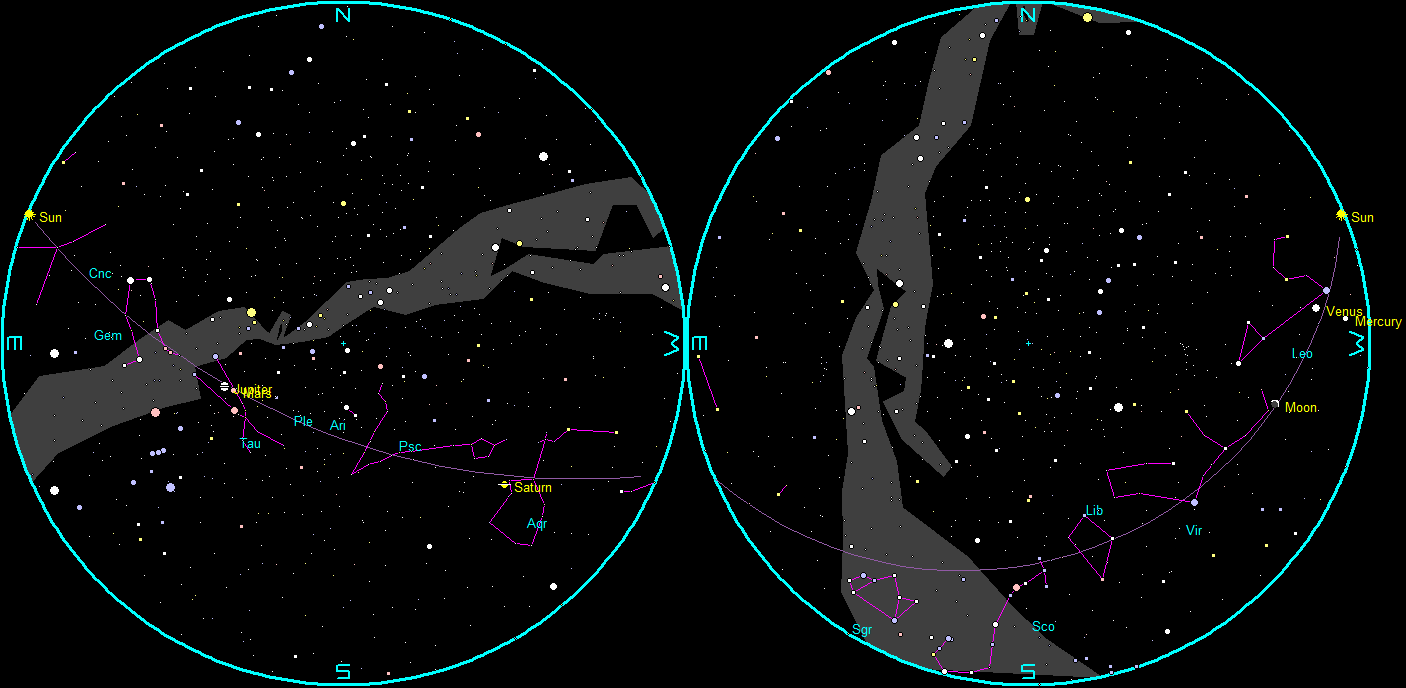
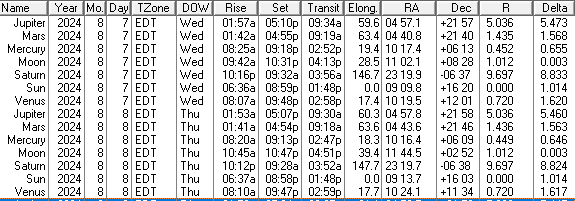
Let’s take our weekly look at the whereabouts of the naked-eye planets. The Moon will be visible as a thin crescent in the west with Venus lower in the west northwest around 9:30 pm. It will set at 9:56 pm in the west-northwest. Venus is best seen over a very low or lake horizon. Saturn will rise at 10:17 pm, and by 11 pm will be low in the east southeast, pretty much by itself. Saturn may look disappointing in telescopes this year since rings are nearly edge on and appear almost as a line through the planet. The other two visible planets are in the morning sky.
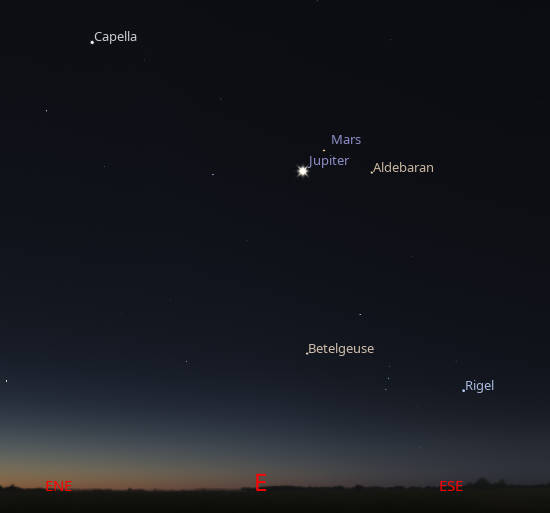
By 5:30 tomorrow morning, or an hour before sunrise, Jupiter and Mars will be up in the east, with Mars approaching Jupiter just above and to the right of it. Mars will rise at 1:41 am, and Jupiter at 1:53 am.
The astronomical event times given are for the Traverse City/Interlochen area of Michigan (EDT, UT–4 hours). Times will be different for other locations.
Addendum
Ephemeris: 08/06/2024 – Looking toward the Perseid Meteor Shower
This is Ephemeris for Tuesday, August 6th. Today the Sun will be up for 14 hours and 25 minutes, setting at 9:01, and it will rise tomorrow at 6:36. The Moon, 2 days past new, will set at 10:15 this evening.
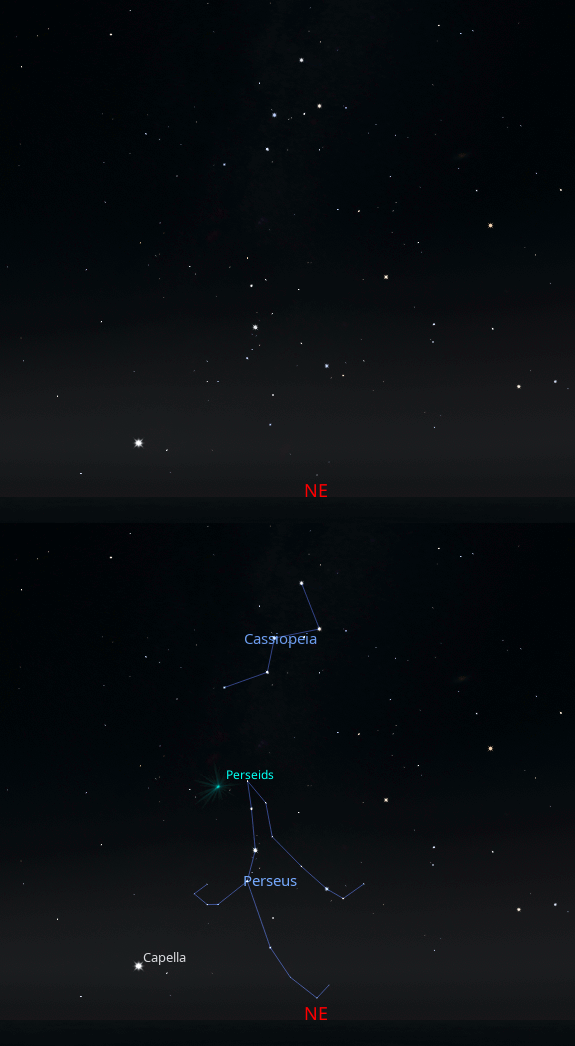
Next Monday morning we’ll see the peak of the Perseid meteor shower. They’re called the Perseids because they seem to come from the constellation of Perseus the hero which is below the W shaped constellation of Cassiopeia in the northeast in the evenings now. The reason they appear to come from the same direction is that they were shed by a comet whose name is Swift-Tuttle discovered in 1862 it’s been around many times before that, though not recognized as such. The first mention of the Perseids in history comes from the year 36 CE, though they were assuredly visible but unrecognized before that. In the past they’ve been known as the Tears of Saint Lawrence because their peak is near the feast date of that martyr. Perseids can be seen now, though not in peak numbers.
The astronomical event times given are for the Traverse City/Interlochen area of Michigan (EDT, UT–4 hours). Times will be different for other locations.
Addendum
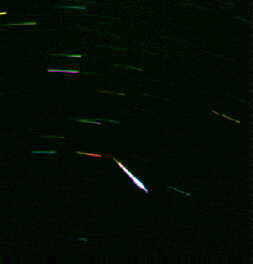
Ephemeris: 08/05/2024 – Finding Aquila the Eagle
This is Ephemeris for Monday, August 5th. Today the Sun will be up for 14 hours and 28 minutes, setting at 9:02, and it will rise tomorrow at 6:35. The Moon, 1 day past new, will set at 9:58 this evening.
The bright star Altair is seen halfway up the sky in the southeast at 10:30 this evening. It is one of the stars of the Summer Triangle with Vega above it, and Deneb above and left of it. It is the brightest star in the constellation Aquila the eagle which is seen flying northward through the Milky Way, with Altair at its head. Altair is flanked by two stars one above one below. Its wing tips can be seen below, and to the upper right. His tail is almost lost in the Milky Way seen lower in the east southeast. Here in Aquila is where the great rift, the dark band that splits the Milky Way, is most prominent. The Greeks and Romans seemed to have trouble telling vultures and eagles apart. Another name of the constellation was Vultur Volans.
The astronomical event times given are for the Traverse City/Interlochen area of Michigan (EDT, UT–4 hours). They will be different for other locations.
Addendum

Ephemeris: 08/02/2024 – The Northern Cross
This is Ephemeris for Friday, August 2nd. Today the Sun will be up for 14 hours and 35 minutes, setting at 9:06, and it will rise tomorrow at 6:31. The Moon, 2 days before new, will rise at 5:12 tomorrow morning.
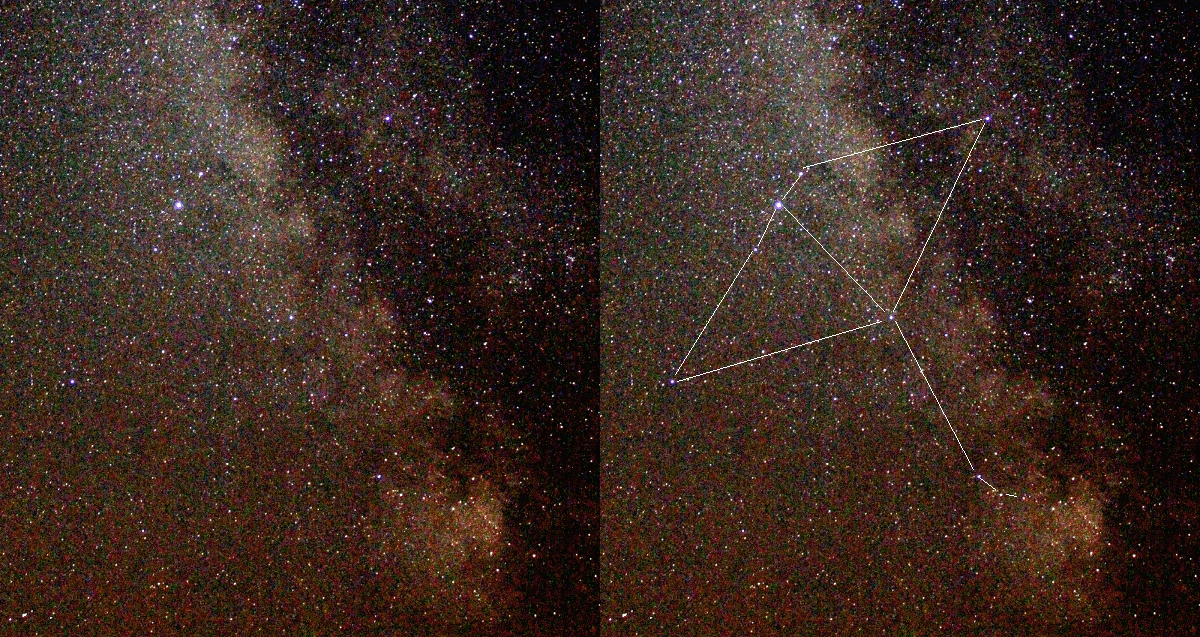
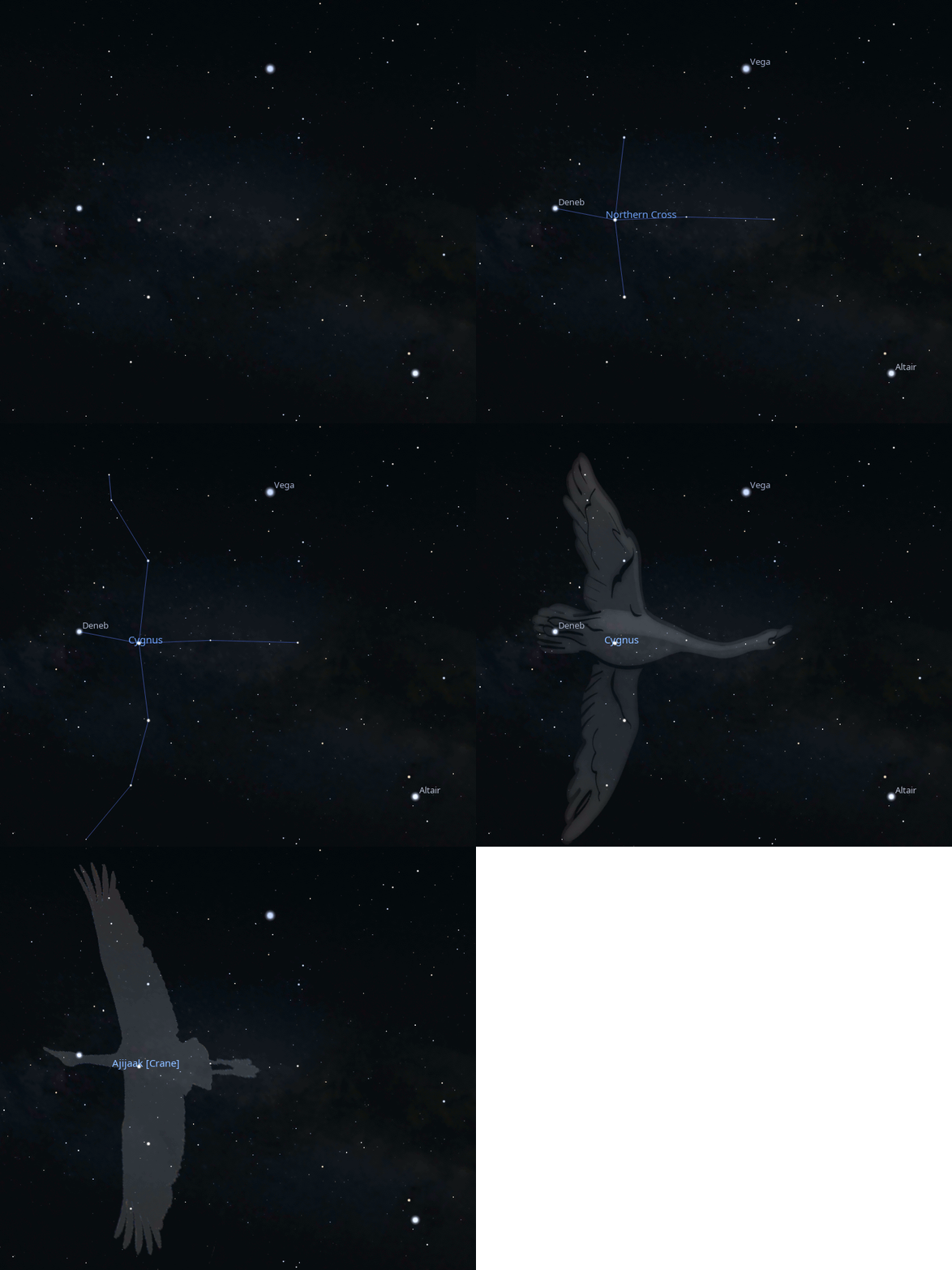
The star Deneb is high in the east-northeast. It is the dimmest of the three stars of the Summer Triangle. It is at the head of the Northern Cross, an informal constellation or asterism. The upright extends to the South. The crossbeam can be seen crossing the star just south of Deneb. There’s also a constellation there. It’s actually Cygnus the swan flying southward along the Milky Way with its neck outstretched. The Anishinaabe natives peoples of our area see Ajijaak the crane, also with a long neck flying north, but also long legs trailing to the south, its wings outstretched. In Greek mythology Cygnus was the guise of the god Zeus when he seduced Leda, whose offspring was Pollux, one of the Gemini twins.
The astronomical event times given are for the Traverse City/Interlochen area of Michigan (EDT, UT–4 hours). They may be different for your location.
Addendum
Ephemeris: 07/30/2024 – The heavenly harp
This is Ephemeris for Tuesday, July 30th. Today the Sun will be up for 14 hours and 42 minutes, setting at 9:10, and it will rise tomorrow at 6:28. The Moon, 3 days past last quarter, will rise at 2:08 tomorrow morning.
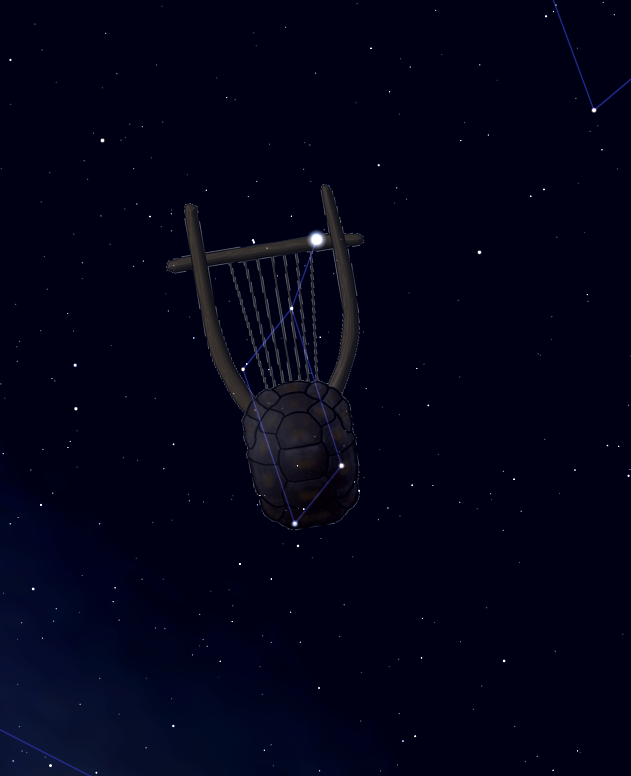
After it gets dark, nearly overhead, appears the bright star Vega, the brightest of the stars of the Summer Triangle. It is part of the constellation called Lyra the harp. The form of the harp is a lyre, which has a U-shaped frame with a bar across the top, the strings are strung from the bar down to the base of the U. According to Greek myth it was invented by the god Hermes who used a tortoise shell as the base of the U. He gave it to Apollo, who in turn gave it to Orpheus. Orpheus had the greatest musical talent. His singing and lyre playing would make animals and even inanimate objects dance. The constellation itself consists of Vega and a parallelogram of four stars which are seen below it.
The astronomical event times given are for the Traverse City/Interlochen area of Michigan (EDT, UT–4 hours). They may be different for your location.
Addendum
Ephemeris: 07/29/2024 – Late July’s meteor shower
This is Ephemeris for Monday, July 29th. Today the Sun will be up for 14 hours and 45 minutes, setting at 9:11, and it will rise tomorrow at 6:27. The Moon, 2 days past last quarter, will rise at 1:26 tomorrow morning.
There are more meteor showers that occur in the second-half of the year than there are in the first six months of the year. I don’t know why that is. The first of these major showers is the Southern Delta Aquariid meteor shower. There happens to be a few meteor showers at appear to emanate from the constellation of Aquarius so they named them after the closest star to the direction they appear to come from at their maximum. The star Delta in the southern part of Aquarius is associated with two meteor showers. This one appears to be coming from south of that star. And are only an eighth as active as the Perseids that we’re going to have next month partly because the radiant point doesn’t get very high in the sky.
The astronomical event times given are for the Traverse City/Interlochen area of Michigan (EDT, UT–4 hours). They may be different for your location.
Addendum
Ephemeris: 07/25/2024 – The Milky Way as it will appear tonight
This is Ephemeris for Thursday, July 25th. Today the Sun will be up for 14 hours and 54 minutes, setting at 9:16, and it will rise tomorrow at 6:23. The Moon, 2 days before last quarter, will rise at 11:43 this evening.
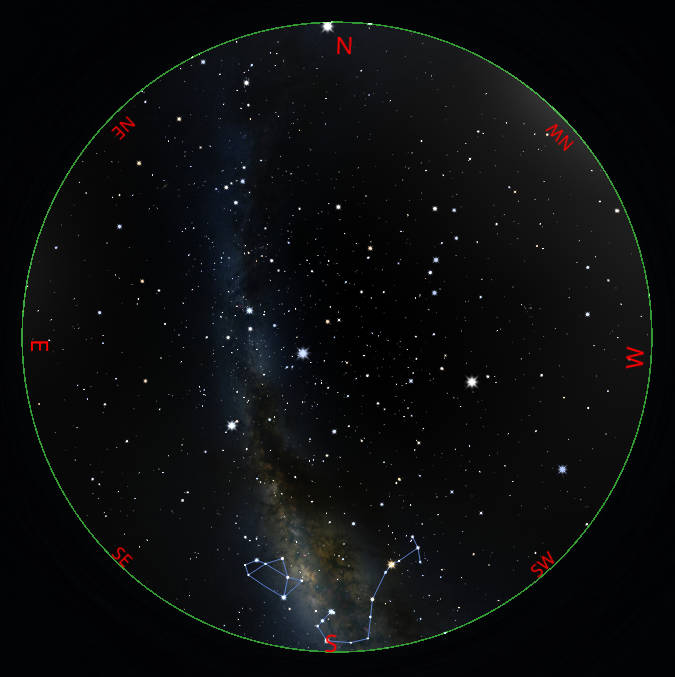
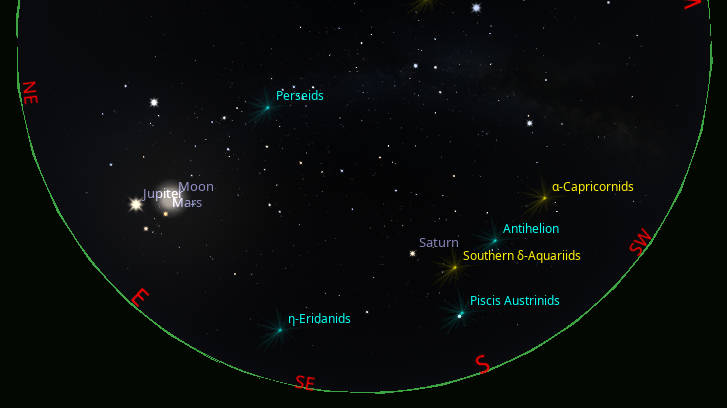
With the Moon out of the sky until almost 11:30 PM we get our first look at the summer Milky Way in the evening. The Milky Way will stretch from the east-northeast, high in the east to the South. The asterism of the stout little Teapot in Sagittarius, low to the south, is near the bottom end of the Milky Way. The milky stream appears as steam coming out of the spout. With more stars there, one might be able to see the Centaur with a bow and arrow. The front part of the teapot is the bow. The bottom left, and the far right star are the back and the tip of the arrow which is pointing at the heart of Scorpius the scorpion in the south-southwest. We’ll be exploring the wonders of the summer Milky Way this month and next.
The astronomical event times given are for the Traverse City/Interlochen area of Michigan (EDT, UT–4 hours). They may be different for your location.
Addendum