Archive
Ephemeris: 06/12/2024 – Where are the naked-eye planets this week?
This is Ephemeris for Wednesday, June 12th. Today the Sun will be up for 15 hours and 32 minutes, setting at 9:29, and it will rise tomorrow at 5:56. The Moon, 2 days before first quarter, will set at 1:49 tomorrow morning.
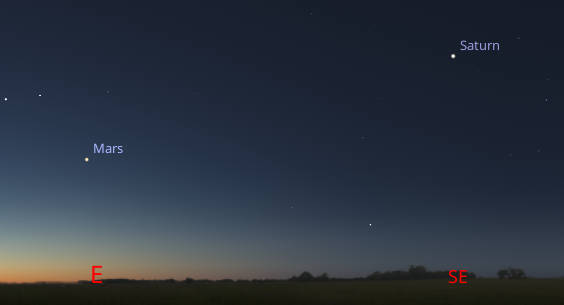
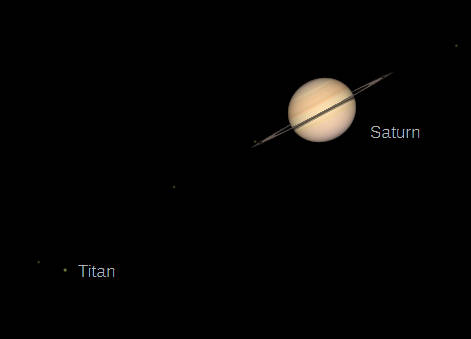
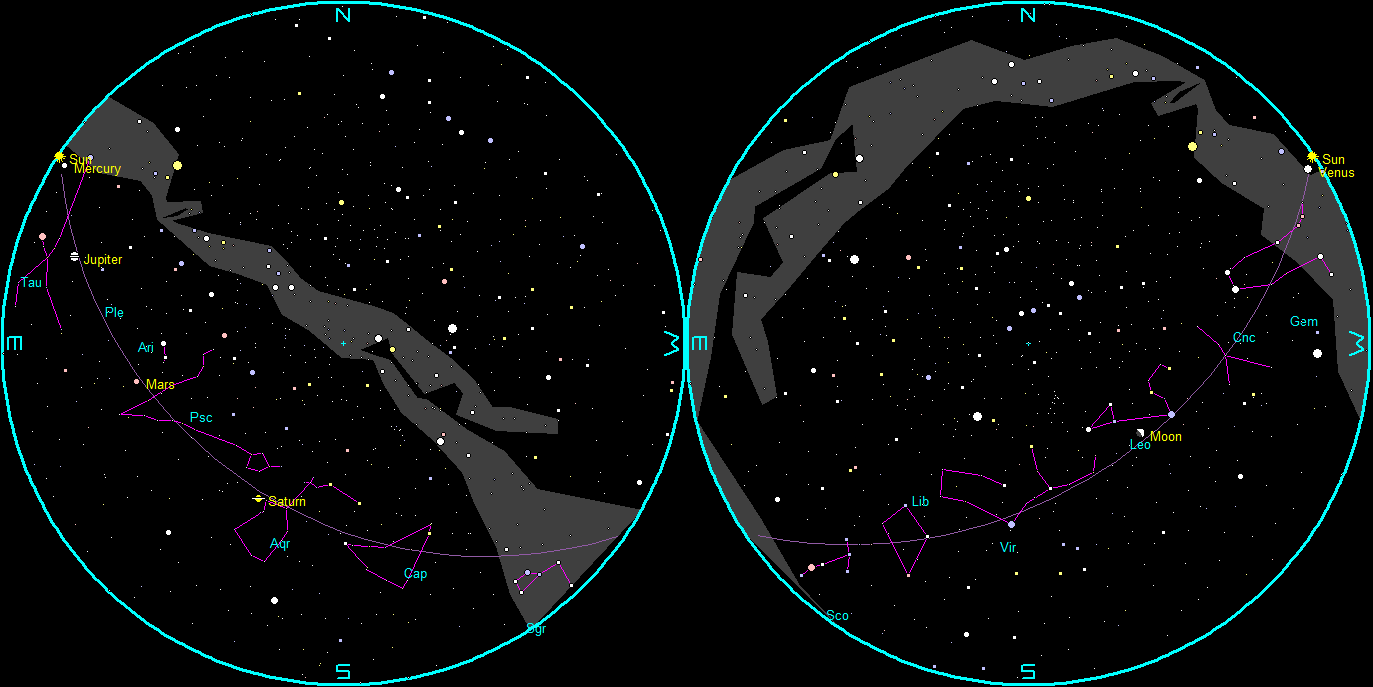
Let’s find out where the naked-eye planets have wandered off to this week, and see what planets are left. Venus and Mercury are too close to the direction of the Sun to be seen. Venus just entered the evening sky last week when it passed behind the Sun in conjunction. It will appear in the evening sky next month. Jupiter, the second-brightest planet still is a week or so from being spotted in the morning, since it rises about an hour before the Sun. By 5 tomorrow morning, or about an hour before sunrise, Saturn will be in the southeast and Mars will be lower in the east. In telescopes, Saturn will look fairly different this year and next with its rings nearly edge on to us. They will open up a bit through October before closing again. They are only 2 degrees from being edge on to us.
The astronomical event times given are for the Traverse City/Interlochen area of Michigan (EDT, UT–4 hours). They may be different for your location.
Addendum
Ephemeris: 01/08/2024 – Orion vs Taurus: conflict for the ages
This is Ephemeris for Monday, January 8th. Today the Sun will be up for 9 hours even, setting at 5:19, and it will rise tomorrow at 8:19. The Moon, 3 days before new, will rise at 6:58 tomorrow morning.
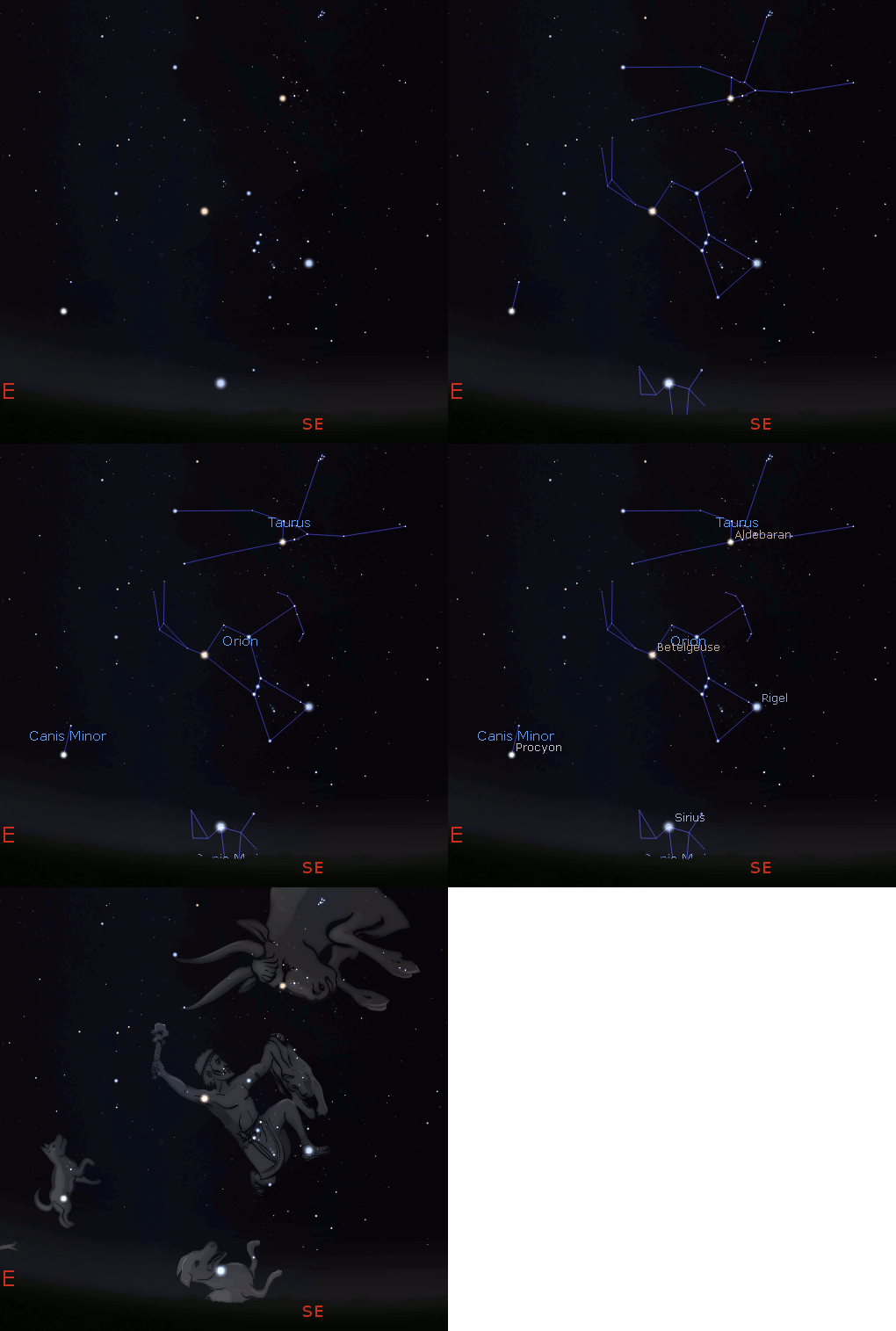
There are several instances in the Greek heavens where constellations appear to interact with one another. This is true with Orion the hunter and Taurus the bull. Taurus, whose face is the letter V of stars with orangish Aldebaran as his angry bloodshot eye is charging down on Orion, who has raised a lion skin shield on one arm and an upraised club in the other, ready to strike. They have been frozen in this pose for millennia. Stars below and right of the letter V of the Bull’s face suggest the front part of his body and his front legs charging at Orion. Orion also has two hunting dogs, Canis Major and Canis Minor. Canis Major with its dazzling star Sirius will rise around 7:30 on a line extended down from Orion’s belt.
The astronomical event times given are for the Traverse City/Interlochen area of Michigan (EST, UT –5 hours). They may be different for your location.
Addendum
Ephemeris: 11/30/2023 – Previewing December skies
This is Ephemeris for Thursday, November 30th. Today the Sun will be up for 9 hours and 5 minutes, setting at 5:04, and it will rise tomorrow at 7:59. The Moon, 3 days past full, will rise at 7:44 this evening. | December is the month with the shortest daylight hours. Winter will officially arrive at the winter solstice on the 21st at 10:28 p.m. There will be little movement in the sunset times: In the Traverse City/Interlochen area this will be from 5:03 Tomorrow, down to 5:02 and then advancing to 5:11 at the end of the month. There is more movement in the sunrise times which will advance from 7:59 am tomorrow to 8:20 am on the 31st. There is also little movement of daylight hours. The noontime Sun will hang around 22 to 23 degrees above the southern horizon all month. The Geminid meteors on the night of the14th and morning of the 15th will have dark skies all night. It is the most active shower of the year, difficult to view from here due to the cold and December’s cloudiness.
The astronomical event times given are for the Traverse City/Interlochen area of Michigan (EST, UT –5 hours). They may be different for your location.
Addendum
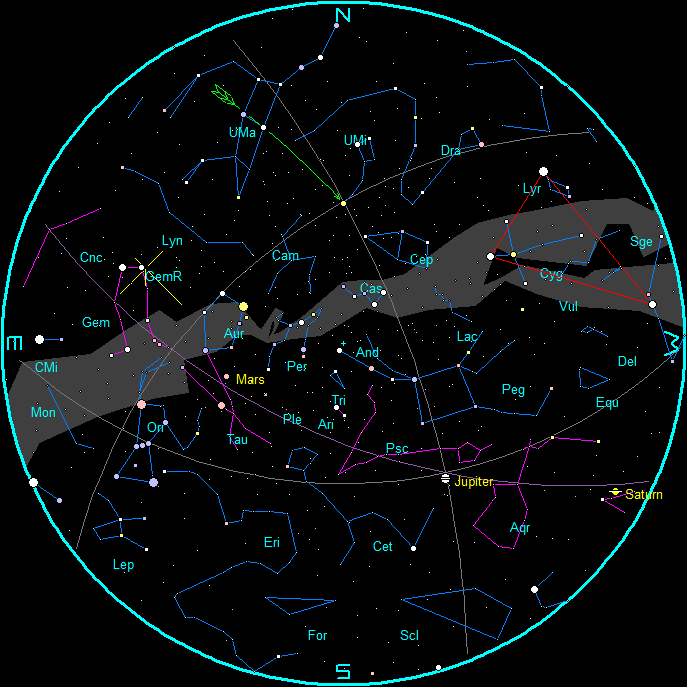
December Evening Star Chart
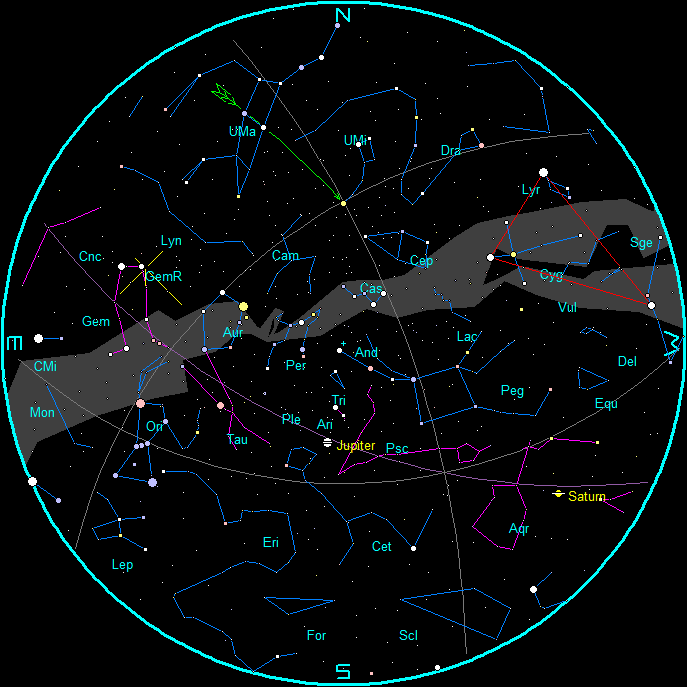
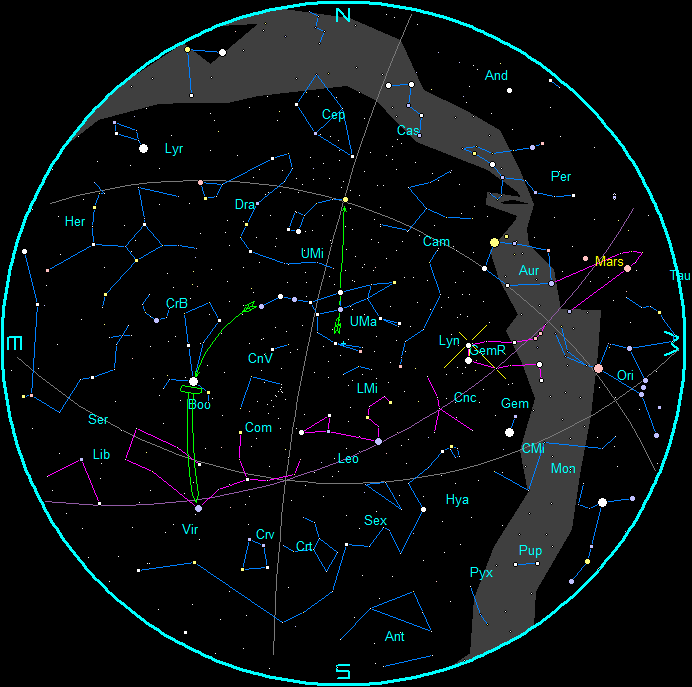
The planets and stars are plotted for the 15th at 9 pm EST in the evening and 6 a.m. for the morning chart. These are the chart times. Note that Traverse City is located approximately 45 minutes behind our time meridian, West 75° longitude. (An hour 45 minutes behind our daylight saving time meridian during EDT).
December Morning Star Chart
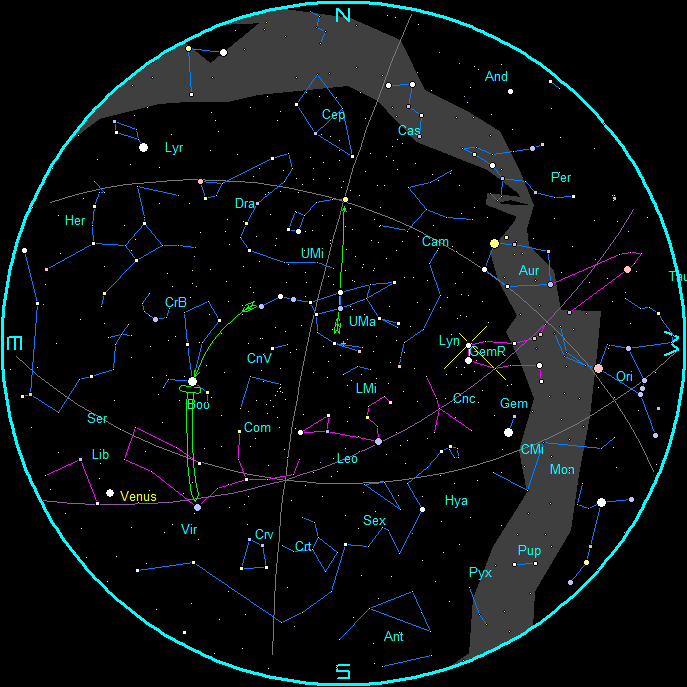
For a list of constellation names to go with the abbreviations, click here.
- Pointer stars at the front of the bowl of the Big Dipper point to Polaris, the North Star.
- The leaky bowl of the Big Dipper drips on Leo.
- Follow the arc of the handle of the Big Dipper to the star Arcturus, then
- Follow the spike to Spica.
- The Summer Triangle is in red.
- GemR on the star charts is the radiant of the Geminid meteor shower, which peaks on the evening of the 14th.
Twilight Limits, Nautical and Astronomical
| EST | |||||||
| Morning | Twilight | Evening | Twilight | Dark | Night | Moon | |
| Date | Astro. | Nautical | Nautical | Astro. | Start | End | Illum. |
| 2023-12-01 | 6h20m | 6h55m | 18h16m | 18h51m | 18h51m | 20h51m | 0.77 |
| 2023-12-02 | 6h21m | 6h56m | 18h16m | 18h51m | 18h51m | 21h58m | 0.69 |
| 2023-12-03 | 6h22m | 6h57m | 18h16m | 18h51m | 18h51m | 23h04m | 0.60 |
| 2023-12-04 | 6h23m | 6h58m | 18h15m | 18h51m | 18h51m | – | 0.51 |
| 2023-12-05 | 6h24m | 6h59m | 18h15m | 18h51m | 18h51m | 0h09m | 0.41 |
| 2023-12-06 | 6h25m | 7h00m | 18h15m | 18h50m | 18h50m | 1h12m | 0.32 |
| 2023-12-07 | 6h26m | 7h01m | 18h15m | 18h50m | 18h50m | 2h15m | 0.23 |
| 2023-12-08 | 6h27m | 7h02m | 18h15m | 18h50m | 18h50m | 3h21m | 0.15 |
| 2023-12-09 | 6h27m | 7h03m | 18h15m | 18h51m | 18h51m | 4h28m | 0.09 |
| 2023-12-10 | 6h28m | 7h04m | 18h15m | 18h51m | 18h51m | 5h40m | 0.04 |
| 2023-12-11 | 6h29m | 7h04m | 18h15m | 18h51m | 18h51m | 6h29m | 0.01 |
| 2023-12-12 | 6h30m | 7h05m | 18h16m | 18h51m | 18h51m | 6h30m | 0.00 |
| 2023-12-13 | 6h30m | 7h06m | 18h16m | 18h51m | 18h51m | 6h30m | 0.02 |
| 2023-12-14 | 6h31m | 7h07m | 18h16m | 18h51m | 18h51m | 6h31m | 0.06 |
| 2023-12-15 | 6h32m | 7h07m | 18h16m | 18h52m | 19h50m | 6h32m | 0.13 |
| 2023-12-16 | 6h33m | 7h08m | 18h16m | 18h52m | 21h12m | 6h33m | 0.22 |
| 2023-12-17 | 6h33m | 7h09m | 18h17m | 18h52m | 22h33m | 6h33m | 0.32 |
| 2023-12-18 | 6h30m | 7h05m | 18h13m | 18h49m | 23h51m | 6h30m | 0.43 |
| 2023-12-19 | 6h30m | 7h06m | 18h14m | 18h49m | – | 6h30m | 0.55 |
| 2023-12-20 | 6h31m | 7h06m | 18h14m | 18h50m | 1h07m | 6h31m | 0.66 |
| 2023-12-21 | 6h31m | 7h07m | 18h14m | 18h50m | 2h22m | 6h31m | 0.76 |
| 2023-12-22 | 6h32m | 7h07m | 18h15m | 18h50m | 3h37m | 6h32m | 0.85 |
| 2023-12-23 | 6h32m | 7h08m | 18h16m | 18h51m | 4h53m | 6h32m | 0.92 |
| 2023-12-24 | 6h33m | 7h08m | 18h16m | 18h52m | 6h09m | 6h33m | 0.97 |
| 2023-12-25 | 6h33m | 7h09m | 18h17m | 18h52m | – | – | 0.99 |
| 2023-12-26 | 6h34m | 7h09m | 18h17m | 18h53m | – | – | 1.00 |
| 2023-12-27 | 6h34m | 7h09m | 18h18m | 18h53m | – | – | 0.99 |
| 2023-12-28 | 6h34m | 7h10m | 18h19m | 18h54m | – | – | 0.95 |
| 2023-12-29 | 6h35m | 7h10m | 18h19m | 18h55m | 18h55m | 19h43m | 0.90 |
| 2023-12-30 | 6h35m | 7h10m | 18h20m | 18h56m | 18h56m | 20h50m | 0.84 |
| 2023-12-31 | 6h35m | 7h10m | 18h21m | 18h56m | 18h56m | 21h55m | 0.77 |
Twilight calendar was generated using Cartes du Ciel (Sky Charts).
See my blog post: Twilight Zone for the definitions of the different periods of twilight here: https://bobmoler.wordpress.com/2018/09/27/.
NASA Calendar of Planetary Events
Dec  1  Fr            Venus: 42.9° W
     1  Fr  11:21 pm  Moon-Beehive: 3.9° S
     4  Mo   8:59 am  Mercury Elongation: 21.3° E
     4  Mo   1:42 pm  Moon Apogee: 404,300 km
     5  Tu  12:49 am  Last Quarter
     8  Fr   9:05 am  Moon-Spica: 2.5° S
     8  Fr  10:24 am  Moon Descending Node
     9  Sa  11:53 am  Moon-Venus: 3.9° N
    12  Tu   6:32 pm  New Moon
    13  We   4:51 pm  Moon South Dec.: 28.2° S
    14  Th   2:02 pm  Geminid Shower: ZHR = 120!
    16  Sa   1:53 pm  Moon Perigee: 367,900 km
    17  Su   4:58 pm  Moon-Saturn: 2.5° N
    19  Tu   1:39 pm  First Quarter
    21  Th   8:54 am  Moon Ascending Node
    21  Th  10:28 pm  Winter Solstice
    22  Fr   9:20 am  Moon-Jupiter: 2.7° S
    22  Fr   1:45 pm  Mercury Inferior Conj.
    22  Fr  10:00 pm  Ursid Shower: ZHR = 10
    24  Su   2:37 am  Moon-Pleiades: 1.1° N
    26  Tu   4:50 pm  Moon North Dec.: 28.1° N
    26  Tu   7:33 pm  Full Cold Moon
    28  Th   6:51 am  Moon-Pollux: 1.9° N
    29  Fr   7:45 am  Moon-Beehive: 3.7° S
Jan  1  Mo            Venus: 37.4° W
All event times are given for UTC-5 Eastern Standard Time.
Sky Events Calendar by Fred Espenak and Sumit Dutta (NASA’s GSFC),
http://eclipse.gsfc.nasa.gov/SKYCAL/SKYCAL.html.
If you go to the above site, you can print out a list like the above for the entire year or calendar pages for your time zone.
Sun and Moon Rising and Setting Events
LU            Ephemeris of Sky Events for Interlochen/TC
December, 2023    Local time zone: EST
+-----------------------------------------------------------------------+
| DATE |  SUN     SUN  DAYLIGHT|   TWILIGHT*    |MOON  RISE OR    ILLUM |
|      |  RISE    SET    HOURS |  END    START  |PHASE SET** TIME FRACTN|
+=======================================================================+
|Fri  1| 07:59a  05:03p  09:04 | 06:13p  06:50a |      Rise 08:51p   79%|
|Sat  2| 08:00a  05:03p  09:02 | 06:12p  06:51a |      Rise 09:58p   71%|
+------+-----------------------+----------------+-----------------------+
|Sun  3| 08:01a  05:03p  09:01 | 06:12p  06:52a |      Rise 11:04p   62%|
|Mon  4| 08:02a  05:02p  08:59 | 06:12p  06:53a |      Rise 12:08a   52%|
|Tue  5| 08:04a  05:02p  08:58 | 06:12p  06:54a |L Qtr Rise 01:11a   43%|
|Wed  6| 08:05a  05:02p  08:57 | 06:12p  06:55a |      Rise 02:15a   34%|
|Thu  7| 08:06a  05:02p  08:56 | 06:12p  06:56a |      Rise 03:20a   25%|
|Fri  8| 08:07a  05:02p  08:55 | 06:12p  06:56a |      Rise 04:28a   17%|
|Sat  9| 08:08a  05:02p  08:54 | 06:12p  06:57a |      Rise 05:40a   10%|
+------+-----------------------+----------------+-----------------------+
|Sun 10| 08:08a  05:02p  08:53 | 06:12p  06:58a |      Rise 06:54a    5%|
|Mon 11| 08:09a  05:02p  08:52 | 06:12p  06:59a |      Rise 08:09a    1%|
|Tue 12| 08:10a  05:02p  08:51 | 06:12p  07:00a |New   Set  04:26p    0%|
|Wed 13| 08:11a  05:02p  08:50 | 06:12p  07:01a |      Set  05:22p    2%|
|Thu 14| 08:12a  05:02p  08:50 | 06:13p  07:01a |      Set  06:31p    5%|
|Fri 15| 08:13a  05:02p  08:49 | 06:13p  07:02a |      Set  07:50p   12%|
|Sat 16| 08:13a  05:03p  08:49 | 06:13p  07:03a |      Set  09:11p   20%|
+------+-----------------------+----------------+-----------------------+
|Sun 17| 08:14a  05:03p  08:48 | 06:13p  07:03a |      Set  10:32p   30%|
|Mon 18| 08:15a  05:03p  08:48 | 06:14p  07:04a |      Set  11:50p   41%|
|Tue 19| 08:15a  05:04p  08:48 | 06:14p  07:05a |F Qtr Set  01:06a   53%|
|Wed 20| 08:16a  05:04p  08:48 | 06:15p  07:05a |      Set  02:21a   64%|
|Thu 21| 08:16a  05:04p  08:48 | 06:15p  07:06a |      Set  03:37a   74%|
|Fri 22| 08:17a  05:05p  08:48 | 06:16p  07:06a |      Set  04:53a   83%|
|Sat 23| 08:17a  05:05p  08:48 | 06:16p  07:07a |      Set  06:08a   90%|
+------+-----------------------+----------------+-----------------------+
|Sun 24| 08:18a  05:06p  08:48 | 06:17p  07:07a |      Set  07:21a   96%|
|Mon 25| 08:18a  05:07p  08:48 | 06:17p  07:07a |      Set  08:25a   99%|
|Tue 26| 08:18a  05:07p  08:48 | 06:18p  07:08a |Full  Rise 04:30p  100%|
|Wed 27| 08:19a  05:08p  08:49 | 06:19p  07:08a |      Rise 05:30p   99%|
|Thu 28| 08:19a  05:09p  08:49 | 06:19p  07:08a |      Rise 06:35p   96%|
|Fri 29| 08:19a  05:10p  08:50 | 06:20p  07:09a |      Rise 07:43p   91%|
|Sat 30| 08:19a  05:10p  08:51 | 06:21p  07:09a |      Rise 08:50p   85%|
+------+-----------------------+----------------+-----------------------+
|Sun 31| 08:20a  05:11p  08:51 | 06:22p  07:09a |      Rise 09:55p   78%|
+-----------------------------------------------------------------------+
* Nautical Twilight
** Moonrise or moonset, whichever occurs between sunrise and sunset
Generated using my LookingUp for DOS program.
Ephemeris: 10/27/2023 – Report on October 14th’s partial solar eclipse and looking forward
This is Ephemeris for Friday, October 27th. Today the Sun will be up for 10 hours and 25 minutes, setting at 6:38, and it will rise tomorrow at 8:15. The Moon, 1 day before full, will set at 7:55 tomorrow morning.
Two weeks ago tomorrow we had a partial eclipse of the Sun. Unfortunately around here it was pretty cloudy. I went to the Betsie Valley District Library knowing it was cloudy and brought a program to talk about mainly eclipses that I’ve seen and a preview of next April’s eclipse, which would be even better than the one we had two weeks ago. Towards the end of my talk I was looking out towards my audience and windows. I was the only one who could see out those windows, because I was facing that direction and I saw shadows. Sure enough the Sun came out, so we all piled out with our eclipse glasses and saw the maximum of the eclipse for maybe 15 minutes before it clouded up again. So the event was indeed a success.
The astronomical event times given are for the Traverse City/Interlochen area of Michigan (EDT, UT –4 hours). They may be different for your location.
Addendum
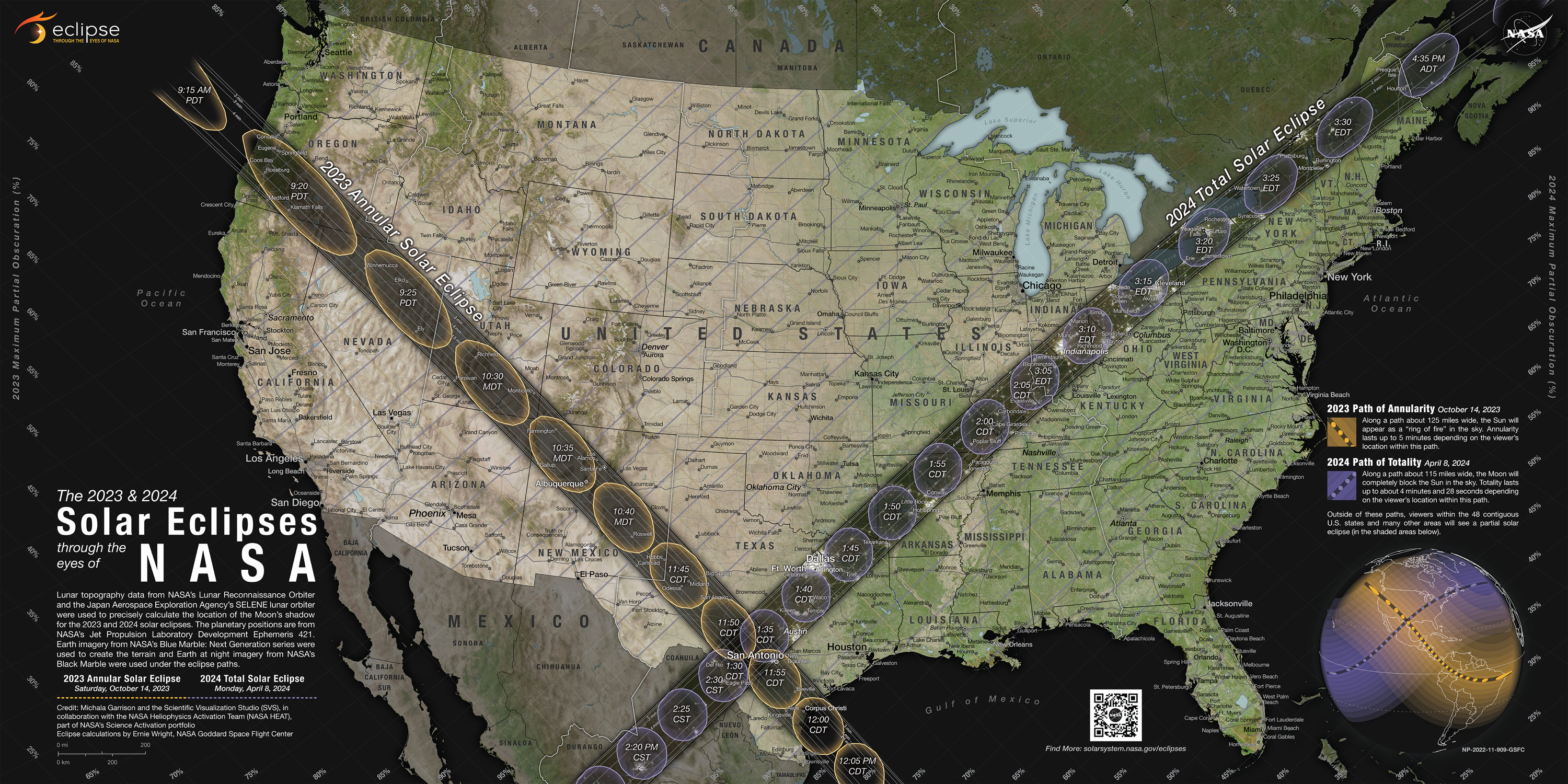
Below is a file to show April 8, 2024 eclipse path on Google Earth. It can be saved or used to bring up Google Earth. The file was created using Stellarium.
Ephemeris: 09/11/2023 – Scutum, an almost invisible constellation in the Milky Way
This is Ephemeris for Monday, September 11th. Today the Sun will be up for 12 hours and 44 minutes, setting at 8:01, and it will rise tomorrow at 7:17. The Moon, 3 days before new, will rise at 4:32 tomorrow morning.
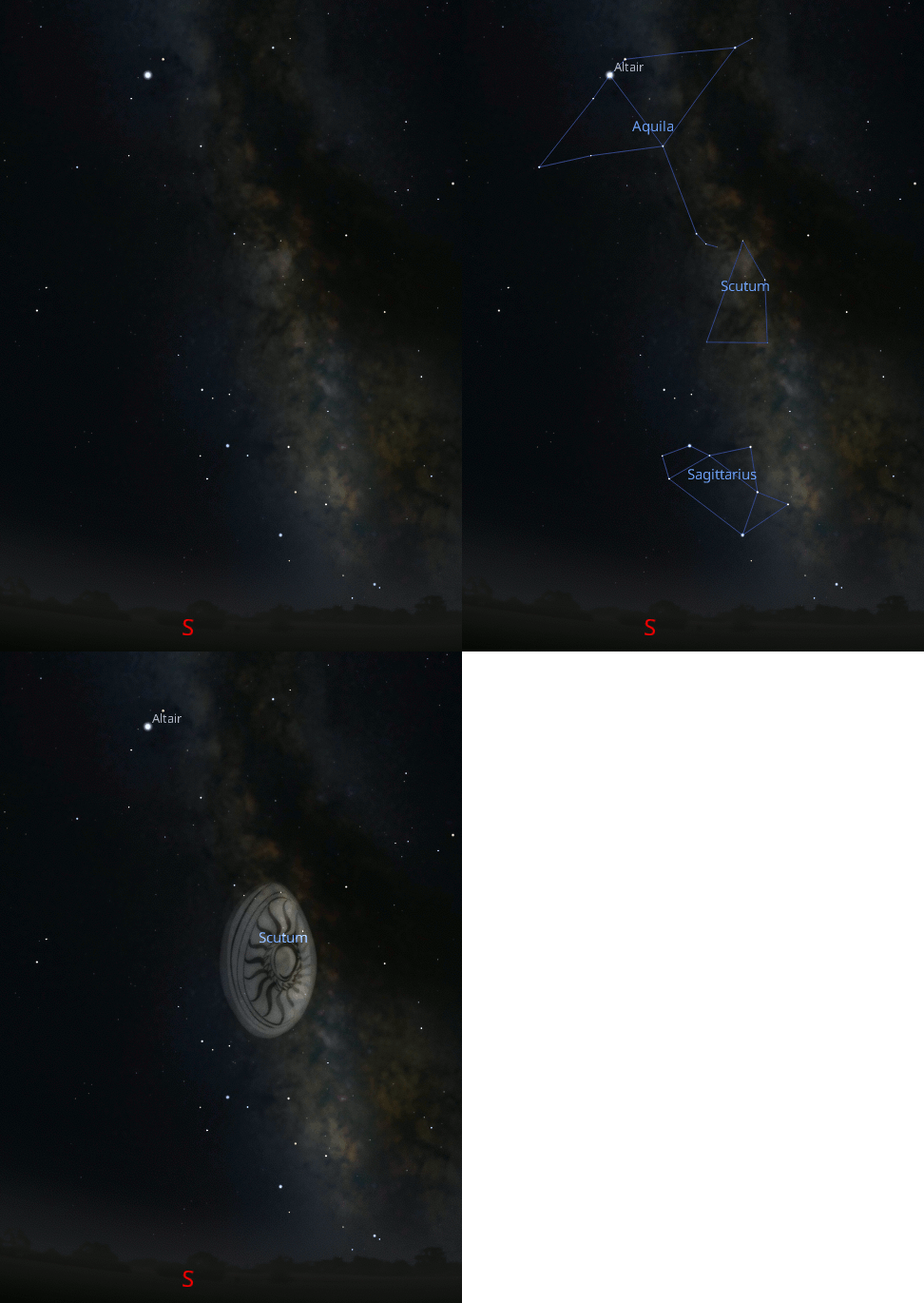
In the southern sky between the Teapot of Sagittarius below and Aquila the Eagle above, with Altair the southernmost star of the Summer Triangle, lies Scutum the shield of John Sobieski the Polish king who stopped the advance of the Turks at Kalenberg in 1683. The Polish half of me is very proud. Scutum is one of two official constellations which are related to real persons. The other one is Coma Berenices, a hank of the Egyptian Queen Berenice’s hair. However, the stars here are so dim and embedded in the glow of the Milky Way as to be nearly impossible to discern. Scutum lies in one of the richest portions of the Milky Way, wonderful to scan with binoculars and telescopes for star clusters and nebulae, clouds of dust and gas.
The astronomical event times given are for the Traverse City/Interlochen area of Michigan (EDT, UT –4 hours). They may be different for your location.
Addendum
Ephemeris: 08/24/2023 – The Moon will pass in front of the star Antares tonight
This is Ephemeris for Thursday, August 24th. Today the Sun will be up for 13 hours and 38 minutes, setting at 8:33, and it will rise tomorrow at 6:56. The Moon, at first quarter today, will set at 12:11 tomorrow morning. | Tonight the Moon is going to pass in front of the bright reddish star in Antares in Scorpius scorpion. The event is called an occultation, and it is the only one of the monthly occultations which we’re going to be able to see in this series that began last month and will extend to August 2028. Antares will disappear at the lower left edge of the dark or night part of the Moon at approximately 10:28 pm* this evening, and it’ll stay hidden until 11:32 pm* when it will pop out on the lower right edge of the bright part of the Moon. Start looking for Antares early, probably with binoculars, because the Moon will be quite bright and might overpower Antares when viewed by the naked eye. Hoping for clear skies tonight.
*The astronomical event times given are for the Traverse City/Interlochen area of Michigan (EDT, UT –4 hours). They may be different for your location. For other locations a planetarium computer app like Stellarium can be used to graphically predict occultation timings within a few minutes. Check your planetarium app, and set it to use Topocentric coordinates. In Stellarium, the selection is in the Configuration window, Tools tab. Check everything under Topocentric coordinates. That way the position of the Moon in the sky will be based on the chosen location, rather than the center of the Earth.
Addendum
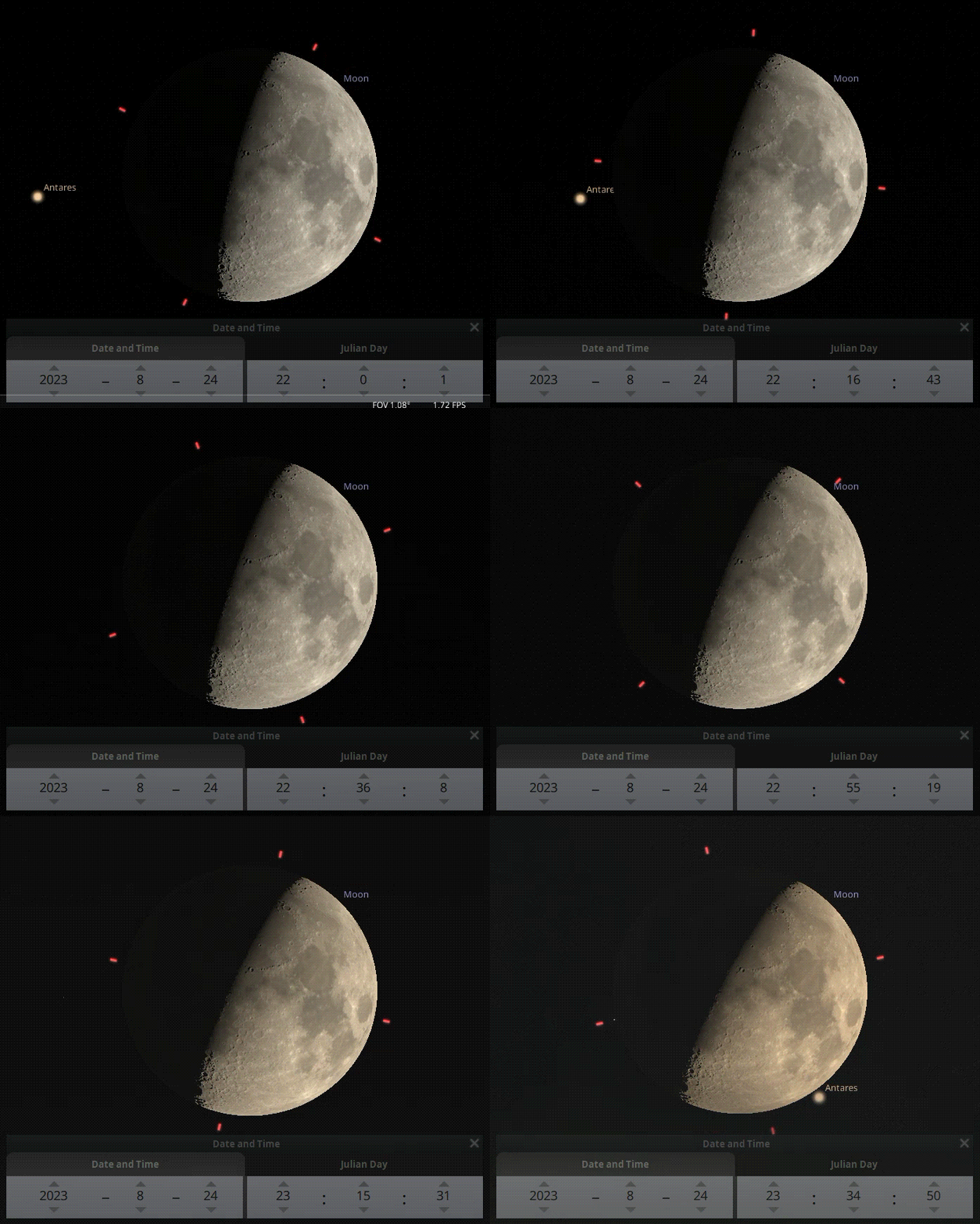
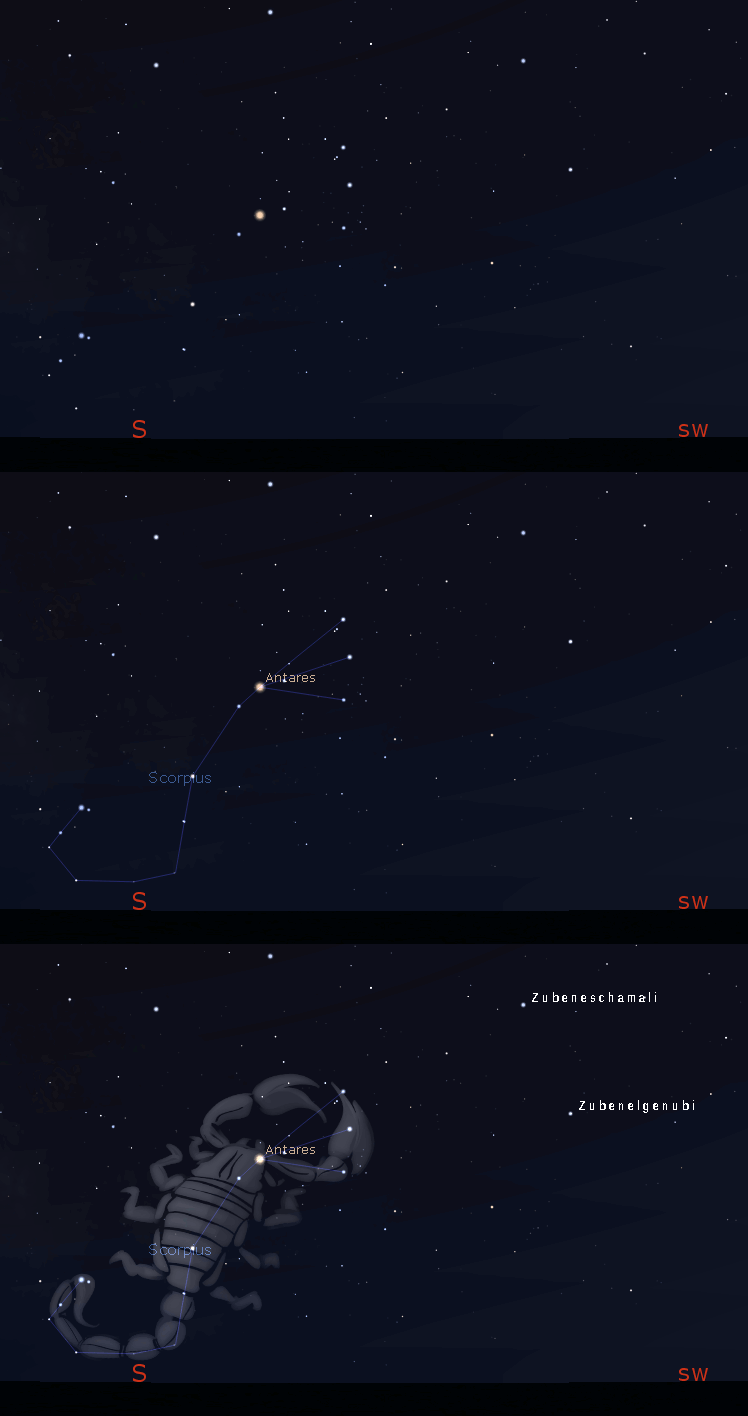
A time-lapse prediction of the occultation of Antares by the Moon based on Stellarium imagery. In the actual occultation Antares will wink out and on suddenly. Antares is a double star, with a 5th magnitude companion. It should wink out and in 9 seconds before the main first magnitude star.
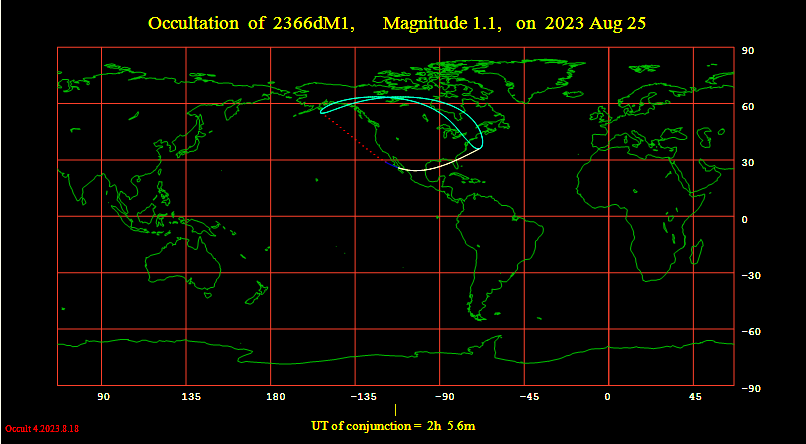
World map showing the area where the occultation of Antares can be visible. It is the area bounded by the white line, the red dotted line and the floppy figure 8 is the area where the occultation is visible. The red line shows that the area near that part of the line is where the occultation occurs during daylight the solid white line on the bottom encloses there is where the occultation will be seen at night. Michigan is close to that cyan line and so the occultation will occur near moonset. Credit: Occult 4 app.
07-11-2023 – Ephemeris – How to find Scorpius the scorpion
This is Bob Moler with Ephemeris for Tuesday, July 11th. Today the Sun will be up for 15 hours and 20 minutes, setting at 9:28, and it will rise tomorrow at 6:08. The Moon, 2 days past last quarter, will rise at 2:02 tomorrow morning.
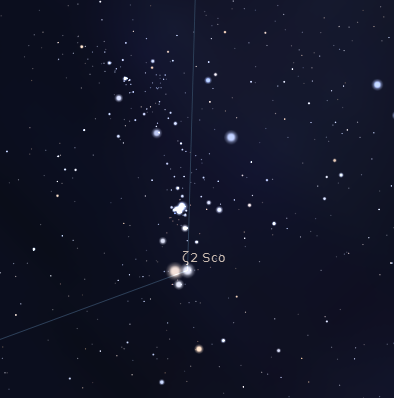
There’s a large constellation located low in the south at about 11 tonight. It’s Scorpius the scorpion. Its brightest star is Antares in its heart, a red giant star, that I’ve gotten calls about it as being a UFO. From Antares to the right is a star, then a vertical arc of three stars that is its head. The Scorpion’s tail is a line of stars running down to the left of Antares, swooping to the horizon before coming back up and ending in a pair of stars that portray his poisonous stinger. There is a beautiful star cluster, NGC 6231, seen in binoculars at that first bend in the tail that is unfortunately too low to appreciate from this far north. I was very impressed with it when spotting it from the Florida Keys when I was down there in 1986 to observe Halley’s Comet.
The astronomical event times given are for the Traverse City/Interlochen area of Michigan (EDT, UT –4 hours). They may be different for your location.
Addendum
05/30/2023 – Ephemeris – The Terminator… No, not Arnold Swartzenegger
This is Ephemeris for Tuesday, May 30th. Today the Sun will be up for 15 hours and 17 minutes, setting at 9:19, and it will rise tomorrow at 6:01. The Moon, 3 days past first quarter, will set at 3:59 tomorrow morning.
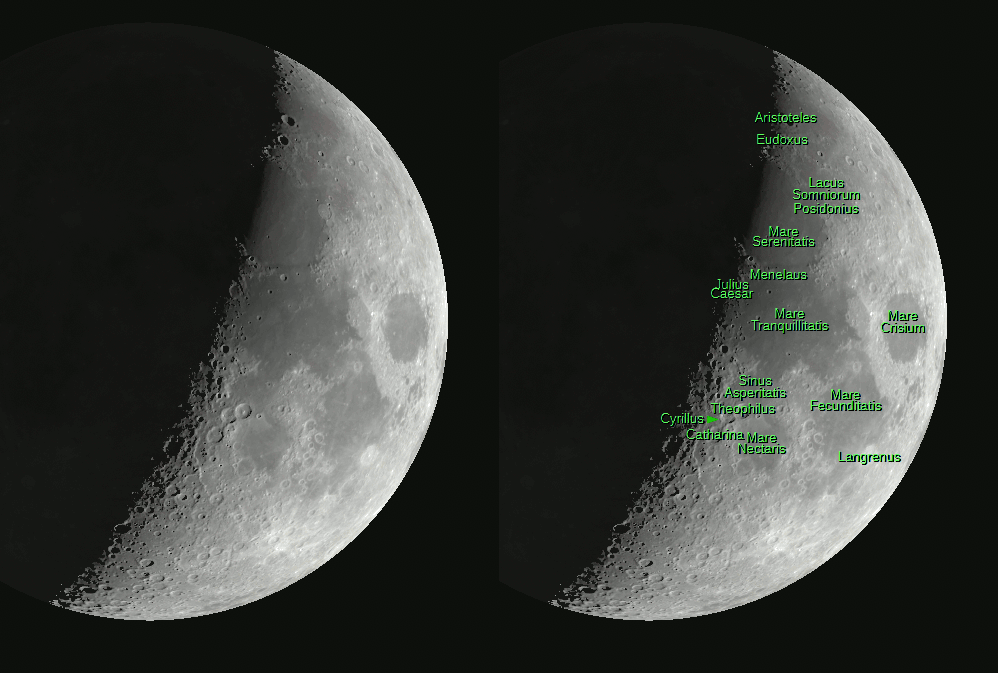
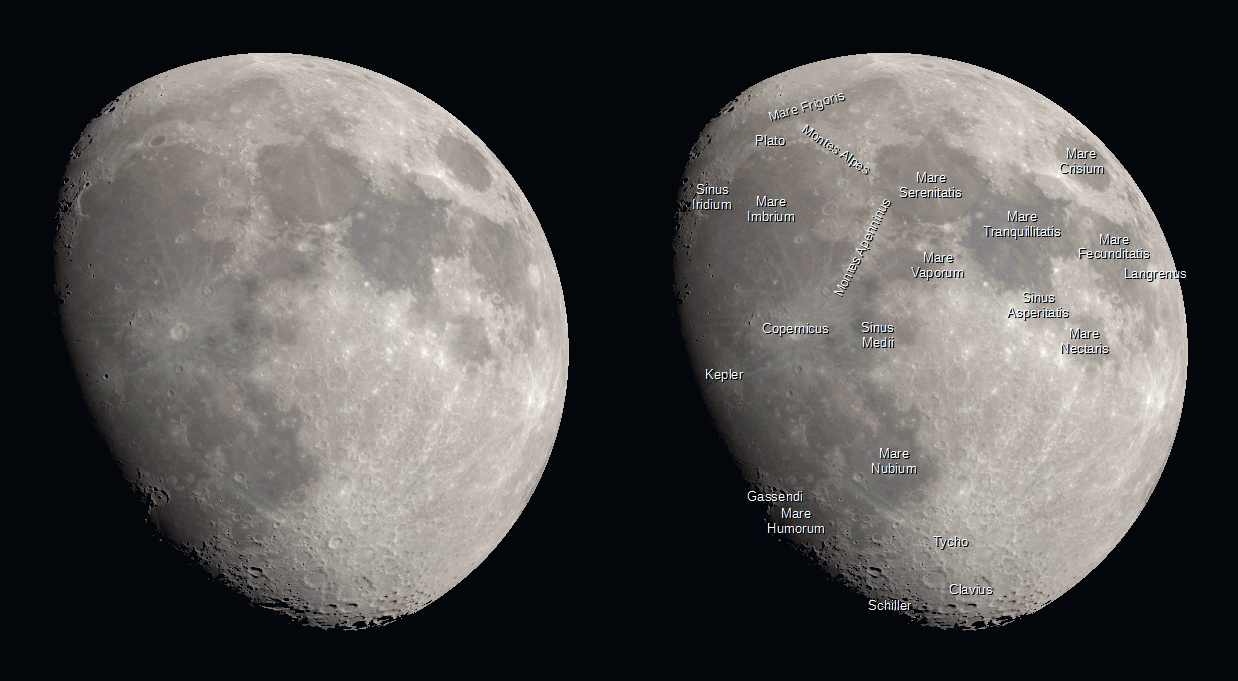
The Moon tonight is getting to be a fatter and fatter gibbous phase, until Saturday, when it will be full. The Moon will be blindingly bright in telescopes of low magnification. As always the case with the Moon, the most detail is seen near the terminator. The terminator, in the case of the waxing moon, is the sunrise line. After full moon, the terminator becomes the sunset line. This is where the shadows are longest, showing the detail of the craters. Farther from the terminator, where the Sun is higher in the Moon’s sky, shadows are short or nonexistent. Giving the surface a flat appearance. Even lacking wind and water, there is still erosion on the Moon, coming from meteoroid and asteroid impacts and their ejecta. And the breakdown of rocks due to the extreme day-night temperature swings.
The astronomical event times given are for the Traverse City/Interlochen area of Michigan (EDT, UT –4 hours). They may be different for your location.
Addendum
05/29/2023 – Ephemeris Extra – Clouds will cause the Star Party, tonight, to be canceled, however…
The Grand Traverse Astronomical Society members will not come out this afternoon and evening to The Dune Climb at Sleeping Bear Dunes National Lakeshore if it stays cloudy. However, the park rangers will be there unless it is raining with alternate activities.
The next scheduled Sun & Star Party will be May 27, the Saturday of the Memorial Day weekend.
03/21/2023 – Ephemeris Extra – Spring has sprung without me
Being in the hospital and now in inpatient rehab one loses a sense of time. So the vernal equinox snuck by me unnoticed. My view of the outside world is another part of the hospital, a part of the HVAC system, and a piece of sky.
Yesterday, the Sun passed over the Earth’s equator, heading northward. The Sun is gradually setting at the South Pole and rising at the North Pole. Folks like me who live in the Northern Hemisphere are experiencing longer daylight than those south of the equator, who are beginning autumn. The daylight hours will increase daily until June 21st, the summer solstice. In the Interlochen/Traverse City area, that will be 15 hours and 34 minutes.
The cause of the Earth’s seasons is not our varying distance from the Sun in our eliptical orbit of the Sun of 93 million plus or minus a million and a half miles.By the way, the Earth is currently moving away from the Sun. It will be farthest from the Sun around July 4th or 5th.
Our perception of the advance of spring, besides the gradully warming temperatures and increasing daylight hours, will be the height of the Sun’s path in the sky, and the position of the Sun’s rise and set points on the horizon. All these annual changes are angles having to do with one’s latitude (an angle), Earth’s position in orbit (an angle), and the tilt of the Earth’s axis to it’s orbit (more angles).
Bob
 Bob Moler's Ephemeris Blog