07/13/2021 – Ephemeris – Virgin Galactic had a successful full crew flight to the edge of space
This is Bob Moler with Ephemeris for Tuesday, July 13th. Today the Sun will be up for 15 hours and 16 minutes, setting at 9:26, and it will rise tomorrow at 6:10. The Moon, halfway from new to first quarter, will set at 11:59 this evening.
This past Sunday was Virgin Galactic’s first test passenger flight to what the United States calls space, past 50 miles altitude, in their VSS Unity spaceship. The four passengers for this test flight were all basically Virgin Galactic employees, including its founder, Richard Branson. The international definition of where space begins is 100 kilometers or 62 miles altitude. At either altitude, a suborbital spacecraft at its peak altitude would be traveling so slowly that the atmospheric effects are negligible. However, if a spacecraft were to pass through that altitude on reentry at over 17 thousand miles an hour, that’s an entirely different story. On July 20th Jeff Bezos will ride his New Shepard rocket up past 62 miles.
The astronomical event times given are for the Traverse City/Interlochen area of Michigan (EDT, UT – 4 hr). They may be different for your location.
Addendum
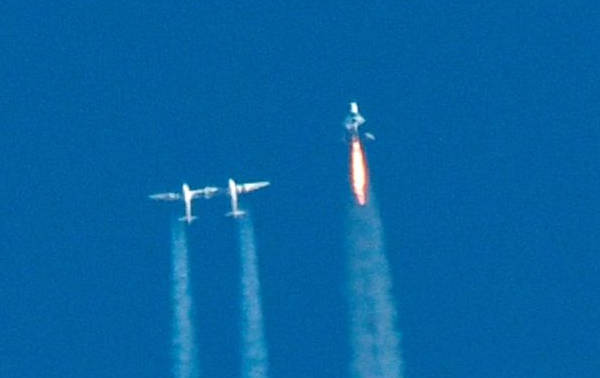
Virgin Galactic’s Spaceship VSS Unity ignites its hybrid rocket engine after being dropped from its carrier aircraft Eve on a prior test flight to the edge of space. Credit Sky News.
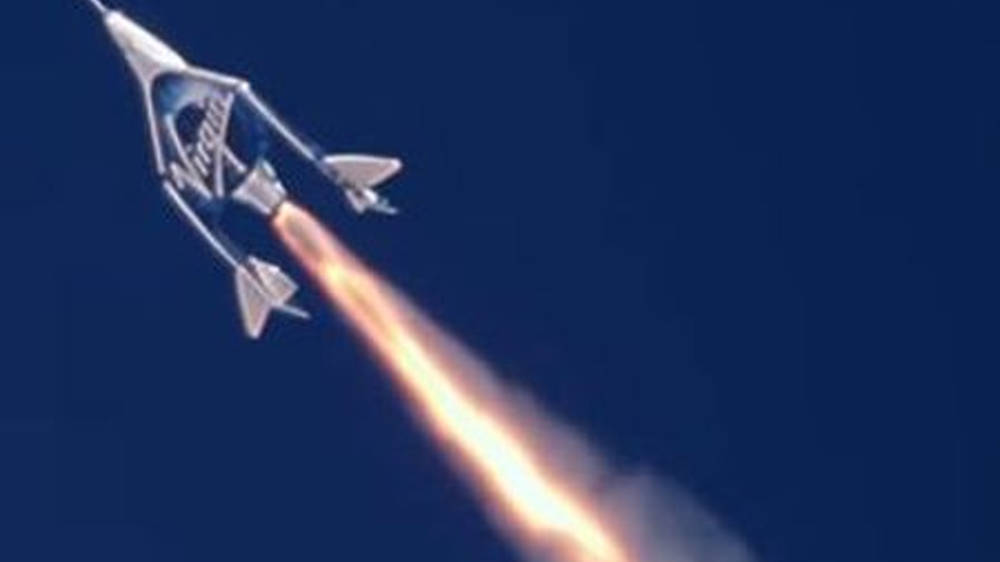
VSS Unity under power with its hybrid rocket motor. The fuel is a solid rubbery compound, with a nitrous oxide as the oxidizer. Powered flight lasts only 60 seconds to reach 56 miles in altitude. This is from a prior flight. Click on the image to enlarge it. Credit: Virgin Galactic.

Floating in zero G in VSS Unity 22. I can imagine the announcement: “The seat belt sign has been turned off. You may float about the cabin.” At least for 5 minutes. Click on the image to enlarge it. Credit: Virgin Galactic video.
07/12/2021 – Ephemeris – Two cultures look at the star pattern of Cygnus the swan
This is Ephemeris for Monday, July 12th. Today the Sun will be up for 15 hours and 18 minutes, setting at 9:27, and it will rise tomorrow at 6:09. The Moon, 3 days past new, will set at 11:33 this evening.
Last week I looked at the constellation of Cygnus the swan and the informal constellation or asterism made from most of its stars, the Northern Cross. Cygnus is the official International Astronomical Union constellation name. However, the indigenous Anishinaabe people of our area, and the northern Great Lakes, had another bird in mind when seeing these stars, which are now fairly high in the east in the evening: Ajijaak, (pronounced a-ji-jock) a Sand Hill crane. While the swan is flying, neck outstretched to the south through the Milky Way, the crane is flying northward with its long legs trailing behind. The bright star Deneb is at its head. I see more cranes than swans around here in recent years and hear their creaking-door-like calls, and can see a pair foraging, from time to time, in a field south of where I live.
The astronomical event times given are for the Traverse City/Interlochen area of Michigan (EDT, UT – 4 hr). They may be different for your location.
Addendum
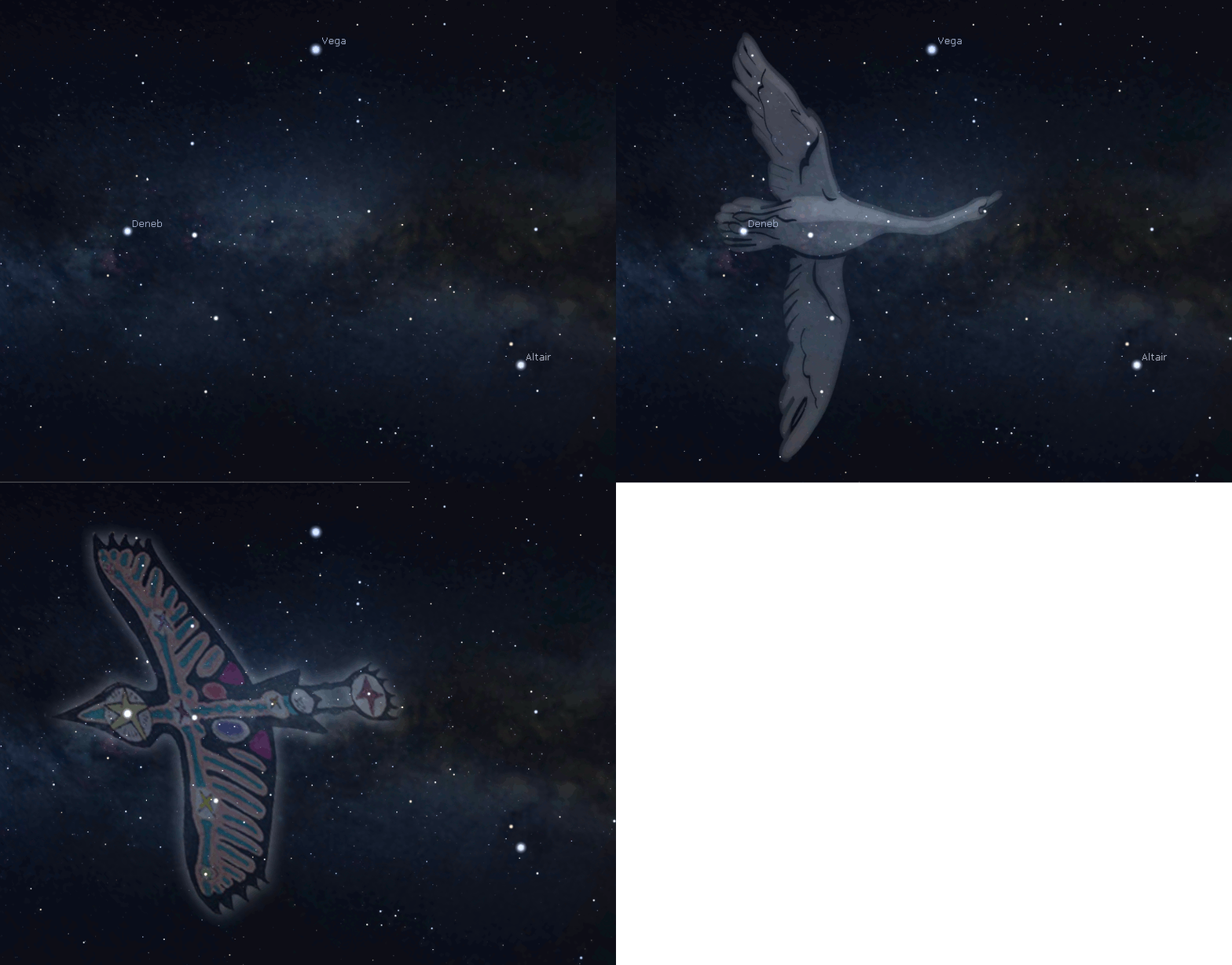
The IAU Cygnus the swan and the Anishinaabe Ajijaak the crane constellations demonstrated via an animated GIF image. Click on the image to enlarge it. Credit Stellarium (both star lore images are embedded in Stellarium). The Anishinaabe image is from Ojibwe Giizhig Anung Masinaaigan – Ojibwe Sky Star Map created by A. Lee, W. Wilson, and C. Gawboy.
07/09/2021 – Ephemeris – Finding the constellation of Aquila the eagle
This is Ephemeris for Friday, July 9th. Today the Sun will be up for 15 hours and 22 minutes, setting at 9:29, and it will rise tomorrow at 6:07. The Moon is new today, and won’t be visible.
Aquila the eagle is a constellation that lies in the Milky Way. It’s in the southeastern sky as it gets dark. Its brightest star, Altair, is one of the stars of the Summer Triangle, a group of three bright stars dominating the eastern sky in the evening now. Altair, in the head of the eagle, is flanked by two slightly dimmer stars, the shoulders of the eagle. The eagle is flying northeastward through the Milky Way. Its wings are seen in the wing tip stars. A curved group of stars to the lower right of Altair is its tail. Within Aquila, the Milky Way shows many dark clouds as part of the Great Rift that splits it here. The other summer bird is Cygnus the swan above and left of Aquila, flying in the opposite direction. It was said this was the eagle that attended the god Jupiter.
The astronomical event times given are for the Traverse City/Interlochen area of Michigan (EDT, UT-4). They may be different for your location.
Addendum
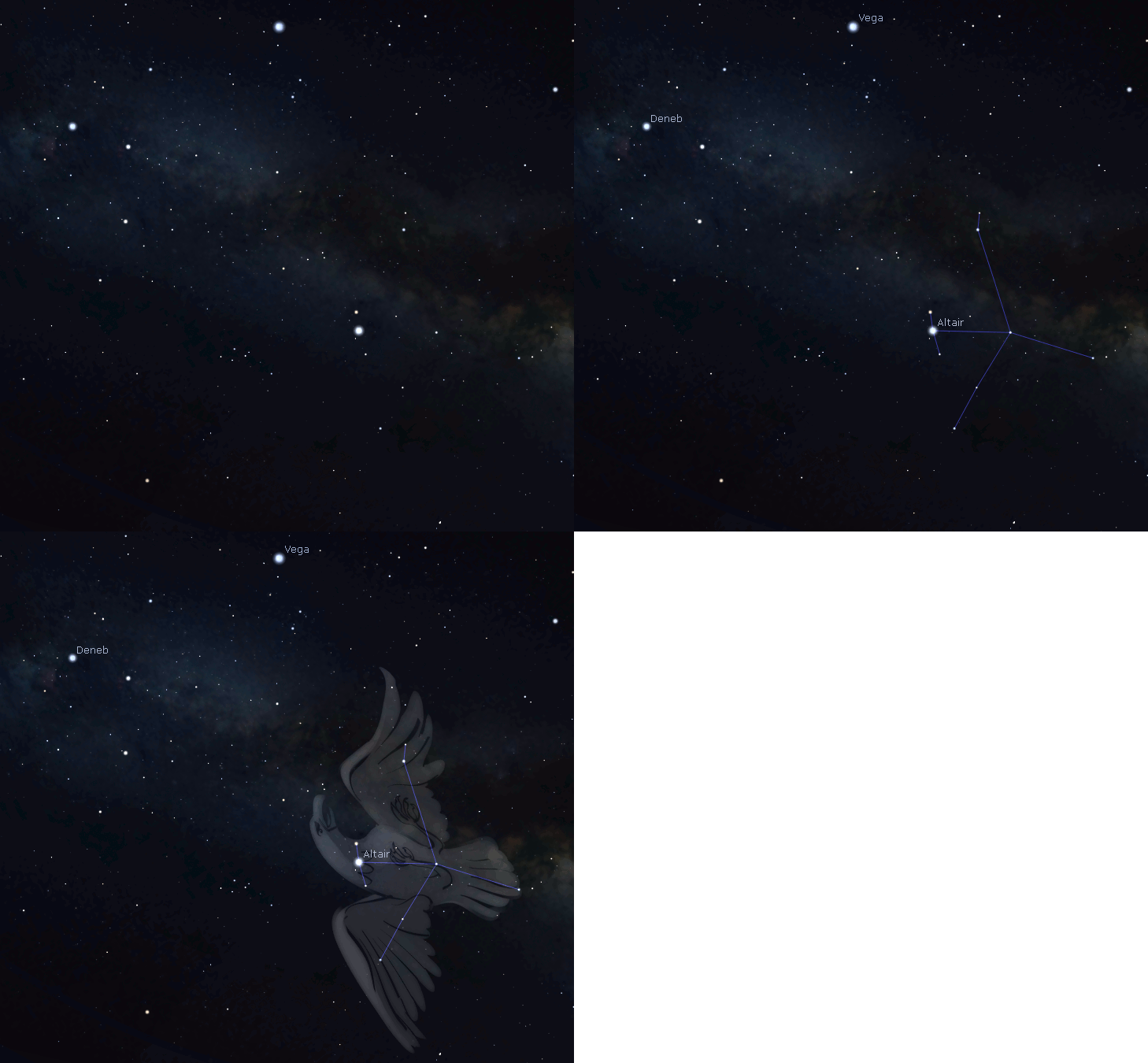
Animated Cygnus finder chart. Lyra the harp, Cygnus the swan, Delphinus the dolphin and Sagitta the arrow are also in the image. Can you find them? Click on the image to enlarge it. Created using Stellarium and GIMP.
07/08/2021 – Ephemeris – How to find the constellation of Cygnus the swan
This is Ephemeris for Thursday, July 8th. Today the Sun will be up for 15 hours and 23 minutes, setting at 9:29, and it will rise tomorrow at 6:06. The Moon, 1 day before new, will rise at 5:23 tomorrow morning.
Halfway up the sky in the east at 11 pm is the constellation of Cygnus the swan, flying south through the Milky Way. It is also called the Northern Cross. At the left, the tail of the swan or the head of the cross is the bright star Deneb, one of the stars of the Summer Triangle. The next star to the right is Sadr the intersection of the body and the wings of the swan seen in flight, or the intersection of the two pieces of the cross. There are two or three stars farther to the right that delineate the swan’s long neck or upright of the cross, that ends with the star Alberio, a beautiful double star in telescopes, in the beak of the swan or foot of the cross. The crosspiece of the cross extends to the stars on either side of the intersection star Sadr, while the swan’s wings extend for a couple more stars each side.
The astronomical event times given are for the Traverse City/Interlochen area of Michigan (EDT, UT-4). They may be different for your location.
Addendum
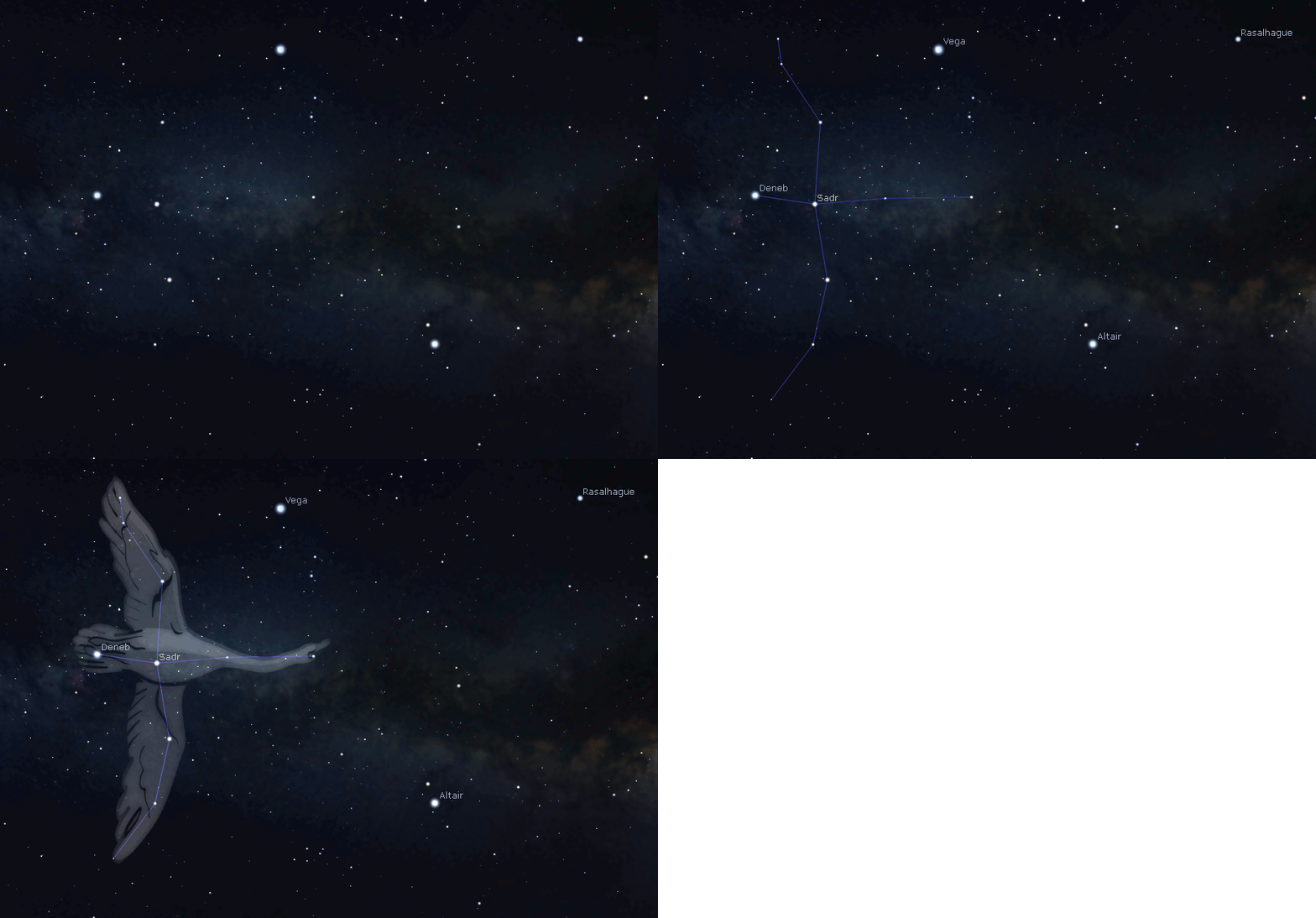
Animated Cygnus finder chart. Included also are, beside Deneb, the other stars of the Summer Triangle: Vega and Altair and their constellations Lyra the harp and Aquila. See if you can find them. Click on the image to enlarge it. Created using Stellarium.
07/07/2021 – Ephemeris – Let’s search for the naked-eye planets for this week
This is Ephemeris for Wednesday, July 7th. Today the Sun will be up for 15 hours and 24 minutes, setting at 9:30, and it will rise tomorrow at 6:05. The Moon, 2 days before new, will rise at 4:36 tomorrow morning.
Let’s search for the naked-eye planets for this week. Venus can be spotted low in the west-northwest twilight by 10 pm or a little after. It will set at 11:03 pm. Venus will be spending the rest of summer low in the western sky, and not be as conspicuous as it usually is as the Evening Star. Mars’ visibility is getting to be a real problem. It can be found to the left and a bit above Venus at 10:30 pm, and will set at 11:06 pm. Saturn and Jupiter, are seen best in the morning sky. Saturn will rise before midnight at 10:47 pm. It’s seen with the stars of Capricornus. Brighter Jupiter, to the left of Saturn, will rise at 11:34 pm. By 5 am, these two planets will be in the southern sky in the morning twilight.
The astronomical event times given are for the Traverse City/Interlochen area of Michigan (EDT, UT-4 hr). They may be different for your location.
Addendum
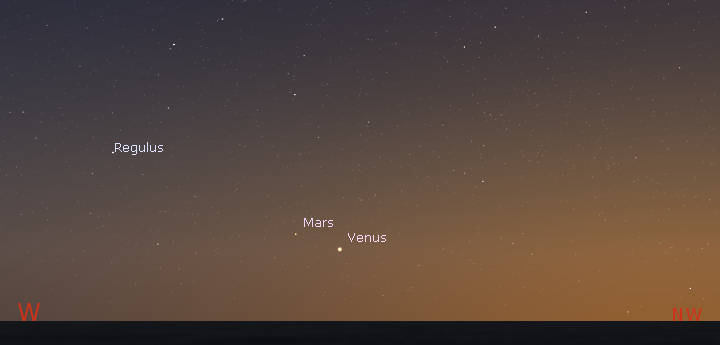
Venus and Mars in the evening twilight at 10:30 pm tonight, July 7, 2021. I’m not promising that Mars will be visible, since it’s now down to second magnitude. Created using Stellarium.
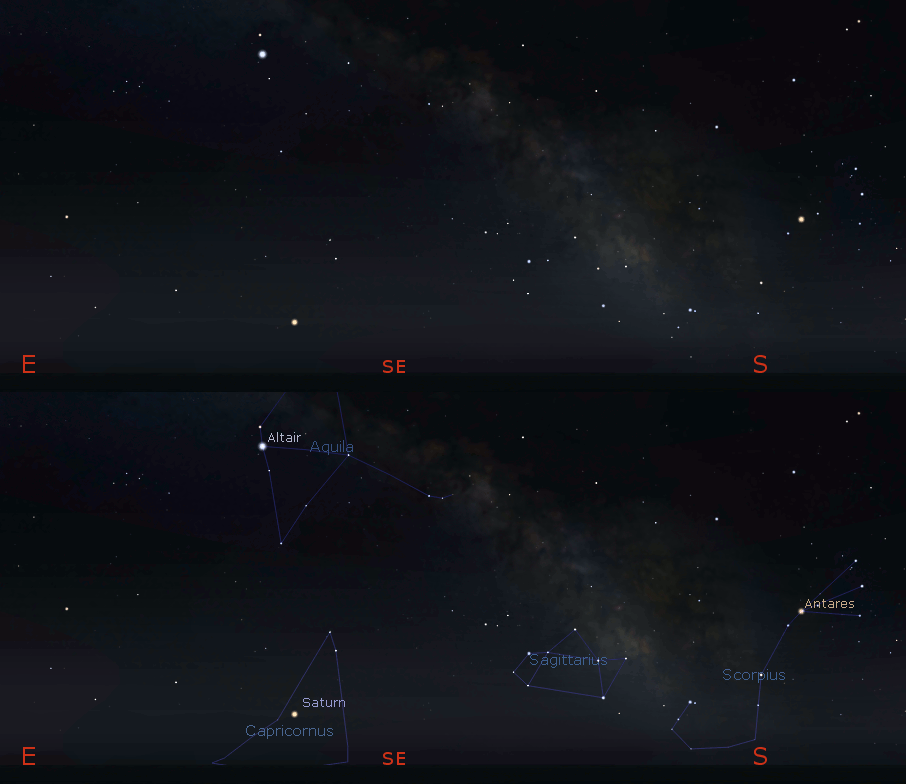
Saturn finder animation for 11:30 pm tonight, July 7, 2021. Click on the image to enlarge it. Created using Stellarium and GIMP.
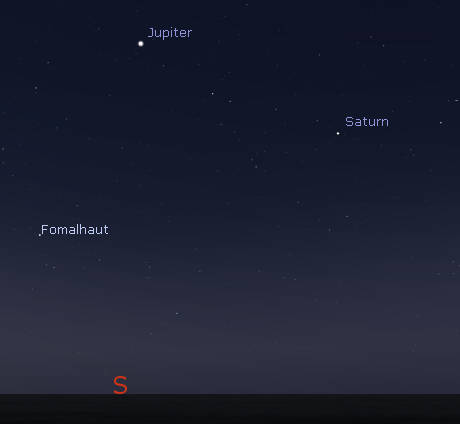
Jupiter and Saturn at 5 am tomorrow morning, July 8, 2021. Created using Stellarium.
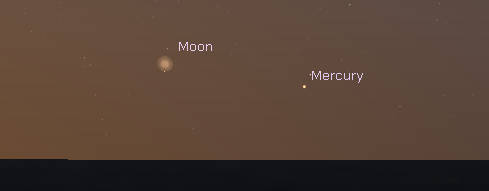
Mercury and the Moon at 5:15 am tomorrow morning, July 8, 2021. Created using Stellarium.
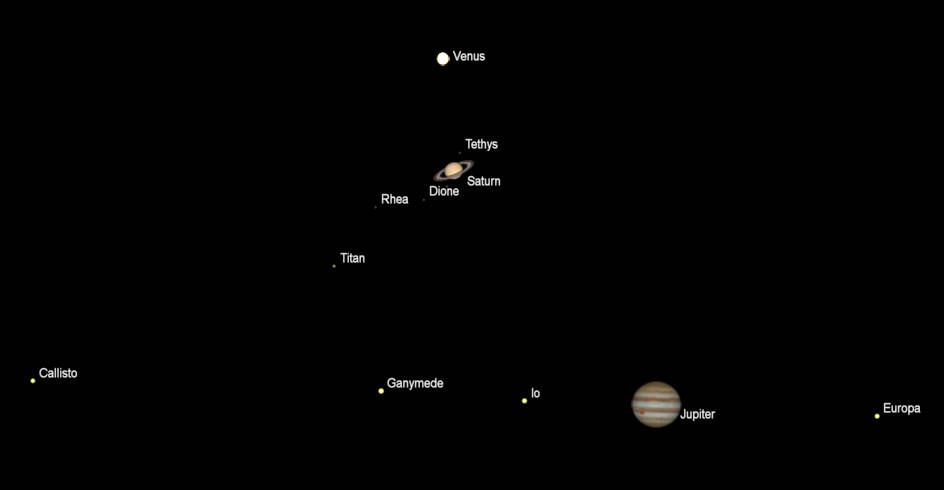
The planets as seen in a telescope (north up) with the same magnification for the night of July 7/8, 2021. Times of the display are: Venus, 10:30 pm; Saturn and Jupiter, 5 am. Apparent diameters: Venus, 11.46″; Saturn 18.41″, its rings 42.88″; Jupiter, 46.18″. Mars has an apparent diameter of only 3.80″, and Mercury of 7.32 and are not represented. The ” symbol means seconds of arc (1/3600th of a degree.) Click on the image to enlarge it. Created using Cartes du Ciel (Sky Charts).
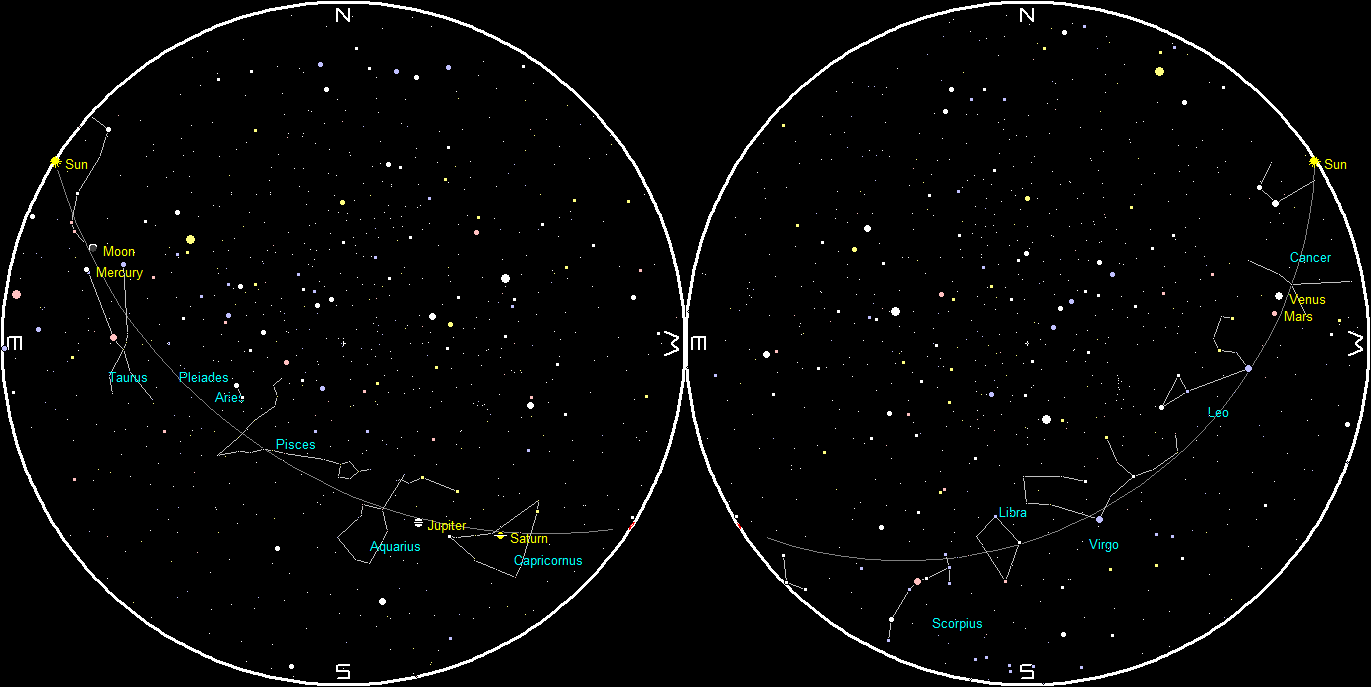
Planets and the Moon at sunset and sunrise of a single night, starting with sunset on the right on July 7, 2021. The night ends on the left with sunrise on the 8th. Click on the image to enlarge. Created using my LookingUp program.
07/06/2021 – Ephemeris – Looking at the constellation of Lyra the harp
This is Ephemeris for Tuesday, July 6th. Today the Sun will be up for 15 hours and 26 minutes, setting at 9:30, and it will rise tomorrow at 6:05. The Moon, 3 days before new, will rise at 3:56 tomorrow morning.
High in the east at 11 p.m. can be found a bright star just above a small, narrow, but very distinctive parallelogram of stars. They are the stars of the constellation Lyra the harp. The bright star is Vega, the 5th brightest night-time star. To the Romans, the star Vega represented a falling eagle or vulture. Apparently they never made the distinction between the two species. It is a pure white star and serves as a calibration star for color and brightness. In the evening, it is the top-most star of the Summer Triangle. The harp, according to Greek mythology, was invented by the god Hermes. The form of the harp, in the sky, is as he had invented it: by stretching strings across a tortoise shell. Hermes gave it to his half-brother Apollo, who in turn gave it to the legendary musician Orpheus.
The astronomical event times given are for the Traverse City/Interlochen area of Michigan (EDT, UT-4). They may be different for your location.
Addendum
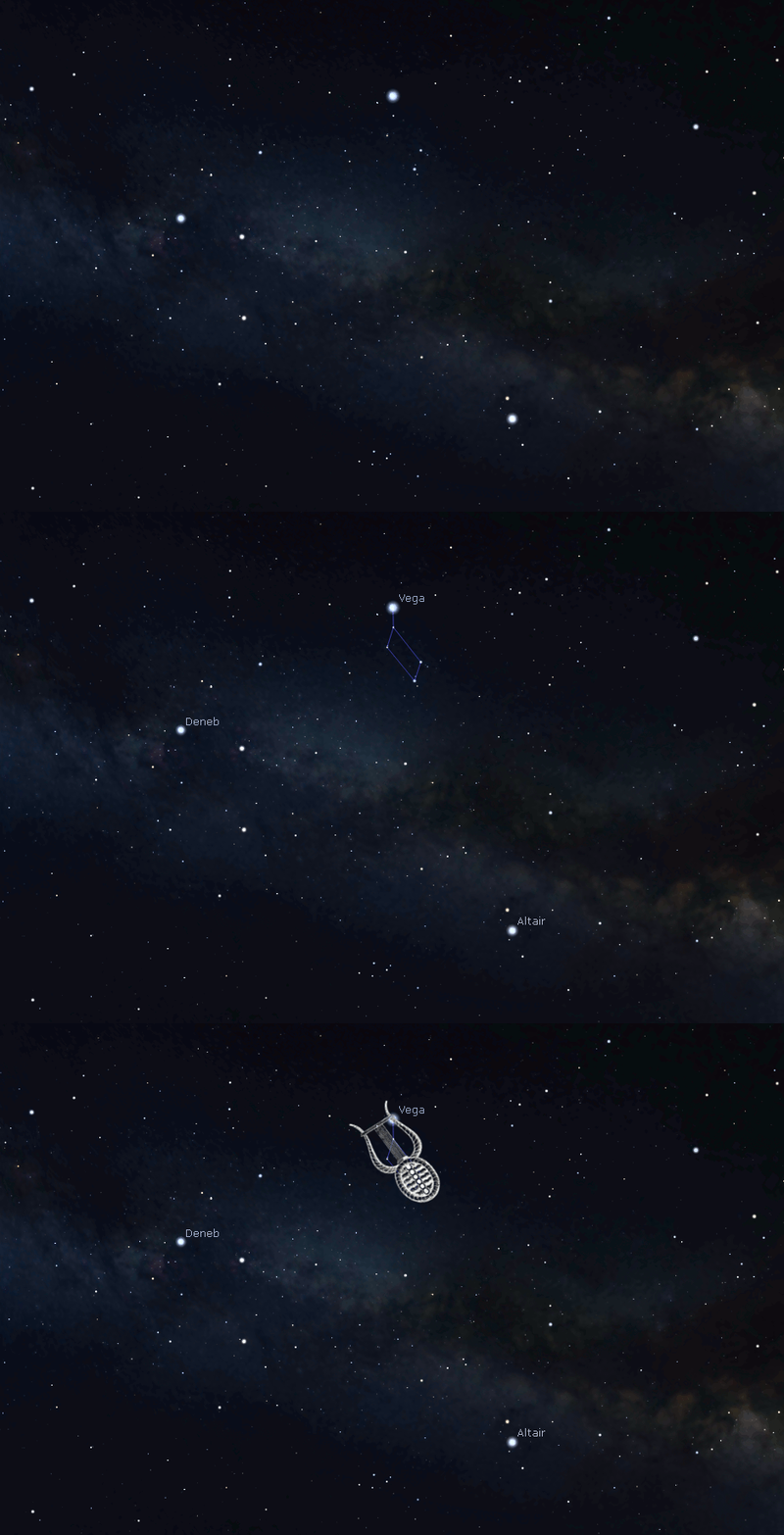
Animated Lyra finder chart. The lyre image not supplied by Stellarium but is from The World’s Earliest Music by Hermann Smith, Figure 60, A Project Gutenberg E-Book, and captioned “The Chelys or Greek Tortoiseshell Lyre”. Click on the image to enlarge it. Created using Stellarium and GIMP.
07/05/2021 – Ephemeris – Happy Aphelion Day
This is Bob Moler with Ephemeris for Monday, July 5th. Today the Sun will be up for 15 hours and 27 minutes, setting at 9:30, and it will rise tomorrow at 6:04. The Moon, halfway from last quarter to new, will rise at 3:24 tomorrow morning.
Today, the Moon and Sun are at their farthest from the Earth. For the Moon it’s called apogee, for the Sun it’s called aphelion. At 10:48 this morning the Moon will be at that point 251,842 miles (405,300 kilometers) away. The Sun will be farthest at 10:59 pm at a distance of 94 million, 452 thousand miles (152 million, 6 thousand kilometers) away. Because of the gravitational pull of the Moon and planets on the Earth, and the Pull of the planets, especially Jupiter on the Sun, the aphelion and perihelion or closest date in January don’t occur on the same date or same distance every year. The date wanders by a day or two each year. The entire distance variation for the Earth is plus or minus 1.5 million miles (2.4 million kilometers) over the year, but makes summer the longest season by a few days because the Earth moves slower when farther from the Sun, than when it is nearer.
The astronomical event times given are for the Traverse City/Interlochen area of Michigan (EDT, UT-4). They may be different for your location.
Addendum
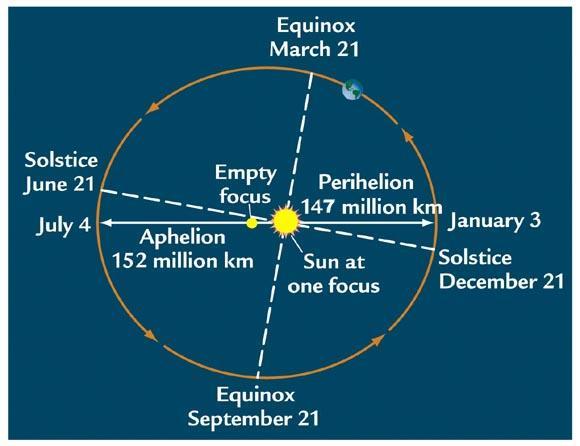
The Earth’s orbital ellipse, somewhat exaggerated, showing perihelion, aphelion and the seasons. Credit “Starts with a Bang” blog by Ethan Siegel.
Currently, summer is the longest season at 93.65 days, while winter is the shortest season at 88.99 days. (Source: Astronomical Tables of the Sun, Moon and Planets, Third Edition by Jean Meeus)
07/02/2021 – Ephemeris – Virtual star party to be held tonight
This is Ephemeris for Friday, July 2nd. Today the Sun will be up for 15 hours and 29 minutes, setting at 9:31, and it will rise tomorrow at 6:02. The Moon, 1 day past last quarter, will rise at 2:14 tomorrow morning.
The Grand Traverse Astronomical Society hold a virtual star party starting at 10 pm tonight via Zoom app on the Internet. Jerry Dobek, professor of astronomy at Northwestern Michigan College, will host the event with the 16-inch telescope and an imager, but only if it’s clear in Traverse City. It should feature a look at Venus to start. There will be other objects visible in the darkening twilight, such as binary stars and a dramatic pair with contrasting colors. As it gets darker, we might spot clusters of stars including the Great Hercules Globular Cluster, a veritable popcorn ball of stars. Also, bright clouds of gas expelled by dying stars. Instructions to join the meeting and a link can be found on the society’s website, www.gtastro.org.
The astronomical event times given are for the Traverse City/Interlochen area of Michigan (EDT, UT-4). They may be different for your location.
07/01/2021 – Ephemeris – Looking ahead at July’s skies
This is Ephemeris for Thursday, July 1st. Today the Sun will be up for 15 hours and 30 minutes, setting at 9:32, and it will rise tomorrow at 6:01. The Moon, at last quarter today, will rise at 1:54 tomorrow morning.
Let’s preview July’s skies. The Sun, having reached its northern solstice, is beginning to slide southward again, at first imperceptibly, then with greater speed. The daylight hours will decrease from 15 hours and 30 minutes today to 14 hours 41 minutes at month’s end. The daylight hours will be slightly shorter south of Interlochen, and slightly longer to the north. The altitude of the Sun at local noon, when it is due south, will decrease from 68 degrees today to 63 degrees at month’s end. The Sun will be a degree lower in the Straits area. Despite the warmth, the Earth will reach its greatest distance from the Sun late Monday. That’s called aphelion where the Sun will be almost 94.5 million miles (152 million kilometers) away, which makes summer the longest season.
The astronomical event times given are for the Traverse City/Interlochen area of Michigan (EDT, UT-4). They may be different for your location.
Addendum
July Evening Star Chart
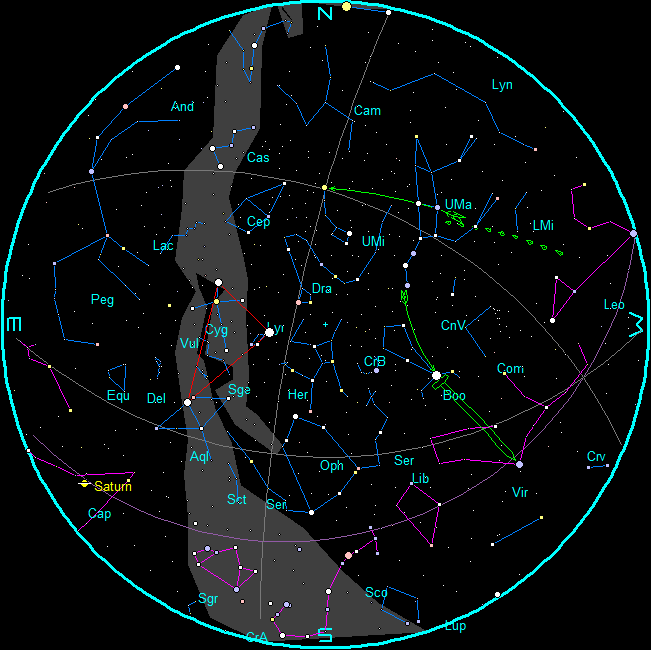
Star Chart for July 2021 (11 p.m. EDT, July 15, 2021). Created using my LookingUp program. Click on image to enlarge.
The planets and stars are plotted for the 15th at 11 p.m. EDT in the evening and 4:30 a.m. for the morning chart. These are the chart times. Note that Traverse City is located approximately 45 minutes behind our time meridian, West 75° longitude. (An hour 45 minutes behind our daylight saving time meridian during EDT). To duplicate the star positions on a planisphere you may have to set it to 1 hour 45 minutes earlier than the current time.
Note the chart times are for the 15th. For each week before the 15th, add ½ hour (28 minutes if you’re picky). For each week after the 15th, subtract ½ hour. The planet positions are updated each Wednesday on this blog. For planet positions on dates other than the 15th.
July Morning Star Chart
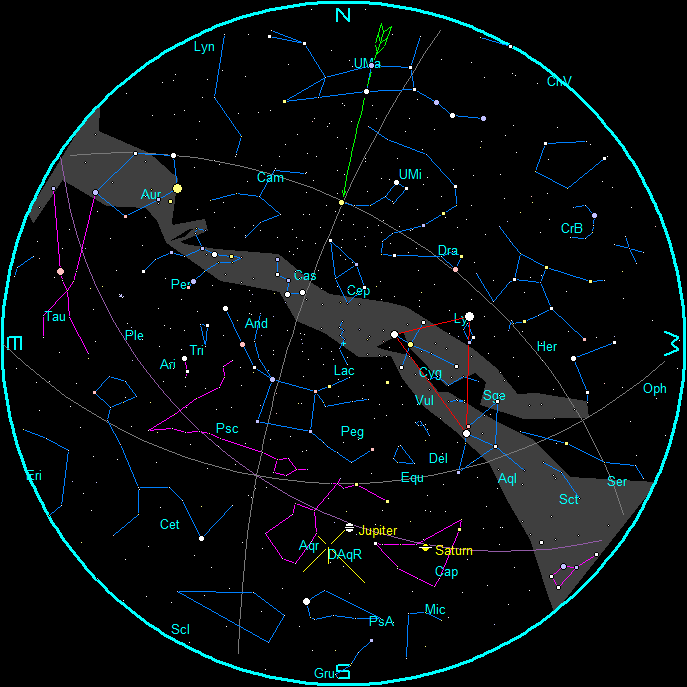
Star Chart for July mornings, 2021 (4:30 a.m. EDT July 15, 2021). Created using my LookingUp program. Click on image to enlarge.
For a list of constellation names to go with the abbreviations, click here.
- Pointer stars at the front of the bowl of the Big Dipper point to Polaris, the North Star.
- Leaky dipper drips on Leo.
- Follow the arc of the handle of the Big Dipper to the star Arcturus, and
- Extend like a spike to Spica.
- The Summer Triangle is in red.
- DAqR is the radiant of the South Delta Aquariid meteor shower (Peaks on the 27th)
Twilight Limits, Nautical and Astronomical
| EDT | |||||||
| Morning | Twilight | Evening | Twilight | Dark | Night | Moon | |
| Date | Astro. | Nautical | Nautical | Astro. | Start | End | Illum. |
| 2021-07-01 | 3h38m | 4h41m | 23h00m | 0h03m | 0h03m | 1h35m | 0.47 |
| 2021-07-02 | 3h39m | 4h42m | 22h59m | 0h02m | 0h02m | 1h55m | 0.37 |
| 2021-07-03 | 3h40m | 4h42m | 22h59m | 0h01m | 0h01m | 2h14m | 0.28 |
| 2021-07-04 | 3h41m | 4h43m | 22h58m | 0h00m | 0h00m | 2h35m | 0.2 |
| 2021-07-05 | 3h43m | 4h44m | 22h58m | 23h59m | 23h59m | 2h57m | 0.13 |
| 2021-07-06 | 3h44m | 4h45m | 22h57m | 23h58m | 23h58m | 3h24m | 0.07 |
| 2021-07-07 | 3h45m | 4h46m | 22h57m | 23h57m | 23h57m | 3h45m | 0.03 |
| 2021-07-08 | 3h47m | 4h47m | 22h56m | 23h56m | 23h56m | 3h47m | 0.01 |
| 2021-07-09 | 3h48m | 4h48m | 22h55m | 23h55m | 23h55m | 3h48m | 0 |
| 2021-07-10 | 3h50m | 4h49m | 22h54m | 23h53m | 23h53m | 3h50m | 0.01 |
| 2021-07-11 | 3h52m | 4h50m | 22h54m | 23h52m | 23h52m | 3h52m | 0.05 |
| 2021-07-12 | 3h53m | 4h51m | 22h53m | 23h51m | 23h51m | 3h53m | 0.1 |
| 2021-07-13 | 3h55m | 4h53m | 22h52m | 23h49m | 0h00m | 3h55m | 0.17 |
| 2021-07-14 | 3h57m | 4h54m | 22h51m | 23h48m | – | 3h57m | 0.26 |
| 2021-07-15 | 3h58m | 4h55m | 22h50m | 23h46m | 0h23m | 3h58m | 0.37 |
| 2021-07-16 | 4h00m | 4h56m | 22h49m | 23h45m | 0h46m | 4h00m | 0.48 |
| 2021-07-17 | 4h02m | 4h58m | 22h47m | 23h43m | 1h08m | 4h02m | 0.59 |
| 2021-07-18 | 4h04m | 4h59m | 22h46m | 23h41m | 1h33m | 4h04m | 0.7 |
| 2021-07-19 | 4h06m | 5h00m | 22h45m | 23h40m | 2h01m | 4h06m | 0.8 |
| 2021-07-20 | 4h07m | 5h02m | 22h44m | 23h38m | 2h35m | 4h07m | 0.89 |
| 2021-07-21 | 4h09m | 5h03m | 22h43m | 23h36m | 3h18m | 4h09m | 0.95 |
| 2021-07-22 | 4h11m | 5h04m | 22h41m | 23h34m | – | – | 0.99 |
| 2021-07-23 | 4h13m | 5h06m | 22h40m | 23h32m | – | – | 1 |
| 2021-07-24 | 4h15m | 5h07m | 22h39m | 23h31m | – | – | 0.98 |
| 2021-07-25 | 4h17m | 5h09m | 22h37m | 23h29m | – | – | 0.94 |
| 2021-07-26 | 4h19m | 5h10m | 22h36m | 23h27m | – | – | 0.88 |
| 2021-07-27 | 4h21m | 5h11m | 22h34m | 23h25m | 23h25m | 23h37m | 0.81 |
| 2021-07-28 | 4h23m | 5h13m | 22h33m | 23h23m | 23h23m | 23h58m | 0.72 |
| 2021-07-29 | 4h25m | 5h14m | 22h31m | 23h21m | 23h21m | – | 0.63 |
| 2021-07-30 | 4h27m | 5h16m | 22h30m | 23h19m | 23h19m | 0h17m | 0.53 |
| 2021-07-31 | 4h29m | 5h17m | 22h28m | 23h17m | 23h17m | 0h38m | 0.44 |
Twilight calendar was generated using Cartes du Ciel (Sky Charts).
See my blog post: Twilight Zone for the definitions of the different periods of twilight here: https://bobmoler.wordpress.com/2018/09/27/.
NASA Calendar of Planetary Events
Date         Time     Event
Jul  1  Th            Venus: 25.4° E
     1  Th   5:11 pm  Last Quarter
     2  Fr  10:45 pm  Venus-Beehive: 0.1° N
     4  Su   3:59 pm  Mercury Elongation: 21.6° W
     5  Mo  10:48 am  Moon Apogee: 405300 km
     5  Mo  10:59 pm  Aphelion: 1.0167 AU
     6  Tu   6:41 pm  Moon Ascending Node
     8  Th  12:38 am  Moon-Mercury: 4.1° S
     9  Fr   6:05 am  Moon North Dec.: 25.6° N
     9  Fr   9:16 pm  New Moon
    12  Mo   5:10 am  Moon-Venus: 3.5° S
    12  Mo   6:10 am  Moon-Mars: 4° S
    13  Tu   9:17 am  Venus-Mars: 0.5° N
    17  Sa   6:11 am  First Quarter
    20  Tu   9:22 am  Moon Descending Node
    21  We   6:30 am  Moon Perigee: 364500 km
    21  We   5:21 pm  Venus-Regulus: 1.1° N
    22  Th  11:12 am  Moon South Dec.: 25.6° S
    23  Fr  10:37 pm  Full Moon
    24  Sa  12:42 pm  Moon-Saturn: 3.9° N
    25  Su   9:17 pm  Moon-Jupiter: 4.3° N
    27  Tu  11:17 pm  Delta Aquariid Shower: ZHR = 20
    29  Th  10:09 am  Mars-Regulus: 0.6° N
    31  Sa   9:16 am  Last Quarter
Aug  1  Su            Venus: 33.1° E
All event times are given for UTC-4 hr: Eastern Daylight Saving Time.
Sky Events Calendar by Fred Espenak and Sumit Dutta (NASA’s GSFC),
http://eclipse.gsfc.nasa.gov/SKYCAL/SKYCAL.html.
If you go to the above site you can print out a list like the above for the entire year or calendar pages for your time zone.
Sun and Moon Rising and Setting Events
LU                  Ephemeris of Sky Events for Interlochen/TC
July, 2021    Local time zone: EDT
+-----------------------------------------------------------------------+
| DATE |  SUN     SUN  DAYLIGHT|   TWILIGHT*    |MOON  RISE OR    ILLUM |
|      |  RISE    SET    HOURS |  END    START  |PHASE SET** TIME FRACTN|
+=======================================================================+
|Thu  1| 06:01a  09:32p  15:30 | 10:57p  04:35a |L Qtr Rise 01:54a   49%|
|Fri  2| 06:01a  09:31p  15:29 | 10:56p  04:36a |      Rise 02:14a   39%|
|Sat  3| 06:02a  09:31p  15:29 | 10:56p  04:37a |      Rise 02:34a   30%|
+------+-----------------------+----------------+-----------------------+
|Sun  4| 06:03a  09:31p  15:28 | 10:55p  04:38a |      Rise 02:57a   22%|
|Mon  5| 06:03a  09:30p  15:27 | 10:55p  04:39a |      Rise 03:24a   15%|
|Tue  6| 06:04a  09:30p  15:26 | 10:54p  04:40a |      Rise 03:56a    9%|
|Wed  7| 06:05a  09:30p  15:24 | 10:53p  04:40a |      Rise 04:36a    4%|
|Thu  8| 06:05a  09:29p  15:23 | 10:53p  04:42a |      Rise 05:23a    1%|
|Fri  9| 06:06a  09:29p  15:22 | 10:52p  04:43a |New   Set  09:42p    0%|
|Sat 10| 06:07a  09:28p  15:21 | 10:51p  04:44a |      Set  10:26p    1%|
+------+-----------------------+----------------+-----------------------+
|Sun 11| 06:08a  09:28p  15:19 | 10:50p  04:45a |      Set  11:02p    4%|
|Mon 12| 06:09a  09:27p  15:18 | 10:49p  04:46a |      Set  11:33p    9%|
|Tue 13| 06:09a  09:26p  15:16 | 10:48p  04:47a |      Set  11:59p   16%|
|Wed 14| 06:10a  09:26p  15:15 | 10:47p  04:48a |      Set  12:23a   24%|
|Thu 15| 06:11a  09:25p  15:13 | 10:46p  04:49a |      Set  12:45a   34%|
|Fri 16| 06:12a  09:24p  15:11 | 10:45p  04:51a |      Set  01:08a   45%|
|Sat 17| 06:13a  09:23p  15:10 | 10:44p  04:52a |F Qtr Set  01:32a   57%|
+------+-----------------------+----------------+-----------------------+
|Sun 18| 06:14a  09:23p  15:08 | 10:43p  04:53a |      Set  02:00a   68%|
|Mon 19| 06:15a  09:22p  15:06 | 10:42p  04:55a |      Set  02:35a   78%|
|Tue 20| 06:16a  09:21p  15:04 | 10:40p  04:56a |      Set  03:18a   87%|
|Wed 21| 06:17a  09:20p  15:02 | 10:39p  04:57a |      Set  04:13a   94%|
|Thu 22| 06:18a  09:19p  15:00 | 10:38p  04:59a |      Set  05:18a   98%|
|Fri 23| 06:19a  09:18p  14:58 | 10:37p  05:00a |Full  Rise 09:35p  100%|
|Sat 24| 06:20a  09:17p  14:56 | 10:35p  05:02a |      Rise 10:16p   99%|
+------+-----------------------+----------------+-----------------------+
|Sun 25| 06:21a  09:16p  14:54 | 10:34p  05:03a |      Rise 10:49p   95%|
|Mon 26| 06:22a  09:15p  14:52 | 10:32p  05:04a |      Rise 11:15p   90%|
|Tue 27| 06:23a  09:14p  14:50 | 10:31p  05:06a |      Rise 11:37p   82%|
|Wed 28| 06:24a  09:13p  14:48 | 10:29p  05:07a |      Rise 11:58p   74%|
|Thu 29| 06:25a  09:11p  14:45 | 10:28p  05:09a |      Rise 12:17a   65%|
|Fri 30| 06:27a  09:10p  14:43 | 10:26p  05:10a |      Rise 12:38a   55%|
|Sat 31| 06:28a  09:09p  14:41 | 10:25p  05:12a |L Qtr Rise 01:00a   46%|
+-----------------------------------------------------------------------+
* Nautical Twilight
** Moonrise or moonset, whichever occurs between sunrise and sunset
06/30/2021 – Ephemeris – Let’s search for the naked-eye planets for this week
This is Ephemeris for Wednesday, June 30th. Today the Sun will be up for 15 hours and 31 minutes, setting at 9:32, and it will rise tomorrow at 6:01. The Moon, 1 day before last quarter, will rise at 1:35 tomorrow morning.
Let’s search for the naked-eye planets for this week. Venus can be spotted low in the west-northwest twilight by 10 pm or a little after. It will set at 11:06 pm. Venus will be spending the rest of summer low in the western sky for the rest of summer, and not be a conspicuous as it usually is. Mars can be found in the west-northwest at 11pm. It’s in Cancer and will set at 11:25 pm as it is slowly losing its race with the Sun. Saturn and Jupiter, are seen best in the morning sky. Saturn will rise before midnight at 11:15 pm. It’s seen with the stars of Capricornus. Brighter Jupiter, to the left of Saturn, will rise at 12:06 am. By 5 am, these two planets will be in the south in the morning twilight.
The astronomical event times given are for the Traverse City/Interlochen area of Michigan (EDT, UT-4). They may be different for your location.
Addendum
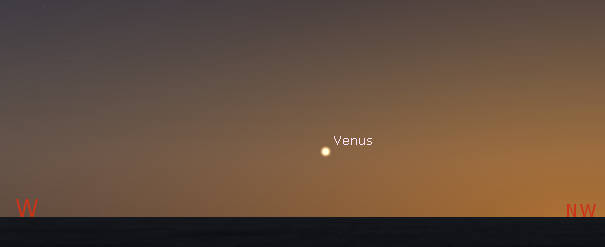
Venus in evening twilight at 10:30, about an hour after sunset. Mars is in the picture, but the twilight is overpowering it. Created using Stellarium.
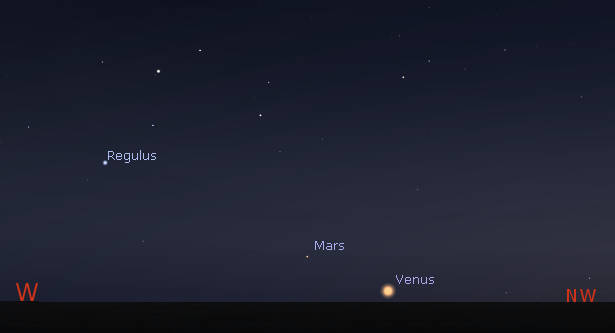
Mars with Venus setting at 11 pm, an hour and a half after sunset. Also, visible may be the bright star Regulus in the constellation of Leo the lion with the asterism of the Sickle or backwards question mark that delineate the head and mane of the beast. Created using Stellarium.
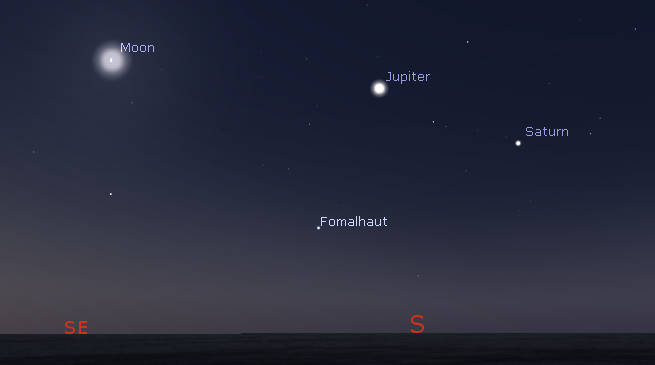
Saturn, Jupiter and the Moon in morning twilight of 5 am, about an hour before sunrise. Created using Stellarium.
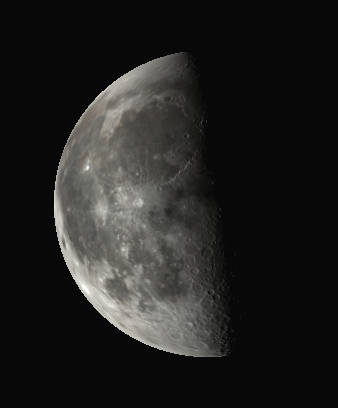
The Moon at last quarter as it might be seen in binoculars or small telescope at 5 am, July 1, 2021. Created using Stellarium.
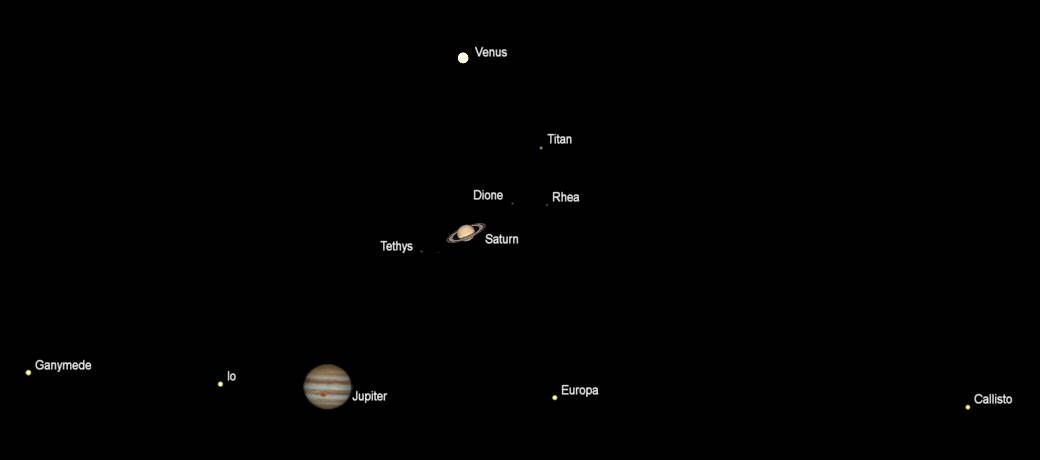
The planets as seen in a telescope (north up) with the same magnification for the night of June 30/July 1, 2021. Times of the display are: Venus, 10:30 pm; Saturn and Jupiter, 5 am. Apparent diameters: Venus, 11.19″; Saturn 18.29″, its rings 42.62″; Jupiter, 45.30″. Mars has an apparent diameter of only 3.86″ and is not represented. The ” symbol means seconds of arc (1/3600th of a degree.) Click on the image to enlarge it. Created using Cartes du Ciel (Sky Charts).
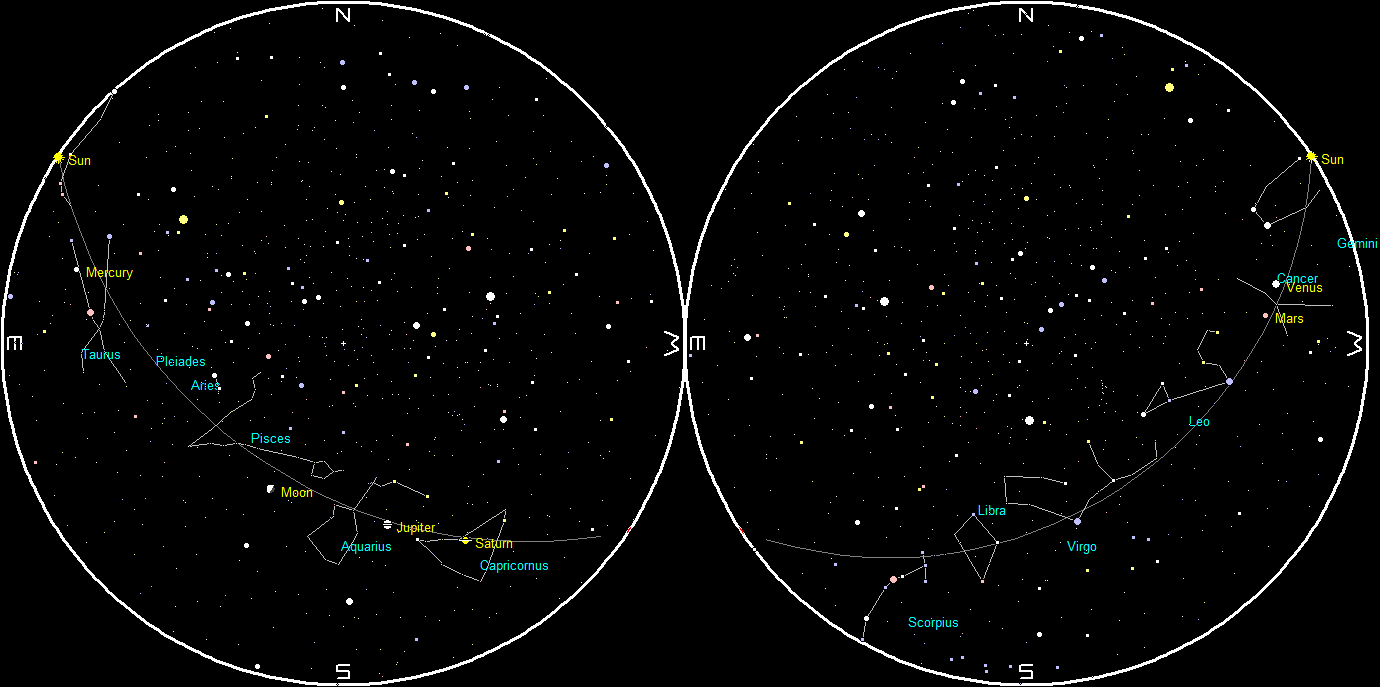
Planets and the Moon at sunset and sunrise of a single night, starting with sunset on the right on June 30, 2021. The night ends on the left with sunrise on the July 1st. Click on the image to enlarge. Created using my LookingUp program.
 Bob Moler's Ephemeris Blog