08/26/2021 – Ephemeris – Two tiny summer constellations
This is Ephemeris for Thursday, August 26th. Today the Sun will be up for 13 hours and 31 minutes, setting at 8:29, and it will rise tomorrow at 6:59. The Moon, half-way from full to last quarter, will rise at 10:40 this evening. | Located below the eastern edge of the Summer Triangle of three of the brightest stars in the sky, which is nearly overhead in our sky at 10 p.m., is the tiny constellation of Delphinus the dolphin. Delphinus’ 6 stars, in a small parallelogram with a tail, really does look like a dolphin leaping out of the water. The parallelogram itself has the name Job’s Coffin. The origin of this asterism or informal constellation is unknown. Of the dolphin itself: the ancient Greeks appreciated this aquatic mammal as we do, and told stories of dolphins rescuing shipwrecked sailors. There’s another tiny constellation to the right of Delphinus, Sagitta the arrow a small thin group of 5 stars, which represents Cupid’s dart.
The astronomical event times given are for the Traverse City/Interlochen area of Michigan (EDT, UT – 4 hr). They may be different for your location.
Addendum
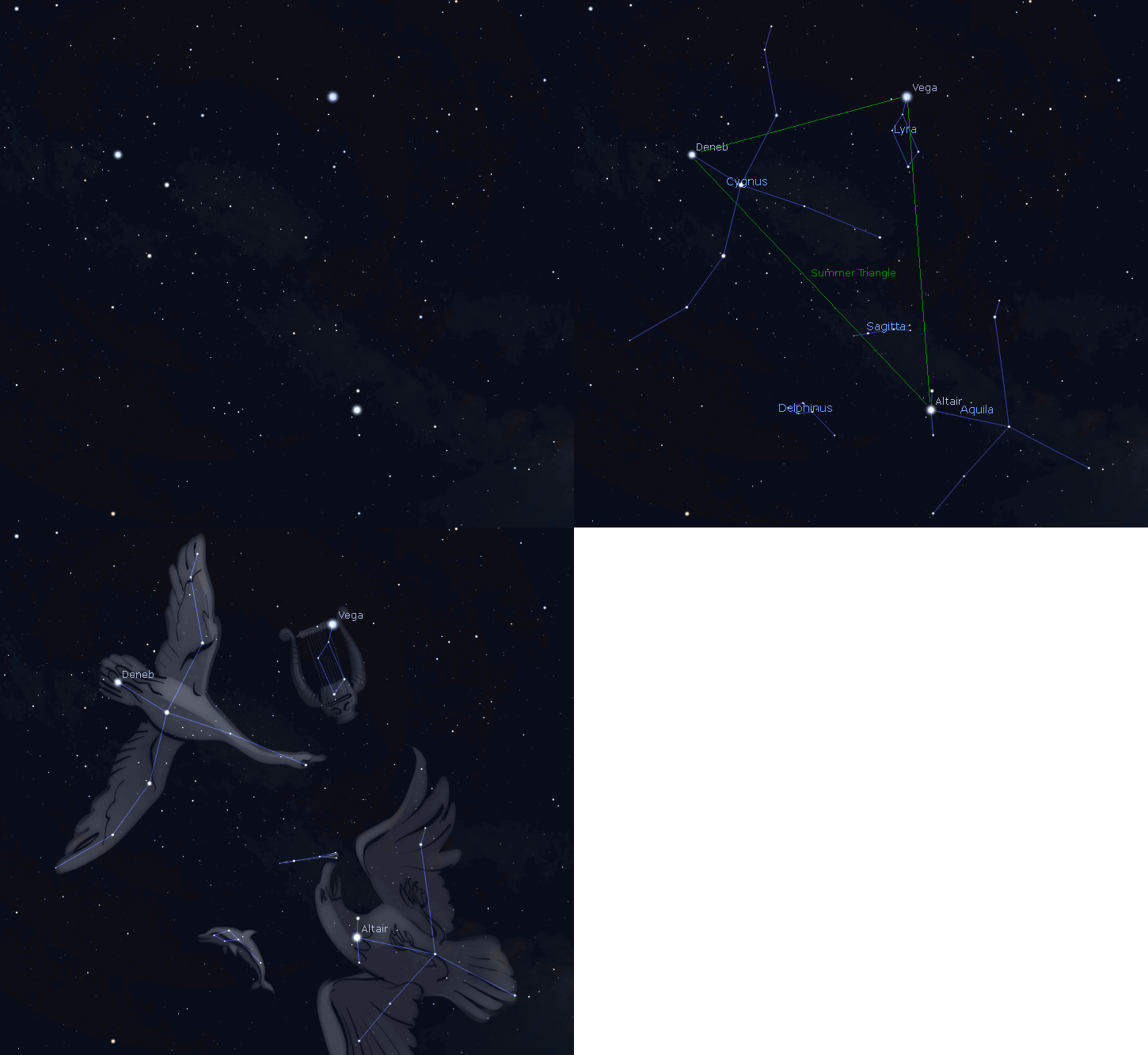
Delphinus and Sagitta finder animation. Created using Stellarium and GIMP.
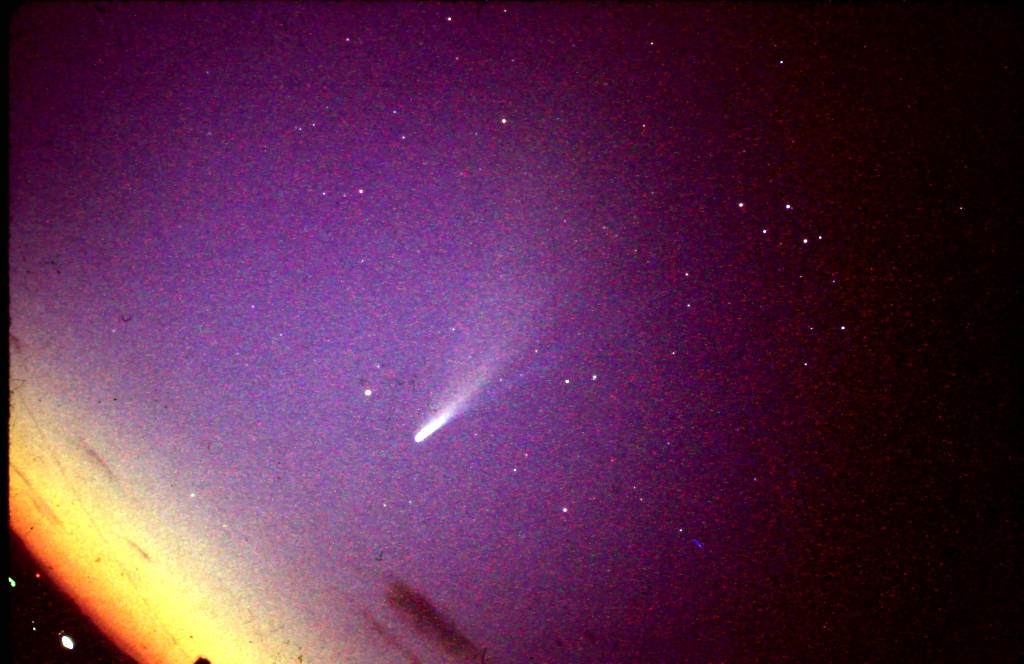
Comet West, C/1975 V1, as photographed by me at about 6 am, March 8, 1976. The wide, curved dust tail is most prominent, with the narrow blue ion tail streaming more directly away from the rising Sun. The small summer constellation of Delphinus the dolphin is to the upper right. The diamond shape of stars at the front of the dolphin’s body is an asterism called Job’s Coffin.
08/25/2021 – Ephemeris – Let’s search for the naked-eye planets for this week
This is Ephemeris for Wednesday, August 25th. Today the Sun will be up for 13 hours and 34 minutes, setting at 8:31, and it will rise tomorrow at 6:58. The Moon, 3 days past full, will rise at 10:20 this evening.
Let’s search for the naked-eye planets for this week. Venus should be visible in the western evening twilight before 9 tonight. It will set at 9:53 pm. By 9 pm, Jupiter and Saturn will be seen low in the southeastern sky. The brighter Jupiter will be easy to spot at that hour. Saturn will be dimmer, but a bit higher and to its right. Both these planets will be visible for most of the night, with Saturn setting first at 4:52 am, with Jupiter setting at 6:26 tomorrow morning. Saturn’s rings can be seen in a spotting scope of about 20 power magnification. Though at that power, the rings won’t appear separated from the planet, so Saturn will look like an elliptical spot. Most of Jupiter’s 4 brightest moon can be spotted in binoculars.
The astronomical event times given are for the Traverse City/Interlochen area of Michigan (EDT, UT – 4 hr). They may be different for your location.
Addendum
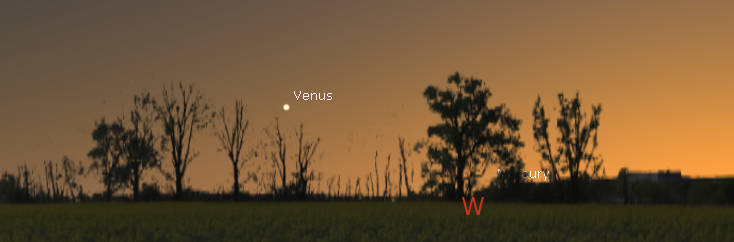
Venus in evening twilight tonight, August 25, 2021 at 9 pm, about 1/2 hour after sunset. Created using Stellarium.
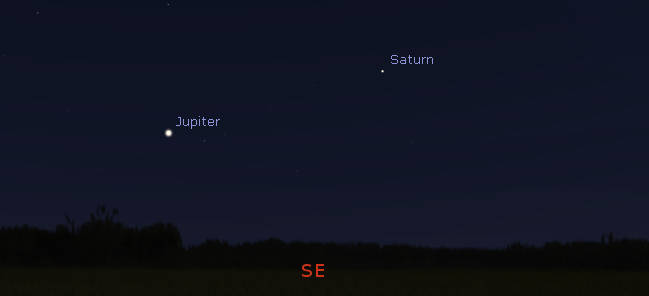
Jupiter and Saturn in the southeast at 9:30 pm tonight, August 25, 2021, about 45 minutes after sunset. Created using Stellarium.
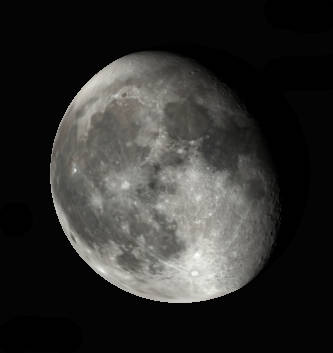
The Moon as it might appear tonight in binoculars or a small telescope at 11:30 pm, about an hour after it rises tonight, August 25, 2021. Created using Stellarium.
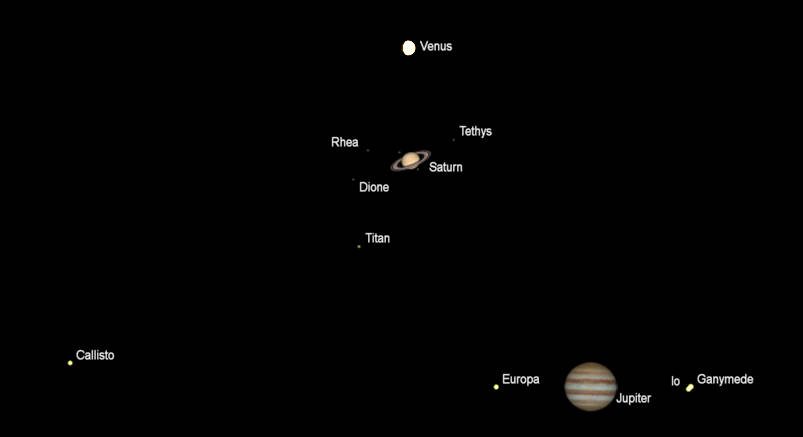
Telescopic view of the bright planets (north up) as they would be seen in a small telescope, with the same magnification, this evening. Venus at 9:15 pm, and the other two at 11 pm, August 25, 2021. Apparent diameters: Venus, 14.51″ 75% illuminated; Saturn 18.43″, its rings 42.93″; Jupiter, 49.06″. Jupiter’s moons Io and Ganymede will slowly separate after 11 pm. The ” symbol means seconds of arc (1/3600th of a degree.) Click on the image to enlarge it. Created using Cartes du Ciel (Sky Charts).
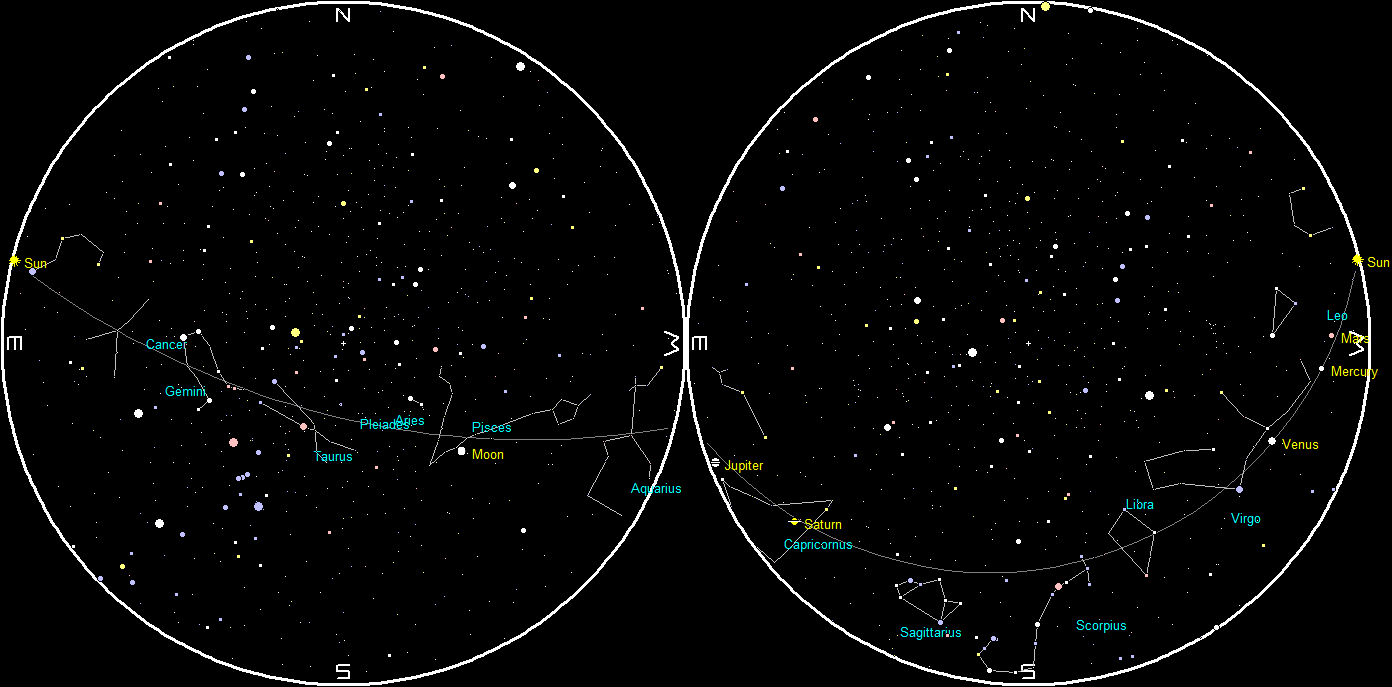
Planets and the Moon at sunset and sunrise of a single night, starting with sunset on the right on August 25, 2021. The night ends on the left with sunrise on the 26th. Click on the image to enlarge. Created using my LookingUp program.
08/24/2021 – Ephemeris – The Harvest Moon is coming next full moon
This is Bob Moler with Ephemeris for Tuesday, August 24th. Today the Sun will be up for 13 hours and 36 minutes, setting at 8:33, and it will rise tomorrow at 6:57. The Moon, 2 days past full, will rise at 10:00 this evening.
We are at that time of year when the advance in Moon rising times from night to night is shorter than the average 50 minutes per night. Tonight the Moon will rise only 21 minutes later than it did last night, and tomorrow’s Moon will rise 20 minutes later than it will tonight. It’s what I call the harvest moon effect, though Harvest Moon will be next month. I find the effect lasts for three full moons, centered on the start of autumn. That’s because the angle of the Moon’s and also the Sun’s paths in the sky called the ecliptic intersect the horizon at a shallow angle near sunset. It’s also the reason Venus will stay close to the western horizon for its evening appearance this year. The planets also hang around the ecliptic, where the zodiacal constellations are.
The astronomical event times given are for the Traverse City/Interlochen area of Michigan (EDT, UT – 4 hr). They may be different for your location.
Addendum
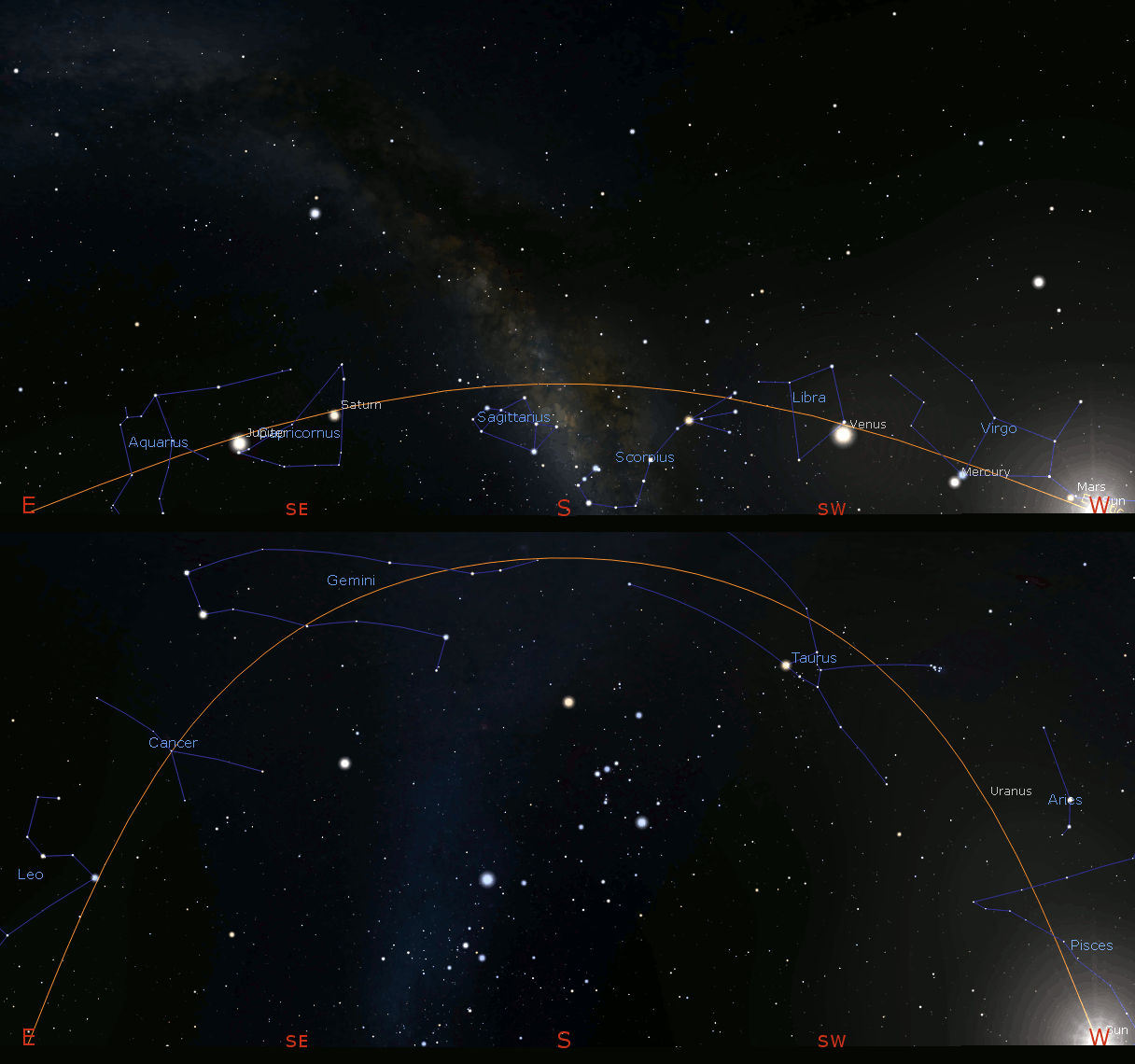
The autumn vs spring sunset ecliptic (orange line). I’m using the autumnal equinox 2021 and vernal equinox 2022 as examples. At the autumnal equinox sunset, the ecliptic runs low in the south, and the ecliptic meets the horizon at a low angle. At the vernal equinox in March, the ecliptic runs very high in the south. It meets the horizon at a steep angle. Click on the image to enlarge it. Created using Stellarium and GIMP.
Near the autumnal equinox, the ecliptic appears low in the south at sunset. Planets near the Sun like Venus are seen low in the west and set soon after sunset. At the opposite end of the sky, a rising Moon near full will rise at less than the 50 minutes later each night average.
08/23/2021 – Ephemeris – Seeking shelter on the Moon
This is Ephemeris for Monday, August 23rd. Today the Sun will be up for 13 hours and 39 minutes, setting at 8:34, and it will rise tomorrow at 6:56. The Moon, 1 day past full, will rise at 9:39 this evening.
The area of interest on the Moon for NASA’s Artemis crewed landing program and the target for Chinese lunar ambitions is the south pole, where signs of water ice have been detected in permanently shadowed craters. That is a valuable resource, if one wants to live off the land on the Moon. There’s another resource that is also valuable in finding: shelter from radiation and the Moon’s extreme temperature swings. Those are lava tubes. They are lava channels in which lava flowed, the top and sides cooled and crusted over. They emptied when the lava ran out, leaving a hollow tube. Sometimes part of the upper crust fails, leaving what is called a skylight. Several of these skylights have been found on the Moon and even Mars.
The astronomical event times given are for the Traverse City/Interlochen area of Michigan (EDT, UT – 4 hr). They may be different for your location.
Addendum
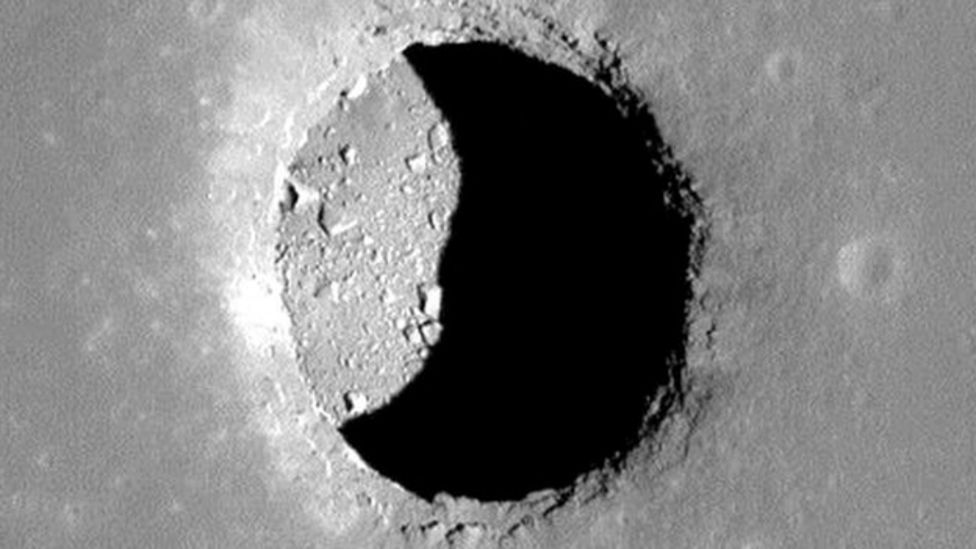
A skylight betrays the presence of a lunar lava tube. Credit NASA/LRO.
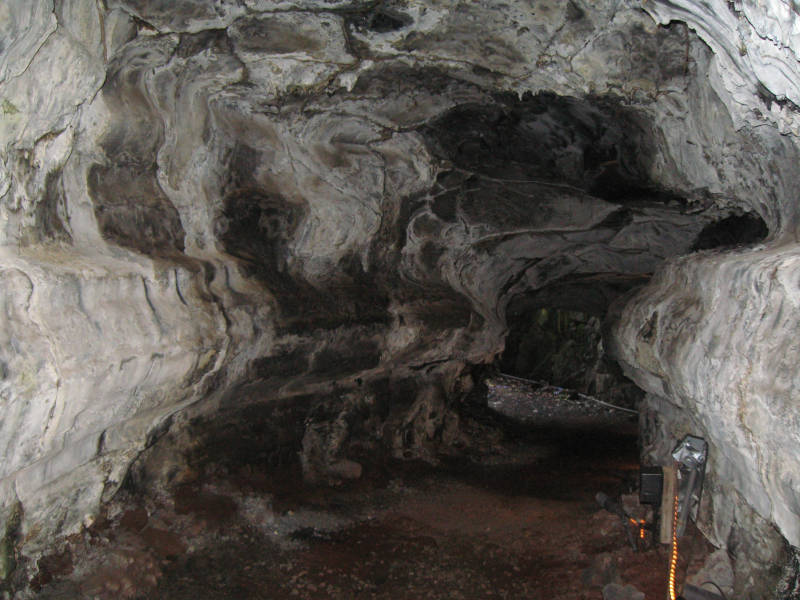
Here’s an earthly lava tube on the Island of Hawai’i, I visited in 2012 with my wife. It was on the site of a coffee plantation south of Kona. Credit mine.
08/20/2021 – Ephemeris – The Moon will pass Saturn tonight
This is Bob Moler with Ephemeris for Friday, August 20th. Today the Sun will be up for 13 hours and 48 minutes, setting at 8:39, and it will rise tomorrow at 6:52. The Moon, 2 days before full, will set at 5:26 tomorrow morning.
The Moon is passing Saturn this evening. Saturn will be directly above the Moon by about 10 moon-widths or five degrees at 10 pm tonight. Tomorrow night the Moon will have moved toward Jupiter, which at the same time of night, the planet will appear to the upper left of our satellite. The sky appears to us to be a dome over us, which is useful for imagining the constellations, navigation, and pointing telescopes. However, that is an illusion. The night sky is impossibly and wonderfully deep. The Moon is a quarter of a million miles away, Jupiter and Saturn are hundreds of million miles away. The nearest nighttime stars are trillions of miles away, and so on as far as our eyes and instruments can see.
The astronomical event times given are for the Traverse City/Interlochen area of Michigan (EDT, UT – 4 hr). They may be different for your location.
Addendum
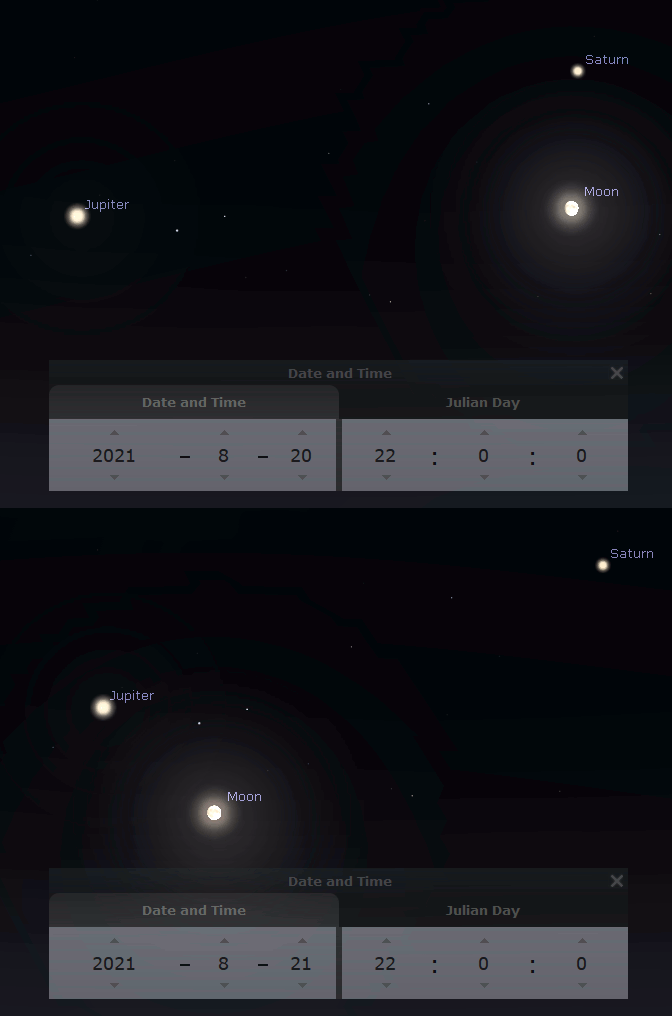
Animation showing the Moon passing Saturn and Jupiter at 10 pm on August 20 & 21, 2021. Beside the Moon jumping position between the two dates, the planets and stars do too, but to a lesser extent to the right. This is due to the Earth’s change in position as it orbits the Sun. Stars rise and set 3 minutes, 56 seconds earlier each night. The Created using Stellarium and GIMP.
08/19/2021 – Ephemeris – Jupiter is at opposition today!
This is Ephemeris for Thursday, August 19th. Today the Sun will be up for 13 hours and 51 minutes, setting at 8:41, and it will rise tomorrow at 6:51. The Moon, 3 days before full, will set at 4:11 tomorrow morning.
Tonight, Jupiter will be at opposition. That’s a shortcut term for Jupiter being opposite the Sun in our sky. At that time, Jupiter rises at sunset and sets at sunrise. It is also at its closest to us. It also officially becomes an evening planet, available in the evening for those of us with daytime jobs. In even small telescopes, Jupiter shows two dark bands. There’s more, but those two are the most prominent. Its four largest moons will be visible before 9:50 pm tonight, after that the innermost of the four, Io, will start to cross the face of Jupiter. It will leave Ganymede on Jupiter’s east side. On the west side will be the moon Europa, and farther out, Callisto. At 12:08 am, Io will reappear on the west side of Jupiter, joining Europa and Callisto. The moons do put on a show.
The astronomical event times given are for the Traverse City/Interlochen area of Michigan (EDT, UT – 4 hr). They may be different for your location.
Addendum
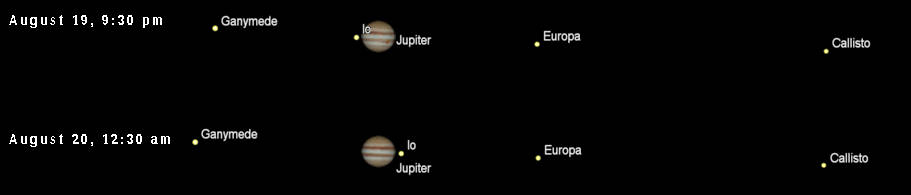
Jupiter’s Galilean moons at two times tonight, August 19th at 9:30 pm (01:30 on the 20th, UT) and 12:30 am (04:30 UT). From 9:50 pm to 12:08 am (01:50 – 04:08 UT), Io will pass in front of Jupiter and be practically invisible. Click on the image to enlarge it. Created using Cartes du Ciel (Sky Charts).
08/18/2021 – Ephemeris – Let’s search for the naked-eye planets for this week
This is Bob Moler with Ephemeris for Wednesday, August 18th. Today the Sun will be up for 13 hours and 54 minutes, setting at 8:43, and it will rise tomorrow at 6:50. The Moon, 3 days past first quarter, will set at 3:02 tomorrow morning.
Let’s search for the naked-eye planets for this week. Venus should be visible in the western evening twilight by 9:15 tonight. It will set at 10:04 pm. By 9:30 pm, Jupiter and Saturn will be seen low in the southeastern sky. The brighter Jupiter will be easy to spot at that hour. Saturn will be dimmer, but a bit higher and to its right. Jupiter, just a day from opposition from the Sun, will be at its brightest and closest to us. It’s now 373 million miles (600 million km) from us. It won’t change much by tomorrow. Actually it’s a closer approach than average, so it’s brighter than at an average opposition and larger appearing than normal in telescopes. Jupiter and four of its largest moons always provide for a great show.
The astronomical event times given are for the Traverse City/Interlochen area of Michigan (EDT, UT – 4 hr). They may be different for your location.
Addendum
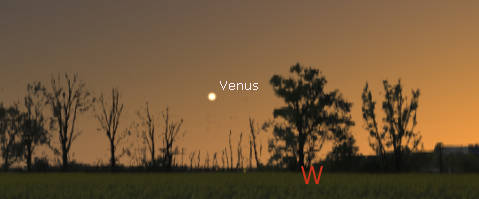
Venus low in the west, tonight at 9:15, about a half hour after sunset, August 18, 2021. Created using Stellarium.
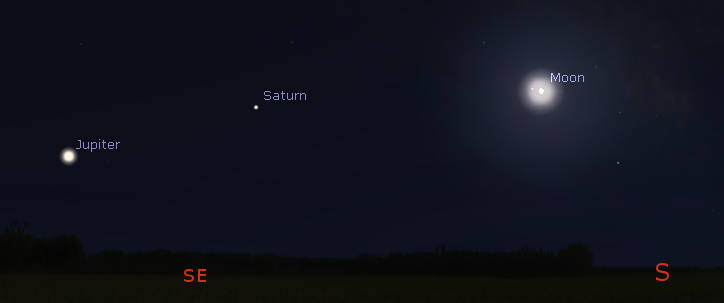
Jupiter, Saturn and the Moon at 10 pm, about an hour and a quarter after sunset tonight, August 18, 2021. Click on the image to enlarge it. Created using Stellarium.
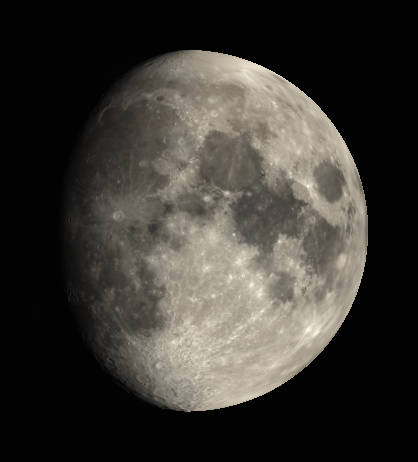
The waxing gibbous Moon as it might appear tonight in binoculars or a small telescope. Created using Stellarium.
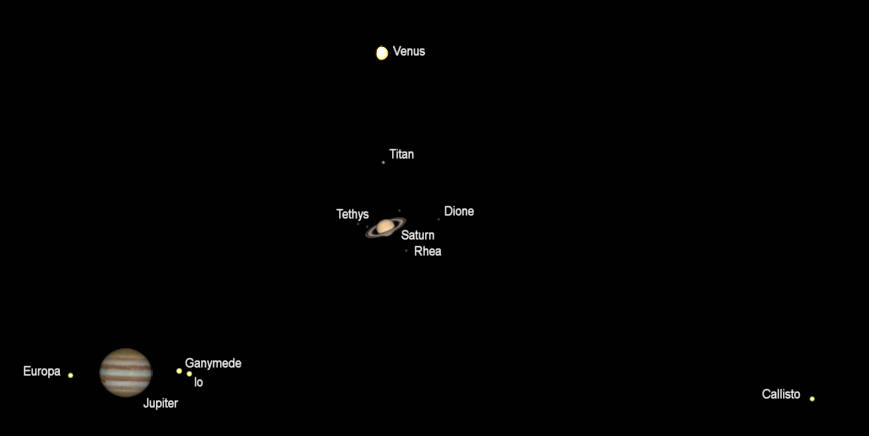
Telescopic view of the bright planets (north up) as they would be seen in a small telescope, with the same magnification, this evening. Venus at 10 pm, and the other two at 11 pm, August 18, 2021. Apparent diameters: Venus, 13.93″; Saturn 18.51″, its rings 43.13″; Jupiter, 49.12″. Jupiter’s moon have a cluster of events in the am hours. See below. The ” symbol means seconds of arc (1/3600th of a degree.) Click on the image to enlarge it. Created using Cartes du Ciel (Sky Charts).
Satellite  Event             EDT (UT-4)   UT
Europa     Shadow start      12:34 am     04:34
Europa	   Transit start     12:37 am     04:37
Io         Occultation start 12:37 am     04:37
Ganymede   Eclipse start     12:43 am     04:43
Io         Occultation end    2:55 am     06:55
Europa     Shadow end         3:25 am     07:25
Europa     Transit end        3:27 am     07:27
Ganymede   Occultation end    4:24 am     08:24

From 12:43 to 2:55 am, only Callisto of the four Galilean moons will be visible.
The above times were determined using Stellarium, and may be off by several minutes.
Shadow events are when a satellite’s shadow is cast onto the face of the planet
Transit events are when the satellite passes in front of the planet. The satellite is usually not visible
Eclipse events are when a satellite passes through the planet’s shadow
Occultation events are when the satellite passes behind the planet
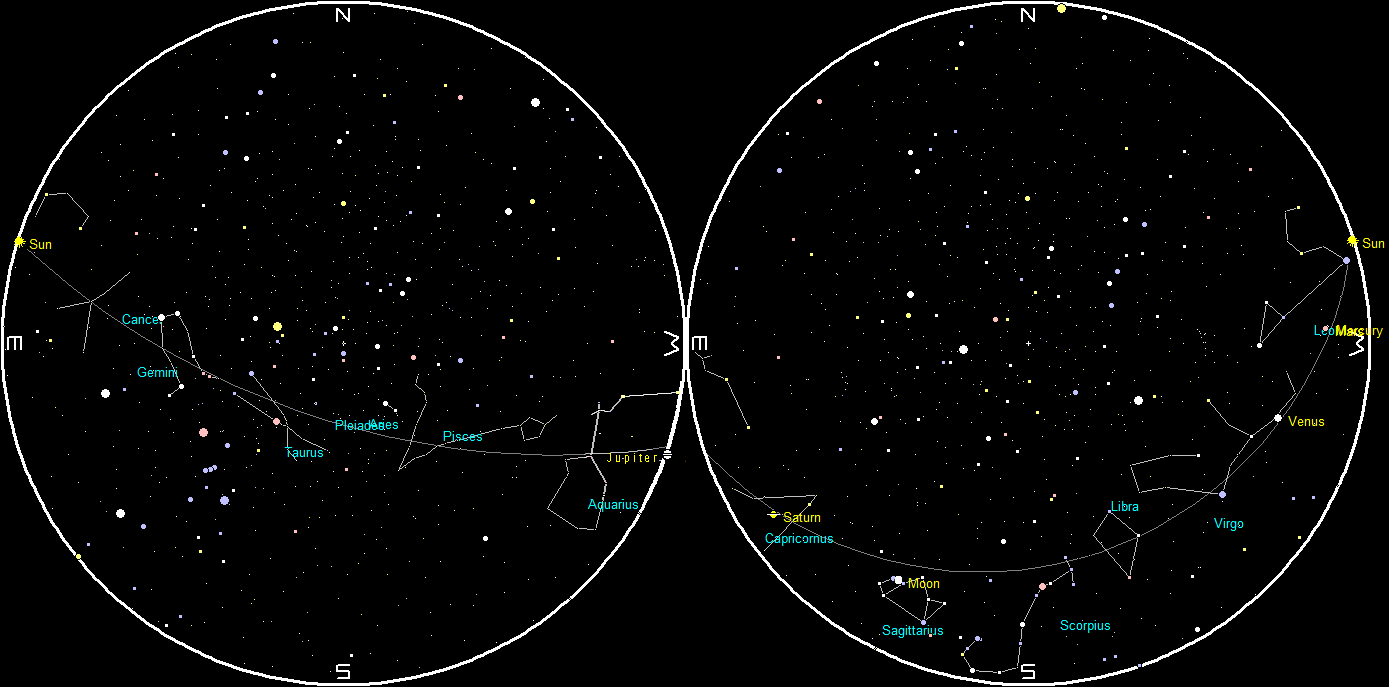
The naked-eye planets and the Moon are shown at sunset and sunrise of a single night, starting with sunset on the right on August 18, 2021. The night ends on the left with sunrise on the 19th. Mars and Mercury will be in conjunction in Leo that evening, so their labels overlap. Click on the image to enlarge. Created using my LookingUp program.
08/17/2021 – Ephemeris – Jupiter is big and bright in the evening
This is Bob Moler with Ephemeris for Tuesday, August 17th. Today the Sun will be up for 13 hours and 56 minutes, setting at 8:44, and it will rise tomorrow at 6:49. The Moon, 2 days past first quarter, will set at 2:02 tomorrow morning.
The brilliant planet we see rising in the east-southeast in the evening is not Venus, which is low in the west, ensnared in evening twilight. It’s Jupiter, the second-brightest planet and the largest by far. Jupiter would be the brightest planet except that the strength of sunlight falling on it is only 1/25th of what we get on the Earth and less than 1/50th of what Venus gets. Plus, it’s a lot farther away. Even in binoculars, Jupiter appears as not quite star-like. Most of the time, Jupiter is the largest appearing planet in telescopes. It is only beaten by Venus for a couple of months when it is nearest to us. When I was a kid, just learning about the planets, Jupiter had 12 moons. Astronomers by now have discovered 68 more.
The astronomical event times given are for the Traverse City/Interlochen area of Michigan (EDT, UT – 4 hr). They may be different for your location.
Addendum
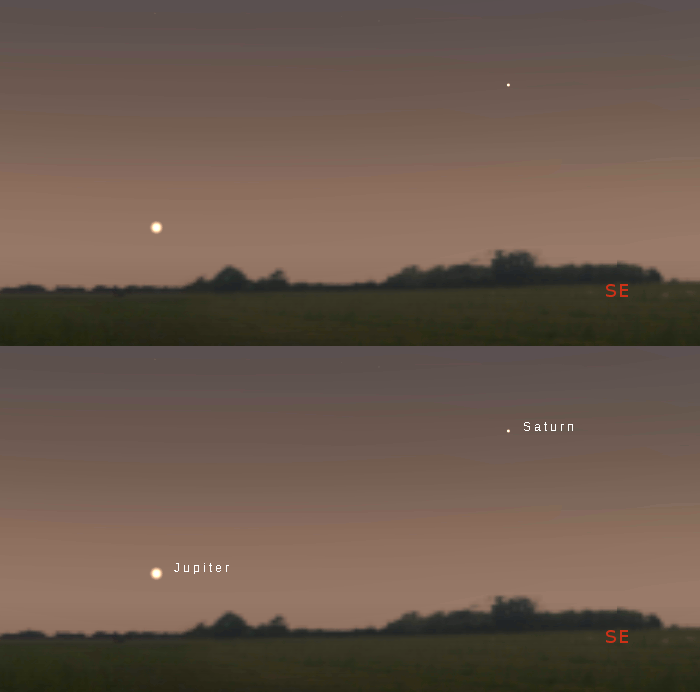
Jupiter finder animation for tonight, August 17, 2021, at 9:15 pm. Venus i is in the west, which is brighter but suffering in bright twilight. Saturn may not be as easily visible as it is shown here until later. Credit: Stellarium and GIMP.
08/16/2021 – Ephemeris – The first Artemis mission (maybe) – CAPSTONE
This is Ephemeris for Monday, August 16th. Today the Sun will be up for 13 hours and 59 minutes, setting at 8:46, and it will rise tomorrow at 6:47. The Moon, 1 day past first quarter, will set at 1:13 tomorrow morning.
Tonight’s Moon is a great one to view with a small telescope. Speaking of the Moon, a company called Rocket Lab will be launching the first Artemis program mission, later this year, in preparation to land crews back on the Moon. They are launching a small CubeSat to orbit the Moon in a Near Rectilinear Halo Orbit which always faces the Earth and never goes behind the Moon. To test whether all the mathematical calculations for the orbit actually work in real life. The satellite is called CAPSTONE (another tortured NASA acronym*). It will be launched from New Zealand, Rocket Lab’s main launch site first into a polar orbit before heading to the lunar orbit, taking several months to get there.
The astronomical event times given are for the Traverse City/Interlochen area of Michigan (EDT, UT – 4 hr). They may be different for your location.
* Cislunar Autonomous Positioning System Technology Operations and Navigation Experiment. Told ya. Cislunar space is a spherical volume of space centered on the Earth, whose radius is the Moon’s distance. Beyond that is interplanetary space.
Addendum
Rocket Lab had been planning to launch the CAPSTONE satellite from Wallops Island, Virginia, but approval was taking too long, so they moved the launch to their New Zealand launch site instead.
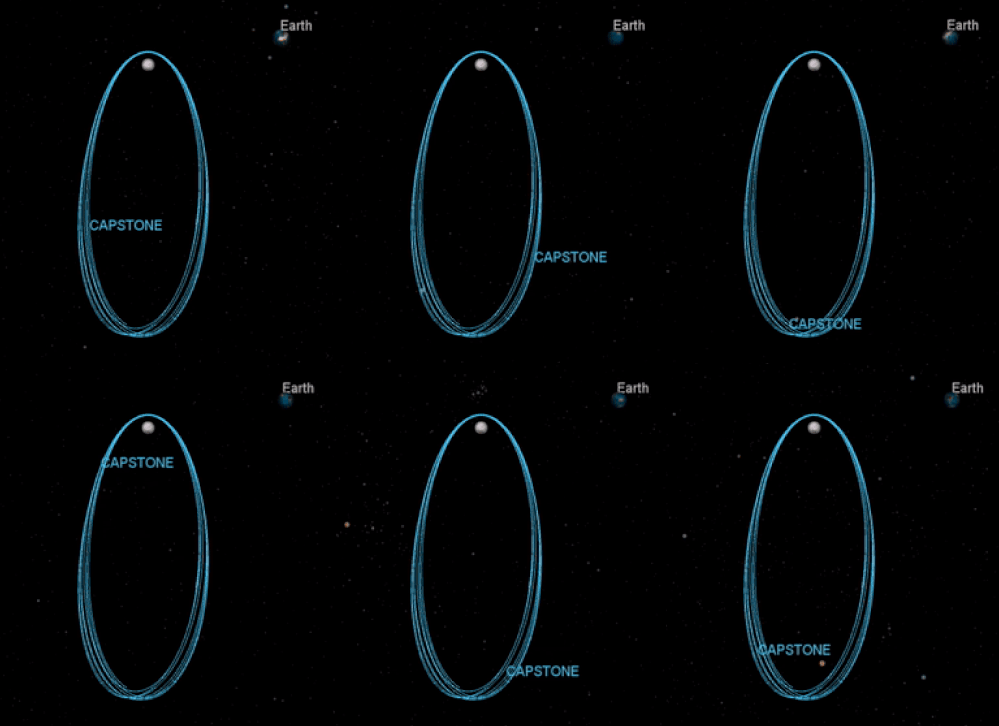
NASA CAPSTONE* pathfinder for gateway orbit is to be launched late this year by Rocket Lab to prove out the near rectilinear orbit for the Lunar Gateway.
08/13/2021 – Ephemeris – Rescheduled virtual star party tonight
This is Bob Moler with Ephemeris for Friday, August 13th. Today the Sun will be up for 14 hours and 8 minutes, setting at 8:51, and it will rise tomorrow at 6:44. The Moon, 2 days before first quarter, will set at 11:36 this evening.
The Grand Traverse Astronomical Society will try again to hold a virtual star party starting at 9:30 pm tonight via the Zoom app on the Internet. We were clouded out last Friday night. Jerry Dobek, professor of astronomy at Northwestern Michigan College, will host the event with the 16-inch telescope at the College’s Observatory and an imager, but only if it’s clear in Traverse City. It should feature a look at Venus and the crescent Moon to start. Saturn and Jupiter will be up by then, but they’re quite low in the sky. We might take another look at them later on when their images are steadier. The wonders of the Milky Way are all available. Instructions and a link can be found on the society’s website, www.gtastro.org.
The astronomical event times given are for the Traverse City/Interlochen area of Michigan (EDT, UT – 4 hr). They may be different for your location.
Addendum
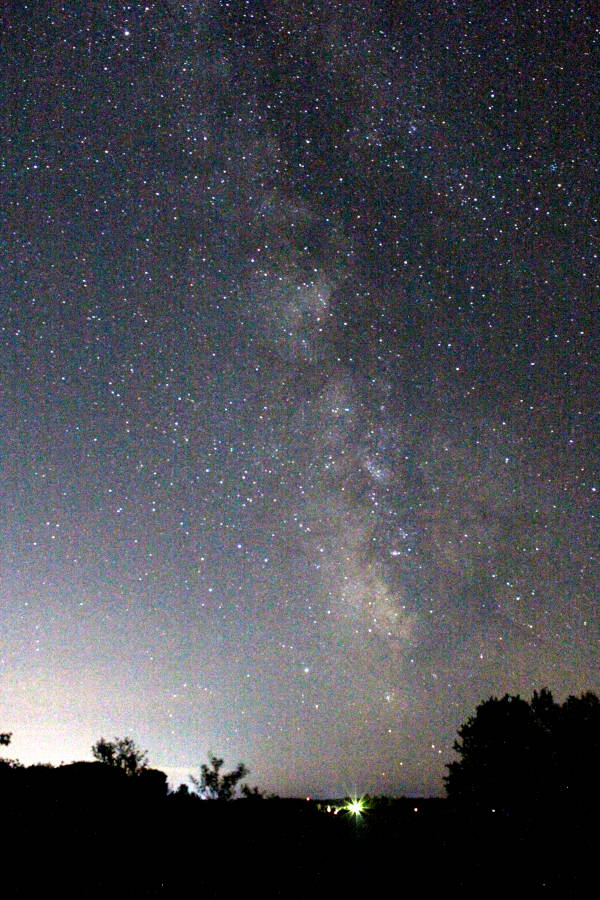
The southern Milky Way from Aquila to Sagittarius taken from my backyard with light pollution from businesses on US 31 in Chums Corners and Grawn south of me. I live about 7 miles west of the NMC Observatory. These bright lights are to its southwest and farther away. Click on the image to enlarge it.

