07/01/2021 – Ephemeris – Looking ahead at July’s skies
This is Ephemeris for Thursday, July 1st. Today the Sun will be up for 15 hours and 30 minutes, setting at 9:32, and it will rise tomorrow at 6:01. The Moon, at last quarter today, will rise at 1:54 tomorrow morning.
Let’s preview July’s skies. The Sun, having reached its northern solstice, is beginning to slide southward again, at first imperceptibly, then with greater speed. The daylight hours will decrease from 15 hours and 30 minutes today to 14 hours 41 minutes at month’s end. The daylight hours will be slightly shorter south of Interlochen, and slightly longer to the north. The altitude of the Sun at local noon, when it is due south, will decrease from 68 degrees today to 63 degrees at month’s end. The Sun will be a degree lower in the Straits area. Despite the warmth, the Earth will reach its greatest distance from the Sun late Monday. That’s called aphelion where the Sun will be almost 94.5 million miles (152 million kilometers) away, which makes summer the longest season.
The astronomical event times given are for the Traverse City/Interlochen area of Michigan (EDT, UT-4). They may be different for your location.
Addendum
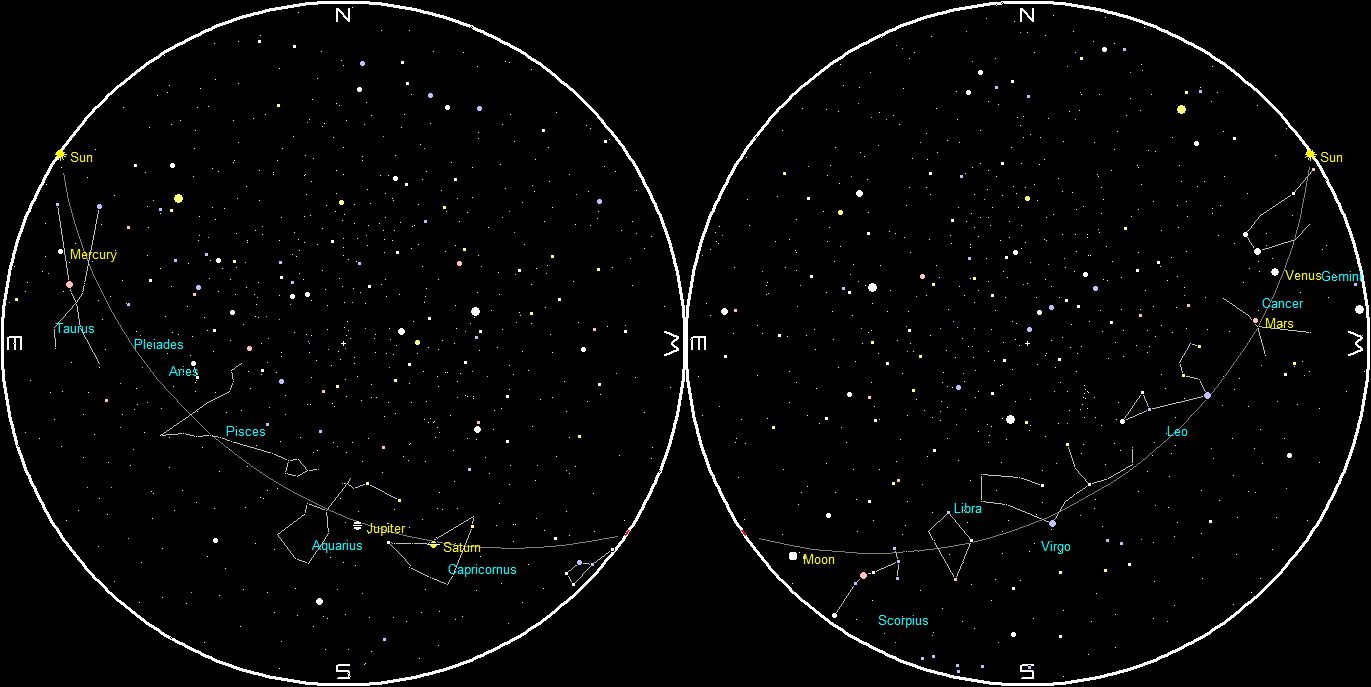
July Evening Star Chart
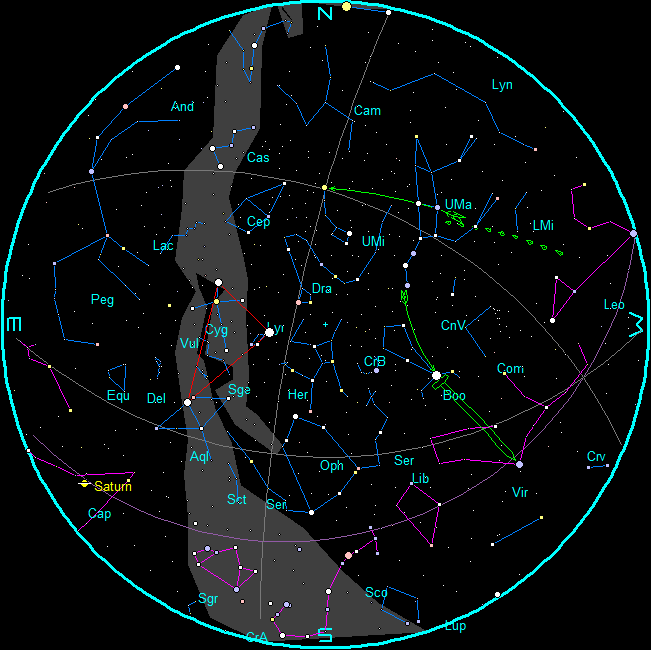
Star Chart for July 2021 (11 p.m. EDT, July 15, 2021). Created using my LookingUp program. Click on image to enlarge.
The planets and stars are plotted for the 15th at 11 p.m. EDT in the evening and 4:30 a.m. for the morning chart. These are the chart times. Note that Traverse City is located approximately 45 minutes behind our time meridian, West 75° longitude. (An hour 45 minutes behind our daylight saving time meridian during EDT). To duplicate the star positions on a planisphere you may have to set it to 1 hour 45 minutes earlier than the current time.
Note the chart times are for the 15th. For each week before the 15th, add ½ hour (28 minutes if you’re picky). For each week after the 15th, subtract ½ hour. The planet positions are updated each Wednesday on this blog. For planet positions on dates other than the 15th.
July Morning Star Chart
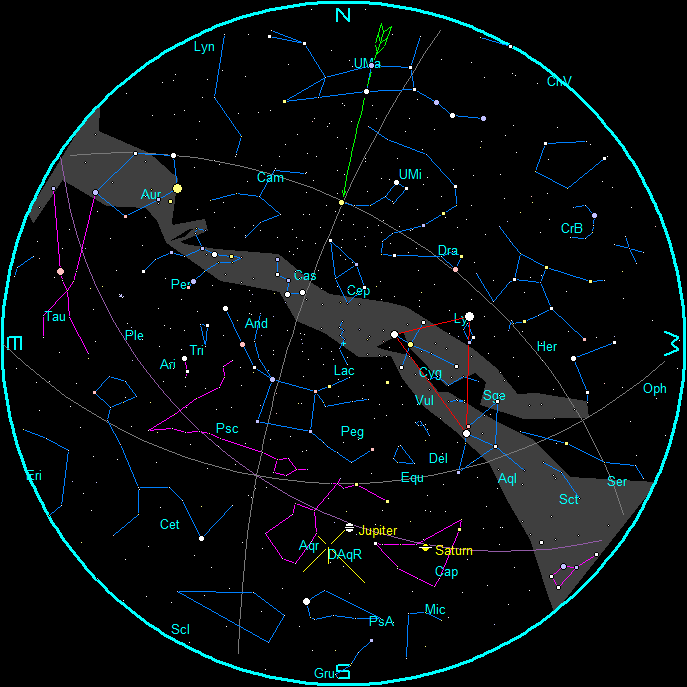
Star Chart for July mornings, 2021 (4:30 a.m. EDT July 15, 2021). Created using my LookingUp program. Click on image to enlarge.
For a list of constellation names to go with the abbreviations, click here.
- Pointer stars at the front of the bowl of the Big Dipper point to Polaris, the North Star.
- Leaky dipper drips on Leo.
- Follow the arc of the handle of the Big Dipper to the star Arcturus, and
- Extend like a spike to Spica.
- The Summer Triangle is in red.
- DAqR is the radiant of the South Delta Aquariid meteor shower (Peaks on the 27th)
Twilight Limits, Nautical and Astronomical
| EDT | |||||||
| Morning | Twilight | Evening | Twilight | Dark | Night | Moon | |
| Date | Astro. | Nautical | Nautical | Astro. | Start | End | Illum. |
| 2021-07-01 | 3h38m | 4h41m | 23h00m | 0h03m | 0h03m | 1h35m | 0.47 |
| 2021-07-02 | 3h39m | 4h42m | 22h59m | 0h02m | 0h02m | 1h55m | 0.37 |
| 2021-07-03 | 3h40m | 4h42m | 22h59m | 0h01m | 0h01m | 2h14m | 0.28 |
| 2021-07-04 | 3h41m | 4h43m | 22h58m | 0h00m | 0h00m | 2h35m | 0.2 |
| 2021-07-05 | 3h43m | 4h44m | 22h58m | 23h59m | 23h59m | 2h57m | 0.13 |
| 2021-07-06 | 3h44m | 4h45m | 22h57m | 23h58m | 23h58m | 3h24m | 0.07 |
| 2021-07-07 | 3h45m | 4h46m | 22h57m | 23h57m | 23h57m | 3h45m | 0.03 |
| 2021-07-08 | 3h47m | 4h47m | 22h56m | 23h56m | 23h56m | 3h47m | 0.01 |
| 2021-07-09 | 3h48m | 4h48m | 22h55m | 23h55m | 23h55m | 3h48m | 0 |
| 2021-07-10 | 3h50m | 4h49m | 22h54m | 23h53m | 23h53m | 3h50m | 0.01 |
| 2021-07-11 | 3h52m | 4h50m | 22h54m | 23h52m | 23h52m | 3h52m | 0.05 |
| 2021-07-12 | 3h53m | 4h51m | 22h53m | 23h51m | 23h51m | 3h53m | 0.1 |
| 2021-07-13 | 3h55m | 4h53m | 22h52m | 23h49m | 0h00m | 3h55m | 0.17 |
| 2021-07-14 | 3h57m | 4h54m | 22h51m | 23h48m | – | 3h57m | 0.26 |
| 2021-07-15 | 3h58m | 4h55m | 22h50m | 23h46m | 0h23m | 3h58m | 0.37 |
| 2021-07-16 | 4h00m | 4h56m | 22h49m | 23h45m | 0h46m | 4h00m | 0.48 |
| 2021-07-17 | 4h02m | 4h58m | 22h47m | 23h43m | 1h08m | 4h02m | 0.59 |
| 2021-07-18 | 4h04m | 4h59m | 22h46m | 23h41m | 1h33m | 4h04m | 0.7 |
| 2021-07-19 | 4h06m | 5h00m | 22h45m | 23h40m | 2h01m | 4h06m | 0.8 |
| 2021-07-20 | 4h07m | 5h02m | 22h44m | 23h38m | 2h35m | 4h07m | 0.89 |
| 2021-07-21 | 4h09m | 5h03m | 22h43m | 23h36m | 3h18m | 4h09m | 0.95 |
| 2021-07-22 | 4h11m | 5h04m | 22h41m | 23h34m | – | – | 0.99 |
| 2021-07-23 | 4h13m | 5h06m | 22h40m | 23h32m | – | – | 1 |
| 2021-07-24 | 4h15m | 5h07m | 22h39m | 23h31m | – | – | 0.98 |
| 2021-07-25 | 4h17m | 5h09m | 22h37m | 23h29m | – | – | 0.94 |
| 2021-07-26 | 4h19m | 5h10m | 22h36m | 23h27m | – | – | 0.88 |
| 2021-07-27 | 4h21m | 5h11m | 22h34m | 23h25m | 23h25m | 23h37m | 0.81 |
| 2021-07-28 | 4h23m | 5h13m | 22h33m | 23h23m | 23h23m | 23h58m | 0.72 |
| 2021-07-29 | 4h25m | 5h14m | 22h31m | 23h21m | 23h21m | – | 0.63 |
| 2021-07-30 | 4h27m | 5h16m | 22h30m | 23h19m | 23h19m | 0h17m | 0.53 |
| 2021-07-31 | 4h29m | 5h17m | 22h28m | 23h17m | 23h17m | 0h38m | 0.44 |
Twilight calendar was generated using Cartes du Ciel (Sky Charts).
See my blog post: Twilight Zone for the definitions of the different periods of twilight here: https://bobmoler.wordpress.com/2018/09/27/.
NASA Calendar of Planetary Events
Date         Time     Event
Jul  1  Th            Venus: 25.4° E
     1  Th   5:11 pm  Last Quarter
     2  Fr  10:45 pm  Venus-Beehive: 0.1° N
     4  Su   3:59 pm  Mercury Elongation: 21.6° W
     5  Mo  10:48 am  Moon Apogee: 405300 km
     5  Mo  10:59 pm  Aphelion: 1.0167 AU
     6  Tu   6:41 pm  Moon Ascending Node
     8  Th  12:38 am  Moon-Mercury: 4.1° S
     9  Fr   6:05 am  Moon North Dec.: 25.6° N
     9  Fr   9:16 pm  New Moon
    12  Mo   5:10 am  Moon-Venus: 3.5° S
    12  Mo   6:10 am  Moon-Mars: 4° S
    13  Tu   9:17 am  Venus-Mars: 0.5° N
    17  Sa   6:11 am  First Quarter
    20  Tu   9:22 am  Moon Descending Node
    21  We   6:30 am  Moon Perigee: 364500 km
    21  We   5:21 pm  Venus-Regulus: 1.1° N
    22  Th  11:12 am  Moon South Dec.: 25.6° S
    23  Fr  10:37 pm  Full Moon
    24  Sa  12:42 pm  Moon-Saturn: 3.9° N
    25  Su   9:17 pm  Moon-Jupiter: 4.3° N
    27  Tu  11:17 pm  Delta Aquariid Shower: ZHR = 20
    29  Th  10:09 am  Mars-Regulus: 0.6° N
    31  Sa   9:16 am  Last Quarter
Aug  1  Su            Venus: 33.1° E
All event times are given for UTC-4 hr: Eastern Daylight Saving Time.
Sky Events Calendar by Fred Espenak and Sumit Dutta (NASA’s GSFC),
http://eclipse.gsfc.nasa.gov/SKYCAL/SKYCAL.html.
If you go to the above site you can print out a list like the above for the entire year or calendar pages for your time zone.
Sun and Moon Rising and Setting Events
LU                  Ephemeris of Sky Events for Interlochen/TC
July, 2021    Local time zone: EDT
+-----------------------------------------------------------------------+
| DATE |  SUN     SUN  DAYLIGHT|   TWILIGHT*    |MOON  RISE OR    ILLUM |
|      |  RISE    SET    HOURS |  END    START  |PHASE SET** TIME FRACTN|
+=======================================================================+
|Thu  1| 06:01a  09:32p  15:30 | 10:57p  04:35a |L Qtr Rise 01:54a   49%|
|Fri  2| 06:01a  09:31p  15:29 | 10:56p  04:36a |      Rise 02:14a   39%|
|Sat  3| 06:02a  09:31p  15:29 | 10:56p  04:37a |      Rise 02:34a   30%|
+------+-----------------------+----------------+-----------------------+
|Sun  4| 06:03a  09:31p  15:28 | 10:55p  04:38a |      Rise 02:57a   22%|
|Mon  5| 06:03a  09:30p  15:27 | 10:55p  04:39a |      Rise 03:24a   15%|
|Tue  6| 06:04a  09:30p  15:26 | 10:54p  04:40a |      Rise 03:56a    9%|
|Wed  7| 06:05a  09:30p  15:24 | 10:53p  04:40a |      Rise 04:36a    4%|
|Thu  8| 06:05a  09:29p  15:23 | 10:53p  04:42a |      Rise 05:23a    1%|
|Fri  9| 06:06a  09:29p  15:22 | 10:52p  04:43a |New   Set  09:42p    0%|
|Sat 10| 06:07a  09:28p  15:21 | 10:51p  04:44a |      Set  10:26p    1%|
+------+-----------------------+----------------+-----------------------+
|Sun 11| 06:08a  09:28p  15:19 | 10:50p  04:45a |      Set  11:02p    4%|
|Mon 12| 06:09a  09:27p  15:18 | 10:49p  04:46a |      Set  11:33p    9%|
|Tue 13| 06:09a  09:26p  15:16 | 10:48p  04:47a |      Set  11:59p   16%|
|Wed 14| 06:10a  09:26p  15:15 | 10:47p  04:48a |      Set  12:23a   24%|
|Thu 15| 06:11a  09:25p  15:13 | 10:46p  04:49a |      Set  12:45a   34%|
|Fri 16| 06:12a  09:24p  15:11 | 10:45p  04:51a |      Set  01:08a   45%|
|Sat 17| 06:13a  09:23p  15:10 | 10:44p  04:52a |F Qtr Set  01:32a   57%|
+------+-----------------------+----------------+-----------------------+
|Sun 18| 06:14a  09:23p  15:08 | 10:43p  04:53a |      Set  02:00a   68%|
|Mon 19| 06:15a  09:22p  15:06 | 10:42p  04:55a |      Set  02:35a   78%|
|Tue 20| 06:16a  09:21p  15:04 | 10:40p  04:56a |      Set  03:18a   87%|
|Wed 21| 06:17a  09:20p  15:02 | 10:39p  04:57a |      Set  04:13a   94%|
|Thu 22| 06:18a  09:19p  15:00 | 10:38p  04:59a |      Set  05:18a   98%|
|Fri 23| 06:19a  09:18p  14:58 | 10:37p  05:00a |Full  Rise 09:35p  100%|
|Sat 24| 06:20a  09:17p  14:56 | 10:35p  05:02a |      Rise 10:16p   99%|
+------+-----------------------+----------------+-----------------------+
|Sun 25| 06:21a  09:16p  14:54 | 10:34p  05:03a |      Rise 10:49p   95%|
|Mon 26| 06:22a  09:15p  14:52 | 10:32p  05:04a |      Rise 11:15p   90%|
|Tue 27| 06:23a  09:14p  14:50 | 10:31p  05:06a |      Rise 11:37p   82%|
|Wed 28| 06:24a  09:13p  14:48 | 10:29p  05:07a |      Rise 11:58p   74%|
|Thu 29| 06:25a  09:11p  14:45 | 10:28p  05:09a |      Rise 12:17a   65%|
|Fri 30| 06:27a  09:10p  14:43 | 10:26p  05:10a |      Rise 12:38a   55%|
|Sat 31| 06:28a  09:09p  14:41 | 10:25p  05:12a |L Qtr Rise 01:00a   46%|
+-----------------------------------------------------------------------+
* Nautical Twilight
** Moonrise or moonset, whichever occurs between sunrise and sunset
06/30/2021 – Ephemeris – Let’s search for the naked-eye planets for this week
This is Ephemeris for Wednesday, June 30th. Today the Sun will be up for 15 hours and 31 minutes, setting at 9:32, and it will rise tomorrow at 6:01. The Moon, 1 day before last quarter, will rise at 1:35 tomorrow morning.
Let’s search for the naked-eye planets for this week. Venus can be spotted low in the west-northwest twilight by 10 pm or a little after. It will set at 11:06 pm. Venus will be spending the rest of summer low in the western sky for the rest of summer, and not be a conspicuous as it usually is. Mars can be found in the west-northwest at 11pm. It’s in Cancer and will set at 11:25 pm as it is slowly losing its race with the Sun. Saturn and Jupiter, are seen best in the morning sky. Saturn will rise before midnight at 11:15 pm. It’s seen with the stars of Capricornus. Brighter Jupiter, to the left of Saturn, will rise at 12:06 am. By 5 am, these two planets will be in the south in the morning twilight.
The astronomical event times given are for the Traverse City/Interlochen area of Michigan (EDT, UT-4). They may be different for your location.
Addendum
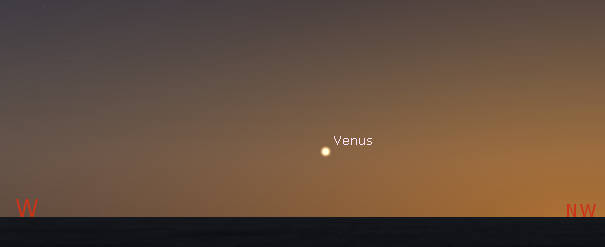
Venus in evening twilight at 10:30, about an hour after sunset. Mars is in the picture, but the twilight is overpowering it. Created using Stellarium.
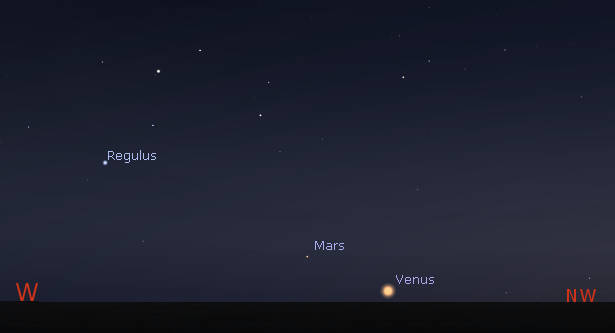
Mars with Venus setting at 11 pm, an hour and a half after sunset. Also, visible may be the bright star Regulus in the constellation of Leo the lion with the asterism of the Sickle or backwards question mark that delineate the head and mane of the beast. Created using Stellarium.
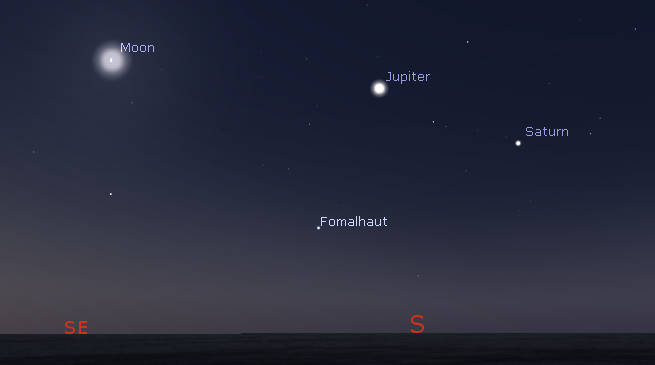
Saturn, Jupiter and the Moon in morning twilight of 5 am, about an hour before sunrise. Created using Stellarium.
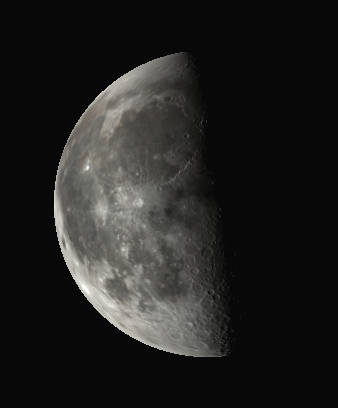
The Moon at last quarter as it might be seen in binoculars or small telescope at 5 am, July 1, 2021. Created using Stellarium.
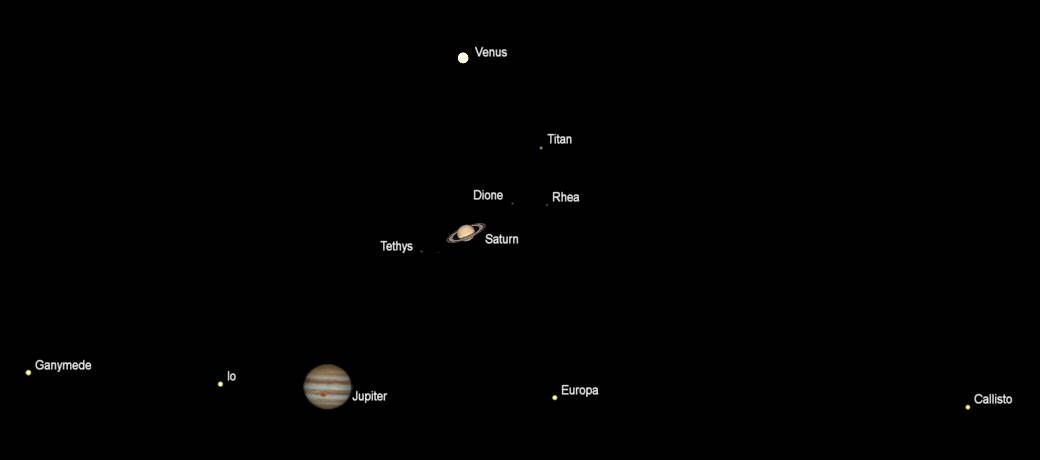
The planets as seen in a telescope (north up) with the same magnification for the night of June 30/July 1, 2021. Times of the display are: Venus, 10:30 pm; Saturn and Jupiter, 5 am. Apparent diameters: Venus, 11.19″; Saturn 18.29″, its rings 42.62″; Jupiter, 45.30″. Mars has an apparent diameter of only 3.86″ and is not represented. The ” symbol means seconds of arc (1/3600th of a degree.) Click on the image to enlarge it. Created using Cartes du Ciel (Sky Charts).
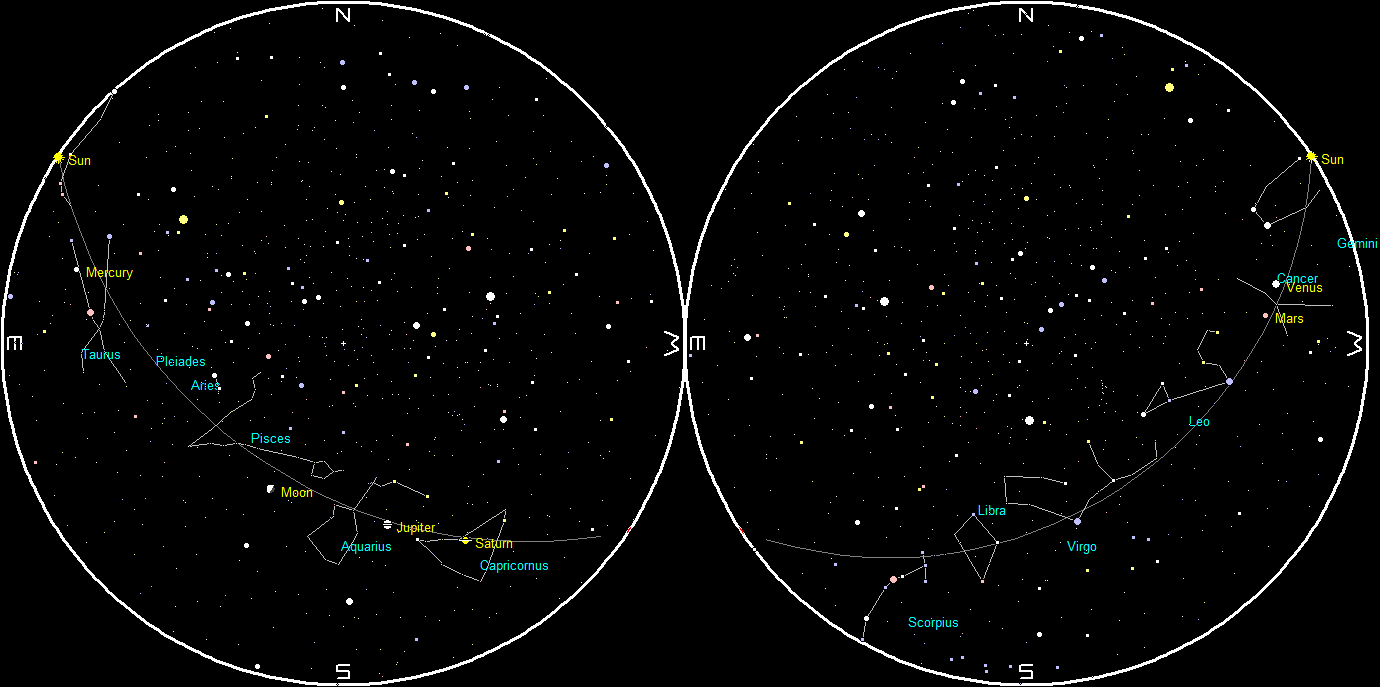
Planets and the Moon at sunset and sunrise of a single night, starting with sunset on the right on June 30, 2021. The night ends on the left with sunrise on the July 1st. Click on the image to enlarge. Created using my LookingUp program.
06/29/2021 – Ephemeris – The Summer Triangle
This is Ephemeris for Tuesday, June 29th. Today the Sun will be up for 15 hours and 32 minutes, setting at 9:32, and it will rise tomorrow at 6:00. The Moon, 2 days before last quarter, will rise at 1:14 tomorrow morning.
Dominating the eastern sky at 11 pm are three bright stars. These are all first magnitude stars, members of the group of 21 brightest stars in the night sky. Highest, in the east, is Vega, the brightest of the three. It and a small, slim parallelogram of stars below it belong to the constellation of Lyra the harp. Below it to the northeast is Deneb, dimmest of the three at the head of the horizontally appearing Northern Cross, an informal constellation or asterism. Properly, Deneb is in the tail of Cygnus the swan flying south through the Milky Way. The third star of the three is Altair, lower still, but in the east-southeast at the head of Aquila the Eagle. These three stars are in a large asterism called the Summer Triangle, which will be with us through summer and fall.
The astronomical event times given are for the Traverse City/Interlochen area of Michigan (EDT, UT-4). They may be different for your location.
Addendum
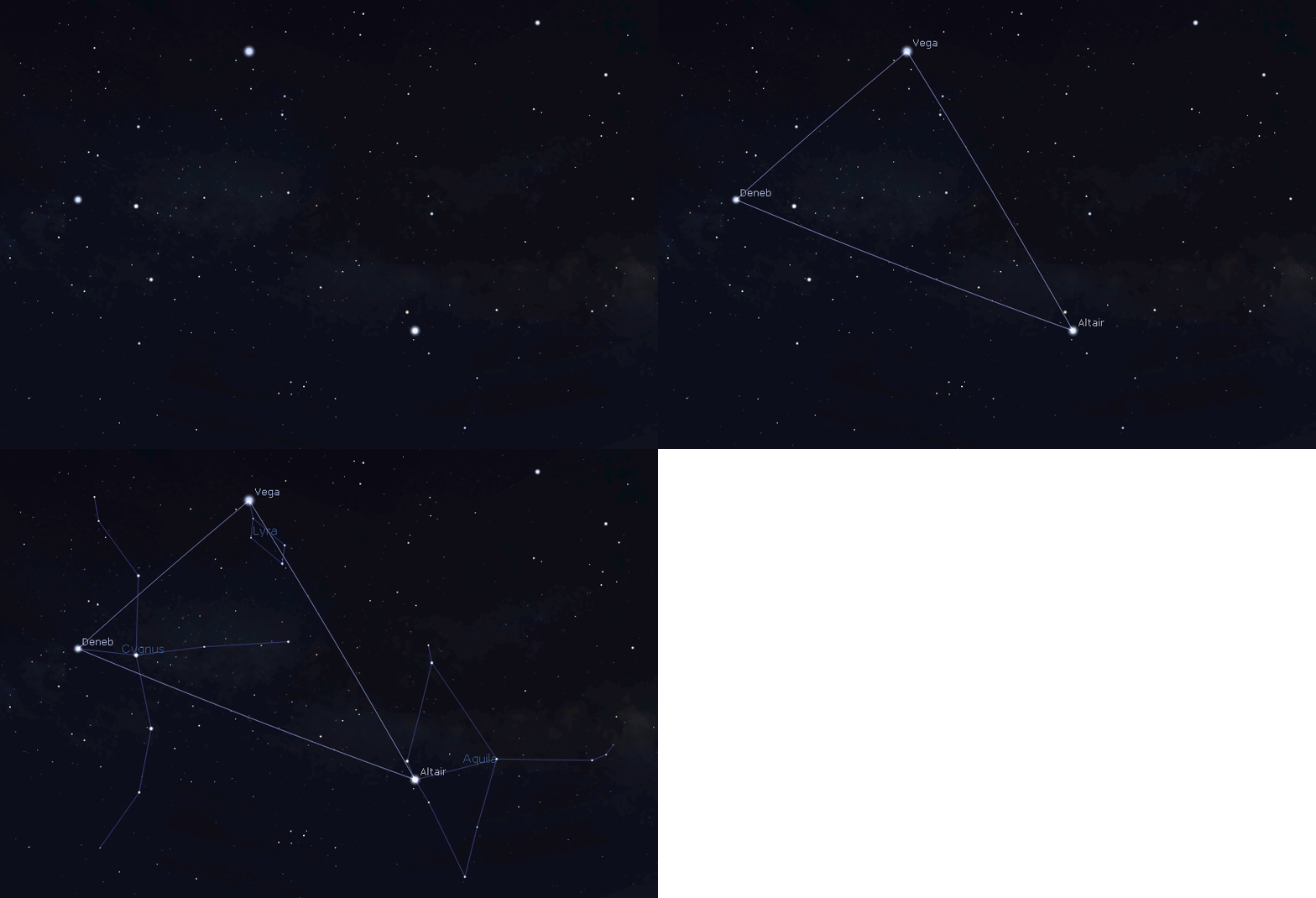
The Summer Triangle finder animation showing first the unlabeled sky, Then the Summer Triangle with the stars labeled, then the constellations of those stars. Click on the image to enlarge it. Created using Stellarium and GIMP.
06/28/2021 – Ephemeris – The summer Milky Way
This is Ephemeris for Monday, June 28th. Today the Sun will be up for 15 hours and 32 minutes, setting at 9:32, and it will rise tomorrow at 6:00. The Moon, 3 days before last quarter, will rise at 12:50 tomorrow morning.
Last night we had the latest sunset of the year. That’s great news for star gazers who like dark skies and the Sun is not among the stars they want to gaze at. But it won’t get noticeably darker earlier in the evening until late July. But when that does happen, the glory of the summer Milky Way becomes visible. On top of that, the peak night of the Perseid meteor shower, the night of August 11th and morning of the 12th. The three-day-old Moon that night won’t bother the meteor shower at all. The winter sky has the Milky Way also, but we are then looking out, away from the center of our galaxy. It’s hard to tell there’s a milky band there at all. In summer, we are looking toward the more populated parts of our galaxy. It’s a wonder to behold.
The astronomical event times given are for the Traverse City/Interlochen area of Michigan (EDT, UT-4). They may be different for your location.
Addendum
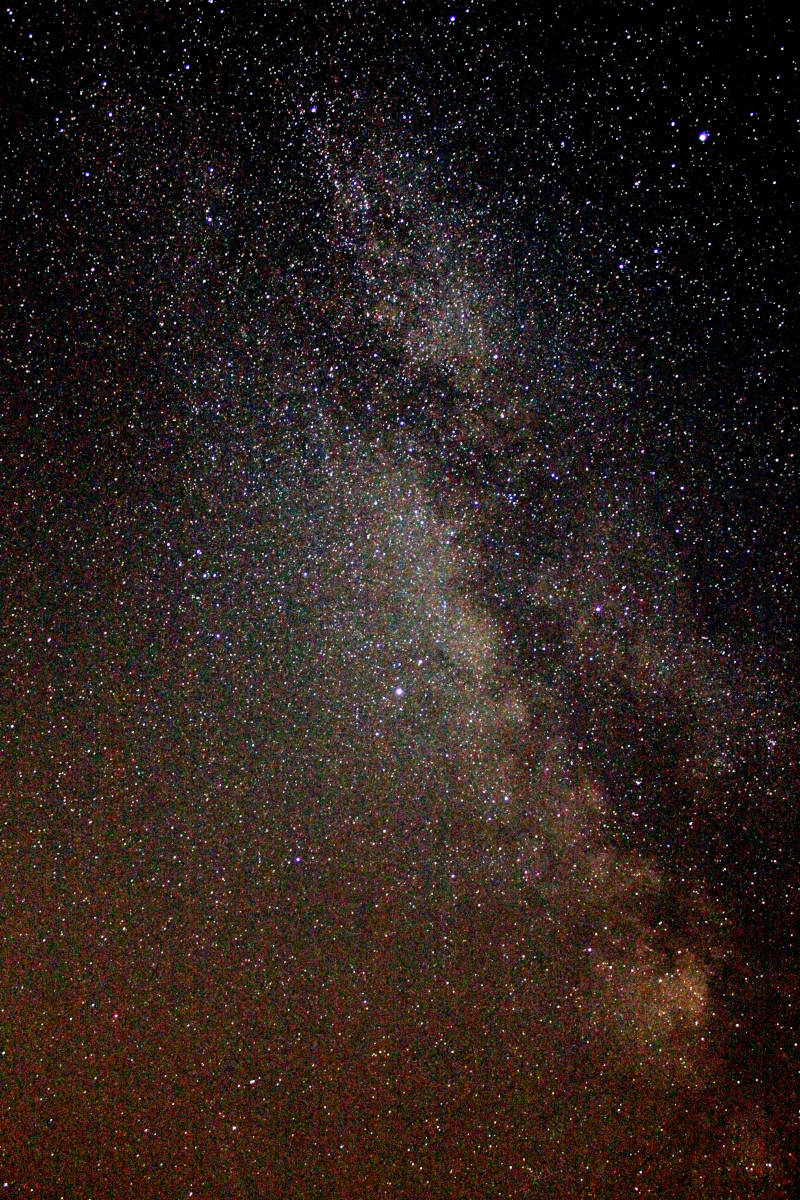
The Milky Way from Cygnus to Scutum. This image, actually a stack of 5 images, was taken on August 12, 2018. I was hoping to record Perseid meteors. It was a poor showing, as none appeared in these images. We were hampered that year by smoke from the western US wildfires, which really affected the lower part of this image, which was still pretty high up in the sky, by giving it a red tinge. Featured here is the Great Rift, a series of dust clouds that split the Milky Way into two sections, subject of previous and future programs. Click on the image to enlarge. Credit: Bob Moler (me).
06/25/2021 – Ephemeris – The era of commercial human space flight has begun
This is Bob Moler with Ephemeris for Friday, June 25th. Today the Sun will be up for 15 hours and 34 minutes, setting at 9:32, and it will rise tomorrow at 5:58. The Moon, 1 day past full, will rise at 10:58 this evening.
It looks like this year 2021 is the year that commercial crewed spaceflight is going to take off, literally. There’s Richard Branson’s Virgin Galactic with their air dropped VSS Unity that will achieve a few minutes of weightlessness in suborbital space like the old X15 did. Competing in suborbital space is Jeff Bezos’ Blue Origin with their New Shepard rocket and capsule. Bezos and his brother are expected to ride the first crewed capsule flight later this summer. Running rings around these guys, actually, is Elon Musk’s SpaceX with three orbital Commercial Crew missions for NASA already under his belt and a completely civilian orbital mission, Inspiration 4, slated for the end of summer. So the era of commercial human space flight is finally beginning.
The astronomical event times given are for the Traverse City/Interlochen area of Michigan (EDT, UT-4). They may be different for your location.
Addendum
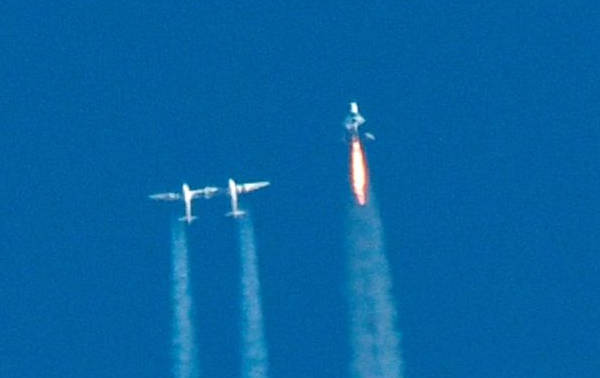
Virgin Galactic’s Spaceship VSS Unity ignites its hybrid rocket engine after being dropped from its carrier aircraft WhiteKnight Two on a test flight to the edge of space. Credit Sky News.

The Launch of the Blue Origin’s New Shepard rocket and Crew Capsule. Credit: Blue Origin.
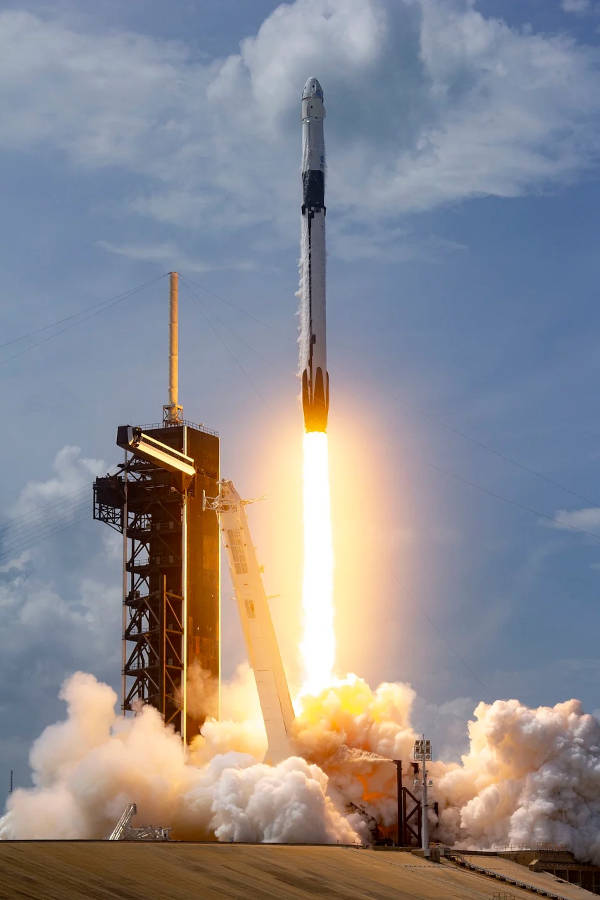
SpaceX Falcon 9 lifts off from historic Launch Complex 39A and sends Crew Dragon to orbit on its first flight with NASA astronauts. Credit: SpaceX/Twitter.
Boeing also built a human rated spacecraft, the Starliner, which will be used to ferry astronauts to the International Space Station. It will be launched on a United Launch Alliance Atlas V rocket. They are scheduled to repeat their uncrewed test flight this summer before they can send crews to the ISS.
Virgin has Virgin Orbital a company to air launch small payloads, Blue Origin is developing the New Glenn rocket a partially reusable rocket, which is expected to launch in 2022 or 2023. SpaceX is actively developing its StarShip completely reusable rocket and booster near Brownsville, Texas.
06/24/2021 – Ephemeris – SpaceX Inspiration 4 mission
This is Bob Moler with Ephemeris for Thursday, June 24th. Today the Sun will be up for 15 hours and 34 minutes, setting at 9:32, and it will rise tomorrow at 5:58. The Moon, at full today, will rise at 9:59 this evening.
If all goes as planned, SpaceX will send four civilians, two men and two women, into orbit for a three-day mission aboard the Crew Dragon “Resilience” spacecraft, sent up by a Falcon 9 rocket in mid-September. It’s called the Inspiration 4 Mission to raise awareness and funds for the St. Jude Children’s Hospital. Their orbit will be higher, at 340 miles (540 kilometers) altitude, than that of the International Space Station. The mission commander will be Jared Isaacman, who is paying for the whole thing. Dr. Sian Proctor will be the pilot. Also, on the crew will be Hayley Arceneaux, a St. Jude childhood cancer survivor and now a Physician’s Assistant at St. Jude, and Christopher Sembroski. The crew has been in training since their selection in early April.
The astronomical event times given are for the Traverse City/Interlochen area of Michigan (EDT, UT-4). They may be different for your location.
Addendum

The Inspiration 4 Crew. Left to right: Jared Isaacman, Commander who financed the mission, and flies military jets for fun; Dr Sian Proctor, Pilot who is an entrepreneur, educator and trained pilot; Hayley Arceneaux, who is a physician assistant at St. Jude Children’s Research Hospital; and Christopher Sembroski. Credit: Inspration4 Photos.
06/23/2021 – Ephemeris – Let’s search for the naked-eye planets for this week
This is Bob Moler with Ephemeris for Wednesday, June 23rd. Today the Sun will be up for 15 hours and 34 minutes, setting at 9:32, and it will rise tomorrow at 5:58. The Moon, 1 day before full, will set at 5:30 tomorrow morning.
Let’s search for the naked-eye planets for this week. Venus can be spotted low in the west-northwest twilight by 10 pm or a little after. Venus will set at 11:07 pm. Mars can be found in the west-northwest at 11pm, It’s in Cancer and is currently passing in front of the Beehive star cluster which can be spotted in a pair of binoculars. Mars will set at 11:38 pm as it is slowing losing its race with the Sun. Saturn and Jupiter, are in the morning sky. Saturn will actually rise before midnight at 11:44 pm. It’s seen with the stars of Capricornus. Brighter Jupiter, to the left of Saturn, will rise at 12:34 am. By 5 am, these two planets will be in the south and south-southeast in the morning twilight.
The astronomical event times given are for the Traverse City/Interlochen area of Michigan (EDT, UT-4). They may be different for your location.
Addendum
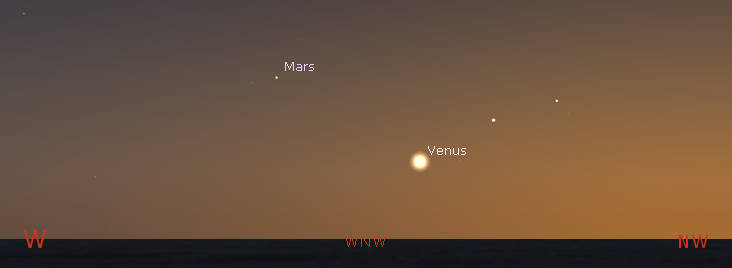
Venus and Mars in Evening twilight, seen at 10:30 pm, about an hour after sunset. Venus is about 5 1/2 degrees in altitude above a sea or lake horizon. Click on the image to enlarge. Created using Stellarium.
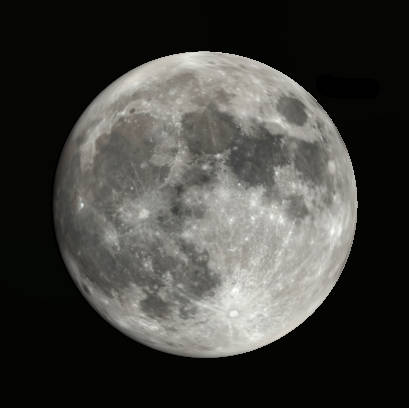
The Moon tonight at 10:30 pm, approximately 16 hours before actual full moon. Created using Stellarium.
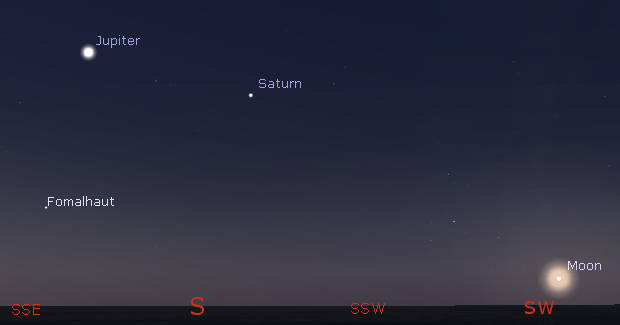
Jupiter, Saturn and the Moon tomorrow morning at 5 am, about an hour before sunrise. Click on the image to enlarge. Created using Stellarium.
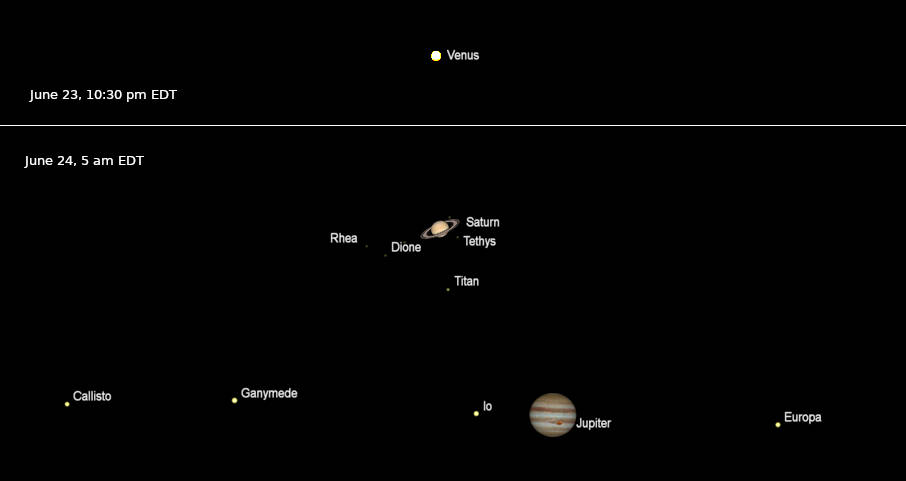
The planets as seen in a telescope (north up) with the same magnification for the night of June 23/24, 2021. Times of the display are: Venus, 10:30 pm; Saturn and Jupiter, 5 am. Apparent diameters: Venus, 10.94″; Saturn 18.16″, its rings 42.29″; Jupiter, 44.38″. Mars has an apparent diameter of only 3.91″ and is not represented. The ” symbol means seconds of arc (1/3600th of a degree.) Created using Cartes du Ciel (Sky Charts).
Planets and the Moon at sunset and sunrise of a single night, starting with sunset on the right on June 23, 2021. The night ends on the left with sunrise on the 24th. Click on the image to enlarge. Created using my LookingUp program.
06/22/2021 – Ephemeris – Mars is poised to cross in front of the Beehive Star Cluster tonight
This is Bob Moler with Ephemeris for Tuesday, June 22nd. Today the Sun will be up for 15 hours and 34 minutes, setting at 9:32, and it will rise tomorrow at 5:57. The Moon, 2 days before full, will set at 4:41 tomorrow morning.
Tonight, the planet Mars will be at the western edge of the Beehive star cluster. Tomorrow night, Mars will be seen against its stars. Normally, the Beehive star cluster is easily seen in binoculars. The problem is, that both the cluster and Mars will be low in the west-northwestern sky, only six to seven degrees above a sea or lake horizon near the optimal time to spot them of 11 pm. It has been 8 months since Mars was opposite the Sun in our skies, and relatively close to us. Back then it was as bright as Jupiter and relatively close to the Earth. Now, Mars is 221 million miles (356 million kilometers) and 5 times farther aw0ay, about half the distance to Jupiter. It’s tiny in telescopes and very hard to pick out of the dim twilight glow of 11 pm.
The astronomical event times given are for the Traverse City/Interlochen area of Michigan (EDT, UT-4). They may be different for your location.
Addendum
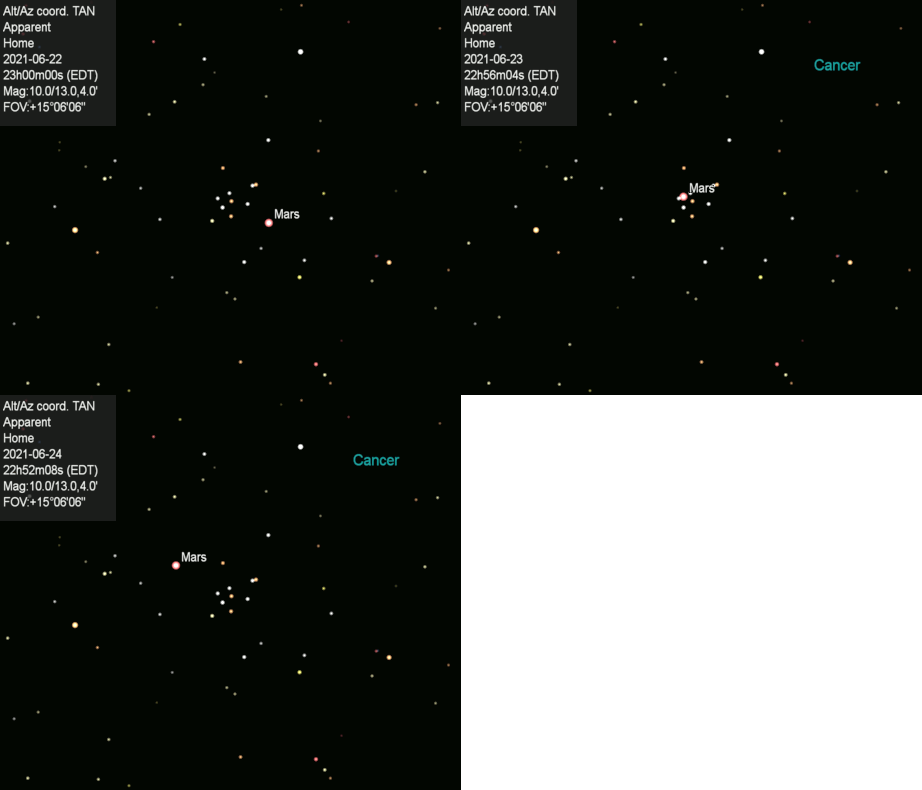
Mars passing in front of M44 as a GIF animation. This is difficult to spot with binoculars low in the west-northwest at 11 pm on the nights of June 22nd, 23rd and 24th. The Beehive star cluster is a relatively close and sparse cluster. On dark nights in early spring, the cluster looks like a fuzzy spot to the naked-eye. It reveals its true nature in binoculars. Created using Cartes du Ciel.
06/21/2021 – Ephemeris – A quick look at three of the naked-eye planets
This is Ephemeris for Monday, June 21st. Today the Sun will be up for 15 hours and 34 minutes, setting at 9:32, and it will rise tomorrow at 5:57. The Moon, 3 days before full, will set at 4:02 tomorrow morning.
I have a couple of pieces of planetary news. Venus will pass south of the star Pollux in Gemini tonight. That means in their current orientation, low on the west-northwestern horizon, that Pollux will appear above and right of the much brighter Venus. This may be visible by 10:30 pm. Venus will set tonight at 11:07. You’ll need a really low western horizon to see it. In the morning sky, Saturn is backtracking to the west slowly, and now Jupiter has stopped its eastward motion and is stationary today and will start its retrograde or westward motion. Both retrograde motions are caused by the Earth, which is in the process of passing these planets. We will pass Saturn August 2nd, and pass Jupiter August 19th. We call these events, oppositions.
The astronomical event times given are for the Traverse City/Interlochen area of Michigan (EDT, UT – 4hr). They may be different for your location.
Addendum
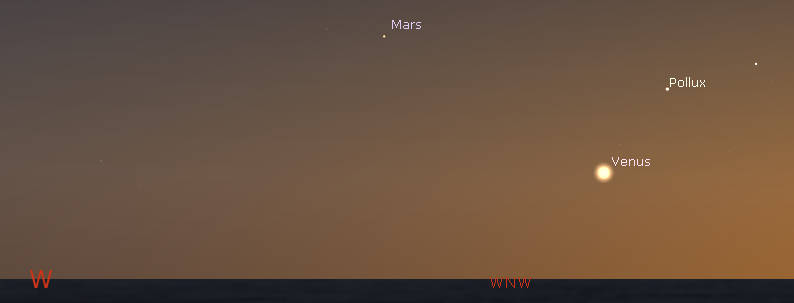
Venus, Pollux and Mars in the evening twilight tonight at 10:30 pm. Venus and Pollux in evening twilight. Venus will be about 5 degrees above the sea or lake horizon at that time. Venus and Mars will cross their apparent paths and be in conjunction on July 13th. Click on the image to enlarge. Created using Stellarium.
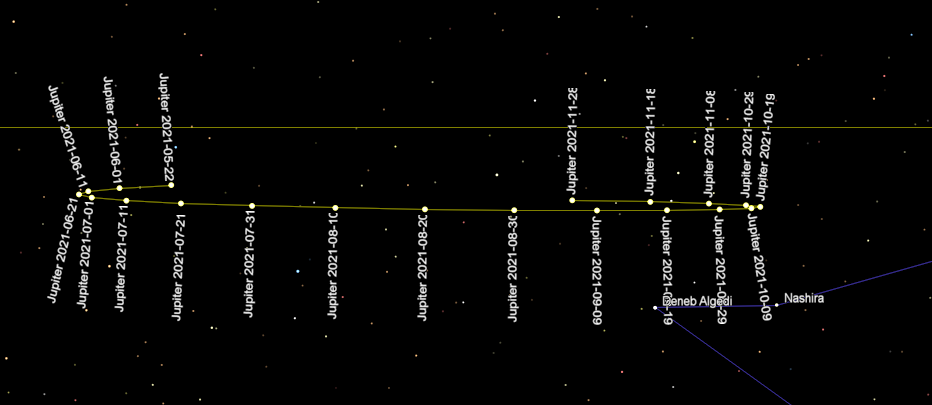
Jupiter’s retrograde path, June 21, to October 20, 2021. The constellation lines in the lower right are for the eastern end of Capricornus. We pass Jupiter, officially called opposition from the Sun, on August 20th. The solid yellow line above Jupiter’s apparent path is the Ecliptic, the Sun’s apparent path in the sky. Click on the image to enlarge. Created using Cartes du Ciel (Sky Charts).
06/18/2021 – Ephemeris – Summer* will start Sunday night
This is Bob Moler with Ephemeris for Friday, June 18th. Today the Sun will be up for 15 hours and 34 minutes, setting at 9:31, and it will rise tomorrow at 5:56. The Moon, 1 day past first quarter, will set at 2:41 tomorrow morning.
Summer is just a couple of days away, though we have already been sweltering through a very hot first half of June. Summer will officially arrive for us on Earth’s Northern Hemisphere at 11: 32 pm, June 20th. If you are south of the equator, winter will arrive. If you are listening to this on the Internet, or reading this on my blog, it’s 3:32 UT, June 21st. And to be season agnostic, it’s the June solstice. From the 20th to the December solstice, the first day of winter for we northern hemispherians, (I think that’s a word) the daylight hours will get shorter as the Sun heads south. Solstice means Sun standstill as it stops its northerly motion and will, after Sunday, head back south again. The Northern Hemisphere will still be heating up for another month.
The astronomical event times given are for the Traverse City/Interlochen area of Michigan (EDT, UT – 4hr). They may be different for your location.
* Summer in the Northern Hemisphere only. Winter starts in the Southern Hemisphere.
Addendum
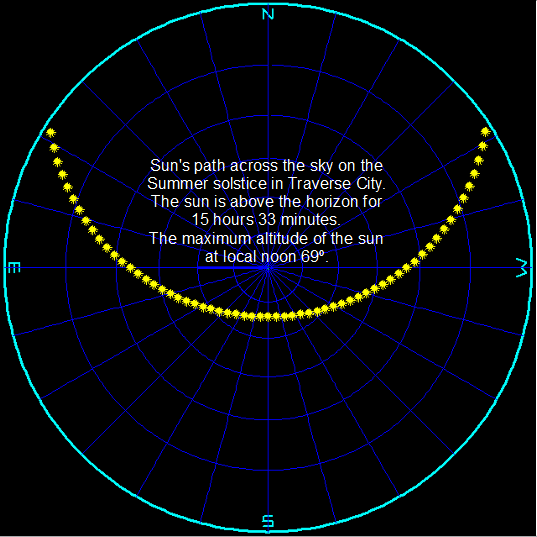
The Sun’s path through the sky on the summer solstice day from Traverse City, MI. The Sun is plotted every 15 minutes. The Sun’s motion is constant. The closeness of the Sun plots at higher altitudes is an artifact of portraying a hemispherical sky on a flat screen. It is a stereographic projection. Created using my LookingUp program.
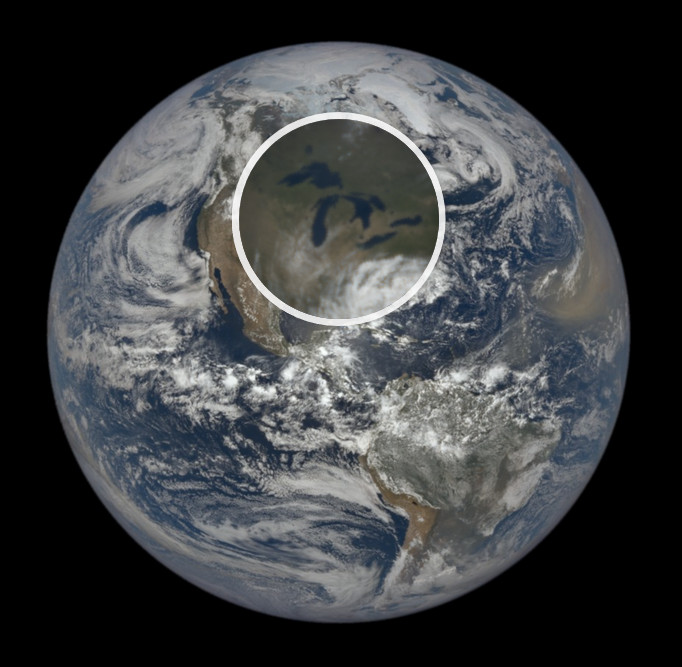
Earth and magnified local area near summer solstice. Image taken near local noon June 17, 2020. Credit NOAA DSCOVR satellite orbiting the Sun-Earth L1 point 994,970 miles (1,601,432 kilometers) sunward from the Earth.

