10/03/2019 -Ephemeris – The Moon tonight
Ephemeris for Thursday, October 3rd. Today the Sun will be up for 11 hours and 37 minutes, setting at 7:20, and it will rise tomorrow at 7:44. The Moon, 2 days before first quarter, will set at 10:46 this evening.
The planet Jupiter will appear below and right of the crescent Moon tonight. This evening one of the striking lunar craters will be seen at the sunrise line or terminator on the Moon. The crater might just be glimpsed in steadily held or tripod mounted binoculars, and definitely in a small telescope. The crater is Theophilus, some 61 miles (101 km) in diameter located south of the Sea of Tranquility. At lunar sunrise the central peak of the crater catches the Sun of the lunar sunrise way before the floor is illuminated showing a point of light within the circular crater rim against the black floor of the crater. That should happen before the Moon sets at quarter to 11 p.m. The central peak extends 650 feet (200 m) above the crater walls.
The times given are for the Traverse City/Interlochen area of Michigan. They may be different for your location.
Addendum
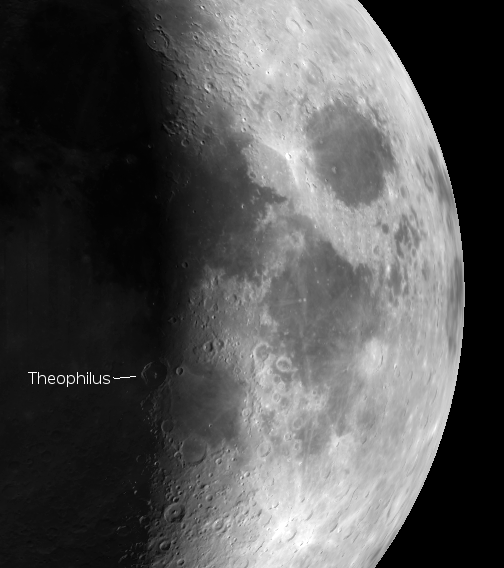
The Crater Theophilus on the Moon’s terminator at10 p.m. October 3, 2019, Created using Virtual Moon Atlas.
10/02/2019 – Ephemeris – A look at the bright planets for this week
Ephemeris for Wednesday, October 2nd. Today the Sun will be up for 11 hours and 40 minutes, setting at 7:21, and it will rise tomorrow at 7:42. The Moon, 3 days before first
quarter, will set at 10:04 this evening.
Let’s look at the bright planets for this week. Mars, Venus and Mercury are too close to the Sun to be seen. Venus and Mercury are on the evening or east side of the Sun, Mars is on the west or morning side. Bright Jupiter will be low in the southwestern sky as it gets dark. With steadily held binoculars a few of the 4 largest satellites of Jupiter can be seen. All four: Ganymede, Io and Europa on the east and Callisto far to the west of the planet can be easily spotted in telescopes this evening. Jupiter will set at 10:29 p.m. Saturn, the ringed planet, will be in the south-southwestern sky in the evening, and set at 12:24 a.m. Jupiter is approaching Saturn in our sky. They will cross paths late next year, something they do about every 20 years.
The times given are for the Traverse City/Interlochen area of Michigan. They may be different for your location.
Addendum
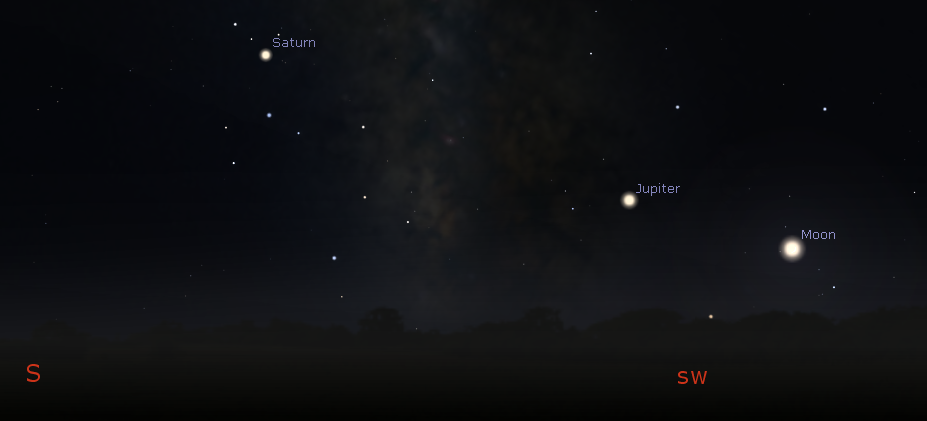
Jupiter, Saturn and the Moon at 9 p.m. October 2, 2019. Created using Stellarium.
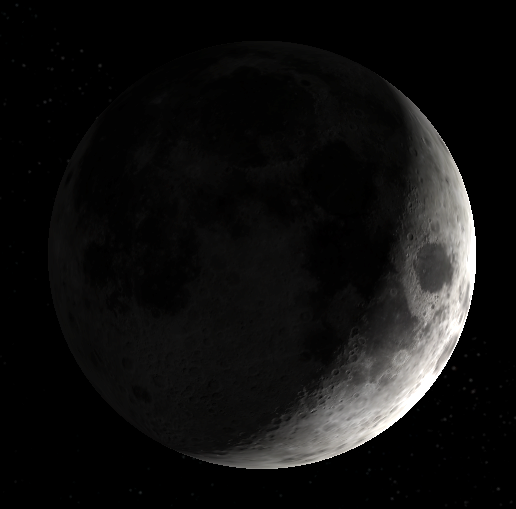
The crescent Moon as it might appear in binoculars or a small telescope tonight at 9 p.m. October 2, 2019. Created using Stellarium.
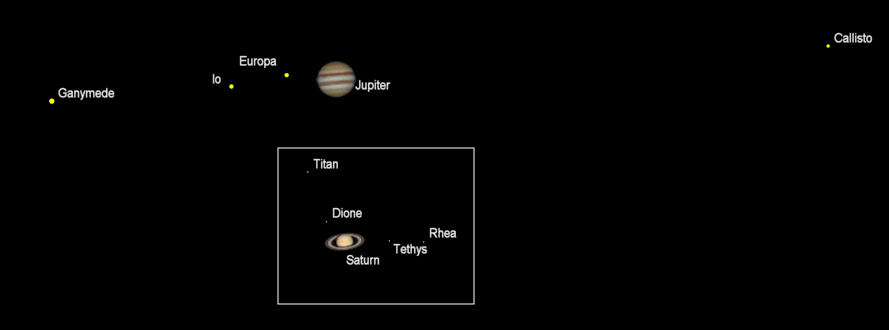
Telescopic views of Jupiter and Saturn with the same magnification at 9 p.m. October 2, 2019. Created using Cartes du Ciel (Sky Charts).
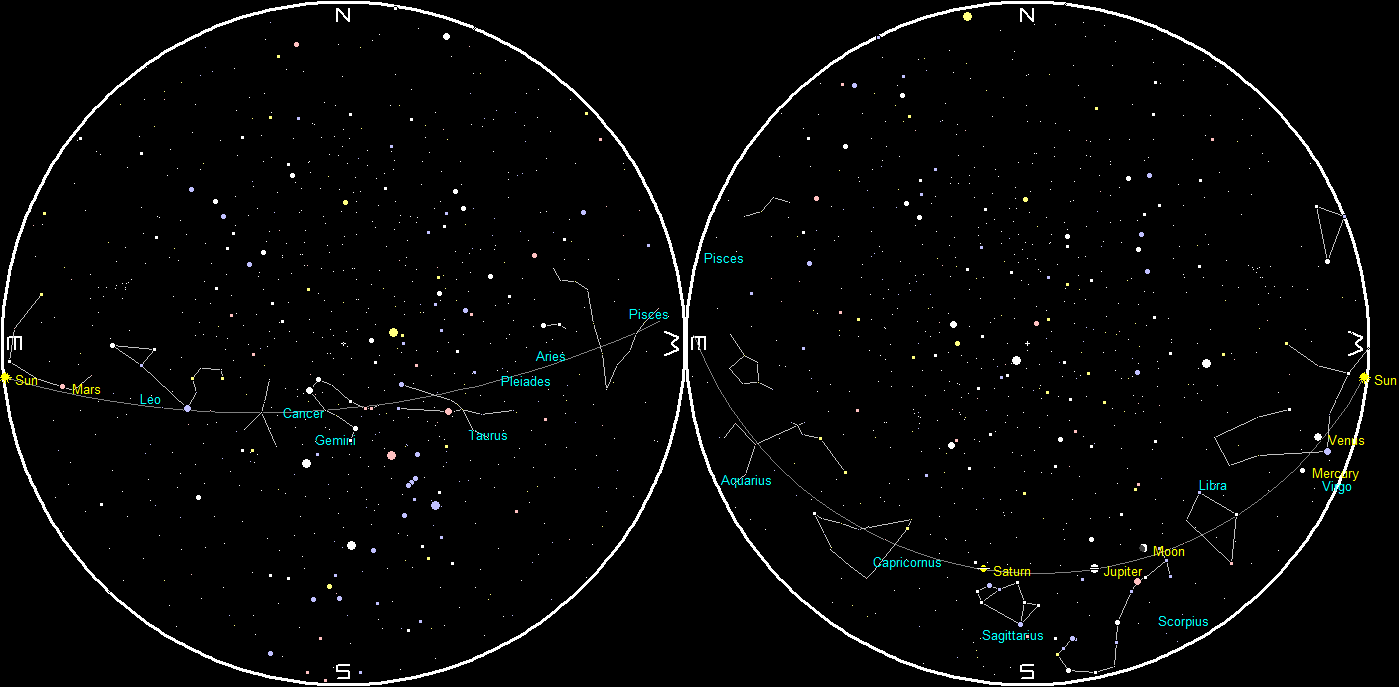
Planets and the Moon at sunset and sunrise of a single night starting with sunset on the right on October 2, 2019. The night ends on the left with sunrise on the 3rd. Click on the image to enlarge. Created using my LookingUp program.
10-01-2019 – Ephemeris – Previewing October skies
Ephemeris for Tuesday, October 1st. Today the Sun will be up for 11 hours and 43 minutes, setting at 7:23, and it will rise tomorrow at 7:41. The Moon, 3 days past new, will set at 9:28 this evening.
Let’s look at the skies for the month of October. The sun will still be moving south rapidly. Daylight hours in the Interlochen/Traverse City area will drop from 11 hours and 43 minutes today to 10 hours 14 minutes on the 31st. The altitude of the Sun above the southern horizon at local noon will be 42 degrees today, and will descend to 31 degrees on Halloween, also in the Interlochen area. The Straits area will have the Sun a degree lower. Local noon, when the Sun is due south will be about 1:30 p.m. in Interlochen. The planets Saturn and Jupiter will appear low in the southwest in the early evening, and Venus just might be visible low in the west-southwest a half hour after sunset by month’s end.
The times given are for the Traverse City/Interlochen area of Michigan. They may be different for your location.
Addendum
October Evening Star Chart
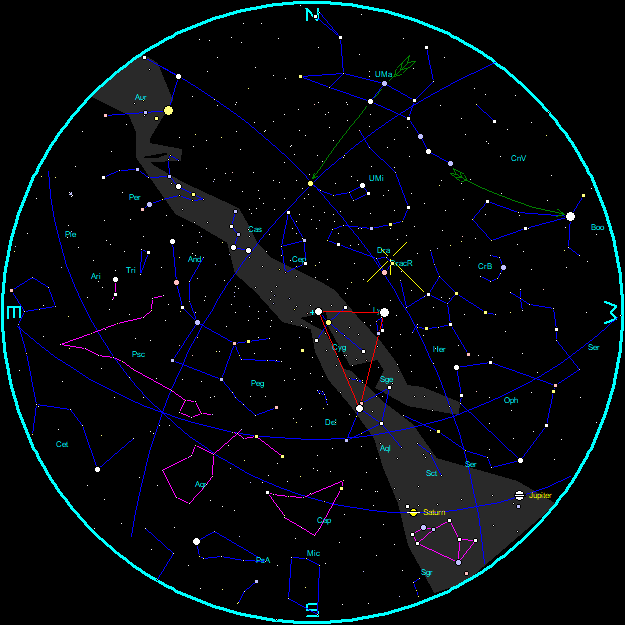
Star Chart for October 2019 (9 p.m. EDT October 15, 2019). Click on image to enlarge.Created using my LookingUp program. Click on image to enlarge.
The planets and stars are plotted for the 15th at 9 p.m. EDT in the evening and 6 a.m. for the morning chart. These are the chart times. Note that Traverse City is located approximately 45 minutes behind our time meridian, West 75° longitude. (An hour 45 minutes behind our daylight saving time meridian during EDT). To duplicate the star positions on a planisphere you may have to set it to 1 hour 45 minutes earlier than the current time.
October Morning Star Chart
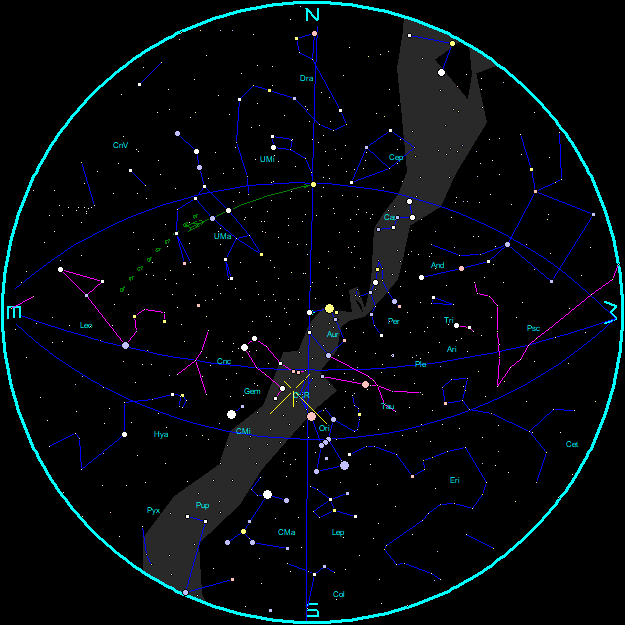
Star Chart for October mornings 2019 (6 a.m. EDT October 15, 2019). Click on image to enlarge. Created using my LookingUp program.
For a list of constellation names to go with the abbreviations click here.
- Pointer stars at the front of the bowl of the Big Dipper point to Polaris the North Star.
- Leaky dipper drips on Leo.
- Follow the arc of the handle of the Big Dipper to the star Arcturus.
- The Summer Triangle is in red.
- DracR – Draconid Radiant – Peak 9th – Zenithal Hourly Rate = 10
- OriR – Orionid Radiant – Peak 22nd – Zenithal Hourly Rate = 20
Twilight Limits, Nautical and Astronomical
| EDT | |||||||
| Traverse City |
Morning twilight | Evening twilight | Dark night | Moon | |||
| Date | Astro. | Nautical | Nautical | Astro. | Start | End | Illum. |
| 2019-10-01 | 6h08m | 6h42m | 20h30m | 21h04m | 21h28m | 6h08m | 0.13 |
| 2019-10-02 | 6h09m | 6h44m | 20h28m | 21h02m | 22h04m | 6h09m | 0.22 |
| 2019-10-03 | 6h11m | 6h45m | 20h26m | 21h00m | 22h46m | 6h11m | 0.32 |
| 2019-10-04 | 6h12m | 6h46m | 20h24m | 20h58m | 23h33m | 6h12m | 0.43 |
| 2019-10-05 | 6h13m | 6h47m | 20h22m | 20h56m | – | 6h13m | 0.53 |
| 2019-10-06 | 6h15m | 6h49m | 20h20m | 20h54m | 0h25m | 6h15m | 0.63 |
| 2019-10-07 | 6h16m | 6h50m | 20h19m | 20h53m | 1h22m | 6h16m | 0.73 |
| 2019-10-08 | 6h17m | 6h51m | 20h17m | 20h51m | 2h21m | 6h17m | 0.81 |
| 2019-10-09 | 6h18m | 6h52m | 20h15m | 20h49m | 3h21m | 6h18m | 0.88 |
| 2019-10-10 | 6h20m | 6h53m | 20h13m | 20h47m | 4h22m | 6h20m | 0.93 |
| 2019-10-11 | 6h21m | 6h55m | 20h12m | 20h45m | 5h23m | 6h21m | 0.93 |
| 2019-10-12 | 6h22m | 6h56m | 20h10m | 20h44m | – | – | 0.97 |
| 2019-10-13 | 6h23m | 6h57m | 20h08m | 20h42m | – | – | 1 |
| 2019-10-14 | 6h25m | 6h58m | 20h06m | 20h40m | – | – | 1 |
| 2019-10-15 | 6h26m | 7h00m | 20h05m | 20h38m | – | – | 0.98 |
| 2019-10-16 | 6h27m | 7h01m | 20h03m | 20h37m | 20h37m | 20h44m | 0.94 |
| 2019-10-17 | 6h28m | 7h02m | 20h01m | 20h35m | 20h35m | 21h18m | 0.89 |
| 2019-10-18 | 6h29m | 7h03m | 20h00m | 20h34m | 20h34m | 21h59m | 0.81 |
| 2019-10-19 | 6h31m | 7h04m | 19h58m | 20h32m | 20h32m | 22h49m | 0.72 |
| 2019-10-20 | 6h32m | 7h06m | 19h57m | 20h30m | 20h30m | 23h48m | 0.62 |
| 2019-10-21 | 6h33m | 7h07m | 19h55m | 20h29m | 20h29m | – | 0.5 |
| 2019-10-22 | 6h34m | 7h08m | 19h54m | 20h27m | 20h27m | 0h55m | 0.39 |
| 2019-10-23 | 6h36m | 7h09m | 19h52m | 20h26m | 20h26m | 2h08m | 0.28 |
| 2019-10-24 | 6h37m | 7h11m | 19h51m | 20h24m | 20h24m | 3h24m | 0.17 |
| 2019-10-25 | 6h38m | 7h12m | 19h49m | 20h23m | 20h23m | 4h42m | 0.09 |
| 2019-10-26 | 6h39m | 7h13m | 19h48m | 20h21m | 20h21m | 6h00m | 0.03 |
| 2019-10-27 | 6h40m | 7h14m | 19h46m | 20h20m | 20h20m | 6h40m | 0 |
| 2019-10-28 | 6h42m | 7h15m | 19h45m | 20h19m | 20h19m | 6h42m | 0 |
| 2019-10-29 | 6h43m | 7h17m | 19h43m | 20h17m | 20h17m | 6h43m | 0.04 |
| 2019-10-30 | 6h44m | 7h18m | 19h42m | 20h16m | 20h36m | 6h44m | 0.09 |
| 2019-10-31 | 6h45m | 7h19m | 19h41m | 20h15m | 21h22m | 6h45m | 0.17 |
Twilight calendar was generated using Cartes du Ciel (Sky Charts).
See my blog post: Twilight Zone for the definitions of the different periods of twilight here: https://bobmoler.wordpress.com/2018/09/27/.
NASA Calendar of Planetary Events
     Date   Time   Event
Oct  1 Tu          Venus: 13.1° E
     3 Th  4:23 pm Moon-Jupiter: 2° S
     5 Sa 12:01 pm Moon South Dec.: 22.8° S
     5 Sa 12:47 pm First Quarter
     5 Sa  2:49 pm Moon Descending Node
     5 Sa  4:48 pm Moon-Saturn: 0.3° N
    10 Th  2:29 pm Moon Apogee: 405900 km
    13 Su  5:08 pm Full Moon
    19 Sa 11:59 pm Mercury Elongation: 24.6° E
    20 Su  3:28 am Moon Ascending Node
    20 Su  4:07 am Moon North Dec.: 22.9° N
    21 Mo  8:39 am Last Quarter
    21 Mo  7:12 pm Orionid Shower: ZHR = 20
    22 Tu 12:41 am Moon-Beehive: 0.7° S
    26 Sa  6:41 am Moon Perigee: 361300 km
    27 Su 10:38 pm New Moon
    28 Mo  3:17 am Uranus Opposition
    29 Tu  8:33 am Moon-Venus: 4° S
    30 We 11:22 pm Mercury-Venus: 2.5° N
    31 Th  9:22 am Moon-Jupiter: 1.4° S
Nov  1 Fr          Venus: 20.8° E
All event times are given for UTC-4 hr: Eastern Daylight Saving Time.
Sky Events Calendar by Fred Espenak and Sumit Dutta (NASA’s GSFC),
http://eclipse.gsfc.nasa.gov/SKYCAL/SKYCAL.html.
If you go to the above site you can print out a list like the above for the entire year or calendar pages for your time zone.
Sun and Moon Rising and Setting Events
     LU                  Ephemeris of Sky Events for Interlochen/TC
     October, 2019    Local time zone: EDT
     +-----------------------------------------------------------------------+
     | DATE |  SUN     SUN  DAYLIGHT|   TWILIGHT*    |MOON  RISE OR    ILLUM |
     |      |  RISE    SET    HOURS |  END    START  |PHASE SET** TIME FRACTN|
     +=======================================================================+
     |Tue  1| 07:40a  07:23p  11:43 | 08:26p  06:37a |      Set  09:28p   14%|
     |Wed  2| 07:41a  07:21p  11:40 | 08:24p  06:38a |      Set  10:04p   23%|
     |Thu  3| 07:42a  07:20p  11:37 | 08:22p  06:39a |      Set  10:46p   33%|
     |Fri  4| 07:44a  07:18p  11:34 | 08:21p  06:41a |      Set  11:33p   43%|
     |Sat  5| 07:45a  07:16p  11:30 | 08:19p  06:42a |F Qtr Set  12:25a   53%|
     +------+-----------------------+----------------+-----------------------+
     |Sun  6| 07:46a  07:14p  11:27 | 08:17p  06:43a |      Set  01:21a   63%|
     |Mon  7| 07:47a  07:12p  11:24 | 08:15p  06:44a |      Set  02:21a   72%|
     |Tue  8| 07:49a  07:10p  11:21 | 08:13p  06:46a |      Set  03:21a   80%|
     |Wed  9| 07:50a  07:09p  11:18 | 08:12p  06:47a |      Set  04:22a   87%|
     |Thu 10| 07:51a  07:07p  11:15 | 08:10p  06:48a |      Set  05:23a   92%|
     |Fri 11| 07:52a  07:05p  11:12 | 08:08p  06:49a |      Set  06:24a   97%|
     |Sat 12| 07:54a  07:03p  11:09 | 08:06p  06:50a |      Set  07:25a   99%|
     +------+-----------------------+----------------+-----------------------+
     |Sun 13| 07:55a  07:02p  11:06 | 08:05p  06:52a |Full  Rise 07:25p  100%|
     |Mon 14| 07:56a  07:00p  11:03 | 08:03p  06:53a |      Rise 07:49p   99%|
     |Tue 15| 07:57a  06:58p  11:00 | 08:01p  06:54a |      Rise 08:14p   96%|
     |Wed 16| 07:59a  06:56p  10:57 | 08:00p  06:55a |      Rise 08:44p   91%|
     |Thu 17| 08:00a  06:55p  10:54 | 07:58p  06:57a |      Rise 09:18p   84%|
     |Fri 18| 08:01a  06:53p  10:51 | 07:56p  06:58a |      Rise 09:59p   76%|
     |Sat 19| 08:03a  06:51p  10:48 | 07:55p  06:59a |      Rise 10:49p   66%|
     +------+-----------------------+----------------+-----------------------+
     |Sun 20| 08:04a  06:50p  10:45 | 07:53p  07:00a |      Rise 11:48p   56%|
     |Mon 21| 08:05a  06:48p  10:42 | 07:52p  07:02a |L Qtr Rise 12:55a   45%|
     |Tue 22| 08:07a  06:46p  10:39 | 07:50p  07:03a |      Rise 02:08a   34%|
     |Wed 23| 08:08a  06:45p  10:36 | 07:49p  07:04a |      Rise 03:24a   23%|
     |Thu 24| 08:09a  06:43p  10:33 | 07:47p  07:05a |      Rise 04:41a   14%|
     |Fri 25| 08:11a  06:42p  10:31 | 07:46p  07:06a |      Rise 06:00a    7%|
     |Sat 26| 08:12a  06:40p  10:28 | 07:44p  07:08a |      Rise 07:18a    2%|
     +------+-----------------------+----------------+-----------------------+
     |Sun 27| 08:13a  06:39p  10:25 | 07:43p  07:09a |New   Set  06:51p    0%|
     |Mon 28| 08:15a  06:37p  10:22 | 07:41p  07:10a |      Set  07:22p    1%|
     |Tue 29| 08:16a  06:36p  10:19 | 07:40p  07:11a |      Set  07:57p    5%|
     |Wed 30| 08:17a  06:34p  10:16 | 07:39p  07:13a |      Set  08:36p   11%|
     |Thu 31| 08:19a  06:33p  10:14 | 07:37p  07:14a |      Set  09:22p   18%|
     +-----------------------------------------------------------------------+
     * Nautical Twilight
     ** Moonrise or moonset, whichever occurs between sunrise and sunset
Generated using my LookingUp for DOS program.
09/30/2019 – Ephemeris – Autumn Stars talk tonight
Ephemeris for Monday, September 30th. Today the Sun will be up for 11 hours and 46 minutes, setting at 7:25, and it will rise tomorrow at 7:40. The Moon, 2 days past new, will set at 8:55 this evening.
I will be giving a presentation Autumn Stars, Galaxies Myths, and Stories tonight at the Woodmere Avenue branch of the Traverse Area District Library at 7 p.m. Afterward if it’s clear members of the Grand Traverse Astronomical Society will bring their telescopes out to view Jupiter and Saturn. In the autumn season we lose the southern part of the Milky Way in the southwest, but there are number of of constellations that tell a famous story, that’s even made it to the cinema twice in recent years. There’s a star that evilly winks at us, and a huge galaxy the is visible to the naked eye that will crash into our Milky Way galaxy in the far future. Also the Native Americans around here have a constellation that paints the fall colors.
The times given are for the Traverse City/Interlochen area of Michigan. They may be different for your location.
Addendum

09/27/2019 – Ephemeris – Apollo 50th anniversary talk tonight in Thompsonville
Ephemeris for Friday, September 27th. Today the Sun will be up for 11 hours and 55 minutes, setting at 7:31, and it will rise tomorrow at 7:36. The Moon, 1 day before new, will rise at 7:09 tomorrow morning.
Tonight to commemorate the 50th anniversary the Apollo 11 landing on the Moon, I will present the illustrated talk Apollo and the Race to the Moon at 7 p.m. at the Betsie Valley District Library in Thompsonville. Afterwards, if it’s clear, members of the Grand Traverse Astronomical Society will host a star party featuring Saturn and Jupiter and some of the brighter deep sky objects. In the talk I’ll explore the Apollo 11 mission, the engineers, astronauts and all the crewed and robotic missions that paved the way for the successful lunar landings. I’ll also look at the Soviet space program their triumphs, plans, and ultimate failure to beat the Americans to the Moon.
The times given are for the Traverse City/Interlochen area of Michigan. They may be different for your location.
Addendum

Apollo and the Race to the Moon Title slide
09/26/2019 – Ephemeris – Looking for Andromeda
Ephemeris for Thursday, September 26th. Today the Sun will be up for 11 hours and 58 minutes, setting at 7:33, and it will rise tomorrow at 7:35. The Moon, 2 days before new, will rise at 5:49 tomorrow morning.
In the east at 9 this evening can be found a large square of stars, the Great Square of Pegasus the flying horse. The square is standing on one corner. What look like its hind legs stretching to the left from the left corner star is another constellation, Andromeda the chained maiden. She is seen in the sky as two diverging curved strings of stars that curve upward. She was rescued by the hero Perseus, a nearby constellation, riding his steed Pegasus. Andromeda’s claim to astronomical fame is the large galaxy seen with the unaided eye just above the upper line of stars, the Great Andromeda Galaxy, about 2 and a half million light years away. To the unaided eye the galaxy appears as a small smudge of light. In binoculars the galaxy is a delicate spindle of light.
The times given are for the Traverse City/Interlochen area of Michigan. They may be different for your location.
Addendum
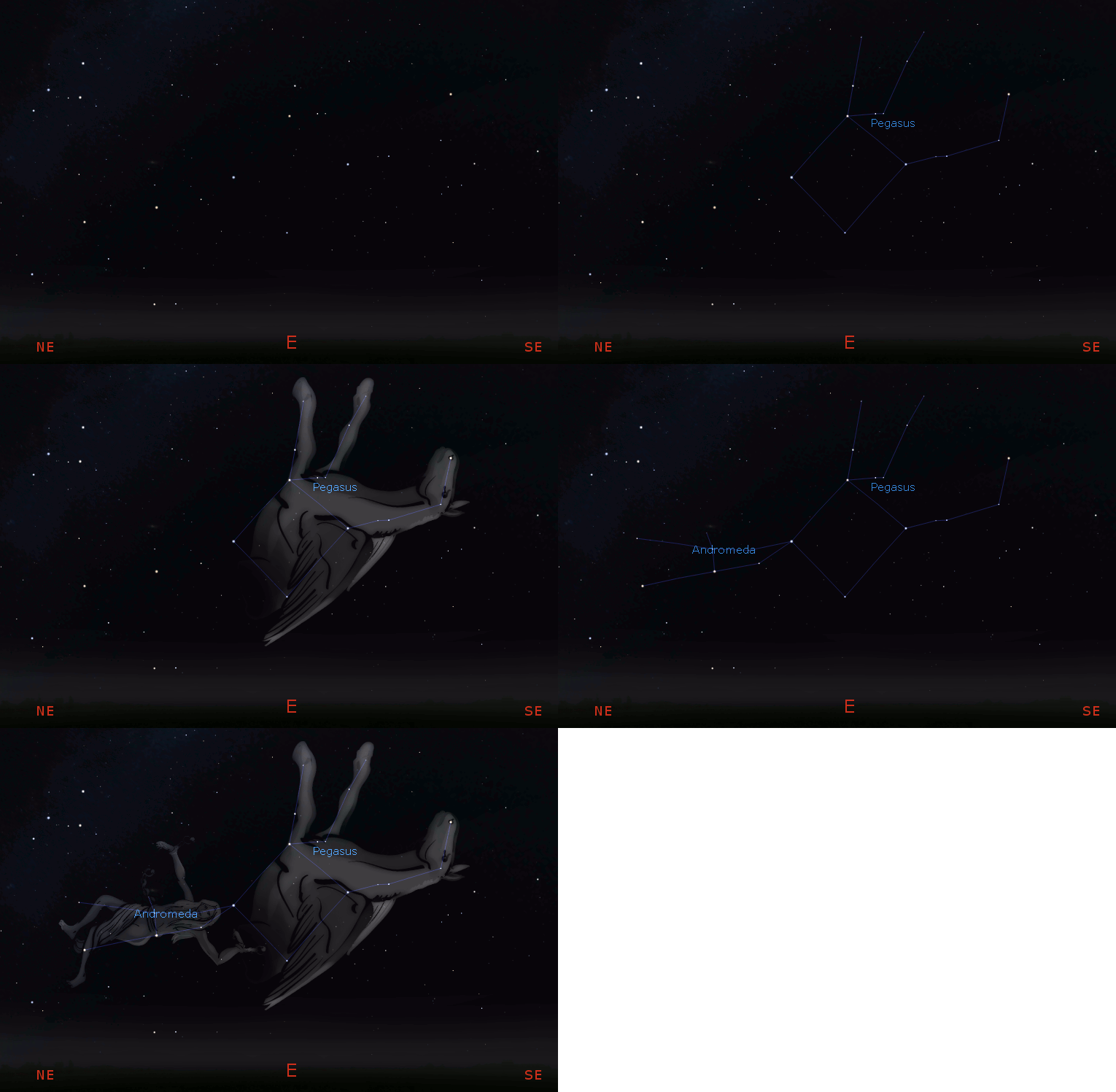
Pegasus & Andromeda animated finder chart for 9 p.m. in late September. Created using Stellarium and GIMP.
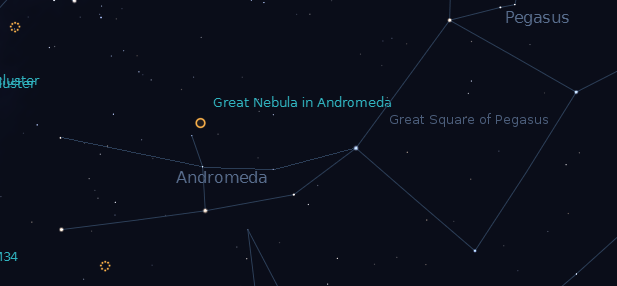
Andromeda at 9 p.m. with the Great Andromeda Galaxy. Created using Stellarium.
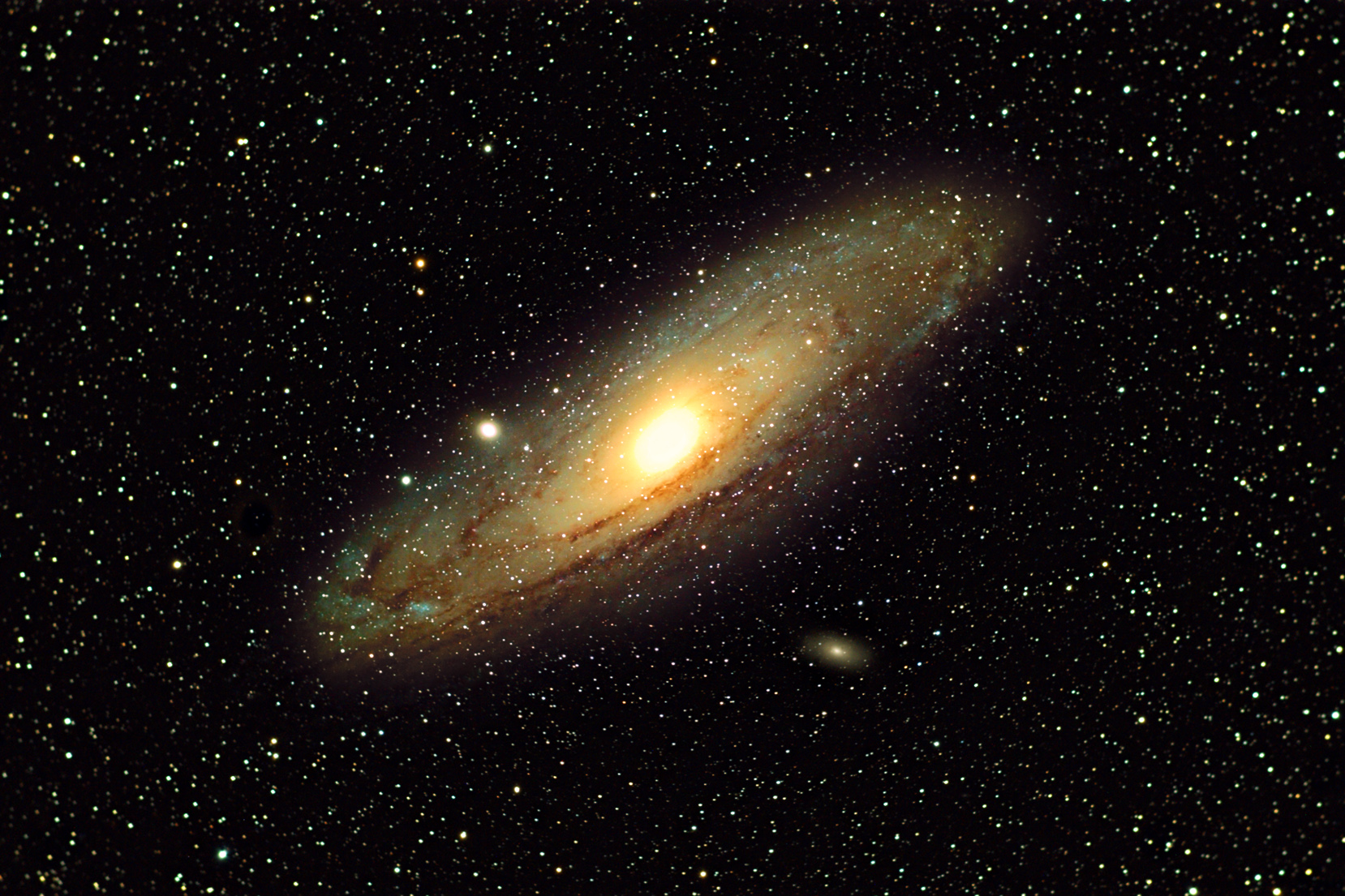
The Great Andromeda Galaxy (M31). Image taken by Scott Anttila.
09/25/2019 – Ephemeris – Where are all the bright planets?
Ephemeris for Wednesday, September 25th. Today the Sun will be up for 12 hours and 1 minute, setting at 7:34 p.m., and it will rise tomorrow at 7:34 a.m. The Moon, 3 days before new, will rise at 4:30 tomorrow morning.
Let’s look at the planets for this week. Mars, Venus and Mercury are too close to the Sun to be seen. Venus and Mercury are on the evening or east side of the Sun, Mars is on the west or morning side. Bright Jupiter will be low in the southwestern sky as it gets dark. With steadily held binoculars a few of the 4 largest satellites of Jupiter can be seen. Three of the four Jupiter’s Galilean satellites can be easily spotted in telescopes this evening. The moon Europa will be transiting across the face of the planet. Jupiter will set at 10:53 p.m. Saturn, the ringed planet, will be in the southern sky in the evening. It will pass the meridian, due south at 8:25 p.m. and will set at 12:51 a.m.
The times given are for the Traverse City/Interlochen area of Michigan. They may be different for your location.
Addendum
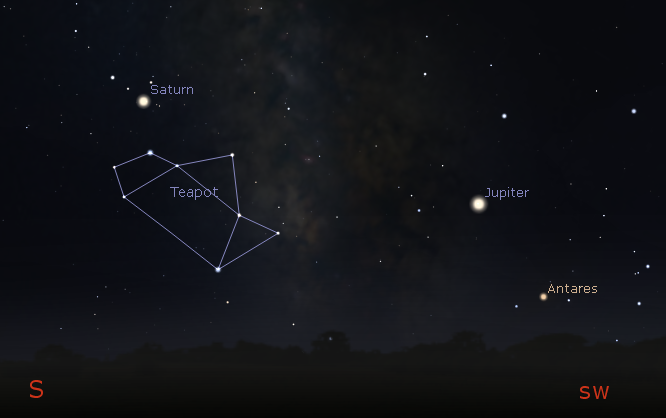
Jupiter and Saturn with the Teapot asterism of Sagittarius of the southern sky at 9 p.m. September 25, 2019. Created using Stellarium.
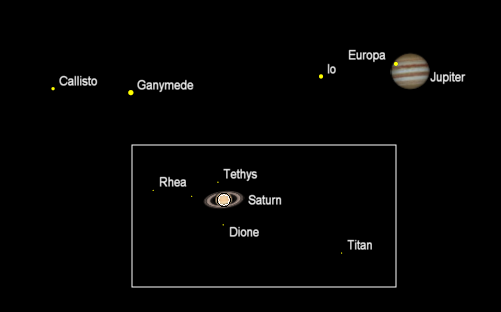
Telescopic views of Jupiter and Saturn with the same magnification at 9 p.m. September 25, 2019. Created using Cartes du Ciel (Sky Charts).
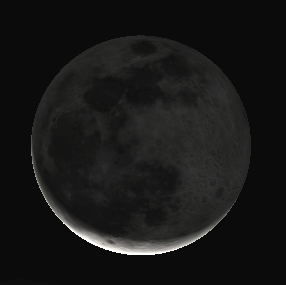
The waning crescent Moon at 6 a.m. September 26, 2019. Created using Stellarium.
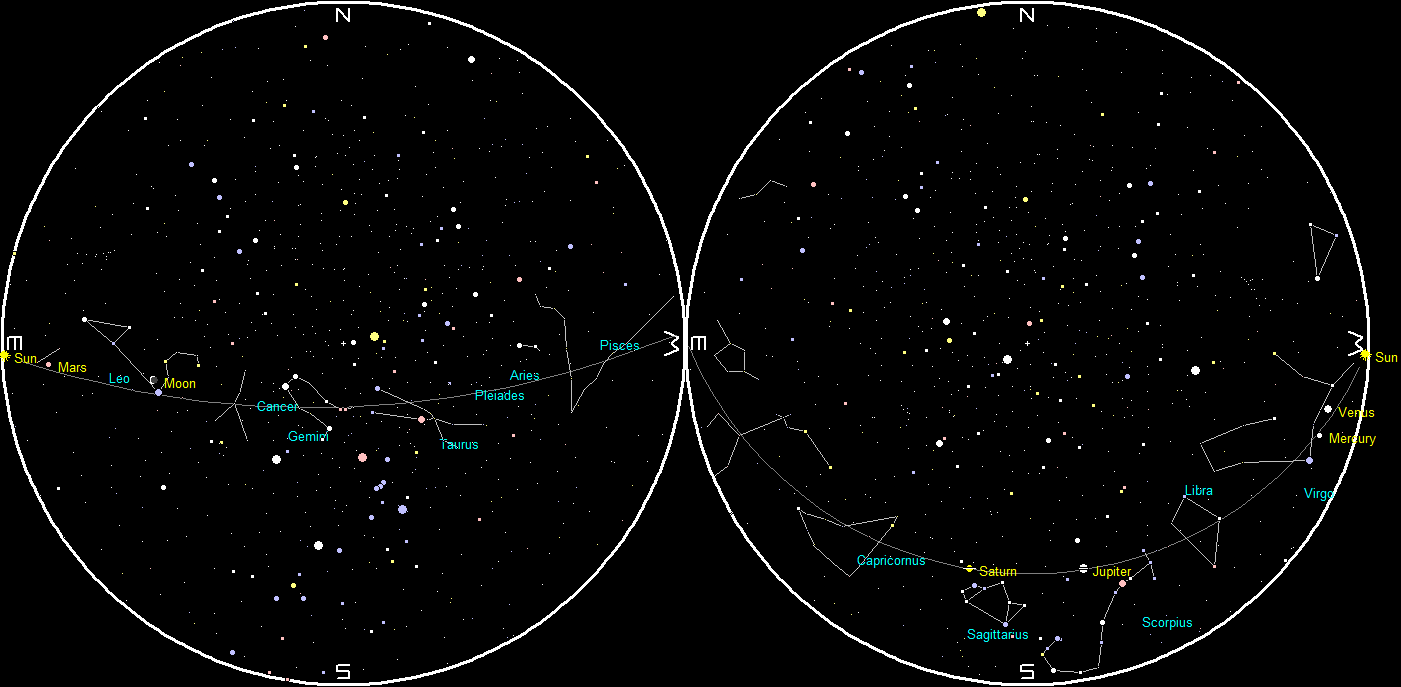
Planets and the Moon at sunset and sunrise of a single night starting with sunset on the right on September 25, 2019. The night ends on the left with sunrise on the 26th. Click on the image to enlarge. Created using my LookingUp program.
09/24/2019 – Ephemeris – Cassiopeia the “W” shaped constellation
Ephemeris for Tuesday, September 24th. Today the Sun will be up for 12 hours and 4 minutes, setting at 7:36, and it will rise tomorrow at 7:33. The Moon, 3 days past last quarter, will rise at 3:13 tomorrow morning.
The stars of the autumn skies slowly are replacing the summer stars from the east. Look in the northeastern sky by 9 p.m. and you can find the W shaped constellation of Cassiopeia the queen. Cassiopeia is so far north that it never sets for us in Michigan. It is opposite the pole star Polaris from the Big Dipper. There’s a dim star that appears above the middle star of the W which turns the W into a very crooked backed chair. Cassiopeia, in Greek mythology, represents a queen of ancient Ethiopia, the W represents the profile of her throne. She enters in to the great autumn story whose other characters are also seen in the stars as the constellations Andromeda, Pegasus, Perseus, Cetus and her husband Cepheus.
For my retelling of the Greek myth that links these autumn constellations click here.
The times given are for the Traverse City/Interlochen area of Michigan. They may be different for your location.
Addendum
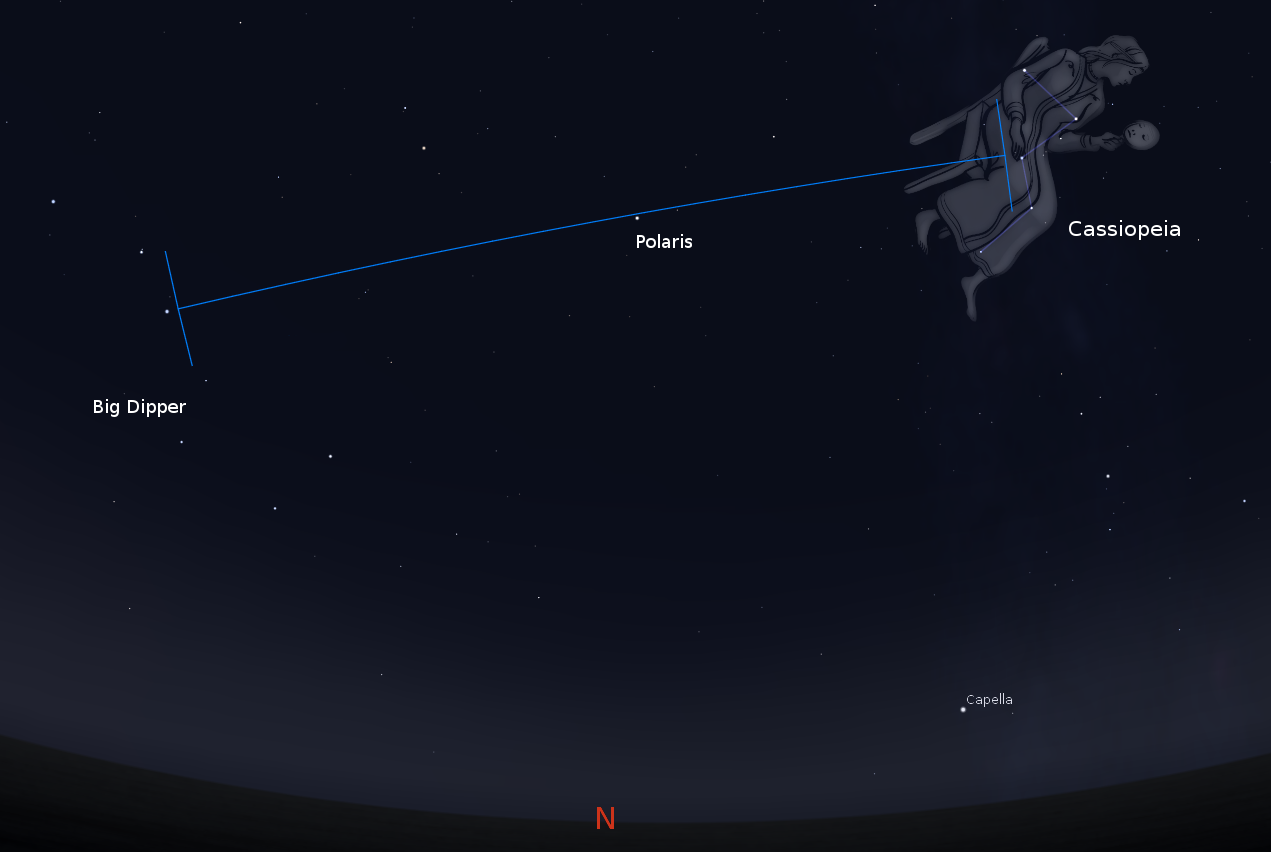
Cassiopeia, in the northeast is opposite Polaris from the Big Dipper. For 9 p.m. in late September. Created using Stellarium. Artistic credit: Johan Meuris.
09/23/2019 – Ephemeris – Fall has fallen upon us
Ephemeris for Monday, September 23rd. Today the Sun will be up for 12 hours and 7 minutes, setting at 7:38, and it will rise tomorrow at 7:32. The Moon, 2 days past last quarter, will rise at 2:01 tomorrow morning.
Fall has, well… fallen upon us and in a few weeks so will the leaves. At 3:49 (7:49 UT) this morning the Sun crossed overhead at the Earth’s equator heading south. At that same time the Sun theoretically set at the north pole and rose at the south pole. The day is called the autumnal equinox and the daylight hours today is 12 hours and 7 minutes instead of 12 hours exactly. That’s due to our atmosphere and our definition of sunrise and sunset. The reason for the cooler weather for us north of the equator now and the cold weather this winter is that the length of daylight is shortening, and the Sun rides lower in the sky, spreading its heat over a larger area, thus diluting its intensity.
The times given are for the Traverse City/Interlochen area of Michigan. They may be different for your location.
Addendum
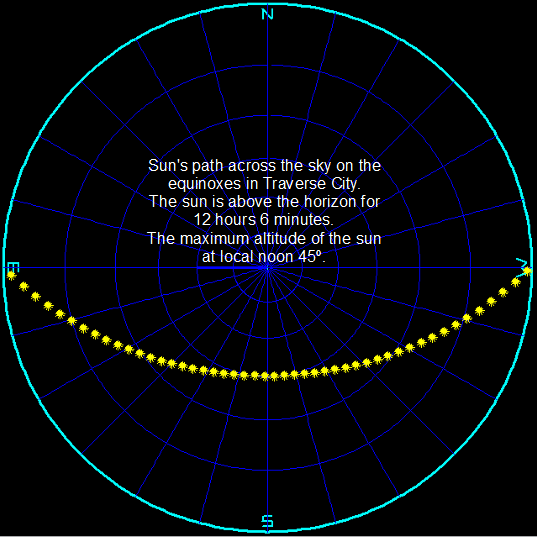
The Sun’s path through the sky on the equinox day from Traverse City, MI. Created using my LookingUp program.

That is not a pumpkin on the head of the motorcyclist. That’s the Sun rising as I’m traveling east on South Airport Road south of Traverse City Mi. on the autumnal equinox. This is the east-west section of the road. The Sun is rising over the hills some 6 miles to the east. Credit: Bob Moler.
09/20/2019 – Ephemeris – Two local astronomy events this weekend
Ephemeris for Friday, September 20th. Today the Sun will be up for 12 hours and 17 minutes, setting at 7:44, and it will rise tomorrow at 7:28. The Moon, 1 day before last quarter, will rise at 11:19 this evening.
There are two local astronomical events tomorrow. The Leland Heritage Celebration will take place from 10 a.m. to 4 p.m. at Fishtown in Leland. The Grand Traverse Astronomical Society will be there to show the Sun through member’s telescopes, maybe spot the Moon plus give out NASA items for the kids. That evening from 9 to 11 p.m. members of the society will move to the Sleeping Bear Dunes National Lakeshore’s Dune Climb for this month’s star party featuring the planets Jupiter and Saturn and the wonders of the summer Milky Way. Rain will affect the Leland event, and heavy overcast will affect the Dunes event. Last month’s Dune event appeared earlier in the day to be clouded out, but it did clear up later on.
The times given are for the Traverse City/Interlochen area of Michigan. They may be different for your location.
Addendum
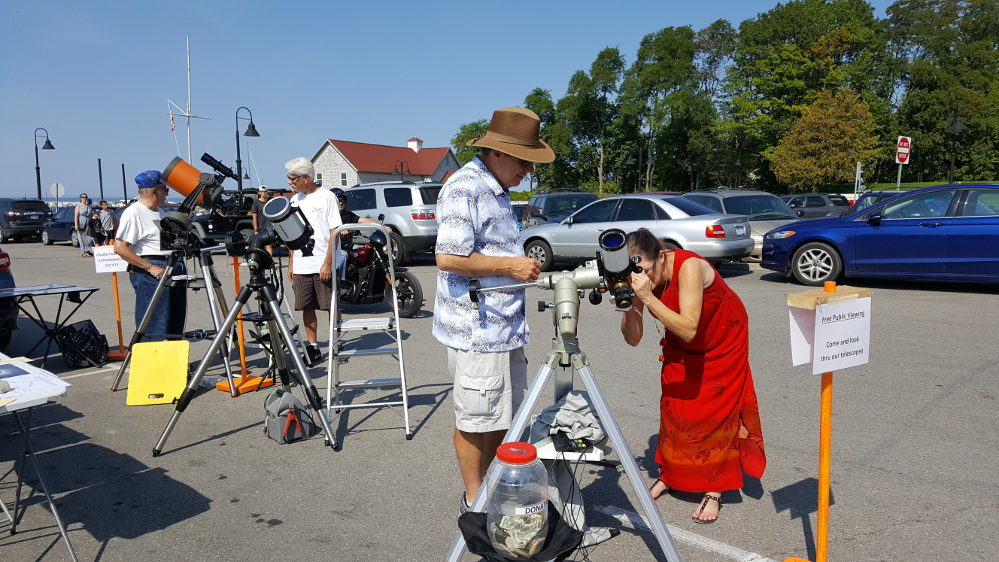
Don Flegel, in the foreground, with the society’s solar telescope assisting a person viewing the Sun at he Leland Heritage Festival 2017 at Fishtown. Don Flegel, in the foreground, with the society’s solar telescope assisting a person viewing the Sun at he Leland Heritage Festival 2017 at Fishtown. Man in the background in the blue cap is Gary Carlisle. Telescope in the middle is mine.
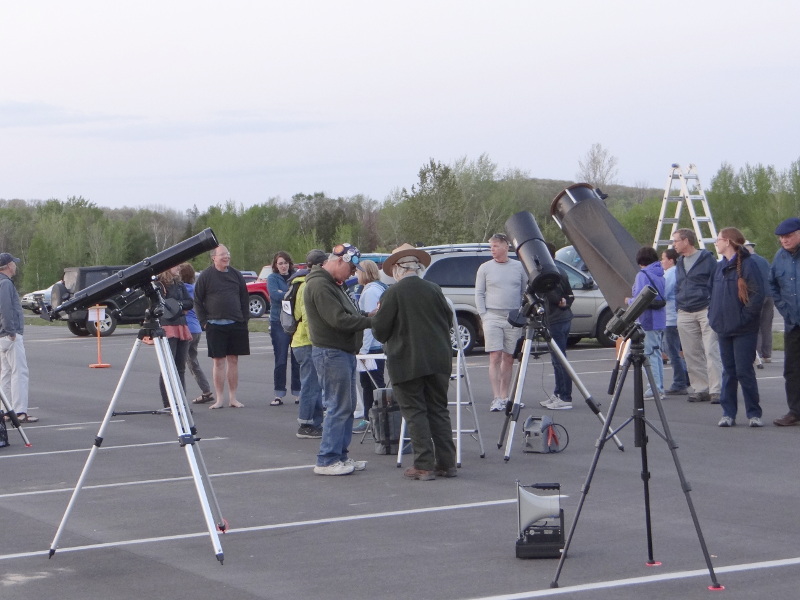
Preparing to start the May star party 3 years ago at the Dune Climb. A few of the telescopes are visible including the GTAS 25″ “Emmettron” telescope at the far right. Credit: Eileen Carlisle.
 Bob Moler's Ephemeris Blog