Archive
11/04/2014 – Ephemeris – Last week was a bad one for commercial space
Ephemeris for Election Day, Tuesday, November 4th. The sun will rise at 7:24. It’ll be up for 10 hours and 3 minutes, setting at 5:27. The moon, 2 days before full, will set at 5:46 tomorrow morning.
Last week was not a happy one for commercial space companies. First, last Tuesday the Orbital Science’s Antares blew up (or in space-talk: “Suffered an anomaly”) attempting to deliver it’s third contracted commercial cargo to the International Space Station. No one was killed because it was an unmanned rocket and the spectators were kept at a safe distance. Then on Friday an anomaly occurred during a test flight of Virgin Galactic’s SpaceShipTwo. In that mishap the co-pilot, Michael Alsbury, was killed. “Space is hard.” was the phrase heard quite often last week. And it’s true. I’ve found that the natural state of any mechanism is not to work. The more complicated the device is, like a rocket, the harder it is to get it to work.
Times are for the Traverse City/Interlochen area of Michigan. They may be different for your location.
Addendum

The initial signs that the Antares rocket was in trouble. Credit: Parabolic Arc.

A sequence of photos of the flight and breakup of SpaceShipTwo. Credit: Kenneth Brown/Reuters.
10/01/2014 – Ephemeris – Let’s start off the month with a look at the bright planets
Ephemeris for Wednesday, October 1st. The sun will rise at 7:40. It’ll be up for 11 hours and 42 minutes, setting at 7:23. The moon, at first quarter today, will set at 12:43 tomorrow morning.
Let’s check out the bright planets for this week. Mars and Saturn are in the southwestern sky at 8:30 p.m. with Mars above the equally bright and red star Antares with Saturn a ways right of them and as high in the sky as Antares. Saturn will set at 9:16 p.m. Mars is in the constellation of Ophiuchus as astronomers draw constellation boundaries, though it looks to be in Scorpius. Mars will set at 10:04. In the morning sky brilliant Jupiter will rise in the east-northeast at 3:02 a.m. Venus will rise about a half hour before the sun, so it will not be visible. On the 25th of this month Venus will be in superior conjunction with the sun, that is it will move behind the sun, and will then enter the evening sky.
Times are for the Traverse City/Interlochen area of Michigan. They may be different for your location.
Addendum
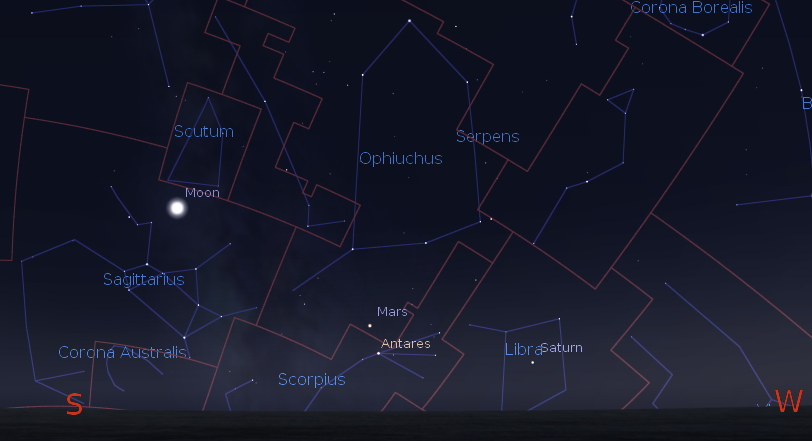
Saturn and Mars with the evening constellations, showing constellation boundaries in red at 8:30 p.m. on October 1, 2014. Created using Stellarium.
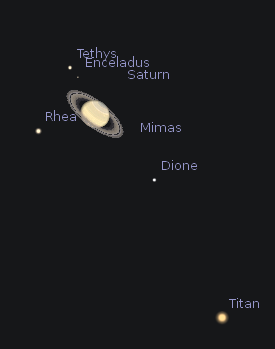
Saturn through a telescope. Of the satellites only Titan should be visible with Saturn so low in the sky at 8:30 p.m. Created using Stellarium.
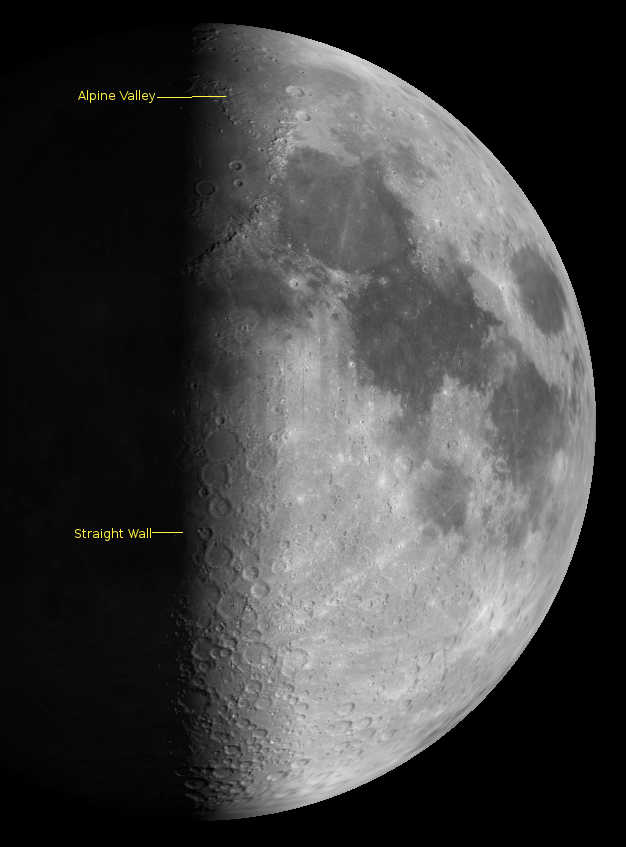
The first quarter Moon tonight at 8:30 p.m. with some interesting locations. Created using Virtual Moon Atlas.
Points of interest on the moon tonight:
- Alpine Valley – This is a fault valley some 79 miles (130 km) long and 7 miles (11 km) wide through the lunar Alps.
- Straight Wall – This is a fault that runs north-south on the moon and is only seen either one day after first quarter or one day after last quarter. It is 67 miles (110 km) long and 900 feet (300 meters) high. But instead of being a wall, it has only a 7 degree slope, which explains its brief appearance. Tonight it will cast a shadow. One day after last quarter the sun will shine directly on the slope, which is covered by lighter material and will show as a bright line.
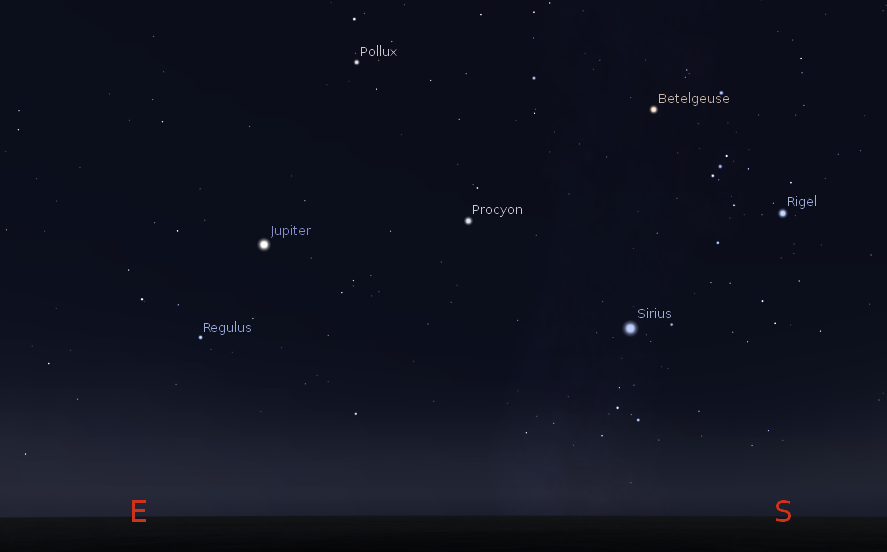
Jupiter and the winter stars at 6:30 a.m. on October 2, 2014. Created using Stellarium.
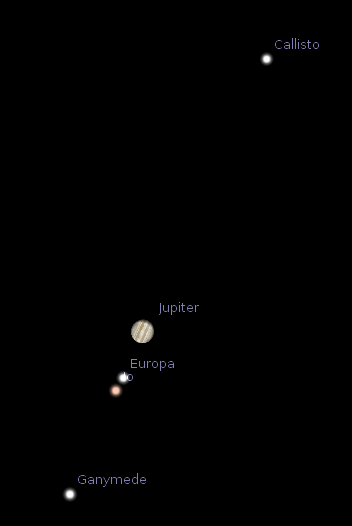
Jupiter and its satellites as seen through a telescope at 6:30 a.m. October 2, 2014. Created using Stellarium.
09/29/2014 – Ephemeris – The Moon, Mars and Antares will line up tonight
Ephemeris for Monday, September 29th. The sun will rise at 7:37. It’ll be up for 11 hours and 48 minutes, setting at 7:26. The moon, 2 days before first quarter, will set at 10:49 this evening.
Tonight we’ll still have Mars hanging around the star Antares. However we’ll have the Moon joining the party. The three will nearly be in line at 9 p.m. with the fat crescent Moon on top, Mars below it and Antares below Mars. They will be in a straighter line but the Sun out makes them impossible to see. With binoculars or a small telescope the lunar seas visible, kind of in order from the Moon’s sunlit edge are Crises, Fertility, Nectar, Tranquility and half of Serenity. If you’re looking for the Man in the Moon, you’ll have to wait until the Moon is nearly full to completely discern his face. However most of the upside down rabbit is visible. The seas of Fertility and Nectar make up his ears, Tranquility, his head, and Serenity his body.
Times are for the Traverse City/Interlochen area of Michigan. They may be different for your location.
Addendum
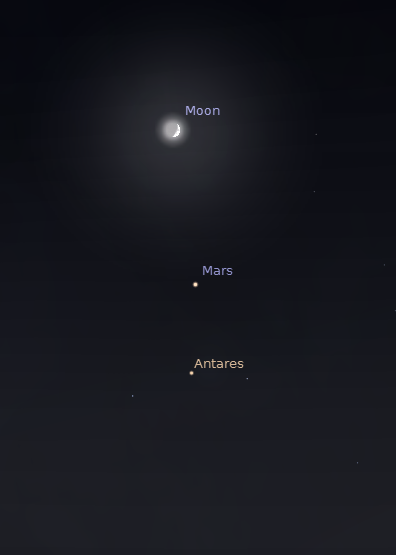
The Moon, Mars and the bright red star Antares line up on the evening of September 29, 2014. Created using Stellarium.
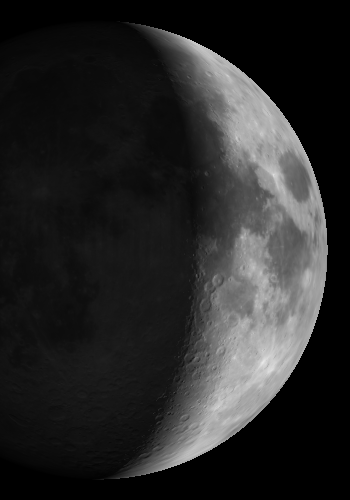
The moon tonight September 29, 2014. Created using Virtual Moon Atlas.
09/26/2014 – Ephemeris – Mars meets its rival
Ephemeris for Friday, September 26th. The sun will rise at 7:34. It’ll be up for 11 hours and 58 minutes, setting at 7:32. The moon, 2 days past new, will set at 8:45 this evening.
The planet Mars and the bright star Antares will appear at their closest tomorrow night. The name of the star Antares means “Rival of Mars”. “Ant” meaning anti, “Ares”, the Greek equivalent to the Roman god Mars. This is about a 26 month recurrence, give or take. Usually Mars is way brighter than Antares, or way dimmer. This time Mars and Antares are the same brightness. Both planet and star have the same color, kind of a faded orange color, made redder by being low in our sky which drains even more of the blue out. The reason Mars is red is that its surface is rusty. Antares is another matter. It is a cool red giant star. Well, cool on the outside by hotter than the sun’s interior on the inside where it’s changing helium into carbon and oxygen for power. Hint: Mars is always on top. Also tomorrow night the crescent Moon will be just to the right of Saturn.
Times are for the Traverse City/Interlochen area of Michigan. They may be different for your location.
Addenda
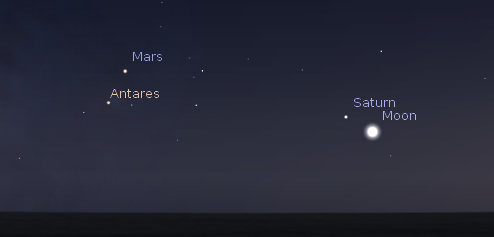
Mars appears its closest to Antares. Here seen low in the southwest at 8:30 p.m. on September 27, 2014. The Moon, near Saturn is too small to show a phase. Created using Stellarium.
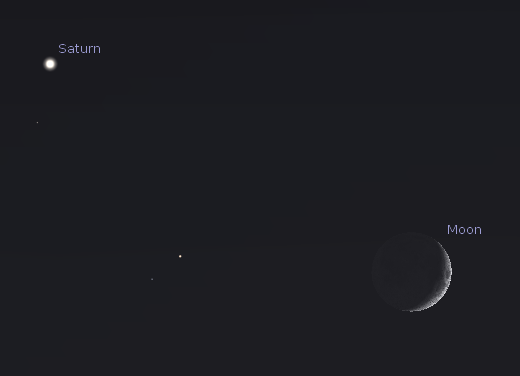
Saturn with the crescent moon. Earthshine may still be visible on the three day old Moon’s night side. Created using Stellarium.
Acme Fall Festival
The Grand Traverse Astronomical Society will be at the Acme Fall Festival at Flintfields Horse Park on Bates Rd, North of M72, which runs from 10 a.m. to 4 p.m. Saturday the 27th. The society will bring telescopes, including the 25 inch Dobsonian telescope and the Solar Telescope to view the Sun in white light and the light of the element hydrogen. There will also be exhibits and free stuff from NASA for the kids.
09/24/2014 – Ephemeris – Where are the bright planets this week?
Ephemeris for Wednesday, September 24th. The sun will rise at 7:31. It’ll be up for 12 hours and 4 minutes, setting at 7:36. The moon is new today, and won’t be visible.
Let’s take our weekly look at the bright planets. Mars and Saturn are in the southwestern sky at 9 p.m. with Saturn to the right and a bit below Mars by 17 degrees, about the two widths of your fist held at arm’s length. Saturn will set at 9:38 p.m. Saturn is in Libra, while Mars is in Scorpius. Mars is closing in on a star that has the identical color, and this year the same brightness, its rival Antares. Indeed that’s what the star’s name means: Ant as in anti, Ares the Greek god of war, and the counterpart of the Roman Mars. They will be closest Saturday. Mars will set at 10:13.. In the morning sky brilliant Jupiter will rise in the east-northeast at 3:23 a.m., while Venus, will rise in the east at 6:51 a.m. only 42 minutes before the sun. I’m not sure you’ll see it.
Times are for the Traverse City/Interlochen area of Michigan. They may be different for your location.
Addendum
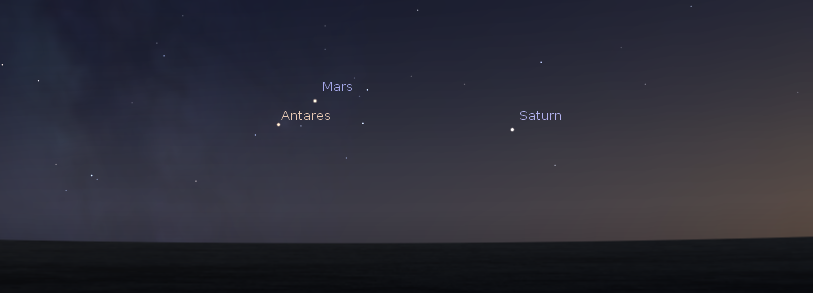
Saturn with Mars approaching Antares low in the southwest at 8:30 p.m. on September 24, 2014. Created using Stellarium.
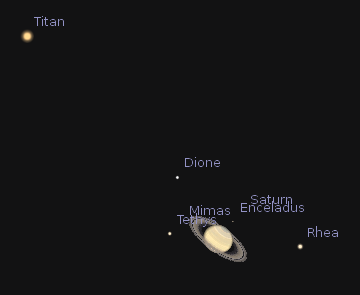
Saturn in a telescope on September 24, 2014. Of the satellites, only Titan should be visible. Created using Stellarium.
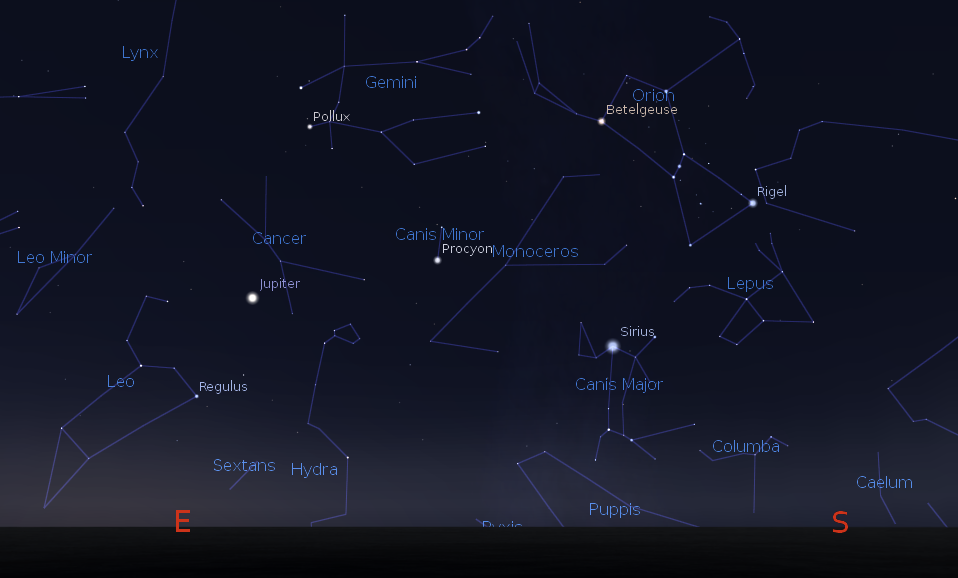
Jupiter and the winter and the western most spring constellations at 6:30 a.m. on September 25, 2014. Created using Stellarium.
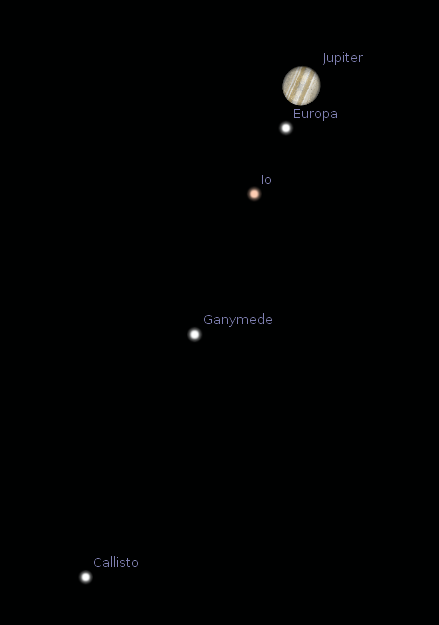
Jupiter and its moon through a telescope at 6:30 a.m. on September 25, 2014. Created using Stellarium.
09/17/2014 – Ephemeris – It’s Wednesday, do you know where the bright planets are?
Ephemeris for Wednesday, September 17th. The sun will rise at 7:23. It’ll be up for 12 hours and 25 minutes, setting at 7:49. The moon, 2 days past last quarter, will rise at 2:06 tomorrow morning.
Let’s take our weekly look at the bright planets. Mars and Saturn are now nearly side by side with Saturn to the right by 15 degrees, about the width of your fist and a half held at arm’s length. Saturn will set at 10:04 p.m. Saturn is in Libra, while Mars is entering Scorpius just above the star tonight called Dschubba. Mars is closing in to a star that has the identical hue, and this year the same brightness, its rival Antares. Indeed that’s what the star’s name means: Ant as in anti, Ares the Greek god of war, and the counterpart of the Roman Mars. They will be closest next week. Mars will set at 10:25. In the morning sky brilliant Jupiter will rise in the east-northeast at 3:43 a.m., while Venus, will rise at 6:30 a.m.
Times are for the Traverse City/Interlochen area of Michigan. They may be different for your location.
Addendum
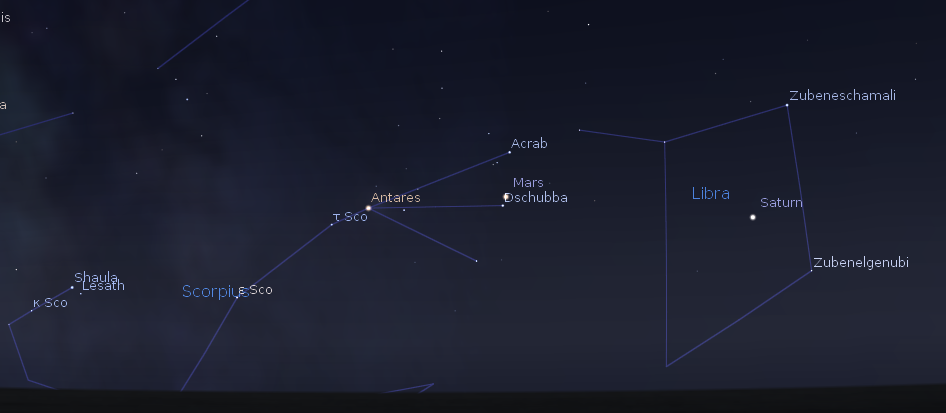
Looking southwest at Saturn and Mars with the stars of Scorpius and Libra at 9 p.m. on September 17, 2014. Created using Stellarium.
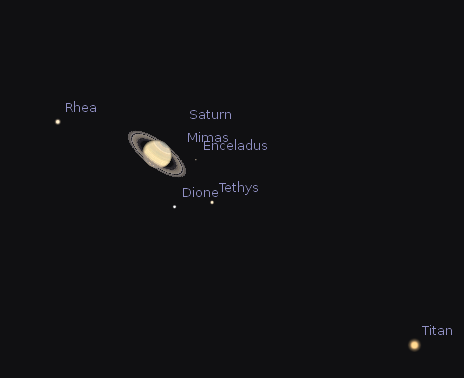
Saturn through a telescope. However being so low in the sky even the moon Titan might be hard to see. September 17, 2014. Created using Stellarium.
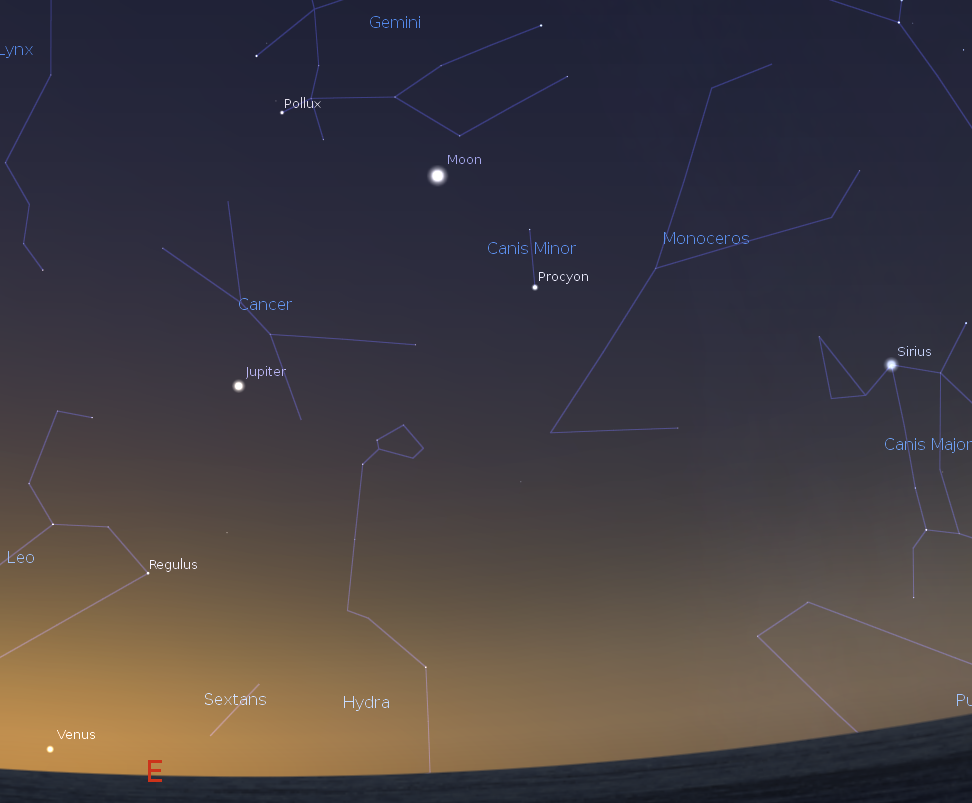
The Moon, Jupiter and Venus with some of the bright stars of winter and spring at 6:45 a.m. on September 18, 2014. Created using Stellarium.
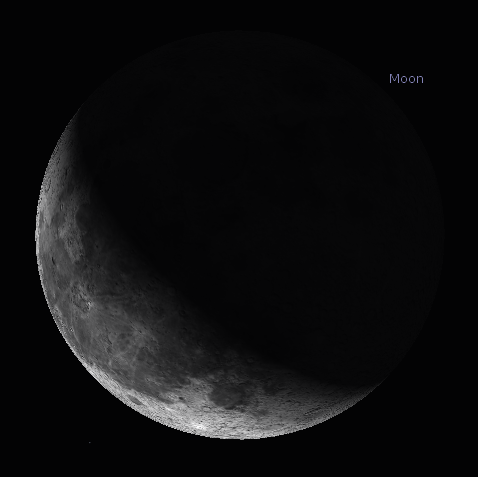
The Moon at 6:45 a.m. on September 18, 2014. I doubt you’d see Earth shine (the rest of the Moon like this) with the crescent this wide. Created using Stellarium.
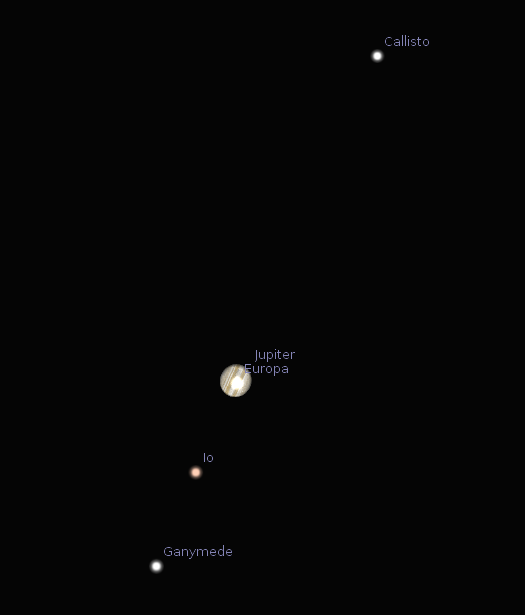
Jupiter through a telescope. Europa is transiting in front of Jupiter at 6:45 a.m. and will be very difficult or impossible to spot. Stellarium shows that the shadow of Europa is just about directly behind the moon. Created using Stellarium.
09/01/2014 – Ephemeris – Previewing the month of September
Ephemeris for Labor Day, Monday, September 1st. The sun will rise at 7:04. It’ll be up for 13 hours and 14 minutes, setting at 8:19. The moon, 1 day before first quarter, will set at 12:02 tomorrow morning.
Let’s look at the skies for the month of September. The sun will moving at its greatest speed in its retreat to the south. Daylight hours in the Interlochen/Traverse City area and will drop from 13 hours and 14 minutes today to 11 hours 45 minutes on the 30th. The altitude of the sun above the southern horizon at local noon will be 54 degrees today, and will descend to 42 degrees on the 30th. The season of summer is getting short, so enjoy it while you can. Summer ends and autumn begins at 10:30 p.m. on September 22nd. Saturn is retreating toward the sun now. Mars is pushing on eastward. On the 27th Mars will be north of the star Antares. It will be a good time to compare their colors.
Times are for the Traverse City/Interlochen area of Michigan. They may be different for your location.
Addendum
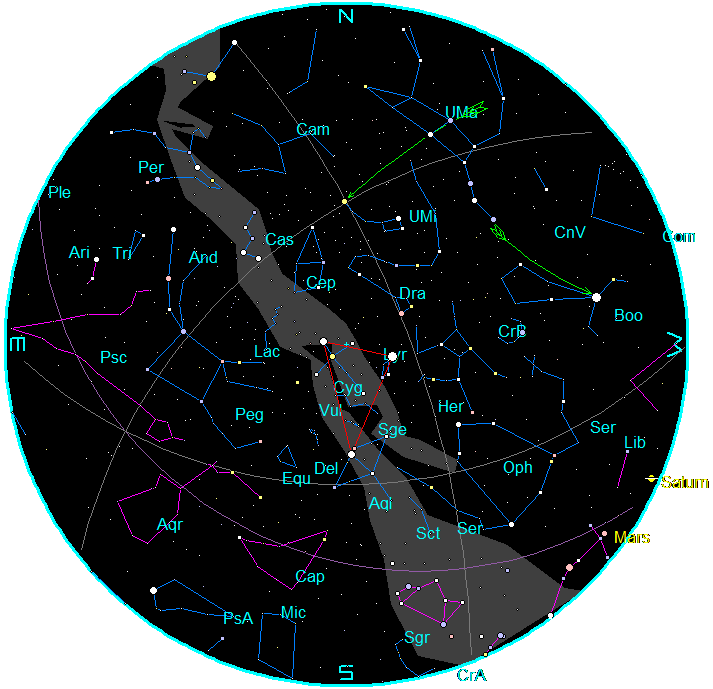
September star chart for 10 p.m. on September 15, 2014. Created by my LookingUp program.
The Moon is not plotted. The planets are plotted for the 15th. Mars will move eastward through the month and will approach Saturn.
Astronomical twilight ends at 10:05 p.m. on September 1st, decreasing to 9:01 on the 30th.
Add a half hour to every week before the 15th and subtract and hour for every week after the 15th.
For a list of constellation names to go with the abbreviations click here.
Also shown is the Summer Triangle in red. Clockwise from the top star is Deneb in Cygnus, Vega in Lyra and Altair in Aquila.
The green pointers from the Big Dipper are:
- Pointer stars at the front of the bowl of the Big Dipper point to Polaris the North Star.
- The arc of the dipper’s handle points to Arcturus.
07/04/2014 – Ephemeris – Find patriotic red, white and blue stars
Ephemeris for Independence Day, Friday, July 4th. Today the sun will be up for 15 hours and 27 minutes, setting at 9:30. The moon, 1 day before first quarter, will set at 1:03 tomorrow morning. Tomorrow the sun will rise at 6:03.
On this patriotic day let’s look for some red, white, and blue stars. Red is easy, the red star Antares is seen in the south at 11 p.m. Mars, the red planet, in the southwest, can be added even though it’s not technically a star. White is easy too, the official white calibration star Vega high in the east at 11 p.m. The blue star is really blue-white. The brightest of these out at 11 p.m. is Spica, low in the southwest. The color is best seen in binoculars. Star colors are quite subtle, and are an indicator of the temperature of their outer gaseous layers. The temperature of a stars outer layers, in order of their increasing temperatures, red, white and blue, is not related to the temperature in their cores. Of these three the coolest on the outside, Antares is really the hottest inside, using helium as fuel.
Times are for the Traverse City/Interlochen area of Michigan. They may be different for your location.
Addendum
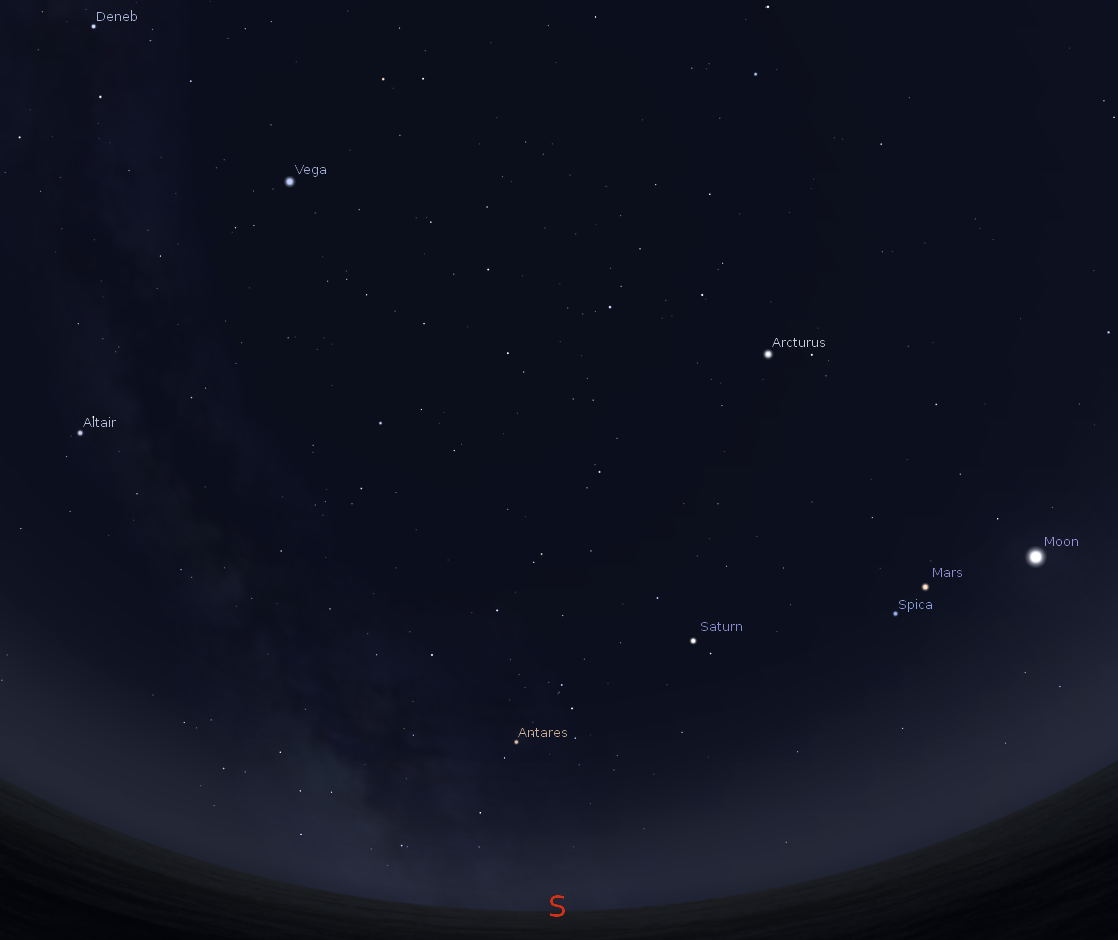
Red white and blue stars for Independence Day at 11 p.m. on July 4, 2014. Created using Stellarium.
06/30/2014 – Ephemeris – The celestial snake handler
Ephemeris for Monday, June 30th. Today the sun will be up for 15 hours and 30 minutes, setting at 9:31. The moon, 3 days past new, will set at 11:14 this evening. Tomorrow the sun will rise at 6:01. | The red star Antares shines in the south at 11 p.m. In the constellation of Scorpius. In the area of sky above and a little to the left lies a large constellation of faint stars called Ophiuchus, the serpent bearer. The constellation shape is like a large bell, which reminds me of the head, shoulders and arms of a fellow that’s holding the snake-like a weight lifter pulling up a heavy bar bell. The serpent he’s holding is Serpens, the only two-part constellation in the heavens. The head rises to Ophiuchus’ right and the tail extends up to the left. In legend Ophiuchus was a great physician, educated by the god Apollo, and the centaur Chiron, also found in the stars as Sagittarius, now rising below and left of him.
Times are for the Traverse City/Interlochen area of Michigan. They may be different for your location.
Addendum
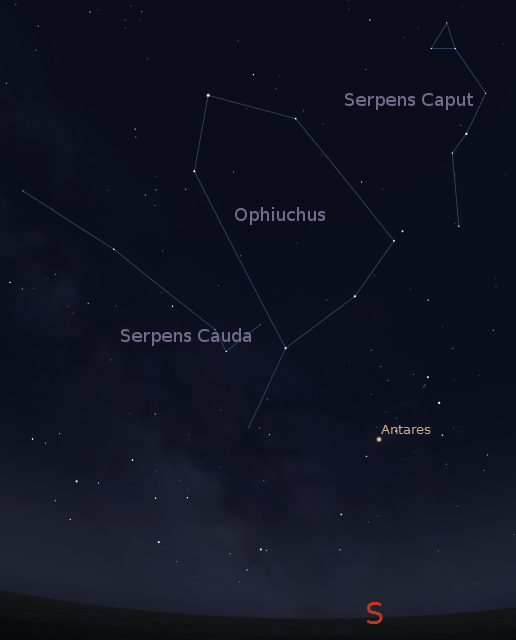
Ophiuchus and Serpens at 11 p.m.. Created using Stellarium.
07/16/2013 – Ephemeris – The red giant star Antares
Ephemeris for Tuesday, July 16th. Today the sun will be up for 15 hours and 11 minutes, setting at 9:23. The moon, 1 day past first quarter, will set at 1:24 tomorrow morning. Tomorrow the sun will rise at 6:13.
Low in the south is the red giant star Antares. It lies at the heart of Scorpius the scorpion. Its name means Rival of Mars, because it has the same hue as the red planet. In Mars case the color comes from iron oxide, rust. In Antares case it has a cool surface temperature, relatively speaking of 5,700 degrees Fahrenheit. As a red giant star Antares is near the end of its life, though for a star Antares is young, possibly 12 million years old. That that age the sun was just getting started. But Antares with around 15 to 17 the sun’s mass has already run out of fusible hydrogen in its core and bloated out to over Mars orbit in size. Antares is 450 light years away and has a companion star in its system that looks greenish in contrast to Antares red. However when Antares A, the red giant’s light is blocked, the companion looks bluish.
Times are for the Traverse City/Interlochen area of Michigan. They may be different for your location.
Addendum
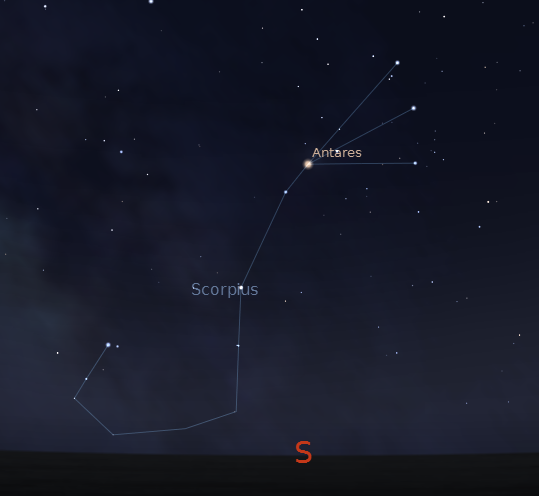
The constellation Scorpius and the star Antares. Created using Stellarium.
 Bob Moler's Ephemeris Blog