Archive
09/21/2015 – Ephemeris – Next Sunday’s total lunar eclipse
Ephemeris for Monday, September 21st. The Sun will rise at 7:28. It’ll be up for 12 hours and 14 minutes, setting at 7:42. The Moon, at first quarter today, will set at 1:02 tomorrow morning.
It’s six days to the total lunar eclipse next Sunday night. The eclipse starts just after 9 p.m. and ends shortly before 12:30 a.m. Of the remarkable four eclipse string at every possible lunar eclipse opportunity, this last one is the best for us, in that it occurs in the evening. The others were in the morning our time or occurred around the time of moon set around here. So if clear skies prevail we will have a wonderful and beautiful total lunar eclipse. Lunar eclipses occur at full moon when the Sun, Earth and Moon line up close enough for the Moon to enter the Earth’s shadow. Generally this only occurs about 1 out of 6 full moons. Eclipses of the Sun and Moon normally appear in pairs. The solar eclipse already occurred 8 days ago.
Times are for the Traverse City/Interlochen area of Michigan. They may be different for your location.
Addendum
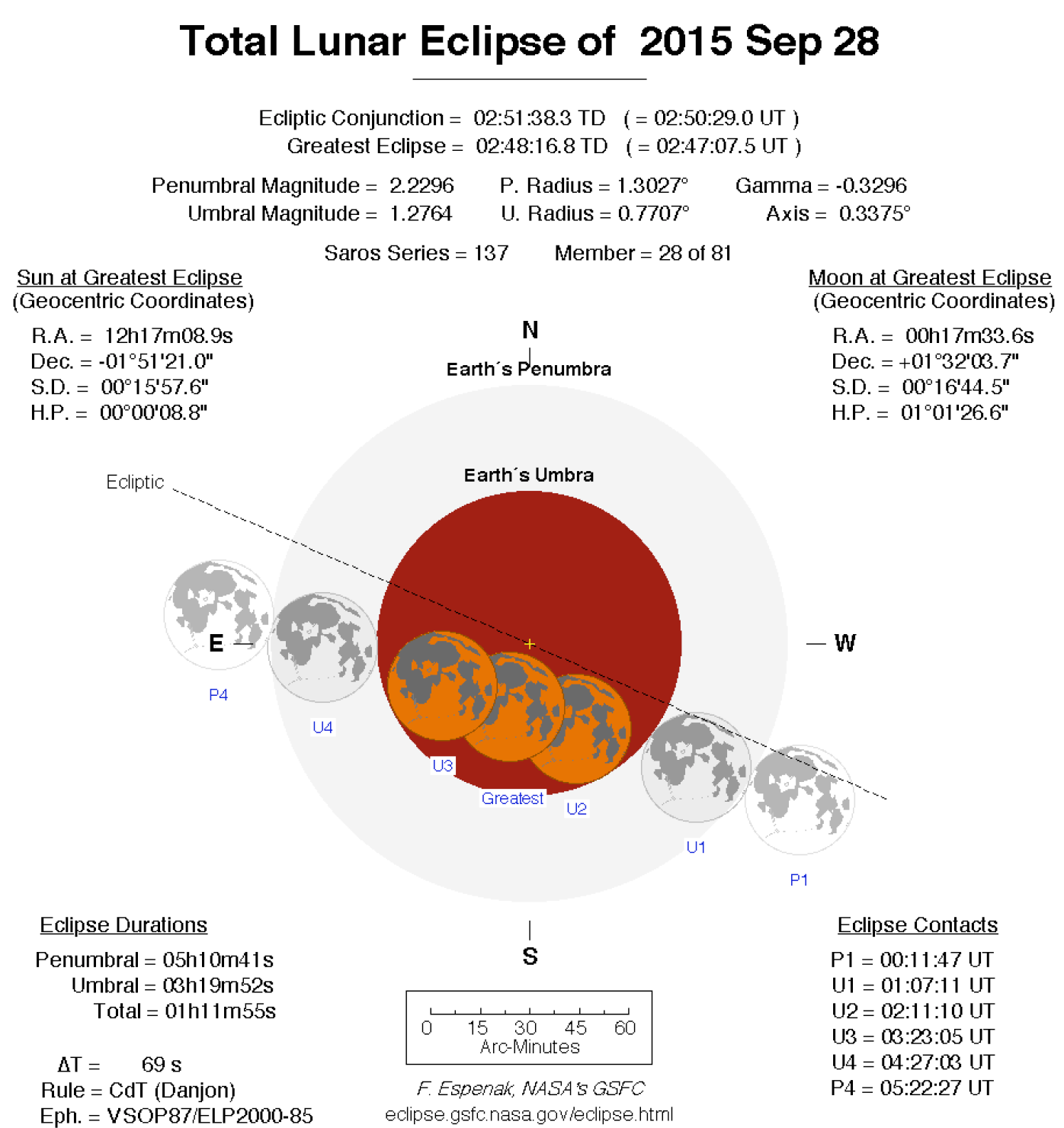
NASA eclipse chart portion. In the eastern US the Date will be September 27. Subtract 4 hours from UT to get EDT (Eastern Daylight Time) Credit: NASA/ Fred Espanek.
Here’s the link to the full chart.
09/18/2015 – Ephemeris – Saturn and the Moon together tonight and tomorrow a big day for the GTAS – It starts with the Leland Heritage Celebration
Ephemeris for Friday, September 18th. The Sun will rise at 7:24. It’ll be up for 12 hours and 23 minutes, setting at 7:48. The Moon, 3 days before first quarter, will set at 10:40 this evening.
Tonight the planet Saturn will appear left of and a bit below the crescent Moon. Saturn will be visible in the evening sky for 2 and a half more months with about a month where it’s high enough to see clearly in telescopes. There are two local astronomical events tomorrow. Tomorrow the Leland Heritage Celebration will take place from 11 a.m. to 4 p.m. at Fish Town in Leland. The Grand Traverse Astronomical Society will be there to show the Sun through member’s telescopes and give out NASA items for the kids. Then a few hours later the crew will be on Front Street in Traverse City for the International Observe the Moon Night starting at 7 p.m. Both events are weather dependent. Rain will affect the Leland event and clouds the evening one.
Times are for the Traverse City/Interlochen area of Michigan. They may be different for your location.
Addendum
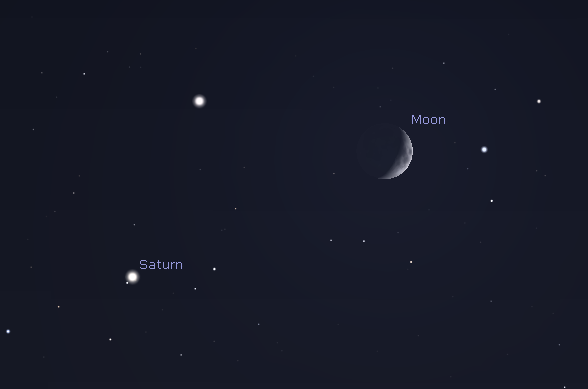
Saturn and the Moon at 9 p.m. September 18 from Northern Michigan. Created using Stellarium.
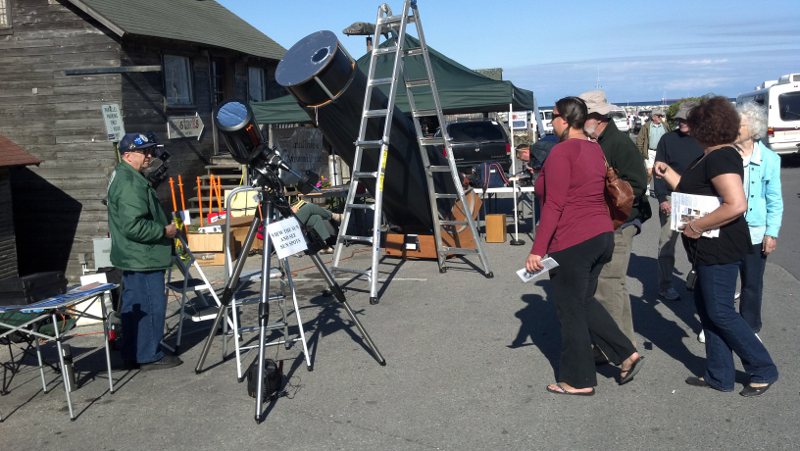
GTAS telescopes at Leland Heritage Celebration in 2011.
09/17/2015 – Ephemeris – International Observe the Moon Night is Saturday
Ephemeris for Thursday, September 17th. The Sun will rise at 7:23. It’ll be up for 12 hours and 26 minutes, setting at 7:50. The Moon, half way from new to first quarter, will set at 10:04 this evening.
The annual International Observe the Moon Night will be observed this Saturday evening. Members of the Grand Traverse Astronomical Society will be stationed on the north side of the 200 block of East Front Street. Starting at 7 p.m. near Orvis Streamside and will be moving our telescopes eastward from time to time to keep up with the westward sinking motion of the Moon over the single story buildings to the south as long as we can. The moon will be a fat crescent with lots of detail visible in telescopes. The society will also have some giveaway items from NASA for the young and not so young. The event will be canceled due to heavy overcast or other inclement weather.
Times are for the Traverse City/Interlochen area of Michigan. They may be different for your location.
Addendum
The information above is for our local location (northwestern lower Michigan). To find the location of the International Observe the Moon Night event near you go here. There’s even a downloadable Moon map for the evening here.
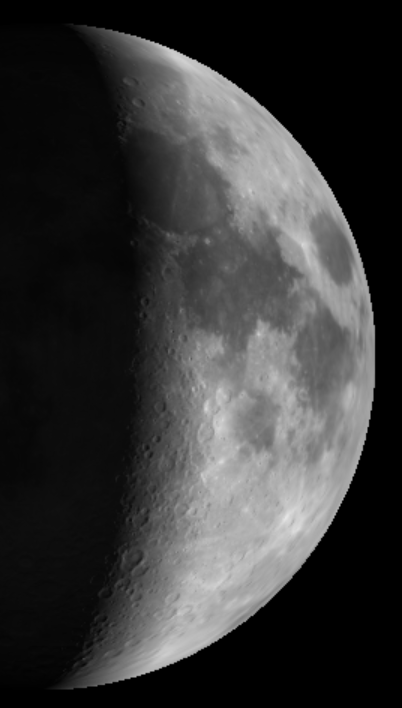
The Moon at 9 p.m. September 19, 2015 (Observe the Moon Night for the Eastern Daylight Time zone. Created with Virtual Moon Atlas.
09/16/2015 – Ephemeris – Looking for Saturn in the evening and Venus, Mars and Jupiter in the morning
Ephemeris for Wednesday, September 16th. The Sun will rise at 7:22. It’ll be up for 12 hours and 29 minutes, setting at 7:52. The Moon, 3 days past new, will set at 9:32 this evening.
Lets look for the bright planets for this week. Saturn is alone in the evening sky spotted by 9 p.m. low in the southwestern sky near the bright star Antares to its left. Antares has a reddish hue, while Saturn is brighter and yellowish. Both these colors are enhanced by being low to the horizon. Saturn will set at 10:39 p.m. The rest of the planet action has moved to the morning sky. Venus, the morning star, will rise at 4:42 a.m. a bit north of east. Much dimmer Mars will rise at 4:48 a.m. in the east-northeast. Jupiter is beginning to be visible in the morning sky and will rise at 5:57, almost an hour before the Sun. Mercury, though in the evening sky, sets too soon after the Sun to be visible.
Times are for the Traverse City/Interlochen area of Michigan. They may be different for your location.
Addendum
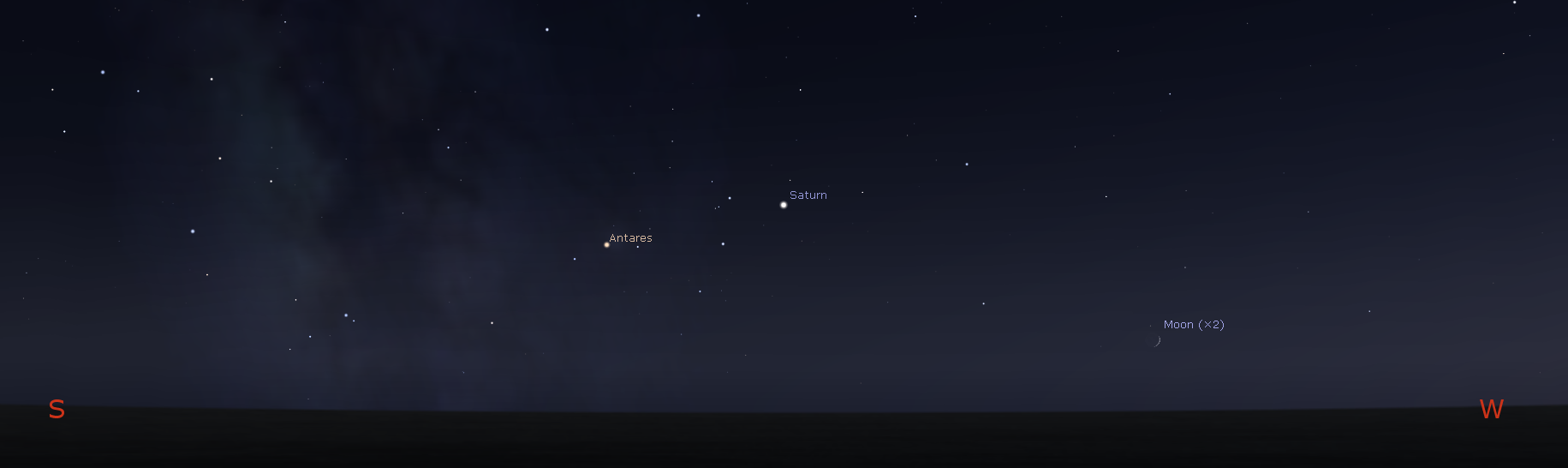
Saturn and the Moon with the Sagittarius teapot pouring its tea on the tail of Scorpius at 9 p.m. September 16, 2015. Created using Stellarium.
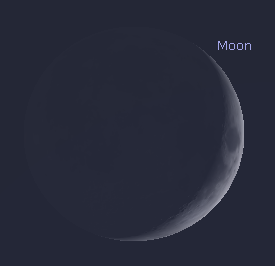
The moon as it might be seen in binoculars at 9 p.m. September 16, 2015. Created using Stellarium.
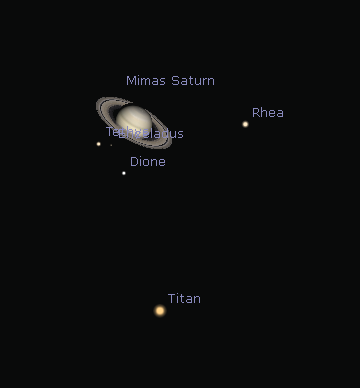
What Saturn and its moons might appear like in a telescope at 9 p.m., September 16, 2015. Small telescopes will show only the moon Titan. Created using Stellarium.
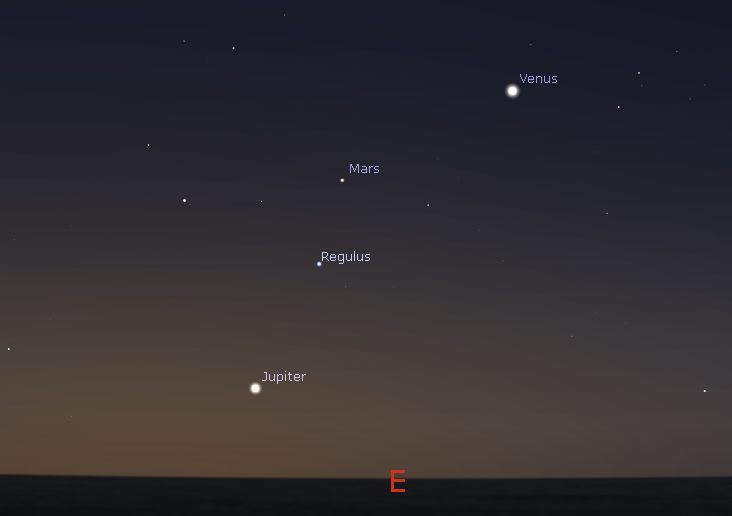
Venus, Mars and Jupiter with the star Regulus in morning twilight at 6:30 a.m. September 17, 2015. Created using Stellarium.
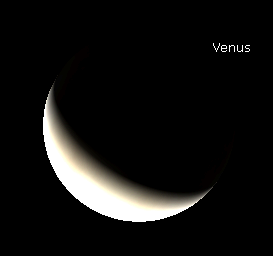
Venus through a telescope – September 17, 2015. Created using Stellarium.
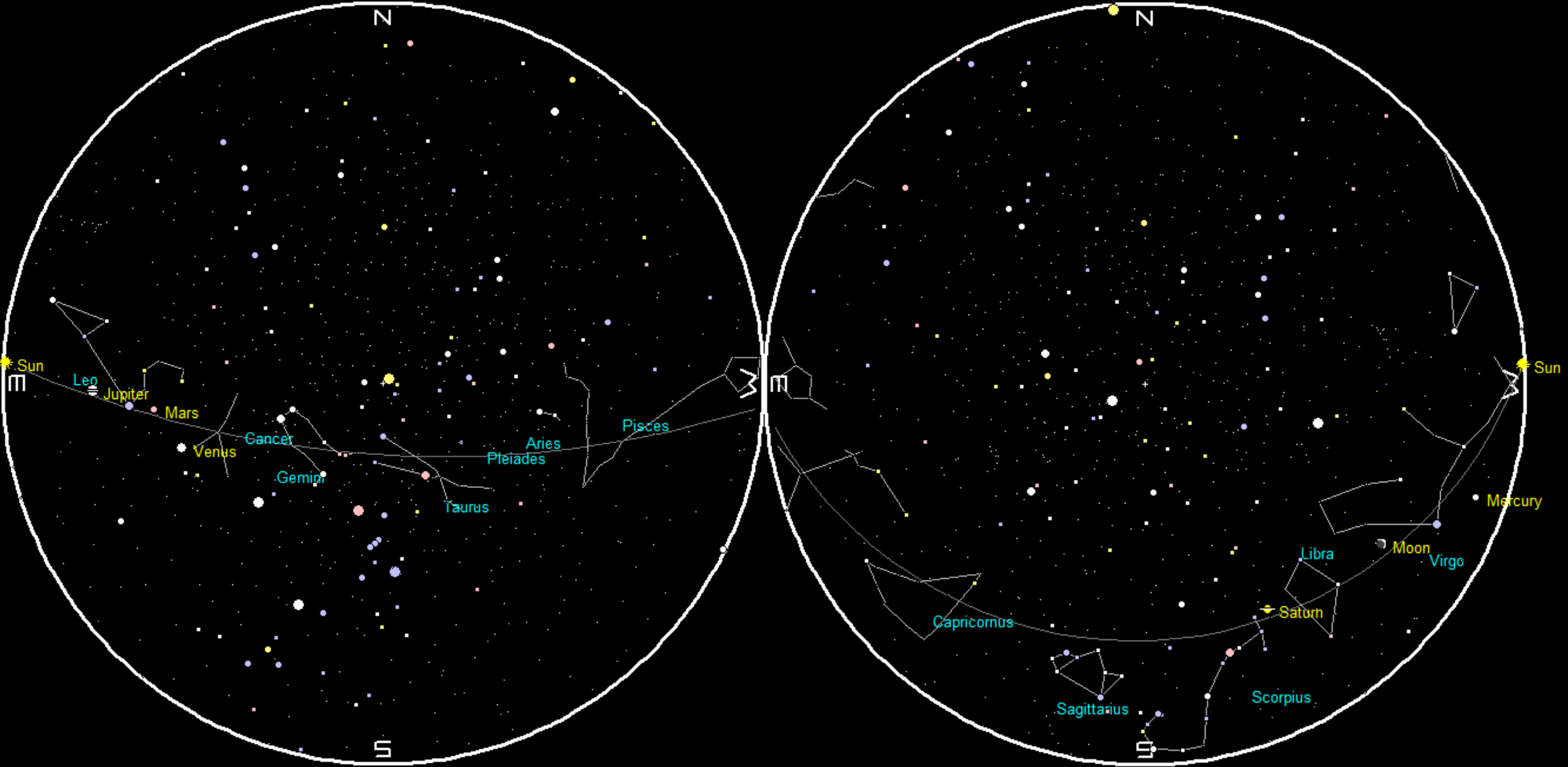
This is a chart showing the sunrise and sunset skies for September 16, 2015 showing the location of the planets and the Moon at that time. Created using my LookingUp program. Click on the image to enlarge.
08/26/2015 – Ephemeris – Saturn in the evening and an event at the Traverse Area District Library tonight
Wednesday, August 26th. The Sun rises at 6:57. It’ll be up for 13 hours and 32 minutes, setting at 8:30. The Moon, 3 days before full, will set at 4:21 tomorrow morning.
Lets take a look for the bright planets for this week. Saturn is alone in the evening sky spotted low in the southwestern sky near the bright star Antares to its lower left. It will set at 11:59 p.m. Venus crossed over to the morning sky 10 days ago, and Jupiter is passing conjunction with the Sun today. Mars is now in the morning sky climbing away from the Sun. It’s probably too far away from the Earth and faint to spot in the morning twilight. It will rise at 5 a.m. tomorrow. Venus will rise at 5:50 a.m. Tonight the Grand Traverse Astronomical Society will have a summer star party at the Woodmere branch of the Traverse Area District Library starting at 8 p.m. It starts with exploring the summer night skies with a digital sky, before viewing the real one.
Times are for the Traverse City/Interlochen area of Michigan. They may be different for your location.
Addendum
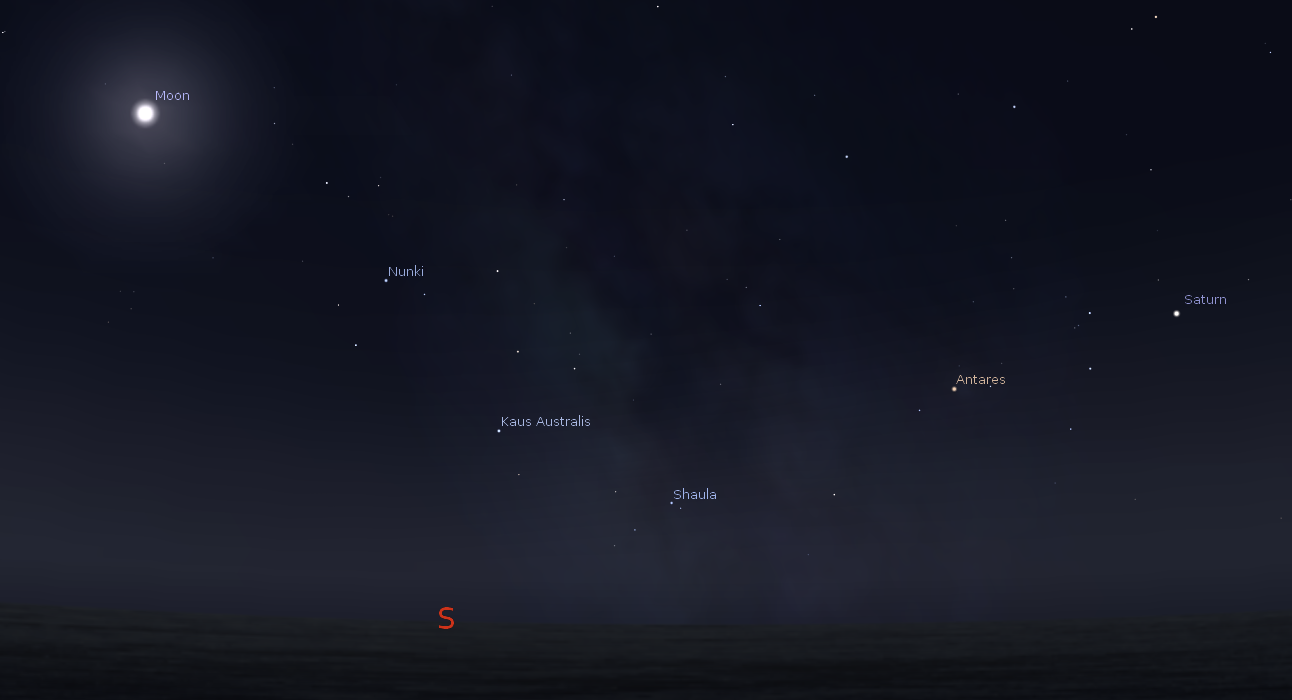
Saturn and the Moon at 10 p.m. August 26, 2015. Created using Stellarium.
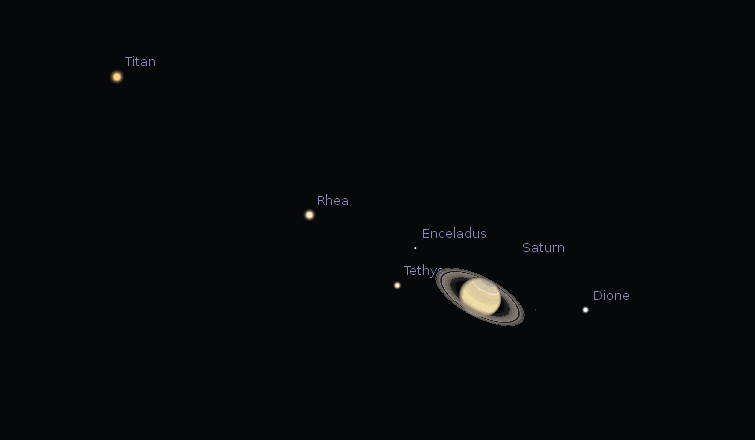
Saturn as seen in a telescope on August 26, 2015. In small telescopes only Titan of all the moons will be visible. Created using Stellarium.
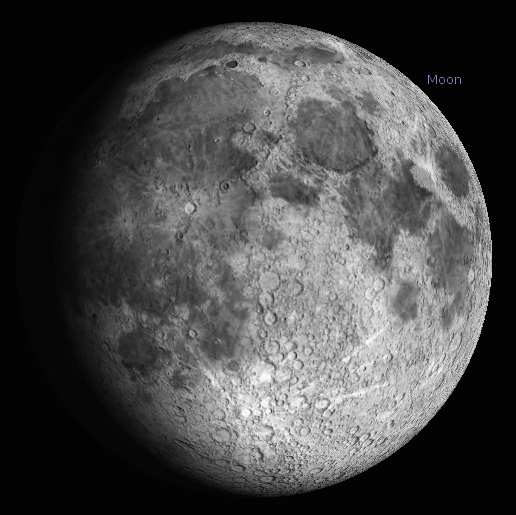
The moon as it would be seen in binoculars at 10 p.m. on August 26, 2015. Created using Stellarium.
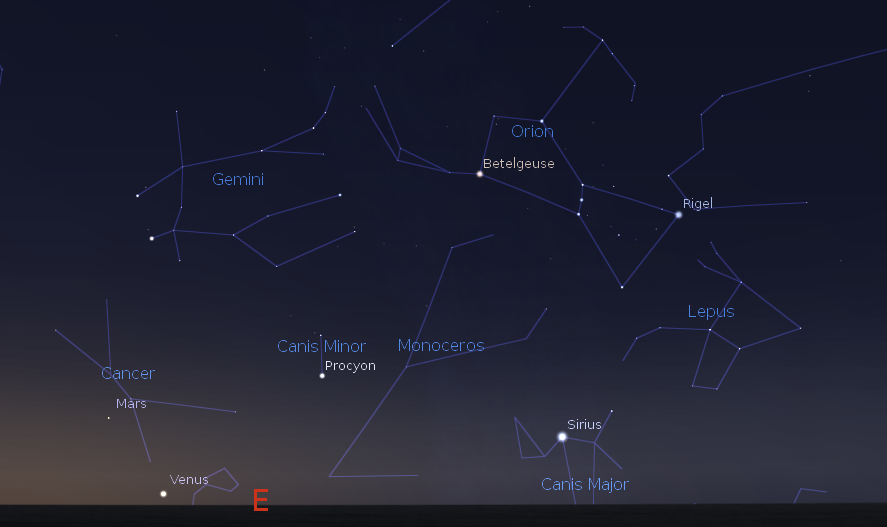
Good morning Venus, with Mars nearby. Venus is very low in the twilight with the stars and constellations of Winter at 6 a.m. August 27, 2015. Created using Stellarium.
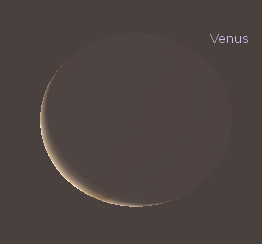
Venus through a telescope – August 27, 2015. Created using Stellarium.
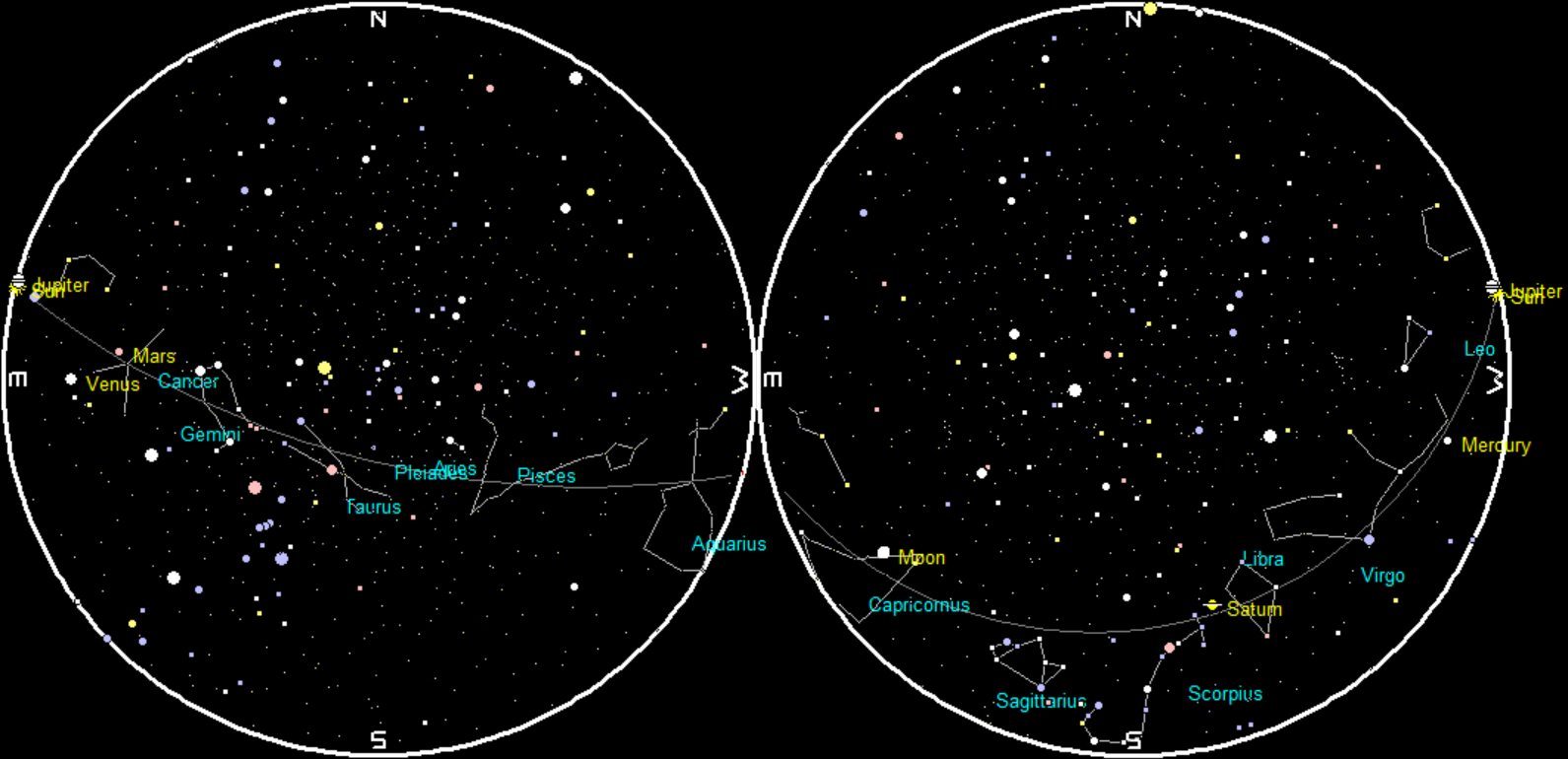
This is a chart showing the sunrise and sunset skies for August 26, 2015 showing the location of the planets and the Moon at that time. Created using my LookingUp program. Click on the image to enlarge.
07/29/2015 – Ephemeris – Where are the bright planets tonight
Ephemeris for Wednesday, July 29th. The Sun rises at 6:25. It’ll be up for 14 hours and 47 minutes, setting at 9:12. The Moon, 2 days before full, will set at 5:36 tomorrow morning.
Lets take a look at the bright planets for this week. Our evening stars Venus and Jupiter are together in the west by 9:30 p.m. with Jupiter above and right of Venus. Venus will set at 9:46 with Jupiter 23 minutes later. Venus will slide down to the Sun faster and faster in the coming weeks leaving Jupiter behind for a while. Venus will take 17 days to slide past the Sun. Jupiter though will take 28 days, so Venus will pass it again around August 4th when both are too close to the horizon and Sun to spot. There’s a third conjunction of these two in October in the morning sky with Mars nearby. Saturn is in the south in the evening twilight. It will set at 1:48 a.m. Even small telescopes can see Saturn’s rings.
Times are for the Traverse City/Interlochen area of Michigan. They may be different for your location.
Addendum
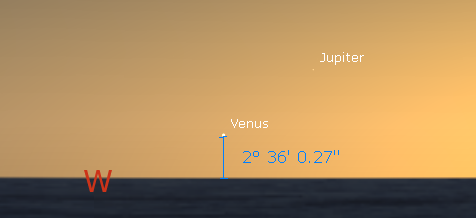
Venus and Jupiter low on the western horizon at 9:30 p.m. on July 29, 2015. This will be their last appearance on this blog in the west this year. We’ll wait until they appear in the east in the morning. For Venus it’ll be sooner than you think. Created using Stellarium.
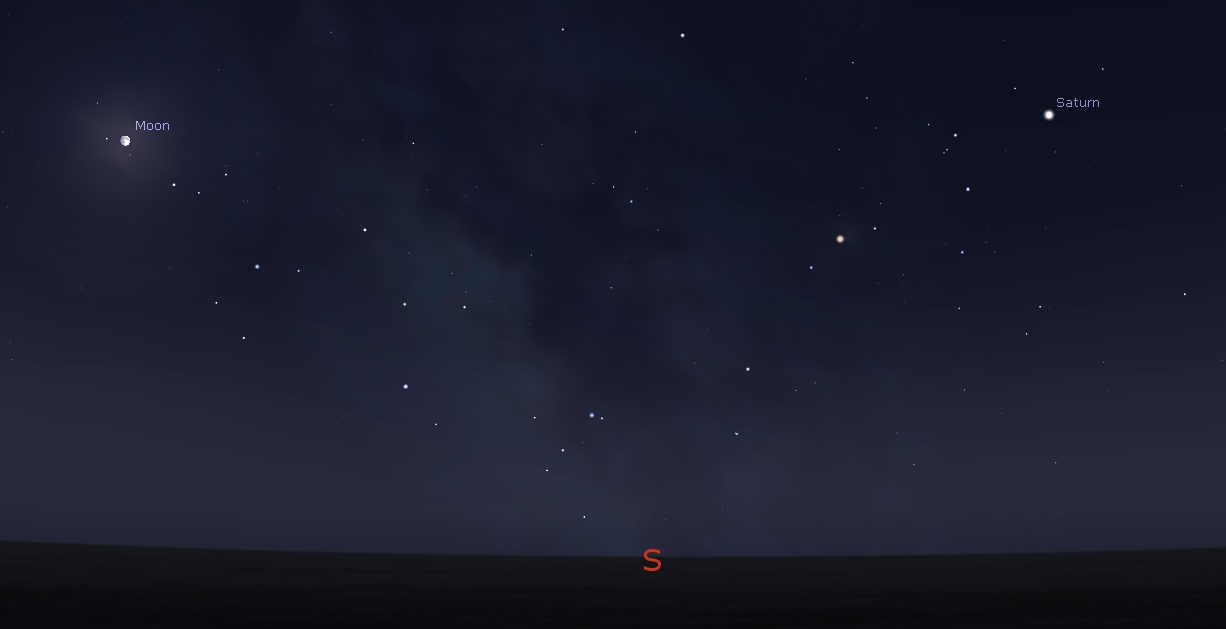
Saturn with the bright Moon and some stars of summer in the constellations Scorpius and Sagittarius at 10:30 p.m. July 29, 2015. Created using Stellarium.
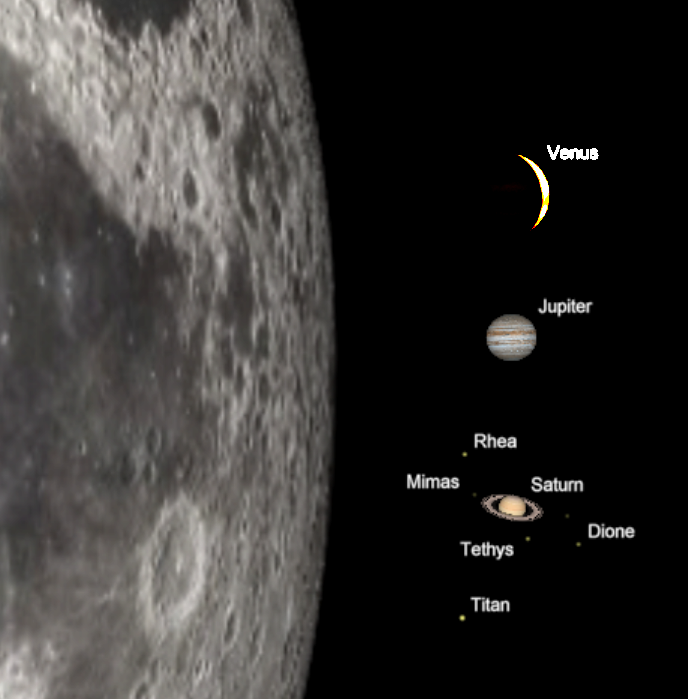
Comparative apparent sizes of the evening planets as seen through a telescope of the same magnification on July 29, 2015. Created using Cartes du Ciel (Sky Charts). Note that I didn’t show the moons of Jupiter which are not visible in the bright twilight. Also the program didn’t extend the cusps of Venus’ crescent properly.
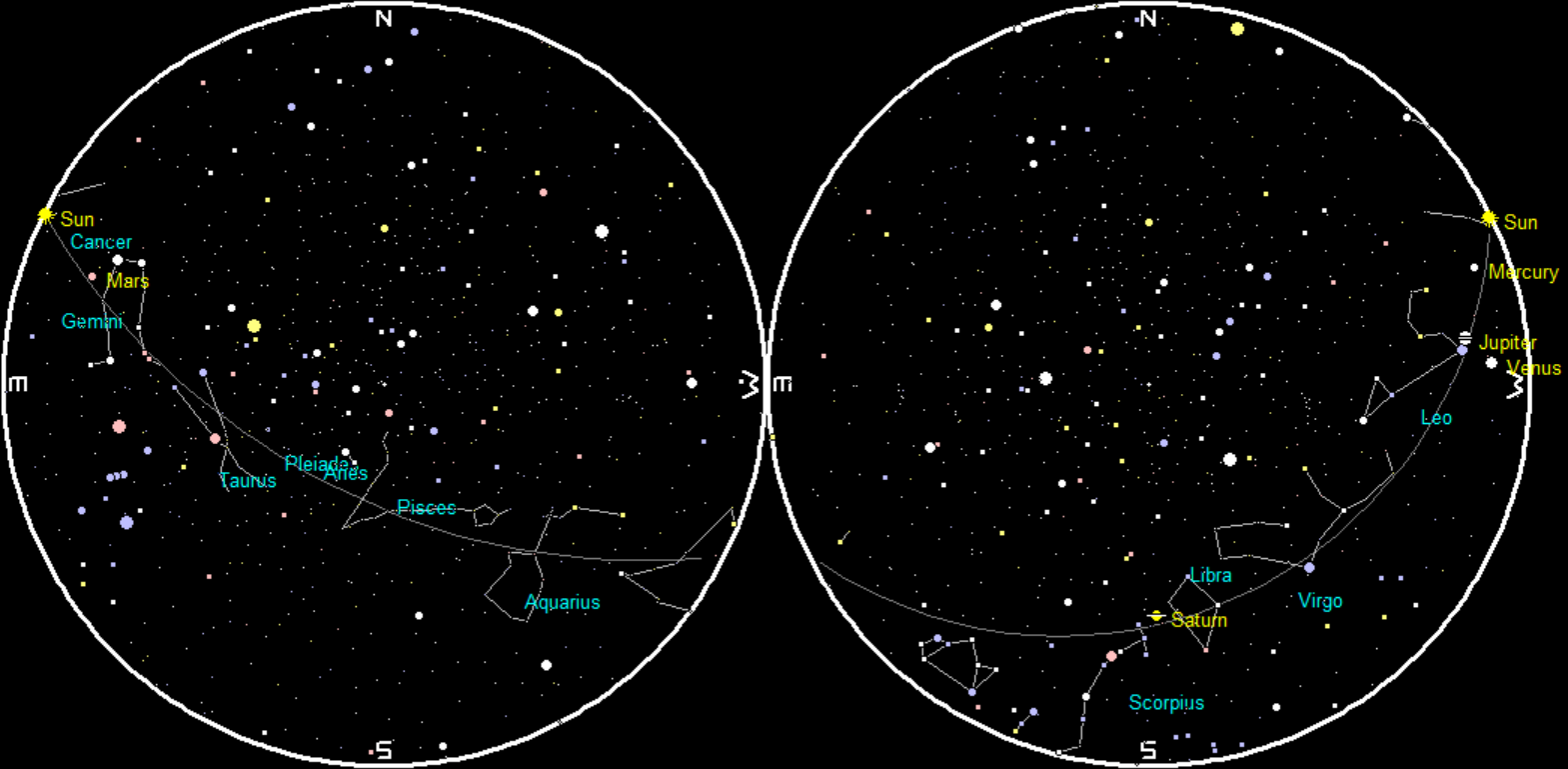
This is a chart showing the sunrise and sunset skies for July 29, 2015 showing the location of the planets at that time. Created using my LookingUp program.
07/22/2015 – Ephemeris – Two planets preparing to leave the evening sky
Ephemeris for Wednesday, July 22nd. Today the Sun will be up for 15 hours and 1 minute, setting at 9:19. The Moon, 2 days before first quarter, will set at 12:28 tomorrow morning. Tomorrow the Sun will rise at 6:18.
Lets take a look at the bright planets for this week. Our evening stars Venus and Jupiter are together in the west by 9:45 p.m. with Jupiter a little above and right of Venus. Venus will set at 10:22 with Jupiter 11 minutes later. Venus’ will slide down to the Sun faster and faster in the coming weeks leaving Jupiter behind for a while. Venus will take 24 days to slide past the Sun. Jupiter though will take 35 days, so Venus will pass it again around August 4th when both are too close to the horizon and Sun to spot. There’s a third conjunction of these two in October in the morning sky with Mars nearby. Saturn is in the south in the evening twilight. It will pass due south at 9:27 p.m. and will set at 2:16 a.m. Even small telescopes can see Saturn’s rings.
Times are for the Traverse City/Interlochen area of Michigan. They may be different for your location.
Addendum
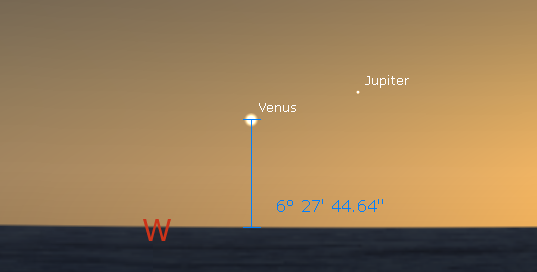
Venus and Jupiter low on the western horizon at 9:45 p.m. on July 22, 2015. Created using Stellarium.
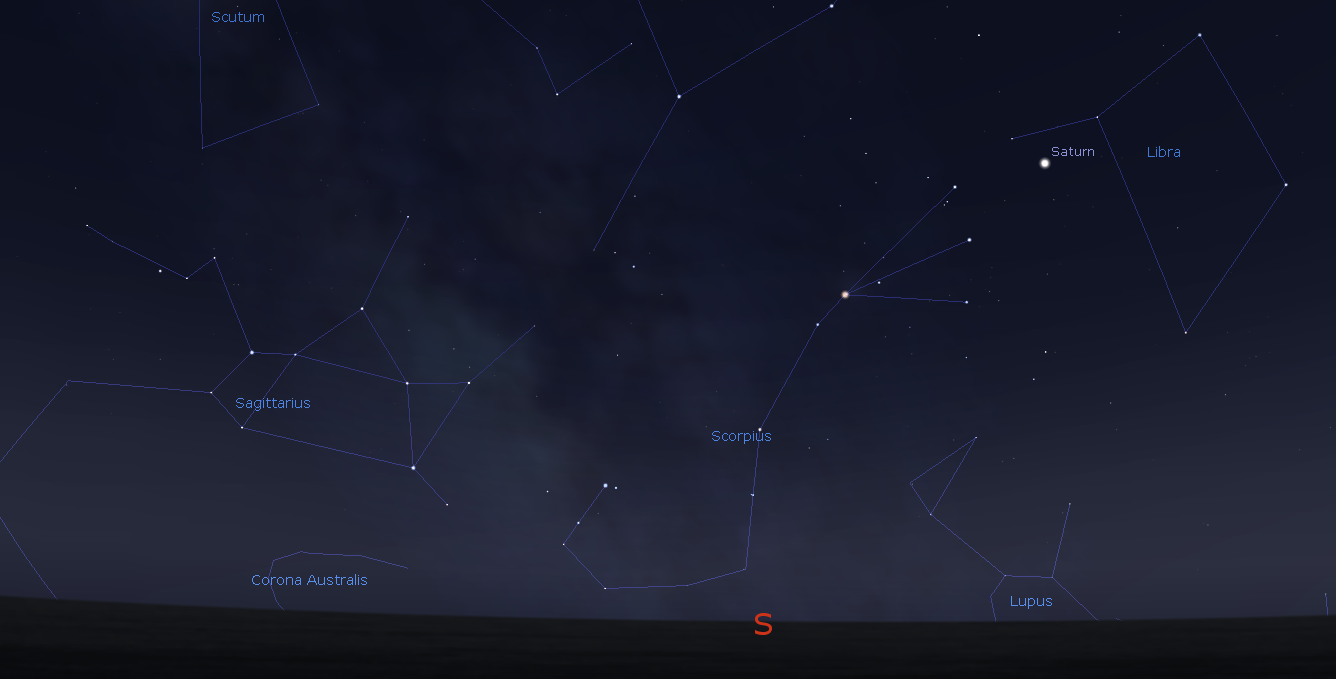
Saturn and the summer zodiacal constellations of Libra, Scorpius and Sagittarius at 10:30 p.m. on July 22, 2015. Created using Stellarium.
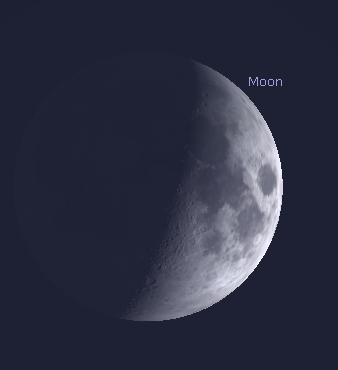
The Moon as it might appear in binoculars tonight at 10:30 p.m. (July 22, 2015). Created using Stellarium.
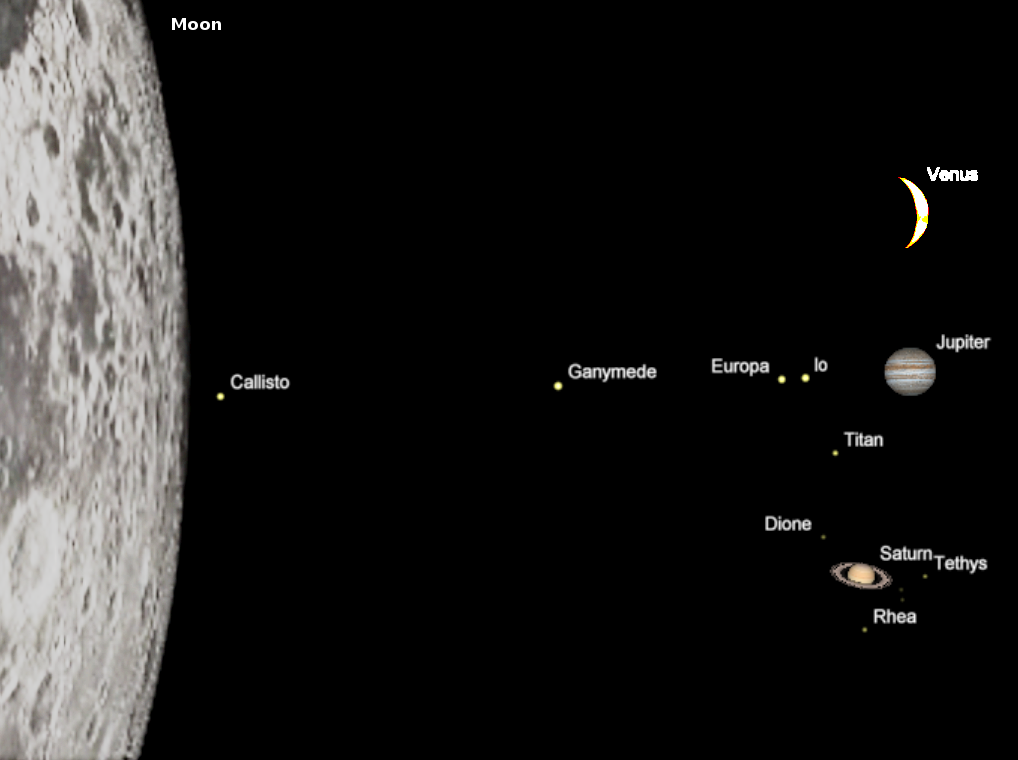
Comparative apparent sizes of the evening planets as seen through a telescope of the same magnification on July 22, 2015. Created using Cartes du Ciel (Sky Charts).
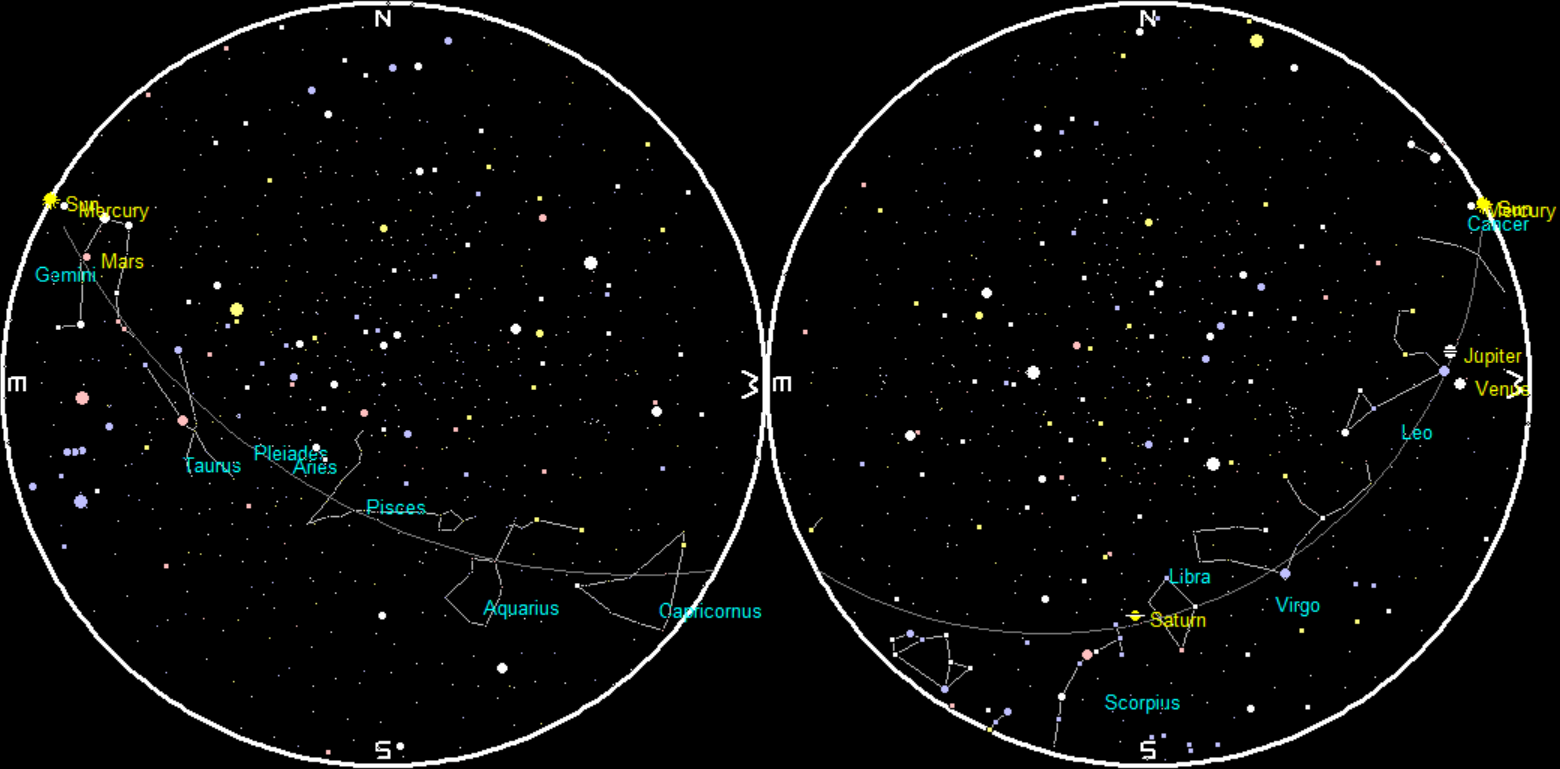
This is a chart showing the sunrise and sunset skies for July 22, 2015 showing the location of the planets at that time. Created using my LookingUp program.
07/17/2015 – Ephemeris – The constellation of the harp now and Venus and the Moon tomorrow night.
Ephemeris for Friday, July 17th. Today the Sun will be up for 15 hours and 11 minutes, setting at 9:24. The Moon, 2 days past new, will set at 10:07 this evening, and tomorrow the Sun will rise at 6:14.
High in the east at 11 p.m. can be found a bright star just above a small, narrow, but very distinctive parallelogram of stars. They are the stars of the constellation Lyra the harp. The bright star is Vega, one of the twenty one brightest stars, called first magnitude stars. Vega is actually the 5th brightest night time star. The harp, according to Greek mythology, was invented by the god Hermes. The form of the harp in the sky, is as he had invented it: by stretching strings across a tortoise-shell. Hermes gave it to his half-brother Apollo, who in turn gave it to the great musician Orpheus.
Looking westward tomorrow night the planet Venus will appear about 2 moon widths above the crescent Moon.
Times are for the Traverse City/Interlochen area of Michigan. They may be different for your location.
Addendum
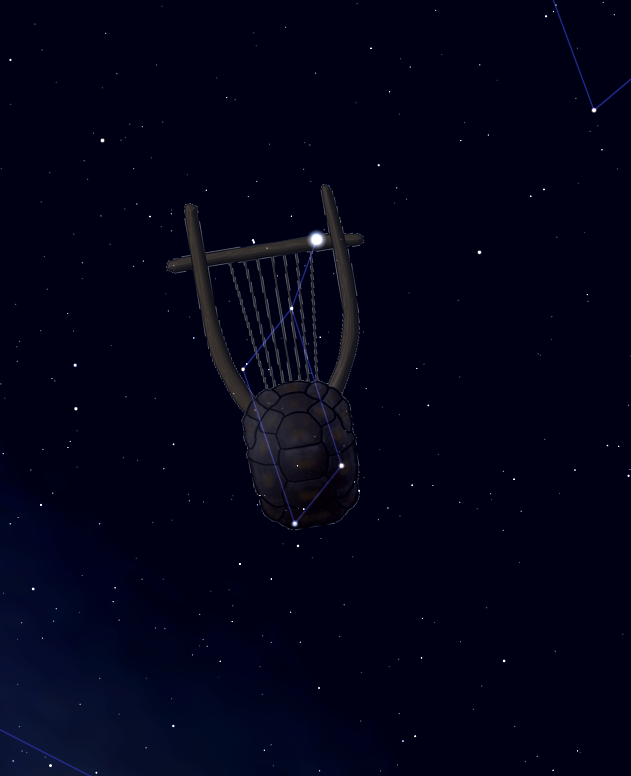
Lyra as a tortoise-shell harp. Created using Stellarium and free clip art.
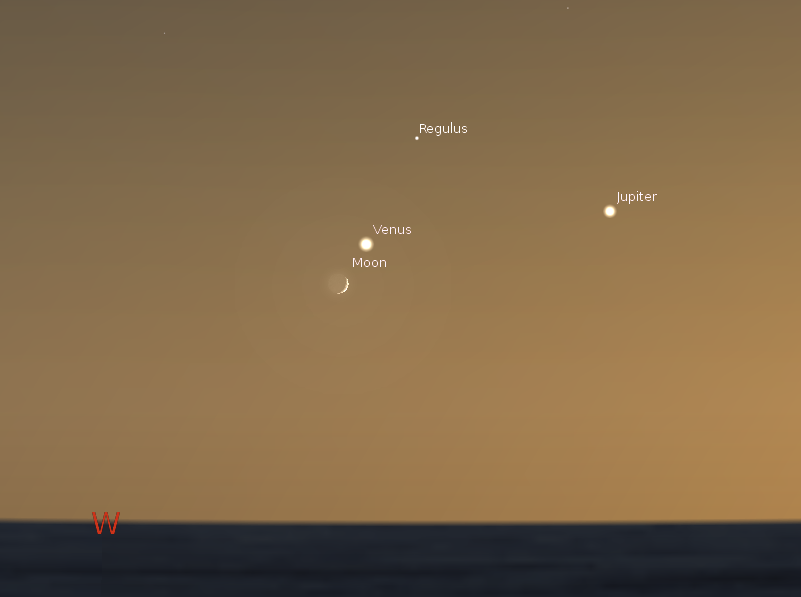
Venus appears above the thin crescent moon with Jupiter to the right at 10 p.m. Saturday July 18, 2015. Created using Stellarium.
07/01/2015 – Ephemeris – Jupiter, Venus and Saturn grace our evening sky
Ephemeris for Wednesday, July 1st. Today the Sun will be up for 15 hours and 31 minutes, setting at 9:32. The Moon, at full today, will rise at 8:58 this evening and tomorrow the Sun will rise at 6:01.
Lets take a look at the bright planets for this week. Our brilliant evening star Venus and Jupiter are close together in the west by 9:45 p.m. They will set around 11:45 p.m.. Venus’ will slide down to the Sun faster and faster in the coming weeks leaving Jupiter behind for a while. Venus will take a month and a half to slide past the Sun. Jupiter though will take 2 months, so Venus will pass it again around August 4th when both are too close to the horizon and Sun to spot. There’s a third conjunction of these two in October in the morning sky with Mars nearby. Saturn is in the southeast in evening twilight. It will pass due south at 10:53 p.m. and will set at 3:41 a.m. Even small telescopes can see Saturn’s rings.
Times are for the Traverse City/Interlochen area of Michigan. They may be different for your location.
Addendum
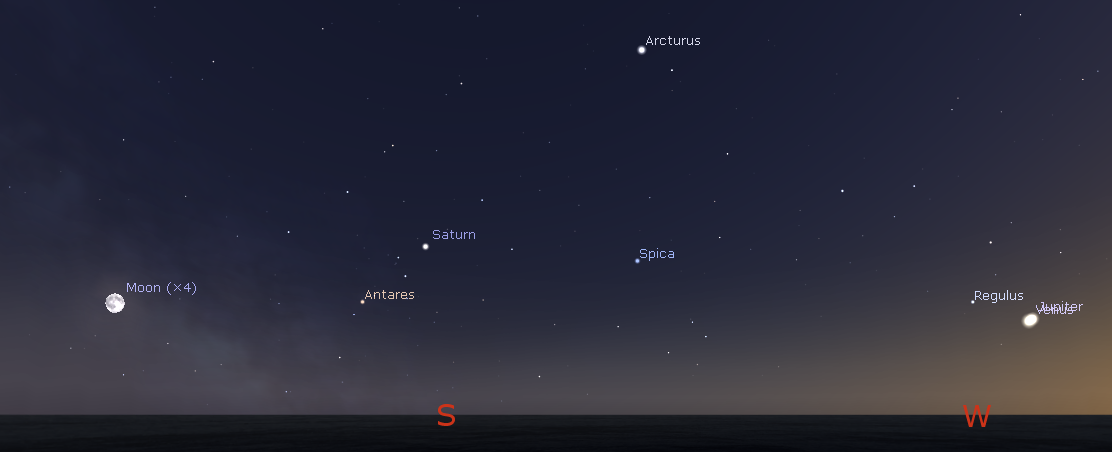
The evening planets and the Moon at 10:30 p.m. July 1, 2015. Though their images overlap Jupiter is above right of Venus. Click on the image to enlarge. Created using Stellarium.
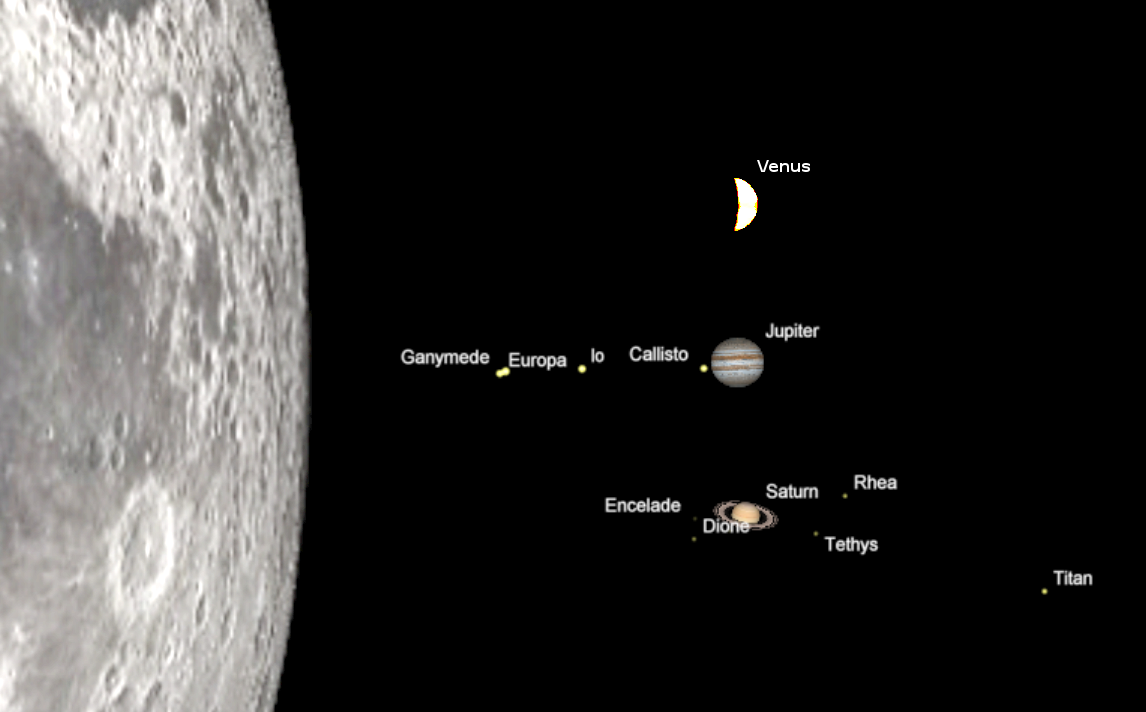
The evening planets and the Moon with their satellites to scale at 10:30 p.m. July 1, 2015. Created using Stellarium.
Mercury is officially in the morning sky now, but it is not a favorable appearance for northern hemisphere observers.
06/24/2015 – Ephemeris – Jupiter and Venus inch closer while Saturn keeps its distance
Ephemeris for Wednesday, June 24th. Today the Sun will be up for 15 hours and 34 minutes, setting at 9:32. The Moon, at first quarter today, will set at 1:58 tomorrow morning and tomorrow the Sun will rise at 5:58.
Lets take a look at the bright planets for this week. Our brilliant evening star Venus is in the west by 9:45 p.m. It will set around midnight. Venus’ will slide down to the Sun faster and faster in the coming weeks. It will take a bit less than 2 months. Jupiter will appear western sky to the left of and slightly above Venus at about 10 p.m. It will set at 12:09 a.m. It seems to approach Venus, and now appears about 3 and a half degrees away. That’s about three finger widths held at arm’s length. They will cross paths in 6 days, on the 30th. Saturn is in the southeast in evening twilight. It will pass due south at 11:22 p.m. and will set at 4:10 a.m. Even small telescopes can see Saturn’s rings.
Times are for the Traverse City/Interlochen area of Michigan. They may be different for your location.
Addendum
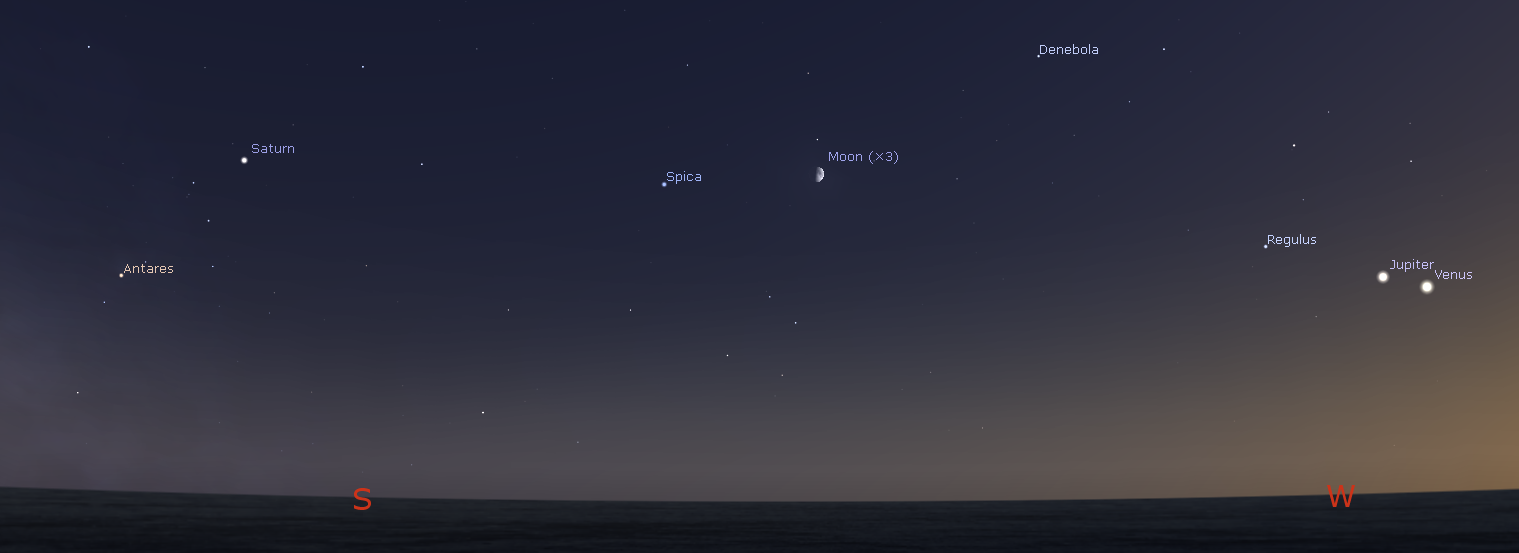
Jupiter and Venus converge in the west while the Moon and Saturn look on. 10:30 p.m., June 24, 2015. Created using Stellarium. Click to enlarge.
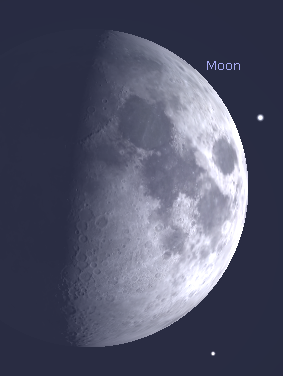
Closeup of the Moon at 10:30 p.m. June 24, 2015. Created using Stellarium.
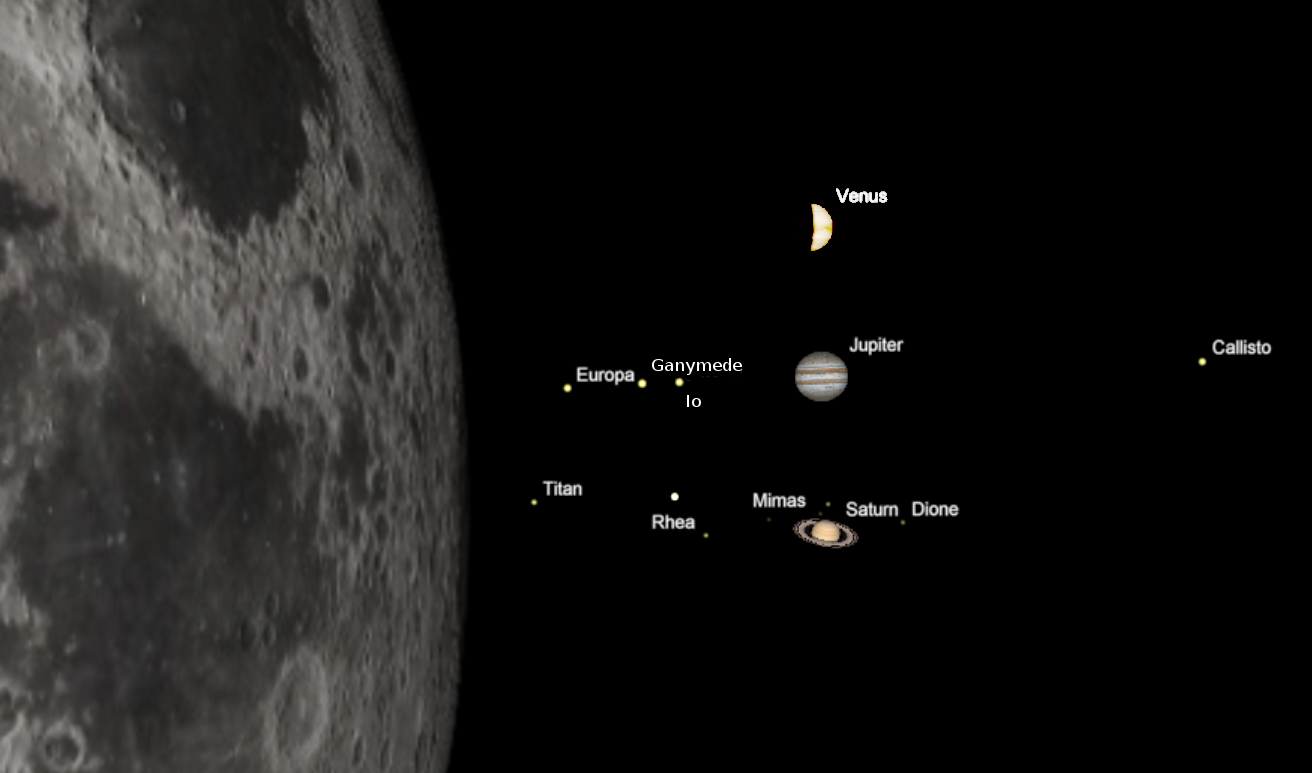
The evening planets and the Moon using the same magnification at 10:30 p.m., June 24, 2015. Created using Cartes du Ciel (Sky Charts). Click on image to enlarge.
Note that over the last few Wednesdays that I’ve portrayed the planets at the same scale that Venus has been getting larger with respect to Jupiter as it approaches the Earth and Jupiter moves away.
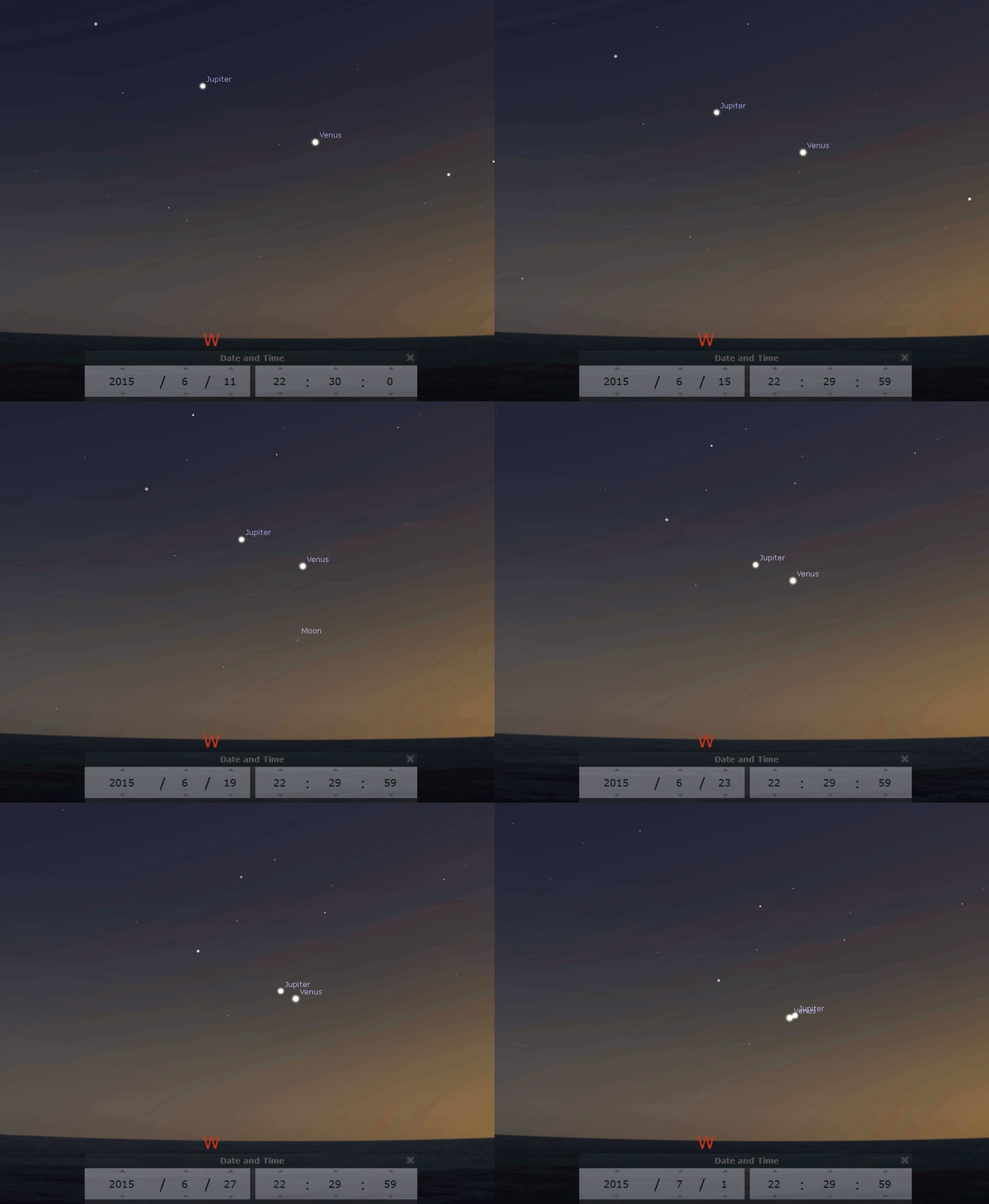
Jupiter-Venus approach animation June 11 to July 1, 2015 at 10:30 p.m. Created using Stellarium and GIMP. Click on image to enlarge.
 Bob Moler's Ephemeris Blog