Archive
07/01/2015 – Ephemeris – Jupiter, Venus and Saturn grace our evening sky
Ephemeris for Wednesday, July 1st. Today the Sun will be up for 15 hours and 31 minutes, setting at 9:32. The Moon, at full today, will rise at 8:58 this evening and tomorrow the Sun will rise at 6:01.
Lets take a look at the bright planets for this week. Our brilliant evening star Venus and Jupiter are close together in the west by 9:45 p.m. They will set around 11:45 p.m.. Venus’ will slide down to the Sun faster and faster in the coming weeks leaving Jupiter behind for a while. Venus will take a month and a half to slide past the Sun. Jupiter though will take 2 months, so Venus will pass it again around August 4th when both are too close to the horizon and Sun to spot. There’s a third conjunction of these two in October in the morning sky with Mars nearby. Saturn is in the southeast in evening twilight. It will pass due south at 10:53 p.m. and will set at 3:41 a.m. Even small telescopes can see Saturn’s rings.
Times are for the Traverse City/Interlochen area of Michigan. They may be different for your location.
Addendum
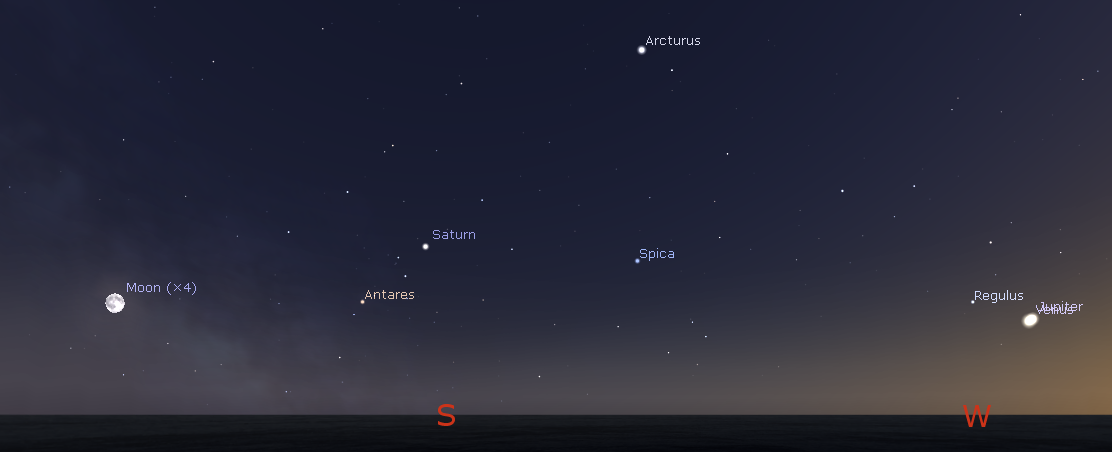
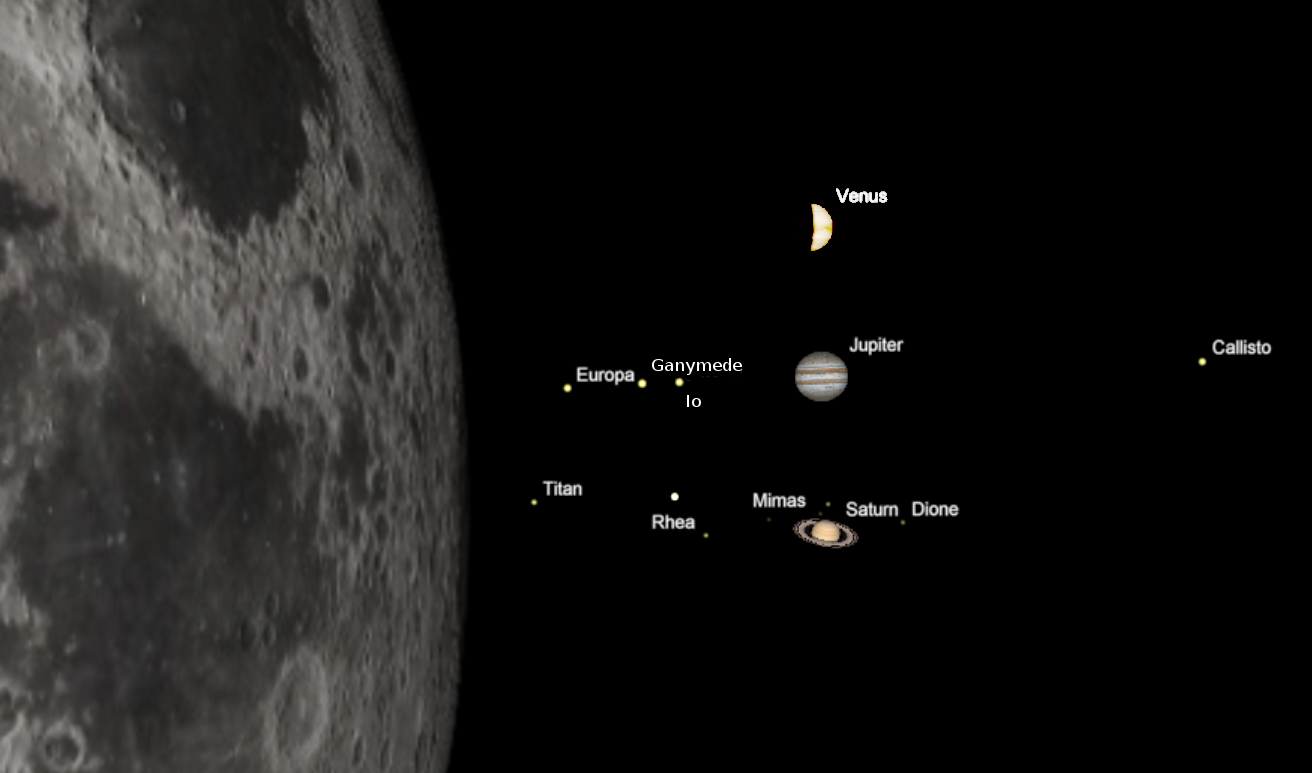
The evening planets and the Moon at 10:30 p.m. July 1, 2015. Though their images overlap Jupiter is above right of Venus. Click on the image to enlarge. Created using Stellarium.
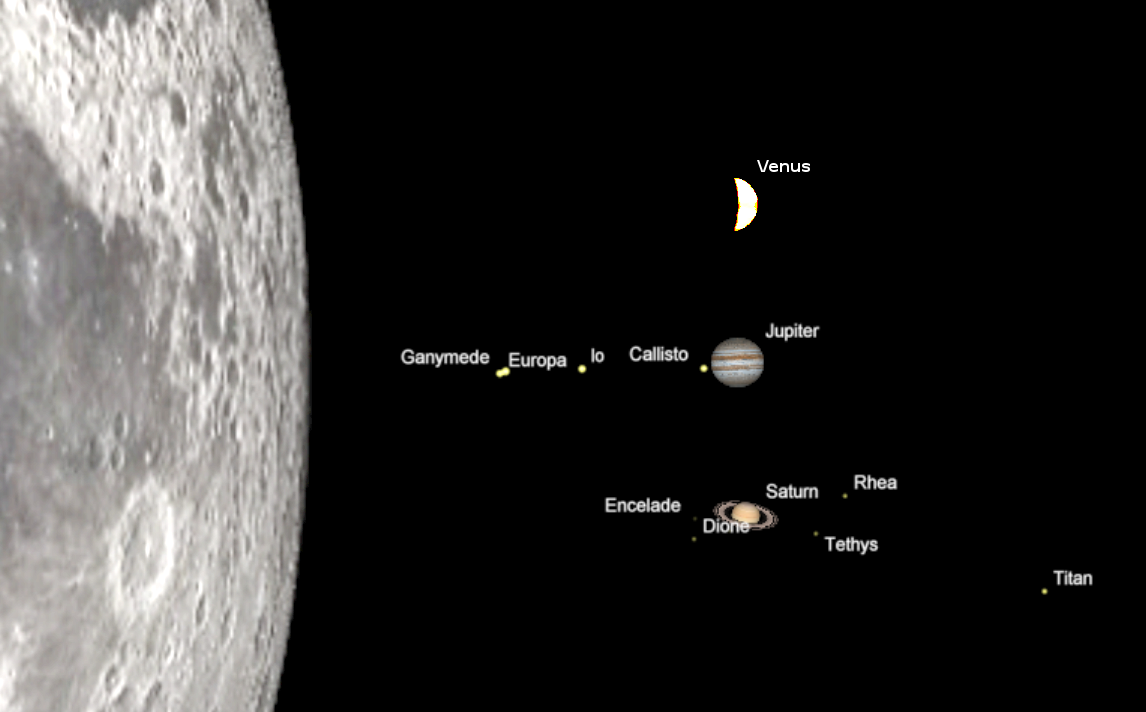
The evening planets and the Moon with their satellites to scale at 10:30 p.m. July 1, 2015. Created using Stellarium.
Mercury is officially in the morning sky now, but it is not a favorable appearance for northern hemisphere observers.
06/24/2015 – Ephemeris – Jupiter and Venus inch closer while Saturn keeps its distance
Ephemeris for Wednesday, June 24th. Today the Sun will be up for 15 hours and 34 minutes, setting at 9:32. The Moon, at first quarter today, will set at 1:58 tomorrow morning and tomorrow the Sun will rise at 5:58.
Lets take a look at the bright planets for this week. Our brilliant evening star Venus is in the west by 9:45 p.m. It will set around midnight. Venus’ will slide down to the Sun faster and faster in the coming weeks. It will take a bit less than 2 months. Jupiter will appear western sky to the left of and slightly above Venus at about 10 p.m. It will set at 12:09 a.m. It seems to approach Venus, and now appears about 3 and a half degrees away. That’s about three finger widths held at arm’s length. They will cross paths in 6 days, on the 30th. Saturn is in the southeast in evening twilight. It will pass due south at 11:22 p.m. and will set at 4:10 a.m. Even small telescopes can see Saturn’s rings.
Times are for the Traverse City/Interlochen area of Michigan. They may be different for your location.
Addendum
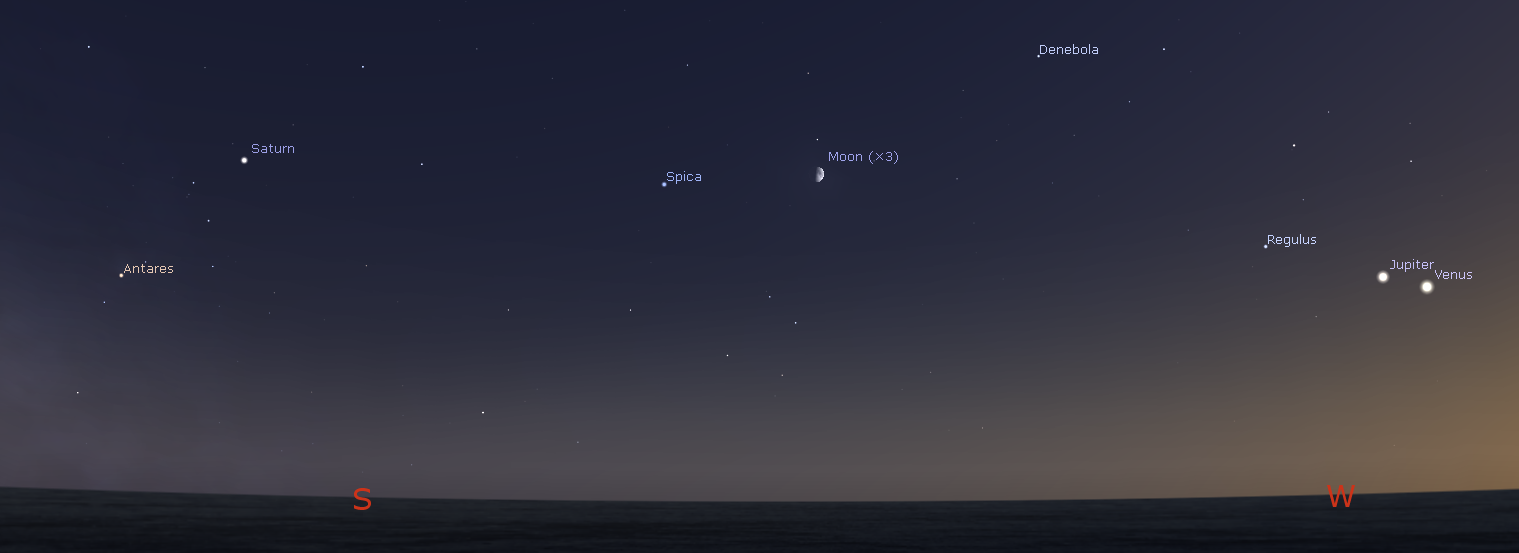
Jupiter and Venus converge in the west while the Moon and Saturn look on. 10:30 p.m., June 24, 2015. Created using Stellarium. Click to enlarge.
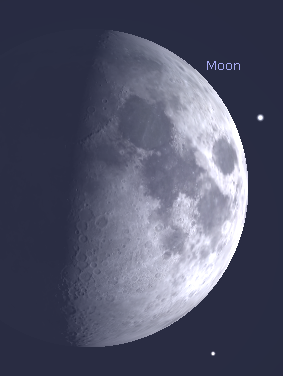
Closeup of the Moon at 10:30 p.m. June 24, 2015. Created using Stellarium.
The evening planets and the Moon using the same magnification at 10:30 p.m., June 24, 2015. Created using Cartes du Ciel (Sky Charts). Click on image to enlarge.
Note that over the last few Wednesdays that I’ve portrayed the planets at the same scale that Venus has been getting larger with respect to Jupiter as it approaches the Earth and Jupiter moves away.
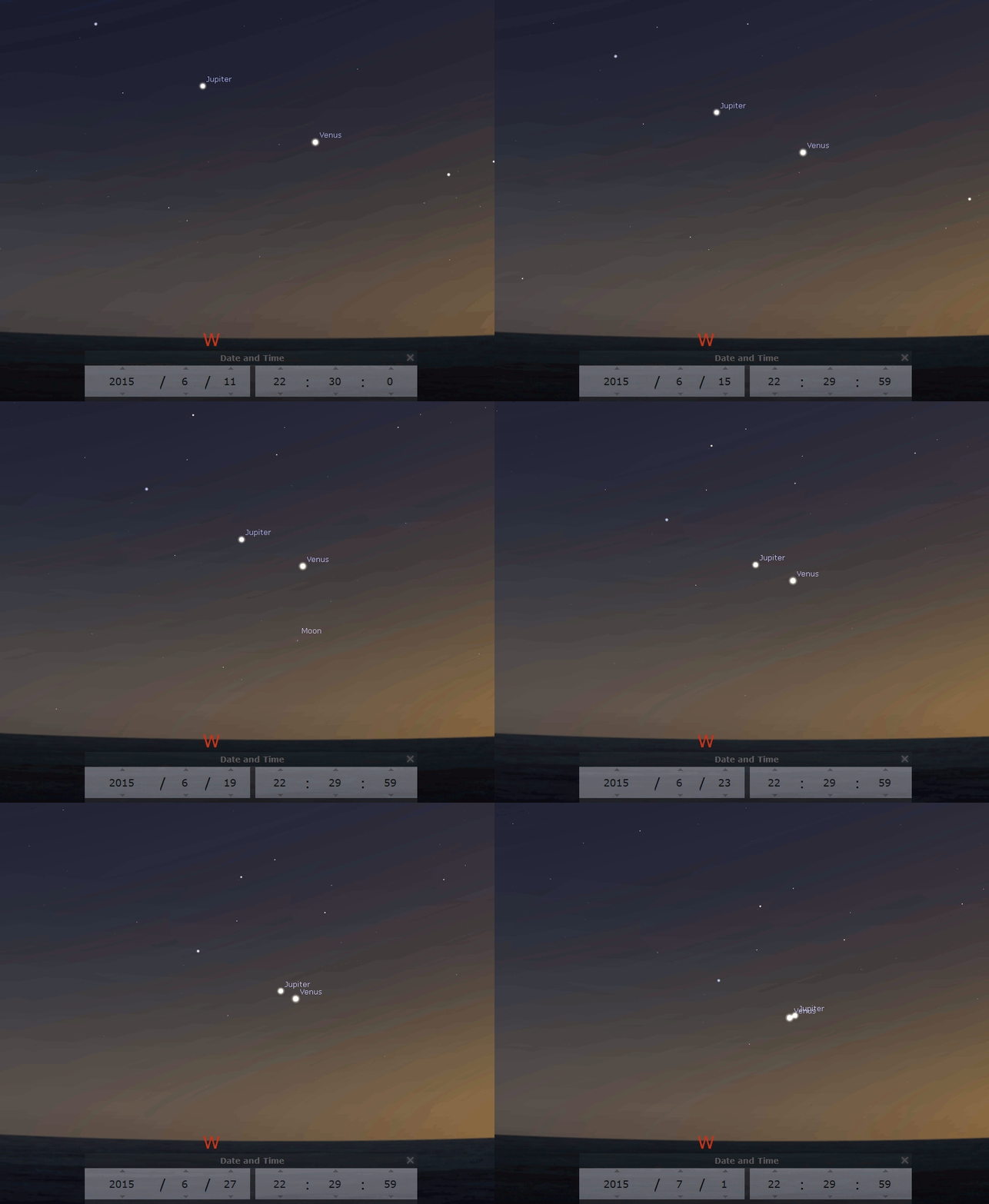
Jupiter-Venus approach animation June 11 to July 1, 2015 at 10:30 p.m. Created using Stellarium and GIMP. Click on image to enlarge.
06/17/2015 – Ephemeris – Jupiter and Venus approach each other while Saturn looks on
Ephemeris for Wednesday, June 17th. Today the Sun will be up for 15 hours and 34 minutes, setting at 9:30. The Moon, 1 day past new, will set at 10:14 this evening. Tomorrow the Sun will rise at 5:56.
Lets take a look at the bright planets for this week. Our brilliant evening star Venus is in the west by 9:45 p.m. It will set at 12:19 a.m. Venus’ will slide down to the Sun faster and faster in the coming weeks. It will take a bit less than 2 months. Jupiter will appear western sky to the left of and slightly above Venus at about 10 p.m. It will set at 12:34 a.m. It seems to approach Venus, and now appears about 8 degrees away. That’s somewhat less than the width of your fist held at arm’s length. They will cross paths in 13 days, on the 30th. Saturn is in the southeast in evening twilight. It will pass due south at 11:51 p.m. and will set at 4:39 a.m. Check out Saturn’s rings in any small telescope.
Times are for the Traverse City/Interlochen area of Michigan. They may be different for your location.
Addendum
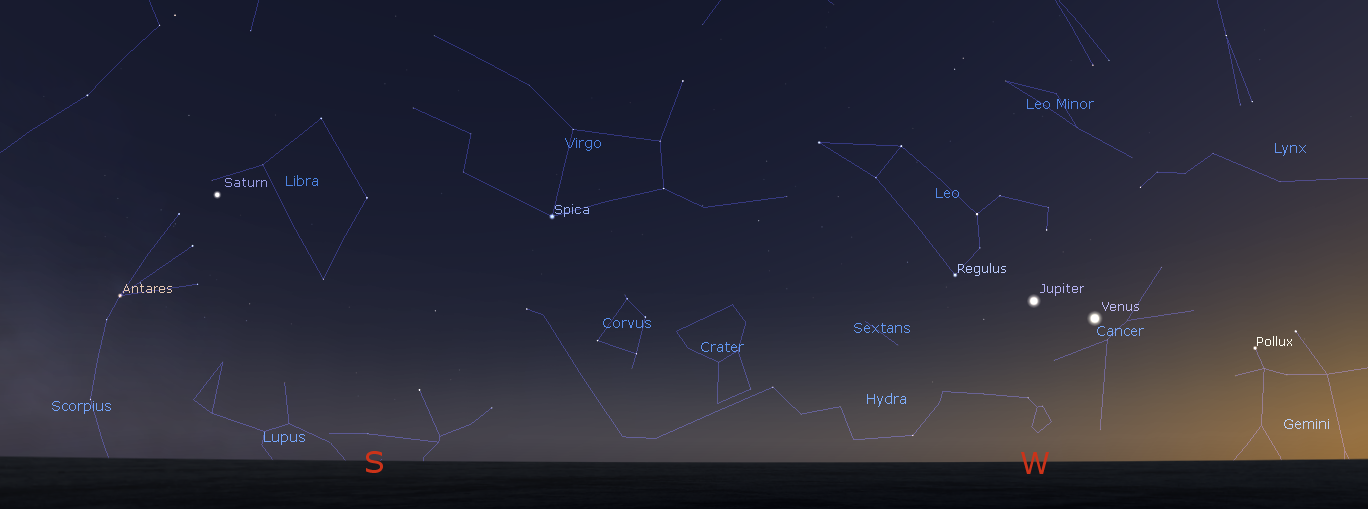
Venus, Jupiter and Saturn with the late spring southern constellations at 10:30 p.m., June 17, 2015. Created using Stellarium. Click on image to enlarge.
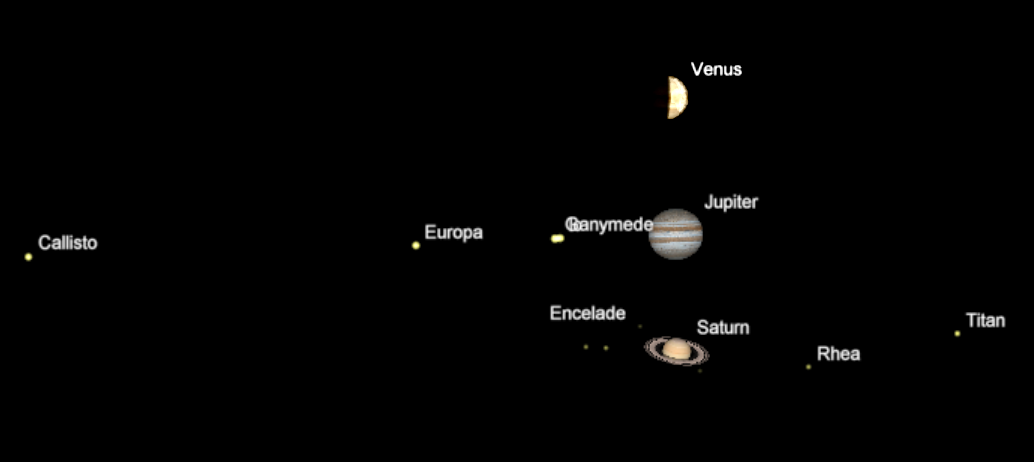
The evening planets using the same magnification at 10:30 p.m., June 17, 2015. Created using Cartes du Ciel (Sky Charts). Click on image to enlarge. Note that Jupiter’s moons Ganymede and Io are so close their labels overlap.
06/12/2015 – Ephemeris – The first stars to appear at night
Ephemeris for Friday, June 12th. Today the Sun will be up for 15 hours and 31 minutes, setting at 9:28. The Moon, 3 days past last quarter, will rise at 4:03 tomorrow morning. Tomorrow the Sun will rise at 5:56.
Evening twilight lasts a very long time this time of year, so the stars will come out slowly. By about a half hour after sunset the planets Venus and Jupiter should be visible in the west. Probably the first actual star to appear is very high in the east, the orange star Arcturus in the constellation of Boötes, which is the 4th brightest night-time star. Next, lower in the northeast, is the 5th brightest star the white Vega in Lyra the harp. By this time Saturn should appear low in the southeast as a yellowish star. Soon many more stars will become visible with the Big Dipper overhead pointing to Polaris in the north, blue-white Spica in the south, Regulus, left of Jupiter and Capella low in the northwest.
Times are for the Traverse City/Interlochen area of Michigan. They may be different for your location.
Addendum
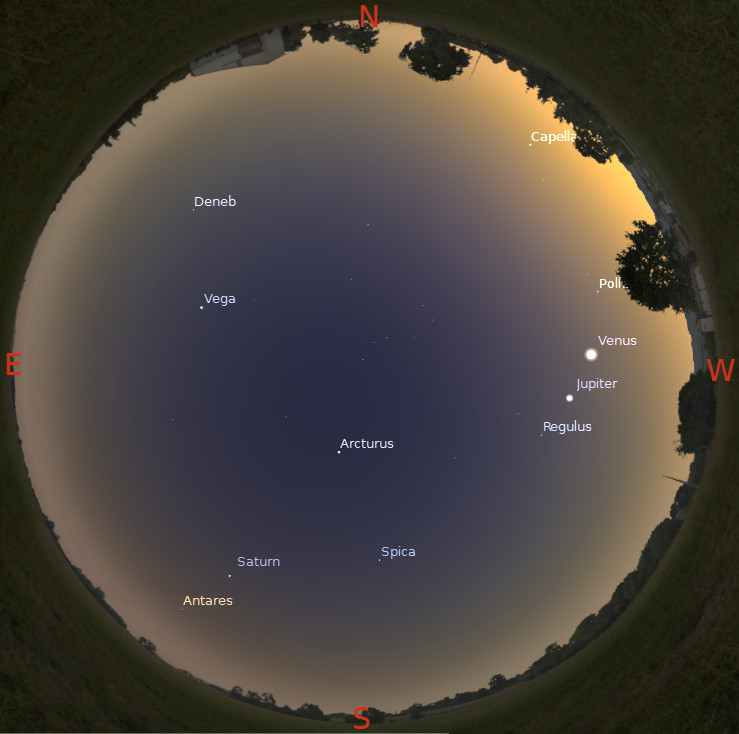
The first stars to appear after sunset. This is created from Stellarium for a half hour after sunset. It’s a bit optimistic, in my view, though my eyes aren’t the best. Try your eyes. Click on image to enlarge.
06/10/2015 – Ephemeris – Three bright planets in the evening
Ephemeris for Wednesday, June 10th. Today the Sun will be up for 15 hours and 30 minutes, setting at 9:27. The Moon, 1 day past last quarter, will rise at 2:52 tomorrow morning. Tomorrow the Sun will rise at 5:56.
Lets take a look at the bright planets for this week. Our brilliant evening star Venus is in the west by 9:45 p.m. It will set at 12:31 a.m. Venus reached its greatest eastern elongation or separation from the Sun last Saturday it is now setting earlier. Venus’ slide down to the Sun will be much faster than its climb to greatest elongation. It will take a bit more than 2 months. Jupiter will appear western sky to the left of and slightly above Venus at about 10 p.m. It will set at 12:59 a.m. It seems to approach Venus. Now it appears about 13 degrees away. That’s somewhat more than the width of your fist held at arm’s length. They will cross paths on the 30th. Saturn is in the southeast as evening twilight fades.
Times are for the Traverse City/Interlochen area of Michigan. They may be different for your location.
Addendum
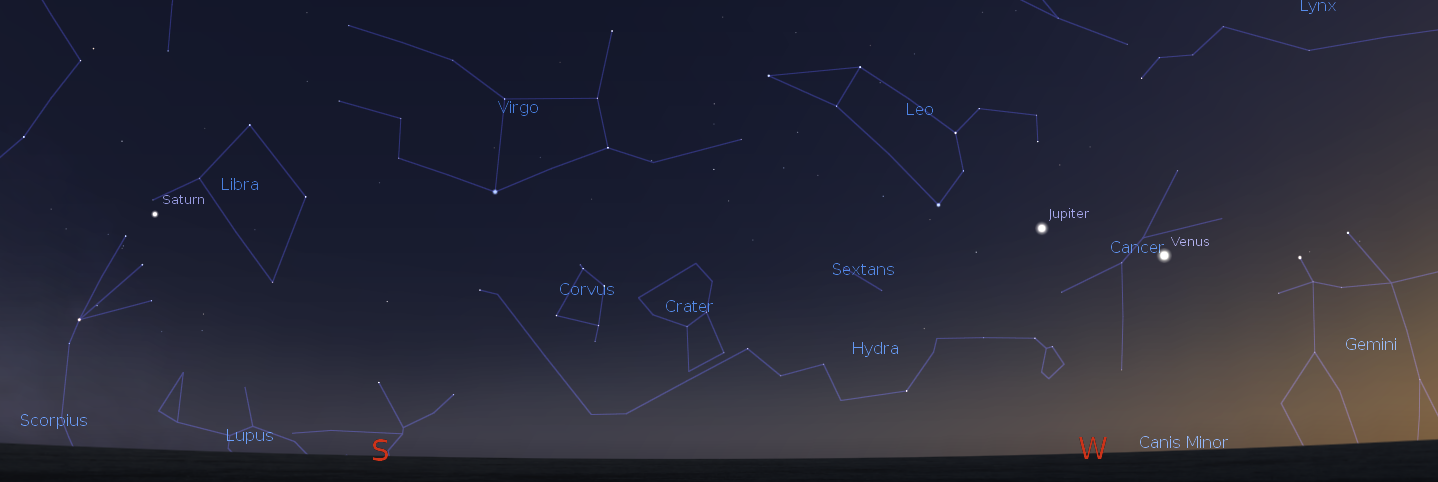
Venus, Jupiter and Saturn with the late spring southern constellations at 10:30 p.m., June 10, 2015. Created using Stellarium. Click on image to enlarge.
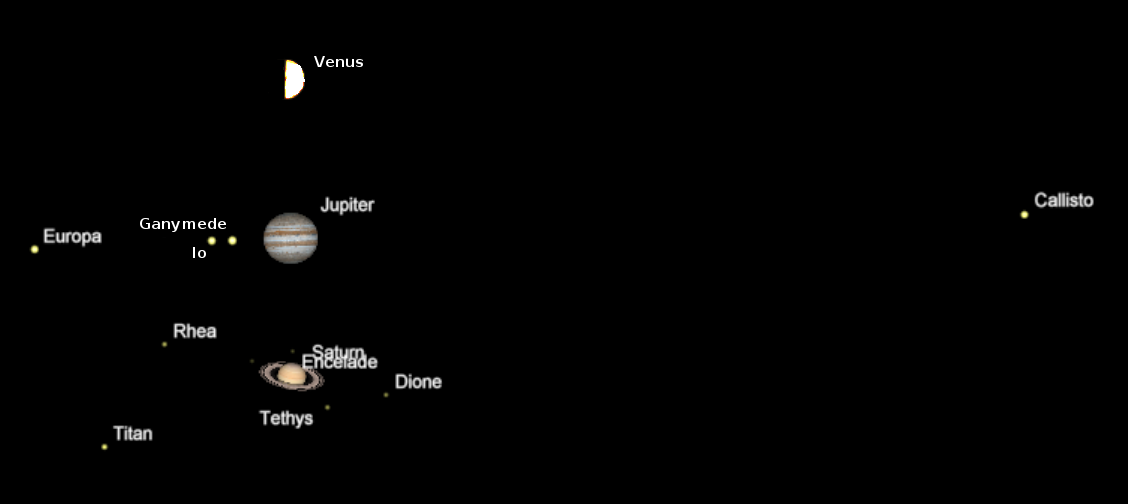
The evening planets using the same magnification at 10:30 p.m., June 10, 2015. Created using Cartes du Ciel (Sky Charts). Click on image to enlarge.
06/08/2015 – Ephemeris – Libra in the balance
Ephemeris for Monday, June 8th. Today the Sun will be up for 15 hours and 28 minutes, setting at 9:26. The Moon, 1 day before last quarter, will rise at 1:46 tomorrow morning and tomorrow the Sun will rise at 5:57.
One of the constellations of the Zodiac or circle of animals isn’t either animal or human. It is Libra the Scales or balance. It lies low in the southeastern sky at 11 p.m., just to the right of the rising Saturn and Scorpius the scorpion. Libra, it seems, is an afterthought, a simple diamond shape of four stars. Its two brightest stars Zubeneschamali and Zubenelgenubi translate to the north and south claw respectively, of Scorpius to the left of it. The Arabs, at least, seemed to view this as part of Scorpius. The balance was perhaps to signify the equality of day and night, at the time the sun was in this part of the sky at the start of autumn, over 2000 years ago. Now its in Virgo.
Times are for the Traverse City/Interlochen area of Michigan. They may be different for your location.
Addendum
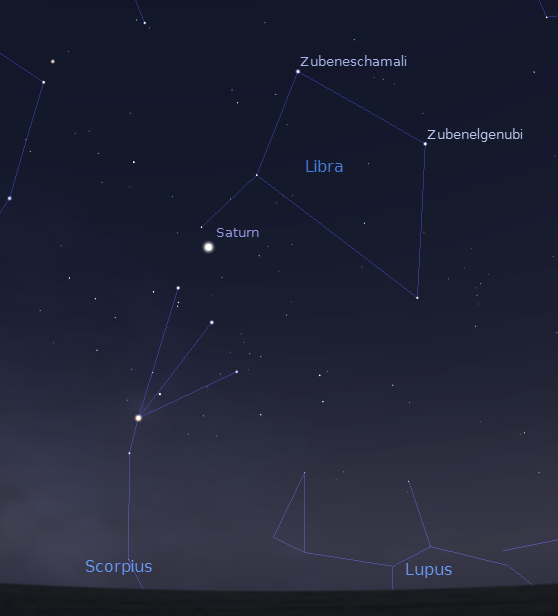
Libra with Saturn and Scorpius rising behind in the southeast at 10:30 p.m. on June 8, 2015. Created using Stellarium.
06/03/2015 – Ephemeris – The visible bright planets are hanging on in the evening
Ephemeris for Wednesday, June 3rd. Today the Sun will be up for 15 hours and 23 minutes, setting at 9:22. The Moon, 1 day past full, will rise at 10:15 this evening and tomorrow the Sun will rise at 5:59.
Lets take a look at the bright planets for this week. Our brilliant evening star Venus is in the west by 9:45 p.m. It will set at 12:40 a.m. As Venus is reaching its greatest eastern elongation or separation from the Sun it is now setting earlier. Venus apparent orbit of the Sun is also tilting to a lower angle with the horizon, since though east, it is now south of the Sun. Jupiter will appear high in the west-southwestern sky about 10 p.m. It will set at 1:23 a.m. It’s near the sickle-shaped head of Leo the lion, and it’s the second brightest star-like object in the sky after Venus, which is approaching it. Saturn is in the southeast as evening twilight fades. It will set at 5:37 a.m. in the southwest.
Times are for the Traverse City/Interlochen area of Michigan. They may be different for your location.
Addendum
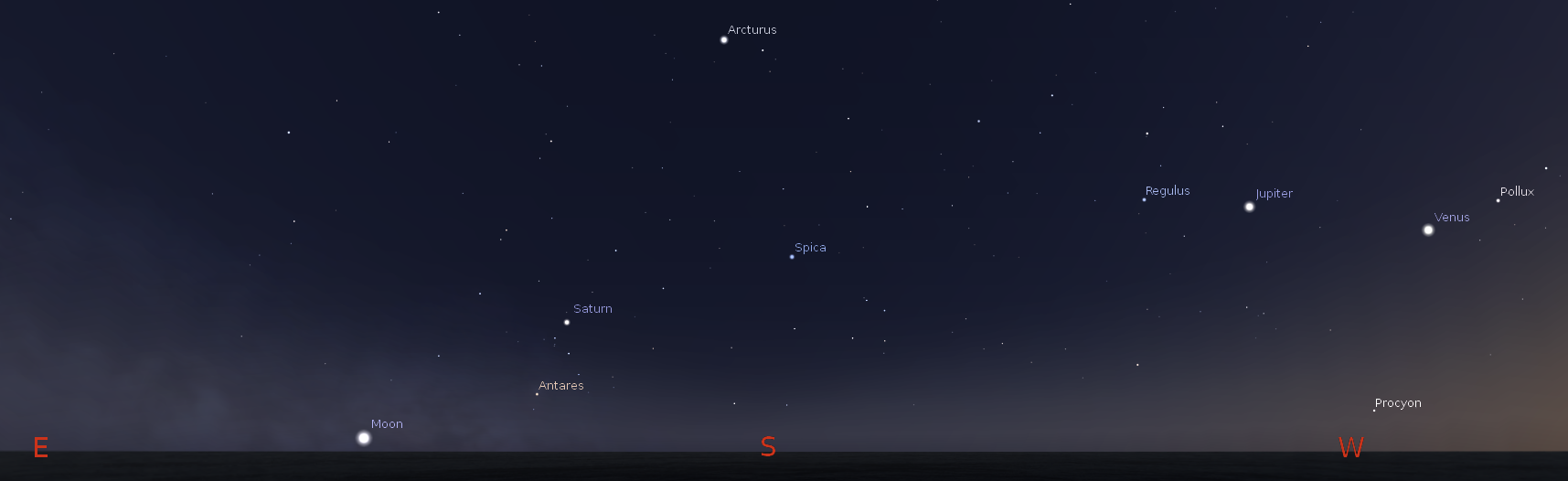
The evening planets and bright stars, including the Moon, at 10:30 p.m. June 3, 2015. Created using Stellarium. Click on Image to enlarge.
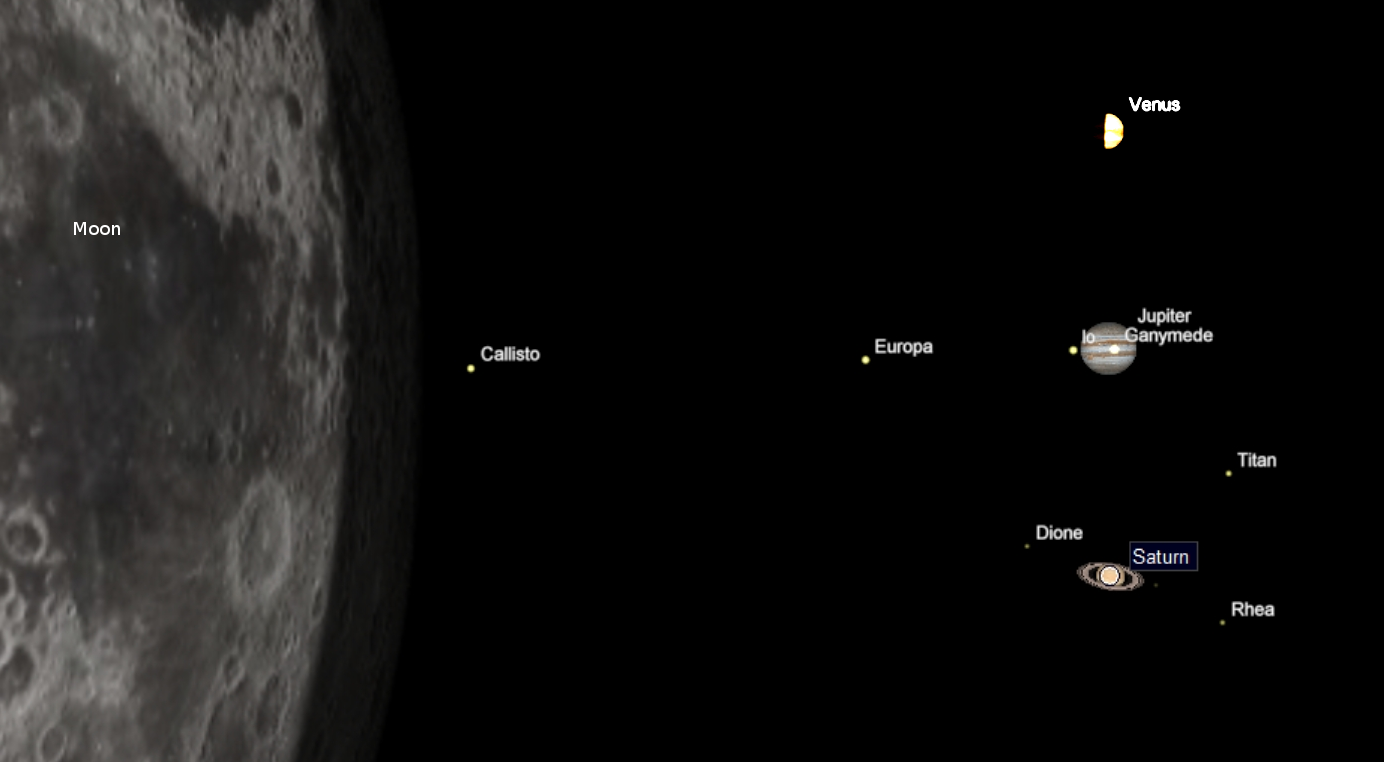
Comparison of the apparent sizes and satellite locations of the bright planets and the Moon at 10:30 p.m. June 3, 2015. Created using Cartes du Ciel (Sky Charts) and GIMP.
Jupiter’s satellites Io and Ganymede have a busy night tonight
Satellite  Event           UT            EDT
Ganymede   Transit Start   June 4  0:17  June 3  8:17 p.m.
Io         Transit Start   June 4  2:46  June 3 10:46 p.m.
Io         Shadow Start    June 4  3:56  June 3 11:56 p.m.
Ganymede   Transit End     June 4  3:56  June 3 11:56 p.m.
Ganymede   Shadow Start    June 4  4:57  June 4 12:57 a.m.
Io         Transit End     June 4  5:04  June 4  1:04 a.m.
Io         Shadow End      June 4  6:13  *
Ganymede   Shadow End      June 4  8:35  *

* Not visible from the Traverse City/Interlochen are, Jupiter has set.
Satellite data was taken from www.projectpluto.com/jevent.htm
05/28/2015 – Ephemeris – Saturn’s satellites
Thursday, May 28th. Today the Sun will be up for 15 hours and 14 minutes, setting at 9:17. The Moon, 3 days past first quarter, will set at 3:56 tomorrow morning and tomorrow the Sun will rise at 6:02.
Saturn has a lot of moons, even if you don’t count the billions of ring particles circling the planet. The count is up to 62, five short of Jupiter’s 67 at last count. The largest is Titan which is larger than Mercury, a world with a thick nitrogen atmosphere and liquid filled lakes. At its distance from the Sun, some 10 times Earth’s and receiving only one percent the heat we get the lakes are filled with methane and ethane while the surface rocks are water ice. The small moon Enceladus spews salty water geysers at its south pole. The more distant moon Iapetus is half black and half white and has an equatorial mountain range that rings it like a walnut. Another moon Hyperion appears like it’s honeycombed.
Times are for the Traverse City/Interlochen area of Michigan. They may be different for your location.
Addendum
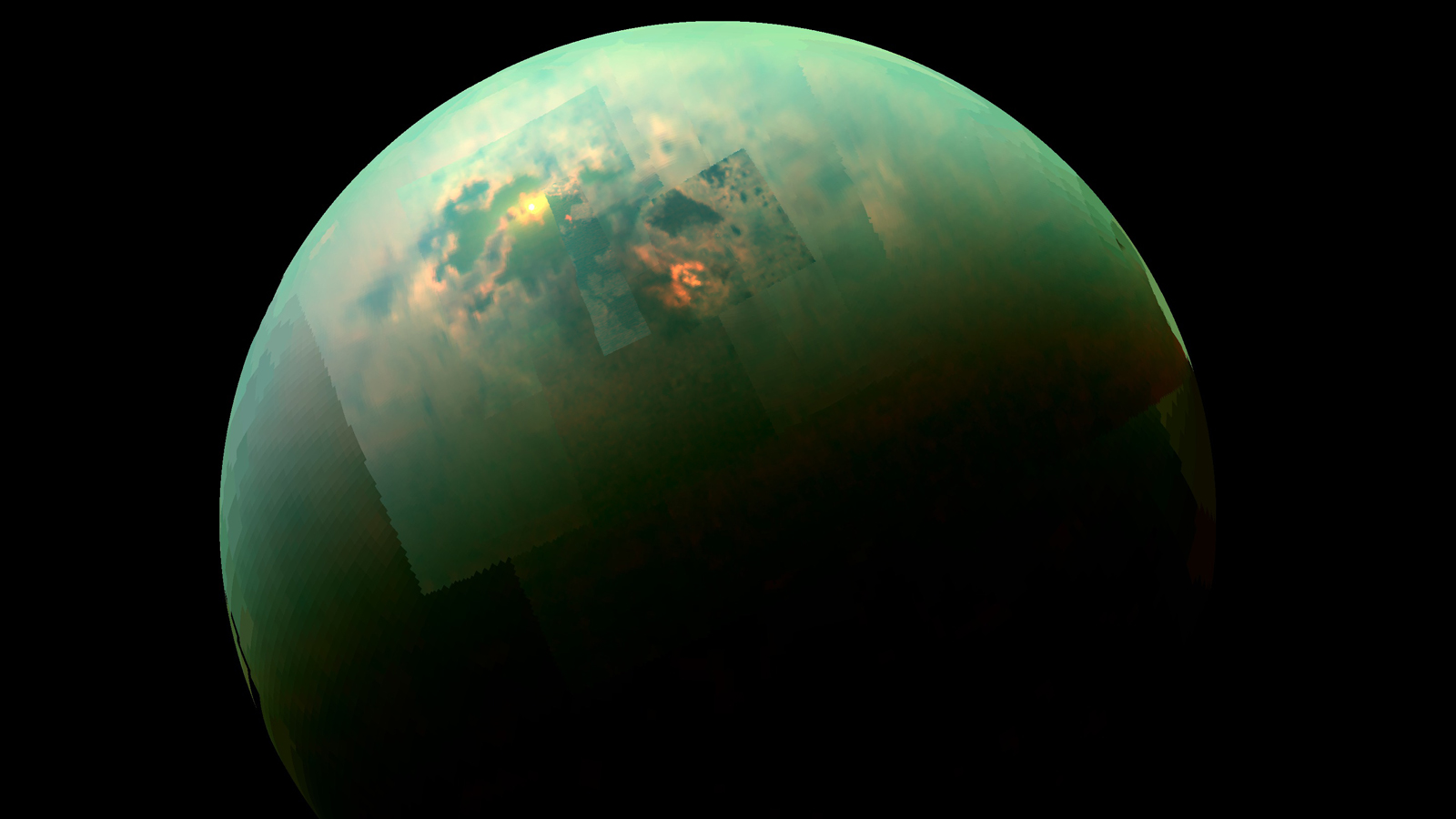
Titan in a false color near infrared view, showing the Sun’s light glinting off a north polar sea. Credit: NASA/JPL.
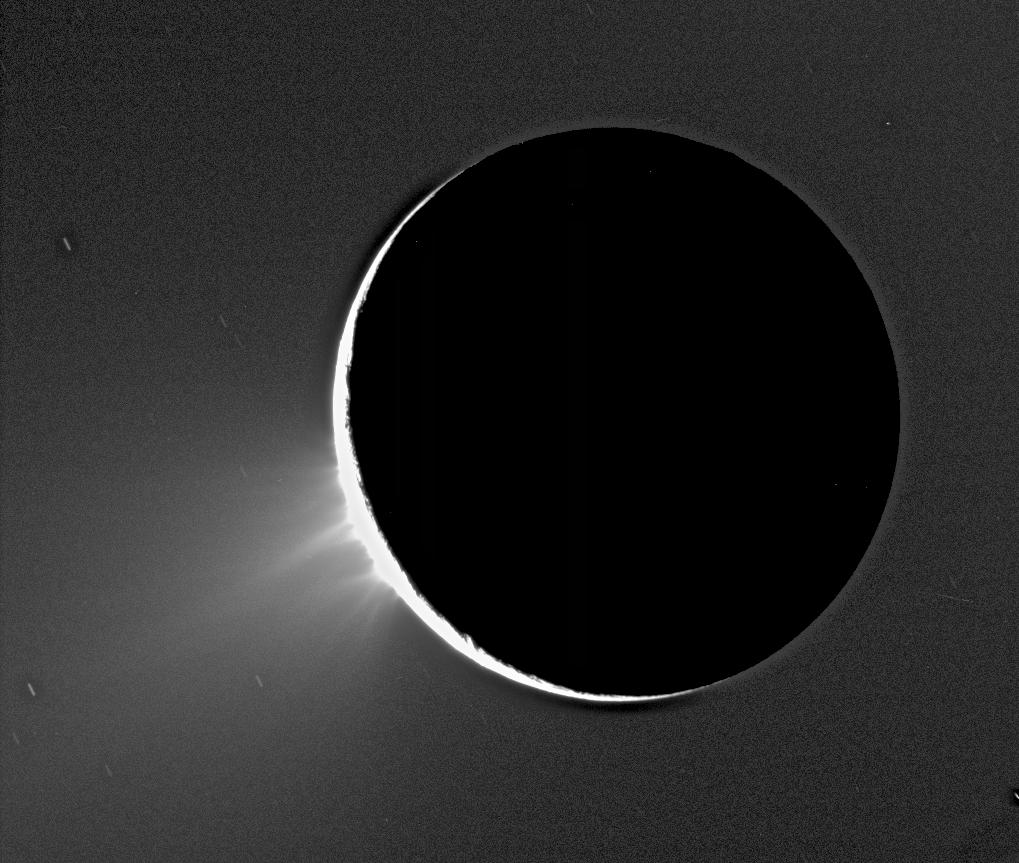
Enceladus’ south polar geysers create the E ring. Credit: NASA/JPL.
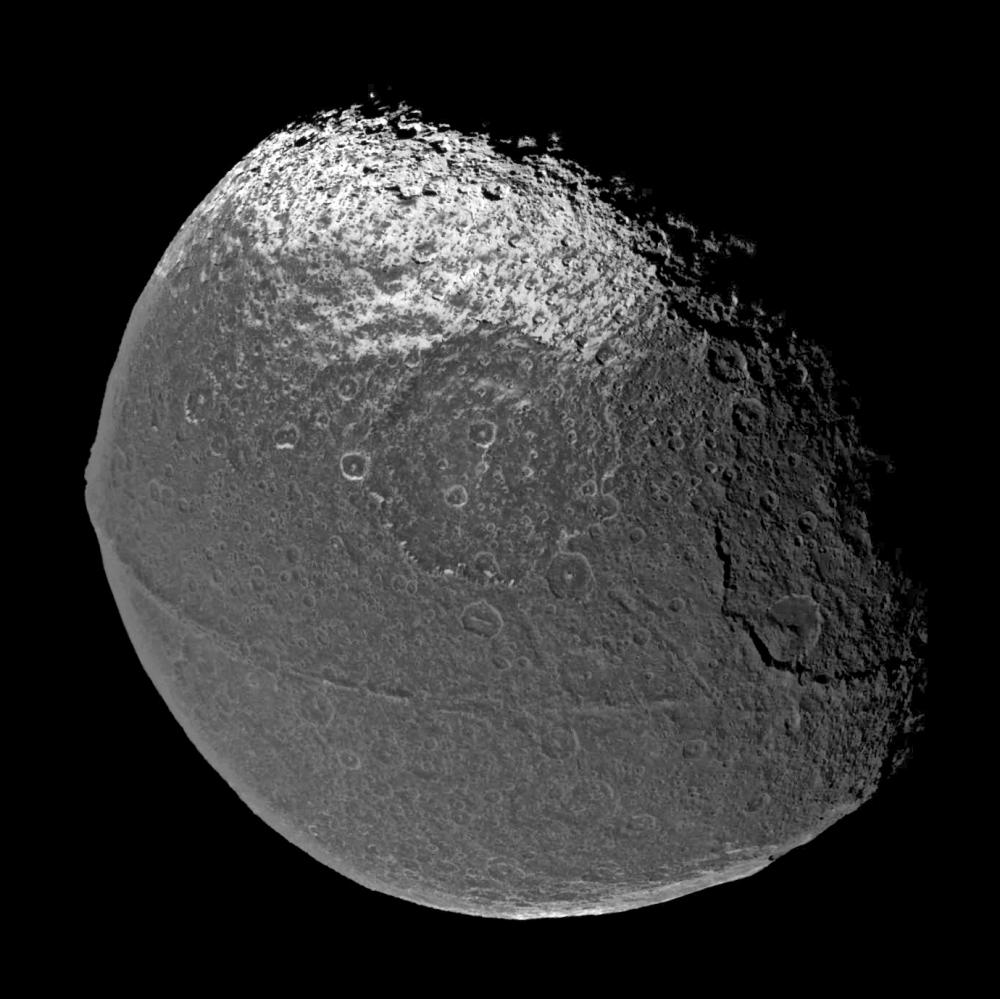
Iapetus showing mostly its dark side and equatorial mountain ridge. Credit: NASA/JPL.
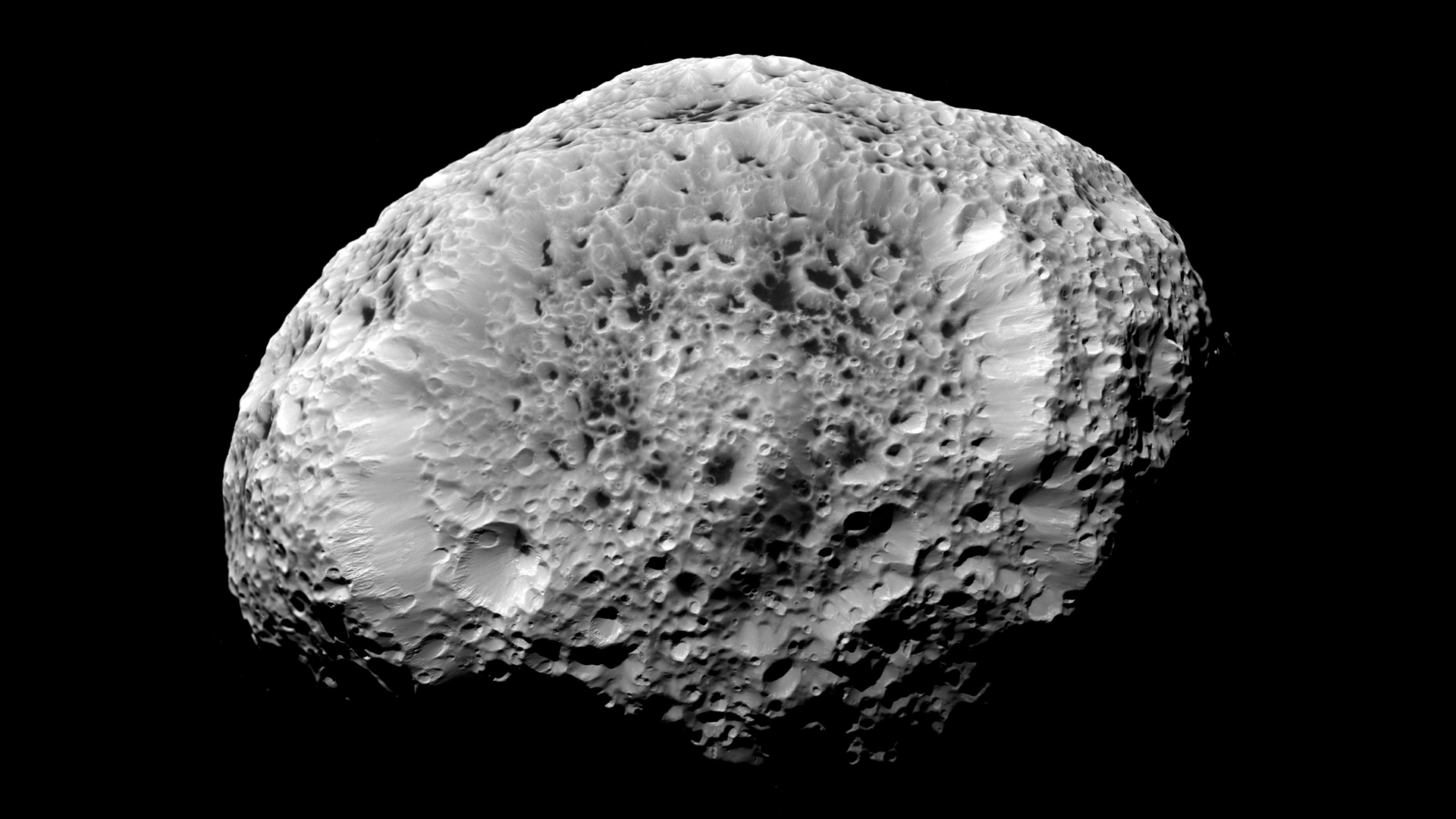
The weird moon Hyperion. It’s half as dense as ice. Credit: NASA/JPL:
05/27/2015 – Ephemeris – Let’s look at the bright planets for this week
Ephemeris for Wednesday, May 27th. Today the Sun will be up for 15 hours and 12 minutes, setting at 9:16. The Moon, 2 days past first quarter, will set at 3:28 tomorrow morning and tomorrow the Sun will rise at 6:03.
Lets take a look at the bright planets for this week. Our brilliant evening star Venus is seen in the west by 9:30 p.m. In telescopes it will appear as a dazzling orb somewhat over half illuminated by the sun. It will set at 12:46 a.m. Finally it’s beginning to set earlier. The Sun is catching up with it. Venus will reach its greatest angular separation from the Sun on June 6th. Venus is seen below the stars Castor and Pollux in Gemini. Jupiter will appear high in the west-southwestern sky before 10 p.m. It will set at 1:48 a.m. It’s near the sickle-shaped head of Leo the lion. Saturn will be seen in the east southeastern sky as evening twilight deepens. It’s in Scorpius this year.
Times are for the Traverse City/Interlochen area of Michigan. They may be different for your location.
Addendum
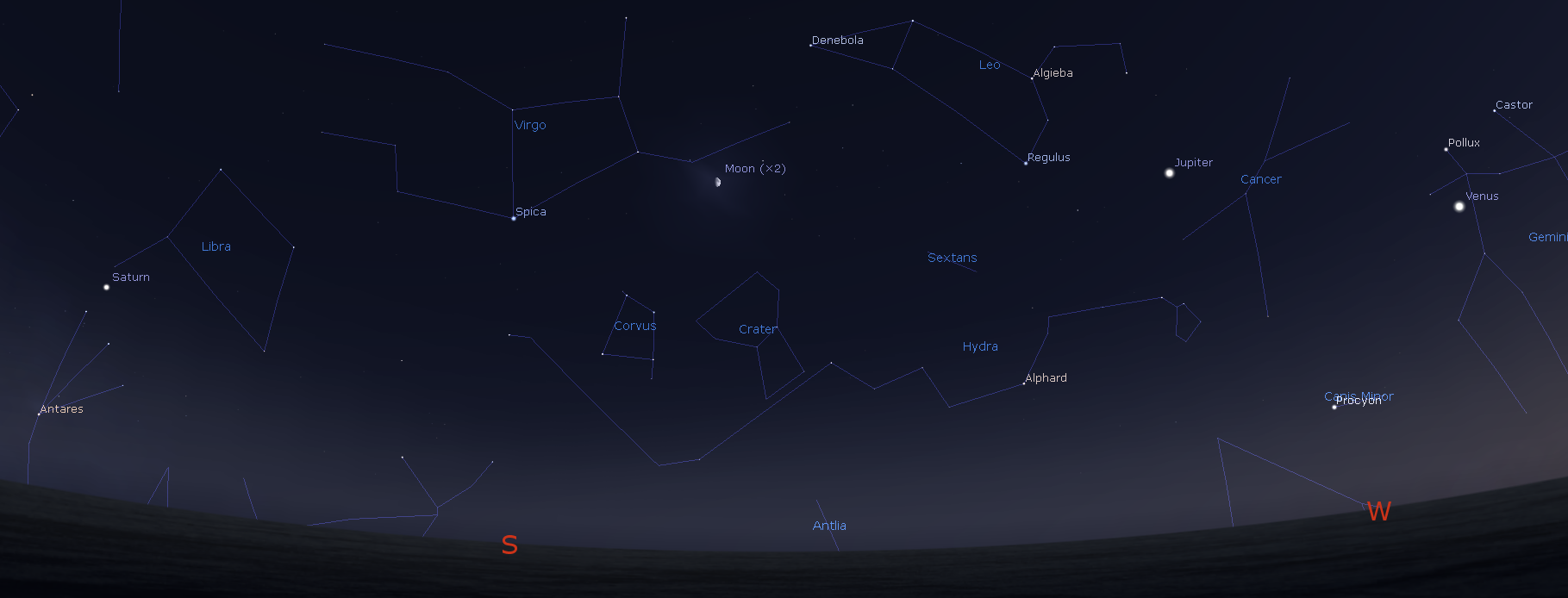
The evening planets and the Moon from west to east at 10:30 p.m. on May 27, 2015. Created using Stellarium.
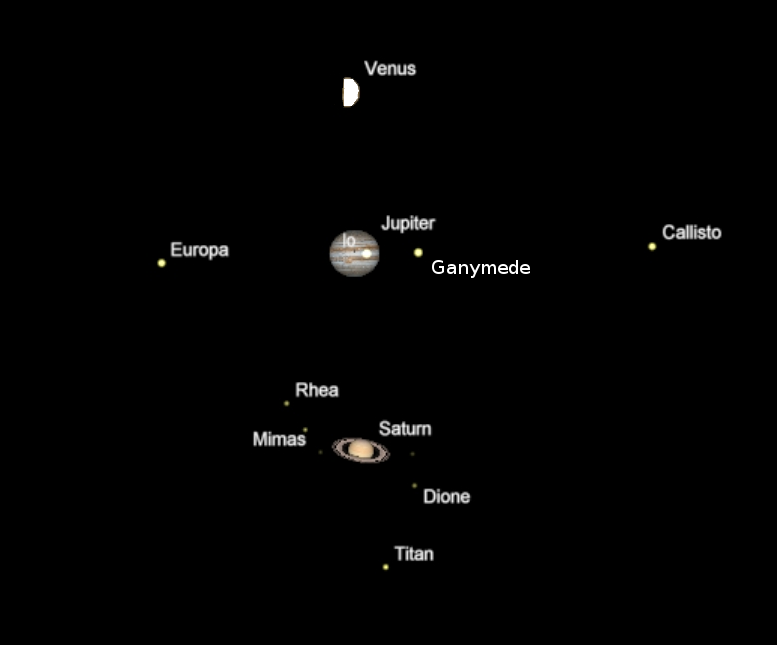
Apparent sizes of the planets Venus, Jupiter and Saturn compared for 10:30 p.m. on May 27, 2015. Created using Cartes du Ceil (Sky Charts).
Note above that the moon Io will be transiting Jupiter at 10:30 p.m. It’s shadow is also projected on the planet. Io will move off the planet at 11:06 p.m., and the shadow event will end at 12:18 a.m.
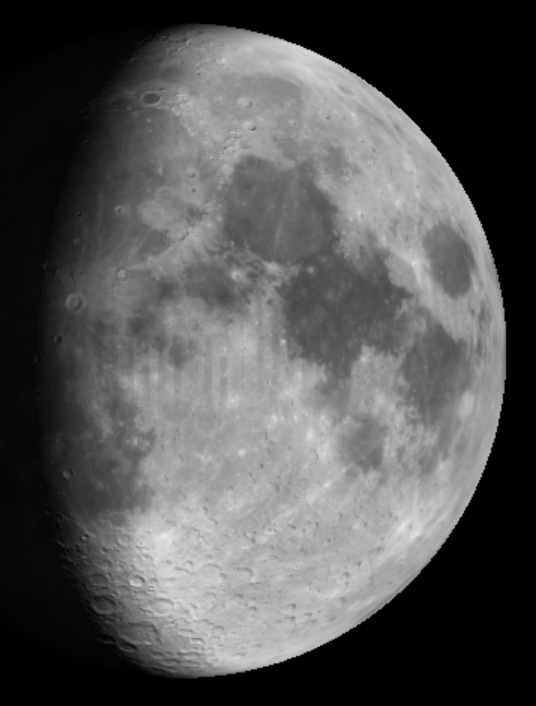
Telescopic view of the Moon at 10:30 p.m. on May 27,2015. Created using Virtual Moon Atlas.
05/20/2015 – Ephemeris – Evening bright planet lineup
Ephemeris for Wednesday, May 20th. Today the Sun will be up for 14 hours and 59 minutes, setting at 9:09. The Moon, 2 days past new, will set at 11:35 this evening, and tomorrow the Sun will rise at 6:08.
Lets take a look at the bright planets for this week. Mercury is now too close to the Sun to really be spotted in the evening twilight. It’s at a 13 degree angle from the sun and will set at 10:47. Mercury is getting dimmer as its phase becomes a decreasingly thin crescent. Our brilliant evening star Venus is in the west by 9:30 p.m. It will set at 12:47 a.m. Jupiter will appear high in the west-southwestern sky before 10 p.m. It will set at 2:14 a.m. It’s near the sickle-shaped head of Leo the lion, and it’s the second brightest star-like object in the sky after Venus. Saturn will rise in the east-southeast at 9:03 p.m. It will be low in the southwest as morning twilight brightens. It’s rings and the moon Titan can be seen in small telescopes.
Times are for the Traverse City/Interlochen area of Michigan. They may be different for your location.
Addendum
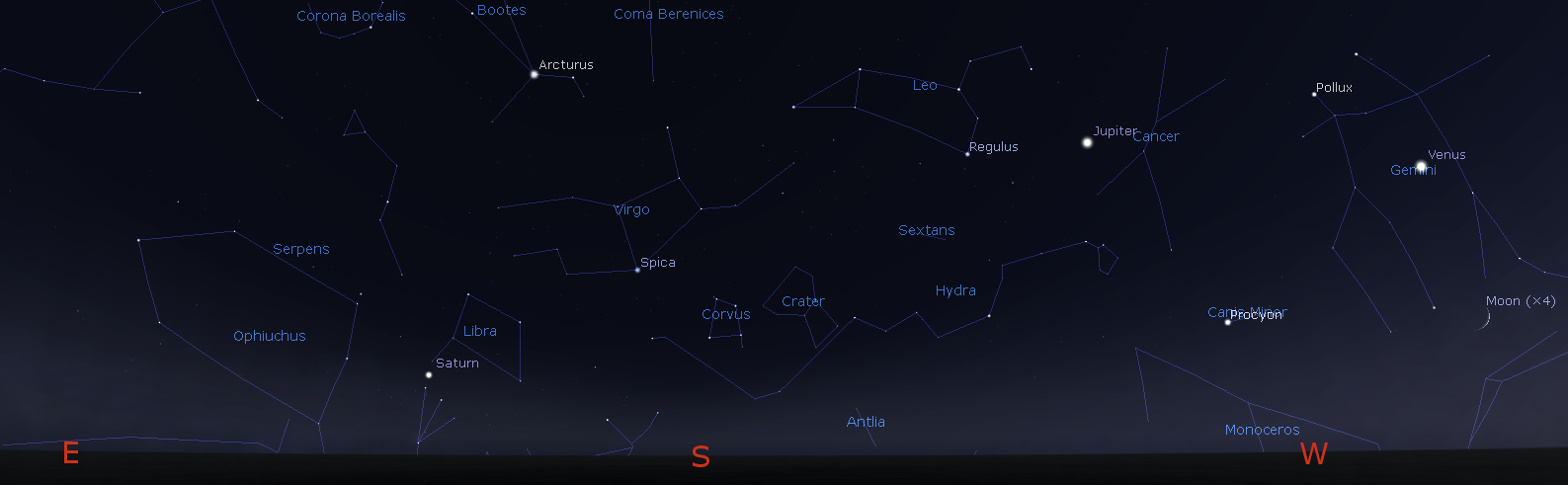
The evening planets from west to east at 10:30 p.m. on May 20, 2015. Created using Stellarium.
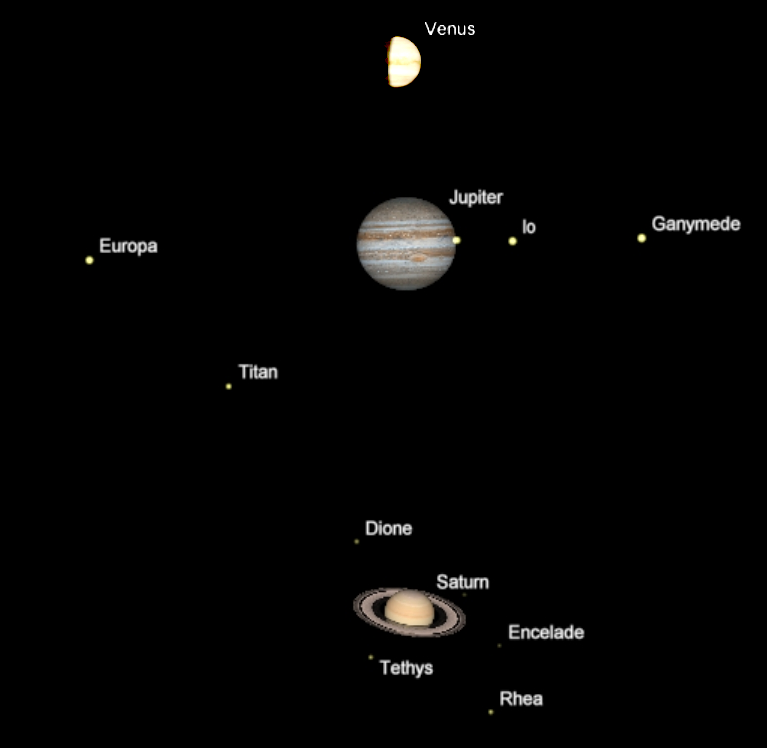
Telescopic views of the evening planets showing their relative sizes at 10:30 p.m. on May 20, 2015. Created using Cartes du Ceil (Sky Charts).
Note: The unnamed satellite of Jupiter is Callisto, which ended its transit of Jupiter at 10:27 p.m.
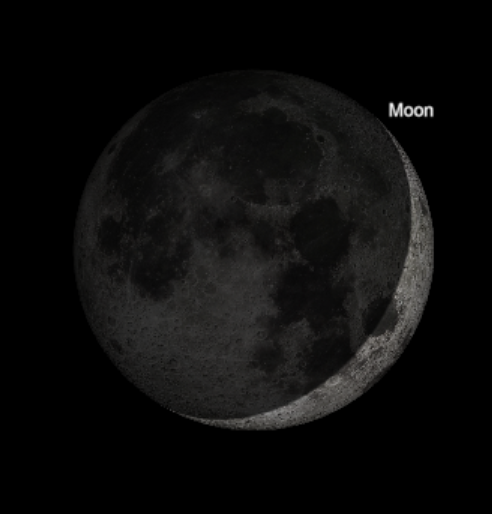
Binocular-like view of the Moon at 10:30 p.m. on May 20,2015. Created using Cartes du Ceil (Sky Charts).

