Archive
08/19/2015 – Ephemeris – Saturn’s in the evening, but say “Good morning” to Mars
Ephemeris for Wednesday, August 19th. The Sun rises at 6:49. It’ll be up for 13 hours and 52 minutes, setting at 8:42. The Moon, 3 days before first quarter, will set at 10:59 this evening.
Lets take a look for the bright planets for this week. Saturn is alone in the evening sky spotted low in the southwestern sky near the bright star Antares to its lower left. It will set at 12:26 a.m. Venus crossed over to the morning sky last Saturday, and Jupiter is too close to the Sun to spot and will follow Venus into the morning sky on the 26th. Mars is now in the morning sky climbing away from the Sun. It’s probably too far away from the Earth and faint to spot in the morning twilight. It will rise tomorrow at 5:03. Venus will move away from the Sun and will rapidly become visible before sunrise by the end of the month. When Venus appears rather suddenly in the morning sky like this it prompts a few UFO reports.
Times are for the Traverse City/Interlochen area of Michigan. They may be different for your location.
Addendum
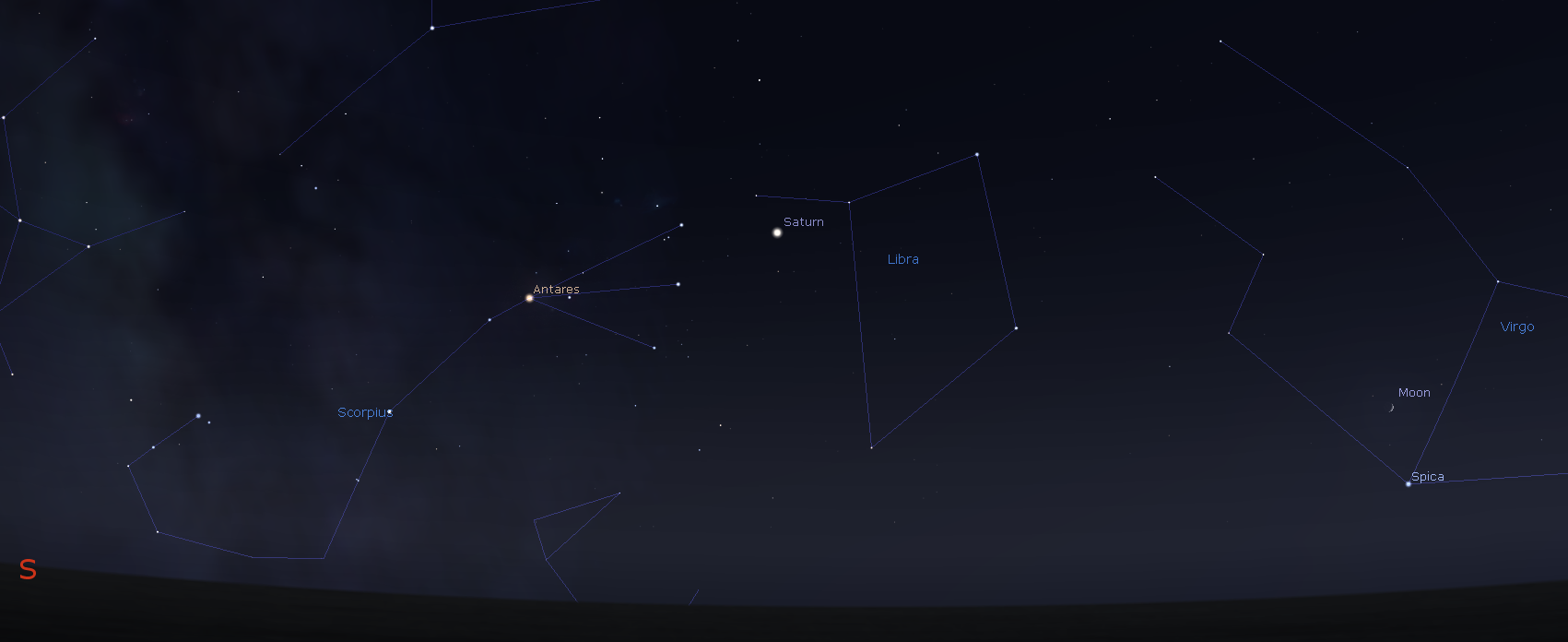
Saturn and the Moon with southern summer constellations at 10 p.m. on August 19, 2015. Created using Stellarium.
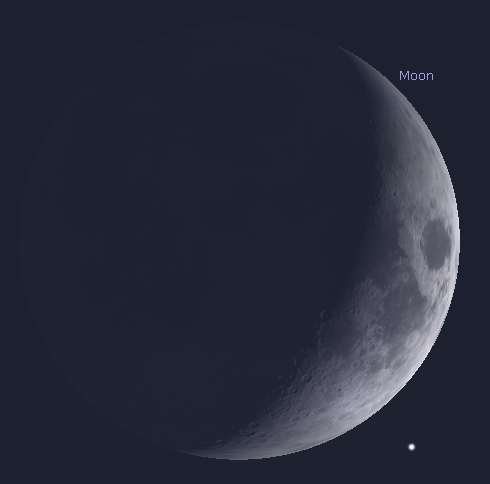
The moon as it would be seen in binoculars at 10 p.m. on August 19, 2015. Created using Stellarium.
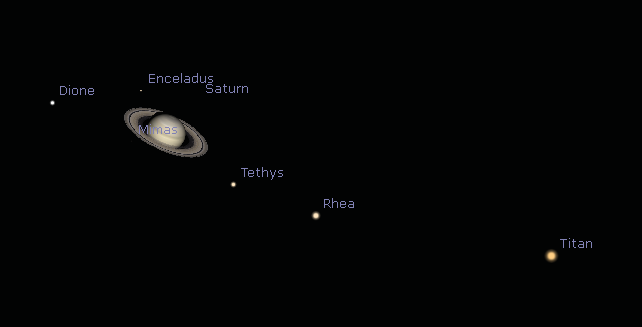
Saturn as seen in a telescope. In small telescopes only Titan of all the moons will be visible. Created using Stellarium.
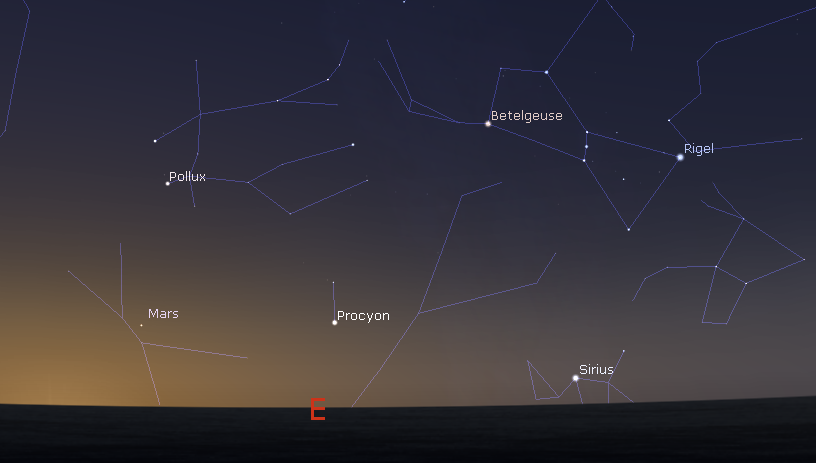
Good morning Mars! It’s barely visible in twilight with the stars and constellations of Winter at 6 a.m. August 20, 2015. The constellation named have been omitted because Mars plotted on top of the Cancer label. Created using Stellarium.
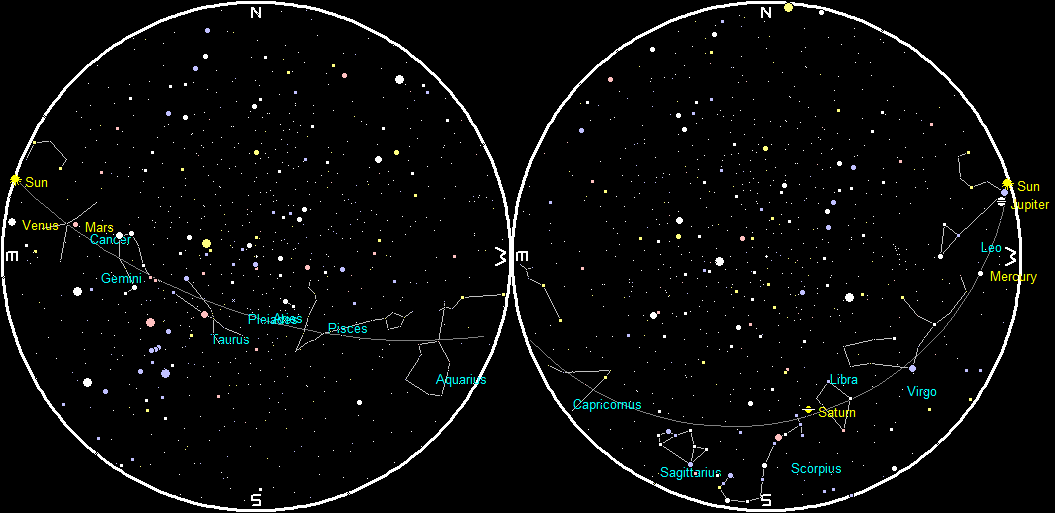
This is a chart showing the sunrise and sunset skies for August 19, 2015 showing the location of the planets at that time. Created using my LookingUp program. Click on the image to enlarge.
08/17/2015 – Ephemeris – The celestial snake handler
Ephemeris for Monday, August 17th. The Sun rises at 6:47. It’ll be up for 13 hours and 58 minutes, setting at 8:45. The Moon, 3 days past new, will set at 10:04 this evening.
The planet Saturn and the red star Antares shine in the south-southwest at 10:30 p.m. In the and around constellation of Scorpius. In the area of sky above it lies a large constellation of faint stars called Ophiuchus, the serpent bearer. The constellation shape is like a large bell, which reminds me of the head, shoulders and arms of a fellow that’s holding the snake-like a weight lifter pulling up a heavy bar bell. The serpent he’s holding is Serpens, the only two part constellation in the heavens. The head rises to Ophiuchus’ right and the tail extends up to the left. In legend Ophiuchus was a great physician, educated by the god Apollo, and the centaur Chiron, also found in the stars as Sagittarius, below and left of him.
Times are for the Traverse City/Interlochen area of Michigan. They may be different for your location.
Addendum
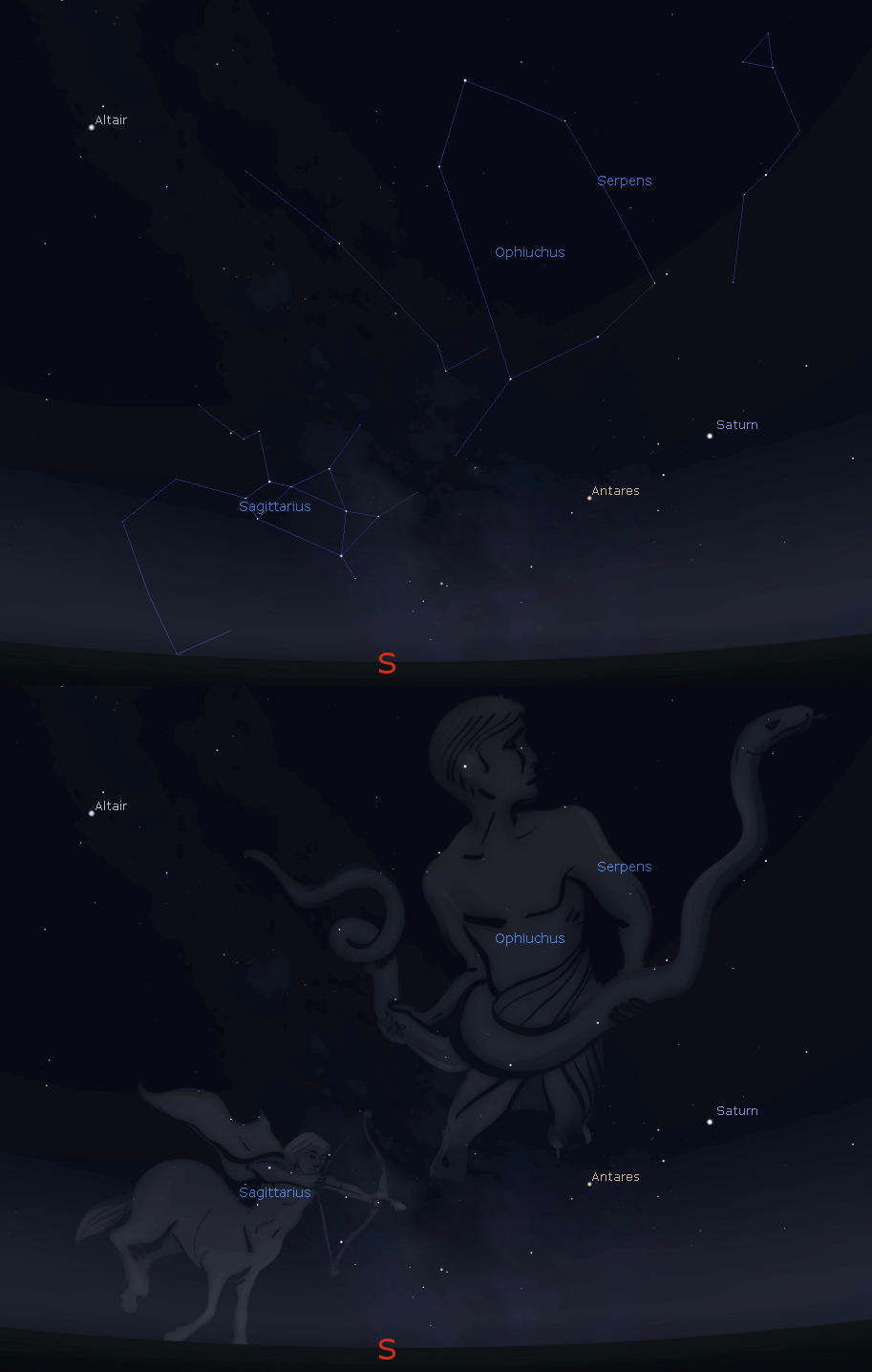
Ophiuchus, Serpens and Sagittarius with Saturn and Antares on August 17, at 10 p.m. Created using Stellarium.
08/12/2015 – Ephemeris – One ringed planet and a sky full of meteors
Ephemeris for Wednesday, August 12th. The Sun rises at 6:41. It’ll be up for 14 hours and 12 minutes, setting at 8:53. The Moon, 2 days before new, will rise at 5:49 tomorrow morning.
Lets take a look for the bright planets for this week. Our brightest evening planets Venus and Jupiter are leaving the evening sky in the west. Venus is 3 days from inferior conjunction with the Sun. Saturn is in the south-southwest in the evening twilight. It can be spotted just to the right of the constellation of Scorpius the scorpion and its bright red star Antares below and right of it. Even small telescopes can see Saturn’s rings. The Perseid meteor shower will reach its peak overnight tonight. Your back yard is a fine spot to view the meteors, or for dark skies, I’ll be leading an all night meteor watch at the Sleeping Bear Dunes National Lakeshore’s Dune Climb if it’s clear. I’ll be there by 9 p.m. and it will be dark enough by 10:30.
Times are for the Traverse City/Interlochen area of Michigan. They may be different for your location.
Addendum
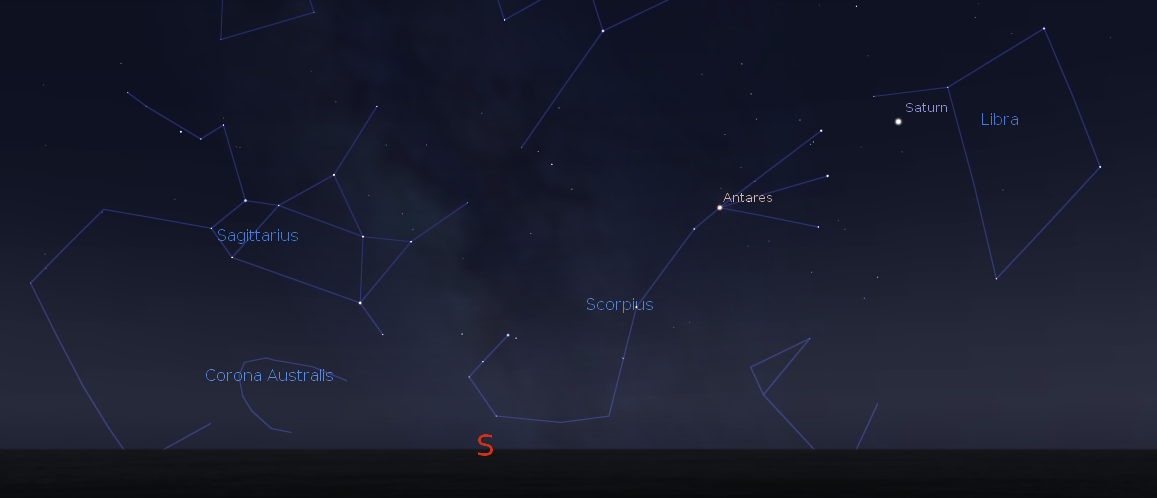
Saturn and the summer Zodiacal constellations in the south at 10 p.m. August 12, 2015. Created using Stellarium.
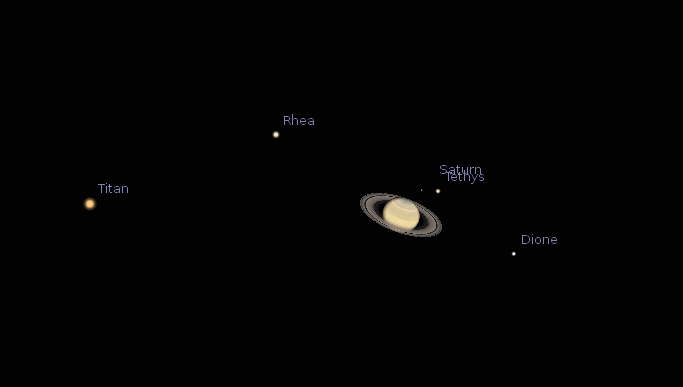
Saturn through a telescope at 10 p.m. on August 12, 2015. Created using Stellarium.
Next week Wednesday we will also turn to the morning sky looking for Mars and awaiting Venus’ grand entrance into the dawn skies.
All-sky meteor charts from yesterday’s post
“PerR” is the Perseid radiant.
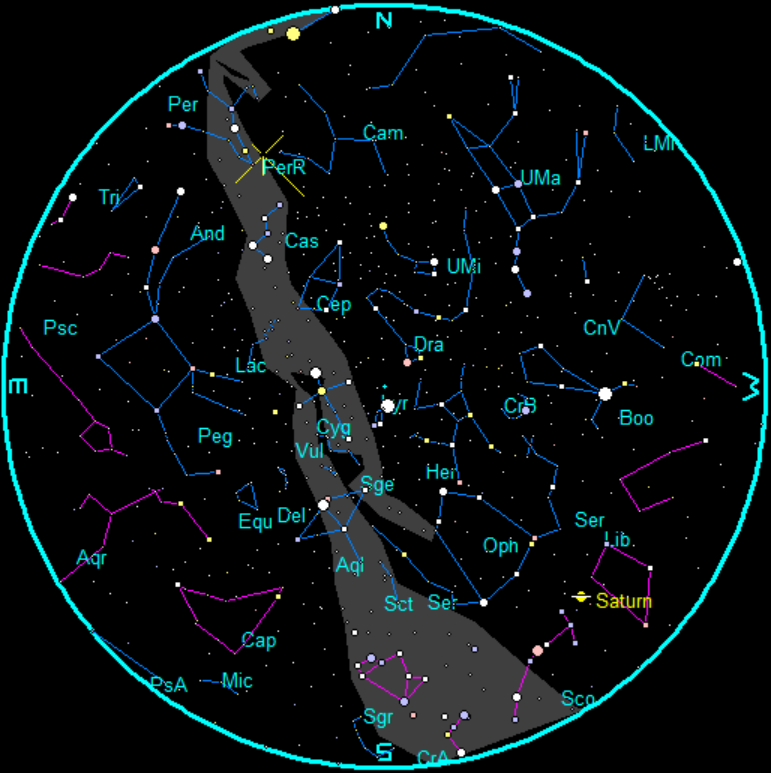
11 p.m. August 12, 2015. Created using Bob Moler’s LookingUp program for Windows.
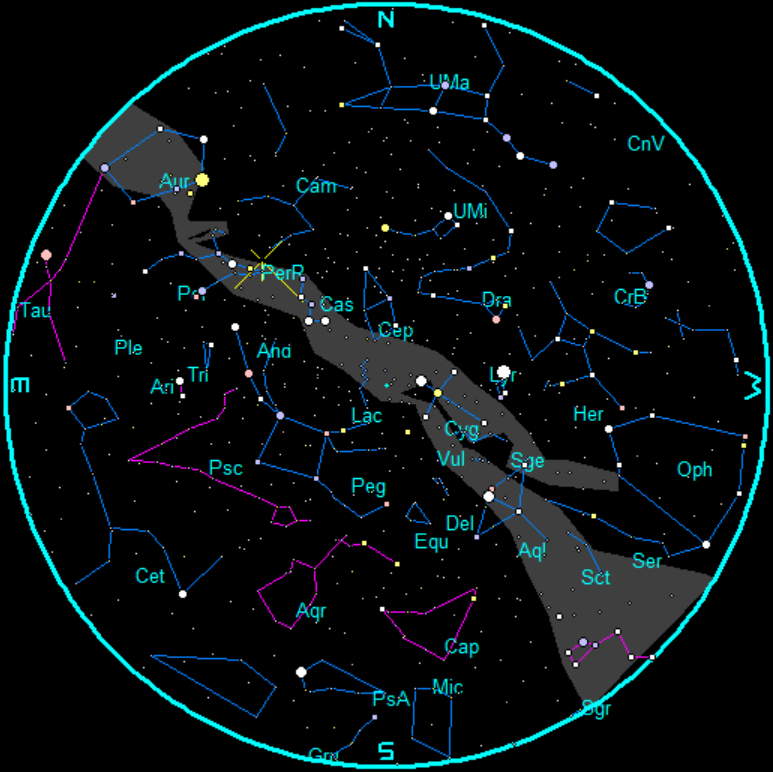
2 a.m. August 13, 2015. Previewing autumn stars. Created using Bob Moler’s LookingUp program for Windows.
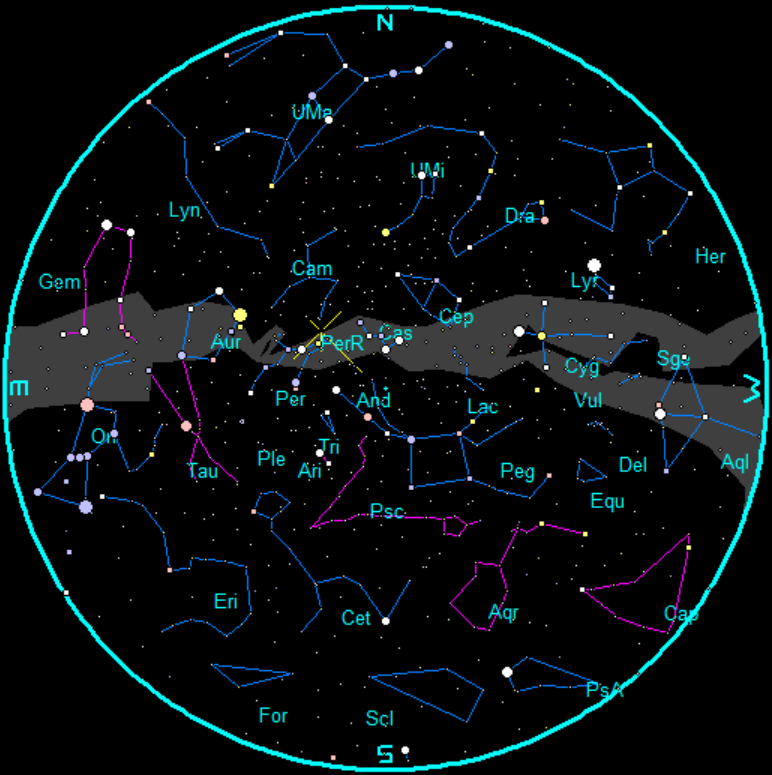
5 a.m. August 13, 2015. Good morning Orion! Created using Bob Moler’s LookingUp program for Windows.
08/05/2015 – Ephemeris – Down to one easily visible evening planet
Ephemeris for Wednesday, August 5th. The Sun rises at 6:33. It’ll be up for 14 hours and 30 minutes, setting at 9:03. The Moon, 1 day before last quarter, will rise at 12:08 tomorrow morning.
Lets take a look at the bright planets for this week. Our evening stars Venus and Jupiter leaving the evening sky in the west. Venus will set 2 minutes after the Sun, so the only hope to spot it is before sunset, a dangerous prospect with the Sun so close. Jupiter is just too faint in the twilight to pick up. Venus is 10 days from inferior conjunction with the Sun. Saturn is in the south in the evening twilight. Saturn can be spotted just to the right of the constellation of Scorpius the scorpion and its bright red star Antares below and right of it. Even small telescopes can see Saturn’s rings. A spotting scope of 20 power magnification can show that Saturn has a ring. Antares though is star-like, scintillating like a sparkler.
Times are for the Traverse City/Interlochen area of Michigan. They may be different for your location.
Addendum
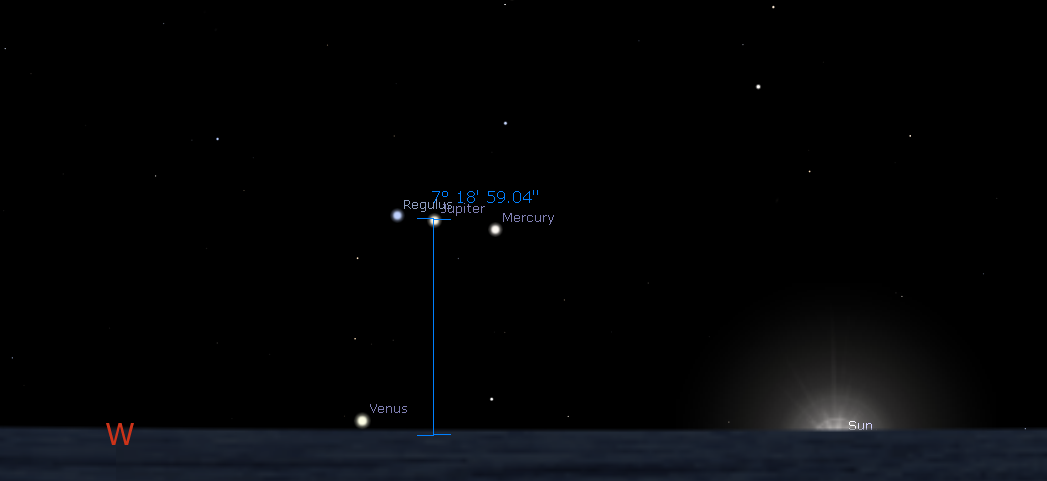
Venus, Jupiter, and Mercury plus the star Regulus together at 9 p.m. August 5, 2015 with the bright Earth’s atmosphere removed. Created using Stellarium.
The reason I don’t discuss Mercury is that This will not be a good apparition of that planet. Apparitions (appearances) of Mercury are best seen in the evening in late winter and spring. Morning apparitions are best seen in late summer and autumn.
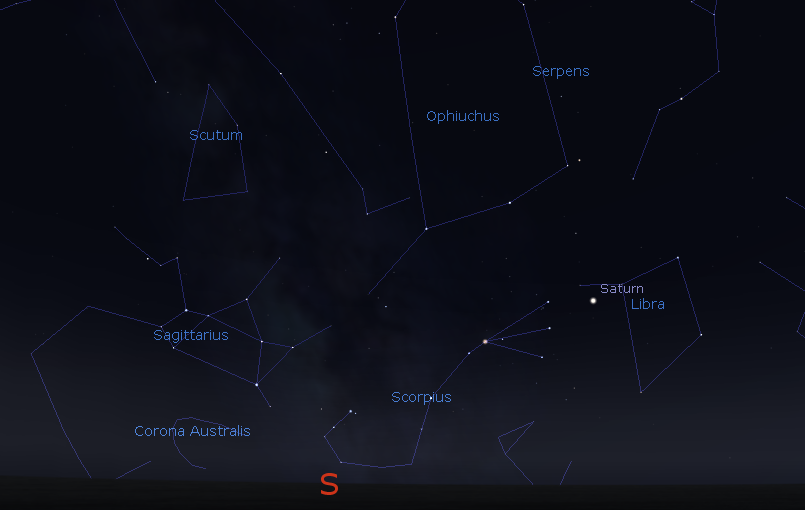
Saturn and the southern Milky Way and stars of summer at 10:30 p.m. August 5, 2015. Created using Stellarium.
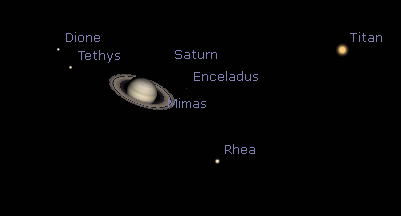
What Saturn and its moons might appear like in a telescope at 10:30 p.m., August 5, 2015. Small telescopes will show only the moon Titan. Created using Stellarium.
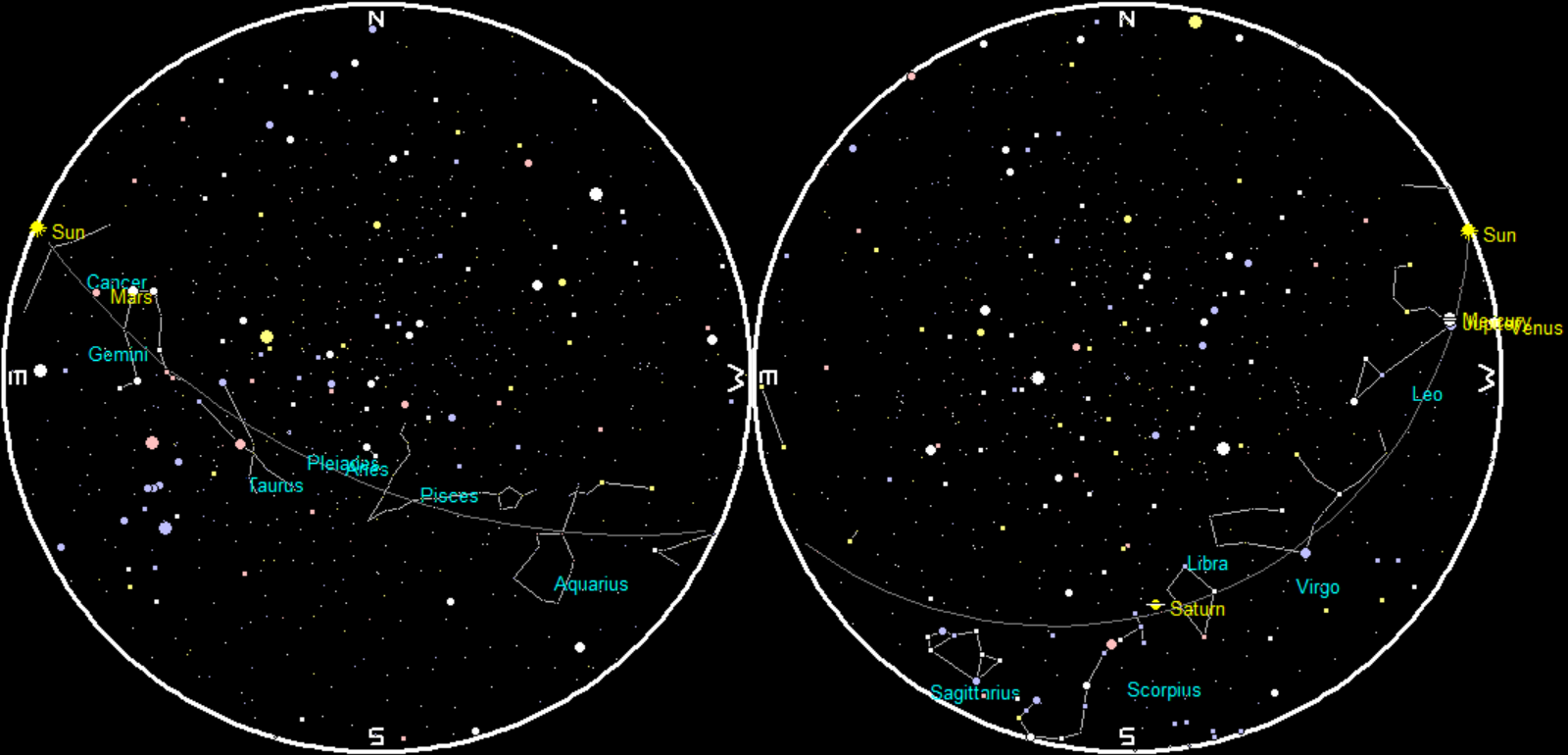
This is a chart showing the sunrise and sunset skies for August 5, 2015 showing the location of the planets at that time. The traffic jam of planets near the western horizon at sunset is best seen in the first image above. Created using my LookingUp program. Click on the image to enlarge.
07/29/2015 – Ephemeris – Where are the bright planets tonight
Ephemeris for Wednesday, July 29th. The Sun rises at 6:25. It’ll be up for 14 hours and 47 minutes, setting at 9:12. The Moon, 2 days before full, will set at 5:36 tomorrow morning.
Lets take a look at the bright planets for this week. Our evening stars Venus and Jupiter are together in the west by 9:30 p.m. with Jupiter above and right of Venus. Venus will set at 9:46 with Jupiter 23 minutes later. Venus will slide down to the Sun faster and faster in the coming weeks leaving Jupiter behind for a while. Venus will take 17 days to slide past the Sun. Jupiter though will take 28 days, so Venus will pass it again around August 4th when both are too close to the horizon and Sun to spot. There’s a third conjunction of these two in October in the morning sky with Mars nearby. Saturn is in the south in the evening twilight. It will set at 1:48 a.m. Even small telescopes can see Saturn’s rings.
Times are for the Traverse City/Interlochen area of Michigan. They may be different for your location.
Addendum
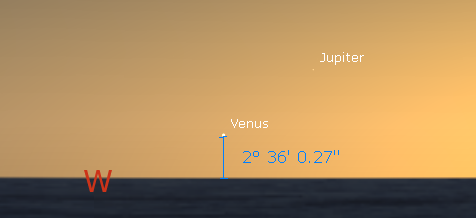
Venus and Jupiter low on the western horizon at 9:30 p.m. on July 29, 2015. This will be their last appearance on this blog in the west this year. We’ll wait until they appear in the east in the morning. For Venus it’ll be sooner than you think. Created using Stellarium.
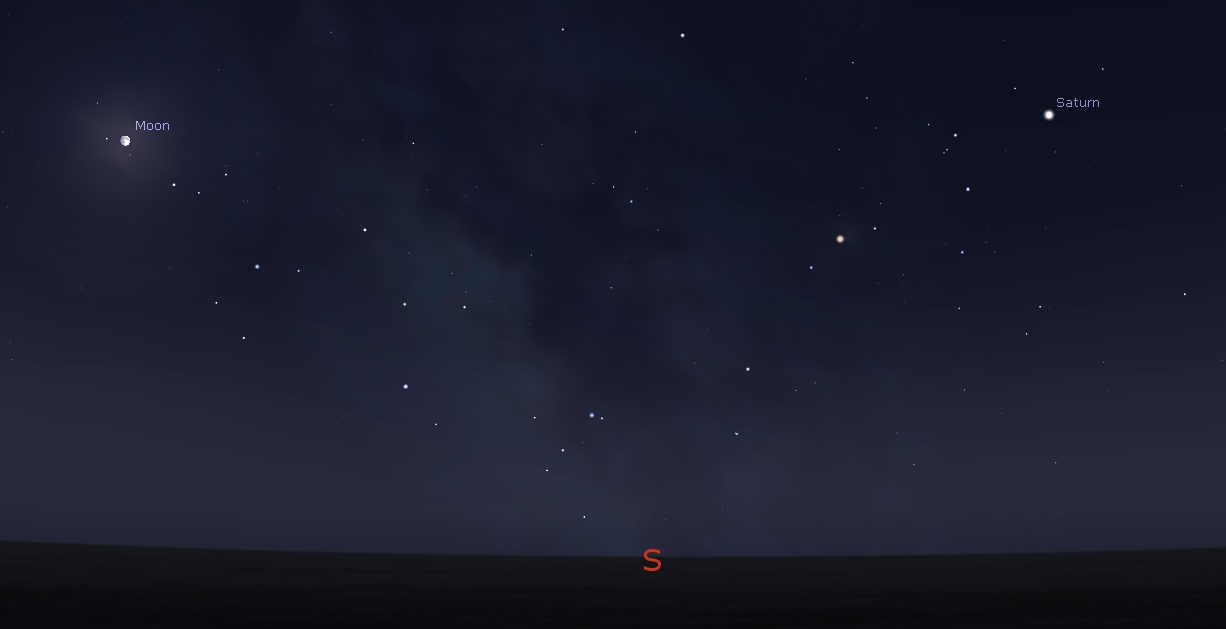
Saturn with the bright Moon and some stars of summer in the constellations Scorpius and Sagittarius at 10:30 p.m. July 29, 2015. Created using Stellarium.
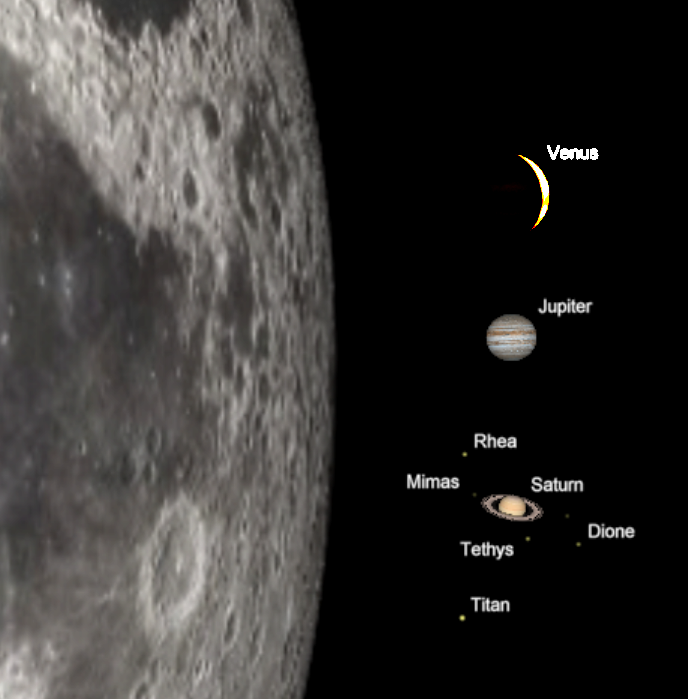
Comparative apparent sizes of the evening planets as seen through a telescope of the same magnification on July 29, 2015. Created using Cartes du Ciel (Sky Charts). Note that I didn’t show the moons of Jupiter which are not visible in the bright twilight. Also the program didn’t extend the cusps of Venus’ crescent properly.
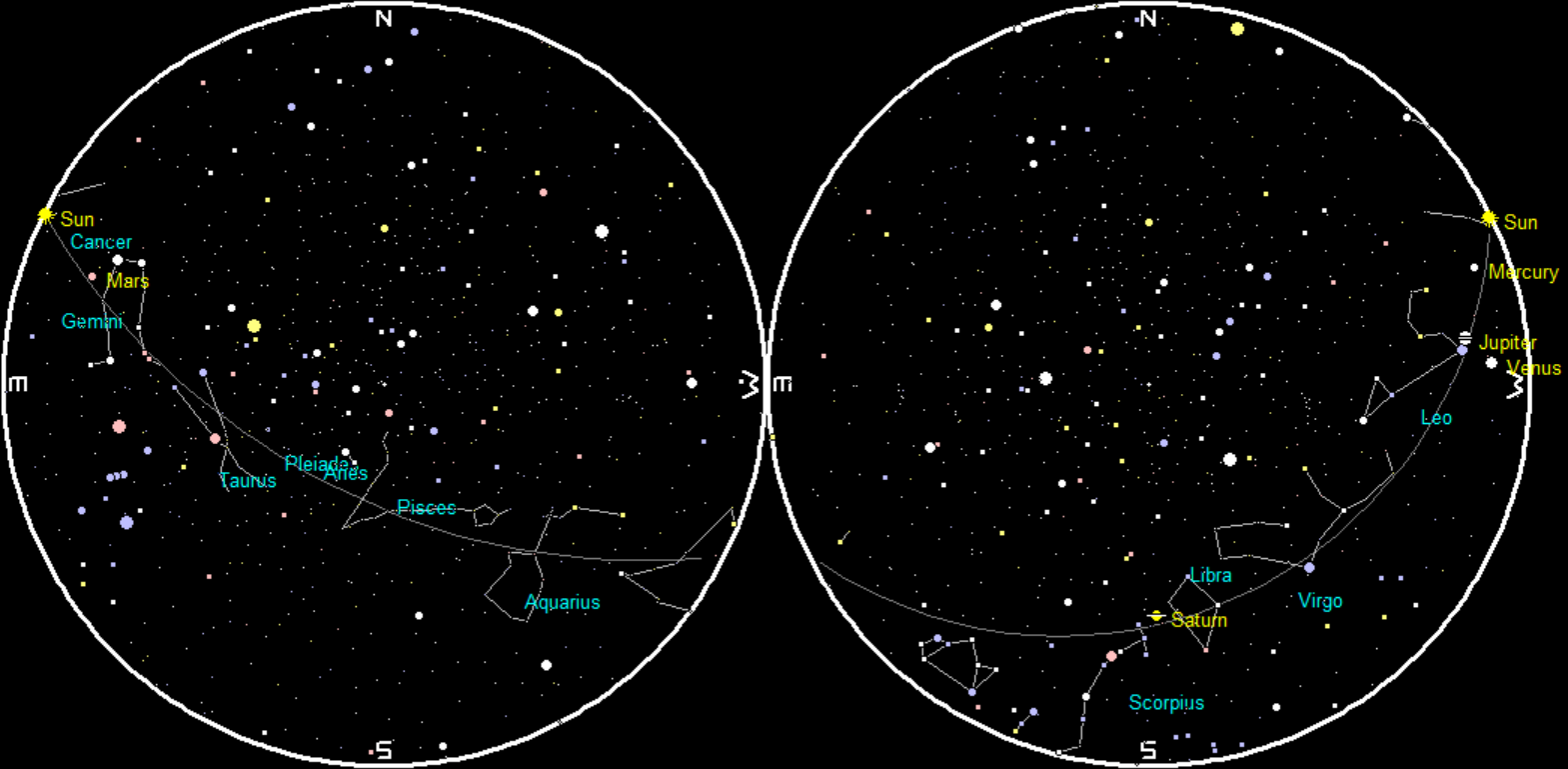
This is a chart showing the sunrise and sunset skies for July 29, 2015 showing the location of the planets at that time. Created using my LookingUp program.
07/22/2015 – Ephemeris – Two planets preparing to leave the evening sky
Ephemeris for Wednesday, July 22nd. Today the Sun will be up for 15 hours and 1 minute, setting at 9:19. The Moon, 2 days before first quarter, will set at 12:28 tomorrow morning. Tomorrow the Sun will rise at 6:18.
Lets take a look at the bright planets for this week. Our evening stars Venus and Jupiter are together in the west by 9:45 p.m. with Jupiter a little above and right of Venus. Venus will set at 10:22 with Jupiter 11 minutes later. Venus’ will slide down to the Sun faster and faster in the coming weeks leaving Jupiter behind for a while. Venus will take 24 days to slide past the Sun. Jupiter though will take 35 days, so Venus will pass it again around August 4th when both are too close to the horizon and Sun to spot. There’s a third conjunction of these two in October in the morning sky with Mars nearby. Saturn is in the south in the evening twilight. It will pass due south at 9:27 p.m. and will set at 2:16 a.m. Even small telescopes can see Saturn’s rings.
Times are for the Traverse City/Interlochen area of Michigan. They may be different for your location.
Addendum
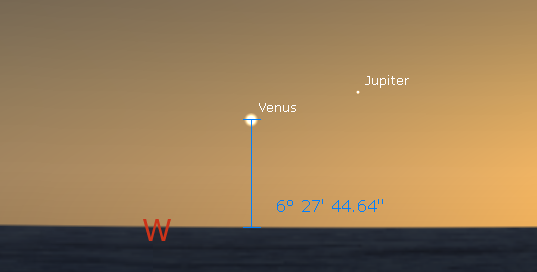
Venus and Jupiter low on the western horizon at 9:45 p.m. on July 22, 2015. Created using Stellarium.
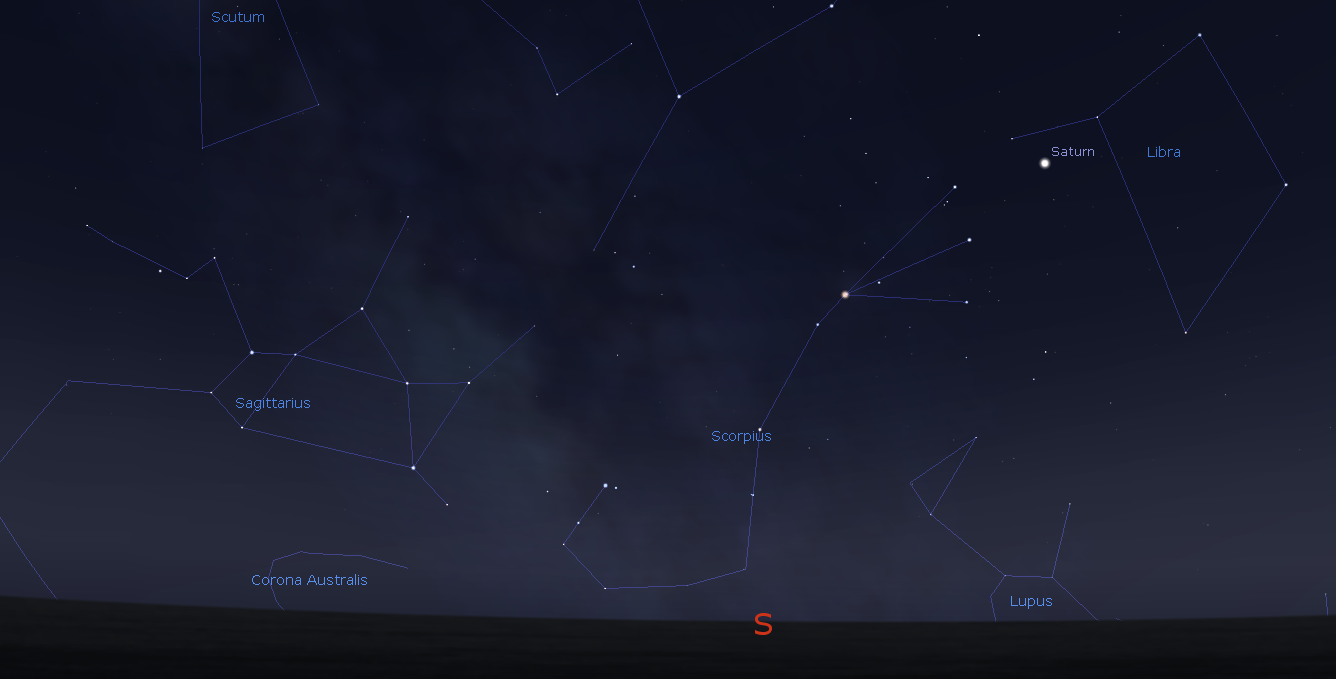
Saturn and the summer zodiacal constellations of Libra, Scorpius and Sagittarius at 10:30 p.m. on July 22, 2015. Created using Stellarium.
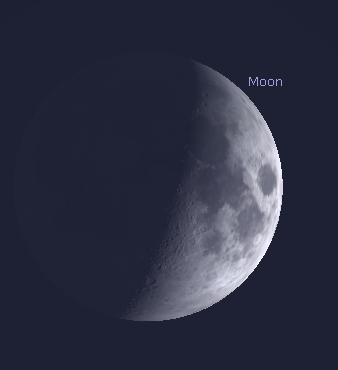
The Moon as it might appear in binoculars tonight at 10:30 p.m. (July 22, 2015). Created using Stellarium.
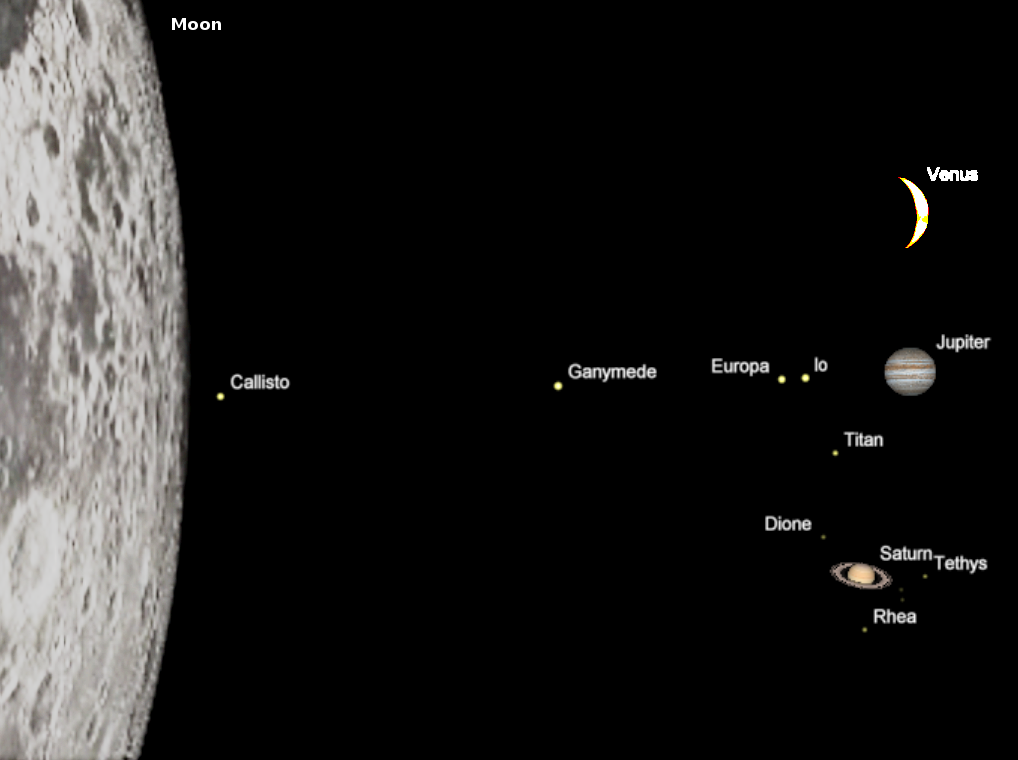
Comparative apparent sizes of the evening planets as seen through a telescope of the same magnification on July 22, 2015. Created using Cartes du Ciel (Sky Charts).
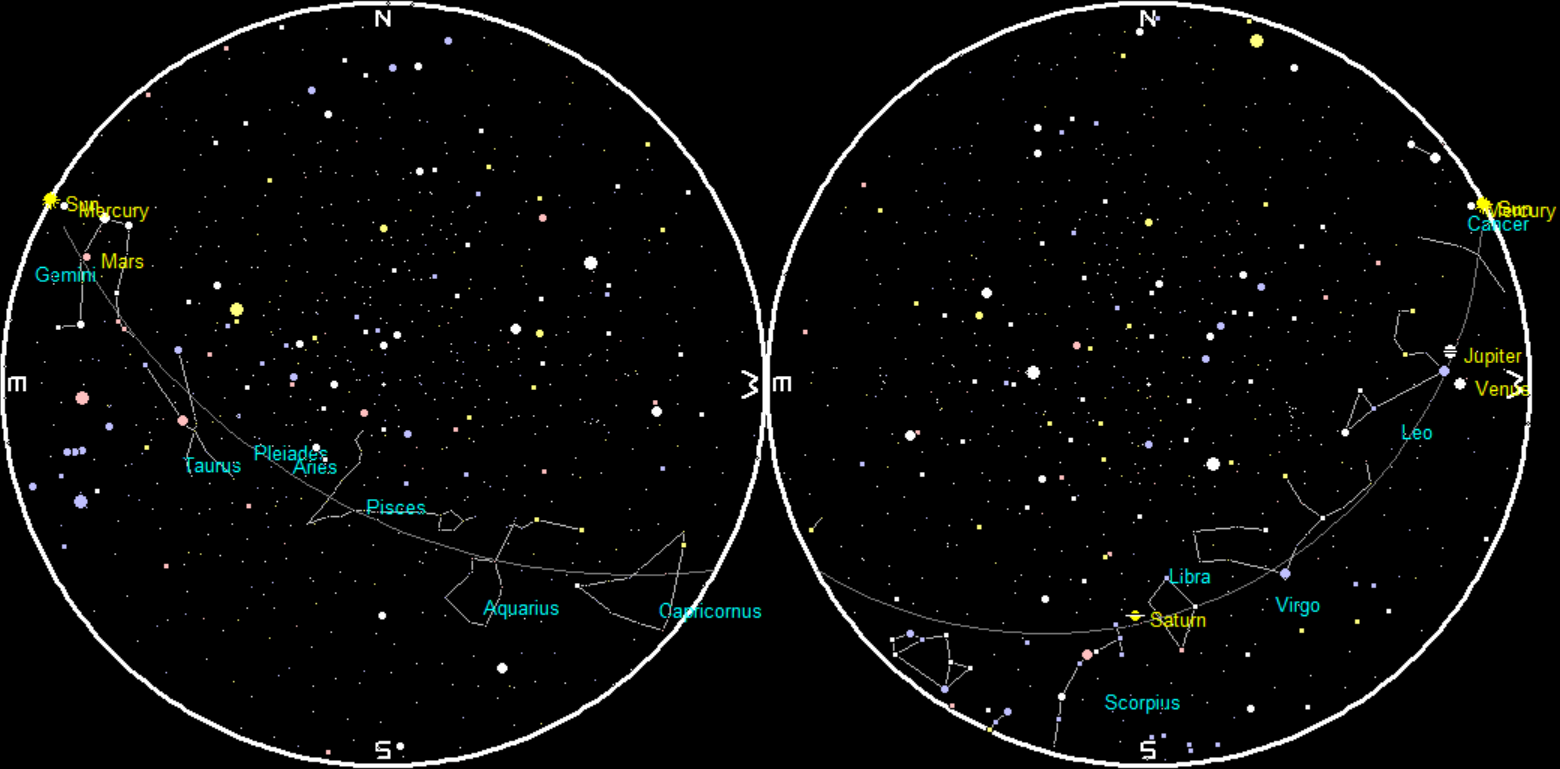
This is a chart showing the sunrise and sunset skies for July 22, 2015 showing the location of the planets at that time. Created using my LookingUp program.
07/15/2015 – Ephemeris – Venus and Jupiter are dipping lower in the west
Ephemeris for Wednesday, July 15th. Today the Sun will be up for 15 hours and 14 minutes, setting at 9:25. The Moon is new today, and won’t be visible. Tomorrow the Sun will rise at 6:12.
Lets take a look at the bright planets for this week. Our evening stars Venus and Jupiter are still side by side in the west by 9:45 p.m. They both will set near 10:55 p.m.. Venus’ will slide down to the Sun faster and faster in the coming weeks leaving Jupiter behind for a while. Venus will take 1 month to slide past the Sun. Jupiter though will take 6 weeks, so Venus will pass it again around August 4th when both are too close to the horizon and Sun to spot. There’s a third conjunction of these two in October in the morning sky with Mars nearby. Saturn is in the south in the evening twilight. It will pass due south at 9:55 p.m. and will set at 2:44 a.m. Even small telescopes can see Saturn’s rings.
Times are for the Traverse City/Interlochen area of Michigan. They may be different for your location.
Addendum
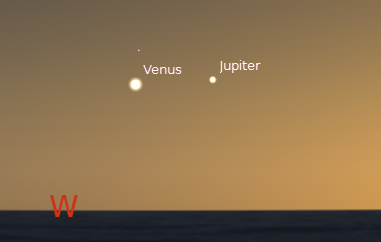
Venus and Jupiter will be about 9 degrees above the western horizon at 10 p.m. (45 minutes after sunset if you’re not from around here) on July 15, 2015. Created using Stellarium.
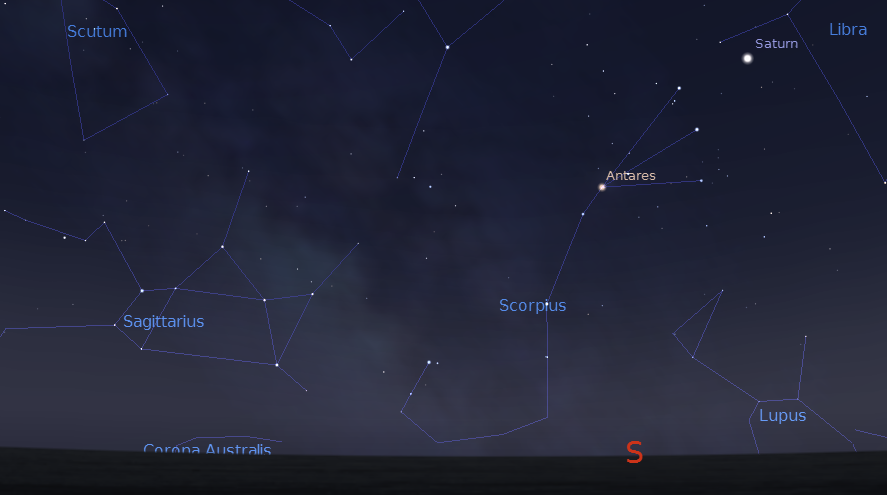
Saturn with Scorpius and the Teapot of Sagittarius at 10:30 p.m., July 15, 2015. Created using Stellarium.
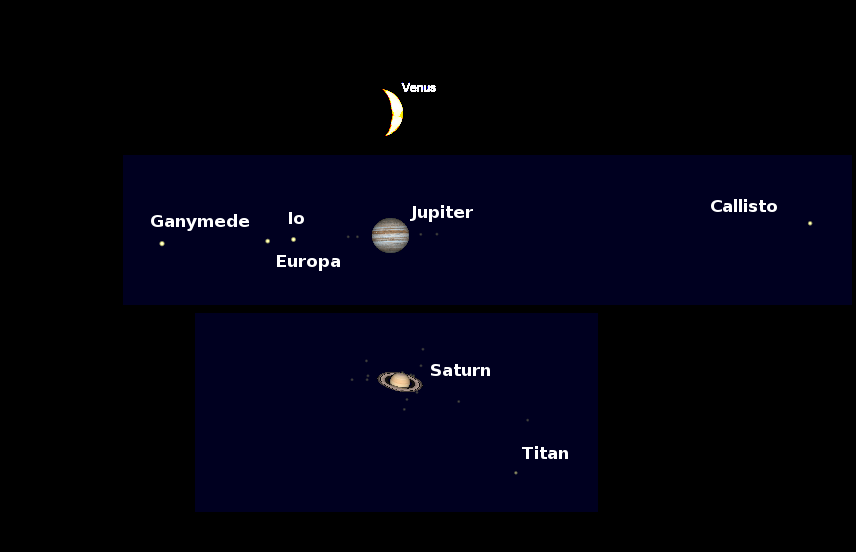
Comparative apparent sizes of the evening planets as seen through a telescope of the same magnification. Created using Cartes du Ciel (Sky Charts).
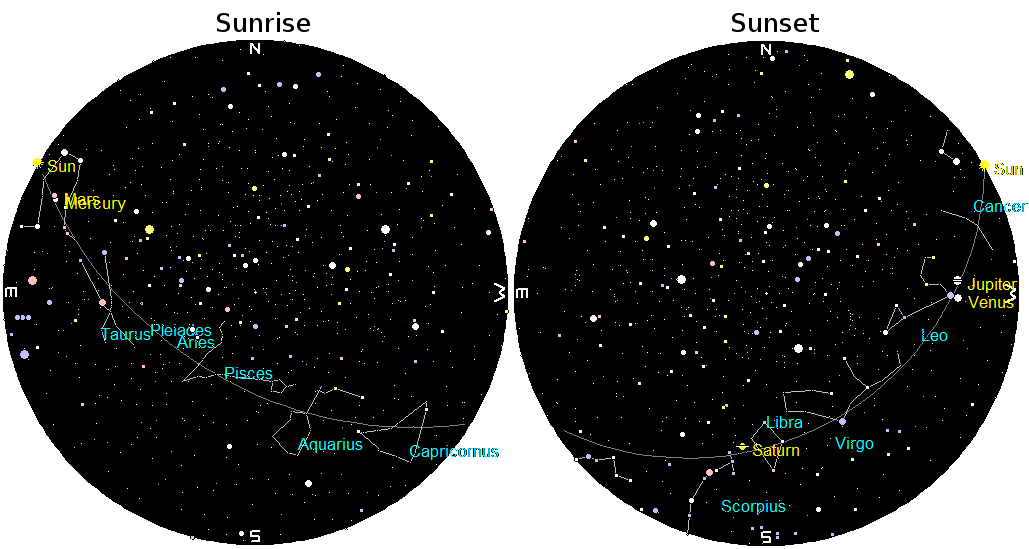
This is a chart adapted from the one I publish monthly as my role as the editor of the Grand Traverse Astronomical Society newsletter the Stellar Sentinel. It’s for sunrise and sunset for July 15, 2015 showing the location of the planets at that time. I’m bringing it to Wednesday Planet Day on this blog. Created using my LookingUp program. Click on the image to enlarge.
07/10/2015 – Ephemeris – The celestial scorpion crawls over the horizon
Ephemeris for Friday, July 10th. Today the Sun will be up for 15 hours and 21 minutes, setting at 9:28. The Moon, 2 days past last quarter, will rise at 2:44 tomorrow morning, and tomorrow the Sun will rise at 6:07.
The planet Saturn, this year, is on the right edge of the constellation of Scorpius the scorpion which is in the south at 11 p.m. Its brightest star is Antares in its heart, a red giant star. From Antares to the right is a star then a vertical arc of three stars that is its head. The Scorpion’s tail is a line of stars running down to the left of Antares swooping to the horizon before coming back up and ending in a pair of stars that portray his poisonous stinger. Scorpius looks huge lying on the southern horizon. But if you go south Scorpius will be higher in the sky, and will look smaller. Being close to the horizon from Michigan, Scorpius shares with the rising and setting sun and moon the illusion of increased size.
Times are for the Traverse City/Interlochen area of Michigan. They may be different for your location.
Addendum
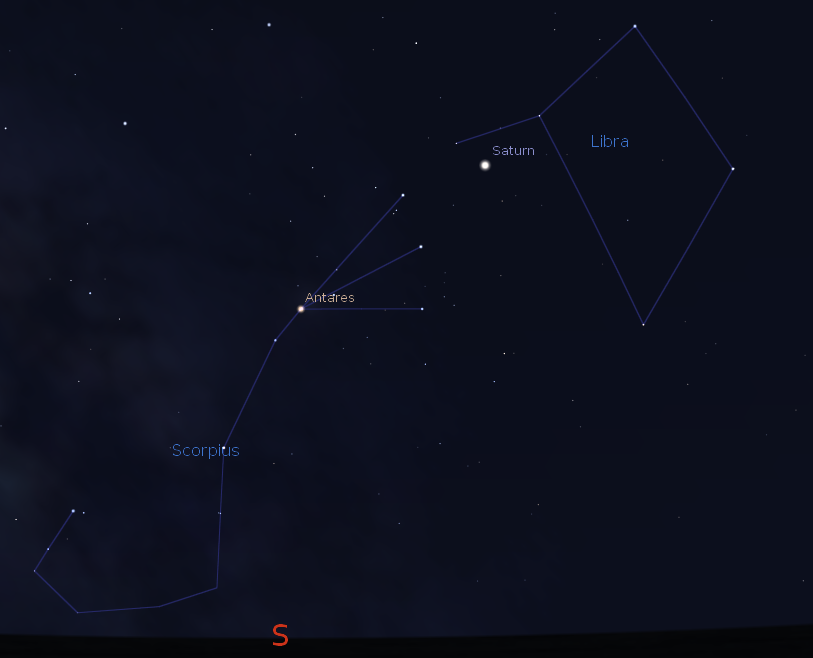
Scorpius from Traverse City/Interlochen at 11 p.m. on July 10, 2015. Created using Stellarium.
07/09/2015 – Ephemeris – The first stars to appear at night
Ephemeris for Thursday, July 9th. Today the Sun will be up for 15 hours and 23 minutes, setting at 9:29. The Moon, 1 day past last quarter, will rise at 2:05 tomorrow morning, and tomorrow the Sun will rise at 6:07.
Let’s check out all the bright stars in the evening sky, as it gets dark tonight. Low in the west are the planets Venus and Jupiter. High in the west is the bright yellow-orange star Arcturus. In the northwest is the Big Dipper, whose curved handle points to Arcturus. Straightening that curve to a spike will point to Spica a blue-white star low in the southwest. The planet Saturn is located in the south. Below and left of it is the red star Antares which usually twinkles merrily. High in the east is the bright white star Vega. To its lower right is Altair, and to its lower left the star Deneb. Vega, Altair and Deneb make the Summer Triangle, whose rising in the east signals the coming of summer.
Times are for the Traverse City/Interlochen area of Michigan. They may be different for your location.
Addendum
I talked about seeing the first stars a month ago. It seems that in holding star parties this time of year we spend a lot of time watching the first stars appear. I wanted to discuss the Summer Triangle, but it wandered off to what you see above. I’ll get there next week, I promise.
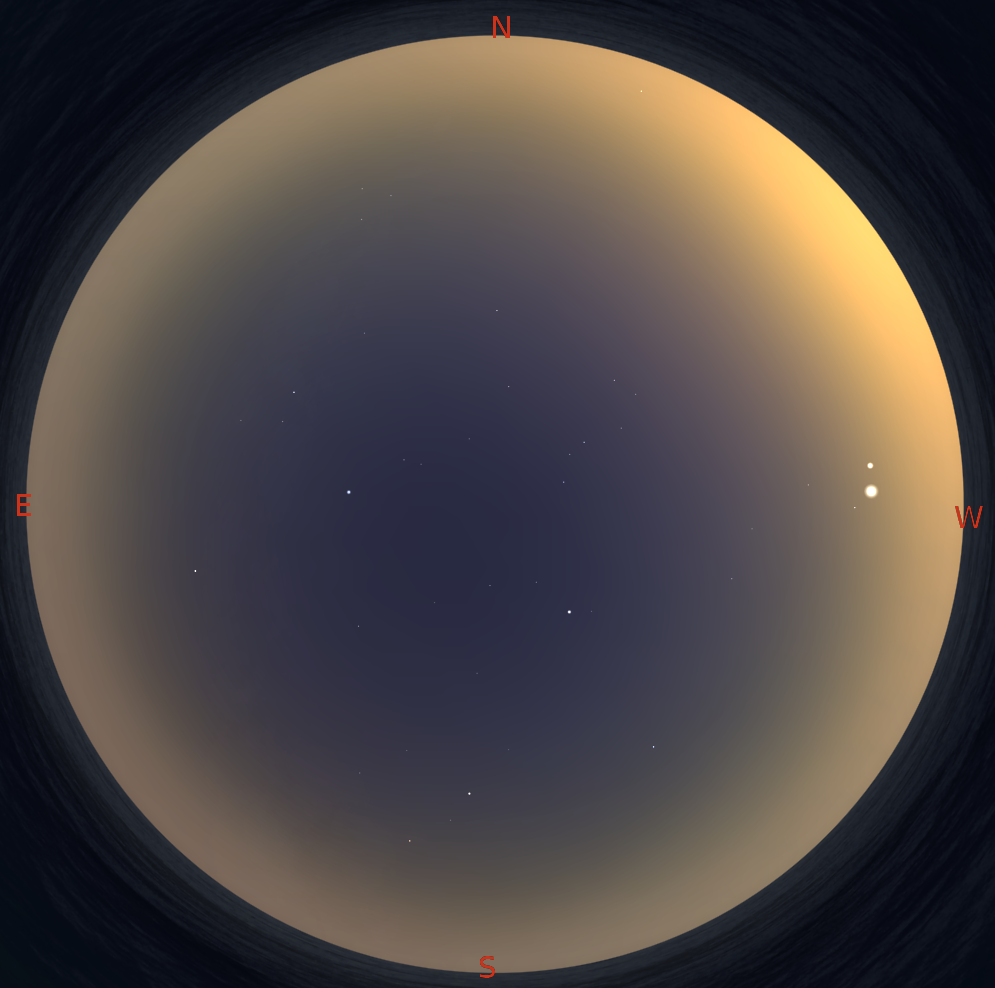
The first stars and planets to appear. See if you can located them from the text. Created using Stellarium for about 10 p.m., July 9, 2015.
07/08/2015 – Ephemeris – The bright planets are hanging around in the evening.
Ephemeris for Wednesday, July 8th. Today the Sun will be up for 15 hours and 24 minutes, setting at 9:29. The Moon, at last quarter today, will rise at 1:30 tomorrow morning, and tomorrow the Sun will rise at 6:06.
Lets take a look at the bright planets for this week. Our evening stars Venus and Jupiter are side by side in the west by 9:45 p.m. They both will set at 11:21 p.m.. Venus’ will slide down to the Sun faster and faster in the coming weeks leaving Jupiter behind for a while. Venus will take 5 weeks to slide past the Sun. Jupiter though will take 7 weeks, so Venus will pass it again around August 4th when both are too close to the horizon and Sun to spot. There’s a third conjunction of these two in October in the morning sky with Mars nearby. Saturn is in the south in the evening twilight. It will pass due south at 10:24 p.m. and will set at 3:16 a.m. Even small telescopes can see Saturn’s rings.
Times are for the Traverse City/Interlochen area of Michigan. They may be different for your location.
Addendum
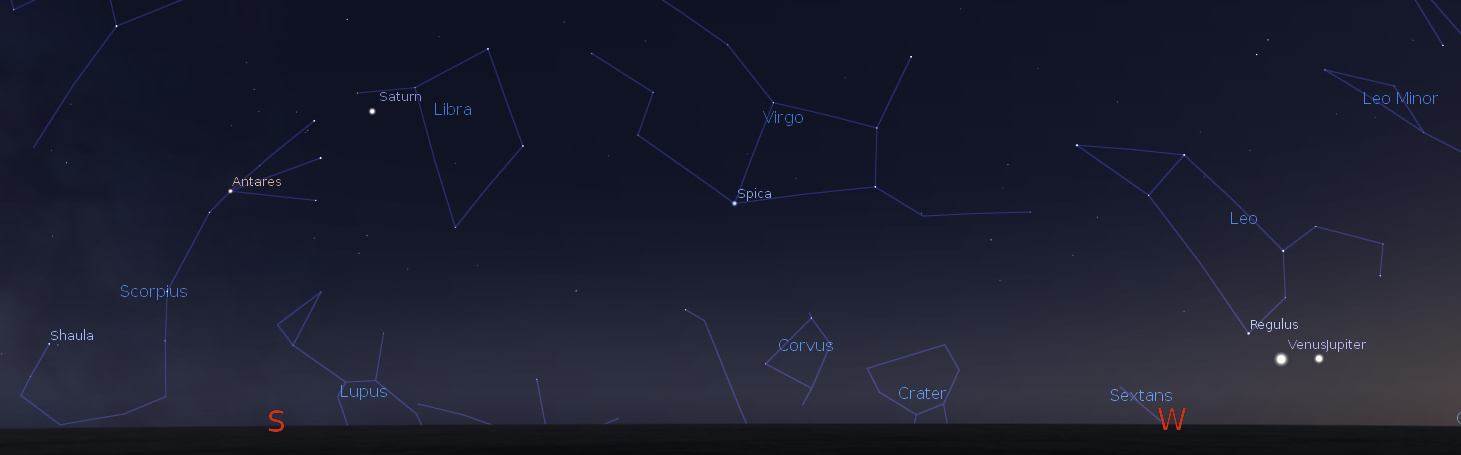
The evening planets at 10:30 p.m. July 8, 2015. Created using Stellarium.
Venus’ greatest brilliancy will be on Sunday the 12th. This is the point where Venus’ increasing size is countered by its decreasing phase. The brightness of Venus doesn’t change much over its orbit, and will be stay brilliant. However it will surrender to the brightening twilight as it sets closer and closer to sunset.
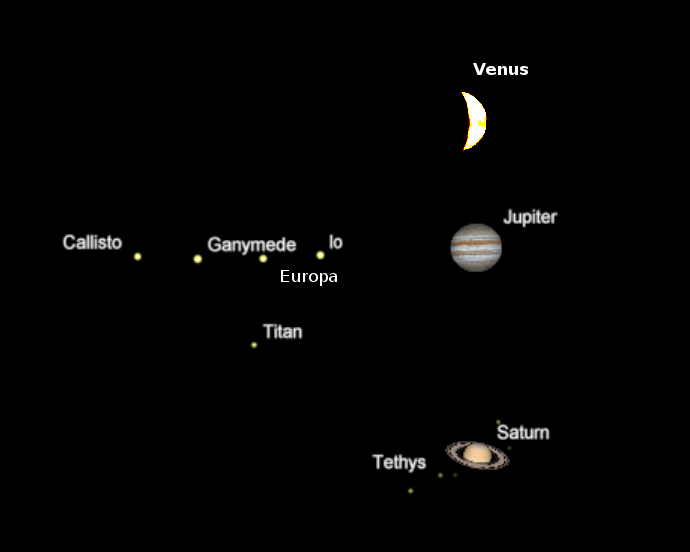
The evening planets as seen with the same magnification. Note that Venus is noticeably larger appearing than Jupiter. This is probably the time Venus’ crescent is visible in binoculars. Created using Cartes du Ciel (Sky Charts).

