Archive
07/17/2012 – Ephemeris – Scorpius and Orion
Ephemeris for Tuesday, July 17th. Today the sun will be up for 15 hours and 9 minutes, setting at 9:22. The moon, 2 days before new, will rise at 5:50 tomorrow morning. Tomorrow the sun will rise at 6:14.
Crawling just above the southern horizon at 11 p.m. is the zodiacal constellation of Scorpius the scorpion. His heart is the red giant star Antares. Its facing the west or right with a short arc of three stars as its head. His body and tail drop to the left and scrape the horizon before curving up to the critter’s poisonous stinger of two stars. One story of the scorpion concerns Orion the hunter the great winter constellation. In that story Orion was supposedly killed by the sting of a scorpion. Therefore Orion and Scorpius are never seen in the sky at the same time. That is certainly true around here and for the Greeks, whose legend it is. However if one travels far enough south that is no longer true.
Times are for the Traverse City/Interlochen area of Michigan. They may be different for your location.
Addendum
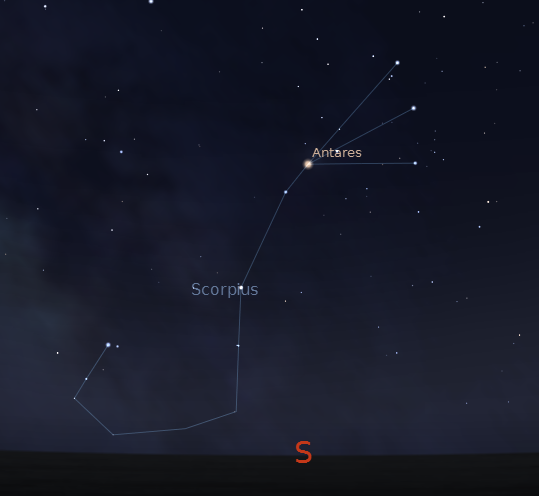
The constellation Scorpius at 10:30 p.m. on July 17, 2012. Created using Stellarium.
07/16/2012 – Ephemeris – The constellation Draco the dragon
Ephemeris for Monday, July 16th. Today the sun will be up for 15 hours and 10 minutes, setting at 9:23. The moon, 3 days before new, will rise at 4:50 tomorrow morning. Tomorrow the sun will rise at 6:13.
High in the northern sky at 11 p.m. lies a twisted constellation, that of Draco the dragon. This dragon is more like the snake-like Chinese dragon than the dinosaur like Hungarian Horntail of Harry Potter fame. At least that’s how I see it. I find it better to start at the tail of Draco, to trace him out in the stars. Draco’s tail starts between the bowl of the Big Dipper and the Little Dipper. The Dragon is seen in a line of stars that extends parallel to the handle of the Big Dipper before curving around the bowl of the Little Dipper then bends back toward the south. The head of Draco is an odd box of stars near the bright star Vega, nearly overhead. Though not made up of very bright stars, Draco has an easy shape to trace.
Times are for the Traverse City/Interlochen area of Michigan. They may be different for your location.
Addendum
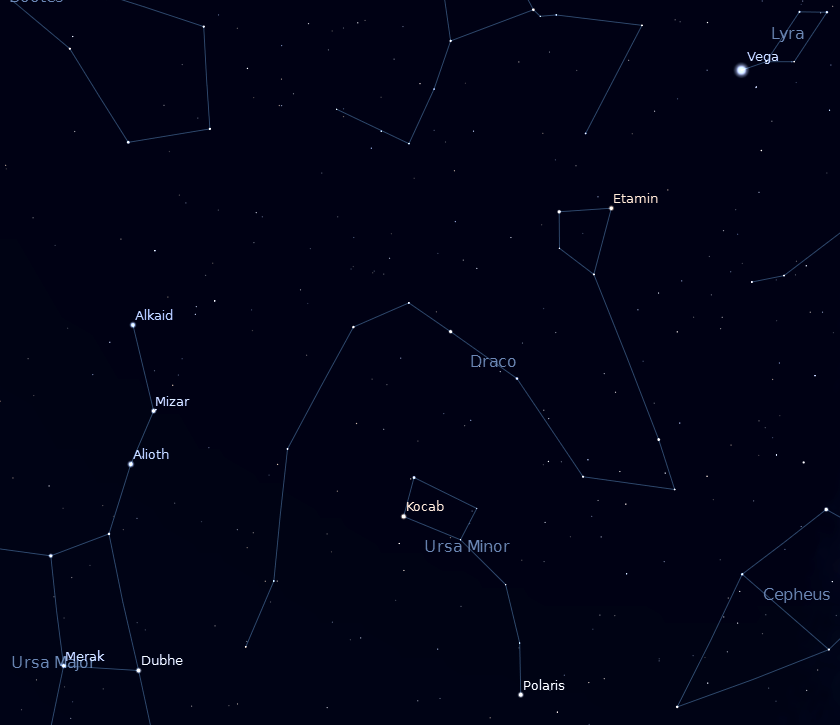
Draco the dragon at 11 p.m. July 16th looking high in the north. Created using Stellarium.
Click on the image to enlarge.
Solar flare might give us an aurora Friday night to Saturday morning
A huge x-ray flare occurred in the huge sunspot group (AR 1520) now on the sun. We might be affected by about 2:20 a.m. EDT Saturday the 14th, give or take 7 hours. So check the skies Friday night. Go to spaceweather.com for more information.
07/13/2012 – Ephemeris – The moon will join Venus and Jupiter Sunday morning
Ephemeris for Friday, July 13th. Today the sun will be up for 15 hours and 15 minutes, setting at 9:25. The moon, 3 days past last quarter, will rise at 2:26 tomorrow morning. Tomorrow the sun will rise at 6:11.
Sunday Morning maybe isn’t the most convenient time to get up early, but this Sunday it may be worth it. At 5 a.m. or so Jupiter will appear above Venus, as they have for the last few weeks. But Sunday morning the crescent moon will appear right between the two. For other parts of the world the moon will actually pass in front of Jupiter, an event called an occultation. This will occur before sunrise for us. But still the planet and moon group should be a beautiful sight in the twilit sky. Venus and Jupiter will soon separate, Venus to stay near the sun, while Jupiter due to the earth’s orbital motion moves away to rise earlier and earlier by somewhat less than a half hour a week. Jupiter lies in the constellation Taurus now.
Times are for the Traverse City/Interlochen area of Michigan. They may be different for your location.
Addendum
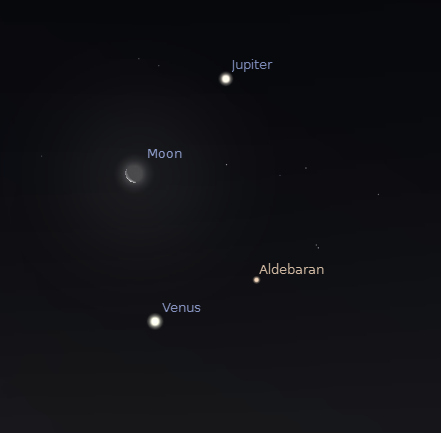
Jupiter, Venus and the moon on July 15, 2012 at 5 a,m, Created using Stellarium.
07/12/2012 – Ephemeris – The constellation Lyra the harp
Thursday, July 12th. Today the sun will be up for 15 hours and 17 minutes, setting at 9:26. The moon, 2 days past last quarter, will rise at 1:50 tomorrow morning. Tomorrow the sun will rise at 6:10.
High in the east at 11 p.m. can be found a bright star called Vega just above a small, narrow, but very distinctive parallelogram of stars. They are the stars of the constellation Lyra the harp. Vega, the 5th brightest night time star, is one of the twenty one brightest stars, called first magnitude stars. The harp, according to Greek mythology, was invented by the god Hermes. The form of the harp in the sky, is as he had invented it: by stretching strings across a tortoise shell. Hermes gave it to his half-brother Apollo, who in turn gave it to the great musician Orpheus. In binoculars, near Vega, two stars appear together. They barely appear to the unaided eye as a single star, designated Epsilon Lyrae.
Times are for the Traverse City/Interlochen area of Michigan. They may be different for your location.
Addendum
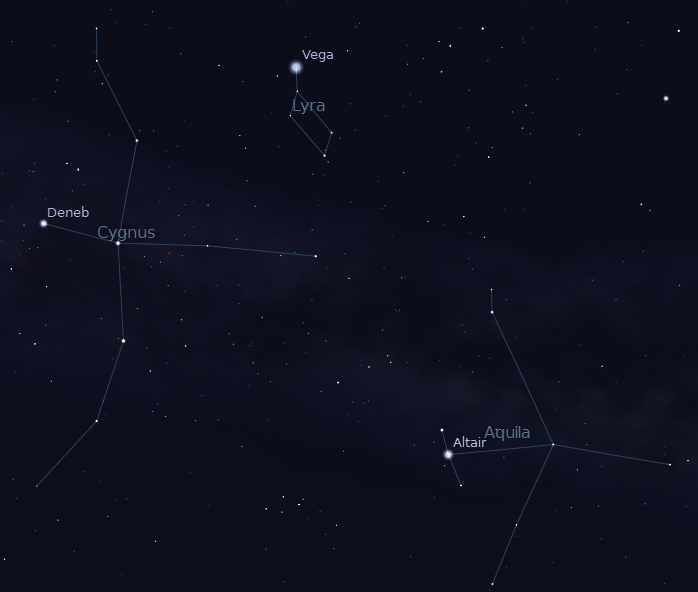
Summer Triangle and the constellation Lyra at 07-12-12 at 11 p.m. Created using Stellarium.
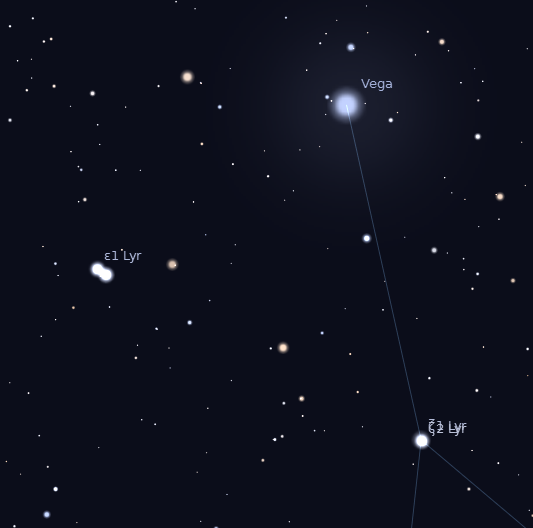
Closeup on Vega and Epsilon Lyrae. Created using Stellarium.
ε1 Lyrae is one of the stars of Epsilon Lyrae. The pair can be split better than this image with binoculars. Looking at the two with a good telescope and over 100 power can split each component into two more stars. We amateur astronomers call it the “Double-Double Star” Note too that Zeta (ζ) Lyrae is also a double star that can be split with a low power telescope.
07/11/2012 – Ephemeris – Where are the bright planets this week?
Ephemeris for Wednesday, July 11th. Today the sun will be up for 15 hours and 18 minutes, setting at 9:27. The moon, 1 day past last quarter, will rise at 1:18 tomorrow morning. Tomorrow the sun will rise at 6:09.
Let’s see what’s happening with the bright planets for this week. Mars, with its unmistakable bright reddish color, is in the west southwest in the evening in the constellation of Virgo the virgin. Mars will be setting in the west at 12:34 a.m. It is approaching Saturn and Spica just to its left. Saturn will be in the southwest above the bright star Spica now. It will set at 1:26 a.m. Jupiter, now a morning planet will rise at 3:08 a.m. in the east northeast. Venus, is now seen just below Jupiter after it rises at 3:45 a.m. Tomorrow morning, Venus will appear next to the bright star Aldebaran. The planets are striking in telescopes with Venus as a large thin crescent, and Jupiter with its cloud bands and satellites.
Times are for the Traverse City/Interlochen area of Michigan. They may be different for your location.
Addendum
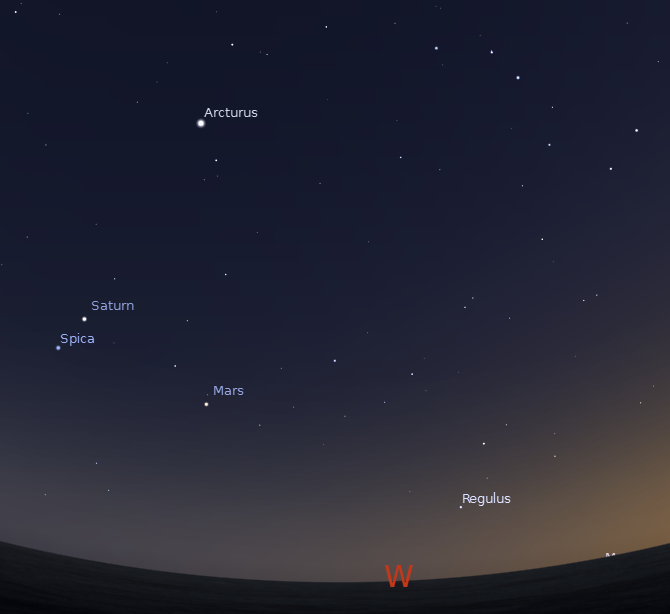
Looking westward at 10:30 p.m. on July 11, 2012. Created using Stellarium.
Click on image to enlarge.
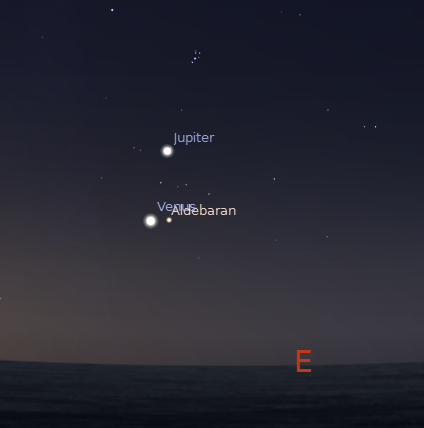
Looking eastward at 5 a.m. on July 12, 2012. Created using Stellarium.
Note Aldebaran near Venus. Aldebaran is the brightest star in the winter constellation Taurus the bull. Note the Pleiades star cluster above Jupiter. Well worth a look with binoculars.
07/10/2012 – Ephemeris – The constellation of Ophiuchus
Ephemeris for Tuesday, July 10th. Today the sun will be up for 15 hours and 20 minutes, setting at 9:27. The moon, at last quarter today, will rise at 12:50 tomorrow morning. Tomorrow the sun will rise at 6:08.
The red star Antares shines in the south at 11 p.m. In the area of sky above it lies a large constellation of faint stars called Ophiuchus, the serpent bearer. Ophiuchus represent the legendary physician Aesculapius. The constellation shape is like a large bell, which reminds me of the head, shoulders and arms of a fellow that’s holding the snake like a weight lifter struggling to pull up a heavy barbell. Serpens, the constellation of the serpent is in the sky in two sections. The front end lies to the right as Serpens Caput, and wends its way up towards Corona Borealis, the Northern Crown. Serpens Cauda, the tail rises to the left of Ophiuchus. It’s a rewarding sight, and not that hard to spot.
Times are for the Traverse City/Interlochen area of Michigan. They may be different for your location.
Addendum
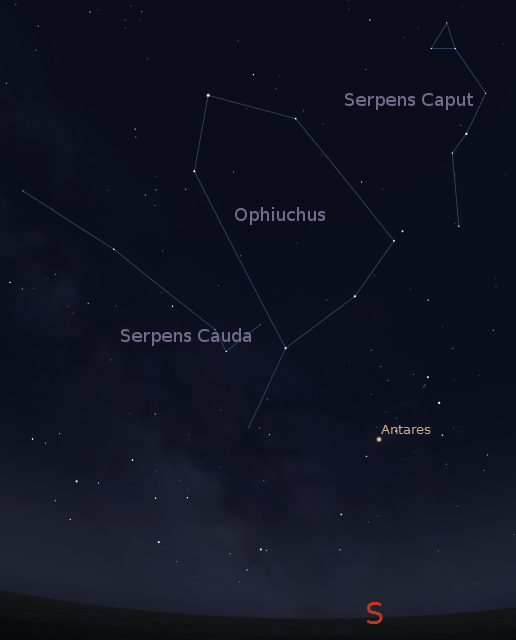
Ophiuchus and Serpens July 10, 2012 at 11 p.m.. Created using Stellarium.
07/09/2012 – Ephemeris – The constellation of Scorpius the scorpion
Ephemeris for Monday, July 9th. Today the sun will be up for 15 hours and 21 minutes, setting at 9:28. The moon, 1 day before last quarter, will rise at 12:23 tomorrow morning. Tomorrow the sun will rise at 6:07.
There’s a large constellation located low in the south at about about 11 tonight. It’s Scorpius the scorpion. Its brightest star is Antares in its heart, a red giant star, that I get calls about from time to time as being a UFO. It’s due south at 11 this evening. From Antares to the right is a star then a vertical arc of three stars that is its head. The Scorpion’s tail is a line of stars running down to the left of Antares swooping to the horizon before coming back up and ending in a pair of stars that portray his poisonous stinger. There is a beautiful star cluster seen in binoculars at that first bend in the tail that is unfortunately too low to appreciate from this far north. I was very impressed with it when spotting it from the Florida Keys.
Times are for the Traverse City/Interlochen area of Michigan. They may be different for your location.
Addendum
The constellation Scorpius at 11 p.m. on July 9, 2012. Created using Stellarium.
In the Traverse City area the bottom stars just barely clear the horizon. farther north the constellation will not fully rise above the southern horizon.
The star cluster mentioned is near the star closest to the south compass point in the view above.
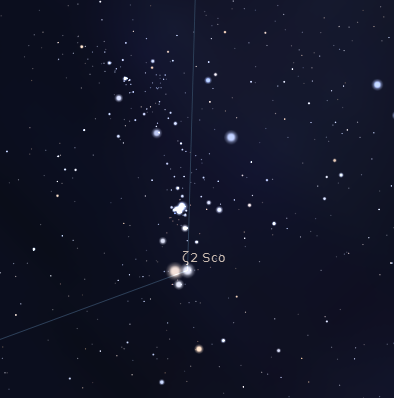
NGC6231 – a great binocular star cluster visible from south of Michigan. Created using Stellarium.
In this view there is a hint of ever more stars visible in a small telescope. This recreation doesn’t do it justice.
07/06/2012 – Ephemeris – Sun and planet viewing tonight
Ephemeris for Friday, July 6th. Today the sun will be up for 15 hours and 25 minutes, setting at 9:29. The moon, 3 days past full, will rise at 11:06 this evening. Tomorrow the sun will rise at 6:05.
This evening the Grand Traverse Astronomical Society will hold its monthly meeting at the Northwestern Michigan College’s Rogers Observatory at 8 p.m. This meeting will be devoted to viewing the sun through the society’s new solar telescope. After that starting at 9 p.m. Will be a star party. For both events, the public is welcome. The tiny planet Mars and the ringed planet Saturn will be visible as will a number of binary stars and brighter wonders of the heavens as the skies darken. Mercury is now receded toward the sun so is not visible. For the rest of the abbreviated planet report this week: A note for early risers that Jupiter and Venus make a fine sight low in the east northeast in the morning after 5 a.m.
Times are for the Traverse City/Interlochen area of Michigan. They may be different for your location.
Possibility of an aurora (northern lights) late Friday night or early Saturday morning
http:www.spaceweather.com reports that a coronal mass ejection (CME) is heading toward the earth from the sun to arrive sometime about 2 a.m. EDT Saturday July 7th. So we may get to see an aurora. Active region 1515, the biggest sunspot group on the sun now is the culprit. It’s been kicking off lots of solar flares recently. The flare responsible was one of the ones that occurred yesterday, July 4th.
 Bob Moler's Ephemeris Blog