Archive
07/18/2014 – Ephemeris – Deneb is the brightest star of the Summer Triangle… Really
Ephemeris for Friday, July 18th. Today the sun will be up for 15 hours and 8 minutes, setting at 9:22. The moon, at last quarter today, will rise at 12:58 tomorrow morning. Tomorrow the sun will rise at 6:15.
At 11 this evening the bright star Deneb in Cygnus the swan will be moderately high in the east northeast. Deneb is the dimmest star of the summer triangle. Of the other stars of the triangle, Vega is nearly overhead, and Altair to the southeast. While Deneb’s apparent magnitude, or brightness as seen from Earth, makes it the dimmest of the three bright stars, Deneb has a vast distance of possibly 1,550 light years. If brought as close as Vega, Deneb would be several times brighter than Venus. For all this it is only 13-20 times the mass of the sun. It will have an extremely short life and will explode, go supernova, in perhaps a few million years. Closer to home, check out the Sun at Kingsley Heritage Days This Saturday and Sunday.
Times are for the Traverse City/Interlochen area of Michigan. They may be different for your location.
Addendum
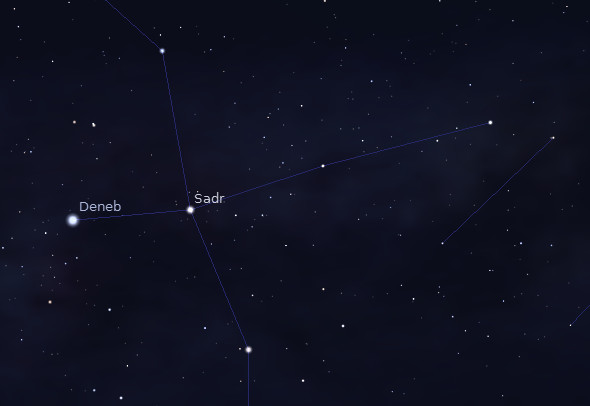
Deneb and the Northern Cross section of Cygnus the swan. Created using Stellarium.
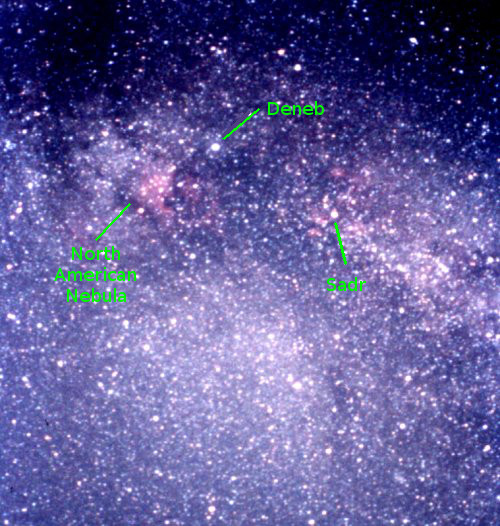
One of my old photographs of Deneb and the North American Nebula digitized from a slide.
The North American Nebula, visible as a faint smudge in binoculars or the naked eye may be ionized and illuminated by Deneb. It’s distance appears to be comparable to that of Deneb.
You may note that previous postings about Deneb over the years have given different distances of Deneb. That just denotes how difficult it is to pin down its distance.
07/17/2014 – Ephemeris – The constellation Cygnus the swan
Ephemeris for Thursday, July 17th. Today the sun will be up for 15 hours and 10 minutes, setting at 9:23. The moon, 1 day before last quarter, will rise at 12:25 tomorrow morning. Tomorrow the sun will rise at 6:14. | Fairly high in the east at 11 p.m. Is the constellation of Cygnus the swan, flying south through the Milky Way. It is also called the Northern Cross. At the left, the tail of the swan or the head of the cross is the bright star Deneb, one of the stars of the Summer Triangle. The next star right is Sadr the intersection of the body and the wings of the swan seen in flight, or the intersection of the two pieces of the cross. There are two or three stars farther to the right that delineate the swan’s long neck or upright of the cross, that ends with the star Alberio in the beak of the swan or foot of the cross. The crosspiece of the cross extends to the stars on either side of the intersection star Sadr, while the swan’s wings extend to a couple more stars each.
Times are for the Traverse City/Interlochen area of Michigan. They may be different for your location.
Addendum
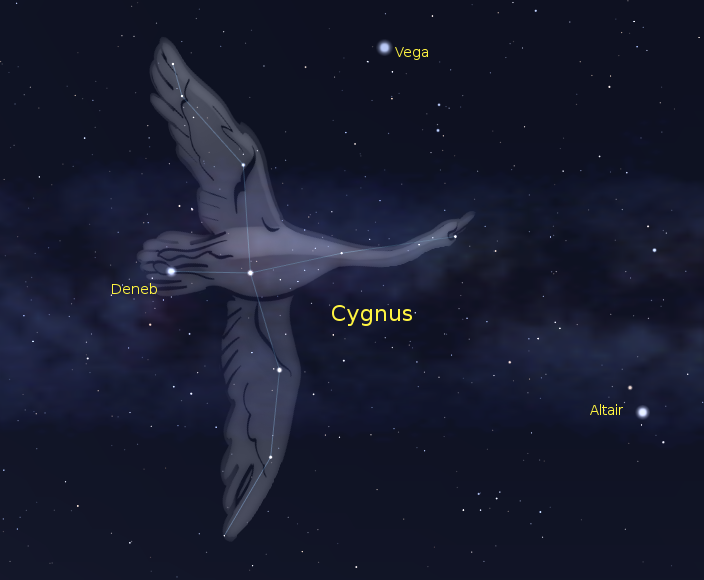
CygnusTheSwan Created using Stellarium.
07/16/2014 – Ephemeris – A late post for the planet day
Ephemeris for Wednesday, July 16th. Today the sun will be up for 15 hours and 11 minutes, setting at 9:24. The moon, 2 days before last quarter, will rise at 11:52 this evening. Tomorrow the sun will rise at 6:13.
It’s Wednesday and once again time to locate the bright planets for this week. Reddish Mars is in Virgo in the southwest as darkness falls. It’s 101 million miles (163 million km) away now, nearly 2 and a half times farther away than last April, and will set at 12:56 a.m. Saturn will be low in the south-southwest as darkness falls, in the faint constellation of Libra the scales. It will set at 2:06 a.m. Saturn’s in perfect position for viewing with a small or large telescopes to see those fabulous rings and its large moon Titan. Somewhat larger telescopes can spot some smaller moons closer in. Brilliant Venus will rise in the east at 4:14 a.m. in morning twilight. Mercury will rise at 4:46 and be barely visible below Venus.
Times are for the Traverse City/Interlochen area of Michigan. They may be different for your location.
Addendum
I’m late on this one, so the planet positions below are for Thursday evening and Friday Morning.
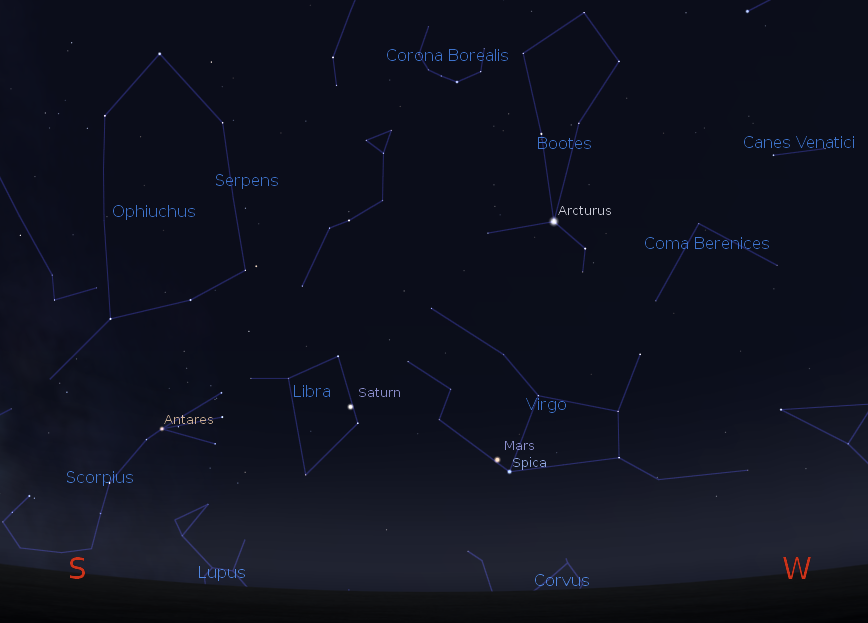
Mars and Saturn with the evening stars and constellations at 11 p.m. Thursday July 17, 2014. Created using Stellarium.
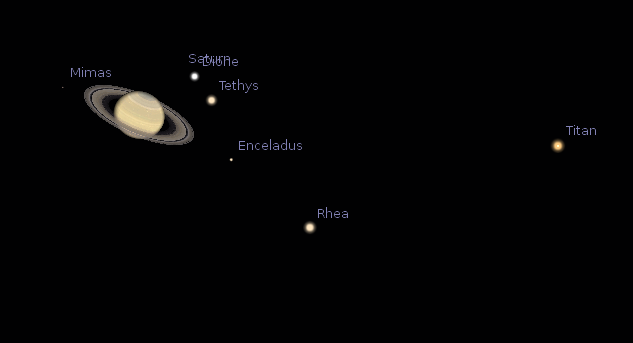
Saturn through a telescope. In small telescopes of the moons only Titan will be visible. July 17, 2014. Created using Stellarium.
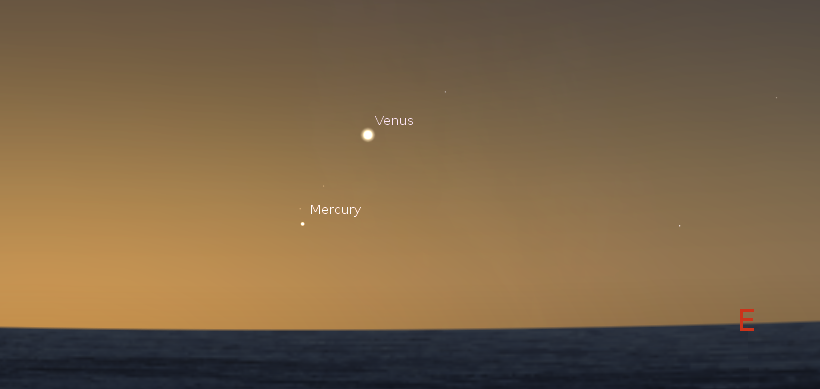
Venus and Mercury at 5:30 a.m. July 18, 2014. Created using Stellarium.
07/15/2014 – Ephemeris – The constellation of Lyra the harp
Ephemeris for Tuesday, July 15th. Today the sun will be up for 15 hours and 13 minutes, setting at 9:24. The moon, half way from full to last quarter, will rise at 11:19 this evening. Tomorrow the sun will rise at 6:12.
Very high up in the eastern sky at 11 p.m. can be found a bright star just north of a small, narrow, but very distinctive parallelogram of stars. They are the stars of the constellation Lyra the harp. The bright star is Vega, one of the twenty one brightest first magnitude stars. Vega is actually the 5th brightest night-time star. The harp, according to Greek mythology, was invented by the Greek god Hermes. The form of the harp in the sky, is as he had invented it: by stretching strings across a tortoise shell. Hermes gave it to his half-brother Apollo, who in turn gave it to the great musician Orpheus. The sun has a motion with respect to most stars around it. Its direction is towards the vicinity of Lyra.
Times are for the Traverse City/Interlochen area of Michigan. They may be different for your location.
Addendum
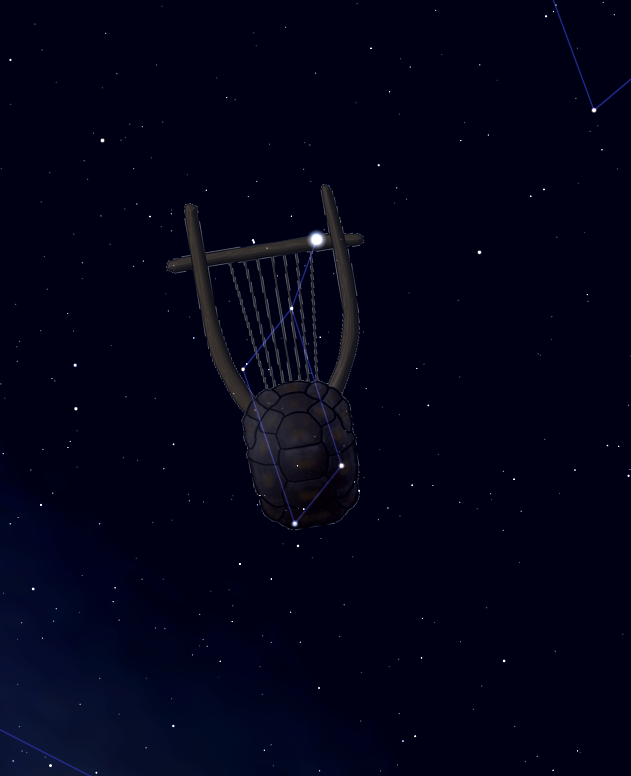
Lyra as a tortoise shell harp. Created using Stellarium and free clip art.
07/14/2014 – Ephemeris – New Horizons to Pluto: 1 year and counting!
Ephemeris for Monday, July 14th. Today the sun will be up for 15 hours and 14 minutes, setting at 9:25. The moon, 2 days past full, will rise at 10:45 this evening. Tomorrow the sun will rise at 6:11.
Exactly one year from today the New Horizons spacecraft will fly by the dwarf planet Pluto. It will be taking photographs of Pluto and its moons, sniffing out Pluto and its large moon Charon. During most of the close flyby the spacecraft will be too busy to talk to Earth. When past Pluto the spacecraft will be able over the next few months to down-link to us all its information. At that great distance it must send data back to us with a transmission speed will make the old 300 baud modems of three decades ago seem fast. Recently the Hubble Space Telescope has been pressed into service to spot new targets beyond Pluto for New Horizons. It quickly found two, and is looking for more.
Times are for the Traverse City/Interlochen area of Michigan. They may be different for your location.
Addendum
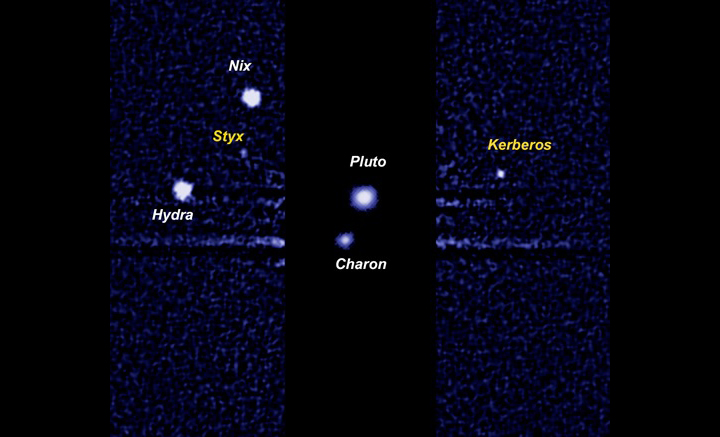
Pluto and its moons as photographed by the Hubble Space Telescope. Pluto and Charon were filtered to reduce their brightness to bring out the other dim moons. Credit: NASA/Hubble.
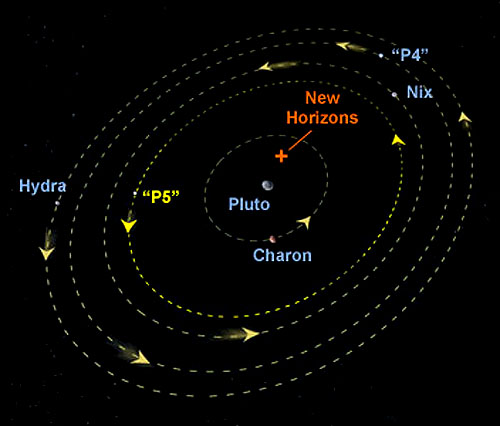
New Horizon’s aim point in relation to the moons. This was created before P4 and P5 received names. P4 became Styx, and P5 became Kerberos. Credit: NASA/GSFC.
When more and more moons were discovered around Pluto serious consideration was given to steer clear of the moon orbits. It is quite possible that there is much debris orbiting Pluto where all these satellites are. They all orbit Pluto in the same plane, along with Charon, above Pluto’s equator. It is thought that any material streaming toward Pluto would be intercepted by Charon, so the space between Charon and Pluto might be clear of debris, so New Horizons can punch through in safety. New Horizons is going like a bat out of heck and has no brakes. New Horizon’s velocity with respect to Pluto at closest approach will be 49,600 kilometers per hour or 30,800 mph according to the New Horizons article on Wikipedia (no citation given). The path of the spacecraft can be altered is a moon or other hazard is detected.
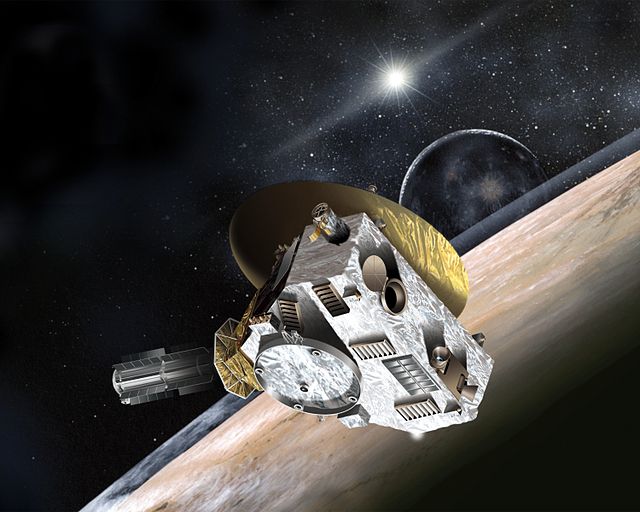
Artist conception of the New Horizons spacecraft at Pluto. Credit: NASA/Johns Hopkins University Applied Physics Laboratory/Southwest Research Institute.
New Horizon’s web page: http://pluto.jhuapl.edu/
07/11/2014 – Ephemeris – Spot Mercury tomorrow and Learn about two comets tonight
Ephemeris for Friday, July 11th. Today the sun will be up for 15 hours and 19 minutes, setting at 9:27. The moon, 1 day before full, will set at 6:31 tomorrow morning. Tomorrow the sun will rise at 6:08.
Really diehard Mercury watchers just may catch a glimpse of this very elusive planet tomorrow morning after it rises at 4:47 a.m. It’s below and left of Venus at that time. But before then the Grand Traverse Astronomical Society will hold its monthly meeting tonight at Northwestern Michigan College’s Observatory on Birmley Road. Yours truly will be giving the talk starting at 8 p.m. about the two comets that will be in the news starting next month. The first will be orbited by the European Rosetta spacecraft which will send down a lander starting next month. The second will be a close approach of a comet to Mars, near enough to possibly menace our satellites orbiting Mars in October. There will be viewing afterwords.
Times are for the Traverse City/Interlochen area of Michigan. They may be different for your location.
More information on the talk is here.
Addendum
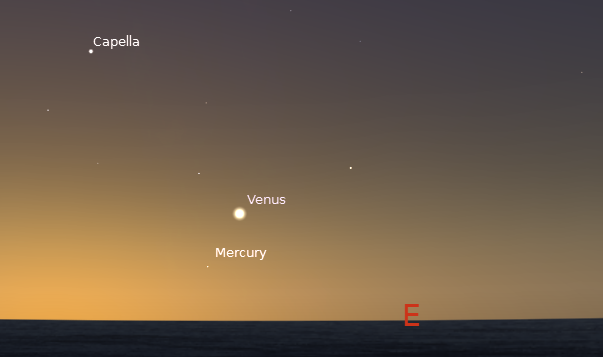
Mercury and Venus rising in twilight at 5:30 a.m. July 12, 2014. Created using Stellarium.

Title Slide for Tail of Two Comets
07/10/2014 – Ephemeris – Why is the bright Moon so low in summer and so high in winter?
Ephemeris for Thursday, July 10th. Today the sun will be up for 15 hours and 20 minutes, setting at 9:28. The moon, 2 days before full, will set at 5:22 tomorrow morning. Tomorrow the sun will rise at 6:08.
If you watch the moon for the next few nights, you won’t have to strain your neck because the moon at its highest will be less than 30 degrees above the southern horizon for us in northern Michigan. That’s because the moon closely follows the path of the sun in the sky, called the ecliptic, with a deviation of only 5 degrees maximum. Tonight it’s a couple of degrees north of the ecliptic. Tonight it’s located about where the sun was back last November or will be next November. In winter you’d swear that the full moon at its greatest height was practically overhead. It’s another effect of the Earth’s axial tilt of 23 ½ degrees. Our moon is odd in it doesn’t orbit the Earth’s equator like most large moons do for their planets.
Times are for the Traverse City/Interlochen area of Michigan. They may be different for your location.
Addendum
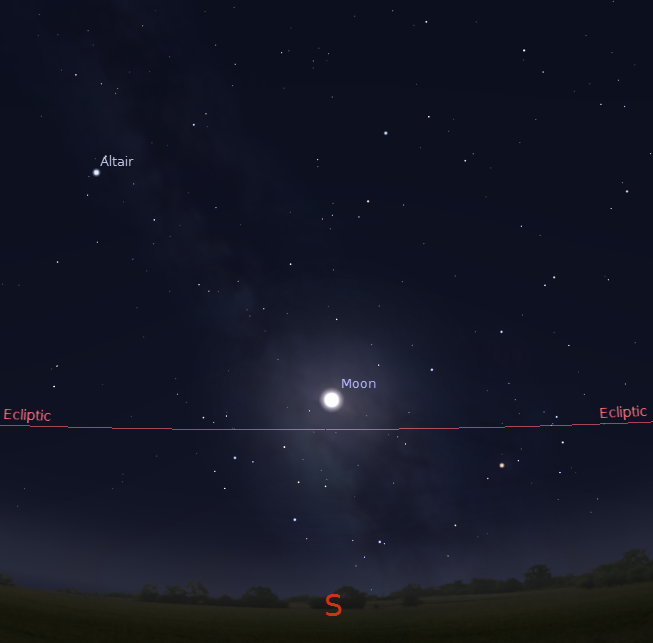
The full Moon on July, 12, 2014. Created using Stellarium.
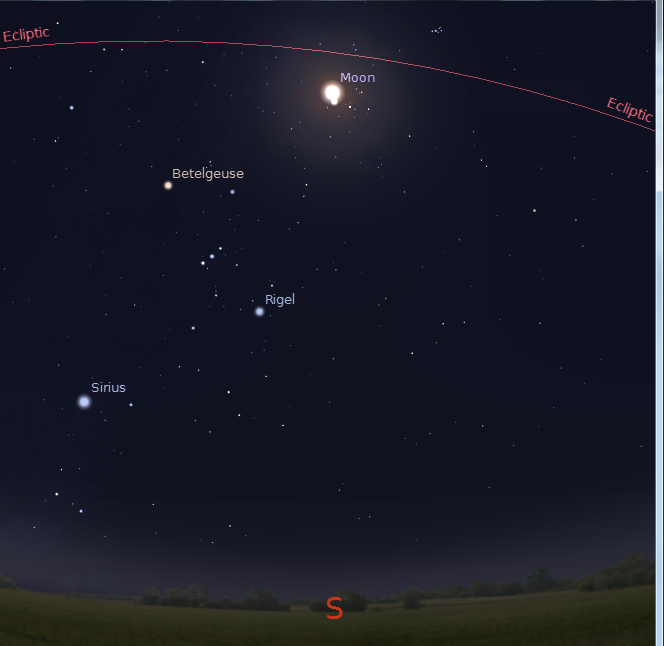
The full Moon on December 6, 2014. Created using Stellarium.
07/09/2014 – Ephemeris – Where are the bright planets this week?
Ephemeris for Wednesday, July 9th. Today the sun will be up for 15 hours and 22 minutes, setting at 9:28. The Moon, 3 days before full, will set at 4:20 tomorrow morning. Tomorrow the sun will rise at 6:07.
It’s Wednesday and once again time to locate the bright planets for this week. Jupiter sets less than a half hour after the sun, so it’s gone for us until September mornings. Reddish Mars is in Virgo in the southwest as darkness falls. It’s 97 million miles (156 million km) away now, nearly 2 and a half times farther away than last April, and will set at 1:17 a.m. Saturn will be low in the south-southwest as darkness falls, in the faint constellation of Libra the scales. It will set at 2:34 a.m. Saturn’s in perfect position for viewing with a small or large telescope to see those fabulous rings and its large moon Titan. Somewhat larger telescopes can spot some smaller moons closer in. Brilliant Venus will rise in the east at 4:09 a.m. in morning twilight.
Times are for the Traverse City/Interlochen area of Michigan. They may be different for your location.
Addendum
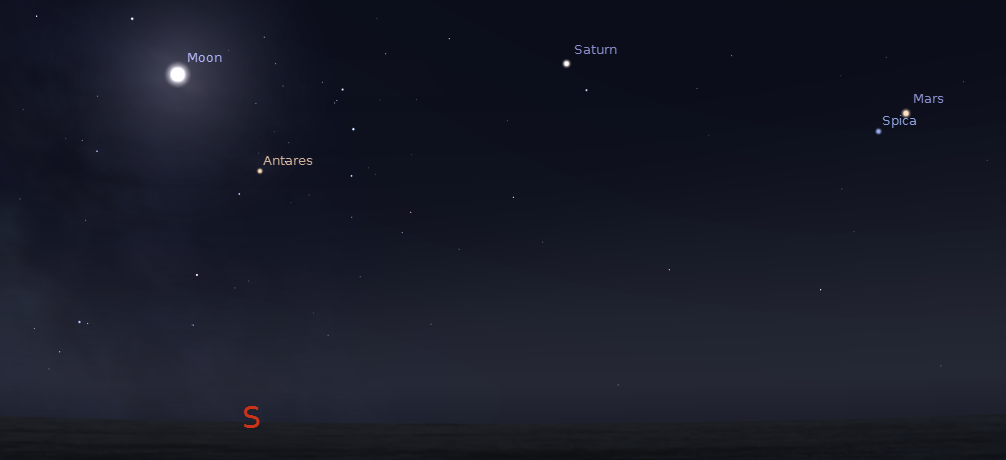
Mars, Saturn and the Moon will appear along with the brighter stars of summer at 11 p.m. on July 9, 2014. Created using Stellarium.
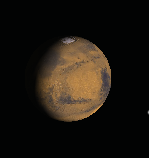
Mars as seen through a large telescope. It appears really tiny in any other telescope. Time: 11 p.m. on July 9, 2014. Created using Stellarium.
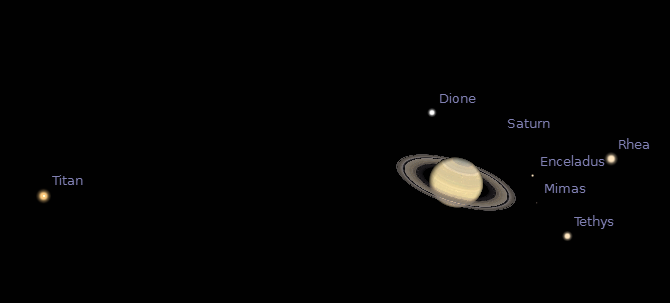
Saturn and some of its moons. Smaller telescopes will see only Titan, but see how many moon you can see. July 9, 11 p.m. Created using Stellarium.
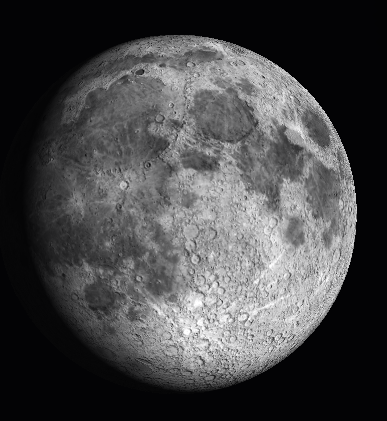
A binocular view of the gibbous Moon on July 9, 2014 at 11 p.m. Created using Stellarium.
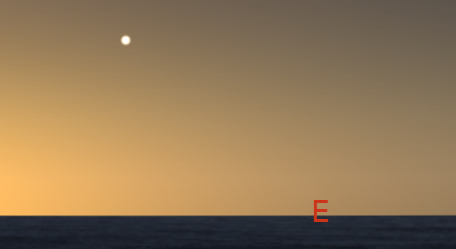
Venus low in the east at 5:45 a.m. July 11, 2014; roughly a half hour before sunrise. Created using Stellarium.
Venus low in the east at 5:45 a.m. July 11, 2014; roughly a half hour before sunrise. Created using Stellarium.

Bright gibbous disk of Venus as seen through a telescope on July 10, 2014. Created using Stellarium.
07/08/2014 – Ephemeris – Why are the near side and the far side of the moon so different?
Ephemeris for Tuesday, July 8th. Today the sun will be up for 15 hours and 23 minutes, setting at 9:29. The moon, 3 days past first quarter, will set at 3:27 tomorrow morning. Tomorrow the sun will rise at 6:06.
We’re all familiar with the gray blotches on the moon called seas that make up the face of the Man in the Moon. The other side, the far side, misnamed the dark side, has only one small sea. Astronomers have wondered why. Seems that it’s a product of the Moon’s birth and the late heavy bombardment that came later. In a new hypothesis, a Mars sized proto-planet hit the proto-Earth with a glancing blow peeling off material that fell into a disk that coalesced into the Moon, a lot closer to the earth than it is today, and the far side contained thicker light crustal material than the near side. When the giant planets began their migration much asteroidal material struck the moon. Near side impacts penetrated into the Moons magma, while the far side impacts did not.
Times are for the Traverse City/Interlochen area of Michigan. They may be different for your location.
Addendum
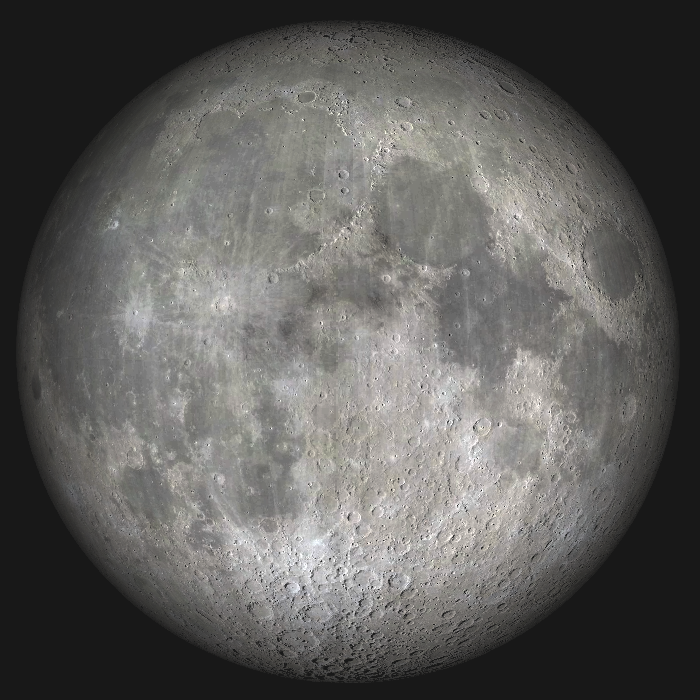
The Moon’s near side. Created using Virtual Moon Atlas.
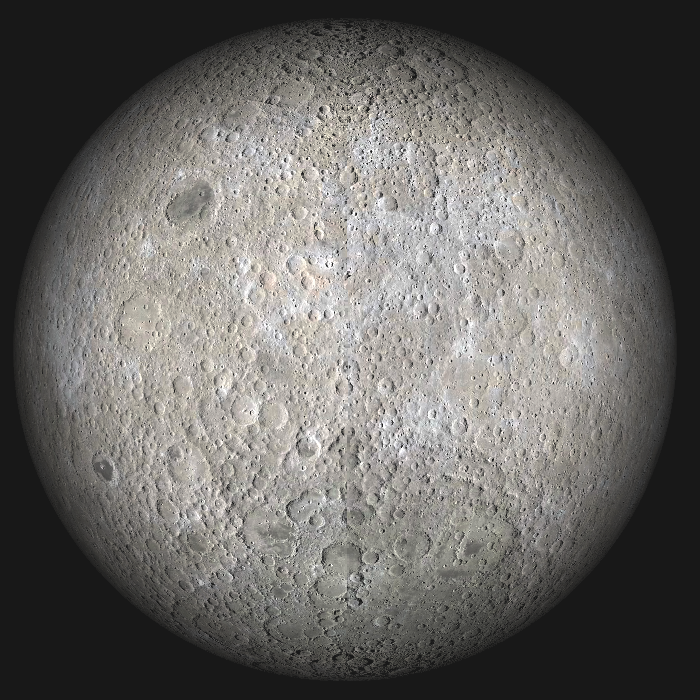
The Moon’s far side. Created using Virtual Moon Atlas.
07/07/2014 – Ephemeris – The Moon will appear near Saturn tonight
Ephemeris for Monday, July 7th. Today the sun will be up for 15 hours and 24 minutes, setting at 9:29. The Moon, 2 days past first quarter, will set at 2:43 tomorrow morning. Tomorrow the sun will rise at 6:05.
Tonight the planet Saturn will be seen above the bright gibbous Moon. At 11 p.m. Saturn will be only 3 moon widths above the moon and may be hard to spot in the Moon’s glare, so that binoculars may be needed to find it. Other than that the moon makes a nice pointer to the ringed planet. The rings of Saturn become apparent in telescopes of at least 20 power. At first the planet looks elliptical, then the planet can be seen to separate from the rings. The Moon itself is a fine but bright object for the telescope. Look near the terminator or sunrise line to see the long lunar shadows delineate the Moon’s crater detail, especially the grand Crater Copernicus near the center of the Moon.
Times are for the Traverse City/Interlochen area of Michigan. They may be different for your location.
Addendum
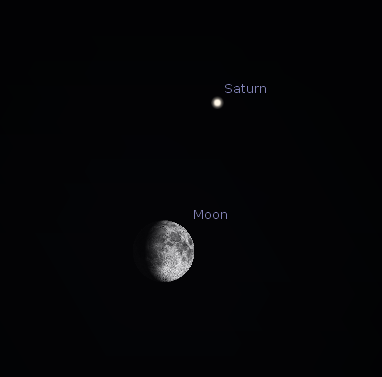
Saturn and the Moon as they would appear at 11 p.m. on July 7, 2014. Created using Stellarium.
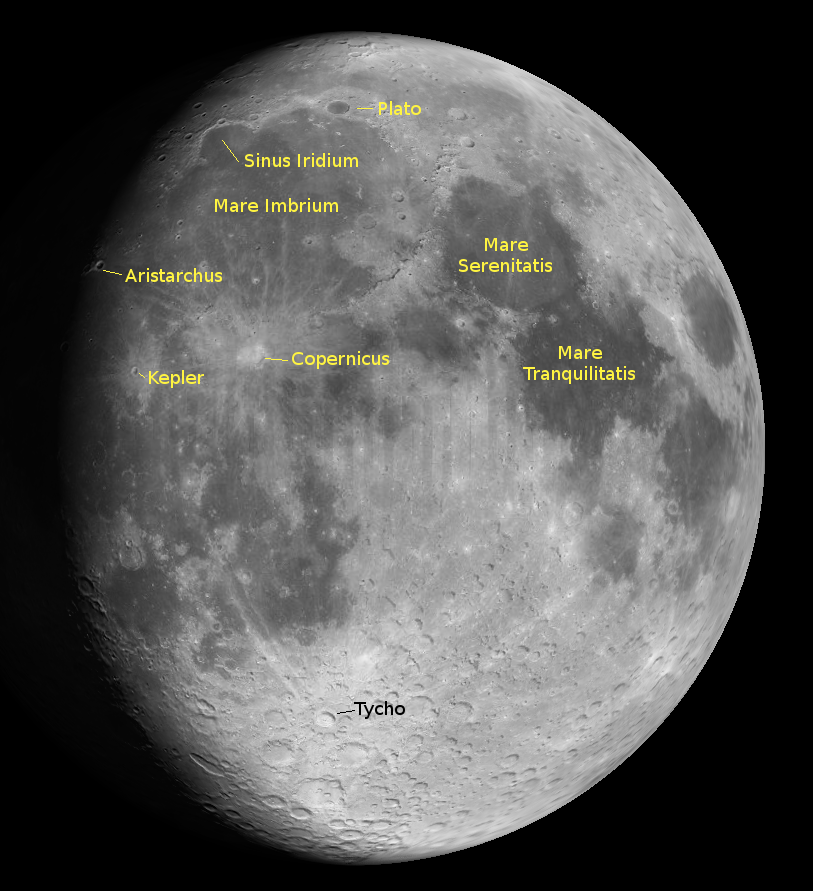
Oops, here’s the Moon for tomorrow night July 8th, 2014. The difference from tonight is the Aristarchus will not be visible, and Sinus Iridium will look cooler. Created using Virtual Moon Atlas. It’s 2 a.m. and I’m too tired to fix it.
 Bob Moler's Ephemeris Blog