Archive
Ephemeris: 07/31/2024 – Where are the naked-eye planets this week?
This is Ephemeris for Wednesday, July 31st. Today the Sun will be up for 14 hours and 40 minutes, setting at 9:09, and it will rise tomorrow at 6:29. The Moon, halfway from last quarter to new, will rise at 3:01 tomorrow morning.
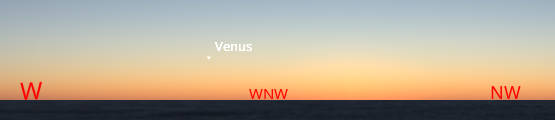
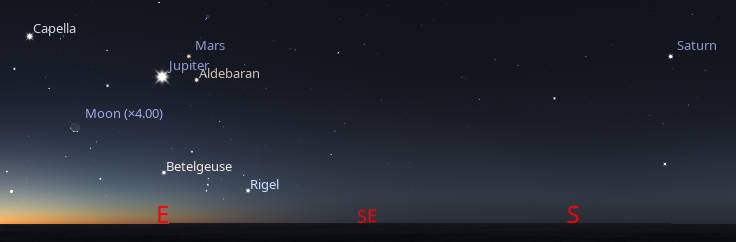
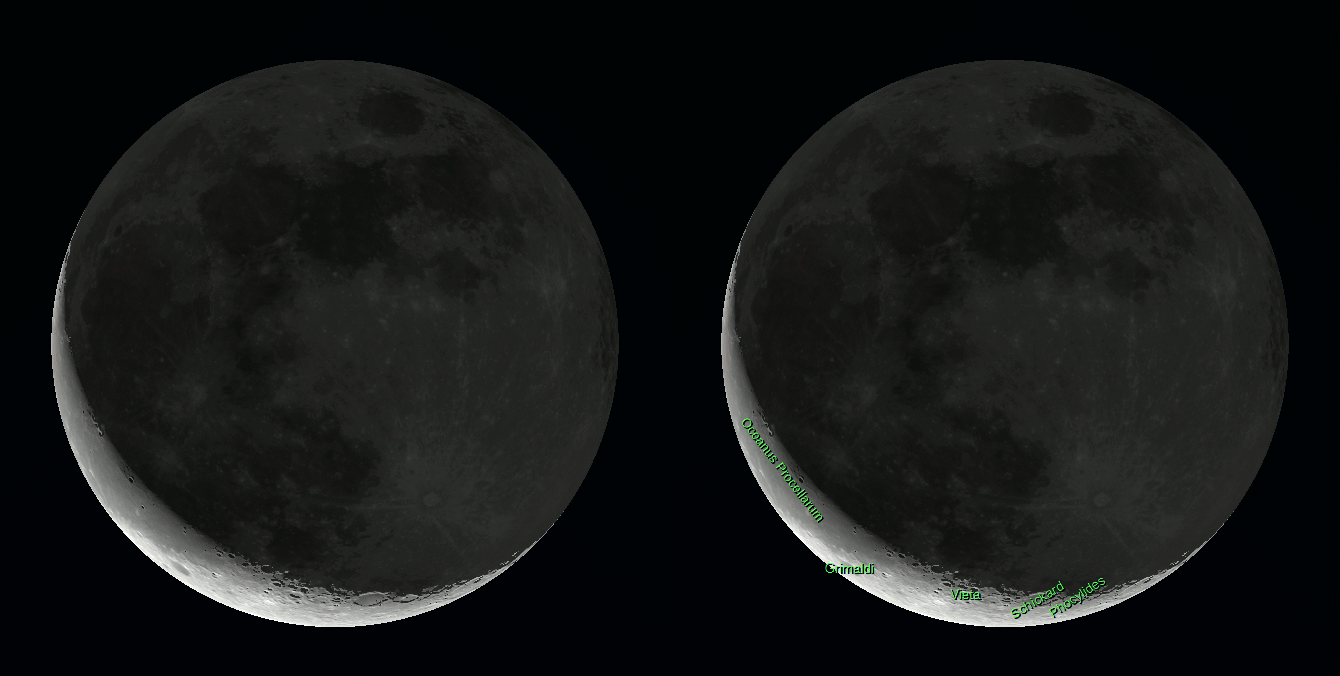
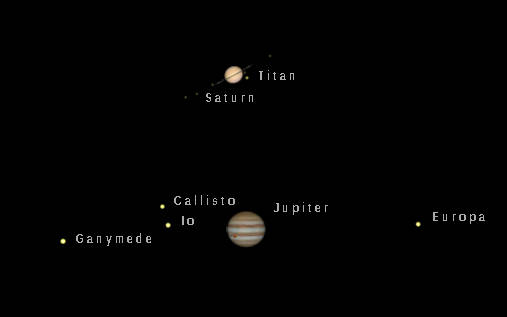
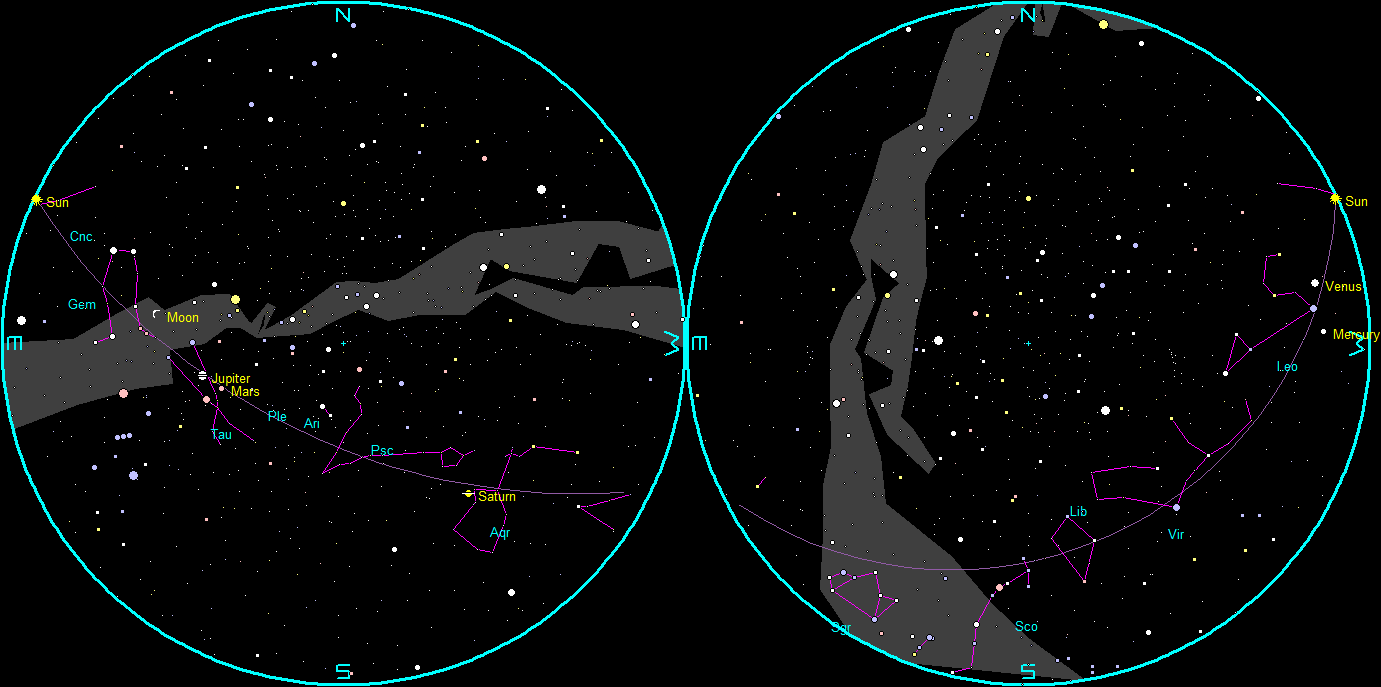
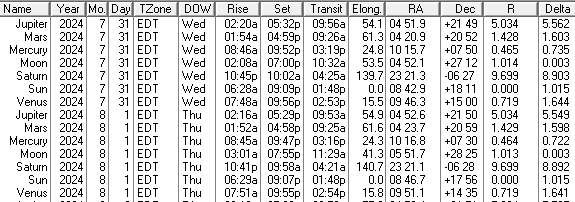
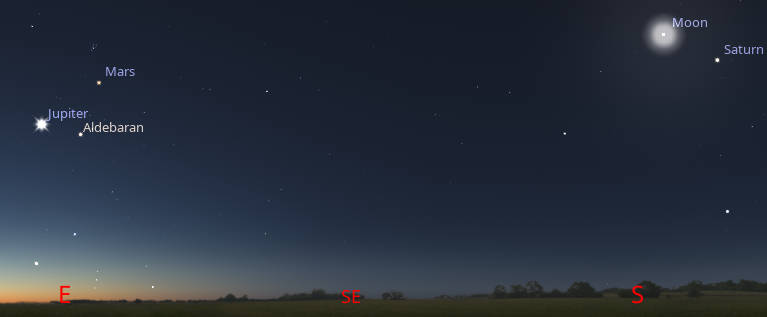
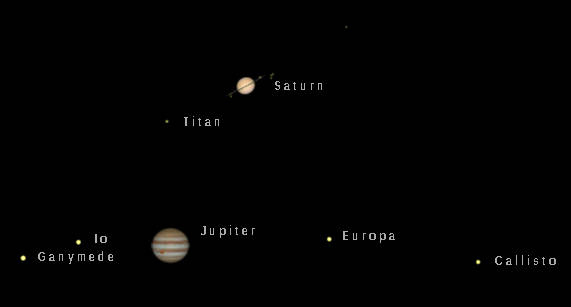
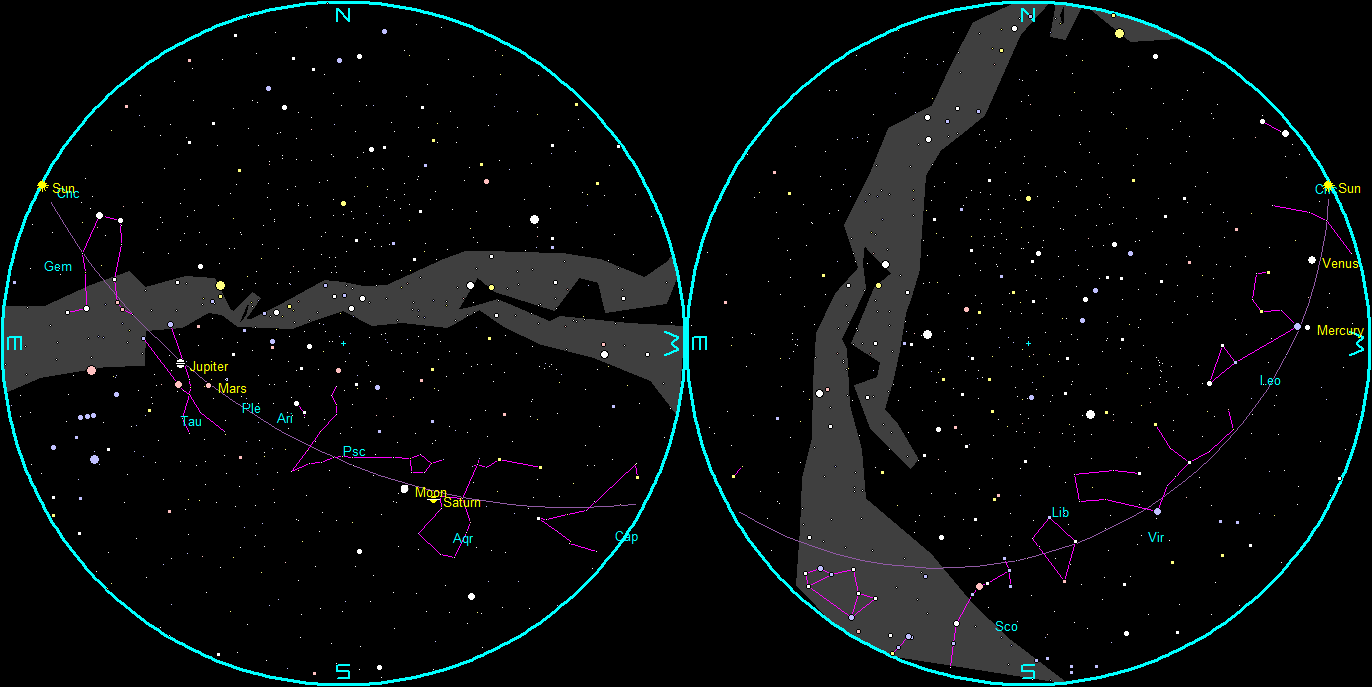
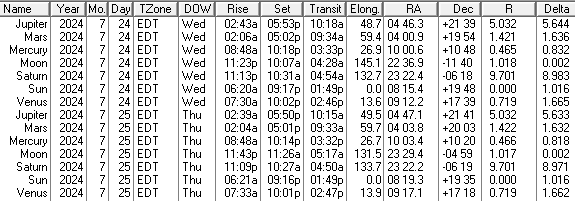
Let’s take our weekly look at the whereabouts of the naked-eye planets. Venus may still be too close to the direction of the Sun to be easily seen, it will set at 9:56 pm in the west-northwest. The best time to spot it will start about 9:30 pm or so, looking over a Lake Michigan horizon. Mercury now is too low and faint to be seen at that time. The rest of the planets are in the morning sky. By 5:30 tomorrow morning, or an hour before sunrise, Saturn will be in the south-southwest, Mars and Jupiter will make a small triangle with the bright star Aldebaran in the east with Mars on top and Jupiter on the left. Below and left of Jupiter will be the crescent Moon. Saturn may look disappointing in telescopes this year since rings are nearly edge on and appear almost as a line through the planet. Saturn will rise at 10:45 pm, Mars will rise at 1:56 am, and finally Jupiter at 2:20 am.
The astronomical event times given are for the Traverse City/Interlochen area of Michigan (EDT, UT–4 hours). They may be different for your location.
Addendum
Ephemeris: 07/30/2024 – The heavenly harp
This is Ephemeris for Tuesday, July 30th. Today the Sun will be up for 14 hours and 42 minutes, setting at 9:10, and it will rise tomorrow at 6:28. The Moon, 3 days past last quarter, will rise at 2:08 tomorrow morning.
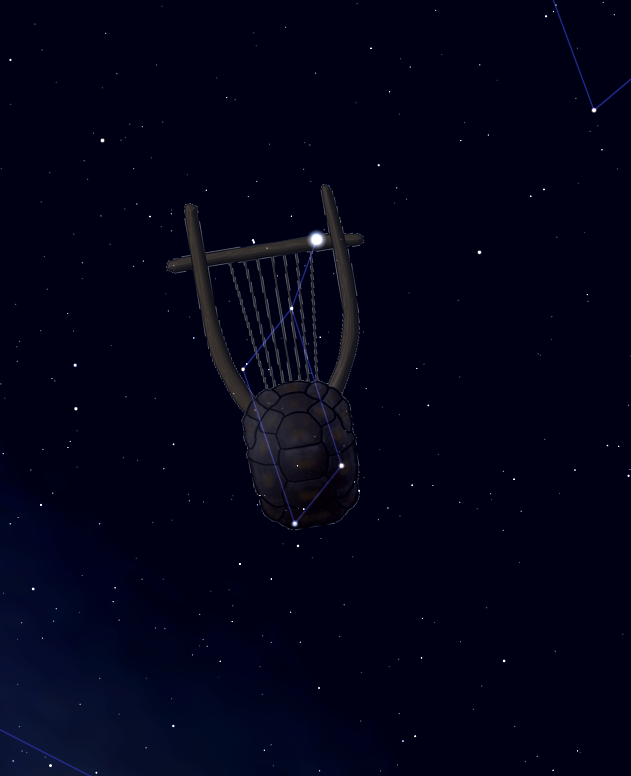
After it gets dark, nearly overhead, appears the bright star Vega, the brightest of the stars of the Summer Triangle. It is part of the constellation called Lyra the harp. The form of the harp is a lyre, which has a U-shaped frame with a bar across the top, the strings are strung from the bar down to the base of the U. According to Greek myth it was invented by the god Hermes who used a tortoise shell as the base of the U. He gave it to Apollo, who in turn gave it to Orpheus. Orpheus had the greatest musical talent. His singing and lyre playing would make animals and even inanimate objects dance. The constellation itself consists of Vega and a parallelogram of four stars which are seen below it.
The astronomical event times given are for the Traverse City/Interlochen area of Michigan (EDT, UT–4 hours). They may be different for your location.
Addendum
Ephemeris: 07/29/2024 – Late July’s meteor shower
This is Ephemeris for Monday, July 29th. Today the Sun will be up for 14 hours and 45 minutes, setting at 9:11, and it will rise tomorrow at 6:27. The Moon, 2 days past last quarter, will rise at 1:26 tomorrow morning.
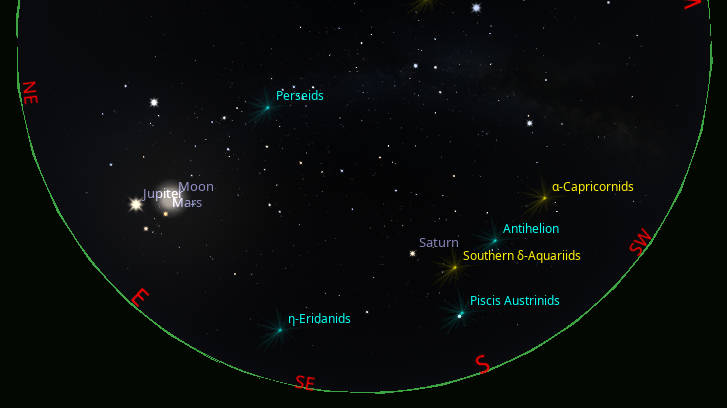
There are more meteor showers that occur in the second-half of the year than there are in the first six months of the year. I don’t know why that is. The first of these major showers is the Southern Delta Aquariid meteor shower. There happens to be a few meteor showers at appear to emanate from the constellation of Aquarius so they named them after the closest star to the direction they appear to come from at their maximum. The star Delta in the southern part of Aquarius is associated with two meteor showers. This one appears to be coming from south of that star. And are only an eighth as active as the Perseids that we’re going to have next month partly because the radiant point doesn’t get very high in the sky.
The astronomical event times given are for the Traverse City/Interlochen area of Michigan (EDT, UT–4 hours). They may be different for your location.
Addendum
Ephemeris: 07/26/2024 – View the Sun from the Sleeping Bear Dunes tomorrow
Sorry, I’ve posted this a bit late.
This is Ephemeris for Friday, July 26th. Today the Sun will be up for 14 hours and 51 minutes, setting at 9:14, and it will rise tomorrow at 6:24. The Moon, 1 day before last quarter, will rise at 12:03 tomorrow morning.
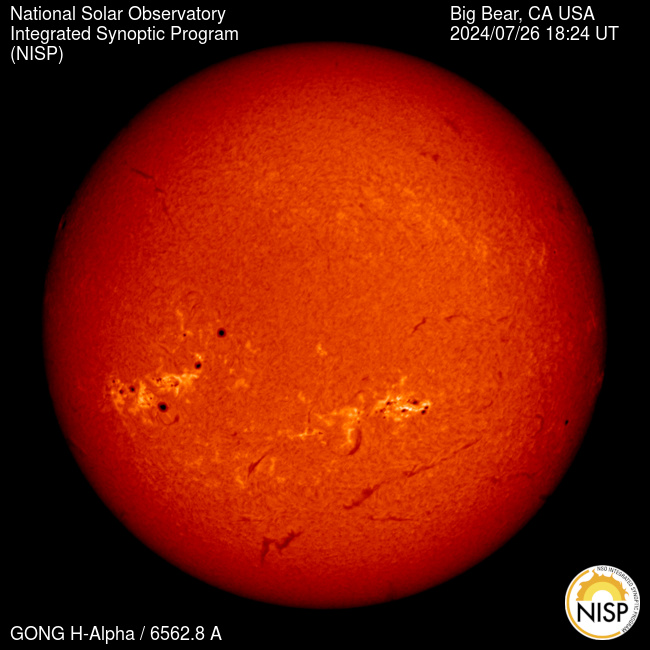
Tomorrow, Saturday, July 27th there will be solar viewing at the Sleeping Bear Dunes National Lakeshore, at the Dune Climb from 3 to 6 PM. Park Rangers will be joined by members of the Grand Traverse Astronomical Society with their specially filtered telescopes to view the sun safely. This is a period of great solar activity. Remember the Northern Lights of last month? Solar filtered telescopes will safely view the surface of the sun, called the photosphere and sunspots, while the society also has two special solar telescopes with which to view the layer of gas above the surface called the chromosphere and prominences which look like flames coming off the chromosphere. This is the last of the two solar observing opportunities this summer.
The astronomical event times given are for the Traverse City/Interlochen area of Michigan (EDT, UT–4 hours). They may be different for your location.
Addendum
Ephemeris: 07/25/2024 – The Milky Way as it will appear tonight
This is Ephemeris for Thursday, July 25th. Today the Sun will be up for 14 hours and 54 minutes, setting at 9:16, and it will rise tomorrow at 6:23. The Moon, 2 days before last quarter, will rise at 11:43 this evening.
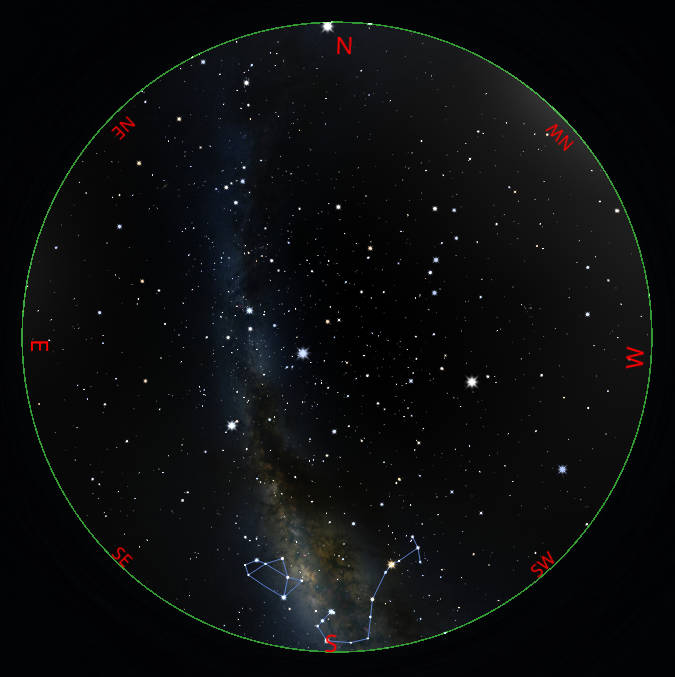
With the Moon out of the sky until almost 11:30 PM we get our first look at the summer Milky Way in the evening. The Milky Way will stretch from the east-northeast, high in the east to the South. The asterism of the stout little Teapot in Sagittarius, low to the south, is near the bottom end of the Milky Way. The milky stream appears as steam coming out of the spout. With more stars there, one might be able to see the Centaur with a bow and arrow. The front part of the teapot is the bow. The bottom left, and the far right star are the back and the tip of the arrow which is pointing at the heart of Scorpius the scorpion in the south-southwest. We’ll be exploring the wonders of the summer Milky Way this month and next.
The astronomical event times given are for the Traverse City/Interlochen area of Michigan (EDT, UT–4 hours). They may be different for your location.
Addendum
Ephemeris: 07/24/2024 – Where are the naked-eye planets this week?
This is Ephemeris for Wednesday, July 24th. Today the Sun will be up for 14 hours and 56 minutes, setting at 9:17, and it will rise tomorrow at 6:21. The Moon, halfway from full to last quarter, will rise at 11:23 this evening.
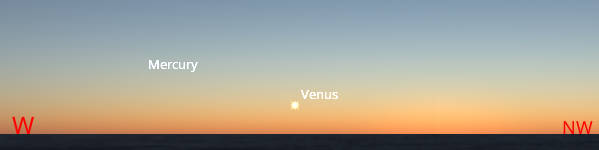
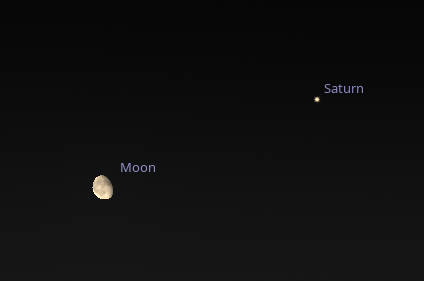
Let’s take our weekly look at the whereabouts of the naked-eye planets. Venus may still be too close to the direction of the Sun to be easily seen, it will set at 10:02 pm in the west-northwest. The best time to spot it will start about 9:40 pm or so. Mercury has been fading as its phase has become a crescent, as it’s heading back to the direction of the Sun. By 5:30 tomorrow morning, or about 50 minutes before sunrise, Saturn will be in the south below and right of the waning gibbous Moon, Mars and Jupiter will make a right triangle with the bright star Aldebaran in the east with Mars on top and Jupiter on the left. Saturn may look disappointing in telescopes this year since rings are nearly edge on and appear almost as a line through the planet. Saturn will rise at 11:14 pm, Mars will rise at 2:04 am, and finally Jupiter at 2:39 am.
The astronomical event times given are for the Traverse City/Interlochen area of Michigan (EDT, UT–4 hours). They may be different for your location.
Addendum
Ephemeris: 07/23/2024 – Albireo, a blue and gold double star
This is Bob Moler with Ephemeris for Tuesday, July 23rd. Today the Sun will be up for 14 hours and 58 minutes, setting at 9:18, and it will rise tomorrow at 6:20. The Moon, 2 days past full, will rise at 11:01 this evening.
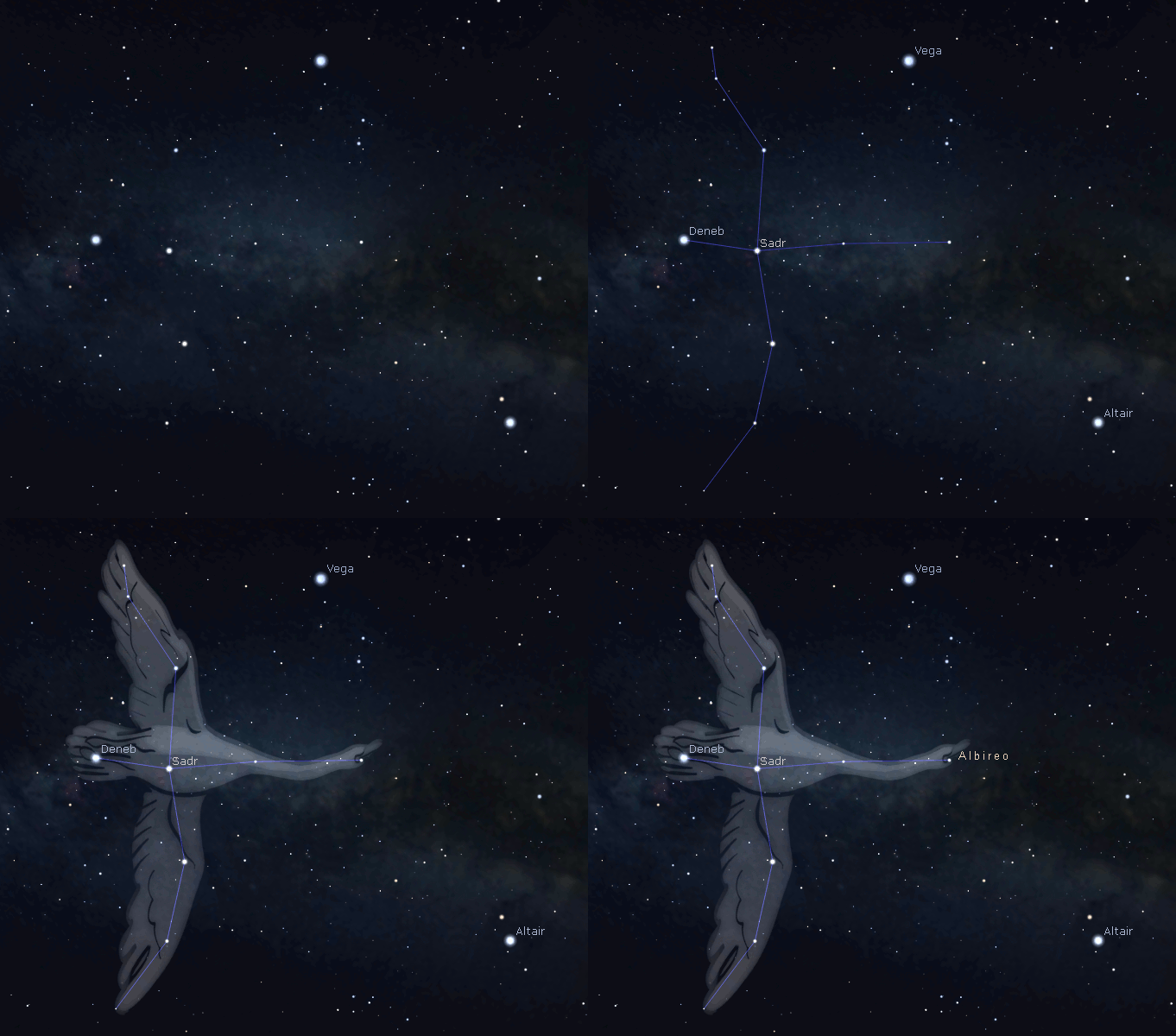
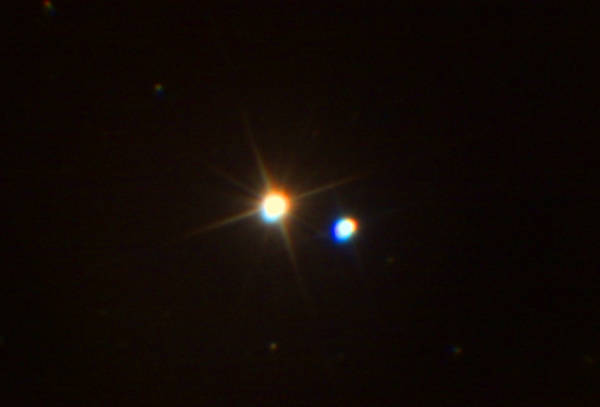
Alberio is the name given to the star that is in the head of the constellation of Cygnus the swan, which is in the east these evenings, flying south along the Milky Way. It is also at the foot of the asterism or informal constellation of the Northern Cross. To the naked eye and binoculars Albireo looks like a single star. However, even in small telescopes its true nature is revealed. It’s a double star whose individual star colors are strikingly different Its brightest star is yellow, and the dimmer star is blue. While star colors are subtle, these two, due to their apparent closeness, make an obvious color contrast. Unlike what your interior decorator says: In stars, blue is hot, yellow, orange and red are cool. The two stars are too far apart to be considered a binary star system that are gravitationally bound, but appear to move together in space. It is what is called an optical double, though they’re both around 430 light years away.
The astronomical event times given are for the Traverse City/Interlochen area of Michigan (EDT, UT–4 hours). They may be different for your location.
Addendum
Ephemeris: 07/22/2024 – Happy Pi Approximation Day
This is Bob Moler with Ephemeris for Pi Approximation Day*, Monday, July 22nd. Today the Sun will be up for 15 hours exactly, setting at 9:19, and it will rise tomorrow at 6:19. The Moon, 1 day past full, will rise at 10:37 this evening.
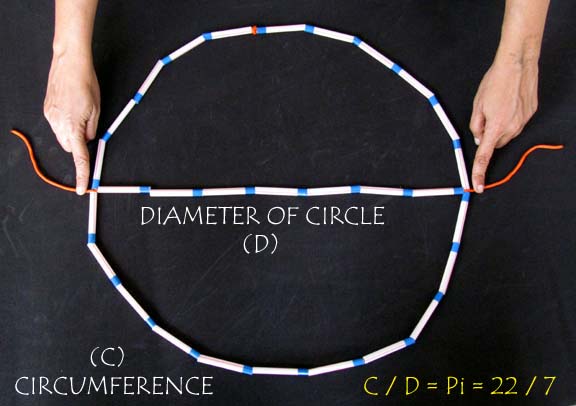
The first Pi day of the year for mathematics junkies was March 14th utilizing the three most significant digits of the mathematical value π, the ratio of the circumference of a circle to its diameter, written as 3.14. Today is the second version of π written as the fraction 22/7. We don’t write our date that way, we write it as 7/22. In other parts of the world it is written as 22/7. So whichever way you slice it, it’s a pi day and in Northern Michigan I would imagine it’s a cherry pi. In the sky today the planet Mercury is at its greatest elongation or separation east of the Sun in the western sky. It is preceding the Sun heading southward against the stars and is not easily visible after sunset.
The astronomical event times given are for the Traverse City/Interlochen area of Michigan (EDT, UT–4 hours). They may be different for your location.
* In the radio program I called it Pi Day #2. I have since found out that today has a special name.
Addendum
Ephemeris: 07/19/2024 – SpaceX’s Falcon 9 has the first failure in many years
This is Ephemeris for Friday, July 19th. Today the Sun will be up for 15 hours and 6 minutes, setting at 9:21, and it will rise tomorrow at 6:16. The Moon, 2 days before full, will set at 4:45 tomorrow morning.
A week ago yesterday a SpaceX Falcon 9 rocket was unable to put a batch of 20 Starlink satellites into the proper orbit due to a failure in the second stage. The problem seems to be an oxygen leak that prevented a second burn of the engine to circularize the orbit leaving the orbit perigee or low point to be 135 kilometers high, which though in orbit, that orbit would soon decay, having the satellites burn up on reentry after a few orbits. The Falcon 9 fleet has been grounded pending an investigation. However, there are two immediate planned flights of the Falcon 9 utilizing the Crew Dragon, the first is at the end of July which is a private mission called Polaris Dawn and in August the Crew 9 transfer to the International Space Station. It remains to be seen how long those missions will be postponed.
The astronomical event times given are for the Traverse City/Interlochen area of Michigan (EDT, UT–4 hours). They may be different for your location.
Addendum

Ephemeris: 07/18/2024 The brightest spot on the Moon
This is Ephemeris for Thursday, July 18th. Today the Sun will be up for 15 hours and 7 minutes, setting at 9:22, and it will rise tomorrow at 6:15. The Moon, 3 days before full, will set at 3:40 tomorrow morning.
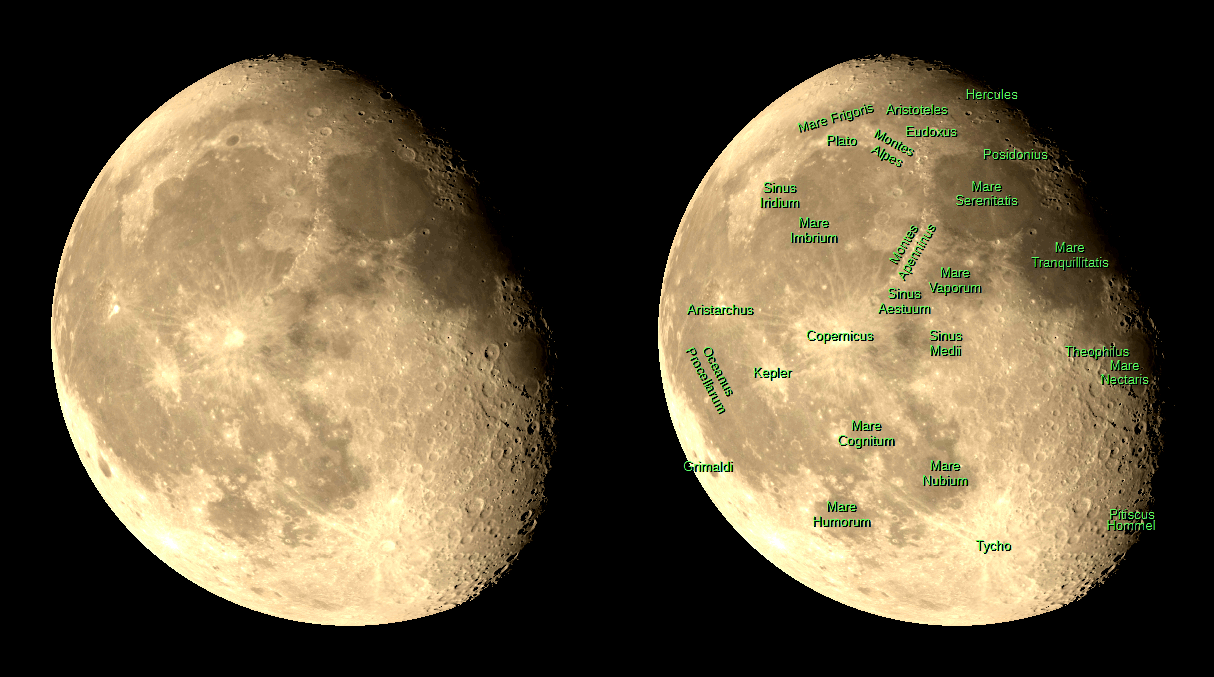
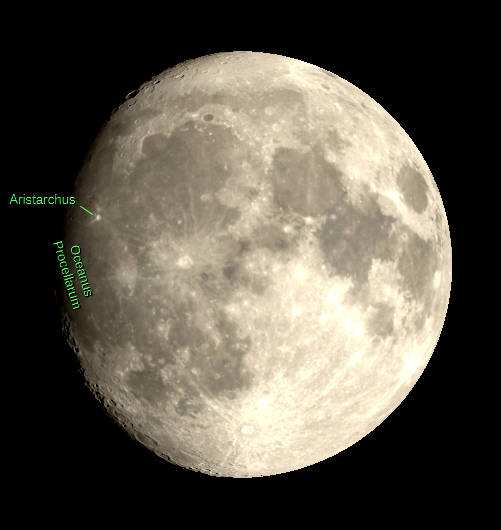
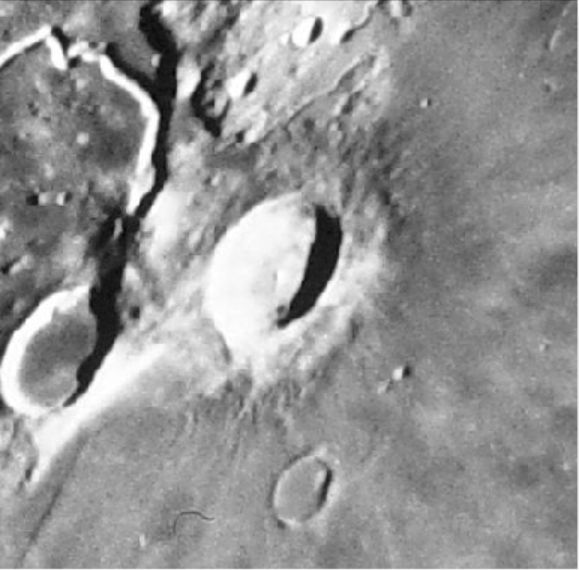
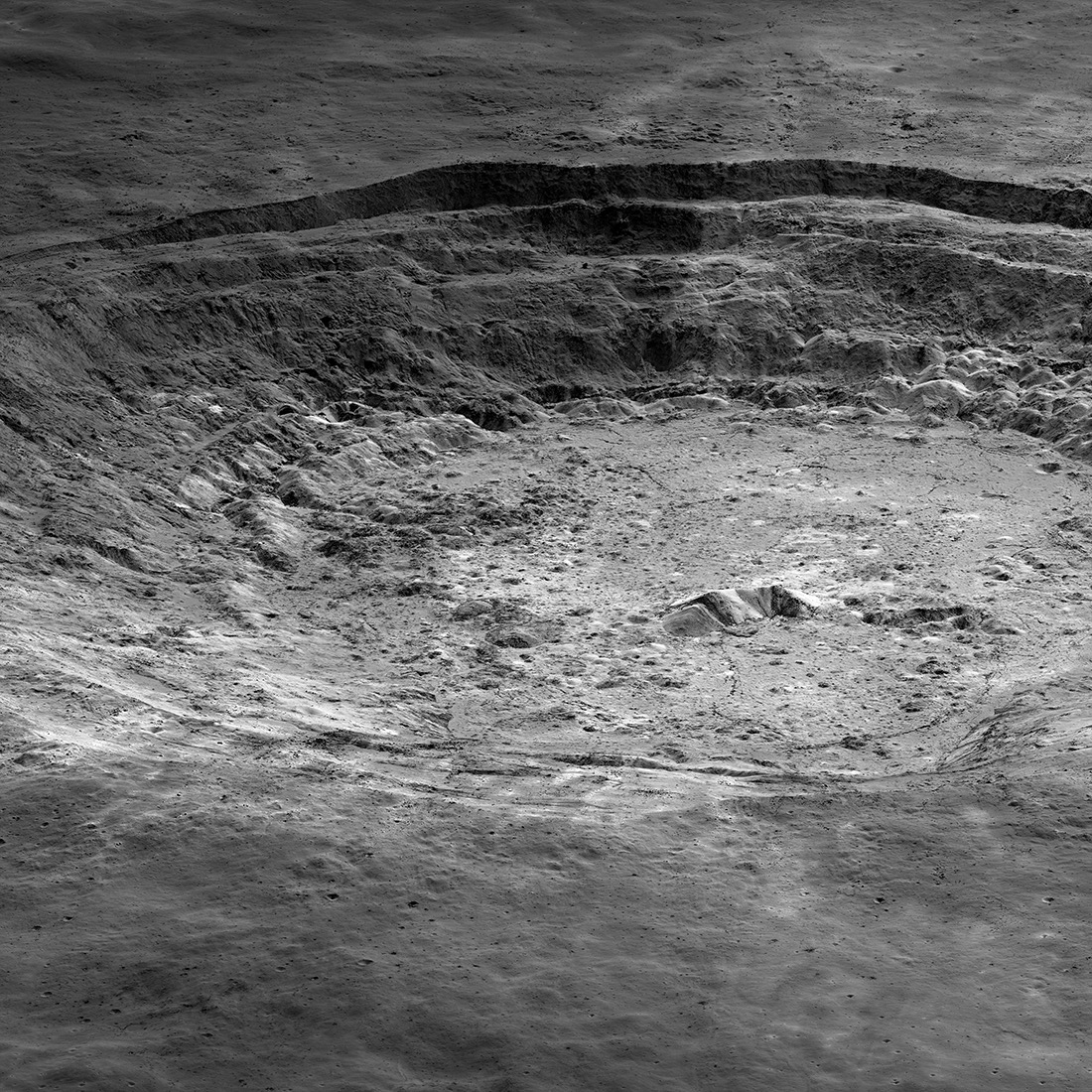
The moon tonight is bright. The sunrise line or terminator on the moon is crossing the large gray plain called Oceanus Procellarum, the largest of the moon’s seas. These seas were figments of the first telescopic observer’s imagination. They are really huge impact basins into which interior lava flowed. On the left side of the Moon is a bright spot in the gray expanse of Oceanus Procellarum visible in binoculars. In a telescope it is a crater called Aristarchus. It is a fairly new crater in lunar terms, probably less than a billion years old. As a rule the brighter the crater the newer it is. Aristarchus is the brightest spot on the Moon. Over the years visual astronomers have seen hazes and bright spots from time to time in and near Aristarchus.
The astronomical event times given are for the Traverse City/Interlochen area of Michigan (EDT, UT–4 hours). They may be different for your location.
Addendum
 Bob Moler's Ephemeris Blog