Archive
01/12/2018 – Ephemeris – A look at Gemini the very unusual twins
Ephemeris for Friday, January 12th. The Sun will rise at 8:18. It’ll be up for 9 hours and 6 minutes, setting at 5:24. The Moon, half way from last quarter to new, will rise at 5:16 tomorrow morning.
The constellation Gemini, the Twins is visible half way up the sky in the east at 9 p.m. The namesake stars of the two lads will be on the upper left edge of the constellation, nearly vertically aligned. Castor is above, while Pollux, a slightly brighter star is below it. Lines of stars from Castor and Pollux to the right delineate the lads. In Greek mythology Castor and Pollux were twins, and half brothers, Castor was fathered by a mere mortal, while Pollux was fathered by Zeus in the famous Leda and the swan affair. The brothers, however were inseparable, and when Castor was killed during the quest for the Golden Fleece, Pollux pleaded with Zeus to let him die also. Zeus granted his wish, so they both appear in the sky together forever.
The times given are for the Traverse City/Interlochen area of Michigan. They may be different for your location.
Addendum
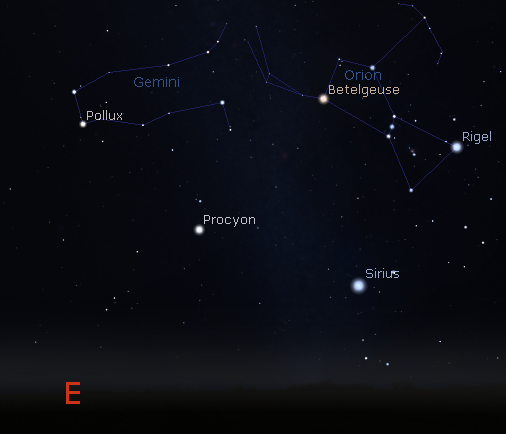
Gemini as it should appear at 9 p.m., January 12, 2018. Created using Stellarium.
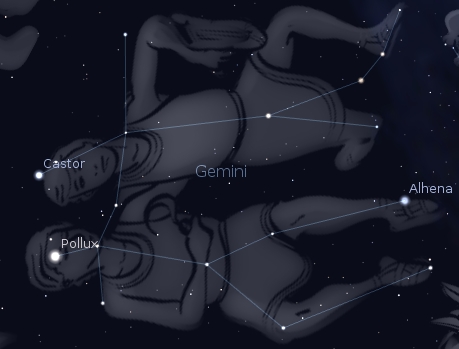
Gemini with Castor and Pollux. A closeup with a different way to link the stars with constellation art. Created with Stellarium.
01/11/2018 – Ephemeris – This morning the Moon passes Jupiter and Mars
Jan 11. This is Bob Moler with Ephemeris for Thursday, January 11th. The Sun will rise at 8:18. It’ll be up for 9 hours and 5 minutes, setting at 5:23. The Moon, 3 days past last quarter, will rise at 4:19 tomorrow morning.
This morning the thin crescent Moon will be poised over Jupiter and Mars in the east southeast at 7 a.m. It will make a pretty sight for the eye and camera. I follow many amateur astronomers on Twitter with clearer skies than ours who take many great pictures of planetary conjunctions, the Moon and other wonders of the heavens.
There is space mission orbiting Jupiter right now. It doesn’t make great discoveries that shake up the astronomical world enough to make the national news. The Juno mission skims close and then away from Jupiter in order to ferret out its internal structure. It does contain a camera for the public that reveals the spectacular cloud formations of Jupiter’s polar cloudscapes.
The times given are for the Traverse City/Interlochen area of Michigan. They may be different for your location.
Addendum
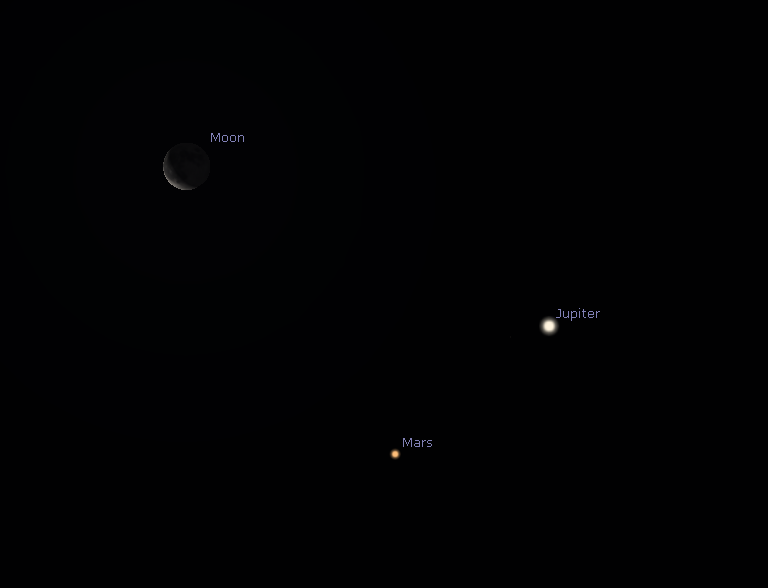
The Moon with Jupiter and Mars this morning January 11, 2018 at 7 a.m. Created using Stellarium.
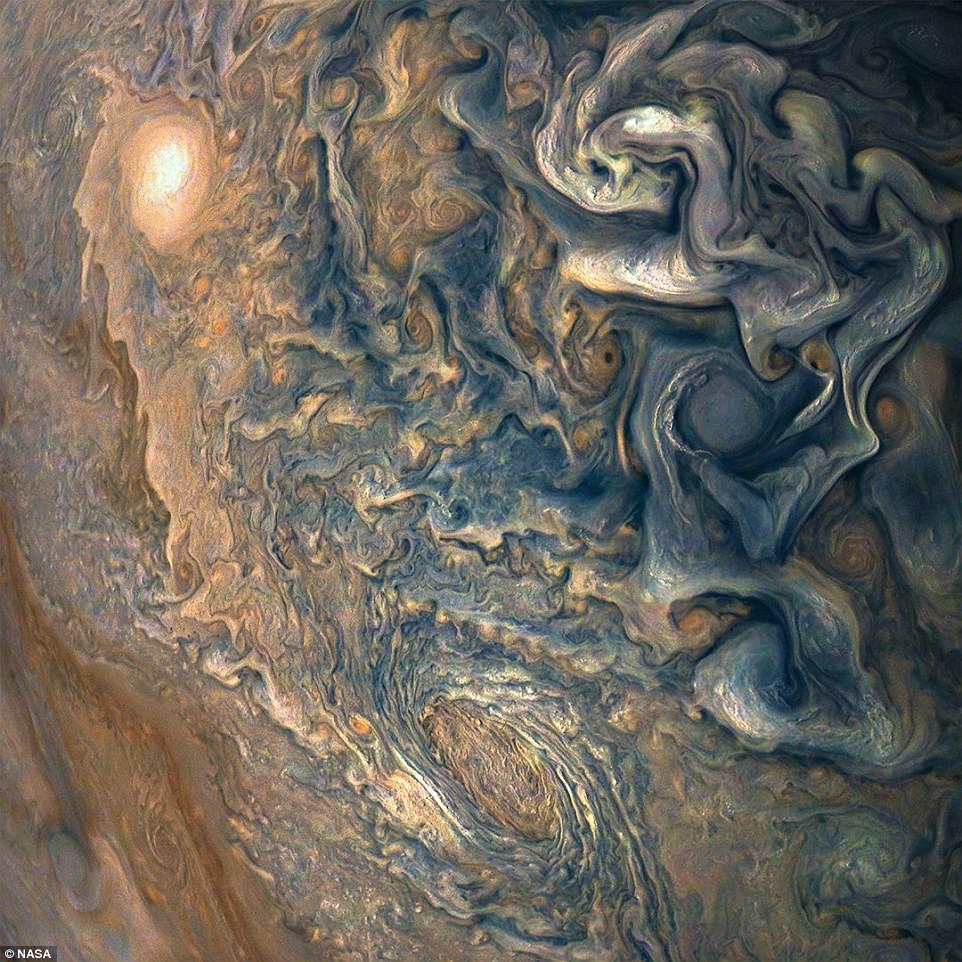
Some of Jupiter’s clouds photographed by NASA’s Juno spacecraft.
Ride along with Juno on its 6th close encounter (perijove 6) with Jupiter. Jove is another Roman name for Jupiter, by Jove!
Jupiter: Juno Perijove 06 from Seán Doran on Vimeo.
01/10/2018 – Ephemeris – One lone, but invisible, bright planet in the evening, the rest in the morning
Ephemeris for Wednesday, January 10th. The Sun will rise at 8:18. It’ll be up for 9 hours and 3 minutes, setting at 5:22. The Moon, 2 days past last quarter, will rise at 3:20 tomorrow morning.
Let’s take our weekly look at the bright planets. While Uranus and Neptune are evening planets, they require binoculars or a telescope to spot. All of the bright naked eye planets save one are in the morning sky now, but Venus is too close to the Sun to be seen. So is Saturn, but that’s in the morning sky along with Mercury. At 7 this morning Jupiter is in the east-southeast and is a lot brighter than Mars, just below and left of it. Jupiter will rise at 3:29 tomorrow with Mars following at 3:40. If you want to take a crack at Mercury, it will rise this morning at 6:52 And Saturn will rise at 7:07 this morning. Saturn’s rise times will increase by 3 to 4 minutes each morning. The morning sky you’ll see at 7 a.m. will be the same stars as in the late spring sky with the summer triangle just rising.
The times given are for the Traverse City/Interlochen area of Michigan. They may be different for your location.
Addendum
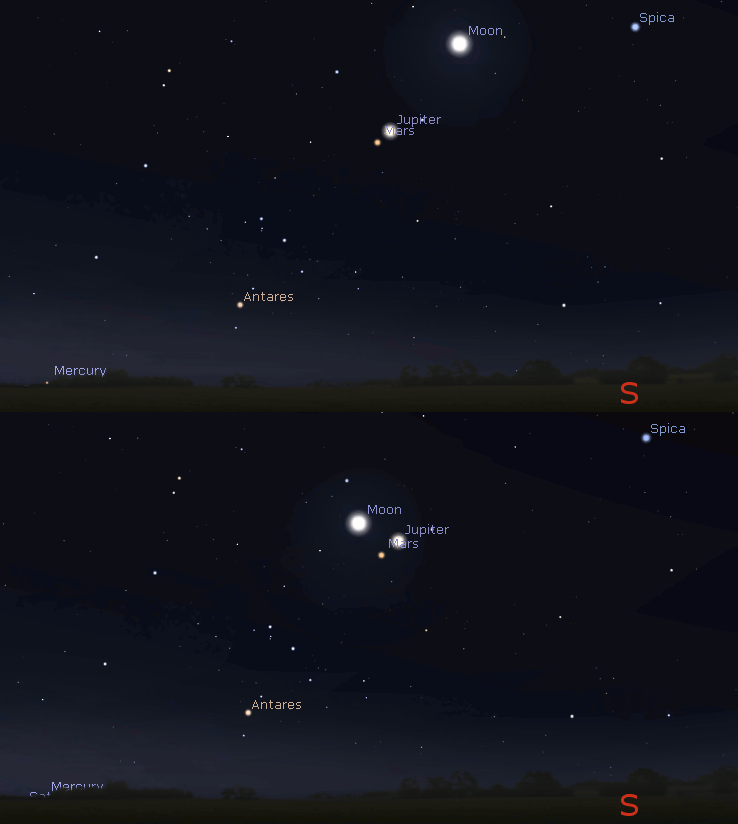
Morning planets with an animation of the Moon’s motion on the morning of the 10th & 11th. Created using Stellarium and GIMP. I’ll be covering the Moon’s apparent proximity to the planets tomorrow. Click on image to enlarge.
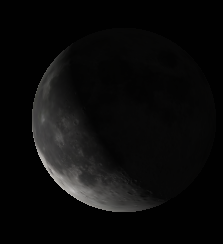
The fat waning crescent Moon as it might be seen in binoculars at 7 a.m. January 10, 2017. Created using Stellarium.
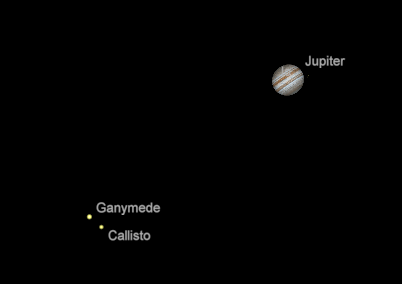
Jupiter with only two of its moons visible at 7 a.m. January 10, 2018. Io and Europa will be visible before 5:27 a.m. before ducking into Jupiter’s shadow. Created using Cartes du Ciel.
Satellite Event           Date      UT     EST
Europa Eclipse start:   10 Jan 2018 10:27  5:27 a.m.
Io Eclipse start:       10 Jan 2018 10:28  5:28 a.m.
Io Occultation end:     10 Jan 2018 13:42  Daylight
Europa Occultation end: 10 Jan 2018 14:56  Daylight
Satellite events are from the Pluto Project: https://www.projectpluto.com/jevent.htm
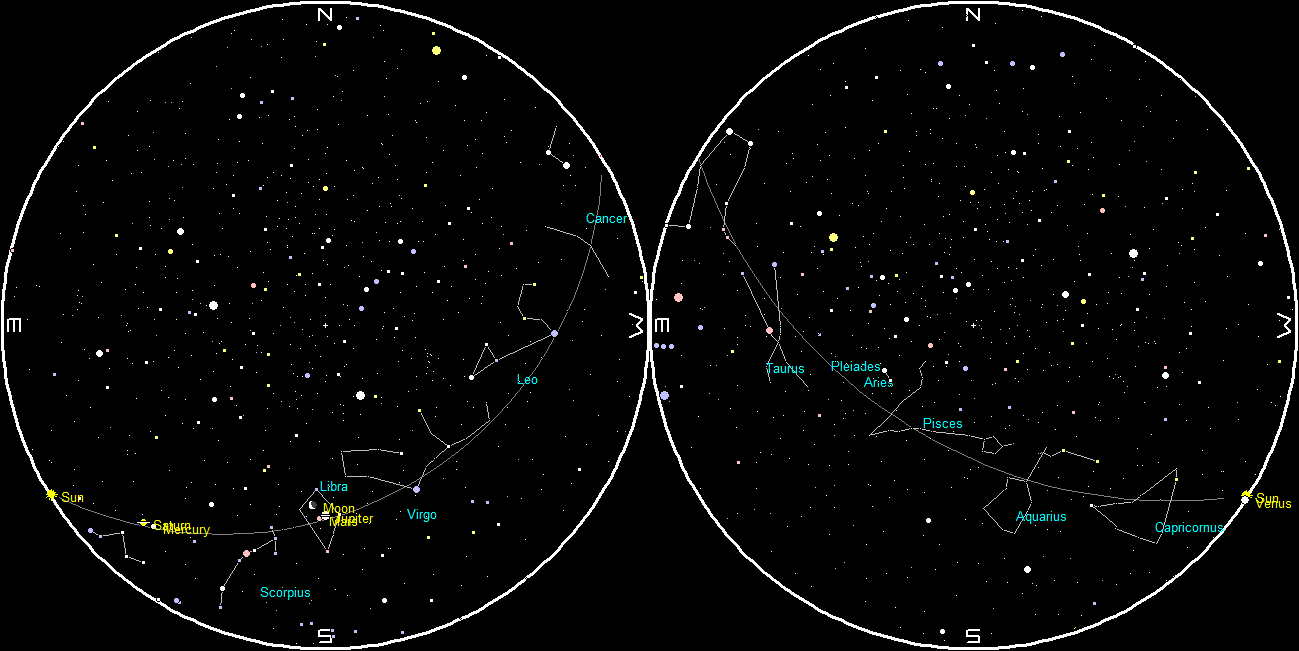
Planets at sunset and sunrise of a single night starting with sunset on the right on January 10, 2017. The night ends on the left with sunrise on the 11th. Click on the image to enlarge. Created using my LookingUp program.
01/08/2018 – Ephemeris – The Pleiades in Greek myth
Ephemeris for Monday, January 8th. The Sun will rise at 8:19. It’ll be up for 9 hours and 1 minute, setting at 5:20. The Moon, at last quarter today, will rise at 1:17 tomorrow morning.
The large and bright constellation of Orion is now in the southeast at 9 p.m. It is seen as an upright rectangle of bright stars, with a belt of three stars in the center. Orion is a minor character in Greek mythology. Orion was the son of Neptune, and was a hunter. He had an ill-fated romance with Merope, whose father King Oenopion, had him blinded. After having his sight restored, Orion became a companion of Diana goddess of the hunt and they wanted to marry. Apollo, Diana’s brother disapproved of Orion also and was able to trick Diana into accidentally killing Orion with an arrow. The heart-broken Diana then placed Orion in the sky with his hunting dogs, were we see him to this day.
The times given are for the Traverse City/Interlochen area of Michigan. They may be different for your location.
Addendum
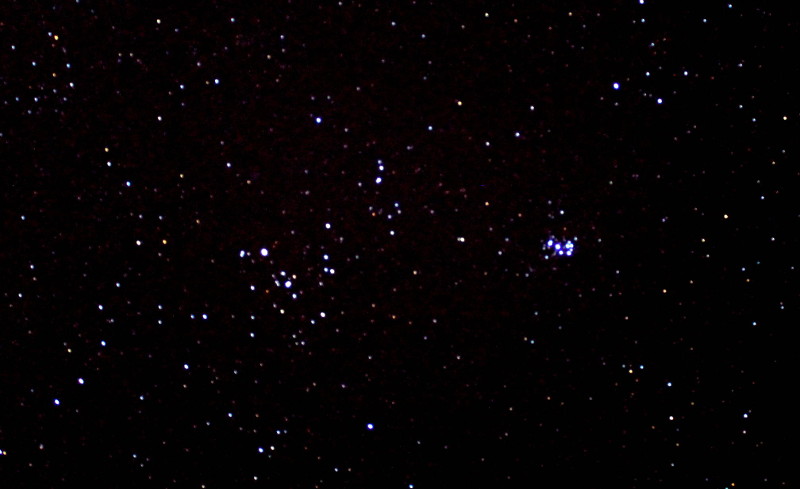
The Pleiades (right) and the Hyades (left) in this photograph I took January 4, 2016.
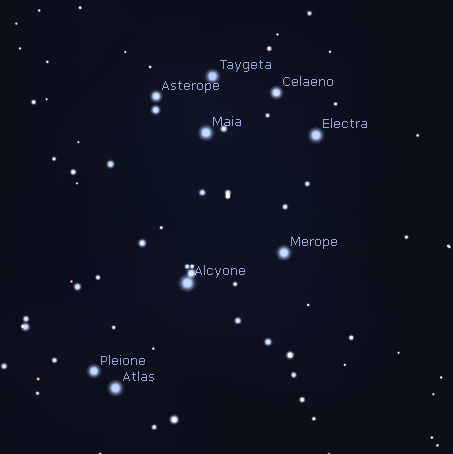
The named stars of the Pleiades. This is also showing more stars than can be seen with the naked eye. This is the number of stars that can be seen in binoculars, which is the best way to observe them. Most telescopes are offer too much magnification to fit all the stars in. A thirty power wide-angle eyepiece can just fit all the stars in. Created using Stellarium.
01/04/2018 – Ephemeris – Mars will pass Jupiter in the morning sky this weekend
Ephemeris for Thursday, January 4th. The Sun will rise at 8:20. It’ll be up for 8 hours and 55 minutes, setting at 5:15. The Moon, 3 days past full, will rise at 8:44 this evening.
We have, weather permitting, been watching Mars and Jupiter getting closer together day by day in the morning sky. Their paths will cross Saturday evening as Mars slips under Jupiter. However at that time they will be below our horizon. So Saturday morning the 6th Mars will be just to the lower right of the brighter Jupiter by a bit less than he diameter of the Moon and Sunday morning the 7th Mars will be left and below Jupiter by about the same amount. After that they will continue to separate. Jupiter will stay in the constellation of Libra and enter the evening sky in early May. The Earth will catch up to Mars at the end of July. Then it will be closer to the Earth than any time since 2003. It will come as close as 35.8 million miles (57.9 million km) from the Earth.
The times given are for the Traverse City/Interlochen area of Michigan. They may be different for your location.
Addendum
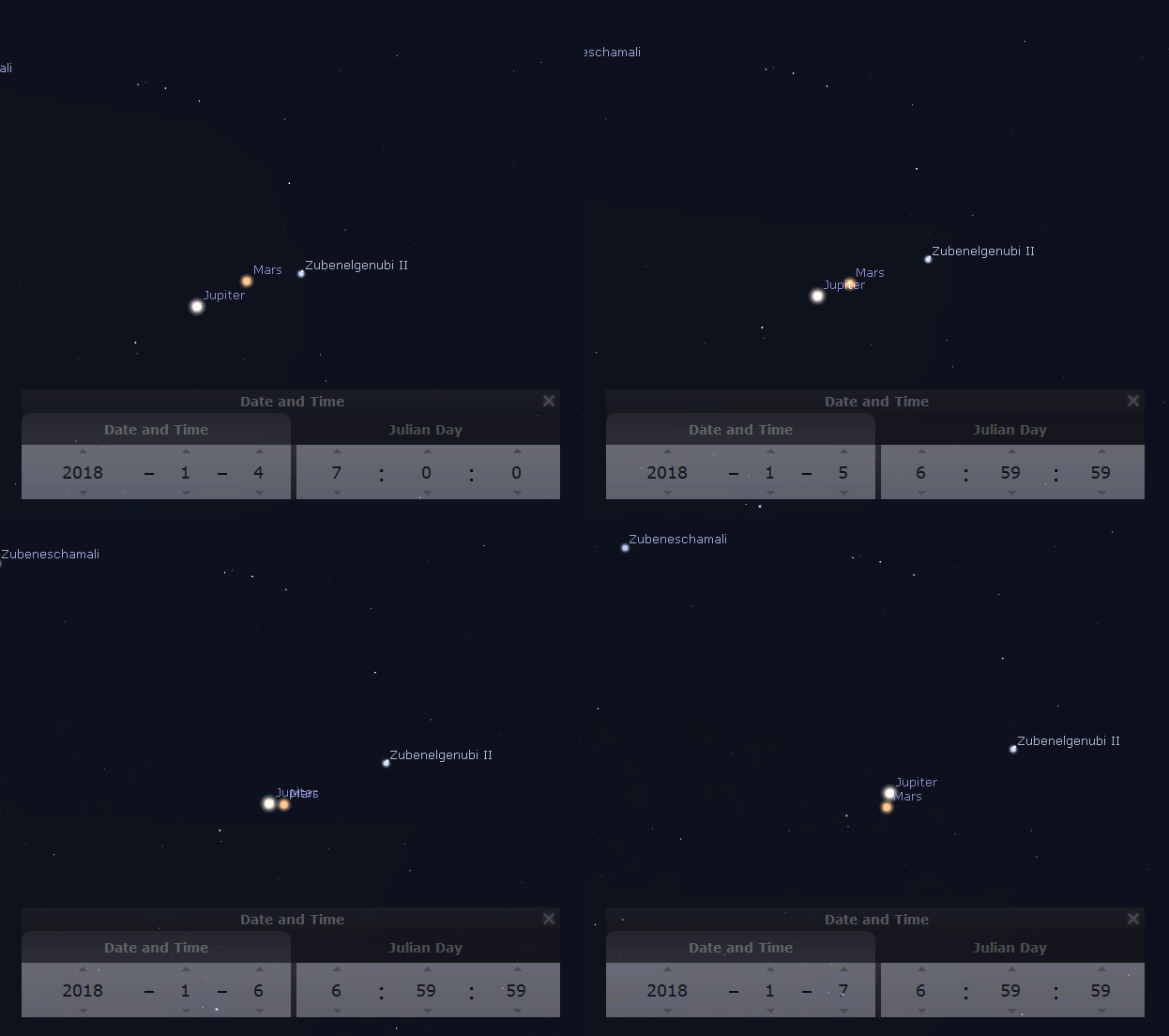
An animation of the Mars-Jupiter conjunction from January 4th thru 7th at 7 a.m.. The two named stars seen Zubenelgenubi and Zubeneschamali, stars in the constellation Libra, meaning south claw and north claw respectively. Claws of Scorpius, the constellation rising to the east. Created using Stellarium and GIMP.
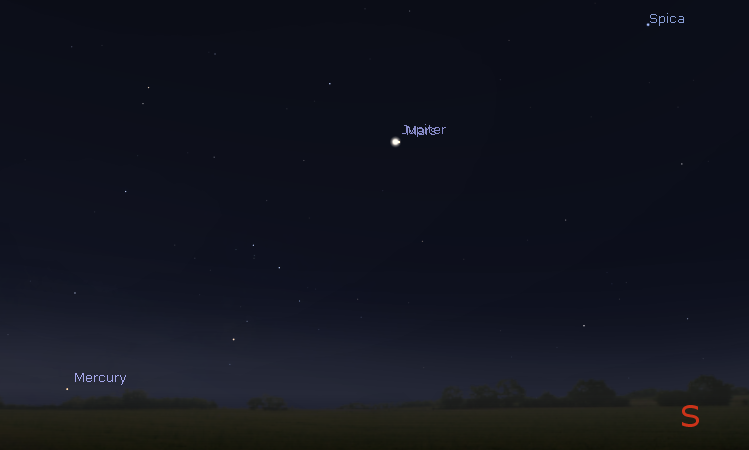
Morning planets at 7 a.m. January 6th, 2018. Mars and Jupiter labels are superimposed. Created with Stellarium.
01/03/2018 – Ephemeris – The year starts out with all the bright planets in the morning sky
Ephemeris for Wednesday, January 3rd. The Sun will rise at 8:20. It’ll be up for 8 hours and 54 minutes, setting at 5:14. The Moon, 2 days past full, will rise at 7:30 this evening.
Let’s take our weekly look at the bright planets. While Uranus and Neptune are evening planets, they require binoculars or a telescope to spot. All of the bright naked eye planets are in the morning sky now, However Saturn and Venus, the brightest, are too close to the Sun to be seen. At 7 this morning Mars is in the south-southeast while Jupiter is a lot brighter and below and left of it. Mars will rise tomorrow morning at 3:45. It’s approaching Jupiter which will rise 6 minutes later at 3:51. They will cross paths this weekend, I’ll have more on that tomorrow. Mercury will be a challenge to spot, rising in the east-southeast around 6:38 a.m. now. At 7 a.m. It will require a low horizon, binoculars and luck to find. In its next evening appearance in March it will be placed much higher in the sky for the same twilight conditions.
The times given are for the Traverse City/Interlochen area of Michigan. They may be different for your location.
Addendum
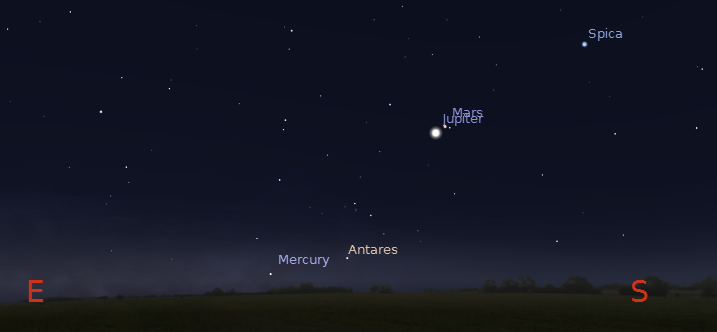
Three morning planets are visible at 7 this morning. Created using Stellarium.
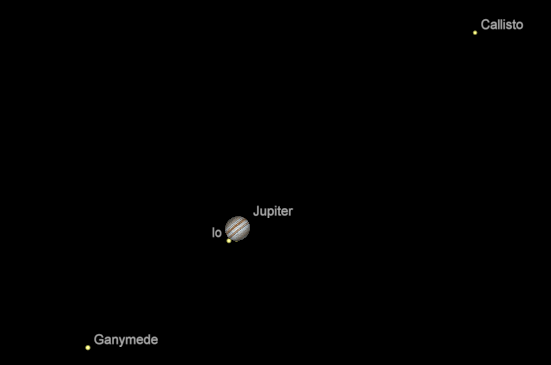
Jupiter and three of its four Galilean moons as they might be seen in a telescope at 7 a.m. this morning, January 3, 2018. Created using Cartes du Ciel (Sky Charts).
Event                      UT        EST
Europa Eclipse starts:    7:51
Io Eclipse starts:        8:35
Io Occultation ends:     11:45    6:45 a.m.
Europa Occultation ends: 12:12    7:12 a.m.
Only the last two events will be visible in the Grand Traverse area. Occultations now have the moon enter Jupiter’s shadow to the west, then unseen pass behind the planet to emerge at the east edge of the planet.
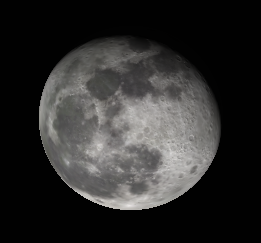
The only bright solar system object visible in the evening is the waning gibbous Moon. Binoculars will reveal several large craters. this evening January 3, 2018. Created using Stellarium.
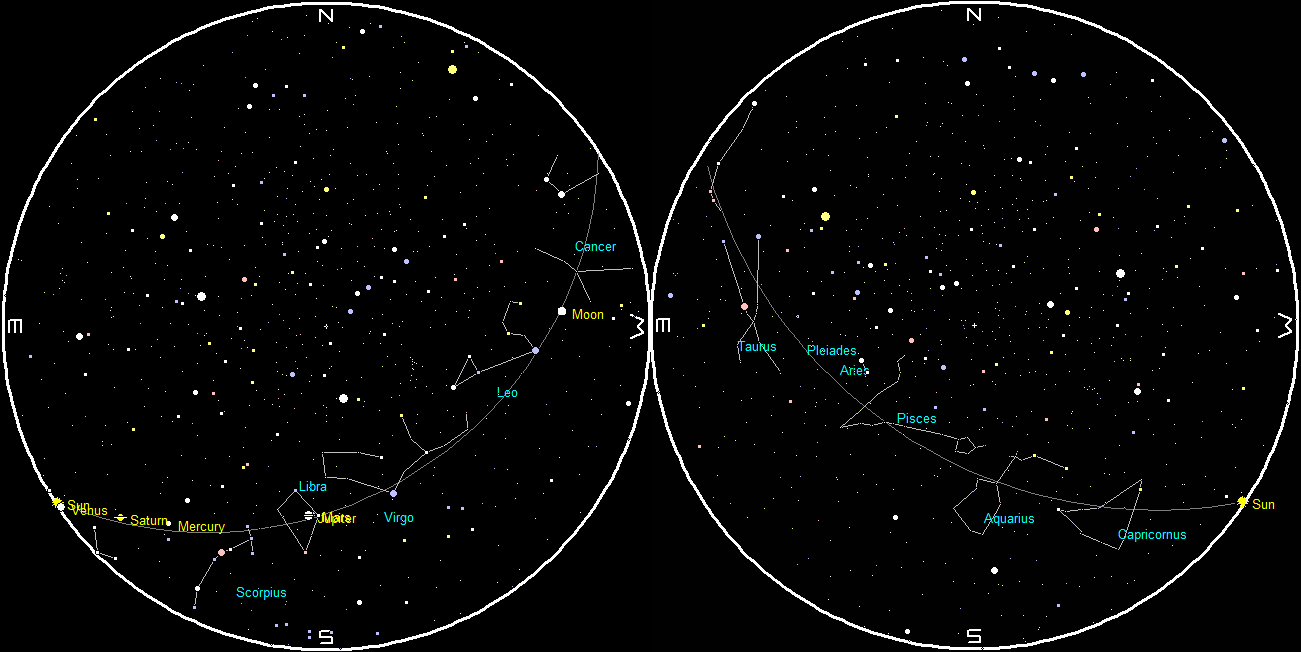
Planets at sunset and sunrise of a single night starting with sunset on the right on January 3, 2017. The night ends on the left with sunrise on the 4th. Click on the image to enlarge. Created using my LookingUp program.
01/02/2018 – Ephemeris – Cozying up to the Sun and a major meteor shower
Ephemeris for Tuesday, January 2nd. The Sun will rise at 8:20. It’ll be up for 8 hours and 53 minutes, setting at 5:13. The Moon, 1 day past full, will rise at 6:18 this evening.
Today the Earth will reach its closest distance from the sun, of 91.4 million miles. This point in Earth’s orbit is called perihelion. The Earth varies about 3 million miles from perihelion to aphelion its farthest point from the sun, which usually occurs around July 4th or 5th. Perihelion doesn’t help warm our winters though, but it does make winter the shortest season because the Earth moves its fastest at perihelion. That makes summer the longest season by several days. Tomorrow afternoon will see the peak of the Quadrantid Meteor Shower. This active meteor shower has its radiant north of the kite shape of Boötes and near the handle of the Big Dipper but the bright Moon will interfere both tomorrow and Thursday mornings.
The times given are for the Traverse City/Interlochen area of Michigan. They may be different for your location.
Addendum
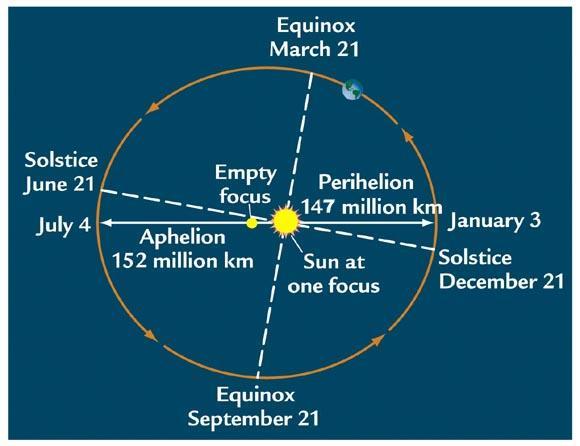
The Earth’s orbit, somewhat exaggerated, showing perihelion and the seasons. Credit “Starts with a Bang” blog by Ethan Siegel.
While a planet’s distance from the Sun modify the seasons somewhat, seasons are always governed by the axial tilt of the planet with respect to the Sun.
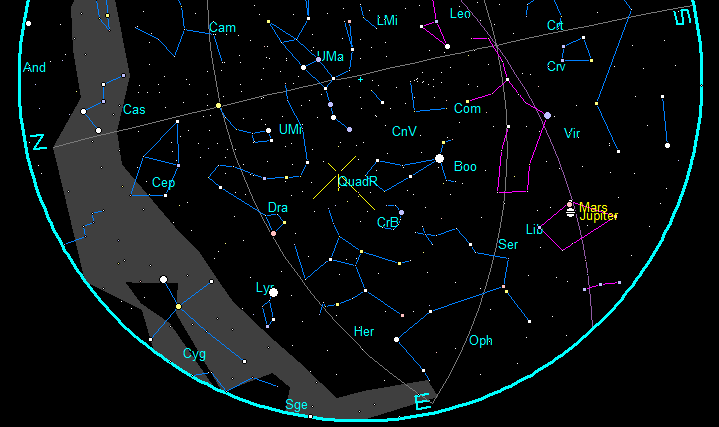
Facing the Quadrantid radiant at 6 a.m. January 3rd. Created using my LookingUp program.
01/01/2018 – Ephemeris – The difference between the winter full moon and the summer one
Happy New Year, this is Bob Moler with Ephemeris for New Years Day, Monday, January 1st. 2018. The Sun will rise at 8:19. It’ll be up for 8 hours and 53 minutes, setting at 5:13. The Moon, at full today, will rise at 5:11 this evening.
The exact time that the Moon will be fill, at least to the nearest minute is 9:24 tonight. Ever notice the placement of the full moon in the sky between winter and summer? The Full moon near the winter solstice moves very high at midnight, while the full moon near the summer solstice is seen quite low in the south. For the Moon to be full, it most be nearly opposite the Sun in the sky, so we see it fully illuminated as the Sun does. The Moon’s orbit is close to the Sun’s apparent path in the sky, the ecliptic, which is the projection of the Earth’s orbit of the Sun. So the Moon now is near where the Sun will be 6 months from now in late June, high in the sky. Next full moon we will see a lunar eclipse.
The times given are for the Traverse City/Interlochen area of Michigan. They may be different for your location.
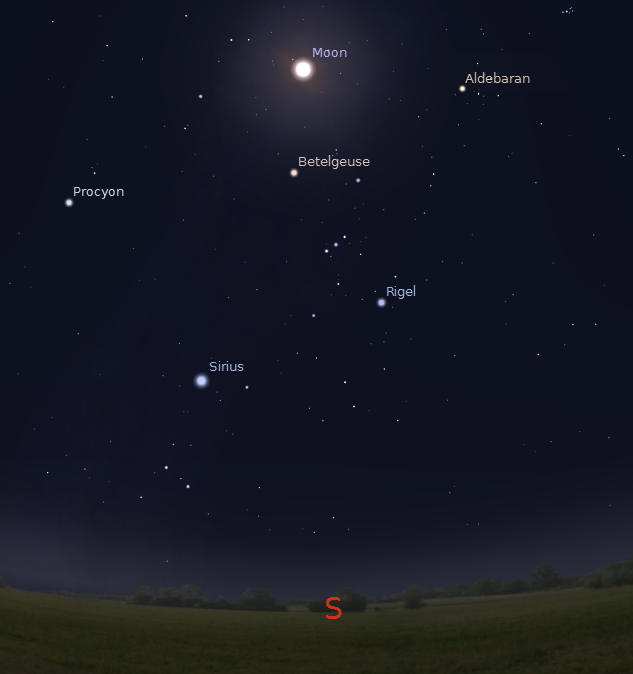
The winter full moon at its highest. Created using Stellarium.
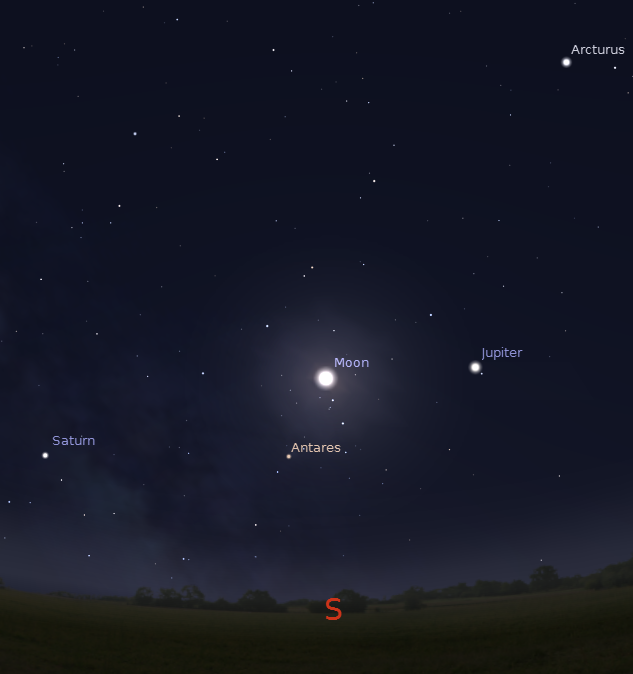
The summer full moon at its lowest. Created using Stellarium.
12/31/2017 – Ephemeris Extra – January 2018 preview
This isn’t going to be recorded as an actual program. I’m not sure how much information one could retain at 6 or 7 New Years Day morning.
Year end is a busy time astronomically with Earth’s perihelion and the Quadrantid meteor shower following rapidly on New Years day
Let’s look ahead at January 2018. Tuesday the 2nd is the date of the latest sunrise. The Sun is already beginning to head north, as can be seen in the sunset time on the 1st, 11 minutes later than at its earliest three weeks ago. Both sunrise and sunset will be moving in January with sunrise time at 8:20 a.m. and sunset time at 5:12 p.m. on the 1st moving to 8:02 a.m. and 5:50 p.m. at month’s end. The sun’s altitude at noon will increase from 22 degrees on the 1st to nearly 28 degrees by the 31st. The Earth will reach its closest to the Sun in its orbit, called perihelion, on the 2nd at 91.4 million miles (147.1 million km).
We’ll have a full moon on the 1st and the 31st, the so-called blue moon. Both those moons will be super moons, occurring at or near perigee. On top of all that the full moon on the 31st will be totally eclipsed. We in Michigan will see nearly the first half of the eclipse before the Moon sets at 8:04 in the grand Traverse area. Folks farther west will see more, if not all of the eclipse. February will have no full moons, so March again will have two full moons.
The Quadrantid meteor shower will reach peak on the 3rd, in the afternoon. The radiant is circumpolar here, being off the handle of the Big Dipper. Mercury will reach its greatest western elongation on the 1st and be visible shortly before sunrise for the next week rising after 6:30, but brightening a bit each day. It’s not a particularly favorable elongation, now that winter is here. The next evening elongation in March will be a lot better. Venus will be in superior conjunction with the Sun on the 9th and will enter the evening sky, but don’t look for it this month. Mars and Jupiter will have a close conjunction on the 6th. It will look about equally OK on the morning of the 6th or 7th around here because it occurs on the evening of the 6th, when they are not up.
Addenda
January Evening Sky Chart
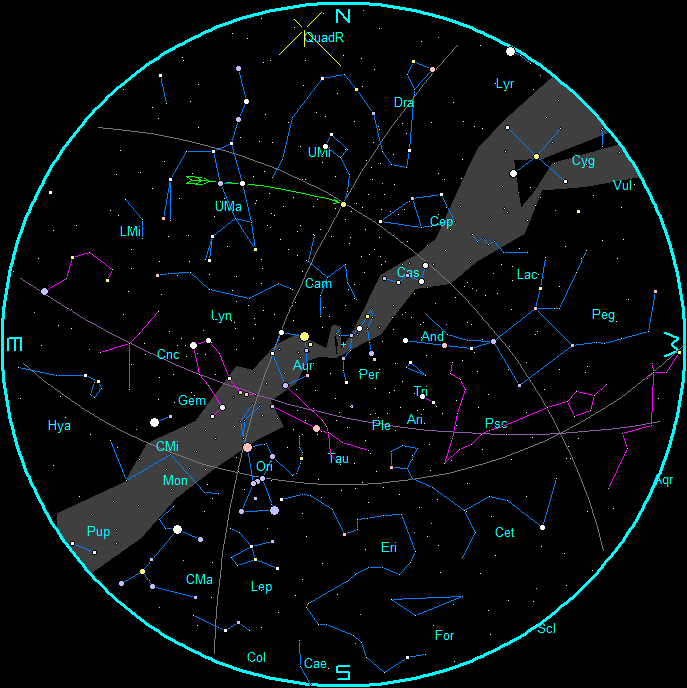
Star Chart for January 2018 (9 p.m. January 15, 2018). Created using my LookingUp program. Click on image to enlarge.
The planets and stars are plotted for the 15th at 9 p.m. EST in the evening and 6 a.m. for the morning chart. These are the chart times. Note that Traverse City is located approximately 45 minutes behind our time meridian. (An hour 45 minutes behind our daylight saving time meridian. during EDT and 45 minutes behind our daylight standard time meridian. during EST). To duplicate the star positions on a planisphere you may have to set it to 1 hour 45 minutes (Daylight Time) or 45 minutes (Standard Time) earlier than the current time if you are near your time meridian.
Note the chart times of 9 p.m. and 6 a.m. are for the 15th. For each week before the 15th add ½ hour. For each week after the 15th subtract ½ hour. The planet positions are updated each Wednesday on this blog. For planet positions on dates other than the 15th, check the Wednesday planet posts on this blog.
January Morning Star Chart
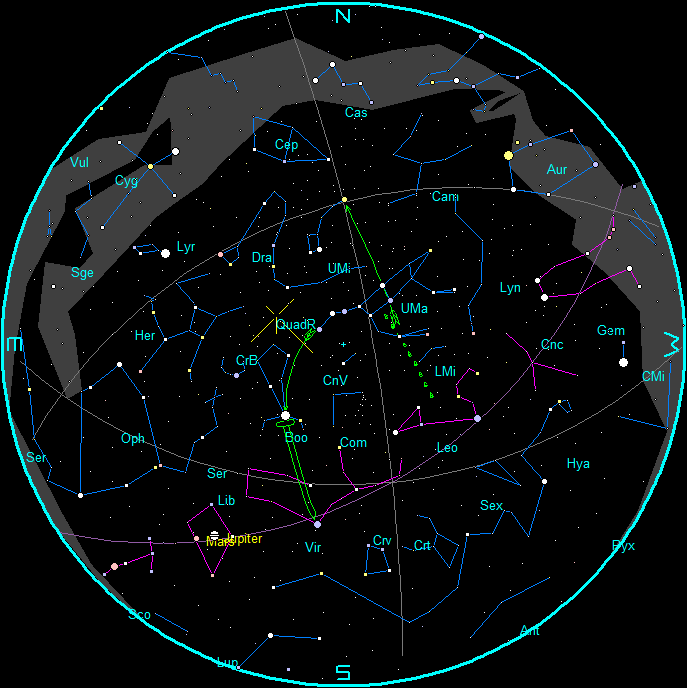
Star Chart for January 2018 mornings based on 6 a.m. January 15th. Created using my LookingUp program. Click on image to enlarge.
For a list of constellation names to go with the abbreviations click here.
- Pointer stars at the front of the bowl of the Big Dipper point to Polaris the North Star.
- Leaky Big Dipper drips on Leo.
- Follow the arc of the handle of the Big Dipper to the star Arcturus.
- The Summer Triangle is in red
- QuadR is the Quadrantid meteor shower radiant. Peaks on January 2nd, but the almost full moon will interfere this year.
Twilight
Evening nautical twilight ends at 6:22 p.m. EST on the 1st, increasing to 6:55 p.m. EST on the 31st.
Evening astronomical twilight ends at 6:57 p.m. EST on the 1st, increasing to 7:29 p.m. EST on the 31st.
Morning astronomical twilight starts at 6:35 a.m. EST on the 1st, and decreasing to 6:23 a.m. EST on the 31st.
Morning nautical twilight starts at 7:10 a.m. EST on the 1st, and decreasing to 6:57 a.m. EST on the 31st.
NASA Calendar of Planetary Events
    Date    Time    Event
Jan 01  Mo          Venus: 1.9° W
    01  Mo  2:59 pm Mercury Elongation: 22.7° W
    01  Mo  4:54 pm Moon Perigee: 356600 km
    01  Mo  7:01 pm Moon North Dec.: 20.1° N
    01  Mo  9:24 pm Full Moon
    02  Tu  9:59 pm Perihelion: 0.9833 AU
    03  We  2:50 pm Moon-Beehive: 2.3° N
    03  We  3:19 pm Quadrantid Meteor Shower: ZHR = 120
    04  Th  2:48 am Moon Ascending Node
    05  Fr  2:24 am Moon-Regulus: 0.9° S
    06  Sa  7:39 pm Mars-Jupiter: 0.2° N
    08  Mo  5:25 pm Last Quarter
    09  Tu  1:16 am Venus Superior Conjunction w/Sun
    11  Th 12:59 am Moon-Jupiter: 4.7° S
    13  Sa  2:58 am Mercury-Saturn: 0.7° N
    14  Su  9:09 pm Moon Apogee: 406500 km
    14  Su  9:13 pm Moon-Saturn: 2.9° S
    15  Mo 11:28 am Moon South Dec.: 20° S
    16  Tu  9:17 pm New Moon
    18  Th  9:28 am Moon Descending Node
    24  We  5:20 pm First Quarter
    27  Sa  5:09 am Moon-Aldebaran: 0.7° S
    29  Mo  6:32 am Moon North Dec.: 20° N
    30  Tu  4:54 am Moon Perigee: 359000 km
    31  We  2:19 am Moon-Beehive: 2.3° N
    31  We  8:27 am Full Moon
    31  We  8:30 am Total Lunar Eclipse (See Below)
    31  We  1:46 pm Moon Ascending Node
Feb 01  Th          Venus: 5.7° E
Sky Events Calendar by Fred Espenak and Sumit Dutta (NASA’s GSFC),
http://eclipse.gsfc.nasa.gov/SKYCAL/SKYCAL.html
If you go to the above site you can print out a list like the above for the entire year
or calendar pages for your time zone.
Sun and Moon Rising and Setting Events
     LU                  Ephemeris of Sky Events for Interlochen/TC
     January, 2018    Local time zone: EST
     +-----------------------------------------------------------------------+
     | DATE |  SUN     SUN  DAYLIGHT|   TWILIGHT*    |MOON  RISE OR    ILLUM |
     |      |  RISE    SET    HOURS |  END    START  |PHASE SET** TIME FRACTN|
     +=======================================================================+
     |Mon  1| 08:20a  05:13p  08:52 | 06:23p  07:09a |Full  Rise 05:11p  100%|
     |Tue  2| 08:20a  05:13p  08:53 | 06:24p  07:09a |      Rise 06:18p   99%|
     |Wed  3| 08:20a  05:14p  08:54 | 06:25p  07:10a |      Rise 07:30p   95%|
     |Thu  4| 08:20a  05:15p  08:55 | 06:25p  07:10a |      Rise 08:44p   88%|
     |Fri  5| 08:19a  05:16p  08:56 | 06:26p  07:10a |      Rise 09:56p   80%|
     |Sat  6| 08:19a  05:17p  08:58 | 06:27p  07:09a |      Rise 11:05p   70%|
     +------+-----------------------+----------------+-----------------------+
     |Sun  7| 08:19a  05:19p  08:59 | 06:28p  07:09a |      Rise 12:12a   60%|
     |Mon  8| 08:19a  05:20p  09:00 | 06:29p  07:09a |L Qtr Rise 01:17a   49%|
     |Tue  9| 08:19a  05:21p  09:02 | 06:30p  07:09a |      Rise 02:19a   39%|
     |Wed 10| 08:18a  05:22p  09:03 | 06:31p  07:09a |      Rise 03:20a   30%|
     |Thu 11| 08:18a  05:23p  09:05 | 06:32p  07:09a |      Rise 04:19a   22%|
     |Fri 12| 08:18a  05:24p  09:06 | 06:33p  07:08a |      Rise 05:16a   14%|
     |Sat 13| 08:17a  05:25p  09:08 | 06:34p  07:08a |      Rise 06:11a    8%|
     +------+-----------------------+----------------+-----------------------+
     |Sun 14| 08:17a  05:27p  09:10 | 06:36p  07:08a |      Rise 07:02a    4%|
     |Mon 15| 08:16a  05:28p  09:11 | 06:37p  07:07a |      Rise 07:49a    1%|
     |Tue 16| 08:15a  05:29p  09:13 | 06:38p  07:07a |New   Set  05:21p    0%|
     |Wed 17| 08:15a  05:31p  09:15 | 06:39p  07:06a |      Set  06:17p    1%|
     |Thu 18| 08:14a  05:32p  09:17 | 06:40p  07:06a |      Set  07:15p    3%|
     |Fri 19| 08:14a  05:33p  09:19 | 06:41p  07:05a |      Set  08:15p    8%|
     |Sat 20| 08:13a  05:34p  09:21 | 06:42p  07:05a |      Set  09:17p   14%|
     +------+-----------------------+----------------+-----------------------+
     |Sun 21| 08:12a  05:36p  09:23 | 06:44p  07:04a |      Set  10:20p   21%|
     |Mon 22| 08:11a  05:37p  09:25 | 06:45p  07:04a |      Set  11:24p   30%|
     |Tue 23| 08:10a  05:38p  09:28 | 06:46p  07:03a |      Set  12:30a   40%|
     |Wed 24| 08:10a  05:40p  09:30 | 06:47p  07:02a |F Qtr Set  01:38a   51%|
     |Thu 25| 08:09a  05:41p  09:32 | 06:48p  07:01a |      Set  02:48a   62%|
     |Fri 26| 08:08a  05:43p  09:34 | 06:50p  07:01a |      Set  03:59a   72%|
     |Sat 27| 08:07a  05:44p  09:37 | 06:51p  07:00a |      Set  05:09a   82%|
     +------+-----------------------+----------------+-----------------------+
     |Sun 28| 08:06a  05:45p  09:39 | 06:52p  06:59a |      Set  06:14a   90%|
     |Mon 29| 08:05a  05:47p  09:42 | 06:53p  06:58a |      Set  07:13a   96%|
     |Tue 30| 08:04a  05:48p  09:44 | 06:55p  06:57a |      Set  08:04a  100%|
     |Wed 31| 08:02a  05:50p  09:47 | 06:56p  06:56a |Full  Rise 06:15p  100%|
     +-----------------------------------------------------------------------+
     * Nautical Twilight
     ** Moonrise or moonset, whichever occurs between sunrise and sunset
Total Lunar Eclipse January 31, 2018
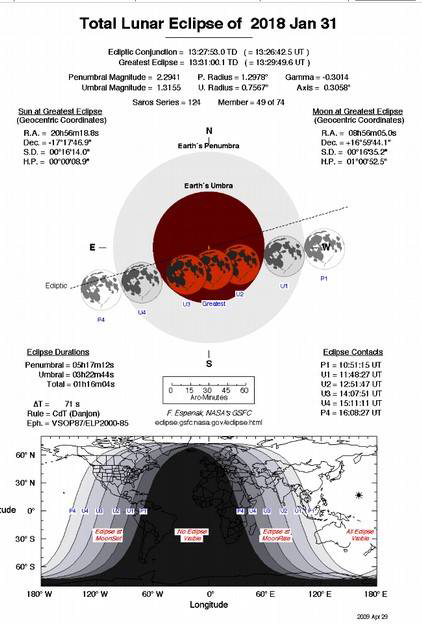
I’ll have more on this toward the end of the month. Credit NASA.
The original page for this graphic is: https://eclipse.gsfc.nasa.gov/LEplot/LEplot2001/LE2018Jan31T.pdf
    Total Lunar Eclipse January 31
Event               Time EST   Time UT
                    GT Area
Enter penumbra      5:51 a.m.  10:51   Unseen
Begin partial phase 6:48 a.m.  11:48
Totality begins     7:51 a.m.  12:51
Moon sets           8:04 a.m.
Mid eclipse                    13:28
Totality ends                  14:07
End partial phase              15:11
Leave penumbra                 16:08   Unseen

The shading of the penumbra is generally seen within 1/2
hour before and after the partial begins and ends.
Update
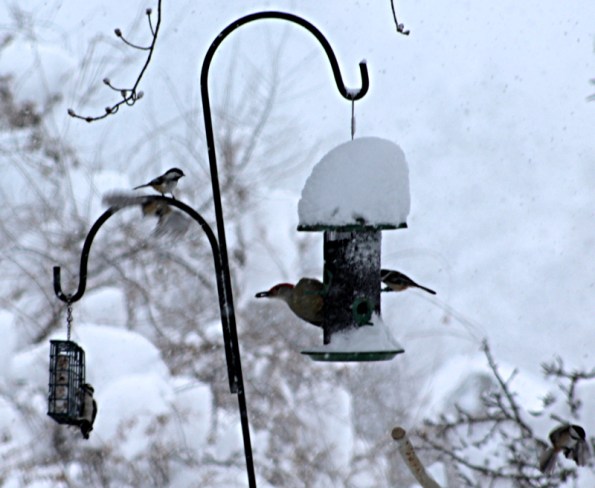
Our bird feeder at about 2 p.m. It was cleaned off and filled 6 hours before. Dining are a downy woodpecker, behind the suet block; a flicker with a seed in its beak and three chickadees. Can you spot the third?
While I was writing this post on the afternoon of the 30th, we were getting a rather intense lake effect snow storm, at about an inch an hour. By nightfall the snow on top of the feeder just about reached the hook. We also get cardinals, blue jays, sparrows. Poor juncos. They seem to feed on the ground, and the snow came too fast and covered the seed that had dropped, so they were looking in vain.
I really love the chickadees, they’re fearless. When I’m filling the bird feeder the other birds scatter, but the chickadees sit in the tree, a couple of feet over my head and wait patiently until I hang it back up.
12/29/2017 – Ephemeris – Last occultation of the star Aldebaran by the Moon is tomorrow night
Ephemeris for Friday, December 29th. The Sun will rise at 8:19. It’ll be up for 8 hours and 51 minutes, setting at 5:10. The Moon, half way from first quarter to full, will set at 5:08 tomorrow morning.
We have one last cool astronomical event that can be seen from here in 2017. Of course, weather permitting. Tomorrow night the Moon will occult the bright star Aldebaran in Taurus the bull from 6:17 to 7:17 p.m. I’m not dabbling with the black arts here, even though I’m using the Occult 4 program to find it. In astronomy occult is a verb meaning to hide, and the event is called an occultation. The Moon will appear to move in front of, or hide the star Aldebaran. At 6:17 p.m. Aldebaran will disappear at the dark edge of the Moon at its 8 o’clock position. Binoculars will be needed to spot the star against the glare of the bright Moon before the event. Aldebaran will pop out from behind the Moon at a bit above the 3 o’clock position at 7:17 p.m.
The times given are for the Traverse City/Interlochen area of Michigan. They may be different for your location.
Addendum
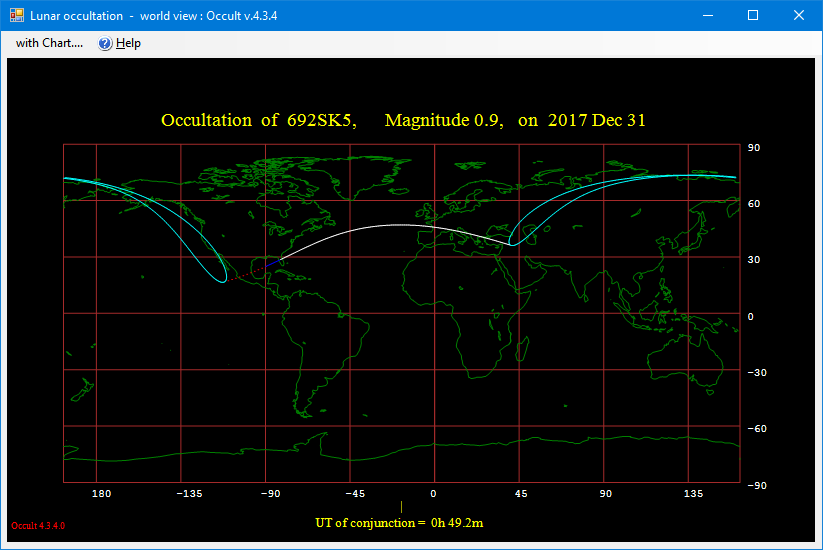
Occultation visibility map for the occultation of Aldebaran by the Moon for us in the Unites States, the early evening of December 30, 2017. Created using Occult 4 by IOTA.
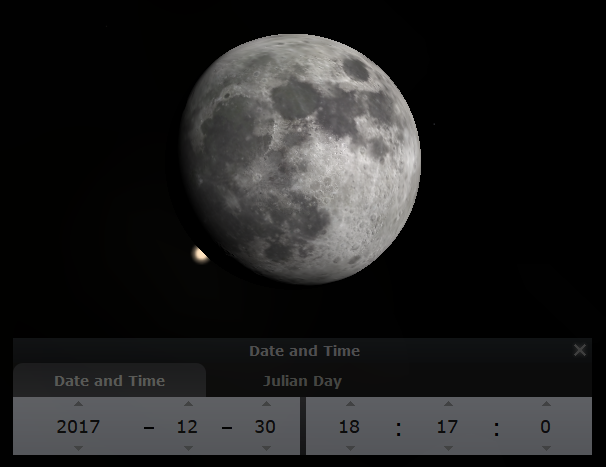
Occultation start 6:17 p.m. December 30, 2017. as seen from the Grand Traverse area of Michigan. Actual times may vary depending on your location. Created using Stellarium.
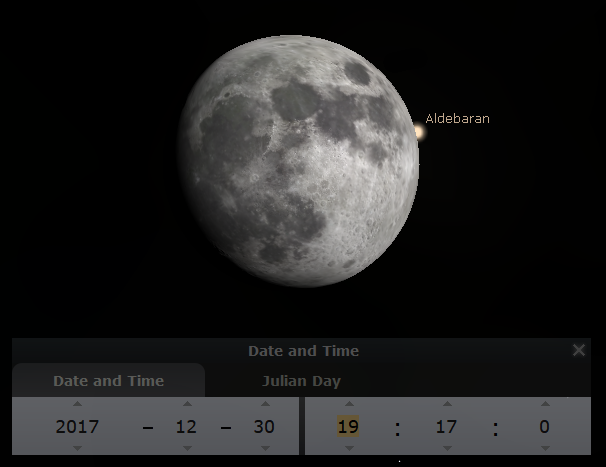
Occultation end 7:17 p.m. December 30, 2017. as seen from the Grand Traverse area of Michigan. Actual times may vary depending on your location. Created using Stellarium.
Note the times are for the Traverse City/Interlochen area. It will vary by a few minutes for northern lower Michigan. The position angles of the entrance and exit points of Aldebaran will also be different.
Otherwise use a planetarium program like Stellarium to preview the event. However, set the program for topocentric coordinates. In Stellarium that’s in the Configuration window, Tools Tab and check the Topocentric coordinates box. Topocentric coordinates are the apparent positions for your location on the Earth. So also make sure your location is correct. The geocentric conjunction of the two bodies will be December, 31, 0:49.2 UT, so it will occur after midnight on the morning of December 31st for locations in northern Europe and Asia.
Program Note
The January preview will be an Ephemeris Extra post on December 31st.

