Ephemeris: 05/01/2026 – Previewing May skies
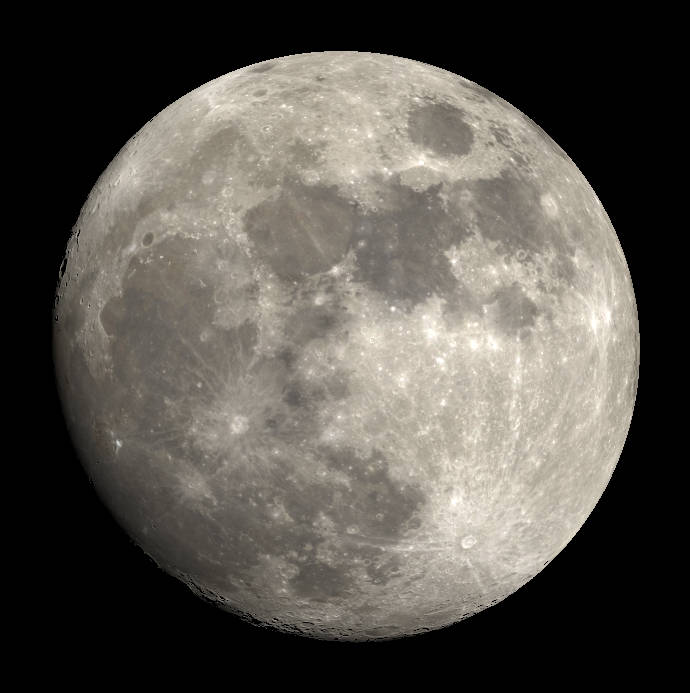
This is Ephemeris for Friday, May 1st. Today the Sun will be up for 14 hours and 15 minutes, setting at 8:47, and it will rise tomorrow at 6:31. The Moon, at full today, will rise at 9:17 this evening.
Before we look at the month of May’s skies, consider that it’s May Day, a Cross-Quarter day meaning that spring is about half over. Daylight hours in the Interlochen/Traverse City area will increase from 14 hours and 15 minutes today to 15 hours 19 minutes on the 31st. The altitude, or angle, of the Sun above the southern horizon at local noon will ascend from 60 degrees today to 67 degrees at month’s end. The altitude of the Sun in the Straits area will be a degree lower than that, but the length of daylight will be a few minutes longer. Local apparent noon this month, when the Sun passes due south, will be about 1:38 p.m. The Eta Aquariid meteor shower will reach its peak on the 5th, but will be hindered by the bright moon.
The astronomical event times given in this blog are for the Traverse City/Interlochen area of Michigan (Lat 44.7° N, Long 85.7° W; EDT, UT – 4 hours) unless stated otherwise. Times will be different for other locations.
Addendum
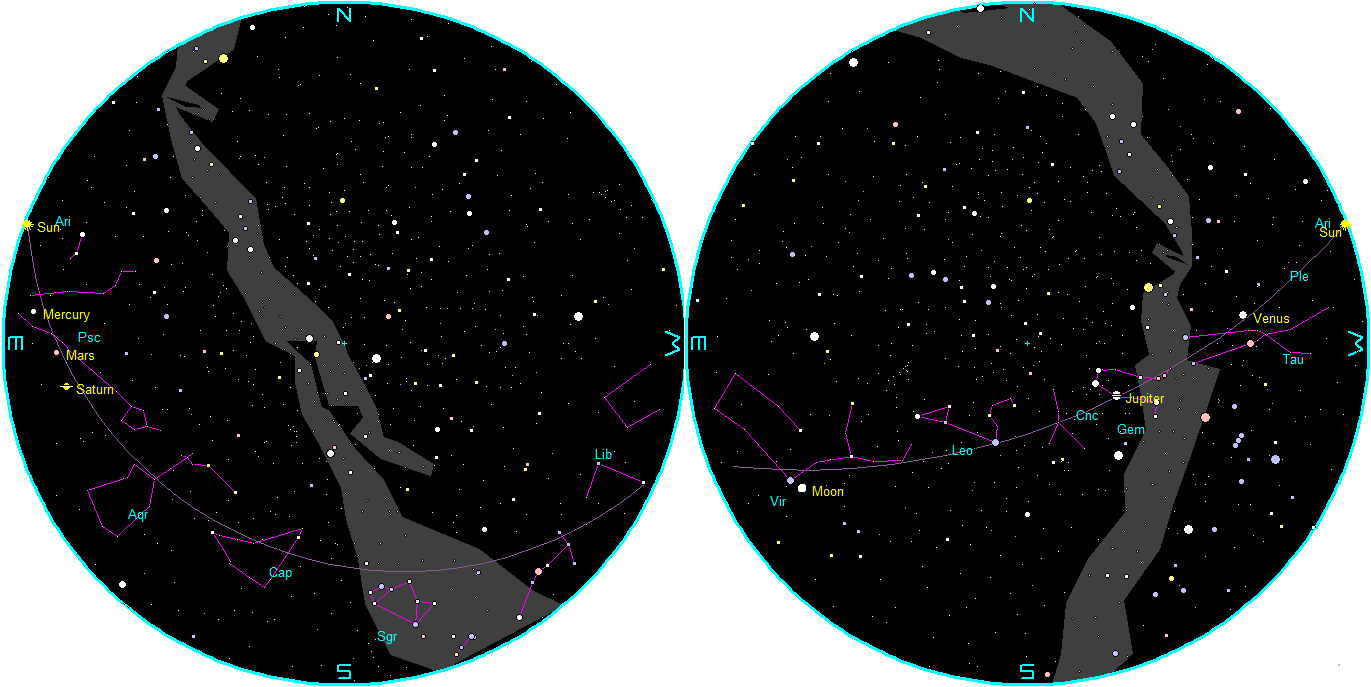
May Evening Star Chart
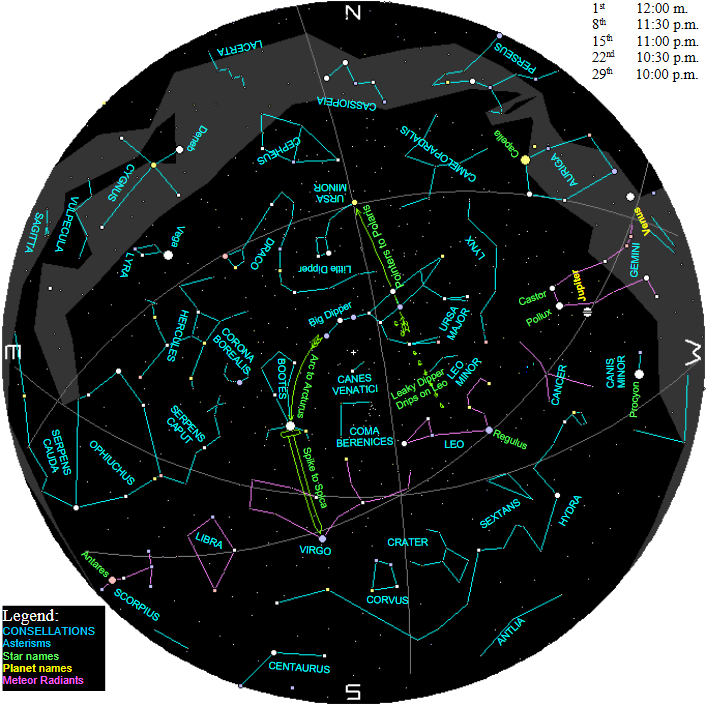
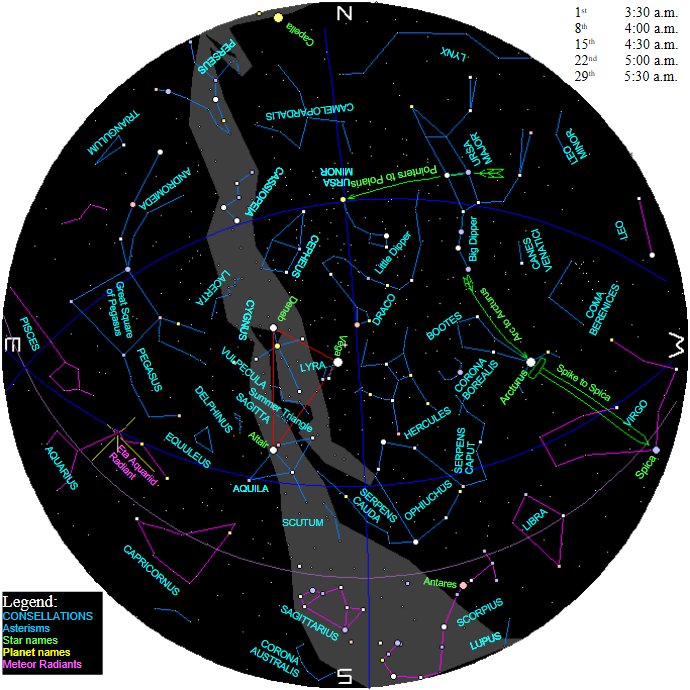
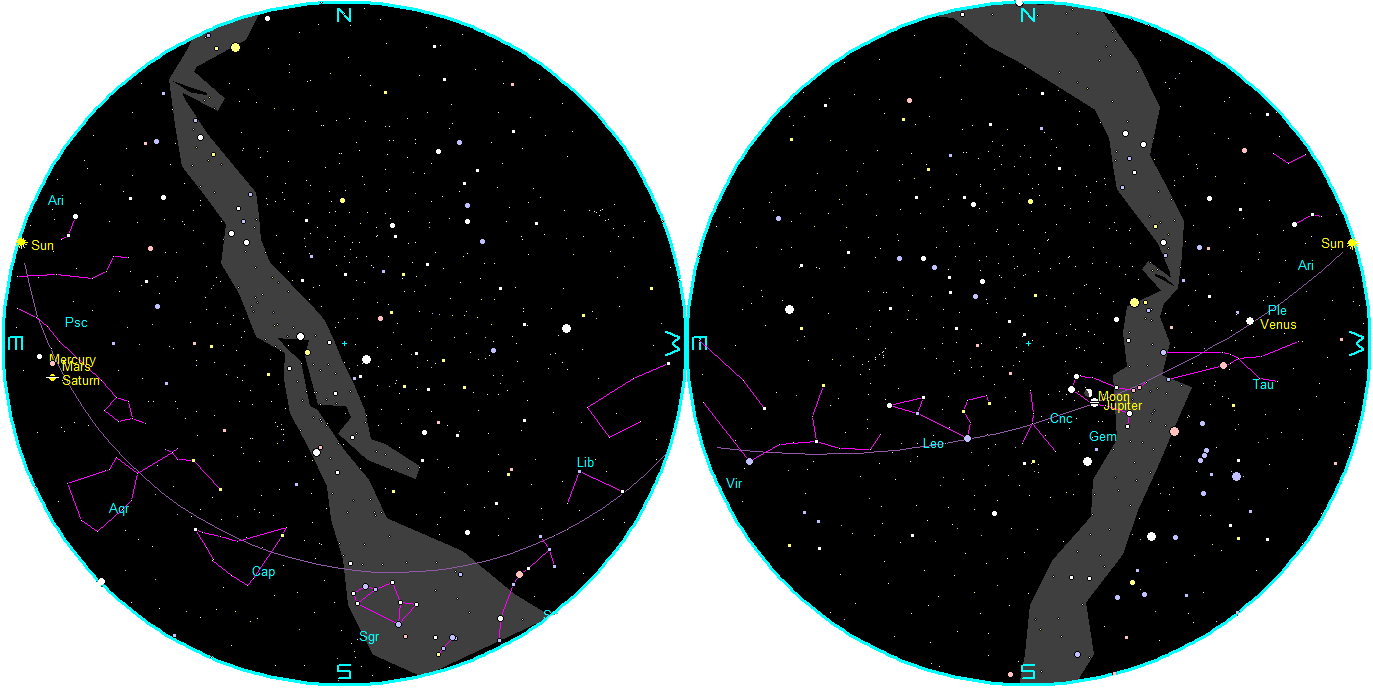
The planets and stars are plotted for the 15th at 11 p.m. EDT in the evening and 4:30 a.m. on the 16th for the morning chart. These are the chart times. Note that Traverse City is located approximately 45 minutes behind our time meridian, West 75° longitude. (An hour 45 minutes behind our daylight saving time meridian during EDT). To duplicate the star positions on a planisphere you may have to set it to 1 hour 45 minutes earlier than the current time.
Note, the chart times of 11 p.m. and 4:30 a.m. are for the night of the15/16th. For each week before then add ½ hour (28 minutes if you’re picky). For each week after then, subtract ½ hour or 28 minutes. The planet positions are updated each Wednesday on this blog. For planet positions on dates other than the 15th, check the Wednesday planet posts on this blog for their weekly locations.
May Morning Star Chart
Twilight Limits, Nautical and Astronomical
| EDT | |||||||
| Morning | Twilight | Evening | Twilight | Dark | Night | Moon | |
| Date | Astro. | Nautical | Nautical | Astro. | Start | End | Illum. |
| 2026-05-01 | 4h37m | 5h21m | 22h02m | 22h46m | – | – | 100% |
| 2026-05-02 | 4h35m | 5h20m | 22h04m | 22h48m | – | – | 98% |
| 2026-05-03 | 4h33m | 5h18m | 22h05m | 22h50m | 22h50m | 23h28m | 94% |
| 2026-05-04 | 4h30m | 5h16m | 22h07m | 22h52m | 22h52m | – | 89% |
| 2026-05-05 | 4h28m | 5h14m | 22h08m | 22h54m | 22h54m | 0h26m | 83% |
| 2026-05-06 | 4h26m | 5h13m | 22h10m | 22h56m | 22h56m | 1h15m | 75% |
| 2026-05-07 | 4h24m | 5h11m | 22h11m | 22h58m | 22h58m | 1h56m | 67% |
| 2026-05-08 | 4h22m | 5h09m | 22h13m | 23h00m | 23h00m | 2h29m | 57% |
| 2026-05-09 | 4h20m | 5h08m | 22h15m | 23h02m | 23h02m | 2h55m | 47% |
| 2026-05-10 | 4h18m | 5h06m | 22h16m | 23h04m | 23h04m | 3h18m | 37% |
| 2026-05-11 | 4h16m | 5h04m | 22h18m | 23h06m | 23h06m | 3h38m | 27% |
| 2026-05-12 | 4h14m | 5h03m | 22h19m | 23h08m | 23h08m | 3h57m | 18% |
| 2026-05-13 | 4h12m | 5h01m | 22h21m | 23h10m | 23h10m | 4h12m | 10% |
| 2026-05-14 | 4h10m | 5h00m | 22h22m | 23h12m | 23h12m | 4h10m | 4% |
| 2026-05-15 | 4h08m | 4h58m | 22h24m | 23h14m | 23h14m | 4h08m | 1% |
| 2026-05-16 | 4h06m | 4h57m | 22h25m | 23h16m | 23h16m | 4h06m | 0% |
| 2026-05-17 | 4h04m | 4h55m | 22h27m | 23h18m | 23h18m | 4h04m | 3% |
| 2026-05-18 | 4h02m | 4h54m | 22h28m | 23h20m | – | 4h02m | 8% |
| 2026-05-19 | 4h00m | 4h53m | 22h30m | 23h22m | 0h08m | 4h00m | 16% |
| 2026-05-20 | 3h58m | 4h51m | 22h31m | 23h24m | 1h01m | 3h58m | 26% |
| 2026-05-21 | 3h57m | 4h50m | 22h33m | 23h26m | 1h41m | 3h57m | 36% |
| 2026-05-22 | 3h55m | 4h49m | 22h34m | 23h28m | 2h11m | 3h55m | 47% |
| 2026-05-23 | 3h53m | 4h48m | 22h35m | 23h30m | 2h35m | 3h53m | 58% |
| 2026-05-24 | 3h51m | 4h46m | 22h37m | 23h32m | 2h55m | 3h51m | 68% |
| 2026-05-25 | 3h50m | 4h45m | 22h38m | 23h33m | 3h13m | 3h50m | 77% |
| 2026-05-26 | 3h48m | 4h44m | 22h39m | 23h35m | 3h30m | 3h48m | 85% |
| 2026-05-27 | 3h47m | 4h43m | 22h41m | 23h37m | – | – | 91% |
| 2026-05-28 | 3h45m | 4h42m | 22h42m | 23h39m | – | – | 96% |
| 2026-05-29 | 3h44m | 4h41m | 22h43m | 23h41m | – | – | 99% |
| 2026-05-30 | 3h42m | 4h40m | 22h44m | 23h42m | – | – | 100% |
| 2026-05-31 | 3h41m | 4h39m | 22h46m | 23h44m | – | – | 99% |
The twilight calendar was generated using Cartes du Ciel (Sky Charts), with some corrections.
See my blog post: Twilight Zone for the definitions of the different periods of twilight here: https://bobmoler.blog/2018/09/27/.
NASA Calendar of Planetary Events
May  1  Fr            Venus: 27.8° E
     1  Fr   1:23 PM  Full Moon
     1  Fr   8:59 PM  Venus-Aldebaran: 6.4° N
     3  Su  10:20 PM  Moon-Antares: 0.5° N
     4  Mo   6:30 PM  Moon Apogee: 405800 km
     5  Tu   4:16 AM  Eta Aquariid Shower: ZHR = 60
     5  Tu   7:35 AM  Moon South Dec.: 28.1° S
     9  Sa   5:11 PM  Last Quarter
    11  Mo  12:36 AM  Moon Ascending Node
    14  Th  10:15 AM  Mercury Superior Conjunction
    16  Sa   4:01 PM  New Moon
    17  Su   9:48 AM  Moon Perigee: 358100 km
    18  Mo   3:38 PM  Moon North Dec.: 28.1° N
    18  Mo   9:50 PM  Moon-Venus: 2.9° S
    20  We   8:39 AM  Moon-Jupiter: 3.1° S
    21  Th  10:39 AM  Moon-Beehive: 0.8° S
    22  Fr  11:56 AM  Uranus Conjunction
    23  Sa   2:40 AM  Moon-Regulus: 0°
    23  Sa   7:11 AM  First Quarter
    23  Sa  11:26 AM  Moon Descending Node
    27  We  10:09 AM  Moon-Spica: 2.1° N
    31  Su   4:32 AM  Moon-Antares: 0.4° N
    31  Su   4:45 AM  Full Moon
Jun  1  Mo            Venus: 35° E
Sky Events Calendar by Fred Espenak and Sumit Dutta (NASA’s GSFC),
http://eclipse.gsfc.nasa.gov/SKYCAL/SKYCAL.html.
Sun and Moon Rising and Setting Events
LU             Ephemeris of Sky Events for Interlochen/TC
May, 2026    Local time zone: EDT
+-----------------------------------------------------------------------+
| DATE |  SUN     SUN  DAYLIGHT|   TWILIGHT*    |MOON  RISE OR    ILLUM |
|      |  RISE    SET    HOURS |  END    START  |PHASE SET** TIME FRACTN|
+=======================================================================+
|Fri  1| 06:32a  08:47p  14:15 | 10:00p  05:20a |Full  Rise 09:17p  100%|
|Sat  2| 06:31a  08:49p  14:17 | 10:01p  05:18a |      Rise 10:24p   98%|
+------+-----------------------+----------------+-----------------------+
|Sun  3| 06:29a  08:50p  14:20 | 10:03p  05:17a |      Rise 11:28p   95%|
|Mon  4| 06:28a  08:51p  14:23 | 10:04p  05:15a |      Rise 12:25a   90%|
|Tue  5| 06:26a  08:52p  14:25 | 10:06p  05:13a |      Rise 01:15a   84%|
|Wed  6| 06:25a  08:53p  14:28 | 10:08p  05:11a |      Rise 01:55a   77%|
|Thu  7| 06:24a  08:55p  14:30 | 10:09p  05:10a |      Rise 02:28a   68%|
|Fri  8| 06:22a  08:56p  14:33 | 10:11p  05:08a |      Rise 02:55a   59%|
|Sat  9| 06:21a  08:57p  14:35 | 10:12p  05:06a |L Qtr Rise 03:18a   49%|
+------+-----------------------+----------------+-----------------------+
|Sun 10| 06:20a  08:58p  14:38 | 10:14p  05:05a |      Rise 03:38a   39%|
|Mon 11| 06:19a  08:59p  14:40 | 10:15p  05:03a |      Rise 03:57a   29%|
|Tue 12| 06:17a  09:01p  14:43 | 10:17p  05:02a |      Rise 04:16a   19%|
|Wed 13| 06:16a  09:02p  14:45 | 10:18p  05:00a |      Rise 04:37a   11%|
|Thu 14| 06:15a  09:03p  14:47 | 10:20p  04:58a |      Rise 05:02a    5%|
|Fri 15| 06:14a  09:04p  14:49 | 10:21p  04:57a |      Rise 05:34a    1%|
|Sat 16| 06:13a  09:05p  14:52 | 10:23p  04:56a |New   Set  09:36p    0%|
+------+-----------------------+----------------+-----------------------+
|Sun 17| 06:12a  09:06p  14:54 | 10:24p  04:54a |      Set  10:57p    2%|
|Mon 18| 06:11a  09:07p  14:56 | 10:26p  04:53a |      Set  12:07a    7%|
|Tue 19| 06:10a  09:08p  14:58 | 10:27p  04:51a |      Set  01:01a   15%|
|Wed 20| 06:09a  09:09p  15:00 | 10:29p  04:50a |      Set  01:41a   24%|
|Thu 21| 06:08a  09:11p  15:02 | 10:30p  04:49a |      Set  02:11a   34%|
|Fri 22| 06:07a  09:12p  15:04 | 10:32p  04:47a |      Set  02:35a   45%|
|Sat 23| 06:06a  09:13p  15:06 | 10:33p  04:46a |F Qtr Set  02:54a   56%|
+------+-----------------------+----------------+-----------------------+
|Sun 24| 06:05a  09:14p  15:08 | 10:34p  04:45a |      Set  03:12a   66%|
|Mon 25| 06:05a  09:15p  15:10 | 10:36p  04:44a |      Set  03:30a   75%|
|Tue 26| 06:04a  09:16p  15:11 | 10:37p  04:43a |      Set  03:48a   83%|
|Wed 27| 06:03a  09:17p  15:13 | 10:38p  04:42a |      Set  04:08a   90%|
|Thu 28| 06:02a  09:17p  15:15 | 10:40p  04:41a |      Set  04:32a   95%|
|Fri 29| 06:02a  09:18p  15:16 | 10:41p  04:40a |      Set  05:01a   98%|
|Sat 30| 06:01a  09:19p  15:18 | 10:42p  04:39a |      Set  05:37a  100%|
+------+-----------------------+----------------+-----------------------+
|Sun 31| 06:00a  09:20p  15:19 | 10:43p  04:38a |Full  Rise 10:19p   99%|
+-----------------------------------------------------------------------+
* Nautical Twilight
** Moonrise or moonset, whichever occurs between sunset and sunrise
Created using my LookingUp for DOS app.
Ephemeris: 04/30/2026 – GTAS meeting tomorrow, The Space Race.
This is Ephemeris for Thursday, April 30th. Today the Sun will be up for 14 hours and 12 minutes, setting at 8:46, and it will rise tomorrow at 6:32. The Moon, 1 day before full, will set at 6:03 tomorrow morning.
The Grand Traverse Astronomical Society will host its May meeting tomorrow, May 1st at 9 PM at Northwestern Michigan College’s Joseph H Rogers Observatory. The later meeting time through July allows us to have viewing after the meeting start in darker skies. The program is a video called the Space Race. I’m not sure if it was the one 6 decades ago in the 1960s or the current one, which is in doubt. It will be informative either way. Afterward, about 10 PM if it’s clear, there will be viewing of the heavens through the observatory’s telescopes, featuring Jupiter, its cloud bands and moons. The observatory is located on Birmley Rd. South of Traverse City. Also, available on ZOOM, see gtastro.org.
The astronomical event times given in this blog are for the Traverse City/Interlochen area of Michigan (Lat 44.7° N, Long 85.7° W; EDT, UT – 4 hours) unless stated otherwise. Times will be different for other locations.
Addendum

Ephemeris: 04/29/2026 – Taking our weekly look at the whereabouts of the naked-eye planets
This is Ephemeris for Wednesday, April 29th. Today the Sun will be up for 14 hours and 9 minutes, setting at 8:45, and it will rise tomorrow at 6:34. The Moon, 2 days before full, will set at 5:42 tomorrow morning.
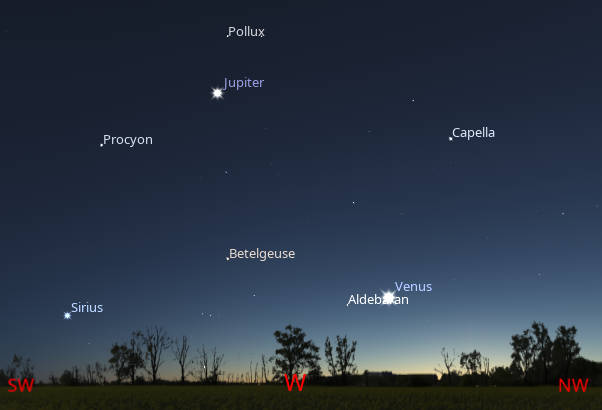
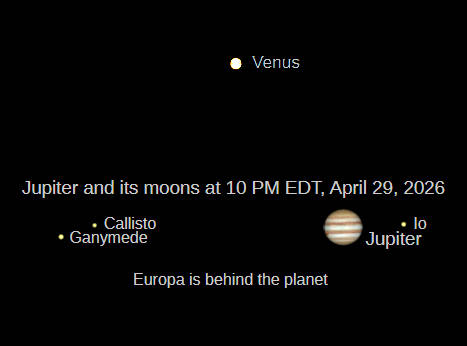
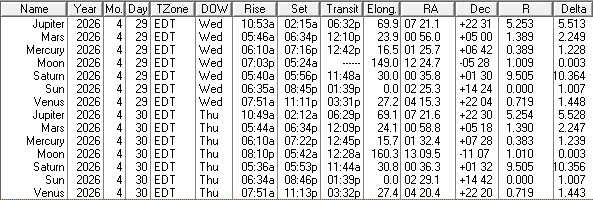
Let’s take our weekly look at the whereabouts of the naked-eye planets. By 9:30 PM tonight or about 45 minutes or so after sunset, Venus may be seen very low in the West. A telescope will show a very tiny disc on Venus, because it is still pretty much beyond the Sun, 136 million miles (217 million kilometers) away from us. Over the next 6 months it will be moving closer to us and becoming much larger. Jupiter is the brilliant star-like object in the western before 10 PM. It is above and left of the brighter Venus. Venus will set at 11:11 PM, while Jupiter will hold out until 2:12 AM. Meanwhile, Mercury, Mars and Saturn are breaking up just west of the Sun, but are still overwhelmed by bright morning twilight.
The astronomical event times given in this blog are for the Traverse City/Interlochen area of Michigan (Lat 44.7° N, Long 85.7° W; EDT, UT – 4 hours) unless stated otherwise. Times will be different for other locations.
Addendum
Ephemeris: 04/28/2026 – Stars spend most of their lives fueled by hydrogen
This is Ephemeris for Tuesday, April 28th. Today the Sun will be up for 14 hours and 7 minutes, setting at 8:44, and it will rise tomorrow at 6:35. The Moon, 3 days before full, will set at 5:24 tomorrow morning.
A star is a gaseous ball made mostly of hydrogen, which due to its mass crushes down in its core to create heat in the millions of degrees. Under those temperatures and pressures hydrogen nuclei, stripped of their electrons can collide to convert into helium and in doing so lose a tiny bit of mass that turns into energy which is used to sustain the star’s light and keep it stable. This hydrogen burning, so to speak, takes place during the longest period of a star’s life. And stars have a characteristic color based on their mass. Stars with little mass are cooler and appear a dim red. We call them red dwarfs. The nearest star to our solar system is a red dwarf called Proxima Centauri. It’s so dim that it’d be difficult to find with a pair of binoculars. And it’s only four light years away.
The astronomical event times given in this blog are for the Traverse City/Interlochen area of Michigan (Lat 44.7° N, Long 85.7° W; EDT, UT – 4 hours) unless stated otherwise. Times will be different for other locations.
Addendum
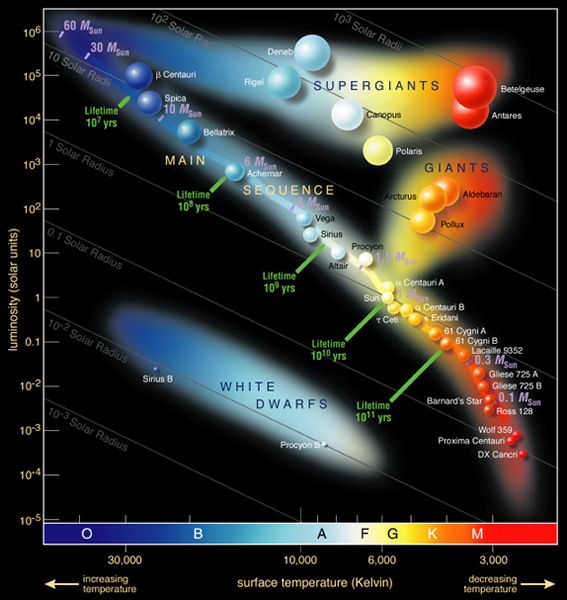
The HR diagram above shows the various types and brightness of stars. The relatively thin line of stars from upper left to lower right, called the main sequence, are stars that are running primarily on hydrogen as a fuel. At the bottom end of the main sequence small stars with a fraction of the sun’s mass. All these stars are near the sun. It doesn’t mean that we live in a bad neighborhood, but that the most numerous stars are red dwarfs, and we just can’t see them when they’re farther away. All the other stars are not using as hydrogen as their main fuel source. Stars the upper right are using heavier elements to produce energy from the fusion products of lighter elements, after having run out of hydrogen in their cores. The white dwarf stars in the lower part of the diagram no longer have active thermonuclear reactions in their cores and are cooling down and collapsing. A star with the mass of the sun, when it becomes a white dwarf, will shrink down to about the size of the earth.
Ephemeris: 04/27/2026 – Mare Orientale made a splash!
This is Ephemeris for Monday, April 27th. Today the Sun will be up for 14 hours and 4 minutes, setting at 8:42, and it will rise tomorrow at 6:37. The Moon, halfway from first quarter to full, will set at 5:06 tomorrow morning.
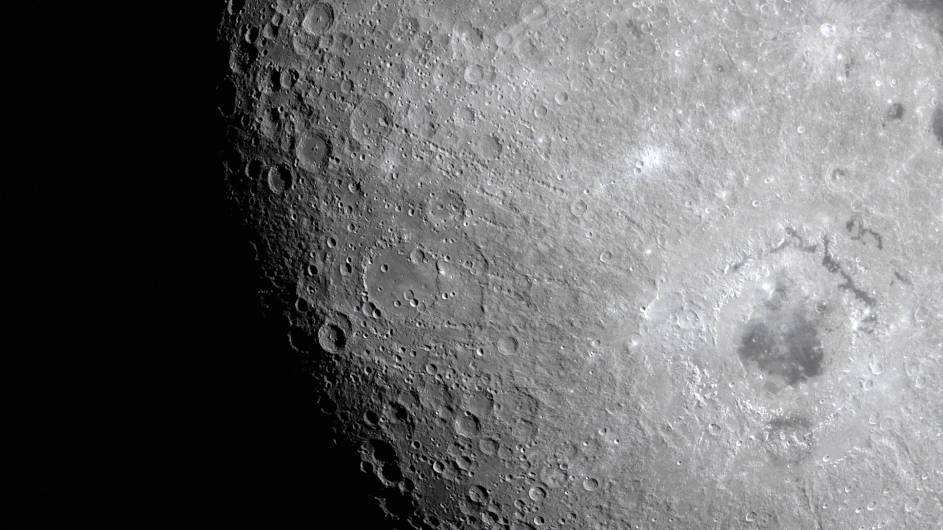
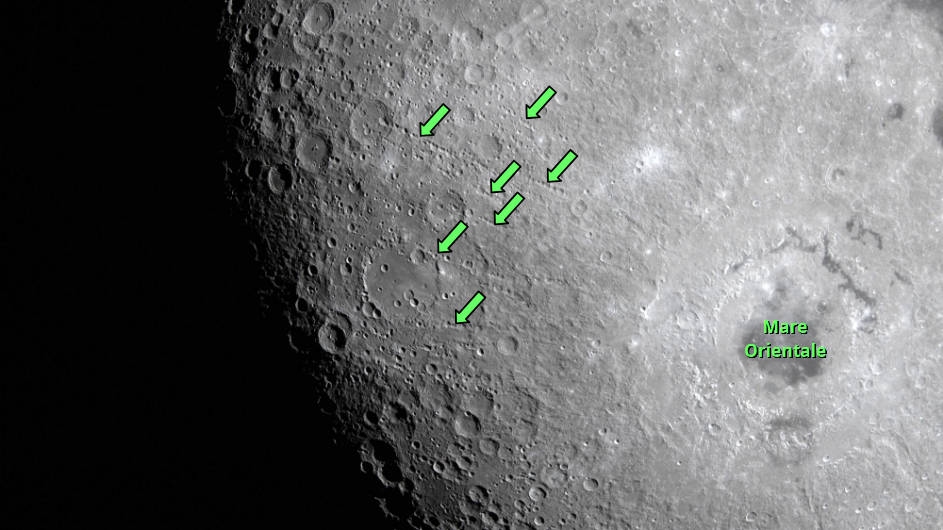
One of the pictures that the astronauts of Artemis 2 took of the far side of the moon was one that revealed chains of craters which appear to be emanating from the Sea on the edge of what we can see on the moon from the Earth, called Mare Orientale or the Eastern Sea. It was created by the impact of an asteroid onto the Moon’s surface, maybe 4 billion years ago, kicking out debris in all directions. Apparently the ejecta thrown out created chains of craters that appear to trace back to Orientale. They are most easily seen to the north and west of Orientale towards the terminator, the sunrise line, where the shadows are deeper. There’s probably chains of craters going in other directions, but they have no shadows.
The astronomical event times given in this blog are for the Traverse City/Interlochen area of Michigan (Lat 44.7° N, Long 85.7° W; EDT, UT – 4 hours) unless stated otherwise. Times will be different for other locations.
Addendum
Ephemeris: 04/24/2026 – Where did the lunar “seas” come from?
This is Bob Moler with Ephemeris for Arbor Day, Friday, April 24th. Today the Sun will be up for 13 hours and 55 minutes, setting at 8:39, and it will rise tomorrow at 6:41. The Moon, 1 day past first quarter, will set at 4:08 tomorrow morning.
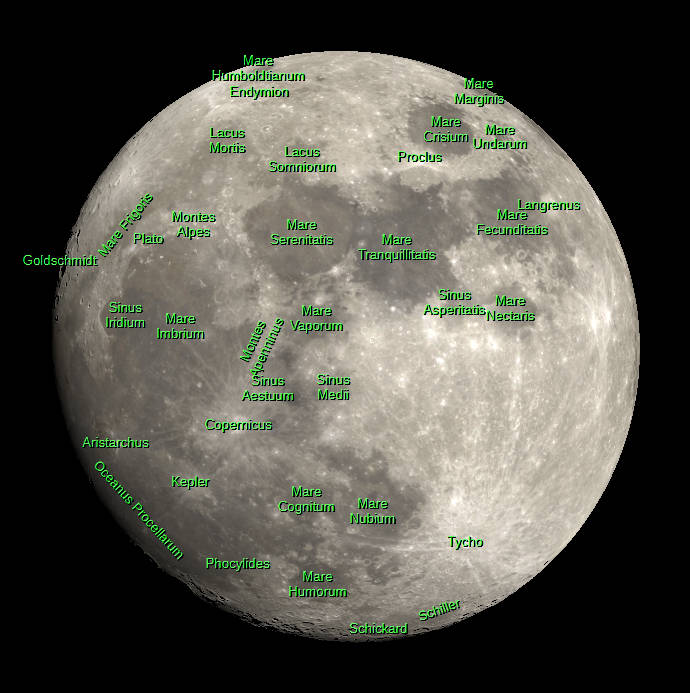
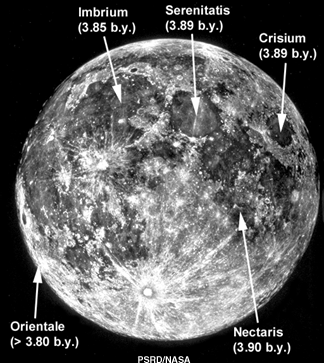
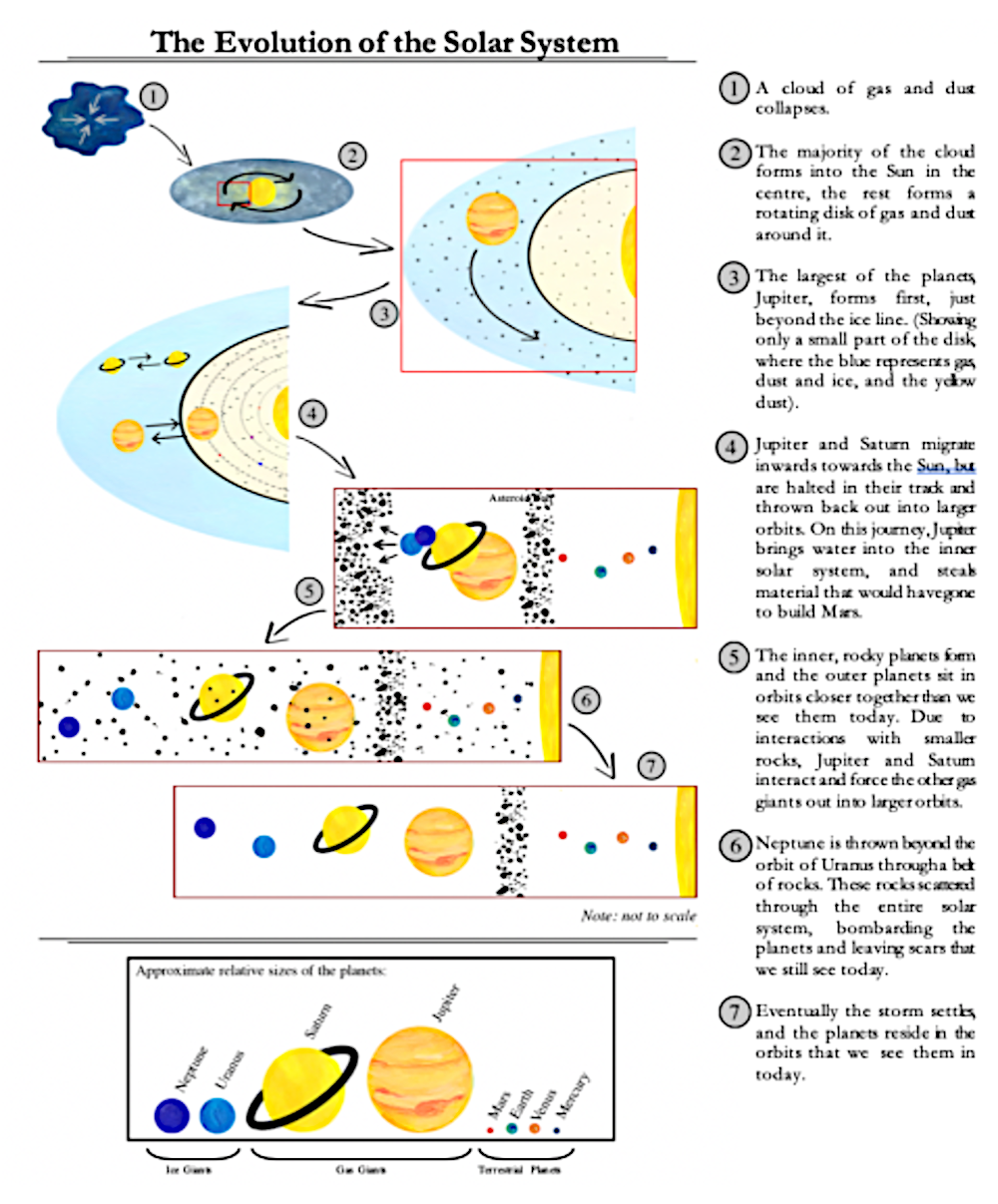
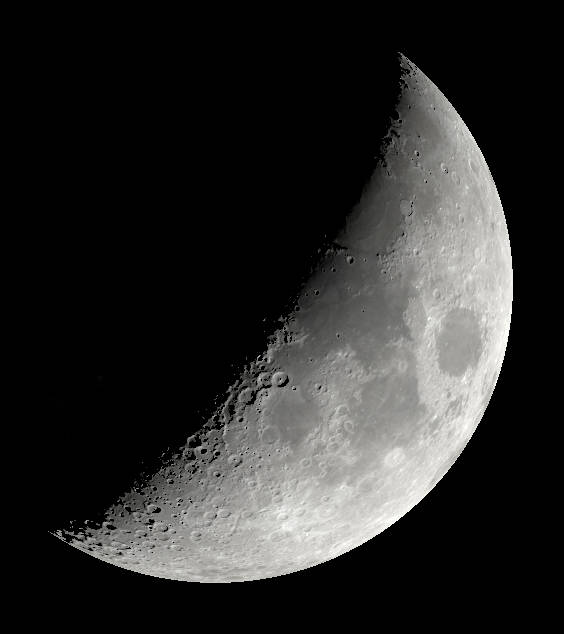
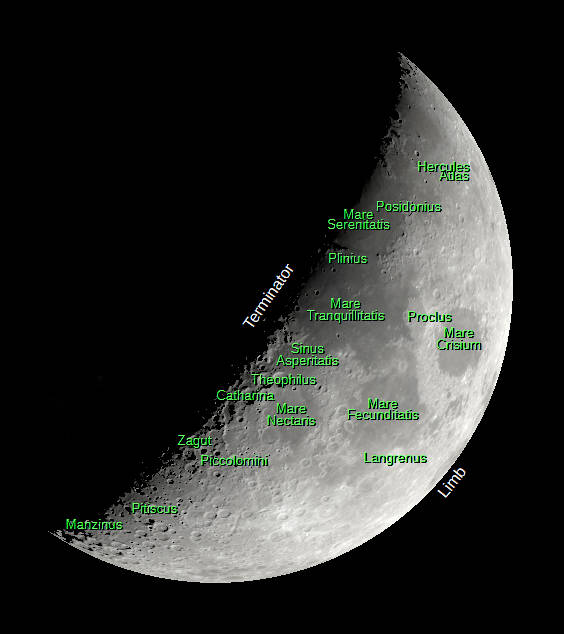
The face of the Moon is a bit more than half uncovered from our point of view, with first quarter occurring yesterday. It shows the string of lunar seas, those gray areas on the Moon which lead to the terminator, the Moon’s sunrise line. There is a larger sea called the Ocean of Storms on the eastern side of the Moon, as we see it. Most were created about 3.8 to 3.9 billion years ago by asteroid strikes. The same collisions happened to the Earth, but plate tectonics destroyed the evidence. Not so on the Moon. Many planetary scientists think it was the result of the Late Heavy Bombardment, caused by the changing orbits of mainly Saturn, Uranus and Neptune disrupting the asteroids, and sending them careening through the solar system.
The astronomical event times given in this blog are for the Traverse City/Interlochen area of Michigan (Lat 44.7° N, Long 85.7° W; EDT, UT – 4 hours) unless stated otherwise. Times will be different for other locations.
Addendum
Ephemeris: 04/23/2026 – Where did the Moon come from?
This is Ephemeris for Thursday, April 23rd. Today the Sun will be up for 13 hours and 52 minutes, setting at 8:37, and it will rise tomorrow at 6:43. The Moon, at first quarter today, will set at 3:42 tomorrow morning.
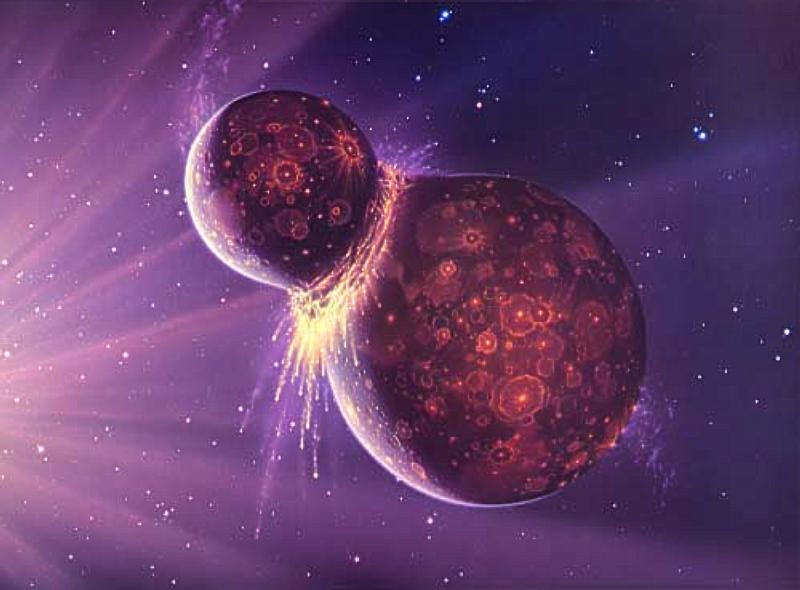
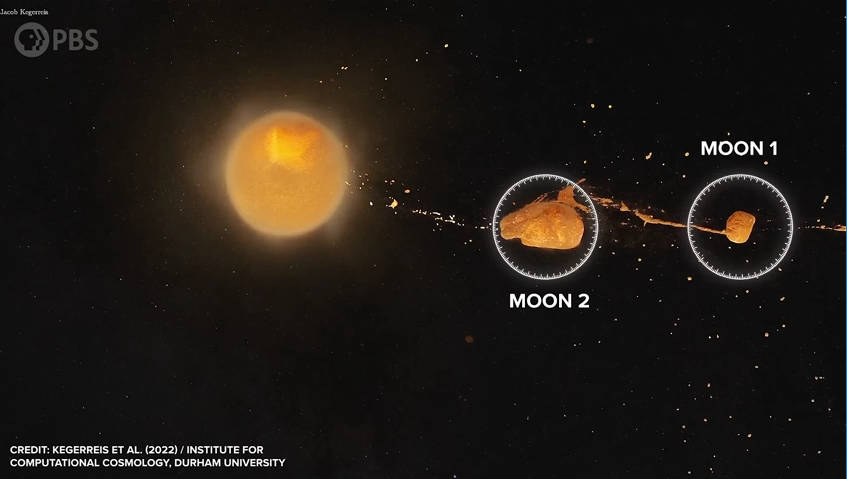
When one gazes upon the moon tonight the thought of where the moon came from might come to mind. Did it form with the Earth? Was it captured by the Earth? The latest thinking on the origin of the moon centers around a grazing collision with the Earth of a Mars sized body that has been given the name Theia, the mother of Selene, the goddess of the Moon, shortly after the Earth was formed. This is based on Apollo mission discoveries that the composition of the rocks on the moon are approximately the same as those of Earth’s crust. It’s been known for a while that there are two dense masses within the Earth about halfway to the center. One geologist has put forth that these masses could have been the core of Theia that sank into the Earth.
The astronomical event times given in this blog are for the Traverse City/Interlochen area of Michigan (Lat 44.7° N, Long 85.7° W; EDT, UT – 4 hours) unless stated otherwise. Times will be different for other locations.
Addendum
Ephemeris: 04/22/2026 – Taking our weekly look at the whereabouts of the naked-eye planets
This is Ephemeris for Earth Day, Wednesday, April 22nd. Today the Sun will be up for 13 hours and 50 minutes, setting at 8:36, and it will rise tomorrow at 6:45. The Moon, 1 day before first quarter, will set at 3:07 tomorrow morning.
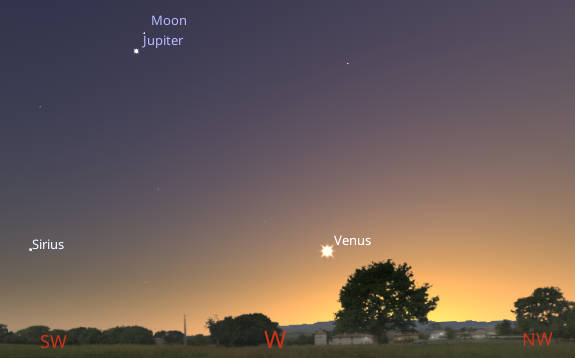
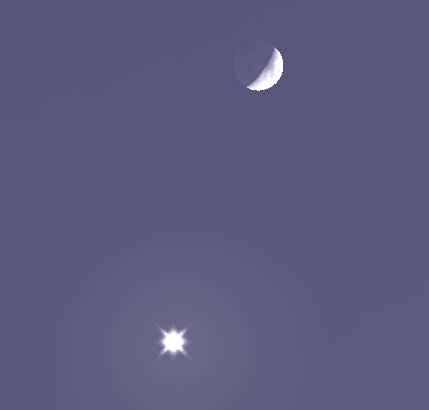
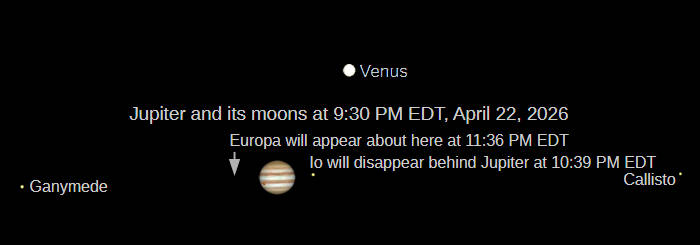
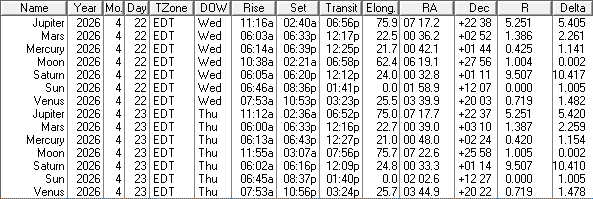
Let’s take our weekly look at the whereabouts of the naked-eye planets. By 9 PM tonight or about 30 minutes or so after sunset, Venus may be seen very low in the West. A telescope will show a very tiny disc on Venus, because it is still pretty much beyond the Sun, 138 million miles (222 million kilometers) away from us. Over the next 6 months it will be moving closer to us and becoming much larger. Jupiter is the brilliant star-like object high in the west-southwestern sky before 10 PM. It will appear just below the crescent Moon tonight. Venus will set at 10:54, while Jupiter will hold out until 2:30 AM. Meanwhile, Mercury, Mars and Saturn are still bunched up just west of the Sun, but are overwhelmed by bright morning twilight.
The astronomical event times given in this blog are for the Traverse City/Interlochen area of Michigan (Lat 44.7° N, Long 85.7° W; EDT, UT – 4 hours) unless stated otherwise. Times will be different for other locations.
Addendum
Ephemeris: 04/21/2026 – The Lyrid meteor shower reaches its peak tomorrow
This is Ephemeris for Tuesday, April 21st. Today the Sun will be up for 13 hours and 47 minutes, setting at 8:35, and it will rise tomorrow at 6:46. The Moon, 2 days before first quarter, will set at 2:21 tomorrow morning.
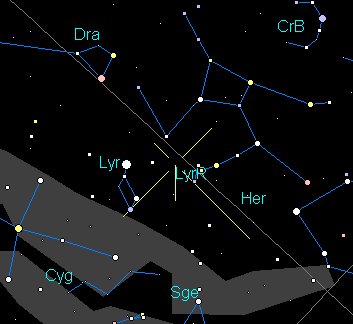
The second major meteor shower this year will reach its peak tomorrow afternoon around 3 PM (~19h UT). The best time to see it will be tomorrow morning after moonset at 2:21 AM. Astronomical twilight will begin to interfere after 5 AM. The other is tomorrow night starting 45 minutes later. The meteor shower is called the Lyrids, because they seem to come from near the constellation Lyra the harp and the bright star Vega. By 3 AM Vega will be high in the east. The radiant of the meteors is to the west of Vega, between Lyra and the dim constellation of Hercules. Though a major shower, the peak hourly rate is expected to be about 20 meteors an hour.
The astronomical event times given in this blog are for the Traverse City/Interlochen area of Michigan (Lat 44.7° N, Long 85.7° W; EDT, UT – 4 hours) unless stated otherwise. Times will be different for other locations.
Addendum
Ephemeris: 04/20/2026 – A seeming convergence of planets too close to the Sun to be seen from Michigan
This is Ephemeris for Monday, April 20th. Today the Sun will be up for 13 hours and 44 minutes, setting at 8:34, and it will rise tomorrow at 6:48. The Moon, halfway from new to first quarter, will set at 1:20 tomorrow morning.
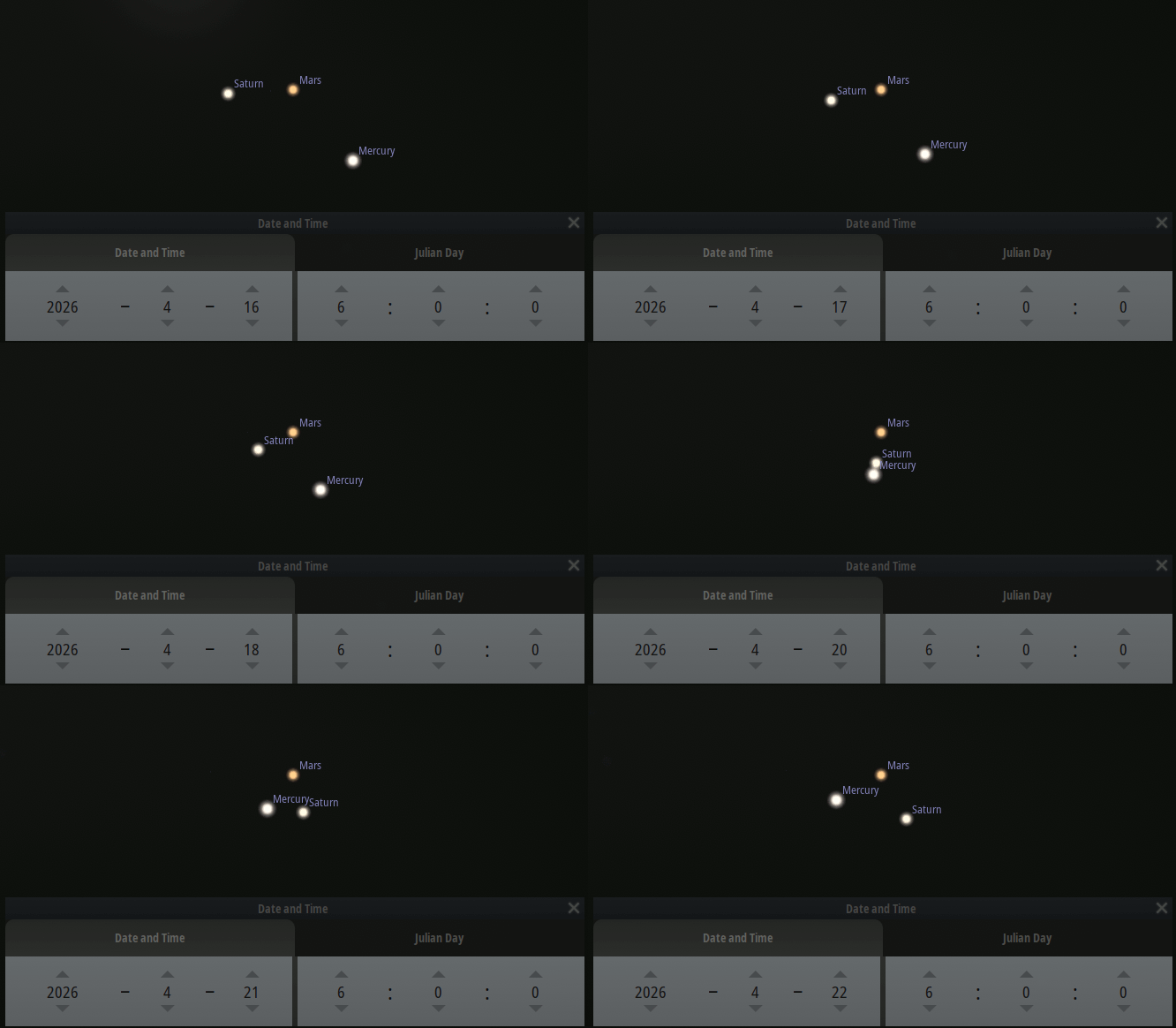
There’s a close planetary alignment this happening and today in the morning sky that we can’t see, of Mercury Mars and Saturn which are too close to the sun, and the time of year is not the best for seeing them. So they’re invisible to us but visible for folks in the Southern Hemisphere. Even the Artemis 2 astronauts talked about them when they went into solar eclipse on their trip around the moon. But the action is all happening yesterday and today. As of last Friday they were, from left to right, Saturn Mars and Mercury. As of today it’s almost a vertical arrangement with Mars on top Saturn in the middle and Mercury on the bottom and by tomorrow it will be Mercury on the bottom Venus on the top and Saturn off to the right.
The astronomical event times given in this blog are for the Traverse City/Interlochen area of Michigan (Lat 44.7° N, Long 85.7° W; EDT, UT – 4 hours) unless stated otherwise. Times will be different for other locations.
Addendum