Ephemeris: 02/02/2024 – It’s Groundhog Day!

February 2, 2024 Comments off

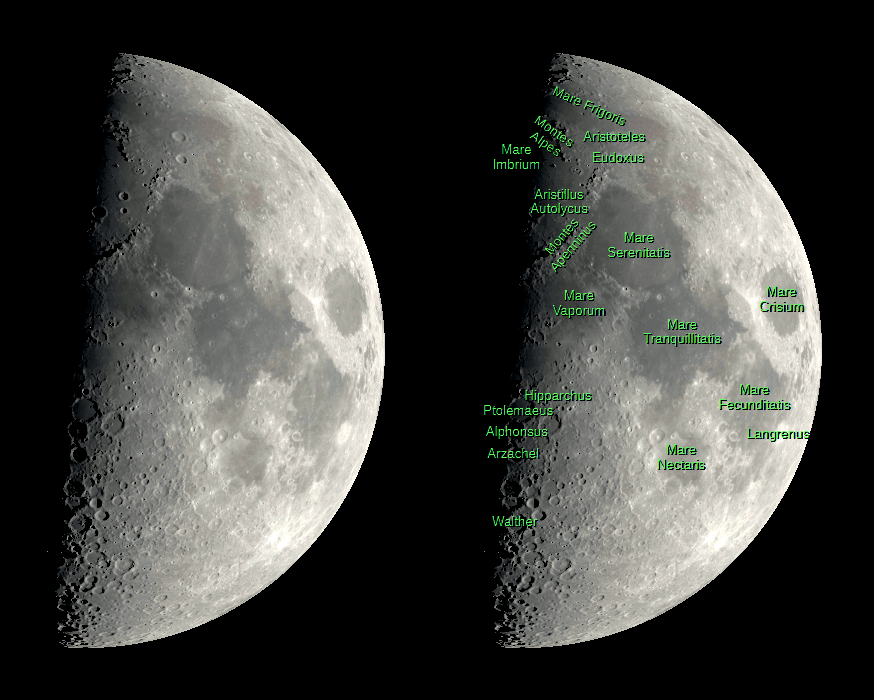
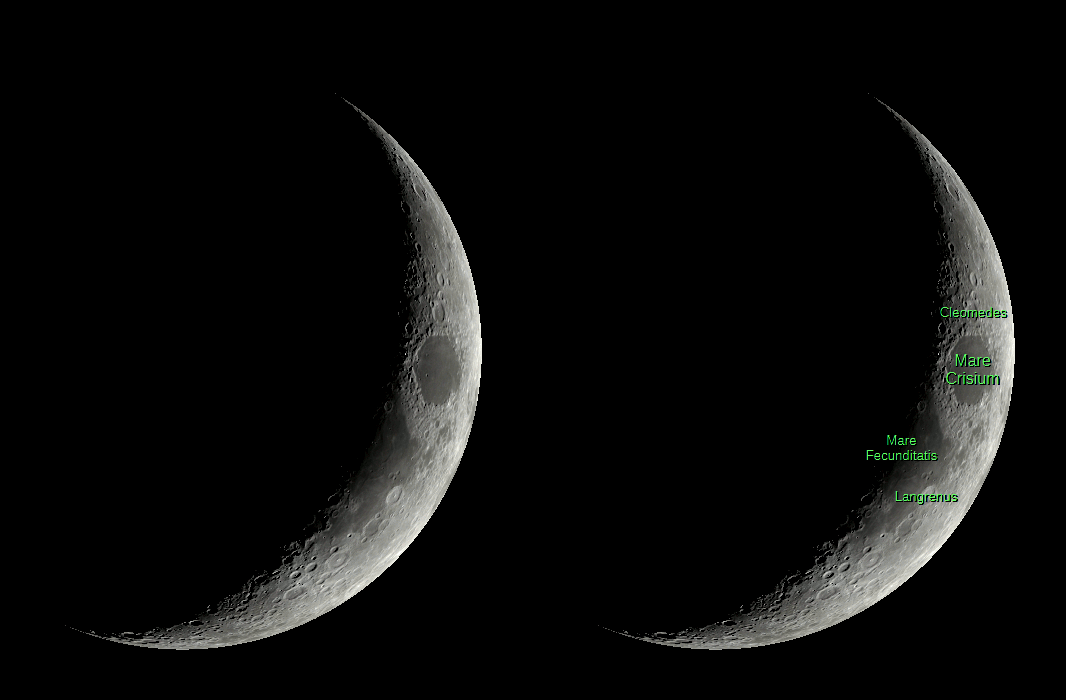
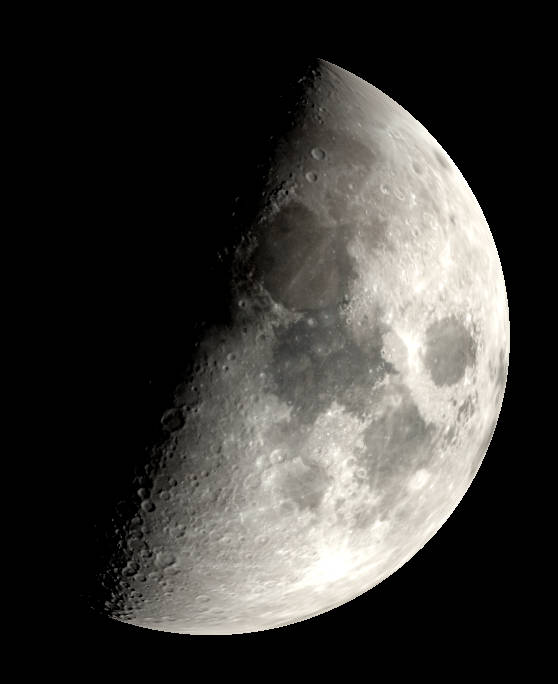
This is Bob Moler with Ephemeris for Groundhog Day, Friday, February 2nd. Today the Sun will be up for 9 hours and 51 minutes, setting at 5:52, and it will rise tomorrow at 8:00. The Moon, at last quarter today, will rise at 2:11 tomorrow morning.

I’m not sure if Punxsutawney Phil will see his shadow this morning or not, but February 2nd was a special day to the ancients. It is also Candlemas day for the Catholic Church, and it is celebrated as a cross-quarter day, the middle of the season of winter, though the exact date of the middle of winter is the 4th. And if Phil sees his shadow, and we do get 6 more weeks of winter, that’s OK too. By the calendar, it’s actually more like 6 ½ weeks to the vernal or spring equinox and the official end of winter. Of the other cross-quarter days, two others stand out. They are May 1st, May Day; and Halloween. The way this year has been going, winter has had a hard time getting started. The temperatures are above normal and the snowfall is below normal. A lot of grass is showing, and the bay isn’t even thinking of freezing over.

The astronomical event times given are for the Traverse City/Interlochen area of Michigan (EST, UT –5 hours). They may be different for your location.

Addendum
Ground Hog Day
Poor Punxsutawney Phil, rousted out of his mid winter nap. He’s looking a bit grumpy. Credit: http://www.fuzzytoday.com
A happier groundhog chewing on a bit of bread given by my granddaughter Coley on the deck of a condo we were staying at in Virginia eight years ago.

Ephemeris: 02/01/2024 – Preview of February days and nights

February 1, 2024 Comments off

    This is Ephemeris for Thursday, February 1st. Today the Sun will be up for 9 hours and 48 minutes, setting at 5:50, and it will rise tomorrow at 8:01. The Moon, 1 day before last quarter, will rise at 1:02 tomorrow morning.

    Let’s preview the month of February. It will be a day longer this year because it’s a leap year, the adjustment to keep the calendar in sync with the seasons. The daylight hours throughout February will be getting longer. Daylight hours will increase from 9 hours and 48 minutes today to 11 hours and 8 minutes on the 29th. The altitude of the Sun at noon will increase from 28 degrees today to nearly 38 degrees at month’s end. The Straits area will see the Sun a degree lower. Local noon, by the way for Interlochen and Traverse City at mid-month is about 12:56 p.m, which is mainly due to the fact that our standard time meridian happens to run through Philadelphia and the Sun is currently running 13 minutes slow.

    The astronomical event times given are for the Traverse City/Interlochen area of Michigan (EST, UT –5 hours). They may be different for your location.

    Addendum
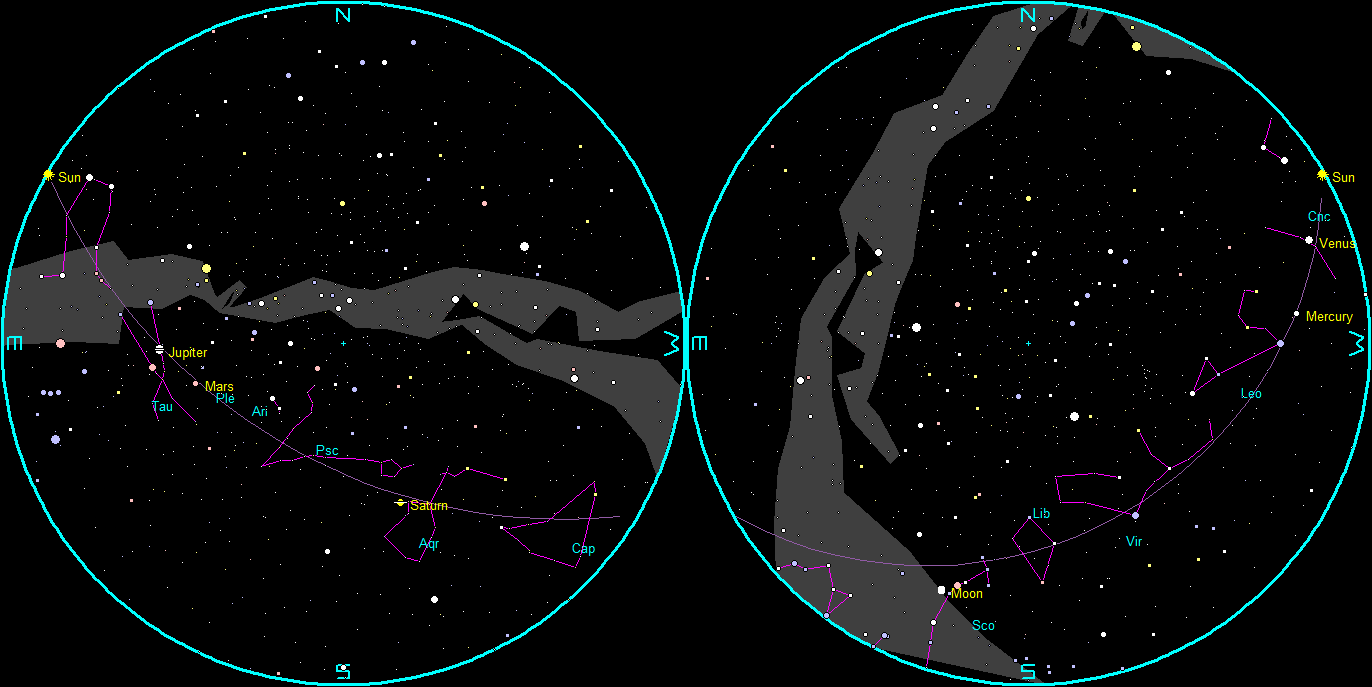
    February Evening Star Chart

    Star Chart for February 2024, (9 p.m. EST February 15, 2024). Created using my LookingUp program. Click on image to enlarge.

    The planets and stars are plotted for the 15th at 9 p.m. EST in the evening and 6 a.m. for the morning chart. These are the chart times. Note that Traverse City is located approximately 45 minutes behind our time meridian. (An hour 45 minutes behind our daylight saving time meridian during EDT). To duplicate the star positions on a planisphere (rotating star finder) you may have to set it to 45 minutes or one hour 45 minutes (Daylight Time) earlier than the current time.

    Note the chart times of 9 p.m. and 6 a.m. are for the 15th. For each week before the 15th, add ½ hour (28 minutes if you’re picky). For each week after the 15th, subtract ½ hour. Planet positions on dates other than the 15th can be found in the Wednesday planet posts on this blog.

    February Morning Star Chart

    Star Chart for February mornings, 2024 (6 a.m. EST February 15, 2024). No naked-eye planets are visible at chart time. Created using my LookingUp program. Click on image to enlarge.

    For a list of constellation names to go with the abbreviations, click here.

    • Pointer stars at the front of the bowl of the Big Dipper point to Polaris, the North Star.
    • Follow the arc of the handle of the Big Dipper to the star Arcturus, and
    • Extend like a spike to Spica,
    • The Summer Triangle is in red.

    Twilight Limits, Nautical and Astronomical

          EST        
      Morning Twilight Evening Twilight Dark Night Moon
    Date Astro. Nautical Nautical Astro. Start End Illum.
    2024-02-01 6h23m 6h57m 18h56m 19h34m 19h34m 0.58
    2024-02-02 6h22m 6h56m 19h01m 19h35m 19h35m 1h03m 0.48
    2024-02-03 6h21m 6h55m 19h02m 19h36m 19h36m 2h12m 0.38
    2024-02-04 6h20m 6h54m 19h03m 19h37m 19h37m 3h23m 0.28
    2024-02-05 6h19m 6h53m 19h05m 19h39m 19h39m 4h36m 0.19
    2024-02-06 6h18m 6h51m 19h06m 19h40m 19h40m 5h44m 0.11
    2024-02-07 6h16m 6h50m 19h07m 19h41m 19h41m 6h16m 0.04
    2024-02-08 6h15m 6h49m 19h08m 19h42m 19h42m 6h15m 0.01
    2024-02-09 6h14m 6h48m 19h10m 19h44m 19h44m 6h14m 0.00
    2024-02-10 6h13m 6h47m 19h11m 19h45m 19h45m 6h13m 0.02
    2024-02-11 6h12m 6h45m 19h12m 19h46m 20h32m 6h12m 0.07
    2024-02-12 6h10m 6h44m 19h13m 19h47m 21h53m 6h10m 0.15
    2024-02-13 6h09m 6h43m 19h15m 19h49m 23h13m 6h09m 0.24
    2024-02-14 6h08m 6h41m 19h16m 19h50m 6h08m 0.35
    2024-02-15 6h06m 6h40m 19h17m 19h51m 0h31m 6h06m 0.46
    2024-02-16 6h05m 6h39m 19h19m 19h52m 1h49m 6h05m 0.56
    2024-02-17 6h04m 6h37m 19h20m 19h54m 3h04m 6h04m 0.67
    2024-02-18 6h02m 6h36m 19h21m 19h55m 4h12m 6h02m 0.76
    2024-02-19 6h01m 6h34m 19h23m 19h56m 5h12m 6h01m 0.84
    2024-02-20 5h59m 6h33m 19h24m 19h58m 0.90
    2024-02-21 5h58m 6h31m 19h25m 19h59m 0.95
    2024-02-22 5h56m 6h30m 19h26m 20h00m 0.98
    2024-02-23 5h55m 6h28m 19h28m 20h01m 1.00
    2024-02-24 5h53m 6h27m 19h29m 20h03m 1.00
    2024-02-25 5h51m 6h25m 19h30m 20h04m 0.98
    2024-02-26 5h50m 6h23m 19h32m 20h05m 20h05m 20h45m 0.94
    2024-02-27 5h48m 6h22m 19h33m 20h07m 20h07m 21h48m 0.88
    2024-02-28 5h46m 6h20m 19h34m 20h08m 20h08m 22h53m 0.82
    2024-02-29 5h45m 6h19m 19h35m 20h09m 20h09m 0h00m 0.74

    Twilight calendar was generated using Cartes du Ciel (Sky Charts).

    See my blog post: Twilight Zone for the definitions of the different periods of twilight here: https://bobmoler.wordpress.com/2019/09/27/

    NASA Calendar of Planetary Events

    Feb  1  Th            Venus: 30.8° W
    2 Fr 6:18 pm Last Quarter
    4 Su 7:15 pm Moon-Antares: .6° S
    6 Tu 12:06 pm Moon South Dec.: 28.3° S
    7 We 1:52 pm Moon-Venus: 5.4° N
    8 Th 1:30 am Moon-Mars: 4.2° N
    9 Fr 5:59 pm New Moon
    10 Sa 1:49 pm Moon Perigee: 358100 km
    13 Tu 12:01 pm Moon Ascending Node
    15 Th 3:15 am Moon-Jupiter: 3.2° S
    16 Fr 10:01 am First Quarter
    16 Fr 2:13 pm Moon-Pleiades: .6° N
    19 Mo 3:47 am Moon North Dec.: 28.4° N
    20 Tu 7:54 pm Moon-Pollux: 1.8° N
    21 We 9:13 pm Moon-Beehive: 3.7° S
    22 Th 4:01 am Venus-Mars: .6° N
    24 Sa 7:30 am Full Moon
    25 Su 10:00 am Moon Apogee: 406300 km
    27 Tu 5:53 pm Moon Descending Node
    28 We 3:19 am Mercury Superior Conj.
    28 We 8:41 am Moon-Spica: 1.6° S
    28 We 4:01 pm Saturn Conjunction
    Mar 1 Fr Venus: 24.3° W

    All event times are given for UTC-5 Eastern Standard or UTC-4, Daylight Time

    Sky Events Calendar by Fred Espenak and Sumit Dutta (NASA’s GSFC),
    http://eclipse.gsfc.nasa.gov/SKYCAL/SKYCAL.html

    If you go to the above site you can print out a list like the above for the entire year or calendar pages for your time zone.

    Sun and Moon Rising and Setting Events

    LU              Ephemeris of Sky Events for Interlochen/TC
    February 2024 Local time zone: EST
    +-----------------------------------------------------------------------+
    | DATE | SUN SUN DAYLIGHT| TWILIGHT* |MOON RISE OR ILLUM |
    | | RISE SET HOURS | END START |PHASE SET** TIME FRACTN|
    +=======================================================================+
    |Thu 1| 08:02a 05:50p 09:48 | 06:57p 06:56a | Rise 01:02a 59%|
    |Fri 2| 08:01a 05:52p 09:51 | 06:58p 06:55a |L Qtr Rise 02:11a 50%|
    |Sat 3| 08:00a 05:53p 09:53 | 06:59p 06:54a | Rise 03:23a 40%|
    +------+-----------------------+----------------+-----------------------+
    |Sun 4| 07:58a 05:55p 09:56 | 07:00p 06:53a | Rise 04:35a 30%|
    |Mon 5| 07:57a 05:56p 09:59 | 07:02p 06:52a | Rise 05:44a 20%|
    |Tue 6| 07:56a 05:57p 10:01 | 07:03p 06:50a | Rise 06:44a 12%|
    |Wed 7| 07:55a 05:59p 10:04 | 07:04p 06:49a | Rise 07:32a 6%|
    |Thu 8| 07:53a 06:00p 10:07 | 07:05p 06:48a | Rise 08:09a 2%|
    |Fri 9| 07:52a 06:02p 10:09 | 07:07p 06:47a |New Set 05:42p 0%|
    |Sat 10| 07:50a 06:03p 10:12 | 07:08p 06:46a | Set 07:08p 2%|
    +------+-----------------------+----------------+-----------------------+
    |Sun 11| 07:49a 06:05p 10:15 | 07:09p 06:44a | Set 08:32p 6%|
    |Mon 12| 07:48a 06:06p 10:18 | 07:11p 06:43a | Set 09:53p 13%|
    |Tue 13| 07:46a 06:07p 10:21 | 07:12p 06:42a | Set 11:12p 22%|
    |Wed 14| 07:45a 06:09p 10:24 | 07:13p 06:40a | Set 12:31a 32%|
    |Thu 15| 07:43a 06:10p 10:26 | 07:15p 06:39a | Set 01:48a 43%|
    |Fri 16| 07:42a 06:12p 10:29 | 07:16p 06:38a |F Qtr Set 03:03a 54%|
    |Sat 17| 07:40a 06:13p 10:32 | 07:17p 06:36a | Set 04:12a 64%|
    +------+-----------------------+----------------+-----------------------+
    |Sun 18| 07:39a 06:14p 10:35 | 07:18p 06:35a | Set 05:12a 74%|
    |Mon 19| 07:37a 06:16p 10:38 | 07:20p 06:33a | Set 06:00a 82%|
    |Tue 20| 07:36a 06:17p 10:41 | 07:21p 06:32a | Set 06:39a 89%|
    |Wed 21| 07:34a 06:19p 10:44 | 07:22p 06:30a | Set 07:09a 94%|
    |Thu 22| 07:32a 06:20p 10:47 | 07:24p 06:29a | Set 07:32a 98%|
    |Fri 23| 07:31a 06:21p 10:50 | 07:25p 06:27a | Set 07:52a 100%|
    |Sat 24| 07:29a 06:23p 10:53 | 07:26p 06:26a |Full Rise 06:38p 100%|
    +------+-----------------------+----------------+-----------------------+
    |Sun 25| 07:27a 06:24p 10:56 | 07:27p 06:24a | Rise 07:41p 98%|
    |Mon 26| 07:26a 06:25p 10:59 | 07:29p 06:22a | Rise 08:44p 95%|
    |Tue 27| 07:24a 06:27p 11:02 | 07:30p 06:21a | Rise 09:47p 90%|
    |Wed 28| 07:22a 06:28p 11:05 | 07:31p 06:19a | Rise 10:52p 83%|
    |Thu 29| 07:21a 06:30p 11:08 | 07:33p 06:18a | Rise 11:59p 75%|
    +-----------------------------------------------------------------------+
    * Nautical Twilight
    ** Moonrise or moonset, whichever occurs between sunrise and sunset

    Created using my LookingUp for MS-DOS.

    Ephemeris: 01/31/2024 – Where have the naked-eye planets wandered* off to this week?

    January 31, 2024 Comments off

    This is Ephemeris for Wednesday, January 31st. Today the Sun will be up for 9 hours and 46 minutes, setting at 5:49, and it will rise tomorrow at 8:02. The Moon, 2 days before last quarter, will rise at 11:56 this evening.

    Let’s find out where the naked-eye planets have wandered off to this week. Three of those five planets are now visible. Saturn and Jupiter are the evening planets. Saturn is getting harder to spot low in the west-southwest, nearly succumbing to evening twilight, setting at 7:59 pm. Jupiter will move from high in the south to low in the west by midnight, and will set in the west-northwest at 1:20 am. Venus, the brilliant morning star, will rise in the east-southeast at 6:18 am, and be a brilliant beacon in the morning, shining in the southeast before the bright morning twilight claims it around 7:45 am. As we advance through winter into spring Venus is going to be harder to spot before sunrise.

    The astronomical event times given are for the Traverse City/Interlochen area of Michigan (EST, UT –5 hours). They may be different for your location.

    Addendum
    Jupiter and Saturn as they would appear in the southwestern quadrant of the sky around 7 pm or about an hour and a quarter after sunset. Saturn will set an hour later, while Jupiter will last past midnight. Created using Stellarium.
    The Moon and the star Spica as they might appear in binoculars or a very low power telescope at 3 am EST (8:00 UT) tomorrow morning, February 1st 2024. The exact position of the Moon with respect to Spica may be different for your longitude as compared to about 86° west longitude where I am. Created using Stellarium.
    The Morning Star Venus, left, and the last quarter Moon, right, as they might appear about 7:30 am or about half an hour before sunrise February 1st 2024. Created using Stellarium.

    Telescopic Saturn, Jupiter and Venus (north up) as they would be seen in a small telescope, with the same magnification. At 7 pm January 31, 2024, for Saturn and Jupiter, and 7:30 am on February 1st, for Venus. Apparent diameters: Saturn 15.66″, its rings 36.48″; Jupiter 39.69″; and Venus 12.22″, 85.8% illuminated. There are some Jovian satellite events this evening. At about 7:40 pm Ganymede will appear from behind Jupiter. The image shows the Ganymede label. However, the moon will be hidden at 7:00 pm. Then at 11:12 this evening Ganymede will enter Jupiter’s shadow, and stay hidden until 12:54 am tomorrow morning. The ” symbol means seconds of arc (1/3600th of a degree). Click or tap on the image to enlarge it. Created using Cartes du Ciel (Sky Charts) and GIMP.
    The naked-eye planets and the Moon at sunset and sunrise on a single night, starting with sunset on the right on January 31, 2024. The night ends on the left with sunrise on February 1st. The labels for Mars and Mercury overlap. Click or tap on the image to enlarge it. Created using my LookingUp app and GIMP.

    * The Greeks called the moving objects in the sky Planetes meaning Wanderers, from which we get the name Planet. In reality the planets do not wander, or move aimlessly, but move in orbits, discovered by Johannes Kepler, in accordance with the laws of gravitation discovered by Isaac Newton and Albert Einstein. The ancients considered the Sun and Moon planets, because they also moved against the “fixed” stars in the sky. This made seven, adding to the five naked eye planets we know today. These seven objects became the names of the days of the week in many countries. We have retained three of them: Sun’s day, Moon’s day, and Saturn’s day. The rest are named for Norse gods and a goddess.

    Ephemeris: 01/30/2024 – The Winter Maker moves to center stage at midwinter

    January 30, 2024 Comments off

    This is Bob Moler with Ephemeris for Tuesday, January 30th. Today the Sun will be up for 9 hours and 43 minutes, setting at 5:48, and it will rise tomorrow at 8:03. The Moon, 3 days before last quarter, will rise at 10:53 this evening.

    As we approach midwinter looking in the south at about 9 pm we see the great constellation of Orion the hunter. For the Anishinaabek people, who are native to our Great Lakes area, that constellation is the Wintermaker. Instead of holding a club and a shield, as Orion does, he has his arms outstretched from Aldebaran in Taurus to Procyon in Canis Minor embracing all the winter constellations. I’ve first seen him as morning twilight started when I’ve stayed up all night to watch the Perseid meteor shower in August. We begin to see him on late November evenings, rising in the east, to herald the coming of winter, and we will lose him in April when he descends into the West in the evening twilight.

    The astronomical event times given are for the Traverse City/Interlochen area of Michigan (EST, UT –5 hours). They may be different for your location.

    Addendum
    A three frame animation of the western constellation of Orion the hunter and the Anishinaabek constellation of the Winter Maker
    Here’s a three frame animation of the western constellation of Orion the hunter and the Anishinaabek constellation of the Winter Maker. Created using Stellarium and GIMP.

    Ephemeris: 01/29/2024 – Canis Major, Orion’s larger hunting dog

    January 29, 2024 Comments off

    This is Ephemeris for Monday, January 29th. Today the Sun will be up for 9 hours and 41 minutes, setting at 5:46, and it will rise tomorrow at 8:04. The Moon, halfway from full to last quarter, will rise at 9:50 this evening.

    The great winter constellation or star group, Orion the hunter, is located in the south-southeastern sky at 9 p.m. His elongated rectangle of a torso is nearly vertical. In the center of the rectangle are three stars in a line that make his belt. As a hunter, especially one of old, he has two hunting dogs. The larger, Canis Major, can be found by following the three belt stars of Orion down and to the left. They point to Sirius, the brightest nighttime star, also known as the Dog Star. It’s in the heart of a stick figure dog low in the southeast facing Orion that appears to be begging. There’s a fine star cluster, called Messier 41, or M41, the Little Beehive Cluster, at the 5 o’clock position from Sirius. It’s easily visible in binoculars or a small telescope.

    The astronomical event times given are for the Traverse City/Interlochen area of Michigan (EST, UT –5 hours). They may be different for your location.

    Addendum
    Orion and Canis Major
    Orion and Canis Major Animation for 8:30 pm in late January. Created using Stellarium and GIMP.

    Ephemeris: 01/26/2024 – In astronomy “dark” means we can’t see it

    January 26, 2024 Comments off

    This is Ephemeris for Friday, January 26th. Today the Sun will be up for 9 hours and 33 minutes, setting at 5:42, and it will rise tomorrow at 8:07. The Moon, 1 day past full, will rise at 6:37 this evening.

    What does the word “dark” mean? In astronomy the word dark means something we cannot see. In ages before 1959 we could not see the backside of the moon, so people got to calling it the dark side of the Moon. All changed in 1959 when a Soviet spacecraft went around behind the moon it took photographs of it. The two contenders for dark things in astronomy are now dark matter and dark energy. Dark matter is something that has a gravitational effect on the galaxies that it surrounds, but we can’t see it. Also, the expansion of the universe appears to be accelerating, where we would expect it to be decelerating because of gravitational forces of all the galaxies in it. We call that cause dark energy. And we don’t know what either is.

    The astronomical event times given are for the Traverse City/Interlochen area of Michigan (EST, UT –5 hours). They may be different for your location.

    Addendum
    Two possible causes of Dark Matter are in the running, WIMPs, and of course MACHOs. WIMPs are Weakly Interacting Massive Particles, while MACHOs are the bit more tortured acronym Massive Astrophysical Compact Halo Objects. Whatever they are they don’t interact much with themselves or ordinary matter, neither emitting light or any other radiation, or block it. However, they have mass and warp spacetime, distorting the shape of galaxies seen behind them. They also make galaxies seem to be more massive than their starlight would make them appear, and other effects.

    Teaser Deep Field Image from President Biden's Presentation
    The first deep field image from the James Webb Space Telescope shows a cluster of galaxies and a few stars. The stars have diffraction spikes, the rest of them are galaxies. The foreground galaxies of the cluster are white. The ones farther away are reddish, showing their red shift due to their greater recession speed with respect to the galaxy cluster we’re looking through. Note how those reddish galaxies are generally distorted into arcs whereas the nearer galaxies are not. This is the result of gravitational lensing caused by the gravitational fields of the galaxies and the dark matter between them. The warping of space by mass is a prediction of Einstein’s Theory of General Relativity, and one of its first proofs. Credit: NASA, ESA, CSA, JWST, STScI.

    Ephemeris: 01/25/2024 – Where is the full moon in winter?

    January 25, 2024 Comments off

    This is Ephemeris for Thursday, January 25th. Today the Sun will be up for 9 hours and 31 minutes, setting at 5:41, and it will rise tomorrow at 8:08. The Moon, at full today, will rise at 5:30 this evening.

    The exact time that the Moon will be full, at least to the nearest minute is 12:54 this afternoon. Have you ever noticed the placement of the full moon in the sky between winter and summer? The full moon near the winter solstice moves very high at midnight, while the full moon near the summer solstice is seen quite low in the south. For the Moon to be full, it must be nearly opposite the Sun in the sky, so we see it fully illuminated as the Sun does. The Moon’s orbit is close to the Sun’s apparent path in the sky, the ecliptic, which is the projection of the Earth’s orbit of the Sun. So the Moon now is near, and actually a bit north of, where the Sun will be 6 months from now in mid to late July.

    The astronomical event times given are for the Traverse City/Interlochen area of Michigan (EST, UT –5 hours). They may be different for your location.

    Addendum
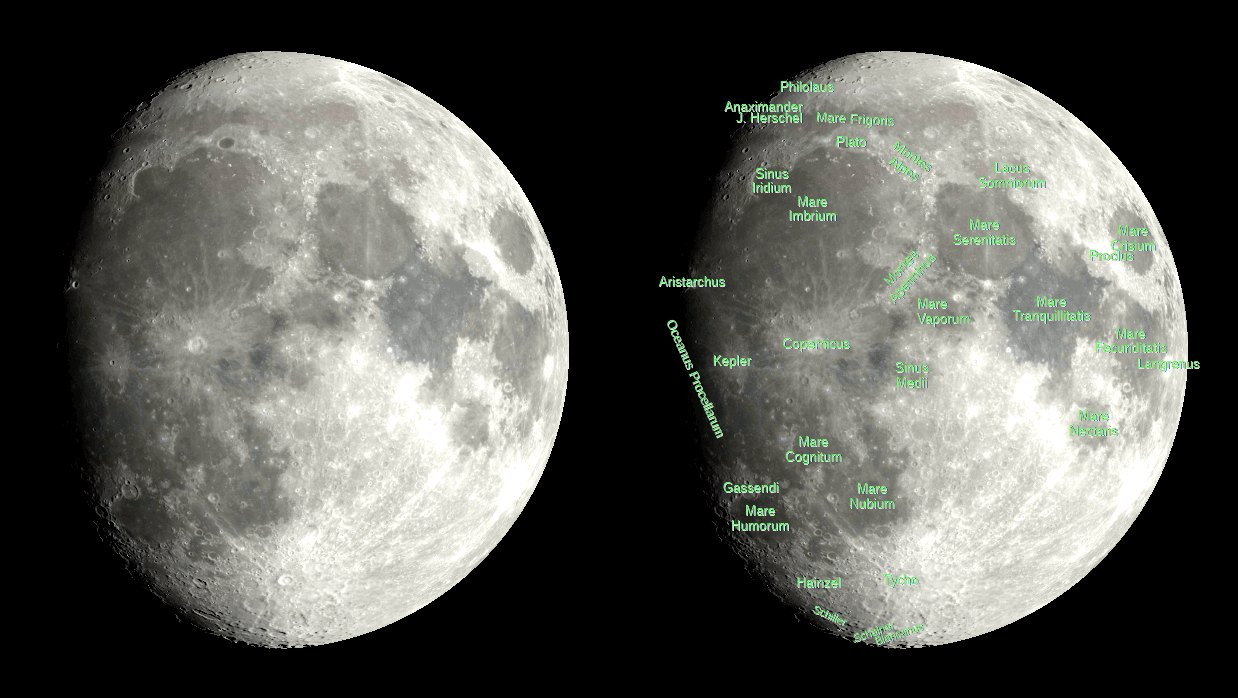
    The altitude of the full moon on two dates 6 lunar months apart. In winter the moon rides high in the south (66 degrees altitude). That would be tomorrow morning. Six lunar months later on July 21st the full moon rides very low in the south (19 degrees altitude). This cylindrical view represents the altitude uniformly, but is distorted horizontally with altitude, which is why the winter high altitude full moon appears distorted. Created using Stellarium.

    Ephemeris: 01/24/2024 – Where have the planets wandered off to this week?

    January 24, 2024 Comments off

    This is Ephemeris for Wednesday, January 24th. Today the Sun will be up for 9 hours and 29 minutes, setting at 5:39, and it will rise tomorrow at 8:09. The Moon, 1 day before full, will set at 8:36 tomorrow morning.

    Let’s find out where the naked-eye planets have wandered off to this week. Three of those five planets are now easily visible. Saturn and Jupiter are the evening planets. Saturn is getting harder to spot low in the west-southwest, setting at 8:19 pm. Jupiter will move from high in the south to low in the west by midnight, and will set in the west-northwest at 1:40 am. Venus, the brilliant morning star, will rise in the east-southeast at 6:09 am, and be a brilliant beacon in the morning, shining in the southeast before the bright morning twilight claims it around 8 am. Mercury, which rises by 7:03 am might just be visible below and left of Venus by 7:30 am.

    The astronomical event times given are for the Traverse City/Interlochen area of Michigan (EST, UT –5 hours). They may be different for your location.

    Addendum
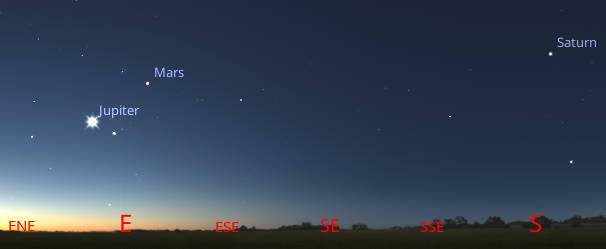
    A panorama of the evening sky
    A panorama of the evening sky at 7 pm tonight, January 24, 2024, looking from the east northeast through south to the west to view the Moon, the bright winter stars, Jupiter, in the south, and Saturn, which is close to setting. Click or tap on the image to enlarge it. Created using Stellarium.
    The nearly full moon visible in binoculars or small telescopes
    The nearly full moon visible in binoculars or small telescopes at 7 this evening, January 24, 2024, showing very little shadow detail. The Moon being fully lit by the Sun and Earth is looking at the Moon from that the same direction. This allows crater rays to be quite visible. The best example of this is the crater Tycho, to the lower right. Rays are thought to be shallow craters caused by the debris kicked out when the impact of the body that created the crater occurred. They show better at full moon because there are no shadows. Otherwise, there would be shadows in these tiny craters, making the rays less visible. Shadows help us see the bigger craters, but only when there are no shadows do these little ejecta craters show up bright. Click or tap on the image to enlarge it. Created using Stellarium, LibreOffice Draw, and GIMP.
    Venus and Mercury as seen about 40 minutes before sunrise
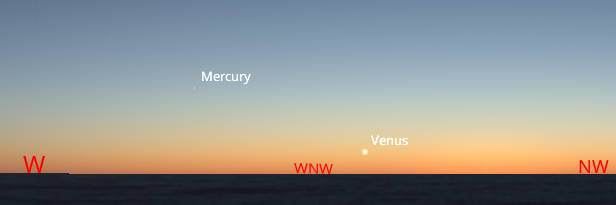
    Here are Venus and Mercury as seen about 40 minutes before sunrise. That’s about 7:30 am in the Grand Traverse area of Michigan. There’s a good chance that Mercury will be invisible because it’s seen very low in the growing twilight. Mars, just below and left of Mercury, will pass it this weekend, as Mercury moves towards the Sun and Mars moves away. Venus of course is moving towards the Sun also and Mars will pass it about a month from now. Click or tap on the image to enlarge it. Created using Stellarium.
    Telescopic Saturn, Jupiter and Venus (north up) as they would be seen in a small telescope, with the same magnification. At 7 pm January 24, 2024, for Saturn and Jupiter, and 7:30 am on the 25th, for Venus. Apparent diameters: Saturn 15.74″, its rings 36.66″; Jupiter 40.61″; and Venus 12.58″, 84.2% illuminated. Mercury appears too small to be shown here, but its apparent diameter is 5.52″ and is 82.5% illuminated. Jupiter's moon Ganymede will be eclipsed by Jupiter's shadow and disappear at 7:10 pm, and will emerge from the shadow at 8:53 pm. The ” symbol means seconds of arc (1/3600th of a degree). Click or tap on the image to enlarge it. Created using Cartes du Ciel (Sky Charts) and GIMP.
    Telescopic Saturn, Jupiter and Venus (north up) as they would be seen in a small telescope, with the same magnification. At 7 pm January 24, 2024, for Saturn and Jupiter, and 7:30 am on the 25th, for Venus. Apparent diameters: Saturn 15.74″, its rings 36.66″; Jupiter 40.61″; and Venus 12.58″, 84.2% illuminated. Mercury appears too small to be shown here, but its apparent diameter is 5.52″ and is 82.5% illuminated. Jupiter’s moon Ganymede will be eclipsed by Jupiter’s shadow and disappear at 7:10 pm, and will emerge from the shadow at 8:53 pm. The ” symbol means seconds of arc (1/3600th of a degree). Click or tap on the image to enlarge it. Created using Cartes du Ciel (Sky Charts) and GIMP.
    The naked-eye planets and the Moon at sunset and sunrise on a single night
    The naked-eye planets and the Moon at sunset and sunrise on a single night, starting with sunset on the right on January 24, 2024. The night ends on the left with sunrise on the 25th. The labels for Mars and Mercury overlap, though the planets do not. Mars is the reddish one. Click or tap on the image to enlarge it. Created using my LookingUp app and GIMP.

    Ephemeris: 01/23/2024- The “dark” side of the Moon is its brightest side

    January 23, 2024 Comments off

    This is Ephemeris for Tuesday, January 23rd. Today the Sun will be up for 9 hours and 27 minutes, setting at 5:38, and it will rise tomorrow at 8:10. The Moon, 2 days before full, will set at 8 o’clock tomorrow morning.

    In a couple of days the far side of the Moon will become the dark side for real. It’ll be night when the near side of the moon becomes fully illuminated, the far side will be a night. The far side of the moon actually gets more sunlight than the near side of the moon because it does not suffer solar eclipses. The lunar solar eclipse occurs when we see a lunar eclipse. The Sun is blocked from shining on the Moon. The totality of a lunar solar eclipse lasts much longer than a few minutes that we get when the Moon totally blocks the Sun, the length of totality for the Moon’s solar eclipse can last several hours. The far side of the moon does not see eclipses, and when fully illuminated at what we call new moon it is a quarter of a million miles closer to the Sun than Earth.

    The astronomical event times given are for the Traverse City/Interlochen area of Michigan (EST, UT –5 hours). They may be different for your location.

    Addendum
    The near side and the far side of the Moon compared
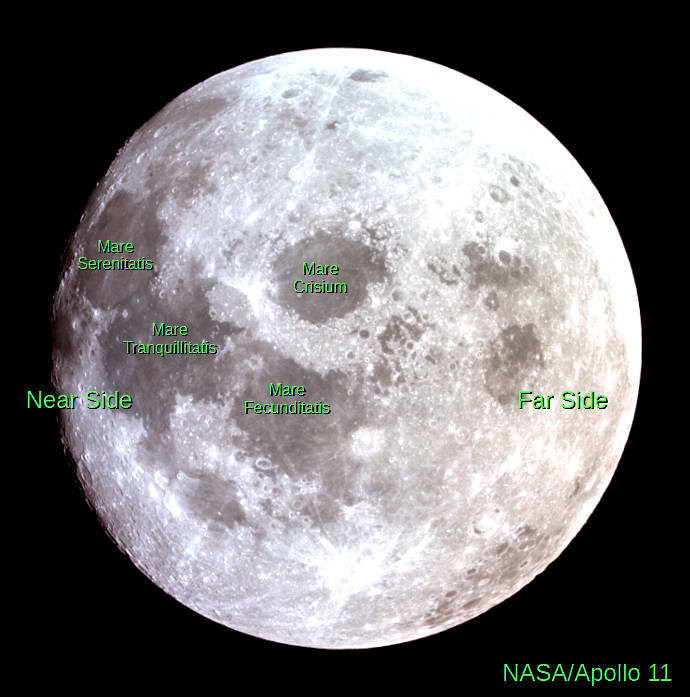
    The near side and the far side of the Moon compared. On the far side the only really dark areas are the Moscow Sea at the 10 o’clock position and the crater Tsiolkovsky at the 8 o’clock position. The large semi dark area at the 5 o’clock position is the Aitken basin which would probably be a lot darker if the impact that created it had occurred on the near side of the Moon. Click or tap on the image to enlarge it. Credit NASA, Clementine spacecraft.

    Ephemeris: 01/22/2024 – The Dog Star’s little buddy

    January 22, 2024 Comments off

    This is Ephemeris for Monday, January 22nd. Today the Sun will be up for 9 hours and 24 minutes, setting at 5:37, and it will rise tomorrow at 8:11. The Moon, 3 days before full, will set at 7:14 tomorrow morning.

    Sirius is the brightest nighttime star and is located low in the southeast at 9 p.m. below and a bit left of Orion the Hunter. We’ve visited Sirius on Tuesday, but there is another star in the Sirius system that is practically invisible due to Sirius’ dazzling glare. Its name is Sirius B, nicknamed the Pup, alluding to Sirius’ Dog Star title. The tiny star was suspected as far back as 1834 due to Sirius’ wavy path against the more distant stars in the sky. Sirius and the Pup have 50-year orbits of each other. The Pup was first seen in 1862. It was the first of a new class of stars to be discovered, white dwarfs. The Pup is a dying star with the mass of the Sun, collapsed down to the size of the Earth after running out of hydrogen fuel in its core.

    The astronomical event times given are for the Traverse City/Interlochen area of Michigan (EST, UT –5 hours). They may be different for your location.

    Addendum
    Sirius finder
    A Sirius finder animation for late January/early February at around 8 pm. Even in bright moonlight the seven bright stars of Orion can be seen. The three stars of Orion’s belt make a great pointer to Sirius. Created using Stellarium, GIMP and LibreOffice Draw (for the arrow).
    Sirius' path
    Sirius A & B’s path in the sky showing the wobble that betrayed the Pup’s presence. Credit Mike Guidry, University of Tennessee.
    Two views of Sirius and the Pup
    Sirius A and B imaged by two different space telescopes, revealing dramatically different views! Hubble’s image (left) shows Sirius A shining brightly in visible light, with diminutive Sirius B a tiny dot. However, in Chandra’s image (right) tiny Sirius B is dramatically brighter in X-rays! The “Universe in a Different Light” activity highlights more surprising views of some familiar objects: http://bit.ly/different-light-nsn NASA, ESA, H. Bond (STScI), and M. Barstow (University of Leicester) (left); NASA/SAO/CXC (right)