07/12/2023 – Ephemeris – Let’s find out where the naked-eye planets have wandered off to this week
This is Bob Moler with Ephemeris for Wednesday, July 12th. Today the Sun will be up for 15 hours and 19 minutes, setting at 9:27, and it will rise tomorrow at 6:09. The Moon, 3 days past last quarter, will rise at 2:30 tomorrow morning.
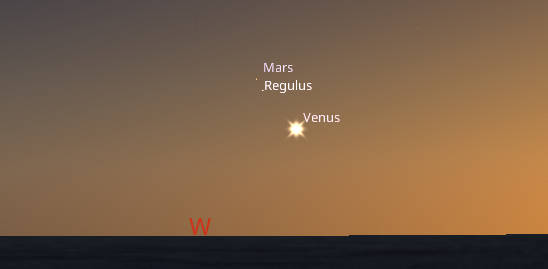
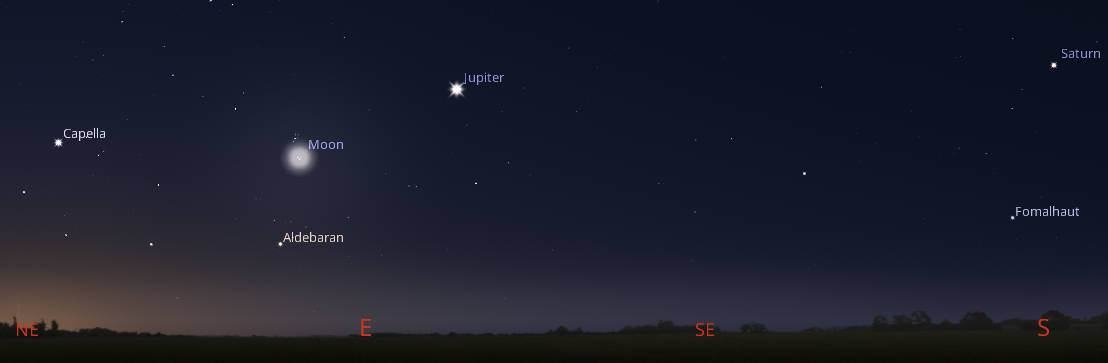
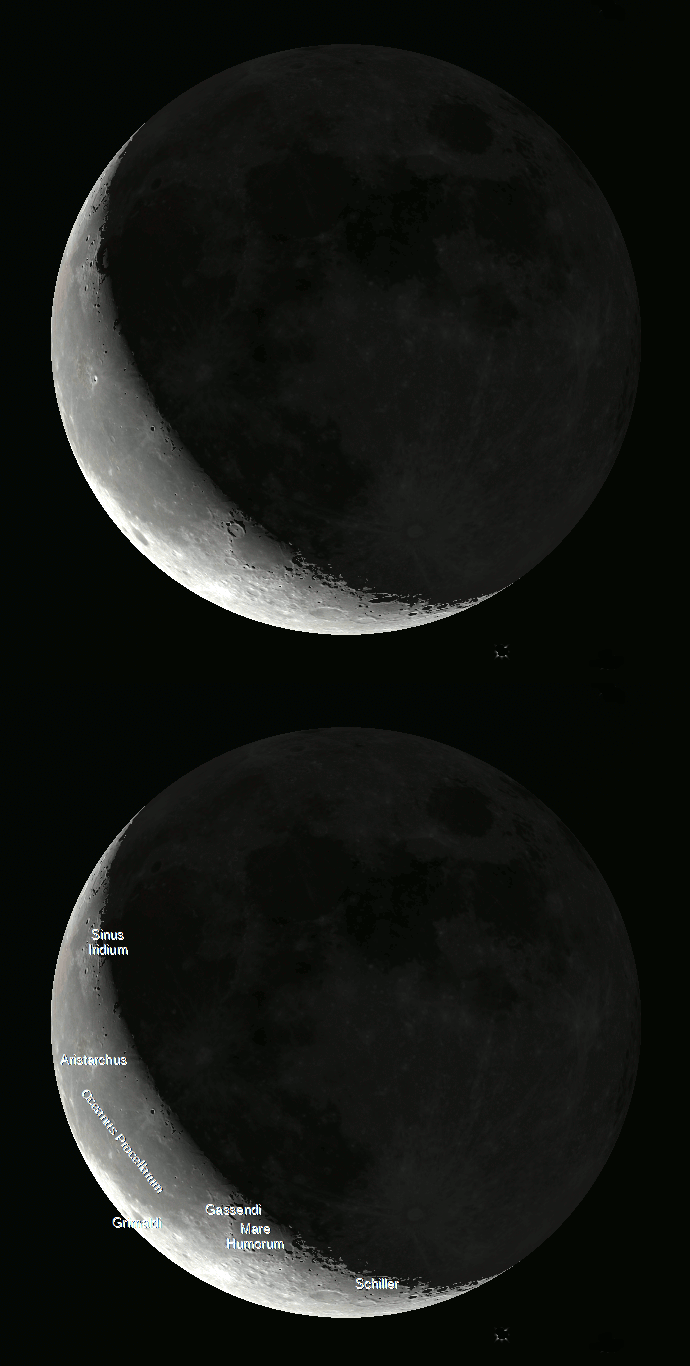
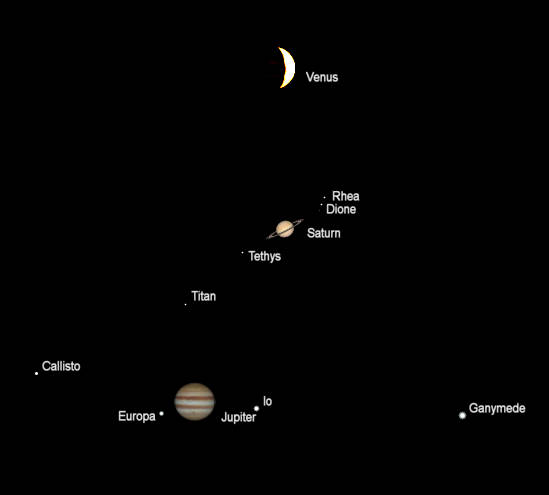
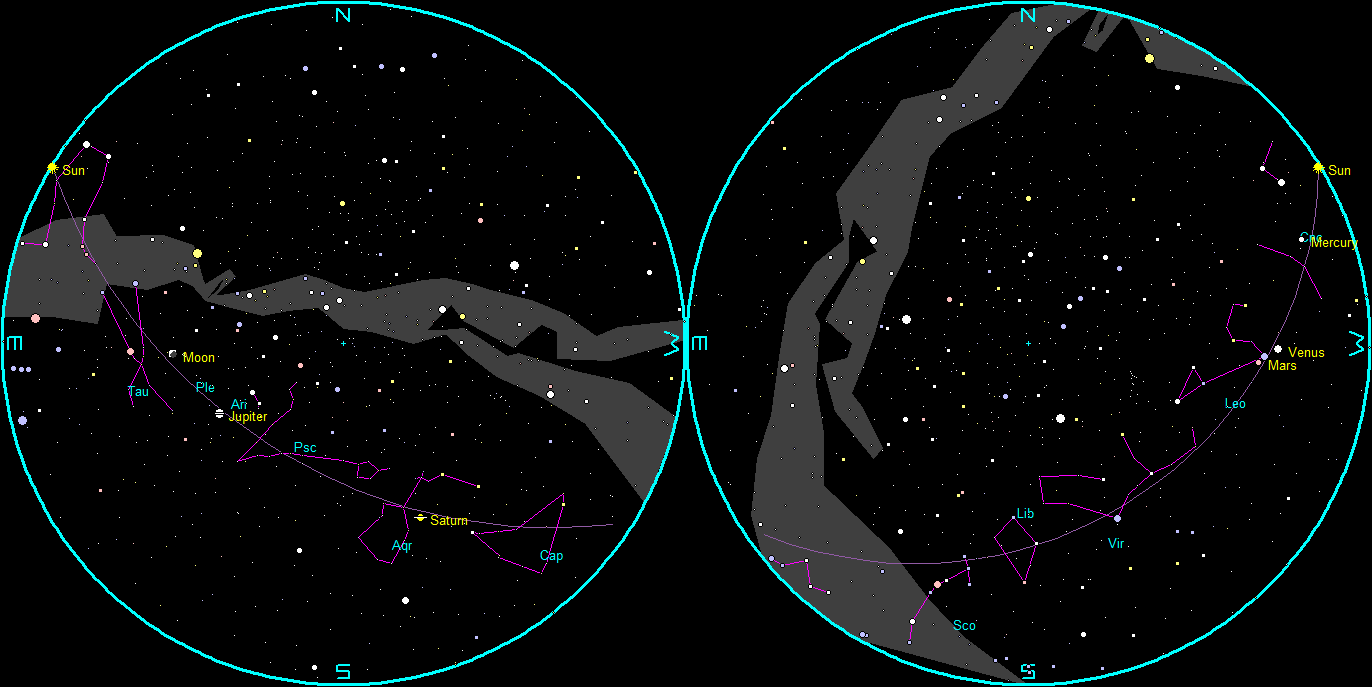
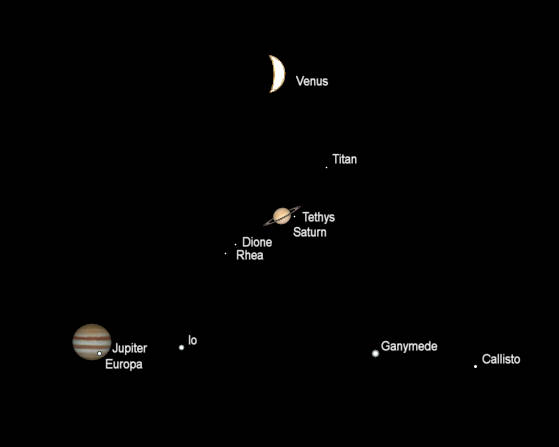
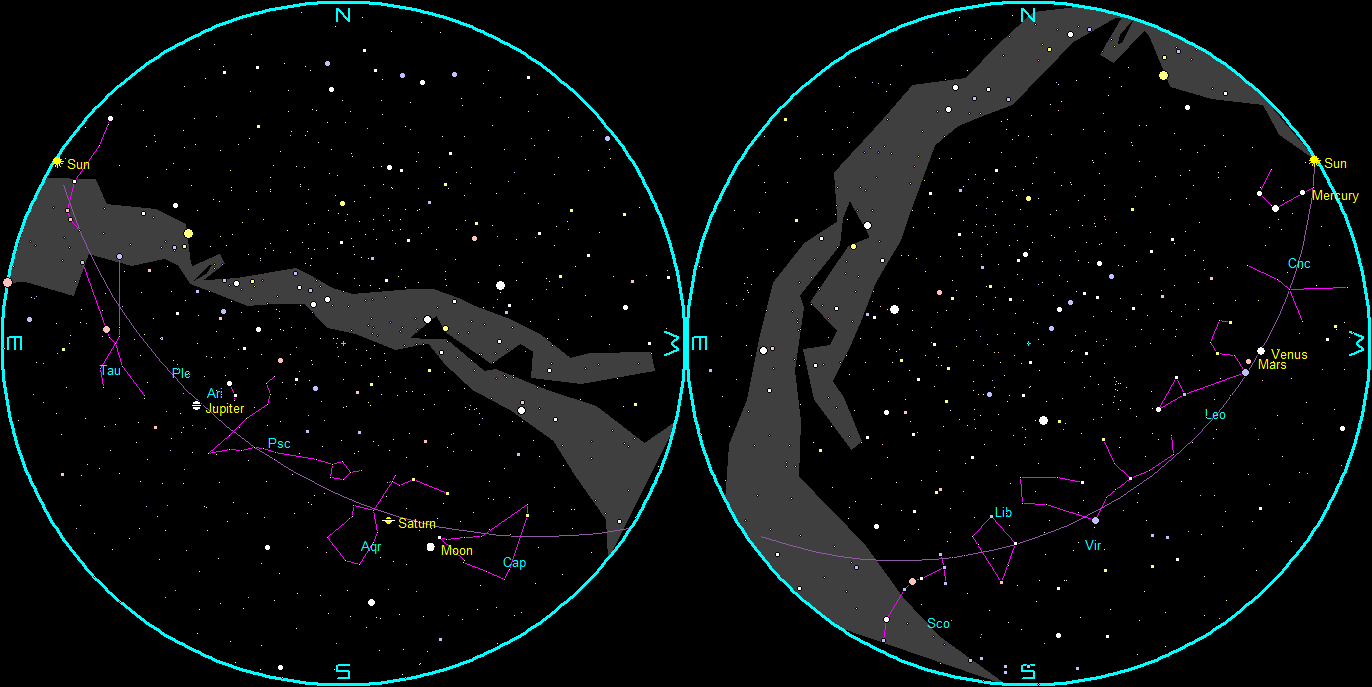
Let’s find out where the naked-eye planets have wandered off to this week. Tonight, Venus is our blazing Evening Star, seen very low in the west in evening twilight. It will set at 11:06 pm, and by four minutes earlier each night. The red planet Mars is seen left of and above Venus. It’s the second “star” with the brighter real star Regulus in Leo the lion between it and Venus. Mars is much fainter than Venus and difficult to spot in twilight. Saturn will rise shortly before midnight. And by 5 am tomorrow, will appear in the south, the brightest “star” in that direction. Jupiter will be in the east at that hour. It will appear above and right of the waning crescent Moon at that hour. Jupiter is the brightest star-like object in the morning sky now.
The astronomical event times given are for the Traverse City/Interlochen area of Michigan (EDT, UT –4 hours). They may be different for your location.
Addendum
07-11-2023 – Ephemeris – How to find Scorpius the scorpion
This is Bob Moler with Ephemeris for Tuesday, July 11th. Today the Sun will be up for 15 hours and 20 minutes, setting at 9:28, and it will rise tomorrow at 6:08. The Moon, 2 days past last quarter, will rise at 2:02 tomorrow morning.
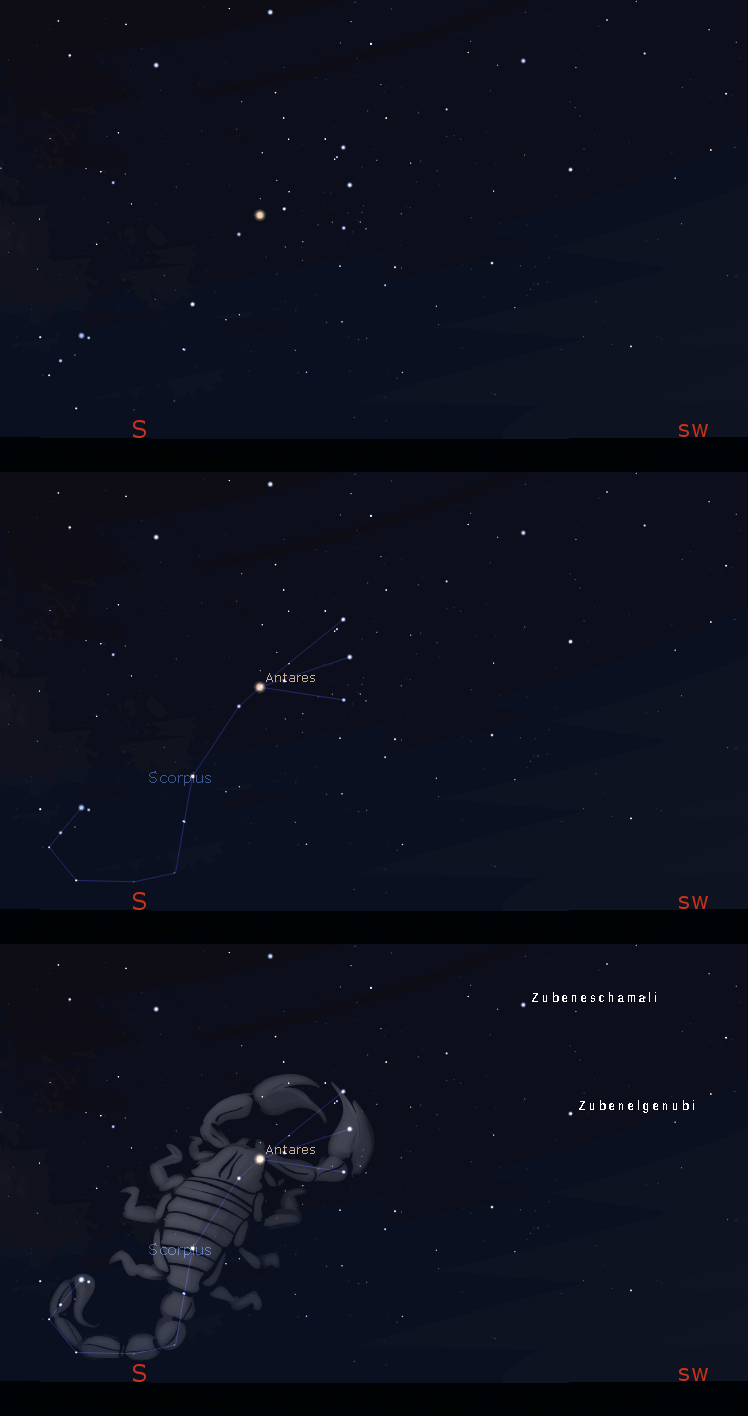
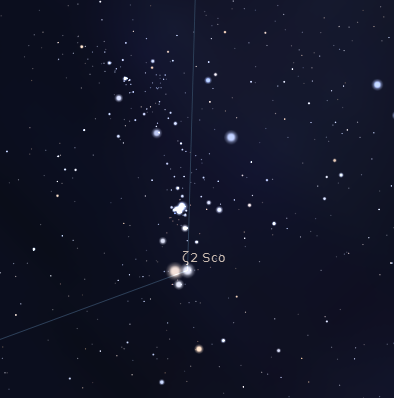
There’s a large constellation located low in the south at about 11 tonight. It’s Scorpius the scorpion. Its brightest star is Antares in its heart, a red giant star, that I’ve gotten calls about it as being a UFO. From Antares to the right is a star, then a vertical arc of three stars that is its head. The Scorpion’s tail is a line of stars running down to the left of Antares, swooping to the horizon before coming back up and ending in a pair of stars that portray his poisonous stinger. There is a beautiful star cluster, NGC 6231, seen in binoculars at that first bend in the tail that is unfortunately too low to appreciate from this far north. I was very impressed with it when spotting it from the Florida Keys when I was down there in 1986 to observe Halley’s Comet.
The astronomical event times given are for the Traverse City/Interlochen area of Michigan (EDT, UT –4 hours). They may be different for your location.
Addendum
07/10/2023 – Ephemeris – Presentation about the James Webb Space Telescope in Traverse City!
This is Bob Moler with Ephemeris for Monday, July 10th. Today the Sun will be up for 15 hours and 21 minutes, setting at 9:28, and it will rise tomorrow at 6:07. The Moon, 1 day past last quarter, will rise at 1:39 tomorrow morning.
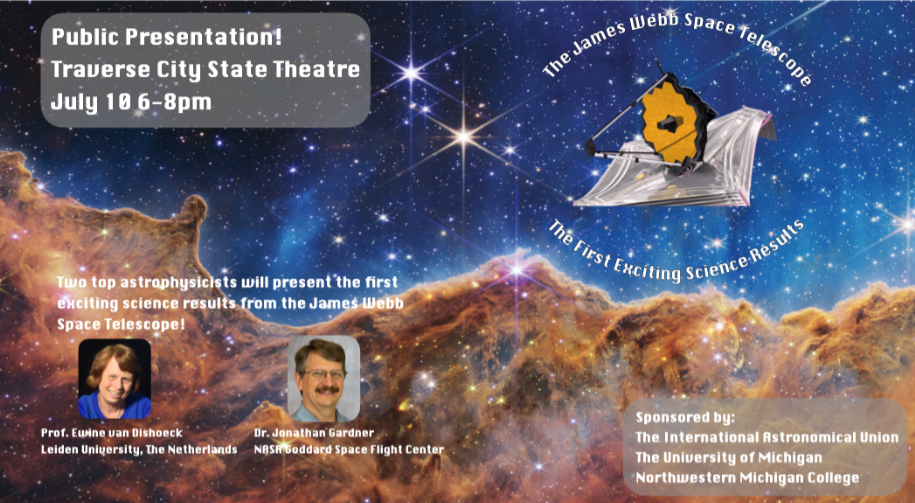
The International Astronomical Union, or IAU, is holding a symposium in Traverse City this week, a meeting of some of the world’s astronomers on the general topic of astrochemistry: From the First Galaxies to the Formation of Habitable Worlds, at the Park Place Hotel & Conference Center. As part of the meeting, there will be a presentation at the State Theater on East Front Street at 6 pm Monday, July 10, 2023 by Professor Ewine van Dishoeck and Dr. Jonathan Gardner on The James Webb Space Telescope – The First Exciting Results. There may still be some free tickets that can be obtained from the State Theater website: https://stateandbijou.org. The program is sponsored by the IAU, University of Michigan, Northwestern Michigan College and the Grand Traverse Astronomical Society.
The astronomical event times given are for the Traverse City/Interlochen area of Michigan (EDT, UT –4 hours). They may be different for your location.
Addendum
This was provided to us about the presentation and the presenters:
Title: The James Webb Space Telescope: a new exploration of the cosmos
Speakers: Jonathan Gardner and Ewine van Dishoeck
Abstract:
The James Webb Space Telescope was launched on Christmas Day 2021 after 25 years of planning, design, development, integration, and testing. Following a six-month deployment and commissioning period, the first science results from Webb have engaged the public and surprised the scientists. Webb’s science goals address our origins and the history of the universe: the first stars and galaxies that formed after the Big Bang; the morphological and dynamical buildup of galaxies; the formation of stars and planetary systems; and exoplanets, our Solar System, and the conditions for life. Webb has already found the most distant galaxies ever seen, made the first detection of carbon dioxide in the atmosphere of an exoplanet, and has examined the interactions between giant stars and the planets that are forming near them.
Jonathan Gardner will review Webb’s construction, launch, and deployments, and discuss the commissioning of the telescope and its instruments. He will describe what scientists have learned in the first year of science results from the telescope on the deep universe. Ewine van Dishoeck will focus on the new insights that Webb has provided us on the formation of new stars and planets and the habitability of other worlds. She will highlight chemical richness of the Webb data, with water and other molecules seen throughout the universe.
Bio:
Jonathan Gardner is the Deputy Senior Project Scientist for the James Webb Space Telescope, a position he has held since 2002 at NASA’s Goddard Space Flight Center. Gardner received an AB degree from Harvard and MS and PhD from the University of Hawaii. As a NATO Fellow, he did postdoctoral research at the University of Durham in the UK. He came to NASA-Goddard in 1996 to work with the Hubble Space Telescope, but soon got involved in early studies of Webb. His scientific research involves using deep infrared observations to study the statistical evolution of galaxies. On the Webb project, he works with the other scientists to ensure the scientific success of the mission, now coming to fruition with Webb’s scientific results.
Ewine van Dishoeck is professor of molecular astrophysics at Leiden University, the
Netherlands. Graduated from Leiden in 1984, she held positions at Harvard, Princeton and
Caltech before returning to Leiden in 1990. The work of her group unites the world of
chemistry with that of physics and astronomy. She has been heavily involved in planning
major new telescopes, including being co-PI on the JWST-MIRI instrument for more than 20
years. She has been fortunate to receive many awards, including the 2018 Kavli Prize for
Astrophysics, as well as membership of the Netherlands, US, German and Norwegian
academies. From 2018-2021, Ewine served as the President of the International
Astronomical Union (IAU).
07/07/223 – Ephemeris – GTAS meeting and presentation: Observing the summer skies with the naked-eye
This is Ephemeris for Friday, July 7th. Today the Sun will be up for 15 hours and 25 minutes, setting at 9:30, and it will rise tomorrow at 6:05. The Moon, 2 days before last quarter, will rise at 12:38 tomorrow morning.
Viewing Summer skies with just your Eyes will be the presentation by Robert Carroll at tonight’s meeting of the Grand Traverse Astronomical Society at Northwestern Michigan College’s Rogers Observatory at 9 pm. Bob is one of the charter members of the society. He will show artist’s interpretation of the heavens. Then, focusing on Hercules, the Summer Triangle, and the Milky Way. Hopefully, he “will inspire young parents, and their children, to go OUTSIDE, leave the screens and tablets behind, and LOOK UP to see the night sky.” There are two ways to attend: In person at the observatory, south of Traverse City on Birmley Road, or via Zoom with a link provided by the society’s website gtastro.org just prior to the meeting.
The astronomical event times given are for the Traverse City/Interlochen area of Michigan (EDT, UT –4 hours). They may be different for your location.
Addendum
07/06/2023 – Ephemeris – Today the Earth is farther from the Sun than anytime this year
This is Ephemeris for Thursday, July 6th. Today the Sun will be up for 15 hours and 26 minutes, setting at 9:30, and it will rise tomorrow at 6:04. The Moon, halfway from full to last quarter, will rise at 12:16 tomorrow morning.
Today, the Sun is at its farthest distance from the Earth. It’s called aphelion. The exact time actually occurred at 4:59 this morning at a distance of 94 and a half million miles away. Because of the gravitational pull of the Moon and planets on the Earth, especially Jupiter and Venus and gravitational pull of the planets, especially Jupiter on the Sun, the aphelion and perihelion, the closest date in January don’t occur on the same date or same distance every year. The date wanders by a day or two each year. The entire distance variation of the Earth from the Sun is plus or minus 1.5 million miles (2.4 million kilometers) over the year, makes summer the longest season by a few days because the Earth moves slower when farther from the Sun, than when it is nearer.
The astronomical event times given are for the Traverse City/Interlochen area of Michigan (EDT, UT –4 hours). They may be different for your location.
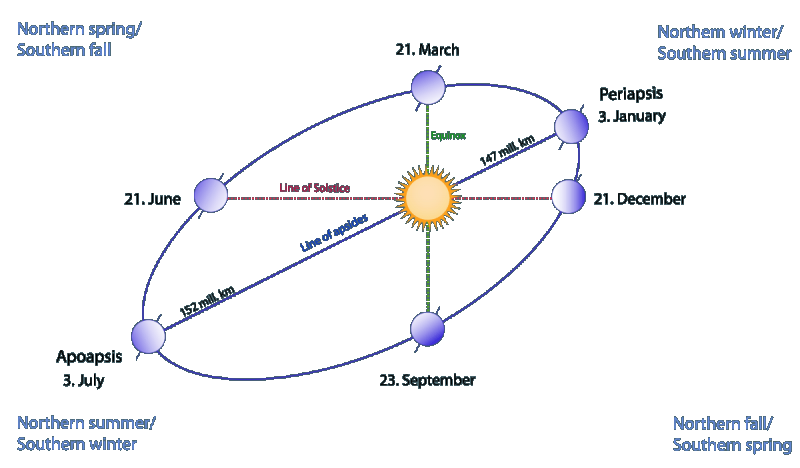
Note: Apoapsis and Periapsis are generic terms for the farthest and nearest points in an orbit to the central body. For a body orbiting the Sun, it’s aphelion and perihelion. For a satellite of the Earth, it’s apogee and perigee.
07/05/2023 – Ephemeris – Let’s find out where the naked-eye planets have wandered off to this week
This is Ephemeris for Wednesday, July 5th. Today the Sun will be up for 15 hours and 27 minutes, setting at 9:31, and it will rise tomorrow at 6:04. The Moon, 2 days past full, will rise at 11:49 this evening.
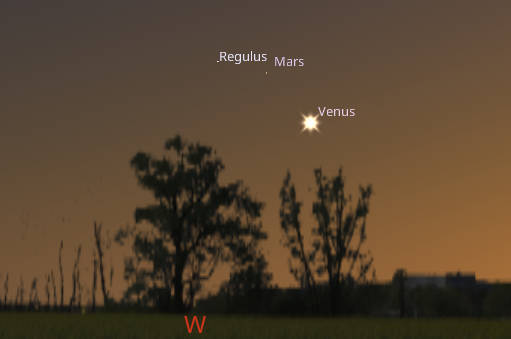
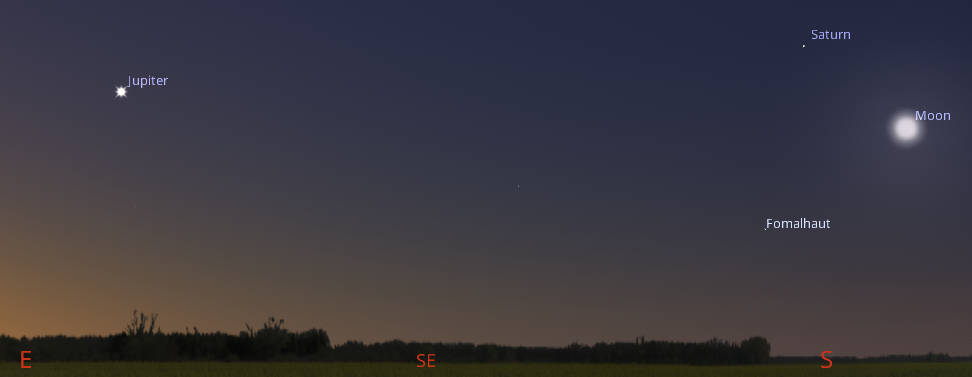
Let’s find out where the naked-eye planets have wandered off to this week. Venus is our blazing Evening Star, seen low in the west most of the evening. It sets tonight at 11:28 pm, and by three minutes earlier each night. The red planet Mars is seen left of and above Venus. And left of Mars is the brighter star Regulus in Leo the lion. Venus is pulling away from Mars now. Mars is much fainter than Venus and difficult to spot in twilight. Saturn will rise shortly after midnight. And by 5:15 am will appear in the south, the brightest “star” in that direction. It will appear above and left of the waning gibbous Moon at that hour. Jupiter will be in the east at that hour. It is the brightest star-like object in the morning sky now.
The astronomical event times given are for the Traverse City/Interlochen area of Michigan (EDT, UT –4 hours). They may be different for your location.
Addendum
07/04/2023 – Ephemeris – The Bicentennial space mission
This is Bob Moler with Ephemeris for Independence Day, Tuesday, July 4th. Today the Sun will be up for 15 hours and 28 minutes, setting at 9:31, and it will rise tomorrow at 6:03. The Moon, 1 day past full, will rise at 11:14 this evening.
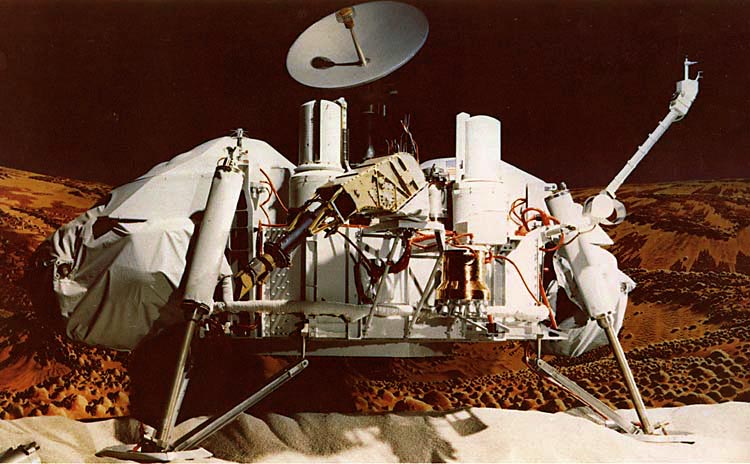
To celebrate our nation’s 200th birthday, NASA attempted to land the Viking 1 lander on the planet Mars on July 4th, 1976. The Viking was a combination orbiter and lander and had a twin spacecraft arriving almost two months later. Viking 1 entered orbit on June 19th and began to survey the prime landing area, that radar from the Earth suggested would be smooth, to land on the day of the Bicentennial. However, images from orbit showed too many obstructions, so another area was surveyed. The mission planners from JPL found a spot and sent the Viking lander down to land on Mars on another historic date, July 20, 1976, the 7th anniversary of the Apollo 11 landing on the Moon.
The astronomical event times given are for the Traverse City/Interlochen area of Michigan (EDT, UT –4 hours). They may be different for your location.
Addendum
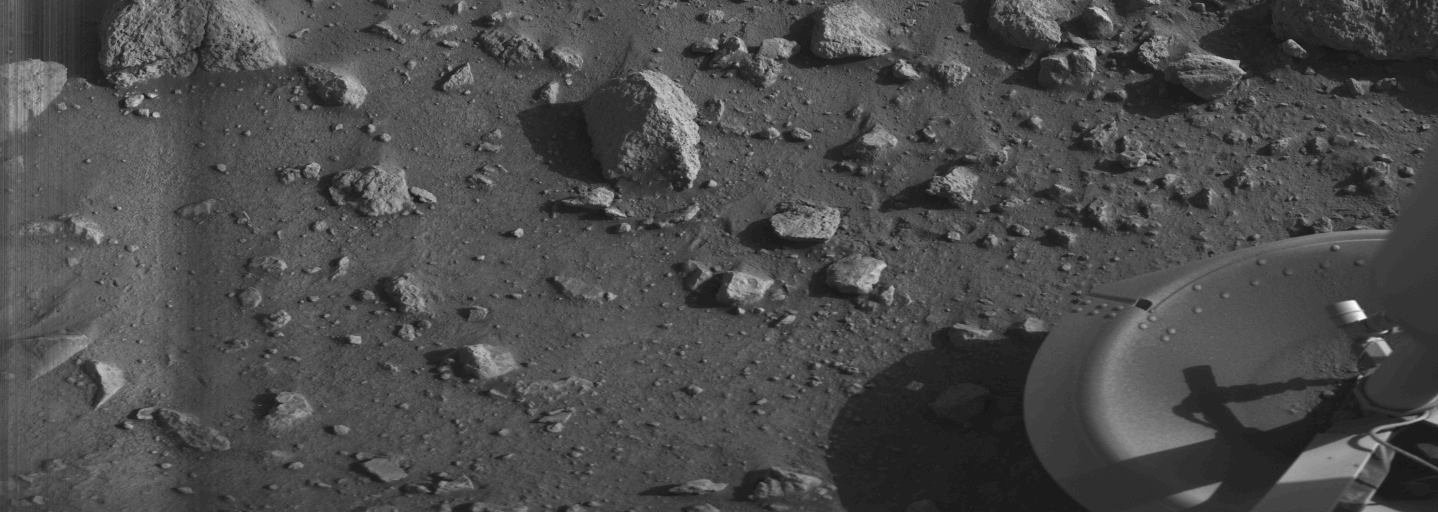
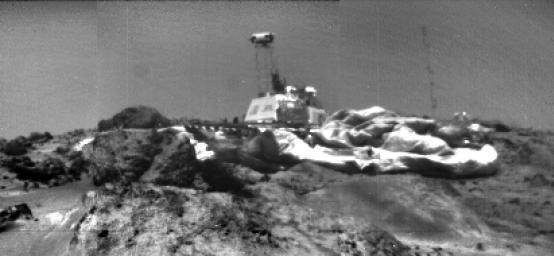
NASA did finally make a historic landing on July 4th,
the Mars Pathfinder mission, with the first rover to operate on Mars, the Sojourner rover, landed on July 4, 1997. It was a microwave sized rover. The mission on the surface lasted 85 days.


07/03/2023 – Ephemeris – The Sun is more massive than most stars
This is Bob Moler with Ephemeris for Monday, July 3rd. Today the Sun will be up for 15 hours and 29 minutes, setting at 9:31, and it will rise tomorrow at 6:02. The Moon, at full today, will rise at 10:28 this evening.
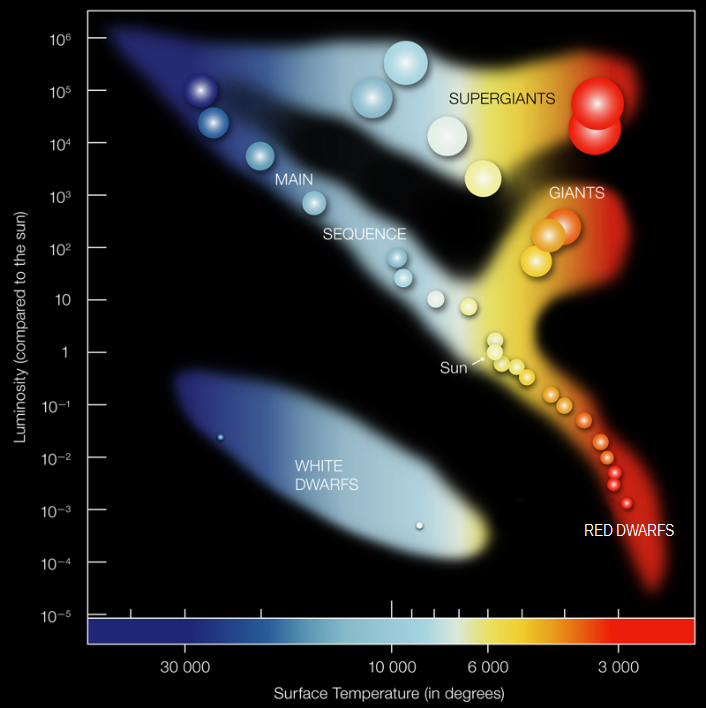
The Sun appears to be a singular object in the sky. There is none other. But is that true? No, it’s not. The Sun is a star, middle-aged for a star of its mass. The Sun is bigger than most stars, because most stars are runty red dwarf stars. In fact the closest star to our Sun is a red dwarf, called Proxima Centauri, the third, outlying star in the triple star system whose brightest star is called Rigil Kentaurus, though better known by its 1603 Bayer catalog designation, Alpha Centauri. Proxima is a challenge to spot even with binoculars. It turns out that stars visible to the naked eye are all brighter than the Sun. As far as the range of stellar masses go, the Sun is pretty much in the middle. Rigil Kentaurus itself is 8 percent more massive than the Sun and 50 percent brighter. Both Rigil Kentaurus and Proxima are too far south to see from Michigan.
The astronomical event times given are for the Traverse City/Interlochen area of Michigan (EDT, UT –4 hours). They may be different for your location.
Addendum
06/30/2023 – Ephemeris – Previewing July’s skies
This is Bob Moler with Ephemeris for International Asteroid Day, Friday, June 30th. Today the Sun will be up for 15 hours and 31 minutes, setting at 9:32, and it will rise tomorrow at 6:01. The Moon, 3 days before full, will set at 3:45 tomorrow morning.
Let’s preview July’s skies. The Sun, having reached its northern solstice, is beginning to slide southward again, at first imperceptibly, then with greater speed. The daylight hours will decrease from 15 hours and 31 minutes tomorrow to 14 hours 42 minutes at month’s end. The daylight hours will be slightly shorter south of Interlochen, and slightly longer to the north. The altitude of the Sun at local noon, when it is due south, will decrease from 68 degrees now to 63 degrees at month’s end. The Sun will be a degree lower in the Straits area. Despite the warmth, the Earth will reach its greatest distance from the Sun next Thursday, the 6th. On that day, the Earth will reach 94.5 million miles (152.1 million kilometers) from the Sun.
The astronomical event times given are for the Traverse City/Interlochen area of Michigan (EDT, UT –4 hours). They may be different for your location.
Addendum
July Evening Star Chart
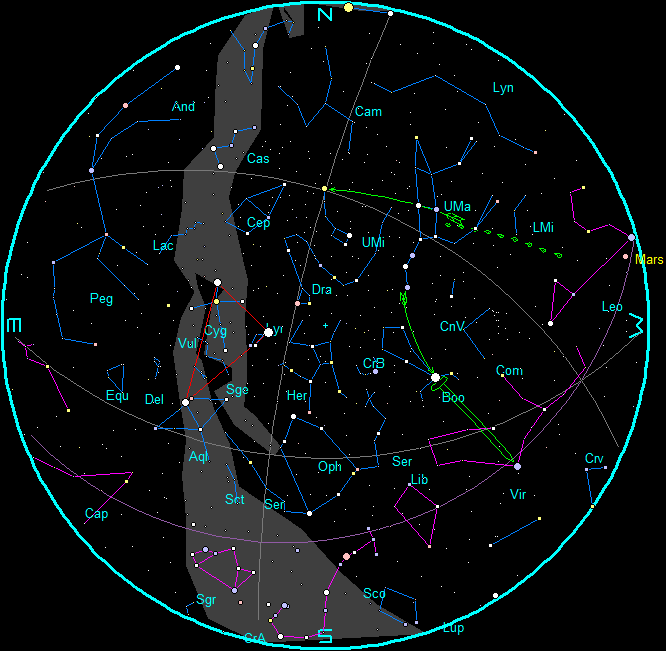
The planets and stars are plotted for the 15th at 11 p.m. EDT in the evening and 4 a.m. for the morning chart. These are the chart times. Note that Interlochen/Traverse City is located approximately 45 minutes behind our time meridian, West 75° longitude. (An hour 45 minutes behind our daylight saving time meridian during EDT). To duplicate the star positions on a planisphere you may have to set it to 1 hour 45 minutes earlier than the current time.
Note, the chart times of 11 p.m. and 4 a.m. are for the 15th. For each week before the 15th, add ½ hour (28 minutes if you’re picky). For each week after the 15th, subtract ½ hour, or 28 minutes. The planet positions are updated each Wednesday on this blog. For planet positions on dates other than the 15th, check the Wednesday planet posts on this blog for weekly positions.
July Morning Star Chart
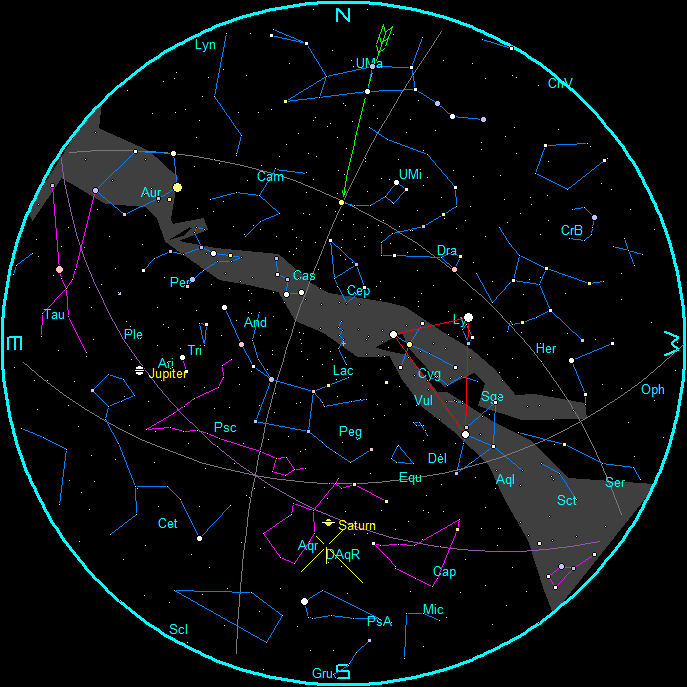
For a list of constellation names to go with the abbreviations, click here.
- Pointer stars at the front of the bowl of the Big Dipper point to Polaris, the North Star.
- Leaky dipper drips on Leo.
- Follow the arc of the handle of the Big Dipper to the star Arcturus, and
- Extend like a spike to Spica.
- The Summer Triangle is in red.
- DAqR is the radiant of the South Delta Aquariid meteor shower (Peaks on the morning of the 28th)
Twilight Limits, Nautical and Astronomical
| EDT | |||||||
| Morning | Twilight | Evening | Twilight | Dark | Night | Moon | |
| Date | Astro. | Nautical | Nautical | Astro. | Start | End | Illum. |
| 2023-07-01 | 3h38m | 4h41m | 23h00m | 0h03m | – | – | 0.98 |
| 2023-07-02 | 3h39m | 4h42m | 23h00m | 0h02m | – | – | 1.00 |
| 2023-07-03 | 3h40m | 4h43m | 22h59m | 0h01m | – | – | 0.99 |
| 2023-07-04 | 3h42m | 4h43m | 22h59m | 0h00m | – | – | 0.96 |
| 2023-07-05 | 3h43m | 4h44m | 22h58m | 0h00m | – | – | 0.89 |
| 2023-07-06 | 3h44m | 4h45m | 22h58m | 23h59m | 23h59m | – | 0.81 |
| 2023-07-07 | 3h46m | 4h46m | 22h57m | 23h57m | 23h57m | 0h16m | 0.71 |
| 2023-07-08 | 3h47m | 4h47m | 22h56m | 23h56m | 23h56m | 0h39m | 0.60 |
| 2023-07-09 | 3h49m | 4h48m | 22h56m | 23h55m | 23h55m | 0h59m | 0.49 |
| 2023-07-10 | 3h50m | 4h49m | 22h55m | 23h54m | 23h54m | 1h19m | 0.38 |
| 2023-07-11 | 3h52m | 4h50m | 22h54m | 23h53m | 23h53m | 1h40m | 0.28 |
| 2023-07-12 | 3h53m | 4h52m | 22h53m | 23h51m | 23h51m | 2h03m | 0.19 |
| 2023-07-13 | 3h55m | 4h53m | 22h52m | 23h50m | 23h50m | 2h30m | 0.12 |
| 2023-07-14 | 3h57m | 4h54m | 22h51m | 23h48m | 23h48m | 3h04m | 0.06 |
| 2023-07-15 | 3h58m | 4h55m | 22h50m | 23h47m | 23h47m | 3h46m | 0.02 |
| 2023-07-16 | 4h00m | 4h56m | 22h49m | 23h45m | 23h45m | 4h00m | 0.00 |
| 2023-07-17 | 4h02m | 4h58m | 22h48m | 23h44m | 23h44m | 4h02m | 0.00 |
| 2023-07-18 | 4h04m | 4h59m | 22h47m | 23h42m | 23h42m | 4h04m | 0.02 |
| 2023-07-19 | 4h05m | 5h00m | 22h46m | 23h40m | 23h40m | 4h05m | 0.05 |
| 2023-07-20 | 4h07m | 5h02m | 22h44m | 23h39m | 23h39m | 4h07m | 0.10 |
| 2023-07-21 | 4h09m | 5h03m | 22h43m | 23h37m | 23h37m | 4h09m | 0.17 |
| 2023-07-22 | 4h11m | 5h04m | 22h42m | 23h35m | 23h51m | 4h11m | 0.25 |
| 2023-07-23 | 4h13m | 5h06m | 22h41m | 23h33m | – | 4h13m | 0.33 |
| 2023-07-24 | 4h15m | 5h07m | 22h39m | 23h31m | 0h07m | 4h15m | 0.43 |
| 2023-07-25 | 4h17m | 5h08m | 22h38m | 23h30m | 0h25m | 4h17m | 0.53 |
| 2023-07-26 | 4h19m | 5h10m | 22h36m | 23h28m | 0h44m | 4h19m | 0.63 |
| 2023-07-27 | 4h21m | 5h11m | 22h35m | 23h26m | 1h08m | 4h21m | 0.73 |
| 2023-07-28 | 4h23m | 5h13m | 22h33m | 23h24m | 1h39m | 4h23m | 0.83 |
| 2023-07-29 | 4h24m | 5h14m | 22h32m | 23h22m | 2h19m | 4h24m | 0.90 |
| 2023-07-30 | 4h26m | 5h16m | 22h30m | 23h20m | 3h14m | 4h26m | 0.96 |
| 2023-07-31 | 4h28m | 5h17m | 22h29m | 23h18m | 4h24m | 4h28m | 0.99 |
Twilight calendar was generated using Cartes du Ciel (Sky Charts).
See my blog post: Twilight Zone for the definitions of the different periods of twilight here: https://bobmoler.wordpress.com/2018/09/27/.
NASA Calendar of Planetary Events
Jul  1  Sa            Venus: 41.7° E
     1  Sa  12:46 am  Mercury Superior Conj.
     1  Sa   2:48 am  Venus-Mars: 3.6° N Quasi-conjunction
     1  Sa   3:20 am  Moon-Antares: 1.5° S
     2  Su   9:23 pm  Moon South Dec.: 27.8° S
     3  Mo   7:39 am  Full Buck Moon
     4  Tu   6:28 pm  Moon Perigee: 360,200 km
     6  Th   4:59 am  Aphelion: 1.0167 AU
     6  Th  11:05 pm  Moon-Saturn: 2.7° N
     7  Fr            Venus greatest brilliancy, magnitude -4.7
     9  Su   9:48 pm  Last Quarter
    10  Mo   1:18 am  Mars-Regulus:  0.6° N
    10  Mo   9:23 pm  Moon Ascending Node
    11  Tu   5:18 pm  Moon-Jupiter: 2.3° S
    13  Th   2:31 am  Moon-Pleiades: 1.8° N
    14  Fr   6:33 pm  Mercury-Beehive:  0.2° N
    15  Sa  10:40 pm  Moon North Dec.: 27.8° N
    16  Su   3:49 am  Venus-Regulus: 3.3° S
    17  Mo   2:32 pm  New Moon
    20  Th   2:56 am  Moon Apogee: 406,300 km
    20  Th  12:00 am  Moon-Mars: 3.6° S
    25  Tu  11:05 am  Moon Descending Node
    25  Tu   6:07 pm  First Quarter
    27  Th   7:00 am  Mercury-Venus: 5.1° N
    28  Fr  11:35 am  Delta Aquariid Shower: ZHR = 20
    28  Fr   1:11 pm  Moon-Antares: 1.3° S
    28  Fr   2:21 pm  Mercury-Regulus:  0.1° S
    30  Su   7:13 am  Moon South Dec.: 27.9° S
Aug  1  Tu            Venus: 18.7° E
All event times are given for UTC-5:00: Eastern Standard Time before the 14th or UTC-4:00 Daylight Saving Time thereafter.
Sky Events Calendar by Fred Espenak and Sumit Dutta (NASA’s GSFC),
http://eclipse.gsfc.nasa.gov/SKYCAL/SKYCAL.html
If you go to the above site you can print out a list like the above for the entire year or calendar pages for your time zone.
Note that the site is now kept up for archival purposes. Fred Espenak retired from NASA several years ago and has his own site, AstroPixels, which contain the same information: http://astropixels.com/almanac/almanac.html. However it uses standard time all year.
NASA Calendar of Planetary Events
     LU                  Ephemeris of Sky Events for Interlochen/TC
June, 2023    Local time zone: EDT
+-----------------------------------------------------------------------+
| DATE |  SUN     SUN  DAYLIGHT|   TWILIGHT*    |MOON  RISE OR    ILLUM |
|      |  RISE    SET    HOURS |  END    START  |PHASE SET** TIME FRACTN|
+=======================================================================+
|Thu  1| 06:00a  09:21p  15:20 | 10:44p  04:37a |      Set  04:43a   94%|
|Fri  2| 05:59a  09:22p  15:22 | 10:45p  04:36a |      Set  05:14a   98%|
|Sat  3| 05:59a  09:22p  15:23 | 10:46p  04:35a |Full  Rise 09:27p  100%|
+------+-----------------------+----------------+-----------------------+
|Sun  4| 05:59a  09:23p  15:24 | 10:47p  04:35a |      Rise 10:42p   99%|
|Mon  5| 05:58a  09:24p  15:25 | 10:48p  04:34a |      Rise 11:47p   95%|
|Tue  6| 05:58a  09:25p  15:26 | 10:49p  04:33a |      Rise 12:39a   89%|
|Wed  7| 05:57a  09:25p  15:27 | 10:50p  04:33a |      Rise 01:18a   80%|
|Thu  8| 05:57a  09:26p  15:28 | 10:51p  04:32a |      Rise 01:48a   70%|
|Fri  9| 05:57a  09:27p  15:29 | 10:52p  04:32a |      Rise 02:13a   59%|
|Sat 10| 05:57a  09:27p  15:30 | 10:53p  04:31a |L Qtr Rise 02:34a   48%|
+------+-----------------------+----------------+-----------------------+
|Sun 11| 05:56a  09:28p  15:31 | 10:53p  04:31a |      Rise 02:53a   37%|
|Mon 12| 05:56a  09:28p  15:31 | 10:54p  04:31a |      Rise 03:13a   27%|
|Tue 13| 05:56a  09:29p  15:32 | 10:55p  04:30a |      Rise 03:34a   18%|
|Wed 14| 05:56a  09:29p  15:33 | 10:55p  04:30a |      Rise 03:59a   10%|
|Thu 15| 05:56a  09:30p  15:33 | 10:56p  04:30a |      Rise 04:28a    5%|
|Fri 16| 05:56a  09:30p  15:33 | 10:56p  04:30a |      Rise 05:04a    2%|
|Sat 17| 05:56a  09:30p  15:34 | 10:57p  04:30a |      Rise 05:49a    0%|
+------+-----------------------+----------------+-----------------------+
|Sun 18| 05:56a  09:31p  15:34 | 10:57p  04:30a |New   Set  10:36p    1%|
|Mon 19| 05:56a  09:31p  15:34 | 10:57p  04:30a |      Set  11:22p    3%|
|Tue 20| 05:56a  09:31p  15:34 | 10:58p  04:30a |      Set  11:58p    8%|
|Wed 21| 05:57a  09:32p  15:34 | 10:58p  04:30a |      Set  12:27a   13%|
|Thu 22| 05:57a  09:32p  15:34 | 10:58p  04:31a |      Set  12:51a   20%|
|Fri 23| 05:57a  09:32p  15:34 | 10:58p  04:31a |      Set  01:11a   28%|
|Sat 24| 05:57a  09:32p  15:34 | 10:58p  04:31a |      Set  01:29a   37%|
+------+-----------------------+----------------+-----------------------+
|Sun 25| 05:58a  09:32p  15:34 | 10:58p  04:32a |      Set  01:45a   47%|
|Mon 26| 05:58a  09:32p  15:33 | 10:58p  04:32a |F Qtr Set  02:02a   57%|
|Tue 27| 05:59a  09:32p  15:33 | 10:58p  04:33a |      Set  02:21a   66%|
|Wed 28| 05:59a  09:32p  15:32 | 10:58p  04:33a |      Set  02:43a   76%|
|Thu 29| 05:59a  09:32p  15:32 | 10:58p  04:34a |      Set  03:10a   84%|
|Fri 30| 06:00a  09:32p  15:31 | 10:57p  04:34a |      Set  03:45a   92%|
+-----------------------------------------------------------------------+
* Nautical Twilight
** Moonrise or moonset, whichever occurs between sunrise and sunset
Created using my LookingUp for DOS output as text.
06/29/2023 – Ephemeris – Learning about the Sun – sunspots
This is Ephemeris for Thursday, June 29th. Today the Sun will be up for 15 hours and 32 minutes, setting at 9:32, and it will rise tomorrow at 6:00. The Moon, 3 days past first quarter, will set at 3:10 tomorrow morning.
The face of the Sun is populated, from time to time, with dark spots, simply called sunspots. It is rare that a sunspot or sunspot group is large enough to see with eclipse glasses. Sunspots normally form in groups, and are called active regions, because they are sites of solar flares, explosions that would put the world’s entire nuclear arsenals to shame in a single explosion. The bright ball of the Sun that is sometimes called a surface is called the photosphere, a region of the Sun, where the gases are of low enough density so the transportation of energy from the Sun’s core changes from convection to radiation. It is within this convective region that magnetic fields form that cool the gas, making it darker, by restricting their movement.
The astronomical event times given are for the Traverse City/Interlochen area of Michigan (EDT, UT –4 hours). They may be different for your location.
Addendum
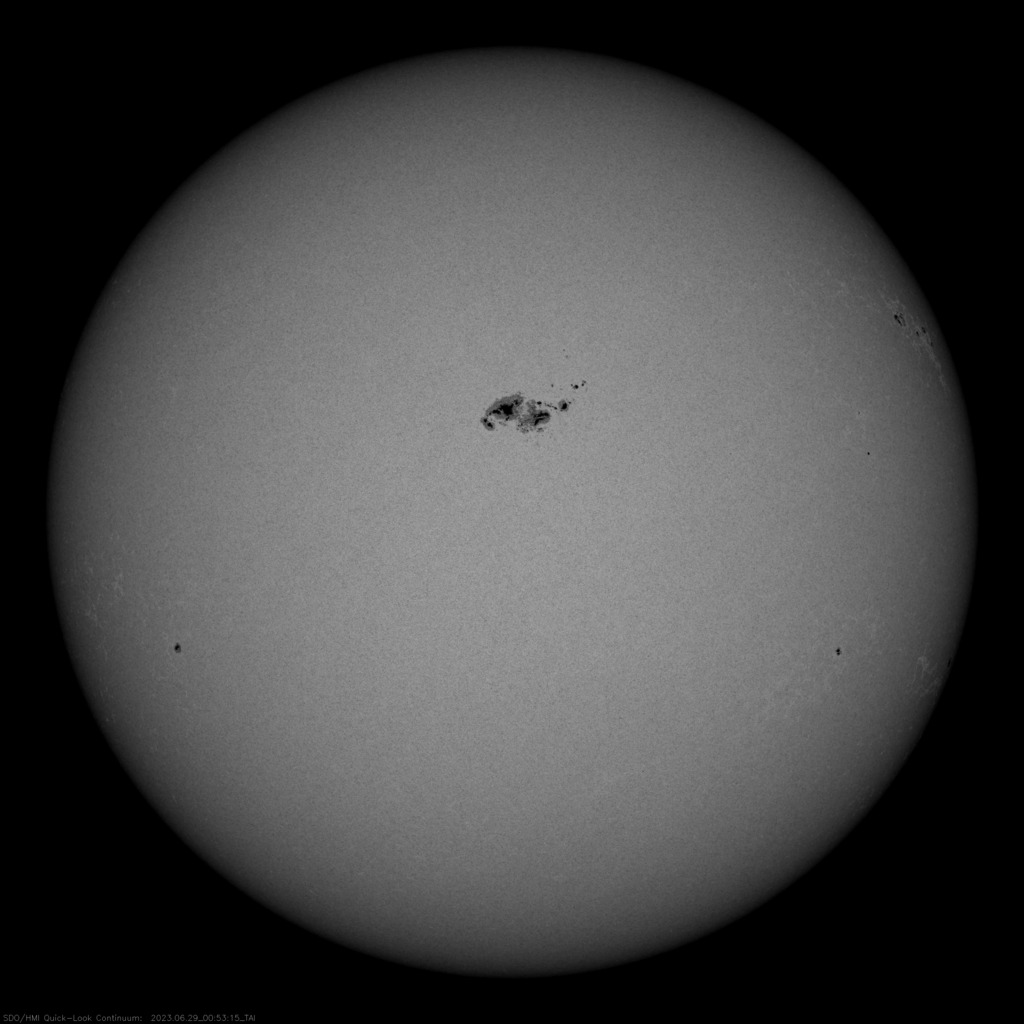
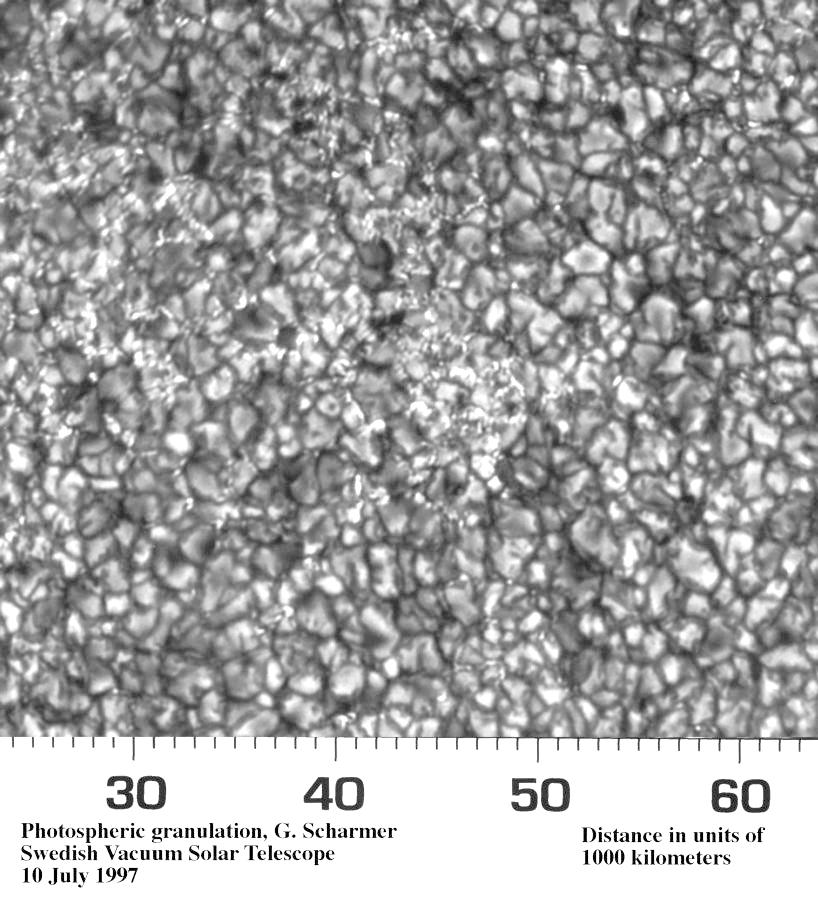
Other features of the photosphere are faculae (plural of facula), brighter areas of the photosphere, often associated with or are a precursor to sunspots. Faculae are best seen near the Sun’s limb (edge), as can be seen above. If the photosphere doesn’t appear smooth, that’s because it isn’t. The photosphere lies atop the convective zone of the Sun. The photosphere is populated by the tops of convection cells called granules, approximately 600 miles, or 1,000 kilometers wide and last only about 20 minutes.
 Bob Moler's Ephemeris Blog