Ephemeris: 05/05/2026 – The constellation of Hydra the water snake slithers along the southern horizon

May 5, 2026 Comments off

This is Bob Moler with Ephemeris for Cinco de Mayo, Tuesday, May 5th. Today the Sun will be up for 14 hours and 25 minutes, setting at 8:52, and it will rise tomorrow at 6:25. The Moon, halfway from full to last quarter, will rise at 1:15 tomorrow morning.

Low in the southwest to the southeastern sky in the evening one can spot the constellation of Hydra the water snake, the longest constellation of all. Unlike the monster of the same name, this Hydra has but one head, which is actually its most distinctive part. At 10 p.m. the head of Hydra is found below a line from brilliant Jupiter in the west and Leo the lion in the southwest. Hydra’s head is a small but distinctive group of 6 stars that make a drooping loop to the right. The rest of Hydra wends its way above the southern horizon below the bright blue star Spica in Virgo and Corvus the crow. Some delineations of Hydra have its tail tickling the constellation Libra, the balance, or scales, which has just risen in the southeast.

The astronomical event times given in this blog are for the Traverse City/Interlochen area of Michigan (Lat 44.7° N, Long 85.7° W; EDT, UT – 4 hours) unless stated otherwise. Times will be different for other locations.

Addendum
How to find the hydra the water snake 2026 edition. The head of Hydra the water snake can be found this spring by imagining a line between Jupiter and Leo the lion, specifically the bright star Regulus. Dropping below about the center of that line and find Hydra’s distinctive head. From there follow the stars down to the lower left towards the horizon, under Corvus and the crow, and the star Spica. I’ll talk about Corvus later this week. The snake’s tail ends near the horizon in the southeast near the constellation of Libra the scales. Also off the lower right-hand side of the image is the brilliant planet Venus, so don’t confuse that with Jupiter. Created using Stellarium, LibreOffice Draw, and GIMP.

The head of Hydra and the front part of Leo are parts of a constellation of the original inhabitants of our area, the Anishinaabek peoples. The constellation is the Great Underwater Panther, and the front part of the Leo is its curly tail. For more information about it check my blog post here.

Ephemeris: 05/04/2026 – Looking out of the Milky Way

May 4, 2026 Comments off

This is Bob Moler with Ephemeris for Monday, May 4th. Today the Sun will be up for 14 hours and 23 minutes, setting at 8:51, and it will rise tomorrow at 6:26. The Moon, 3 days past full, will rise at 12:25 tomorrow morning.

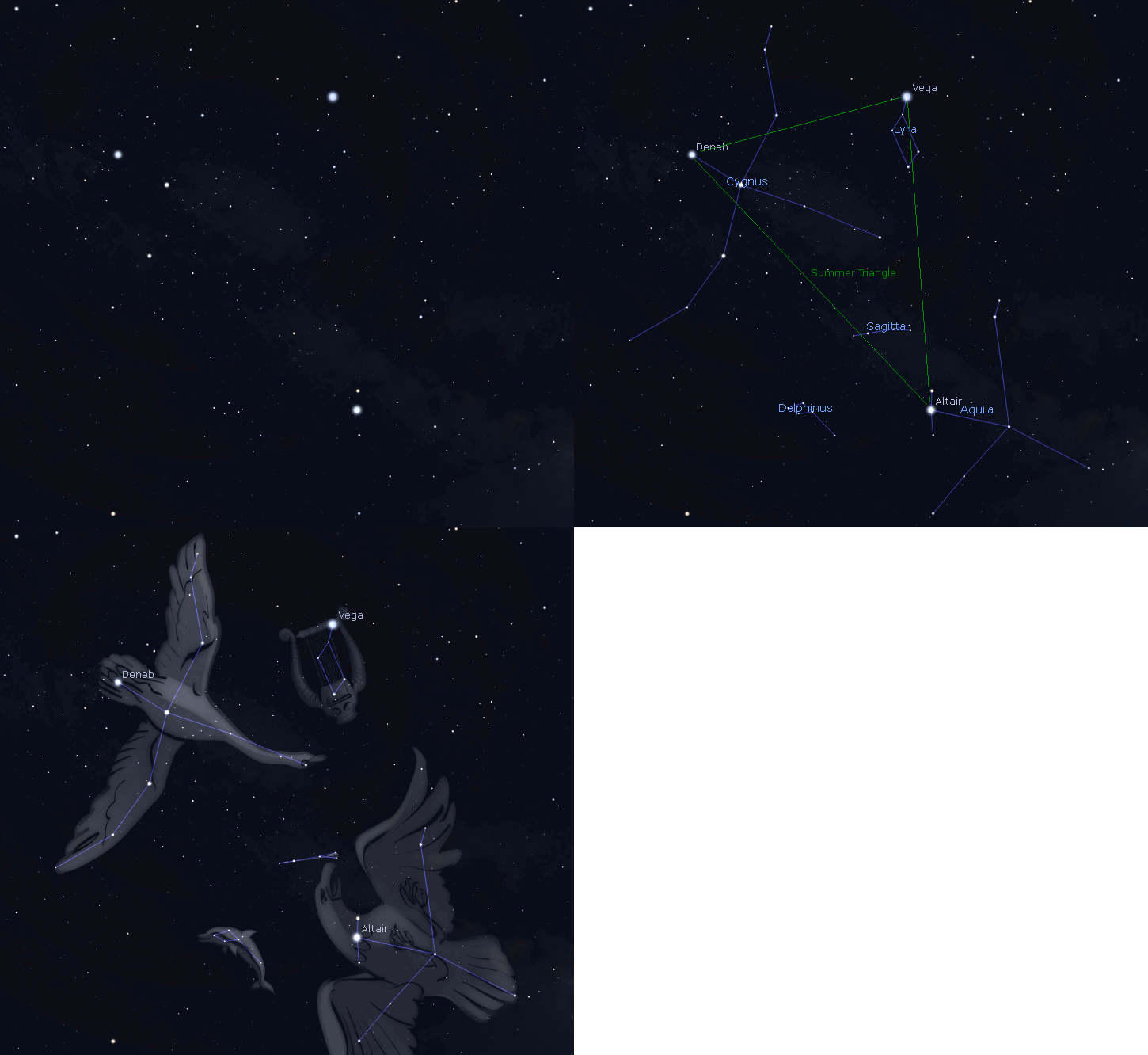
The May evening sky, when it finally gets dark, contains fewer stars than those of winter. And they’re much dimmer. The main reason for that is that we are looking out the plane of the Milky Way Galaxy. The Milky Way is no nowhere to be seen, because it rings the horizon. A bit is visible in the north. The summer triangle of bright stars is not completely up in the evening, and it straddles the Milky Way. So we are looking out to the universe beyond the Milky Way, for the most part. Even amateur telescopes will reveal a great number of galaxies, because there’s a huge cluster of galaxies in the constellation Virgo which is right behind and below Leo the lion in the sky. However, just about 90° from the plane of the Milky Way is a star cluster that looks like strands of hair.

The astronomical event times given in this blog are for the Traverse City/Interlochen area of Michigan (Lat 44.7° N, Long 85.7° W; EDT, UT – 4 hours) unless stated otherwise. Times will be different for other locations.

Addendum
May sky dome for 11 PM May 15th, showing constellations and deep sky objects. It shows how galaxies dominate the spring sky.
May sky dome for 11 PM May 15th, showing constellations and deep sky objects. It shows how galaxies dominate the spring sky. The tiny red circles are galaxies, other Milky Ways beyond our own. The other symbols are also what we call deep sky objects, that are extended objects among and beyond the solar system, such as star clusters, nebulae and galaxies. Most of the other symbols cluster around the plane of the Milky Way, that can be seen along the northern half of the horizon. The little orange circles are galactic or open star clusters which are relatively young and born out of the nebulae (red squares) in the the galactic plane. The green circles with the cross inside are globular star clusters which are very old and compact and are aranged within a large spherical volume concentrated on the center of the Milky Way. The green circles will line through it are planetary nebulae which have nothing to do with planets but are dying stars who puffed out their outer layers of gas. Created using Cartes du Ciel (Sky Charts).

Ephemeris: 05/01/2026 – Previewing May skies

May 1, 2026 Comments off

This is Ephemeris for Friday, May 1st. Today the Sun will be up for 14 hours and 15 minutes, setting at 8:47, and it will rise tomorrow at 6:31. The Moon, at full today, will rise at 9:17 this evening.

Before we look at the month of May’s skies, consider that it’s May Day, a Cross-Quarter day meaning that spring is about half over. Daylight hours in the Interlochen/Traverse City area will increase from 14 hours and 15 minutes today to 15 hours 19 minutes on the 31st. The altitude, or angle, of the Sun above the southern horizon at local noon will ascend from 60 degrees today to 67 degrees at month’s end. The altitude of the Sun in the Straits area will be a degree lower than that, but the length of daylight will be a few minutes longer. Local apparent noon this month, when the Sun passes due south, will be about 1:38 p.m. The Eta Aquariid meteor shower will reach its peak on the 5th, but will be hindered by the bright moon.

The astronomical event times given in this blog are for the Traverse City/Interlochen area of Michigan (Lat 44.7° N, Long 85.7° W; EDT, UT – 4 hours) unless stated otherwise. Times will be different for other locations.

Addendum
May Evening Star Chart

Star Chart for May 2026 (11 p.m. EDT, May 15, 2026). Created using my LookingUp app.

The planets and stars are plotted for the 15th at 11 p.m. EDT in the evening and 4:30 a.m. on the 16th for the morning chart. These are the chart times. Note that Traverse City is located approximately 45 minutes behind our time meridian, West 75° longitude. (An hour 45 minutes behind our daylight saving time meridian during EDT). To duplicate the star positions on a planisphere you may have to set it to 1 hour 45 minutes earlier than the current time.
Note, the chart times of 11 p.m. and 4:30 a.m. are for the night of the15/16th. For each week before then add ½ hour (28 minutes if you’re picky). For each week after then, subtract ½ hour or 28 minutes. The planet positions are updated each Wednesday on this blog. For planet positions on dates other than the 15th, check the Wednesday planet posts on this blog for their weekly locations.

May Morning Star Chart

Star Chart for May Mornings
Star Chart for May mornings, 2026 (4:30 a.m. EDT, May 16, 2026). Created using my LookingUp app

Twilight Limits, Nautical and Astronomical

      EDT        
  Morning Twilight Evening Twilight Dark Night Moon
Date Astro. Nautical Nautical Astro. Start End Illum.
2026-05-01 4h37m 5h21m 22h02m 22h46m 100%
2026-05-02 4h35m 5h20m 22h04m 22h48m 98%
2026-05-03 4h33m 5h18m 22h05m 22h50m 22h50m 23h28m 94%
2026-05-04 4h30m 5h16m 22h07m 22h52m 22h52m 89%
2026-05-05 4h28m 5h14m 22h08m 22h54m 22h54m 0h26m 83%
2026-05-06 4h26m 5h13m 22h10m 22h56m 22h56m 1h15m 75%
2026-05-07 4h24m 5h11m 22h11m 22h58m 22h58m 1h56m 67%
2026-05-08 4h22m 5h09m 22h13m 23h00m 23h00m 2h29m 57%
2026-05-09 4h20m 5h08m 22h15m 23h02m 23h02m 2h55m 47%
2026-05-10 4h18m 5h06m 22h16m 23h04m 23h04m 3h18m 37%
2026-05-11 4h16m 5h04m 22h18m 23h06m 23h06m 3h38m 27%
2026-05-12 4h14m 5h03m 22h19m 23h08m 23h08m 3h57m 18%
2026-05-13 4h12m 5h01m 22h21m 23h10m 23h10m 4h12m 10%
2026-05-14 4h10m 5h00m 22h22m 23h12m 23h12m 4h10m 4%
2026-05-15 4h08m 4h58m 22h24m 23h14m 23h14m 4h08m 1%
2026-05-16 4h06m 4h57m 22h25m 23h16m 23h16m 4h06m 0%
2026-05-17 4h04m 4h55m 22h27m 23h18m 23h18m 4h04m 3%
2026-05-18 4h02m 4h54m 22h28m 23h20m 4h02m 8%
2026-05-19 4h00m 4h53m 22h30m 23h22m 0h08m 4h00m 16%
2026-05-20 3h58m 4h51m 22h31m 23h24m 1h01m 3h58m 26%
2026-05-21 3h57m 4h50m 22h33m 23h26m 1h41m 3h57m 36%
2026-05-22 3h55m 4h49m 22h34m 23h28m 2h11m 3h55m 47%
2026-05-23 3h53m 4h48m 22h35m 23h30m 2h35m 3h53m 58%
2026-05-24 3h51m 4h46m 22h37m 23h32m 2h55m 3h51m 68%
2026-05-25 3h50m 4h45m 22h38m 23h33m 3h13m 3h50m 77%
2026-05-26 3h48m 4h44m 22h39m 23h35m 3h30m 3h48m 85%
2026-05-27 3h47m 4h43m 22h41m 23h37m 91%
2026-05-28 3h45m 4h42m 22h42m 23h39m 96%
2026-05-29 3h44m 4h41m 22h43m 23h41m 99%
2026-05-30 3h42m 4h40m 22h44m 23h42m 100%
2026-05-31 3h41m 4h39m 22h46m 23h44m 99%

The twilight calendar was generated using Cartes du Ciel (Sky Charts), with some corrections.

See my blog post: Twilight Zone for the definitions of the different periods of twilight here: https://bobmoler.blog/2018/09/27/.

NASA Calendar of Planetary Events

May  1  Fr            Venus: 27.8° E
1 Fr 1:23 PM Full Moon
1 Fr 8:59 PM Venus-Aldebaran: 6.4° N
3 Su 10:20 PM Moon-Antares: 0.5° N
4 Mo 6:30 PM Moon Apogee: 405800 km
5 Tu 4:16 AM Eta Aquariid Shower: ZHR = 60
5 Tu 7:35 AM Moon South Dec.: 28.1° S
9 Sa 5:11 PM Last Quarter
11 Mo 12:36 AM Moon Ascending Node
14 Th 10:15 AM Mercury Superior Conjunction
16 Sa 4:01 PM New Moon
17 Su 9:48 AM Moon Perigee: 358100 km
18 Mo 3:38 PM Moon North Dec.: 28.1° N
18 Mo 9:50 PM Moon-Venus: 2.9° S
20 We 8:39 AM Moon-Jupiter: 3.1° S
21 Th 10:39 AM Moon-Beehive: 0.8° S
22 Fr 11:56 AM Uranus Conjunction
23 Sa 2:40 AM Moon-Regulus: 0°
23 Sa 7:11 AM First Quarter
23 Sa 11:26 AM Moon Descending Node
27 We 10:09 AM Moon-Spica: 2.1° N
31 Su 4:32 AM Moon-Antares: 0.4° N
31 Su 4:45 AM Full Moon
Jun 1 Mo Venus: 35° E

Sky Events Calendar by Fred Espenak and Sumit Dutta (NASA’s GSFC),
http://eclipse.gsfc.nasa.gov/SKYCAL/SKYCAL.html.

Sun and Moon Rising and Setting Events

LU             Ephemeris of Sky Events for Interlochen/TC
May, 2026 Local time zone: EDT
+-----------------------------------------------------------------------+
| DATE | SUN SUN DAYLIGHT| TWILIGHT* |MOON RISE OR ILLUM |
| | RISE SET HOURS | END START |PHASE SET** TIME FRACTN|
+=======================================================================+
|Fri 1| 06:32a 08:47p 14:15 | 10:00p 05:20a |Full Rise 09:17p 100%|
|Sat 2| 06:31a 08:49p 14:17 | 10:01p 05:18a | Rise 10:24p 98%|
+------+-----------------------+----------------+-----------------------+
|Sun 3| 06:29a 08:50p 14:20 | 10:03p 05:17a | Rise 11:28p 95%|
|Mon 4| 06:28a 08:51p 14:23 | 10:04p 05:15a | Rise 12:25a 90%|
|Tue 5| 06:26a 08:52p 14:25 | 10:06p 05:13a | Rise 01:15a 84%|
|Wed 6| 06:25a 08:53p 14:28 | 10:08p 05:11a | Rise 01:55a 77%|
|Thu 7| 06:24a 08:55p 14:30 | 10:09p 05:10a | Rise 02:28a 68%|
|Fri 8| 06:22a 08:56p 14:33 | 10:11p 05:08a | Rise 02:55a 59%|
|Sat 9| 06:21a 08:57p 14:35 | 10:12p 05:06a |L Qtr Rise 03:18a 49%|
+------+-----------------------+----------------+-----------------------+
|Sun 10| 06:20a 08:58p 14:38 | 10:14p 05:05a | Rise 03:38a 39%|
|Mon 11| 06:19a 08:59p 14:40 | 10:15p 05:03a | Rise 03:57a 29%|
|Tue 12| 06:17a 09:01p 14:43 | 10:17p 05:02a | Rise 04:16a 19%|
|Wed 13| 06:16a 09:02p 14:45 | 10:18p 05:00a | Rise 04:37a 11%|
|Thu 14| 06:15a 09:03p 14:47 | 10:20p 04:58a | Rise 05:02a 5%|
|Fri 15| 06:14a 09:04p 14:49 | 10:21p 04:57a | Rise 05:34a 1%|
|Sat 16| 06:13a 09:05p 14:52 | 10:23p 04:56a |New Set 09:36p 0%|
+------+-----------------------+----------------+-----------------------+
|Sun 17| 06:12a 09:06p 14:54 | 10:24p 04:54a | Set 10:57p 2%|
|Mon 18| 06:11a 09:07p 14:56 | 10:26p 04:53a | Set 12:07a 7%|
|Tue 19| 06:10a 09:08p 14:58 | 10:27p 04:51a | Set 01:01a 15%|
|Wed 20| 06:09a 09:09p 15:00 | 10:29p 04:50a | Set 01:41a 24%|
|Thu 21| 06:08a 09:11p 15:02 | 10:30p 04:49a | Set 02:11a 34%|
|Fri 22| 06:07a 09:12p 15:04 | 10:32p 04:47a | Set 02:35a 45%|
|Sat 23| 06:06a 09:13p 15:06 | 10:33p 04:46a |F Qtr Set 02:54a 56%|
+------+-----------------------+----------------+-----------------------+
|Sun 24| 06:05a 09:14p 15:08 | 10:34p 04:45a | Set 03:12a 66%|
|Mon 25| 06:05a 09:15p 15:10 | 10:36p 04:44a | Set 03:30a 75%|
|Tue 26| 06:04a 09:16p 15:11 | 10:37p 04:43a | Set 03:48a 83%|
|Wed 27| 06:03a 09:17p 15:13 | 10:38p 04:42a | Set 04:08a 90%|
|Thu 28| 06:02a 09:17p 15:15 | 10:40p 04:41a | Set 04:32a 95%|
|Fri 29| 06:02a 09:18p 15:16 | 10:41p 04:40a | Set 05:01a 98%|
|Sat 30| 06:01a 09:19p 15:18 | 10:42p 04:39a | Set 05:37a 100%|
+------+-----------------------+----------------+-----------------------+
|Sun 31| 06:00a 09:20p 15:19 | 10:43p 04:38a |Full Rise 10:19p 99%|
+-----------------------------------------------------------------------+
* Nautical Twilight
** Moonrise or moonset, whichever occurs between sunset and sunrise

Created using my LookingUp for DOS app.

Ephemeris: 04/30/2026 – GTAS meeting tomorrow, The Space Race.

April 30, 2026 Comments off

This is Ephemeris for Thursday, April 30th. Today the Sun will be up for 14 hours and 12 minutes, setting at 8:46, and it will rise tomorrow at 6:32. The Moon, 1 day before full, will set at 6:03 tomorrow morning.

The Grand Traverse Astronomical Society will host its May meeting tomorrow, May 1st at 9 PM at Northwestern Michigan College’s Joseph H Rogers Observatory. The later meeting time through July allows us to have viewing after the meeting start in darker skies. The program is a video called the Space Race. I’m not sure if it was the one 6 decades ago in the 1960s or the current one, which is in doubt. It will be informative either way. Afterward, about 10 PM if it’s clear, there will be viewing of the heavens through the observatory’s telescopes, featuring Jupiter, its cloud bands and moons. The observatory is located on Birmley Rd. South of Traverse City. Also, available on ZOOM, see gtastro.org.

The astronomical event times given in this blog are for the Traverse City/Interlochen area of Michigan (Lat 44.7° N, Long 85.7° W; EDT, UT – 4 hours) unless stated otherwise. Times will be different for other locations.

Addendum
Maybe we can contrast the 1960s space race with the 2020s. There are differences on many levels.

Ephemeris: 04/29/2026 – Taking our weekly look at the whereabouts of the naked-eye planets

April 29, 2026 Comments off

This is Ephemeris for Wednesday, April 29th. Today the Sun will be up for 14 hours and 9 minutes, setting at 8:45, and it will rise tomorrow at 6:34. The Moon, 2 days before full, will set at 5:42 tomorrow morning.

Let’s take our weekly look at the whereabouts of the naked-eye planets. By 9:30 PM tonight or about 45 minutes or so after sunset, Venus may be seen very low in the West. A telescope will show a very tiny disc on Venus, because it is still pretty much beyond the Sun, 136 million miles (217 million kilometers) away from us. Over the next 6 months it will be moving closer to us and becoming much larger. Jupiter is the brilliant star-like object in the western before 10 PM. It is above and left of the brighter Venus. Venus will set at 11:11 PM, while Jupiter will hold out until 2:12 AM. Meanwhile, Mercury, Mars and Saturn are breaking up just west of the Sun, but are still overwhelmed by bright morning twilight.

The astronomical event times given in this blog are for the Traverse City/Interlochen area of Michigan (Lat 44.7° N, Long 85.7° W; EDT, UT – 4 hours) unless stated otherwise. Times will be different for other locations.

Addendum
Looking west to Jupiter, and Venus with fading winter stars at 9:30 PM tonight, April 29, 2026. Jupiter and Venus are appearing to approach each other. They will be in conjunction on the evening of June 8th.
Jupiter, and Venus with fading winter stars at 9:30 PM tonight, April 29, 2026. Jupiter and Venus are appearing to approach each other. They will be in conjunction on the evening of June 8th. Created using Stellarium.
The Moon, 2 days before full, as seen at 10 PM tonight, April 29, 2026. A view visible in small telescopes showing an image with and without selected features labeled. Created using Stellarium, LibreOffice Draw, and GIMP.
Telescopic Jupiter and Venus as they would be seen in a small telescope with the same magnification.
Telescopic Jupiter and Venus (north up) as they would be seen in a small telescope with the same magnification. Venus will be visible for a short time near the western horizon, while Jupiter will be visible until after midnight. Venus’ apparent diameter will be 11.6″, and be 88.2% illuminated. It’s on the far side of the Sun. Jupiter will be 35.7″ in diameter, with its moons shown here for 10 PM, tonight April 29, 2026. The moons can shift noticably over an hour, especially Io and Europa. The (”) symbol means seconds of arc, or 1/3600th of a degree. Created using Cartes du Ciel (Sky Charts), LibreOffice Draw and GIMP.
The naked-eye planets at sunset and sunrise on a single night.
The naked-eye planets at sunset and sunrise on a single night, starting with sunset on the right on April 29, 2026. The night ends on the left with sunrise on the 30th. Click or tap on the image to enlarge it. Created using my LookingUp app and GIMP.
A low precision ephemeris of the Sun Moon and naked eye planet positions for today and tomorrow, April 29 and 30th, 2026.
This is a low precision ephemeris of the Sun Moon and naked eye planet positions for today and tomorrow, April 29 and 30th, 2026. Some of the columns are self-explanatory, others are not. The transit column is the time that the body crosses the meridian and is due south. Elong, for elongation, is the angle between the Sun and that body. RA is right ascension, which is the object’s east-west position on the celestial sphere in hours and minutes. Dec is declination which is the north-south position of the object on the celestial sphere in degrees and minutes. R is the distance of that object from the Sun in astronomical units. An astronomical unit is about 93 million miles or 150 million kilometers. And Delta is the distance of that object from the Earth, also in astronomical units. I omit the ‘m’ in am and pm for compactness. The data was generated using my LookingUp for DOS app and displayed as a table by my Ephemeris Helper app.

Ephemeris: 04/28/2026 – Stars spend most of their lives fueled by hydrogen

April 28, 2026 Comments off

This is Ephemeris for Tuesday, April 28th. Today the Sun will be up for 14 hours and 7 minutes, setting at 8:44, and it will rise tomorrow at 6:35. The Moon, 3 days before full, will set at 5:24 tomorrow morning.

A star is a gaseous ball made mostly of hydrogen, which due to its mass crushes down in its core to create heat in the millions of degrees. Under those temperatures and pressures hydrogen nuclei, stripped of their electrons can collide to convert into helium and in doing so lose a tiny bit of mass that turns into energy which is used to sustain the star’s light and keep it stable. This hydrogen burning, so to speak, takes place during the longest period of a star’s life. And stars have a characteristic color based on their mass. Stars with little mass are cooler and appear a dim red. We call them red dwarfs. The nearest star to our solar system is a red dwarf called Proxima Centauri. It’s so dim that it’d be difficult to find with a pair of binoculars. And it’s only four light years away.

The astronomical event times given in this blog are for the Traverse City/Interlochen area of Michigan (Lat 44.7° N, Long 85.7° W; EDT, UT – 4 hours) unless stated otherwise. Times will be different for other locations.

Addendum
H-R diagram
The Hertzsprung-Russell (H-R) diagram of star luminosity vs. surface temperature. Credit: European Southern Observatory (ESO).

The HR diagram above shows the various types and brightness of stars. The relatively thin line of stars from upper left to lower right, called the main sequence, are stars that are running primarily on hydrogen as a fuel. At the bottom end of the main sequence small stars with a fraction of the sun’s mass. All these stars are near the sun. It doesn’t mean that we live in a bad neighborhood, but that the most numerous stars are red dwarfs, and we just can’t see them when they’re farther away. All the other stars are not using as hydrogen as their main fuel source. Stars the upper right are using heavier elements to produce energy from the fusion products of lighter elements, after having run out of hydrogen in their cores. The white dwarf stars in the lower part of the diagram no longer have active thermonuclear reactions in their cores and are cooling down and collapsing. A star with the mass of the sun, when it becomes a white dwarf, will shrink down to about the size of the earth.

Ephemeris: 04/27/2026 – Mare Orientale made a splash!

April 27, 2026 Comments off

This is Ephemeris for Monday, April 27th. Today the Sun will be up for 14 hours and 4 minutes, setting at 8:42, and it will rise tomorrow at 6:37. The Moon, halfway from first quarter to full, will set at 5:06 tomorrow morning.

One of the pictures that the astronauts of Artemis 2 took of the far side of the moon was one that revealed chains of craters which appear to be emanating from the Sea on the edge of what we can see on the moon from the Earth, called Mare Orientale or the Eastern Sea. It was created by the impact of an asteroid onto the Moon’s surface, maybe 4 billion years ago, kicking out debris in all directions. Apparently the ejecta thrown out created chains of craters that appear to trace back to Orientale. They are most easily seen to the north and west of Orientale towards the terminator, the sunrise line, where the shadows are deeper. There’s probably chains of craters going in other directions, but they have no shadows.

The astronomical event times given in this blog are for the Traverse City/Interlochen area of Michigan (Lat 44.7° N, Long 85.7° W; EDT, UT – 4 hours) unless stated otherwise. Times will be different for other locations.

Addendum
Crater chains that can be traced back to Mare Orientale. Credit: NASA/CSA/Artemis II Crew

Ephemeris: 04/24/2026 – Where did the lunar “seas” come from?

April 24, 2026 Comments off

This is Bob Moler with Ephemeris for Arbor Day, Friday, April 24th. Today the Sun will be up for 13 hours and 55 minutes, setting at 8:39, and it will rise tomorrow at 6:41. The Moon, 1 day past first quarter, will set at 4:08 tomorrow morning.

The face of the Moon is a bit more than half uncovered from our point of view, with first quarter occurring yesterday. It shows the string of lunar seas, those gray areas on the Moon which lead to the terminator, the Moon’s sunrise line. There is a larger sea called the Ocean of Storms on the eastern side of the Moon, as we see it. Most were created about 3.8 to 3.9 billion years ago by asteroid strikes. The same collisions happened to the Earth, but plate tectonics destroyed the evidence. Not so on the Moon. Many planetary scientists think it was the result of the Late Heavy Bombardment, caused by the changing orbits of mainly Saturn, Uranus and Neptune disrupting the asteroids, and sending them careening through the solar system.

The astronomical event times given in this blog are for the Traverse City/Interlochen area of Michigan (Lat 44.7° N, Long 85.7° W; EDT, UT – 4 hours) unless stated otherwise. Times will be different for other locations.

Addendum
Lunar seas
Lunar seas and their ages. (b.y. = billion years ago) Credit NASA.
Nice model of solar system evolution infographic
Nice model infographic: Evolution of the solar system. Step 6, with the exchange of Neptune’s and Uranus’ orbits, cause the Late Heavy Bombardment. The Nice model isn’t that nice. It’s named for Nice, France, the city where the model was first developed. Click or tap on the image to enlarge it. Credit: Nora Eisner

Ephemeris: 04/23/2026 – Where did the Moon come from?

April 23, 2026 Comments off

This is Ephemeris for Thursday, April 23rd. Today the Sun will be up for 13 hours and 52 minutes, setting at 8:37, and it will rise tomorrow at 6:43. The Moon, at first quarter today, will set at 3:42 tomorrow morning.

When one gazes upon the moon tonight the thought of where the moon came from might come to mind. Did it form with the Earth? Was it captured by the Earth? The latest thinking on the origin of the moon centers around a grazing collision with the Earth of a Mars sized body that has been given the name Theia, the mother of Selene, the goddess of the Moon, shortly after the Earth was formed. This is based on Apollo mission discoveries that the composition of the rocks on the moon are approximately the same as those of Earth’s crust. It’s been known for a while that there are two dense masses within the Earth about halfway to the center. One geologist has put forth that these masses could have been the core of Theia that sank into the Earth.

The astronomical event times given in this blog are for the Traverse City/Interlochen area of Michigan (Lat 44.7° N, Long 85.7° W; EDT, UT – 4 hours) unless stated otherwise. Times will be different for other locations.

Addendum
Collision spawning the Moon
The hypothetical collision of a Mars sized body with the young Earth. Credit: Joe Tucciarone via NASA
New moon formation
A new simulation on how the Moon formed. Credit: PBS.
Categories: Ephemeris Program, Origins Tags: , ,

Ephemeris: 04/22/2026 – Taking our weekly look at the whereabouts of the naked-eye planets

April 22, 2026 Comments off

This is Ephemeris for Earth Day, Wednesday, April 22nd. Today the Sun will be up for 13 hours and 50 minutes, setting at 8:36, and it will rise tomorrow at 6:45. The Moon, 1 day before first quarter, will set at 3:07 tomorrow morning.

Let’s take our weekly look at the whereabouts of the naked-eye planets. By 9 PM tonight or about 30 minutes or so after sunset, Venus may be seen very low in the West. A telescope will show a very tiny disc on Venus, because it is still pretty much beyond the Sun, 138 million miles (222 million kilometers) away from us. Over the next 6 months it will be moving closer to us and becoming much larger. Jupiter is the brilliant star-like object high in the west-southwestern sky before 10 PM. It will appear just below the crescent Moon tonight. Venus will set at 10:54, while Jupiter will hold out until 2:30 AM. Meanwhile, Mercury, Mars and Saturn are still bunched up just west of the Sun, but are overwhelmed by bright morning twilight.

The astronomical event times given in this blog are for the Traverse City/Interlochen area of Michigan (Lat 44.7° N, Long 85.7° W; EDT, UT – 4 hours) unless stated otherwise. Times will be different for other locations.

Addendum

Jupiter, and Venus with the Moon and Sirius at 9 PM tonight.
Jupiter, and Venus with the Moon and Sirius at 9 PM tonight, April 22, 2026. Created using Stellarium.
A closer look at Jupiter and the Moon at 9 PM tonight.
A closer look at Jupiter and the Moon at 9 PM tonight, April 22, 2026. Created using Stellarium.
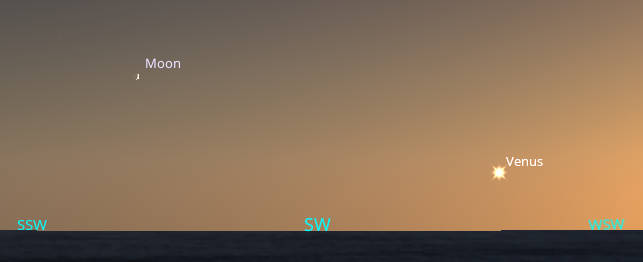
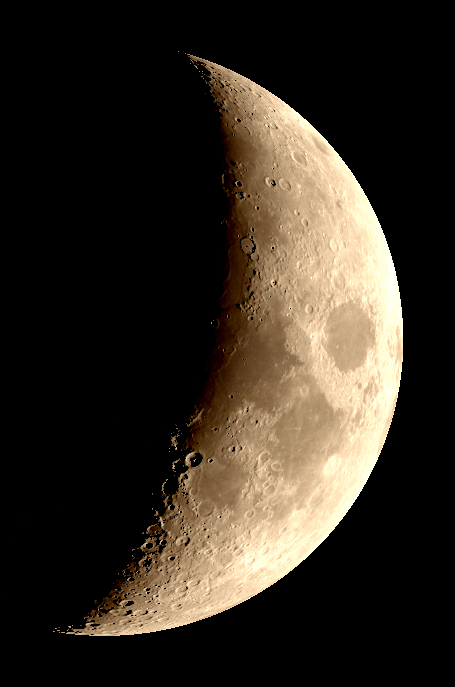
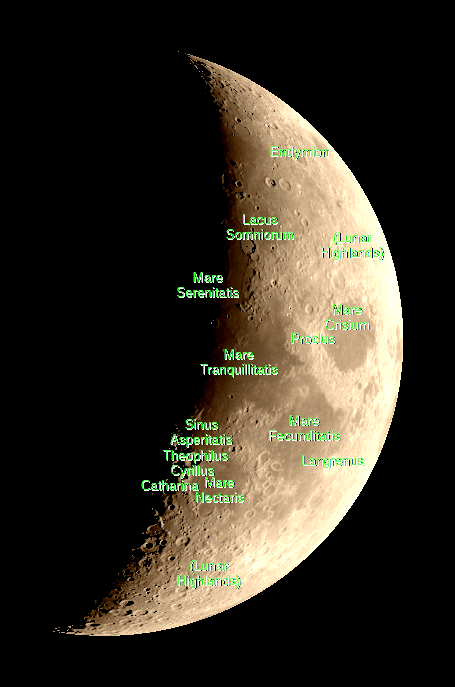
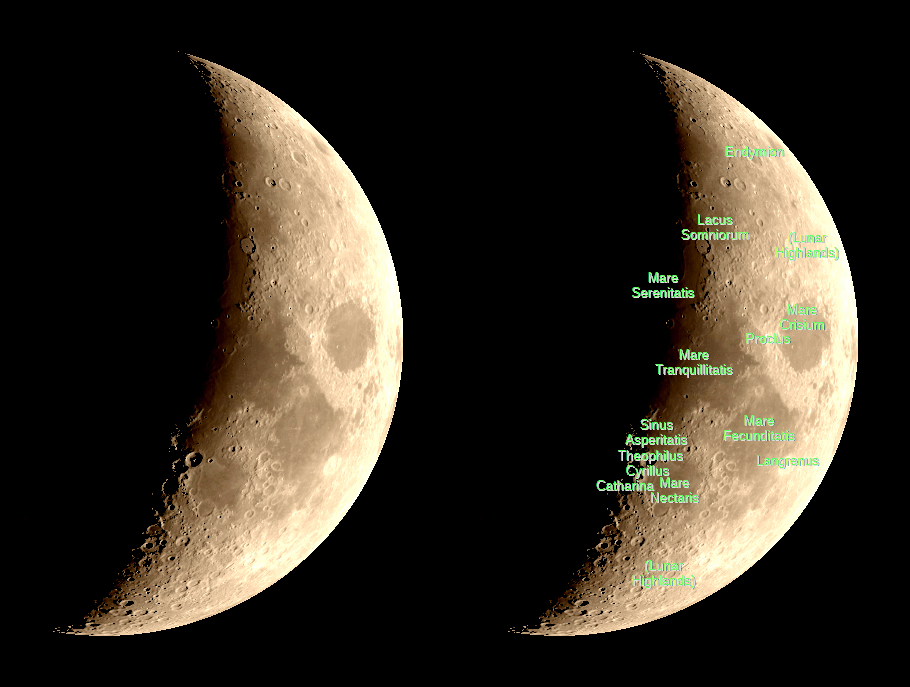
The Moon, a day before first quarter, as seen at 9:30 PM tonight, April 22, 2026. A view visible in small telescopes showing an image with and without selected features labeled. Created using Stellarium, LibreOffice Draw, and GIMP.
Telescopic Jupiter and Venus (north up) as they would be seen in a small telescope with the same magnification.
Telescopic Jupiter and Venus (north up) as they would be seen in a small telescope with the same magnification. Venus will be visible for a short time near the western horizon, while Jupiter is visible most of the night. Venus’ apparent diameter will be 11.3″, and be 89.7% illuminated. It’s on the far side of the Sun, 1.5 times the Sun’s distance from us. Jupiter will be 36.4″ in diameter, with its moons shown here for 9:30 PM, tonight April 22, 2026. The moons can shift noticably over an hour, especially Io and Europa. The (”) symbol means seconds of arc, or 1/3600th of a degree. Created using Cartes du Ciel (Sky Charts), LibreOffice Draw and GIMP.
The naked-eye planets at sunset and sunrise on a single night, starting with sunset on the right on April 22, 2026. The night ends on the left with sunrise on the 22nd.
The naked-eye planets at sunset and sunrise on a single night, starting with sunset on the right on April 22, 2026. The night ends on the left with sunrise on the 22nd. Click or tap on the image to enlarge it. Created using my LookingUp app and GIMP.
A low precision ephemeris of the Sun Moon and naked eye planet positions for today and tomorrow.
This is a low precision ephemeris of the Sun Moon and naked eye planet positions for today and tomorrow, April 22 and 23rd, 2026. Some of the columns are self-explanatory, others are not. The transit column is the time that the body crosses the meridian and is due south. Elong, for elongation, is the angle between the Sun and that body. RA is right ascension, which is the object’s east-west position on the celestial sphere in hours and minutes. Dec is declination which is the north-south position of the object on the celestial sphere in degrees and minutes. R is the distance of that object from the Sun in astronomical units. An astronomical unit is about 93 million miles or 150 million kilometers. And Delta is the distance of that object from the Earth, also in astronomical units. I omit the ‘m’ in am and pm for compactness. The data was generated using my LookingUp for DOS app and displayed as a table by my Ephemeris Helper app.