Archive
06/16/2020 – Ephemeris – One circlet of stars, two constellations: old world and new world
This is Ephemeris for Tuesday, June 16th. Today the Sun will be up for 15 hours and 34 minutes, setting at 9:30, and it will rise tomorrow at 5:56. The Moon, 3 days past last quarter, will rise at 3:52 tomorrow morning.
High in the south-southeast at 11 this evening can be seen a small nearly circular constellation of Corona Borealis, the Northern Crown. It is just below Boötes, the kite shaped constellation off the handle of the Big Dipper. According to Greek myth the crown was given by the gods to the princess Ariadne, daughter of King Minos of Crete. The crown is more like a tiara with the bright star Alphecca at the front. To the Anishinaabe people, who are natives of our region it is the Sweat Lodge. Part of what we call Hercules next to it is the Exhausted Bather, who is lying on the ground after the ceremony. The seven stones that are heated for the Sweat Lodge are the Pleiades, now too close to the Sun to be seen.
The event times given are for the Traverse City/Interlochen area of Michigan. They may be different for your location.
Addendum

Animated Corona Borealis/Sweat Lodge Finder Chart looking to the south-southeast at 11 p.m. June 16th. Click on the image to enlarge Created using Stellarium and GIMP.
06/15/2020 – Ephemeris – Now is the date of the earliest sunrise and it isn’t even summer yet
This is Ephemeris for Monday, June 15th. Today the Sun will be up for 15 hours and 33 minutes, setting at 9:30, and it will rise tomorrow at 5:56. The Moon, 2 days past last quarter, will rise at 3:30 tomorrow morning.
Today, give or take a day is the date of the earliest sunrise. The latest sunrise was about January 2nd, leaving only about 165 days for the transition of three hours, 24 minutes and since we still have five days to the longest day. The sunset change rate is a lot more leisurely. It has to do with the tilt of Earth’s axis and its slightly elliptical orbit. It’s why sundials don’t keep proper time. Though most sundials appear to be decorative and are not set up correctly anyway. Besides sundials can’t cope with time zones, and daylight time unless they are specially built for a particular location. Anyway the latest sunset will be on the 26th, 200 days since the earliest sunset, on December 9th, last year. The sunset retreat to December 9th will take 165 days, and the sunrise advance will take 200 days until next January 2nd next year.
The event times given are for the Traverse City/Interlochen area of Michigan. They may be different for your location.
06/12/2020 – Ephemeris – The Summer Triangle proclaims that summer is almost here
This is Bob Moler with Ephemeris for Friday, June 12th. Today the Sun will be up for 15 hours and 32 minutes, setting at 9:29, and it will rise tomorrow at 5:56. The Moon, 1 day before last quarter, will rise at 2:27 tomorrow morning.
Summer skies are coming. It’s only 8 days until summer officially arrives. It is a calendar day early this year because of the extra day added in February for the leap year. Looking to the eastern sky at 11 pm are three bright stars in a large triangle. The top star Vega is about half way up the sky to the zenith, and the brightest of the three. It’s in the small constellation of Lyra the harp. Lowest of the stars and just about due east is Altair in Aquila the eagle. Completing the triangle is Deneb in the northeast in the tail of Cygnus the swan or the head of the horizontal Northern Cross. These three stars make up the Summer Triangle. Be that as it may, the Summer Triangle will be in our evening sky moving slowly westward until December.
The event times given are for the Traverse City/Interlochen area of Michigan. They may be different for your location.
Addendum
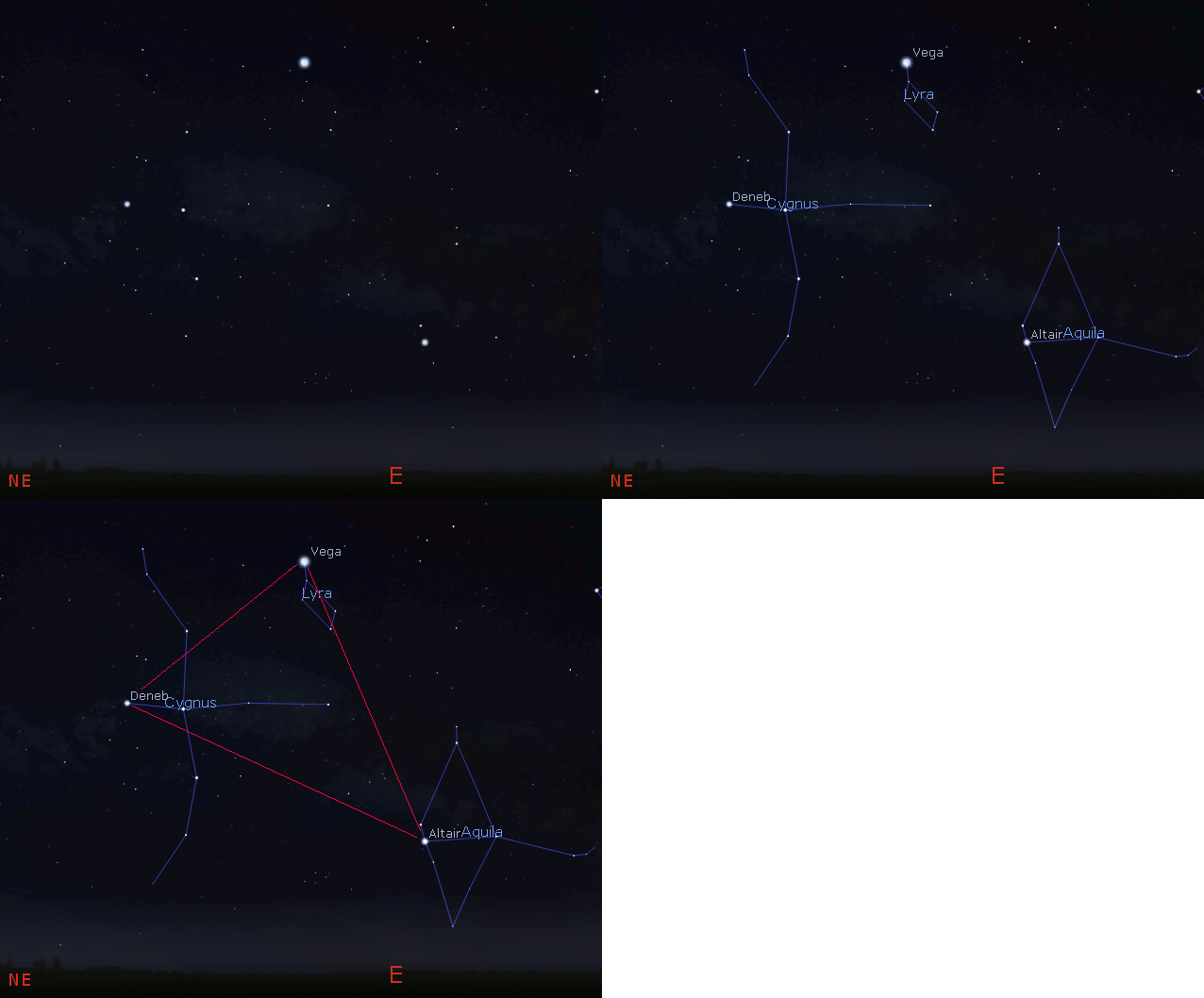
Finder animation for the Summer Triangle, seen in red for 11 pm, June 12th. Created using Stellarium and GIMP.
06/11/2020 – Ephemeris – The Moon passes Mars starting tomorrow morning
This is Ephemeris for Thursday, June 11th. Today the Sun will be up for 15 hours and 31 minutes, setting at 9:28, and it will rise tomorrow at 5:56. The Moon, 2 days before last quarter, will rise at 2:04 tomorrow morning.
In the morning sky tomorrow and Saturday morning the Moon will be passing Mars. Actually you’ll see a before and after shot of them because the Moon’s passage south of Mars will occur about 6 pm tomorrow evening when we can’t see them. Mars is getting brighter as we, on the Earth approach it. It is also getting larger in telescopes. On Wednesdays on this blog besides showing where the planets are, I show what they might look like in a small telescope. Until this week Mars appeared too small for me to show detail on Mars. However it is now large enough to maybe see a polar cap and some other detail depending on telescope size. Mars will double its apparent size between now and October.
The event times given are for the Traverse City/Interlochen area of Michigan. They may be different for your location.
Addendum
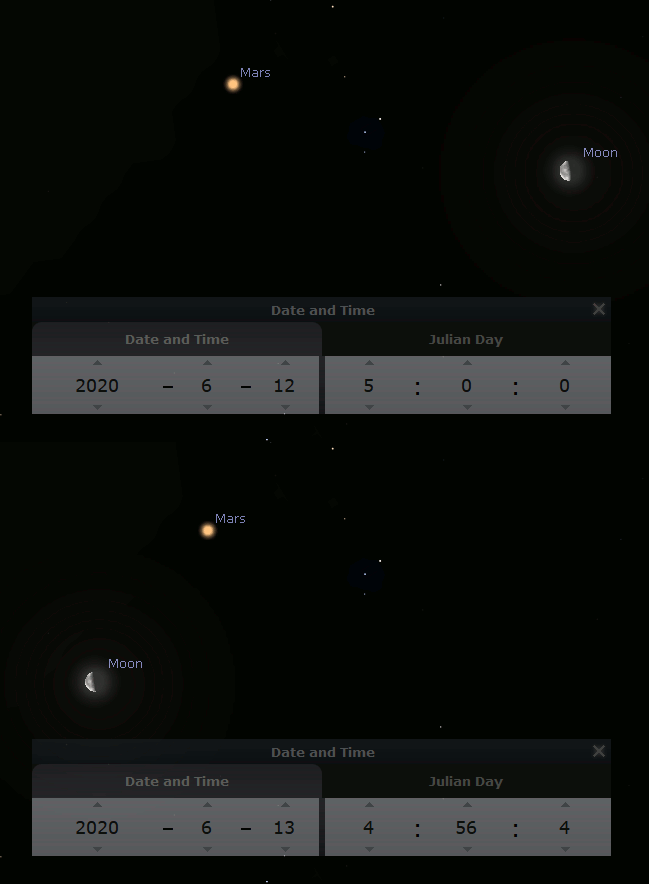
Moon and Mars animation for 5 am Friday June 12, 2020 and 4:56 am Saturday June 13th. The Jump between of 23 hours, 56 minutes and 4 seconds is the Earth’s sidereal day, the true period of its rotation in relation to the stars. Note that the few stars visible do not move, but Mars and the Moon do. Created using Stellarium and GIMP.
06/10/2020 – Ephemeris – Let’s look at the naked-eye planets for this week
This is Bob Moler with Ephemeris for Wednesday, June 10th. Today the Sun will be up for 15 hours and 31 minutes, setting at 9:28, and it will rise tomorrow at 5:56. The Moon, 3 days before last quarter, will rise at 1:38 tomorrow morning.
Let’s look at the naked-eye planets for this week. Mercury is close to the end of its visibility in the evening sky seen low in the northwest after sunset, it will set tonight at 11:03 pm. Jupiter now rises before midnight at 11:41 pm in the east-southeast. It’s still called a morning planet because it’s in the sky at sunrise. Saturn will rise 17 minutes later at 11:58 right behind Jupiter. Mars, is stretching its lead left of Saturn and will rise at 2:10 am in the east. Its now down to 87.6 million miles (141.0 million km) away, as the Earth slowly overtakes it at the rate of about 4.3 million miles (7.0 million km) a week. Jupiter and Saturn will be hanging out Sagittarius and Capricornus this year while Mars is moving rapidly eastward now two constellations over.
The event times given are for the Traverse City/Interlochen area of Michigan. They may be different for your location.
Addendum
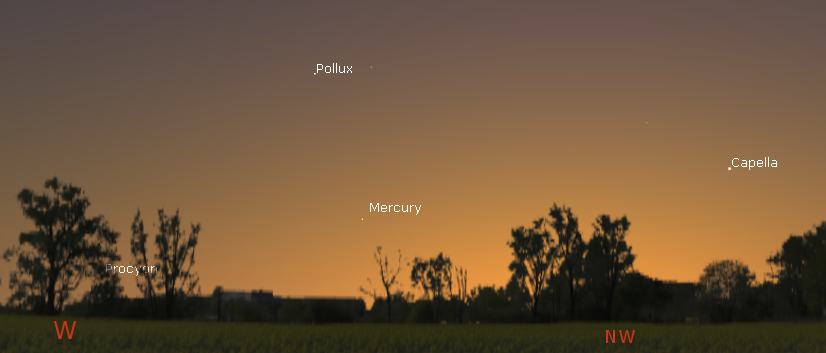
Mercury, very difficult to spot, in the evening tonight at 10 pm, June 10, 2020. Click on the image to enlarge. Created using Stellarium.
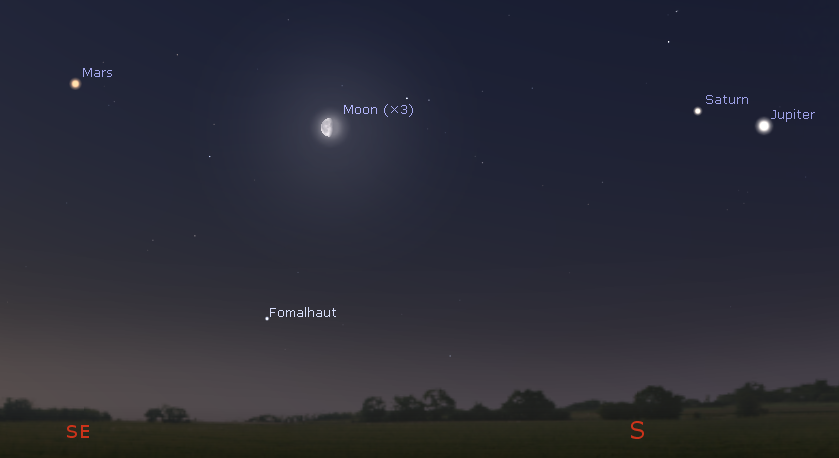
The Morning planets tomorrow at 5 a.m., about an hour before sunrise, June 11, 2020. lick on the image to enlarge. Created using Stellarium.
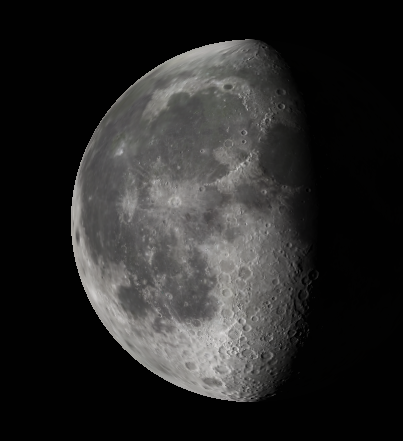
The waning gibbous Moon tomorrow at 5 am June 11, 2020 as it might appear in binoculars or small telescope. Created using Stellarium.
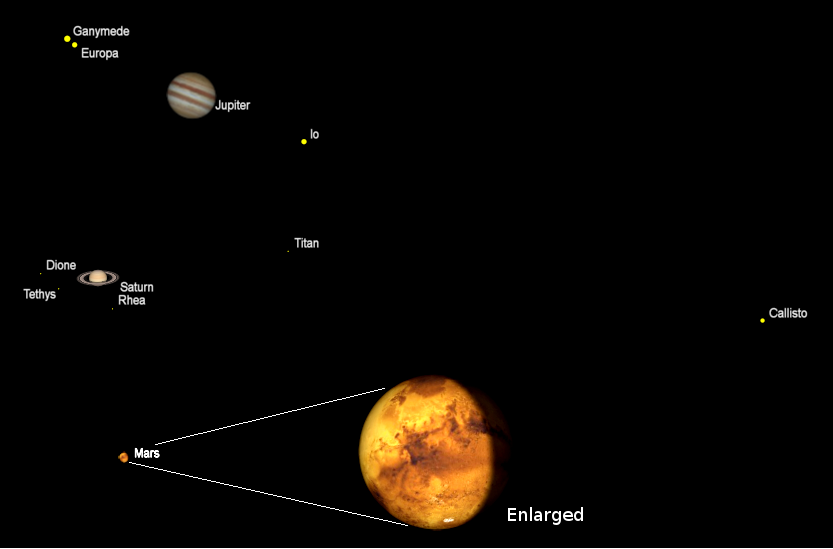
The planets as seen in a telescope with the same magnification. Jupiter and Saturn tomorrow morning of June 4, 2020. Apparent diameters: Jupiter, 45.80″; Saturn, 18.03″, rings, 41.99″ and Mars, 9.95″. Mars also shows an enlargement showing surface detail. The ” symbol means seconds of arc (1/3600th of a degree.) Created using Cartes du Ciel (Sky Charts).
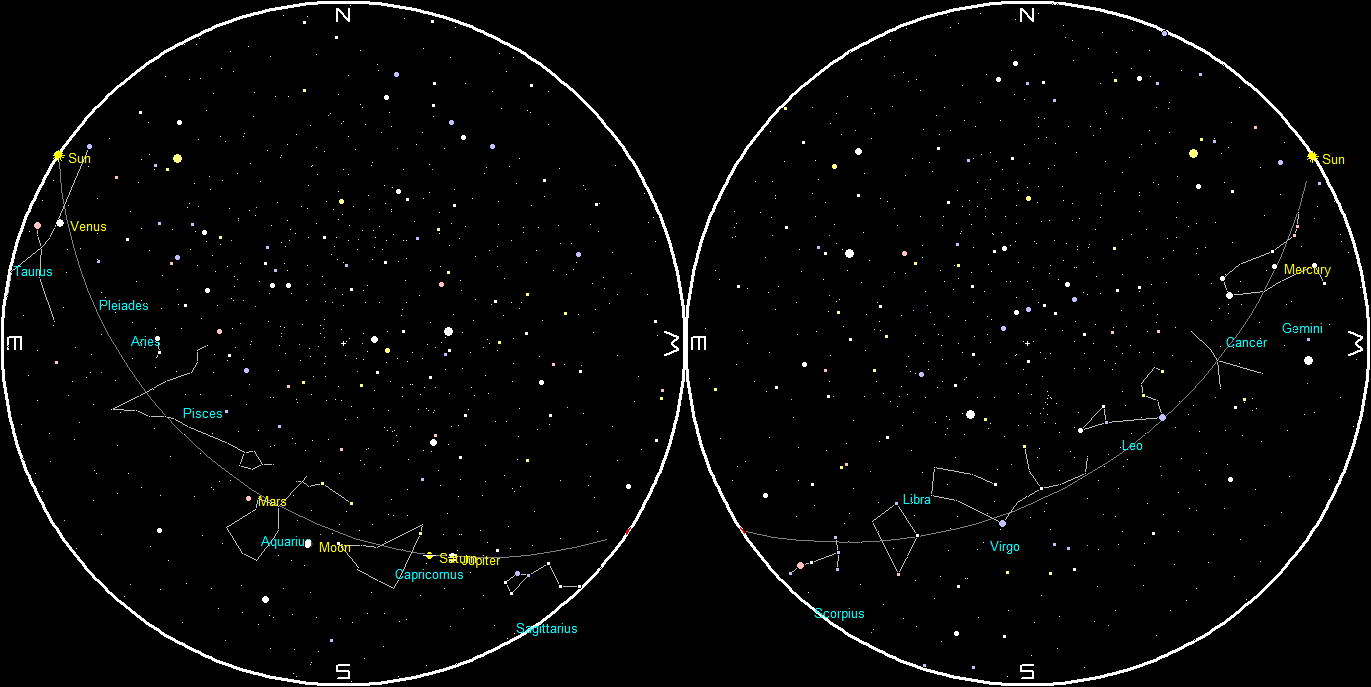
Planets and the Moon at sunset and sunrise of a single night starting with sunset on the right on June 10, 2020. The night ends on the left with sunrise on the 11th. The closeness of Jupiter and Saturn in the morning sky unfortunately overlays planets and labels. Click on the image to enlarge. Created using my LookingUp program.
06/09/2020 – Ephemeris – The constellation of the crow and a star often mistaken for a UFO
This is Ephemeris for Tuesday, June 9th. Today the Sun will be up for 15 hours and 30 minutes, setting at 9:27, and it will rise tomorrow at 5:56. The Moon, half way from full to last quarter, will rise at 1:06 tomorrow morning.
I don’t want spring to get away from us without pointing out a small but distinctive constellation now low in the southwest at 11 pm called Corvus the crow that to me looks like an odd shaped box. Wider at the bottom than the top and left side taller than the right. It’s supposed to be a crow in flight diagonally to the upper right. I find it easy to find by that odd shaped box. Also at 11 pm, the summer constellation of Scorpius the scorpion is rising with its bright red star Antares twinkling madly. This red giant star stays low in the southern sky, so we always, here in Michigan, see it through lots of atmosphere whose turbulence accentuates its twinkling. I call it my UFO star. It’s a riot in binoculars or a telescope.
The event times given are for the Traverse City/Interlochen area of Michigan. They may be different for your location.
Addendum
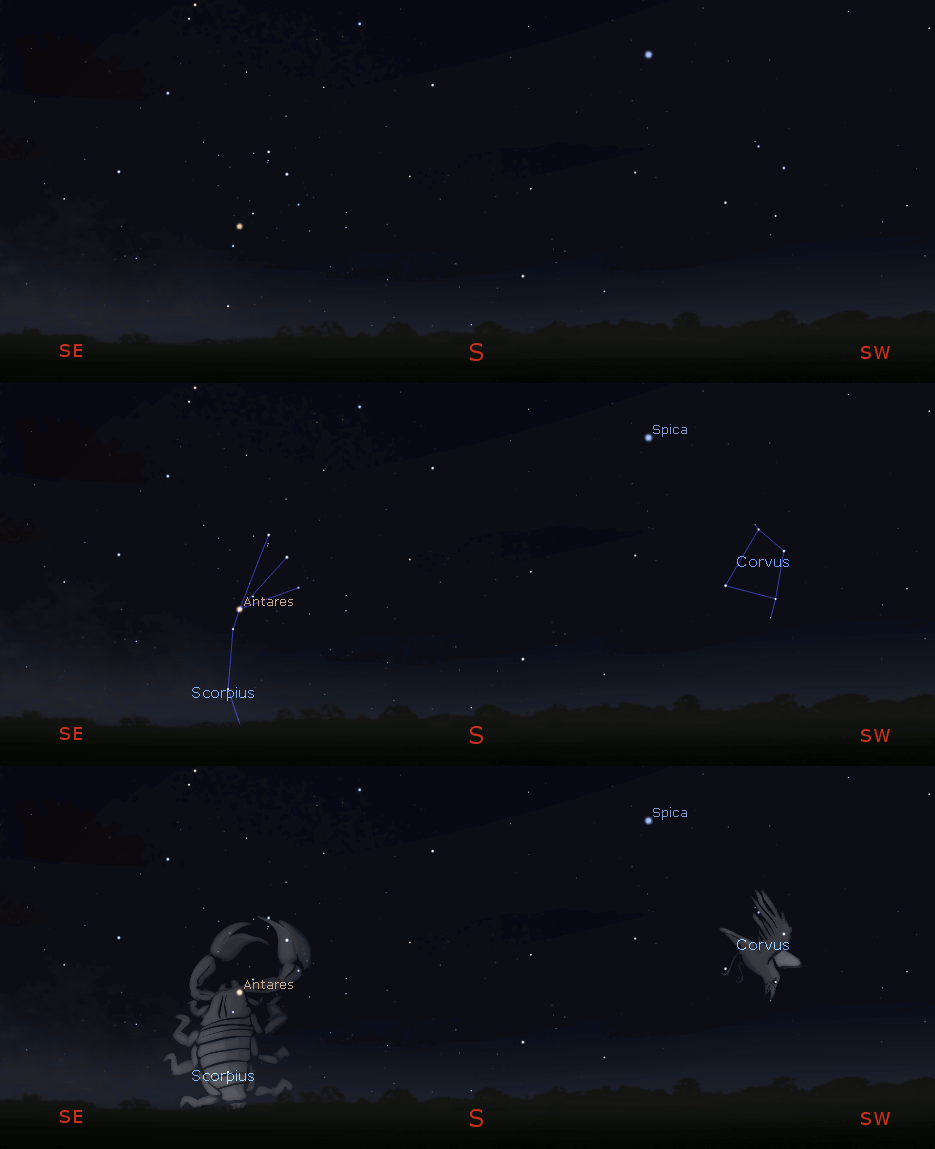
Corvus the crow and Antares the star in Scorpius at 11 pm tonight, June 9, 2020. Created using Stellarium and its embedded art. This is not how I see either constellation. Everyone gets to use their own imagination. Mine doesn’t agree with either image, but I’m not artistic enough to show how I imagine them. Though for Corvus I just see the distinctive box. Click on the image to enlarge it.
06/08/2020 – Ephemeris – Tomorrow’s Moon and the morning planets
This is Ephemeris for Monday, June 8th. Today the Sun will be up for 15 hours and 29 minutes, setting at 9:26, and it will rise tomorrow at 5:57. The Moon, 3 days past full, will rise at 12:28 tomorrow morning.
This afternoon the Moon will pass south of Jupiter, and this evening it will pass south of Saturn. By tomorrow morning the Moon will be to the lower left of both of them. However to see them one should get up by 5 am. By 5:30 the planets will be pretty much lost in twilight. The Moon should still be easily visible low in the south at that time. A careful observer, over time, may notice that both Jupiter and Saturn are moving slowly westward, rather than their normal eastward movement. We call this motion retrograde motion. This motion baffled the ancient Greeks, who thought the Earth to be stationary and the planets moved uniformly in perfect circles. They kind of solved it by adding smaller circles to the original ones.
The event times given are for the Traverse City/Interlochen area of Michigan. They may be different for your location.
Addendum
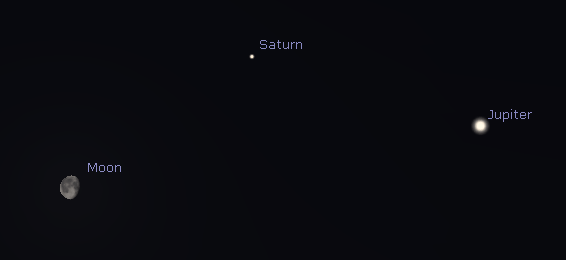
The Moon and morning planets at 5 a.m. tomorrow morning in the eastern US at 5 am, June 12, 2020. Created using Stellarium.
06/05/2020 – Ephemeris – A penumbral eclipse of the Moon for the eastern hemisphere of Earth today
This is Ephemeris for Friday, June 5th. Today the Sun will be up for 15 hours and 26 minutes, setting at 9:24, and it will rise tomorrow at 5:57. The Moon, at full today, will rise at 9:32 this evening.
There will be a penumbral eclipse of the Moon this afternoon. We won’t get to see it because the Moon won’t be up yet. The eclipse, such as it is, will be only visible from the eastern hemisphere of the Earth like Asia. Even then there won’t be much to see. In a penumbral eclipse the Moon only enters the Earth’s outer shadow, called the penumbra where sunlight is only partially cut off. Observers on the affected parts of the Moon would see the Sun only partially eclipsed. And anyone whose seen a partial solar eclipse will tell you that it doesn’t get that dark. So most penumbral eclipses go unnoticed unless one is told about them. This one less than 60% of the Moon will be immersed in the Earth’s penumbral shadow.
There will be two more penumbral lunar eclipses this year, both visible from the United States: July 5th when only 35% of the Moon’s diameter is immersed in the penumbra, and November 30th when 83% is immersed.
The event times given are for the Traverse City/Interlochen area of Michigan. They may be different for your location.
Addendum
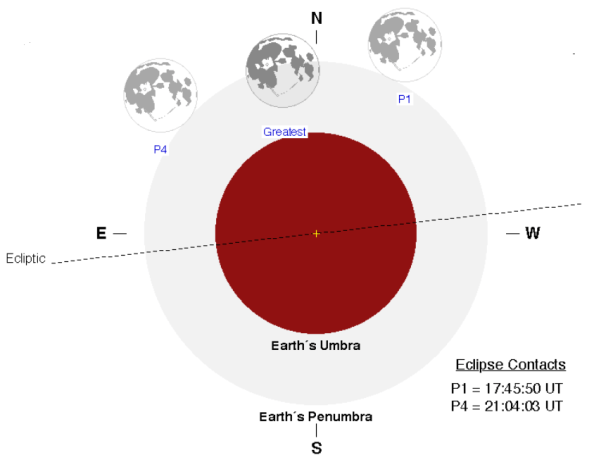
Lunar eclipse chart for the penumbral lunar eclipse of July 5th, 2020. Unfortunately for Michigan it will occur between 1:45 and 5:04 pm before the Moon rises tonight. Click on the image to see the original pdf page from NASA. Credit NASA GSFC/Fred Espenak.
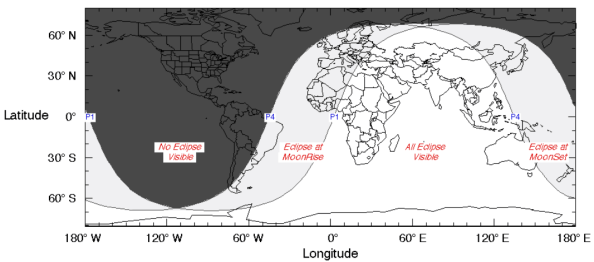
Eclipse visibility map. Areas on the Earth where the eclipse is visible. Credit NASA GSFC/Fred Espenak.
06/04/2020 – Ephemeris – Mercury is at it’s greatest separation from the Sun today
This is Ephemeris for Thursday, June 4th. Today the Sun will be up for 15 hours and 25 minutes, setting at 9:24, and it will rise tomorrow at 5:58. The Moon, 1 day before full, will set at 5:53 tomorrow morning.
Today at 9 am the planet Mercury will be at its greatest eastern elongation. That’s what astronomers call it. Implied is that it is at its greatest angular separation east of the Sun. Mercury, and also Venus have orbits inside Earth’s orbit of the Sun. For that reason they are called inferior planets. Therefore they never stray far from the position of the Sun in the sky. From around our latitude near 45 degrees north, we never see Mercury outside of twilight. Mercury has a remarkably elliptical orbit ranging from 29 million miles (47 million km) to 43 million miles (70 million km) from the Sun. In both spring and fall at favorable elongations, we see Mercury near perihelion, that close point. Southern hemisphere observers get a better view of it. Having a late spring greatest eastern elongation we get to see Mercury farther from the Sun than the same elongation earlier in the year.
The event times given are for the Traverse City/Interlochen area of Michigan. They may be different for your location.
Addendum
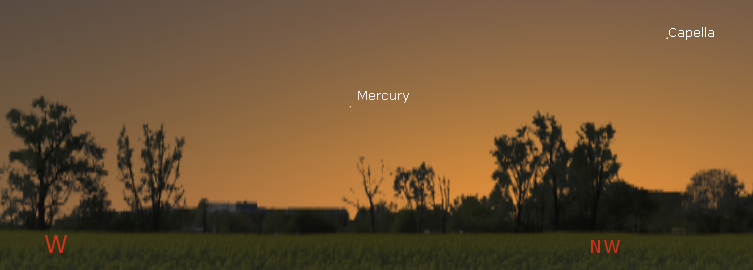
Mercury in the evening tonight at 10 pm June 3, 2020 (About 45 minutes after sunset). Click on the image to enlarge. Created using Stellarium.
06/03/2020 – Ephemeris – Let’s look at the naked-eye planets for this week
This is Ephemeris for Wednesday, June 3rd. Today the Sun will be up for 15 hours and 24 minutes, setting at 9:23, and it will rise tomorrow at 5:58. The Moon, 2 days before full, will set at 5:15 tomorrow morning.
Let’s look at the naked-eye planets for this week. This afternoon Venus will pass between the Earth and the Sun and head toward the morning sky. It’s only 26.8 million miles (43.2 million km) away, and quite invisible. Mercury is visible in the northwest after sunset, coming to greatest separation or elongation from the Sun of 23.6 degrees It will set tonight at 11:16 pm. In the morning sky there are three planets in the south and southeast. Bright Jupiter will rise first at 12:10 am, followed by Saturn at 12:26 am. Mars, is stretching its lead left of Saturn and will rise at 2:27 a.m. Its now down to 91.9 million miles (148.0 million km) away, as the Earth slowly overtakes it at the rate of about 4.4 million miles (7.0 million km) a week.
The event times given are for the Traverse City/Interlochen area of Michigan. They may be different for your location.
Addendum
Mercury in the evening tonight at 10 pm June 3, 2020. This is 11 hours before greatest eastern elongation, 23.6° east of the Sun. Click on the image to enlarge. Created using Stellarium.
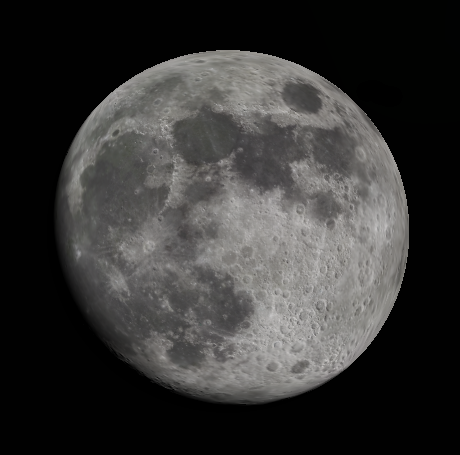
The Moon in binoculars or a low power telescope. Created using Stellarium.
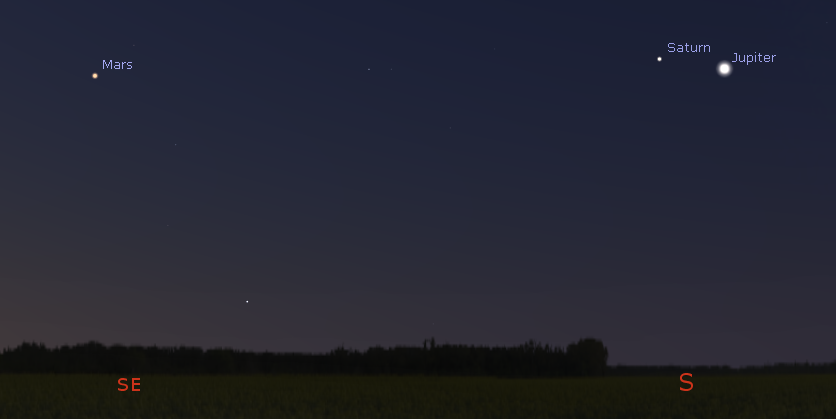
Jupiter, Saturn and Mars in the growing twilit skies of 5 am tomorrow morning, June 4, 2020. Click on image to enlarge. Created using Stellarium.
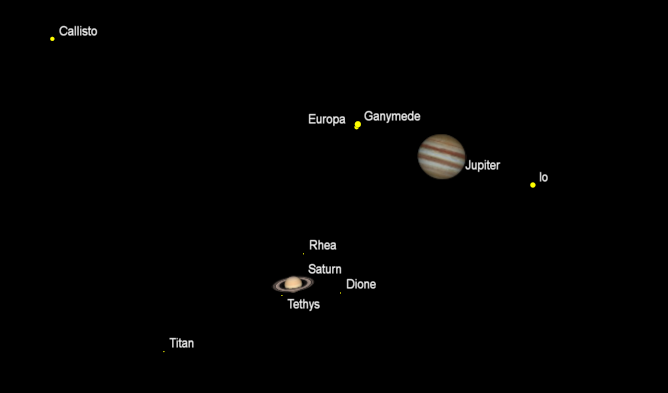
The planets as seen in a telescope with the same magnification. Jupiter and Saturn tomorrow morning of June 4, 2020. Apparent diameters: Jupiter, 45.06″; Saturn, 17.87″, rings, 41.62″. Mars at 9.49″ won’t be added until it reaches 10″, which looks like next week. The ” symbol means seconds of arc (1/3600th of a degree). Created using Cartes du Ciel (Sky Charts).
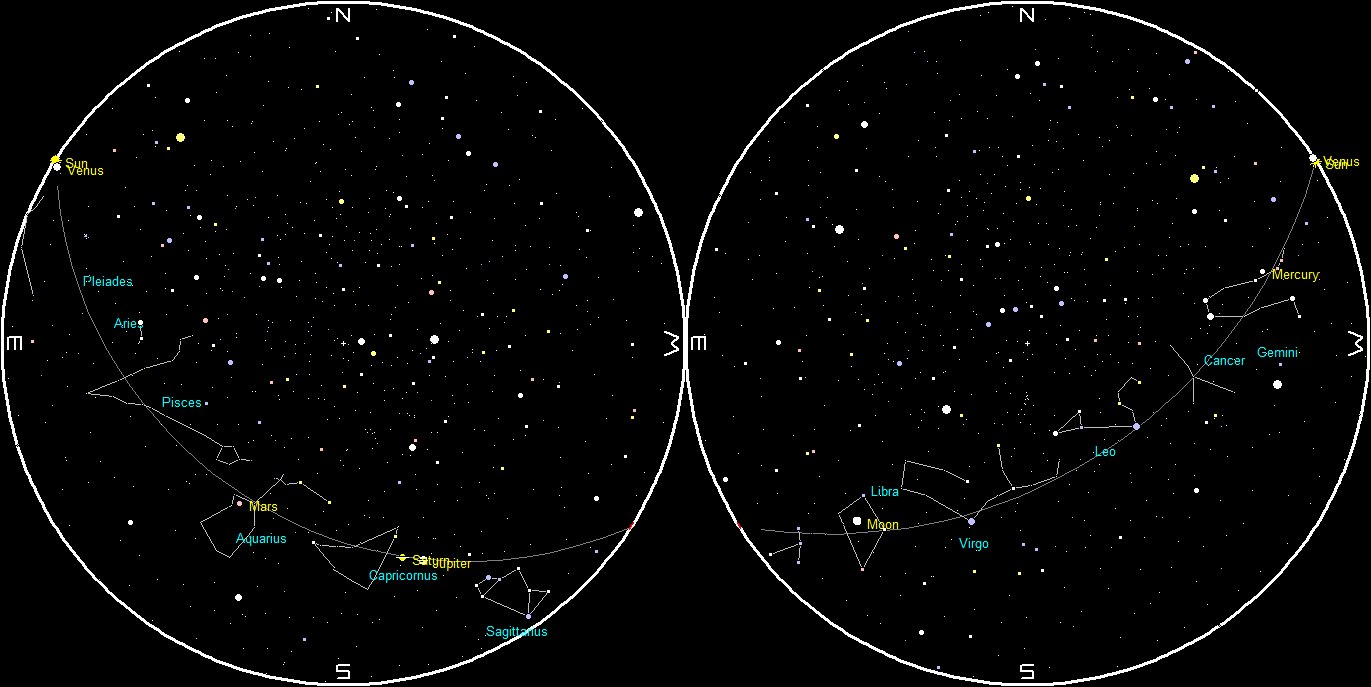
Planets and the Moon at sunset and sunrise of a single night starting with sunset on the right on June 3, 2020. The night ends on the left with sunrise on the 4th. The closeness of Jupiter and Saturn in the morning sky unfortunately overlays planets and labels. Click on the image to enlarge. Created using my LookingUp program.
 Bob Moler's Ephemeris Blog