Archive
09/30/2022 – Ephemeris – View the Sun and Moon tomorrow in the Grand Traverse Area!
This is Ephemeris for Friday, September 30th. Today the Sun will be up for 11 hours and 45 minutes, setting at 7:25, and it will rise tomorrow at 7:40. The Moon, 2 days before first quarter, will set at 9:57 this evening.
There are two observing sessions tomorrow in the Traverse City area with the assistance of the Grand Traverse Astronomical Society. First at the Dennos Museum Center grounds, from 2 to 4 pm, there will be telescopes to safely view the Sun. The Sun’s eleven-year sunspot cycle is getting active again. There will be telescopes to see those sunspots, and special solar hydrogen alpha telescopes to view the Sun’s chromosphere and any prominences above the Sun that day. From 8 to 10 pm, Northwestern Michigan College’s Rogers Observatory will be open for International Observe The Moon Night. There will also be a telescope on the 200 Block of East Front Street to observe the Moon during this time. Of course, all this is contingent on clear or mostly clear skies.
Update: It’s supposed to be nice this weekend, after a week of cold and rain.
The astronomical event times given are for the Traverse City/Interlochen area of Michigan (EDT, UT – 4 hours). They may be different for your location.
Addendum
Later today I’ll add a Moon Map for tomorrow evening and what the Sun looks like today, which should give a clue to what’s happening on the Sun now.
Sun in white light (How we normally see it with a solar filter)
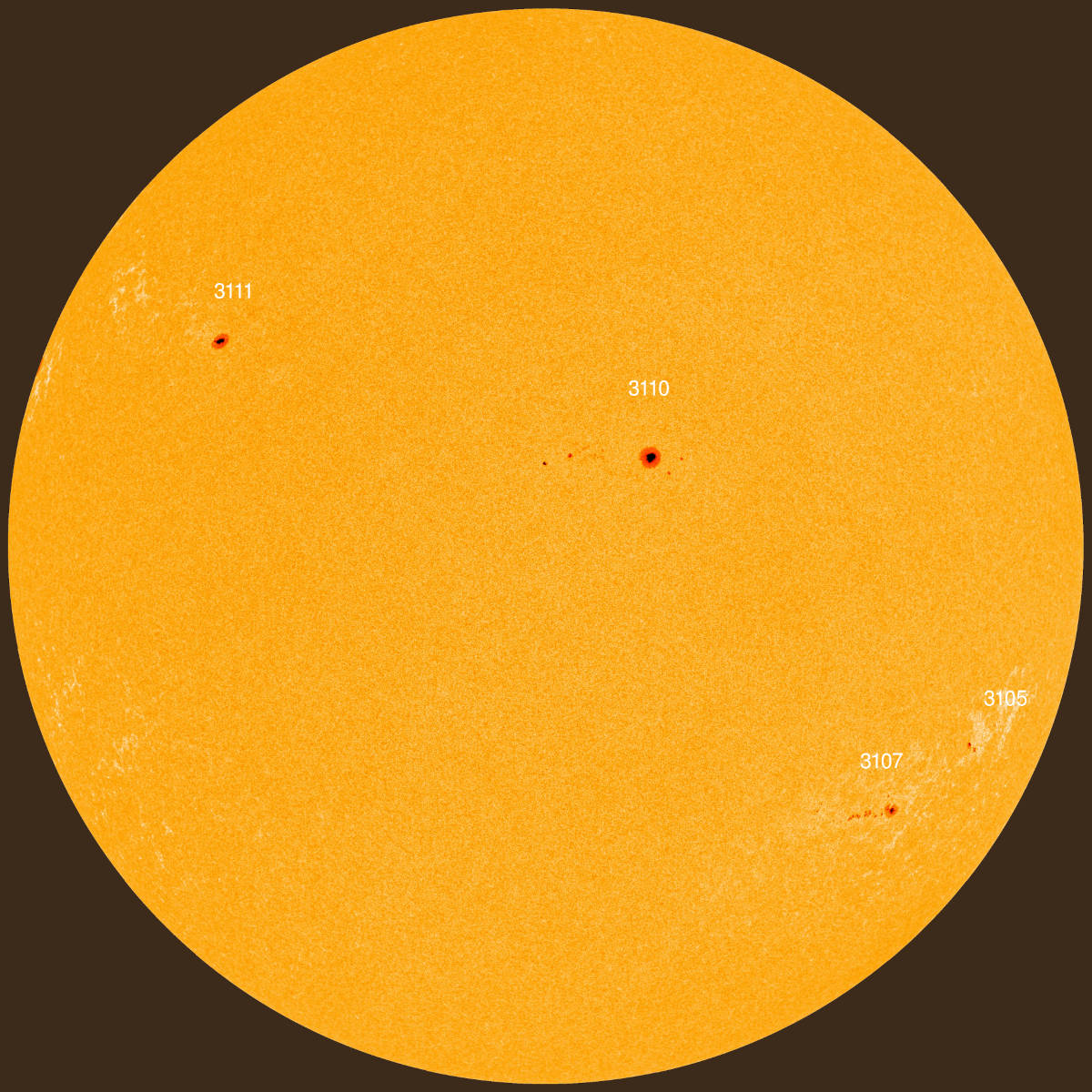
The Sun in white light, by the Solar Dynamics Observatory on September 30, 2022. What is seen is the photosphere, the visible “surface” of the Sun, where the energy transport from the interior changes from convection to radiation. The apparent roughness of the surface are the tops of the convection cells, called granules, which are usually about 600 miles wide that bubble up and recede. The numbers label active areas. The dark spots are sunspots, areas of intense magnetic activity. Brighter wispy or splotchy areas are faculae and are associated with sunspots or precursors of a new group forming. The rotation of the Sun will move the surface features from left to right in this image with north up. Telescopes may show the image upside down or mirror reversed. Click on the image to enlarge it. Credit NASA/SDO.
Sun in the light of the Hydrogen Alpha wavelength. Light absorbed and emitted by the hydrogen atom.
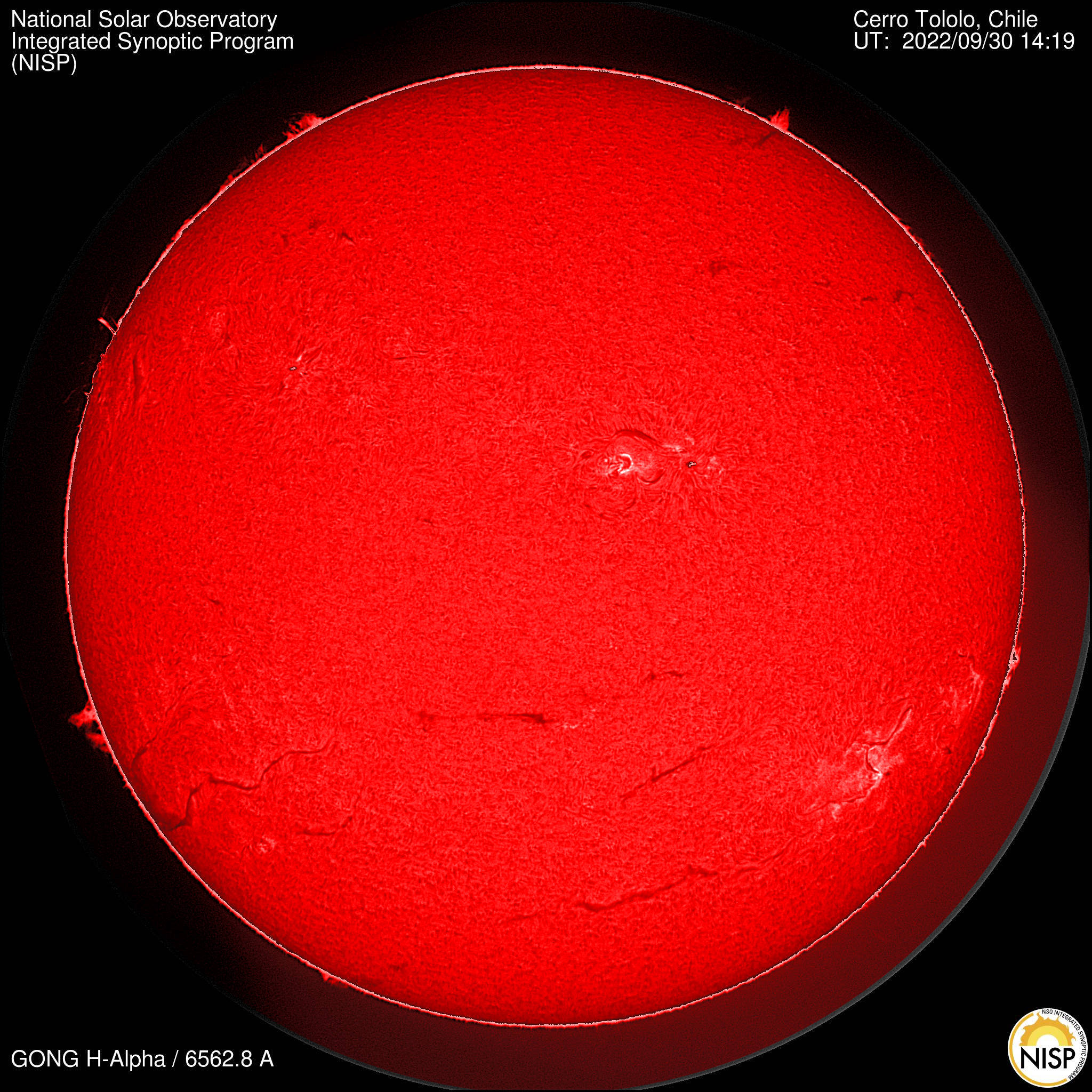
The Sun in Hydrogen-Alpha light, taken at 10:19 EDT today, September 30, 2022. It is in the same orientation as the SDO image above, but may have been taken at a different time of the day. This image was taken from the web page https://gong2.nso.edu/products/tableView/table.php?configFile=configs/hAlpha.cfg I colorized the image to show how it would look in a Hydrogen-Alpha telescope, of which we may have several, both the society’s and personal. The images may be dim since they select one narrow frequency of light from the broad spectrum of white light coming up from the photosphere. Its temperature is 10,000 degrees F. The thin dark markings are called filaments. These are the same thing as the bright prominences seen off the edge or limb of the Sun. Brighter areas of the chromosphere are called plages and are associated with active regions. The Chromosphere is a thin layer of the Sun’s atmosphere lying above the photosphere only 3,000 miles thick, and slightly hotter than the photosphere, its appearance is rougher than the granules of the photosphere. It reminds me of uneven, red grass that hasn’t been mown in a few weeks. They grow and recede in minutes. Sometimes a bright spot will appear in a sunspot group. These are solar flares and are caused by magnetic disruptions in sunspot groups. They last only a relatively few minutes but emit x-rays, electrons and protons as the most energetic explosions in the solar system. The x-rays arrive at Earth in 8 and a half minutes at the speed of light, the particles a day or two later will affect the Earth’s magnetic field if aimed in our direction, causing the aurora (northern and southern lights), and possibly disrupt communications and the power grid. On Earth, it’s called a geomagnetic storm.
The Moon for Saturday evening during the International Observe the Moon Night
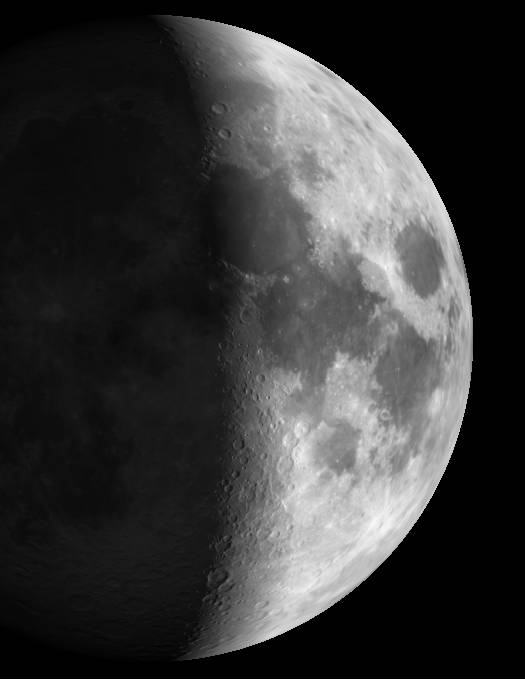
The Moon as it should appear at 9 pm EDT, October 1st, 2022. The telescopic image would be sharper than this. Created using Virtual Moon Atlas.
Download page of maps from the Official 2022 International Observe the Moon Night website.
Images in astronomical telescopes produce images of various orientations. They may be right side up or upside down, mirror reversed or both. Telescopes with an odd number of mirrors produce mirror images. Astronomers are used to it, though they have a preferred orientation… The one their favorable telescope produces.
Come on out!
09/29/2022 – Ephemeris – Previewing October skies
This is Ephemeris for Thursday, September 29th. Today the Sun will be up for 11 hours and 48 minutes, setting at 7:26, and it will rise tomorrow at 7:39. The Moon, 3 days before first quarter, will set at 9:20 this evening.
Let’s take an early look at the skies for the month of October. Tomorrow I’ll talk about local observing events for Saturday, both afternoon and evening. Back to October. The Sun will still be moving south rapidly. Daylight hours in the Interlochen/Traverse City area and will drop from 11 hours and 42 minutes on Saturday the 1st to 10 hours, 13 minutes at month’s end. The altitude of the Sun above the southern horizon at local noon will be 42 degrees Saturday in the Interlochen area, and will descend to 31 degrees on Halloween. For the Straits of Mackinac area, the Sun will be a degree lower, and the daytime hours will be a bit shorter. The Orionid meteor shower, bits of Halley’s Comet, won’t be bothered by the bright Moon until the early morning on the 21st.
The astronomical event times given are for the Traverse City/Interlochen area of Michigan (EDT, UT – 4 hours). They may be different for your location.
Addendum
October Evening Star Chart
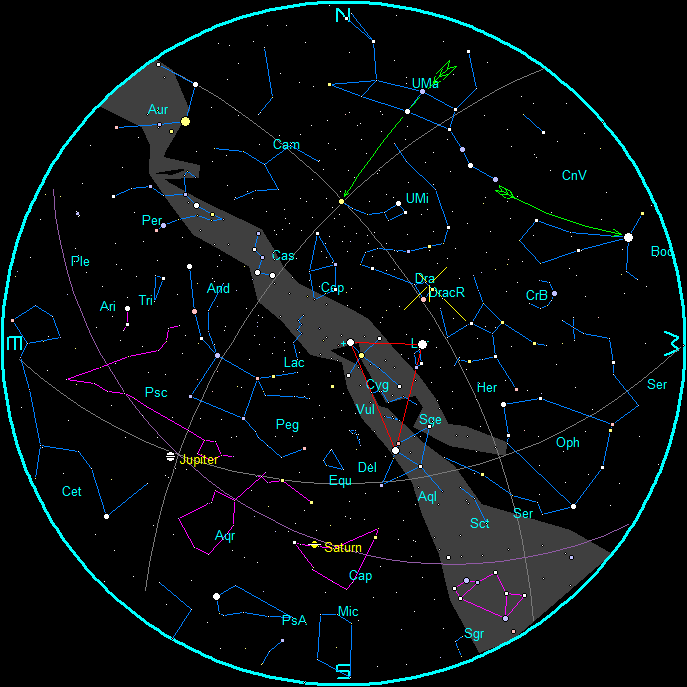
Star Chart for October 2022 (9 p.m. EDT, October 15, 2022). Click on image to enlarge it. Created using my LookingUp app.
The planets and stars are plotted for the 15th at 9 p.m. EDT in the evening and 6 a.m. for the morning chart. These are the chart times. Note that Traverse City is located approximately 45 minutes behind our time meridian, West 75° longitude. (An hour 45 minutes behind our daylight saving time meridian during EDT). To duplicate the star positions on a planisphere you may have to set it to 1 hour 45 minutes earlier than the current time.
October Morning Star Chart
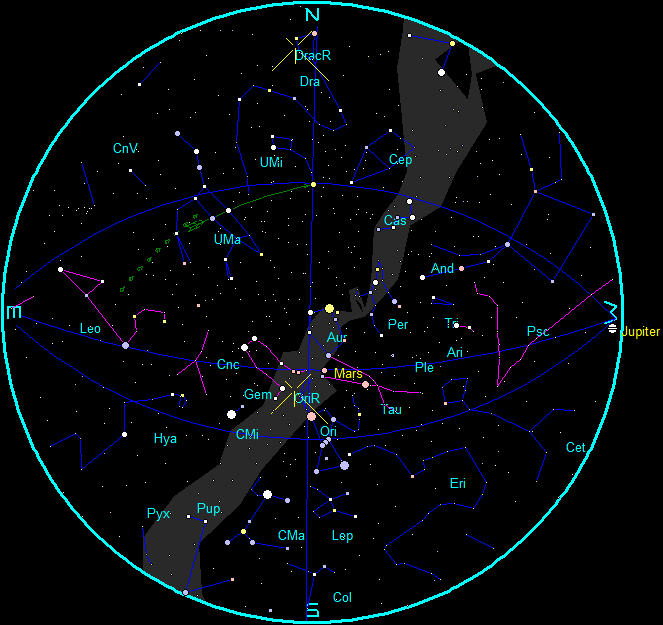
Star Chart for October mornings, 2022 (6 a.m. EDT, October 15, 2022). Click on image to enlarge. Created using my LookingUp app.
For a list of constellation names to go with the abbreviations, click here.
- Pointer stars at the front of the bowl of the Big Dipper point to Polaris, the North Star.
- Leaky dipper drips on Leo.
- Follow the arc of the handle of the Big Dipper to the star Arcturus.
- The Summer Triangle is in red.
- DracR – Draconid Radiant – Peaks the 8th – Zenithal Hourly Rate < 10 with rare outbursts of a thousand an hour. It’s hindered this year by the full moon.
- OriR – Orionid Radiant – Peak 21st – Zenithal Hourly Rate = 20
Twilight Limits, Nautical and Astronomical
| EDT | |||||||
| Morning | Twilight | Evening | Twilight | Dark | Night | Moon | |
| Date | Astro. | Nautical | Nautical | Astro. | Start | End | Illum. |
| 2022-10-01 | 6h09m | 6h43m | 20h29m | 21h04m | 22h45m | 6h09m | 0.41 |
| 2022-10-02 | 6h10m | 6h44m | 20h28m | 21h02m | 23h45m | 6h10m | 0.53 |
| 2022-10-03 | 6h11m | 6h46m | 20h26m | 21h00m | – | 6h11m | 0.64 |
| 2022-10-04 | 6h13m | 6h47m | 20h24m | 20h58m | 0h56m | 6h13m | 0.75 |
| 2022-10-05 | 6h14m | 6h48m | 20h22m | 20h56m | 2h14m | 6h14m | 0.84 |
| 2022-10-06 | 6h15m | 6h49m | 20h20m | 20h54m | 3h34m | 6h15m | 0.91 |
| 2022-10-07 | 6h16m | 6h50m | 20h18m | 20h52m | 4h52m | 6h16m | 0.97 |
| 2022-10-08 | 6h18m | 6h52m | 20h17m | 20h51m | 6h08m | 6h18m | 0.99 |
| 2022-10-09 | 6h19m | 6h53m | 20h15m | 20h49m | – | – | 1 |
| 2022-10-10 | 6h20m | 6h54m | 20h13m | 20h47m | – | – | 0.98 |
| 2022-10-11 | 6h22m | 6h55m | 20h11m | 20h45m | – | – | 0.94 |
| 2022-10-12 | 6h23m | 6h57m | 20h10m | 20h43m | – | – | 0.88 |
| 2022-10-13 | 6h24m | 6h58m | 20h08m | 20h42m | 20h42m | 21h00m | 0.81 |
| 2022-10-14 | 6h25m | 6h59m | 20h06m | 20h40m | 20h40m | 21h38m | 0.73 |
| 2022-10-15 | 6h26m | 7h00m | 20h05m | 20h38m | 20h38m | 22h24m | 0.64 |
| 2022-10-16 | 6h28m | 7h01m | 20h03m | 20h37m | 20h37m | 23h18m | 0.55 |
| 2022-10-17 | 6h29m | 7h03m | 20h01m | 20h35m | 20h35m | – | 0.45 |
| 2022-10-18 | 6h30m | 7h04m | 20h00m | 20h33m | 20h33m | 0h18m | 0.36 |
| 2022-10-19 | 6h31m | 7h05m | 19h58m | 20h32m | 20h32m | 1h23m | 0.27 |
| 2022-10-20 | 6h33m | 7h06m | 19h57m | 20h30m | 20h30m | 2h29m | 0.19 |
| 2022-10-21 | 6h34m | 7h08m | 19h55m | 20h29m | 20h29m | 3h37m | 0.12 |
| 2022-10-22 | 6h35m | 7h09m | 19h53m | 20h27m | 20h27m | 4h45m | 0.06 |
| 2022-10-23 | 6h36m | 7h10m | 19h52m | 20h26m | 20h26m | 5h54m | 0.02 |
| 2022-10-24 | 6h37m | 7h11m | 19h50m | 20h24m | 20h24m | 6h37m | 0 |
| 2022-10-25 | 6h39m | 7h12m | 19h49m | 20h23m | 20h23m | 6h39m | 0.01 |
| 2022-10-26 | 6h40m | 7h14m | 19h48m | 20h21m | 20h21m | 6h40m | 0.04 |
| 2022-10-27 | 6h41m | 7h15m | 19h46m | 20h20m | 20h20m | 6h41m | 0.1 |
| 2022-10-28 | 6h42m | 7h16m | 19h45m | 20h19m | 20h40m | 6h42m | 0.17 |
| 2022-10-29 | 6h44m | 7h17m | 19h43m | 20h17m | 21h37m | 6h44m | 0.27 |
| 2022-10-30 | 6h45m | 7h19m | 19h42m | 20h16m | 22h46m | 6h45m | 0.38 |
| 2022-10-31 | 6h46m | 7h20m | 19h41m | 20h15m | – | 6h46m | 0.49 |
Twilight calendar was generated using Cartes du Ciel (Sky Charts).
See my blog post: Twilight Zone for the definitions of the different periods of twilight here: https://bobmoler.wordpress.com/2018/09/27/.
NASA Calendar of Planetary Events
Oct  1 	Sa            Venus: 5.8° W
     2  Su   3:32 pm  Moon South Dec.: 27.4° S
     2  Su   8:14 pm  First Quarter
     4  Tu   1:01 pm  Moon Perigee: 369,300 km
     5  We  11:51 am  Moon-Saturn: 4.1° N
     8  Sa   2:06 pm  Moon-Jupiter: 2.1° N
     8  Sa   4:59 pm  Mercury Elongation: 18° W (Morning elongation)
     9  Su   4:55 pm  Full Hunter's Moon
    11  Tu   5:49 pm  Moon Ascending Node
    12  We  11:46 pm  Moon-Pleiades: 2.9° N
    15  Sa  12:28 am  Moon-Mars: 4° S
    16  Su   2:12 am  Moon North Dec.: 27.5° N
    17  Mo   6:21 am  Moon Apogee: 404300 km
    17  Mo  11:41 am  Moon-Pollux: 2° N
    17  Mo   1:15 pm  Last Quarter
    21  Fr   1:39 pm  Orionid Shower: ZHR = 20
    22  Sa   4:47 pm  Venus Superior Conjunction. Enters evening sky
    25  Tu   6:49 am  New Moon
    25  Tu   7:00 am  Partial Solar Eclipse (Parts of Europe, Africa and Asia)
    26  We   2:30 am  Moon Descending Node
    27  Th  10:48 pm  Moon-Antares: 2.3° S
    29  Sa  10:48 am  Moon Perigee: 368300 km
    29  Sa   9:04 pm  Moon South Dec.: 27.5° S
Nov  1  Tu            Venus: 2.6° E
All event times are given for UTC-4 hr: Eastern Daylight Saving Time.
Sky Events Calendar by Fred Espenak and Sumit Dutta (NASA’s GSFC),
http://eclipse.gsfc.nasa.gov/SKYCAL/SKYCAL.html.
If you go to the above site, you can print out a list like the above for the entire year or calendar pages for your time zone.
Sun and Moon Rising and Setting Events
LU              Ephemeris of Sky Events for Interlochen/TC
October 2022          Local time zone: EDT
+-----------------------------------------------------------------------+
| DATE |  SUN     SUN  DAYLIGHT|   TWILIGHT*    |MOON  RISE OR    ILLUM |
|      |  RISE    SET    HOURS |  END    START  |PHASE SET** TIME FRACTN|
+=======================================================================+
|Sat  1| 07:40a  07:23p  11:42 | 08:26p  06:37a |      Set  10:44p   39%|
+------+-----------------------+----------------+-----------------------+
|Sun  2| 07:42a  07:21p  11:39 | 08:24p  06:39a |F Qtr Set  11:44p   50%|
|Mon  3| 07:43a  07:19p  11:36 | 08:22p  06:40a |      Set  12:55a   61%|
|Tue  4| 07:44a  07:17p  11:33 | 08:20p  06:41a |      Set  02:14a   72%|
|Wed  5| 07:45a  07:15p  11:30 | 08:18p  06:42a |      Set  03:33a   82%|
|Thu  6| 07:46a  07:14p  11:27 | 08:16p  06:43a |      Set  04:52a   90%|
|Fri  7| 07:48a  07:12p  11:24 | 08:15p  06:45a |      Set  06:08a   96%|
|Sat  8| 07:49a  07:10p  11:20 | 08:13p  06:46a |      Set  07:22a   99%|
+------+-----------------------+----------------+-----------------------+
|Sun  9| 07:50a  07:08p  11:17 | 08:11p  06:47a |Full  Rise 07:19p  100%|
|Mon 10| 07:51a  07:06p  11:14 | 08:09p  06:48a |      Rise 07:39p   99%|
|Tue 11| 07:53a  07:05p  11:11 | 08:08p  06:50a |      Rise 08:02p   95%|
|Wed 12| 07:54a  07:03p  11:08 | 08:06p  06:51a |      Rise 08:28p   90%|
|Thu 13| 07:55a  07:01p  11:05 | 08:04p  06:52a |      Rise 08:59p   83%|
|Fri 14| 07:57a  06:59p  11:02 | 08:02p  06:53a |      Rise 09:37p   75%|
|Sat 15| 07:58a  06:58p  10:59 | 08:01p  06:54a |      Rise 10:23p   66%|
+------+-----------------------+----------------+-----------------------+
|Sun 16| 07:59a  06:56p  10:56 | 07:59p  06:56a |      Rise 11:17p   57%|
|Mon 17| 08:00a  06:54p  10:53 | 07:58p  06:57a |L Qtr Rise 12:18a   47%|
|Tue 18| 08:02a  06:52p  10:50 | 07:56p  06:58a |      Rise 01:22a   38%|
|Wed 19| 08:03a  06:51p  10:47 | 07:54p  06:59a |      Rise 02:29a   29%|
|Thu 20| 08:04a  06:49p  10:44 | 07:53p  07:01a |      Rise 03:36a   20%|
|Fri 21| 08:06a  06:48p  10:41 | 07:51p  07:02a |      Rise 04:44a   13%|
|Sat 22| 08:07a  06:46p  10:38 | 07:50p  07:03a |      Rise 05:53a    7%|
+------+-----------------------+----------------+-----------------------+
|Sun 23| 08:08a  06:44p  10:36 | 07:48p  07:04a |      Rise 07:04a    3%|
|Mon 24| 08:10a  06:43p  10:33 | 07:47p  07:06a |      Rise 08:18a    0%|
|Tue 25| 08:11a  06:41p  10:30 | 07:45p  07:07a |New   Set  06:53p    0%|
|Wed 26| 08:12a  06:40p  10:27 | 07:44p  07:08a |      Set  07:21p    3%|
|Thu 27| 08:14a  06:38p  10:24 | 07:42p  07:09a |      Set  07:55p    8%|
|Fri 28| 08:15a  06:37p  10:21 | 07:41p  07:10a |      Set  08:39p   16%|
|Sat 29| 08:16a  06:35p  10:18 | 07:40p  07:12a |      Set  09:36p   25%|
+------+-----------------------+----------------+-----------------------+
|Sun 30| 08:18a  06:34p  10:16 | 07:38p  07:13a |      Set  10:45p   36%|
|Mon 31| 08:19a  06:32p  10:13 | 07:37p  07:14a |      Set  12:02a   47%|
+-----------------------------------------------------------------------+
* Nautical Twilight
** Moonrise or moonset, whichever occurs between sunrise and sunset
Generated using my LookingUp for DOS program.
09/28/2022 – Ephemeris – Searching for the naked-eye planets for this week
This is Bob Moler with Ephemeris for Wednesday, September 28th. Today the Sun will be up for 11 hours and 51 minutes, setting at 7:28, and it will rise tomorrow at 7:38. The Moon, 3 days past new, will set at 8:51 this evening.
Let’s search for the naked-eye planets for this week. The thin sliver of a waxing crescent Moon may be visible very low in the southwest at 8 pm. We’re back to two naked-eye planets in the evening sky. Jupiter was in opposition from the Sun on Monday, and closest to the Earth. As it gets darker, Jupiter will be seen first low in the east. At that time, Saturn can be seen in the southeast. Jupiter is seen against the stars of Pisces the fish, while Saturn is spotted in the eastern end of Capricornus the sea goat. At 6:45 tomorrow morning, Mars will be high in the south, above the winter constellation of Orion, and Jupiter will be very low in the west. Venus will rise in the east at 7:02 into bright twilight.
The astronomical event times given are for the Traverse City/Interlochen area of Michigan (EDT, UT – 4 hours). They may be different for your location.
Addendum
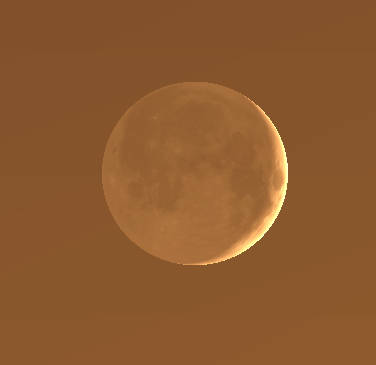
What the three-day-old Moon might look like in binoculars in twilight at 8 pm tonight, September 28, 2022. Illumination of the night part of the Moon will be provided by the bright gibbous Earth in its sky. The phenomenon is called earth shine. Created using Stellarium.
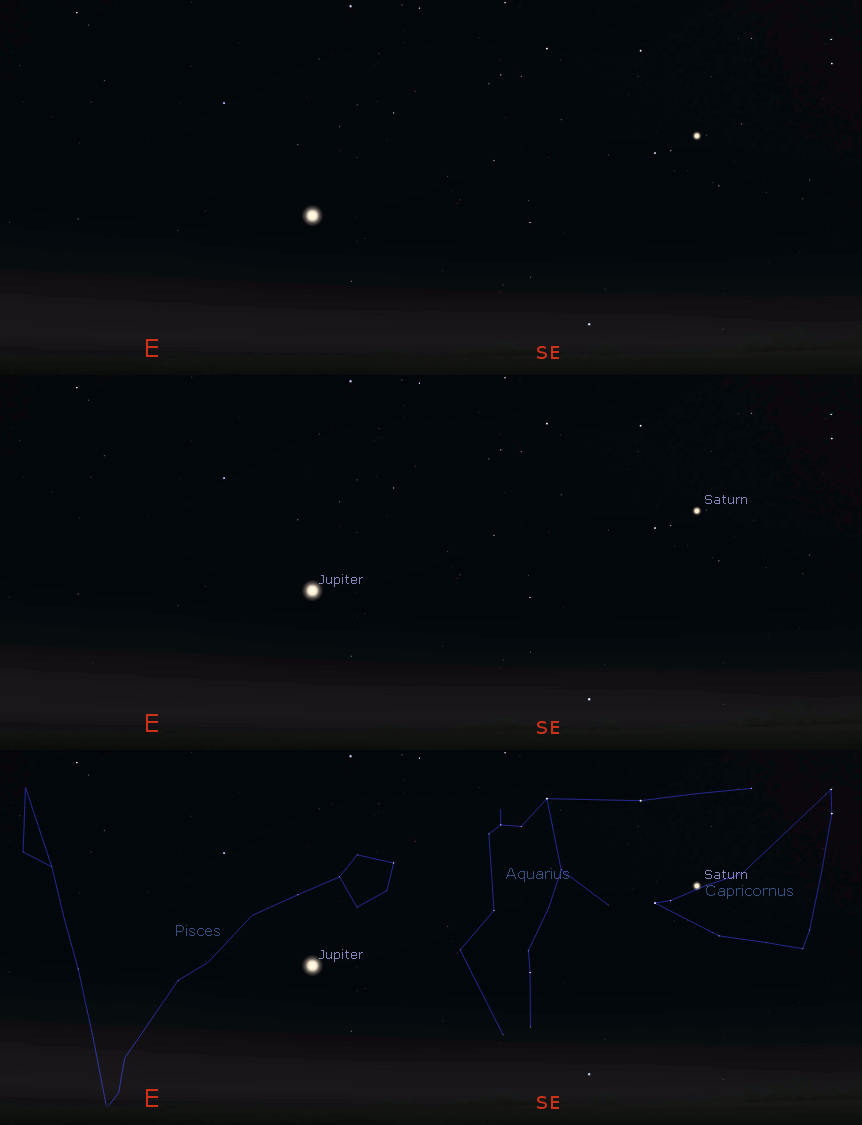
Evening planet finder animation by showing Jupiter and Saturn with and without the constellation lines. For 9 pm this evening, September 28, 2022. Click on the image to enlarge it. Created using Stellarium and GIMP.
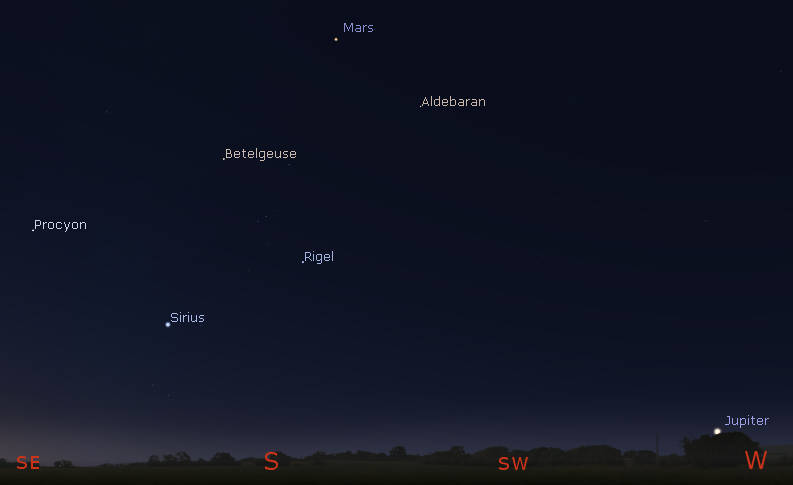
Morning planet Mars with the last gasp of the new evening planet Jupiter and bright winter stars at 6:45 tomorrow morning, September 29, 2022. Click on the image to enlarge it. Created using Stellarium.
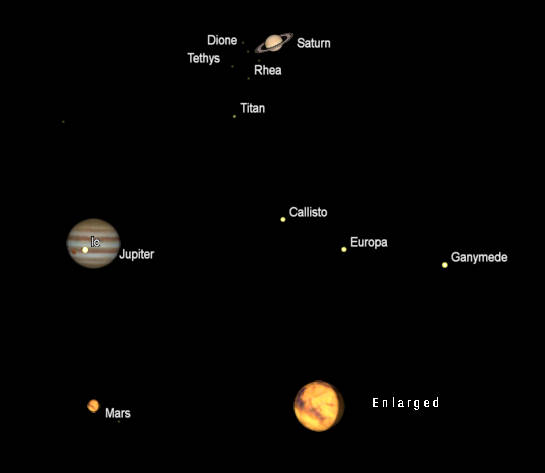
Telescopic views of Saturn, Jupiter and Mars (north up) as they would be seen in a small telescope, with the same magnification. The image doesn’t show it, but the white north polar cap will appear at the top or north limb of Mars. Saturn and Jupiter are shown at 10 pm, Mars at 6 am. Apparent diameters: Saturn 18.17″, its rings 42.33″; Jupiter 49.86″. Mars 11.01″. Mars’ distance is 73.8 million miles (118.7 million kilometers). The ” symbol means seconds of arc (1/3600th of a degree.) Created using Cartes du Ciel (Sky Charts).
One surprising thing about Mars in a telescope is how bright it is. That’s because it’s much closer to the Sun than Jupiter or Saturn, even thought it has a lower albedo (reflectance) than those planets.
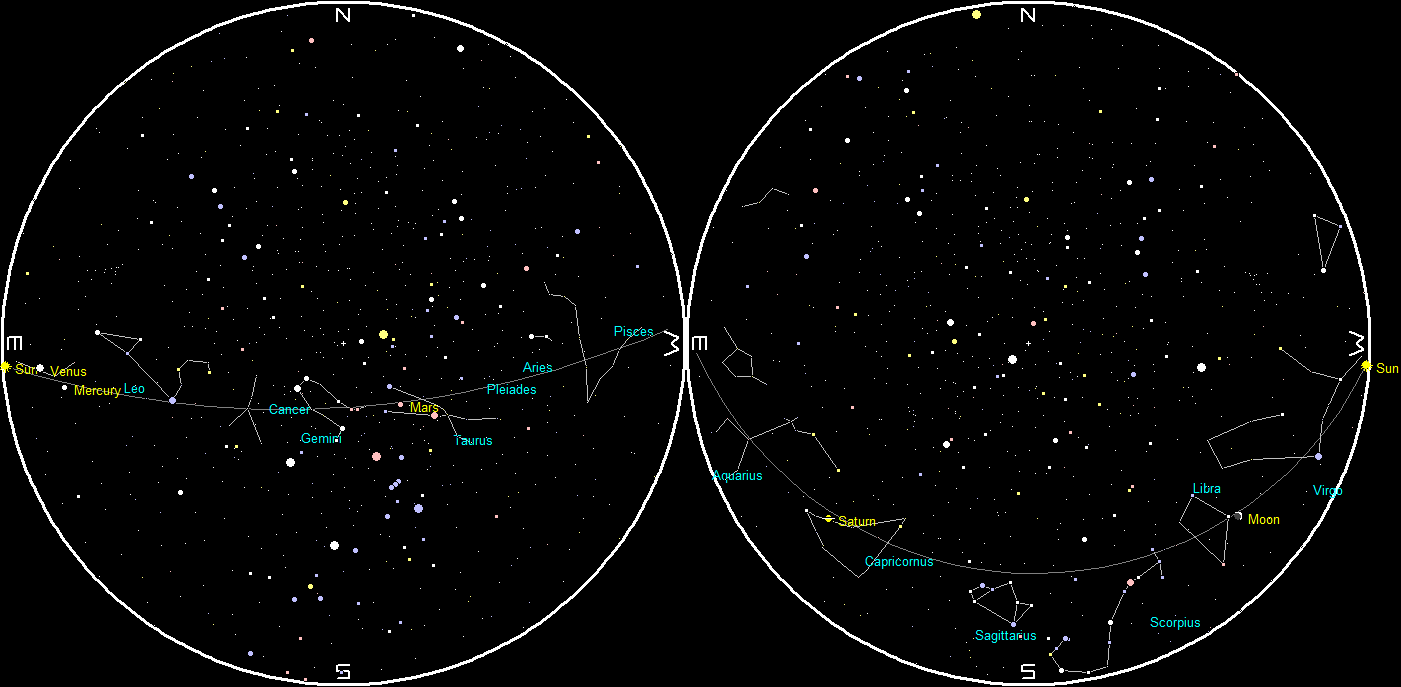
The naked-eye planets and the Moon at sunset and sunrise on a single night, starting with sunset on the right on September 28, 2022. The night ends on the left with sunrise on the 29th. Click on the image to enlarge it. Created using my LookingUp program and GIMP.
09/27/2022 – Ephemeris – Finding the constellation of Perseus the hero
This is Ephemeris for Tuesday, September 27th. Today the Sun will be up for 11 hours and 54 minutes, setting at 7:30, and it will rise tomorrow at 7:37. The Moon, 2 days past new, will set at 8:28 this evening.
Close to the horizon, but rising in the northeast in the evening, is the constellation of Perseus the Greek hero, holding as his prize the severed head of Medusa. To me, the stars don’t seem to match the figure in the stars. It’s either the Greek letter pi (π) tilted to the left or the cartoon roadrunner running up the sky. Perseus’ brightest star is Mirfak in the middle of the top of the letter π, or back of the roadrunner. Using a pair of binoculars to look towards Mirfak, one can see many more stars, just below naked eye visibility near it. It’s a very loose star cluster called the Alpha (α) Persei Association, α Persei being a catalog designation for Mirfak. And Mirfak is actually in the association. Unlike some bright stars, who are just foreground stars.
The astronomical event times given are for the Traverse City/Interlochen area of Michigan (EDT, UT – 4 hours). They may be different for your location.
Addendum
For my take on the mythology featuring Perseus, see The Great Star Story of Autumn. It’s way too long for my short radio program. For Hollywood’s treatment of the story, see Clash of the Titans.
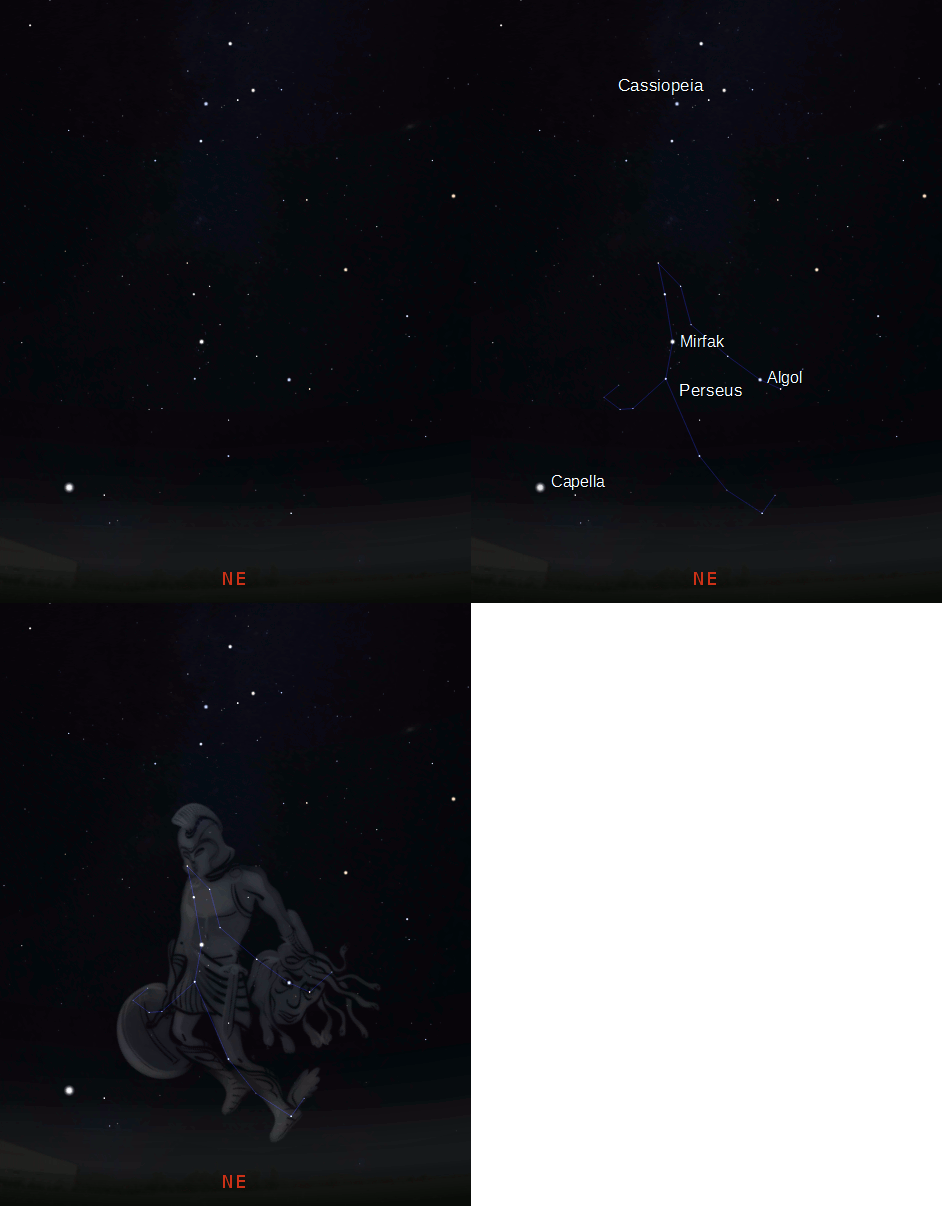
Perseus finder using the animated GIF to show the star field, constellation lines and names, and Perseus as art. Cassiopeia is included as a means to find the dimmer Perseus below it on autumn evenings. Algol, another important star and the second-brightest star of Perseus, is also labeled. I normally cover it around Halloween, but if you can’t wait, type Algol in the search box at the upper right. Created using Stellarium, LibreOffice Draw, and GIMP.
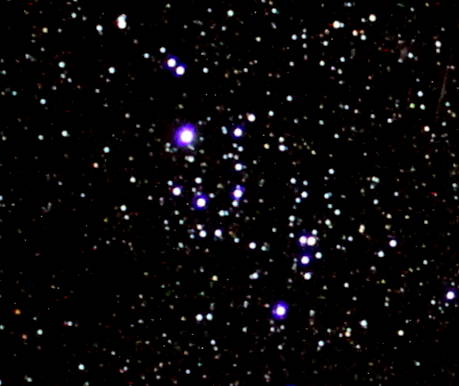
The Alpha Persei Association. The brightest star is Mirfak (Alpha Persei). This is a small section of a photograph taken February 18, 2017, Canon EOS Rebel T5, 121 seconds, f/3.5, 18 mm fl., ISO 3200. Credit Bob Moler.
09/26/2022 – Ephemeris – The DART spacecraft will attempt to deflect an asteroid tonight, Artemis I launch postponed
This is Ephemeris for Monday, September 26th. Today the Sun will be up for 11 hours and 57 minutes, setting at 7:32, and it will rise tomorrow at 7:35. The Moon, 1 day past new, will set at 8:07 this evening.
Tonight at 7:14 pm EDT (23:14 UTC), NASA’s DART spacecraft will collide with the tiny asteroid Dimorphos, which is orbiting the somewhat larger asteroid Didymos. They are potentially hazardous asteroids. The idea is to see what effect the collision has on the orbit of Dimorphos as it orbits Didymos at four tenths of a mile an hour. Trailing DART is an Italian CubeSat LiciaCube (pronounced LEE-cha-cube), which was launched from DART more 15 days ago to witness the collision. DART is an acronym for Double Asteroid Redirection Test, part of the Planetary Defense Program. Earth based radio and optical telescopes will assess if and how much the collision alters the orbit of Dimorphos. LICIAcube will return images of the collision, crater and the other side of Dimorphos. NASA will air it live on their channels.
The astronomical event times given are for the Traverse City/Interlochen area of Michigan (EDT, UT – 4 hours). They may be different for your location.
Addendum
Unlike the Artemis I launch, this event cannot be postponed. It will either hit Dimorphos at 7:14 pm or miss forever.
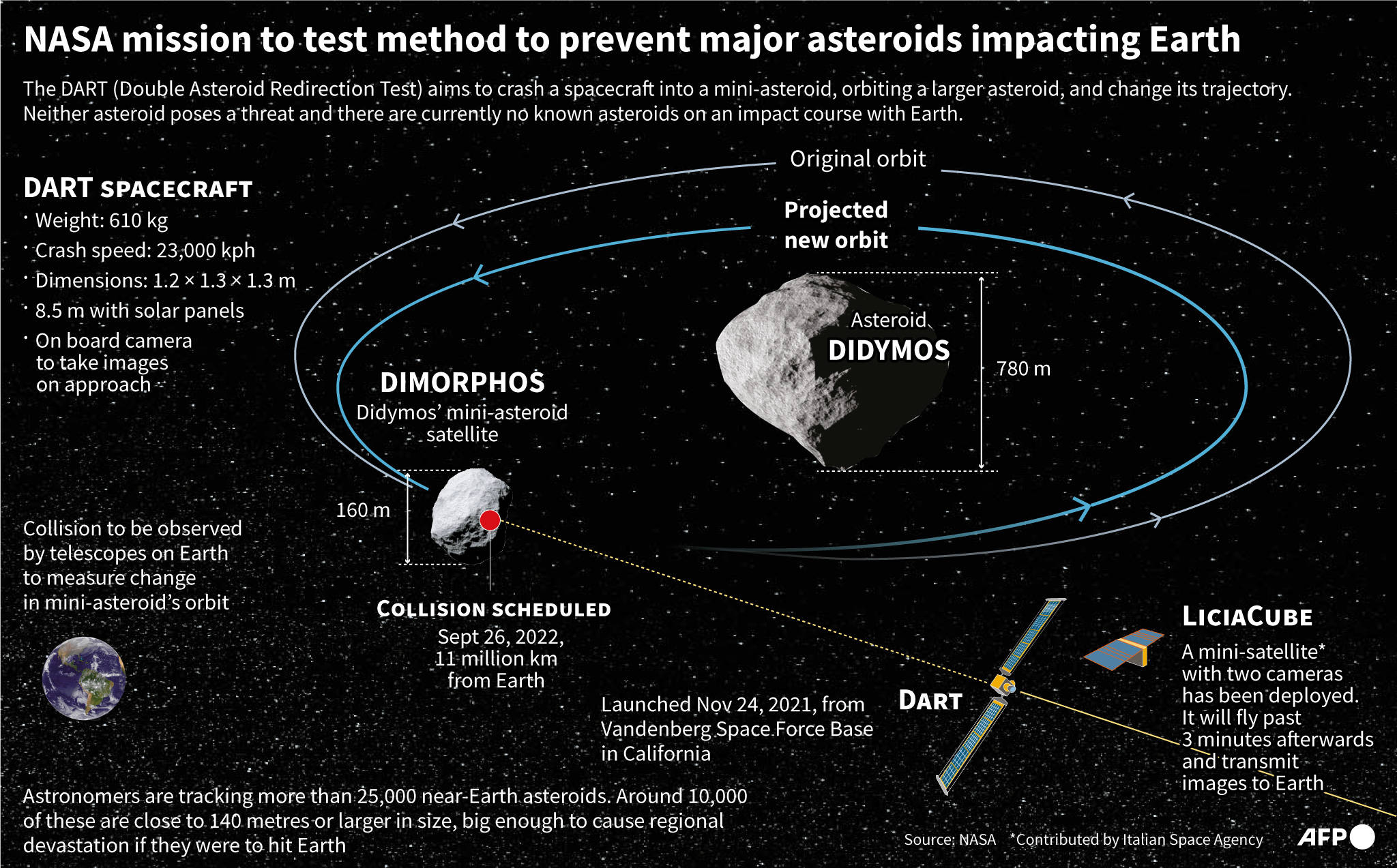
Graphic on NASA’s DART mission to crash a small spacecraft into a mini-asteroid to change its trajectory as a test for any potentially dangerous asteroids in the future. Click on the image to enlarge it. Credit: AFP / AFP (Agence France-Presse)
A Note from EarthSky.org:
If you want to watch the event live, coverage begins at 6 p.m. EDT (22 UTC) on September 26, 2022, on NASA’s website. You can also watch it via Facebook, Twitter and YouTube.
Artemis I news
The Artemis I launch, scheduled for Tuesday, September 27, has been postponed due to the threat from tropical storm Ian.
09/23/2022 – Ephemeris – Weather prospects look dim for a star party tomorrow night, but we won’t know for sure until we get closer
Update: The Star Party has been Canceled
Here’s a deep dark secret: Ephemeris programs are recorded the Sunday night for the week beginning Tuesday through the following Monday. However, the posting of the scripts here is generally done the night before the air date. From this vantage point, with the weather forecast not changing for the past week, it looks like we’ll be greeted with not only clouds but rain. The operative words in the post below are “weather permitting”, Which explains the headline.
This is Ephemeris for Friday, September 23rd. Today the Sun will be up for 12 hours and 7 minutes, setting at 7:38, and it will rise tomorrow at 7:32. The Moon, 2 days before new, will rise at 5:54 tomorrow morning.
Weather permitting, a star party will be held tomorrow night, Saturday, September 24th at Sleeping Bear Dunes National Lakeshore at the Dune Climb starting at 8 pm. The star party will be hosted by the Park Rangers and members of the Grand Traverse Astronomical Society (GTAS), who will bring their telescopes to view the heavens, including the planets Jupiter and Saturn plus the wonders of the summer Milky Way. The telescopes will be set up in the parking area closest to the dune. Saturn will be available immediately, while we wait for Jupiter to rise higher. As it gets darker, more and more wonders of the Milky Way will be seen. They include star clusters and nebulae, clouds of gas and dust from which stars form, and which are expelled in the process of star death.
The astronomical event times given are for the Traverse City/Interlochen area of Michigan (EDT, UT – 4 hours). They may be different for your location.
Addendum
If you are not sure if it will be clear enough to hold the star party, please call the park rangers at 231-326-4700, ext. 5005, for a voicemail message with the decision. Alternately, gtastro.org, the GTAS website, will also display the status of the star party, and if it is canceled by 5 pm on Saturday the 24th.
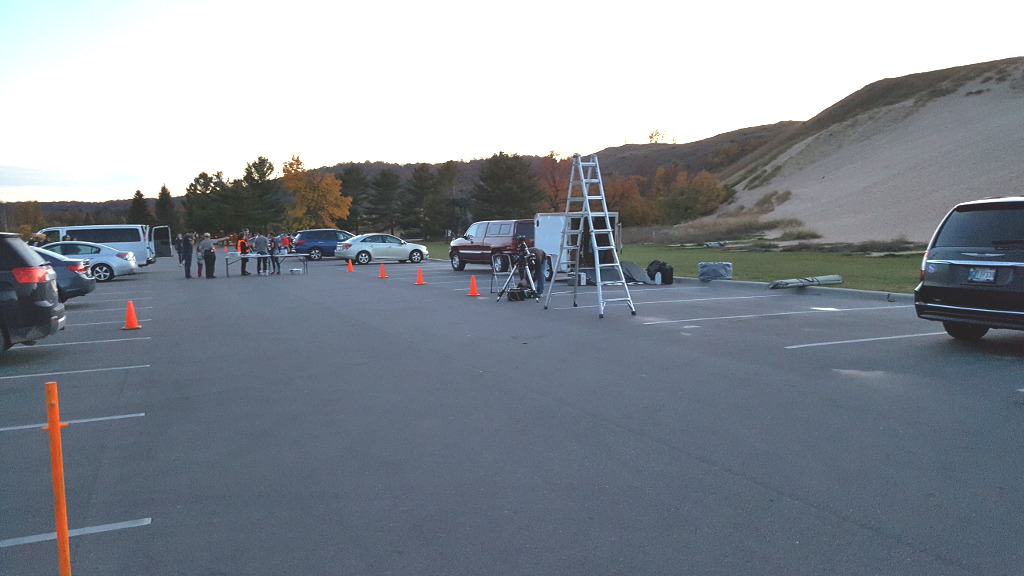
This in the beginning of setup for the October 21, 2017 star party at the dune climb. Taken early, looking to the south-southwest, while there was enough light. The dune blocks up to 12 degrees from the southwest to northwest, but the rest of the horizon is quite low. Note the lone trees on the hill right of the top of the ladder. They are my targets to align my telescope’s finder. Once, while performing the alignment, a fog bank tumbled over that ridge and wiped it out for a time. It was eventually a good night.
We’ve had more than our share of iffy weather at or travelling to the site. A good share of GTAS members live in the Traverse City area, some 30 miles east of the park. More than a few of us, over the years, have driven through rain showers, on our way to the park, for a successful star party. Here’s a link to another night with iffy weather, this time with a lunar eclipse.
09/22/2022 – Ephemeris – Autumn will begin this evening
This is Ephemeris for Thursday, September 22nd. Today the Sun will be up for 12 hours and 10 minutes, setting at 7:40, and it will rise tomorrow at 7:31. The Moon, 3 days before new, will rise at 4:46 tomorrow morning.
The season of fall is about to, ah well, fall upon us and in a few weeks so will the leaves. At 9:04 this evening (1:04 UT tomorrow) the Sun will cross the celestial equator heading south. The celestial equator is an imaginary line in the sky above the earth’s equator. At that point, the Sun will theoretically set at the North Pole and rise at the South Pole. The day is called the autumnal equinox and the daylight hours today is 12 hours and 10 minutes instead of 12 hours exactly. That’s due to our atmosphere and our definition of sunrise and sunset. The reason for the cooler weather now and the cold weather this winter is that the length of daylight is shortening, and the Sun rides lower in the sky, spreading its heat over a larger area, thus diluting its intensity.
The astronomical event times given are for the Traverse City/Interlochen area of Michigan (EDT, UT – 4 hours). They may be different for your location.
Addendum
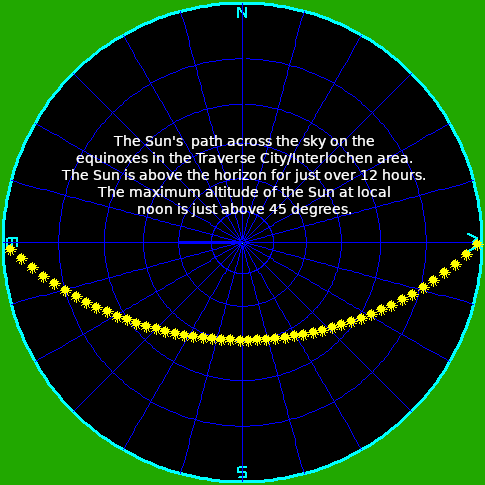
The Sun’s path through the sky on an equinox day from the Traverse City/Interlochen area in Michigan. The Sun is plotted every 15 minutes. This is a stereographic projection which compresses the image near the zenith and enlarges the image towards the horizon. Note that the Sun rises due east and sets due west. Created using my LookingUp program.
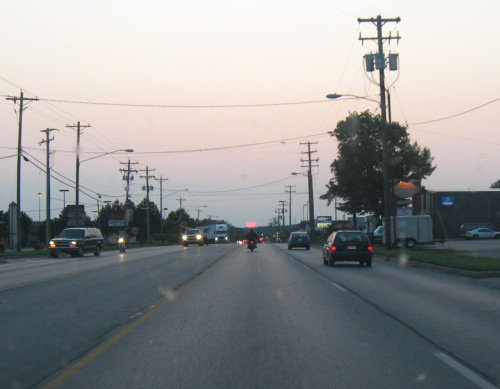
That is not a pumpkin on the head of the motorcyclist. That’s the Sun rising as I’m traveling east on South Airport Road south of Traverse City, MI on the autumnal equinox. This is the east-west section of the road. The Sun is rising over the hills some 6 miles to the east. When the Sun is on the celestial equator, it rises due east and sets due west. Credit: Bob Moler.
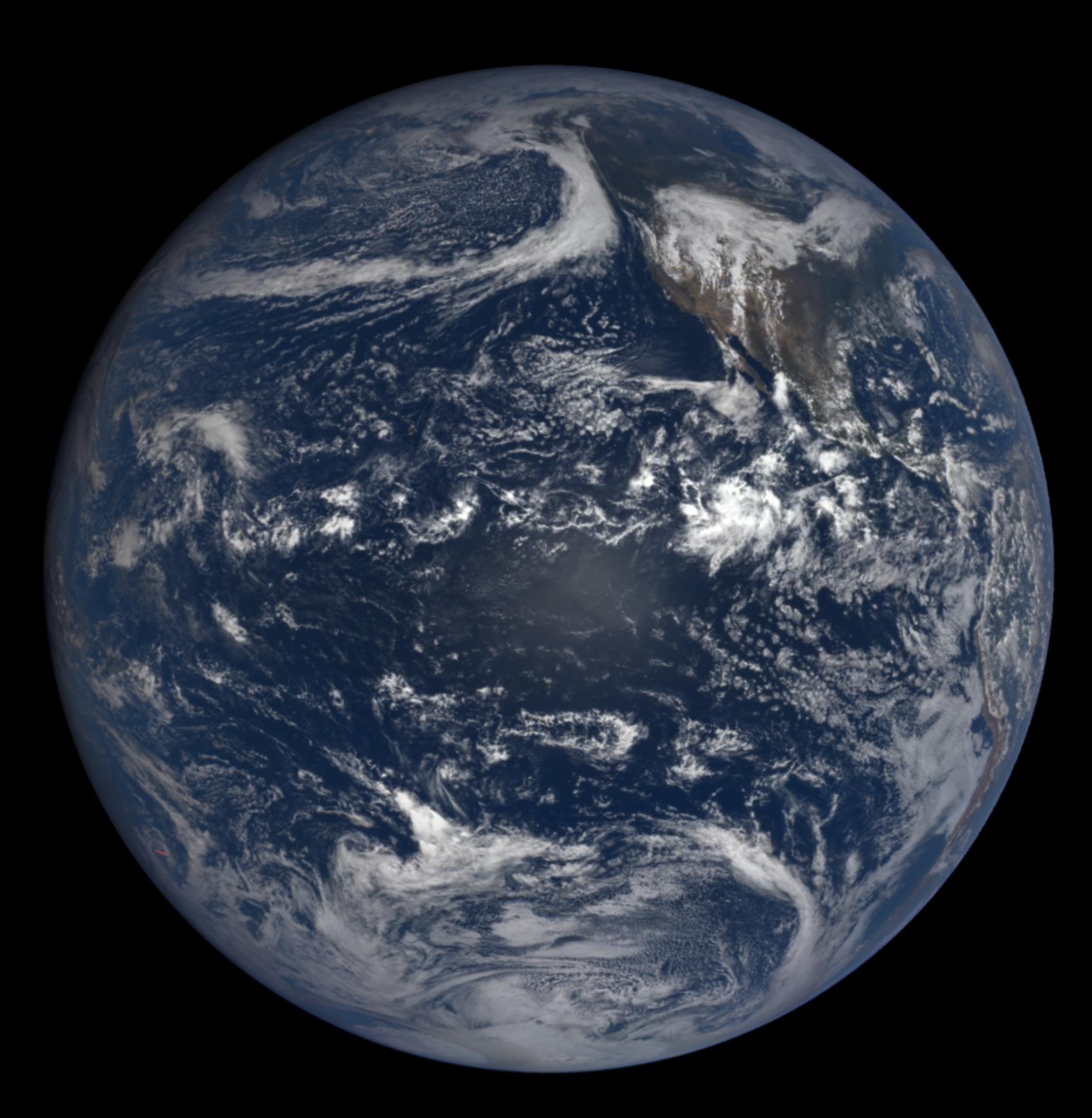
Image from the Earth Polychromatic Imaging Camera (EPIC) on NOAA’s DSCOVR satellite in halo orbit around the Earth-Sun L-1 point 1 million miles sunward from the Earth on the autumnal equinox of 2016. North America is in the upper right of the globe.
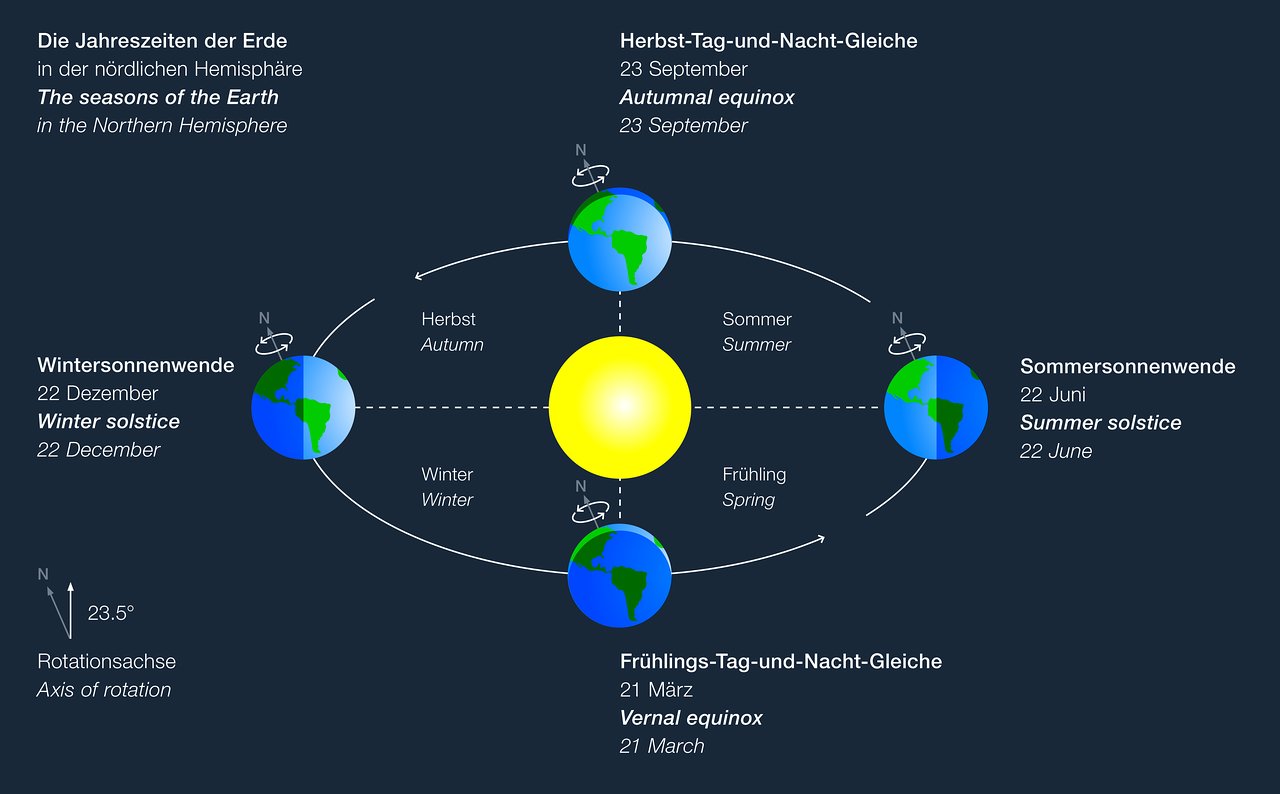
Earth’s position at the solstices and equinoxes. This is an not to scale oblique look at the Earth’s orbit, which is nearly circular. The Earth is actually farthest from the Sun on July 4th. Click on the image to enlarge. Credit: ESO (European Southern Observatory), which explains the captions in German and English.
09/21/2022 – Ephemeris – Let’s search for the naked-eye planets for this week
This is Ephemeris for Wednesday, September 21st. Today the Sun will be up for 12 hours and 13 minutes, setting at 7:41, and it will rise tomorrow at 7:29. The Moon, halfway from last quarter to new, will rise at 3:38 tomorrow morning.
Let’s search for the naked-eye planets for this week. Only one of the naked-eye planets is in the evening sky. Mercury is south of the Sun and cannot be seen. It will pass between the Earth and Sun on Friday and enter the morning sky. As it gets darker, Saturn can be seen in the southeast. Jupiter, though not officially an evening planet, will rise in the east in twilight at 7:54 pm. It is seen against the stars of Pisces now, moving slowly retrograde or westward. At 6:30 am tomorrow, two of the three remaining morning planets will be Mars high in the south, above the winter constellation of Orion, and Jupiter very low in the west. The thin waning crescent Moon will be in the east then. Venus will rise at 6:47 into bright twilight.
The astronomical event times given are for the Traverse City/Interlochen area of Michigan (EDT, UT – 4 hours). They may be different for your location.
Addendum
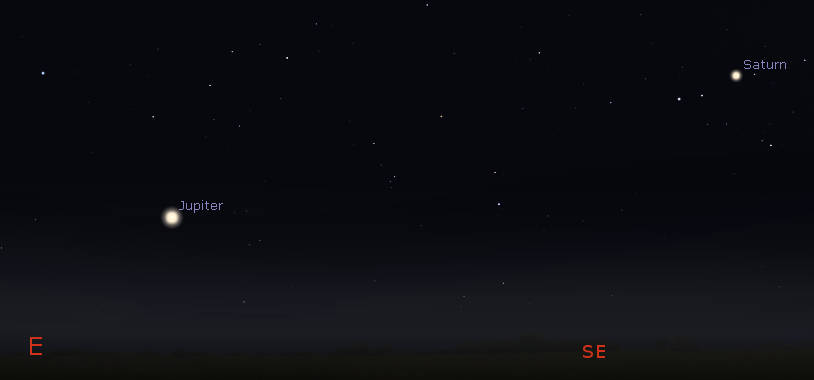
Jupiter and Saturn at 9 pm tonight, September 21, 2022. Created using Stellarium.
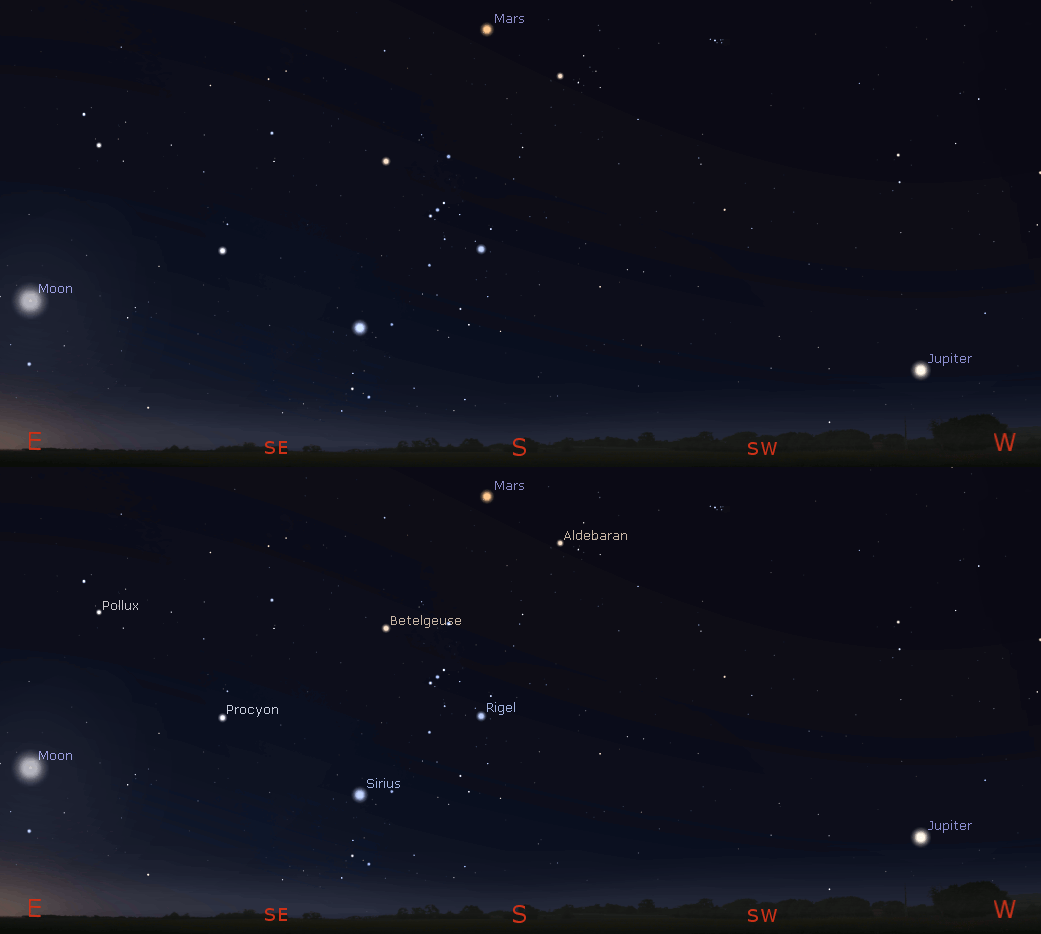
Animation of the morning planets and the waning crescent Moon at 6:30 am tomorrow, September 22, 2022. Star labels are shown alternately, since they clutter the image. Click on the image to enlarge it. Created using Stellarium and GIMP.
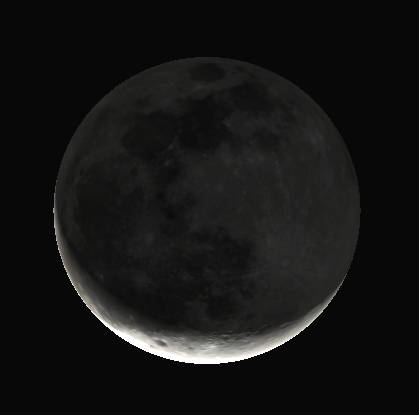
The waning crescent Moon as it might be seen in binoculars or a small telescope. The dark area on the left side of the Moon is Oceanus Procellarum (Ocean of Storms). The dark spot near the bottom of the Moon is the crater Grimaldi. Created using Stellarium.
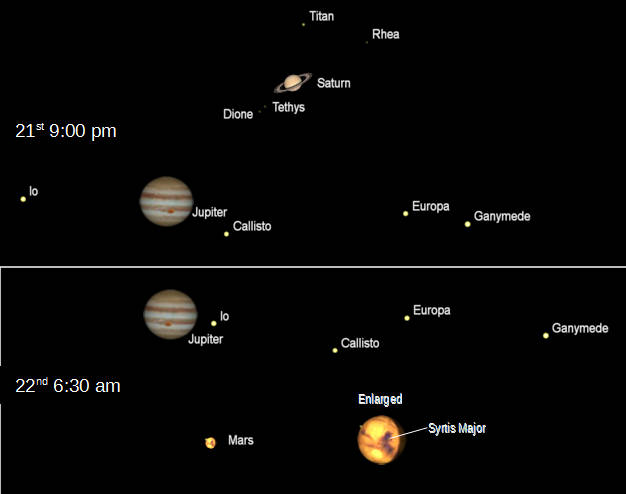
Telescopic views of Saturn Jupiter and Mars (north up) as they would be seen in a small telescope, with the same magnification. The times vary for each planet. Jupiter is shown twice, at 9 pm and 6:30 am, since its moons, especially Io and Europa, move rapidly. I do not show planets less than 10 seconds of arc in diameter. Apparent diameters: Saturn 18.33″, its rings 42.69″; Jupiter 49.85″. Mars 11.21″, 86.6% illuminated. Mars’ distance is 78 million miles (125 million kilometers). The ” symbol means seconds of arc (1/3600th of a degree.) Created using Cartes du Ciel (Sky Charts).
In the above chart, it may appear that Jupiter’s Great Red Spot didn’t move very much. However, the 9.5 hours between the images is a bit less than one Jovian day, so the spot actually made almost one complete rotation. In this view, features on the face of Jupiter rotate from left to right. Satellites behave similarly. They move left to right if in front of the planet, and right to left if behind.
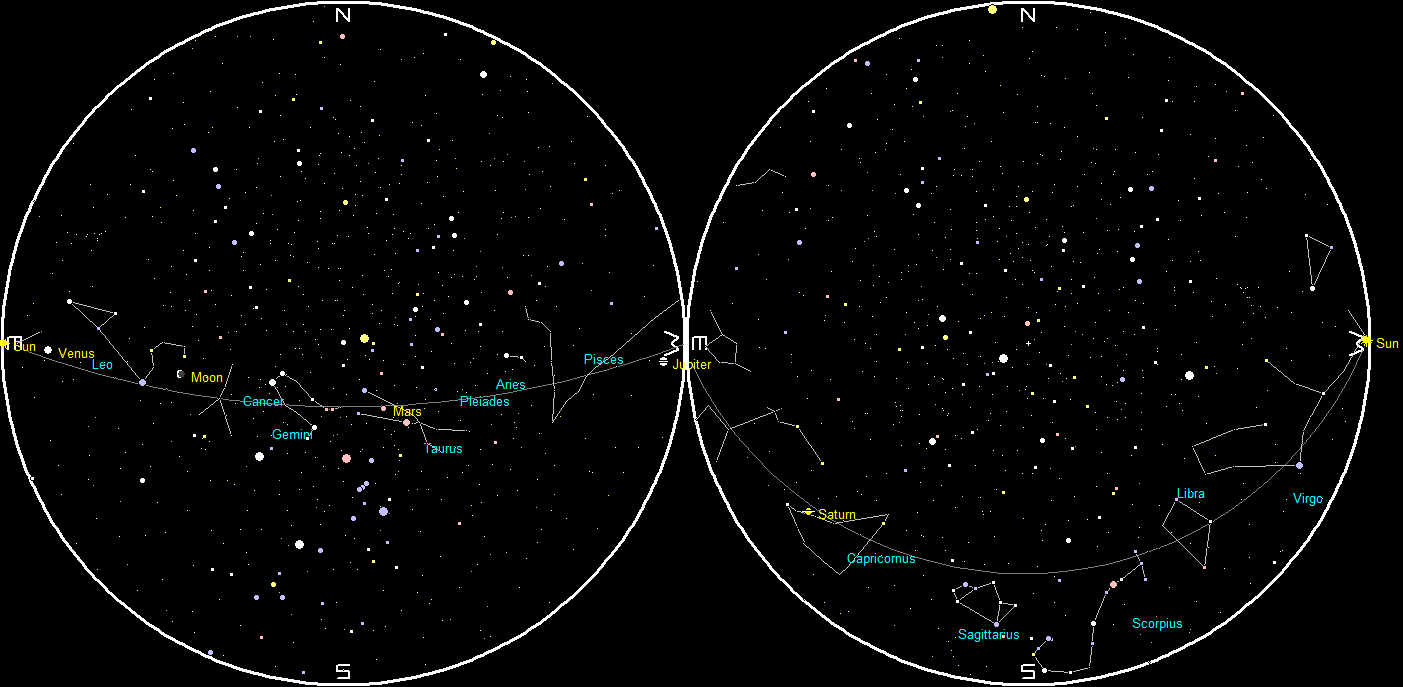
The naked-eye planets and the Moon at sunset and sunrise on a single night, starting with sunset on the right on September 21, 2022. The night ends on the left with sunrise on the 22nd. Click on the image to enlarge it. Created using my LookingUp program and GIMP.
09/20/2022 – Ephemeris – Finding the constellation of Pegasus the flying horse
This is Ephemeris for Tuesday, September 20th. Today the Sun will be up for 12 hours and 16 minutes, setting at 7:43, and it will rise tomorrow at 7:28. The Moon, 3 days past last quarter, will rise at 2:33 tomorrow morning.
Rising about a third of the way up the sky in the east as it gets dark around 9 pm can be found one of the great autumn constellations: Pegasus the flying horse of Greek myth. Its most visible feature is a large square of four stars, now standing on one corner. This feature, called the Great Square of Pegasus, represents the front part of the horse’s body. The horse is quite aerobatic, because it is seen flying upside down. Remembering that fact, the neck and head is a bent line of stars emanating from the right corner star of the square. Its front legs can be seen in a gallop extending to the upper right from the top star of the square. From the left star extend, not hind legs but the constellation of Andromeda, the princess rescued with the help of Pegasus.
The astronomical event times given are for the Traverse City/Interlochen area of Michigan (EDT, UT – 4 hours). They may be different for your location.
Addendum
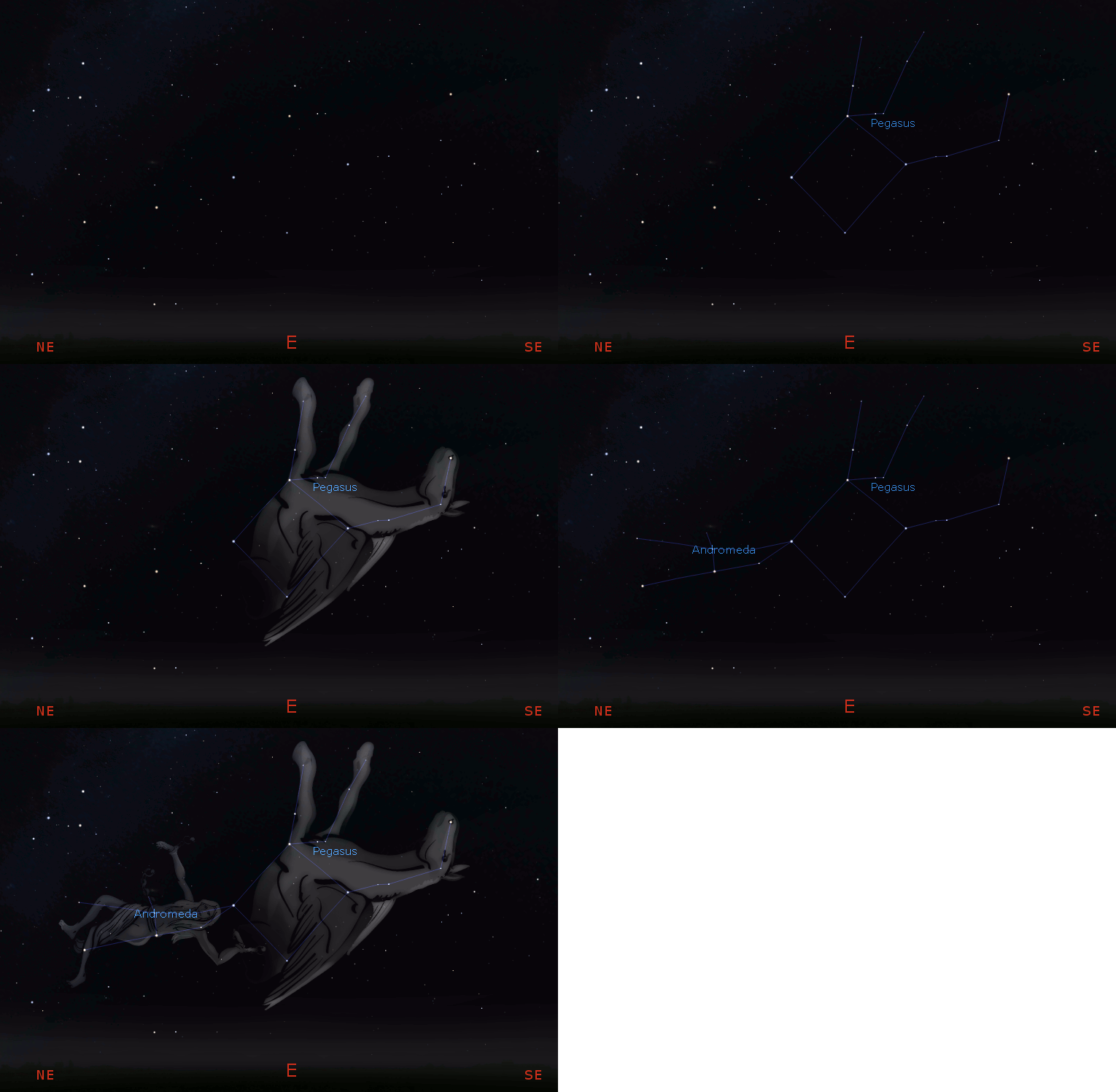
Pegasus & Andromeda animated finder chart for 9 pm in mid-September. To the upper left are most of the stars of the “W” shape of Cassiopeia the queen, Andromeda’s mother. Created using Stellarium and GIMP.
Pegasus, Andromeda and Cassiopeia plus other constellations are characters in the great star story of autumn which I relate here.
09/19/2022 – Ephemeris – Finding the constellation Cepheus
This is Ephemeris for Monday, September 19th. Today the Sun will be up for 12 hours and 19 minutes, setting at 7:45, and it will rise tomorrow at 7:27. The Moon, 2 days past last quarter, will rise at 1:30 tomorrow morning.
There’s a faint constellation in the northeast above the W shaped constellation of Cassiopeia. It’s a nearly upside down church steeple of a constellation called Cepheus the king, and husband of queen Cassiopeia. Cepheus’ claim to modern astronomical fame is that one of its stars, Delta (δ) Cephei, is the archetype for the important Cepheid variable stars. Delta is the bottom most of a trio of stars at the right corner of the constellation. In the early 20th century, Henrietta Leavitt discovered that Cepheids in the nearby galaxy the Large Magellanic Cloud varied in brightness with a period that was related to their average brightness. This meant that Cepheids could be used as standard candles to measure the great distances to other galaxies.
The astronomical event times given are for the Traverse City/Interlochen area of Michigan (EDT, UT – 4 hours). They may be different for your location.
Addendum
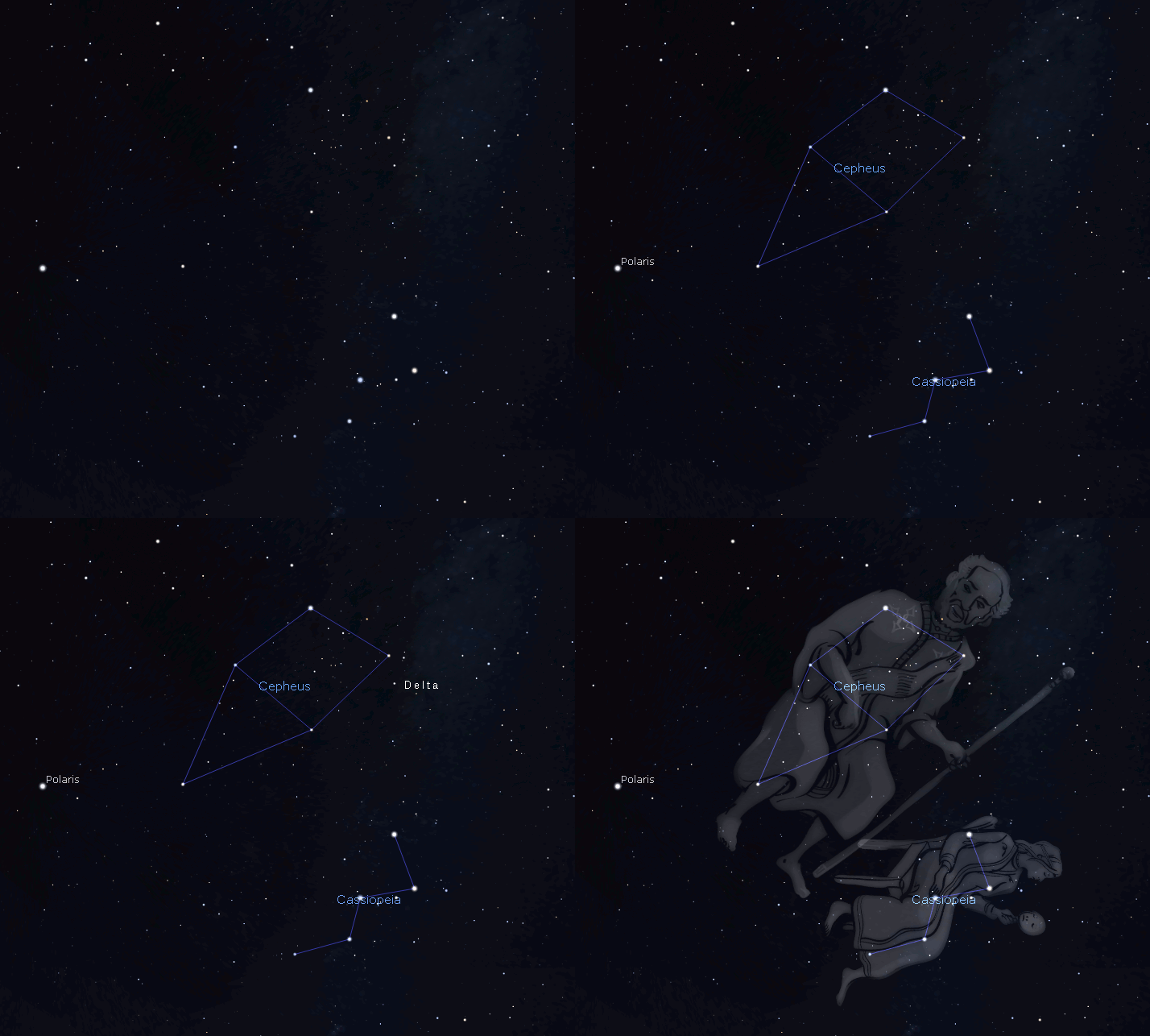
Cassiopeia and Cepheus finder animation looking in the northeast at 9 pm or about an hour after sunset in mid-September. Also labeled is Delta (δ) Cephei. Created using Stellarium and GIMP.
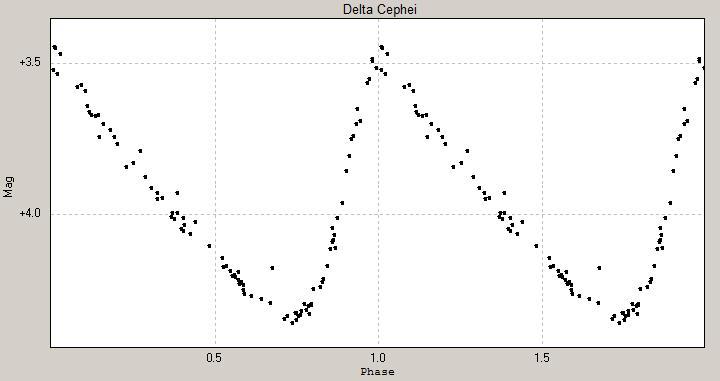
Light Curve of Delta Cephei. The pulsation period is 5.367 days. Note the Magnitude vertical axis, the lower the magnitude the brighter the star is. Blame that on the Greek astronomer Hipparchus, 2nd century BC. It’s like golf scores; the lower the score, the better the golfer, and for magnitudes, the brighter the star. Credit: Thomas K Vbg – Own work, CC BY-SA 3.0, https://commons.wikimedia.org/w/index.php?curid=13887639.
 Bob Moler's Ephemeris Blog