Archive
Ephemeris: 06/10/2024 – Finding Draco the Dragon
This is Ephemeris for Monday, June 10th. Today the Sun will be up for 15 hours and 31 minutes, setting at 9:28, and it will rise tomorrow at 5:56. The Moon, halfway from new to first quarter, will set at 1:09 tomorrow morning.
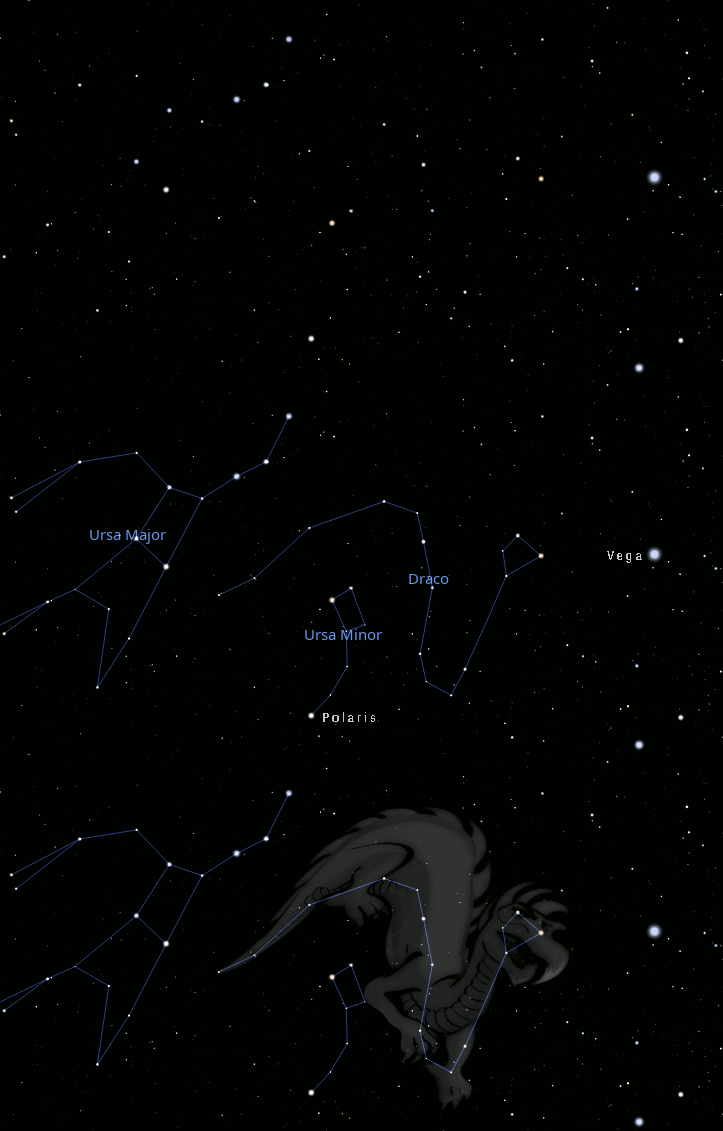
High in the northern sky at 11 p.m. lies the twisted constellation, that of Draco the dragon. This dragon is more like the snakelike Chinese dragon than the dinosaur-like dragon of European legend. I find it better to start at the tail of Draco, to trace him out in the stars. Draco’s tail starts, or ends, between the bowl of the Big Dipper and the Little Dipper high in the north-northwest. The Dragon is seen in a line of stars that extends parallel to the handle of the Big Dipper before curving around the bowl of the Little Dipper then bends back down to the level of Polaris in the north-northeast before turning toward the east. The head of Draco is an odd box of stars near the bright star Vega, high in the east. Though not made up of very bright stars, Draco has an easy shape to trace.
The astronomical event times given are for the Traverse City/Interlochen area of Michigan (EDT, UT–4 hours). They may be different for your location.
Addendum
Ephemeris: 06/07/2024 – GTAS hears from NASA engineer tonight
This is Ephemeris for Friday, June 7th. Today the Sun will be up for 15 hours and 28 minutes, setting at 9:26, and it will rise tomorrow at 5:57. The Moon, 1 day past new, will set at 11:19 this evening.
Tonight’s meeting of the Grand Traverse Astronomical Society will start at 9 pm, at Northwestern Michigan College’s Rogers Observatory. The later start time in June and July will allow the following star party, which will start at the end of the meeting, around 10 pm, to start after sunset. The sky will still be in bright twilight. We are pleased to have Joe Gibson, Principal Flight Software Engineer, from NASA’s Goddard Space Flight Center to speak to us. After the program, at about 10 pm, if it’s clear will be viewing of the skies as it gets dark. The public is always welcome. This meeting also marks the Society’s 42nd anniversary. The observatory is located south of Traverse City on Birmley Road between Garfield and Keystone roads.
The astronomical event times given are for the Traverse City/Interlochen area of Michigan (EDT, UT–4 hours). They may be different for your location.
Addendum

Ephemeris: 06/06/2024 – 80 years ago, D-Day’s astronomical connection
This is Ephemeris for Thursday, June 6th. Today the Sun will be up for 15 hours and 27 minutes, setting at 9:25, and it will rise tomorrow at 5:57. The Moon is new today, and won’t be visible.
Today is the 80th anniversary of the greatest battle of World War II was the Allied invasion of Mainland Europe at Normandy on D-Day, a date governed by the phase of the Moon. The full moon on June the 6th, 1944 gave light for the gliders and paratroopers to carry out their operations at midnight. Plus the high tides were near noon and midnight and the low tides near dawn. The idea was to hit the beach at low tide to enable the landing craft to operate without hitting the obstacles the Germans had planted in the tidal zone. It was great for the landing craft, but the troops had a lot of open beach to run through to get to any sort of shelter. The best days for the invasion were the 5th, 6th and 7th of June. Bad weather on the 5th caused a one day postponement.
The astronomical event times given are for the Traverse City/Interlochen area of Michigan (EDT, UT–4 hours). They may be different for your location.
Addendum

Ephemeris: 06/05/2024 – Where have the naked-eye planets wandered off to this week?
Wonder why I use the term wander? Planets, definitely don’t wander. They do not move aimlessly, but their motions behave by the action of gravitation discovered by Newton and Einstein. However, we do call these bodies planets, from the Greek “Planetes” which means wanderer. By the time of Aristotle circa 4th century BCE, they realized there was a method to their motions. Except for Aristarchus, they all got it wrong. But they did realize that the planet’s motions were predictable.
This is Ephemeris for Wednesday, June 5th. Today the Sun will be up for 15 hours and 26 minutes, setting at 9:24, and it will rise tomorrow at 5:57. The Moon, 1 day before new, will rise at 5:32 tomorrow morning.
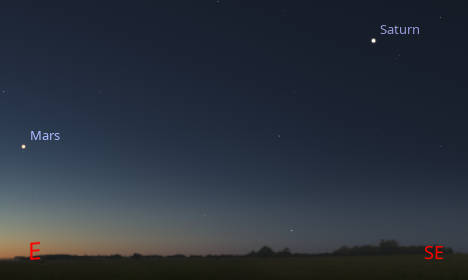
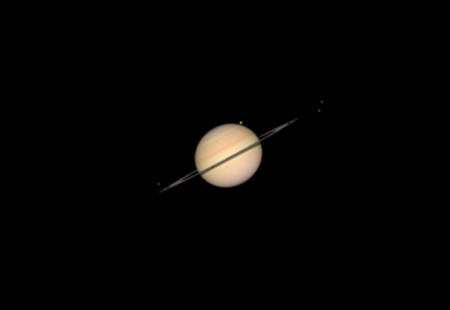
Let’s find out where the naked-eye planets have wandered off to this week, and see what planets are left. Venus, Mercury and Jupiter are now too close to the direction of the Sun to be seen. Venus just entered the evening sky yesterday when it passed behind the Sun in conjunction. It will appear in the evening sky next month, while Jupiter may be visible in the morning later this month. By 5 tomorrow morning, or about an hour before sunrise, Saturn will be low in the southeast and Mars will be lower in the east. In telescopes, Saturn will look fairly different this year and next with its rings nearly edge on to us. They will open up a bit through October before closing again. They are only 2 degrees from being edge on to us.
The astronomical event times given are for the Traverse City/Interlochen area of Michigan (EDT, UT–4 hours). They may be different for your location.
Addendum
Ephemeris: 06/03/2024 – We begin our 50th orbit of the Sun
This is Ephemeris for Monday, June 3rd. Today the Sun will be up for 15 hours and 24 minutes, setting at 9:23, and it will rise tomorrow at 5:58. The Moon, 3 days before new, will rise at 4:20 tomorrow morning.
Today begins Ephemeris’ 50th circuit of the Sun having completed 49 last Friday. Next month will be the 50th anniversary of my stint as a volunteer program producer for IPR, but that’s another story. So already having produced a weekly program for Interlochen Public Radio, which back then was simply, to me anyway, WIAA. I was asked to come up with a week daily program giving out the sunrise and sunset times. Well I really didn’t want to do just that. Back then I had to come into the station to record them. So what I did was add the Moon rise or set times and a little bit of astronomical trivia. By the way an Ephemeris is a table of celestial body positions over time.
The astronomical event times given are for the Traverse City/Interlochen area of Michigan (EDT, UT–4 hours). They may be different for your location.
Addendum
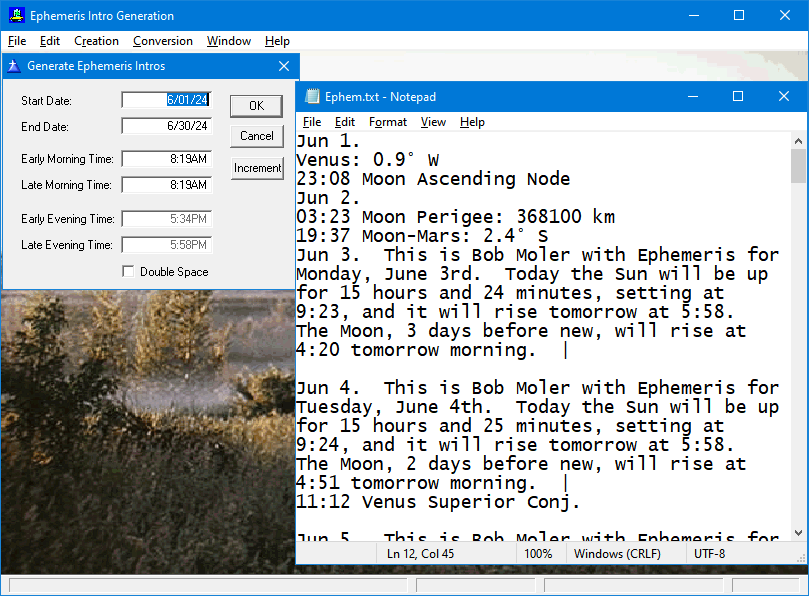
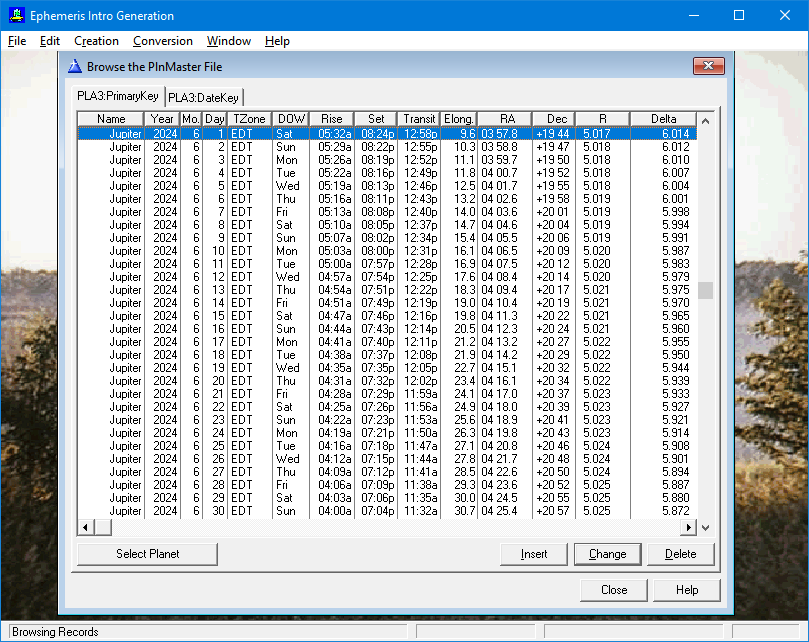
My programming background is not that of scientific coding, but that of the financial industry which is completely different. So I had to pretty much learn on my own and use references for the coding and algorithms for the calculation of astronomical positions, times, and events.
Ephemeris: 05/31/2024 – Previewing June’s skies
This is Ephemeris for Friday, May 31st. Today the Sun will be up for 15 hours and 20 minutes, setting at 9:21, and it will rise tomorrow at 6:00. The Moon, 1 day past last quarter, will rise at 3:12 tomorrow morning.
This is the last program of Ephemeris’ 49th orbit of the Sun, so let’s preview June skies, starting the 50th circuit. There will be a lot of sunlight in June. The daylight hours will increase a bit from 15 hours and 21 minutes tomorrow to 15 hours and 34 minutes on the 20th, the summer solstice, retreating back to 15 hours and 31 minutes at month’s end. At this time of the year the sunset times for Ludington, Interlochen, Petoskey and Mackinaw City are very nearly the same. However, the sunrise times are at their most divergent. With Ludington’s sunrise being 14 minutes later than Mackinaw City’s. The altitude of the Sun above the southern horizon at local noon will hover around 68 degrees. Local noon, when the Sun is actually due south in the Interlochen area will occur at about 1:43 p.m.
The astronomical event times given are for the Traverse City/Interlochen area of Michigan (EDT, UT–4 hours). They may be different for your location.
Addendum
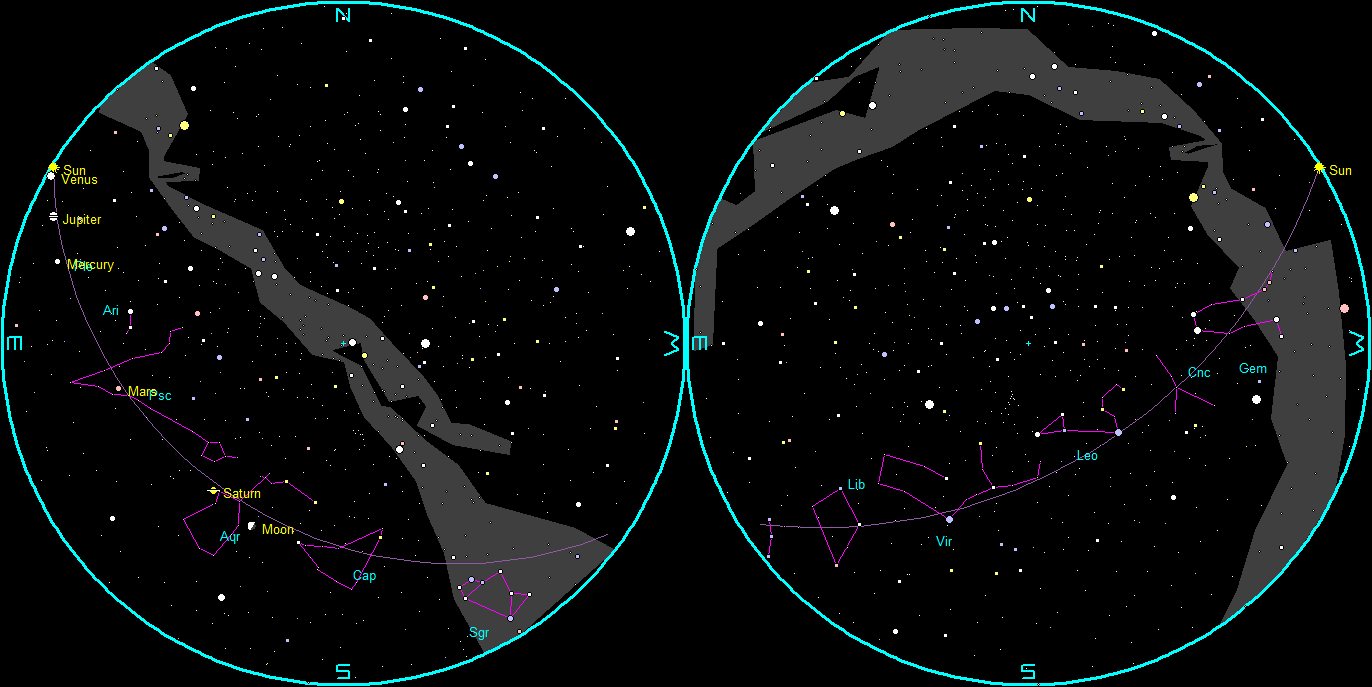
June Evening Star Chart
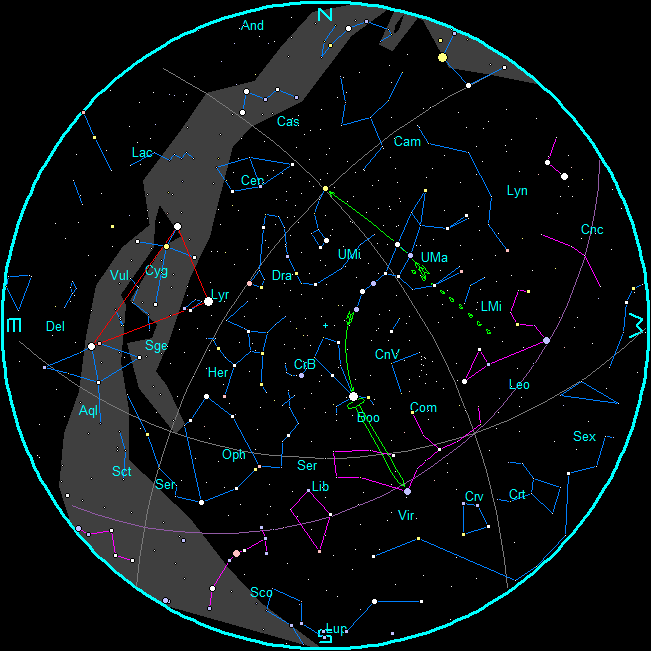
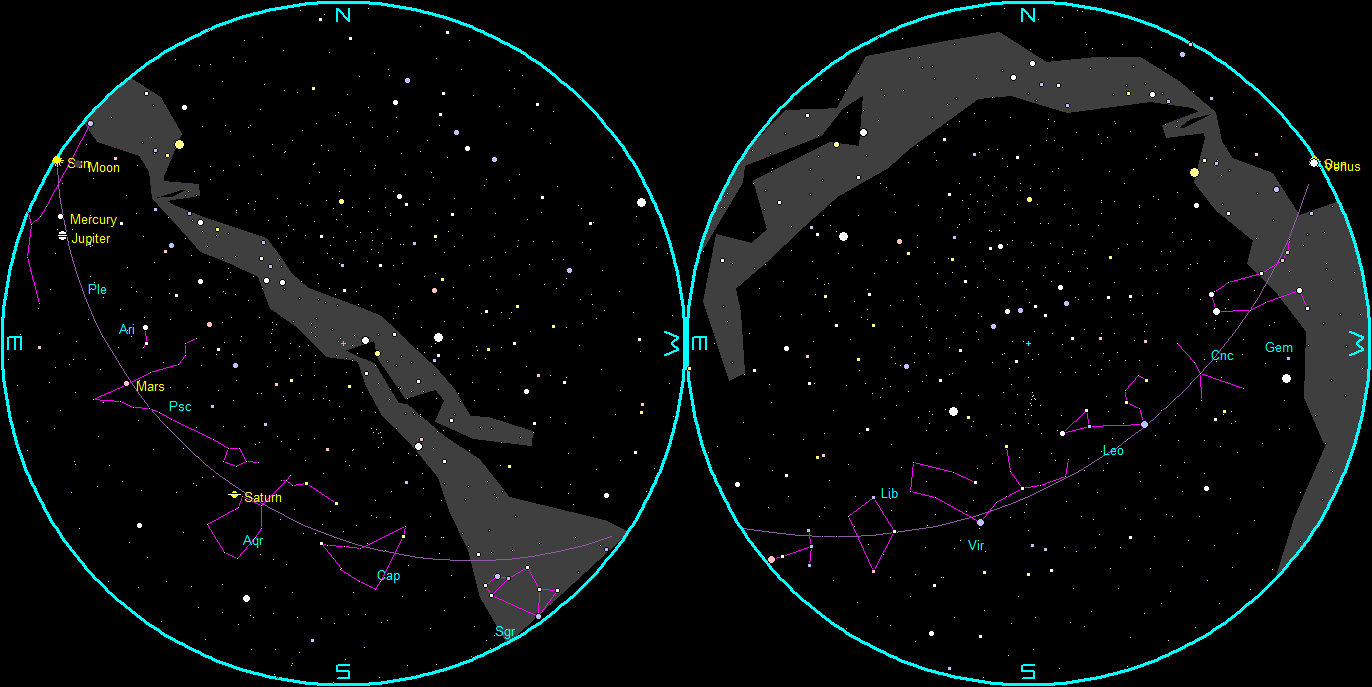
The planets and stars are plotted for the 15th at 11 p.m. EDT in the evening and 4 a.m. for the morning chart. These are the chart times. Note that Interlochen/Traverse City is located approximately 45 minutes behind our time meridian, West 75° longitude. (An hour 45 minutes behind our daylight saving time meridian during EDT). To duplicate the star positions on a planisphere you may have to set it to 1 hour 45 minutes earlier than the current time.
Note, the chart times of 11 p.m. and 4 a.m. are for the 15th. For each week before the 15th, add ½ hour (28 minutes if you’re picky). For each week after the 15th, subtract ½ hour, or 28 minutes. The planet positions are updated each Wednesday on this blog. For planet positions on dates other than the 15th, check the Wednesday planet posts on this blog for weekly positions.
June Morning Star Chart
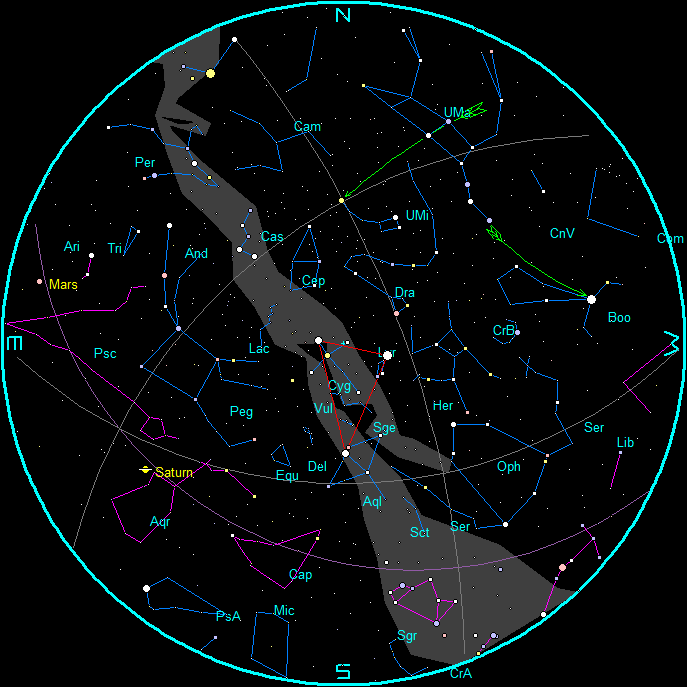
For a list of constellation names to go with the abbreviations, click here.
- Pointer stars at the front of the bowl of the Big Dipper point to Polaris, the North Star.
- Leaky dipper drips on Leo
- Follow the arc of the handle of the Big Dipper to the star Arcturus, and
- Extend like a spike to Spica,
Twilight Limits, Nautical and Astronomical
| EDT | |||||||
| Morning | Twilight | Evening | Twilight | Dark | Night | Moon | |
| Date | Astro. | Nautical | Nautical | Astro. | Start | End | Illum. |
| 2024-06-01 | 3h39m | 4h38m | 22h47m | 23h46m | 23h46m | 3h13m | 0.23 |
| 2024-06-02 | 3h38m | 4h37m | 22h48m | 23h48m | 23h48m | 3h33m | 0.14 |
| 2024-06-03 | 3h36m | 4h37m | 22h49m | 23h49m | 23h49m | 3h36m | 0.07 |
| 2024-06-04 | 3h35m | 4h36m | 22h50m | 23h51m | 23h51m | 3h35m | 0.02 |
| 2024-06-05 | 3h34m | 4h35m | 22h51m | 23h52m | 23h52m | 3h34m | 0.00 |
| 2024-06-06 | 3h33m | 4h35m | 22h52m | 23h54m | 23h54m | 3h33m | 0.01 |
| 2024-06-07 | 3h32m | 4h34m | 22h53m | 23h55m | 23h55m | 3h32m | 0.03 |
| 2024-06-08 | 3h32m | 4h34m | 22h54m | 23h56m | – | 3h32m | 0.08 |
| 2024-06-09 | 3h31m | 4h33m | 22h55m | 23h57m | 0h07m | 3h31m | 0.15 |
| 2024-06-10 | 3h30m | 4h33m | 22h56m | 23h58m | 0h42m | 3h30m | 0.23 |
| 2024-06-11 | 3h30m | 4h33m | 22h56m | 23h59m | 1h10m | 3h30m | 0.31 |
| 2024-06-12 | 3h29m | 4h32m | 22h57m | 0h00m | 1h32m | 3h29m | 0.40 |
| 2024-06-13 | 3h29m | 4h32m | 22h58m | 0h01m | 1h50m | 3h29m | 0.50 |
| 2024-06-14 | 3h28m | 4h32m | 22h58m | 0h02m | 2h06m | 3h28m | 0.59 |
| 2024-06-15 | 3h28m | 4h32m | 22h59m | 0h03m | 2h22m | 3h28m | 0.68 |
| 2024-06-16 | 3h28m | 4h32m | 22h59m | 0h03m | 2h38m | 3h28m | 0.77 |
| 2024-06-17 | 3h28m | 4h32m | 23h00m | 0h04m | 2h56m | 3h28m | 0.85 |
| 2024-06-18 | 3h28m | 4h32m | 23h00m | 0h04m | 3h16m | 3h28m | 0.91 |
| 2024-06-19 | 3h28m | 4h32m | 23h00m | 0h05m | – | – | 0.96 |
| 2024-06-20 | 3h28m | 4h32m | 23h01m | 0h05m | – | – | 0.99 |
| 2024-06-21 | 3h28m | 4h32m | 23h01m | 0h05m | – | – | 1.00 |
| 2024-06-22 | 3h28m | 4h33m | 23h01m | 0h05m | – | – | 0.98 |
| 2024-06-23 | 3h29m | 4h33m | 23h01m | 0h05m | – | – | 0.94 |
| 2024-06-24 | 3h29m | 4h34m | 23h01m | 0h05m | – | – | 0.88 |
| 2024-06-25 | 3h30m | 4h34m | 23h01m | 0h05m | 0h05m | 0h09m | 0.79 |
| 2024-06-26 | 3h31m | 4h34m | 23h01m | 0h05m | 0h05m | 0h36m | 0.69 |
| 2024-06-27 | 3h31m | 4h35m | 23h01m | 0h04m | 0h04m | 0h58m | 0.58 |
| 2024-06-28 | 3h32m | 4h36m | 23h01m | 0h04m | 0h04m | 1h18m | 0.47 |
| 2024-06-29 | 3h33m | 4h36m | 23h00m | 0h03m | 0h03m | 1h38m | 0.35 |
| 2024-06-30 | 3h34m | 4h37m | 23h00m | 0h03m | 0h03m | 1h58m | 0.25 |
The twilight calendar was generated using Cartes du Ciel (Sky Charts), with some corrections.
See my blog post: Twilight Zone for the definitions of the different periods of twilight here: https://bobmoler.wordpress.com/2018/09/27/.
NASA Calendar of Planetary Events
Jun  1  Sa            Venus:  .9° W
     1  Sa  11:08 pm  Moon Ascending Node
     2  Su   3:23 am  Moon Perigee: 368100 km
     2  Su   7:37 pm  Moon-Mars: 2.4° S
     4  Tu  11:12 am  Venus Superior Conj.
     6  Th   8:38 am  New Moon
     7  Fr  12:40 pm  Moon North Dec.: 28.4° N
     9  Su   3:23 am  Moon-Pollux: 1.9° N
    10  Mo   3:34 am  Moon-Beehive: 3.4° S
    14  Fr   1:18 am  First Quarter
    14  Fr   9:36 am  Moon Apogee: 404100 km
    14  Fr  12:15 pm  Mercury Superior Conj.
    15  Sa   4:17 pm  Moon Descending Node
    16  Su   1:28 pm  Moon-Spica: 1.3° S
    20  Th   6:33 am  Moon-Antares:  .4° S
    20  Th   4:51 pm  Summer Solstice
    21  Fr   9:08 pm  Full Moon
    21  Fr  10:41 pm  Moon South Dec.: 28.3° S
    27  Th   7:45 am  Moon Perigee: 369300 km
    27  Th  10:52 am  Moon-Saturn:  .1° S
    28  Fr   1:39 pm  Mercury-Pollux: 4.8° S
    28  Fr   5:53 pm  Last Quarter
    29  Sa  12:26 am  Moon Ascending Node
Jul  1  Mo            Venus: 7.4° E
Sky Events Calendar by Fred Espenak and Sumit Dutta (NASA’s GSFC),
http://eclipse.gsfc.nasa.gov/SKYCAL/SKYCAL.html.
Sun and Moon Rising and Setting Events
LU             Ephemeris of Sky Events for Interlochen/TC
June, 2024    Local time zone: EDT
+-----------------------------------------------------------------------+
| DATE |  SUN     SUN  DAYLIGHT|   TWILIGHT*    |MOON  RISE OR    ILLUM |
|      |  RISE    SET    HOURS |  END    START  |PHASE SET** TIME FRACTN|
+=======================================================================+
|Sat  1| 06:00a  09:21p  15:21 | 10:45p  04:36a |      Rise 03:32a   25%|
+------+-----------------------+----------------+-----------------------+
|Sun  2| 05:59a  09:22p  15:23 | 10:46p  04:36a |      Rise 03:54a   16%|
|Mon  3| 05:59a  09:23p  15:24 | 10:47p  04:35a |      Rise 04:20a    8%|
|Tue  4| 05:58a  09:24p  15:25 | 10:48p  04:34a |      Rise 04:51a    3%|
|Wed  5| 05:58a  09:24p  15:26 | 10:49p  04:34a |      Rise 05:32a    0%|
|Thu  6| 05:57a  09:25p  15:27 | 10:50p  04:33a |New   Set  10:18p    0%|
|Fri  7| 05:57a  09:26p  15:28 | 10:51p  04:32a |      Set  11:19p    3%|
|Sat  8| 05:57a  09:26p  15:29 | 10:52p  04:32a |      Set  12:06a    7%|
+------+-----------------------+----------------+-----------------------+
|Sun  9| 05:57a  09:27p  15:30 | 10:52p  04:32a |      Set  12:42a   13%|
|Mon 10| 05:56a  09:28p  15:31 | 10:53p  04:31a |      Set  01:09a   21%|
|Tue 11| 05:56a  09:28p  15:31 | 10:54p  04:31a |      Set  01:31a   29%|
|Wed 12| 05:56a  09:29p  15:32 | 10:54p  04:31a |      Set  01:49a   38%|
|Thu 13| 05:56a  09:29p  15:32 | 10:55p  04:30a |      Set  02:06a   48%|
|Fri 14| 05:56a  09:30p  15:33 | 10:56p  04:30a |F Qtr Set  02:22a   57%|
|Sat 15| 05:56a  09:30p  15:33 | 10:56p  04:30a |      Set  02:38a   67%|
+------+-----------------------+----------------+-----------------------+
|Sun 16| 05:56a  09:30p  15:34 | 10:57p  04:30a |      Set  02:55a   75%|
|Mon 17| 05:56a  09:31p  15:34 | 10:57p  04:30a |      Set  03:16a   83%|
|Tue 18| 05:56a  09:31p  15:34 | 10:57p  04:30a |      Set  03:41a   90%|
|Wed 19| 05:56a  09:31p  15:34 | 10:58p  04:30a |      Set  04:15a   95%|
|Thu 20| 05:57a  09:31p  15:34 | 10:58p  04:30a |      Set  04:59a   99%|
|Fri 21| 05:57a  09:32p  15:34 | 10:58p  04:31a |Full  Rise 09:57p  100%|
|Sat 22| 05:57a  09:32p  15:34 | 10:58p  04:31a |      Rise 10:52p   99%|
+------+-----------------------+----------------+-----------------------+
|Sun 23| 05:57a  09:32p  15:34 | 10:58p  04:31a |      Rise 11:35p   95%|
|Mon 24| 05:58a  09:32p  15:34 | 10:58p  04:31a |      Rise 12:09a   89%|
|Tue 25| 05:58a  09:32p  15:33 | 10:58p  04:32a |      Rise 12:35a   81%|
|Wed 26| 05:58a  09:32p  15:33 | 10:58p  04:32a |      Rise 12:58a   71%|
|Thu 27| 05:59a  09:32p  15:33 | 10:58p  04:33a |      Rise 01:18a   60%|
|Fri 28| 05:59a  09:32p  15:32 | 10:58p  04:34a |L Qtr Rise 01:37a   49%|
|Sat 29| 06:00a  09:32p  15:31 | 10:57p  04:34a |      Rise 01:58a   38%|
+------+-----------------------+----------------+-----------------------+
|Sun 30| 06:00a  09:32p  15:31 | 10:57p  04:35a |      Rise 02:22a   27%|
+-----------------------------------------------------------------------+
* Nautical Twilight
** Moonrise or moonset, whichever occurs between sunset and sunrise
Generated using my LookingUp for DOS program.
Ephemeris: 05/30/2024 – Virgo and what’s hidden within
This is Bob Moler with Ephemeris for Thursday, May 30th. Today the Sun will be up for 15 hours and 18 minutes, setting at 9:20, and it will rise tomorrow at 6:00. The Moon, at last quarter today, will rise at 2:52 tomorrow morning.
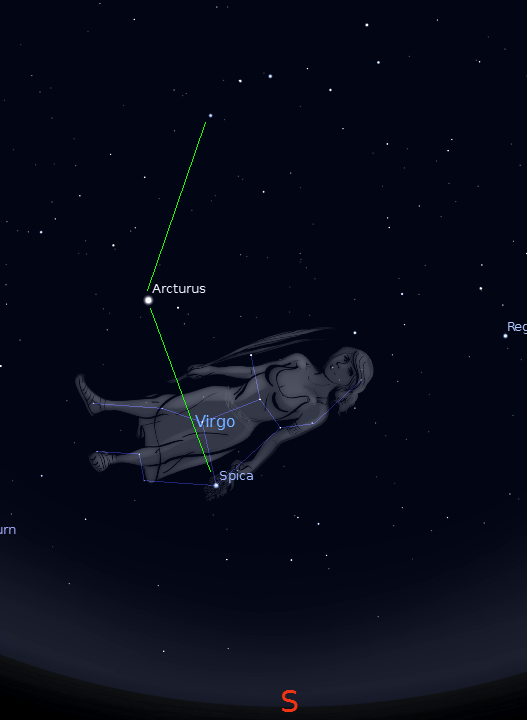
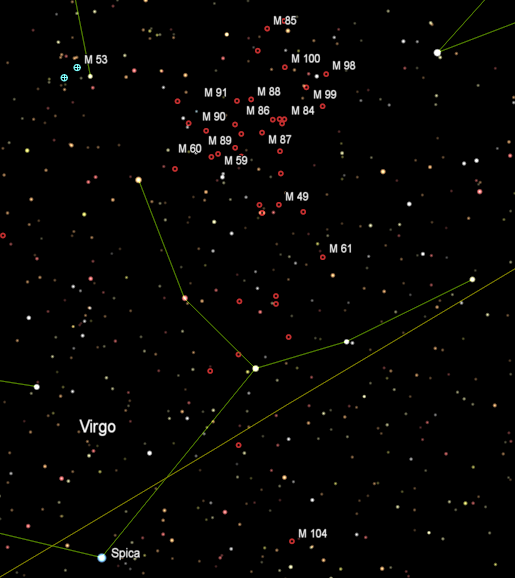
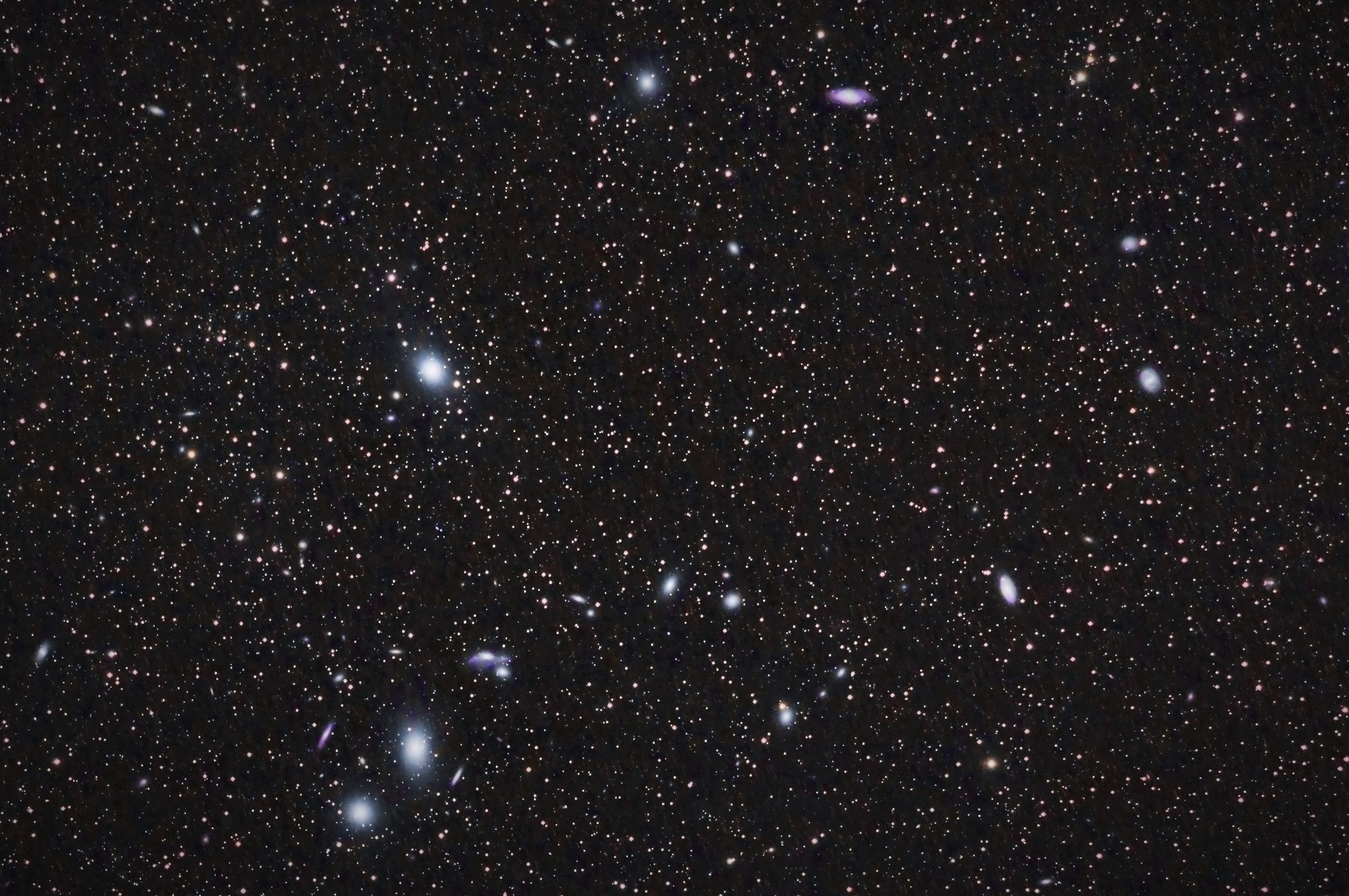
One of the large constellations we see in the south at 11 p.m. can be found using the Big Dipper overhead, follow the arc of the handle to the bright star Arcturus, then straighten the arc to a spike to reach Spica, a bright blue-white star in the south. Spica is the brightest star in the constellation Virgo, the virgin. She represents the goddess of the harvest, Virgo is holding a sheaf of wheat in depictions of her, and Spica is placed at the head of the sheaf. In the space between Spica and Leo the lion to her upper right is, a great cluster of thousands of galaxies just below naked eye visibility. The Virgo Cluster. Inside that cluster is galaxy M87, in whose center lies a black hole with the mass of 6.5 billion suns. The center of the cluster is at about 54 million light years away. The first black hole imaged by the Earth spanning Event Horizon Telescope.
The astronomical event times given are for the Traverse City/Interlochen area of Michigan (EDT, UT–4 hours). They may be different for your location.
Addendum
Ephemeris: 05/29/2024 – Where have the naked-eye planets wandered off to this week?
This is Ephemeris for Wednesday, May 29th. Today the Sun will be up for 15 hours and 17 minutes, setting at 9:19, and it will rise tomorrow at 6:01. The Moon, 1 day before last quarter, will rise at 2:31 tomorrow morning.
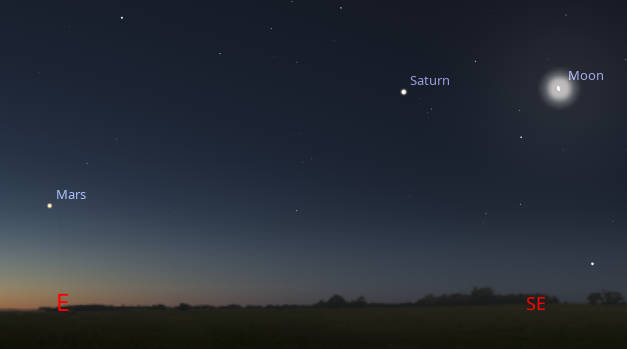
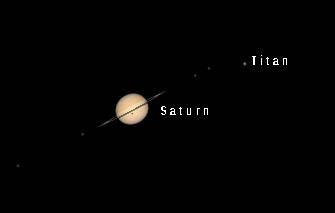
Let’s find out where the naked-eye planets have wandered off to this week, and see what planets are left. Venus, Mercury and Jupiter are now too close to the direction of the Sun to be seen. Venus will appear in the evening sky by July, while Jupiter may be visible in the morning in late June. By 5:15 tomorrow morning, or about 45 minutes before sunrise, Saturn will be low in the southeast and Mars will be lower still in the east. In telescopes, Saturn will look fairly different this year and next with its rings nearly edge on to us. They will open up a bit through October before closing again. We won’t see the rings go exactly edge on because Saturn will be too close to the Sun in the sky on March 23rd next year. After that, the rings will open up again.
The astronomical event times given are for the Traverse City/Interlochen area of Michigan (EDT, UT–4 hours). They may be different for your location.
Addendum
Ephemeris: 05/28/2024 – Finding Spica and Virgo
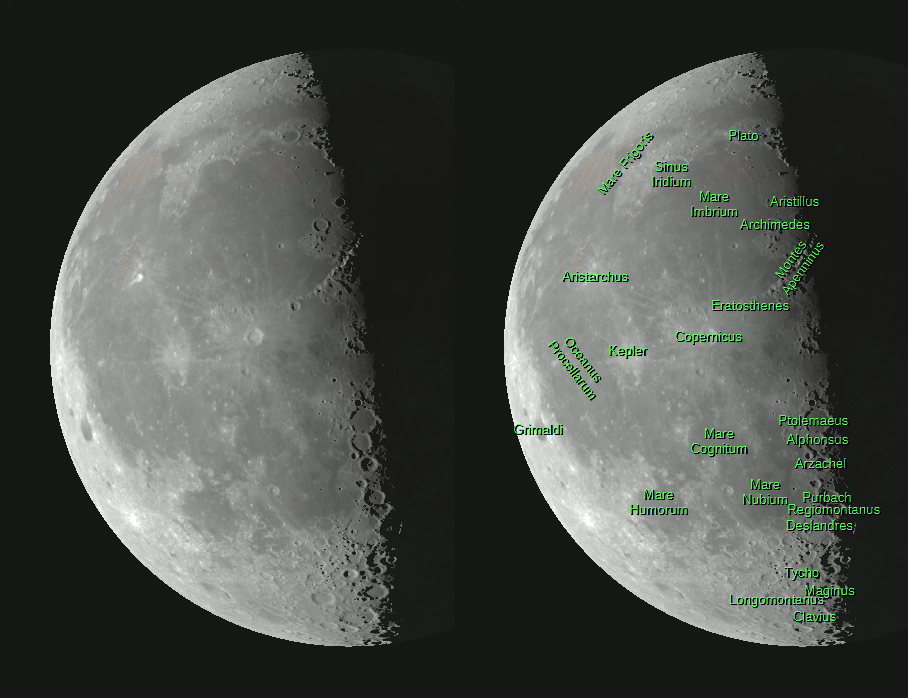
This is Ephemeris for Tuesday, May 28th. Today the Sun will be up for 15 hours and 15 minutes, setting at 9:18, and it will rise tomorrow at 6:01. The Moon, 2 days before last quarter, will rise at 2:06 tomorrow morning.
The Big Dipper, near the zenith at 10:30 pm points to several stars and constellations. It’s handle points to two bright stars. First we follow the arc of the handle to the bright orange star Arcturus, the 4th brightest nighttime star. The reason I say nighttime is that the Sun is a star also, but by definition is not out at night. The arc to Arcturus is a way to find Arcturus and a clue to its name. Arcturus, high in the south-southeast, lies at the base point of the kite shaped constellation of Boötes the herdsman. From Arcturus, straighten out the arc to a spike and one soon arrives at Spica a blue-white star in Virgo the virgin, now in the south. Spica is also sometimes pronounced ‘Speeka’.
The astronomical event times given are for the Traverse City/Interlochen area of Michigan (EDT, UT–4 hours). They may be different for your location.
Addendum
Ephemeris: 05/27/2024 The evening sky is transitioning into summer
This is Bob Moler with Ephemeris for Memorial Day, Monday, May 27th. Today the Sun will be up for 15 hours and 14 minutes, setting at 9:17, and it will rise tomorrow at 6:02. The Moon, 3 days before last quarter, will rise at 1:36 tomorrow morning.
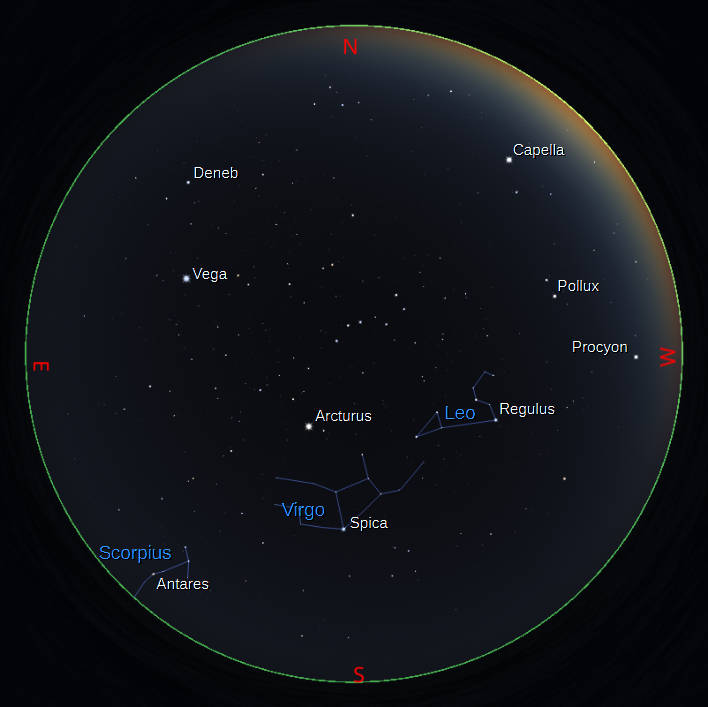
The sky tonight at 10:30 is beginning to show the transition from spring to summer. Antares in Scorpius is very low in the southeast, rising and chasing away Orion who has disappeared in the West. According to Greek mythology, at least in one story, Orion was killed by the sting of a giant scorpion and so neither he nor Scorpius the scorpion can be in the sky at the same time. The bright star Spica in Virgo the virgin is due South at that time, with Leo the lion in the southwest. Very high in the southeast is the star Arcturus. The Big Dipper is overhead. And in the east-northeast high up this is the bright star Vega, one of the stars of the summer triangle. The second star of the triangle Deneb is lower in the northeast. The third star has yet to rise.
The astronomical event times given are for the Traverse City/Interlochen area of Michigan (EDT, UT–4 hours). They may be different for your location.
Addendum
 Bob Moler's Ephemeris Blog