Archive
Ephemeris: 07/24/2023 – The Moon appears to wobble a bit
This is Ephemeris for Monday, July 24th. Today the Sun will be up for 14 hours and 57 minutes, setting at 9:17, and it will rise tomorrow at 6:21. The Moon, 1 day before first quarter, will set at 12:24 tomorrow morning.
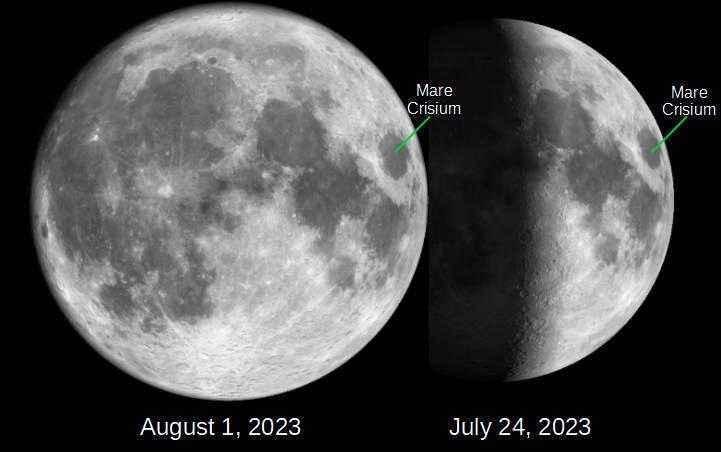
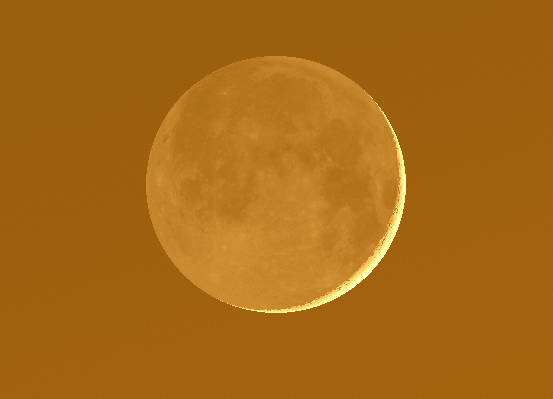
The Moon tonight is nearly half illuminated. In binoculars the dark oval spot visible on the Moon’s right edge is the Sea of Crises or Mare Crisium a small dark lava plain. The Moon’s rotation is quite uniform, however its orbit isn’t circular, so the Moon’s motion in its orbit slows as it moves farthest from the Earth, called apogee, and is sped up when closest, at perigee, So its face seems to rock a bit back and forth over the month. It’s an effect called libration. And one way to track that is to note how close the Mare Crisium (Sea of Crises) is to the edge of the Moon. It appears close to the right edge now. A week from now, that sea will appear to move away from the edge. Unfortunately, by then the Moon will be full, and night will soon fall on that little sea.
The astronomical event times given are for the Traverse City/Interlochen area of Michigan (EDT, UT –4 hours). They may be different for your location.
Addendum
Ephemeris: 07/21/2023 – Antares just looks weird
This is Ephemeris for Friday, July 21st. Today the Sun will be up for 15 hours and 3 minutes, setting at 9:20, and it will rise tomorrow at 6:18. The Moon, halfway from new to first quarter, will set at 11:34 this evening.
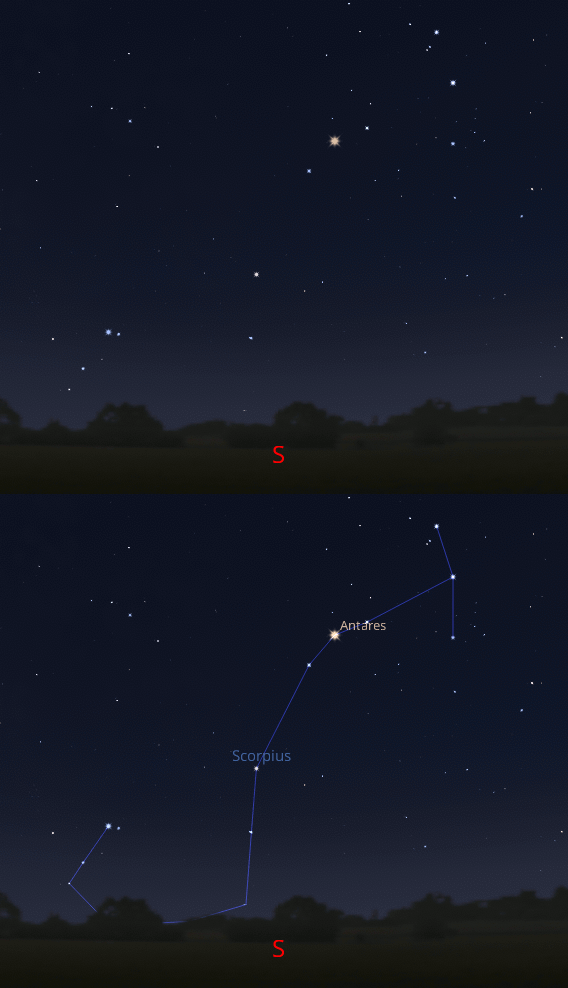
We’ve had our Fourth of July fireworks over two weeks ago, but there’s one star still celebrating as a sparkler. That’s Antares in Scorpius the scorpion low in the south tonight. We in Michigan always see Antares low in the south. It’s a bright red giant star which twinkles mightily, and since it’s low in the sky, it spits and sputters all kinds of colors due to our atmosphere’s turbulence, and the fact that we’re looking through so much of it at Antares. At it’s highest, due south, we are seeing it though 3 times more atmosphere than we would be if it was overhead. The more magnification one uses with binoculars or a telescope, the greater the sparkler effect. It is even called in sometimes as a UFO.
The astronomical event times given are for the Traverse City/Interlochen area of Michigan (EDT, UT –4 hours). They may be different for your location.
Addendum
The name of the star Antares means “Rival of Mars”. “Ant” meaning anti, “Ares”, the Greek equivalent to the Roman god Mars. The reason is their similar reddish color. Antares is red because it is a cool star, a red giant. Mars is red due to its red dust, colored by iron rust. The planet passes Antares about every 23 1/2 months. Mars will next pass Antares on December 8th, 2023. However, the event will not be visible, because both the star and the planet will be too close to the Sun in the morning sky then. Their next meeting, or conjunction, after that, on November 17th, 2025 will be in the evening sky, but still too close to the Sun to be spotted. The conjunction after that will be in the evening sky, again rather close to the Sun, on October 28, 2027. For these three encounters, Mars will be north or above Antares, and dimmer than the star.
Ephemeris: 07/20/2023 – How Boötes and Ursa Major got into the sky
This is Ephemeris for Thursday, July 20th. Today the Sun will be up for 15 hours and 5 minutes, setting at 9:21, and it will rise tomorrow at 6:17. The Moon, 3 days past new, will set at 11:16 this evening.
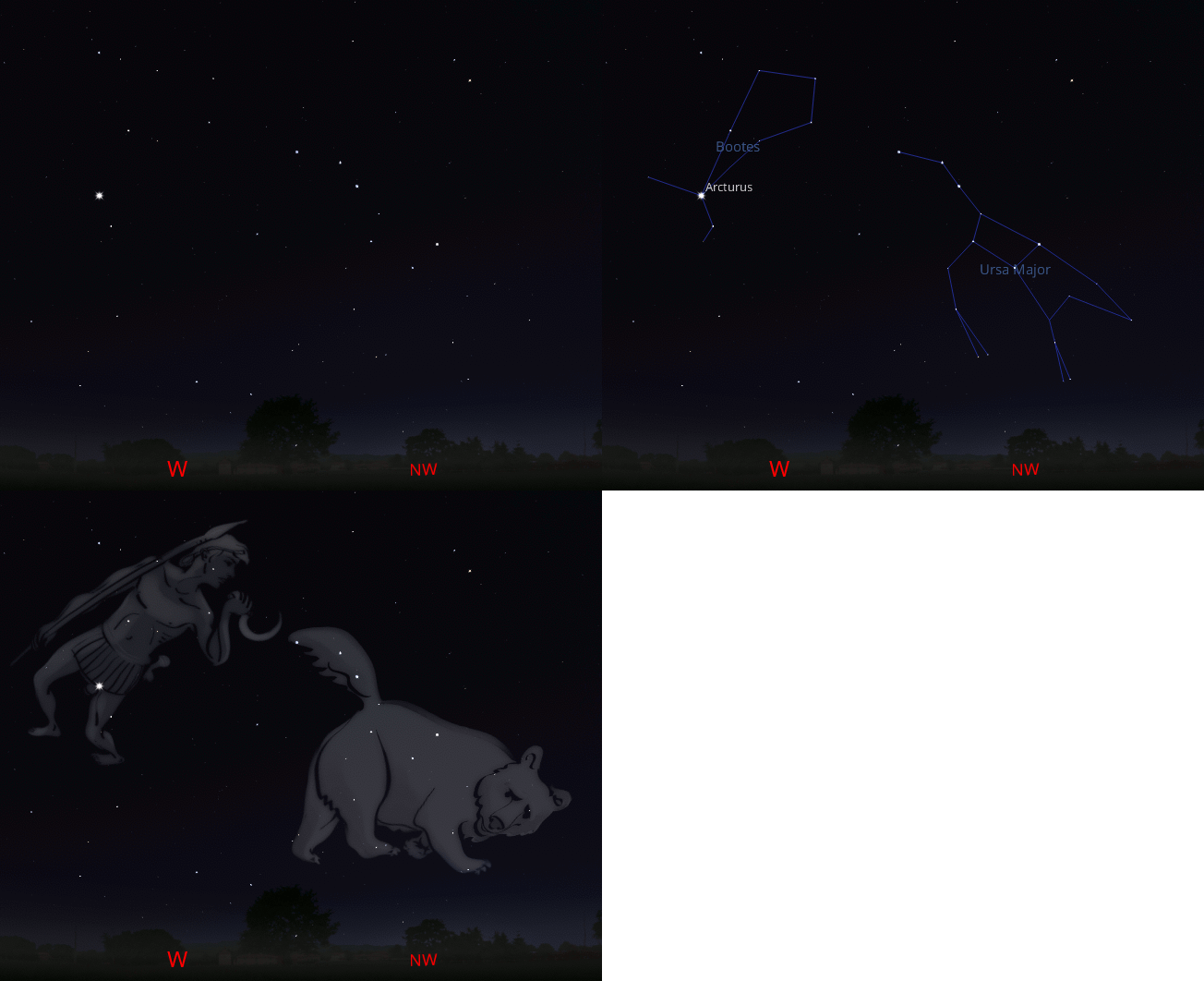
Seen in high in the west-southwest at 10:30 this evening is the kite shaped constellation of Boötes (pronounced Bo-o-tees) the herdsman. The bright star Arcturus is at the bottom of the kite. It is pointed to by the arc of the handle of the Big Dipper, part of Ursa Major, the Great Bear, over toward the northwest. Boötes represents a young hunter named Arcas, son of Callisto, a beautiful young lady who had the misfortune of being loved by Zeus, the chief of the Greek gods. Zeus’ wife, Hera, found out about it, and since she couldn’t punish Zeus, turned the poor woman into a bear. Arcas, many years later, unaware of the events surrounding his mother’s disappearance, was about to kill the bear when Jupiter intervened and placed them both in the sky to save her. Arcas still pursues her across the sky nightly.
The astronomical event times given are for the Traverse City/Interlochen area of Michigan (EDT, UT –4 hours). They may be different for your location.
Addendum

Ephemeris: 07/19/2023 – Let’s find out where the naked-eye planets have wandered off to this week
This is Ephemeris for Wednesday, July 19th. Today the Sun will be up for 15 hours and 7 minutes, setting at 9:22, and it will rise tomorrow at 6:16. The Moon, 2 days past new, will set at 10:55 this evening.
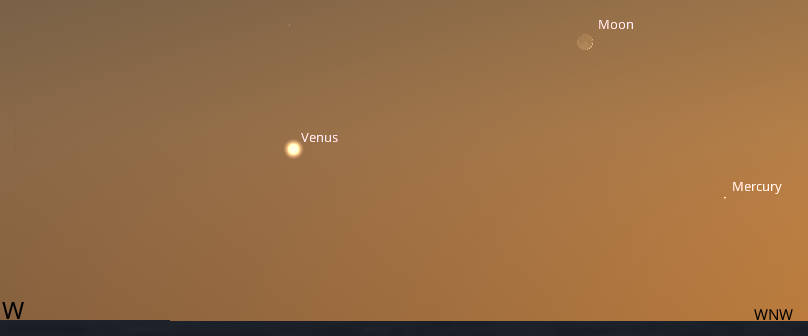
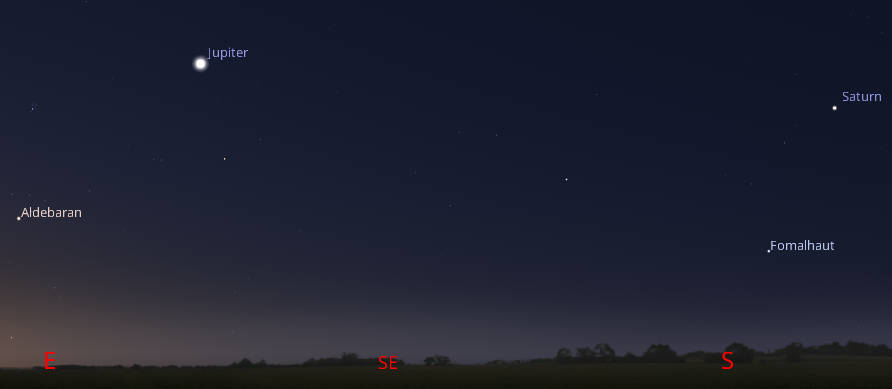
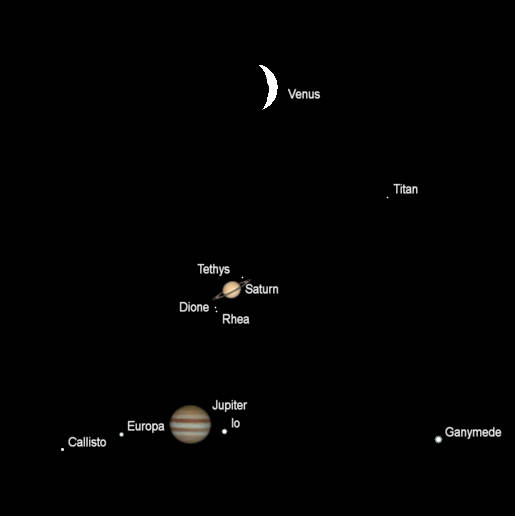
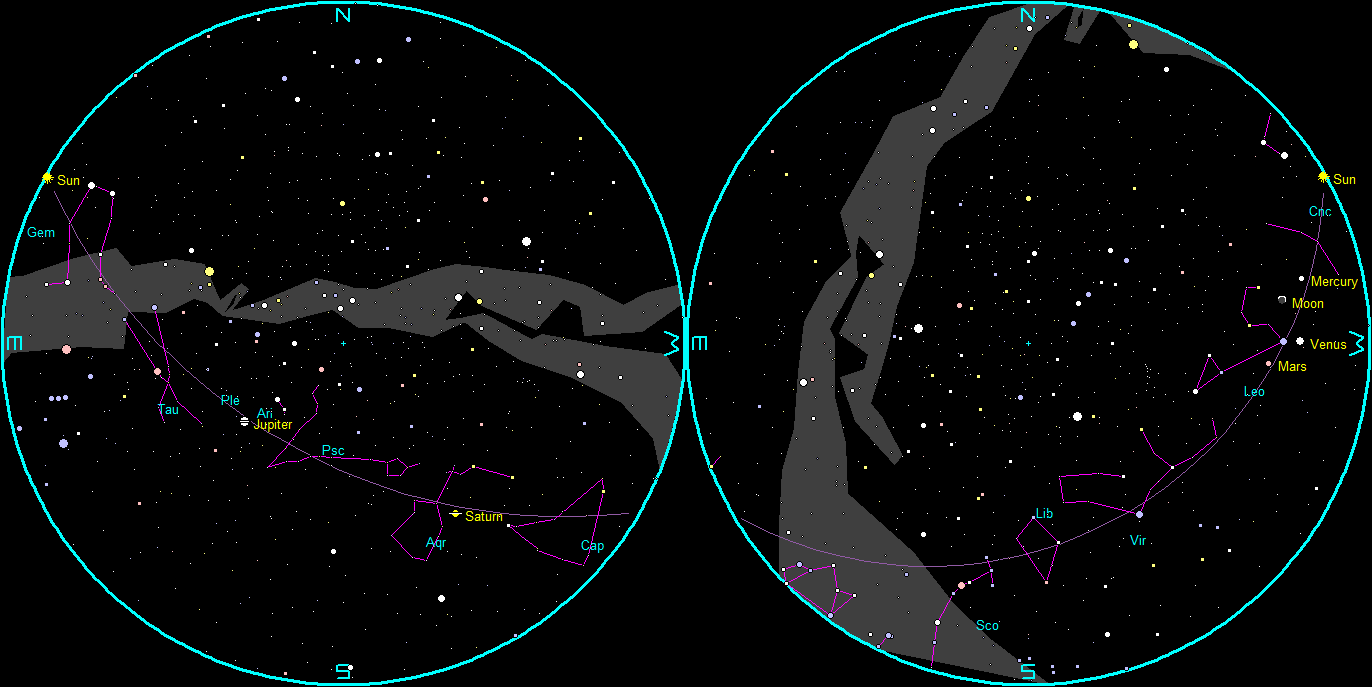
Let’s find out where the naked-eye planets have wandered off to this week. Venus is our blazing Evening Star, seen very low in the west in evening twilight. It will set at 10:31 pm, and by four minutes earlier each night. The red planet Mars is now pretty much lost in the evening twilight. We’ll see it in the morning sky in a few months. Venus too will soon leave the evening sky. Saturn will rise shortly after 11 pm. And by 5:15 am, or an hour before sunrise, it will appear in the south-southwest, the brightest “star” in that direction. It’s above the bright star Fomalhaut, normally the loneliest bright star in the sky. Jupiter will be in the east-southeast at that hour. Jupiter is the brightest star-like object in the morning sky now.
The astronomical event times given are for the Traverse City/Interlochen area of Michigan (EDT, UT –4 hours). They may be different for your location.
Addendum
Ephemeris: 07/18/2023 – Vega, the brightest star of the Summer Triangle
This is Ephemeris for Tuesday, July 18th. Today the Sun will be up for 15 hours and 9 minutes, setting at 9:23, and it will rise tomorrow at 6:15. The Moon, 1 day past new, will set at 10:30 this evening.
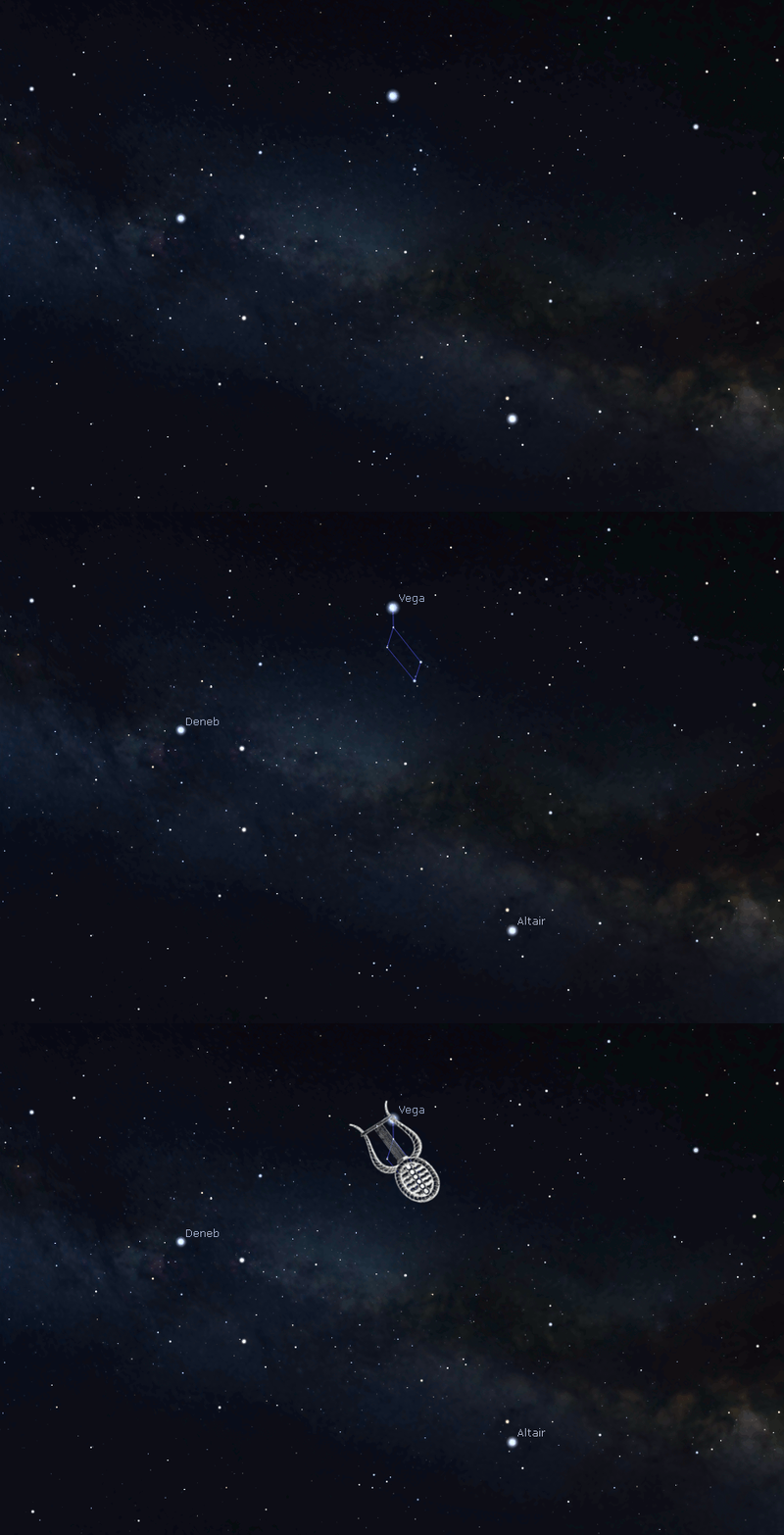
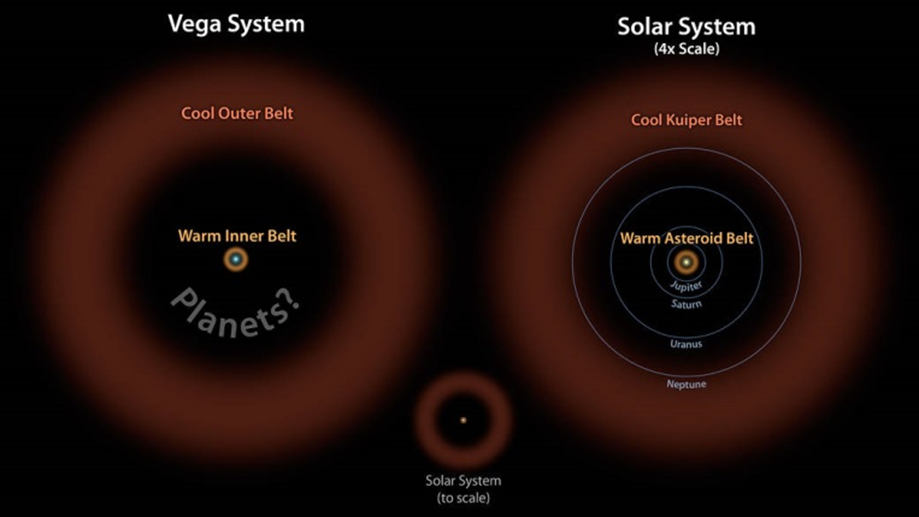
Vega, in the constellation Lyra the harp, is the highest bright star In the east and brightest star of the Summer Triangle also rising in that direction. It is an important and much studied star, first as a standard for brightness for the magnitude scale at almost exactly zero. In 1983 the Infrared Astronomy Satellite, IRAS, discovered an excess of infrared radiation coming from the star. It seems now that there are two orbiting rings around the star, an inner warm ring and an outer cold ring. This is somewhat like the two disks of material the Sun has: The asteroid belt between Mars and Jupiter and the Kuiper belt, beyond Neptune. No planets have yet been discovered around Vega, but I wouldn’t bet against it.
The astronomical event times given are for the Traverse City/Interlochen area of Michigan (EDT, UT –4 hours). They may be different for your location.
Addendum
07/17/2023 – Ephemeris – Arcturus, a look at the Sun’s future
This is Ephemeris for Monday, July 17th. Today the Sun will be up for 15 hours and 11 minutes, setting at 9:24, and it will rise tomorrow at 6:14. The Moon is new today, and won’t be visible.
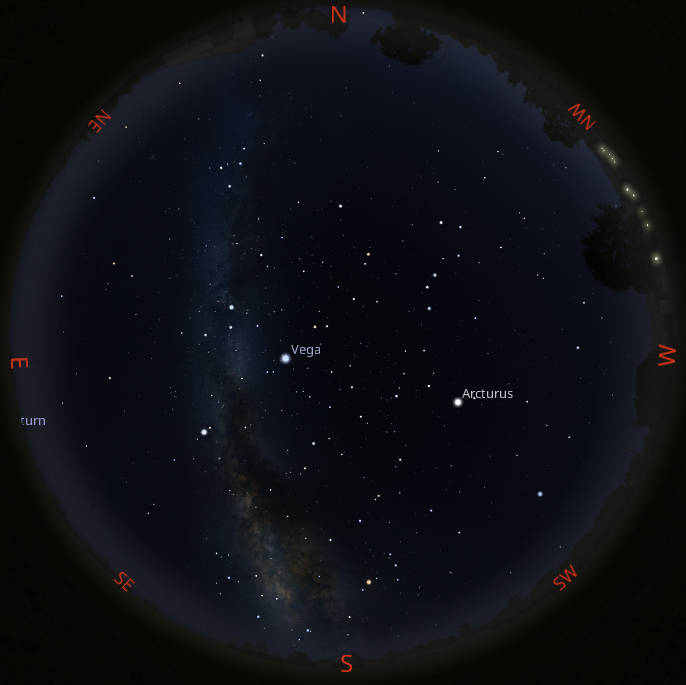
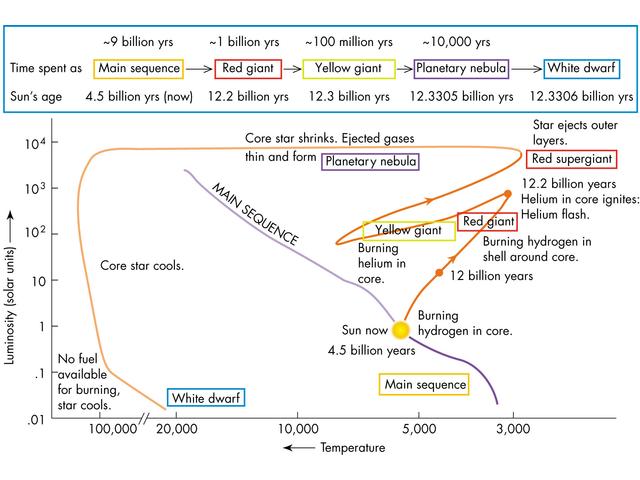
Arcturus, a red giant star, is about two thirds the way up the sky in the southwest at 10:30 or 11 p.m. It’s one of the earliest stars to appear in twilight, being nearly tied in brightness with Vega, a white star about as high in the east. A pointer to Arcturus is the handle of the Big Dipper, following the arc of the handle to Arcturus. Though only 37 light years away, it’s not from around here. It’s passing through the galactic disk from north to south. Arcturus is about 7 billion years old, and is about 8% more massive than our Sun. It appears to be starting its red giant phase, after running out of hydrogen to fuse into helium in its core, and is beginning to fuse the helium. It’s 25 times the size of the Sun and 170 times brighter, and a preview of our Sun when it gets that old.
The astronomical event times given are for the Traverse City/Interlochen area of Michigan (EDT, UT –4 hours). They may be different for your location.
Addendum
07/14/2023 – Ephemeris – Finding Polaris and why it’s important
This is Bob Moler with Ephemeris for Friday, July 14th. Today the Sun will be up for 15 hours and 16 minutes, setting at 9:26, and it will rise tomorrow at 6:11. The Moon, 3 days before new, will rise at 3:46 tomorrow morning.
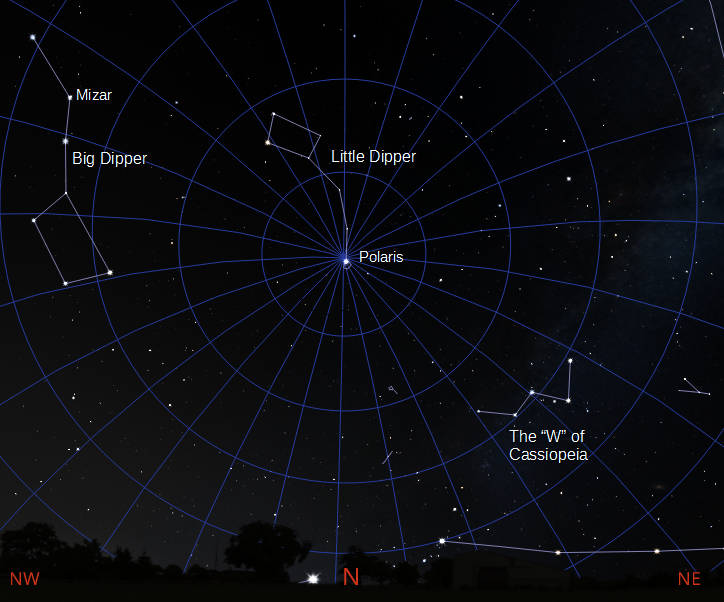
The most important star in the night sky, especially if you are lost, is Polaris, also called the North Star or Pole Star. Face Polaris and North is in front of you, East is to the right, west to the left and south will be behind you. To find Polaris, first find the Big Dipper. In the evening. This time of year, it’s hanging by its handle in the northwest, the direction that the sun set at. The two stars at the front of the bowl point to Polaris, which is to the right of it, now. Throughout the night, as the Earth rotates. Polaris will hold its position as all the other stars go around it in a counterclockwise direction. Polaris is at the end of the handle of the Little Dipper. That handle start’s vertically but curves to the left and is made of faint stars.
The astronomical event times given are for the Traverse City/Interlochen area of Michigan (EDT, UT –4 hours). They may be different for your location.
Addendum
07/13/2023 – Ephemeris – How to find Ophiuchus the serpent bearer
This is Ephemeris for Thursday, July 13th. Today the Sun will be up for 15 hours and 17 minutes, setting at 9:27, and it will rise tomorrow at 6:10. The Moon, halfway from last quarter to new, will rise at 3:04 tomorrow morning.
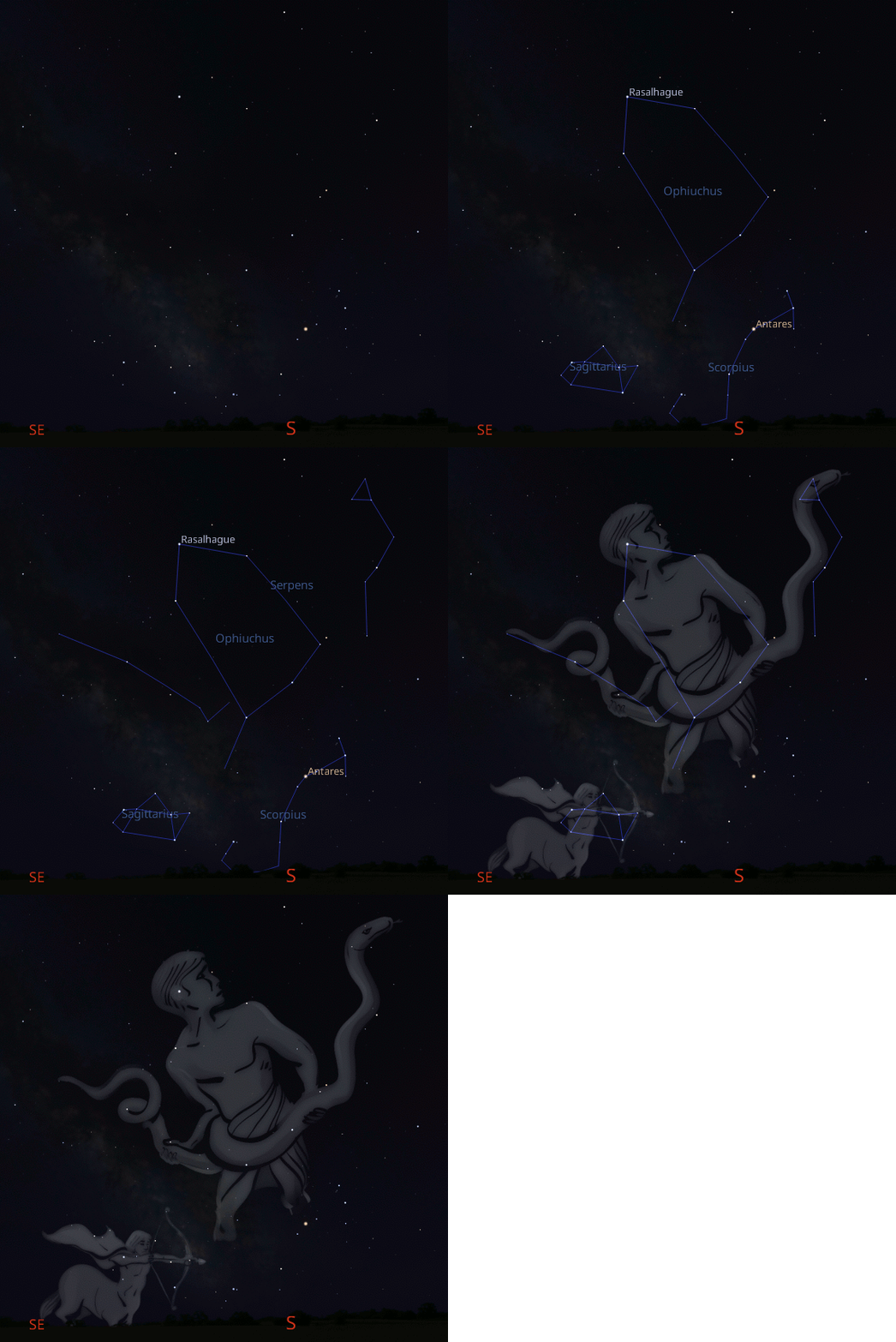
The red star Antares shines in the south at 11 p.m. In the constellation of Scorpius. In the area of sky above and a little to the left lies a large constellation of faint stars called Ophiuchus, the serpent bearer. The constellation shape is like a large bell, which reminds me of the head, shoulders and arms of a fellow that’s holding the snake-like a weight lifter pulling up a heavy barbell. The serpent he’s holding is Serpens, the only two-part constellation in the heavens. The head rises to Ophiuchus’ right, and the tail extends up to the left. In Greek myth, Ophiuchus represents the great physician Aesculapius, educated by the god Apollo, and the centaur Chiron, who is found in the stars as Sagittarius, now rising below and left of him.
The astronomical event times given are for the Traverse City/Interlochen area of Michigan (EDT, UT –4 hours). They may be different for your location.
Addendum
07/12/2023 – Ephemeris – Let’s find out where the naked-eye planets have wandered off to this week
This is Bob Moler with Ephemeris for Wednesday, July 12th. Today the Sun will be up for 15 hours and 19 minutes, setting at 9:27, and it will rise tomorrow at 6:09. The Moon, 3 days past last quarter, will rise at 2:30 tomorrow morning.
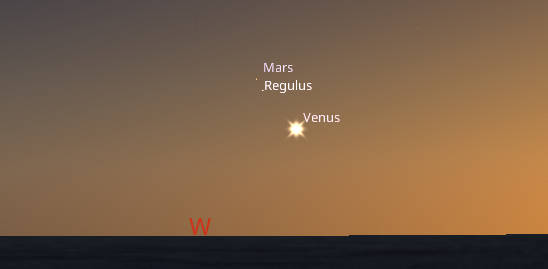
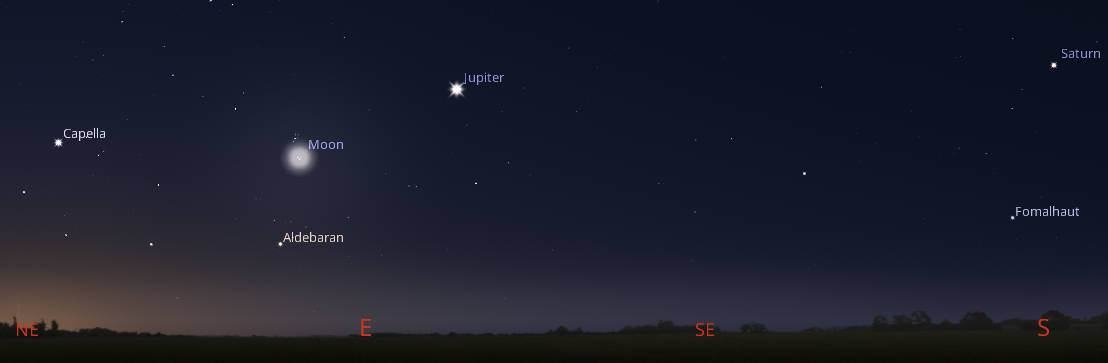
Let’s find out where the naked-eye planets have wandered off to this week. Tonight, Venus is our blazing Evening Star, seen very low in the west in evening twilight. It will set at 11:06 pm, and by four minutes earlier each night. The red planet Mars is seen left of and above Venus. It’s the second “star” with the brighter real star Regulus in Leo the lion between it and Venus. Mars is much fainter than Venus and difficult to spot in twilight. Saturn will rise shortly before midnight. And by 5 am tomorrow, will appear in the south, the brightest “star” in that direction. Jupiter will be in the east at that hour. It will appear above and right of the waning crescent Moon at that hour. Jupiter is the brightest star-like object in the morning sky now.
The astronomical event times given are for the Traverse City/Interlochen area of Michigan (EDT, UT –4 hours). They may be different for your location.
Addendum
07/10/2023 – Ephemeris – Presentation about the James Webb Space Telescope in Traverse City!
This is Bob Moler with Ephemeris for Monday, July 10th. Today the Sun will be up for 15 hours and 21 minutes, setting at 9:28, and it will rise tomorrow at 6:07. The Moon, 1 day past last quarter, will rise at 1:39 tomorrow morning.

The International Astronomical Union, or IAU, is holding a symposium in Traverse City this week, a meeting of some of the world’s astronomers on the general topic of astrochemistry: From the First Galaxies to the Formation of Habitable Worlds, at the Park Place Hotel & Conference Center. As part of the meeting, there will be a presentation at the State Theater on East Front Street at 6 pm Monday, July 10, 2023 by Professor Ewine van Dishoeck and Dr. Jonathan Gardner on The James Webb Space Telescope – The First Exciting Results. There may still be some free tickets that can be obtained from the State Theater website: https://stateandbijou.org. The program is sponsored by the IAU, University of Michigan, Northwestern Michigan College and the Grand Traverse Astronomical Society.
The astronomical event times given are for the Traverse City/Interlochen area of Michigan (EDT, UT –4 hours). They may be different for your location.
Addendum
This was provided to us about the presentation and the presenters:
Title: The James Webb Space Telescope: a new exploration of the cosmos
Speakers: Jonathan Gardner and Ewine van Dishoeck
Abstract:
The James Webb Space Telescope was launched on Christmas Day 2021 after 25 years of planning, design, development, integration, and testing. Following a six-month deployment and commissioning period, the first science results from Webb have engaged the public and surprised the scientists. Webb’s science goals address our origins and the history of the universe: the first stars and galaxies that formed after the Big Bang; the morphological and dynamical buildup of galaxies; the formation of stars and planetary systems; and exoplanets, our Solar System, and the conditions for life. Webb has already found the most distant galaxies ever seen, made the first detection of carbon dioxide in the atmosphere of an exoplanet, and has examined the interactions between giant stars and the planets that are forming near them.
Jonathan Gardner will review Webb’s construction, launch, and deployments, and discuss the commissioning of the telescope and its instruments. He will describe what scientists have learned in the first year of science results from the telescope on the deep universe. Ewine van Dishoeck will focus on the new insights that Webb has provided us on the formation of new stars and planets and the habitability of other worlds. She will highlight chemical richness of the Webb data, with water and other molecules seen throughout the universe.
Bio:
Jonathan Gardner is the Deputy Senior Project Scientist for the James Webb Space Telescope, a position he has held since 2002 at NASA’s Goddard Space Flight Center. Gardner received an AB degree from Harvard and MS and PhD from the University of Hawaii. As a NATO Fellow, he did postdoctoral research at the University of Durham in the UK. He came to NASA-Goddard in 1996 to work with the Hubble Space Telescope, but soon got involved in early studies of Webb. His scientific research involves using deep infrared observations to study the statistical evolution of galaxies. On the Webb project, he works with the other scientists to ensure the scientific success of the mission, now coming to fruition with Webb’s scientific results.
Ewine van Dishoeck is professor of molecular astrophysics at Leiden University, the
Netherlands. Graduated from Leiden in 1984, she held positions at Harvard, Princeton and
Caltech before returning to Leiden in 1990. The work of her group unites the world of
chemistry with that of physics and astronomy. She has been heavily involved in planning
major new telescopes, including being co-PI on the JWST-MIRI instrument for more than 20
years. She has been fortunate to receive many awards, including the 2018 Kavli Prize for
Astrophysics, as well as membership of the Netherlands, US, German and Norwegian
academies. From 2018-2021, Ewine served as the President of the International
Astronomical Union (IAU).
 Bob Moler's Ephemeris Blog