Archive
Ephemeris: 04/17/2024 – Where have all the planets gone?
This is Ephemeris for Wednesday, April 17th. Today the Sun will be up for 13 hours and 36 minutes, setting at 8:31, and it will rise tomorrow at 6:52. The Moon, 2 days past first quarter, will set at 5:04 tomorrow morning.
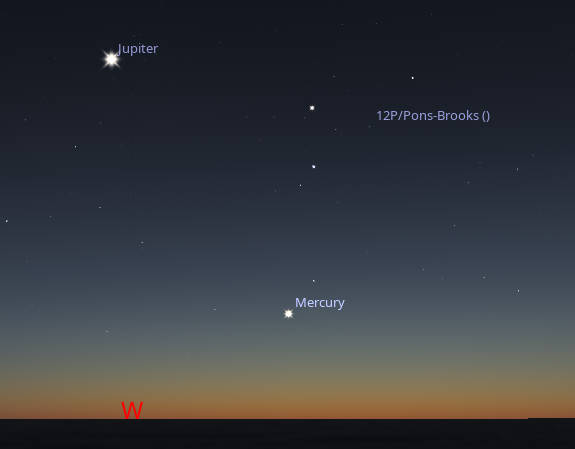
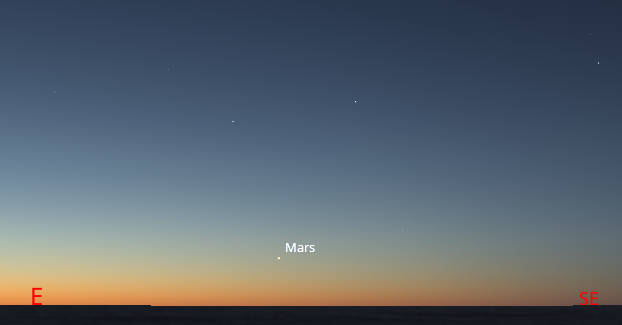
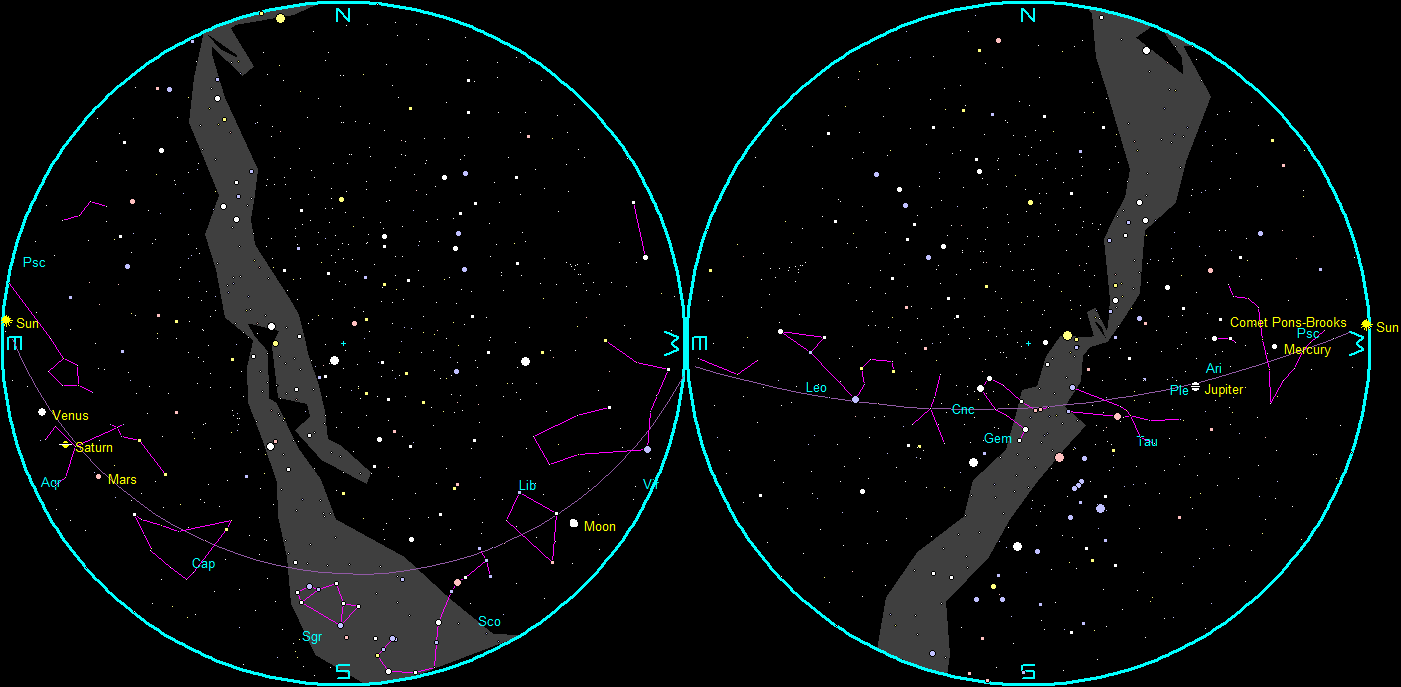
Let’s find out where the naked-eye planets have wandered off to this week, and see what planets are left. Bright Jupiter is very low and in the west. It will set at 10:23 pm. We are getting close to losing Jupiter in the evening sky. Comet 12P/Pons-Brooks is just below-left of it. Observers in the Southern Hemisphere might now get a chance to spot it, but I believe it’s too far gone for us. In the morning, Mars and Saturn will be very close together in the east southeastern sky at 6:30. They will be fighting the bright morning twilight and low altitude then. Saturn will be difficult to see right now in the twilight . It will look fairly different this year and next with its rings nearly edge on to us. They will look more like a line through the planet.
The astronomical event times given are for the Traverse City/Interlochen area of Michigan (EDT, UT–4 hours). They may be different for your location.
Addendum
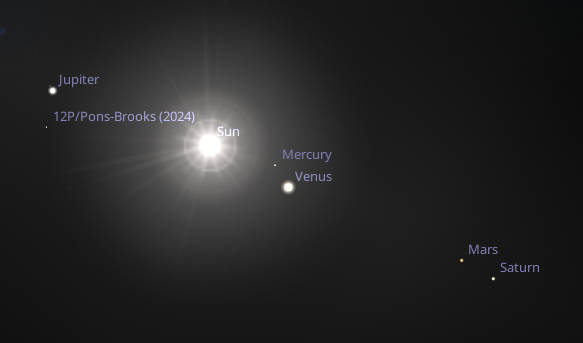
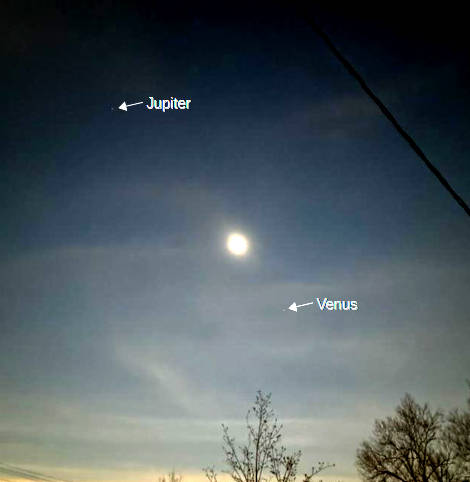
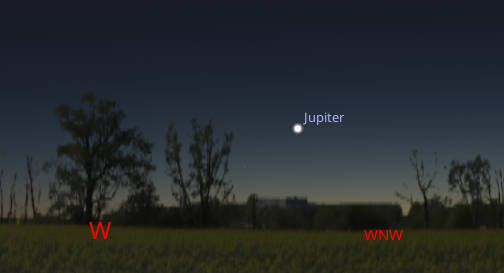
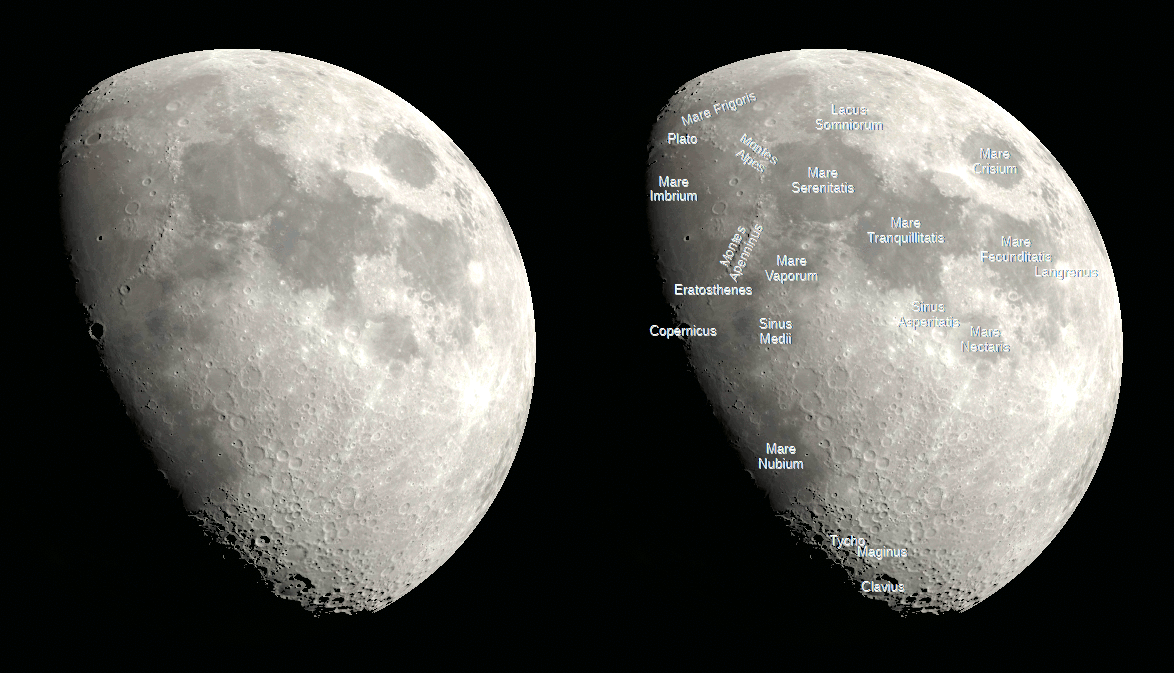
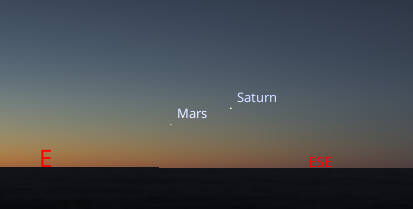
None of the planets are good telescopic objects now, due to their low position in the sky, and twilight.
Ephemeris: 04/10/2024 – Where have the naked-eye planets wandered off to?
This post was updated due to it being uploaded late, and without illustrations. This was due to my recovery from the mad dash eclipse trip Sunday through Tuesday. By the way it was glorious! I shall recount it soon in an Ephemeris Extra post.
This is Ephemeris for Wednesday, April 10th. Today the Sun will be up for 13 hours and 16 minutes, setting at 8:22, and it will rise tomorrow at 7:04. The Moon, 2 days past new, will set at 11:21 this evening.
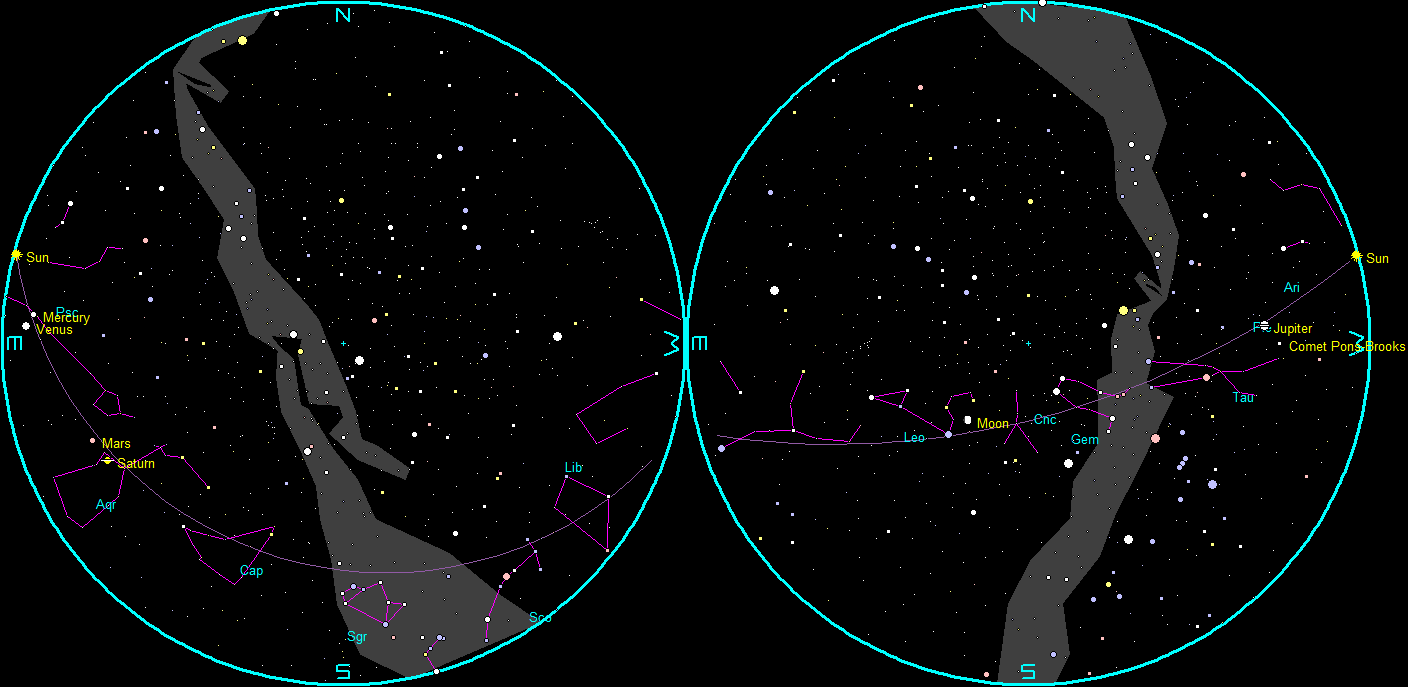
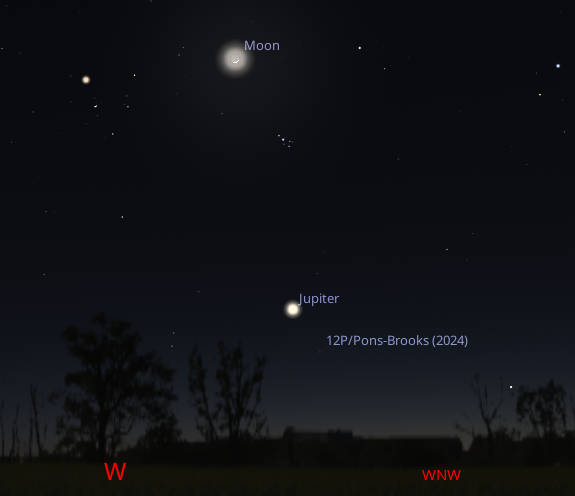
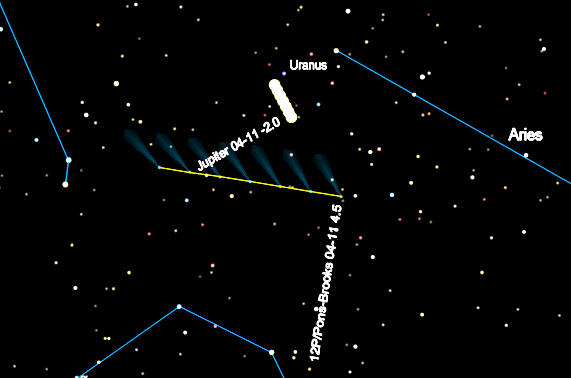
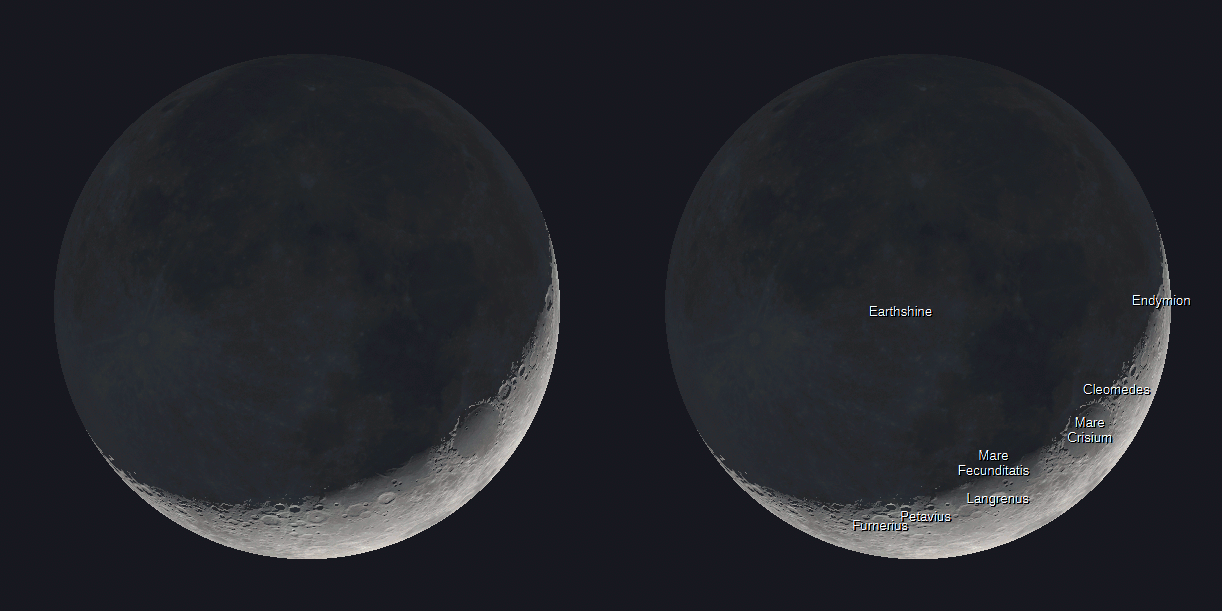
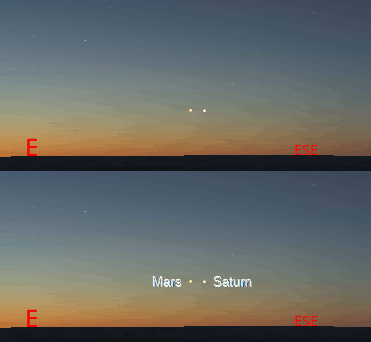
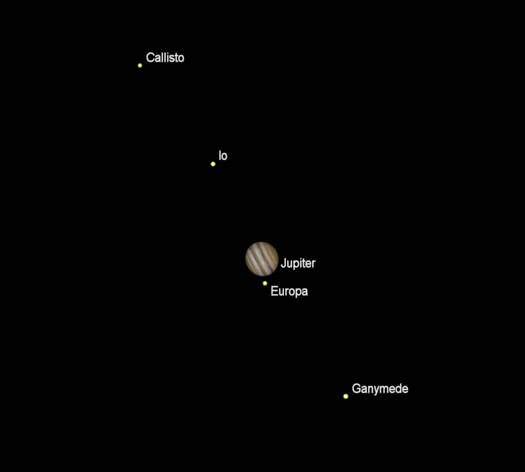
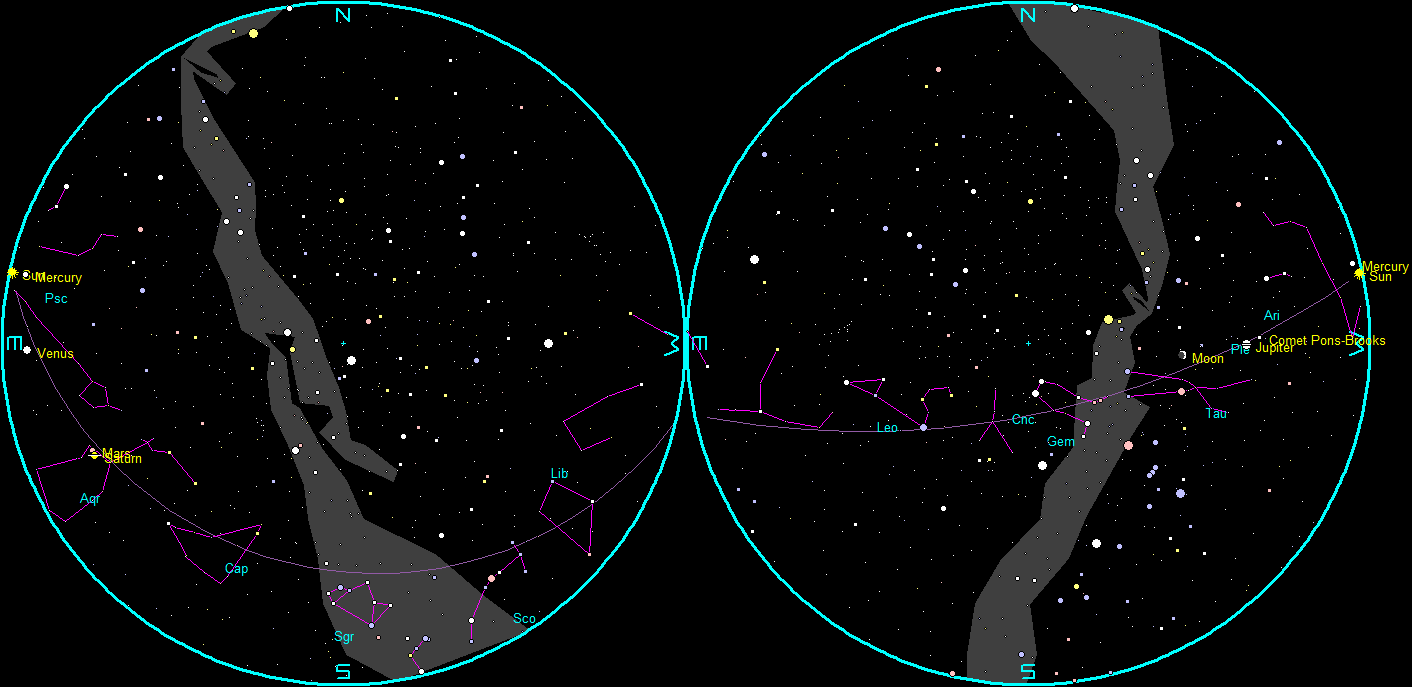
Let’s find out where the naked-eye planets have wandered off to this week, and see what planets are left. Bright Jupiter is low and in the west, and tonight only can be seen below the crescent Moon. It will set at 10:25 pm. We are getting close to losing Jupiter in the evening sky. Comet 12P/Pons-Brooks is just below-right of it. Though officially naked-eye brightness, one has to have very good eyes, binoculars or telescope to spot it. In my Wednesday blog posts at bobmoler.wordpress.com I have finder charts. In the morning Mars, and Saturn will be very close together in the east southeastern sky at 6:30. They will be fighting the bright morning twilight and low altitude then.
The astronomical event times given are for the Traverse City/Interlochen area of Michigan (EDT, UT–4 hours). They may be different for your location.
Addendum
Ephemeris: 04/08/2024 – Solar Eclipse Today!
This is Ephemeris for Monday, April 8th. Today the Sun will be up for 13 hours and 10 minutes, setting at 8:19, and it will rise tomorrow at 7:08. The Moon is new today, and won’t be visible.
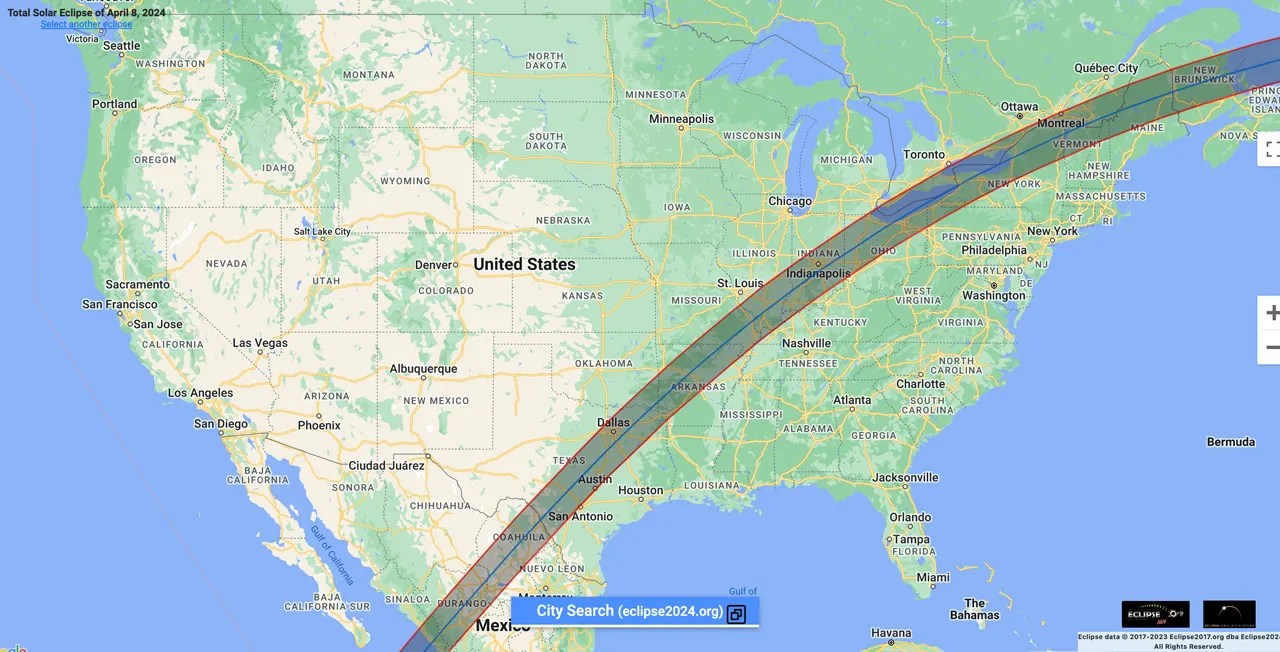
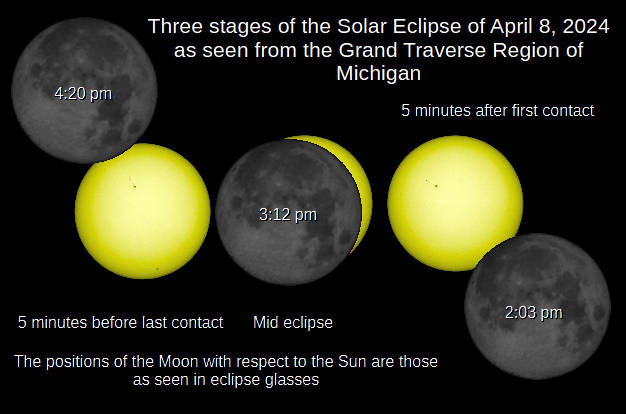
This afternoon there will be a total eclipse of the sun in the United States. But right here it’ll be a very deep partial eclipse, with the moon covering nearly 90% of the sun. For the Grand Traverse Area of Michigan, it will begin at 1:58 PM, mid-eclipse will be at 3:12 PM and the eclipse will end at 4:25 PM. In deep partial eclipses I’ve noticed that the sunlight has a slight yellowish hue. It’s possible effect of the Sun’s edge being cooler than the rest of the disk. Even if it’s cloudy here NASA will broadcast the eclipse from eight points along its route from Texas to Maine. It’s on the Internet on NASA’s YouTube channel, or in an Internet browser type NASA and ECLIPSE. Look for a link for nasa.gov, and you should be able to find out where that feed is. Good Luck!
The astronomical event times given are for the Traverse City/Interlochen area of Michigan (EDT, UT–4 hours). They may be different for your location.
Addendum
Ephemeris: 04/04/2024 – Viewing the eclipse with pinhole projection.
This is Bob Moler with Ephemeris for Thursday, April 4th. Today the Sun will be up for 12 hours and 57 minutes, setting at 8:14, and it will rise tomorrow at 7:15. The Moon, 3 days past last quarter, will rise at 6:01 tomorrow morning.
If you have eclipse glasses and even if you don’t a good way perhaps the best way to view the solar eclipse is to use projection specifically pinhole projection the pinhole can act like a lens and with something as bright as the sun can cast a good visible image of the sun. Probably the best way to do it is to find a long box and cut a hole in one end. Have one long side open or partially open to view the Sun’s projected image. Cover the hole with aluminum foil and then make pinholes of various sizes, about half inch apart. The bigger the pinhole the brighter the Sun’s image but also the fuzzier it will be. The smaller the hole the sharper and dimmer the sun will be. For the IPR listening area the eclipse will start around 1:58 pm, and end around 4:25 pm.
The astronomical event times given are for the Traverse City/Interlochen area of Michigan (EDT, UT–4 hours). They may be different for your location.
Addendum
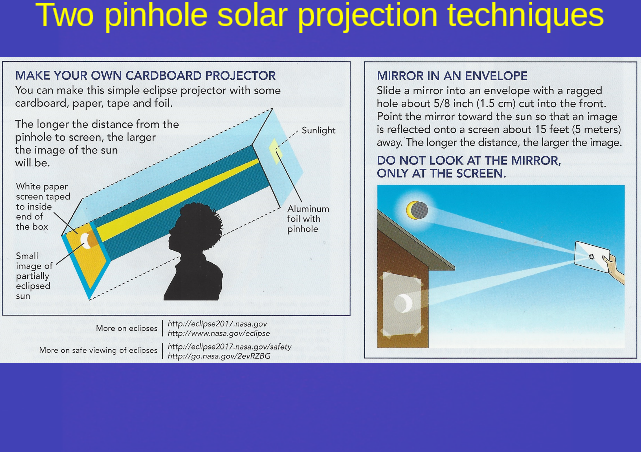
A long box can be used to project the image inside. The diameter of the pin hole is a compromise between sharpness and brightness of the image.
…The farther the image is projected the larger it is.
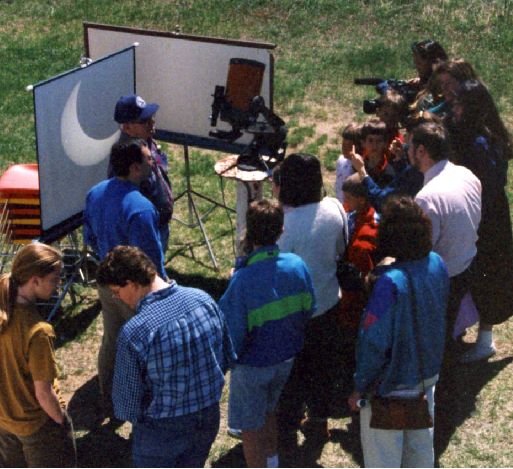
The throw of the image can be increased by using a mirror masked with a quarter of a inch or larger hole and sending the image 10 or more feet away.
Ephemeris: 04/03/2024 – Where have the naked-eye planets wandered off to this week?
This is Ephemeris for Wednesday, April 3rd. Today the Sun will be up for 12 hours and 54 minutes, setting at 8:13, and it will rise tomorrow at 7:17. The Moon, 2 days past last quarter, will rise at 5:33 tomorrow morning.
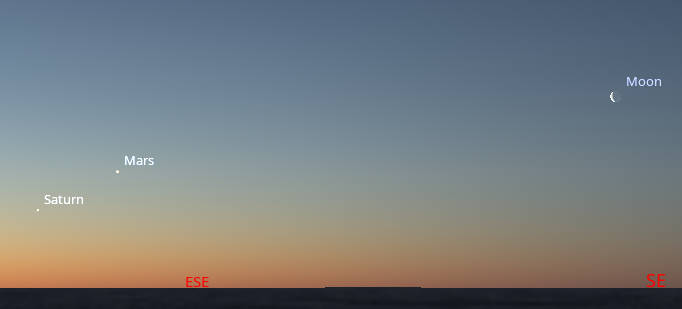
Let’s find out where the naked-eye planets have wandered off to this week, and see what planets are left. Mercury is now too close to the Sun to be spotted. Bright Jupiter is due west at 8:45 pm or a half hour after sunset. It will set at 11:05 pm. We are getting close to losing Jupiter in the evening sky. Comet 12P/Pons-Brooks is right of and a bit below Jupiter in the evening. Though officially naked-eye brightness, one has to have very good eyes, binoculars or telescope to spot it. In my Wednesday blog posts at bobmoler.wordpress.com I have finder charts. In the morning Mars, and especially Venus and Saturn may be impossible to spot, in the east-southeast in the bright twilight. Mars will rise at 6:10, and will be very low in the east-southeast at 6:45 am.
The astronomical event times given are for the Traverse City/Interlochen area of Michigan (EDT, UT–4 hours). They may be different for your location.
Addendum
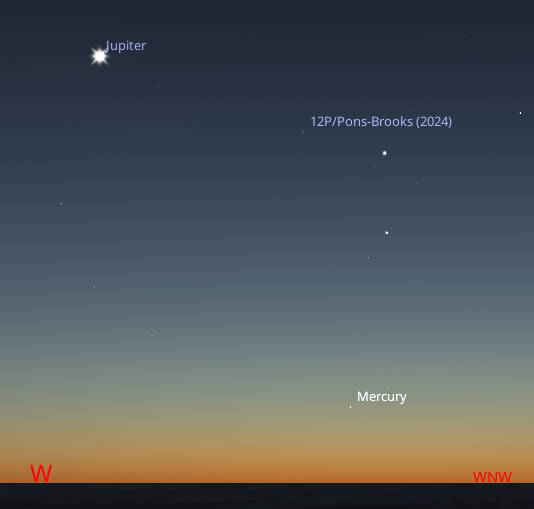
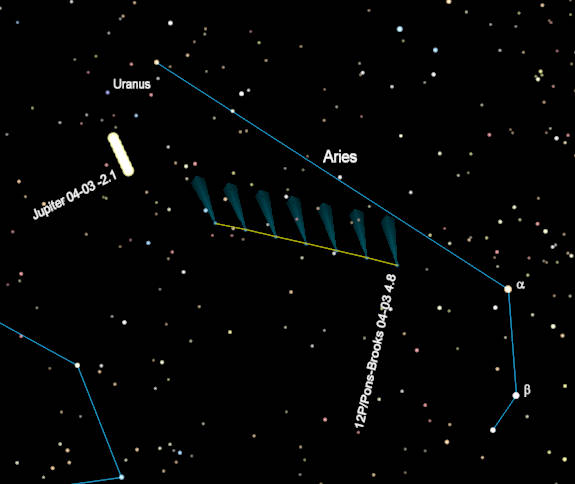
During the solar eclipse on the 8th, during totality, the comet will be located around the 2nd to the last position of its track. However, unless it is obviously noticeable, totality time is too short to use trying to find it. Enjoy the glory of the sun’s corona for the brief time you have.
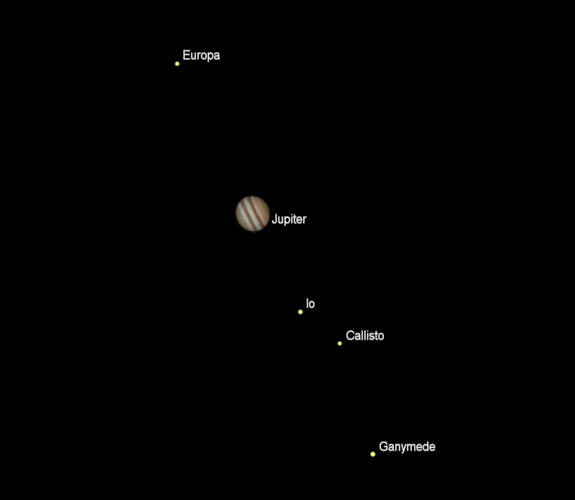
Ephemeris: 03/28/2024 Comet Pons-Brooks can be seen near Jupiter with binoculars
This is Ephemeris for Thursday, March 28th. Today the Sun will be up for 12 hours and 36 minutes, setting at 8:06, and it will rise tomorrow at 7:28. The Moon, 3 days past full, will rise at 11:59 this evening.
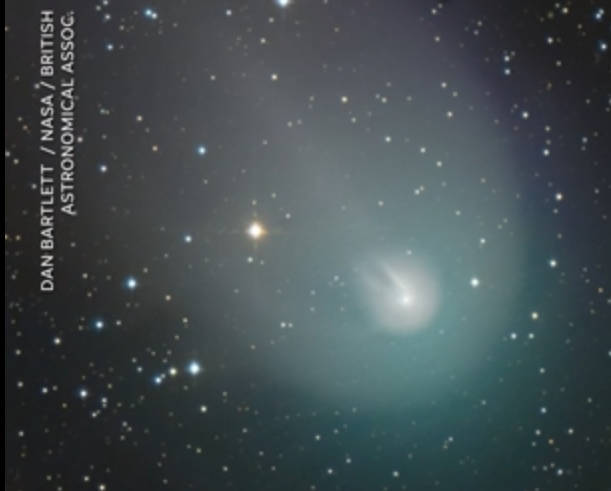
A dim naked eye comet is gracing our evening skies now. It’s called 12P/Pons Brooks. The 12P designation means it was the 12th periodic comet discovered. It was discovered in 1812 by French astronomer Jean-Louis Pons and rediscovered 71 years later on its return by William Brooks. Last July it had an outburst and gained about 100 times increase in brightness. It has held on to most of that. However, right now it’s 5th magnitude which makes it very difficult to spot even in binoculars. Comets always appear to be much dimmer than their magnitude suggests. It was last seen in 1954 and has a 71-year orbit of the Sun that takes it out to Neptune’s orbit. It currently appears below-right of Jupiter.
The astronomical event times given are for the Traverse City/Interlochen area of Michigan (EDT, UT–4 hours). They may be different for your location.
Addendum
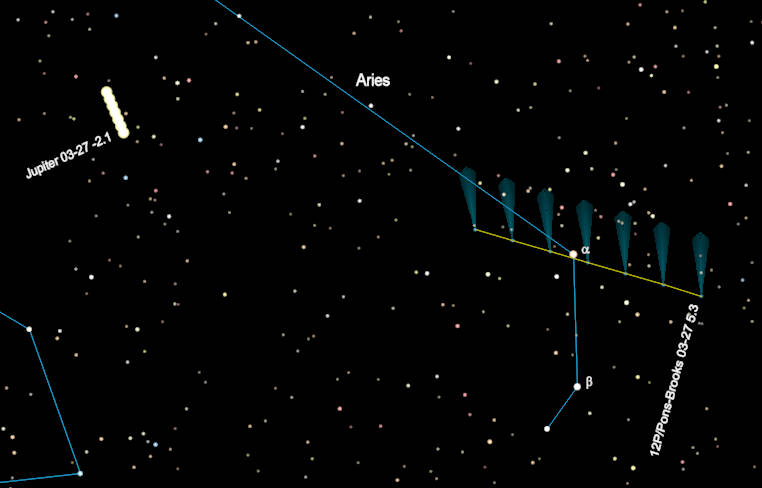
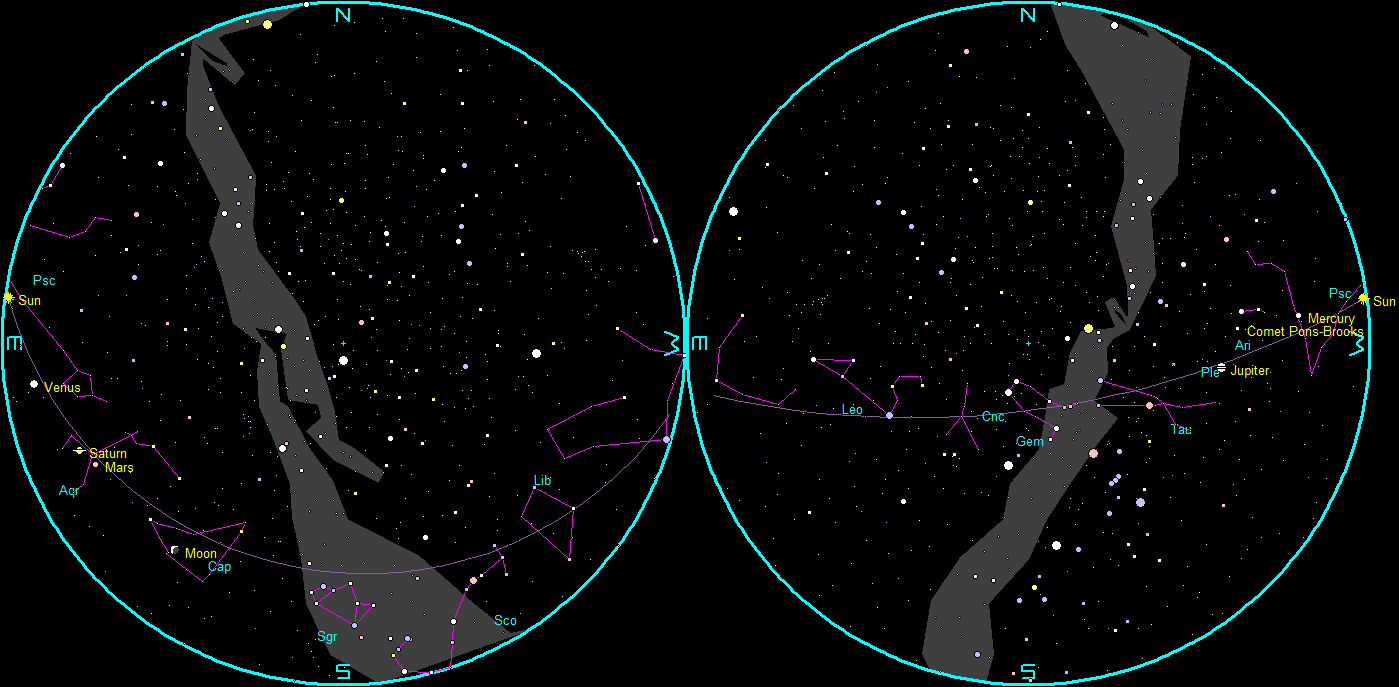
Ephemeris: 03/27/2024 – Let’s find out where the naked-eye planets have wandered off to this week
This is Ephemeris for Wednesday, March 27th. Today the Sun will be up for 12 hours and 33 minutes, setting at 8:04, and it will rise tomorrow at 7:30. The Moon, 2 days past full, will rise at 10:50 this evening.
Let’s find out where the naked-eye planets have wandered off to this week, and see what planets are left. Mercury is visible in the evening sky shortly after sunset appearing very low in the west. It will be visible for the next few days or so, slowly heading back toward the Sun since this past Sunday. Higher up in the sky is bright Jupiter in the west southwest. It will set at 11:25 pm. Jupiter will be visible in the evening for only about another month or so. In the morning Mars, and especially Venus and Saturn may be impossible to spot, in the east-southeast in the bright twilight. Mars will rise at 6:28, and will be very low in the east-southeast. Comet 12P/Pons-Brooks is below-right of Jupiter in the evening. I’ll have more about it tomorrow.
The astronomical event times given are for the Traverse City/Interlochen area of Michigan (EDT, UT–4 hours). They may be different for your location.
Addendum
Ephemeris: 03/26/2024 – The dimmest constellation of the Zodiac is Cancer the crab
This is Ephemeris for Tuesday, March 26th. Today the Sun will be up for 12 hours and 29 minutes, setting at 8:03, and it will rise tomorrow at 7:31. The Moon, 1 day past full, will rise at 9:44 this evening.
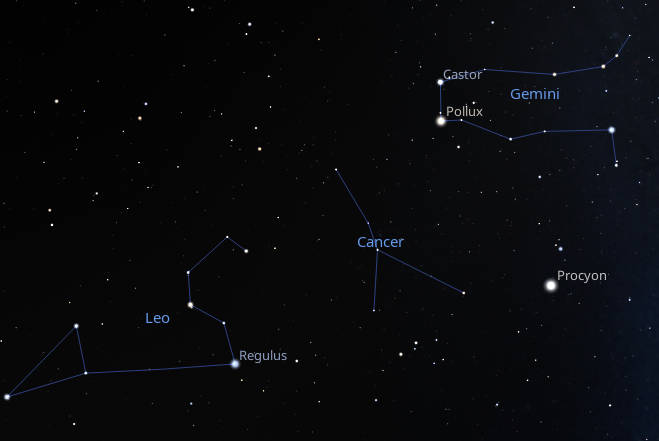
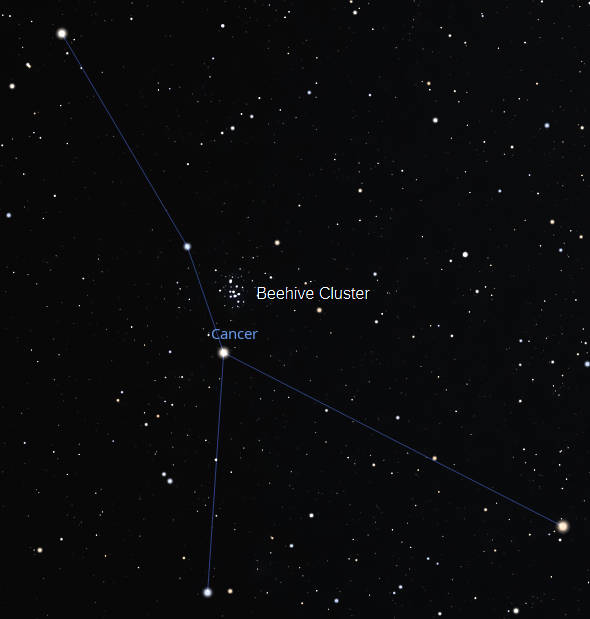
The dimmest constellation of the Zodiac is Cancer the crab. It is located high in the southeast at 9 PM between the backwards question mark that is the front of Leo the lion towards the lower left and Castor and Pollux of Gemini to the upper right. Its claim to more modern astronomical fame is the star cluster within it called the Beehive Cluster also known in ancient times as Praesepe the manger which looks like a fuzzy spot to the naked eye. In binoculars or a small telescope it shows up as a rather sparse open cluster of stars and to me the whole cluster appears somewhat triangular like an old-fashioned beehive. The Beehive cluster is relatively close to us at about 610 light years away.
The astronomical event times given are for the Traverse City/Interlochen area of Michigan (EDT, UT–4 hours). They may be different for your location.
Addendum
Ephemeris: 03/22/2024 – There will be a penumbral eclipse of the Moon Monday morning
This is Ephemeris for Friday, March 22nd. Today the Sun will be up for 12 hours and 17 minutes, setting at 7:58, and it will rise tomorrow at 7:39. The Moon, 3 days before full, will set at 7:16 tomorrow morning.
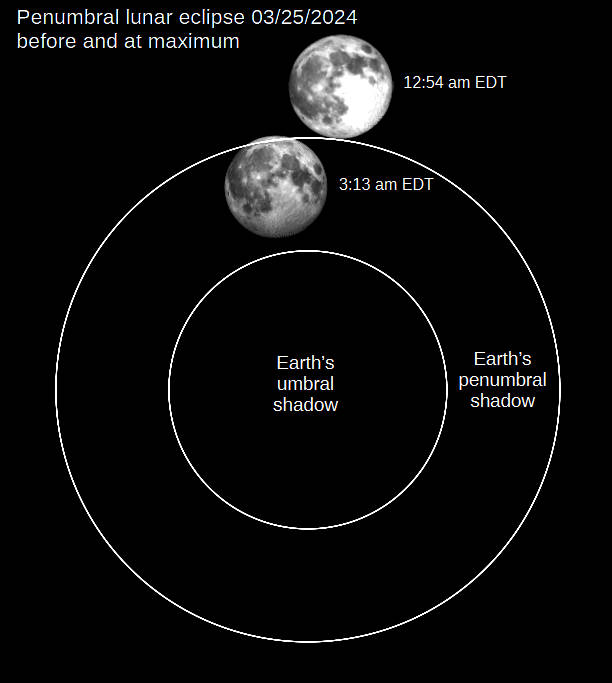
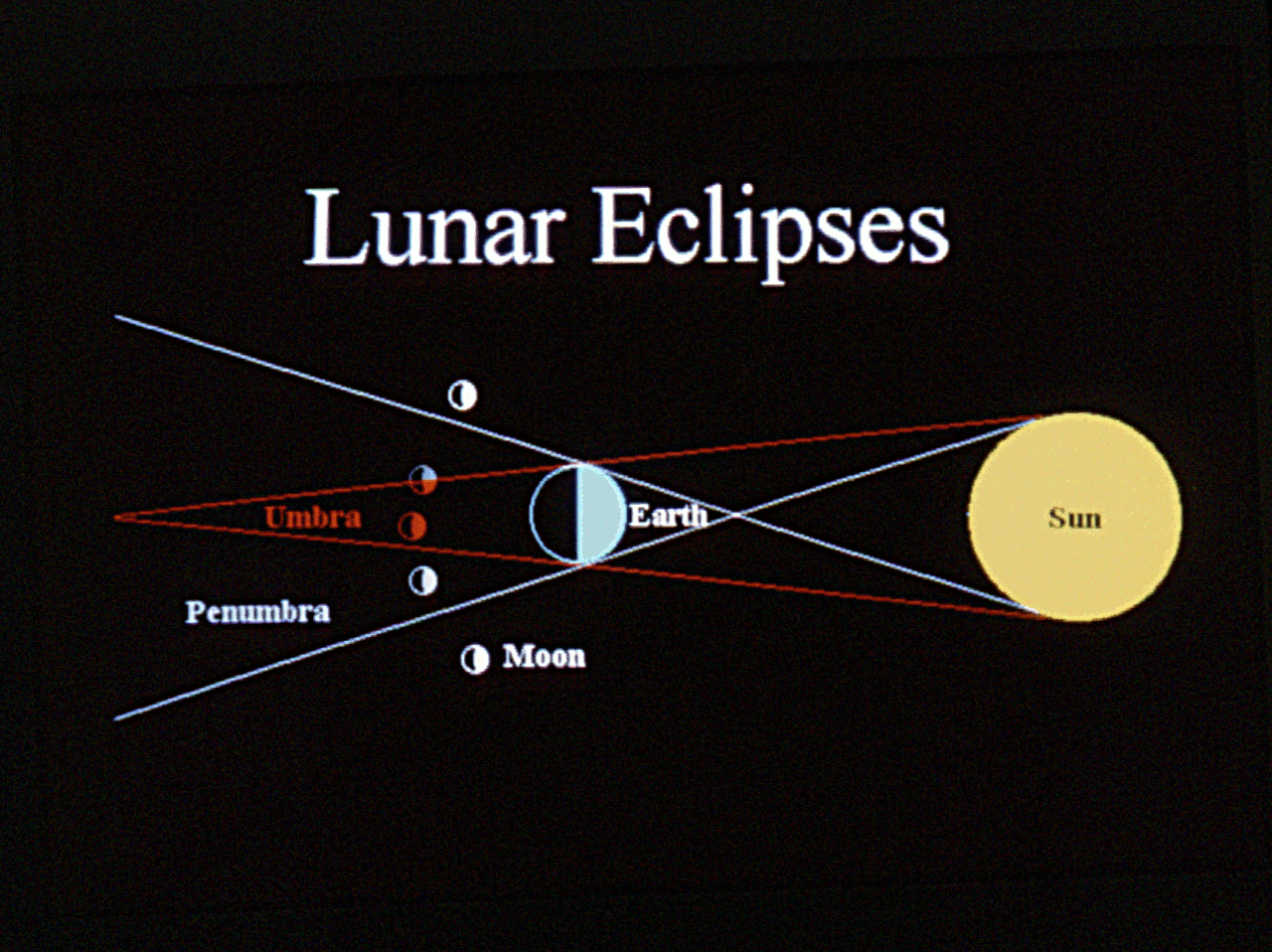
We are in an eclipse season. These occur at a bit less than 6 months intervals, and last about 35 days. During this period we will have a solar eclipse and a lunar eclipse. Of course the big eclipse of this eclipse season is the April 8th total solar eclipse, which will be visible from the United States and be visible from here as a very deep partial eclipse. We start off this eclipse season with a lunar eclipse, not a really great lunar eclipse, but a lunar eclipse nonetheless. It is a penumbral eclipse where the Moon enters the Earth’s outer shadow where the Sun is only partially blocked to it. What we will see will be not much. It will reach its maximum at 3:13 am Monday morning, when the bottom part of the Moon will be slightly darker than the top.
The astronomical event times given are for the Traverse City/Interlochen area of Michigan (EDT, UT–4 hours). They may be different for your location.
Addendum
Ephemeris: 03/21/2024 – Three lunar craters named for heliocentrists by a geocentrist
This is Ephemeris for Thursday, March 21st. Today the Sun will be up for 12 hours and 14 minutes, setting at 7:57, and it will rise tomorrow at 7:41. The Moon, halfway from first quarter to full, will set at 6:59 tomorrow morning.
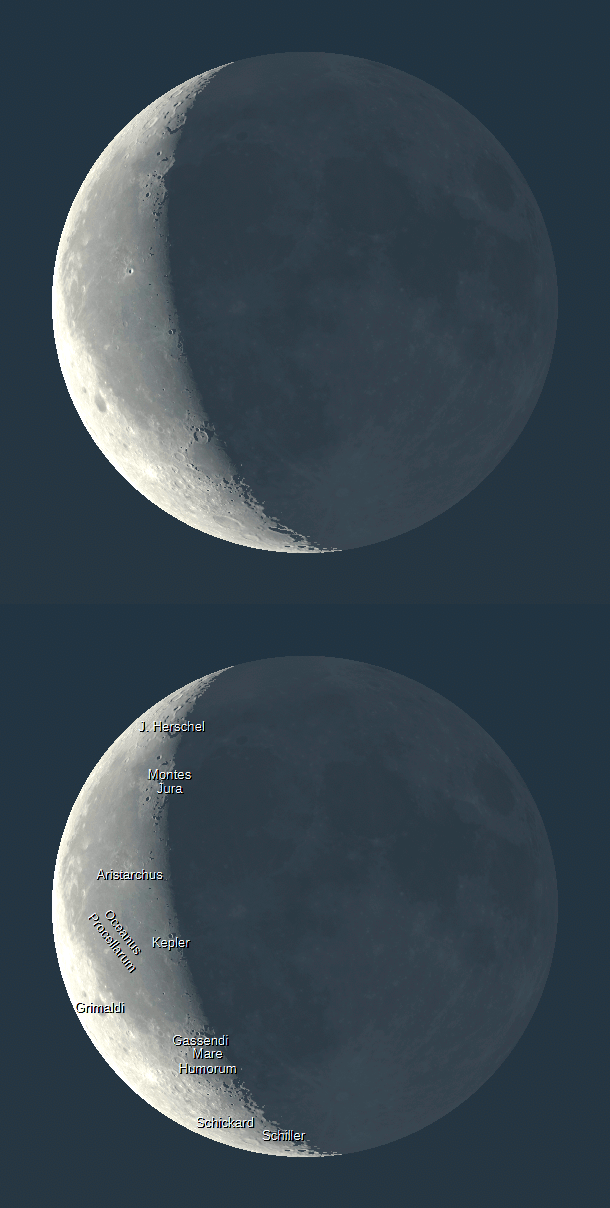
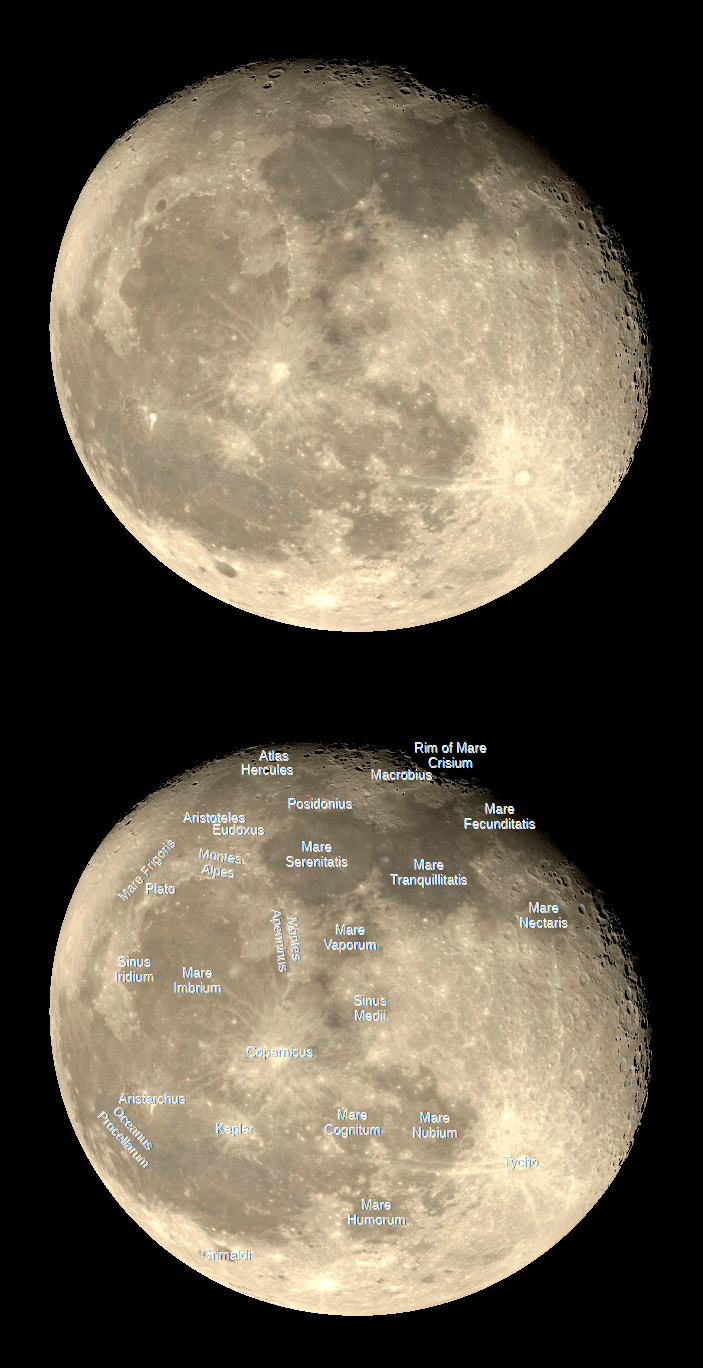
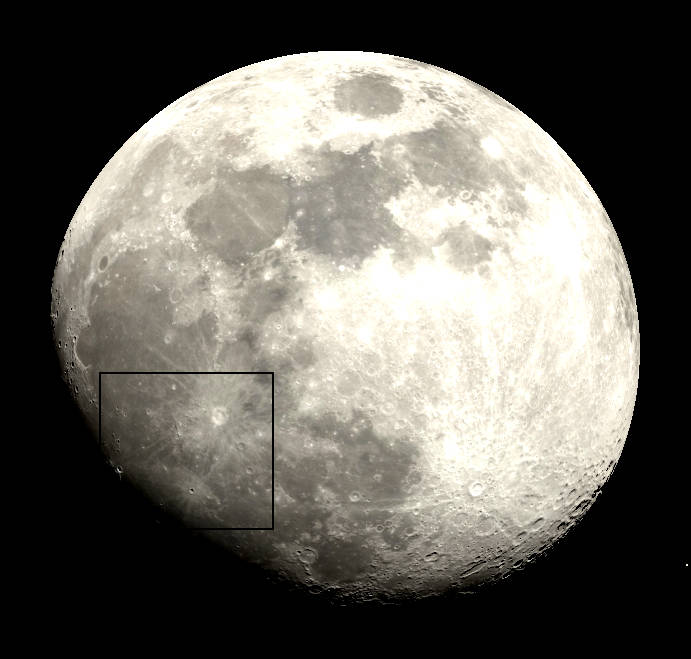
The gibbous moon tonight is exhibiting, over the last three days, three craters named for those who promoted the heliocentric or Sun centered solar system. The largest crater of the three, Copernicus, can be seen to the lower left of the center of the Moon. The asteroid that hit it made a big splash, which can be seen in its rays of ejecta being round and full. Then about halfway between it and the terminator is a small crater named for Johannes Kepler, and then nearby and on the terminator tonight is the crater named for the Greek philosopher who first proposed the Sun centered solar system, or in his case the universe, Aristarchus. He was a contemporary of and overshadowed by Aristotle, so his ideas were never adopted.
The astronomical event times given are for the Traverse City/Interlochen area of Michigan (EDT, UT–4 hours). They may be different for your location.
Addendum
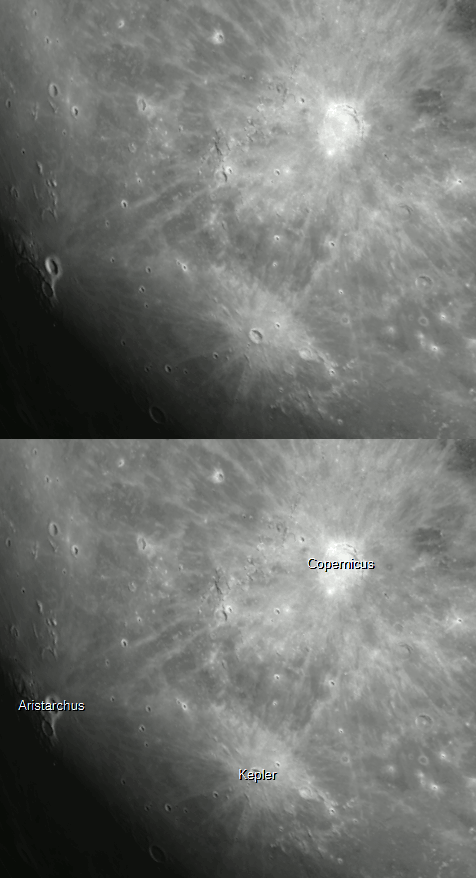
These craters were named by Giovanni Battista Riccioli, an astronomer and Jesuit priest. He established the lunar nomenclature we have today and named many of the largest craters. Being a 17th century Catholic, he bought the Roman Catholic line that the universe was geocentric, that is earth centered, yet he honored these heliocentrists with their own craters. He tended to group crater names by their relationship in life or their ideas, so the three proponents of the Sun centered solar system were given craters near each other in one section of the Moon.

Aristarchus of Samos was a Greek philosopher who lived between 310 and 230 BCE. He proposed a heliocentric solar system or universe, where Earth and all the planets revolved about the Sun. However, the work that he proposed it in has been lost. We know of his idea only referenced in the writings of others who attempted to debunk it.
Copernicus (Mikola Kopernik 1473-1543), was a Polish Catholic Canon, who was a mathematician, astronomer and translator, among other talents. He came up with the theory of the Sun centered or heliocentric solar system or in his day, universe.
Johannes Kepler (1571–1630) was an astronomer, astrologer and mathematician who discovered the laws of planetary motion. While Copernicus kept the circular orbits of the planets, they still didn’t match the motions of the planets in the sky. So he had to add some epicycles to make it all work. He actually had more epicycles than Ptolemy had. Kepler was able to figure out that he didn’t need epicycles if he assumed that the orbits were elliptical. He developed his Three Laws of Planetary Motion.
Galileo also has a crater there (Galilaei). It’s a tiny crater right on the terminator, below Kepler in the images above, and not visible. The Virtual Moon Atlas does not give an origin of the naming of the crater. Back in 1651, when Riccioli was giving craters names, Galileo was still on the outs with the Vatican, and the church.

