06/03/2021 – Ephemeris – Arcturus in the Bible.
This is Ephemeris for Thursday, June 3rd. Today the Sun will be up for 15 hours and 23 minutes, setting at 9:23, and it will rise tomorrow at 5:58. The Moon, 1 day past last quarter, will rise at 3:30 tomorrow morning.
Arcturus is a bright orangish star that’s high in the south at 11 pm. It’s also found by following the arc of the handle of the Big Dipper, which is the ridiculous tail of Ursa Major the Great Bear. It was considered the “Guardian of the Bear”, It is in the base of the kite shaped constellation of Boötes, the herdsman or the Bear Chaser. The latter story I recounted earlier this year. The name from the Greek has been confused with the bear itself. Thus, in the King James version of the Bible Arcturus, not the Bear, meaning the Great Bear, is mentioned in the 38th chapter of Job. This has been corrected in the newer versions I’ve seen. Arcturus has a rich history in literature, mostly by being confused with the Great Bear.
The astronomical event times given are for the Traverse City/Interlochen area of Michigan. They may be different for your location.
Addendum
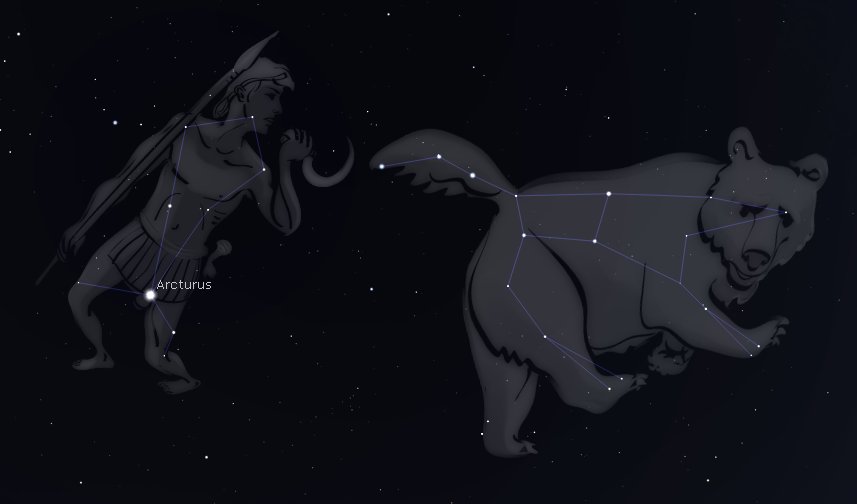
Arcturus, Boötes and Ursa Major can be seen by looking overhead while facing the west-southwest at 11 pm in early June. Created using Stellarium. Lines and figures not included.
Biblical translations
King James Version of Job 38:31-32
31 Canst thou bind the sweet influences of Pleiades,
   or loose the bands of Orion?

32 Canst thou bring forth Mazzaroth in his season?
   or canst thou guide Arcturus with his sons?
New International Version of Job 38:31-32
31
“Can you bind the chains of the Pleiades?
Can you loosen Orion’s belt?
32
Can you bring forth the constellations in their seasons
or lead out the Bear with its cubs?
No one is sure what a Mazzaroth is.
06/02/2021 – Ephemeris – Let’s look for the naked-eye planets for this week
This is Bob Moler with Ephemeris for Wednesday, June 2nd. Today the Sun will be up for 15 hours and 22 minutes, setting at 9:22, and it will rise tomorrow at 5:59. The Moon, at last quarter today, will rise at 3:10 tomorrow morning.
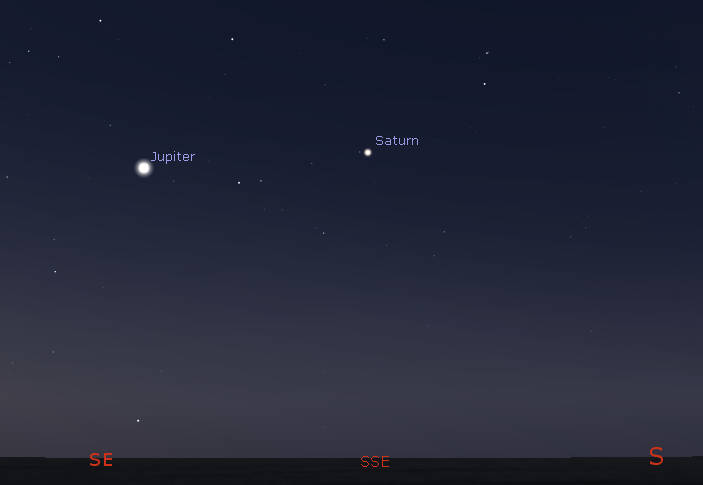
Let’s look for the naked-eye planets for this week. Venus can be spotted low in the west-northwest twilight by 10 pm. Venus will set at 10:49 pm. Mars can be found in the west at 10:30 tonight, and about to leave the constellation of Gemini, the twins. Tonight it’s below and left of Gemini’s brightest star, Pollux. Mars will set at 12:34 am. Jupiter and Saturn, are in the morning sky. Saturn will rise at 1:08 am. It’s seen with the stars of Capricornus. It has begun its retrograde or westward motion caused by the fact that we are viewing it from another moving planet. Brighter Jupiter, is now within the boundaries of Aquarius, and will rise at 1:55 am. By 5 am these two planets will be in the south-southeast in the morning twilight.
The astronomical event times given are for the Traverse City/Interlochen area of Michigan. They may be different for your location.
Addendum
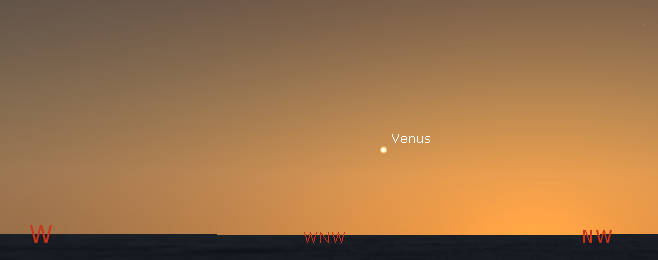
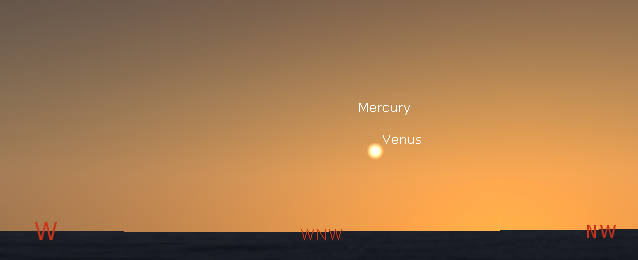
Venus on a flat lake horizon at 10 pm (38 minutes after sunset), June 2, 2021. Created using Stellarium.
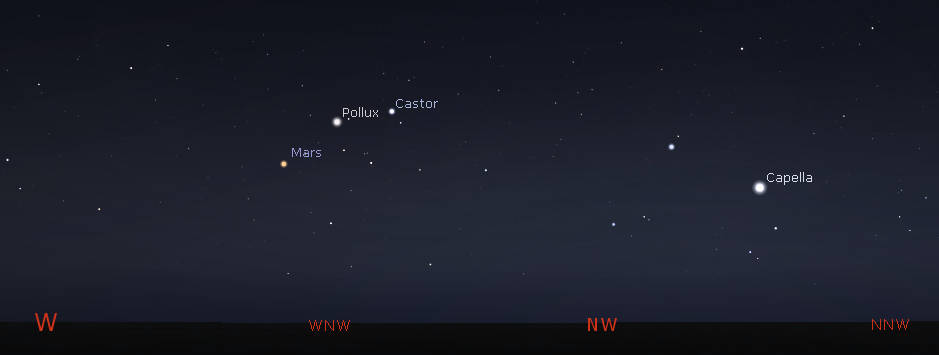
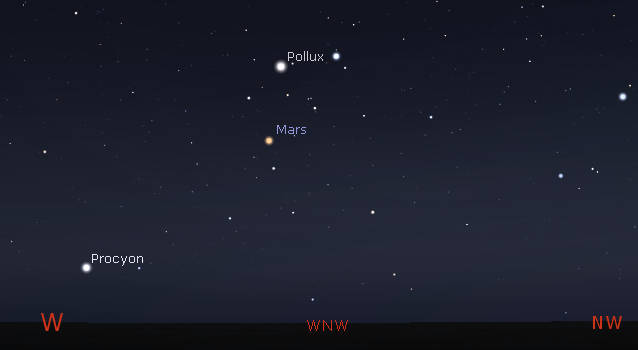
Mars finder chart for 11 pm, June 2, 2021. Created using Stellarium.
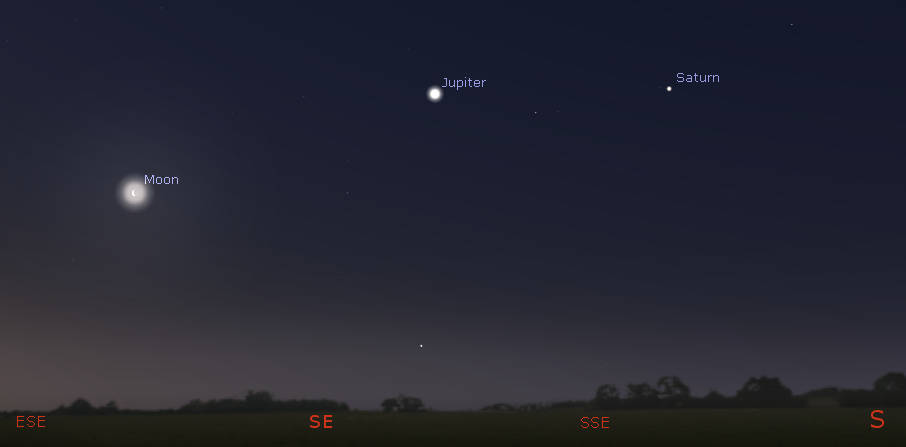
Saturn Jupiter and the crescent Moon at 5 am, about an hour before sunrise. Click on the image to enlarge. Created using Stellarium.
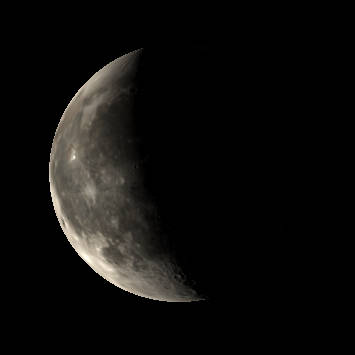
The waning crescent Moon as it should appear in binoculars, tomorrow morning at 5 am, June 3, 2021.
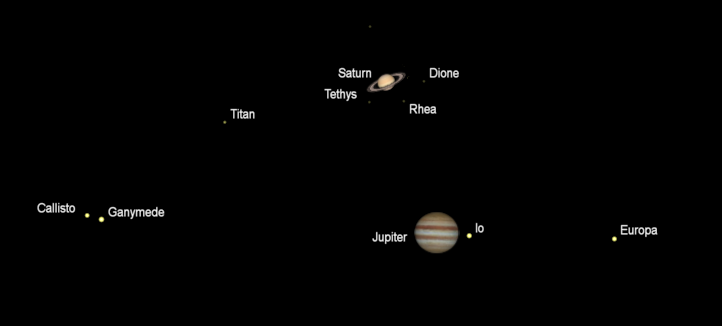
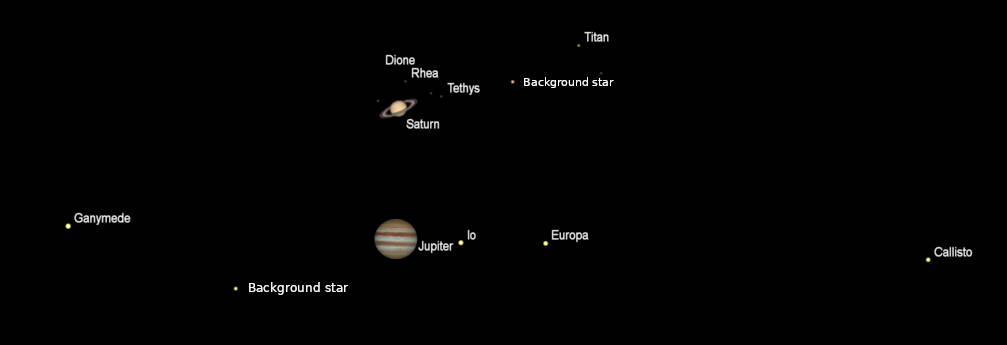
Saturn and Jupiter as seen in a small telescope at the same magnification at 5 am June 3, 2021. Apparent diameters: Saturn, 17.64″, rings, 41.09″; Jupiter, 41.51″. Mars is too far away to make out detail on its surface, except maybe a polar cap. Its apparent diameter is 4.13″. Venus’ apparent diameter is 10.35″ and will be added when it gets far enough from the Sun to be easily seen. The normal cutoff for whether to show a planet here is an apparent diameter of 10″ or greater. The symbol means seconds of arc (1/3600th of a degree). Created using Cartes du Ciel (Sky Charts).
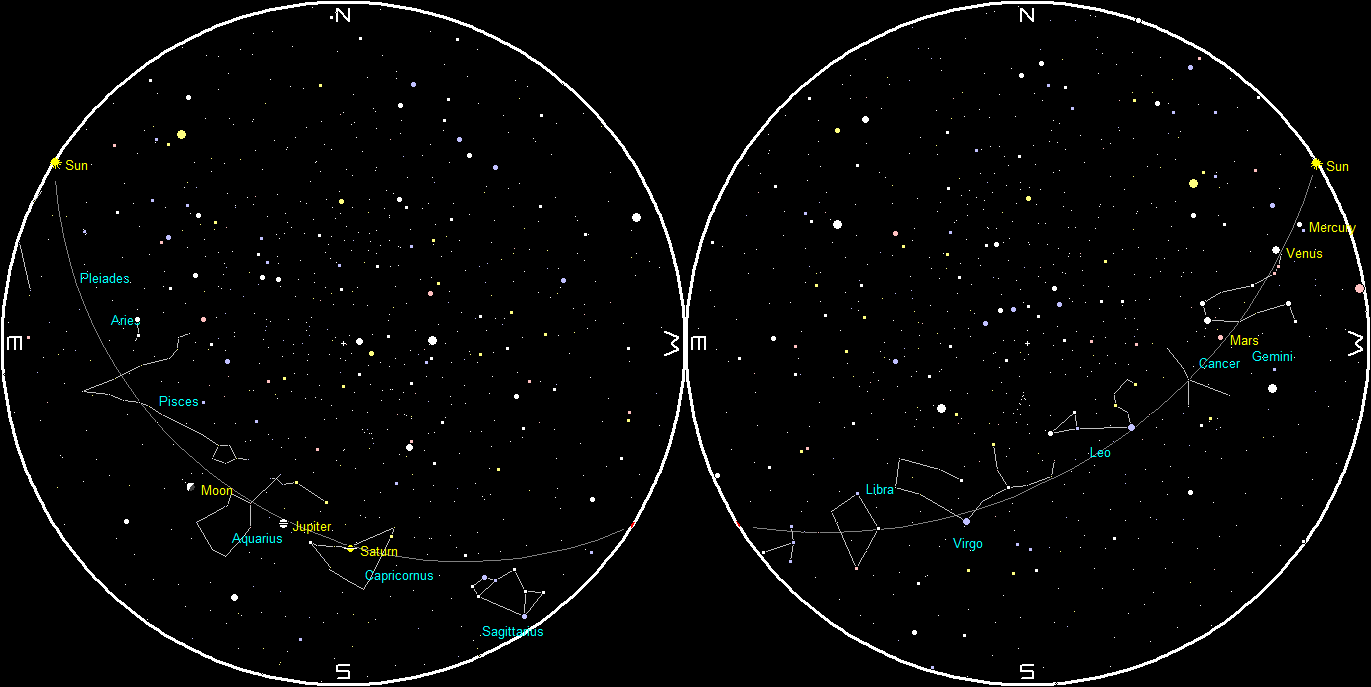
Planets and the Moon at sunset and sunrise of a single night starting with sunset on the right on June 2, 2021. The night ends on the left with sunrise on the 3rd. Click on the image to enlarge. Created using my LookingUp program.
06/01/2021 – Ephemeris – Previewing June Skies
This is Ephemeris for Tuesday, June 1st. Today the Sun will be up for 15 hours and 21 minutes, setting at 9:21, and it will rise tomorrow at 5:59. The Moon, 1 day before last quarter, will rise at 2:49 tomorrow morning.
This is the 46th anniversary of this program as we start our 47th orbit of the Sun. Let’s take a look at June skies. There will be a lot of Sunshine this month. The daylight hours will increase a bit from 15 hours and 21 minutes today to 15 hours and 34 minutes on the 21st, retreating back to 15 hours 31 minutes at month’s end. At this time of the year the sunset times for Ludington, Interlochen, Petoskey and Mackinaw City are very nearly the same. However, the sunrise times are at their most divergent. With Ludington’s sunrise being 14 minutes later than Mackinaw City’s. The altitude of the Sun above the southern horizon at local noon (1:44 pm in Interlochen) on the solstice, June 20th will be 68 and three-quarters degrees in Interlochen. Summer will start at 11:32 pm that night.
The big event this month will be a sunrise partial eclipse on the 10th. I’ll have more information next week.
The astronomical event times given are for the Traverse City/Interlochen area of Michigan. They may be different for your location.
Addendum
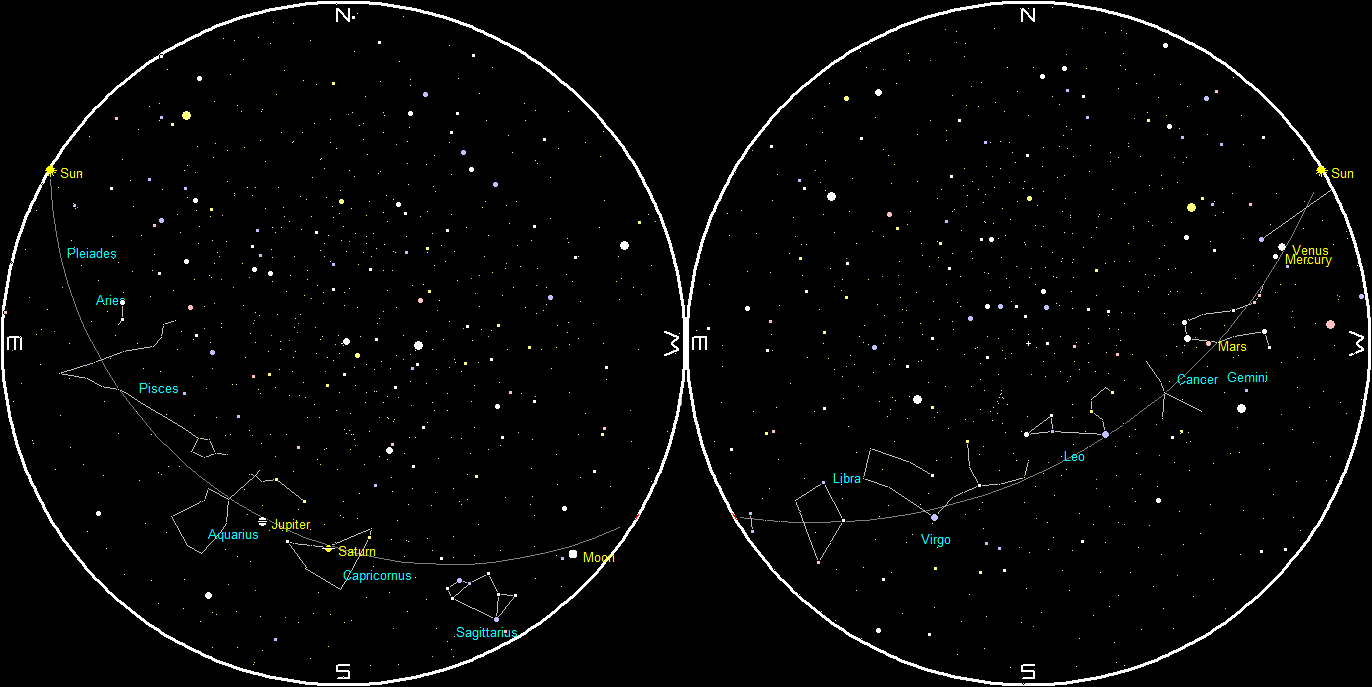
June Evening Star Chart
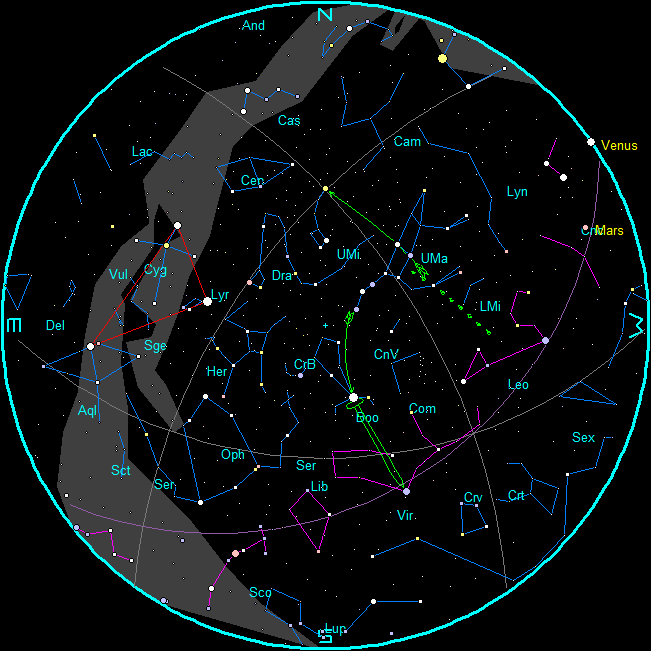
Star Chart for June 2021 (11 p.m. EDT June 15, 2021). Created using my LookingUp program. Click on image to enlarge.
The planets and stars are plotted for the 15th at 11 p.m. EDT in the evening and 4 a.m. for the morning chart. These are the chart times. Note that Interlochen/Traverse City is located approximately 45 minutes behind our time meridian, West 75° longitude. (An hour 45 minutes behind our daylight saving time meridian during EDT). To duplicate the star positions on a planisphere you may have to set it to 1 hour 45 minutes earlier than the current time.
Note the chart times of 11 p.m. and 5 a.m. are for the 15th. For each week before the 15th, add ½ hour (28 minutes if you’re picky). For each week after the 15th, subtract ½ hour, or 28 minutes. The planet positions are updated each Wednesday on this blog. For planet positions on dates other than the 15th, check the Wednesday planet posts on this blog for weekly positions.
June Morning Star Chart
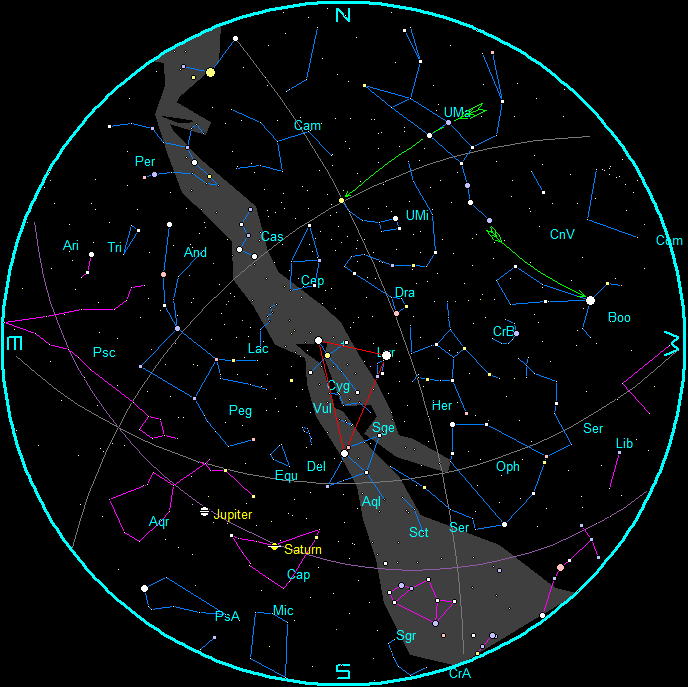
Star Chart for June mornings 2021 (4 am EDT June 15, 2021). Created using my LookingUp program. Click on image to enlarge.
For a list of constellation names to go with the abbreviations, click here.
- Pointer stars at the front of the bowl of the Big Dipper point to Polaris, the North Star.
- Leaky dipper drips on Leo
- Follow the arc of the handle of the Big Dipper to the star Arcturus, and
- Extend like a spike to Spica,
Twilight Limits, Nautical and Astronomical
| EDT | |||||||
| Morning | Twilight | Evening | Twilight | Dark | Night | Moon | |
| Date | Astro. | Nautical | Nautical | Astro. | Start | End | Illum. |
| 2021-06-01 | 3h42m | 4h42m | 22h47m | 23h46m | 23h46m | 2h23m | 0.51 |
| 2021-06-02 | 3h41m | 4h41m | 22h48m | 23h48m | 23h48m | 2h49m | 0.41 |
| 2021-06-03 | 3h40m | 4h40m | 22h49m | 23h49m | 23h49m | 3h11m | 0.32 |
| 2021-06-04 | 3h39m | 4h39m | 22h50m | 23h51m | 23h51m | 3h30m | 0.23 |
| 2021-06-05 | 3h38m | 4h39m | 22h51m | 23h52m | 23h52m | 3h38m | 0.16 |
| 2021-06-06 | 3h37m | 4h38m | 22h52m | 23h54m | 23h54m | 3h37m | 0.09 |
| 2021-06-07 | 3h36m | 4h38m | 22h53m | 23h55m | 23h55m | 3h36m | 0.05 |
| 2021-06-08 | 3h35m | 4h37m | 22h54m | 23h56m | 23h56m | 3h35m | 0.01 |
| 2021-06-09 | 3h34m | 4h37m | 22h55m | 23h57m | 23h57m | 3h34m | 0 |
| 2021-06-10 | 3h33m | 4h36m | 22h55m | 23h58m | 23h58m | 3h33m | 0.01 |
| 2021-06-11 | 3h33m | 4h36m | 22h56m | 23h59m | 23h59m | 3h33m | 0.03 |
| 2021-06-12 | 3h32m | 4h36m | 22h57m | 0h00m | 0h00m | 3h32m | 0.07 |
| 2021-06-13 | 3h32m | 4h35m | 22h58m | 0h01m | 0h01m | 3h32m | 0.13 |
| 2021-06-14 | 3h31m | 4h35m | 22h58m | 0h02m | 0h26m | 3h31m | 0.21 |
| 2021-06-15 | 3h31m | 4h35m | 22h59m | 0h03m | 1h01m | 3h31m | 0.3 |
| 2021-06-16 | 3h31m | 4h35m | 22h59m | 0h03m | 1h30m | 3h31m | 0.4 |
| 2021-06-17 | 3h31m | 4h35m | 23h00m | 0h04m | 1h55m | 3h31m | 0.5 |
| 2021-06-18 | 3h31m | 4h35m | 23h00m | 0h05m | 2h18m | 3h31m | 0.62 |
| 2021-06-19 | 3h31m | 4h35m | 23h00m | 0h05m | 2h41m | 3h31m | 0.72 |
| 2021-06-20 | 3h31m | 4h35m | 23h01m | 0h05m | 3h05m | 3h31m | 0.82 |
| 2021-06-21 | 3h31m | 4h36m | 23h01m | 0h05m | 3h31m | 3h31m | 0.91 |
| 2021-06-22 | 3h31m | 4h36m | 23h01m | 0h06m | – | – | 0.96 |
| 2021-06-23 | 3h32m | 4h36m | 23h01m | 0h06m | – | – | 1 |
| 2021-06-24 | 3h32m | 4h37m | 23h01m | 0h06m | – | – | 1 |
| 2021-06-25 | 3h33m | 4h37m | 23h01m | 0h05m | – | – | 0.97 |
| 2021-06-26 | 3h33m | 4h38m | 23h01m | 0h05m | – | – | 0.92 |
| 2021-06-27 | 3h34m | 4h38m | 23h01m | 0h05m | – | – | 0.85 |
| 2021-06-28 | 3h35m | 4h39m | 23h01m | 0h04m | 0h04m | 0h22m | 0.76 |
| 2021-06-29 | 3h36m | 4h39m | 23h00m | 0h04m | 0h04m | 0h50m | 0.67 |
| 2021-06-30 | 3h37m | 4h40m | 23h00m | 0h03m | 0h03m | 1h14m | 0.57 |
The twilight calendar was generated using Cartes du Ciel (Sky Charts), with some corrections.
See my blog post: Twilight Zone for the definitions of the different periods of twilight here: https://bobmoler.wordpress.com/2018/09/27/.
NASA Calendar of Planetary Events
Jun  1  Tu            Venus: 17.5° E
     1  Tu   4:57 am  Moon-Jupiter: 4.9° N
     2  We   3:24 am  Last Quarter
     7  Mo  10:27 pm  Moon Apogee: 406200 km
     9  We  12:42 pm  Moon Ascending Node
    10  Th   6:43 am  Annular Solar Eclipse*
    10  Th   6:53 am  New Moon
    10  Th   9:06 pm  Mercury Inferior Conj.
    12  Sa  12:11 am  Moon North Dec.: 25.6° N
    12  Sa   2:44 am  Moon-Venus: 1.6° S
    13  Su   3:52 pm  Moon-Mars: 3° S
    14  Mo   2:47 am  Moon-Beehive: 3.1° S
    17  Th  11:54 pm  First Quarter
    20  Su  11:32 pm  Summer Solstice
    21  Mo  11:57 am  Venus-Pollux: 5.2° S
    22  Tu   4:54 pm  Mercury-Aldebaran: 6.4° N
    23  We   1:21 am  Mars-Beehive: 0.3° S
    23  We   2:07 am  Moon Descending Node
    23  We   5:58 am  Moon Perigee: 360000 km
    24  Th   2:40 pm  Full Moon
    25  Fr   1:49 am  Moon South Dec.: 25.6° S
    27  Su   5:30 am  Moon-Saturn: 4.1° N
    28  Mo   2:38 pm  Moon-Jupiter: 4.6° N
Sky Events Calendar by Fred Espenak and Sumit Dutta (NASA’s GSFC),
http://eclipse.gsfc.nasa.gov/SKYCAL/SKYCAL.html.
Sun and Moon Rising and Setting Events
LU                  Ephemeris of Sky Events for Interlochen/TC
June, 2021    Local time zone: EDT
+-----------------------------------------------------------------------+
| DATE |  SUN     SUN  DAYLIGHT|   TWILIGHT*    |MOON  RISE OR    ILLUM |
|      |  RISE    SET    HOURS |  END    START  |PHASE SET** TIME FRACTN|
+=======================================================================+
|Tue  1| 06:00a  09:21p  15:21 | 10:45p  04:37a |      Rise 02:49a   53%|
|Wed  2| 05:59a  09:22p  15:22 | 10:46p  04:36a |L Qtr Rise 03:10a   43%|
|Thu  3| 05:59a  09:23p  15:23 | 10:47p  04:35a |      Rise 03:30a   33%|
|Fri  4| 05:58a  09:23p  15:25 | 10:48p  04:34a |      Rise 03:49a   25%|
|Sat  5| 05:58a  09:24p  15:26 | 10:49p  04:34a |      Rise 04:09a   17%|
+------+-----------------------+----------------+-----------------------+
|Sun  6| 05:58a  09:25p  15:27 | 10:50p  04:33a |      Rise 04:30a   10%|
|Mon  7| 05:57a  09:26p  15:28 | 10:50p  04:33a |      Rise 04:54a    5%|
|Tue  8| 05:57a  09:26p  15:29 | 10:51p  04:32a |      Rise 05:22a    2%|
|Wed  9| 05:57a  09:27p  15:30 | 10:52p  04:32a |      Rise 05:57a    0%|
|Thu 10| 05:57a  09:27p  15:30 | 10:53p  04:31a |New   Set  10:01p    0%|
|Fri 11| 05:56a  09:28p  15:31 | 10:54p  04:31a |      Set  10:56p    2%|
|Sat 12| 05:56a  09:28p  15:32 | 10:54p  04:31a |      Set  11:45p    6%|
+------+-----------------------+----------------+-----------------------+
|Sun 13| 05:56a  09:29p  15:32 | 10:55p  04:30a |      Set  12:26a   12%|
|Mon 14| 05:56a  09:29p  15:33 | 10:55p  04:30a |      Set  01:00a   19%|
|Tue 15| 05:56a  09:30p  15:33 | 10:56p  04:30a |      Set  01:29a   28%|
|Wed 16| 05:56a  09:30p  15:34 | 10:56p  04:30a |      Set  01:55a   37%|
|Thu 17| 05:56a  09:31p  15:34 | 10:57p  04:30a |F Qtr Set  02:18a   48%|
|Fri 18| 05:56a  09:31p  15:34 | 10:57p  04:30a |      Set  02:41a   59%|
|Sat 19| 05:56a  09:31p  15:34 | 10:58p  04:30a |      Set  03:04a   70%|
+------+-----------------------+----------------+-----------------------+
|Sun 20| 05:57a  09:31p  15:34 | 10:58p  04:30a |      Set  03:31a   80%|
|Mon 21| 05:57a  09:32p  15:34 | 10:58p  04:30a |      Set  04:02a   89%|
|Tue 22| 05:57a  09:32p  15:34 | 10:58p  04:31a |      Set  04:41a   95%|
|Wed 23| 05:57a  09:32p  15:34 | 10:58p  04:31a |      Set  05:30a   99%|
|Thu 24| 05:58a  09:32p  15:34 | 10:58p  04:31a |Full  Rise 09:59p  100%|
|Fri 25| 05:58a  09:32p  15:34 | 10:58p  04:32a |      Rise 10:58p   98%|
|Sat 26| 05:58a  09:32p  15:33 | 10:58p  04:32a |      Rise 11:45p   93%|
+------+-----------------------+----------------+-----------------------+
|Sun 27| 05:59a  09:32p  15:33 | 10:58p  04:33a |      Rise 12:22a   86%|
|Mon 28| 05:59a  09:32p  15:32 | 10:58p  04:33a |      Rise 12:50a   78%|
|Tue 29| 06:00a  09:32p  15:32 | 10:57p  04:34a |      Rise 01:14a   69%|
|Wed 30| 06:00a  09:32p  15:31 | 10:57p  04:35a |      Rise 01:35a   59%|
+-----------------------------------------------------------------------+
* Nautical Twilight
** Moonrise or moonset, whichever occurs between sunrise and sunset
Generated using my LookingUp for DOS program.
05/31/2021 – Ephemeris – Hercules the constellation
This is Bob Moler with Ephemeris for Memorial Day, Monday, May 31st. Today the Sun will be up for 15 hours and 19 minutes, setting at 9:20, and it will rise tomorrow at 6:00. The Moon, 2 days before last quarter, will rise at 2:23 tomorrow morning.
Orion, the hard luck mythological Greek hunter gets a splashy constellation in the winter sky, but the greatest hero of all, Hercules, gets a dim group of stars on the border between the spring and summer stars. At 11 p.m. Hercules is fairly high in the east. It is located above and a bit right of the bright star, Vega east-northeast. Hercules’ central feature is a keystone shaped box of stars, called the Keystone laying on its side, which represents the old boy’s shorts. From each left corner stars extend lines of stars that are his legs, from the right stars, the rest of his torso and arms extend. So in one final indignity he’s upside down in our sky. For those with a telescope, Hercules contains the beautiful globular star cluster Messier 13.
The astronomical event times given are for the Traverse City/Interlochen area of Michigan. They may be different for your location.
Addendum
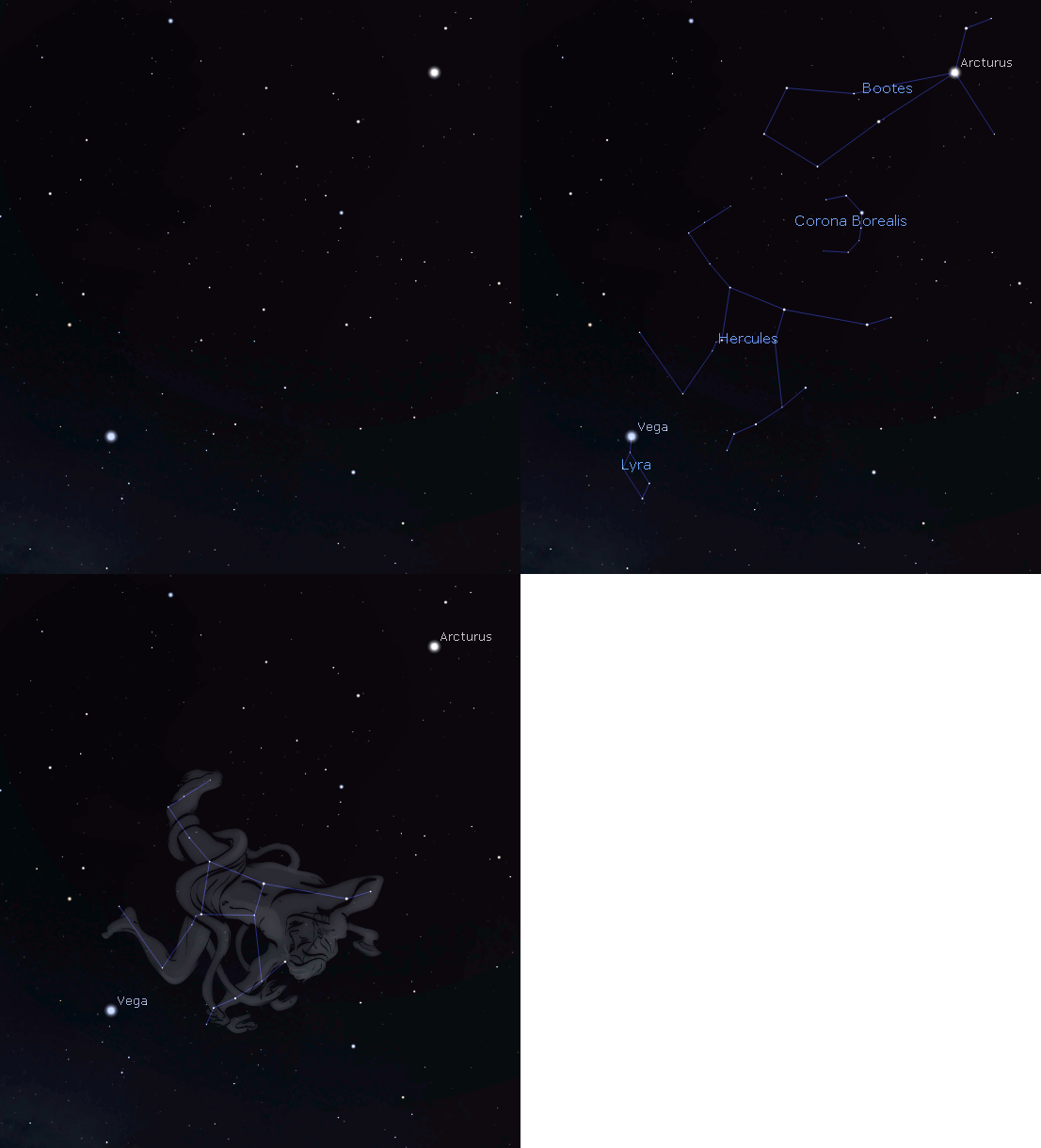
Hercules can be found in the east among the line of constellations at around 11 pm in late May or early June between the bright stars Arcturus and Vega. Created using Stellarium and GIMP.
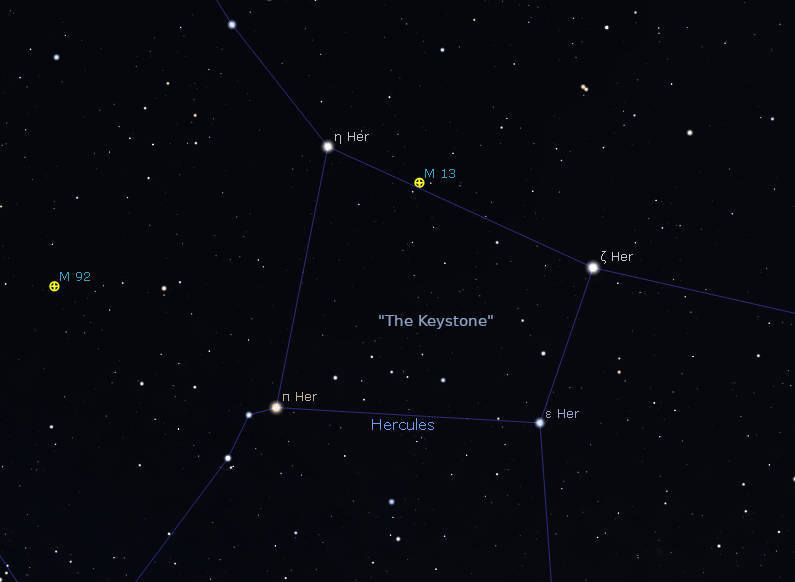
M 13 is found on the western side of the Keystone. In this orientation when Hercules is in the east, it is the top side. Created using Stellarium with an annotation.
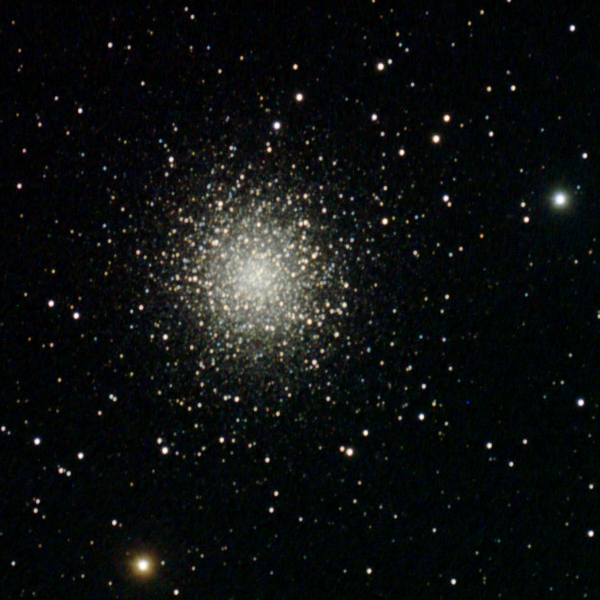
M 13, the Great Globular Star Cluster in Hercules. Credit: Scott Anttila.
M 13 is the brightest and finest globular star cluster in the northern hemisphere of the sky. It’s at a distance of 25 thousand light years. Some amateur astronomers can spot M 13 with the naked eye. It is a fuzzy spot in binoculars. I can barely resolve some of its stars in an 8-inch (200 mm) telescope. It’s a wonderful sight in anything bigger! The slightly dimmer M 92 is also slightly farther away at nearly 27 thousand light years.
Click on any of the images above to enlarge them.
05/28/2021 – Ephemeris – The Northern Crown
This is Bob Moler with Ephemeris for Friday, May 28th. Today the Sun will be up for 15 hours and 15 minutes, setting at 9:18, and it will rise tomorrow at 6:01. The Moon, 2 days past full, will rise at 12:19 tomorrow morning.
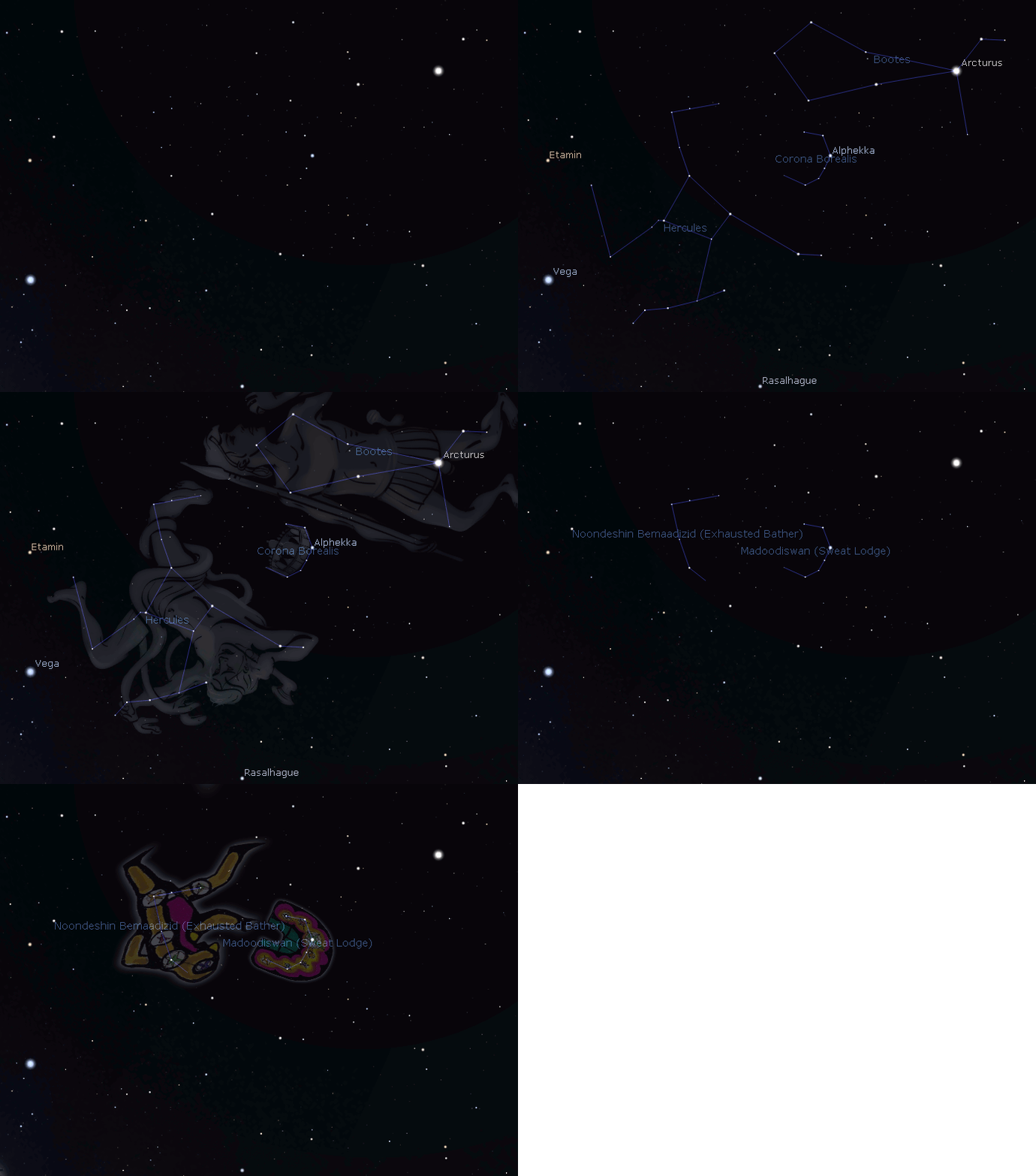
High in the east-southeast at 11 this evening can be seen a small nearly circular constellation of Corona Borealis, the Northern Crown. It is just below Boötes, the kite shaped constellation off the handle of the Big Dipper. According to Greek myth the crown was given by the gods to the princess Ariadne, daughter of King Minos of Crete. The crown is more like a tiara with the bright star Alphecca at the front. To the Anishinaabe people, who are natives of our region, it is the Sweat Lodge. Part of what we call Hercules next to it is the Exhausted Bather, who is lying on the ground after the ceremony. The seven stones that are heated for the Sweat Lodge are the Pleiades, now too close to the Sun to be seen.
The astronomical event times given are for the Traverse City/Interlochen area of Michigan. They may be different for your location.
Addendum
05/27/2021 – Ephemeris – Miss yesterday’s eclipse? There’s 2 more in the next 12 months.
This is Bob Moler with Ephemeris for Thursday, May 27th. Today the Sun will be up for 15 hours and 13 minutes, setting at 9:17, and it will rise tomorrow at 6:02. The Moon, 1 day past full, will rise at 11:14 this evening.
While yesterday morning’s lunar eclipse may have been disappointing by setting just as it got going. That won’t happen with the next one. The next lunar eclipse visible from Northern Michigan will occur this November 19th, a Friday. It’s another morning eclipse, but doesn’t compete with sunrise or morning twilight. It’s not quite total, but nearly 97.5% of the Moon’s diameter will be covered by the Earth’s inner umbral shadow. The partial eclipse will start at 2:18 am and end at 5:47 am, which in November is nowhere near sunrise. We seem to be coming into a fortuitous period of eclipses in the next few years. Our next lunar eclipse after November will be next May 15th’s lunar eclipse, and it will be total and will conveniently happen in the evening.
The astronomical event times given are for the Traverse City/Interlochen area of Michigan. They may be different for your location.
05/26/2021 – Ephemeris – Let’s search for the naked-eye planets for this week
There is a lunar eclipse this morning. See https://bobmoler.wordpress.com/2021/05/25/05-25-2021-ephemeris-viewing-the-lunar-eclipse-tomorrow-morning/
This is Ephemeris for Wednesday, May 26th. Today the Sun will be up for 15 hours and 12 minutes, setting at 9:16, and it will rise tomorrow at 6:03. The Moon, at full today, will rise at 9:57 this evening.
Let’s search for the naked-eye planets for this week. Venus might be spotted low in the west-northwest twilight by 10 pm. Mercury will be a bit above and left of Venus, but is now too dim to spot. Venus will set at 10:36 pm. Mars can be found in the west at 10:30 tonight, in the constellation of Gemini the twins. Tonight it’s on the left side of the constellation, below Gemini’s brightest star, Pollux. Mars will set at 12:37 am. Jupiter and Saturn, are in the morning sky. Saturn will rise at 1:36 am. It’s seen with the stars of Capricornus. Brighter Jupiter, now within the boundaries of Aquarius, will rise at 2:21 am. By 5 am they will be in the southeast in the morning twilight.
The astronomical event times given are for the Traverse City/Interlochen area of Michigan. They may be different for your location.
Addendum
05/25/2021 – Ephemeris – Viewing the lunar eclipse tomorrow morning
This post is for the appearance of the May 26th lunar eclipse in Michigan.
This is Ephemeris for Tuesday, May 25th. Today the Sun will be up for 15 hours and 10 minutes, setting at 9:15, and it will rise tomorrow at 6:04. The Moon, 1 day before full, will set at 6:09 tomorrow morning.
If we are really lucky tomorrow morning, and it is clear all the way down to the southwestern horizon at dawn we will witness the start of an eclipse of the Moon near sunrise and moonset. The eclipse starts at 4:48 am, but nothing unusual will be visible as the Moon starts to enter Earth’s outer, penumbral shadow. Perhaps by 5:15 the left edge of the Moon might appear dimmer than the right side. The Moon will be getting deeper in that shadow for the next half hour until at 5:45 it begins to enter the Earth’s inner shadow, the umbra. The only light in the umbra is that bent into it by the simultaneous sunrises and sunsets around the Earth. For the next 20 to 25 minutes the shadow will increase until the Sun rises and shortly after that the Moon sets around 6:09.
The astronomical event times given are for the Traverse City/Interlochen area of Michigan. They may be different for your location.
Addendum
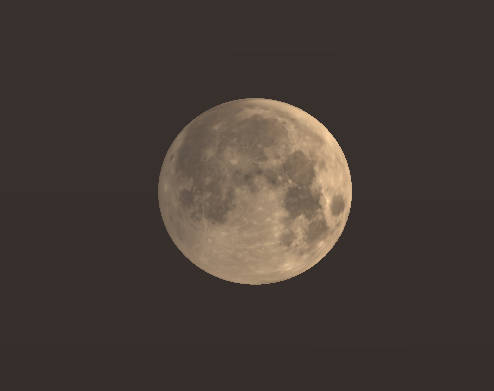
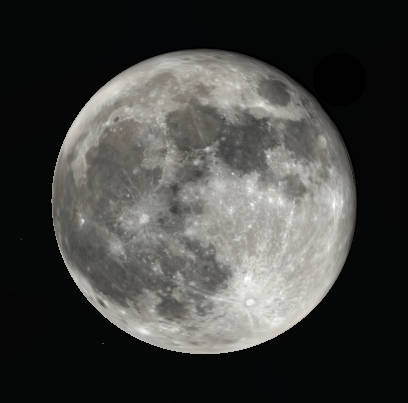
Simulated image of the Moon deep in the penumbra of the lunar eclipse of May 26, 2021 at 5:40 am. Notice that the left side of the Moon is darker than the right side. I find that the effect is more noticeable when wearing sunglasses to cut down the Moon’s bright glare. Created using Stellarium.
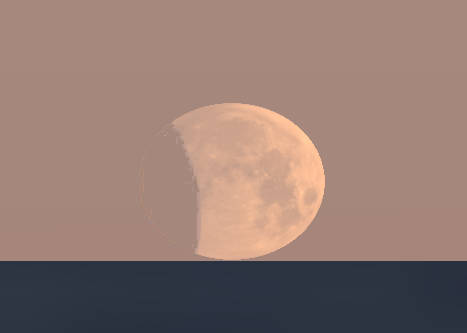
Simulated view of the partially eclipsed Moon of May 26, 2021 setting on a flat horizon. Created using Stellarium and touched up by using GIMP.
| Time | Event |
| 4:47 am | Nautical twilight starts |
| 4:48 am | The Moon enters penumbra (Nothing to see, the dimming on the left side is imperceptible) |
| 5:15 am | The penumbral shadow should become visible at the left edge of the Moon by this time |
| 5:45 am | The Moon enters the umbra (The partial part of the eclipse begins) |
| 6:04 am | Sunrise for Traverse City |
| 6:09 am | Moon sets for Traverse City |
The sunrise and moon set times may vary by more than a few minutes depending on your location.
05/24/2021 – Ephemeris – Get ready for Wednesday morning’s lunar eclipse
This is Bob Moler with Ephemeris for Monday, May 24th. Today the Sun will be up for 15 hours and 8 minutes, setting at 9:14, and it will rise tomorrow at 6:04. The Moon, 2 days before full, will set at 5:33 tomorrow morning.
If we are really lucky Wednesday morning, and it is clear all the way down to the southwestern horizon at dawn, we will witness the start of an eclipse of the Moon as the Sun rises and the Moon sets. The first inkling that something strange is happening to the Moon will come around 5:15 am or so. The Moon will be deep in the Earth’s outer, partial, shadow called the penumbra and the left side of the Moon should appear darker than the rest of it. The brightening of the twilight should enhance the effect. The partial phase of the eclipse will start at 5:45, where the left edge of the Moon will actually begin to disappear into the Earth’s inner shadow, the umbra. Within 20 to 25minutes later the Sun will rise and shortly after the Moon will set.
The astronomical event times given are for the Traverse City/Interlochen area of Michigan. They may be different for your location.
Addendum
Simulated image of the Moon deep in the penumbra of the lunar eclipse of May 26, 2021 at 5:40 am. Notice that the left side of the Moon is darker than the right side. I find that the effect is more noticeable when wearing sunglasses to cut down the Moon’s bright glare. Created using Stellarium.
Simulated view of the partially eclipsed Moon of May 26, 2021 setting on a flat horizon. Created using Stellarium and touched up by using GIMP.
| Time | Event |
| 4:47 am | Nautical twilight starts |
| 4:48 am | The Moon enters penumbra (Nothing to see, the dimming on the left side is imperceptible) |
| 5:15 am | The penumbral shadow should become visible at the left edge of the Moon by this time |
| 5:45 am | The Moon enters the umbra (The partial part of the eclipse begins) |
| 6:04 am | Sunrise for Traverse City |
| 6:09 am | Moon sets for Traverse City |
The sunrise and moon set times may vary by more than a few minutes depending on your location.
05/21/2021 – Ephemeris – For everything there is a season… even eclipses
This is Ephemeris for Friday, May 21st. Today the Sun will be up for 15 hours and 3 minutes, setting at 9:11, and it will rise tomorrow at 6:07. The Moon, 2 days past first quarter, will set at 4:14 tomorrow morning.
There are seasons for everything: baseball season, football season, spring, summer, what have you. There are also eclipse seasons. The Moon’s orbit is tilted by about 5 degrees to the ecliptic, the path of the Sun in the sky. The points where they cross are called nodes, 180 degrees apart. When the Sun is near one of those nodes we are in an eclipse season, where a solar eclipse can occur at new moon, and a lunar eclipse can occur at full moon. We are guaranteed one of each per eclipse season, and on rare occasions a third eclipse. Of course one has to be at the right place to see an eclipse. This eclipse season we will be at a marginal place to see both eclipses. Both are at sunrise, so we’ll see just a part of each of them.
The astronomical event times given are for the Traverse City/Interlochen area of Michigan. They may be different for your location.
Addendum
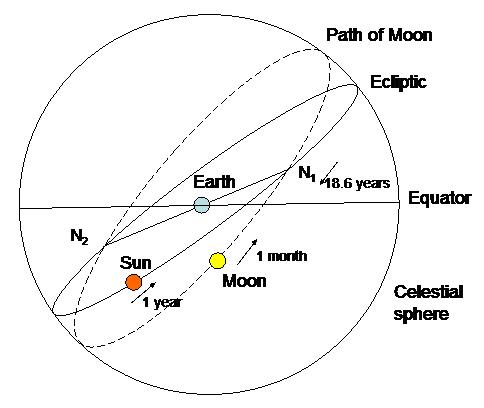
For a more extensive treatment of this subject check out: https://earthsky.org/astronomy-essentials/definition-what-is-an-eclipse-season
 Bob Moler's Ephemeris Blog