Ephemeris: 09/10/2026 – Finding Pegasus the winged horse of Greek myth
This is Ephemeris for Thursday, September 10th. Today the Sun will be up for 12 hours and 46 minutes, setting at 8:02, and it will rise tomorrow at 7:17. The Moon is new today, and won’t be visible.
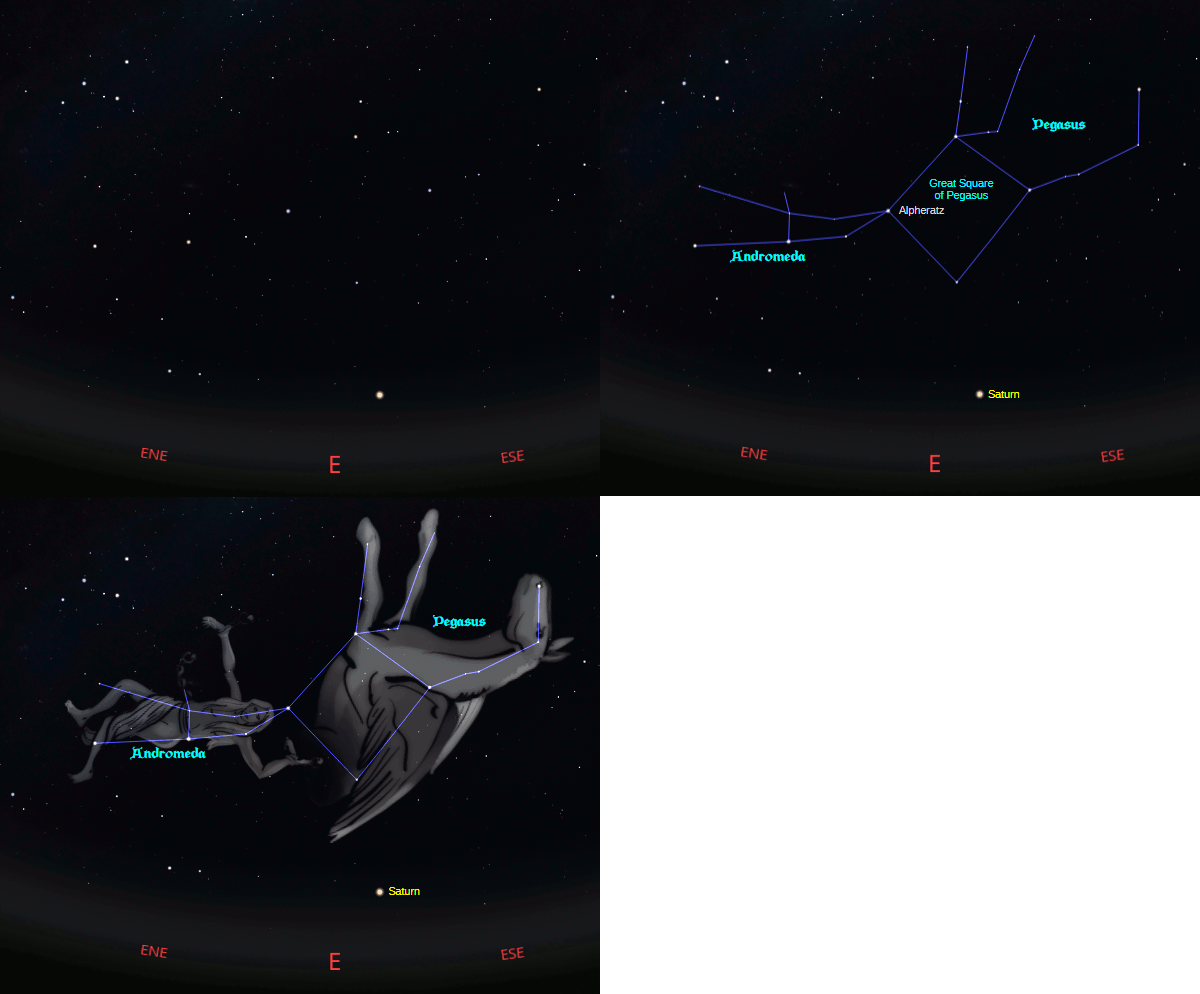
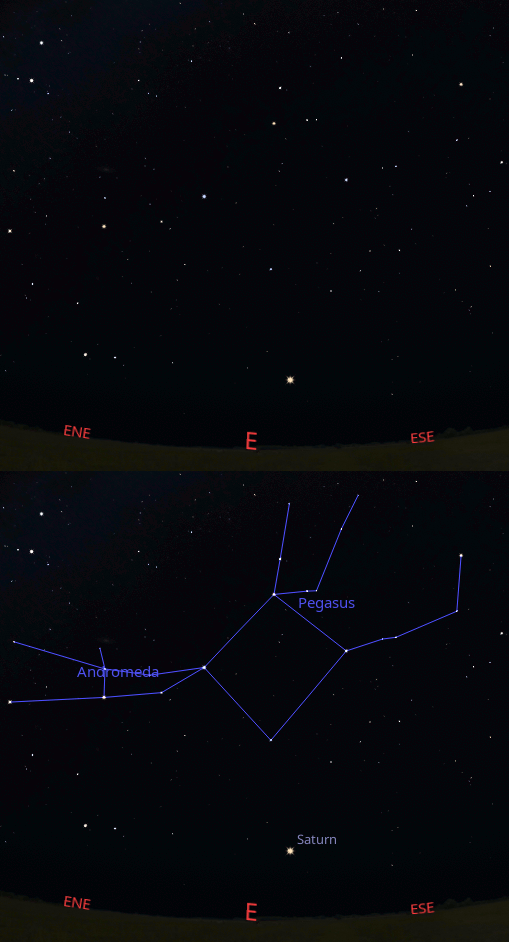
Saturn is low in the eastern sky at 10 PM. This is the brightest “star” in that direction. Above Saturn is the Great Square of Pegasus, a large, nearly perfect square of stars, standing on one corner. This is the front part of the body of Pegasus the flying horse. He’s climbing to the upper right, following the rotation of the sky. But it’s flying upside down, having its neck and head extend from the rightmost star of the square. From the top star are his forelegs extend. From the leftmost star extend two curved lines of stars which may look like hind legs, but belong to another constellation, Andromeda the Princess. Pegasus’ wings are not seen in the stars. Pegasus is part of a Greek myth, which has been made into two movies, both titled Clash of the Titans. But no actual Titans were used in the movies. All gods and godesses in the movie were their decendents.
The astronomical event times given in this blog are for the Traverse City/Interlochen area of Michigan (Lat 44.7° N, Long 85.7° W; EDT, UT – 4 hours) unless stated otherwise. Times will be different for other locations.
Addendum
Ephemeris: 09/09/2026 – Taking our weekly look at the whereabouts of the naked-eye planets
This is Ephemeris for Wednesday, September 9th. Today the Sun will be up for 12 hours and 49 minutes, setting at 8:04, and it will rise tomorrow at 7:15. The Moon, 1 day before new, will rise at 6:35 tomorrow morning.
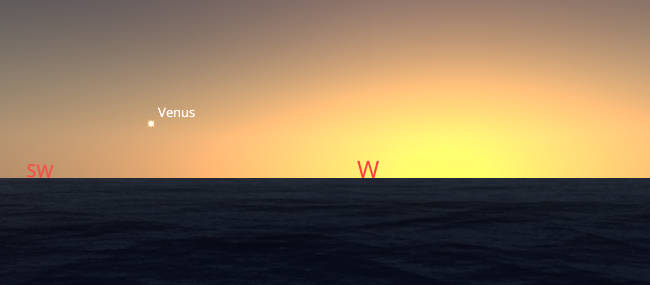
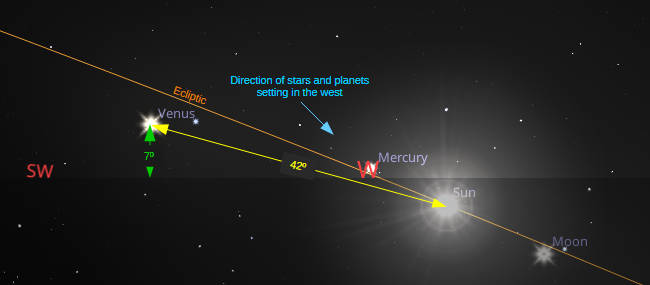
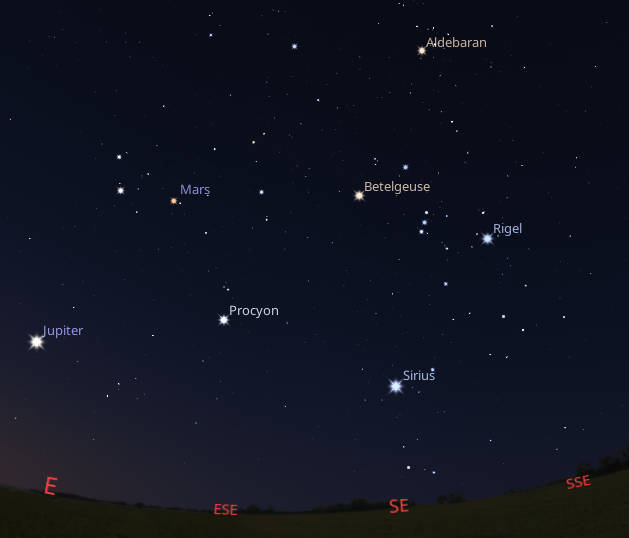
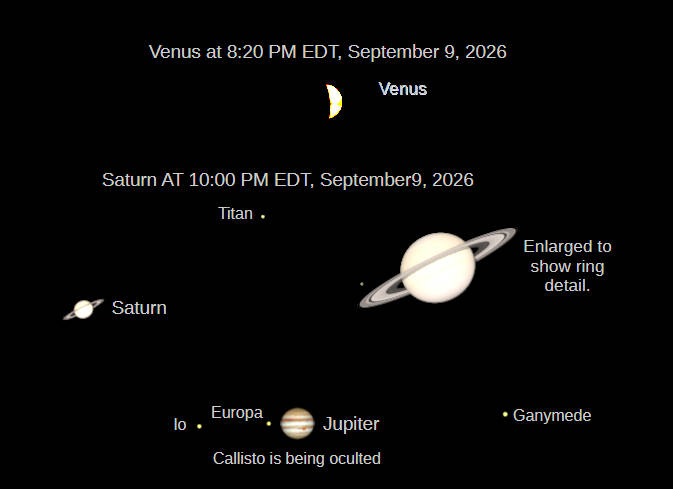
Let’s take our weekly look at the whereabouts of the naked-eye planets. By 8:20 tonight,nearly a half-hour after sunset, Venus will be spotted very low in the west southwestern sky. Though at a 42º angle from the sun, it’ll only be 7º above the horizon then. A telescope will show a small crescent disk of the planet. It is now rapidly approaching earth in its orbit, at 45.9 million miles (73.9 mil km) away from us. Venus is becoming an ever decreasing crescent as its apparent diameter grows in telescopes. Saturn will rise at 9:08 PM in the east. At 6 AM, Mars and Jupiter will be in the east. Jupiter is brightest and lowest while Mars has the competition of brighter stars in Gemini.
The astronomical event times given in this blog are for the Traverse City/Interlochen area of Michigan (Lat 44.7° N, Long 85.7° W; EDT, UT – 4 hours) unless stated otherwise. Times will be different for other locations.
Addendum
Ephemeris: 09/08/2026 – Where is the Sun heading to?
This is Ephemeris for Tuesday, September 8th. Today the Sun will be up for 12 hours and 52 minutes, setting at 8:06, and it will rise tomorrow at 7:14. The Moon, 2 days before new, will rise at 5:18 tomorrow morning.
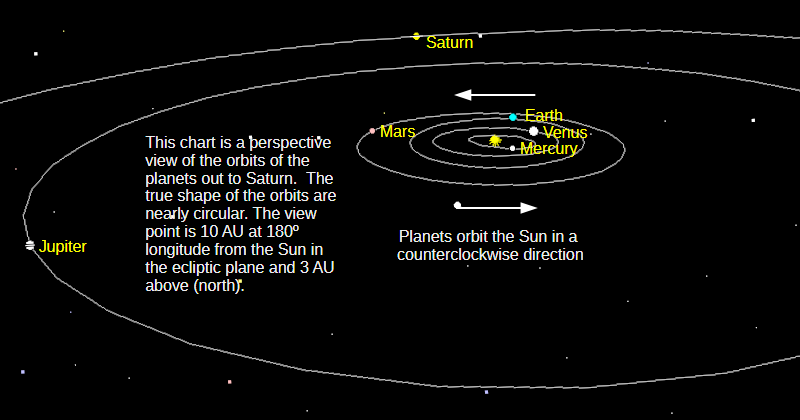
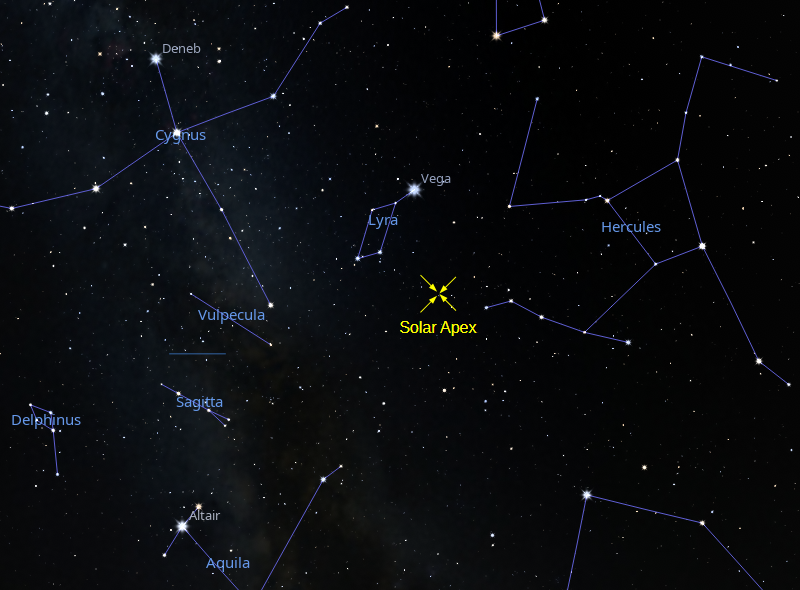
We know that the Earth orbits the sun, but where is the sun going? The sun orbits the center of the Milky Way moving something like 137 miles (220 kilometers) per second in the direction of Cygnus the Swan. It takes about 200 to 250 million years to orbit the center of the galaxy. However, the sun has a motion with respect to the general flow of stars in our neighborhood orbiting the center of the galaxy. Where the sun is heading is it called the solar apex. That point is it just a little bit south of the star Vega which is high in the south in the evening. Vega is the brightest star of this Summer Triangle, which includes Altair to the southeast and Deneb to the east. The sun’s motioned towards the apex that is about 8 miles (13 kilometers) per second.
The astronomical event times given in this blog are for the Traverse City/Interlochen area of Michigan (Lat 44.7° N, Long 85.7° W; EDT, UT – 4 hours) unless stated otherwise. Times will be different for other locations.
Addendum
Ephemeris: 09/07/2026 – Unsung heros of Apollo
This is Ephemeris for Labor Day, Monday, September 7th. Today the Sun will be up for 12 hours and 55 minutes, setting at 8:08, and it will rise tomorrow at 7:13. The Moon, half way from last quarter to new, will rise at 3:58 tomorrow morning.
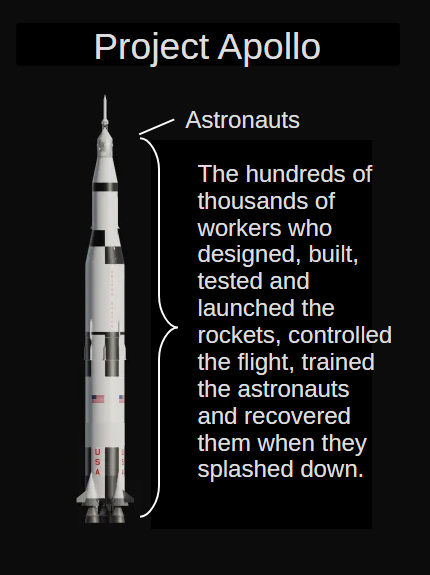
Today is the day we salute all workers. I’d like to remember hundreds of thousands of unsung workers in the 1960s who built and launched machines that went to places no one had gone before namely, space and eventually to the moon. Back then as in now, building rockets and spacecraft is not an assembly line operation, exactly. These are not exact copies of each other for the most part, there was always changes and upgrades with every single one. No two are exactly the same. Space hardware are always in development and inprovements eek out every last bit of performance possible. It takes skill and dedication to build something with the specs always changing, and then getting it right every time.
The astronomical event times given in this blog are for the Traverse City/Interlochen area of Michigan (Lat 44.7° N, Long 85.7° W; EDT, UT – 4 hours) unless stated otherwise. Times will be different for other locations.
Addendum
Ephemeris: 09/04/2026 – GTAS meeting: Meteorites and Quasicrystals
This is Ephemeris for Friday, September 4th. Today the Sun will be up for 13 hours and 5 minutes, setting at 8:13, and it will rise tomorrow at 7:10. The Moon, at last quarter today, will rise at 12:11 tomorrow morning.
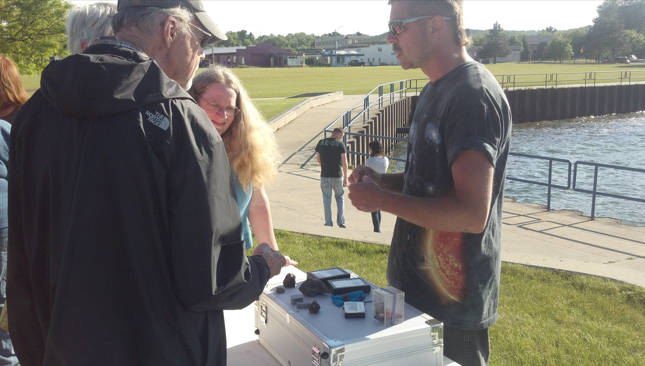
The Grand Traverse Astronomical Society (GTAS) will host its September meeting tonight at 8 PM at Northwestern Michigan College’s Joseph H Rogers Observatory. Joe Brooks our Meteorite Man will present a talk about meteorites and quasicrystals and have meteorites to display. Without giving too much away, NASA has been growing and studying quasicrystals. They have interesting properties, which among other things hold promise in sensors and high efficiency solar cells. Afterward, about 9 PM if it’s clear, there will be viewing of the heavens through the observatory’s telescopes. The observatory is located on Birmley Rd. The meeting is also on Zoom, see gtastro.org for more information.
The astronomical event times given in this blog are for the Traverse City/Interlochen area of Michigan (Lat 44.7° N, Long 85.7° W; EDT, UT – 4 hours) unless stated otherwise. Times will be different for other locations.
Addendum
Ephemeris: 09/03/2026 – Finding the North American Nebula
This is Ephemeris for Thursday, September 3rd. Today the Sun will be up for 13 hours and 8 minutes, setting at 8:15, and it will rise tomorrow at 7:08. The Moon, 1 day before last quarter, will rise at 11:15 this evening.
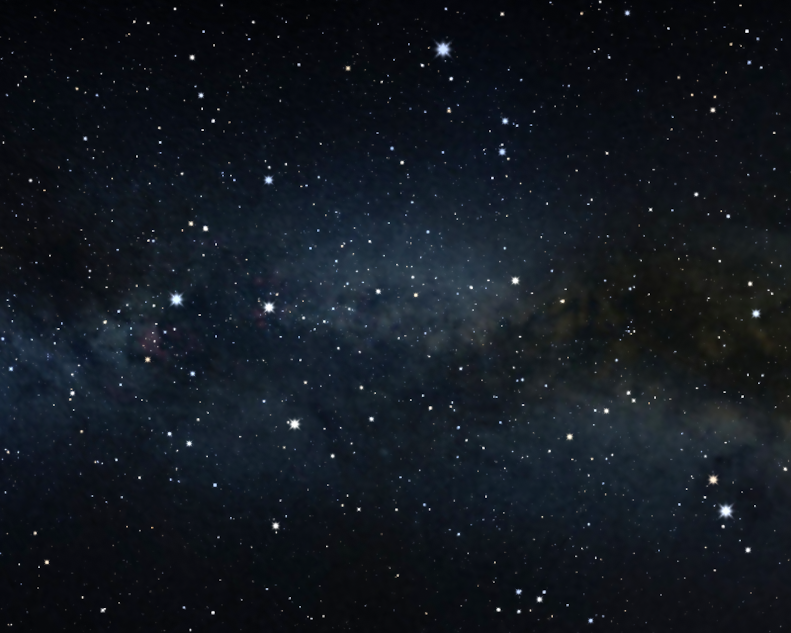
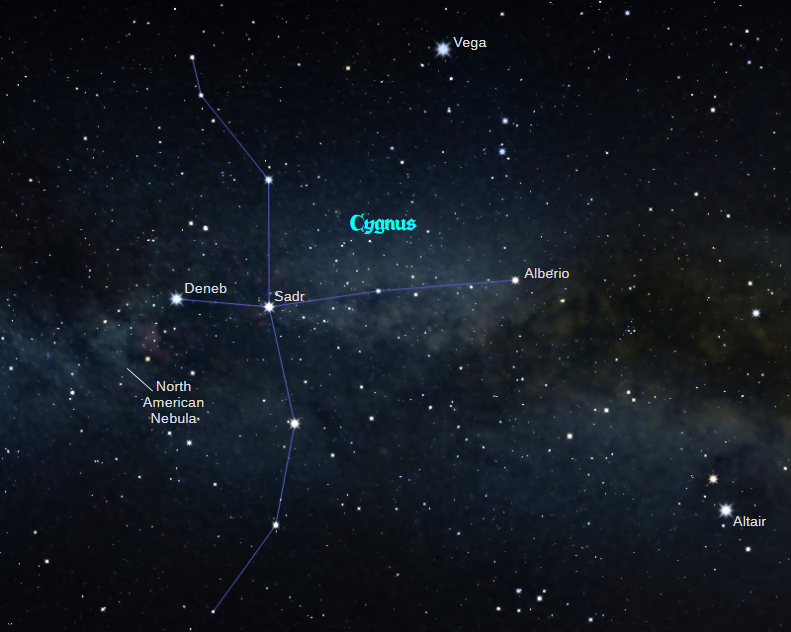
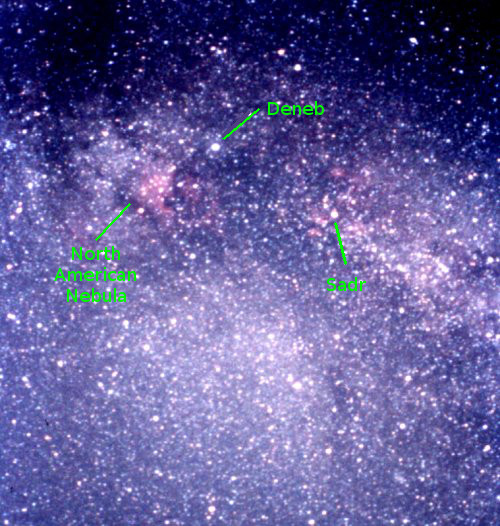
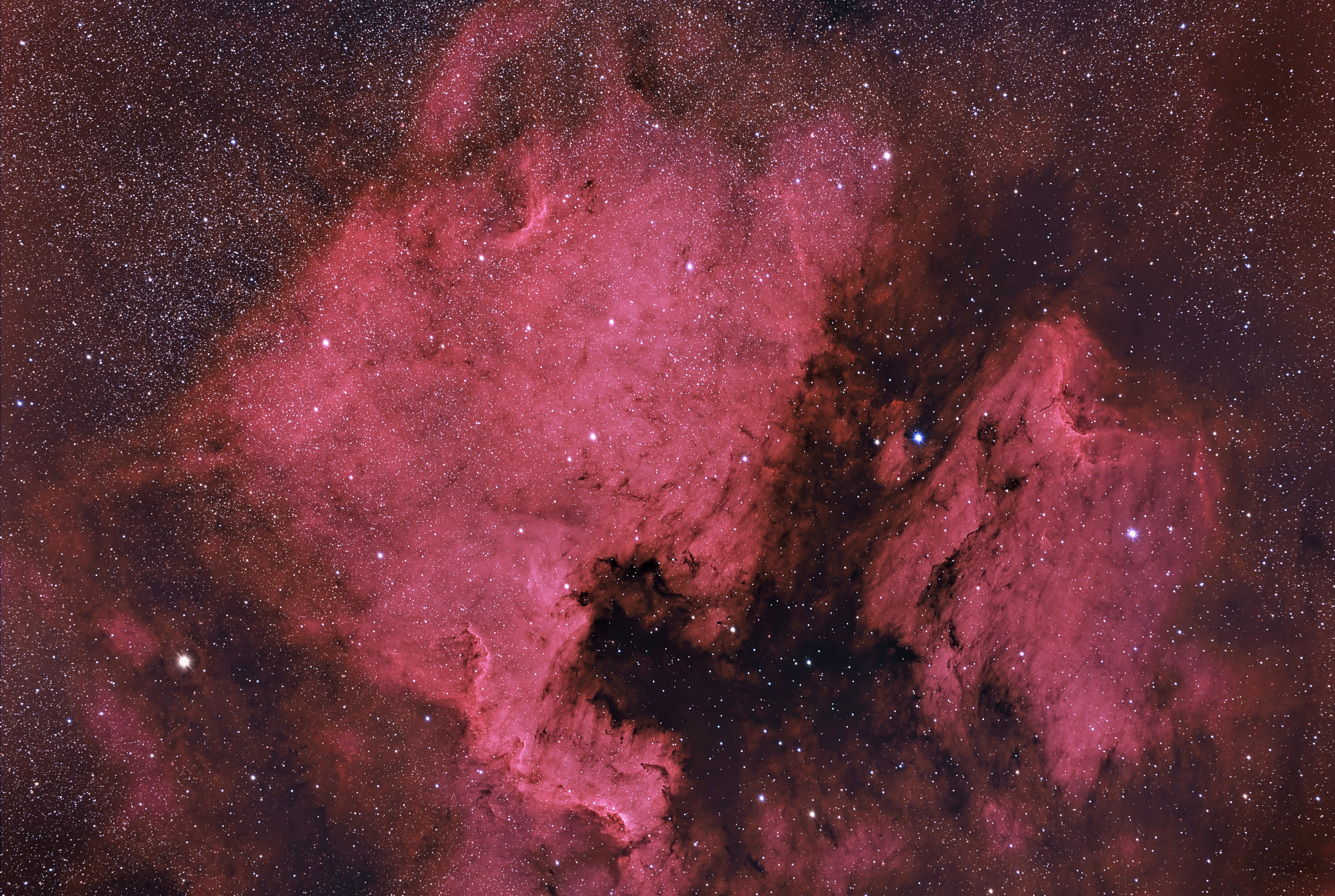
Most of what we see in the Milky Way are just masses of stars, but there are bright clouds of gas, or to name them properly: emission nebulae. These bright clouds are areas of star formation. It is the ultraviolet light from young massive stars that light up the clouds they were formed from. A bright one, easily visible in binoculars, is just about overhead at 10 p.m. Called the North American Nebula, a glow, that in photographs is shaped much like our continent, is just east of the star Deneb which is practically overhead in the evening. Deneb is the northernmost star of the Summer Triangle, and brightest star in Cygnus the swan or Northern Cross. There are many other nebulae in the Milky Way, visible in binoculars and small telescopes. Many enjoyable hours can be spent sweeping the Milky Way for nebulae and star clusters.
The astronomical event times given in this blog are for the Traverse City/Interlochen area of Michigan (Lat 44.7° N, Long 85.7° W; EDT, UT – 4 hours) unless stated otherwise. Times will be different for other locations.
Addendum
Ephemeris: 09/02/2026 – Taking our weekly look at the whereabouts of the naked-eye planets
This is Ephemeris for Wednesday, September 2nd. Today the Sun will be up for 13 hours and 11 minutes, setting at 8:17, and it will rise tomorrow at 7:07. The Moon, 2 days before last quarter, will rise at 10:33 this evening.
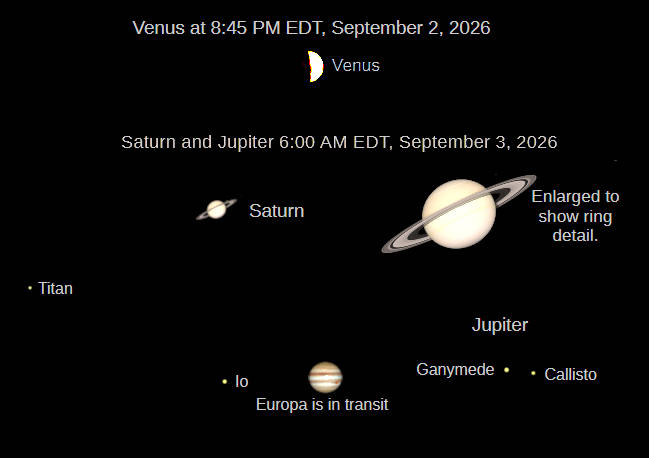
Let’s take our weekly look at the whereabouts of the naked-eye planets. By 8:45 PM tonight, a nearly a half-hour after sunset, Venus will be spotted low in the west southwestern sky. Though at a 44º angle from the sun, it’ll only be 6º above the horizon then. A telescope will show a small crescent disk of the planet. It is now rapidly approaching earth in its orbit, at 50.8 million miles (81.8 mil km) away from us. Venus is becoming an ever decreasing crescent as its apparent diameter grows in telescopes. At 6 AM, Saturn will be alone in the southwest, while Mars and Jupiter will be in the east. Jupiter is brightest and lowest while Mars has the competition of brighter stars in Gemini.
The astronomical event times given in this blog are for the Traverse City/Interlochen area of Michigan (Lat 44.7° N, Long 85.7° W; EDT, UT – 4 hours) unless stated otherwise. Times will be different for other locations.
Addendum
Ephemeris: 09/01/2026 – Previewing September skies
This is Bob Moler with Ephemeris for Tuesday, September 1st. Today the Sun will be up for 13 hours and 14 minutes, setting at 8:19, and it will rise tomorrow at 7:06. The Moon, 3 days before last quarter, will rise at 10:00 this evening.
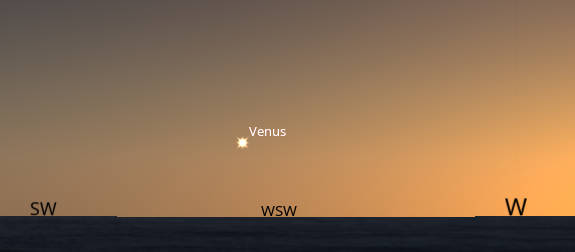
Let’s look at the skies for the month of September, a transition month between summer and autumn. The Sun will be moving at its greatest speed in its retreat to the south. Daylight hours in the Interlochen/Traverse City area and will drop from 13 hours and 14 minutes today to 11 hours 45 minutes on the 30th. The altitude of the Sun above the southern horizon at local noon will be 54 degrees today, and will descend to 42 degrees on the 30th. The season of summer is getting short, so enjoy it while you can. Summer ends and autumn begins at 8:06 p.m. with the autumnal equinox on September 22nd. The Harvest Moon will occur on the 26th, being the closest full moon to the autumnal equinox.
The astronomical event times given in this blog are for the Traverse City/Interlochen area of Michigan (Lat 44.7° N, Long 85.7° W; EDT, UT – 4 hours) unless stated otherwise. Times will be different for other locations.
Addendum
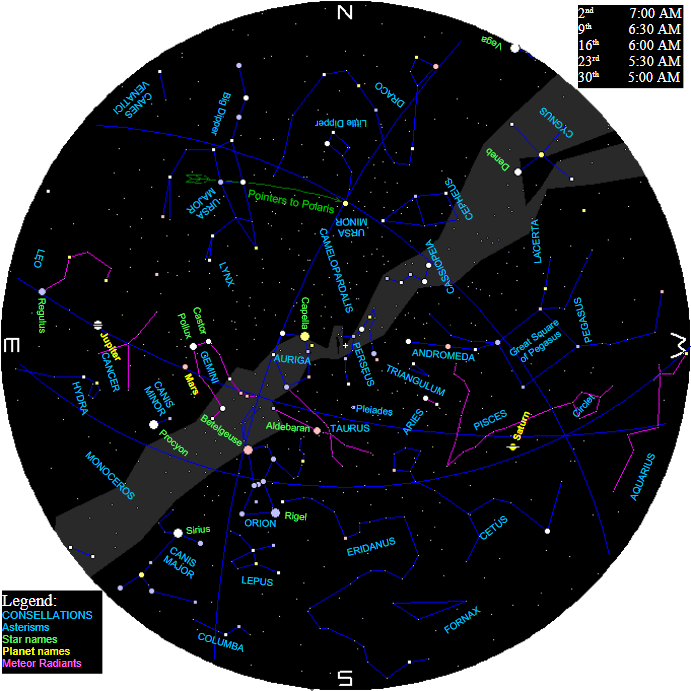
September Evening Star Chart
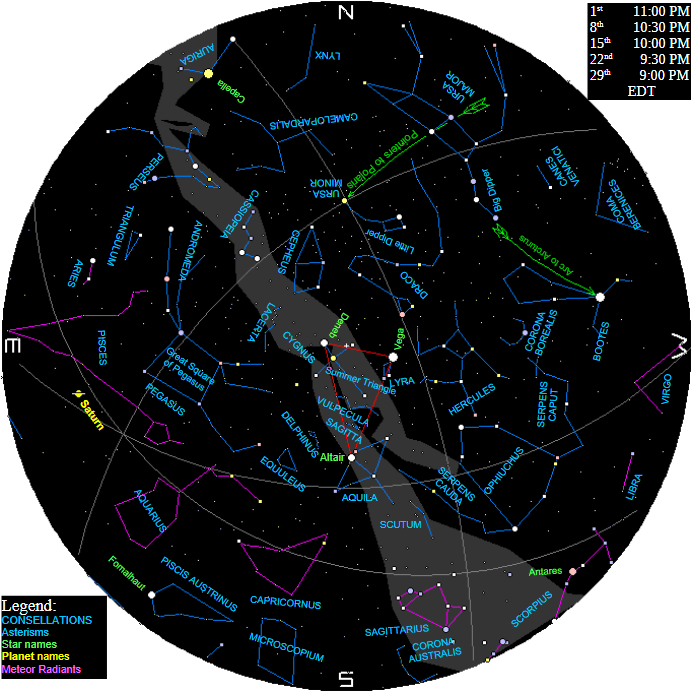
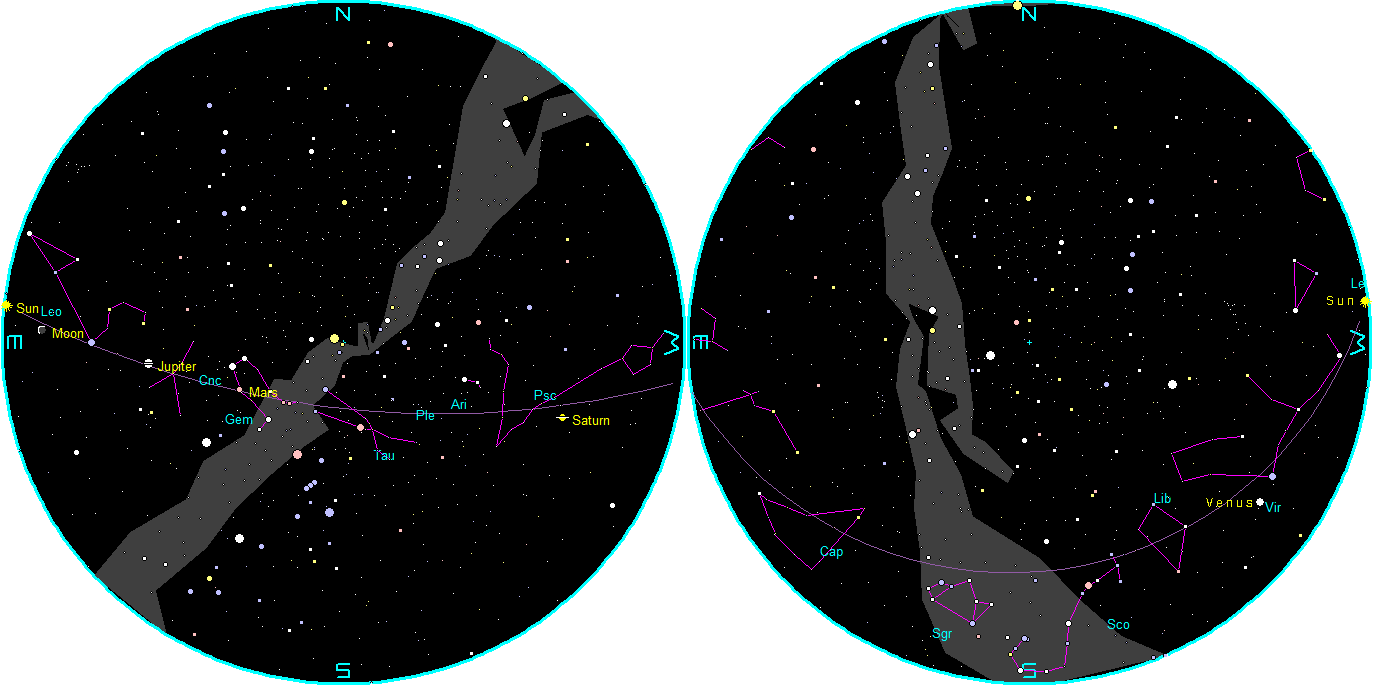
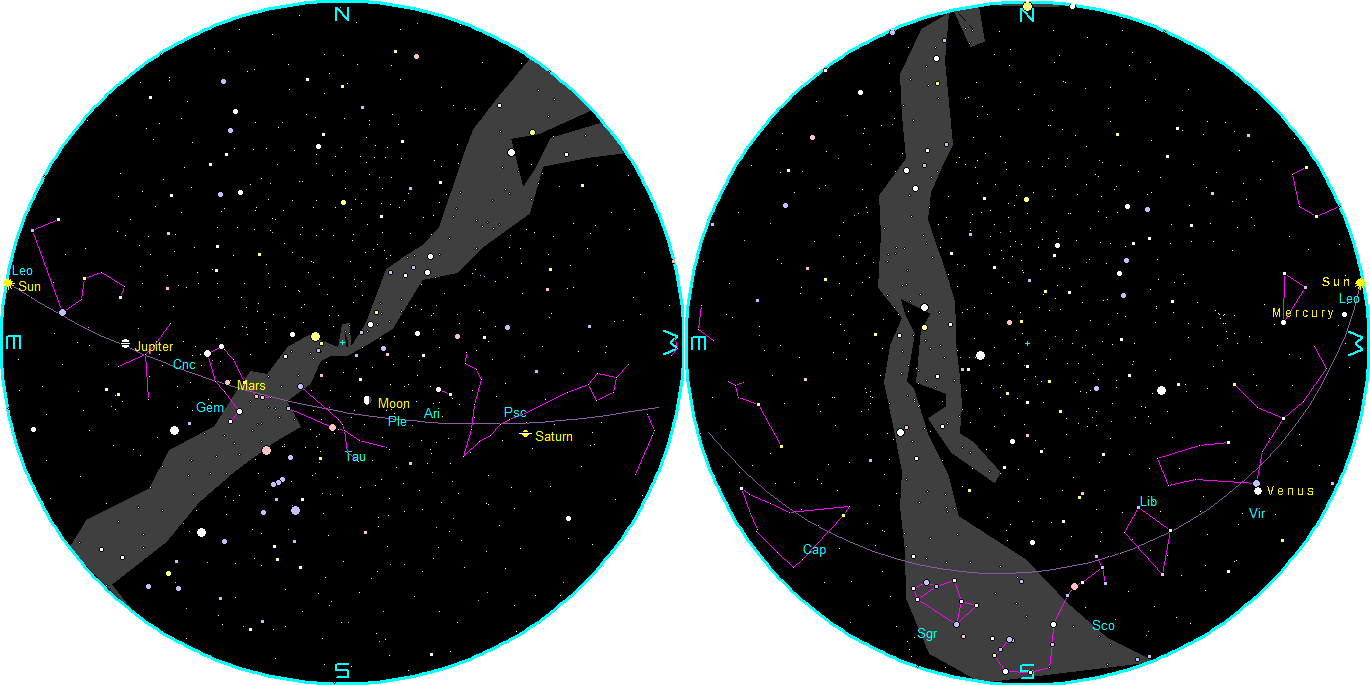
The planets and stars are plotted for the 15th at 10 p.m. EDT in the evening and 6 a.m. for the morning chart. These are the chart times. Note that Traverse City is located approximately 45 minutes behind our time meridian, West 75° longitude. (An hour 45 minutes behind our daylight saving time meridian during EDT). To duplicate the star positions on a planisphere you may have to set it to 1 hour 45 minutes earlier than the current time.
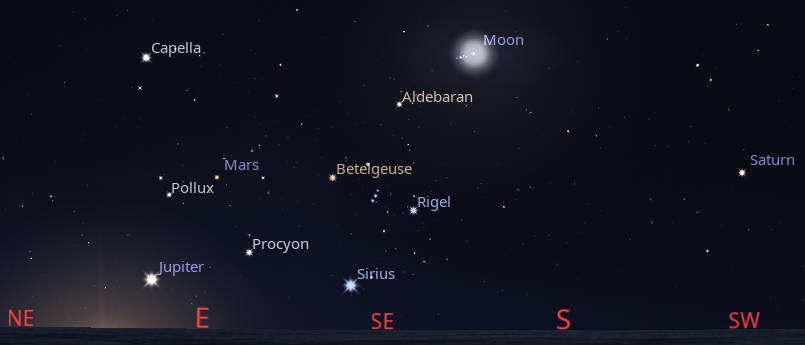
September Morning Star Chart
Twilight Limits, Nautical and Astronomical
| EDT | |||||||
| Morning | Twilight | Evening | Twilight | Dark | Night | Moon | |
| Date | Astro. | Nautical | Nautical | Astro. | Start | End | Illum. |
| 2026-09-01 | 5h22m | 6h00m | 21h29m | 22h07m | – | – | 73% |
| 2026-09-02 | 5h24m | 6h02m | 21h27m | 22h05m | 22h05m | 22h33m | 63% |
| 2026-09-03 | 5h25m | 6h03m | 21h25m | 22h03m | 22h03m | 23h16m | 52% |
| 2026-09-04 | 5h27m | 6h05m | 21h23m | 22h00m | 22h00m | – | 40% |
| 2026-09-05 | 5h28m | 6h06m | 21h21m | 21h58m | 21h58m | 0h11m | 29% |
| 2026-09-06 | 5h30m | 6h07m | 21h19m | 21h56m | 21h56m | 1h20m | 19% |
| 2026-09-07 | 5h32m | 6h09m | 21h17m | 21h54m | 21h54m | 2h37m | 11% |
| 2026-09-08 | 5h33m | 6h10m | 21h15m | 21h51m | 21h51m | 3h58m | 5% |
| 2026-09-09 | 5h35m | 6h11m | 21h13m | 21h49m | 21h49m | 5h18m | 1% |
| 2026-09-10 | 5h36m | 6h13m | 21h11m | 21h47m | 21h47m | 5h36m | 0% |
| 2026-09-11 | 5h38m | 6h14m | 21h09m | 21h45m | 21h45m | 5h38m | 1% |
| 2026-09-12 | 5h39m | 6h15m | 21h07m | 21h43m | 21h43m | 5h39m | 5% |
| 2026-09-13 | 5h40m | 6h17m | 21h05m | 21h41m | 21h41m | 5h40m | 11% |
| 2026-09-14 | 5h42m | 6h18m | 21h03m | 21h38m | 21h38m | 5h42m | 18% |
| 2026-09-15 | 5h43m | 6h19m | 21h01m | 21h36m | 21h36m | 5h43m | 26% |
| 2026-09-16 | 5h45m | 6h20m | 20h59m | 21h34m | 22h08m | 5h45m | 35% |
| 2026-09-17 | 5h46m | 6h22m | 20h57m | 21h32m | 22h50m | 5h46m | 44% |
| 2026-09-18 | 5h48m | 6h23m | 20h55m | 21h30m | 23h40m | 5h48m | 53% |
| 2026-09-19 | 5h49m | 6h24m | 20h53m | 21h28m | – | 5h49m | 63% |
| 2026-09-20 | 5h50m | 6h25m | 20h51m | 21h26m | 0h39m | 5h50m | 72% |
| 2026-09-21 | 5h52m | 6h27m | 20h49m | 21h24m | 1h43m | 5h52m | 80% |
| 2026-09-22 | 5h53m | 6h28m | 20h47m | 21h22m | 2h50m | 5h53m | 87% |
| 2026-09-23 | 5h54m | 6h29m | 20h45m | 21h20m | 3h59m | 5h54m | 93% |
| 2026-09-24 | 5h56m | 6h31m | 20h43m | 21h18m | 5h08m | 5h56m | 97% |
| 2026-09-25 | 5h57m | 6h32m | 20h41m | 21h16m | – | – | 100% |
| 2026-09-26 | 5h58m | 6h33m | 20h39m | 21h13m | – | – | 100% |
| 2026-09-27 | 6h00m | 6h34m | 20h37m | 21h11m | – | – | 97% |
| 2026-09-28 | 6h01m | 6h35m | 20h35m | 21h09m | – | – | 92% |
| 2026-09-29 | 6h02m | 6h37m | 20h33m | 21h08m | – | – | 85% |
| 2026-09-30 | 6h04m | 6h38m | 20h31m | 21h06m | 21h06m | 21h15m | 76% |
Twilight calendar was generated using Cartes du Ciel (Sky Charts).
See my blog post: Twilight Zone for the definitions of the different periods of twilight here: https://bobmoler.wordpress.com/2018/09/27/.
NASA Calendar of Planetary Events
Date         Time     Event
Sep  1  Tu            Venus: 44.6° E
     1  Tu   9:27 AM  Venus-Spica: 1.4° S
     3  Th   8:03 AM  Moon-Pleiades: 1.2° S
     4  Fr   3:51 AM  Last Quarter
     5  Sa   2:12 AM  Moon North Dec.: 28.1° N
     6  Su   2:24 PM  Moon-Mars: 3° S
     6  Su   4:26 PM  Moon Perigee: 368300 km
     8  Tu  12:43 AM  Moon-Beehive: 0.5° S
     8  Tu   2:13 PM  Moon-Jupiter: 0.8° S
     9  We   3:17 PM  Moon Descending Node
    10  Th  11:27 PM  New Moon
    13  Su   4:53 PM  Moon-Spica: 2.6° N
    14  Mo   7:10 AM  Moon-Venus: 0.6° S
    16  We   9:42 PM  Mars-Pollux: 5.9° S
    17  Th   8:18 AM  Moon-Antares: 0.6° N
    18  Fr   2:54 PM  Moon South Dec.: 28.1° S
    18  Fr   4:44 PM  First Quarter
    18  Fr  11:00 PM  Moon Apogee: 404200 km
    22  Tu   8:06 PM  Autumnal Equinox
    23  We  10:40 PM  Moon Ascending Node
    25  Fr   8:13 PM  Neptune Opposition
    25  Fr   9:49 PM  Mercury-Spica: 0.9° N
    26  Sa  12:49 PM  Full Moon (Harvest Moon)
    30  We   1:39 PM  Moon-Pleiades: 1.1° S
Sky Events Calendar by Fred Espenak and Sumit Dutta (NASA’s GSFC), with modifications by the author.
http://eclipse.gsfc.nasa.gov/SKYCAL/SKYCAL.html.
If you go to the above site, you can print out a list like the above for the entire year or calendar pages for your time zone.
Ephemeris: 08/31/2026 – September’s Milky Way
This is Ephemeris for Monday, August 31st. Today the Sun will be up for 13 hours and 17 minutes, setting at 8:21, and it will rise tomorrow at 7:05. The Moon, 3 days past full, will rise at 9:35 this evening.
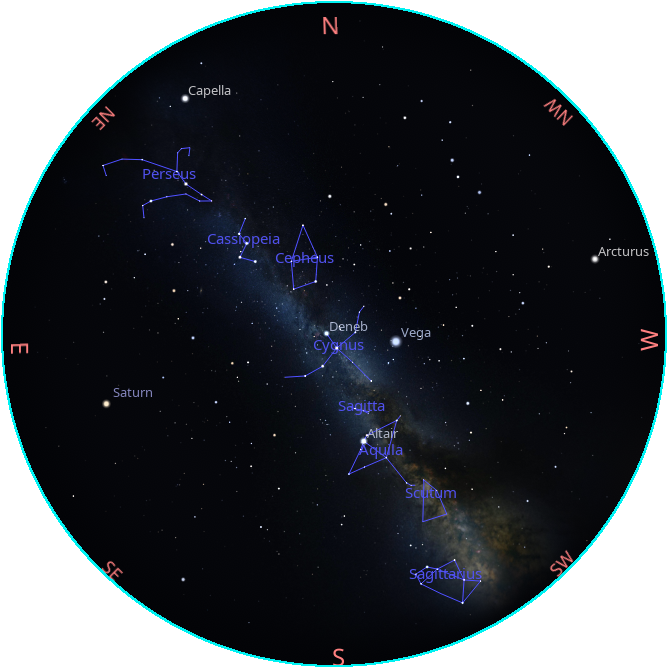
In the coming nights, as the moon leaves the evening sky, we will again be able to see the summer Milky Way. In September the Milky Way will twist from roughly northeast to south to northeast overhead to southwest. The teapot asterism of the constellation Sagittarius tilts and pours its tea onto the southwestern horizon and soon also succumbs to the rotation of the earth and sets. It will give us our last chance to see the great star clouds toward the center of our galaxy. The Milky Way will be with us until spring. Actually twisting, with new parts passing overhead. But, we will be looking out, opposite from the center, to the further reaches of the Milky Way that is not as bright, but the active star forming regions are closer.
The astronomical event times given in this blog are for the Traverse City/Interlochen area of Michigan (Lat 44.7° N, Long 85.7° W; EDT, UT – 4 hours) unless stated otherwise. Times will be different for other locations.
Addendum
Ephemeris: 08/28/2026 – Crater found from Falcon 9 impact on the Moon
This is Ephemeris for Friday, August 28th. Today the Sun will be up for 13 hours and 25 minutes, setting at 8:26, and it will rise tomorrow at 7:01. The Moon, which was full just after midnight this morning during ther lunar eclipse, will rise at 8:36 this evening.
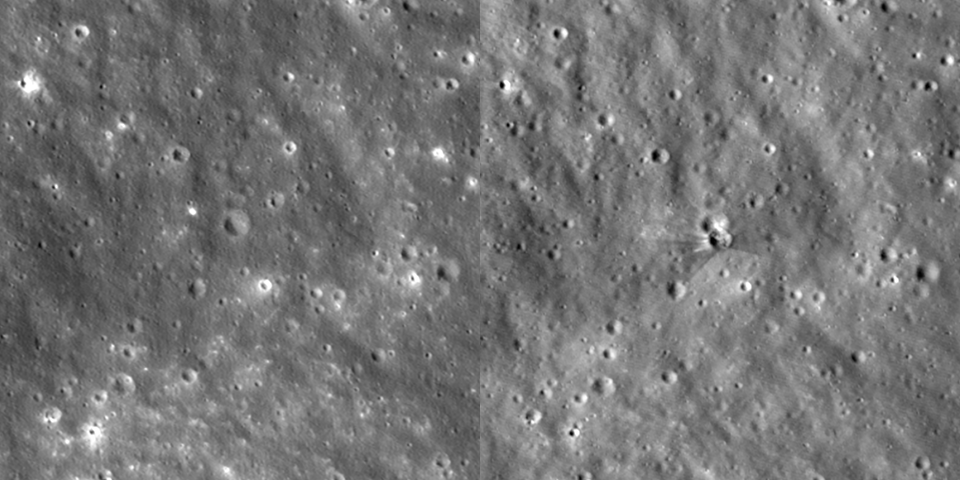
SpaceX made a big splash on the moon a couple of weeks ago when the second stage of the Falcon 9 rocket that delivered two lunar landers to the moon last year, itself crashed into the moon. This, plus detection of the flashes of several meteoroid strikes on the moon by the Artemis 2 crew, suggested to some scientists that lunar colonization might be a very risky thing. On the moon when something hits it, material flies off in all directions. But without an atmosphere to slow these particles down they fly a long way and will crash back onto the moon at the same velocity they were ejected with. The crash dug a crater 60 feet (18 meters) across and 10 feet (3 meters) deep.
The astronomical event times given in this blog are for the Traverse City/Interlochen area of Michigan (Lat 44.7° N, Long 85.7° W; EDT, UT – 4 hours) unless stated otherwise. Times will be different for other locations.
Addendum