Archive
Ephemeris: 06/16/2026 – More pointers to help you find Mercury tonight
This is Bob Moler with Ephemeris for Tuesday, June 16th. Today the Sun will be up for 15 hours and 34 minutes, setting at 9:30, and it will rise tomorrow at 5:56. The Moon, 2 days past new, will set at 11:34 this evening.
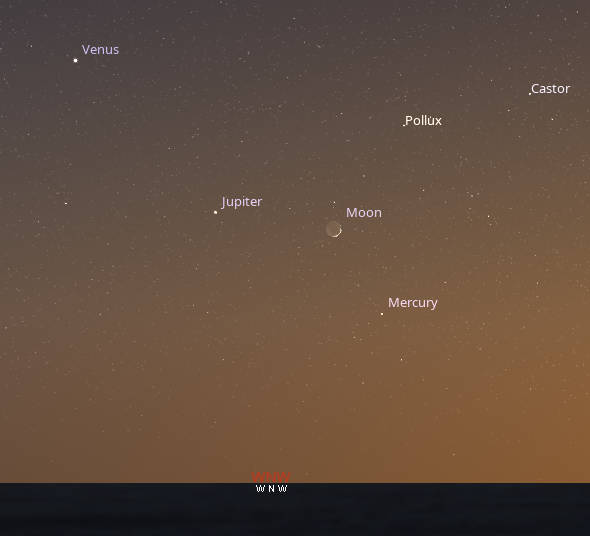
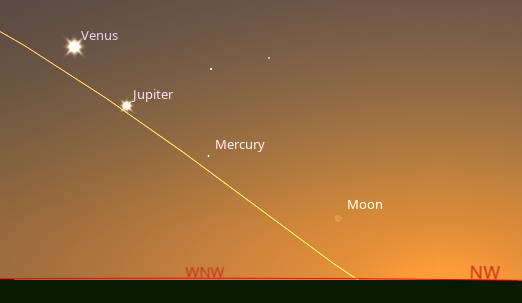
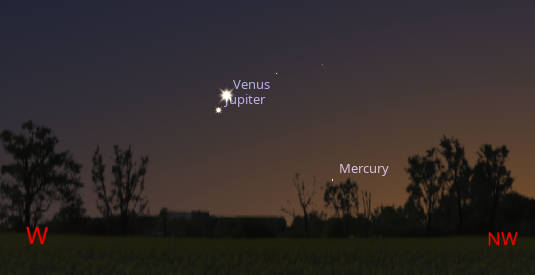
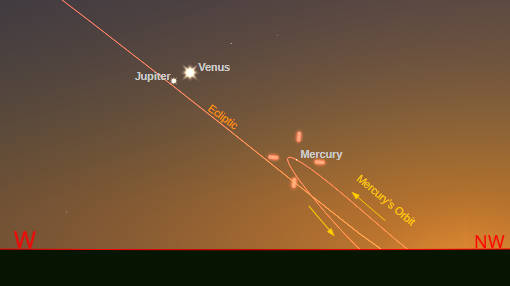
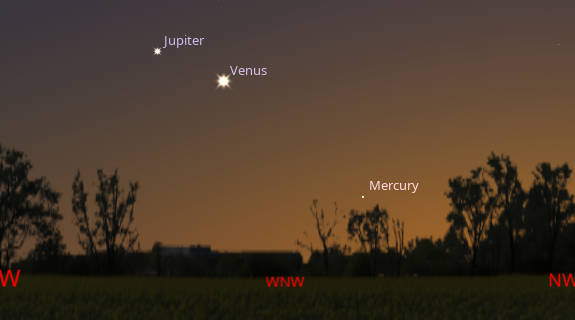
The planet Mercury, which had its greatest elongation or separation east of the sun yesterday, is still visible in line with Venus and Jupiter down to the lower right. It is also below the thin crescent moon tonight. There are a couple of other stars which you might mistake for Mercury. They’re higher in the sky, above the Moon and to the upper right of Jupiter. These are some of our leftover winter stars, Castor and Pollux of Gemini. Pollux is the slightly brighter one and closer to Jupiter of the two. Mercury is below them. A pair of binoculars is really helpful in picking Mercury out from the twilight.It seems to increase the contrast between star-like objects from the background. Actually, binoculars make a great first telescope.
The astronomical event times given in this blog are for the Traverse City/Interlochen area of Michigan (Lat 44.7° N, Long 85.7° W; EDT, UT – 4 hours) unless stated otherwise. Times will be different for other locations.
Addendum
Ephemeris: 06/15/2026 – Spotting the elusive planet Mercury
This is Ephemeris for Monday, June 15th. Today the Sun will be up for 15 hours and 33 minutes, setting at 9:30, and it will rise tomorrow at 5:56. The Moon, 1 day past new, will set at 10:47 this evening.
Today is Mercury’s greatest elongations or separation east of the sun, which means it trails the sun as the earth rotates and sets in the evening sky after sunset. The separation angle from the sun is better than we get when eastern elongations are closer to the vernal equinox. However, the angle of Mercury with respect to the sun is actually a little bit less than 45° rather than 60 plus degrees, that occurs near the vernal equinox. This is the last semi-decent appearance of Mercury in the evening this year. Our best hope of seeing Mercury again this year is in the morning sky around August 2nd. Personally I find that Mercury seems to be easier to find when it’s appearing in the morning sky rather than in the evening sky.
The astronomical event times given in this blog are for the Traverse City/Interlochen area of Michigan (Lat 44.7° N, Long 85.7° W; EDT, UT – 4 hours) unless stated otherwise. Times will be different for other locations.
Addendum
Ephemeris: 06/12/2026 – Finding the elusive Little Dipper
This is Ephemeris for Friday, June 12th. Today the Sun will be up for 15 hours and 32 minutes, setting at 9:28, and it will rise tomorrow at 5:56. The Moon, 2 days before new, will rise at 4:04 tomorrow morning.
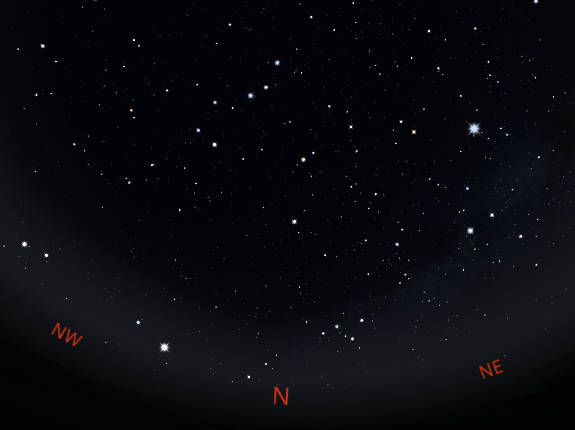
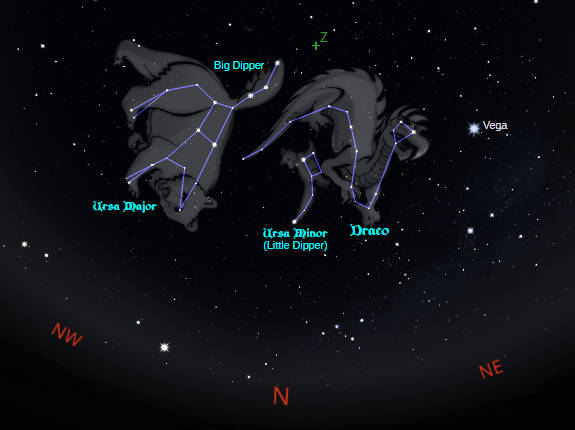
One of the constellations I don’t talk about much, except in passing is Ursa Minor, the Little Bear with an impossibly long tail. It is better known as the Little Dipper. As a dipper goes, its handle is bent the wrong way, like someone stepped on it. Anyway, this time of year in the evening, it’s standing on the tip of it’s handle, which is the North Star, Polaris. Polaris is pointed to by the front two stars of the Big Dipper. As dippers go they pour their contents into each other. The second and third-brightest stars of the Little Dipper are at the front of the bowl, and are Kochab and Pherkad, the Guard Stars, that is, Guardians of the Pole. To the Anishinaabe native peoples of our area the Little Dipper is Maang, the Loon.
The astronomical event times given in this blog are for the Traverse City/Interlochen area of Michigan (Lat 44.7° N, Long 85.7° W; EDT, UT – 4 hours) unless stated otherwise. Times will be different for other locations.
Addendum

Ephemeris: 06/11/2026 – Finding the celestial dragon, Draco
This is Bob Moler with Ephemeris for Thursday, June 11th. Today the Sun will be up for 15 hours and 31 minutes, setting at 9:28, and it will rise tomorrow at 5:56. The Moon, halfway from last quarter to new, will rise at 3:28 tomorrow morning.
High in the northern sky at 11 p.m. lies the twisted constellation, of Draco the dragon. This dragon is more like the snakelike Chinese dragon than the dinosaur-like dragon of European legend. I find it better sneak up on its tail, to trace him out in the stars. Draco’s tail starts, or ends, between the bowl of the Big Dipper and the Little Dipper high in the north. The Dragon is seen in a line of stars that extends parallel to the handle of the Big Dipper before curving around the bowl of the Little Dipper then bends back down to the level of Polaris in the north-northeast before turning toward the east. The head of Draco is an odd box of stars near the bright star Vega, high in the east. Though not made up of very bright stars, Draco has an easy shape to trace.
The astronomical event times given in this blog are for the Traverse City/Interlochen area of Michigan (Lat 44.7° N, Long 85.7° W; EDT, UT – 4 hours) unless stated otherwise. Times will be different for other locations.
Addendum
Ephemeris: 06/10/2026 – Where are the naked-eye planets this week?
This is Ephemeris for Wednesday, June 10th. Today the Sun will be up for 15 hours and 30 minutes, setting at 9:27, and it will rise tomorrow at 5:56. The Moon, 2 days past last quarter, will rise at 3 o’clock tomorrow morning.
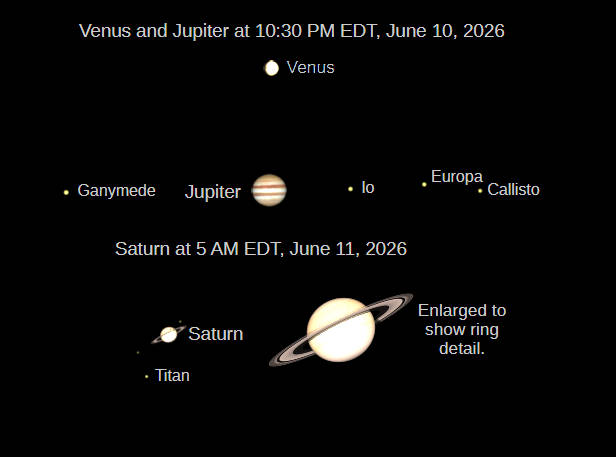
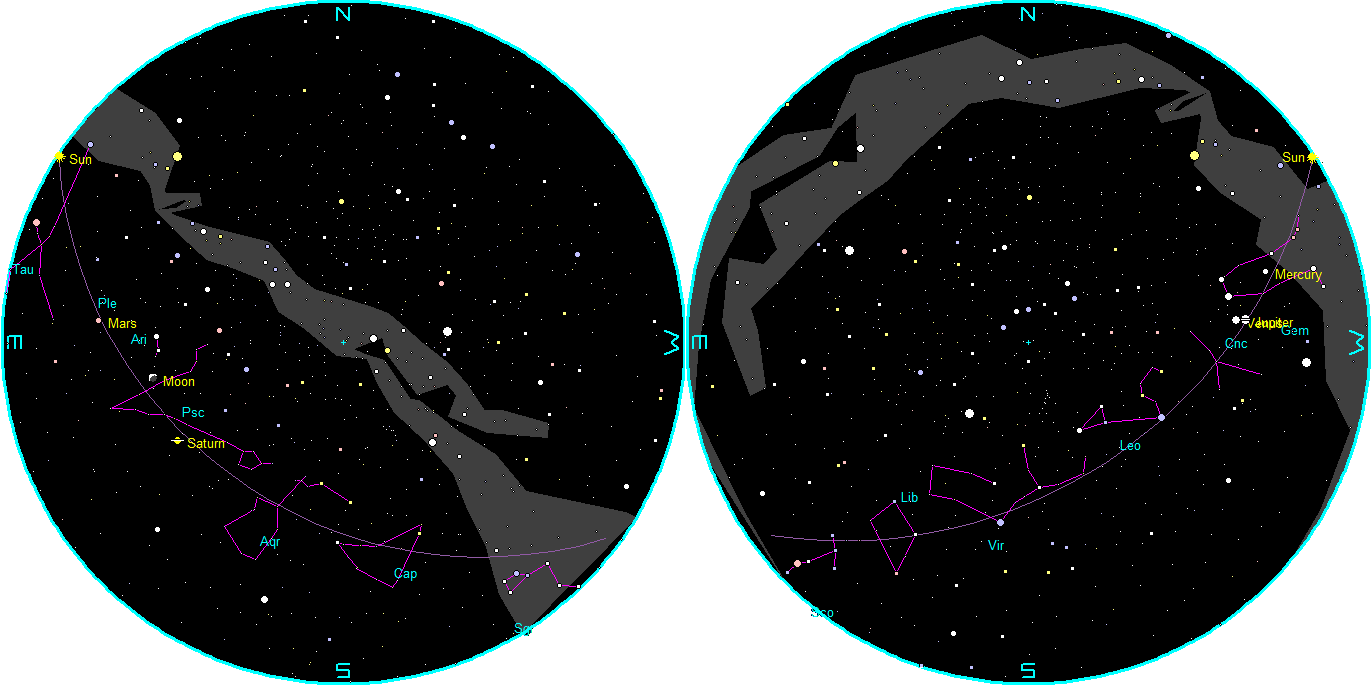
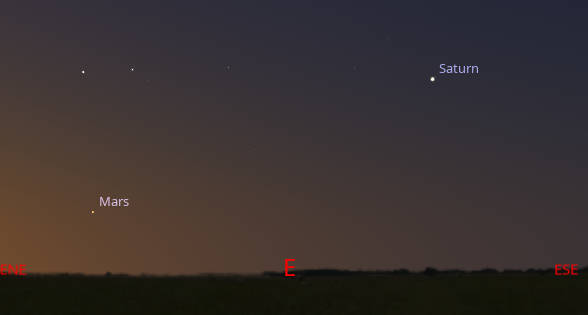
Let’s take our weekly look at the whereabouts of the naked-eye planets. By 10:15 PM tonight, nearly an hour after sunset, Venus and Jupiter may be seen in the western sky, with the brighter Venus above Jupiter. A telescope will show a very tiny disc on Venus, because it is still pretty much beyond the Sun, 111 million miles (179 million kilometers) away from us. Over the next 4 1/2 months it will be moving closer to us and becoming much larger. Mercury is marginally visible below and right of Venus and Jupiter. Jupiter now sets at 11:52 PM, with Venus setting ten minutes later. Saturn will rise into the eastern sky at 3:04 AM, followed by dimmer Mars an hour later.
The astronomical event times given in this blog are for the Traverse City/Interlochen area of Michigan (Lat 44.7° N, Long 85.7° W; EDT, UT – 4 hours) unless stated otherwise. Times will be different for other locations.
Addendum
Ephemeris: 06/09/2026 – Jupiter and Venus meet again
Well, not really.*
This is Ephemeris for Tuesday, June 9th. Today the Sun will be up for 15 hours and 29 minutes, setting at 9:27, and it will rise tomorrow at 5:57. The Moon, 1 day past last quarter, will rise at 2:38 tomorrow morning.
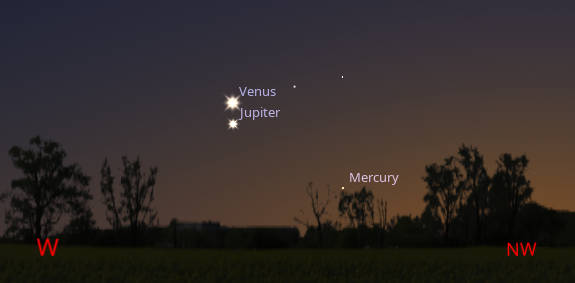
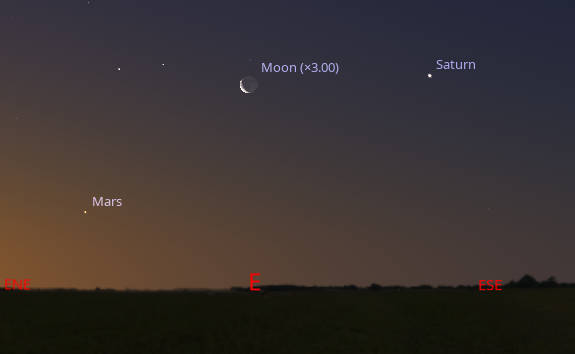
In the last month or so as Jupiter and Venus ended up in the same part of the sky we’ve been seeing that Venus has been approaching Jupiter well today they cross paths with Jupiter just below Venus tonight. Jupiter, which is brighter than any nighttime star, looks rather dim compared to Venus when they’re close together. It is about 1/6 of the brightness of Venus. Venus is much brighter than the larger Jupiter because it is much closer to us and closer to the sun which is illuminating it. Jupiter is five times the earth’s distance from the sun. The sunlight it receives is diluted to only 4% that the earth gets, which is further diminished by the reflected light travelling back to us by about the same distance.
The astronomical event times given in this blog are for the Traverse City/Interlochen area of Michigan (Lat 44.7° N, Long 85.7° W; EDT, UT – 4 hours) unless stated otherwise. Times will be different for other locations.
* See the second image in the addendum.
Addendum
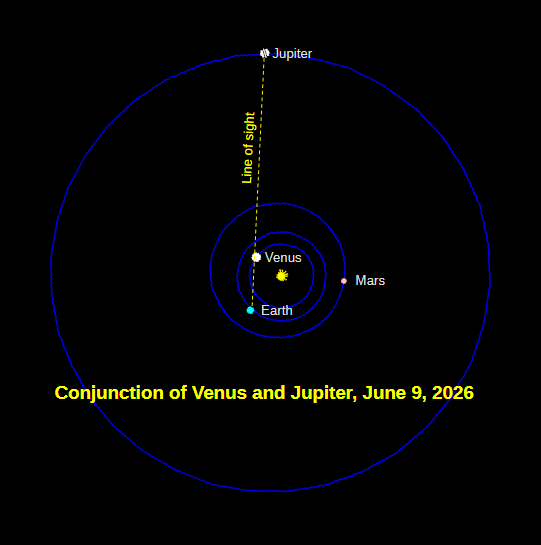
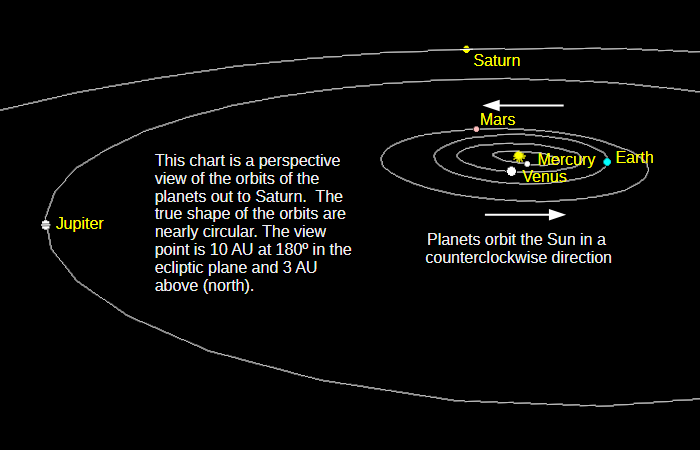
Starting with tomorrow’s posting I will be including a diagram something like this of the naked-eye planets and their positions relative to the Earth.
Ephemeris: 06//08/2026 – Observing Mercury in the evening
This is Bob Moler with Ephemeris for Monday, June 8th. Today the Sun will be up for 15 hours and 29 minutes, setting at 9:26, and it will rise tomorrow at 5:57. The Moon, at last quarter today, will rise at 2:18 tomorrow morning.
We have a little more than a week to observe Mercury in the western sky after sunset. Mercury’s greatest eastern elongation or separation from the sun will occur on the 15th. It will get as far as a 24° angle from the sun. That separation is tilted a bit less than 45° to the horizon. Mercury’s greatest eastern elongations, occur about 116 days, more or less apart, because Mercury has the most elliptical orbit of any other planet. This is longer than Mercury’s orbital period of 88 days because we’re viewing it from a planet that is also orbiting the sun. Mercury is easier to observe the week before greatest eastern elongation then the week after. Part of the reason is that the phase of Mercury is waning from gibbous to a crescent and getting dimmer.
The astronomical event times given in this blog are for the Traverse City/Interlochen area of Michigan (Lat 44.7° N, Long 85.7° W; EDT, UT – 4 hours) unless stated otherwise. Times will be different for other locations.
Addendum
Ephemeris: 06/05/2026 – Studying Artemis II images
This is Ephemeris for Friday, June 5th. Today the Sun will be up for 15 hours and 26 minutes, setting at 9:24, and it will rise tomorrow at 5:58. The Moon, 3 days before last quarter, will rise at 1:21 tomorrow morning.
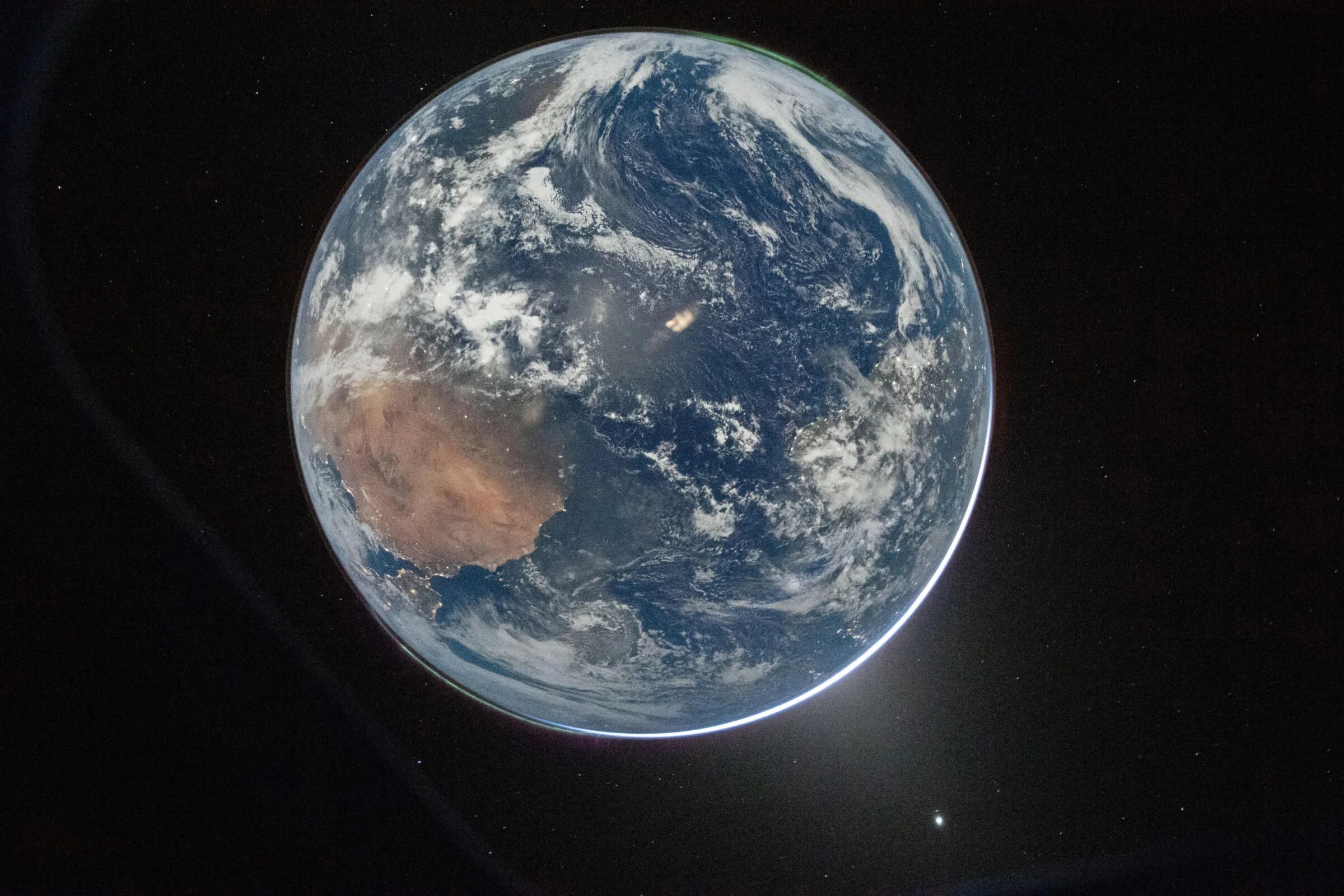
The Grand Traverse Astronomical Society will host its June meeting tonight at 9 PM at Northwestern Michigan College’s Joseph H Rogers Observatory. The later meeting time through July allows us to have viewing after the meeting start in darker skies. The program is an informal one. The Artemis 2 mission brought back a treasure trove of photographs of the earth the moon. We will be showing some of them and having everyone having a chance to comment on them, ask questions, explore them further or explain them. Afterward, about 10 PM if it’s clear, there will be viewing of the heavens through the observatory’s telescopes. The observatory is located on Birmley Rd. The meeting is also on Zoom, see gtastro.org.
The astronomical event times given in this blog are for the Traverse City/Interlochen area of Michigan (Lat 44.7° N, Long 85.7° W; EDT, UT – 4 hours) unless stated otherwise. Times will be different for other locations.
Addendum
Ephemeris: 06/04/2026 – Finding Lyra the harp
This is Bob Moler with Ephemeris for Thursday, June 4th. Today the Sun will be up for 15 hours and 24 minutes, setting at 9:23, and it will rise tomorrow at 5:58. The Moon, halfway from full to last quarter, will rise at 12:57 tomorrow morning.
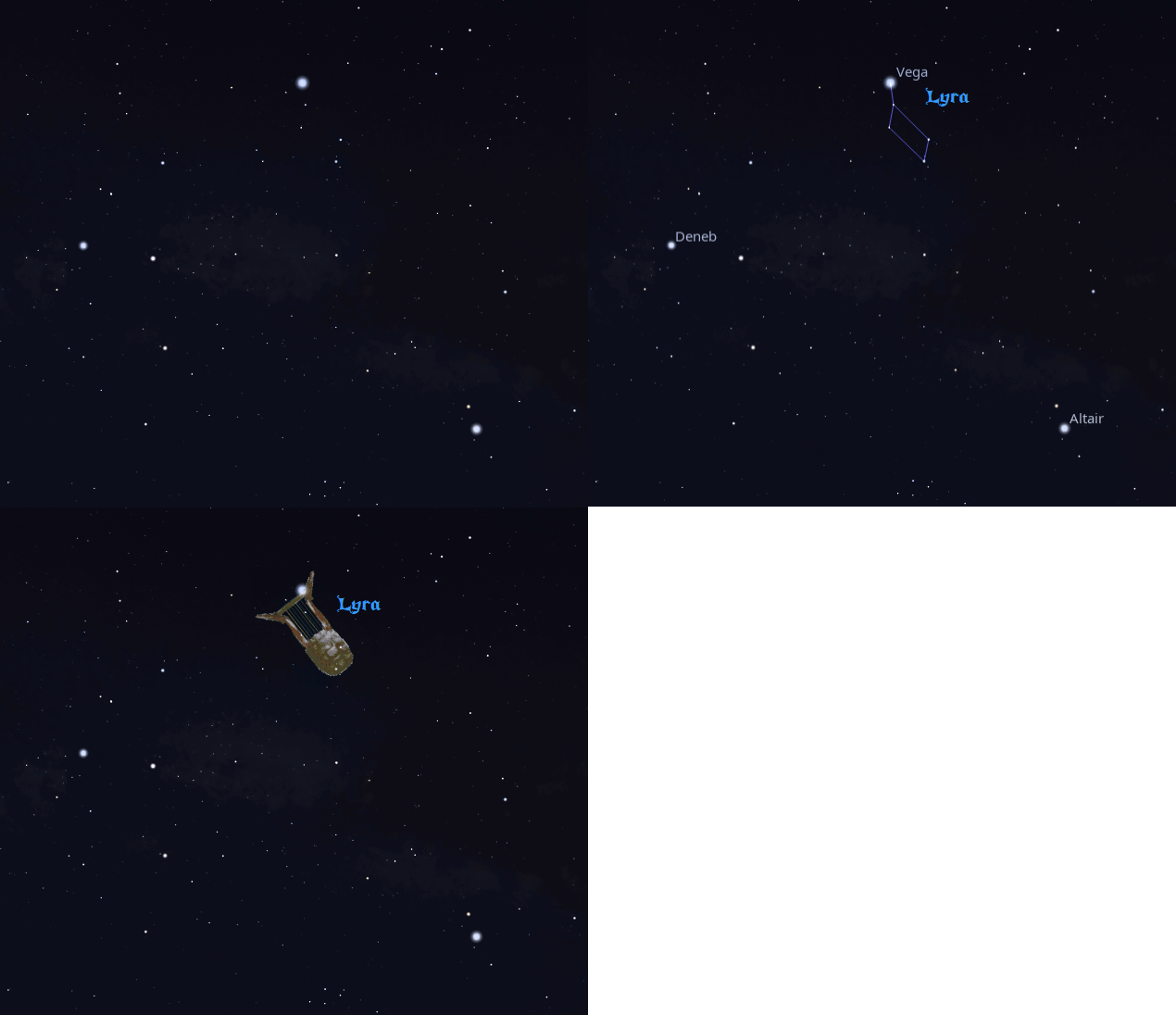
Halfway up the sky in the east at 11 PM, one can find a bright star just above a small, narrow, but very distinctive parallelogram of stars. They are the stars of the constellation Lyra the harp. The bright star is Vega, the 5th brightest nighttime star. To the Romans, the star Vega represented a falling eagle or vulture. Apparently they never made the distinction between the two species. It is a pure white star and serves as a calibration star for color and brightness. In the evening, it is the top-most star of the Summer Triangle. The harp, according to Greek mythology, was invented by the god Hermes. The form of the harp, in the sky, is as he had invented it: by stretching strings across a tortoise shell. Hermes gave it to his half-brother Apollo, who in turn gave it to the legendary musician Orpheus.
The astronomical event times given in this blog are for the Traverse City/Interlochen area of Michigan (Lat 44.7° N, Long 85.7° W; EDT, UT – 4 hours) unless stated otherwise. Times will be different for other locations.
Addendum
Ephemeris: 06/03/2026 – Where are the naked-eye planets this week?
This is Ephemeris for Wednesday, June 3rd. Today the Sun will be up for 15 hours and 23 minutes, setting at 9:23, and it will rise tomorrow at 5:58. The Moon, 3 days past full, will rise at 12:29 tomorrow morning.
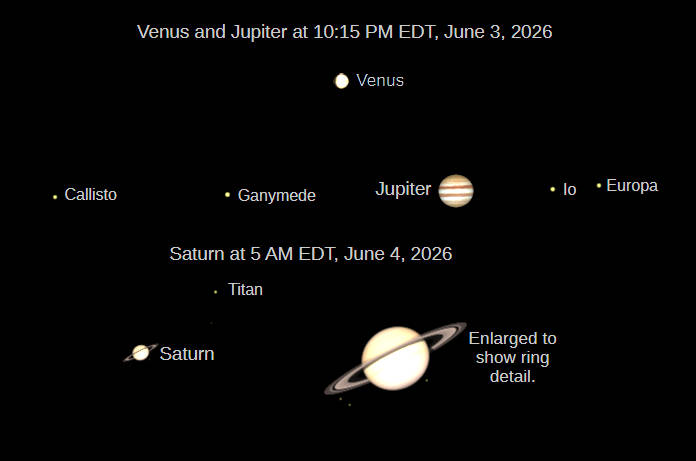
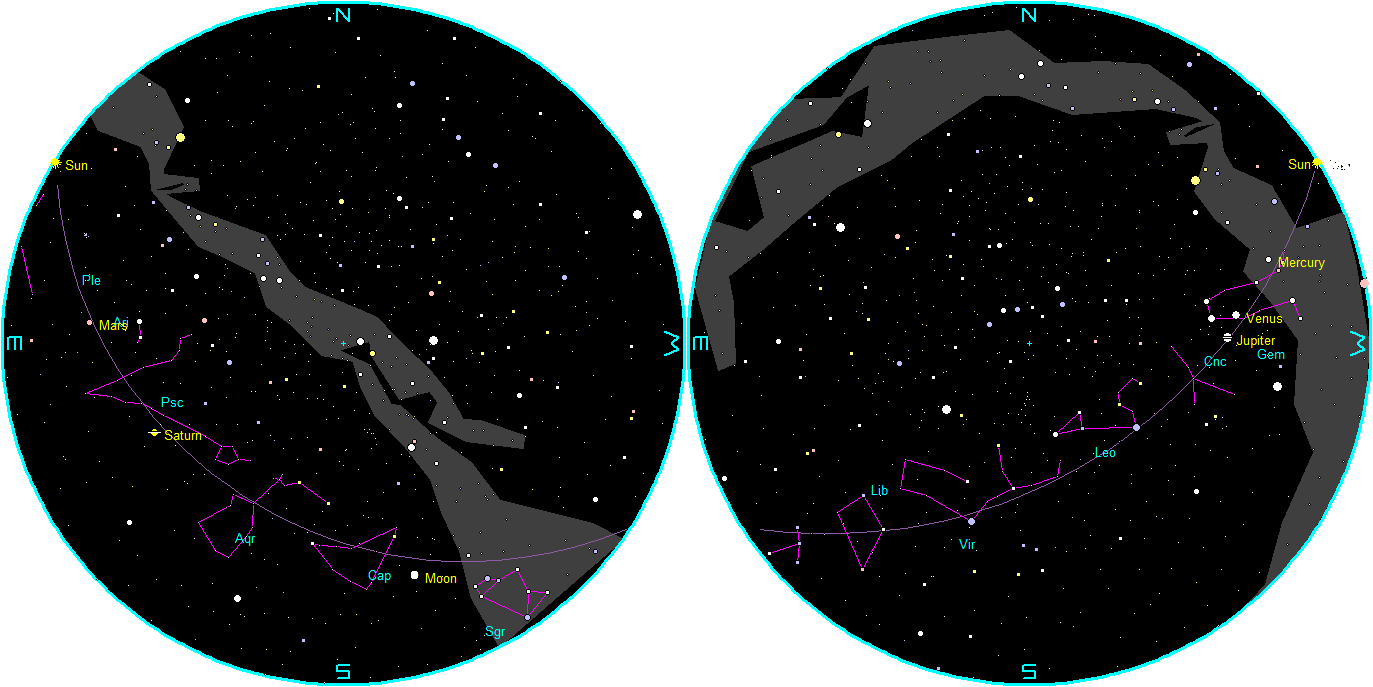
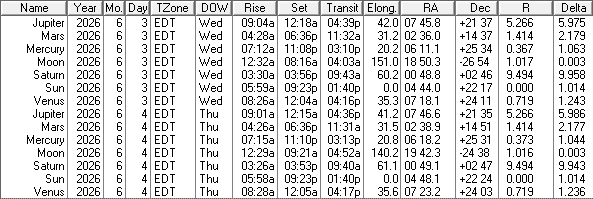
Let’s take our weekly look at the whereabouts of the naked-eye planets. By 10:15 PM tonight, nearly an hour after sunset, Venus and Jupiter may be seen in the western sky. A telescope will show a very tiny disc on Venus, because it is still pretty much beyond the Sun, 115 million miles (186 million kilometers) away from us. Over the next 4½ months it will be moving closer to us and becoming much larger. Jupiter is to the upper left of Venus, and the second-brightest star-like object in the sky. Venus will set at 12:05 AM, while Jupiter will hold out ten minutes longer. Venus will pass Jupiter on the afternoon of the 9th. Saturn rises into the eastern sky at 3:27 AM, followed by dimmer Mars an hour later.
The astronomical event times given in this blog are for the Traverse City/Interlochen area of Michigan (Lat 44.7° N, Long 85.7° W; EDT, UT – 4 hours) unless stated otherwise. Times will be different for other locations.
Addendum
 Bob Moler's Ephemeris Blog