Archive
07/17/2023 – Ephemeris – Arcturus, a look at the Sun’s future
This is Ephemeris for Monday, July 17th. Today the Sun will be up for 15 hours and 11 minutes, setting at 9:24, and it will rise tomorrow at 6:14. The Moon is new today, and won’t be visible.
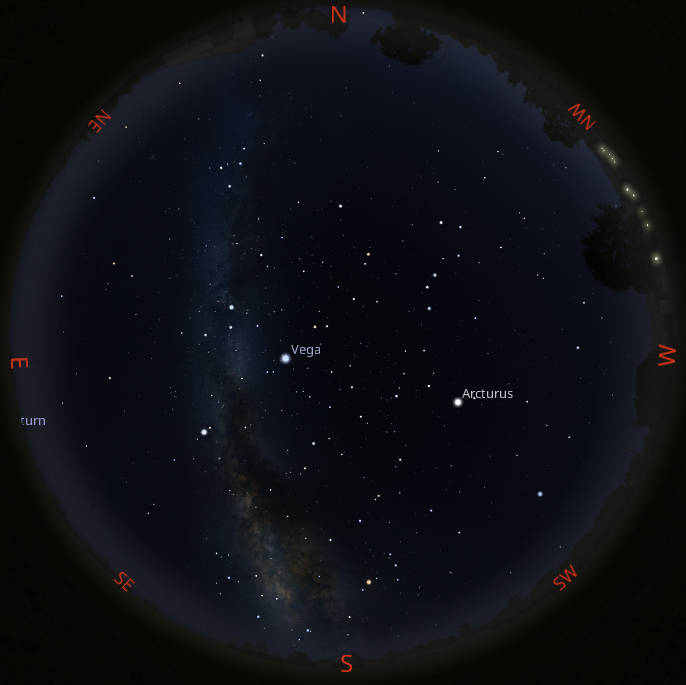
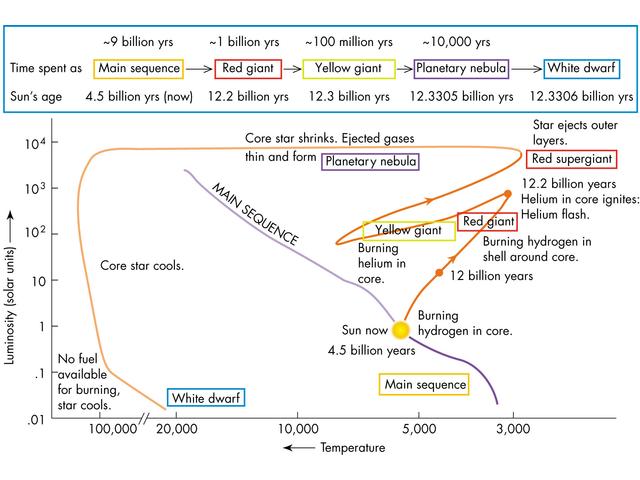
Arcturus, a red giant star, is about two thirds the way up the sky in the southwest at 10:30 or 11 p.m. It’s one of the earliest stars to appear in twilight, being nearly tied in brightness with Vega, a white star about as high in the east. A pointer to Arcturus is the handle of the Big Dipper, following the arc of the handle to Arcturus. Though only 37 light years away, it’s not from around here. It’s passing through the galactic disk from north to south. Arcturus is about 7 billion years old, and is about 8% more massive than our Sun. It appears to be starting its red giant phase, after running out of hydrogen to fuse into helium in its core, and is beginning to fuse the helium. It’s 25 times the size of the Sun and 170 times brighter, and a preview of our Sun when it gets that old.
The astronomical event times given are for the Traverse City/Interlochen area of Michigan (EDT, UT –4 hours). They may be different for your location.
Addendum
07/14/2023 – Ephemeris – Finding Polaris and why it’s important
This is Bob Moler with Ephemeris for Friday, July 14th. Today the Sun will be up for 15 hours and 16 minutes, setting at 9:26, and it will rise tomorrow at 6:11. The Moon, 3 days before new, will rise at 3:46 tomorrow morning.
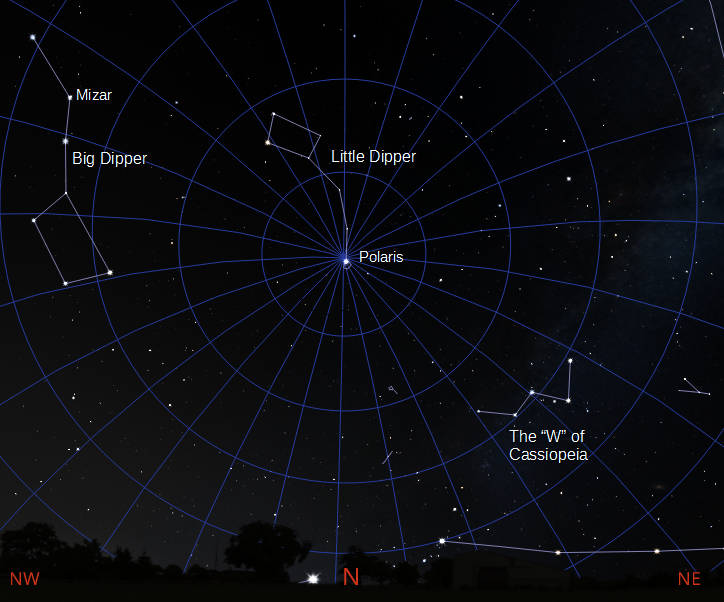
The most important star in the night sky, especially if you are lost, is Polaris, also called the North Star or Pole Star. Face Polaris and North is in front of you, East is to the right, west to the left and south will be behind you. To find Polaris, first find the Big Dipper. In the evening. This time of year, it’s hanging by its handle in the northwest, the direction that the sun set at. The two stars at the front of the bowl point to Polaris, which is to the right of it, now. Throughout the night, as the Earth rotates. Polaris will hold its position as all the other stars go around it in a counterclockwise direction. Polaris is at the end of the handle of the Little Dipper. That handle start’s vertically but curves to the left and is made of faint stars.
The astronomical event times given are for the Traverse City/Interlochen area of Michigan (EDT, UT –4 hours). They may be different for your location.
Addendum
07/13/2023 – Ephemeris – How to find Ophiuchus the serpent bearer
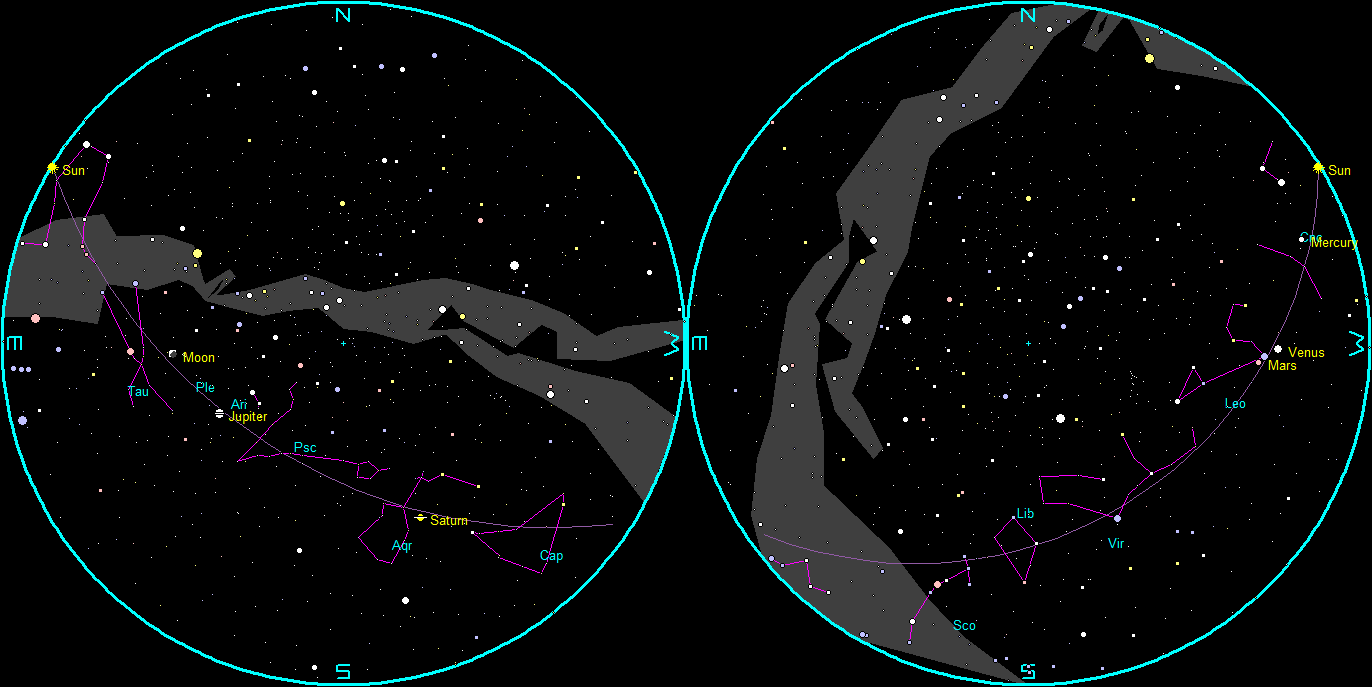
This is Ephemeris for Thursday, July 13th. Today the Sun will be up for 15 hours and 17 minutes, setting at 9:27, and it will rise tomorrow at 6:10. The Moon, halfway from last quarter to new, will rise at 3:04 tomorrow morning.
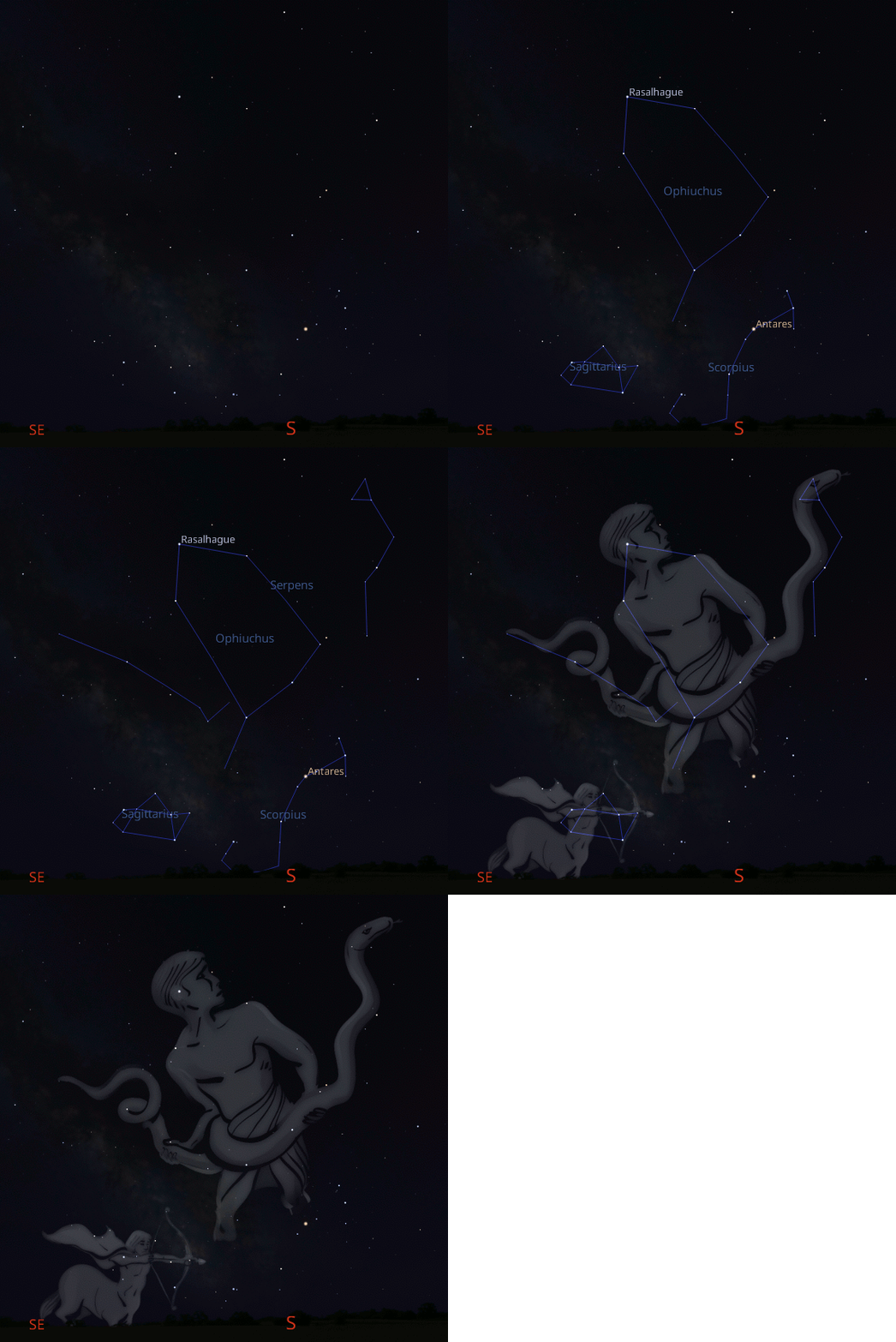
The red star Antares shines in the south at 11 p.m. In the constellation of Scorpius. In the area of sky above and a little to the left lies a large constellation of faint stars called Ophiuchus, the serpent bearer. The constellation shape is like a large bell, which reminds me of the head, shoulders and arms of a fellow that’s holding the snake-like a weight lifter pulling up a heavy barbell. The serpent he’s holding is Serpens, the only two-part constellation in the heavens. The head rises to Ophiuchus’ right, and the tail extends up to the left. In Greek myth, Ophiuchus represents the great physician Aesculapius, educated by the god Apollo, and the centaur Chiron, who is found in the stars as Sagittarius, now rising below and left of him.
The astronomical event times given are for the Traverse City/Interlochen area of Michigan (EDT, UT –4 hours). They may be different for your location.
Addendum
07/12/2023 – Ephemeris – Let’s find out where the naked-eye planets have wandered off to this week
This is Bob Moler with Ephemeris for Wednesday, July 12th. Today the Sun will be up for 15 hours and 19 minutes, setting at 9:27, and it will rise tomorrow at 6:09. The Moon, 3 days past last quarter, will rise at 2:30 tomorrow morning.
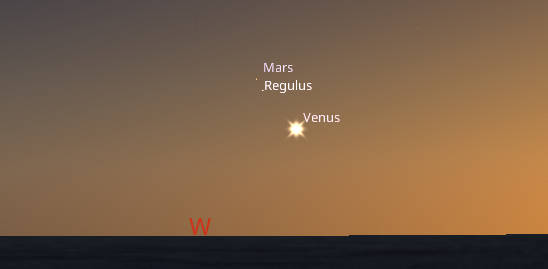
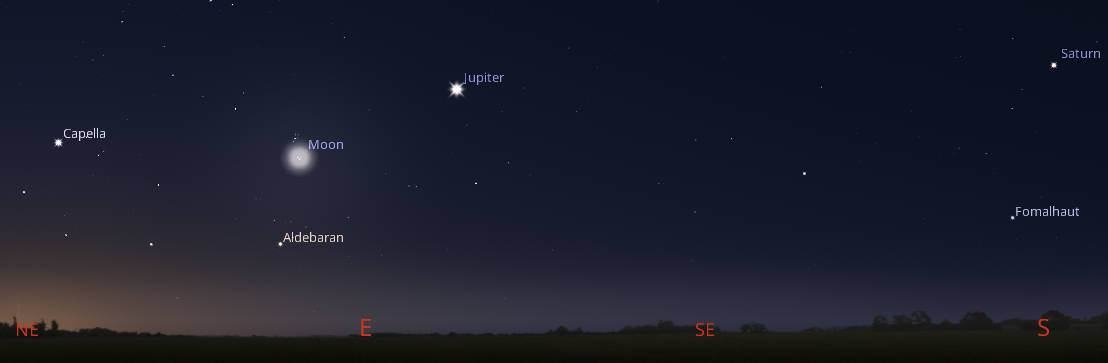
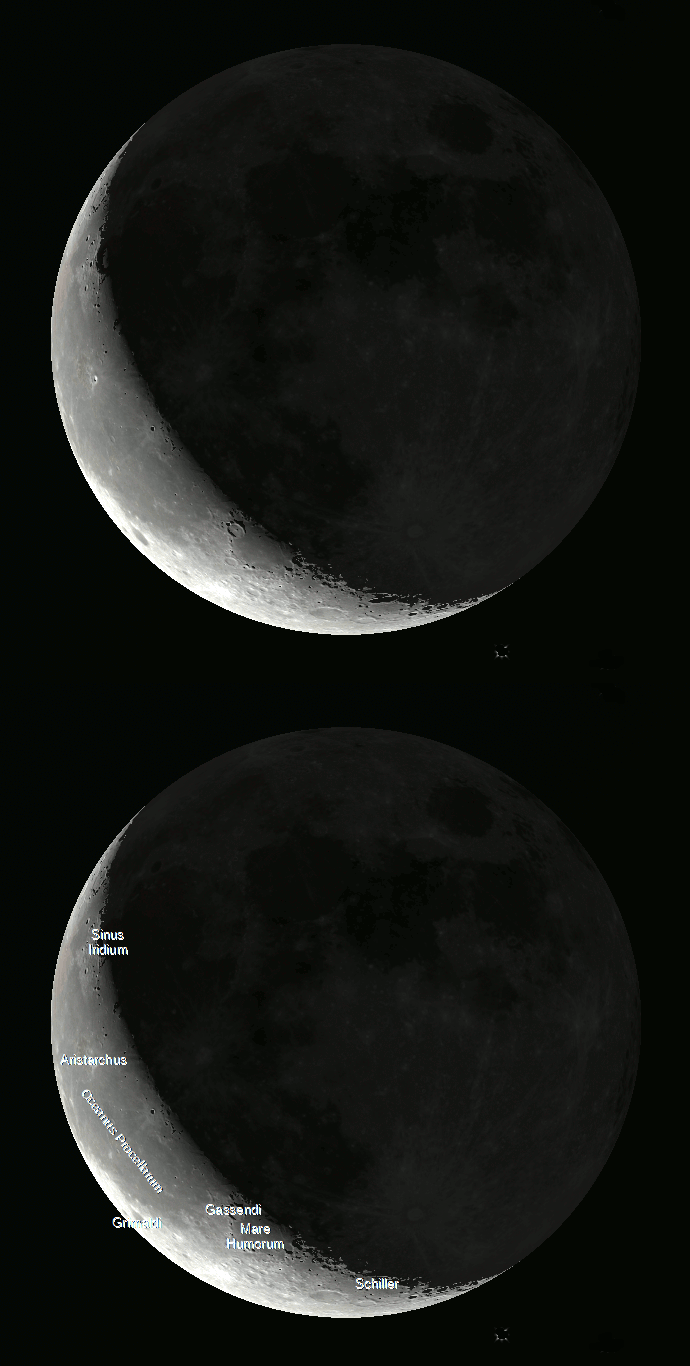
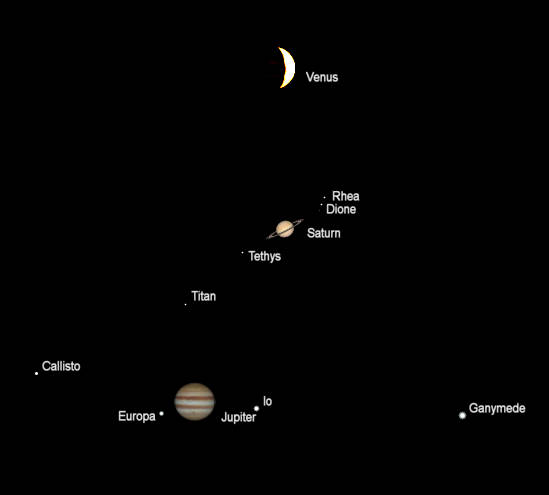
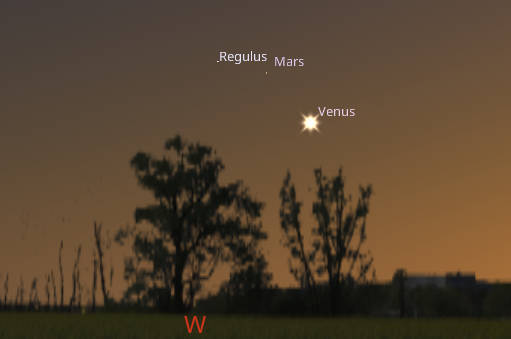
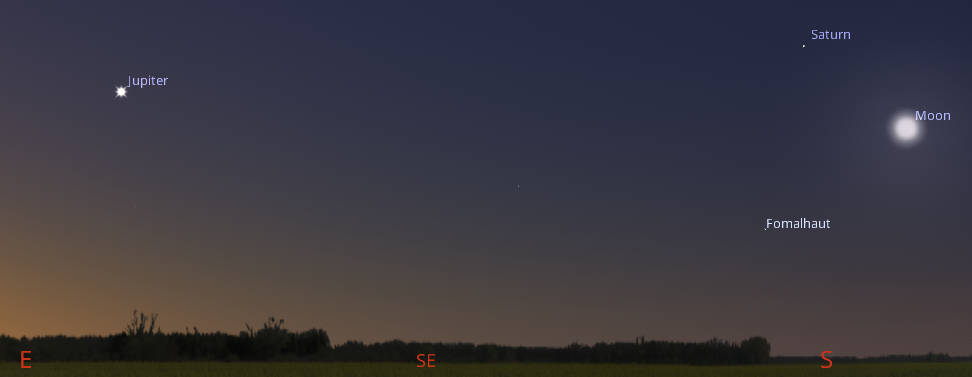
Let’s find out where the naked-eye planets have wandered off to this week. Tonight, Venus is our blazing Evening Star, seen very low in the west in evening twilight. It will set at 11:06 pm, and by four minutes earlier each night. The red planet Mars is seen left of and above Venus. It’s the second “star” with the brighter real star Regulus in Leo the lion between it and Venus. Mars is much fainter than Venus and difficult to spot in twilight. Saturn will rise shortly before midnight. And by 5 am tomorrow, will appear in the south, the brightest “star” in that direction. Jupiter will be in the east at that hour. It will appear above and right of the waning crescent Moon at that hour. Jupiter is the brightest star-like object in the morning sky now.
The astronomical event times given are for the Traverse City/Interlochen area of Michigan (EDT, UT –4 hours). They may be different for your location.
Addendum
07-11-2023 – Ephemeris – How to find Scorpius the scorpion
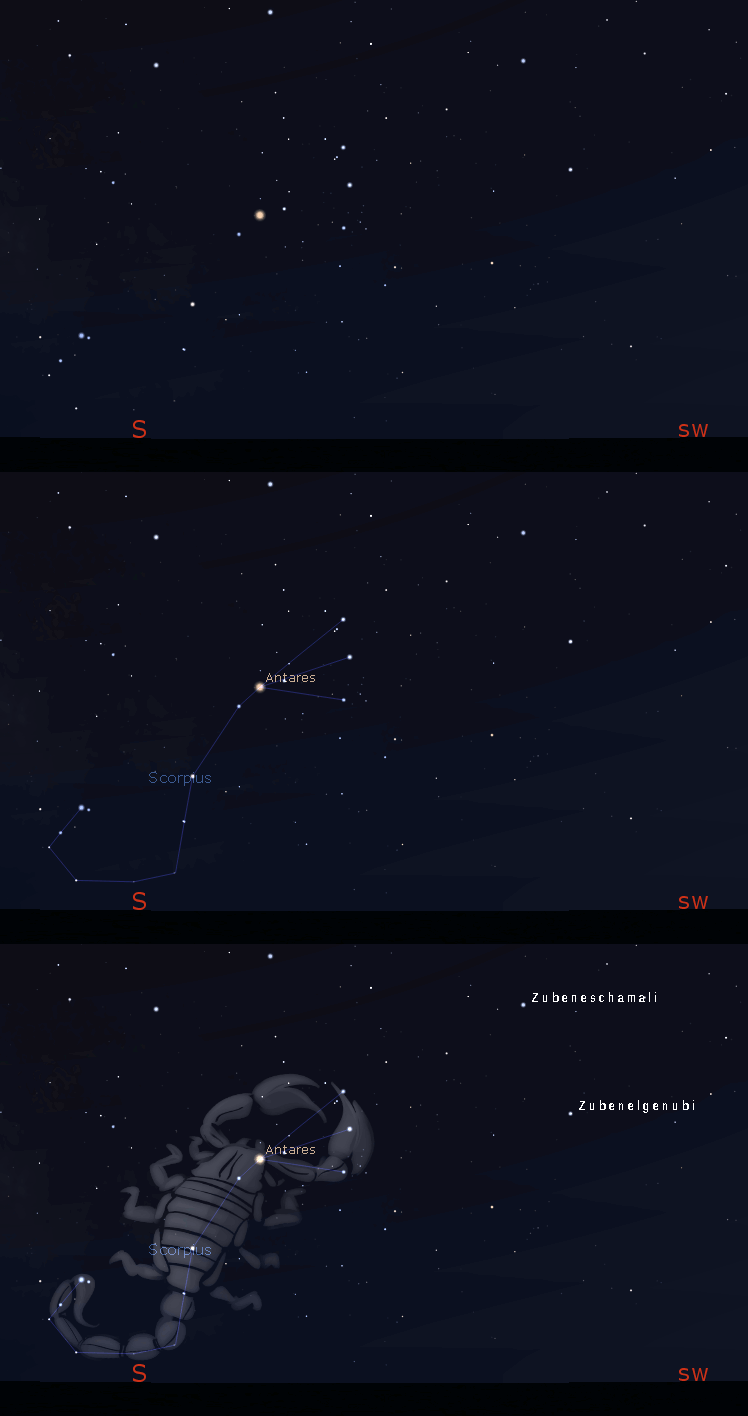
This is Bob Moler with Ephemeris for Tuesday, July 11th. Today the Sun will be up for 15 hours and 20 minutes, setting at 9:28, and it will rise tomorrow at 6:08. The Moon, 2 days past last quarter, will rise at 2:02 tomorrow morning.
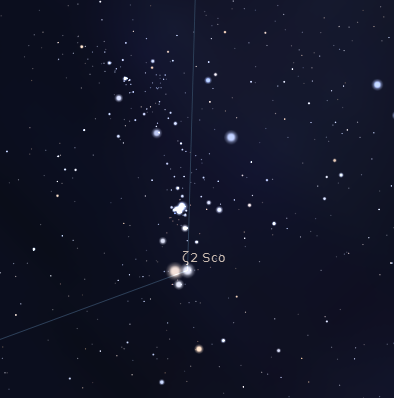
There’s a large constellation located low in the south at about 11 tonight. It’s Scorpius the scorpion. Its brightest star is Antares in its heart, a red giant star, that I’ve gotten calls about it as being a UFO. From Antares to the right is a star, then a vertical arc of three stars that is its head. The Scorpion’s tail is a line of stars running down to the left of Antares, swooping to the horizon before coming back up and ending in a pair of stars that portray his poisonous stinger. There is a beautiful star cluster, NGC 6231, seen in binoculars at that first bend in the tail that is unfortunately too low to appreciate from this far north. I was very impressed with it when spotting it from the Florida Keys when I was down there in 1986 to observe Halley’s Comet.
The astronomical event times given are for the Traverse City/Interlochen area of Michigan (EDT, UT –4 hours). They may be different for your location.
Addendum
07/10/2023 – Ephemeris – Presentation about the James Webb Space Telescope in Traverse City!
This is Bob Moler with Ephemeris for Monday, July 10th. Today the Sun will be up for 15 hours and 21 minutes, setting at 9:28, and it will rise tomorrow at 6:07. The Moon, 1 day past last quarter, will rise at 1:39 tomorrow morning.

The International Astronomical Union, or IAU, is holding a symposium in Traverse City this week, a meeting of some of the world’s astronomers on the general topic of astrochemistry: From the First Galaxies to the Formation of Habitable Worlds, at the Park Place Hotel & Conference Center. As part of the meeting, there will be a presentation at the State Theater on East Front Street at 6 pm Monday, July 10, 2023 by Professor Ewine van Dishoeck and Dr. Jonathan Gardner on The James Webb Space Telescope – The First Exciting Results. There may still be some free tickets that can be obtained from the State Theater website: https://stateandbijou.org. The program is sponsored by the IAU, University of Michigan, Northwestern Michigan College and the Grand Traverse Astronomical Society.
The astronomical event times given are for the Traverse City/Interlochen area of Michigan (EDT, UT –4 hours). They may be different for your location.
Addendum
This was provided to us about the presentation and the presenters:
Title: The James Webb Space Telescope: a new exploration of the cosmos
Speakers: Jonathan Gardner and Ewine van Dishoeck
Abstract:
The James Webb Space Telescope was launched on Christmas Day 2021 after 25 years of planning, design, development, integration, and testing. Following a six-month deployment and commissioning period, the first science results from Webb have engaged the public and surprised the scientists. Webb’s science goals address our origins and the history of the universe: the first stars and galaxies that formed after the Big Bang; the morphological and dynamical buildup of galaxies; the formation of stars and planetary systems; and exoplanets, our Solar System, and the conditions for life. Webb has already found the most distant galaxies ever seen, made the first detection of carbon dioxide in the atmosphere of an exoplanet, and has examined the interactions between giant stars and the planets that are forming near them.
Jonathan Gardner will review Webb’s construction, launch, and deployments, and discuss the commissioning of the telescope and its instruments. He will describe what scientists have learned in the first year of science results from the telescope on the deep universe. Ewine van Dishoeck will focus on the new insights that Webb has provided us on the formation of new stars and planets and the habitability of other worlds. She will highlight chemical richness of the Webb data, with water and other molecules seen throughout the universe.
Bio:
Jonathan Gardner is the Deputy Senior Project Scientist for the James Webb Space Telescope, a position he has held since 2002 at NASA’s Goddard Space Flight Center. Gardner received an AB degree from Harvard and MS and PhD from the University of Hawaii. As a NATO Fellow, he did postdoctoral research at the University of Durham in the UK. He came to NASA-Goddard in 1996 to work with the Hubble Space Telescope, but soon got involved in early studies of Webb. His scientific research involves using deep infrared observations to study the statistical evolution of galaxies. On the Webb project, he works with the other scientists to ensure the scientific success of the mission, now coming to fruition with Webb’s scientific results.
Ewine van Dishoeck is professor of molecular astrophysics at Leiden University, the
Netherlands. Graduated from Leiden in 1984, she held positions at Harvard, Princeton and
Caltech before returning to Leiden in 1990. The work of her group unites the world of
chemistry with that of physics and astronomy. She has been heavily involved in planning
major new telescopes, including being co-PI on the JWST-MIRI instrument for more than 20
years. She has been fortunate to receive many awards, including the 2018 Kavli Prize for
Astrophysics, as well as membership of the Netherlands, US, German and Norwegian
academies. From 2018-2021, Ewine served as the President of the International
Astronomical Union (IAU).
07/07/223 – Ephemeris – GTAS meeting and presentation: Observing the summer skies with the naked-eye
This is Ephemeris for Friday, July 7th. Today the Sun will be up for 15 hours and 25 minutes, setting at 9:30, and it will rise tomorrow at 6:05. The Moon, 2 days before last quarter, will rise at 12:38 tomorrow morning.
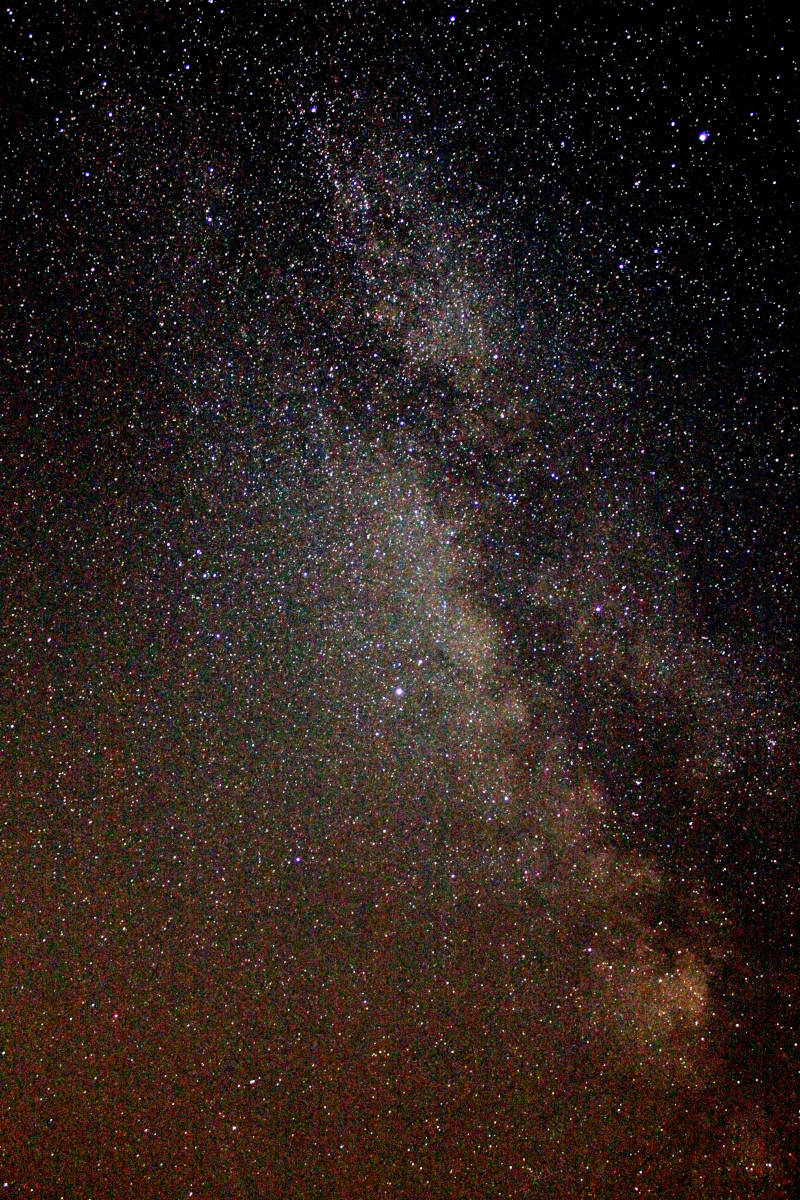
Viewing Summer skies with just your Eyes will be the presentation by Robert Carroll at tonight’s meeting of the Grand Traverse Astronomical Society at Northwestern Michigan College’s Rogers Observatory at 9 pm. Bob is one of the charter members of the society. He will show artist’s interpretation of the heavens. Then, focusing on Hercules, the Summer Triangle, and the Milky Way. Hopefully, he “will inspire young parents, and their children, to go OUTSIDE, leave the screens and tablets behind, and LOOK UP to see the night sky.” There are two ways to attend: In person at the observatory, south of Traverse City on Birmley Road, or via Zoom with a link provided by the society’s website gtastro.org just prior to the meeting.
The astronomical event times given are for the Traverse City/Interlochen area of Michigan (EDT, UT –4 hours). They may be different for your location.
Addendum
07/06/2023 – Ephemeris – Today the Earth is farther from the Sun than anytime this year
This is Ephemeris for Thursday, July 6th. Today the Sun will be up for 15 hours and 26 minutes, setting at 9:30, and it will rise tomorrow at 6:04. The Moon, halfway from full to last quarter, will rise at 12:16 tomorrow morning.
Today, the Sun is at its farthest distance from the Earth. It’s called aphelion. The exact time actually occurred at 4:59 this morning at a distance of 94 and a half million miles away. Because of the gravitational pull of the Moon and planets on the Earth, especially Jupiter and Venus and gravitational pull of the planets, especially Jupiter on the Sun, the aphelion and perihelion, the closest date in January don’t occur on the same date or same distance every year. The date wanders by a day or two each year. The entire distance variation of the Earth from the Sun is plus or minus 1.5 million miles (2.4 million kilometers) over the year, makes summer the longest season by a few days because the Earth moves slower when farther from the Sun, than when it is nearer.
The astronomical event times given are for the Traverse City/Interlochen area of Michigan (EDT, UT –4 hours). They may be different for your location.
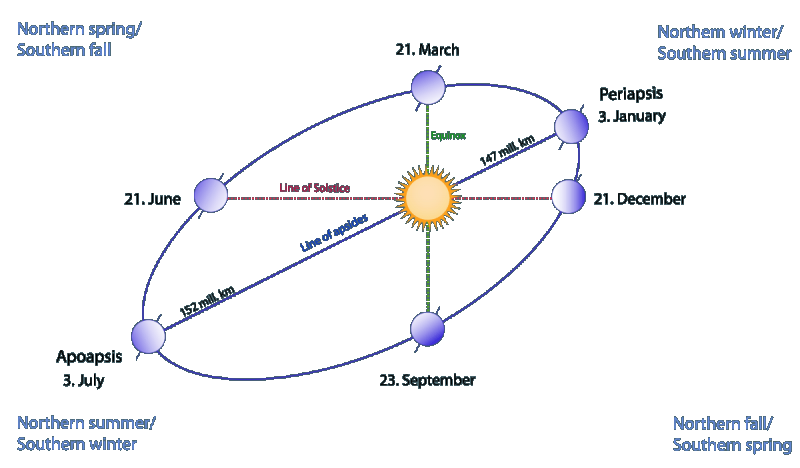
Note: Apoapsis and Periapsis are generic terms for the farthest and nearest points in an orbit to the central body. For a body orbiting the Sun, it’s aphelion and perihelion. For a satellite of the Earth, it’s apogee and perigee.
07/05/2023 – Ephemeris – Let’s find out where the naked-eye planets have wandered off to this week
This is Ephemeris for Wednesday, July 5th. Today the Sun will be up for 15 hours and 27 minutes, setting at 9:31, and it will rise tomorrow at 6:04. The Moon, 2 days past full, will rise at 11:49 this evening.
Let’s find out where the naked-eye planets have wandered off to this week. Venus is our blazing Evening Star, seen low in the west most of the evening. It sets tonight at 11:28 pm, and by three minutes earlier each night. The red planet Mars is seen left of and above Venus. And left of Mars is the brighter star Regulus in Leo the lion. Venus is pulling away from Mars now. Mars is much fainter than Venus and difficult to spot in twilight. Saturn will rise shortly after midnight. And by 5:15 am will appear in the south, the brightest “star” in that direction. It will appear above and left of the waning gibbous Moon at that hour. Jupiter will be in the east at that hour. It is the brightest star-like object in the morning sky now.
The astronomical event times given are for the Traverse City/Interlochen area of Michigan (EDT, UT –4 hours). They may be different for your location.
Addendum
07/04/2023 – Ephemeris – The Bicentennial space mission
This is Bob Moler with Ephemeris for Independence Day, Tuesday, July 4th. Today the Sun will be up for 15 hours and 28 minutes, setting at 9:31, and it will rise tomorrow at 6:03. The Moon, 1 day past full, will rise at 11:14 this evening.
To celebrate our nation’s 200th birthday, NASA attempted to land the Viking 1 lander on the planet Mars on July 4th, 1976. The Viking was a combination orbiter and lander and had a twin spacecraft arriving almost two months later. Viking 1 entered orbit on June 19th and began to survey the prime landing area, that radar from the Earth suggested would be smooth, to land on the day of the Bicentennial. However, images from orbit showed too many obstructions, so another area was surveyed. The mission planners from JPL found a spot and sent the Viking lander down to land on Mars on another historic date, July 20, 1976, the 7th anniversary of the Apollo 11 landing on the Moon.
The astronomical event times given are for the Traverse City/Interlochen area of Michigan (EDT, UT –4 hours). They may be different for your location.
Addendum
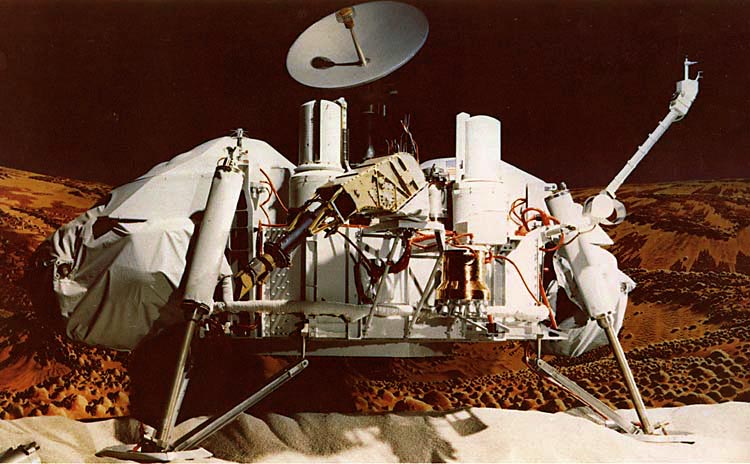

NASA did finally make a historic landing on July 4th,
the Mars Pathfinder mission, with the first rover to operate on Mars, the Sojourner rover, landed on July 4, 1997. It was a microwave sized rover. The mission on the surface lasted 85 days.



 Bob Moler's Ephemeris Blog