Archive
Ephemeris: 04/16/2026 – The greatest distance humans have traveled from the Earth
This is Ephemeris for Thursday, April 16th. Today the Sun will be up for 13 hours and 32 minutes, setting at 8:29, and it will rise tomorrow at 6:54. The Moon, 1 day before new, will rise at 6:38 tomorrow morning.
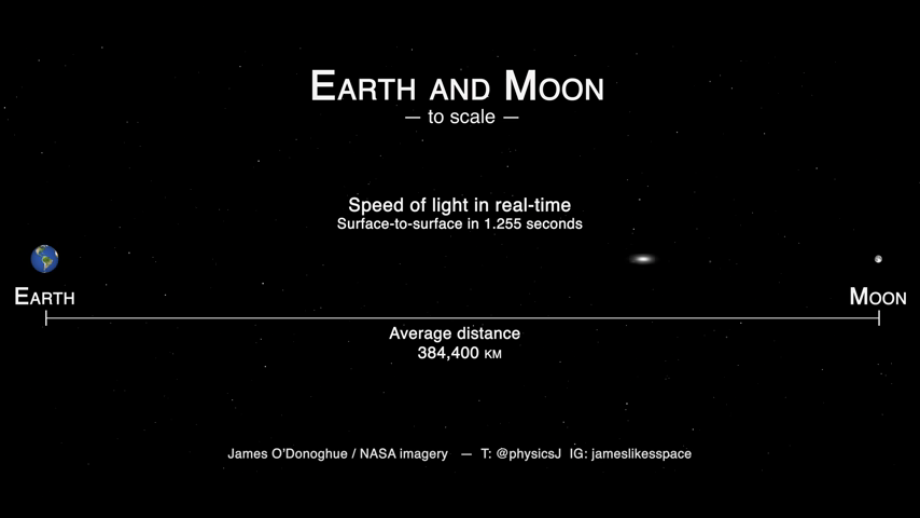
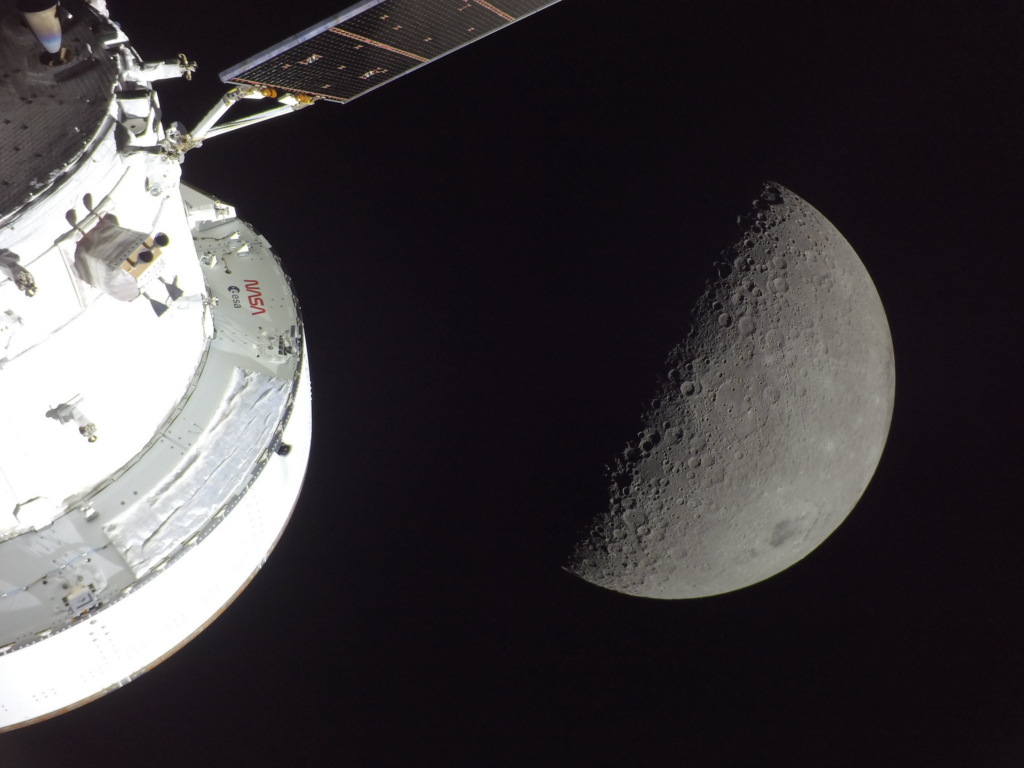
On their trip around the moon the Artemis 2 crew set a new record for distance from the earth of 252,760 miles (406,778 kilometers) which beat by 4,105 miles (6,607 kilometers) the record of Apollo 13 of 248,655 miles (400,171 kilometers). This was helped a great deal by the fact that the moon reached apogee, its farthest distance from the Earth, a few hours after the Artemis 2 capsule, Integrity, passed by. So I think the record is going to hold up for a while. So the only way to get further away from the earth is to head out to Mars, or the Chinese make a farther flyby of the Moon. The Artemis 2 mission was to see if the capsule can sustain human life comfortably during an extended mission. It seemed proved it’s worth. The videos that came back seem to be reasonably roomy, much more so than the Apollo capsule.
The astronomical event times given in this blog are for the Traverse City/Interlochen area of Michigan (Lat 44.7° N, Long 85.7° W; EDT, UT – 4 hours) unless stated otherwise. Times will be different for other locations.
Addendum
Ephemeris: 04/15/2026 – Taking our weekly look at the whereabouts of the naked-eye planets
This is Ephemeris for Wednesday, April 15th. Today the Sun will be up for 13 hours and 29 minutes, setting at 8:28, and it will rise tomorrow at 6:56. The Moon, 2 days before new, will rise at 6:15 tomorrow morning.
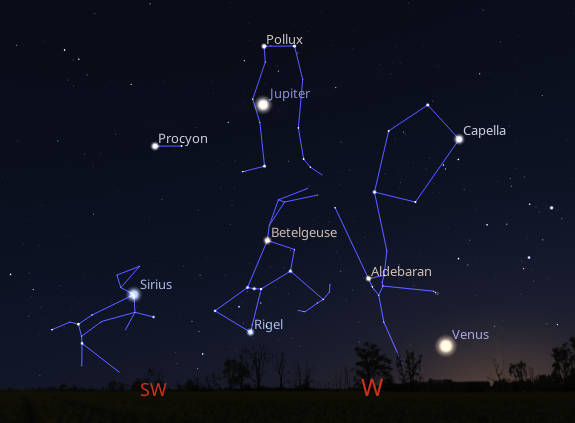
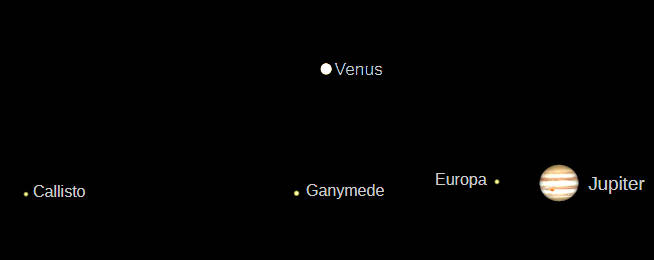
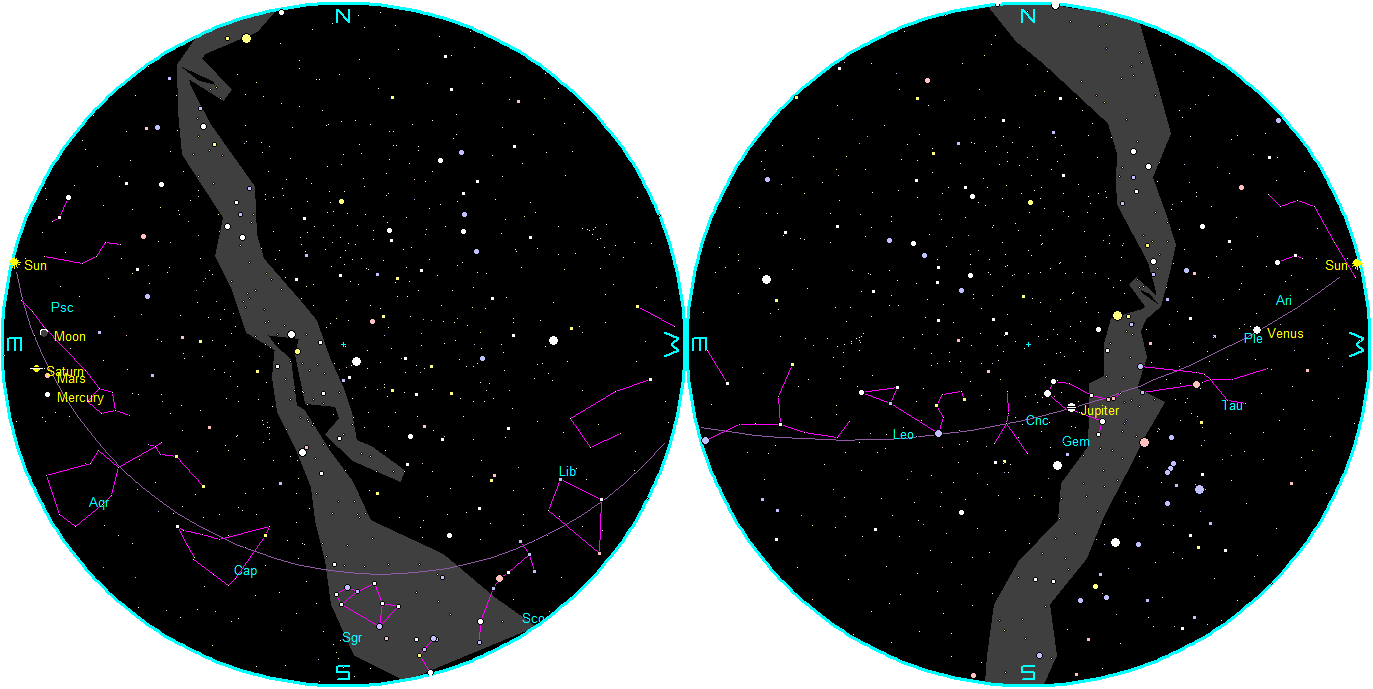
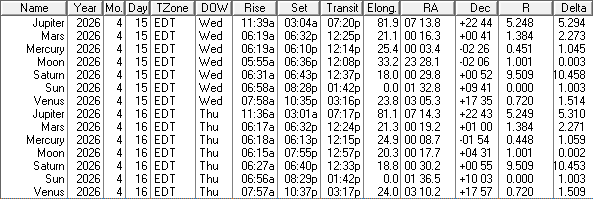
Let’s take our weekly look at the whereabouts of the naked-eye planets. By 9:15 PM tonight or about 45 minutes or so after sunset, Venus may be seen very low in the West. A telescope will show a very tiny disc on Venus, because it is still pretty much beyond the Sun, 141 million miles (226 million kilometers) away from us. Over the next 6 months it will be moving closer to us and becoming much larger. Jupiter is the brilliant star-like object high in the southwestern sky at the same time. Venus will set at 10:35, while Jupiter will hold out to 3 AM. Meanwhile, Mercury, Mars and Saturn are lined up just west of the Sun, but unfortunately are overwhelmed by bright morning twilight. Southern Hemisphere observers will them bunched up next week.
The astronomical event times given in this blog are for the Traverse City/Interlochen area of Michigan (Lat 44.7° N, Long 85.7° W; EDT, UT – 4 hours) unless stated otherwise. Times will be different for other locations.
Addendum
Ephemeris: 04/14/2026 – My virtual flight with the Artemis II crew
This is Ephemeris for Tuesday, April 14th. Today the Sun will be up for 13 hours and 26 minutes, setting at 8:26, and it will rise tomorrow at 6:58. The Moon, 3 days before new, will rise at 5:55 tomorrow morning.
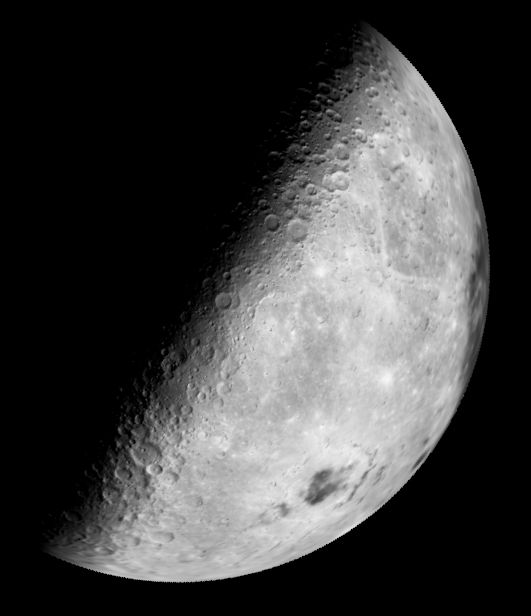
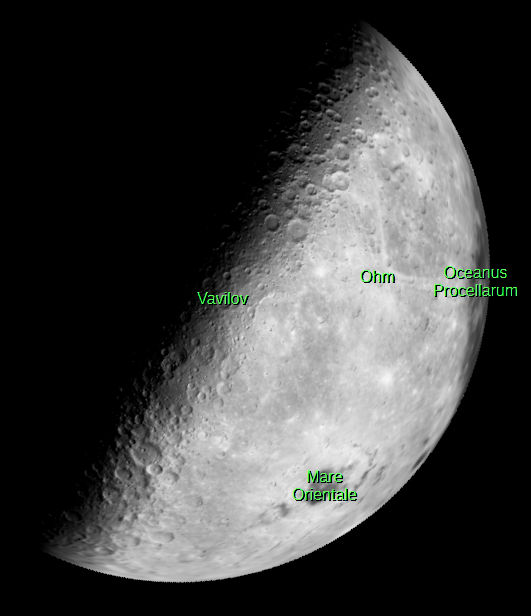
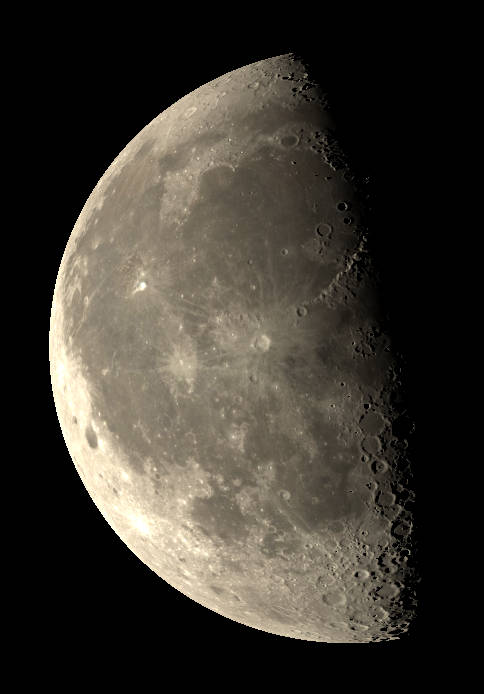
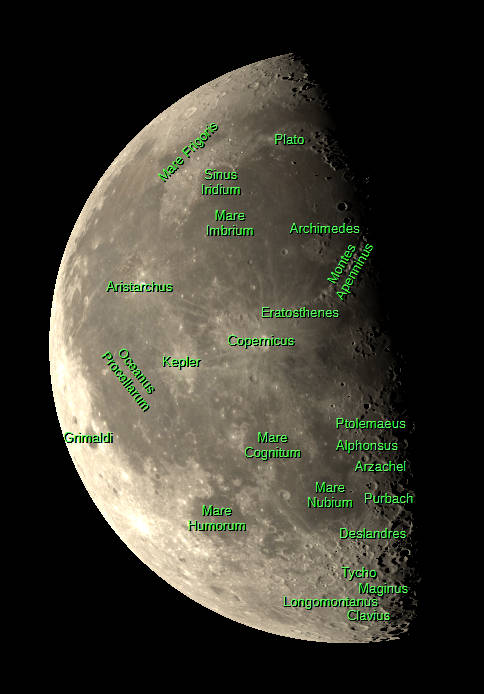
I hadn’t enjoyable time last week Monday afternoon listening to Artemis 2 astronauts talking with the science team on Earth about what they were seeing Moon’s far side. I have the program called Virtual Moon Atlas which allows one to see the entire Moon with the phase and shadows. And I was able to rotate it and get the phase right so it appeared pretty much as it did to the astronauts. So I was able to follow along with their discussions of the far side features that they were seeing and photographing. I could zoom in to craters and features they were talking about, but nowhere near the detail they were seeing. So I consider it to be a really great time of, in essence, flying along with the astronauts.
The astronomical event times given in this blog are for the Traverse City/Interlochen area of Michigan (Lat 44.7° N, Long 85.7° W; EST, UT – 5 hours) unless stated otherwise. Times will be different for other locations.
Addendum
Ephemeris: 04/13/2026 – How the Greeks saw the constellation Leo
This is Bob Moler with Ephemeris for Monday, April 13th. Today the Sun will be up for 13 hours and 23 minutes, setting at 8:25, and it will rise tomorrow at 7:00. The Moon, 3 days past last quarter, will rise at 5:35 tomorrow morning.
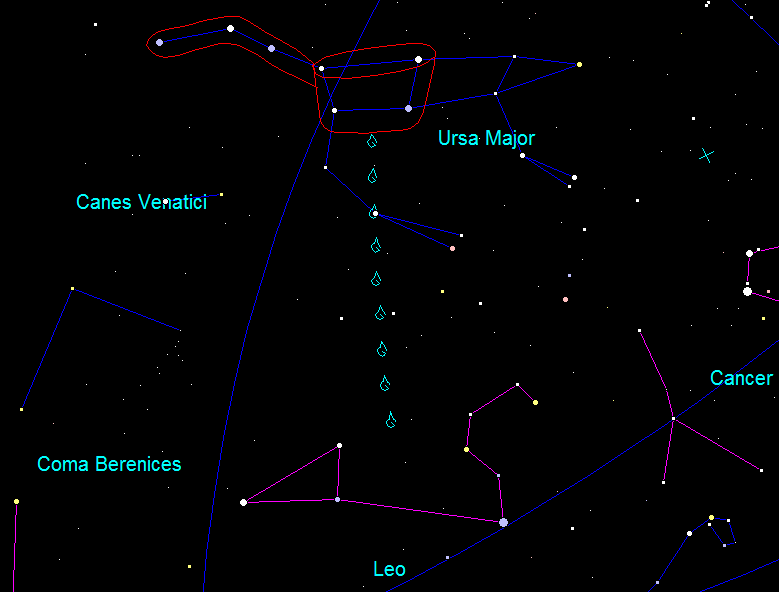
The constellations that we know are mostly those that come from the Sumerians and other civilizations who lived around what is now modern day Iraq. They were adopted and adapted by the ancient Greeks, and to us. Foremost of these was Leo the lion, seen high in the south-southeastern sky at 10 PM. It is easily found by imagining the bottom of the Big Dipper leaks. It will drip on the back of Leo, with its distinctive backward question mark as his front with his head and mane. To the Greeks he was the Nemean Lion, whose coat was impervious to arrows or spears. Heracles (Hercules) was able to kill it by first stunning it with a club then strangling it with his bare hands. It was the first of his Twelve Labors.
The astronomical event times given in this blog are for the Traverse City/Interlochen area of Michigan (Lat 44.7° N, Long 85.7° W; EST, UT – 5 hours) unless stated otherwise. Times will be different for other locations.
Addendum

Ephemeris: 04/10/2026 – The origin of the constellation Leo the lion.
This is Ephemeris for Friday, April 10th. Today the Sun will be up for 13 hours and 14 minutes, setting at 8:21, and it will rise tomorrow at 7:05. The Moon, at last quarter today, will rise at 4:29 tomorrow morning.
The constellation of Leo the lion was envisioned as far back as 4,000 BCE by the Sumerians. It was known as UR.GU.LA, the Great or Divine Lion. Back then it was in the same seasonal location where Gemini is today, the most northern of the constellations of the Zodiac, where the Sun was at the summer solstice. It was important for that reason. They showed him in their artwork as having wings, a sign of his divinity. The Sumerians gave Regulus, Leo’s brightest star, the name MUL.LUGAL, meaning the King Star, with MUL meaning or pertaining to “Star” and LUGAL meaning “King”. Regulus means the same thing. As empires and languages changed over the millennia, the star’s name always meant King.
The astronomical event times given in this blog are for the Traverse City/Interlochen area of Michigan (Lat 44.7° N, Long 85.7° W; EST, UT – 5 hours) unless stated otherwise. Times will be different for other locations.
Addendum
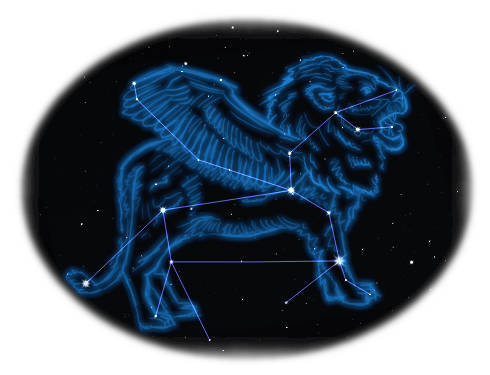
Leo as depicted by the Sumerians circa 4,000 BCE. Created with Stellarium using the Babylonian (Seleucid) Sky Culture.
Ephemeris: 04/09/2026 – Finding Leo the lion
This is Ephemeris for Thursday, April 9th. Today the Sun will be up for 13 hours and 11 minutes, setting at 8:20, and it will rise tomorrow at 7:07. The Moon, 1 day before last quarter, will rise at 3:58 tomorrow morning.
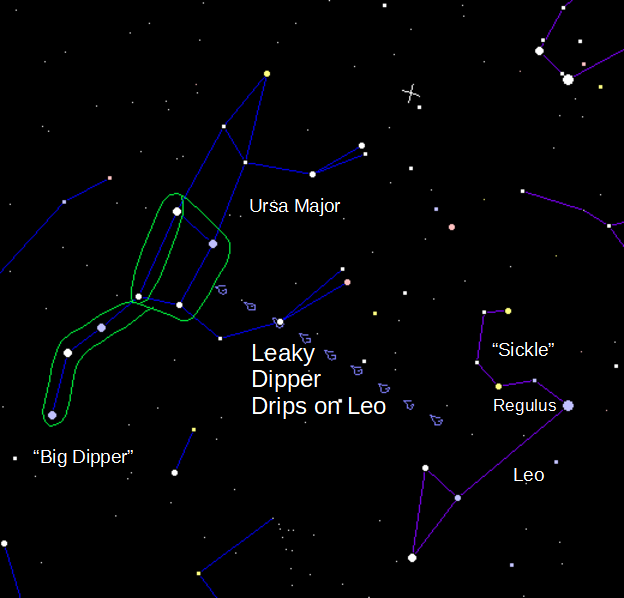
At 10 p.m. the spring constellation of Leo the lion will be high in the south-southeast. It can be found by locating the Big Dipper high in the northeast and imagining that a hole were drilled in the bowl to let the water leak out. It would drip on the back of this giant cat. The Lion is standing or lying facing westward. His head and mane are seen in the stars as a backwards question mark. This group of stars is also called the sickle. The bright star Regulus is at the bottom, the dot at the bottom of the question mark. A triangle of stars, to the left of Regulus, is the lion’s haunches. Leo contains some nice galaxies visible in moderate sized telescopes. The stars in Leo’s part of the sky are fewer than those in the winter sky.
The astronomical event times given in this blog are for the Traverse City/Interlochen area of Michigan (Lat 44.7° N, Long 85.7° W; EST, UT – 5 hours) unless stated otherwise. Times will be different for other locations.
Addendum
Ephemeris: 04/08/2026 – Taking our weekly look at the whereabouts of the naked-eye planets
This is Ephemeris for Wednesday, April 8th. Today the Sun will be up for 13 hours and 8 minutes, setting at 8:19, and it will rise tomorrow at 7:08. The Moon, 2 days before last quarter, will rise at 3:20 tomorrow morning.
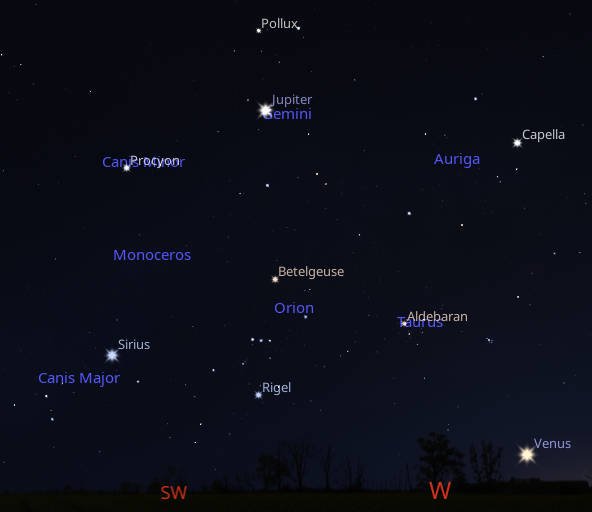
Let’s take our weekly look at the whereabouts of the naked-eye planets. By 9 PM tonight or about 40 minutes or so after sunset, Venus may be seen very low in the West. Binoculars or a telescope will show a very tiny disc on Venus, because it is pretty much behind the Sun, 145 million miles (231 million kilometers) away from us. Over the next 6 months it will be moving closer to us and becoming much larger. Jupiter is the brilliant star-like object high in the southwestern sky at 9:30 PM. Venus will set at 10:15, while Jupiter will hold out to 3:30 AM. Meanwhile, Mercury, Mars and Saturn are lined up just west of the Sun, but unfortunately are overwhelmed by bright morning twilight. The Artemis II astronauts reported seeing them during their solar eclipse.
The astronomical event times given in this blog are for the Traverse City/Interlochen area of Michigan (Lat 44.7° N, Long 85.7° W; EST, UT – 5 hours) unless stated otherwise. Times will be different for other locations.
Addendum
Ephemeris: 04/07/2026 – The Artemis II crew made amazing observations of the Moon’s Far Side
This post was made late due to some WordPress posting issues last night.
This is Ephemeris for Tuesday, April 7th. Today the Sun will be up for 13 hours and 5 minutes, setting at 8:18, and it will rise tomorrow at 7:10. The Moon, 3 days before last quarter, will rise at 2:33 tomorrow morning.
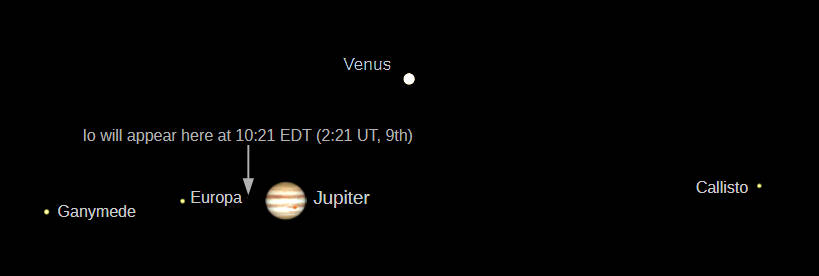
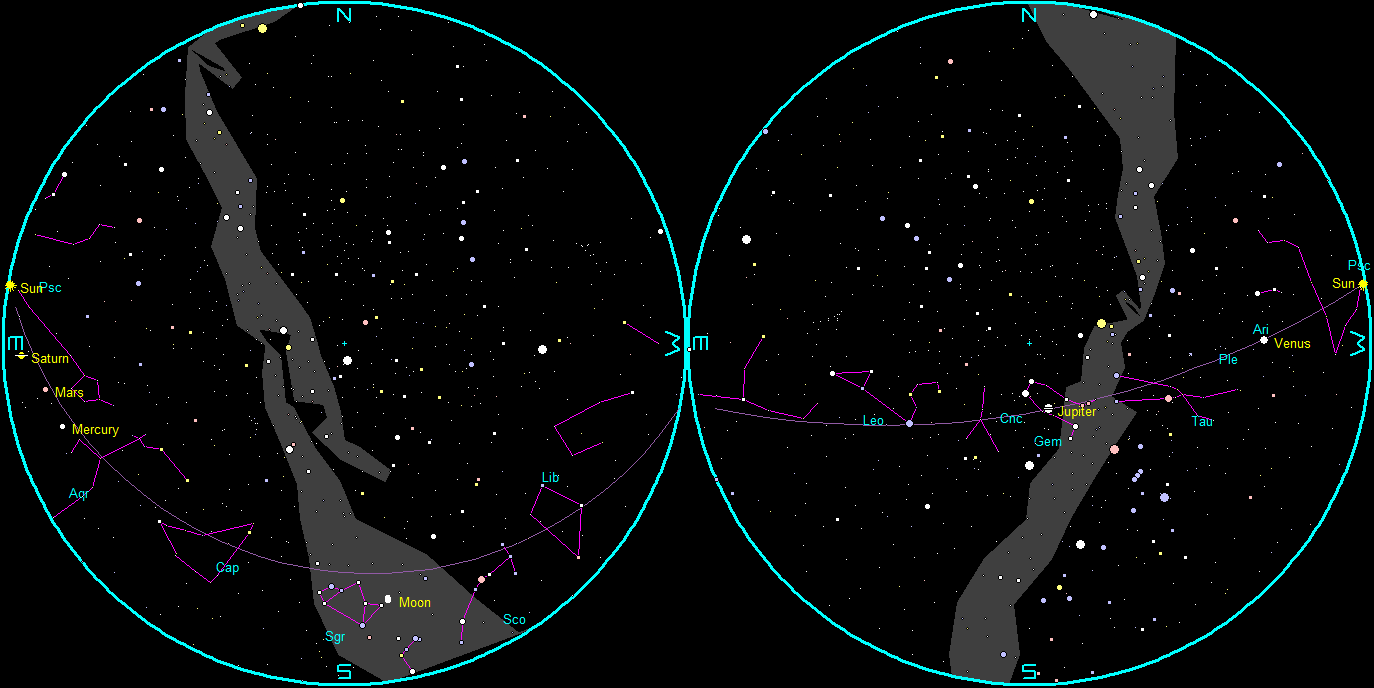
Yesterday evening the Artemis 2 crew flew over the far side of the moon. The moon to us has a waning gibbous phase. The far side is actually a waxing crescent, so most of the far side was in night. They might have gotten a good look at Mare Orientale, which is right on the edge of the moon that we see from Earth. It is a double-walled sea that looks like a bulls eye. Now they’re on their way back to the earth and will splash down in the Pacific Ocean later this week. Unlike Apollo 8 which orbited the moon, they will not be flying over any proposed landing sites. They flew over the moon’s equator while Artemis 4 will attempt to land near the moon’s South Pole. Besides, the Lunar Reconnaissance Orbiter has surveyed it much better than they could have.
The astronomical event times given in this blog are for the Traverse City/Interlochen area of Michigan (Lat 44.7° N, Long 85.7° W; EST, UT – 5 hours) unless stated otherwise. Times will be different for other locations.
Addendum
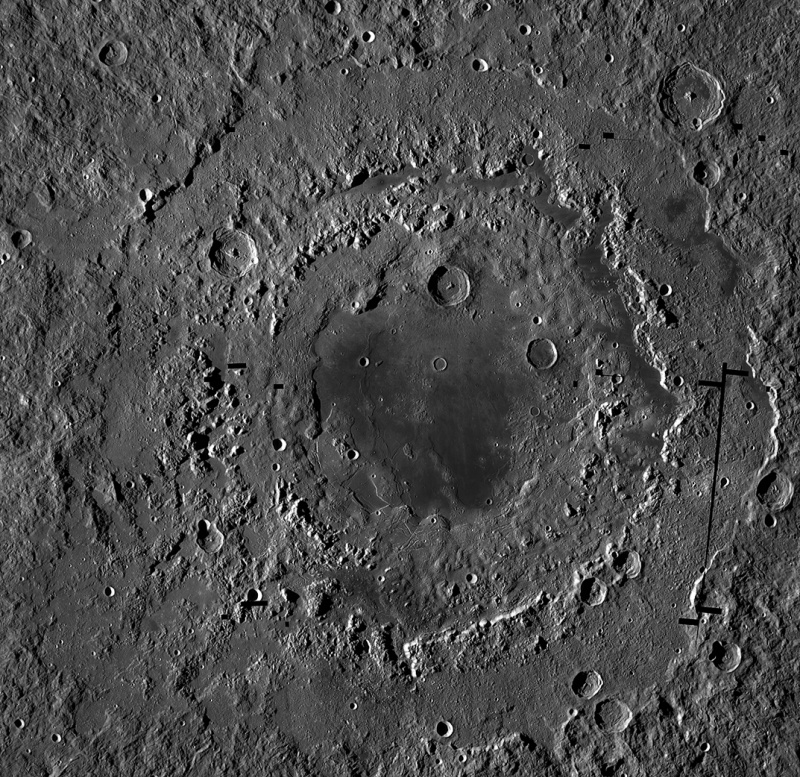
The script for the program seen above was written and recorded Sunday night April 5th before Artemis 2’s lunar flyby. This comment is made after the flyby on the late afternoon of April 6th. I speculated about Mare Orientale being something I wanted to have them investigate. And they did spend a great deal of time observing it, so we should expect some very nice photographs of it when they’re sent back. The image above is from the Lunar Reconnaissance Orbiter taken several years ago, at least. I find it a really cool feature.
Ephemeris: 04/06/2026 – A Ghostly pyramid of light
This is Ephemeris for Monday, April 6th. Today the Sun will be up for 13 hours and 2 minutes, setting at 8:16, and it will rise tomorrow at 7:12. The Moon, 4 days before last quarter, will rise at 1:38 tomorrow morning.
The evening sky will stay dark for the rest of the week, so it’s time to look for the zodiacal light in the evening. It is a faint but towering glow that can be seen after the end of astronomical twilight on moonless nights. It is seen in the west in the evening in late winter and early spring. The axis of the glow is the ecliptic, the apparent annual path of the Sun in the sky, along which lie the constellations of the zodiac. It’s a glow whose wide base is in the west that extends upwards and tilted to the left. Right now, the end of astronomical twilight is about 10 PM and advancing at a rate of a minute or two each night. Go to a spot with a dark western sky, with no big cities or towns out that way. Zodiacal light is caused by dust spread out around the Sun.
The astronomical event times given in this blog are for the Traverse City/Interlochen area of Michigan (Lat 44.7° N, Long 85.7° W; EST, UT – 5 hours) unless stated otherwise. Times will be different for other locations.
Addendum
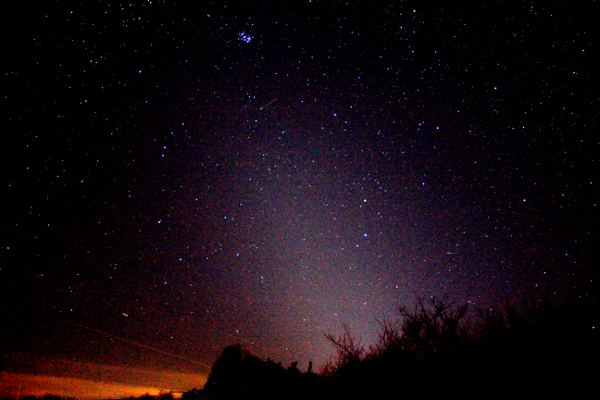
The photograph above has been increased in brightness and contrast, and of course compressed into a small picture. The zodiacal light encompasses a fairly large part of the sky. It is difficult to see. It wasn’t until my 20s that I was able to get to a dark enough spot to actually see it. But once you have spotted it, and know what you’re looking for, it is easy to detect again. A good way to find it is to scan near the horizon from northwest to southwest and notice the darkness of the sky. You’ll probably notice that towards the center of that scan the sky is not as dark as it is at the edges. Then you can follow it up into the sky and leaning to the left. This time of year the Pleiades will be at the apex of the left leaning pyramid of light. It is easiest seen on mornings near the vernal equinox, and in the mornings near the autumnal equinox where it leans to the right.
Ephemeris: 04/03/2026 – GTAS Astronomy meeting tonight
This is Ephemeris for Good Friday, April 3rd. Today the Sun will be up for 12 hours and 53 minutes, setting at 8:13, and it will rise tomorrow at 7:17. The Moon, 2 days past full, will rise at 10:22 this evening.
The Grand Traverse Astronomical Society will hold its April meeting tonight at 8:00 PM at Northwestern Michigan College’s Joseph H Rogers Observatory. This may be an unstructured meeting, and a good time for anyone interested to ask knowledgeable members anything about the sky or telescopes. Even though our telescope clinic is passed, there will always be someone there to help with your telescope questions or problems. Afterward, about 9 PM if it’s clear, there will be viewing of the heavens through the observatory’s telescopes, featuring Jupiter, its cloud bands and moons. Its Great Red Spot might also be visible. The observatory is located on Birmley Rd. South of Traverse City between Garfield and Keystone roads.
The astronomical event times given in this blog are for the Traverse City/Interlochen area of Michigan (Lat 44.7° N, Long 85.7° W; EST, UT – 5 hours) unless stated otherwise. Times will be different for other locations.
Addendum